EP1787545A2 - Applikatorbürste - Google Patents
Applikatorbürste Download PDFInfo
- Publication number
- EP1787545A2 EP1787545A2 EP06123032A EP06123032A EP1787545A2 EP 1787545 A2 EP1787545 A2 EP 1787545A2 EP 06123032 A EP06123032 A EP 06123032A EP 06123032 A EP06123032 A EP 06123032A EP 1787545 A2 EP1787545 A2 EP 1787545A2
- Authority
- EP
- European Patent Office
- Prior art keywords
- rod
- housing
- applicator according
- applicator
- bristles
- Prior art date
- Legal status (The legal status is an assumption and is not a legal conclusion. Google has not performed a legal analysis and makes no representation as to the accuracy of the status listed.)
- Withdrawn
Links
Images


Classifications
-
- A—HUMAN NECESSITIES
- A45—HAND OR TRAVELLING ARTICLES
- A45D—HAIRDRESSING OR SHAVING EQUIPMENT; EQUIPMENT FOR COSMETICS OR COSMETIC TREATMENTS, e.g. FOR MANICURING OR PEDICURING
- A45D34/00—Containers or accessories specially adapted for handling liquid toiletry or cosmetic substances, e.g. perfumes
- A45D34/04—Appliances specially adapted for applying liquid, e.g. using roller or ball
- A45D34/042—Appliances specially adapted for applying liquid, e.g. using roller or ball using a brush or the like
- A45D34/045—Appliances specially adapted for applying liquid, e.g. using roller or ball using a brush or the like connected to the cap of the container
-
- A—HUMAN NECESSITIES
- A46—BRUSHWARE
- A46B—BRUSHES
- A46B11/00—Brushes with reservoir or other means for applying substances, e.g. paints, pastes, water
- A46B11/001—Brushes with reservoir or other means for applying substances, e.g. paints, pastes, water with integral reservoirs
- A46B11/002—Brushes with reservoir or other means for applying substances, e.g. paints, pastes, water with integral reservoirs pressurised at moment of use manually or by powered means
- A46B11/0041—Flexible or deformable reservoirs, e.g. resilient bulbs, compressible tubes
-
- A—HUMAN NECESSITIES
- A46—BRUSHWARE
- A46B—BRUSHES
- A46B3/00—Brushes characterised by the way in which the bristles are fixed or joined in or on the brush body or carrier
- A46B3/16—Brushes characterised by the way in which the bristles are fixed or joined in or on the brush body or carrier by wires or other anchoring means, specially for U-shaped bristle tufts
-
- A—HUMAN NECESSITIES
- A46—BRUSHWARE
- A46B—BRUSHES
- A46B5/00—Brush bodies; Handles integral with brushware
- A46B5/002—Brush bodies; Handles integral with brushware having articulations, joints or flexible portions
-
- A—HUMAN NECESSITIES
- A46—BRUSHWARE
- A46D—MANUFACTURE OF BRUSHES
- A46D1/00—Bristles; Selection of materials for bristles
-
- B—PERFORMING OPERATIONS; TRANSPORTING
- B29—WORKING OF PLASTICS; WORKING OF SUBSTANCES IN A PLASTIC STATE IN GENERAL
- B29C—SHAPING OR JOINING OF PLASTICS; SHAPING OF MATERIAL IN A PLASTIC STATE, NOT OTHERWISE PROVIDED FOR; AFTER-TREATMENT OF THE SHAPED PRODUCTS, e.g. REPAIRING
- B29C65/00—Joining or sealing of preformed parts, e.g. welding of plastics materials; Apparatus therefor
- B29C65/02—Joining or sealing of preformed parts, e.g. welding of plastics materials; Apparatus therefor by heating, with or without pressure
-
- B—PERFORMING OPERATIONS; TRANSPORTING
- B29—WORKING OF PLASTICS; WORKING OF SUBSTANCES IN A PLASTIC STATE IN GENERAL
- B29C—SHAPING OR JOINING OF PLASTICS; SHAPING OF MATERIAL IN A PLASTIC STATE, NOT OTHERWISE PROVIDED FOR; AFTER-TREATMENT OF THE SHAPED PRODUCTS, e.g. REPAIRING
- B29C65/00—Joining or sealing of preformed parts, e.g. welding of plastics materials; Apparatus therefor
- B29C65/56—Joining or sealing of preformed parts, e.g. welding of plastics materials; Apparatus therefor using mechanical means or mechanical connections, e.g. form-fits
-
- B—PERFORMING OPERATIONS; TRANSPORTING
- B29—WORKING OF PLASTICS; WORKING OF SUBSTANCES IN A PLASTIC STATE IN GENERAL
- B29C—SHAPING OR JOINING OF PLASTICS; SHAPING OF MATERIAL IN A PLASTIC STATE, NOT OTHERWISE PROVIDED FOR; AFTER-TREATMENT OF THE SHAPED PRODUCTS, e.g. REPAIRING
- B29C66/00—General aspects of processes or apparatus for joining preformed parts
- B29C66/69—General aspects of joining filaments
-
- A—HUMAN NECESSITIES
- A46—BRUSHWARE
- A46B—BRUSHES
- A46B2200/00—Brushes characterized by their functions, uses or applications
- A46B2200/10—For human or animal care
- A46B2200/1046—Brush used for applying cosmetics
-
- B—PERFORMING OPERATIONS; TRANSPORTING
- B29—WORKING OF PLASTICS; WORKING OF SUBSTANCES IN A PLASTIC STATE IN GENERAL
- B29C—SHAPING OR JOINING OF PLASTICS; SHAPING OF MATERIAL IN A PLASTIC STATE, NOT OTHERWISE PROVIDED FOR; AFTER-TREATMENT OF THE SHAPED PRODUCTS, e.g. REPAIRING
- B29C66/00—General aspects of processes or apparatus for joining preformed parts
- B29C66/70—General aspects of processes or apparatus for joining preformed parts characterised by the composition, physical properties or the structure of the material of the parts to be joined; Joining with non-plastics material
- B29C66/73—General aspects of processes or apparatus for joining preformed parts characterised by the composition, physical properties or the structure of the material of the parts to be joined; Joining with non-plastics material characterised by the intensive physical properties of the material of the parts to be joined, by the optical properties of the material of the parts to be joined, by the extensive physical properties of the parts to be joined, by the state of the material of the parts to be joined or by the material of the parts to be joined being a thermoplastic or a thermoset
- B29C66/739—General aspects of processes or apparatus for joining preformed parts characterised by the composition, physical properties or the structure of the material of the parts to be joined; Joining with non-plastics material characterised by the intensive physical properties of the material of the parts to be joined, by the optical properties of the material of the parts to be joined, by the extensive physical properties of the parts to be joined, by the state of the material of the parts to be joined or by the material of the parts to be joined being a thermoplastic or a thermoset characterised by the material of the parts to be joined being a thermoplastic or a thermoset
- B29C66/7392—General aspects of processes or apparatus for joining preformed parts characterised by the composition, physical properties or the structure of the material of the parts to be joined; Joining with non-plastics material characterised by the intensive physical properties of the material of the parts to be joined, by the optical properties of the material of the parts to be joined, by the extensive physical properties of the parts to be joined, by the state of the material of the parts to be joined or by the material of the parts to be joined being a thermoplastic or a thermoset characterised by the material of the parts to be joined being a thermoplastic or a thermoset characterised by the material of at least one of the parts being a thermoplastic
-
- B—PERFORMING OPERATIONS; TRANSPORTING
- B29—WORKING OF PLASTICS; WORKING OF SUBSTANCES IN A PLASTIC STATE IN GENERAL
- B29L—INDEXING SCHEME ASSOCIATED WITH SUBCLASS B29C, RELATING TO PARTICULAR ARTICLES
- B29L2031/00—Other particular articles
- B29L2031/42—Brushes
Definitions
- the present invention relates to brush applicators and more particularly but not exclusively those intended for the application of a cosmetic product, especially on the nails, eyelids, lips or hair, for example a nail polish, a lipstick or a gloss lips.
- Patent applications European 1 462 023 , 1,477,083 , 1,504,691 , 1,563,759 , licences US 2,122,980 , 4,253,213 , 5,588,447 and 6,033,143 and 6,070,595 and the request for Japanese Patent 11-244040 disclose examples of brush applicators.
- a known brush applicator typically comprises a molded rod having, below, a tubular wall defining a housing and at least one tuft of bristles disposed in this housing.
- the tuft of bristles can be folded in half in the housing and fixed by means of a staple.
- the shape of the housing determines how the hairs of the tuft leave the stem and therefore affect the application characteristics.
- the rod being made by molding, a new mold is needed every time you want to change the shape of the housing, which implies a relatively large investment.
- the brush applicators can be made with bristles of different natures or in variable amounts, depending on the desired application characteristics.
- the holding of the staple in the stem is likely to decrease when the number of hairs of the tuft decreases. However, it may be desirable when one seeks flexibility to reduce the number of hairs of the tuft.
- an applicator brush having a relatively broad bundle of bristles, for example to cover the surface of a fingernail, and / or relatively homogeneous or having a difficult shape or even impossible to obtain with conventional applicators.
- the invention makes it possible to meet all or part of these needs.
- the stamped portion may for example increase the staple holding and / or change the configuration of the bristles in and / or out of the housing.
- the stamped portion may be useful for changing the shape of the housing receiving the bristles without having to make a new mold.
- the same mold can be used to make applicators having, after stamping, housings of different shapes receiving the tufts of bristles, which allows an economy of scale.
- the stamped portion may allow to create housing forms different from those that can be obtained by molding, or even impossible to obtain by molding, which allows for applicators having other application characteristics.
- the stamped portion may define a necking in the housing.
- the stamped portion may allow to create a housing having an opening whose shape would not be suitable for insertion through it of a staple.
- the rod of the applicator may have at least one portion having in cross section a generally flattened shape. This may facilitate the insertion into the stem of a tuft of bristles and a staple with a predefined orientation relative to the stem.
- the rod of the applicator may also have a polarizer to position it with a predefined orientation during the establishment of the tuft and the staple and / or during stamping.
- the clip may be oriented for example substantially parallel to a major axis of the cross section of the rod or be oriented substantially perpendicular to a major axis of the cross section of the rod or be oriented otherwise.
- the stamped portion may extend to only one side of the housing, or on at least two opposite sides of the shaft.
- the housing can lead to an opening of circular or non-circular cross section, after stamping.
- the rod may comprise two external bulges, preferably laterally opposed, at the level of the stamped portion. These bulges can project outwardly relative to the tubular wall of the rod.
- the stamped portion may extend to the end of the rod, or withdrawn from it.
- the tuft of hair may leave the stem forming a bundle of bristles having a longitudinal axis substantially parallel to a longitudinal axis of a distal portion of the shaft or forming a bundle of bristles having a longitudinal axis at a non-zero angle with a longitudinal axis of a distal portion of the stem.
- the stem may comprise a distal portion attached to a proximal portion and the housing may be defined by this distal portion.
- the reported distal portion may be snapped or otherwise affixed to the proximal portion, such as gluing, welding or stamping.
- the housing can open out externally not only by an opening at the end of the stem, but also by at least one lateral opening. This lateral opening can be made, if necessary, during the stamping.
- the lateral opening may allow to give more flexibility to the end of the rod, for example.
- the tuft of bristles may have less than 110 strands, or even 100 strands or less, before insertion into the housing of the stem, and the applicator may have less than 220 apparent hairs, or 200 hairs or less.
- the stamping of the stem can ensure good hold of the tuft of hair and staple even for a lower number of hairs than that usually encountered.
- the applicator may comprise, in an exemplary implementation of the invention, a sheath at least partially surrounding the rod and for constituting a stock of product.
- the sheath may or may not at least partially cover the portion of the hair that extends out of the housing.
- the rod can be connected to a gripper, which can be configured to close a container containing the composition to be applied.
- the rod can still be secured to a container containing the composition to be applied.
- the rod may comprise at least one channel for feeding the tuft of bristles with the composition from the container.
- Stamping can be done cold or hot.
- the tuft of bristles may be fixed in a manner marked with respect to the shank.
- Stamping can be done with or without removal of material.
- Stamping can be done away from the free end of the rod or alternatively from the free end of the rod.
- Stamping can be done in at least two axially spaced locations of the rod.
- At least one of said locations may be located above the housing, so as to create a hinge on the rod.
- Forging may be carried out over a longer or shorter distance along the rod, for example over a distance of between 0.5 mm and 10 mm.
- the rod can be planed, if necessary, which can facilitate the flow of the composition.
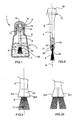
- the packaging and application device 1 shown in Figure 1 comprises a container 2 containing a composition P and a brush applicator 3 for the application of the composition P on keratin materials, for example nails.
- the composition P is for example a nail polish or a nail care product.
- the device 1 may contain, where appropriate, at least one ball 4 for homogenizing the composition P before application.
- the applicator 3 comprises a rod 5, for example made of plastic, provided at one end with a tuft of bristles 8 and at the other end with a gripping member 10 which also constitutes a cap closing the container 2.
- the gripping member 10 is for example arranged to be screwed onto a threaded neck 12 of the container 2 but it is not beyond the scope of the present invention when the applicator 3 is attached differently to the container, or is not arranged to attach to the container, the latter being for example closed by a closure means independent of the applicator.
- the rod 5 comprises at its end engaged in the gripping member 10 a plate 13, against which can abut the upper end 14 of the neck 12 at the end of the screwing of the gripping member 10 , in order to obtain a tight closure of the container 2.
- the upper end 14 may be provided, as illustrated, with a tapered lip to facilitate sealing.
- the rod 5 is arranged to be applied on the radially inner surface of the neck 12, in order to sealingly close the container 2. It may comprise for this purpose a frustoconical portion or a sealing lip.
- the rod 5 can be fixed in various ways in the gripping member 10, for example by snapping, friction, gluing or welding.
- the rod represented in FIG. 1 comprises, above the plate 13, a tubular skirt 16 serving for fixing in the gripping member 10.
- the rod 5 is made in one piece by molding plastic with a threaded skirt 120 for fixing on the neck of the container 2.
- This skirt 120 can serve as a gripping member 10 and can, if necessary, be covered by a dressing part.
- the rod 5 comprises, at its lower end, a tubular wall 17 which defines a housing 18 in which the tuft of bristles 8 is received.
- the rod 15 may be of solid cross section above the housing 18, over at least a portion of its length, for example over more than half of its length, or over its entire length.
- the tuft of bristles 8 is folded in two in the housing 18 and held therein by means of a clip 19 inserted in the material of the rod 5 above the housing 18.
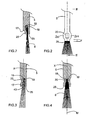
- the tubular wall 17 comprises at least one stamped portion 20, which extends for example on one side of the rod in the example of FIG. 3 and on two opposite sides of the rod in the variant of FIG. 4.
- the stamped portion 20 extends at a non-zero distance from the lower end 25 of the rod.
- stamping may be useful in particular to improve the maintenance of the tuft of bristles 8 in the rod 5, without necessarily modifying the shape of the opening 40 of the housing 18.
- the rod 5 is stamped after fixing the tuft of bristles 8 in the housing 18, being introduced into a suitable machine, having at least one die whose shape corresponds to the stamping to be performed.
- This machine may comprise a base having a shape adapted to receive the rod, in a predefined position relative to the matrix.
- the base can make it possible to position the rod in a predefined angular position with respect to the matrix, so that the stamping is effected in a manner marked with respect to the tuft and / or the staple 19.
- Matrices having different shapes can be used, depending on the desired result.
- Forging may be cold or hot, depending, for example, on the shape that is to be given to the stamped portion or portions, as well as depending on the nature of the stem and / or that of the bristles, if appropriate.
- FIGS. 5 and 6 illustrate an alternative embodiment in which the stamping exerts an influence on the configuration of the hairs outside the shank.
- the stamped portion 20 extends upwards from the lower end 25 of the rod over a distance which is for example less than the depth of the housing 18.
- the presence of the stamped portion 20, in the example of Figures 5 and 6, causes a narrowing of the inner section of the housing 18 towards the opening thereof, which can make it possible for example to make a beam of hairs less thick and / or more homogeneous out of the stem.
- the rod 5 may comprise two outer bulges 200, 201, preferably laterally opposite, at the stamped portion 20. Such bulges project outwardly relative to the tubular wall 17 of the rod 5. Such an applicator can 'prove relatively accurate.
- stamped portions 20 may also make it possible to widen the bundle of bristles, for example along a median plane M substantially perpendicular to the sectional plane of FIG. 6.
- the shape of the bundle of bristles can be easily modified without having to make a new mold for the rod.
- the deformation of the housing 18 under the effect of the stamping of the rod 5 can improve the holding of the tuft of hair on the stem, which offers new possibilities concerning the tuft of hair, for example as to the choice of hair and / or as to their number, without fearing insufficient holding of the tuft on the stem.
- the tuft of bristles may comprise, for example, less than 110 strands, for example about 100 strands or less, before folding and stapling in the housing 18.
- the shaft may be planed to provide a smoother exterior surface.
- FIG. 7 illustrates the possibility of stamping the rod 5 only on one side.
- the housing can be given 18 different forms without departing from the scope of the present invention.
- FIGS. 3 and 4 illustrate the possibility of making the housing 18 with a substantially flat bottom and perpendicular to the longitudinal axis X of the rod, but the housing 18 may have other shapes.
- the lower end of the rod of the applicator of FIG. 7 is shown separately in FIG. 8, before the setting of the pile and stamping beam.
- the housing 18 may for example have a cylindrical shape of constant section, with a bottom 28 for example substantially frustoconical.
- the housing 18 can also be given a stepped shape, as illustrated in FIG. 9, with a proximal portion 30, adjacent to the bottom 28 of the housing, and a distal portion 31, enlarged relative to the proximal portion 30.
- the rod 5 can be made with an increased thickness of material around the housing 18, as illustrated in FIG.
- the rod 5 has an enlarged distal portion, which allows to obtain a tubular wall 17 thicker. A greater thickness can give the rod better resistance to the stamping operation.
- the forged portion or portions 20 may extend for example only along the distal portion 31 of the housing, as illustrated in FIG. 11.
- the forged portion or portions 20 may extend for example only along the proximal portion 30 of the housing 18, or both along the proximal 30 and distal portions 31.
- the rod 5 can be stamped so as to modify the orientation of the bundle of bristles 8 which leaves the rod, and it can for example be stamped to direct the bundle of hairs leaving the rod in a Y direction at an angle ⁇ not zero with the longitudinal axis X of the rod 5, as shown in Figure 12.
- the angle ⁇ is for example between 1 and 10 °.
- the stamping of the rod 5 can be carried out in such a way as to result in a removal of material, as illustrated in FIG. 13.
- the stamped portion has a lateral opening 29 which increases the flexibility of the 'applicator.
- rod 5 can also be stamped above the housing receiving the tuft of bristles 8, so as to create a hinge 50.
- the rod 5 shown in FIG. 14 comprises several stamped portions 20 which make it possible to increase the holding of the staple and to modify the configuration of the bristles 8. These stamped portions 20 are for example made simultaneously or successively.
- the presence of the stamped portions may also provide more flexibility to the rod 5.
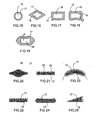
- the opening 40 of the housing 18 may have, before stamping, a circular shape for example, as shown in Figure 15, but the invention is not limited to such a shape.
- FIGS 16 to 19 show further examples of possible sections, among others.
- the rod 5 may in particular have an opening of polygonal shape, for example diamond-shaped or rectangle as shown in Figures 16 and 17 respectively.
- the thickness e of the tubular wall 17 which extends around the housing 18 may be non-constant. Alternatively, this thickness can be constant.
- the rod 5 may comprise at least one longitudinal groove 42, for example in the manner described in the patent application. US 2004/0096261 .
- a rod of non-circular cross section may facilitate the implantation of the tuft of bristles with a predefined orientation relative to the rod and may also allow to stamp the rod in a manner marked with respect to the tuft of bristles.
- the rod 5 may include a polarizer for this purpose.
- the rod 5 has a flattened cross section, for example substantially rectangular with rounded corners and two longitudinal grooves on main faces. Such grooves can channel the composition which flows on the rod towards a median region of the bundle of bristles 8.
- the stamping may make it possible to give the rod various shapes, for example a substantially flattened shape as illustrated in FIG. 6, or even a generally lenticular or swollen shape at the center and with flattened sides, as illustrated in FIG.
- the stamping may also make it possible to give the rod a corrugated section, for example corrugated on two opposite sides as illustrated in FIG. 21, or on one side only as illustrated in FIG. 22.
- the rod can be stamped so as to give the opening 40 of the housing a shape having a generally curved longitudinal axis Z, as illustrated in FIG. 23, the end of the rod having for example a general shape of tile. This can create a curved pile of hair that can match the curvature of the nail.
- the opening of the housing 18 can also be given a narrower shape in a central region than at the ends, as illustrated in FIG. 24.
- the rod can be deformed so that the opening of the housing has a non-symmetrical shape relative to the longitudinal axis of the rod, as shown in FIG. 25.
- the width of the opening 40 of the housing 18 increases when one moves laterally, the housing 18 having for example a substantially triangular cross section.
- the rod 5 can be made in various ways, being for example full over part of its length.
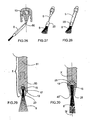
- the rod 5 may for example comprise at least one hinge zone 50, as shown in Figure 26.
- the latter may be made for example by stamping, as in the example of Figure 13, or by molding.
- Rods having at least one articulated region are described in particular in the patent application US 2005-0031401 .
- the rod may have a thinner portion, as shown in Figure 27. Examples of rods having such a thinner portion are disclosed in the patent US 6,033,143 .
- the rod may also have a flattened portion, as shown in Figure 28.
- a rod having such a flattened portion is given in the aforementioned US Patent.
- the stamping of the rod may have the effect of flattening the housing receiving the bristles generally in a plane parallel to the flat of the rod.
- the housing 18 can be made in a distal portion 60 which is attached to a proximal portion 61 of the rod 5, as shown in Figure 29.
- the distal portion 60 is for example fixed by snapping on the proximal portion 61.
- the attachment of the distal portion 60 could be performed differently, for example by gluing, welding, screwing or crimping.
- the clip 19 may be oriented substantially parallel to the median plane M as illustrated in FIGS. 6 and 26, but in a variant the clip 19 may be oriented differently, for example with a central portion 26 substantially perpendicular to the median plane M and to the major axis the opening 40 of the housing 18, as shown in Figure 30.
- the rod 5 of the applicator 3 shown in Figure 31 is surrounded by a sheath 70 which forms with the rod 5 a space 71 in which the composition P can accumulate. This can increase the autonomy of the applicator.
- Examples of applicators having a sheath surrounding the stem are disclosed in EP 1 563 759 A1 .
- the container containing the composition to be applied may be integral with the applicator during the use of the latter.
- the rod 5 is for example fixed to the container 2, as illustrated in FIG.
- the rod 5 can be traversed by at least one channel 83 for feeding the composition P.
- a sheath 70 may surround the shank 5, as appropriate, as illustrated.
- the applicator can be attached to another container 85.
- the stamping may allow, if necessary, to separate the bundle of hairs leaving the rod into two distinct sub-beams, as shown in Figure 34.
- the hairs used can be varied.
- the tuft of bristles may comprise bristles of various diameters, for example bristles having a larger cross section less than or equal to 6.5 / 100 mm, for example greater than 250 before folding and implantation in the stem.
Landscapes
- Engineering & Computer Science (AREA)
- Mechanical Engineering (AREA)
- Brushes (AREA)
- Coating Apparatus (AREA)
- Pens And Brushes (AREA)
Applications Claiming Priority (1)
| Application Number | Priority Date | Filing Date | Title |
|---|---|---|---|
| FR0553490A FR2893237B1 (fr) | 2005-11-17 | 2005-11-17 | Applicateur pinceau. |
Publications (2)
| Publication Number | Publication Date |
|---|---|
| EP1787545A2 true EP1787545A2 (de) | 2007-05-23 |
| EP1787545A3 EP1787545A3 (de) | 2010-06-30 |
Family
ID=36754686
Family Applications (1)
| Application Number | Title | Priority Date | Filing Date |
|---|---|---|---|
| EP06123032A Withdrawn EP1787545A3 (de) | 2005-11-17 | 2006-10-26 | Applikatorbürste |
Country Status (4)
| Country | Link |
|---|---|
| US (1) | US20070110501A1 (de) |
| EP (1) | EP1787545A3 (de) |
| JP (1) | JP2007136200A (de) |
| FR (1) | FR2893237B1 (de) |
Cited By (3)
| Publication number | Priority date | Publication date | Assignee | Title |
|---|---|---|---|---|
| FR2908018A1 (fr) * | 2006-11-02 | 2008-05-09 | Oreal | Applicateur pour appliquer un produit sur les cils ou les sourcils |
| FR3014651A1 (fr) * | 2013-12-17 | 2015-06-19 | Oreal | Dispositif de conditionnement et d'application d'une composition cosmetique fluide |
| US11406175B2 (en) | 2017-07-31 | 2022-08-09 | Shiseido Company, Ltd. | Makeup brush |
Families Citing this family (12)
| Publication number | Priority date | Publication date | Assignee | Title |
|---|---|---|---|---|
| JP2013102926A (ja) * | 2011-11-14 | 2013-05-30 | Shinwa Seisakusho:Kk | 化粧筆 |
| FR2993440B1 (fr) | 2012-07-20 | 2015-05-29 | Oreal | Pinceau applicateur |
| US20160338468A1 (en) * | 2014-02-14 | 2016-11-24 | S.G.A. Snc Dei F.Lli Spizzi Maria Paola E Abramo & C. | Method for obtaining a fan-like brush |
| FR3021195B1 (fr) * | 2014-05-21 | 2017-08-25 | Oreal | Applicateur de produit cosmetique apte a reguler l'ecoulement du produit |
| FR3031283B1 (fr) * | 2015-01-05 | 2017-07-28 | Oreal | Applicateur cosmetique |
| WO2016164046A1 (en) * | 2015-04-10 | 2016-10-13 | Aa R&D Llc | Fan brush cosmetic applicator |
| US9888762B2 (en) * | 2015-04-10 | 2018-02-13 | Aa R&D Llc | Fan brush cosmetic applicator |
| BE1023624B1 (de) * | 2016-03-30 | 2017-05-19 | Bart Gerard Boucherie | Verfahren und Vorrichtung zum Herstellen einer Bürste oder eines Pinsels sowie Träger für eine Bürste oder einen Pinsel |
| IT201800009599A1 (it) * | 2018-10-19 | 2020-04-19 | Sorini E Migliavacca Spa | Pennello per l'applicazione di un prodotto cosmetico, in particolare uno smalto, sulle unghie. |
| US20210085056A1 (en) * | 2019-04-14 | 2021-03-25 | Toly Management Ltd. | Cosmetic applicator with facial application member and pump |
| JP7446755B2 (ja) * | 2019-10-01 | 2024-03-11 | 三菱鉛筆株式会社 | 染毛容器 |
| FR3142871B1 (fr) * | 2022-12-09 | 2026-06-26 | Oreal | Organe d’application de produit cosmétique, ensemble de conditionnement d’un produit cosmétique et procédé d’assemblage d’un organe d’application de produit cosmétique |
Citations (2)
| Publication number | Priority date | Publication date | Assignee | Title |
|---|---|---|---|---|
| EP0651955A1 (de) * | 1993-11-05 | 1995-05-10 | L'oreal | Pinsel zum Auflegen von Nagellack, oder eines ähnlichen Produkten |
| US20020083953A1 (en) * | 2000-12-28 | 2002-07-04 | Paula Dorf | Cosmetic brush for applying eyeliner to the lashline |
Family Cites Families (17)
| Publication number | Priority date | Publication date | Assignee | Title |
|---|---|---|---|---|
| US1919011A (en) * | 1931-11-09 | 1933-07-18 | James F Connor | Brush |
| US2122980A (en) * | 1934-11-22 | 1938-07-05 | Grumbacher Walter | Brush |
| US4253213A (en) * | 1979-03-05 | 1981-03-03 | The Wooster Brush Company | Paint brush |
| US5464275A (en) * | 1992-12-11 | 1995-11-07 | Jason, Inc. | End brush and method of making |
| FR2717057B1 (fr) * | 1994-03-14 | 1996-04-12 | Oreal | Pinceau de vernis à ongles et ensemble d'application de vernis à ongles muni d'un tel pinceau. |
| US5425591A (en) * | 1994-05-17 | 1995-06-20 | Contreras; Thomas J. | Disposable toothbrush |
| FR2722381B1 (fr) * | 1994-07-12 | 1997-02-28 | Oreal | Applicateur pour l'application d'un produit liquide et ensemble de maquillage muni d'un tel applicateur |
| US6070595A (en) * | 1997-04-07 | 2000-06-06 | Baltierra; Julie | Method for applying a combination of acrylic liquid and powder to nail surface |
| JP4210874B2 (ja) * | 1998-02-27 | 2009-01-21 | 株式会社篠原 | 化粧用マニキュア筆 |
| EP1437211B1 (de) * | 1998-12-10 | 2013-04-24 | Trisa Holding AG | Verfahren zur Herstellung einer Zahnbürste |
| GB0010115D0 (en) * | 2000-04-27 | 2000-06-14 | Smithkline Beecham Gmbh & Co | Toothbrush |
| FR2808981B1 (fr) * | 2000-05-19 | 2002-12-13 | Oreal | Applicateur a ame non torsadee |
| US7458126B2 (en) * | 2002-10-10 | 2008-12-02 | L'oreal | Applicator for applying a substance to nails |
| FR2854779B1 (fr) * | 2003-05-14 | 2006-09-01 | Oreal | Applicateur et dispositif de conditionnement et d'application comportant un tel applicateur |
| FR2858529B1 (fr) * | 2003-08-04 | 2006-02-17 | Oreal | Applicateur et dispositif de conditionnement et d'application comportant un tel applicateur |
| FR2866215B1 (fr) * | 2004-02-17 | 2007-01-26 | Oreal | Applicateur cosmetique |
| US7996947B2 (en) * | 2005-06-15 | 2011-08-16 | L'oreal | Brush and a packaging and applicator device including such a brush |
-
2005
- 2005-11-17 FR FR0553490A patent/FR2893237B1/fr not_active Expired - Lifetime
-
2006
- 2006-10-26 EP EP06123032A patent/EP1787545A3/de not_active Withdrawn
- 2006-11-17 US US11/561,265 patent/US20070110501A1/en not_active Abandoned
- 2006-11-17 JP JP2006311068A patent/JP2007136200A/ja active Pending
Patent Citations (2)
| Publication number | Priority date | Publication date | Assignee | Title |
|---|---|---|---|---|
| EP0651955A1 (de) * | 1993-11-05 | 1995-05-10 | L'oreal | Pinsel zum Auflegen von Nagellack, oder eines ähnlichen Produkten |
| US20020083953A1 (en) * | 2000-12-28 | 2002-07-04 | Paula Dorf | Cosmetic brush for applying eyeliner to the lashline |
Cited By (4)
| Publication number | Priority date | Publication date | Assignee | Title |
|---|---|---|---|---|
| FR2908018A1 (fr) * | 2006-11-02 | 2008-05-09 | Oreal | Applicateur pour appliquer un produit sur les cils ou les sourcils |
| EP1917883A3 (de) * | 2006-11-02 | 2008-05-14 | L'oreal | Applikator zum Auftragen eines Produkts auf Wimpern oder Augenbrauen |
| FR3014651A1 (fr) * | 2013-12-17 | 2015-06-19 | Oreal | Dispositif de conditionnement et d'application d'une composition cosmetique fluide |
| US11406175B2 (en) | 2017-07-31 | 2022-08-09 | Shiseido Company, Ltd. | Makeup brush |
Also Published As
| Publication number | Publication date |
|---|---|
| JP2007136200A (ja) | 2007-06-07 |
| FR2893237B1 (fr) | 2008-06-27 |
| FR2893237A1 (fr) | 2007-05-18 |
| US20070110501A1 (en) | 2007-05-17 |
| EP1787545A3 (de) | 2010-06-30 |
Similar Documents
| Publication | Publication Date | Title |
|---|---|---|
| EP1738894B1 (de) | Auftragevorrichtung und Aufbewahrungs- und Ausgabevorrichtung mit einer solchen Auftragevorrichtung | |
| CA2279499C (fr) | Dispositif pour l'application d'un produit de maquillage comportant une brosse, procede de fabrication et applicateur | |
| EP1504691B1 (de) | Auftragelement und Vorrichtung zum Aufbewahren und zum Auftragen bestehend aus einem solchen Auftragelement | |
| EP1917883B1 (de) | Applikator zum Auftragen eines Produkts auf Wimpern oder Augenbrauen | |
| EP1155637B1 (de) | Auftragevorrichtung mit unverdrilltem Kern | |
| EP1726234B1 (de) | Applikator zum Auftragen eines Produktes auf die Wimpern und/oder Augenbrauen | |
| CA2409269C (fr) | Dispositif pour le conditionnement et/ou l'application d'un produit sur les cils et/ou les sourcils et procede de maquillage | |
| FR2893237A1 (fr) | Applicateur pinceau. | |
| FR2961384B1 (fr) | Applicateur d'un produit cosmetique, de maquillage ou de soin, sur les cils ou les sourcils | |
| EP1652449A2 (de) | Kit zum Schminken von Keratinfasern | |
| FR3058622B1 (fr) | Applicateur pour appliquer un produit cosmetique sur les matieres keratiniques | |
| EP1477083A1 (de) | Applikator und Behälter mit einem solchen Aplikator | |
| FR2922422A1 (fr) | Applicateur pour peigner ou appliquer un produit sur les cils | |
| EP1772074A2 (de) | Vorrichtung zum Aufbewahren und Auftragen eines Produktes | |
| FR2916328A1 (fr) | Brosse pour l'application d'un produit sur les cils et/ou les sourcils | |
| EP1247472A1 (de) | Vorrichtung zum Aufbewahren und Auftragen eines Produkts, insbesondere eines kosmetischen Produktes | |
| FR2979807A1 (fr) | Applicateur pour appliquer un produit sur les cils ou les sourcils | |
| FR2898782A1 (fr) | Brosse a mascara | |
| EP1433399B1 (de) | Applikator zum Auftragen eines Produktes auf Haarsträhnen | |
| EP1407685A1 (de) | Applikator zum Auftragen eines Mittels auf die Fingernägel | |
| EP3030105B1 (de) | Vorrichtung und applikator für ein kosmetikum | |
| EP1169937A1 (de) | Vorrichtung zur Abgabe von einem Produkt auf einen Untergrund und seine Verwendung zur Behandlung von Haaren | |
| EP1493350B1 (de) | Kamm zum Aufbringen eines Kosmetikproduktes auf Haarsträhnen | |
| EP1797789B1 (de) | Applikator mit Vorratsbehälter, im besonderen für den Nagellack | |
| FR2993440A1 (fr) | Pinceau applicateur |
Legal Events
| Date | Code | Title | Description |
|---|---|---|---|
| PUAI | Public reference made under article 153(3) epc to a published international application that has entered the european phase |
Free format text: ORIGINAL CODE: 0009012 |
|
| AK | Designated contracting states |
Kind code of ref document: A2 Designated state(s): AT BE BG CH CY CZ DE DK EE ES FI FR GB GR HU IE IS IT LI LT LU LV MC NL PL PT RO SE SI SK TR |
|
| AX | Request for extension of the european patent |
Extension state: AL BA HR MK YU |
|
| PUAL | Search report despatched |
Free format text: ORIGINAL CODE: 0009013 |
|
| AK | Designated contracting states |
Kind code of ref document: A3 Designated state(s): AT BE BG CH CY CZ DE DK EE ES FI FR GB GR HU IE IS IT LI LT LU LV MC NL PL PT RO SE SI SK TR |
|
| AX | Request for extension of the european patent |
Extension state: AL BA HR MK RS |
|
| 17P | Request for examination filed |
Effective date: 20101230 |
|
| AKX | Designation fees paid |
Designated state(s): AT BE BG CH CY CZ DE DK EE ES FI FR GB GR HU IE IS IT LI LT LU LV MC NL PL PT RO SE SI SK TR |
|
| STAA | Information on the status of an ep patent application or granted ep patent |
Free format text: STATUS: EXAMINATION IS IN PROGRESS |
|
| 17Q | First examination report despatched |
Effective date: 20170117 |
|
| STAA | Information on the status of an ep patent application or granted ep patent |
Free format text: STATUS: THE APPLICATION IS DEEMED TO BE WITHDRAWN |
|
| 18D | Application deemed to be withdrawn |
Effective date: 20170728 |