EP1787964A2 - Gehärtetes Glas mit beschlagverhindernder und schmutzabweisenden Oberfläche und Verfahren zu seine Herstellung - Google Patents
Gehärtetes Glas mit beschlagverhindernder und schmutzabweisenden Oberfläche und Verfahren zu seine Herstellung Download PDFInfo
- Publication number
- EP1787964A2 EP1787964A2 EP06023821A EP06023821A EP1787964A2 EP 1787964 A2 EP1787964 A2 EP 1787964A2 EP 06023821 A EP06023821 A EP 06023821A EP 06023821 A EP06023821 A EP 06023821A EP 1787964 A2 EP1787964 A2 EP 1787964A2
- Authority
- EP
- European Patent Office
- Prior art keywords
- glass
- group
- antisoiling
- groups
- tempered glass
- Prior art date
- Legal status (The legal status is an assumption and is not a legal conclusion. Google has not performed a legal analysis and makes no representation as to the accuracy of the status listed.)
- Withdrawn
Links
- 0 C*(C)C(CC(C)(C)C)[N+](*)(*)[O-] Chemical compound C*(C)C(CC(C)(C)C)[N+](*)(*)[O-] 0.000 description 7
- RRGMZGZJSPMYRP-UHFFFAOYSA-N CC(C)(C)C(CC(C)(C)N)(CO)O Chemical compound CC(C)(C)C(CC(C)(C)N)(CO)O RRGMZGZJSPMYRP-UHFFFAOYSA-N 0.000 description 1
Images

Classifications
-
- C—CHEMISTRY; METALLURGY
- C03—GLASS; MINERAL OR SLAG WOOL
- C03C—CHEMICAL COMPOSITION OF GLASSES, GLAZES OR VITREOUS ENAMELS; SURFACE TREATMENT OF GLASS; SURFACE TREATMENT OF FIBRES OR FILAMENTS MADE FROM GLASS, MINERALS OR SLAGS; JOINING GLASS TO GLASS OR OTHER MATERIALS
- C03C17/00—Surface treatment of glass, not in the form of fibres or filaments, by coating
- C03C17/28—Surface treatment of glass, not in the form of fibres or filaments, by coating with organic material
- C03C17/32—Surface treatment of glass, not in the form of fibres or filaments, by coating with organic material with synthetic or natural resins
-
- B—PERFORMING OPERATIONS; TRANSPORTING
- B32—LAYERED PRODUCTS
- B32B—LAYERED PRODUCTS, i.e. PRODUCTS BUILT-UP OF STRATA OF FLAT OR NON-FLAT, e.g. CELLULAR OR HONEYCOMB, FORM
- B32B17/00—Layered products essentially comprising sheet glass, or glass, slag, or like fibres
- B32B17/06—Layered products essentially comprising sheet glass, or glass, slag, or like fibres comprising glass as the main or only constituent of a layer, next to another layer of a specific material
- B32B17/10—Layered products essentially comprising sheet glass, or glass, slag, or like fibres comprising glass as the main or only constituent of a layer, next to another layer of a specific material of synthetic resin
- B32B17/10005—Layered products essentially comprising sheet glass, or glass, slag, or like fibres comprising glass as the main or only constituent of a layer, next to another layer of a specific material of synthetic resin laminated safety glass or glazing
- B32B17/10009—Layered products essentially comprising sheet glass, or glass, slag, or like fibres comprising glass as the main or only constituent of a layer, next to another layer of a specific material of synthetic resin laminated safety glass or glazing characterized by the number, the constitution or treatment of glass sheets
- B32B17/10036—Layered products essentially comprising sheet glass, or glass, slag, or like fibres comprising glass as the main or only constituent of a layer, next to another layer of a specific material of synthetic resin laminated safety glass or glazing characterized by the number, the constitution or treatment of glass sheets comprising two outer glass sheets
-
- B—PERFORMING OPERATIONS; TRANSPORTING
- B32—LAYERED PRODUCTS
- B32B—LAYERED PRODUCTS, i.e. PRODUCTS BUILT-UP OF STRATA OF FLAT OR NON-FLAT, e.g. CELLULAR OR HONEYCOMB, FORM
- B32B17/00—Layered products essentially comprising sheet glass, or glass, slag, or like fibres
- B32B17/06—Layered products essentially comprising sheet glass, or glass, slag, or like fibres comprising glass as the main or only constituent of a layer, next to another layer of a specific material
- B32B17/10—Layered products essentially comprising sheet glass, or glass, slag, or like fibres comprising glass as the main or only constituent of a layer, next to another layer of a specific material of synthetic resin
- B32B17/10005—Layered products essentially comprising sheet glass, or glass, slag, or like fibres comprising glass as the main or only constituent of a layer, next to another layer of a specific material of synthetic resin laminated safety glass or glazing
- B32B17/10009—Layered products essentially comprising sheet glass, or glass, slag, or like fibres comprising glass as the main or only constituent of a layer, next to another layer of a specific material of synthetic resin laminated safety glass or glazing characterized by the number, the constitution or treatment of glass sheets
- B32B17/10082—Properties of the bulk of a glass sheet
- B32B17/10119—Properties of the bulk of a glass sheet having a composition deviating from the basic composition of soda-lime glass, e.g. borosilicate
-
- B—PERFORMING OPERATIONS; TRANSPORTING
- B32—LAYERED PRODUCTS
- B32B—LAYERED PRODUCTS, i.e. PRODUCTS BUILT-UP OF STRATA OF FLAT OR NON-FLAT, e.g. CELLULAR OR HONEYCOMB, FORM
- B32B17/00—Layered products essentially comprising sheet glass, or glass, slag, or like fibres
- B32B17/06—Layered products essentially comprising sheet glass, or glass, slag, or like fibres comprising glass as the main or only constituent of a layer, next to another layer of a specific material
- B32B17/10—Layered products essentially comprising sheet glass, or glass, slag, or like fibres comprising glass as the main or only constituent of a layer, next to another layer of a specific material of synthetic resin
- B32B17/10005—Layered products essentially comprising sheet glass, or glass, slag, or like fibres comprising glass as the main or only constituent of a layer, next to another layer of a specific material of synthetic resin laminated safety glass or glazing
- B32B17/10165—Functional features of the laminated safety glass or glazing
- B32B17/10174—Coatings of a metallic or dielectric material on a constituent layer of glass or polymer
-
- B—PERFORMING OPERATIONS; TRANSPORTING
- B32—LAYERED PRODUCTS
- B32B—LAYERED PRODUCTS, i.e. PRODUCTS BUILT-UP OF STRATA OF FLAT OR NON-FLAT, e.g. CELLULAR OR HONEYCOMB, FORM
- B32B17/00—Layered products essentially comprising sheet glass, or glass, slag, or like fibres
- B32B17/06—Layered products essentially comprising sheet glass, or glass, slag, or like fibres comprising glass as the main or only constituent of a layer, next to another layer of a specific material
- B32B17/10—Layered products essentially comprising sheet glass, or glass, slag, or like fibres comprising glass as the main or only constituent of a layer, next to another layer of a specific material of synthetic resin
- B32B17/10005—Layered products essentially comprising sheet glass, or glass, slag, or like fibres comprising glass as the main or only constituent of a layer, next to another layer of a specific material of synthetic resin laminated safety glass or glazing
- B32B17/1055—Layered products essentially comprising sheet glass, or glass, slag, or like fibres comprising glass as the main or only constituent of a layer, next to another layer of a specific material of synthetic resin laminated safety glass or glazing characterized by the resin layer, i.e. interlayer
- B32B17/10761—Layered products essentially comprising sheet glass, or glass, slag, or like fibres comprising glass as the main or only constituent of a layer, next to another layer of a specific material of synthetic resin laminated safety glass or glazing characterized by the resin layer, i.e. interlayer containing vinyl acetal
-
- B—PERFORMING OPERATIONS; TRANSPORTING
- B32—LAYERED PRODUCTS
- B32B—LAYERED PRODUCTS, i.e. PRODUCTS BUILT-UP OF STRATA OF FLAT OR NON-FLAT, e.g. CELLULAR OR HONEYCOMB, FORM
- B32B2255/00—Coating on the layer surface
- B32B2255/26—Polymeric coating
-
- C—CHEMISTRY; METALLURGY
- C03—GLASS; MINERAL OR SLAG WOOL
- C03C—CHEMICAL COMPOSITION OF GLASSES, GLAZES OR VITREOUS ENAMELS; SURFACE TREATMENT OF GLASS; SURFACE TREATMENT OF FIBRES OR FILAMENTS MADE FROM GLASS, MINERALS OR SLAGS; JOINING GLASS TO GLASS OR OTHER MATERIALS
- C03C2218/00—Methods for coating glass
- C03C2218/10—Deposition methods
- C03C2218/11—Deposition methods from solutions or suspensions
- C03C2218/113—Deposition methods from solutions or suspensions by sol-gel processes
-
- Y—GENERAL TAGGING OF NEW TECHNOLOGICAL DEVELOPMENTS; GENERAL TAGGING OF CROSS-SECTIONAL TECHNOLOGIES SPANNING OVER SEVERAL SECTIONS OF THE IPC; TECHNICAL SUBJECTS COVERED BY FORMER USPC CROSS-REFERENCE ART COLLECTIONS [XRACs] AND DIGESTS
- Y10—TECHNICAL SUBJECTS COVERED BY FORMER USPC
- Y10T—TECHNICAL SUBJECTS COVERED BY FORMER US CLASSIFICATION
- Y10T428/00—Stock material or miscellaneous articles
- Y10T428/31504—Composite [nonstructural laminate]
- Y10T428/31536—Including interfacial reaction product of adjacent layers
-
- Y—GENERAL TAGGING OF NEW TECHNOLOGICAL DEVELOPMENTS; GENERAL TAGGING OF CROSS-SECTIONAL TECHNOLOGIES SPANNING OVER SEVERAL SECTIONS OF THE IPC; TECHNICAL SUBJECTS COVERED BY FORMER USPC CROSS-REFERENCE ART COLLECTIONS [XRACs] AND DIGESTS
- Y10—TECHNICAL SUBJECTS COVERED BY FORMER USPC
- Y10T—TECHNICAL SUBJECTS COVERED BY FORMER US CLASSIFICATION
- Y10T428/00—Stock material or miscellaneous articles
- Y10T428/31504—Composite [nonstructural laminate]
- Y10T428/31551—Of polyamidoester [polyurethane, polyisocyanate, polycarbamate, etc.]
- Y10T428/31645—Next to addition polymer from unsaturated monomers
Definitions
- the present invention relates to a surface antifogging, antisoiling, tempered glass, which is provided by forming a hydrophilic film excellent in hydrophilicity and abrasion resistance on a glass surface, has a surface excellent in antisoiling and antifogging properties, and further has an excellent scratch resistance, and a method for producing the same.
- Glass produced by the float processes and the down draw processes are higher in shape accuracy as compared with those produced by the other processes, whereby the glasses has been used for automobiles, architectural structures, display devices, etc.
- it is desired that surface scratch resistance, impact resistance (physical strength), antifogging properties, and antisoiling properties of glass are further improved.
- the physical strength of glass can be improved by glass composition control or a chemical surface treatment in its production processes, by attaching a resin film to the glass, by stacking glass sheets, or by forming a laminated glass sandwiching an intermediate resin film.
- a chemical surface treatment satisfying all the requirements of scratch resistance, antifogging properties, and antisoiling properties of the glass surface, nor a surface covering resin film with such properties have not been found.
- a technology for satisfying the requirements of the scratch resistance, antifogging properties, and antisoiling properties, etc. by a simple chemical surface treatment following the glass production processes without the need for a surface covering resin film to be attached, and a functional glass produced by such a technology have been eagerly desired.
- the typical photocatalyst materials of fine titanium oxide particle films are poor in filming properties and brittle, showing extremely low scratch resistance, whereby it is difficult, in practice, to obtain a practically satisfactory durability by using them.
- chemical treatments using fluororesin particles and low molecular silane coupling agents see, e.g. JP-A No. 7-13 8046
- chemical treatments using hydrosilylation reactions between hydrocarbon-based resins and organic silicon compounds see, e.g. JP-A No.2004-322014 ) have been proposed.
- these treatments also result in poor scratch resistance and durability.
- the present invention has been made in consideration of the above-described circumstances and provides a surface antifogging, antisoiling, tempered glass containing a glass formed by a float process or a down draw process, the glass being chemically bonded to a polymer chain represented by formula (I): wherein X 1 to X 3 each independently represent a hydrogen atom, a hydrocarbon group having 1 to 10 carbon atoms, or -CO 2 R 1 , R 1 represents a hydrogen atom, an alkaline metal, or a hydrocarbon group having 1 to 10 carbon atoms, 2 or more of X 1 to X 3 may be bonded together to form a ring structure, Y represents a functional group having a molecular weight of 100,000 or less containing at least one group selected from the group consisting of -NHSO 2 R 2 , -NHCOR 2 , -SO 2 NHR 3 , -CONHR 3 , -CO 2 R 1 , -SO 3 R 1 , -PO 3 R
- the polymer chain represented by formula (I) may be a copolymer chain containing different structural units of the formula (I).
- the glass is bonded to the polymer chain represented by formula (I) by a chemical bond formed between a surface of the glass and a group provided by removing at least 1 atom from Y or between the glass surface and an end of the polymer chain.
- the surface antifogging, antisoiling, tempered glass of the invention utilizes glass-organic polymer hybridization.
- the polymer chain represented by formula (I) is chemically bonded to the glass surface such that an end bondable polymer represented by formula (II) (hereinafter sometimes referred to as "specific polymer”) is chemically bonded by a sol-gel method to the glass surface.
- Z represents a divalent linking group containing an atom selected from C, H, N, O, and S; M represents -Si(OR 1 ) 3 , -Ti(OR 1 ) 3 , -Al(OR 1 ) 2 , or -Zr(OR 1 ) 3 ; and X 1 to X 3 , Y, n, and R 1 have the same definitions as those of formula (I).
- the glass prepared by the float process or down draw process, to which the polymer chain is chemically bonded may be a common glass sheet, and may be a layered glass of two glass sheets, and may be a laminated glass formed by sandwiching an intermediate resin layer between two glass sheets formed by the float process or down draw process.
- the end bondable polymer represented by formula (II) is chemically bonded by the sol-gel method to the glass formed by the float process, to obtain a tempered glass for a vehicle or architectural structure.
- the end bondable polymer represented by formula (II) is chemically bonded by the sol-gel method to the glass formed by the down draw process, to obtain a tempered glass for a display device.
- an organic polymer with high antifogging and antisoiling properties is chemically bonded to the glass surface, so that the resultant tempered glass can show a scratch resistance equal to that of the resin film and can further show the antifogging and antisoiling properties without light effects.
- a method of the invention for producing a surface antifogging, antisoiling, tempered glass is characterized by containing preparing a glass formed by a float process or a down draw process, applying a coating liquid containing an end bondable polymer represented by formula (II) to a surface of the prepared glass, inducing and promoting a sol-gel reaction to bond the end bondable polymer to the surface of the glass.
- Z represents a divalent linking group containing an atom selected from C, H, N, O, and S
- M represents -Si(OR 1 ) 3 , -Ti(OR 1 ) 3 , -Al(OR 1 ) 2 , or -Zr(OR 1 ) 3
- X 1 to X 3 , Y, n, and R' have the same definitions as those of the formula (I).
- the mechanism of the invention is not certain, but is thought to be as follows. It is thought that the polymer represented by formula (I), which has a high density of hydrophilic or oil-repellent functional groups, is chemically bonded to the glass directly utilizing the free mobility of the polymer chain in the tempered glass of the invention, whereby the high antifogging and antisoiling properties are achieved.
- the end bondable polymer having the hydrophilic, oil-repellent, functional groups is chemically bonded to the glass surface by a sol-gel method to form a surface layer.
- a thick film in which the polymer can effectively show its physical strength, is formed on the glass surface, and the surface layer has a crosslinked structure in the film, so that surface scratch resistance can be maintained and the glass surface can be made soft to increase the toughness of the glass itselg.
- the excellent surface antisoiling properties, antifogging properties, life-spans thereof, and surface scratch resistance are achieved because highly smooth glass obtained by a float process or a down draw process is used for chemically bonding the end of the polymer chain, instead of glass obtained by common production methods.
- surface treatment i.e. the introduction of the polymer chain, may be efficiently uniformly carried out due to improved coating properties, to show a synergic effect with the smoothness increase.
- the surface antifogging, antisoiling, tempered glass of the invention contains a glass formed by a float process or a down draw process, the glass being chemically bonded to a polymer chain represented by formula (I).
- X 1 to X 3 each independently represent a hydrogen atom, a hydrocarbon group having 1 to 10 carbon atoms, or -CO 2 R 1 , and R 1 represents a hydrogen atom, an alkaline metal, or a hydrocarbon group having 1 to 10 carbon atoms.
- the hydrocarbon group of X 1 to X 3 may be an alkyl group having 1 to 10 carbon atoms, an aryl group having 6 to 10 carbon atoms, and the like, and is preferably a straight, branched, or cyclic alkyl group having 8 or less carbon atoms.
- Specific examples thereof include a methyl group, an ethyl group, a propyl group, a butyl group, a pentyl group, a hexyl group, a heptyl group, an octyl group, an isopropyl group, an isobutyl group, an s-butyl group, a t-butyl group, an isopentyl group, a neopentyl group, a 1-methylbutyl group, an isohexyl group, a 2-ethylhexyl group, a 2-methylhexyl group, and a cyclopentyl group.
- hydrocarbon groups may further have a substituent.
- the substituted alkyl group is formed by a bond between the substituent and an alkylene group, and herein the substituent is a monovalent non-metallic atomic group other than hydrogen.
- substituents include halogen atoms (-F, -Br, -Cl, -I), a hydroxyl group, alkoxy groups, aryloxy groups, a mercapto group, alkylthio groups, arylthio groups, alkyldithio groups, aryldithio groups, an amino group, N-alkylamino groups, N,N-diarylamino groups, N-alkyl-N-arylamino groups, acyloxy groups, a carbamoyloxy group, N-alkylcarbamoyloxy groups, N-arylcarbamoyloxy groups, N,N-dialkylcarbamoyloxy groups, N,N-diarylcarbamoyloxy groups, N-alkyl-N-arylcarbamoyloxy groups, alkylsulfoxy groups, arylsulfoxy groups, acylthio groups, acylamino
- N-arylureido groups N'-alkyl-N-alkylureido groups, N'-alkyl-N-arylureido groups, N',N'-dialkyl-N-alkylureido groups, N',N'-dialkyl-N-arylureido groups, N'-aryl-N-alkylureido groups, N'-aryl-N-arylureido groups, N',N'-diaryl-N-alkylureido groups, N',N'-diaryl-N-arylureido groups, N'-alkyl-N'-aryl-N-alkylureido groups, N'-alkyl-N'-aryl-N-arylureido groups, alkoxycarbonylamino groups, aryloxycarbonylamino groups, N-alkyl-N-alkoxycarbonylamino groups, N-alkyl-N
- alkyl groups in these substituents include the above-mentioned alkyl group examples, and specific examples of the aryl groups include a phenyl group, a biphenyl group, a naphtyl group, a tolyl 2 group, a xylyl group, a mesityl group, a cumenyl group, a chlorophenyl group, a bromophenyl group, a chloromethylphenyl group, a hydroxyphenyl group, a methoxyphenyl group, an ethoxyphenyl group, a phenoxyphenyl group, an acetoxyphenyl group, a benzoyloxyphenyl group, a methylthiophenyl group, a phenylthiophenyl group, a methylaminophenyl group, a dimethylaminophenyl group, an acetylaminophenyl group, a carboxyphenyl group,
- examples of the alkenyl groups include a vinyl group, a 1-propenyl group, a 1-butenyl group, a cinnamyl group, and a 2-chloro-1-ethenyl group
- examples of the alkynyl groups include an ethynyl group, a 1-propynyl group, a 1-butynyl group, and a trimethylsilylethynyl group.
- examples of G 1 include hydrogen, and the above alkyl groups and aryl groups.
- halogen atoms (-F, -Br, -C1, -I), alkoxy groups, aryloxy groups, alkylthio groups, arylthio groups, N-alkylamino groups, N,N-dialkylamino groups, acyloxy groups, N-alkylcarbamoyloxy groups, N-arylcarbamoyloxy groups, acylamino groups, a formyl group, acyl groups, a carboxyl group, alkoxycarbonyl groups, aryloxycarbonyl groups, a carbamoyl group, N-alkylcarbamoyl groups, N,N-dialkylcarbamoyl groups, N-arylcarbamoyl groups, N-alkyl-N-arylcarbamoyl groups, a sulfo group, sulfonato groups, a sulfamoyl group, N-alkyl
- the alkylene groups in the substituted alkyl groups include divalent organic groups provided by removing one hydrogen atom from the above alkyl groups having 1 to 20 carbon atoms.
- Preferred examples of the alkylene groups include straight alkylene groups having 1 to 12 carbon atoms, branched alkylene groups having 3 to 12 carbon atoms, and cyclic alkylene groups having 5 to 10 carbon atoms.
- Preferred examples of the substituted alkyl groups provided by connecting the substituents and the alkylene groups include a chloromethyl group, a bromomethyl group, a 2-chloroethyl group, a trifluoromethyl group, a methoxymethyl group, a methoxyethoxyethyl group, an allyloxymethyl group, a phenoxymethyl group, a methylthiomethyl group, a tolylthiomethyl group, an ethylaminoethyl group, a diethylaminopropyl group, a morpholinopropyl group, an acetyloxymethyl group, a benzoyloxymethyl group, an N-cyclohexylcarbamoyloxyethyl group, an N-phenylcarbamoyloxyethyl group, an acetylaminoethyl group, an N-methylbenzoylaminopropyl group, a 2-oxyethyl
- a chlorophenoxycarbonylmethyl group a carbamoylmethyl group, an N-methylcarbamoylethyl group, an N,N-dipropylcarbamoylmethyl group, an N-(methoxyphenyl)carbamoylethyl group, an N-methyl-N-(sulfophenyl)carbamoylmethyl group, a sulfobutyl group, a sulfonatobutyl group, a sulfamoylbutyl group, an N-ethylsulfamoylmethyl group, an N,N-dipropylsulfamoylpropyl group, an N-tolylsulfamoylpropyl group, an N-methyl-N-(phosphonophenyl)sulfamoyloctyl group, a phosphonobutyl group, a phosphonatohexyl group, a die
- the hydrocarbon group preferably has 8 or less carbon atoms, more preferably has 3 or less carbon atoms, most preferably has 1 carbon atom.
- R 1 represents a hydrogen atom, an alkaline metal, or a hydrocarbon group having 1 to 10 carbon atoms.
- the hydrocarbon group of R 1 has the same definitions as those of X 1 to X 3 , and preferably has 8 or less carbon atoms, more preferably has 3 or less carbon atoms, most preferably has 1 carbon atom.
- the alkaline metal may be Li, Na, K, or Rb, and is bonded to a carboxylate anion in the monovalent cation state.
- X 1 , X 2 , and X 3 include a hydrogen atom, a hydrocarbon group with 1 carbon atom, -CO 2 CH 3 , and -CO 2 H. Particularly X 3 is most preferably -CO 2 CH 3 , a hydroxymethyl group, an alkoxymethyl group, an acyloxymethyl group, an alkylthiomethyl group, an acylthiomethyl group, an alkylaminomethyl group, or an acylaminomethyl group.
- 2 or more of X 1 to X 3 may be bonded together to form a ring structure, which is preferably a 5- or 6-membered ring structure.
- Y In formula (I) represents a functional group having a molecular weight of 100,000 or less containing at least one group selected from the group consisting of -NHSO 2 R 2 , -NHCOR 2 , -SO 2 NHR 3 , -CONHR 3 , -CO 2 R 1 , -SO 3 R 1 , -PO 3 R 1 2 , -OR 3 , -Si(OR 3 ) 3 , and -CF 3 .
- R 1 has the same meanings as above
- R 2 represents a hydrocarbon group having 1 to 10 carbon atoms
- R 3 represents a hydrogen atom or a hydrocarbon group having 1 to 10 carbon atoms.
- n represents the number of repeating units, 10 to 5,000.
- the hydrocarbon group described herein has the same meanings as that of R 1 .
- Y include -CONH 2 , -CO 2 H, -CO 2 Na, -SO 3 H,
- k is 1 to 20,000.
- Q is a divalent linking group composed of C, H, N, O, and S, and is preferably -CH 2 OCOCH 2 CH 2 S- or -CO 2 CH 2 CH(OH)CH 2 OCOCH 2 CH 2 S-.
- n represents the repeating unit number of 10 to 5,000. n is preferably 10 to 1,000, more preferably 30 to 1,000, most preferably 50 to 500.
- the polymer chain represented by formula (I) may be a copolymer chain containing different structural units of the formula (I). Examples of the structural units of the polymer chain of the formula (I) are illustrated below without intention of restricting the invention.
- the polymer chain represented by formula (I) is formed by connecting 10 to 5,000 structural units, and 1, 2, or more types of such structural units may be used.
- the polymer chain represented by formula (I) is connected to the glass by a chemical bond, which is formed between the glass surface and a group provided by removing at least 1 atom from Y or between the glass surface and an end of the polymer chain.
- Example Compounds (I-1) to (I-20) are illustrated below without intention of restricting the invention.
- Example Compounds (I-1) to (I-6) and (I-14) containing a plurality of types of structural units are random copolymers containing two types of structural units at a mole ratio shown.
- the polymer chain may be chemically connected to a silanol group of the glass surface such that a silane coupling group of the polymer chain is used to form a covalent bond, an ammonium group is used to form a strong ionic bond, or a phosphoric acid or phosphonic acid group is used to form a strong hydrogen bond. It is most preferred that dehydration condensation between a silanol group of the glass surface and an end bondable polymer represented by formula (II) is carried out by a sol-gel method to form a covalent bond.
- Z represents a divalent linking group containing an atom selected from C, H, N, O, and S.
- Preferred examples of Z include hydrocarbon linking groups having an S atom and 1 to 10 carbon atoms.
- Z is more preferably a hydrocarbon linking group having an O atom, an S atom, and 1 to 10 carbon atoms, most preferably a hydrocarbon linking group having an N atom, an S atom, and 1 to 10 carbon atoms.
- Z is preferably -CH 2 CH 2 S- or -CH 2 CH 2 CH 2 S-, more preferably
- M represents -Si(OR 1 ) 3 , -Ti(OR 1 ) 3 , -Al(OR 1 ) 2 , or -Zr(OR 1 ) 3 , and herein the meanings and preferred embodiments of R 1 are the same as those of the formula (I).
- the end bondable polymer (the specific polymer) represented by formula (II) can be synthesized by a method described in JP-A No.2002-361800 , etc.
- the specific polymer according to the invention can be synthesized by radical polymerization of a radical-polymerizable monomer represented by formula (i) using a silane coupling agent represented by formula (ii), which can show a chain transfer ability in the radical polymerization.
- the silane coupling group is introduced to the end of the polymer main chain in the radical polymerization due to the chain transfer ability, whereby a polymer represented by formula (iii) can be synthesized.
- X 1 to X 4 , Y, R, and n of the formulae (i), (ii) and (iii) have the same definitions as those of the above formula (II).
- the compounds for the synthesis represented by formulae (i) and (ii) are commercially available and can be easily synthesized.
- the radical polymerization for synthesizing the specific polymer may be carried out by using known methods. Common radical polymerization methods described in Shin Kobunshi Jikkengaku 3, Kobunshi no Gosei To Hanno 1 (The Society of Polymer Science, Japan, Kyoritsu Shuppan Co., Ltd. ), Shin Jikken Kagaku Koza 19, Kobunshi Kagaku (I) (The Chemical Society of Japan, Maruzen ), Bussitsu Kogaku Koza, Kobunshi Gosei Kagaku (Tokyo Denki University Press ), etc. can be used in the invention.
- the polymer chain may be chemically connected to a silanol group of the glass surface such that a silane coupling group of the polymer is used to form a covalent bond, an ammonium group is used to form a strong ionic bond, or a phosphoric acid or phosphonic acid group is used to form a strong hydrogen bond.
- the glass surface may be coated with the polymer represented by formula (I) having the silane coupling group, ammonium group, phosphoric acid group, or phosphonic acid group after the surface is treated with an acid or a base to increase the surface silanol group active sites.
- the chemical bond of the polymer represented by formula (I) and the glass surface may be formed between Y In formula (I) and the glass surface or between an end of the polymer chain and the glass surface.
- Y is preferably -PO 3 H 2 or -Si(OR 3 ) 3 , and -PO 3 H 2 seems to form a hydrogen bond to the glass surface, and -Si(OR 3 ) 3 seems to form a covalent bond in the state of -Si(OR 3 ) 2 O-, etc.
- the free mobility of the functional groups with the antifogging and antisoiling properties of the polymer side chain is preferably increased in the case of connecting the end of the polymer to the glass, as compared with the case of connecting Y to the glass. It is more preferred that the polymer represented by formula (I) is used in combination with a compound represented by formula (III) to be hereinafter described and subjected to a sol-gel reaction, thereby forming a dense, firm coating on the glass surface.
- the end bondable polymer (the specific polymer) represented by formula (II), which is capable of forming a chemically firm, stable covalent bond, is connected to the silanol group on the glass surface by the sol-gel method. This method will be described in detail in the procedure order below.
- a coating liquid composition containing the specific polymer is prepared, and applied to the glass surface.
- the specific polymer content is preferably 10% or more and less than 50% by mass based on the solid contents. When the content is within this range, preferable film strength and coating properties are achieved and crack in the film is reduced.
- a compound represented by formula (III) is added to the coating liquid in addition to the specific polymer from the viewpoint of increasing the bonding strength of the polymer.
- the compound represented by formula (III) (hereinafter sometimes referred to as the hydrolyzable compound) has a polymerizable functional group.
- the compound is a hydrolysis-polymerizable compound capable of acting as a crosslinking agent, and condensation-polymerized with the specific polymer to form a firm coating having a crosslinked structure.
- R 5 represents a hydrogen atom, an alkyl group, or an aryl group
- R 6 represents an alkyl group or an aryl group
- X represents Si, Al, Ti, or Zr
- m represents an integer of 0 to 2.
- the alkyl group of R 5 or R 6 preferably has 1 to 4 carbon atoms.
- the alkyl group and the aryl group may have a substituent, and examples of usable substituents include halogen atoms, amino groups, and a mercapto group. It should be noted that the compound is a low molecular compound, and its molecular weight is preferably 1,000 or less.
- hydrolyzable compounds are described below without intention of restricting the invention.
- examples thereof include trimethoxysilane, triethoxysilane, tripropoxysilane, tetramethoxysilane, tetraethoxysilane, tetrapropoxysilane, methyltrimethoxysilane, ethyltriethoxysilane, propyltrimethoxysilane, methyltriethoxysilane, ethyltriethoxysilane, propyltriethoxysilane, dimethyldimethoxysilane, diethyldiethoxysilane, ⁇ -chloropropyltriethoxysilane, ⁇ -mercaptopropyltrimethoxysilane, ⁇ -mercaptopropyltriethoxysilane, ⁇ -aminopropyltriethoxy
- particularly preferred ones are tetramethoxysilane, tetraethoxysilane, methyltrimethoxysilane, ethyltrimethoxysilane, methyltriethoxysilane, ethyltriethoxysilane, dimethyldiethoxysilane, phenyltrimethoxysilane, phenyltriethoxysilane, diphenyldimethoxysilane, diphenyldimethoxysilane, and the like.
- X is A1 and thus the hydrolyzable compound contains aluminium
- examples thereof include trimethoxy aluminate, triethoxy aluminate, tripropoxy aluminate, and tetraethoxy aluminate.
- examples thereof include trimethoxy titanate, tetramethoxy titanate, triethoxy titanate, tetraethoxy titanate, tetrapropoxy titanate, chlorotrimethoxy titanate, chlorotriethoxy titanate, ethyltrimethoxy titanate, methyltriethoxy titanate, ethyltriethoxy titanate, diethyldiethoxy titanate, phenyltrimethoxy titanate, and phenyltriethoxy titanate.
- examples thereof include zirconates corresponding to the above titanates.
- the amount of the hydrolyzable compound is preferably such that the polymerizable groups in the hydrolyzable compound is 5 mol% or more, more preferably 10 mol% or more, based on the end bonding groups such as the silane coupling groups in the specific polymer.
- the upper limit of the amount of the hydrolyzable compound added is not particularly restricted as long as the compound can be sufficiently crosslinked with the specific polymer. However, addition of a large excess amount of the hydrolyzable compound can cause a problem that the surface of the resultant tempered glass is made sticky by the crosslinking agent remaining after the crosslinking.
- organic-inorganic complex sol liquid is used as the polymer coating liquid according to the invention, and a surface layer with high hydrophilicity and high film strength is formed using the liquid.
- an acidic or basic catalyst is preferably used to accelerate the hydrolysis and polycondensation. The use of the catalyst is particularly preferred in view of achieving a practically desirable reaction efficiency.
- the catalyst may be used such that an acidic compound or a basic compound (hereinafter referred to as the acidic catalyst, the basic catalyst, respectively) is directly added or is dissolved in a solvent such as water or an alcohol and added in the state of a solution.
- the catalyst concentration of the solution is not particularly limited, and may be appropriately selected in accordance with the properties of the acidic or basic compound, the desired amount of the catalyst, etc. When the concentration is high, the hydrolysis and polycondensation speed tends to be increased. When the basic catalyst is used at a high concentration, precipitates are generated in the sol liquid in some cases.
- the concentration of the basic catalyst is preferably such that it can be converted to a concentration in an aqueous solution of 1 N or less.
- the type of the acidic or basic catalyst is not particularly limited, and in the case of using the catalyst at a high concentration, the catalyst is preferably composed of atoms that hardly remain in the resultant dried film.
- the acidic catalysts include hydrogen halides such as hydrochloric acid, nitric acid, sulfuric acid, sulfurous acid, hydrogen sulfide, perchloric acid, hydrogen peroxide, carbonic acid, carboxylic acids such as formic acid and acetic acid, substituted carboxylic acids provided by replacing R of RCOOH with another atom or substituent, and sulfonic acids such as benzenesulfonic acid.
- Specific examples of the basic catalysts include ammoniacal bases such as aqueous ammonia, and amines such as ethylamine and aniline.
- the polymer coating liquid may be prepared by the processes of dissolving the hydrolyzable compound and the specific polymer having the reactive end group in a solvent such as ethanol, adding the catalyst, and stirring the obtained mixture.
- the reaction temperature is preferably within the range of room temperature to 80°C, and the reaction time, i.e. stirring time, is preferably 1 to 72 hours.
- the organic-inorganic complex sol liquid can be obtained by carrying out the stirring in this manner to promote the hydrolysis and polycondensation of the components.
- the solvent used for preparing the polymer coating liquid composition containing the specific polymer and preferably containing the hydrolyzable compound is not particularly limited as long as the components can be uniformly dissolved or dispersed therein.
- the solvent is preferably methanol, ethanol, or an aqueous solvent such as water.
- the sol-gel method is used for preparing the organic-inorganic complex sol liquid (the hydrophilic coating liquid composition) for forming the antifogging, antisoiling surface layer bonded to the glass surface.
- the sol-gel methods are described in detail in Sumio Sakka, Sol-Gel Ho no Kagaku, Agune Shofusha (1998 ), Seki Hirashima, Saishin Sol-Gel Ho ni Yoru Kinosei Hakumaku Sakusei Gijutsu, Sogo Gijutsu Center (1992 ), etc., and the methods described therein can be used for preparation of the polymer coating liquid composition according to the invention.
- the method of applying the polymer coating liquid composition to the glass surface is not particularly limited, and may be a known method such as a dipping method, a spray method, a flow coating method, a spin coating method, or a printing method.
- the flow coating method can form a film having a thickness sufficient for achieving the functions with high productivity, and thereby is preferred.
- the application amount of the polymer coating liquid composition may be appropriately selected in accordance with the purposes. In general, the amount is preferably 0.1 to 100 g/m 2 , more preferably 1.0 to 10 g/m 2 , based on the solid contents.
- the reaction temperature is preferably 50°C to 300°C, more preferably 70°C to 250°C, most preferably 100°C to 200°C.
- the reaction time is preferably 10 seconds to 4 hours, more preferably 30 seconds to 1 hour, most preferably 1 minute to 30 minutes.
- Fig. 1 is a cross-sectional view showing the structure of an example tempered glass 10 according to the invention produced in this manner.
- the surface antifogging, antisoiling, tempered glass 10 of the invention which is obtained by chemically bonding the polymer chain represented by formula (I) to the surface of the glass formed by the float process or down draw process, has a polymer layer 14 formed by chemically bonding the specific polymer to the surface of the glass 12 formed by the float process or down draw process.
- glasses are classified according to component compositions into A) soda-lime glasses (soda glasses), B) borosilicate glasses, C) lead glasses, and D) other oxide glasses.
- the A) soda-lime glasses can be easily formed and has excellent chemical durability, and the starting materials thereof can be easily available and are inexpensive, so that they have been used for glass sheets, bottle glasses, etc.
- the B) borosilicate glasses contain borax B 2 O 3 , and have been used for low-expansion glasses for touch panels, PYREX (trademark) for chemical experiment, and heat resistant glasses for mercury lamps and glass tubes.
- the C) lead glasses contain lead oxide, and have been used for crystal glasses, highly refractive glasses for optical lens, and radiation shielding glasses for cathode ray tubes.
- the D) other oxide glasses include aluminosilicate glasses excellent in waterproofness, borate glasses usable as solders for connecting glasses, and phosphate glasses usable for artificial bones, etc.
- the A) soda-lime glass and the aluminosilicate glasses of the D) other oxide glasses can be preferably produced by the float process and the down draw process. Particularly the aluminosilicate glasses are more excellent in scratch resistance as compared with common soda-lime glasses.
- the glass used in the invention may be any one as long as it is produced by the float process or the down draw process. From the viewpoint of increasing scratch resistance, size accuracy, and smoothness of the tempered glass, soda-lime glasses or aluminosilicate glasses produced by the float process or the down draw process are preferably used as described above.
- the preferred composition of the glass which can be preferably produced by the float process or down draw process and can be preferably used in the invention, will be described below.
- Preferred examples of such glasses include glasses described in WO94/0891 ( PCT/FR93/01035 ), suitable for aircraft, having a composition (% by weight) containing 65.0 to 76.0% of SiO 2 , 1.5 to 50% of Al 2 O 3 , 4.0 to 8.0% of MgO, 0.0 to 4.5% of CaO, 10.0 to 18.0% of Na 2 O, 1.0 to 7.5% of K 2 O, and 0.0 to 4.0% of B 2 O 3 ;
- the composition of the glass may be appropriately selected in accordance with the purposes of the tempered glass of the invention.
- the basis of the selection of the components is described below.
- SiO 2 is an essential main component of the glass.
- the SiO 2 content is preferably 58 to 66%, more preferably 60 to 66%.
- Al 2 O 3 is one of important components of the glass. Though the waterproofness is improved by adding Al 2 O 3 , the viscosity is increased when the Al 2 O 3 amount is too large.
- the Al 2 O 3 content is preferably 13 to 19%, more preferably 15 to 19%.
- Li 2 O acts to increase the solubility.
- the LiO 2 content is preferably 3 to 4.5%.
- Na 2 O acts to increase the solubility.
- the Na 2 O content is preferably 6 to 13%, more preferably 7.5 to 12.5%, from the viewpoint of hardening.
- K 2 O acts to increase the solubility.
- the K 2 O content is preferably 5% or less, more preferably 2% or less. All the 3 components act to increase the solubility, and thus the R 2 O content, the total content of Li 2 O, Na 2 O, and K 2 O, is preferably 9 to 18%, more preferably 10 to 17%.
- MgO acts to increase the solubility.
- the liquid phase temperature is increased, whereby it becomes difficult to form the glass.
- the MgO content is preferably 3.5% or less, more preferably 0.5 to 3%.
- CaO has a function equal to that of MgO, and the CaO content is preferably 1 to 7%, more preferably 2.5 to 6%.
- SrO and BaO are components for increasing the solubility and reducing the liquid phase temperature. However, as the density of the glass is increased, it causes material cost increase.
- the content of each of SrO and BaO is preferably 2% or less, more preferably 1% or less.
- the RO content which means the total content of MgO, CaO, SrO, and BaO, is preferably 2 to 10%, more preferably 3 to 9%, from the viewpoints of maintaining the glass melt viscosity and the liquid phase temperature at the appropriate levels, and achieving excellent melting properties and forming properties.
- Fe 2 O 3 is in the equilibrium state of Fe 2+ and Fe 3+ , and the light transmittance, particularly the infrared light transmittance, of the melt is greatly affected by these ions.
- the Fe 2 O 3 content is preferably 2% or less.
- TiO 2 , CeO 2 and MnO effectively change the equilibrium state of Fe 2+ and Fe 3+ , and interact therewith, to change the light transmittance.
- the TiO 2 content is preferably 3% or less, more preferably 2% or less. Further, the CeO 2 content is preferably 2% or less, and the MnO content is preferably 1% or less.
- the glass may contain another component in addition to the above ones as long as it does not deteriorate the desired properties, examples thereof including coloring agents such as NiO, Cr 2 O 3 , and CoO, and clarifying agents such as SO 3 , As 2 O 3 , and Sb 2 O 3 .
- SO 3 is derived from a sulfate salt used as the clarifying agent.
- the clarifying effect can be obtained when the residual SO 3 content is 0.05% or more in the glass.
- the residual amount is more than 0.5%, the clarifying effect is not improved, and the SO x content in exhaust gas is increased in the glass melting step, whereby such an amount is not preferred in view of environment.
- the content of SO 3 remaining in the glass is preferably 0.05% to 0.5%.
- 2 O 3 and Sb 2 O 3 are commonly used as the clarifying agent. It is preferred that the contents thereof are 1% or less from the viewpoint of their toxicity. Further, the contents are more preferably equal to or less than the amount of them mixed as impurities, i.e. 0.1% or less.
- B 2 O 3 ZnO, P 2 O 5 , PbO, etc. having high volatility corrode bricks in glass melting furnaces, and the volatiles are deposited on the ceiling of the furnace and fall onto the glass together with the bricks, whereby the components deteriorates the qualities of the glass.
- the contents of the components are preferably equal to or less than the amount of those mixed as impurities, i.e. 0.1% or less.
- the glass base material for the surface antifogging, antisoiling, tempered glass of the invention is formed by the float process or the down draw process.
- the glass sheet formed by the float process is excellent in smoothness, whereby aftertreatments such as grinding are not required. Further, the float process can provide a large glass sheet with low costs.
- a melted glass material is transported onto a melted tin bath, and spread and formed. Thus, the internal stress of the glass is well relaxed, whereby the glass prepared by the float process is less likely to be cracked as compared with glasses prepared by the other processes.
- air is used as a cooling medium to form a glass sheet.
- noncontact forming is carried out, whereby there are no concerns about contamination of impurities from a mold, and a highly pure, thin glass sheet excellent in smoothness can be formed.
- a glass sheet can be suitably used for display devices such as liquid crystal display devices.
- the glass formation by the down draw process is described in detail in JP-A No.5-163032 , JP-A No.2002-167226 , etc., and glasses obtained by methods described therein can be preferably used in the invention.
- the melting temperature of the glass is preferably 1,550°C or lower, more preferably 1,540°C or lower.
- the operation temperature, at which the glass has a viscosity of 10 4 poise is 1,100°C or lower, and the liquid phase temperature is equal to or less than the operation temperature. It is more preferred that the operation temperature is 1,055°C or lower and the liquid phase temperature is equal to or less than the operation temperature.
- the glass can be firmly bonded to the polymer chain by the above sol-gel method to form the polymer hybrid film.
- the reasons for the firm bond are that the glass with high surface smoothness can be provided by the float process and down draw process and thus the coating liquid can be applied to the glass uniformly in the sol-gel process, and that the composition ratio and the crystalline structure of the obtained aluminosilicate glass and soda-lime glass are such that the density and activity of the surface silanol groups and the actual sol-gel reaction efficiency are high.
- the glass obtained in the above manner can be singly used as the glass base material of the tempered glass of the invention, and in this case the tempered glass can be used for antifogging window glasses, vehicle glasses, mirrors, etc.
- the glass base material is not limited thereto, and there are no restrictions on the glass base material as long as the material has a surface of the glass formed by the float process or down draw process, to which the polymer chain is introduced.
- the glass base material may be a layered glass containing a plurality of layers, a laminated glass containing 2 glass sheets and a resin film sandwiched therebetween, etc.
- the glass base material for automobiles and architectural structures.
- film-attached glasses which have functional films attached to the glass surfaces in view of security, have recently been known, and they can be used as the glass base material.
- Laminated glass windows have been used for transparent openings that require safety properties, such as windows of automobiles, trains, aircrafts, etc. and windows of architectural structures.
- the basic structure of the laminated glass window is such that a thermoplastic resin such as a widely-used polyvinyl butyral sheet is sandwiched between transparent sheets such as glass sheets.
- a functional film may be incorporated between the sheets to obtain a laminated glass window having a further function.
- a film excellent in mechanical strength may be incorporated to increase the safety
- a film having a transparent conducting layer may be incorporated to prevent dew condensation
- a film having a selective light transmittance, through which visible ray can pass and near-infrared ray can hardly pass, may be incorporated.
- the functional film may not be disposed between thermoplastic resin layers, and the functional film may be directly attached to one of the transparent glass sheets by an adhesive layer and a thermoplastic resin layer may be formed on the other surface of the functional film. Further, the laminated glass may be formed after a glass is subjected to vapor deposition or surface coating to obtain the selective light transmittance function.
- the tempered glass of the invention for such laminated glass, a highly antifogging and antisoiling surface can be obtained without deteriorating the functions of the laminated glass.
- Fig. 2 is a cross-sectional view showing an example of the structure of a tempered glass 20 according to the invention using a stack of 2 glass sheets as the glass material.
- the 2-layered glass 22 is provided by stacking a lower glass 24 and a glass 12 formed by the float process or down draw process.
- the tempered glass 20 has a polymer layer 14, which is formed by chemically bonding the specific polymer to the upper surface of the glass 12 formed by the float process or down draw process.
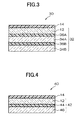
- Fig. 3 is a cross-sectional view showing an example of the structure of a tempered glass 30 according to the invention using a laminated glass as the glass material.
- a laminated glass 32 has a glass 12 formed by the float process or down draw process, a lower glass 34A, and a glass sheet 34B disposed below the lower glass 34A, and functional resin layers 36A, 36B therebetween.
- the laminated glass 32 has 3 glass sheets and 2 resin layers.
- the tempered glass 30 has a polymer layer 14, which is formed by chemically bonding the specific polymer to the upper surface of the glass 12 formed by the float process or down draw process.
- the laminated glass is such that a resin film is incorporated between 2 glass sheets.
- a functional resin film and a thermoplastic resin layer to be hereinafter described in detail are selected in accordance with the purposes and stacked beforehand to produce the laminated glass.
- the stack requires careful storage and handling because the thermoplastic resin layer has hygroscopicity and heat stretching properties and the functional film may be peeled off from the thermoplastic resin layer.
- a polyvinyl butyral sheet as the thermoplastic resin to form a stack having a functional film, greater care should be taken when the stack is stored or handled.
- concave and convex spots may be generated in the laminate in some cases.
- the laminated glass is generally produced by sandwiching the stack of the functional film and the polyvinyl butyral sheet between two glasses, and by bonding them under heat and pressure. It is important to increase the adhesive force between the functional film and the polyvinyl butyral sheet as described above, and also it is important to increase the adhesion to the glass from the viewpoint of impact resistance related to the laminated glass safety.
- the functional resin film for the laminated glass may be a transparent film or a sheet composed of the following polymer resin.
- the polymer resins include polyester resins such as polyethylene terephthalate, polyethylene-2,6-naphthalene dicarboxylate, and polybutylene terephthalate, polycarbonate resins, polyketones, polyolefin resins such as polyethylene and polypropylene, polyvinyl chloride, polysulfone, polyphenylene oxide, polymethacrylates, polyacrylates, polystyrene, polyamide resins, polyimide resins, cellophanes, and cellulose resins such as cellulose triacetate.
- biaxially stretched films of polyethylene terephthalate (PET) and polyethylene-2,6-naphthalene dicarboxylate (PEN) are most preferred because of their excellent size stability, transparency, smoothness, and mechanical properties.
- the surface is preferably coated with a highly refractive or high absorption substance such as a metal, a metal-containing compound, or an organic compound. It is preferred from the viewpoints of costs, durability, etc. that the metal or the metal-containing compound is used as the substance.
- the metal-containing compounds include metal oxides, metal nitrides, metal carbides, metal ion salts, and organic metal complexes.
- metal atoms of the metal or metal-containing compound include noble metals such as Ag, chemically stable Group 4A atoms of the Periodic Table of Elements such as titanium, zirconium, and hafnium, and Group 6A atoms such as chromium, and further include copper, nickel, vanadium, tantalum, and cerium.
- the refractive index of the high-refractive substance is preferably 1.4 to 2.1, more preferably 1.8 to 2.1.
- the molar absorbance coefficient of the high absorption substance is preferably 1,000 to 200,000, more preferably 10,000 to 200,000. It is preferred also that the glass is surface-coated directly with the metal or the metal compound by a known method such as a sputtering method, an arc deposition method, or an ion plating method.
- a further functional material may be added to the laminated glass enclosing the film or the tempered glass having the film on the surface, and examples of the functional materials include selective light transmitting materials such as ultraviolet absorption materials, ultraviolet reflecting materials, infrared absorption materials, and infrared reflecting materials, and low-reflect antidazzle materials, sound insulating materials, conductive materials, dielectric materials, and impact resistant materials (materials for increasing adhesion between the glass and the resin intermediate layer).
- the above materials may be used in the state of a single compound or a mixture with a polymer.
- the material is preferably introduced by (1) forming a film containing the functional compound or mixture and stacking the film, (2) vapor-depositing the functional compound onto the glass, or (3) applying or introducing a liquid paste containing the functional compound or mixture and fixing the paste under light, heat, or pressure.
- the conductive or selective light transmitting materials include thin films of indium oxide and tin oxide, thin films of tin oxide, and thin films of metals such as gold, silver, copper, and aluminium.
- the selective light transmitting materials through which invisible infrared ray in solar light hardly passes, include thin films of gold, silver, copper, aluminium, nickel, palladium, tin, alloys thereof, and mixtures thereof, materials prepared by stacking dielectric substances on one or both surfaces of the metal thin films, and materials prepared by stacking the metal thin films repeatedly.
- the dielectric substances include titanium oxide, bismuth oxide, zinc sulfide, tungsten oxide, indium oxide, zirconium oxide, and silicon oxide.
- the functional film preferably contains polyvinyl butyral, etc. to increase the adhesion to the glass. Further, in the case of stacking the functional film and polyvinyl butyral, etc., an adhesion layer of metal oxide derived from metal alcoholate by hydrolysis may be formed between them.
- the metal oxides include the above-mentioned, selectively light transmitting, dielectric substances, i.e. oxides of titanium, bismuth, tungsten, indium, zirconium, and silicon.
- the adhesion layer needs to show excellent adhesion to polyvinyl butyral sheet, etc. in addition to transparency, resistance (against heat, light, water, etc.), workability, etc., and the above metal oxide sufficiently has these properties. Further, the metal oxide per se has no adhesion properties, and thereby is excellent in handling in and after the step of forming the metal oxide layer on the functional film.
- the above metal oxide is generated by hydrolysis of a metal alcoholate as described above, and examples of the metal alcoholates include alkyl titanates, alkyl zirconates, and alkyl silicates.
- alkyl titanates include tetra-i-propoxytitanium, tetra-n-butoxytitanium, tetrakis(2-ethylhexoxy)titanium, di-i-propoxy-bis(acetylacetonato)titanium, and dihydroxy-bis(lactato)titaniurn.
- Specific examples of the alkyl zirconates and the alkyl silicates include compounds corresponding to the alkyl titanates.
- the alkyl titanate, alkyl zirconate, or alkyl silicate, etc. is preferably a monomer, or a multimer such as a dimer or a tetramer.
- the titanium or zirconate oxide film obtained by hydrolyzing the monomer, dimer, or tetramer of tetra-n-butoxytitanium, tetra-n-butoxyzirconate, etc. is particularly preferably excellent in adhesion to the polyvinyl butyral sheet.
- the polyvinyl butyral sheet which is stacked on the functional film, preferably contains a plasticizer, a thermal stabilizer, an ultraviolet absorber, a coloring agent, etc., which can be thermoplastically worked in principle.
- the polyvinyl butyral sheet formed thermoplastically contains a large amount of the plasticizer.
- the plasticizer content is generally 10 to 60% by weight, preferably 20 to 40% by weight.
- the plasticizer may be a phthalic ester such as dioctyl phthalate, a diethyleneglycol ester, a triethyleneglycol ester such as triethyleneglycol-di-2-ethyl butyrate, etc.
- the thickness of the sheet is 0.10 to 1.50 mm, preferably 0.30 to 0.80 mm.
- the smoothness of the surface of the sheet, which comes into contact with the functional film is 5 ⁇ m or less, preferably 2 ⁇ m or less.
- the smoothness is measured by a surface shape measuring apparatus to be hereinafter described.
- the surface smoothness is required for improving the storability of the laminated glass or the film-attached layered glass for window, an object of the invention, and further is important for producing a laminated glass window without concave and convex spots.
- the entire surface of the polyvinyl butyral sheet completely adheres to the functional film, whereby the smoothness of the boundary is not deteriorated even in the step of lamination under heat and pressure, and a uniform laminated glass or film-attached layered glass can be obtained without concave and convex spots.
- the other surface of the polyvinyl butyral sheet, which is not in contact with the functional film is brought into contact with a plate of a glass or rigid plastic and bonded thereto in the lamination step. In this step, the other surface or the plate generally has an embossed shape of 30 to 100 ⁇ m for so-called air removal.
- the above-described stack of the functional film and the polyvinyl butyral has a remarkably large adhesive force, and it is difficult to separate them.
- the stack is stored, handled, or used for a laminated glass or a film-attached surface glass window, the functional film is not peeled off even in the case of breaking the stack.
- the laminated glass may be produced by the steps of incorporating the stack of the polyvinyl butyral sheet, the functional film, and the polyvinyl butyral sheet, etc. between 2 transparent glass sheets, putting the components in a vacuum bag, and applying light, heat, and/or pressure.
- the laminated glass can be used for safety glass windows of automobiles or architectural structures.
- the laminated glass may be produced by the steps of attaching a stack of the polyvinyl butyral sheet and the functional film to a transparent glass sheet, putting the components in a vacuum bag, and applying light, heat, and/or pressure, whereby the laminated glass can be used for automobile windshields.
- the polyvinyl butyral sheet is sandwiched between the transparent glass sheet and the functional film.
- the surface of the polyvinyl butyral sheet which is not in contact with the functional film, generally has a roughness of 30 to 100 ⁇ m.
- the surface may be coated with a mold release film to prevent adhesion between the polyvinyl butyral sheets or dust adherence.
- the tempered glass of the invention has the glass formed by the float process or down draw process on the outermost surface, can be produced from various glass base materials, and has a surface excellent in the antifogging properties, the antisoiling properties, and the scratch resistance.
- the tempered glass of the invention has excellent antifogging and antisoiling properties and surface scratch resistance, and thus can be applied to various uses and can be used for window glasses of aircrafts and vehicles such as automobiles and trains, and window glasses of architectural structures, highly transparent glasses for display devices, mirrors and curved mirrors that are not fogged even under high humidity, etc.
- ⁇ Synthesis Example 1 synthesis of specific polymer (1)> 50 g of acrylamide, 3.4 g of mercaptopropyltrimethoxysilane, and 220 g of dimethylacetamide were added to a 500-ml, 3-necked flask, and 0.5 g of 2,2-azobis(2,4-dimethylvaleronitrile) was added thereto at 65°C under nitrogen flow. The mixture was maintained at the constant temperature for 6 hours while stirring, and then cooled to the room temperature. The mixture was added to 2 L of ethyl acetate, and the precipitated solid was isolated by filtration and water-washed to obtain a specific polymer (1). The dry weight of the product was 52.4 g.
- the polymer had a weight average molecular weight of 3,000. Further, it was confirmed by a 13 C-NMR (DMSO-d 6 ) analysis that the polymer was Example Compound II-1, in which a trimethoxysilyl group (50.0 ppm) was introduced to the end.
- Examples 1 to 12 ⁇ Preparation of polymer coating liquid composition (sol-gel liquid)> The following components were uniformly mixed, and stirred at 20°C for 2 hours to carry out hydrolysis, whereby a polymer coating liquid composition sol was obtained.
- Specific polymer compound shown in Table 1 0.21 g Tetramethoxysilane (hydrolyzable compound) 0.62 g Ethanol 4.7 g Water 4.7 g 1-N aqueous nitric acid (catalyst) 0.1 g
- Comparative Examples 1 to 4 Surface antifogging, antisoiling, tempered glass of Comparative Examples 1 to 4 were produced in the same manner as Examples 1 to 12 except for using base materials shown in Table 1 for glass sheets, respectively.
- a green signal at 100 m distant was visually observed through each of the tempered glasses of Examples 1 to 12 under natural sunlight in the open air in the daytime on a sunny day.
- the transparency was evaluated by the following 3 standards as compared with the base material glass sheet.
- Each of the above-obtained tempered glasses of Examples 1 to 12 and Comparative Examples 1 to 4 was exposed to water vapor for 1 minute under a fluorescent light in a room in the daytime, and then was separated from the water vapor.
- the glass was placed under conditions of 25°C and RH10%, and the fogging of the glass and the change thereof were evaluated by the following 3 standards under the same fluorescent light.
- a line was made by an oil ink (an oil marker available from Mitsubishi Pencil Co., Ltd.) on the surface of each tempered glass of Examples 1 to 12 and Comparative Examples 1 to 4. Water was thrown on the line, and running down of the ink was evaluated by the following 3 standards.
- oil ink an oil marker available from Mitsubishi Pencil Co., Ltd.
- a sample of each obtained tempered glass having a size of a window in a railway vehicle was prepared.
- the prepared sample was a laminated glass 40 for the vehicle having such a layer structure shown in Fig. 4 that a glass 12 having a polymer layer 14 on the surface was positioned on the outside of a vehicle laminated glass 42, an unstrengthened soda-lime silicate glass sheet 46 (thickness 2 mm) formed by a float process was positioned on the inside thereof, and an intermediate film 44 of polyvinyl butyral was positioned therebetween.
- a stone impact test was carried out such that small stones having a weight of about 2 g were made to impact 30 parts of each laminated glass sample by an air gun at an impact speed of 90 km/h at an impact incident angle of 0 degree.
- the test was designed for using the glass in windshields of vehicles.
- the impact resistance was evaluated using the following standards by counting the defects, which were scratches of 4 mm long or more and cracked portions, considered as exchanging basis.
- the tempered glasses produced by the method of the invention had high transparency, high antifogging and antisoiling properties, and excellent scratch resistance and impact resistance.
- the glasses of Comparative Examples 1 to 4 which were formed by processes other than the float process and down draw process, showed insufficient scratch resistance even when the polymer chains were bonded in the same manner as Examples.
- Examples 13 and 14 Tempered glasses of Examples 13 and 14 were produced in the same manner as Examples 1 to 12 except for using the glass base material and the specific polymer shown in Table 2 respectively.
- Tempered glasses having surfaces coated with siloxane of Comparative Examples 5 and 8 were produced by using the glass base materials shown in Table 2 and by performing the following treatment (the surface treatment A), respectively.
- the treatment agent a-1 prepared in Synthesis Example was applied by a flow coating method to a glass base material shown in Table 2, and was thermally hardened at 130°C for 1 hour. Then, the base material coated with the hardened treatment agent a-1 was further flow-coated with the above produced treatment agent b-1, and the resultant was heated at 100°C for 1 hour. The resulting material was wiped with tissue paper moistened with ethanol and dried at the room temperature for 1 hour, and thus a surface siloxane treatment was carried out to obtain a surface treatment glass of Comparative Example 5.
- the silica sol liquid is added to and mixed with the silica sol liquid to obtain a first liquid such that the weight ratio of the fluororesin in the liquid to the solid contents of the silica sol having an average molecular weight of about 3,000 is approximately 80% by weight.
- the first liquid is diluted with ethyleneglycol monoethylether such that the total solid content is about 3% by weight, to obtain a second liquid.
- a coating liquid of the second liquid was applied to a surface of a glass base material, and heated at approximately 620°C for about 10 minutes to form an SiO 2 thin film having a thickness of approximately 0.1 ⁇ m, whereby surface-treated glasses of Comparative Examples 6 and 9 were obtained.
- the resultant was left and dried in the air for about 30 minutes, and burned at 500°C for 30 minutes, to obtain surface treatment glasses of Comparative Examples 7 and 10.
- the thickness was about 70 nm.
- an X-ray diffraction measurement it was found that the formed film had an anatase titanium oxide structure.
- the tempered glasses of Examples 13 and 14 obtained by the sol-gel treatment according to the invention had high transparency, high antifogging and antisoiling properties, and excellent scratch resistance.
- the surface-treated glasses of Comparative Examples 5 to 10 which were made hydrophilic or water-repellent by methods other than that of the invention, showed lower antifogging properties, antisoiling properties, and scratch resistance as compared with Examples even when the smooth glass base material formed by the float process.
- Example 15 A tempered glass of Example 15 was produced in the same manner as Example 13 except for using a layered glass of 2 glass sheets shown in Table 3 to chemically bond a polymer chain to a surface of an upper layer of an aluminosilicate glass.
- An ST type polyvinyl butyral (PVB) sheet having a thickness of 0.38 mm (available from Sekisui Chemical Co., Ltd.) was prepared, and a surface of the PVB, which is brought into contact with the functional film, was smoothed.
- the smoothing was carried out such that a template film having a PET base material coated with a silicon resin (thickness 38 ⁇ m) was put on a surface of the PVB and formed at 120°C for 30 minutes under a pressure of 50 g/cm 2 .
- the smoothed surface had a roughness of 1.5 ⁇ m or less, and the other surface had an embossed shape and a roughness of 50 ⁇ m.
- a biaxially stretched PET having a thickness of 100 ⁇ m was used as the functional film for improving impact resistance.
- a tempered glass of Example 16 was produced by chemically bonding a polymer chain to the uppermost layer of the aluminosilicate glass in the same manner as Example 13.
- Tempered glasses of Comparative Examples 11 and 12 were produced in the same manner as Examples 15 and 16 except for not treated the layered glass and the laminated glass with the specific polymer treatment according to the invention, respectively.
- the tempered glasses of Examples 15 and 16, and Comparative Examples 11 and 12 were evaluated in the same manner as Examples 1 to 12. The results are shown in Table 3.
- Example 15 Layerd glass of upper layer of aluminosilicate and lower layer of soda lime Float process Sol-gel treatment of the invention with specific polymer II-3 A A A B Comparative Example 11 Layerd glass of upper layer of aluminosilicate and lower layer of soda lime Float process Untreated A C C C
- Example 16 Laminated glass of upper layer of aluminosilicate, intermediate layer of PET & PVB, and lower layer of soda lime Float process Sol-gel treatment of the invention with specific polymer II-3 A A A A Comparative Example 12 Laminated glass of upper layer of aluminosilicate, intermediate layer of PET & PVB, and lower layer of soda lime Float process Untreated A C C B
- the glass materials obtained by the sol-gel treatment of the invention could be preferably applied to the layered glass or laminated glass, and showed high transparency, high antifogging and antisoiling properties, and excellent impact resistance.
- Example 15 Comparative Example 11
- Example 16 Comparative Example 12
Landscapes
- Chemical & Material Sciences (AREA)
- Life Sciences & Earth Sciences (AREA)
- Engineering & Computer Science (AREA)
- Chemical Kinetics & Catalysis (AREA)
- General Chemical & Material Sciences (AREA)
- Geochemistry & Mineralogy (AREA)
- Materials Engineering (AREA)
- Organic Chemistry (AREA)
- Surface Treatment Of Glass (AREA)
- Joining Of Glass To Other Materials (AREA)
- Paints Or Removers (AREA)
Applications Claiming Priority (1)
| Application Number | Priority Date | Filing Date | Title |
|---|---|---|---|
| JP2005333323A JP2007137713A (ja) | 2005-11-17 | 2005-11-17 | 表面防曇かつ防汚性強化ガラス及びその製造方法 |
Publications (2)
| Publication Number | Publication Date |
|---|---|
| EP1787964A2 true EP1787964A2 (de) | 2007-05-23 |
| EP1787964A3 EP1787964A3 (de) | 2007-10-24 |
Family
ID=37875741
Family Applications (1)
| Application Number | Title | Priority Date | Filing Date |
|---|---|---|---|
| EP20060023821 Withdrawn EP1787964A3 (de) | 2005-11-17 | 2006-11-16 | Gehärtetes Glas mit beschlagverhindernder und schmutzabweisenden Oberfläche und Verfahren zu seine Herstellung |
Country Status (3)
| Country | Link |
|---|---|
| US (1) | US20070224427A1 (de) |
| EP (1) | EP1787964A3 (de) |
| JP (1) | JP2007137713A (de) |
Cited By (2)
| Publication number | Priority date | Publication date | Assignee | Title |
|---|---|---|---|---|
| CN105682921A (zh) * | 2013-08-30 | 2016-06-15 | 康宁股份有限公司 | 轻量化、高刚度玻璃层叠结构 |
| US11305517B2 (en) | 2012-05-31 | 2022-04-19 | Corning Incorporated | Stiff interlayers for laminated glass structures |
Families Citing this family (19)
| Publication number | Priority date | Publication date | Assignee | Title |
|---|---|---|---|---|
| US8021749B2 (en) * | 2006-12-20 | 2011-09-20 | Nippon Sheet Glass Company, Limited | Article with organic-inorganic composite film |
| JP2009252347A (ja) * | 2008-04-01 | 2009-10-29 | Panasonic Corp | プラズマディスプレイパネルおよびその製造方法 |
| TWI547369B (zh) * | 2011-05-27 | 2016-09-01 | 康寧公司 | 玻璃塑膠積層之裝置、處理線、及方法 |
| US8969096B2 (en) * | 2011-09-01 | 2015-03-03 | Toyota Motor Engineering & Manufacturing North America, Inc. | Automotive fogging analyses by xenon UV exposure |
| CN107540242B (zh) | 2012-02-28 | 2020-11-20 | 康宁股份有限公司 | 具有低摩擦涂层的玻璃制品 |
| US10737973B2 (en) | 2012-02-28 | 2020-08-11 | Corning Incorporated | Pharmaceutical glass coating for achieving particle reduction |
| US11497681B2 (en) | 2012-02-28 | 2022-11-15 | Corning Incorporated | Glass articles with low-friction coatings |
| US10273048B2 (en) | 2012-06-07 | 2019-04-30 | Corning Incorporated | Delamination resistant glass containers with heat-tolerant coatings |
| RU2674269C2 (ru) | 2012-06-07 | 2018-12-06 | Корнинг Инкорпорейтед | Стойкие к расслаиванию стеклянные контейнеры |
| US9034442B2 (en) | 2012-11-30 | 2015-05-19 | Corning Incorporated | Strengthened borosilicate glass containers with improved damage tolerance |
| US10117806B2 (en) | 2012-11-30 | 2018-11-06 | Corning Incorporated | Strengthened glass containers resistant to delamination and damage |
| EP3107875B1 (de) * | 2014-02-20 | 2018-06-13 | Corning Incorporated | Uv-lichtbleichung von glas mit uv-induzierter kolorierung |
| RU2691189C2 (ru) | 2014-09-05 | 2019-06-11 | Корнинг Инкорпорейтед | Стеклянные изделия и способы повышения надежности стеклянных изделий |
| EP3206998B1 (de) | 2014-11-26 | 2021-09-08 | Corning Incorporated | Verfahren zur herstellung von gehärteten und beständigen glasbehältern |
| EP3150564B1 (de) | 2015-09-30 | 2018-12-05 | Corning Incorporated | Halogenierte chemische polyimidsiloxanzusammensetzungen und glasgegenstände mit halogenierten polylmidsiloxanbeschichtungen mit geringer reibung |
| US20170121058A1 (en) | 2015-10-30 | 2017-05-04 | Corning Incorporated | Glass articles with mixed polymer and metal oxide coatings |
| CN108779382B (zh) * | 2016-03-11 | 2021-09-28 | 松下知识产权经营株式会社 | 抗静电材料、其制造方法和抗静电膜 |
| WO2018021499A1 (ja) * | 2016-07-29 | 2018-02-01 | 日本板硝子株式会社 | ウインドシールド及びウインドシールドの製造方法 |
| WO2022051645A2 (en) | 2020-09-04 | 2022-03-10 | Corning Incorporated | Ultraviolet light-blocking coated pharmaceutical packages |
Family Cites Families (7)
| Publication number | Priority date | Publication date | Assignee | Title |
|---|---|---|---|---|
| GB1138065A (en) * | 1965-09-16 | 1968-12-27 | Ici Ltd | Grafting polymers on glass and like siliceous materials |
| JPS5895630A (ja) * | 1981-11-28 | 1983-06-07 | Nippon Valqua Ind Ltd | ガラス及びガラス繊維の親水化方法 |
| JPS5895629A (ja) * | 1981-11-28 | 1983-06-07 | Nippon Valqua Ind Ltd | ガラス及びガラス繊維の親水化方法 |
| US4567107A (en) * | 1982-05-05 | 1986-01-28 | Essex Specialty Products, Inc. | Acrylic resin having pendant silane groups thereon, and methods of making and using the same |
| FR2590583B1 (fr) * | 1985-11-28 | 1988-01-29 | Saint Gobain Rech | Procede de greffage de composes organiques non satures sur des fibres de verre |
| FR2800998B1 (fr) * | 1999-11-17 | 2002-04-26 | Saint Gobain Vitrage | Substrat transparent comportant un revetement antireflet |
| US7238401B1 (en) * | 2000-06-09 | 2007-07-03 | 3M Innovative Properties Company | Glazing element and laminate for use in the same |
-
2005
- 2005-11-17 JP JP2005333323A patent/JP2007137713A/ja not_active Withdrawn
-
2006
- 2006-11-16 EP EP20060023821 patent/EP1787964A3/de not_active Withdrawn
- 2006-11-16 US US11/600,114 patent/US20070224427A1/en not_active Abandoned
Cited By (3)
| Publication number | Priority date | Publication date | Assignee | Title |
|---|---|---|---|---|
| US11305517B2 (en) | 2012-05-31 | 2022-04-19 | Corning Incorporated | Stiff interlayers for laminated glass structures |
| CN105682921A (zh) * | 2013-08-30 | 2016-06-15 | 康宁股份有限公司 | 轻量化、高刚度玻璃层叠结构 |
| CN105682921B (zh) * | 2013-08-30 | 2018-10-19 | 康宁股份有限公司 | 轻量化、高刚度玻璃层叠结构 |
Also Published As
| Publication number | Publication date |
|---|---|
| JP2007137713A (ja) | 2007-06-07 |
| EP1787964A3 (de) | 2007-10-24 |
| US20070224427A1 (en) | 2007-09-27 |
Similar Documents
| Publication | Publication Date | Title |
|---|---|---|
| EP1787964A2 (de) | Gehärtetes Glas mit beschlagverhindernder und schmutzabweisenden Oberfläche und Verfahren zu seine Herstellung | |
| US8012591B2 (en) | Hydrophilic composition and hydrophilic member | |
| US8304083B2 (en) | Hydrophilic member and process for producing the same | |
| US7955656B2 (en) | Hydrophilic member and process for producing the same | |
| US20100196724A1 (en) | Hydrophilic film forming composition and hydrophilic member | |
| EP1970196A2 (de) | Hydrophiles Element und Herstellungsverfahren dafür | |
| US20100243221A1 (en) | Hydrophilic coating composition and hydrophilic member using the same | |
| KR20100112146A (ko) | 친수성 부재 | |
| EP1905784A1 (de) | Zusammensetzung zur Bildung eines hydrophilen Films und hydrophiles Element | |
| US20080177022A1 (en) | Hydrophilic film forming composition and hydrophilic member | |
| JP2008279736A (ja) | 親水性部材及びその製造方法 | |
| EP2180024A1 (de) | Hydrophile filmbildende zusammensetzung, sprühzusammensetzung und hydrophiles element damit | |
| JP2008308659A (ja) | 親水性膜形成用組成物、親水性部材及び親水性部材の製造方法 | |
| JP2009079076A (ja) | 親水性ポリマー、親水性膜形成用組成物および親水性部材 | |
| JP4951451B2 (ja) | カーボンナノチューブ層含有構造体 | |
| JP2008195856A (ja) | 親水性部材及びその製造方法 | |
| JP2008222998A (ja) | 親水性組成物及び親水性部材 | |
| JP2008308658A (ja) | 親水性膜形成用組成物、親水性部材及び親水性部材の製造方法 | |
| JP2008253985A (ja) | 親水性部材およびその製造方法 | |
| JP2008285530A (ja) | 親水性膜形成用組成物及び親水性部材 | |
| US20090263605A1 (en) | Surface-hydrophilic structure | |
| JP2012203150A (ja) | 親水性反射防止膜 | |
| US20080075873A1 (en) | Coating composition, hydrophilic member and production method thereof | |
| JP2009227808A (ja) | 親水性組成物及び親水性部材 | |
| JP2008248034A (ja) | 親水性組成物、親水性部材ならびにその製造方法 |
Legal Events
| Date | Code | Title | Description |
|---|---|---|---|
| PUAI | Public reference made under article 153(3) epc to a published international application that has entered the european phase |
Free format text: ORIGINAL CODE: 0009012 |
|
| AK | Designated contracting states |
Kind code of ref document: A2 Designated state(s): AT BE BG CH CY CZ DE DK EE ES FI FR GB GR HU IE IS IT LI LT LU LV MC NL PL PT RO SE SI SK TR |
|
| AX | Request for extension of the european patent |
Extension state: AL BA HR MK YU |
|
| PUAL | Search report despatched |
Free format text: ORIGINAL CODE: 0009013 |
|
| AK | Designated contracting states |
Kind code of ref document: A3 Designated state(s): AT BE BG CH CY CZ DE DK EE ES FI FR GB GR HU IE IS IT LI LT LU LV MC NL PL PT RO SE SI SK TR |
|
| AX | Request for extension of the european patent |
Extension state: AL BA HR MK YU |
|
| AKX | Designation fees paid | ||
| STAA | Information on the status of an ep patent application or granted ep patent |
Free format text: STATUS: THE APPLICATION IS DEEMED TO BE WITHDRAWN |
|
| 18D | Application deemed to be withdrawn |
Effective date: 20080425 |
|
| REG | Reference to a national code |
Ref country code: DE Ref legal event code: 8566 |