EP1787967A1 - Formmasse zum Herstellen einer feuerfesten Auskleidung - Google Patents
Formmasse zum Herstellen einer feuerfesten Auskleidung Download PDFInfo
- Publication number
- EP1787967A1 EP1787967A1 EP20050025360 EP05025360A EP1787967A1 EP 1787967 A1 EP1787967 A1 EP 1787967A1 EP 20050025360 EP20050025360 EP 20050025360 EP 05025360 A EP05025360 A EP 05025360A EP 1787967 A1 EP1787967 A1 EP 1787967A1
- Authority
- EP
- European Patent Office
- Prior art keywords
- less
- molding
- fired
- weight
- molding composition
- Prior art date
- Legal status (The legal status is an assumption and is not a legal conclusion. Google has not performed a legal analysis and makes no representation as to the accuracy of the status listed.)
- Granted
Links
- 239000000203 mixture Substances 0.000 title claims abstract description 19
- 238000004519 manufacturing process Methods 0.000 title claims abstract description 9
- 238000000465 moulding Methods 0.000 title claims description 57
- HBMJWWWQQXIZIP-UHFFFAOYSA-N silicon carbide Chemical compound [Si+]#[C-] HBMJWWWQQXIZIP-UHFFFAOYSA-N 0.000 claims abstract description 19
- 229910010271 silicon carbide Inorganic materials 0.000 claims abstract description 15
- PNEYBMLMFCGWSK-UHFFFAOYSA-N Alumina Chemical compound [O-2].[O-2].[O-2].[Al+3].[Al+3] PNEYBMLMFCGWSK-UHFFFAOYSA-N 0.000 claims abstract description 11
- 238000002485 combustion reaction Methods 0.000 claims abstract description 11
- RMAQACBXLXPBSY-UHFFFAOYSA-N silicic acid Chemical compound O[Si](O)(O)O RMAQACBXLXPBSY-UHFFFAOYSA-N 0.000 claims abstract description 6
- 235000012239 silicon dioxide Nutrition 0.000 claims abstract description 6
- 150000001875 compounds Chemical class 0.000 claims description 27
- VYPSYNLAJGMNEJ-UHFFFAOYSA-N Silicium dioxide Chemical compound O=[Si]=O VYPSYNLAJGMNEJ-UHFFFAOYSA-N 0.000 claims description 14
- YKTSYUJCYHOUJP-UHFFFAOYSA-N [O--].[Al+3].[Al+3].[O-][Si]([O-])([O-])[O-] Chemical compound [O--].[Al+3].[Al+3].[O-][Si]([O-])([O-])[O-] YKTSYUJCYHOUJP-UHFFFAOYSA-N 0.000 claims description 13
- 238000010304 firing Methods 0.000 claims description 7
- 238000000034 method Methods 0.000 claims description 7
- 229910021487 silica fume Inorganic materials 0.000 claims description 5
- 239000008119 colloidal silica Substances 0.000 claims description 4
- 238000001035 drying Methods 0.000 claims description 4
- TWNQGVIAIRXVLR-UHFFFAOYSA-N oxo(oxoalumanyloxy)alumane Chemical compound O=[Al]O[Al]=O TWNQGVIAIRXVLR-UHFFFAOYSA-N 0.000 claims description 4
- XLYOFNOQVPJJNP-UHFFFAOYSA-N water Substances O XLYOFNOQVPJJNP-UHFFFAOYSA-N 0.000 claims description 4
- 239000011241 protective layer Substances 0.000 claims description 3
- 230000004888 barrier function Effects 0.000 claims description 2
- 239000011248 coating agent Substances 0.000 claims description 2
- 238000000576 coating method Methods 0.000 claims description 2
- 230000007613 environmental effect Effects 0.000 claims description 2
- 239000007788 liquid Substances 0.000 claims description 2
- 239000002245 particle Substances 0.000 claims description 2
- 239000007787 solid Substances 0.000 claims description 2
- 230000009191 jumping Effects 0.000 claims 1
- 238000004382 potting Methods 0.000 claims 1
- 239000000463 material Substances 0.000 abstract description 7
- 238000002156 mixing Methods 0.000 abstract description 2
- 239000005995 Aluminium silicate Substances 0.000 abstract 1
- BPQQTUXANYXVAA-UHFFFAOYSA-N Orthosilicate Chemical compound [O-][Si]([O-])([O-])[O-] BPQQTUXANYXVAA-UHFFFAOYSA-N 0.000 abstract 1
- TWHBEKGYWPPYQL-UHFFFAOYSA-N aluminium carbide Chemical compound [C-4].[C-4].[C-4].[Al+3].[Al+3].[Al+3].[Al+3] TWHBEKGYWPPYQL-UHFFFAOYSA-N 0.000 abstract 1
- 235000012211 aluminium silicate Nutrition 0.000 abstract 1
- PZZYQPZGQPZBDN-UHFFFAOYSA-N aluminium silicate Chemical compound O=[Al]O[Si](=O)O[Al]=O PZZYQPZGQPZBDN-UHFFFAOYSA-N 0.000 abstract 1
- 229910000323 aluminium silicate Inorganic materials 0.000 abstract 1
- 239000011343 solid material Substances 0.000 abstract 1
- 239000000919 ceramic Substances 0.000 description 12
- 238000005266 casting Methods 0.000 description 7
- 239000012778 molding material Substances 0.000 description 5
- 238000005245 sintering Methods 0.000 description 5
- 229910004298 SiO 2 Inorganic materials 0.000 description 4
- 239000011153 ceramic matrix composite Substances 0.000 description 4
- 239000002131 composite material Substances 0.000 description 4
- 239000000377 silicon dioxide Substances 0.000 description 4
- 239000000126 substance Substances 0.000 description 4
- KZHJGOXRZJKJNY-UHFFFAOYSA-N dioxosilane;oxo(oxoalumanyloxy)alumane Chemical compound O=[Si]=O.O=[Si]=O.O=[Al]O[Al]=O.O=[Al]O[Al]=O.O=[Al]O[Al]=O KZHJGOXRZJKJNY-UHFFFAOYSA-N 0.000 description 3
- 229910052863 mullite Inorganic materials 0.000 description 3
- 230000008569 process Effects 0.000 description 3
- 238000005452 bending Methods 0.000 description 2
- 230000008901 benefit Effects 0.000 description 2
- 239000000470 constituent Substances 0.000 description 2
- 238000001816 cooling Methods 0.000 description 2
- 239000010410 layer Substances 0.000 description 2
- 239000011226 reinforced ceramic Substances 0.000 description 2
- 229910052814 silicon oxide Inorganic materials 0.000 description 2
- 238000003980 solgel method Methods 0.000 description 2
- 238000007711 solidification Methods 0.000 description 2
- 230000008023 solidification Effects 0.000 description 2
- 229910018072 Al 2 O 3 Inorganic materials 0.000 description 1
- 229910052791 calcium Inorganic materials 0.000 description 1
- 239000011575 calcium Substances 0.000 description 1
- -1 calcium aluminates Chemical class 0.000 description 1
- 229910010293 ceramic material Inorganic materials 0.000 description 1
- 239000004927 clay Substances 0.000 description 1
- 238000005260 corrosion Methods 0.000 description 1
- 230000007797 corrosion Effects 0.000 description 1
- 229910052593 corundum Inorganic materials 0.000 description 1
- 239000010431 corundum Substances 0.000 description 1
- 238000010586 diagram Methods 0.000 description 1
- 238000005516 engineering process Methods 0.000 description 1
- 239000000835 fiber Substances 0.000 description 1
- 239000012467 final product Substances 0.000 description 1
- 238000012423 maintenance Methods 0.000 description 1
- 239000007769 metal material Substances 0.000 description 1
- 238000013001 point bending Methods 0.000 description 1
- 238000002360 preparation method Methods 0.000 description 1
- 230000001681 protective effect Effects 0.000 description 1
- 230000009467 reduction Effects 0.000 description 1
- 230000002787 reinforcement Effects 0.000 description 1
Images
Classifications
-
- C—CHEMISTRY; METALLURGY
- C04—CEMENTS; CONCRETE; ARTIFICIAL STONE; CERAMICS; REFRACTORIES
- C04B—LIME, MAGNESIA; SLAG; CEMENTS; COMPOSITIONS THEREOF, e.g. MORTARS, CONCRETE OR LIKE BUILDING MATERIALS; ARTIFICIAL STONE; CERAMICS; REFRACTORIES; TREATMENT OF NATURAL STONE
- C04B35/00—Shaped ceramic products characterised by their composition; Ceramics compositions; Processing powders of inorganic compounds preparatory to the manufacturing of ceramic products
- C04B35/515—Shaped ceramic products characterised by their composition; Ceramics compositions; Processing powders of inorganic compounds preparatory to the manufacturing of ceramic products based on non-oxide ceramics
- C04B35/56—Shaped ceramic products characterised by their composition; Ceramics compositions; Processing powders of inorganic compounds preparatory to the manufacturing of ceramic products based on non-oxide ceramics based on carbides or oxycarbides
- C04B35/565—Shaped ceramic products characterised by their composition; Ceramics compositions; Processing powders of inorganic compounds preparatory to the manufacturing of ceramic products based on non-oxide ceramics based on carbides or oxycarbides based on silicon carbide
-
- C—CHEMISTRY; METALLURGY
- C04—CEMENTS; CONCRETE; ARTIFICIAL STONE; CERAMICS; REFRACTORIES
- C04B—LIME, MAGNESIA; SLAG; CEMENTS; COMPOSITIONS THEREOF, e.g. MORTARS, CONCRETE OR LIKE BUILDING MATERIALS; ARTIFICIAL STONE; CERAMICS; REFRACTORIES; TREATMENT OF NATURAL STONE
- C04B35/00—Shaped ceramic products characterised by their composition; Ceramics compositions; Processing powders of inorganic compounds preparatory to the manufacturing of ceramic products
- C04B35/622—Forming processes; Processing powders of inorganic compounds preparatory to the manufacturing of ceramic products
- C04B35/626—Preparing or treating the powders individually or as batches ; preparing or treating macroscopic reinforcing agents for ceramic products, e.g. fibres; mechanical aspects section B
- C04B35/62605—Treating the starting powders individually or as mixtures
- C04B35/62625—Wet mixtures
- C04B35/6263—Wet mixtures characterised by their solids loadings, i.e. the percentage of solids
-
- C—CHEMISTRY; METALLURGY
- C04—CEMENTS; CONCRETE; ARTIFICIAL STONE; CERAMICS; REFRACTORIES
- C04B—LIME, MAGNESIA; SLAG; CEMENTS; COMPOSITIONS THEREOF, e.g. MORTARS, CONCRETE OR LIKE BUILDING MATERIALS; ARTIFICIAL STONE; CERAMICS; REFRACTORIES; TREATMENT OF NATURAL STONE
- C04B35/00—Shaped ceramic products characterised by their composition; Ceramics compositions; Processing powders of inorganic compounds preparatory to the manufacturing of ceramic products
- C04B35/622—Forming processes; Processing powders of inorganic compounds preparatory to the manufacturing of ceramic products
- C04B35/626—Preparing or treating the powders individually or as batches ; preparing or treating macroscopic reinforcing agents for ceramic products, e.g. fibres; mechanical aspects section B
- C04B35/62605—Treating the starting powders individually or as mixtures
- C04B35/62645—Thermal treatment of powders or mixtures thereof other than sintering
- C04B35/62655—Drying, e.g. freeze-drying, spray-drying, microwave or supercritical drying
-
- C—CHEMISTRY; METALLURGY
- C04—CEMENTS; CONCRETE; ARTIFICIAL STONE; CERAMICS; REFRACTORIES
- C04B—LIME, MAGNESIA; SLAG; CEMENTS; COMPOSITIONS THEREOF, e.g. MORTARS, CONCRETE OR LIKE BUILDING MATERIALS; ARTIFICIAL STONE; CERAMICS; REFRACTORIES; TREATMENT OF NATURAL STONE
- C04B38/00—Porous mortars, concrete, artificial stone or ceramic ware; Preparation thereof
- C04B38/0051—Porous mortars, concrete, artificial stone or ceramic ware; Preparation thereof characterised by the pore size, pore shape or kind of porosity
- C04B38/0058—Porous mortars, concrete, artificial stone or ceramic ware; Preparation thereof characterised by the pore size, pore shape or kind of porosity open porosity
-
- C—CHEMISTRY; METALLURGY
- C04—CEMENTS; CONCRETE; ARTIFICIAL STONE; CERAMICS; REFRACTORIES
- C04B—LIME, MAGNESIA; SLAG; CEMENTS; COMPOSITIONS THEREOF, e.g. MORTARS, CONCRETE OR LIKE BUILDING MATERIALS; ARTIFICIAL STONE; CERAMICS; REFRACTORIES; TREATMENT OF NATURAL STONE
- C04B2111/00—Mortars, concrete or artificial stone or mixtures to prepare them, characterised by specific function, property or use
- C04B2111/00474—Uses not provided for elsewhere in C04B2111/00
- C04B2111/00982—Uses not provided for elsewhere in C04B2111/00 as construction elements for space vehicles or aeroplanes
-
- C—CHEMISTRY; METALLURGY
- C04—CEMENTS; CONCRETE; ARTIFICIAL STONE; CERAMICS; REFRACTORIES
- C04B—LIME, MAGNESIA; SLAG; CEMENTS; COMPOSITIONS THEREOF, e.g. MORTARS, CONCRETE OR LIKE BUILDING MATERIALS; ARTIFICIAL STONE; CERAMICS; REFRACTORIES; TREATMENT OF NATURAL STONE
- C04B2235/00—Aspects relating to ceramic starting mixtures or sintered ceramic products
- C04B2235/02—Composition of constituents of the starting material or of secondary phases of the final product
- C04B2235/30—Constituents and secondary phases not being of a fibrous nature
- C04B2235/32—Metal oxides, mixed metal oxides, or oxide-forming salts thereof, e.g. carbonates, nitrates, (oxy)hydroxides, chlorides
- C04B2235/3217—Aluminum oxide or oxide forming salts thereof, e.g. bauxite, alpha-alumina
-
- C—CHEMISTRY; METALLURGY
- C04—CEMENTS; CONCRETE; ARTIFICIAL STONE; CERAMICS; REFRACTORIES
- C04B—LIME, MAGNESIA; SLAG; CEMENTS; COMPOSITIONS THEREOF, e.g. MORTARS, CONCRETE OR LIKE BUILDING MATERIALS; ARTIFICIAL STONE; CERAMICS; REFRACTORIES; TREATMENT OF NATURAL STONE
- C04B2235/00—Aspects relating to ceramic starting mixtures or sintered ceramic products
- C04B2235/02—Composition of constituents of the starting material or of secondary phases of the final product
- C04B2235/30—Constituents and secondary phases not being of a fibrous nature
- C04B2235/32—Metal oxides, mixed metal oxides, or oxide-forming salts thereof, e.g. carbonates, nitrates, (oxy)hydroxides, chlorides
- C04B2235/3217—Aluminum oxide or oxide forming salts thereof, e.g. bauxite, alpha-alumina
- C04B2235/3218—Aluminium (oxy)hydroxides, e.g. boehmite, gibbsite, alumina sol
-
- C—CHEMISTRY; METALLURGY
- C04—CEMENTS; CONCRETE; ARTIFICIAL STONE; CERAMICS; REFRACTORIES
- C04B—LIME, MAGNESIA; SLAG; CEMENTS; COMPOSITIONS THEREOF, e.g. MORTARS, CONCRETE OR LIKE BUILDING MATERIALS; ARTIFICIAL STONE; CERAMICS; REFRACTORIES; TREATMENT OF NATURAL STONE
- C04B2235/00—Aspects relating to ceramic starting mixtures or sintered ceramic products
- C04B2235/02—Composition of constituents of the starting material or of secondary phases of the final product
- C04B2235/30—Constituents and secondary phases not being of a fibrous nature
- C04B2235/34—Non-metal oxides, non-metal mixed oxides, or salts thereof that form the non-metal oxides upon heating, e.g. carbonates, nitrates, (oxy)hydroxides, chlorides
- C04B2235/3418—Silicon oxide, silicic acids or oxide forming salts thereof, e.g. silica sol, fused silica, silica fume, cristobalite, quartz or flint
-
- C—CHEMISTRY; METALLURGY
- C04—CEMENTS; CONCRETE; ARTIFICIAL STONE; CERAMICS; REFRACTORIES
- C04B—LIME, MAGNESIA; SLAG; CEMENTS; COMPOSITIONS THEREOF, e.g. MORTARS, CONCRETE OR LIKE BUILDING MATERIALS; ARTIFICIAL STONE; CERAMICS; REFRACTORIES; TREATMENT OF NATURAL STONE
- C04B2235/00—Aspects relating to ceramic starting mixtures or sintered ceramic products
- C04B2235/02—Composition of constituents of the starting material or of secondary phases of the final product
- C04B2235/30—Constituents and secondary phases not being of a fibrous nature
- C04B2235/34—Non-metal oxides, non-metal mixed oxides, or salts thereof that form the non-metal oxides upon heating, e.g. carbonates, nitrates, (oxy)hydroxides, chlorides
- C04B2235/3427—Silicates other than clay, e.g. water glass
- C04B2235/3463—Alumino-silicates other than clay, e.g. mullite
-
- C—CHEMISTRY; METALLURGY
- C04—CEMENTS; CONCRETE; ARTIFICIAL STONE; CERAMICS; REFRACTORIES
- C04B—LIME, MAGNESIA; SLAG; CEMENTS; COMPOSITIONS THEREOF, e.g. MORTARS, CONCRETE OR LIKE BUILDING MATERIALS; ARTIFICIAL STONE; CERAMICS; REFRACTORIES; TREATMENT OF NATURAL STONE
- C04B2235/00—Aspects relating to ceramic starting mixtures or sintered ceramic products
- C04B2235/02—Composition of constituents of the starting material or of secondary phases of the final product
- C04B2235/50—Constituents or additives of the starting mixture chosen for their shape or used because of their shape or their physical appearance
- C04B2235/54—Particle size related information
- C04B2235/5418—Particle size related information expressed by the size of the particles or aggregates thereof
- C04B2235/5427—Particle size related information expressed by the size of the particles or aggregates thereof millimeter or submillimeter sized, i.e. larger than 0,1 mm
-
- C—CHEMISTRY; METALLURGY
- C04—CEMENTS; CONCRETE; ARTIFICIAL STONE; CERAMICS; REFRACTORIES
- C04B—LIME, MAGNESIA; SLAG; CEMENTS; COMPOSITIONS THEREOF, e.g. MORTARS, CONCRETE OR LIKE BUILDING MATERIALS; ARTIFICIAL STONE; CERAMICS; REFRACTORIES; TREATMENT OF NATURAL STONE
- C04B2235/00—Aspects relating to ceramic starting mixtures or sintered ceramic products
- C04B2235/70—Aspects relating to sintered or melt-casted ceramic products
- C04B2235/74—Physical characteristics
- C04B2235/77—Density
-
- C—CHEMISTRY; METALLURGY
- C04—CEMENTS; CONCRETE; ARTIFICIAL STONE; CERAMICS; REFRACTORIES
- C04B—LIME, MAGNESIA; SLAG; CEMENTS; COMPOSITIONS THEREOF, e.g. MORTARS, CONCRETE OR LIKE BUILDING MATERIALS; ARTIFICIAL STONE; CERAMICS; REFRACTORIES; TREATMENT OF NATURAL STONE
- C04B2235/00—Aspects relating to ceramic starting mixtures or sintered ceramic products
- C04B2235/70—Aspects relating to sintered or melt-casted ceramic products
- C04B2235/80—Phases present in the sintered or melt-cast ceramic products other than the main phase
-
- C—CHEMISTRY; METALLURGY
- C04—CEMENTS; CONCRETE; ARTIFICIAL STONE; CERAMICS; REFRACTORIES
- C04B—LIME, MAGNESIA; SLAG; CEMENTS; COMPOSITIONS THEREOF, e.g. MORTARS, CONCRETE OR LIKE BUILDING MATERIALS; ARTIFICIAL STONE; CERAMICS; REFRACTORIES; TREATMENT OF NATURAL STONE
- C04B2235/00—Aspects relating to ceramic starting mixtures or sintered ceramic products
- C04B2235/70—Aspects relating to sintered or melt-casted ceramic products
- C04B2235/96—Properties of ceramic products, e.g. mechanical properties such as strength, toughness, wear resistance
-
- Y—GENERAL TAGGING OF NEW TECHNOLOGICAL DEVELOPMENTS; GENERAL TAGGING OF CROSS-SECTIONAL TECHNOLOGIES SPANNING OVER SEVERAL SECTIONS OF THE IPC; TECHNICAL SUBJECTS COVERED BY FORMER USPC CROSS-REFERENCE ART COLLECTIONS [XRACs] AND DIGESTS
- Y10—TECHNICAL SUBJECTS COVERED BY FORMER USPC
- Y10T—TECHNICAL SUBJECTS COVERED BY FORMER US CLASSIFICATION
- Y10T428/00—Stock material or miscellaneous articles
- Y10T428/249921—Web or sheet containing structurally defined element or component
- Y10T428/249953—Composite having voids in a component [e.g., porous, cellular, etc.]
Definitions
- the invention relates to a molding compound for producing a refractory lining, in particular for a combustion chamber of a stationary gas turbine. Furthermore, the invention relates to a fired molded part which has been produced on the basis of such a molding compound, to an associated refractory lining and finally also to a method for producing a fired shaped part of a refractory lining.
- the walls of high-temperature reactors must be protected with suitable linings or shields, so that in particular underlying supporting structures are protected against hot gas attack.
- a shield ceramic materials are generally better suited than metallic materials, because they are more temperature resistant and corrosion resistant and have a lower thermal conductivity.
- the ceramic linings which are often referred to as ceramic heat shields, have usually been produced by a sintering process, in which then the protective properties of the ceramics were determined.
- An object of the invention is to provide a molding compound and a molded article for a refractory lining of the type mentioned in the introduction, which are provided with a, e.g. comparatively low sintering temperature can be processed and thus opens up new opportunities in the development of high temperature resistant composite components.
- the molding compound must meet the requirements for ceramic components for use in stationary gas turbines in the hot gas path or in the combustion chamber.
- the object is achieved according to the invention with a molding compound for producing a refractory lining, which is formed with a weight fraction of more than about 50% silicon carbide and a weight fraction of less than 50% aluminum silicate. Furthermore, the object is achieved with a fired shaped part for a refractory lining, which has a weight fraction of more than about 70% and less than about 90% silicon carbide and / or a weight fraction of more than about 10% and less than about 50% aluminum silicate.
- the object is also achieved according to the invention with a method for producing a fired molded part of a refractory lining, comprising the following steps: preparing a molding composition with at least the proportions of silicon carbide, microsilica, alumina and aluminum silicate with the addition of colloidal silica solution, casting the molding material under vibration , Abrupt lowering of the temperature of the molding compound, and drying and firing of the potted molding compound.
- the molding compound composed according to the invention of said specific proportions by weight of silicon carbide and aluminum oxide or aluminum silicate forms a base material which can be solidified by adding colloidal silica solution in a so-called sol-gel process and further processed by means of vibration molding.
- the first as sol or colloidal Solution present silica is converted by the aforementioned sudden lowering of the temperature in a gel and thus the molding material, which can also be referred to as casting or vibrating mass, solidified.
- the actual drying and sintering process can subsequently take place at comparatively low firing temperatures, as will be explained in more detail below.
- silicon carbide having the chemical formula SiC, is used in a proportion by weight of between about 70% and about 90%.
- Corundum ie alumina in a trigonal structure with the chemical formula Al 2 O 3 , in particular at a weight proportion between approximately 5% and approximately 20%, is used particularly advantageously as alumina in the novel molding material.
- the proportion by weight of the aluminum silicate used is particularly advantageously between about 5% and 30%, most preferably less than about 25%.
- the aluminum silicate is advantageous mullite with the chemical formula 3Al 2 O 3 -2SiO 2 or 2Al 2 O 3 -1SiO 2 .
- a particularly advantageous molded part can be produced if the underlying molding compound has microsilica (SiO 2 ) with a weight fraction of between 5% and 30%.
- the molding according to the invention should advantageously be free of unbonded silicon oxide, SiO 2 or the proportion by weight of such silicon oxide should be at least less than approximately 10%. Finally, it is also advantageous if the molding material is free of calcium aluminates.
- the proportion by weight of the colloidal silicic acid solution added according to the invention should advantageously be less than approximately 10%. Furthermore, the colloidal silicic acid solution should have a solids content of at least about 30 weight percent.
- a liquid in particular water, having a weight fraction of more than approximately 1% and less than approximately 10%.
- the maximum grain size should typically be between about 2 mm and about 5 mm.
- the weight fraction of this grain fraction should be less than about 25%.
- the proportion by weight of silicon carbide in the molding compound whose particle size is smaller than 0.5 mm should not be more than 40% and preferably at least 15%.
- the molding composition according to the invention should be supplemented with a weight fraction of less than approximately 20%, in particular less than approximately 15%, of reactive clay.
- the molded part according to the invention should have proportions by weight in its composition which essentially correspond to those of the abovementioned molding compositions.
- the open porosity of the fired molding should be greater than about 10%, more preferably greater than about 13%, and less than about 35%.
- the present invention advantageously desired bulk density of the fired molding is less than about 3.5 g / cm 3 , in particular less than about 3.0 g / cm 3 .
- the fired molding according to the invention should be adjusted to an average bending strength under normal conditions of more than about 15.0 MPa.
- the specified mean bending strength is measured with a 3-point bending test.
- the molded part thus produced from a molding composition according to the invention can advantageously be used as a refractory lining Combustion chambers are used by stationary gas turbines, especially when the side facing the hot gas has a so-called EBC (Environmental Barrier Coating) protective layer with a layer adapted to the hot gas temperature layer thickness of the order of 5 mm or preferably at least 10 mm.
- EBC Environmental Barrier Coating
- the molding compound is prepared under vibration by solidification based on colloidal silicic acid solution.
- the ambient temperature of the molding composition preferably abruptly drops to a temperature of less than about 0 ° C and held there over a period of more than about 15 minutes and less than about 2.5 hours.
- a cooling temperature of the environment of about -20 ° C to about -40 ° C.
- the finally cast molding compound is preferably fired at a temperature of between approximately 1300 ° C. and approximately 1650 ° C.
- a temperature of between approximately 1350 ° C. and approximately 1650 ° C. is preferred within this temperature range.
- a fiber-reinforced ceramic is preferably fired at a temperature between about 1300 ° C and about 1400 ° C.
- a firing temperature of between approximately 1300 ° C. and approximately 1600 ° C. is preferred according to the invention.
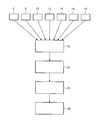
- the FIGURE shows a schematic flow diagram of a manufacturing process of a refractory lining including the preparation of the molding compound used.
- a molded part provided as a refractory lining of a combustion chamber of a stationary gas turbine is produced according to the figure from a molding compound which is mixed together in a first working step from substantially seven constituents.
- the weight proportions of these materials are preferably between 70% and 90% for silicon carbide (SiC), between approximately 5% and 20% for alumina, approximately between 5% and 30% for mullite as aluminum silicate, and approximately between 3% and 7 for water %.
- the silica is added at a weight of between about 3% and 10% and the microsilica (SiO 2 ) at between 5% and 30% by weight.
- the proportion of reactive alumina is between about 5% and 20%.
- the constituents mentioned are combined in a mixing process labeled 20 in the figure to form a molding compound, which is subsequently cast in a casting mold in a casting process designated by reference numeral 22 under vibration.
- the thus prepared mold is abruptly cooled from room temperature by being exposed to an atmosphere having a temperature of about -25 ° C.
- the silica present therein as sol solidifies into a gel.
- the molding material is solidified as a whole and prepared in a particularly advantageous manner for a designated last step 26 of drying and firing.
- the molding compound is fired at a sintering temperature of between about 1300 ° C and about 1600 ° C. Because of this comparatively low firing temperature, fiber reinforcements used in the molding compound can be present, so that overall a fiber-reinforced ceramic can be produced.
- the ceramic produced as a molding - the final product - has particularly advantageous mechanical properties with a particularly low tendency to form thermal cracks. This is based in particular on the fact that a special microcrack structure has been created in the ceramic by the mentioned sol-gel process and also due to the high proportion of silicon carbide, which leads, inter alia, for example, to a considerable reduction in the crack lengths of edge cracks.
- the casting material is a total of cement-free (that is essentially has no CaO) and also result in cost advantages during the manufacturing process due to the low sintering temperature.
- the casting compound Due to its physical, chemical and mineralogical properties, the casting compound is very well suited for the production of composite materials, even of an oxidic nature.
Landscapes
- Chemical & Material Sciences (AREA)
- Engineering & Computer Science (AREA)
- Ceramic Engineering (AREA)
- Manufacturing & Machinery (AREA)
- Structural Engineering (AREA)
- Materials Engineering (AREA)
- Organic Chemistry (AREA)
- Inorganic Chemistry (AREA)
- Physics & Mathematics (AREA)
- Thermal Sciences (AREA)
- Compositions Of Oxide Ceramics (AREA)
- Ceramic Products (AREA)
- Furnace Housings, Linings, Walls, And Ceilings (AREA)
- Application Of Or Painting With Fluid Materials (AREA)
Abstract
Description
- Die Erfindung betrifft eine Formmasse zum Herstellen einer feuerfesten Auskleidung, insbesondere für eine Brennkammer einer stationären Gasturbine. Ferner betrifft die Erfindung ein gebranntes Formteil, das auf der Grundlage einer derartigen Formmasse hergestellt worden ist, eine zugehörige feuerfeste Auskleidung sowie schließlich auch ein Verfahren zum Herstellen eines gebrannten Formteils einer feuerfesten Auskleidung.
- Im Bereich der Brennkammertechnik müssen, wie beispielsweise bei Gasturbinen-Brennkammern, die Wände von Hochtemperaturreaktoren mit geeigneten Auskleidungen bzw. Abschirmungen geschützt werden, damit insbesondere sich dahinter befindende tragende Strukturen gegen Heißgasangriff geschützt sind. Als Abschirmung sind keramische Materialien in der Regel besser geeignet als metallische Werkstoffe, weil sie temperaturbeständiger sowie korrosionsbeständiger sind und eine niedrigere Wärmeleitfähigkeit aufweisen.
- Die keramischen Auskleidungen, welche oftmals auch als keramische Hitzeschilde bezeichnet werden, sind in der Regel durch einen Sinterungsprozess hergestellt worden, bei dem dann auch die schützenden Eigenschaften der Keramiken festgelegt wurden.
- An die keramischen Hitzeschilde werden ferner hohe Anforderungen hinsichtlich ihrer mechanischen Belastbarkeit gestellt und es wird verstärkt versucht hier Verbesserungen durch Herstellen von Composite-Bauteilen, wie beispielsweise mit faserverstärkten Bauteilen auf Basis CMC (ceramic matrix composites), oder mit Strukturkeramik-Bauteilen oder gradierten Bauteilen besonders gute mechanische Eigenschaften zu erzielen.
- Eine Aufgabe der Erfindung ist es, eine Formmasse sowie ein daraus gebranntes Formteil für eine feuerfeste Auskleidung der eingangs genannten Art bereitzustellen, welche mit einer z.B. vergleichsweise geringen Sintertemperatur verarbeitet werden kann und dadurch neue Möglichkeiten bei der Entwicklung von hochtemperaturbeständigen Composite-Bauteilen eröffnet.
- Die Formmasse muss die Anforderungen an keramische Bauteile für den Einsatz in stationären Gasturbinen im Heißgaspfad oder in der Brennkammer erfüllen.
- Die Aufgabe ist erfindungsgemäß mit einer Formmasse zum Herstellen einer feuerfesten Auskleidung gelöst, die mit einem Gewichtsanteil von mehr als zirka 50% Siliziumcarbid und einem Gewichtsanteil von weniger als 50% Aluminiumsilikat gebildet ist. Ferner ist die Aufgabe mit einem gebrannten Formteil für eine feuerfeste Auskleidung gelöst, das einen Gewichtsanteil von mehr als zirka 70% und weniger als zirka 90% Siliziumcarbid und/oder einen Gewichtsanteil von mehr als zirka 10% und weniger als zirka 50% Aluminiumsilikat aufweist. Darüber hinaus ist die Aufgabe auch erfindungsgemäß mit einem Verfahren zum Herstellen eines gebrannten Formteils einer feuerfesten Auskleidung gelöst, welches die folgenden Schritte umfasst: Herstellen einer Formmasse mit mindestens den Anteilen Siliziumcarbid, Microsilica, Aluminiumoxid und Aluminiumsilikat unter Zugabe kolloidaler Kieselsäurelösung, Vergießen der Formmasse unter Vibration, sprunghaftes Absenken der Temperatur der Formmasse, sowie Trocknen und Brennen der vergossenen Formmasse.
- Die erfindungsgemäß aus den genannten bestimmten Gewichtsanteilen von Siliziumcarbid und Aluminiumoxid bzw. Aluminiumsilikat zusammengesetzte Formmasse bildet ein Grundmaterial, welches besonders vorteilhaft durch Zugabe von kolloidaler Kieselsäurelösung in einem so genannten Sol-Gel-Prozess verfestigt und ferner mittels Gießen unter Vibration verarbeitet werden kann. Die dabei zunächst als Sol bzw. kolloidale Lösung vorliegende Kieselsäure wird durch das genannte sprunghafte Absenken der Temperatur in ein Gel überführt und damit die Formmasse, welche auch als Gießmasse oder Vibrationsmasse bezeichnet werden kann, verfestigt. Der eigentliche Trocknungs- und Sinterprozess kann nachfolgend bei vergleichsweise geringen Brenntemperaturen erfolgen, wie unten noch genauer erläutert werden wird.
- In einer vorteilhaften Ausgestaltung wird bei der erfindungsgemäßen Formmasse Siliziumcarbid, mit der chemischen Formel SiC, in einem Gewichtsanteil zwischen zirka 70% und zirka 90% verwendet.
- Besonders vorteilhaft wird bei der erfindungsgemäßen Formmasse als Aluminiumoxid Korund, d.h. Aluminiumoxid in trigonaler Struktur mit der chemischen Formel Al2O3, insbesondere bei einem Gewichtsanteil zwischen zirka 5% und zirka 20% verwendet.
- Der Gewichtsanteil des verwendeten Aluminiumsilikats beträgt besonders vorteilhaft zwischen zirka 5% und 30%, am Bevorzugtesten weniger als zirka 25%. Das Aluminiumsilikat ist dabei vorteilhaft Mullit mit der chemischen Formel 3Al2O3-2SiO2 oder 2Al2O3-1SiO2.
- Ein besonders vorteilhaftes Formteil kann hergestellt werden, wenn die zu Grunde liegende Formmasse Microsilica (SiO2) mit einem Gewichtsanteil zwischen 5% und 30% aufweist.
- Ferner sollte das erfindungsgemäße Formteil vorteilhaft frei von ungebundenem Siliziumoxid, SiO2 sein oder der Gewichtsanteil von derartigem Siliziumoxid zumindest weniger als zirka 10% sein. Schließlich ist es auch von Vorteil, wenn die Formmasse frei von Calcium-Aluminaten ist.
- Der Gewichtsanteil der erfindungsgemäß zugefügten kolloidalen Kieselsäurelösung sollte vorteilhaft weniger als zirka 10% betragen. Ferner sollte die kolloidale Kieselsäurelösung einen Feststoffgehalt von mindestens zirka 30 Gewichtsprozent aufweisen.
- Um eine gute Verarbeitbarkeit zu erzielen sollte der Formmasse bevorzugt eine Flüssigkeit, insbesondere Wasser, mit einem Gewichtsanteil von mehr als zirka 1% und weniger als zirka 10% zugegeben sein.
- Die maximale Korngröße sollte typischerweise zwischen zirka 2 mm und zirka 5 mm liegen. Der Gewichtsanteil dieser Kornfraktion sollte weniger als zirka 25% sein. Außerdem sollte der Gewichtsanteil an Siliziumcarbid in der Formmasse, dessen Korngröße kleiner als 0,5 mm ist, nicht mehr als 40% und vorzugsweise mindestens 15% betragen.
- Alternativ oder zusätzlich sollte die erfindungsgemäße Formmasse mit einem Gewichtsanteil von weniger als zirka 20%, insbesondere von weniger als zirka 15% reaktiver Tonerde ergänzt sein.
- Das erfindungsgemäß gebrannte Formteil sollte in seiner Zusammensetzung Gewichtsanteile aufweisen, welche im Wesentlichen denen der oben genannten Formmassen entsprechen. Die offene Porosität des gebrannten Formteils sollte mehr als zirka 10%, insbesondere mehr als zirka 13% und weniger als zirka 35% betragen. Die erfindungsgemäß vorteilhaft angestrebte Rohdichte des gebrannten Formteils beträgt weniger als zirka 3,5 g/cm3, insbesondere weniger als zirka 3,0 g/cm3.
- Hinsichtlich der gewünschten mechanischen Eigenschaften sollte das erfindungsgemäße gebrannte Formteil auf eine mittlere Biegefestigkeit bei Normalbedingungen von mehr als zirka 15,0 MPa eingestellt sein. Die angegebene mittlere Biegefestigkeit wird dabei mit einem 3-Punkt-Biegeversuch gemessen.
- Das derart aus einer erfindungsgemäßen Formmasse hergestellte Formteil kann vorteilhaft als feuerfeste Auskleidung bei Brennkammern von stationären Gasturbinen verwendet werden, insbesondere wenn die dem Heißgas zugewandte Seite eine so genannte EBC (Environmental Barrier Coating) Schutzschicht mit einer der Heißgastemperatur angepassten Schichtdicke in einer Größenordnung von 5 mm oder von vorzugsweise mindestens 10 mm aufweist. Um das Formteil herzustellen, wird, wie oben bereits erwähnt, die Formmasse unter Vibration durch Verfestigung auf der Basis von kolloidaler Kieselsäurelösung hergestellt. Um diese Verfestigung zu erreichen wird erfindungsgemäß bevorzugt die Umgebungstemperatur der Formmasse sprunghaft auf eine Temperatur von weniger als zirka 0°C abgesenkt und dort insbesondere über einen Zeitraum von mehr als zirka 15 min und weniger als zirka 2,5 h gehalten. Besonders bevorzugt wird eine Abkühltemperatur der Umgebung von zirka -20°C bis zirka -40°C.
- Die fertig vergossene Formmasse wird erfindungsgemäß bevorzugt bei einer Temperatur von zwischen zirka 1300°C und zirka 1650°C gebrannt. Für das Brennen einer Keramik wird innerhalb dieses Temperaturbereichs eine Temperatur von zwischen zirka 1350°C und zirka 1650°C bevorzugt. Eine faserverstärkte Keramik wird bevorzugt bei einer Temperatur zwischen zirka 1300°C und zirka 1400°C gebrannt. Für Strukturkeramik wird erfindungsgemäß eine Brenntemperatur von zwischen zirka 1300°C und zirka 1600°C bevorzugt.
- Nachfolgend wird ein Ausführungsbeispiel einer erfindungsgemäßen Formmasse, eines daraus hergestellten gebrannten Formteils, einer damit gebildeten feuerfesten Auskleidung sowie ein zugehöriges Verfahren zum Herstellen der Auskleidung anhand der beigefügten schematischen Zeichnungen näher erläutert.
- Die Fig. zeigt ein schematisches Ablaufdiagramm eines Herstellungsverfahrens einer feuerfesten Auskleidung inklusive der Vorbereitung der verwendeten Formmasse.
- Ein als feuerfeste Auskleidung einer Brennkammer einer stationären Gasturbine vorgesehenes Formteil wird gemäß der Fig. aus einer Formmasse hergestellt, welche in einem ersten Arbeitsschritt aus im Wesentlichen sieben Bestandteilen zusammengemischt wird.
- Diese sieben Bestandteile sind in der Fig. mit den Bezugszeichen 6, 8, 10, 12, 14, 16 und 18 bezeichnet und beinhalten in dieser Reihenfolge Microsilica (SiO2), Siliziumcarbid (SiC), Korund (Al2O3), Mullit (2Al2O3-1SiO2 oder 3Al2O3-2SiO2) , Kieselsäure (Si(OH)4), Wasser (H2O) sowie reaktive Tonerde. Die Gewichtsanteile dieser Materialien betragen beim Siliziumcarbid (SiC) vorzugsweise zwischen 70% und 90%, beim Korund als Aluminiumoxid zwischen zirka 5% und 20%, beim Mullit als Aluminiumsilikat zwischen zirka 5% und 30% und beim Wasser zwischen zirka 3% und 7%. Die Kieselsäure ist mit einem Gewichtanteil von zwischen zirka 3% und 10% und das Microsilica (SiO2) mit einem Gewichtsanteil von zwischen 5% und 30% zugegeben. Der Anteil an reaktiver Tonerde beträgt zwischen zirka 5% und 20%.
- Die genannten Bestandteile werden in einem in der Fig. mit Bezugszeichen 20 beschrifteten Mischvorgang zu einer Formmasse zusammengefügt, welche nachfolgend in einem mit Bezugszeichen 22 bezeichneten Vergießvorgang unter Vibration in einer Gießform vergossen wird.
- Die derart vorbereitete Gießform wird ausgehend von Raumtemperatur sprunghaft abgekühlt, indem sie einer Atmosphäre mit einer Temperatur von zirka -25°C ausgesetzt wird. Durch diese sprunghafte Abkühlung der sich in der Gießform befindenden Formmasse verfestigt sich die darin als Sol vorliegende Kieselsäure zu einem Gel. Dabei wird auch die Formmasse insgesamt verfestigt und in besonders vorteilhafter Weise für einen mit Bezugszeichen 26 bezeichneten letzten Arbeitsschritt des Trocknens und Brennens vorbereitet.
- Bei diesem Arbeitsschritt 26 wird die Formmasse bei einer Sintertemperatur von zwischen zirka 1300°C und zirka 1600°C gebrannt. Aufgrund dieser vergleichsweise niedrigen Brenntemperatur können sich in der Formmasse eingesetzte Faserverstärkungen befinden, so dass insgesamt eine faserverstärkte Keramik hergestellt werden kann.
- Die als Formteil hergestellte Keramik - das Endprodukt - weist besonders vorteilhafte mechanische Eigenschaften mit besonders geringer Neigung zur Ausbildung von thermischen Rissen auf. Dies beruht insbesondere darauf, dass in der Keramik durch den genannten Sol-Gel-Prozess und auch aufgrund des hohen Siliziumcarbidanteils ein spezielles Mikrorissgefüge geschaffen worden ist, welches unter anderem beispielsweise zu einer starken Verminderung der Risslängen von Kantenrissen führt.
- Auf diese Weise kann mit dem erfindungsgemäßen Vorgehen das Verlustrisiko von keramischen Hitzeschildern an der Auskleidung reduziert und die Anzahl der Wartungs- und Austauschzyklen der Hitzeschilder verringert werden. Insgesamt kann eine höhere Lebensdauer erreicht werden.
- Darüber hinaus ist als besonderer Vorteil der Erfindung noch zu nennen, dass die Gießmasse insgesamt zementfrei ist (also im Wesentlichen kein CaO aufweist) und sich ferner aufgrund der niedrigen Sintertemperatur auch Kostenvorteile beim Herstellungsprozess ergeben.
- Die Gießmasse eignet sich aufgrund ihrer physikalischen, chemischen und mineralogischen Eigenschaften sehr gut zur Herstellung von Verbundwerkstoffen, auch oxidischer Natur. Hiezu zählen Composite-Bauteile, wie beispielsweise mit Fasern verstärkte Bauteile auf CMC-Basis (ceramic matrix composites), mit Strukturkeramiken verstärkte Bauteile oder gradierte Bauteile.
Claims (21)
- Formmasse zum Herstellen einer feuerfesten Auskleidung, insbesondere für eine Brennkammer einer stationären Gasturbine,
wobei die Formmasse mit einem Gewichtsanteil von mehr als zirka 50% Siliziumcarbid (8) und einem Gewichtsanteil von weniger als zirka 50% Aluminiumsilikat (12) gebildet ist. - Formmasse nach Anspruch 1,
mit einem Gewichtsanteil von weniger als zirka 10% kolloidaler Kieselsäurelösung (14). - Formmasse nach Anspruch 2,
bei der die kolloidale Kieselsäurelösung (14) einen Gewichtsanteil von mehr als zirka 30% Feststoff enthält. - Formmasse nach einem der Ansprüche 1 bis 3,
bei der eine Flüssigkeit, insbesondere Wasser (16), mit einem Gewichtsanteil von mehr als zirka 1% und weniger als zirka 10% zugegeben ist. - Formmasse nach einem der Ansprüche 1 bis 4,
mit einem Gewichtsanteil von weniger als zirka 20%, nsbesondere von weniger als zirka 15% reaktiver Tonerde (18). - Formmasse nach einem der Ansprüche 1 bis 5,
mit einem Gewichtsanteil von mehr als zirka 5% und weniger als zirka 20% Aluminiumoxid (10). - Formmasse nach einem der Ansprüche 1 bis 6,
mit einem Gewichtsanteil von mehr als zirka 5% und weniger als zirka 30% Microsilica (6). - Formmasse nach einem der Ansprüche 1 bis 7,
dessen Korngrößen maximal 5 mm betragen. - Formmasse nach einem der Ansprüche 1 bis 8,
bei der der Gewichtsanteil an Siliziumcarbid mit einer Korngröße kleiner als 0,5 mm weniger als 40% und vorzugsweise mehr als 15% beträgt. - Gebranntes Formteil für eine feuerfeste Auskleidung, insbesondere einer Brennkammer einer stationären Gasturbine,
mit einem Gewichtsanteil von mehr als zirka 70% und weniger als zirka 90% Siliziumcarbid (8). - Gebranntes Formteil für eine feuerfeste Auskleidung, insbesondere einer Brennkammer einer stationären Gasturbine,
mit einem Gewichtsanteil von mehr als zirka 10% und weniger als zirka 50% Aluminiumsilikat (12). - Gebranntes Formteil nach Anspruch 10 oder 11,
mit einer offenen Porosität von mehr als zirka 10%, insbesondere von mehr als zirka 13% und weniger als zirka 35%. - Gebranntes Formteil nach einem der Ansprüche 10 bis 12, mit einer Rohdichte von weniger als zirka 3,5 g/cm3, insbesondere von weniger als zirka 3,0 g/cm3.
- Gebranntes Formteil nach einem der Ansprüche 10 bis 13, dessen mittlere Biegefestigkeit bei Normalbedingungen auf mehr als zirka 15,0 MPa eingestellt ist.
- Gebranntes Formteil nach einem der Ansprüche 10 bis 14, dessen einer Heißtemperatur zugewandten Oberfläche mit einer Schutzschicht versehen ist.
- Gebranntes Formteil nach Anspruch 15,
dessen Schutzschicht als Environmental Barrier Coating ausgebildet ist. - Feuerfeste Auskleidung einer Brennkammer,
insbesondere einer stationären Gasturbine,
mit mindestens einem gebrannten Formteil nach einem der Ansprüche 10 bis 16. - Verfahren zum Herstellen eines gebrannten Formteils einer feuerfesten Auskleidung,
insbesondere für eine Brennkammer einer stationären Gasturbine,
mit den Schritten:
Herstellen (20) einer Formmasse mit mindestens den Anteilen Siliziumcarbid (8), Aluminiumoxid (10) und Aluminiumsilikat (12) unter Zugabe kolloidaler Kieselsäurelösung (14),
Vergießen (22) der Formmasse unter Vibration, Sprunghaftes Absenken (24) der Temperatur der Formmasse, sowie Trocknen und Brennen (26) der vergossenen Formmasse. - Verfahren nach Anspruch 18,
bei dem in der Formmasse ein Gewichtsanteil von mehr als zirka 50% Siliziumcarbid (8) und ein Gewichtsanteil von weniger als zirka 50% Aluminiumsilikat (12) gemischt werden. - Verfahren nach Anspruch 18 oder 19,
bei dem die Temperatur beim sprunghaften Absenken (24) auf weniger als zirka 0°C gesenkt und dort insbesondere über einen Zeitraum von mehr als 15 min und weniger als zirka 2,5 h gehalten wird. - Verfahren nach einem der Ansprüche 18 bis 20,
bei dem die vergossene Formmasse bei einer Temperatur von zwischen zirka 1300°C und zirka 1650°C gebrannt wird.
Priority Applications (9)
| Application Number | Priority Date | Filing Date | Title |
|---|---|---|---|
| DE200550009649 DE502005009649D1 (de) | 2005-11-21 | 2005-11-21 | Verfahren zum Herstellen eines gebrannten Formteils einer feuerfesten Auskleidung |
| EP20050025360 EP1787967B1 (de) | 2005-11-21 | 2005-11-21 | Verfahren zum Herstellen eines gebrannten Formteils einer feuerfesten Auskleidung |
| AT05025360T ATE469110T1 (de) | 2005-11-21 | 2005-11-21 | Verfahren zum herstellen eines gebrannten formteils einer feuerfesten auskleidung |
| US12/085,726 US20090137459A1 (en) | 2005-11-21 | 2005-11-30 | Food Product for Enteral or Oral Nutrition |
| CN2006800434625A CN101374784B (zh) | 2005-11-21 | 2006-11-06 | 用于制备耐火衬里的模制浆料 |
| PCT/EP2006/068114 WO2007057315A2 (de) | 2005-11-21 | 2006-11-06 | Formmasse zum herstellen einer feuerfesten auskleidung |
| EP06807748A EP1951640A2 (de) | 2005-11-21 | 2006-11-06 | Formmasse zum herstellen einer feuerfesten auskleidung |
| US12/085,276 US8129301B2 (en) | 2005-11-21 | 2006-11-06 | Molding compound for producing a fireproof lining |
| US13/251,561 US8137610B2 (en) | 2005-11-21 | 2011-10-03 | Molding compound for producing a fireproof lining |
Applications Claiming Priority (1)
| Application Number | Priority Date | Filing Date | Title |
|---|---|---|---|
| EP20050025360 EP1787967B1 (de) | 2005-11-21 | 2005-11-21 | Verfahren zum Herstellen eines gebrannten Formteils einer feuerfesten Auskleidung |
Publications (2)
| Publication Number | Publication Date |
|---|---|
| EP1787967A1 true EP1787967A1 (de) | 2007-05-23 |
| EP1787967B1 EP1787967B1 (de) | 2010-05-26 |
Family
ID=36202524
Family Applications (2)
| Application Number | Title | Priority Date | Filing Date |
|---|---|---|---|
| EP20050025360 Expired - Lifetime EP1787967B1 (de) | 2005-11-21 | 2005-11-21 | Verfahren zum Herstellen eines gebrannten Formteils einer feuerfesten Auskleidung |
| EP06807748A Withdrawn EP1951640A2 (de) | 2005-11-21 | 2006-11-06 | Formmasse zum herstellen einer feuerfesten auskleidung |
Family Applications After (1)
| Application Number | Title | Priority Date | Filing Date |
|---|---|---|---|
| EP06807748A Withdrawn EP1951640A2 (de) | 2005-11-21 | 2006-11-06 | Formmasse zum herstellen einer feuerfesten auskleidung |
Country Status (6)
| Country | Link |
|---|---|
| US (2) | US8129301B2 (de) |
| EP (2) | EP1787967B1 (de) |
| CN (1) | CN101374784B (de) |
| AT (1) | ATE469110T1 (de) |
| DE (1) | DE502005009649D1 (de) |
| WO (1) | WO2007057315A2 (de) |
Cited By (4)
| Publication number | Priority date | Publication date | Assignee | Title |
|---|---|---|---|---|
| US8347636B2 (en) | 2010-09-24 | 2013-01-08 | General Electric Company | Turbomachine including a ceramic matrix composite (CMC) bridge |
| CN104003696A (zh) * | 2008-09-29 | 2014-08-27 | 西门子公司 | 制造耐火材料的材料成分及其使用和耐火成型件及其制造方法 |
| CN105000917A (zh) * | 2015-08-14 | 2015-10-28 | 中南大学 | 一种莫来石抗氧化涂层的制备方法 |
| CN113501681A (zh) * | 2021-06-29 | 2021-10-15 | 常州江南冶金科技有限公司 | 上升管换热器用耐温防腐内衬涂料及施工方法 |
Families Citing this family (4)
| Publication number | Priority date | Publication date | Assignee | Title |
|---|---|---|---|---|
| US8382436B2 (en) | 2009-01-06 | 2013-02-26 | General Electric Company | Non-integral turbine blade platforms and systems |
| US8262345B2 (en) | 2009-02-06 | 2012-09-11 | General Electric Company | Ceramic matrix composite turbine engine |
| CN103954131B (zh) * | 2014-04-17 | 2015-06-03 | 四川科达节能技术有限公司 | 一种工业炉窑内衬材料 |
| DE102018115771A1 (de) * | 2018-06-29 | 2020-01-02 | Saint-Gobain Industriekeramik Rödental GmbH | Kapselartige Aufnahme, insbesondere Kapsel zum Brennen von pulverförmigem Kathoden-Material für Lithium-Ionen-Akkus sowie Mischung hierfür |
Citations (7)
| Publication number | Priority date | Publication date | Assignee | Title |
|---|---|---|---|---|
| US800181A (en) | 1903-02-18 | 1905-09-26 | Chem Fab Griesheim Electron | Method of producing electrodes. |
| SU361159A1 (ru) * | 1971-03-10 | 1972-12-07 | Огнеупорный материал | |
| US4800181A (en) * | 1987-09-01 | 1989-01-24 | Combustion Engineering, Inc. | Silicon carbide refractory composition |
| DE4242610A1 (en) | 1992-12-14 | 1993-07-22 | Siegfried Dipl Ing Mueller | Mixt. for high value silicon carbide prods. - comprises silicon carbide, dextrin soln., alumina, corundum, amorphous silicic acid and refractory binding clay |
| WO1994003410A1 (de) | 1992-07-31 | 1994-02-17 | Lonza A.G. | Feuerfeste formkörper aus siliciumcarbid mit mullitbindung, verfahren zu ihrer herstellung, pressmasse als zwischenprodukt, sowie verwendung als brennhilfsmittel |
| JPH10279357A (ja) | 1997-04-02 | 1998-10-20 | Tokyo Yogyo Co Ltd | 誘導炉用内張り材 |
| JPH10281653A (ja) | 1997-04-02 | 1998-10-23 | Tokyo Yogyo Co Ltd | 誘導炉用内張り材 |
Family Cites Families (18)
| Publication number | Priority date | Publication date | Assignee | Title |
|---|---|---|---|---|
| US3230100A (en) * | 1965-02-15 | 1966-01-18 | Harbison Walker Refractories | Refractory |
| JPS5290507A (en) * | 1976-01-26 | 1977-07-29 | Shinagawa Refractories Co | Refractories*compositions therefor and manufacture |
| US4093470A (en) * | 1976-10-20 | 1978-06-06 | Combustion Engineering, Inc. | Alumina refractories |
| DE3507876A1 (de) * | 1985-03-06 | 1986-09-11 | Didier-Werke Ag, 6200 Wiesbaden | Verwendung von zementfreien vibriermassen auf basis von aluminiumoxid und/oder zirkoniumdioxid zur herstellung von verschleissteilen |
| DE3842403C1 (de) * | 1988-12-16 | 1990-01-18 | Radex-Heraklith Industriebeteiligungs Ag, Wien, At | |
| DD294701A5 (de) * | 1990-05-31 | 1991-10-10 | Energiewerke Schwarze Pumpe Ag,De | Siliciumcarbidmoertel fuer die feuerfestzustellung von festbettdruckvergasern |
| DE4338159A1 (de) * | 1993-11-02 | 1995-05-04 | Projektierung Und Anlagenbau G | Bindemittel für mullitgebundene SiC- haltige Erzeugnisse und Verfahren zu seiner Herstellung |
| JP3507904B2 (ja) * | 1994-01-17 | 2004-03-15 | 東海高熱工業株式会社 | コーティングされた炭化珪素質耐火物 |
| CN1099368A (zh) * | 1994-05-03 | 1995-03-01 | 淄博市淄川工业陶瓷厂 | 碳化硅耐火板材制造工艺 |
| JPH07315933A (ja) * | 1994-05-18 | 1995-12-05 | Riken Corp | SiC質耐火物及びその製造方法 |
| US5494267A (en) * | 1994-07-26 | 1996-02-27 | Magneco/Metrel, Inc. | Pumpable casting composition and method of use |
| JP3226260B2 (ja) * | 1996-09-19 | 2001-11-05 | 大光炉材株式会社 | 緻密質不定形耐火物用耐火組成物の湿式吹付け施工法 |
| JP3046251B2 (ja) * | 1996-10-15 | 2000-05-29 | 大光炉材株式会社 | 緻密質流し込み耐火組成物の湿式吹付け施工方法 |
| KR100341406B1 (ko) * | 2000-03-31 | 2002-06-22 | 윤덕용 | 고부피분율 탄화규소 예비성형체의 제조방법 |
| CN1155540C (zh) * | 2000-07-15 | 2004-06-30 | 淄博科鲁能源动力有限责任公司 | 高强度耐磨耐火砖 |
| CN1232470C (zh) * | 2003-11-18 | 2005-12-21 | 北京科技大学 | 一种含氮化硅铁的免烘烤铁沟捣打料 |
| RU2257361C1 (ru) * | 2004-07-30 | 2005-07-27 | Общество с ограниченной ответственностью "ЦЕНТР ЭНЕРГОСБЕРЕГАЮЩИХ ТЕХНОЛОГИЙ" | Карбидкремниевый бетон |
| EP1739356A1 (de) * | 2005-07-01 | 2007-01-03 | Siemens Aktiengesellschaft | Formmasse zum Herstellen einer feuerfesten Auskleidung |
-
2005
- 2005-11-21 DE DE200550009649 patent/DE502005009649D1/de not_active Expired - Lifetime
- 2005-11-21 AT AT05025360T patent/ATE469110T1/de not_active IP Right Cessation
- 2005-11-21 EP EP20050025360 patent/EP1787967B1/de not_active Expired - Lifetime
-
2006
- 2006-11-06 WO PCT/EP2006/068114 patent/WO2007057315A2/de not_active Ceased
- 2006-11-06 US US12/085,276 patent/US8129301B2/en not_active Expired - Fee Related
- 2006-11-06 EP EP06807748A patent/EP1951640A2/de not_active Withdrawn
- 2006-11-06 CN CN2006800434625A patent/CN101374784B/zh not_active Expired - Fee Related
-
2011
- 2011-10-03 US US13/251,561 patent/US8137610B2/en not_active Expired - Fee Related
Patent Citations (7)
| Publication number | Priority date | Publication date | Assignee | Title |
|---|---|---|---|---|
| US800181A (en) | 1903-02-18 | 1905-09-26 | Chem Fab Griesheim Electron | Method of producing electrodes. |
| SU361159A1 (ru) * | 1971-03-10 | 1972-12-07 | Огнеупорный материал | |
| US4800181A (en) * | 1987-09-01 | 1989-01-24 | Combustion Engineering, Inc. | Silicon carbide refractory composition |
| WO1994003410A1 (de) | 1992-07-31 | 1994-02-17 | Lonza A.G. | Feuerfeste formkörper aus siliciumcarbid mit mullitbindung, verfahren zu ihrer herstellung, pressmasse als zwischenprodukt, sowie verwendung als brennhilfsmittel |
| DE4242610A1 (en) | 1992-12-14 | 1993-07-22 | Siegfried Dipl Ing Mueller | Mixt. for high value silicon carbide prods. - comprises silicon carbide, dextrin soln., alumina, corundum, amorphous silicic acid and refractory binding clay |
| JPH10279357A (ja) | 1997-04-02 | 1998-10-20 | Tokyo Yogyo Co Ltd | 誘導炉用内張り材 |
| JPH10281653A (ja) | 1997-04-02 | 1998-10-23 | Tokyo Yogyo Co Ltd | 誘導炉用内張り材 |
Non-Patent Citations (4)
| Title |
|---|
| DATABASE WPI Section Ch Week 197330, Derwent World Patents Index; Class L02, AN 1973-42263U, XP002398872 * |
| G. ROUTSCHKA: "Pocket Manual Refractory Materials", 1997, VULKAN-VERLAG ESSEN |
| GERALD ROUTSCHKA: "POCKET MANUAL REFRACTORY MATERIALS", 1997, VULKAN-VERLAG ESSEN, XP002379190 * |
| PATENT ABSTRACTS OF JAPAN vol. 1999, no. 01 29 January 1999 (1999-01-29) * |
Cited By (6)
| Publication number | Priority date | Publication date | Assignee | Title |
|---|---|---|---|---|
| CN104003696A (zh) * | 2008-09-29 | 2014-08-27 | 西门子公司 | 制造耐火材料的材料成分及其使用和耐火成型件及其制造方法 |
| US9108886B2 (en) | 2008-09-29 | 2015-08-18 | Siemens Aktiengesellschaft | Material composition for producing a fireproof material and the use thereof, and fireproof molded body and method for the production thereof |
| US8347636B2 (en) | 2010-09-24 | 2013-01-08 | General Electric Company | Turbomachine including a ceramic matrix composite (CMC) bridge |
| CN105000917A (zh) * | 2015-08-14 | 2015-10-28 | 中南大学 | 一种莫来石抗氧化涂层的制备方法 |
| CN105000917B (zh) * | 2015-08-14 | 2017-04-12 | 中南大学 | 一种莫来石抗氧化涂层的制备方法 |
| CN113501681A (zh) * | 2021-06-29 | 2021-10-15 | 常州江南冶金科技有限公司 | 上升管换热器用耐温防腐内衬涂料及施工方法 |
Also Published As
| Publication number | Publication date |
|---|---|
| WO2007057315A2 (de) | 2007-05-24 |
| US20120021203A1 (en) | 2012-01-26 |
| US8129301B2 (en) | 2012-03-06 |
| EP1787967B1 (de) | 2010-05-26 |
| DE502005009649D1 (de) | 2010-07-08 |
| US20090227443A1 (en) | 2009-09-10 |
| EP1951640A2 (de) | 2008-08-06 |
| CN101374784B (zh) | 2013-07-17 |
| WO2007057315A3 (de) | 2008-09-04 |
| CN101374784A (zh) | 2009-02-25 |
| ATE469110T1 (de) | 2010-06-15 |
| US8137610B2 (en) | 2012-03-20 |
Similar Documents
| Publication | Publication Date | Title |
|---|---|---|
| KR100217439B1 (ko) | 콘크리트 부재를 성형하기 위한 금속 섬유 조성물, 생성된 부재 및 열 양생 방법 | |
| DE3881828T2 (de) | Nachgiebige Schicht für Kompositkörper. | |
| DE69911202T3 (de) | In einer zementmatrix dispergierte organische fasern enthaltend beton, beton-zementmatrix und vormischungen | |
| EP2329195B1 (de) | Materialmischung zur herstellung eines feuerfestwerkstoffes, feuerfestformkörper und verfahren zu seiner herstellung | |
| DE69728060T2 (de) | Mit siliciumcarbid verstärktes siliciumcarbid-verbundwerkstoff | |
| DE102010009146B4 (de) | Plastische feuerfeste Masse und feuerfester Mörtel und deren Verwendung | |
| SK288156B6 (sk) | Použitie organických vlákien vo vysoko pevnom betóne, ohňovzdorný a vysoko pevný betón a spôsob jeho výroby | |
| DE102007000840B4 (de) | Gebrannter Körper auf Si-SiC-Basis und Verfahren zur Herstellung desselben | |
| US8137610B2 (en) | Molding compound for producing a fireproof lining | |
| EP2331479A1 (de) | Materialzusammensetzung zur herstellung eines feuerfestwerkstoffes sowie ihre verwendung und feuerfestformkörper sowie verfahren zu seiner herstellung | |
| EP3619178A1 (de) | Betonelement mit bewehrung mit verbessertem oxidationsschutz | |
| DE3329250A1 (de) | Feuerfestes siliziumnitrid-verbundmaterial | |
| CN116903330A (zh) | 一种超高性能混凝土及其制备方法 | |
| CN107382346A (zh) | 耐火耐磨浇筑料及制备方法 | |
| EP1739356A1 (de) | Formmasse zum Herstellen einer feuerfesten Auskleidung | |
| KR102432617B1 (ko) | 균열제어 자기치유 혼화재 조성물과 그 혼화재의 제조방법, 그리고 자기치유 모르타르 조성물과 이를 이용한 콘크리트 구조물의 단면보수공법 | |
| KR100659457B1 (ko) | 영구거푸집 및 내화패널 겸용의 고강도 고인성 패널을사용한 고강도콘크리트 부재의 내화공법 | |
| CN115784682A (zh) | 一种耐火抗爆超高性能混凝土及其制备方法 | |
| DE19605149C2 (de) | Verfahren zur Herstellung poröser keramischer Formkörper, danach hergestellte Formkörper aus Titandioxid sowie deren Verwendungen | |
| CN110040995A (zh) | 一种高温用轻质韧性莫来石骨料制备方法 | |
| WO1999067185A2 (de) | Werkstoffe zur konstruktion und isolation, ein verfahren zur herstellung und deren verwendung sowie ein bindemittel zur herstellung von werkstoffen | |
| DE1471032B2 (de) | Mischung zur herstellung eines feuerfesten koerpers, moertels u.dgl | |
| KR101922806B1 (ko) | 고강도 콘크리트 폭렬방지용 내화패널 구조물 및 이의 제조방법 | |
| JP2515767B2 (ja) | 耐爆裂性に優れた押出成形建材 | |
| DE102015221837B4 (de) | Verfahren zur Herstellung eines Keramikgussteils |
Legal Events
| Date | Code | Title | Description |
|---|---|---|---|
| PUAI | Public reference made under article 153(3) epc to a published international application that has entered the european phase |
Free format text: ORIGINAL CODE: 0009012 |
|
| AK | Designated contracting states |
Kind code of ref document: A1 Designated state(s): AT BE BG CH CY CZ DE DK EE ES FI FR GB GR HU IE IS IT LI LT LU LV MC NL PL PT RO SE SI SK TR |
|
| AX | Request for extension of the european patent |
Extension state: AL BA HR MK YU |
|
| AKX | Designation fees paid | ||
| 17P | Request for examination filed |
Effective date: 20080201 |
|
| RBV | Designated contracting states (corrected) |
Designated state(s): AT BE BG CH CY CZ DE DK EE ES FI FR GB GR HU IE IS IT LI LT LU LV MC NL PL PT RO SE SI SK TR |
|
| 17Q | First examination report despatched |
Effective date: 20080317 |
|
| GRAP | Despatch of communication of intention to grant a patent |
Free format text: ORIGINAL CODE: EPIDOSNIGR1 |
|
| RTI1 | Title (correction) |
Free format text: PROCESS FOR THE MANUFACTURE OF A BURNT SHAPED BODY FOR A REFRACTORY LINING |
|
| GRAS | Grant fee paid |
Free format text: ORIGINAL CODE: EPIDOSNIGR3 |
|
| GRAA | (expected) grant |
Free format text: ORIGINAL CODE: 0009210 |
|
| AK | Designated contracting states |
Kind code of ref document: B1 Designated state(s): AT BE BG CH CY CZ DE DK EE ES FI FR GB GR HU IE IS IT LI LT LU LV MC NL PL PT RO SE SI SK TR |
|
| REG | Reference to a national code |
Ref country code: GB Ref legal event code: FG4D Free format text: NOT ENGLISH |
|
| REG | Reference to a national code |
Ref country code: CH Ref legal event code: EP |
|
| REG | Reference to a national code |
Ref country code: IE Ref legal event code: FG4D Free format text: LANGUAGE OF EP DOCUMENT: GERMAN |
|
| REF | Corresponds to: |
Ref document number: 502005009649 Country of ref document: DE Date of ref document: 20100708 Kind code of ref document: P |
|
| REG | Reference to a national code |
Ref country code: NL Ref legal event code: VDEP Effective date: 20100526 |
|
| LTIE | Lt: invalidation of european patent or patent extension |
Effective date: 20100526 |
|
| PG25 | Lapsed in a contracting state [announced via postgrant information from national office to epo] |
Ref country code: LT Free format text: LAPSE BECAUSE OF FAILURE TO SUBMIT A TRANSLATION OF THE DESCRIPTION OR TO PAY THE FEE WITHIN THE PRESCRIBED TIME-LIMIT Effective date: 20100526 Ref country code: SE Free format text: LAPSE BECAUSE OF FAILURE TO SUBMIT A TRANSLATION OF THE DESCRIPTION OR TO PAY THE FEE WITHIN THE PRESCRIBED TIME-LIMIT Effective date: 20100526 |
|
| PG25 | Lapsed in a contracting state [announced via postgrant information from national office to epo] |
Ref country code: SI Free format text: LAPSE BECAUSE OF FAILURE TO SUBMIT A TRANSLATION OF THE DESCRIPTION OR TO PAY THE FEE WITHIN THE PRESCRIBED TIME-LIMIT Effective date: 20100526 Ref country code: FI Free format text: LAPSE BECAUSE OF FAILURE TO SUBMIT A TRANSLATION OF THE DESCRIPTION OR TO PAY THE FEE WITHIN THE PRESCRIBED TIME-LIMIT Effective date: 20100526 Ref country code: IS Free format text: LAPSE BECAUSE OF FAILURE TO SUBMIT A TRANSLATION OF THE DESCRIPTION OR TO PAY THE FEE WITHIN THE PRESCRIBED TIME-LIMIT Effective date: 20100926 Ref country code: LV Free format text: LAPSE BECAUSE OF FAILURE TO SUBMIT A TRANSLATION OF THE DESCRIPTION OR TO PAY THE FEE WITHIN THE PRESCRIBED TIME-LIMIT Effective date: 20100526 |
|
| PG25 | Lapsed in a contracting state [announced via postgrant information from national office to epo] |
Ref country code: PL Free format text: LAPSE BECAUSE OF FAILURE TO SUBMIT A TRANSLATION OF THE DESCRIPTION OR TO PAY THE FEE WITHIN THE PRESCRIBED TIME-LIMIT Effective date: 20100526 Ref country code: GR Free format text: LAPSE BECAUSE OF FAILURE TO SUBMIT A TRANSLATION OF THE DESCRIPTION OR TO PAY THE FEE WITHIN THE PRESCRIBED TIME-LIMIT Effective date: 20100827 Ref country code: CY Free format text: LAPSE BECAUSE OF FAILURE TO SUBMIT A TRANSLATION OF THE DESCRIPTION OR TO PAY THE FEE WITHIN THE PRESCRIBED TIME-LIMIT Effective date: 20100526 |
|
| REG | Reference to a national code |
Ref country code: IE Ref legal event code: FD4D |
|
| PG25 | Lapsed in a contracting state [announced via postgrant information from national office to epo] |
Ref country code: IE Free format text: LAPSE BECAUSE OF FAILURE TO SUBMIT A TRANSLATION OF THE DESCRIPTION OR TO PAY THE FEE WITHIN THE PRESCRIBED TIME-LIMIT Effective date: 20100526 Ref country code: DK Free format text: LAPSE BECAUSE OF FAILURE TO SUBMIT A TRANSLATION OF THE DESCRIPTION OR TO PAY THE FEE WITHIN THE PRESCRIBED TIME-LIMIT Effective date: 20100526 Ref country code: NL Free format text: LAPSE BECAUSE OF FAILURE TO SUBMIT A TRANSLATION OF THE DESCRIPTION OR TO PAY THE FEE WITHIN THE PRESCRIBED TIME-LIMIT Effective date: 20100526 Ref country code: PT Free format text: LAPSE BECAUSE OF FAILURE TO SUBMIT A TRANSLATION OF THE DESCRIPTION OR TO PAY THE FEE WITHIN THE PRESCRIBED TIME-LIMIT Effective date: 20100927 Ref country code: EE Free format text: LAPSE BECAUSE OF FAILURE TO SUBMIT A TRANSLATION OF THE DESCRIPTION OR TO PAY THE FEE WITHIN THE PRESCRIBED TIME-LIMIT Effective date: 20100526 |
|
| PG25 | Lapsed in a contracting state [announced via postgrant information from national office to epo] |
Ref country code: RO Free format text: LAPSE BECAUSE OF FAILURE TO SUBMIT A TRANSLATION OF THE DESCRIPTION OR TO PAY THE FEE WITHIN THE PRESCRIBED TIME-LIMIT Effective date: 20100526 Ref country code: SK Free format text: LAPSE BECAUSE OF FAILURE TO SUBMIT A TRANSLATION OF THE DESCRIPTION OR TO PAY THE FEE WITHIN THE PRESCRIBED TIME-LIMIT Effective date: 20100526 Ref country code: CZ Free format text: LAPSE BECAUSE OF FAILURE TO SUBMIT A TRANSLATION OF THE DESCRIPTION OR TO PAY THE FEE WITHIN THE PRESCRIBED TIME-LIMIT Effective date: 20100526 |
|
| PLBE | No opposition filed within time limit |
Free format text: ORIGINAL CODE: 0009261 |
|
| STAA | Information on the status of an ep patent application or granted ep patent |
Free format text: STATUS: NO OPPOSITION FILED WITHIN TIME LIMIT |
|
| 26N | No opposition filed |
Effective date: 20110301 |
|
| BERE | Be: lapsed |
Owner name: SIEMENS A.G. Effective date: 20101130 |
|
| REG | Reference to a national code |
Ref country code: DE Ref legal event code: R097 Ref document number: 502005009649 Country of ref document: DE Effective date: 20110228 |
|
| PG25 | Lapsed in a contracting state [announced via postgrant information from national office to epo] |
Ref country code: MC Free format text: LAPSE BECAUSE OF NON-PAYMENT OF DUE FEES Effective date: 20101130 |
|
| REG | Reference to a national code |
Ref country code: CH Ref legal event code: PL |
|
| GBPC | Gb: european patent ceased through non-payment of renewal fee |
Effective date: 20101121 |
|
| PG25 | Lapsed in a contracting state [announced via postgrant information from national office to epo] |
Ref country code: CH Free format text: LAPSE BECAUSE OF NON-PAYMENT OF DUE FEES Effective date: 20101130 Ref country code: LI Free format text: LAPSE BECAUSE OF NON-PAYMENT OF DUE FEES Effective date: 20101130 |
|
| REG | Reference to a national code |
Ref country code: FR Ref legal event code: ST Effective date: 20110801 |
|
| PG25 | Lapsed in a contracting state [announced via postgrant information from national office to epo] |
Ref country code: BE Free format text: LAPSE BECAUSE OF NON-PAYMENT OF DUE FEES Effective date: 20101130 |
|
| PG25 | Lapsed in a contracting state [announced via postgrant information from national office to epo] |
Ref country code: FR Free format text: LAPSE BECAUSE OF NON-PAYMENT OF DUE FEES Effective date: 20101130 |
|
| PG25 | Lapsed in a contracting state [announced via postgrant information from national office to epo] |
Ref country code: GB Free format text: LAPSE BECAUSE OF NON-PAYMENT OF DUE FEES Effective date: 20101121 |
|
| REG | Reference to a national code |
Ref country code: AT Ref legal event code: MM01 Ref document number: 469110 Country of ref document: AT Kind code of ref document: T Effective date: 20101121 |
|
| PG25 | Lapsed in a contracting state [announced via postgrant information from national office to epo] |
Ref country code: AT Free format text: LAPSE BECAUSE OF NON-PAYMENT OF DUE FEES Effective date: 20101121 |
|
| PG25 | Lapsed in a contracting state [announced via postgrant information from national office to epo] |
Ref country code: LU Free format text: LAPSE BECAUSE OF NON-PAYMENT OF DUE FEES Effective date: 20101121 Ref country code: BG Free format text: LAPSE BECAUSE OF FAILURE TO SUBMIT A TRANSLATION OF THE DESCRIPTION OR TO PAY THE FEE WITHIN THE PRESCRIBED TIME-LIMIT Effective date: 20100526 Ref country code: HU Free format text: LAPSE BECAUSE OF FAILURE TO SUBMIT A TRANSLATION OF THE DESCRIPTION OR TO PAY THE FEE WITHIN THE PRESCRIBED TIME-LIMIT Effective date: 20101127 |
|
| PG25 | Lapsed in a contracting state [announced via postgrant information from national office to epo] |
Ref country code: TR Free format text: LAPSE BECAUSE OF FAILURE TO SUBMIT A TRANSLATION OF THE DESCRIPTION OR TO PAY THE FEE WITHIN THE PRESCRIBED TIME-LIMIT Effective date: 20100526 |
|
| PG25 | Lapsed in a contracting state [announced via postgrant information from national office to epo] |
Ref country code: BG Free format text: LAPSE BECAUSE OF FAILURE TO SUBMIT A TRANSLATION OF THE DESCRIPTION OR TO PAY THE FEE WITHIN THE PRESCRIBED TIME-LIMIT Effective date: 20100826 |
|
| PG25 | Lapsed in a contracting state [announced via postgrant information from national office to epo] |
Ref country code: ES Free format text: LAPSE BECAUSE OF FAILURE TO SUBMIT A TRANSLATION OF THE DESCRIPTION OR TO PAY THE FEE WITHIN THE PRESCRIBED TIME-LIMIT Effective date: 20100906 |
|
| PGFP | Annual fee paid to national office [announced via postgrant information from national office to epo] |
Ref country code: IT Payment date: 20151126 Year of fee payment: 11 |
|
| PGFP | Annual fee paid to national office [announced via postgrant information from national office to epo] |
Ref country code: DE Payment date: 20160120 Year of fee payment: 11 |
|
| REG | Reference to a national code |
Ref country code: DE Ref legal event code: R119 Ref document number: 502005009649 Country of ref document: DE |
|
| PG25 | Lapsed in a contracting state [announced via postgrant information from national office to epo] |
Ref country code: IT Free format text: LAPSE BECAUSE OF NON-PAYMENT OF DUE FEES Effective date: 20161121 |
|
| PG25 | Lapsed in a contracting state [announced via postgrant information from national office to epo] |
Ref country code: DE Free format text: LAPSE BECAUSE OF NON-PAYMENT OF DUE FEES Effective date: 20170601 |