EP1790476B1 - Tintenstrahlaufzeichnungsmaterial - Google Patents
Tintenstrahlaufzeichnungsmaterial Download PDFInfo
- Publication number
- EP1790476B1 EP1790476B1 EP05772680A EP05772680A EP1790476B1 EP 1790476 B1 EP1790476 B1 EP 1790476B1 EP 05772680 A EP05772680 A EP 05772680A EP 05772680 A EP05772680 A EP 05772680A EP 1790476 B1 EP1790476 B1 EP 1790476B1
- Authority
- EP
- European Patent Office
- Prior art keywords
- receiving layer
- ink receiving
- inkjet recording
- recording material
- resin
- Prior art date
- Legal status (The legal status is an assumption and is not a legal conclusion. Google has not performed a legal analysis and makes no representation as to the accuracy of the status listed.)
- Expired - Fee Related
Links
Images
Classifications
-
- B—PERFORMING OPERATIONS; TRANSPORTING
- B41—PRINTING; LINING MACHINES; TYPEWRITERS; STAMPS
- B41M—PRINTING, DUPLICATING, MARKING, OR COPYING PROCESSES; COLOUR PRINTING
- B41M5/00—Duplicating or marking methods; Sheet materials for use therein
- B41M5/50—Recording sheets characterised by the coating used to improve ink, dye or pigment receptivity, e.g. for ink-jet or thermal dye transfer recording
-
- B—PERFORMING OPERATIONS; TRANSPORTING
- B41—PRINTING; LINING MACHINES; TYPEWRITERS; STAMPS
- B41J—TYPEWRITERS; SELECTIVE PRINTING MECHANISMS, i.e. MECHANISMS PRINTING OTHERWISE THAN FROM A FORME; CORRECTION OF TYPOGRAPHICAL ERRORS
- B41J2/00—Typewriters or selective printing mechanisms characterised by the printing or marking process for which they are designed
- B41J2/005—Typewriters or selective printing mechanisms characterised by the printing or marking process for which they are designed characterised by bringing liquid or particles selectively into contact with a printing material
- B41J2/01—Ink jet
-
- B—PERFORMING OPERATIONS; TRANSPORTING
- B41—PRINTING; LINING MACHINES; TYPEWRITERS; STAMPS
- B41M—PRINTING, DUPLICATING, MARKING, OR COPYING PROCESSES; COLOUR PRINTING
- B41M5/00—Duplicating or marking methods; Sheet materials for use therein
-
- B—PERFORMING OPERATIONS; TRANSPORTING
- B41—PRINTING; LINING MACHINES; TYPEWRITERS; STAMPS
- B41M—PRINTING, DUPLICATING, MARKING, OR COPYING PROCESSES; COLOUR PRINTING
- B41M5/00—Duplicating or marking methods; Sheet materials for use therein
- B41M5/50—Recording sheets characterised by the coating used to improve ink, dye or pigment receptivity, e.g. for ink-jet or thermal dye transfer recording
- B41M5/52—Macromolecular coatings
Definitions
- the present invention relates to an inkjet recording material suitably used for display materials and the like.
- Inkjet recording system since it realizes accurate recording with low cost, is in general widely spread. Recently, thanks to the improvement of hardware like inkjet head and of software like raster image processor, furthermore high-performance inkjet printers are developed. According to this development, a development of inkjet recording materials, which enable to record output images transferred from the printer with high quality image and which enable to be preservative over the long period of time, has been proceeding. Consequently, many display materials with use of inkjet recording materials for like billboard and display panel have been seen in the market.
- Ink receiving layer of inkjet recording materials is mainly classified into two types: i.e. "void type” where porous inorganic particles for absorbing ink are bound with hydrophobic resin binder; and “swelling type” where hydrophilic resin itself absorbs ink. From the view point of drying property and water resistance of ink, the void type ink receiving layer is now becoming the mainstream.
- the ink absorbent amount is limited. Thereby, for the application of commercial-use display materials which require to have high ink concentration and tone so as to be seen well from the distance, absorbent amount thereof is not sufficient. In order to increase the absorbent amount of the void type ink receiving layer, thickening the ink receiving layer can be considered. Nevertheless, since the void type ink receiving layer is made by the solution coating in the water-based solvent, from the view point of high boiling point of water and the bad coating property, the coating amount is limited, therefore it is not easy to realize to thicken the ink receiving layer.
- ink receiving layers containing hydrophilic resin the resin itself forming the ink receiving layers can absorb ink, this type of layer is excellent in ink absorption capacity and is suitable for the use of like display materials which require high ink concentration and tone.
- Patent document 1 discloses an inkjet recording material.
- the base layer of the inkjet recording material is used as the surface protective layer thereof; this is obtained by back-printing (mirrorlike printing) the images to the thermosensitive adhesive ink receiving layer, then thermally adhering the ink receiving layer to the subjects to be adhered.
- Patent document 1 only discloses a recording material having an ink receiving layer whose thermosensitive adhesive resin is either hydrophilic resin only or hydrophobic resin only.
- thermosensitive adhesive hydrophilic resin has a problem of swelling caused by the moisture from the high water absorption property thereof, thereby the adhesive property declines over the period of time.
- the hydrophilic resin is set under a harsh environment like the way display materials usually exposed, the resin is immediately peeled from the adhered subject, which is not a suitable material for the use under such circumstances.
- the so-called "void type” recording material having hydrophobic resin to which water absorption filler is added has a limit in its ink absorbent amount. Thereby, this type of recording material is lack in ink concentration and tone; hence it is not a suitable material for the use of display materials.
- the ink receiving layer does not absorb the pigment ink, a pigment ink layer is formed on the surface of ink receiving layer.
- the ink receiving layer needs to go through this pigment ink layer and to be adhered to the other material. For this reason, an inkjet recording material, which is capable to favorably adhere so as to make display materials even under the circumstances that the large quantity of pigment ink is injected, is required.
- an object of the present invention is to provide an inkjet recording material which has high ink absorption property and is excellent in moisture resistance adhesiveness, and which is capable to obtain high adhesive strength when a large quantity of pigment ink is injected.
- the present invention is described as follows.
- the first aspect of the present invention provides an inkjet recording material comprises at least a base layer and an ink receiving layer, wherein the melting point of resin composing the ink receiving layer is between 40°C and 55°C, and melting energy of the same is between 60J/g and 90J/g. Accordingly, it is possible to provide an inkjet recording material which can obtain high adhesive strength even at the time of printing with high concentration of pigment ink.
- the ink receiving layer is a mixture of a hydrophilic resin having hot-melt adhesive property, and a plasticizer component. Accordingly, it is possible to obtain high adhesive strength at the time of printing with high concentration of pigment ink.
- the hydrophilic resin having hot-melt adhesive property is preferably a resin composed of a repeating unit represented by the following general formula (1).
- X 1 is a residue of an organic compound having two activated hydroxyl groups
- R 1 is a dicarboxylic compound residue or a diisocyanate type compound residue
- a 1 is represented by the following general formula (2).
- Z is a hydrocarbon radical of carbon number 2 or more; a, b, and c each is an integer number 1 or more; and a mass ratio calculated with a, b, and c, namely, ⁇ 44 x(a + c)/(molecular mass of alkylene oxide of carbon number 4 or more)x b ⁇ is from 80/20 to 94/6. Further, value of c/(a + c) is 0.5 or more and less than 1.0.
- the mass ratio between the hydrophilic resin and the plasticizer component in the ink receiving layer is preferably from 65:35 to 85:15.
- the second aspect of the present invention provides a display material comprises the inkjet recording material described above; and other material to which the ink receiving layer of the inkjet recording material is adhered by hot-melt adhesion.
- the third aspect of the present invention provides a method for producing a display material, comprises the steps of: printing on an ink receiving layer of any one of the above inkjet recording materials; and adhering the printed ink receiving layer to the other material by hot-melt adhesion.
- the inkjet recording material of the present invention by controlling the melting point and melting energy of the resin constituting the ink receiving layer within a predetermined range, it is possible to provide an inkjet recording material which is capable of having high adhesive strength even at the time of printing with high concentration of pigment ink.
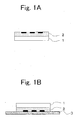
- Fig. 1 is a schematic cross-sectional view showing a configuration of the inkjet recording material.
- Fig. 1 is a schematic cross-sectional view showing a configuration of an inkjet recording material of the present invention.
- the inkjet recording material of the invention as shown in Fig. 1A , has a configuration that a base layer 1 is laminated with an ink receiving layer 2.
- a recording material (A) where an image is mirror-likely printed on the ink receiving layer 2 is overlapped with the surface of other material 3 in a condition that the ink receiving layer 2 side is facing the other material 3, and is thermally adhered to an other material 3, so as to obtain a display material (B).
- the base layer 1 acts as a protective layer of the printed ink receiving layer 2.
- the base layer 1 acts as a supporting body of the ink receiving layer 2 at the time of printing by inkjet printer. After the ink receiving layer 2 is adhered with the other material 3, the base layer 1 also acts as a protective layer of the ink receiving layer 2.
- the base layer 1 needs to be transparent in order to recognize the image recorded in the ink receiving layer 2 through the base layer 1, it is not necessarily completely transparent. If it has a certain transparency which is enough to recognize the image in the ink receiving layer 2 through the base layer 1, the base layer 1 may be colored.
- resin suitably used as the base layer 1, from the view point of workability, weatherability, and so on, include biaxial-stretched polyester, acrylic resin, polyvinyl chloride, polycarbonate, and the like.
- the thickness of base layer 1 is preferably 25 ⁇ m or more from the view point of strength, and is preferably 100 ⁇ m or less in consideration of heat conductance to the ink receiving layer 2 at the time of heating.
- the ink receiving layer 2 may be composed of mixture of a hydrophilic component containing a hydrophilic resin and a hydrophobic resin having hot-melt adhesive property. If too much hydrophilic component exists in the mixture, hydrophilic part in the ink receiving layer 2 overwhelms, that causes a decline of adhesive strength at the time of moisture absorption. On the other hand, if too much hydrophobic resin exists, a decline of ink absorption property is caused.
- the blending ratio (mass ratio) between the hydrophilic component and the hydrophobic resin having hot-melt adhesive property in the ink receiving layer 2 is preferably from 60:40 to 20:80 (hydrophilic component:hydrophobic component), more preferably, from 50:50 to 45:55 (hydrophilic component:hydrophobic component).
- the melting point of the resin composing the ink receiving layer 2 is from 40°C to 55°C and the melting energy of the same is from 60J/g to 90J/g.
- the ink receiving layer is composed of a mixture of a hydrophilic resin having hot-melt adhesive property, and a plasticizer component.
- the mixing ratio (mass ratio) between the hydrophilic resin having hot-melt adhesive property, and the plasticizer component is preferably from 65:35 to 85:15 (hydrophilic component:plasticizer component), more preferably, from 75:25 to 85:15 (hydrophilic component:plasticizer component).
- the melting point of the resin composing the ink receiving layer 2 can be measured by DSC (differential scanning calorimerty). Moreover, the melting energy of the resin composing the ink receiving layer 2 can also be measured by DSC (differential scanning calorimerty).
- viscosity of the ink receiving layer 2 needs to be sufficiently declined and the ink receiving layer 2 needs to contact with other material 3 through the pigment ink layer.
- the above problems are solved by setting the melting point and melting energy of the resins composing the ink receiving layer 2 within the abovementioned range. By doing this, even when a large quantity of pigment ink is injected, it becomes possible to adhere the ink receiving layer 2 to the other material 3 by hot-melt adhesion.
- the melting point of the resin composing the ink receiving layer 2 When the melting point of the resin composing the ink receiving layer 2 is too high, the melting of ink receiving layer 2 under the normal laminating condition becomes difficult. Thereby, hot-melt adhesion of the ink receiving layer 2 to the other material 3 becomes difficult. Further, when the melting energy is too high, afterheat of the laminator is consumed by melting of the crystal of resin composing the ink receiving layer 2, viscosity of the ink receiving layer 2 is not lowered. Furthermore, even though the crystal of resin composing the ink receiving layer 2 is successfully melted, if viscosity of the ink receiving layer 2 is high, the ink receiving layer 2 cannot go through the pigment ink layer.
- hydrophilic resin used for the ink receiving layer 2 examples include polyvinyl alcohol, polyvinyl pyrrolidone, carboxymethyl cellulose, polyalkylene oxide, or the mixture thereof.
- a hydrophilic resin which is excellent in ink absorption capacity and which enables to become a film by dry-type method such as extruding method excellent in productivity polyethylene oxide is suitably used.
- a hydrophilic resin having hot-melt adhesive property composing the ink receiving layer 2 it is preferable to use a polyethylene oxide type hydrophilic resin composed of a repeating unit represented by the general formula (1).
- X 1 is a residue of an organic compound having two activated hydroxyl groups, examples thereof are ethylene glycol, propylene glycol, bisphenol A, aniline propylene glycol, polytetramethylene glycol, and so on.
- R 1 is a dicarboxylic compound residue or a diisocyanate type compound residue.
- a dicarboxylic compound cyclic dicarboxylic compound or straight-chain dicarboxylic compound is desirable; examples thereof are dicarboxylic acid, dicarboxylic anhydride, and lower alkylester of dicarboxylic acid.
- phthalic acid isophthalic acid, terephthalic acid, malonic acid, succinic acid, sebacic acid, maleic acid, fumaric acid, adipic acid, itaconic acid
- dicarboxylic anhydride anhydride of the above respective dicarboxylic acids
- lower alkylester of the above dicarboxylic acid methylester, dimethylester, ethylester, diethylester, propylester, dipropylester, and so on of the above respective dicarboxylic acids can be exemplified.
- straight-chain dicarboxylic acid having carbon number from 12 to 36 and low alkylester thereof are preferably exemplified; and the examples thereof are 1,10-decamethylene dicarboxylic acid, 1,14-tetradecamethylene dicarboxylic acid, 1,18-octadecamethylene dicarboxylic acid, 1,32-dotriacontanemethylene dicarboxylic acid, and so on.
- diisocyanate type compound residues examples include 4,4'-diphenylmethane diisocyanate, toluene diisocyanate, xylenediisocyanate, hexamethylene diisocyanate, isophorone diisocyanate, and the like.
- the above dicarboxylic acid anhydrate and lower alkylester of dicarboxylic acid are preferably used. These may be used alone or in combination with two or more thereof.
- a 1 is represented by the following general formula (2).
- Z is a hydrocarbon group of carbon number 2 or more, preferable examples are alkyl group such as ethyl and propyl.
- a, b, and c each is an integer number 1 or more; and a mass ratio calculated with a, b, and c, namely, ⁇ 44 x(a + c)/(molecular mass of alkylene oxide of carbon number 4 or more)x b ⁇ is from 80/20 to 94/6.
- the value is smaller than 80/20, it is still possible to use as the above hydrophilic resin.
- problems like declines of hydrophilic property, or poor performance of ink absorption property and printing suitability occur.
- the resin can be hydrophilic but also insoluble against water. Further, value of c/(a + c) is set in the range of from 0.5 or more to less than 1.0.
- thermoplastic resin can be made such that: ethylene oxide is addition-polymerized to ethylene glycol; alkylene oxide is addition-polymerized thereto; ethylene oxide is further addition-polymerized thereto; and a dicarboxylic acid compound is added to the obtained polyalkylene oxide.
- material resin used for the ink receiving layer 2 if a resin having functional groups reactive with water is used, intermolecular cross-linking reaction is occurred; thereby it is preferable to use such a resin to make an inkjet recording material which is excellent in moisture resistance.
- functional group include alkoxysilane group and silanol group.
- hydrophobic resin having hot-melt adhesive property that may be used for ink receiving layer 2 includes: ethylene-vinyl acetate copolymer, ethylene-acrylic acid copolymer, ethylene-ethyl acrylate copolymer, polyamide, polyester, rosin-type and pinene-type polymers, acid-modified compound such as acid-modified polyolefin and the like; and the mixture, derivatives, copolymer, modification, and so on thereof.
- ethylene-vinyl acetate copolymer, polyester, ethylene-acrylic acid copolymer, ethylene-ethyl acrylate copolymer are preferable, from the similar point of view, acid-modified compound such as acid-modified polyolefin are also preferably used.
- the plasticizer component composed in the ink receiving layer 2 is preferable in high compatibility with hydrophilic resin having hot-melt adhesive property. And, as a whole mixture of the hydrophilic resin having hot-melt adhesive property and the plasticity component, it has the melting point and the melting energy within the above range.
- the plasticizer component is preferably in solid state in the room temperature in order to prevent bleed-out. When the plasticizer components bleed-out, the adhesive property of the ink receiving layer 2 to the other material 3 declines.
- resins such as ethylene-vinyl acetate copolymer, ethylene-ethyl acrylate copolymer are suitably used.
- the content of the plasticizer component is out of the above mass ratio between the hydrophilic resin and the plasticizer component in the ink receiving layer 2 to become too large, due to the problems of printing performance and dispersion, appearance of the display material becomes worse. While, if the content of the plasticizer is too small, the effect to lower the melting energy of the resin composing the ink receiving layer 2 is low, thereby the adhesive property of the ink receiving layer 2 to the other material 3 does not improve.
- the hydrophobic resin having hot-melt adhesive property acts as sea-part
- the hydrophilic resin acts as island-part in the sea-island structure.
- hydrophilic resin and hydrophobic resin each other in a different form, it is possible for them each to separate the roles of ink absorbent property and adhesive-property. Accordingly, the inventors assume as follows.
- the hydrophobic component is defined as the sea structure
- the hydrophilic resin as the island structure plays a role of ink absorbent property.
- the hydrophobic resin as a matrix can maintain the adhesive property even at the absorbing time of the ink receiving layer 2.
- the ink receiving layer 2 of the invention in order to enhance the structural bound strength between the hydrophilic resin and hydrophobic resin having hot-melt adhesive property, preferably forms cross-linked structure.
- the method to form the cross-linked structure includes a treatment with radiating ray like electron ray, ultraviolet ray, gamma ray after blending the resin. Among them, it is effective and preferable to adopt a method to radiate ultraviolet ray for cross-liking the blended resin to which hydrogen abstraction type photo-radical polymeric initiator is added.
- Hydrogen abstraction type photo-radical polymeric initiators are photo-radical polymeric initiators that produce radicals by abstracting hydrogen from other molecules.
- Hydrogen abstraction type photo-radical polymeric initiators preferably used in the invention includes any one of benzophenone derivatives selected from the group consisting of: benzil, o-benzoyl methyl benzoate, 2,4,6-trimethyl benzophenone, 4-methylbenzophenone, acrylic benzophenone, thioxamthone, 3-ketocoumarin, 2-ethyl anthraquinone, camphorquinone, Michler's ketone, tetra (t-butylperoxy carbonyl) benzophenone, or a mixture of two or more thereof. Mixtures with cleavage-type photo-radical polymeric initiators and the like can be also used.
- the additive amount thereof is appropriately adjusted according to the thickness of the ink receiving layer 2 or the condition of ultraviolet ray radiation.
- the additive amount is preferable to be 0.01 % by mass or more for 100% by mass of hydrophilic resin; from the view point of temporal stability, it is preferable to be 10% by mass or less for 100% by mass of hydrophilic resin.
- the additive amount is particularly preferable in the range from 0.05% by mass to 2.0% by mass.
- porous inorganic particles include inorganic particles generally used for void-type inkjet recording material such as silica group like nanoporous silica and meso-porous silica, and alumina. Silica and alumina may be added in a form of mixture thereof. Further, the additive amount of inorganic particles are preferably from 5% by mass to 70% by mass for the total mass of the ink receiving layer 2 as the standard (100% by mass).
- cationic resin may be added for the purpose to improve the blurring property and fixing property of the ink.
- cationic resin include polymer compound such as copolymer composed of monomers having quaternary amine groups such as polyallylamine hydrochloride and polyalkyl aminoacrylate.
- the additive amount of cationic resin is preferably from 5% by mass to 50% by mass for the total mass of ink receiving layer 2 as the standard (100% by mass).
- low melting-energy resins such as ethylene-vinyl acetate copolymer, ethylene-ethyl acrylate copolymer may be blended and then added to the cationic resin.
- the adhesive property between the ink receiving layer 2, the base layer 1 and the other material 3 can be improved.
- Any additives other than the above additives may be added to the ink receiving layer 2.
- the other additives include antioxidant like tocopherol and butylhydroxy anisole, and silane coupling agent.
- the inkjet recording material of the invention can be produced by applying the ink receiving layer 2 onto the base layer 1, or thermally adhering the base layer 1 and the ink receiving layer 2 each other respectively formed in advance.
- the inkjet recording material of the invention can be also produced by extrusion forming of the ink receiving layer 2 on a resin film of the base layer 1 and laminating the ink receiving layer 2 at the same time.
- This production method is simple, and preferable method which enables to produce high quality recording materials.
- the preferable production method is described in detail as follows. For example, a hydrophilic resin and a hydrophobic resin having hot-melt property are blended with use of biaxial-kneading extruder.
- the blended material is melt-molded by T-type manifold dies, and laminated with a film becoming the base layer 1 by nip roll at the same time as the melt-molding. This is how the laminated film for inkjet recording material is obtained. Further, if ultraviolet lamps are disposed on the production line, cross-linking described above is also realized at the same time.
- hydrophilic resin having hot-melt adhesive property 80 parts by mass of the resin A and 20 parts by mass of plasticizer component (HPRVR105, produced by Du Pont-Mitsui Polychemicals Co., Ltd.) were melt-kneaded with biaxial-kneading extruder; and then, the melt-kneaded material was melt-molded into 30 ⁇ m thick film by T-type manifold dies. At the same time as the melt-molding, it is laminated with biaxial-stretched polyester film (produced by Mitsubishi Polyester Film Corporation, T600E, 50 ⁇ m) used as a base layer by nip roll. Thus, a laminated film for inkjet recording material was obtained.
- HPRVR105 plasticizer component
- Example 4 The same operations as in Example 4 were performed to obtain a laminated film to become the inkjet recording material except for using NUC6090 (produced by Nippon Unicar Company Limited) as a plasticizer component.
- NUC6090 produced by Nippon Unicar Company Limited
- Example 4 The same operations as in Example 4 were performed to obtain a laminated film to become the inkjet recording material except for using the resin A only without mixing plasticizer component.
- Example 5 The same operations as in Example 5 were performed to obtain a laminated film to become the inkjet recording material except for mixing 60 parts by mass of the resin A and 40 parts by mass of NUC6090 (produced by Nippon Unicar Company Limited) as a plasticizer component in Example 5.
- NUC6090 produced by Nippon Unicar Company Limited
- Example 5 The same operations as in Example 5 were performed to obtain a laminated film to become the inkjet recording material except for mixing 90 parts by mass of the resin A and 10 parts by mass of NUC6090 (produced by Nippon Unicar Company Limited) as a plasticizer component in Example 5.
- Printing was made with pigment black ink to each ink receiving layer of test pieces with use of a printer "PX-9000" produced by Seiko Epson Corporation.
- the printing was set via a printing setting software "PS ripper, kind of the printing paper was set “MC photo paper”, and resolution was set "2880dpi x 1440dpi”; the printing was done allover the ink receiving layer with ink in highest concentration.
- each test piece was laminated to a 2mm thick PVC board under the condition of temperature 120°C and line speed 5mm/sec. And the printing quality of the obtained display materials were evaluated by eyes based on the following criteria.
- the inkjet recording material of the invention (Examples 4 and 5) were excellent in printing quality, and had large adhesive strength. While, Comparative example 4 to which the plasticizer component was not added, the adhesive strength was small. Further, Comparative example 5, wherein ratio of the plasticizer was too high, had a poor printing quality. On the other hand, Comparative example 6 wherein the ratio of the plasticizer is too low had a small adhesive strength.
- the inkjet recording material of the present invention has high adhesive strength when a large amount of pigment ink is injected. Having such preferable characteristics, the inkjet recording material can be preferably used for the application of display materials used under a harsh environment which requires to have high ink concentration and tone so as to be seen well from the distance.
Landscapes
- Ink Jet (AREA)
- Ink Jet Recording Methods And Recording Media Thereof (AREA)
Claims (5)
- Tintenstrahlaufzeichnungsmaterial, umfassend: zumindest eine Basisschicht und eine Tintenaufnahmeschicht, wobei die Tintenaufnahmeschicht aus einer Mischung aus einem hydrophilen Harz, das die Eigenschaften eines Heißschmelzklebers aufweist, und aus einer Weichmacherkomponente besteht und der Schmelzpunkt des Harzes, aus dem die Tintenaufnahmeschicht zusammengesetzt ist, zwischen 40°C und 55°C liegt und die Schmelzenergie desselben zwischen 60J/g und 90J/g liegt.
- Tintenstrahlaufzeichnungsmaterial nach Anspruch 1, wobei es sich bei dem die Eigenschaften eines Heißschmelzklebers aufweisenden hydrophilen Harz um ein Harz handelt, das aus einer durch die folgende allgemeine Formel (1) dargestellte wiederholenden Einheit zusammengesetzt ist.
⁅A1X1A1R1⁆ (1)
[In der Formel (1) ist X1 ein Rest einer organischen Verbindung mit zwei aktivierten Hydroxylgruppen, R1 ist ein Rest einer Dicarbonsäureverbindung oder ein Rest einer Verbindung vom Typ eines Diisocyanats, und A1 wird durch die folgende allgemeine Formel (2) dargestellt.]
- Tintenstrahlaufzeichnungsmaterial nach Anspruch 1 oder 2, wobei das Massenverhältnis zwischen dem hydrophilen Harz und der Weichmacherkomponente in der Tintenaufnahmeschicht zwischen 65:35 und 85:15 liegt.
- Werbematerial, umfassend: Tintenstrahlaufzeichnungsmaterial, wie es in einem der Ansprüche 1 bis 3 beschrieben ist; und sonstiges Material, mit der die Tintenaufnahmeschicht des Tintenstrahlaufzeichnungsmaterials durch Heißschmelzkleben verklebt ist.
- Verfahren zum Herstellen eines Werbematerials, die Schritte umfassend:Bedrucken einer Tintenaufnahmeschicht eines Tintenstrahlaufzeichnungsmaterials wie es in einem der Ansprüche 1 bis 3 beschrieben ist; sowie Verkleben der bedruckten Tintenaufnahmeschicht durch Heißschmelzkleben an weiterem Material.
Priority Applications (1)
| Application Number | Priority Date | Filing Date | Title |
|---|---|---|---|
| EP10155008A EP2184167A1 (de) | 2004-08-19 | 2005-08-18 | Tintenstrahlaufzeichnungsmaterial |
Applications Claiming Priority (2)
| Application Number | Priority Date | Filing Date | Title |
|---|---|---|---|
| JP2004239371 | 2004-08-19 | ||
| PCT/JP2005/015064 WO2006019134A1 (ja) | 2004-08-19 | 2005-08-18 | インクジェット記録材料 |
Related Child Applications (1)
| Application Number | Title | Priority Date | Filing Date |
|---|---|---|---|
| EP10155008.5 Division-Into | 2010-03-01 |
Publications (3)
| Publication Number | Publication Date |
|---|---|
| EP1790476A1 EP1790476A1 (de) | 2007-05-30 |
| EP1790476A4 EP1790476A4 (de) | 2008-01-23 |
| EP1790476B1 true EP1790476B1 (de) | 2010-10-20 |
Family
ID=35907517
Family Applications (2)
| Application Number | Title | Priority Date | Filing Date |
|---|---|---|---|
| EP05772680A Expired - Fee Related EP1790476B1 (de) | 2004-08-19 | 2005-08-18 | Tintenstrahlaufzeichnungsmaterial |
| EP10155008A Withdrawn EP2184167A1 (de) | 2004-08-19 | 2005-08-18 | Tintenstrahlaufzeichnungsmaterial |
Family Applications After (1)
| Application Number | Title | Priority Date | Filing Date |
|---|---|---|---|
| EP10155008A Withdrawn EP2184167A1 (de) | 2004-08-19 | 2005-08-18 | Tintenstrahlaufzeichnungsmaterial |
Country Status (7)
| Country | Link |
|---|---|
| US (2) | US7951435B2 (de) |
| EP (2) | EP1790476B1 (de) |
| JP (2) | JPWO2006019134A1 (de) |
| KR (1) | KR100893845B1 (de) |
| CN (1) | CN100513195C (de) |
| DE (1) | DE602005024285D1 (de) |
| WO (1) | WO2006019134A1 (de) |
Families Citing this family (6)
| Publication number | Priority date | Publication date | Assignee | Title |
|---|---|---|---|---|
| JP2008007637A (ja) * | 2006-06-29 | 2008-01-17 | Mitsubishi Plastics Ind Ltd | 接着性材料 |
| JP2008087421A (ja) * | 2006-10-04 | 2008-04-17 | Mitsubishi Plastics Ind Ltd | 積層フィルムおよびインクジェット記録材料 |
| WO2013077063A1 (ja) | 2011-11-22 | 2013-05-30 | 株式会社アドバンテスト | インク記録用部材、インク記録体および積層インク記録体 |
| KR101428764B1 (ko) * | 2013-02-14 | 2014-08-11 | (주)해은켐텍 | 잉크젯 프린터 잉크흡수층용 조성물 및 이를 이용한 잉크젯 프린터용 출력 소재 |
| JP6977467B2 (ja) * | 2017-10-13 | 2021-12-08 | 富士フイルムビジネスイノベーション株式会社 | 三次元造形物及び三次元造形物の製造方法 |
| EP3728491A4 (de) * | 2017-12-18 | 2021-07-14 | Voxel8, Inc. | Bedruckte polymerartikel, systeme und verfahren |
Family Cites Families (32)
| Publication number | Priority date | Publication date | Assignee | Title |
|---|---|---|---|---|
| JPS58134785A (ja) * | 1982-02-03 | 1983-08-11 | Canon Inc | 被記録材 |
| JPH07195826A (ja) * | 1993-12-28 | 1995-08-01 | Dai Ichi Kogyo Seiyaku Co Ltd | 記録シート |
| JPH082095A (ja) * | 1994-06-22 | 1996-01-09 | Gunze Ltd | 水性インキ印刷用多層基材 |
| JPH0939380A (ja) * | 1995-08-01 | 1997-02-10 | Gunze Ltd | 水性インク印刷用基材 |
| EP0782931B1 (de) * | 1995-12-07 | 1999-10-13 | E.I. Du Pont De Nemours And Company | Empfangsschicht für Tintenstrahlaufzeichnung |
| JPH09183929A (ja) * | 1995-12-28 | 1997-07-15 | Nippon Kayaku Co Ltd | インクジエット記録方式用紫外線硬化性樹脂組成物及びその硬化物 |
| JP4237276B2 (ja) * | 1996-11-08 | 2009-03-11 | 株式会社きもと | 記録材料 |
| JP3814391B2 (ja) * | 1996-11-29 | 2006-08-30 | 葛川工業株式会社 | 製版用フィルムおよび該フィルムを用いた製版方法 |
| TW387845B (en) * | 1996-11-29 | 2000-04-21 | Mitsubishi Plastics Inc | Lithography film, lithography ink, and lithographic method and system using the film |
| JPH1158934A (ja) * | 1997-08-18 | 1999-03-02 | Mitsubishi Paper Mills Ltd | インクジェット記録シート |
| JPH1170730A (ja) * | 1997-08-28 | 1999-03-16 | Sumitomo Seika Chem Co Ltd | インクジェット記録材用樹脂組成物およびインクジェット記録材 |
| JP3768339B2 (ja) * | 1997-10-06 | 2006-04-19 | 三菱樹脂株式会社 | 製版用フィルムおよび該フィルムを用いた製版方法と製版システム |
| US6017611A (en) * | 1998-02-20 | 2000-01-25 | Felix Schoeller Technical Papers, Inc. | Ink jet printable support material for thermal transfer |
| US6316120B1 (en) * | 1999-02-20 | 2001-11-13 | 3M Innovative Properties Company | Image receptor medium containing ethylene vinyl acetate carbon monoxide terpolymer |
| EP1232873B1 (de) | 2000-04-05 | 2005-06-15 | Dai-Ichi Kogyo Seiyaku Co., Ltd. | Harzzusammensetzung zu einem tintenstrahlaufzeichnungsblatt, das aufzeichnungsblatt, verfahren zur aufzeichnung und verfahren zur herstellung des aufzeichnungsblattes. |
| JP2002052807A (ja) * | 2000-08-07 | 2002-02-19 | Mitsubishi Plastics Ind Ltd | インクジェット用記録材 |
| US20020052439A1 (en) * | 2000-08-08 | 2002-05-02 | 3M Innovative Properties Company | Ink receptive compositions and articles for image transfer |
| JP2002067481A (ja) | 2000-08-24 | 2002-03-05 | General Kk | 記録媒体 |
| JP2002113942A (ja) * | 2000-10-10 | 2002-04-16 | Nippon Paper Industries Co Ltd | インクジェットキャストコート紙用支持体及びそれを用いたインクジェットキャストコート紙 |
| JP2002240411A (ja) | 2001-02-14 | 2002-08-28 | Konica Corp | インクジェット記録方法及び記録装置 |
| JP2002370443A (ja) * | 2001-06-14 | 2002-12-24 | Konica Corp | 再転写可能なインクジェット受像シート及び画像形成方法 |
| JP4452004B2 (ja) * | 2001-08-09 | 2010-04-21 | セイコーエプソン株式会社 | 転写シート |
| JP2003231348A (ja) * | 2002-02-12 | 2003-08-19 | Konica Corp | インクジェット記録用紙 |
| JP2003285533A (ja) * | 2002-03-27 | 2003-10-07 | Mitsubishi Paper Mills Ltd | インクジェット記録用シートの製造方法 |
| JP3915575B2 (ja) * | 2002-03-29 | 2007-05-16 | 日本製紙株式会社 | インクジェット記録媒体の製造方法 |
| JP2003312130A (ja) | 2002-04-23 | 2003-11-06 | Mitsubishi Paper Mills Ltd | インクジェット用記録材料 |
| JP2004050509A (ja) * | 2002-07-17 | 2004-02-19 | Toyobo Co Ltd | 記録材、記録材及び記録物の製造方法、電飾看板の使用方法 |
| JP2004181935A (ja) * | 2002-08-30 | 2004-07-02 | Oji Paper Co Ltd | インクジェット記録用シート |
| JP4122935B2 (ja) * | 2002-11-05 | 2008-07-23 | 東洋紡績株式会社 | インクジェット印刷用記録材およびその製造方法 |
| JP4724999B2 (ja) | 2002-12-13 | 2011-07-13 | コニカミノルタホールディングス株式会社 | インクジェット記録装置及びインクジェット記録方法 |
| JP4073318B2 (ja) * | 2003-01-09 | 2008-04-09 | 三菱樹脂株式会社 | 記録材およびその製造方法 |
| JPWO2007063995A1 (ja) * | 2005-12-02 | 2009-05-07 | 三菱樹脂株式会社 | 記録材料および印刷物の製造方法 |
-
2005
- 2005-08-18 EP EP05772680A patent/EP1790476B1/de not_active Expired - Fee Related
- 2005-08-18 WO PCT/JP2005/015064 patent/WO2006019134A1/ja not_active Ceased
- 2005-08-18 US US11/573,835 patent/US7951435B2/en not_active Expired - Fee Related
- 2005-08-18 KR KR1020077005612A patent/KR100893845B1/ko not_active Expired - Fee Related
- 2005-08-18 CN CNB2005800276824A patent/CN100513195C/zh not_active Expired - Fee Related
- 2005-08-18 JP JP2006531850A patent/JPWO2006019134A1/ja active Pending
- 2005-08-18 EP EP10155008A patent/EP2184167A1/de not_active Withdrawn
- 2005-08-18 DE DE602005024285T patent/DE602005024285D1/de not_active Expired - Lifetime
-
2011
- 2011-04-01 JP JP2011081528A patent/JP2011168055A/ja active Pending
- 2011-04-12 US US13/084,899 patent/US20110189409A1/en not_active Abandoned
Also Published As
| Publication number | Publication date |
|---|---|
| KR20070042201A (ko) | 2007-04-20 |
| EP1790476A1 (de) | 2007-05-30 |
| CN100513195C (zh) | 2009-07-15 |
| EP2184167A1 (de) | 2010-05-12 |
| US20110189409A1 (en) | 2011-08-04 |
| KR100893845B1 (ko) | 2009-04-17 |
| JPWO2006019134A1 (ja) | 2008-05-08 |
| EP1790476A4 (de) | 2008-01-23 |
| US7951435B2 (en) | 2011-05-31 |
| CN101005958A (zh) | 2007-07-25 |
| JP2011168055A (ja) | 2011-09-01 |
| WO2006019134A1 (ja) | 2006-02-23 |
| US20070298195A1 (en) | 2007-12-27 |
| DE602005024285D1 (de) | 2010-12-02 |
Similar Documents
| Publication | Publication Date | Title |
|---|---|---|
| US20110189409A1 (en) | Inkjet recording material | |
| CN1454140A (zh) | 用于生产防水耐用的水性喷墨接受介质的材料和方法 | |
| CN1119003A (zh) | 改进的吸墨片 | |
| JPH11501584A (ja) | インク受容シート | |
| JPH1095164A (ja) | 記録媒体、これを用いたインクジェット記録方法及び画像形成方法 | |
| EP0477970B1 (de) | Verfahren zur Herstellung von Druckmaterial mit einer Druckschicht aus PVP, Hydroxy enthaltendem Harz und aus einem Kondensationsprodukt von Sorbitol und aromatischem Aldehyd | |
| JP2012051213A (ja) | 中間転写媒体 | |
| JPH10329413A (ja) | 記録シート | |
| EP2266811B1 (de) | Tintenstrahlaufzeichnungsblatt | |
| HK1142038A (en) | Inkjet recording material | |
| JPH107828A (ja) | 記録シート | |
| JP4279750B2 (ja) | インクジェット記録材料 | |
| JPH1111001A (ja) | 水性インク用印刷シート | |
| JP3809671B2 (ja) | インクジェット記録用印画紙 | |
| JP3964698B2 (ja) | インクジェットプリンタ用メディアの使用方法 | |
| JP2000335098A (ja) | インクジェット用被記録材 | |
| JPH10329411A (ja) | 記録シート | |
| JPH10329407A (ja) | 記録シート | |
| JP2001080205A (ja) | インクジェット用記録媒体、これを用いたインクジェット記録方法 | |
| JP2005329642A (ja) | インクジェット用シート状記録材 | |
| JP2002113958A (ja) | 熱転写記録方法及び印画物 | |
| JP3152388B2 (ja) | 記録用シート | |
| JP4566467B2 (ja) | インクジェット用記録シート | |
| JP2000233567A (ja) | インクジェットプリンター用転写受像体 | |
| JP2004276569A (ja) | インクジェット記録品とその製造方法 |
Legal Events
| Date | Code | Title | Description |
|---|---|---|---|
| PUAI | Public reference made under article 153(3) epc to a published international application that has entered the european phase |
Free format text: ORIGINAL CODE: 0009012 |
|
| 17P | Request for examination filed |
Effective date: 20070222 |
|
| AK | Designated contracting states |
Kind code of ref document: A1 Designated state(s): DE GB |
|
| DAX | Request for extension of the european patent (deleted) | ||
| RBV | Designated contracting states (corrected) |
Designated state(s): DE GB |
|
| A4 | Supplementary search report drawn up and despatched |
Effective date: 20071228 |
|
| 17Q | First examination report despatched |
Effective date: 20080320 |
|
| GRAP | Despatch of communication of intention to grant a patent |
Free format text: ORIGINAL CODE: EPIDOSNIGR1 |
|
| RIN1 | Information on inventor provided before grant (corrected) |
Inventor name: NISHIMURA, SHIGEKI,MITSUBISHI PLASTICS, INC. |
|
| GRAS | Grant fee paid |
Free format text: ORIGINAL CODE: EPIDOSNIGR3 |
|
| GRAA | (expected) grant |
Free format text: ORIGINAL CODE: 0009210 |
|
| AK | Designated contracting states |
Kind code of ref document: B1 Designated state(s): DE GB |
|
| REG | Reference to a national code |
Ref country code: GB Ref legal event code: FG4D |
|
| REF | Corresponds to: |
Ref document number: 602005024285 Country of ref document: DE Date of ref document: 20101202 Kind code of ref document: P |
|
| PLBE | No opposition filed within time limit |
Free format text: ORIGINAL CODE: 0009261 |
|
| STAA | Information on the status of an ep patent application or granted ep patent |
Free format text: STATUS: NO OPPOSITION FILED WITHIN TIME LIMIT |
|
| 26N | No opposition filed |
Effective date: 20110721 |
|
| REG | Reference to a national code |
Ref country code: DE Ref legal event code: R097 Ref document number: 602005024285 Country of ref document: DE Effective date: 20110721 |
|
| PGFP | Annual fee paid to national office [announced via postgrant information from national office to epo] |
Ref country code: GB Payment date: 20110725 Year of fee payment: 7 Ref country code: DE Payment date: 20110825 Year of fee payment: 7 |
|
| GBPC | Gb: european patent ceased through non-payment of renewal fee |
Effective date: 20120818 |
|
| PG25 | Lapsed in a contracting state [announced via postgrant information from national office to epo] |
Ref country code: DE Free format text: LAPSE BECAUSE OF NON-PAYMENT OF DUE FEES Effective date: 20130301 Ref country code: GB Free format text: LAPSE BECAUSE OF NON-PAYMENT OF DUE FEES Effective date: 20120818 |
|
| REG | Reference to a national code |
Ref country code: DE Ref legal event code: R119 Ref document number: 602005024285 Country of ref document: DE Effective date: 20130301 |