EP1796122A2 - Schlämmungszusammensetzung, Grünfolie und Verfahren zur Herstellung derTrennrippen einer Plasma-Anzeigetafel - Google Patents
Schlämmungszusammensetzung, Grünfolie und Verfahren zur Herstellung derTrennrippen einer Plasma-Anzeigetafel Download PDFInfo
- Publication number
- EP1796122A2 EP1796122A2 EP06017671A EP06017671A EP1796122A2 EP 1796122 A2 EP1796122 A2 EP 1796122A2 EP 06017671 A EP06017671 A EP 06017671A EP 06017671 A EP06017671 A EP 06017671A EP 1796122 A2 EP1796122 A2 EP 1796122A2
- Authority
- EP
- European Patent Office
- Prior art keywords
- film
- forming layer
- weight
- green sheet
- parts
- Prior art date
- Legal status (The legal status is an assumption and is not a legal conclusion. Google has not performed a legal analysis and makes no representation as to the accuracy of the status listed.)
- Withdrawn
Links
- 230000004888 barrier function Effects 0.000 title claims abstract description 83
- 239000002002 slurry Substances 0.000 title claims abstract description 78
- 239000000203 mixture Substances 0.000 title claims abstract description 42
- 238000000034 method Methods 0.000 title claims abstract description 35
- 238000004519 manufacturing process Methods 0.000 title abstract description 25
- 239000011521 glass Substances 0.000 claims abstract description 44
- 239000000843 powder Substances 0.000 claims abstract description 38
- 239000000945 filler Substances 0.000 claims abstract description 22
- 239000002904 solvent Substances 0.000 claims abstract description 18
- 239000011230 binding agent Substances 0.000 claims abstract description 17
- 239000002270 dispersing agent Substances 0.000 claims abstract description 17
- 239000004014 plasticizer Substances 0.000 claims abstract description 17
- 239000000758 substrate Substances 0.000 claims description 34
- 239000000463 material Substances 0.000 claims description 25
- 238000005530 etching Methods 0.000 claims description 21
- XEKOWRVHYACXOJ-UHFFFAOYSA-N Ethyl acetate Chemical compound CCOC(C)=O XEKOWRVHYACXOJ-UHFFFAOYSA-N 0.000 claims description 12
- 238000000576 coating method Methods 0.000 claims description 12
- 238000007607 die coating method Methods 0.000 claims description 8
- 239000003795 chemical substances by application Substances 0.000 claims description 7
- ZWEHNKRNPOVVGH-UHFFFAOYSA-N 2-Butanone Chemical compound CCC(C)=O ZWEHNKRNPOVVGH-UHFFFAOYSA-N 0.000 claims description 6
- GWEVSGVZZGPLCZ-UHFFFAOYSA-N Titan oxide Chemical compound O=[Ti]=O GWEVSGVZZGPLCZ-UHFFFAOYSA-N 0.000 claims description 6
- WMWLMWRWZQELOS-UHFFFAOYSA-N bismuth(iii) oxide Chemical compound O=[Bi]O[Bi]=O WMWLMWRWZQELOS-UHFFFAOYSA-N 0.000 claims description 6
- 239000002518 antifoaming agent Substances 0.000 claims description 5
- 238000005245 sintering Methods 0.000 claims description 5
- LFQSCWFLJHTTHZ-UHFFFAOYSA-N Ethanol Chemical compound CCO LFQSCWFLJHTTHZ-UHFFFAOYSA-N 0.000 claims description 4
- LYCAIKOWRPUZTN-UHFFFAOYSA-N Ethylene glycol Chemical compound OCCO LYCAIKOWRPUZTN-UHFFFAOYSA-N 0.000 claims description 4
- NTIZESTWPVYFNL-UHFFFAOYSA-N Methyl isobutyl ketone Chemical compound CC(C)CC(C)=O NTIZESTWPVYFNL-UHFFFAOYSA-N 0.000 claims description 4
- UIHCLUNTQKBZGK-UHFFFAOYSA-N Methyl isobutyl ketone Natural products CCC(C)C(C)=O UIHCLUNTQKBZGK-UHFFFAOYSA-N 0.000 claims description 4
- LRHPLDYGYMQRHN-UHFFFAOYSA-N N-Butanol Chemical compound CCCCO LRHPLDYGYMQRHN-UHFFFAOYSA-N 0.000 claims description 4
- PNEYBMLMFCGWSK-UHFFFAOYSA-N aluminium oxide Inorganic materials [O-2].[O-2].[O-2].[Al+3].[Al+3] PNEYBMLMFCGWSK-UHFFFAOYSA-N 0.000 claims description 4
- 229910052593 corundum Inorganic materials 0.000 claims description 4
- JHIVVAPYMSGYDF-UHFFFAOYSA-N cyclohexanone Chemical compound O=C1CCCCC1 JHIVVAPYMSGYDF-UHFFFAOYSA-N 0.000 claims description 4
- 238000001035 drying Methods 0.000 claims description 4
- 229940043265 methyl isobutyl ketone Drugs 0.000 claims description 4
- 229910001845 yogo sapphire Inorganic materials 0.000 claims description 4
- XLOMVQKBTHCTTD-UHFFFAOYSA-N zinc oxide Inorganic materials [Zn]=O XLOMVQKBTHCTTD-UHFFFAOYSA-N 0.000 claims description 4
- 235000019439 ethyl acetate Nutrition 0.000 claims description 3
- WRIDQFICGBMAFQ-UHFFFAOYSA-N (E)-8-Octadecenoic acid Natural products CCCCCCCCCC=CCCCCCCC(O)=O WRIDQFICGBMAFQ-UHFFFAOYSA-N 0.000 claims description 2
- UOCLXMDMGBRAIB-UHFFFAOYSA-N 1,1,1-trichloroethane Chemical compound CC(Cl)(Cl)Cl UOCLXMDMGBRAIB-UHFFFAOYSA-N 0.000 claims description 2
- ARXJGSRGQADJSQ-UHFFFAOYSA-N 1-methoxypropan-2-ol Chemical compound COCC(C)O ARXJGSRGQADJSQ-UHFFFAOYSA-N 0.000 claims description 2
- LQJBNNIYVWPHFW-UHFFFAOYSA-N 20:1omega9c fatty acid Natural products CCCCCCCCCCC=CCCCCCCCC(O)=O LQJBNNIYVWPHFW-UHFFFAOYSA-N 0.000 claims description 2
- QSBYPNXLFMSGKH-UHFFFAOYSA-N 9-Heptadecensaeure Natural products CCCCCCCC=CCCCCCCCC(O)=O QSBYPNXLFMSGKH-UHFFFAOYSA-N 0.000 claims description 2
- DKPFZGUDAPQIHT-UHFFFAOYSA-N Butyl acetate Natural products CCCCOC(C)=O DKPFZGUDAPQIHT-UHFFFAOYSA-N 0.000 claims description 2
- CTQNGGLPUBDAKN-UHFFFAOYSA-N O-Xylene Chemical compound CC1=CC=CC=C1C CTQNGGLPUBDAKN-UHFFFAOYSA-N 0.000 claims description 2
- ZQPPMHVWECSIRJ-UHFFFAOYSA-N Oleic acid Natural products CCCCCCCCC=CCCCCCCCC(O)=O ZQPPMHVWECSIRJ-UHFFFAOYSA-N 0.000 claims description 2
- 239000005642 Oleic acid Substances 0.000 claims description 2
- 229920002367 Polyisobutene Polymers 0.000 claims description 2
- DPXJVFZANSGRMM-UHFFFAOYSA-N acetic acid;2,3,4,5,6-pentahydroxyhexanal;sodium Chemical compound [Na].CC(O)=O.OCC(O)C(O)C(O)C(O)C=O DPXJVFZANSGRMM-UHFFFAOYSA-N 0.000 claims description 2
- 239000002253 acid Substances 0.000 claims description 2
- NIXOWILDQLNWCW-UHFFFAOYSA-N acrylic acid group Chemical group C(C=C)(=O)O NIXOWILDQLNWCW-UHFFFAOYSA-N 0.000 claims description 2
- 150000001408 amides Chemical class 0.000 claims description 2
- 150000003863 ammonium salts Chemical class 0.000 claims description 2
- 229940067597 azelate Drugs 0.000 claims description 2
- 239000001768 carboxy methyl cellulose Substances 0.000 claims description 2
- 239000001913 cellulose Substances 0.000 claims description 2
- 229920002678 cellulose Polymers 0.000 claims description 2
- 235000021323 fish oil Nutrition 0.000 claims description 2
- FUZZWVXGSFPDMH-UHFFFAOYSA-N hexanoic acid Chemical compound CCCCCC(O)=O FUZZWVXGSFPDMH-UHFFFAOYSA-N 0.000 claims description 2
- WGCNASOHLSPBMP-UHFFFAOYSA-N hydroxyacetaldehyde Natural products OCC=O WGCNASOHLSPBMP-UHFFFAOYSA-N 0.000 claims description 2
- QXJSBBXBKPUZAA-UHFFFAOYSA-N isooleic acid Natural products CCCCCCCC=CCCCCCCCCC(O)=O QXJSBBXBKPUZAA-UHFFFAOYSA-N 0.000 claims description 2
- 125000005395 methacrylic acid group Chemical group 0.000 claims description 2
- BDJRBEYXGGNYIS-UHFFFAOYSA-N nonanedioic acid Chemical compound OC(=O)CCCCCCCC(O)=O BDJRBEYXGGNYIS-UHFFFAOYSA-N 0.000 claims description 2
- ZQPPMHVWECSIRJ-KTKRTIGZSA-N oleic acid Chemical compound CCCCCCCC\C=C/CCCCCCCC(O)=O ZQPPMHVWECSIRJ-KTKRTIGZSA-N 0.000 claims description 2
- 150000003014 phosphoric acid esters Chemical class 0.000 claims description 2
- XNGIFLGASWRNHJ-UHFFFAOYSA-L phthalate(2-) Chemical compound [O-]C(=O)C1=CC=CC=C1C([O-])=O XNGIFLGASWRNHJ-UHFFFAOYSA-L 0.000 claims description 2
- 229920000768 polyamine Polymers 0.000 claims description 2
- 235000019812 sodium carboxymethyl cellulose Nutrition 0.000 claims description 2
- 229920001027 sodium carboxymethylcellulose Polymers 0.000 claims description 2
- 125000000391 vinyl group Chemical group [H]C([*])=C([H])[H] 0.000 claims description 2
- 229920002554 vinyl polymer Polymers 0.000 claims description 2
- XLYOFNOQVPJJNP-UHFFFAOYSA-N water Substances O XLYOFNOQVPJJNP-UHFFFAOYSA-N 0.000 claims description 2
- 239000008096 xylene Substances 0.000 claims description 2
- 229940093499 ethyl acetate Drugs 0.000 claims 2
- 229940043232 butyl acetate Drugs 0.000 claims 1
- 230000001681 protective effect Effects 0.000 claims 1
- OAICVXFJPJFONN-UHFFFAOYSA-N Phosphorus Chemical compound [P] OAICVXFJPJFONN-UHFFFAOYSA-N 0.000 description 7
- 230000008569 process Effects 0.000 description 7
- 239000007789 gas Substances 0.000 description 6
- 238000007650 screen-printing Methods 0.000 description 6
- 239000011248 coating agent Substances 0.000 description 5
- 230000003213 activating effect Effects 0.000 description 4
- 239000000654 additive Substances 0.000 description 4
- 238000007796 conventional method Methods 0.000 description 3
- 239000000395 magnesium oxide Substances 0.000 description 3
- CPLXHLVBOLITMK-UHFFFAOYSA-N magnesium oxide Inorganic materials [Mg]=O CPLXHLVBOLITMK-UHFFFAOYSA-N 0.000 description 3
- AXZKOIWUVFPNLO-UHFFFAOYSA-N magnesium;oxygen(2-) Chemical compound [O-2].[Mg+2] AXZKOIWUVFPNLO-UHFFFAOYSA-N 0.000 description 3
- 238000001259 photo etching Methods 0.000 description 3
- 238000005488 sandblasting Methods 0.000 description 3
- 229910007472 ZnO—B2O3—SiO2 Inorganic materials 0.000 description 2
- 230000000996 additive effect Effects 0.000 description 2
- 230000015572 biosynthetic process Effects 0.000 description 2
- 238000007599 discharging Methods 0.000 description 2
- 230000009977 dual effect Effects 0.000 description 2
- 230000002708 enhancing effect Effects 0.000 description 2
- 239000003574 free electron Substances 0.000 description 2
- 230000001965 increasing effect Effects 0.000 description 2
- 150000002500 ions Chemical class 0.000 description 2
- 238000012986 modification Methods 0.000 description 2
- 230000004048 modification Effects 0.000 description 2
- 230000003287 optical effect Effects 0.000 description 2
- 238000007639 printing Methods 0.000 description 2
- 230000005855 radiation Effects 0.000 description 2
- 238000004544 sputter deposition Methods 0.000 description 2
- 239000011787 zinc oxide Substances 0.000 description 2
- 229910020617 PbO—B2O3—SiO2 Inorganic materials 0.000 description 1
- VYPSYNLAJGMNEJ-UHFFFAOYSA-N Silicium dioxide Chemical compound O=[Si]=O VYPSYNLAJGMNEJ-UHFFFAOYSA-N 0.000 description 1
- BQCADISMDOOEFD-UHFFFAOYSA-N Silver Chemical compound [Ag] BQCADISMDOOEFD-UHFFFAOYSA-N 0.000 description 1
- 238000007792 addition Methods 0.000 description 1
- 229910000416 bismuth oxide Inorganic materials 0.000 description 1
- 238000005234 chemical deposition Methods 0.000 description 1
- 238000006243 chemical reaction Methods 0.000 description 1
- 238000007906 compression Methods 0.000 description 1
- 239000004020 conductor Substances 0.000 description 1
- 230000003111 delayed effect Effects 0.000 description 1
- TYIXMATWDRGMPF-UHFFFAOYSA-N dibismuth;oxygen(2-) Chemical compound [O-2].[O-2].[O-2].[Bi+3].[Bi+3] TYIXMATWDRGMPF-UHFFFAOYSA-N 0.000 description 1
- 230000005684 electric field Effects 0.000 description 1
- 238000004070 electrodeposition Methods 0.000 description 1
- 230000005283 ground state Effects 0.000 description 1
- AMGQUBHHOARCQH-UHFFFAOYSA-N indium;oxotin Chemical compound [In].[Sn]=O AMGQUBHHOARCQH-UHFFFAOYSA-N 0.000 description 1
- 239000011261 inert gas Substances 0.000 description 1
- 230000007246 mechanism Effects 0.000 description 1
- 239000007769 metal material Substances 0.000 description 1
- 239000002245 particle Substances 0.000 description 1
- 238000007747 plating Methods 0.000 description 1
- 239000011347 resin Substances 0.000 description 1
- 229920005989 resin Polymers 0.000 description 1
- 238000000518 rheometry Methods 0.000 description 1
- 239000004576 sand Substances 0.000 description 1
- 238000007493 shaping process Methods 0.000 description 1
- 229910052709 silver Inorganic materials 0.000 description 1
- 239000004332 silver Substances 0.000 description 1
- 238000006467 substitution reaction Methods 0.000 description 1
- 238000007669 thermal treatment Methods 0.000 description 1
- 230000009974 thixotropic effect Effects 0.000 description 1
- YVTHLONGBIQYBO-UHFFFAOYSA-N zinc indium(3+) oxygen(2-) Chemical compound [O--].[Zn++].[In+3] YVTHLONGBIQYBO-UHFFFAOYSA-N 0.000 description 1
Images




Classifications
-
- H—ELECTRICITY
- H01—ELECTRIC ELEMENTS
- H01J—ELECTRIC DISCHARGE TUBES OR DISCHARGE LAMPS
- H01J11/00—Gas-filled discharge tubes with alternating current induction of the discharge, e.g. alternating current plasma display panels [AC-PDP]; Gas-filled discharge tubes without any main electrode inside the vessel; Gas-filled discharge tubes with at least one main electrode outside the vessel
- H01J11/20—Constructional details
- H01J11/34—Vessels, containers or parts thereof, e.g. substrates
- H01J11/36—Spacers, barriers, ribs, partitions or the like
-
- H—ELECTRICITY
- H01—ELECTRIC ELEMENTS
- H01J—ELECTRIC DISCHARGE TUBES OR DISCHARGE LAMPS
- H01J11/00—Gas-filled discharge tubes with alternating current induction of the discharge, e.g. alternating current plasma display panels [AC-PDP]; Gas-filled discharge tubes without any main electrode inside the vessel; Gas-filled discharge tubes with at least one main electrode outside the vessel
- H01J11/10—AC-PDPs with at least one main electrode being out of contact with the plasma
- H01J11/12—AC-PDPs with at least one main electrode being out of contact with the plasma with main electrodes provided on both sides of the discharge space
-
- H—ELECTRICITY
- H01—ELECTRIC ELEMENTS
- H01J—ELECTRIC DISCHARGE TUBES OR DISCHARGE LAMPS
- H01J11/00—Gas-filled discharge tubes with alternating current induction of the discharge, e.g. alternating current plasma display panels [AC-PDP]; Gas-filled discharge tubes without any main electrode inside the vessel; Gas-filled discharge tubes with at least one main electrode outside the vessel
- H01J11/20—Constructional details
- H01J11/34—Vessels, containers or parts thereof, e.g. substrates
- H01J11/44—Optical arrangements or shielding arrangements, e.g. filters, black matrices, light reflecting means or electromagnetic shielding means
-
- H—ELECTRICITY
- H01—ELECTRIC ELEMENTS
- H01J—ELECTRIC DISCHARGE TUBES OR DISCHARGE LAMPS
- H01J9/00—Apparatus or processes specially adapted for the manufacture, installation, removal, maintenance of electric discharge tubes, discharge lamps, or parts thereof; Recovery of material from discharge tubes or lamps
- H01J9/24—Manufacture or joining of vessels, leading-in conductors or bases
- H01J9/241—Manufacture or joining of vessels, leading-in conductors or bases the vessel being for a flat panel display
- H01J9/242—Spacers between faceplate and backplate
-
- Y—GENERAL TAGGING OF NEW TECHNOLOGICAL DEVELOPMENTS; GENERAL TAGGING OF CROSS-SECTIONAL TECHNOLOGIES SPANNING OVER SEVERAL SECTIONS OF THE IPC; TECHNICAL SUBJECTS COVERED BY FORMER USPC CROSS-REFERENCE ART COLLECTIONS [XRACs] AND DIGESTS
- Y10—TECHNICAL SUBJECTS COVERED BY FORMER USPC
- Y10T—TECHNICAL SUBJECTS COVERED BY FORMER US CLASSIFICATION
- Y10T428/00—Stock material or miscellaneous articles
- Y10T428/24—Structurally defined web or sheet [e.g., overall dimension, etc.]
- Y10T428/24942—Structurally defined web or sheet [e.g., overall dimension, etc.] including components having same physical characteristic in differing degree
-
- Y—GENERAL TAGGING OF NEW TECHNOLOGICAL DEVELOPMENTS; GENERAL TAGGING OF CROSS-SECTIONAL TECHNOLOGIES SPANNING OVER SEVERAL SECTIONS OF THE IPC; TECHNICAL SUBJECTS COVERED BY FORMER USPC CROSS-REFERENCE ART COLLECTIONS [XRACs] AND DIGESTS
- Y10—TECHNICAL SUBJECTS COVERED BY FORMER USPC
- Y10T—TECHNICAL SUBJECTS COVERED BY FORMER US CLASSIFICATION
- Y10T428/00—Stock material or miscellaneous articles
- Y10T428/24—Structurally defined web or sheet [e.g., overall dimension, etc.]
- Y10T428/24942—Structurally defined web or sheet [e.g., overall dimension, etc.] including components having same physical characteristic in differing degree
- Y10T428/24992—Density or compression of components
Definitions
- the present invention relates to a slurry composition, and a green sheet, for barrier ribs of plasma display panel, particularly to a slurry composition, and a green sheet, for double-layered barrier ribs.
- the present invention also relates to a method for manufacturing a double-layered barrier rib.
- a plasma display panel is a flat panel display device that can display images or information by using the light-emitting phenomenon of plasma discharge.
- PDPs are divided into DC-types and AC-types according to panel structure and driving method.
- PDPs are display devices using the light-emitting phenomenon of visible photons generated from the energy difference occurring when ultraviolet radiation excites a phosphor lining in a cell and then returns to the ground state, wherein the ultraviolet radiation is generated by discharge of a gas (such as He, Xe, etc.) provided in each cell when generating plasma discharge in a discharge cell divided by ribs.
- a gas such as He, Xe, etc.
- PDPs have such advantages as easiness in manufacturing by simple structure, high brightness, high luminous efficacy, memory capacity, and wide viewing angle over 160°. PDPs can also be advantageously used for wide screens of 40 inches or more.
- the structure of a PDP generally includes an upper substrate and a lower substrate oppositely disposed thereto, barrier ribs, and cells defined by the two substrates and barrier ribs.
- Transparent electrodes are disposed on the upper substrate, and bus electrodes are disposed on the transparent electrodes in order to reduce resistance of the transparent electrodes.
- Address electrodes also called data electrodes, are formed on the lower substrate.
- the cells divided by the barrier ribs are lined with phosphors. Further, an upper dielectric layer is disposed on the upper substrate to cover the transparent electrodes and the bus electrodes. Also, a lower dielectric layer is disposed on the lower substrate to cover the address electrodes. A protection layer, generally consisting of magnesium oxide, is disposed on the upper dielectric layer.
- the barrier ribs are present to maintain a discharge distance between the upper substrate and the lower substrate, as well as to prevent electrical, optical cross-talk between adjacent cells. Formation of the barrier ribs is one of the most important steps in the manufacturing process of PDPs in order to achieve good display quality and efficiency. Therefore, there has been much research on the formation of barrier ribs, as the size of panels increase.
- the barrier ribs are formed by the Sand Blasting method, the Screen Printing method, or the Photo Etching method.
- the address electrodes and the dielectric layer are first formed on the lower substrate, and then a glass paste, used as the material for the barrier ribs, is applied thereto, followed by a sintering step. Next, a stripe type of mask pattern is disposed thereon, and fine sand particles are sprayed thereon at high speed through the mask pattern, thereby forming the barrier ribs.
- the address electrodes and the dielectric layer are formed on the lower substrate, followed by disposing a stripe type of screen thereon. Subsequently, printing is performed repeatedly with a glass paste, used as the material for the barrier ribs, until a desired thickness of barrier ribs is obtained. Then, sintering is performed thereto.
- the number of screen-printing steps is increased to obtain a desired thickness of barrier ribs due to limitations in the height of barrier rib which can be obtained by one screen-printing step. And, by repetition of the screen-printing step including aligning of the screen and the lower substrate, printing, and drying, the process becomes complex.
- the address electrodes and the dielectric layer are first formed on the lower substrate, and then a paste, used as the material for the barrier ribs, is applied thereto. Then, a stripe type of mask pattern is positioned, and then the barrier ribs are shaped by etching the exposed portions through openings of the mask with an etching agent. This is then followed by sintering.
- the process is delayed because the paste is applied several times to create the desired thickness of barrier ribs. Also, it is difficult to obtain barrier ribs that are shaped structurally and mechanically stable enough to retain the discharging space because the side portions are over-etched.
- barrier ribs In short, conventional methods for forming the barrier ribs are complex as well as time-consuming; thus, the manufacturing costs are high. Further, it is difficult to form the barrier ribs to a desired shape with conventional methods.
- An object of the present invention is to provide a slurry composition, a green sheet, and a method for forming a desired shape of barrier ribs in a PDP through a simple process.
- a slurry composition for barrier ribs of a PDP comprises about 100 parts by weight of a mixture comprising a glass powder and a filler; about 20 to 50 parts by weight of a solvent; about 0.01 to 2 parts by weight of a dispersing agent; about 1 to 10 parts by weight of a plasticizer; and about 10 to 20 parts by weight of a binder.
- a green sheet for barrier ribs of a PDP comprises a base film; a first film-forming layer disposed on a surface of the base film, wherein the first film-forming layer is preferably disposed by coating the surface of the base film with a first slurry comprising a glass powder, a filler, a solvent, a dispersing agent, a plasticizer, and a binder; and a second film-forming layer disposed on a surface of the first-film forming layer, wherein the second film-forming layer is preferably formed by coating a surface of the first film-forming layer with a second slurry comprising a glass powder, a filler, a solvent, a dispersing agent, a plasticizer, and a binder, and wherein the second film-forming layer has a different etching rate from the etching rate of the first film-forming layer.
- a green sheet for barrier ribs of PDP comprises a base film; a first film-forming layer disposed on a surface of the base film; and a second film-forming layer disposed on a surface of the first-film forming layer, wherein the second film-forming layer has a different etching rate from the etching rate of the first film-forming layer.
- a method for manufacturing barrier ribs of PDP comprises: (a) forming a first film-forming layer on a surface of a base film by applying a first slurry comprising a glass powder, a filler, a solvent, a dispersing agent, a plasticizer, and a binder, onto the surface of the base film; (b) forming a double-layered green sheet by forming a second film-forming layer on a surface of the first-film forming layer, wherein the second film-forming layer is disposed on the surface of the first film-forming layer by applying a second slurry comprising a glass powder, filler, a solvent, a dispersing agent, a plasticizer, and a binder, onto the surface of the first film-forming layer, and wherein the second slurry has a different density from the density of the first slurry; (c) forming a layer for barrier ribs by transferring the green sheet over a substrate with a dielectric layer; and (d
- the slurry composition, green sheet, and method for forming barrier ribs of a PDP according to the present invention can manufacture a desired shape of barrier ribs more easily than conventional barrier ribs in the art.
- the present invention can also provide barrier ribs that are shaped structurally and mechanically stable enough to retain discharging space because the etching rates between the upper and lower parts of barrier ribs are different from each other. This prevents damage of barrier ribs by side-etching, wherein the side portions of the barrier ribs are over-etched.
- Fig. 1 is a cross-sectional view of a plasma display panel (PDP) according to a preferred embodiment of the present invention
- Fig. 2 is a cross-sectional view of a green sheet for barrier ribs of a PDP according to a preferred embodiment of the present invention
- Figs. 3A - 3C are cross-sectional views illustrating the steps of manufacturing a green sheet for barrier ribs according to a first embodiment of the present invention
- Figs. 4A - 4C are cross-sectional views illustrating the steps of manufacturing a green sheet for barrier ribs according to a second embodiment of the present invention.
- Figs. 5A - 5C are cross-sectional views illustrating the steps of manufacturing a green sheet for barrier ribs according to a third embodiment of the present invention.
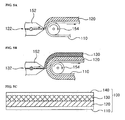
- Figs. 6A - 6B are cross-sectional views illustrating the steps of manufacturing a green sheet for barrier ribs according to a fourth embodiment of the present invention.
- Figs. 7A - 7F are cross-sectional views illustrating the steps of forming the barrier ribs of the PDP of Fig. 2.
- Fig. 1 is a cross-sectional view of plasma display panel (PDP) according to a preferred embodiment of the present invention.
- Fig. 1 shows that the structure of a PDP is divided into an upper plate 200 and a lower plate 300.
- transparent electrodes 220, bus electrodes 250, first black matrices 230, second black matrices 240, an upper dielectric layer 260, and a protection layer 270 are formed on the lower side of a glass substrate 210 (hereinafter, referred to as "upper substrate").
- the transparent electrodes 220 may be made of a transparent conductive material such as indium tin oxide (ITO) or indium zinc oxide (IZO) to transmit light generated from discharge cells.
- ITO indium tin oxide
- IZO indium zinc oxide
- the bus electrodes 250 are present on the transparent electrodes 220 in order to reduce the line resistance of the transparent electrodes 220.
- the bus electrodes 250 may be made of a silver (Ag) paste having high conductivity. Since the bus electrodes 250 are generally made of a material with high electrical conductivity, they may reduce the driving voltage of the transparent electrodes 220 having relatively low electrical conductivity.
- the first black matrices 230 are present as very thin layers between the transparent electrodes 220 and the bus electrodes 250, thereby allowing an electric current to pass between the transparent electrodes 220 and the bus electrodes 250, and enhancing the contrast of the PDP.
- the second black matrices 240 are disposed between the discharge cells, and absorb outside light and inside transmitting light between adjacent discharge cells, thereby enhancing the contrast. And, the second black matrices 240 also play a role to divide or part the discharge cells.
- the upper dielectric layer 260 directly contacts the bus electrodes 250 and may be made of a metallic material, and PbO-based glass may be used for the upper dielectric layer 260 in order to avoid chemical reactions with the bus electrodes 250.
- PbO-based glass may be used for the upper dielectric layer 260 in order to avoid chemical reactions with the bus electrodes 250.
- non-lead containing materials may be used for the upper dielectric layer 260, for instance, bismuth oxide based glass, or other suitable glass may be used.
- the upper dielectric layer 260 restricts discharge current to maintain glow discharge, and the electric charges generated at the time of plasma discharge are deposited on the upper dielectric layer 260.
- the protection layer 270 prevents damage to the upper dielectric layer 260 caused by sputtering at the time of plasma discharge, and increases the discharge efficiency of secondary electrons.
- the protection layer 270 may be made of magnesium oxide (MgO).
- a glass substrate 310 hereinafter, referred to as "lower substrate"
- address electrodes 320 only one shown in Fig. 1
- a lower dielectric layer 330 a glass substrate 310
- barrier ribs 340 each barrier rib 340 has a double-layered structure including a lower barrier rib 344 and an upper barrier rib 342
- a phosphor layer 350 are disposed on the upper surface of the lower substrate 310.
- the address electrodes 320 are positioned at the center of each discharge cell.
- the address electrodes 320 may have a line width of about 70 to 80 ⁇ m.
- the lower dielectric layer 330 is disposed over the substantially all of the surface of the lower substrate 310 and the address electrodes 320, and the lower dielectric layer 330 protects the address electrodes 320.
- the barrier ribs 340 are positioned on top of the lower dielectric layer 330 spaced by a predetermined distance from the address electrodes 320.
- the barrier ribs are formed to be longer in the direction perpendicular to layers such as the lower substrate, the lower dielectric layer, etc.
- the barrier ribs 340 have a double-layered structure comprising a lower barrier rib 344 and an upper barrier rib 342.
- the cross-sectional shape of the barrier ribs 340 may be a rectangular shape, wherein the upper barrier rib 342 has the same width as the lower barrier rib 344.
- the cross-sectional shape of the barrier ribs 340 may be a trapezoid shape, wherein the width of the upper barrier rib 342 is narrower than that of the lower barrier rib 344.
- the barrier ribs 340 are present to maintain the discharge distance, and to prevent electrical and optical interference between adjacent discharge cells.
- the phosphor layer 350 is formed on both sides of the barrier ribs 340 and the upper surface of the lower dielectric layer 330.
- the phosphor layer 350 is excited by ultraviolet rays generated at the time of plasma discharge to generate red (R), green (G) or blue (B) visible rays.
- the force-exerted electrons obtain energy (first ionization energy) enough to remove electrons in an outermost orbit, they ionize the gas, and the ions and electrons created in the gas move to both electrodes by electromagnetic force.
- first ionization energy energy enough to remove electrons in an outermost orbit
- the ions and electrons created in the gas move to both electrodes by electromagnetic force.
- secondary electrons are generated when the ions collide with the protection layer 270, and the secondary electrons help to create the plasma.
- the gas provided in the cells of a PDP is generally an inert gas, such as Ne, Xe, He, etc. Particularly, when Xe is under a quasi stable state, ultraviolet rays with a wavelength of between about 147 and 173 nm are generated and applied to the phosphor layer 350 to emit red, green or blue visible rays.
- each discharge cell becomes a sub-pixel representing a red, a green or a blue color.
- the color of each discharge cell is controlled by combination of lights emitted from the three sub-pixels.
- controlling the time that the plasma is generated controls the color.
- the visible rays generated as described above are emitted to the outside of the cell through the upper substrate 210.
- Fig. 2 is a cross-sectional view of the green sheet for barrier ribs in PDP according to a preferred embodiment of the present invention.
- the green sheet 100 is a sheet adapted to the process of forming a constitutional element of a PDP, particularly the barrier ribs 340.
- the green sheet 100 comprises a first film-forming layer 120 and a second film-forming layer 130, which are formed by applying respective slurries onto a base film 110 and drying them thereafter. The step of drying preferably removes substantially almost all of the solvent(s).
- a protection film 140 disposed on a surface of the second film-forming layer 130. The base film 110 and the protection layer 140 are formed to be releasable from the film-forming layers 120 and 130.
- the base film 110 may be a resin film, preferably having flexibility as well as thermal resistance and solvent resistance.
- the flexibility of the base film 110 helps to apply slurries onto the base film 110 so that the film-forming layers 120 and 130 may be made with a uniform film thickness. Also, the flexibility of the base film 110 allows the film-forming layers 120 and 130 to be stored in the shape of a roll.
- the first and second film-forming layers 120 and 130 are pre-form layers, which become the barrier ribs 340 through the following processes.
- the slurry applied to the base film 110 for forming the first and second film-forming layers 120 and 130 may contain a glass powder, a filler powder, a solvent, a dispersing agent, a plasticizer and a binder.
- the slurry may further contain an additive to improve leveling property and application (coating) property.
- the slurry may comprise about 100 parts by weight of a mixture comprising a glass powder and a filler; about 20 to 50 parts by weight of a solvent; about 0.01 to 2 parts by weight of a dispersing agent; about 1 to 10 parts by weight of a plasticizer; and about 10 to 20 parts by weight of a binder.
- the slurry may further comprise about 0.01 to 0.5 parts by weight of at least one additive, such as a leveling agent or an antifoaming agent.
- the glass powder may be at least one ofPbO-based glass powder, a ZnO-based glass powder, a Bi 2 O 3 -based glass powder, or a mixture thereof.
- the glass powder is a PbO-B 2 O 3 -SiO 2 -based glass powder, a PbO-B 2 O 3 -SiO 2 -Al 2 O 3 -based glass powder, a ZnO-B 2 O 3 -SiO 2 -based glass powder, a PbO-ZnO-B 2 O 3 -SiO 2 -based glass powder or mixtures thereof.
- the glass powder preferably adds to the structural integrity of the ribs ultimately to be formed from the slurry.
- the filler may be at least one selected from the group consisting of Al 2 O 3 , ZnO, TiO 2 and mixtures thereof.
- the solvent may be at least one selected from the group consisting of methyl ethyl ketone, ethanol, xylene, trichloroethane, butanol, methylisobutyl ketone (MIBK), ethyl acetate (EA), butyl acetate, cyclohexanone, water, propyleneglycol monomethyl ether, and mixtures thereof.
- the solvent may be present in an amount of about 20 to 50 parts by weight, preferably about 30 to 40 parts by weight.
- the dispersing agent may be at least one selected from the group consisting of polyamine amide based material, phosphoric acid ester based material, polyisobutylene, oleic acid, fish oil, ammonium salt of a polycarboxylic acid, sodium carboxymethyl cellulose, and mixtures thereof.
- the dispersing agent may be present in an amount of about 0.01 to 2 parts by weight, preferably about 0.75 to 1.25 parts by weight.
- the plasticizer may be at least one selected from the group consisting of phthalate based material, glycol based material, azelate based material, and mixtures thereof.
- the plasticizer may be present in an amount of about 1 to 10 parts by weight, preferably about 4 to 7 parts by weight.
- the binder may be at least one selected from the group consisting of cellulose based material, vinyl based material, methacrylic based material, acrylic based material, and mixtures thereof.
- the binder may be present in an amount of about 10 to 20 parts by weight, preferably about 12 to 16 parts by weight.
- the slurries are prepared to form the first and second film-forming layers 120 and 130 as shown in the foregoing description.
- a first slurry for forming the first film-forming layer 120 and a second slurry for forming the second film-forming layer 130 should not be mixed while the slurries are applied onto the base film 110.
- the first slurry for forming the first film-forming layer 120 should have higher viscosity than the second slurry for forming the second film-forming layer 130 because the slurries may be mixed with each other at the time of coating due to same flowability if the two slurries have same viscosity.
- the viscosity difference between of the first film-forming layer 120 and the second film-forming layer 130 is preferably between about 100cP and 5000cP.
- the density difference between the first slurry and the second slurry is preferably between about 0.01g/cm 3 and 1.0g/cm 3 .
- first and second film-forming layers 120 and 130 preferably have a rheology of between about 1 to 3 TI, wherein TI refers to Thixotropic Index.
- the first slurry for the first film-forming layer 120 contains about 100 parts by weight of a mixture including 71.1 parts by weight of a glass powder and 28.9 parts by weight of a filler.
- the first slurry further contains about 1 part by weight of a dispersing agent, 13 parts by weight of a binder, 36 parts by weight of a solvent, and 5 parts by weight of a plasticizer.
- the first slurry further contains 0.025 parts by weight of a leveling agent and 0.025 parts by weight of an antifoaming agent as additives.
- the second slurry for the second film-forming layer 130 contains about 100 parts by weight of a mixture containing 73.3 parts by weight of a glass powder and 26.7 parts by weight of a filler.
- the second slurry further contains about 1 part by weight of a dispersing agent, 15 parts by weight of a binder, 37 parts by weight of a solvent, and 6 parts by weight of a plasticizer.
- the second slurry further contains 0.025 parts by weight of a leveling agent and 0.025 parts by weight of an antifoaming agent as additives.
- the first slurry shows a viscosity of 2500 cP and 2.5 TI
- the second slurry shows a viscosity of 2000 cP and 2.0 TI. Therefore, the first slurry and the second slurry will not be mixed while applied over the base film.
- first film-forming layer 120 and the second film-forming layer 130 show a difference in etching rates under the same conditions as above, wherein the first film-forming layer 120 has a lower etching rate than the second film-forming layer 130.
- the inventors of the present invention find that the difference of content ratios of the glass powder and the filler between the first slurry and the second slurry provides such difference in the etching rate.
- the differences in content ratios of the glass powder and the filler between the first and second slurries preferably allow for differences in characteristics such as relative etching rates, relative viscosities, and relative densities.
- Exemplary but non-limiting examples of content ratios are as follows:
- the content ratio of glass powder: filler of the first and second slurries may fall within the range between about 2:1 and about 4:1, preferably between about 2.4:1 and about 2.8:1, provided that the content ratios are not the same between the first and second slurries and allow for the above differences in characteristic.
- Fig. 3A - 3C are cross-sectional views illustrating the steps of manufacturing a green sheet for barrier ribs according to a first embodiment of the present invention
- Fig. 4A - 4C are cross-sectional views illustrating the steps of manufacturing a green sheet for barrier ribs according to a second embodiment of the present invention
- Fig. 5A - 5C are cross-sectional views illustrating the steps of manufacturing a green sheet for barrier ribs according to a third embodiment of the present invention
- Fig. 6A - 6C are cross-sectional views illustrating the steps of manufacturing a green sheet for barrier ribs according to a fourth embodiment of the present invention.
- both the first and second film-forming layers are obtained by using a comma coating method as specified below.
- a certain amount of the first slurry 122 is provided onto the base film 110, and the base film 110 with first slurry 122 thereon is passed through a comma shaped knife 150 at a fixed speed to form the first film-forming layer 120 on the base film 110.
- a certain amount of the second slurry 132 is provided onto the first film-forming layer 120 disposed on the base film 110, and then the base film 110 with first film-forming layer 120 and second slurry 132 thereon is passed through the comma shaped knife 150 at a fixed speed to form the second film-forming layer 130 over the base film 110. And then, the first film-forming layer 120 and the second film-forming layer 130 are dried.
- the protection film 140 is covered over the second film-forming layer 130 to obtain the green sheet 100.
- both the first and second film-forming layers 120 and 130 may be obtained by the comma coating method described above.
- the first film-forming layer is obtained by a die coating method
- the second film-forming layer is obtained by a comma coating method.
- the first slurry 122 is filled in a slot shaped coater 152 (connected to a pump, not shown), and the base film 110 is wound around a roller 154.
- the first slurry 122 is discharged by activating the coater 152 while the roller 154 is rotated. As a result, the first film-forming layer 120 is formed on the base film 110.
- a certain amount of the second slurry 132 is provided onto the first film-forming layer 120 disposed on the base film 110, and then the base film 110 with the first film-forming layer and the second slurry 132 thereon is passed through the comma shaped knife 150 at a fixed speed to form the second film-forming layer 130 over the base film 110. And then, the first film-forming layer 120 and the second film-forming layer 130 are dried.
- the protection film 140 is covered over the second film-forming layer 130 to obtain the green sheet 100.
- the first film-forming layer 120 may be obtained by a die coating method
- the second film-forming layer 130 may be obtained by a comma coating method.
- the first film-forming layer may be obtained by a comma coating method
- the second film-forming layer may be obtained by a die coating method.
- both the first and second film-forming layers are formed by die coating methods.
- the first slurry 122 is filled in a slot shaped coater 152 (attached to a pump, not shown), and the base film 110 is wound around a roller 154.
- the first slurry 122 is discharged by activating the coater 152 while the roller 154 is rotated. As a result, the first film-forming layer 120 is formed on the base film 110.
- the second slurry 132 is filled in the slot shaped coater 152 (attached to a pump, not shown), and the base film 110 having the first film-forming layer 120 thereon is wound around the roller 154. Then, the second slurry 132 is discharged by activating the coater 152 while the roller 154 is rotated. As a result, the second film-forming layer 130 is formed on the first film-forming layer 120. And then, the first film-forming layer 120 and the second film-forming layer 130 are dried.
- the protection film 140 is covered over the second film-forming layer 130 to obtain the green sheet 100.
- the first and second film-forming layers 120 and 130 may be obtained by die coating methods.
- the method of manufacturing the green sheet 100 according to the fourth embodiment of the present invention will be described below.
- the first and second film-forming layers are obtained by a dual die coating method.
- the first and second slurries 122 and 132 are filled in a coater 156 with double slots (attached to at least one pump, not shown), and the base film 110 is wound around a roller 154. Then, the first and second slurries 122 and 132 are discharged together by activating the coater 156, and the roller 154 is rotated. As a result, the first film-forming layer 120 and the second film-forming layer130 are formed together on the base film 110 as shown in Fig. 6B. And then, the first film-forming layer 120 and the second film-forming layer 130 are dried.
- the protection film 140 is covered over the second film-forming layer 130 to obtain the green sheet 100.
- the first film-forming layer 120 and second film-forming layer 130 may be obtained by a dual die coating method.
- the method of manufacturing the green sheet 100 is not limited to the foregoing described methods, and other methods, such as gravure method, L.P method, etc., may be also used.
- Fig. 7A - 7F are cross-sectional views illustrating the steps of manufacturing the barrier ribs of the PDP of Fig. 2.
- the green sheet 100 is transferred to the lower substrate 310 with the address electrodes 320 and the lower dielectric layer 330 disposed thereon.
- the address electrodes 320 and the lower dielectric layer 330 may be formed on the lower substrate 310 by any conventional method, such as sputtering, ionic plating, chemical deposition, electro deposition and the like.
- the protection film 140 is released from the second film-forming layer 130 of the green sheet 100, and then the second film-forming layer 130 is overlaid with the lower substrate 310 so that a surface of the second film-forming layer 130 and a surface of the lower dielectric layer 330 are contacted with each other.
- the direction of transferring the green sheet 100 is preferably perpendicular to the direction of the address electrodes 320.
- a movable heat roller 500 is moved and rotated on the green sheet 100 for thermo-compression so that the first and second film-forming layers 120 and 130 on the base film 110 may be transferred onto the lower substrate 310 as shown in Fig. 7B.
- the base film 110 is released from the first film-forming layer 120.
- thermal treatment is performed to the lower substrate 310 with the first film-forming layer 120 and second film-forming layer 130 thereon at a temperature over 500°C, thereby to sinter the first film-forming layer 120 and second film-forming layer 130.
- a mask 400 with openings therein is disposed on the first and second film-forming layers over the lower substrate.
- the openings of the mask 400 are formed in areas other than the areas for the location of the barrier ribs.
- the lower substrate 310 with the mask 400 thereon is treated with an etching agent, thereby removing the areas of the first and second film-forming layers 120 and 130 corresponding to the openings of the mask 400, and thereby shaping the barrier ribs having of an upper rib portion 342 and a lower rib portion 344 as shown in Fig. 7E.
- the first film-forming layer 120 and the second film-forming layer 130 have different etching rates due to the difference of content ratios of glass powder and filler. Moreover, the content ratios are preferably designed so that the second film-forming layer 130 has a higher etching rate than the first film-forming layer 120. Under such conditions, the first film-forming layer 120 is damaged less by side etching while the second film-forming layer 130 is being etched. Thus, a rectangular or trapezoid cross-sectional shape of the barrier ribs, which are structurally and mechanically stable, can be obtained.
- a phosphoric material is coated inside the cells defined by the barrier ribs 340 to form the phosphor layer 350.
Landscapes
- Engineering & Computer Science (AREA)
- Physics & Mathematics (AREA)
- Plasma & Fusion (AREA)
- Manufacturing & Machinery (AREA)
- Electromagnetism (AREA)
- Gas-Filled Discharge Tubes (AREA)
- Glass Compositions (AREA)
- Laminated Bodies (AREA)
Applications Claiming Priority (1)
| Application Number | Priority Date | Filing Date | Title |
|---|---|---|---|
| KR1020050118167A KR100730044B1 (ko) | 2005-12-06 | 2005-12-06 | 격벽용 슬러리, 그린시트 및 플라즈마 디스플레이 패널의격벽 제조방법 |
Publications (2)
| Publication Number | Publication Date |
|---|---|
| EP1796122A2 true EP1796122A2 (de) | 2007-06-13 |
| EP1796122A3 EP1796122A3 (de) | 2008-12-17 |
Family
ID=37685847
Family Applications (1)
| Application Number | Title | Priority Date | Filing Date |
|---|---|---|---|
| EP06017671A Withdrawn EP1796122A3 (de) | 2005-12-06 | 2006-08-24 | Schlämmungszusammensetzung, Grünfolie und Verfahren zur Herstellung derTrennrippen einer Plasma-Anzeigetafel |
Country Status (5)
| Country | Link |
|---|---|
| US (1) | US7767290B2 (de) |
| EP (1) | EP1796122A3 (de) |
| JP (1) | JP2007157689A (de) |
| KR (1) | KR100730044B1 (de) |
| CN (1) | CN1979728A (de) |
Families Citing this family (7)
| Publication number | Priority date | Publication date | Assignee | Title |
|---|---|---|---|---|
| KR100905482B1 (ko) | 2007-11-28 | 2009-07-02 | 엘지전자 주식회사 | 플라즈마 디스플레이 패널 유전체용 조성물, 이를 포함하는플라즈마 디스플레이 패널 |
| KR100905480B1 (ko) * | 2007-12-21 | 2009-07-02 | 엘지전자 주식회사 | 플라즈마 디스플레이 패널 유전체용 조성물, 이를 포함하는플라즈마 디스플레이 패널 |
| KR101010693B1 (ko) * | 2009-02-04 | 2011-01-24 | 엘지전자 주식회사 | 그린시트 및 플라즈마 디스플레이 패널의 제조방법 |
| KR102445275B1 (ko) * | 2019-02-21 | 2022-09-19 | 주식회사 엘지에너지솔루션 | 이차 전지용 전극의 제조방법 |
| EP3966008A4 (de) * | 2019-05-07 | 2023-05-03 | Tritone Technologies Ltd. | Formulierungen zur generativen fertigung von dreidimensionalen gegenständen mit sinterfähigen stoffen |
| WO2022101915A1 (en) * | 2020-11-11 | 2022-05-19 | Tritone Technologies Ltd. | Organic formulations for additive manufacturing of three-dimensional objects containing sinterable materials |
| US12398242B2 (en) | 2021-01-13 | 2025-08-26 | Prior Company Limited | Slurry composition and preparation method therefor |
Citations (3)
| Publication number | Priority date | Publication date | Assignee | Title |
|---|---|---|---|---|
| US5909083A (en) | 1996-02-16 | 1999-06-01 | Dai Nippon Printing Co., Ltd. | Process for producing plasma display panel |
| US6043604A (en) | 1996-07-10 | 2000-03-28 | Toray Industries, Inc. | Plasma display with barrier rib of specific construction |
| WO2004012854A2 (en) | 2002-08-02 | 2004-02-12 | Ultra Plasma Display Corporation | Method for preparing photosensitive barrier rib paste composition for fabricating plasma display pannel |
Family Cites Families (21)
| Publication number | Priority date | Publication date | Assignee | Title |
|---|---|---|---|---|
| JPH0787075B2 (ja) * | 1987-08-05 | 1995-09-20 | 富士通株式会社 | 表示パネルの隔壁形成方法 |
| JP3454654B2 (ja) | 1997-01-13 | 2003-10-06 | 富士通株式会社 | 表示パネルの隔壁形成方法 |
| DE19817478B4 (de) | 1998-04-20 | 2004-03-18 | Patent-Treuhand-Gesellschaft für elektrische Glühlampen mbH | Flache Entladungslampe und Verfahren zu ihrer Herstellung |
| KR100301661B1 (ko) * | 1998-04-30 | 2001-11-14 | 구자홍 | 플라즈마표시장치용유전체조성물 |
| KR100272283B1 (ko) | 1998-08-21 | 2000-11-15 | 구자홍 | 고휘도 플라즈마 디스플레이 패널용 격벽 조성물 |
| JP4214597B2 (ja) * | 1999-02-04 | 2009-01-28 | Jsr株式会社 | パターンの製造方法および転写フィルム |
| KR100607240B1 (ko) * | 1999-12-17 | 2006-08-01 | 엘지전자 주식회사 | 플라즈마 디스플레이 패널의 격벽용 조성물 |
| JP2002063842A (ja) * | 2000-08-22 | 2002-02-28 | Matsushita Electric Ind Co Ltd | プラズマディスプレイパネルおよびその製造方法 |
| JP2002324484A (ja) * | 2001-04-24 | 2002-11-08 | Matsushita Electric Ind Co Ltd | プラズマディスプレイパネルの製造方法 |
| JP2002367519A (ja) | 2001-06-04 | 2002-12-20 | Nippon Electric Glass Co Ltd | プラズマディスプレイパネル用隔壁材料 |
| JP3389243B1 (ja) | 2001-07-03 | 2003-03-24 | 松下電器産業株式会社 | プラズマディスプレイパネルおよびその製造方法 |
| KR100495488B1 (ko) * | 2002-12-07 | 2005-06-16 | 엘지마이크론 주식회사 | 플라즈마 디스플레이 패널의 후면판 |
| JP3972021B2 (ja) * | 2003-05-28 | 2007-09-05 | 東京応化工業株式会社 | プラズマディスプレイ前面板製造用未焼成積層体およびプラズマディスプレイ前面板の製造方法 |
| KR20040104790A (ko) | 2003-06-04 | 2004-12-13 | 엘지전자 주식회사 | 블랙 레지스트를 이용한 플라즈마 디스플레이 패널의 격벽및 그 제조방법 |
| JP4177196B2 (ja) * | 2003-08-07 | 2008-11-05 | 日東電工株式会社 | 膜形成材料層、転写シート、誘電体層、誘電体層形成基板の製造方法、及び誘電体層形成基板 |
| JP2005209588A (ja) * | 2004-01-26 | 2005-08-04 | Jsr Corp | プラズマディスプレイパネル部材の製造方法および転写フィルム |
| JP2005213058A (ja) * | 2004-01-27 | 2005-08-11 | Lintec Corp | 誘電体層用組成物、グリーンシート、誘電体層形成基板およびその製造方法 |
| KR20050096541A (ko) * | 2004-03-31 | 2005-10-06 | 삼성에스디아이 주식회사 | 돌출부를 갖는 네거티브 홀 구조, 그것의 형성 방법 및그것을 포함하는 fed 캐소드 부 |
| KR101085443B1 (ko) * | 2004-10-08 | 2011-11-21 | 삼성전자주식회사 | 박막 보호막 및 박막 보호막을 갖는 표시기판 |
| KR100730043B1 (ko) * | 2005-10-25 | 2007-06-20 | 엘지전자 주식회사 | 플라즈마 디스플레이 패널의 유전체층 제조방법 |
| KR100730042B1 (ko) * | 2005-12-29 | 2007-06-20 | 엘지전자 주식회사 | 플라즈마 디스플레이 패널의 격벽용 페이스트 조성물,그린시트, 및 이를 이용한 플라즈마 디스플레이 패널 |
-
2005
- 2005-12-06 KR KR1020050118167A patent/KR100730044B1/ko not_active Expired - Fee Related
-
2006
- 2006-08-21 US US11/506,928 patent/US7767290B2/en active Active
- 2006-08-24 EP EP06017671A patent/EP1796122A3/de not_active Withdrawn
- 2006-08-30 CN CNA2006101266135A patent/CN1979728A/zh active Pending
- 2006-09-15 JP JP2006251664A patent/JP2007157689A/ja active Pending
Patent Citations (3)
| Publication number | Priority date | Publication date | Assignee | Title |
|---|---|---|---|---|
| US5909083A (en) | 1996-02-16 | 1999-06-01 | Dai Nippon Printing Co., Ltd. | Process for producing plasma display panel |
| US6043604A (en) | 1996-07-10 | 2000-03-28 | Toray Industries, Inc. | Plasma display with barrier rib of specific construction |
| WO2004012854A2 (en) | 2002-08-02 | 2004-02-12 | Ultra Plasma Display Corporation | Method for preparing photosensitive barrier rib paste composition for fabricating plasma display pannel |
Also Published As
| Publication number | Publication date |
|---|---|
| KR20070059381A (ko) | 2007-06-12 |
| KR100730044B1 (ko) | 2007-06-20 |
| CN1979728A (zh) | 2007-06-13 |
| US20070126331A1 (en) | 2007-06-07 |
| US7767290B2 (en) | 2010-08-03 |
| EP1796122A3 (de) | 2008-12-17 |
| JP2007157689A (ja) | 2007-06-21 |
Similar Documents
| Publication | Publication Date | Title |
|---|---|---|
| EP1381071B1 (de) | Plasmaanzeigevorrichtung | |
| US7767290B2 (en) | Slurry composition, green sheet, and method for manufacturing barrier ribs of plasma display panel | |
| JP4111298B2 (ja) | プラズマディスプレイパネル | |
| US6910937B2 (en) | Method for forming fine barrier, method for fabricating planar display and abrasive for blast | |
| EP1803692B1 (de) | Grünfolie zur Herstellung von Isolierstegen in einer Plasmaanzeigentafel | |
| JP4519629B2 (ja) | プラズマディスプレイ部材およびプラズマディスプレイ | |
| US7758395B2 (en) | Lower plate of PDP and method for manufacturing the same | |
| JP2003338246A (ja) | プラズマ表示装置およびその製造方法 | |
| JPH07111135A (ja) | ガス放電表示パネル | |
| JPWO2011118152A1 (ja) | プラズマディスプレイパネルの製造方法 | |
| JP5251355B2 (ja) | プラズマディスプレイパネルの製造方法 | |
| EP2136385A1 (de) | Verfahren zur herstellung einer plasmaanzeigetafel | |
| US20070132393A1 (en) | Method for forming a dielectric layer in a plasma display panel | |
| JP2008159360A (ja) | プラズマディスプレイパネルの製造方法 | |
| JP2009218131A (ja) | プラズマディスプレイパネルの製造方法 | |
| WO2009113254A1 (ja) | プラズマディスプレイパネル | |
| KR20100000221A (ko) | 형광체 페이스트 및 그를 이용한 플라즈마 디스플레이 패널제조방법 | |
| JP2006164526A (ja) | プラズマディスプレイパネルとその製造方法 | |
| US20110127902A1 (en) | Plasma Display Panel and Method of Manufacturing the Same | |
| JPWO2008032355A1 (ja) | プラズマディスプレイパネル及びその蛍光体層形成方法 | |
| EP1939921A1 (de) | Plasmaanzeigetafel und Verfahren zu ihrer Herstellung | |
| JPWO2011114699A1 (ja) | プラズマディスプレイパネル | |
| CN102804324A (zh) | 等离子显示面板 | |
| CN102834893A (zh) | 等离子显示面板的制造方法 | |
| KR20120127557A (ko) | 플라즈마 디스플레이 패널 |
Legal Events
| Date | Code | Title | Description |
|---|---|---|---|
| PUAI | Public reference made under article 153(3) epc to a published international application that has entered the european phase |
Free format text: ORIGINAL CODE: 0009012 |
|
| 17P | Request for examination filed |
Effective date: 20060825 |
|
| AK | Designated contracting states |
Kind code of ref document: A2 Designated state(s): AT BE BG CH CY CZ DE DK EE ES FI FR GB GR HU IE IS IT LI LT LU LV MC NL PL PT RO SE SI SK TR |
|
| AX | Request for extension of the european patent |
Extension state: AL BA HR MK YU |
|
| PUAL | Search report despatched |
Free format text: ORIGINAL CODE: 0009013 |
|
| AK | Designated contracting states |
Kind code of ref document: A3 Designated state(s): AT BE BG CH CY CZ DE DK EE ES FI FR GB GR HU IE IS IT LI LT LU LV MC NL PL PT RO SE SI SK TR |
|
| AX | Request for extension of the european patent |
Extension state: AL BA HR MK RS |
|
| AKX | Designation fees paid |
Designated state(s): DE FR GB NL |
|
| 17Q | First examination report despatched |
Effective date: 20100210 |
|
| RAP1 | Party data changed (applicant data changed or rights of an application transferred) |
Owner name: LG ELECTRONICS INC. |
|
| STAA | Information on the status of an ep patent application or granted ep patent |
Free format text: STATUS: THE APPLICATION IS DEEMED TO BE WITHDRAWN |
|
| 18D | Application deemed to be withdrawn |
Effective date: 20121115 |