EP1796148A2 - Dispositif semiconducteur à carbure de silicium et procédé de sa fabrication - Google Patents
Dispositif semiconducteur à carbure de silicium et procédé de sa fabrication Download PDFInfo
- Publication number
- EP1796148A2 EP1796148A2 EP06025341A EP06025341A EP1796148A2 EP 1796148 A2 EP1796148 A2 EP 1796148A2 EP 06025341 A EP06025341 A EP 06025341A EP 06025341 A EP06025341 A EP 06025341A EP 1796148 A2 EP1796148 A2 EP 1796148A2
- Authority
- EP
- European Patent Office
- Prior art keywords
- silicon carbide
- silicide electrode
- semiconductor device
- electrode
- face
- Prior art date
- Legal status (The legal status is an assumption and is not a legal conclusion. Google has not performed a legal analysis and makes no representation as to the accuracy of the status listed.)
- Withdrawn
Links
Images




Classifications
-
- H—ELECTRICITY
- H10—SEMICONDUCTOR DEVICES; ELECTRIC SOLID-STATE DEVICES NOT OTHERWISE PROVIDED FOR
- H10D—INORGANIC ELECTRIC SEMICONDUCTOR DEVICES
- H10D62/00—Semiconductor bodies, or regions thereof, of devices having potential barriers
- H10D62/80—Semiconductor bodies, or regions thereof, of devices having potential barriers characterised by the materials
- H10D62/83—Semiconductor bodies, or regions thereof, of devices having potential barriers characterised by the materials being Group IV materials, e.g. B-doped Si or undoped Ge
- H10D62/832—Semiconductor bodies, or regions thereof, of devices having potential barriers characterised by the materials being Group IV materials, e.g. B-doped Si or undoped Ge being Group IV materials comprising two or more elements, e.g. SiGe
- H10D62/8325—Silicon carbide
-
- H—ELECTRICITY
- H10—SEMICONDUCTOR DEVICES; ELECTRIC SOLID-STATE DEVICES NOT OTHERWISE PROVIDED FOR
- H10D—INORGANIC ELECTRIC SEMICONDUCTOR DEVICES
- H10D12/00—Bipolar devices controlled by the field effect, e.g. insulated-gate bipolar transistors [IGBT]
- H10D12/01—Manufacture or treatment
- H10D12/031—Manufacture or treatment of IGBTs
-
- H—ELECTRICITY
- H10—SEMICONDUCTOR DEVICES; ELECTRIC SOLID-STATE DEVICES NOT OTHERWISE PROVIDED FOR
- H10D—INORGANIC ELECTRIC SEMICONDUCTOR DEVICES
- H10D30/00—Field-effect transistors [FET]
- H10D30/01—Manufacture or treatment
- H10D30/021—Manufacture or treatment of FETs having insulated gates [IGFET]
- H10D30/028—Manufacture or treatment of FETs having insulated gates [IGFET] of double-diffused metal oxide semiconductor [DMOS] FETs
- H10D30/0291—Manufacture or treatment of FETs having insulated gates [IGFET] of double-diffused metal oxide semiconductor [DMOS] FETs of vertical DMOS [VDMOS] FETs
-
- H—ELECTRICITY
- H10—SEMICONDUCTOR DEVICES; ELECTRIC SOLID-STATE DEVICES NOT OTHERWISE PROVIDED FOR
- H10D—INORGANIC ELECTRIC SEMICONDUCTOR DEVICES
- H10D64/00—Electrodes of devices having potential barriers
- H10D64/01—Manufacture or treatment
- H10D64/011—Manufacture or treatment of electrodes ohmically coupled to a semiconductor
- H10D64/0111—Manufacture or treatment of electrodes ohmically coupled to a semiconductor to Group IV semiconductors
- H10D64/0115—Manufacture or treatment of electrodes ohmically coupled to a semiconductor to Group IV semiconductors to silicon carbide
-
- H—ELECTRICITY
- H10—SEMICONDUCTOR DEVICES; ELECTRIC SOLID-STATE DEVICES NOT OTHERWISE PROVIDED FOR
- H10D—INORGANIC ELECTRIC SEMICONDUCTOR DEVICES
- H10D64/00—Electrodes of devices having potential barriers
- H10D64/60—Electrodes characterised by their materials
- H10D64/62—Electrodes ohmically coupled to a semiconductor
-
- H—ELECTRICITY
- H10—SEMICONDUCTOR DEVICES; ELECTRIC SOLID-STATE DEVICES NOT OTHERWISE PROVIDED FOR
- H10D—INORGANIC ELECTRIC SEMICONDUCTOR DEVICES
- H10D8/00—Diodes
- H10D8/01—Manufacture or treatment
- H10D8/051—Manufacture or treatment of Schottky diodes
-
- H—ELECTRICITY
- H10—SEMICONDUCTOR DEVICES; ELECTRIC SOLID-STATE DEVICES NOT OTHERWISE PROVIDED FOR
- H10D—INORGANIC ELECTRIC SEMICONDUCTOR DEVICES
- H10D8/00—Diodes
- H10D8/60—Schottky-barrier diodes
-
- H—ELECTRICITY
- H10—SEMICONDUCTOR DEVICES; ELECTRIC SOLID-STATE DEVICES NOT OTHERWISE PROVIDED FOR
- H10P—GENERIC PROCESSES OR APPARATUS FOR THE MANUFACTURE OR TREATMENT OF DEVICES COVERED BY CLASS H10
- H10P30/00—Ion implantation into wafers, substrates or parts of devices
- H10P30/20—Ion implantation into wafers, substrates or parts of devices into semiconductor materials, e.g. for doping
- H10P30/22—Ion implantation into wafers, substrates or parts of devices into semiconductor materials, e.g. for doping using masks
-
- H—ELECTRICITY
- H10—SEMICONDUCTOR DEVICES; ELECTRIC SOLID-STATE DEVICES NOT OTHERWISE PROVIDED FOR
- H10D—INORGANIC ELECTRIC SEMICONDUCTOR DEVICES
- H10D64/00—Electrodes of devices having potential barriers
- H10D64/01—Manufacture or treatment
- H10D64/012—Manufacture or treatment of electrodes comprising a Schottky barrier to a semiconductor
- H10D64/0121—Manufacture or treatment of electrodes comprising a Schottky barrier to a semiconductor to Group IV semiconductors
- H10D64/0123—Manufacture or treatment of electrodes comprising a Schottky barrier to a semiconductor to Group IV semiconductors to silicon carbide
Definitions
- the present invention relates to a silicon carbide semiconductor device and a method for producing the same.
- Semiconductor silicon carbide has excellent features such as high electric breakdown field, high saturation electron velocity, high thermal conductivity, high heat resistance, high chemical stability, tough mechanical strength and the like.
- the semiconductor silicon carbide can form a pn junction and grow a thermally oxidized silicon film. Therefore, the semiconductor silicon carbide is the semiconductor material that realizes a ultra-low loss power device, a high frequency power amplifying device, a high temperature operation switching device and the like which cannot be achieved by Si.
- the semiconductor silicon carbide having the above features has been expected from the past and a basic research thereof has been done continuously.
- a silicide electrode is formed on a part for the ohmic contact and an upper conductor film is formed on the part, thereby completing the ohmic contact.
- the upper conductor film may suddenly be stripped, thus decreasing yield of the SiC electron devices or causing the stripping failure after completing the SiC electron devices.
- the above inconveniences are expected to occur even when the contact is not ohmic.
- a silicon carbide semiconductor device comprising: 1) a silicon carbide substrate; 2) a silicide electrode configured to be formed by depositing a contact parent material on the silicon carbide substrate in such a manner as to cause a solid phase reaction, the silicide electrode being a lower carbon content silicide electrode including: i) silicon, and ii) carbon smaller than the silicon in mol number; and 3) an upper conductor film deposited to the silicide electrode.
- a method for producing a silicon carbide semiconductor device which comprises: 1) a silicon carbide substrate; 2) a silicide electrode configured to be formed by depositing a contact parent material on the silicon carbide substrate in such a manner as to cause a solid phase reaction, the silicide electrode being a lower carbon content silicide electrode including: i) silicon, and ii) carbon smaller than the silicon in mol number; and 3) an upper conductor film deposited to the silicide electrode, the method comprising: 1) a first operation for depositing the contact parent material to the silicon carbide substrate; 2) a second operation for implementing a contact annealing, including the following sub-operations: i) heating the silicon carbide substrate to which the contact parent material is deposited, and ii) forming the silicide electrode by the solid phase reaction between the contact parent material and the silicon carbide substrate; 3) a third operation for segregating, to a surface of the silicide electrode, at least a part of carbon
- a method for producing a silicon carbide semiconductor device which comprises: 1) a silicon carbide substrate; 2) a silicide electrode configured to be formed by depositing a contact parent material on the silicon carbide substrate in such a manner as to cause a solid phase reaction, the silicide electrode being a lower carbon content silicide electrode including: i) silicon, and ii) carbon smaller than the silicon in mol number; and 3) an upper conductor film deposited to the silicide electrode, wherein the silicon carbide substrate includes: 1) a first face contacting a Schottky electrode such that the silicon carbide semiconductor device is configured to serve as a vertical Schottky diode, and 2) a second face opposite to the first face, the lower carbon content silicide electrode being formed on the second face, the method comprising: 1) a first operation for covering the first face and the second face of the silicon carbide substrate with a thermally oxidized film; 2) a second operation including the following sub-operations: i)
- a method for producing a silicon carbide semiconductor device which comprises: 1) a silicon carbide substrate; 2) a silicide electrode configured to be formed by depositing a contact parent material on the silicon carbide substrate in such a manner as to cause a solid phase reaction, the silicide electrode being a lower carbon content silicide electrode including: i) silicon, and ii) carbon smaller than the silicon in mol number; and 3) an upper conductor film deposited to the silicide electrode, wherein the silicon carbide semiconductor device further comprises: 1) a source electrode including the lower carbon content silicide electrode, and 2) a drain electrode including the lower carbon content silicide electrode, allowing the silicon carbide semiconductor device to serve as a field effect transistor configured to be a vertical metal-oxide-semiconductor, the method comprising: 1) a first operation for sequentially forming the following on a first face of the silicon carbide substrate by a selective impurity ion implantation: i) a precursor region of
- the present inventors have made a thorough study on causes for the strip failure.
- Fig. 1 shows a structure used for the determination.
- the structure in Fig. 1 is produced according to the related art and shows a cross sectional view of an essential part of an ohmic contact which includes a failure cause.
- a silicide electrode 41 is formed by a solid phase reaction (caused by heating referred to as "contact annealing") between a contact parent material and the silicon carbide substrate 1.
- an upper conductor film 3 is provided on (beneath in Fig. 1) the silicide electrode 41.
- the strip was found in an interface (otherwise, referred to as "electrode-conductor interface 42") between the upper conductor film 3 and the silicide electrode 41 and in the silicide electrode 41 (otherwise, referred to as "silicide inner part 43"), as shown in the cross sectional view in Fig. 1.
- the strip ratio of the electrode-conductor interface 42 was relatively high, specifically about 80 % of total failures, leaving the other strips in the silicide inner part 43.
- contact parent materials such as Ni, Co and the like contacting the SiC make the following solid phase reaction in a high temperature heating, thus easily forming the silicide while not forming the carbide: Ni + 2SiC ⁇ NiSi 2 + 2C (contact parent material: Ni)
- the carbon C generated by the above solid phase reaction is dispersed and present in the entire inner area of the silicide electrode 41.
- the carbon C is discharged rapidly and then is segregated (deposited) to the electrode-conductor interface 42 and the silicide inner part 43.
- the carbon C is in a form of a layer as the deposit 44 which seems to be the graphite.
- the deposit 44 is a frail material and has poor adhesion, thus being easily fragile with a slight stress applied to the deposit 44, thereby stripping off the upper conductor film 3.
- the present inventors have come up with the following inference. "Before forming the upper conductor film, intentionally discharging and removing the excessive amount of carbon C dispersed (as a deposit which seems to be a graphite) in the silicide electrode can suppress the stripping of the upper conductor film.” After various studies, the present inventors have found out several methods for discharging the excessive amount of carbon C and for removing the deposit which seems to be the graphite, and confirmed that the use of the above methods can bring about the inferred effects.
- a silicon carbide semiconductor device comprising: 1) a silicon carbide substrate; 2) a silicide electrode configured to be formed by depositing a contact parent material on the silicon carbide substrate in such a manner as to cause a solid phase reaction, the silicide electrode being a lower carbon content silicide electrode including: i) silicon, and ii) carbon smaller than the silicon in mol number; and 3) an upper conductor film deposited to the silicide electrode.
- the carbon generated by the solid phase reaction is the same in mol number as the silicon in silicide.
- the silicon carbide semiconductor device under the present invention therefore, includes the i) silicon and ii) the carbon which is smaller than the silicon in mol number, by discharging and removing outside the silicide electrode at least a part of the generated carbon.
- the embodiments of the present invention are applicable to all crystal faces including substrates of crystal systems such as 4H, 6H, 3C, 15R (where H denotes hexagonal system, C denotes cubic system, and R denotes rhombohedral system) and the like.
- substrates of crystal systems such as 4H, 6H, 3C, 15R (where H denotes hexagonal system, C denotes cubic system, and R denotes rhombohedral system) and the like.
- 4H-SiC substrate Being capable of bringing about an element feature that is the most excellent in various silicon carbide substrates, the 4H-SiC substrate to be described hereinafter is most promising today.
- SiC substrate any material having SiC substrate on which an epitaxial layer, other film(s) or electrode is formed are referred to as “SiC substrate” or simply “substrate.”
- a silicon carbide semiconductor device 10 having a simple ohmic contact includes a silicon carbide semiconductor device 10 having a simple ohmic contact, and a method for producing the silicon carbide semiconductor device 10, according to a first embodiment of the present invention.
- Fig. 2 shows a cross sectional view of an essential part of the silicon carbide semiconductor device 10, according to the first embodiment of the present invention.
- an n type 4H-SiC substrate 1 which is a silicon carbide substrate. At least a surface layer of a contact face of the n type 4H-SiC substrate 1 is doped with a high-concentration n type impurity.
- the substrate 1 has the contact face formed with a lower carbon content silicide electrode 52 (for example, NiSi 2 ) which is formed by a contact annealing (solid phase reaction) and has a carbon content smaller than silicon content in mol number.
- the carbon content in mol number is 1/5 or less the silicon content, or preferably 1/10 or less the silicon content.
- the carbon concentration 1/5 or more the silicon concentration may bring about an effect of the present invention to a certain extent, decreasing occurrence of strip failure of an upper conductor film 3 (to be described afterward).
- the carbon concentration 1/5 or less the silicon concentration shows an extremely remarkable effect, further decreasing occurrence of the strip failure of the upper conductor film 3, specifically, 2-digit decrease or more.
- the lower carbon content silicide electrode 52 has a thickness of 20 nm to 500 nm, or preferably 50 nm to 250 nm.
- the upper conductor film 3 may be made of a metalized film (for example, Ti/Ni/Ag laminate film) for mounting or made of a current takeout surface interconnect (Al film or Cu film).
- the ohmic contact is formed.
- the low resistance n + type 4H-SiC substrate 1 is the silicon carbide substrate having a main surface 1A (upper in Fig. 2) which is (0001) Si face.
- a main backface 1B (lower in Fig. 2) of the low resistivity n + type 4H-SiC substrate 1 the ohmic contact having the upper conductor film 3 (metalized film) for mounting is formed.
- the ohmic contact may be, however, formed on the main surface 1A of the low resistivity n + type 4H-SiC substrate 1, bringing about the same effect.
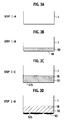
- Step I-A to (Step I-F) respectively correspond to Fig. 3A to Fig. 3F.
- the n type SiC substrate (n + type 4H-SiC) 1 which is the silicon carbide substrate for forming the contact is dry-oxidized at 1160° C, to thereby grow a thermally oxidized film on the main backface 1B of the silicon carbide substrate. Then, the thermally oxidized film is immediately removed by a buffered hydrofluoric acid solution, to thereby remove a low quality crystal layer on the surface layer of the silicon carbide substrate and expose a high quality crystal layer (Fig. 3A).
- the above sacrificial oxidization is essential for achieving low resistance of the contact, but can be omitted if such low resistance contact is not necessary.
- a contact parent material 50 is deposited on (beneath in Fig. 3B) the entire main backface 1B of the n type SiC substrate 1 through a film-forming such as DC spattering.
- Used for the contact parent material 50 includes a conductive material such as Ni, Co or the like. Through contact annealing, the above conductive material forms silicide and generates carbon as by-product. In the following steps, for convenience sake, the explanation is based on the contact parent material 50 made of Ni.
- Film thickness of the contact parent material 50 is one of the essential factors giving a substantial effect on strip of the upper conductor film 3.
- the larger the film thickness of the contact parent material 50 the larger the carbon amount generated in the subsequent contact annealing, resulting in higher risk of the film strip. Therefore, the smaller film thickness of the contact parent material 50 is more preferable.
- the contact parent material 50 having a too small film thickness is not preferable, which may cause, from a certain decreased thickness, a rapid increase in contact resistance. In the progress of decreasing the film thickness of contact parent material 50, the optimum film thickness of the contact parent material 50 is found right before the contact resistance is rapidly increased.
- the optimum film thickness of the contact parent material 50 is 50 nm for a sufficiently flat contact face, and about 100 nm for a ground face having irregularities on the contact face.
- the optimum film thickness of the contact parent material 50 may slightly vary with crystal quality, crystal system, polished (or ground) state and the like of the SiC substrate 1.
- the optimum film thickness of the contact parent material 50 is 15 nm to 250 nm, usually 25 nm to 125 nm.
- the substrate 1 is put on a rapid thermal annealer, to be subjected to a rapid thermal annealing (contact annealing) at 1000° C for 2 minutes in a high purity Ar atmosphere where water content and oxygen are drastically removed.
- a rapid thermal annealing contact annealing
- the Ni film (the contact parent material 50) deposited on the main backface 1 B of the substrate 1 makes a solid phase reaction with the SiC substrate 1, to be converted to a silicide electrode 51 in Fig. 3C.
- An interface between the n + type SiC substrate 1 and the silicide electrode 51 presents an extremely low contact resistance. At this point in time, however, the excessive amount of carbon generated by the solid phase reaction is dispersed in the entire inner area of the silicide electrode 51.
- the substrate 1 is subjected to a thermal annealing (surface segregation treatment) in a non-oxidized gas atmosphere at 100° C to 600° C.
- the carbon in an unstable state dispersed in the silicide electrode 51 actively moves toward a surface 51S of the silicide electrode 51, to be segregated as a graphite 53 as shown in Fig. 3D.
- the surface segregation treatment is to be implemented until the carbon concentration (mol concentration) in the lower carbon content silicide electrode 52 is decreased to 1/5 or less, preferably 1/10 or less the silicon concentration.
- the silicide electrode 51 is converted to the lower carbon content silicide electrode 52.
- the graphite 53 is segregated on a surface 52S of the lower carbon content silicide electrode 52, instead of in the lower carbon content silicide electrode 52.
- the upper conductor film 3 as an obstacle is not present. Therefore, depositing the graphite 53 on the surface having a free space is easier and more stable thermodynamically than depositing the graphite 53 in the solid.
- the rapid thermal annealer for the contact annealing at Step I-C in Fig. 3C can also be used for the Step I-D in Fig. 3D, thereby rationalizing the Step I-C and Step I-D.
- adding the following conditions (1) to (3) can decrease the treatment time, decrease the treatment temperature or secure the treatment.
- an example of a practical surface segregation treatment condition includes "temperature 400° C (constant) for 20 minutes in a pure hydrogen gas atmosphere.
- the graphite 53 deposited on the surface of the lower carbon content silicide electrode 52 is snugly removed (graphite removal treatment), to thereby expose the lower carbon content silicide electrode 52.
- the graphite removal treatment includes any of the following methods:
- Simultaneously implementing the method (1) to method (3) can accelerate the graphite removal treatment more effectively. For example, rubbing the graphite 53 by the chemical tissue wetted with the buffered hydrofluoric acid solution ⁇ i.e., combining method (1) with method (2) ⁇ can complete the graphite removal treatment in several tens of seconds.
- the substrate 1 is sufficiently cleaned.
- Ti, Ni and Ag as the upper conductor film 3 are sequentially deposited on (beneath in Fig. 3F) the surface 52S of the lower carbon content silicide electrode 52 of the substrate 1, by using a film forming method such as DC spattering, electron beam vacuum evaporation and the like.
- a film forming method such as DC spattering, electron beam vacuum evaporation and the like.
- photolithography and etching are to be implemented continuously.
- the final structure (Fig. 3F) of the ohmic contact is completed.
- the final structure in Fig. 3F is the same as the structure of the silicon carbide semiconductor device 10 in Fig. 2, according to the first embodiment of the present invention.
- the lower carbon content silicide electrode 52 to which the upper conductor film 3 is deposited does not substantially include the excessive amount of carbon causing the strip, thereby causing no segregation of the graphite 53, therefore causing no strip of the upper conductor film 3.
- the following problem can be solved: "the upper conductor film 3 is suddenly stripped, thereby decreasing yield of the silicon carbide semiconductor device 10, leading to a failure after completing the silicon carbide semiconductor device 10.”
- the lower carbon content silicide electrode 52 not including the excessive amount of carbon causing the strip can be formed through the following operations: In the production method according to the first embodiment of the present invention, before forming of the upper conductor film 3, the excessive amount of carbon in the silicide electrode 51 is forcibly segregated as the graphite 53 on the main backface 1B (or the main surface 1A) of the substrate 1, and the thus segregated graphite 53 is removed.
- the present invention is applied to a vertical Schottky diode which is a 2-terminal type device.
- Fig. 4 shows a cross sectional view of an essential part of the vertical Schottky diode which is the silicon carbide semiconductor device 40, according to the second embodiment of the present invention.
- an n + type single crystal 4H-SiC substrate 1 which is a silicon carbide substrate having impurity concentration of 1 ⁇ 10 19 /cm 3 or more.
- the n + type single crystal 4H-SiC substrate 1 has the main surface 1A (upper in Fig. 4), that is, (0001) Si face where a first n - type epitaxial layer 4 having a thickness about 10 ⁇ m and added by nitrogen 5 ⁇ 10 15 /cm 3 is homo-epitaxially grown.
- annular p type electric field relieving regions 9 a1 , 9 a2 , 9 a3 to 9 an each having a width of 2 ⁇ m are formed at a distance of 2 ⁇ m through an ion implantation and activation annealing.
- a field insulating film 5 having an opening part 6 covers the main surface 1A of the substrate 1.
- a Schottky electrode 7 contacting the n type epitaxial layer 4 is disposed on a bottom face of the opening part 6, forming a Schottky junction with the n - type epitaxial layer 4.
- An outer end of the Schottky electrode 7 is disposed on the p type electric field relieving region 9 a1 (innermost p type annular region).
- a main surface interconnect 8 mechanically electrically contacting the Schottky electrode 7 is so disposed as to block the field opening part 6.
- an outer end of the main surface interconnect 8 is so designed as to be disposed outside the outer end of the Schottky electrode 7 and inside an outer end of the p type electric field relieving region 9 a1 .
- a lower carbon content silicide electrode (ohmic electrode) 52 disposed on the main backface 1 B of the substrate 1.
- the upper conductor film 3 for die bonding is disposed on (beneath in Fig. 4) the main backface 1B.
- a rectifying property is caused between the Schottky electrode 7 and the upper conductor film 3, allowing the silicon carbide semiconductor device 40 to serve as the vertical Schottky diode, according to the second embodiment.
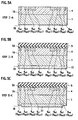
- Step II-A a method for producing the silicon carbide semiconductor device 40 shown Fig. 4 is to be described, referring to cross sectional steps in Fig. 5A to Fig. 5G.
- (Step II-A) to (Step II-G) respectively correspond to Fig. 5A to Fig. 5G.
- the n + type 4H-SiC substrate 1 is prepared (purchased) which is the silicon carbide substrate having the main surface 1A where the n - type epitaxial layer 4 having a thickness about 10 ⁇ m is homo-epitaxially grown. Then, as shown in Fig. 5A, the p type electric field relieving regions 9 a1 , 9 a2 , 9 a3 to 9 an are formed on the surface of the n - type epitaxial layer 4 by a high temperature selective ion implantation.
- an SiO 2 film having thickness about 1.5 ⁇ m is deposited on the entire main surface 1A of the substrate 1 by a Chemical Vapor Deposition (CVD). Then, the SiO 2 film on a region for forming the high concentration impurity region is selectively removed by a photolithography (patterning using photoresist) and a dry-wet etching technology.
- CVD Chemical Vapor Deposition
- the dry-wet etching technology is a compound etching technology having the following operations in the removing of the SiO 2 film by an anisotropic dry etching such as reaction ion etching (RIE), inductive couple plasma (ICP) etching and the like:
- anisotropic dry etching such as reaction ion etching (RIE), inductive couple plasma (ICP) etching and the like:
- RIE reaction ion etching
- ICP inductive couple plasma
- the photoresist is removed from the substrate 1, followed by a sufficient cleaning. Then, on the main surface 1A of the substrate 1, a thin SiO 2 film having thickness of 10 nm to 30 nm is deposited by a Low Pressure Chemical Vapor Deposition (LPCVD), to thereby form a through SiO 2 film.
- LPCVD Low Pressure Chemical Vapor Deposition
- a multi-step ion implantation of Al + ion is implemented on the main surface 1 A of the substrate 1, to thereby form precursor regions 9 ap1 , 9 ap2 , 9 ap3 to 9 apn of the p type electric field relieving regions 9 a1 , 9 a2 , 9 a3 to 9 an .
- An example of ion implantation conditions for the p type electric field relieving regions 9 a1 , 9 a2 , 9 a3 to 9 an is shown below.
- Ion implantation conditions for the p type electric field relieving regions 9 a1 , 9 a2 , 9 a3 to 9 an Temperature of substrate 1 700° C Acceleration energy (voltage)/Dose First phase 300 keV/8.3 ⁇ 10 15 /cm 2 Second phase 190 keV/3.2 ⁇ 10 15 /cm 2 Third phase 150 keV/2.1 ⁇ 10 15 /cm 2 Fourth phase 100 keV/1.9 ⁇ 10 15 /cm 2 Fifth phase 60 keV/1.7 ⁇ 10 15 /cm 2 Sixth phase 30 keV/9.4 ⁇ 10 14 /cm 2 After the completion of the ion implantation, the substrate 1 is dipped in the buffered hydrofluoric acid solution, to thereby remove all SiO 2 films (mask film and through film) on the main surface 1A and main backface 1B, followed by drying.
- the activation annealing is implemented in a high purity Ar atmosphere at a temperature of 1650° C for about 1 minute for activating the precursor regions 9 ap1 , 9 ap2 , 9 ap3 to 9 apn of the p type electric field relieving regions 9 a1 , 9 a2 , 9 a3 to 9 an , to thereby form the p type electric field relieving regions 9 a1 , 9 a2 , 9 a3 to 9 an .
- the structure shown in Fig. 5A is formed.
- the substrate 1 is sufficiently cleaned and dried, followed by a sacrificial oxidization at 1100° C in a dry oxygen atmosphere, to thereby grow a thermally oxidized film on both the main surface 1A and main backface 1B of the substrate 1.
- the substrate 1 is dipped in the buffered hydrofluoric acid solution, to thereby remove the thermally oxidized film on the main surface 1A and main backface 1B of the substrate 1 (sacrificial oxidization) .
- the thermally oxidized film has a thickness less than 50 nm, or preferably 5 nm to 20 nm.
- the substrate 1 After the sacrificial oxidizing of the surface of the substrate 1, the substrate 1 is sufficiently cleaned, followed by a thermal oxidization at 1100° C in a dry oxygen atmosphere, to thereby a grow thermally oxidized film (having thickness of 5 nm to 20 nm) on both of the entire main surface 1A and entire main backface 1B of the substrate 1. Then, the SiO 2 film (600 nm thickness) is deposited on the thermally oxidized film by using Atmospheric Pressure Chemical Vapor Deposition (APCVD) and the like, to thereby form the field insulating film 5 of 2-layer structure including the thermally oxidized film and the APCVD-SiO 2 film, as shown in Fig. 5B. On the main backface 1B of the substrate 1, the thermal oxidization also forms a thermally oxidized film 13 having a thickness of 100 nm or more.
- APCVD Atmospheric Pressure Chemical Vapor Deposition
- a thermally oxidized film 5A which is a lower layer of the field insulating film 5 brings about such effects as stabilizing an interface between the field insulating film 5 and the main surface 1A of the SiC substrate 1, increasing high voltage capability of the vertical device (silicon carbide semiconductor device 40), and suppressing variation of the high voltage capabilities.
- the thermally oxidized film 13 of the main backface 1B of the substrate 1 removes low quality crystal layer of the main backface 1B of the substrate 1, thereby decreasing the contact resistance.
- a protective photoresist is applied on the field insulating film 5, then the substrate 1 is dipped in the buffered hydrofluoric acid solution, and then the thermally oxidized film 13 formed on the main backface 1B is removed, to thereby expose the main backface 1B of the substrate 1. Then, the substrate 1 is sufficiently rinsed with a ultra-pure water and sufficiently dried. Then, the contact parent material is vacuum-evaporated to the exposed main backface 1B of the substrate 1 by the film forming method such as DC spattering and the like.
- the vacuum evaporation by using a shadow mask and the like in such a manner that the periphery of the main backface 1 B of the substrate 1 is free from adhesion of the ohmic electrode parent material.
- the contact parent material include Ni, Co and the like having a thickness of 100 nm.
- the substrate 1 After the vacuum evaporation of the contact parent material, the substrate 1 is dipped in a special photoresist-stripper solution, thereby completely stripping the protective photoresist. Then, the substrate 1 is sufficiently cleaned and rinsed, followed by drying. Immediately after that, the substrate 1 is disposed in the rapid thermal annealer, to be subjected to the rapid thermal annealing (contact annealing) in a high purity Ar atmosphere at 1000° C for 2 minutes. Through the rapid thermal annealing, the contact parent material (Ni film and the like) deposited on the main backface 1B of the substrate 1 makes a solid phase reaction with the main backface 1B of the n + type SiC substrate 1, as shown in Fig.
- the achieved contact resistance of the silicide electrode 51 is in the order of 10 -6 ⁇ cm 2 (0.000001 ⁇ cm 2 to 0.00001 ⁇ cm 2 ) or less which is ignorably small compared with an on resistance of the Schottky diode (silicon carbide semiconductor device 40).
- the surface segregation treatment step (Fig. 3D) and the graphite removal treatment step (Fig. 3E) according to the first embodiment are likewise implemented.
- the silicide electrode 51 including the excessive amount of carbon is converted to the lower carbon content silicide electrode 52, and the graphite 53 deposited on the surface 52S (lower in Fig. 5D) of the lower carbon content silicide electrode 52 is removed.
- the main surface 1A of the substrate 1 is subjected to the photolithography, to thereby form a photoresist pattern 19 for opening the opening part 6 in the surface of the field insulating film 5.
- a photoresist 20 is applied to the main backface 1B of the substrate 1, such that the lower carbon content silicide electrode 52 is completely covered and thereby protected.
- the photoresist pattern 19 on the main surface 1 A and the photoresist 20 on the main backface 1B are subjected to a post bake.
- i) the wet etching using the buffered hydrofluoric acid solution or ii) the above described dry-wet etching is implemented (see Step II-A).
- the opening part 6 is formed in the field insulating film 5, to thereby expose the n- type epitaxial layer 4 at the bottom of the opening part 6 (opening etching).
- the SiC epitaxial layer 4 is exposed through the opening part 6. Then, the substrate 1 is sufficiently rinsed with a ultra-pure water and dried. Soon after that, the substrate 1 is immediately installed in a high vacuum electron beam vacuum evaporator, to thereby form a preferable Schottky electrode material 21 (Ti 50 nm thick) on the entire main surface 1A of the substrate 1. With this, the structure shown in Fig. 5E is formed.
- the Schottky electrode material 21 includes such materials as Ti and A1 which are likely to be oxidized or dissolved with a pure water or a photoresist-stripper solution, a conductor film (for example, Pt having thickness of 50 nm to 150 nm) for preventing oxidization is further formed continuously on the Schottky electrode material 21.
- a conductor film for example, Pt having thickness of 50 nm to 150 nm
- Fig. 5F shows a cross sectional shape of the substrate 1 where the stripper solution is sufficiently rinsed with a ultra-pure water and the like, followed by drying of the substrate 1.
- the Schottky electrode 7 is left only at the bottom (surface of n - type epitaxial layer 4) of the opening part 6, and the Schottky electrode material 21 on the photoresist pattern 19 is removed together with the dissolved photoresist pattern 19.
- the DC magnetron spattering or the like is used for vacuum evaporating a thick surface interconnect material on the entire main surface 1A of the substrate 1.
- the surface interconnect material is patterned with the dry etching such as a known photolithography, RIE and the like, to thereby form the main surface interconnect 8, resulting in the structure shown in Fig. 5G
- the surface interconnect material include a laminate film formed by continuously vacuum evaporating Ti (50 nm thick) and A1 (2 ⁇ m thick).
- the entire backface 1B (i.e., the surface 52S of the lower carbon content silicide electrode 52) of the cleaned and dried substrate 1 a conductor material used for die bond mounting and the like is vacuum-evaporated by using the DC magnetron spattering and the like, to thereby form the upper conductor film 3 on (beneath in Fig. 4) the main backface 1B, thus completing the Schottky diode having the final structure as shown in Fig. 4.
- An example of the upper conductor film 3 includes a Ti/Ni/Ag film where Ti (50 nm thick), Ni (100 nm thick) and Ag (150 nm thick) are sequentially laminated. The present invention is, however, not limited to this.
- the lower carbon content silicide electrode 52 which is disposed on (beneath in Fig. 4) the main backface 1B and to which the upper conductor film 3 is deposited is a film free from the excessive amount of carbon causing the strip. Therefore, the graphite 53 is not deposited in the lower carbon content silicide electrode 52 or in the interface between the silicide electrode 52 and the upper conductor film 3. Therefore, the upper conductor film 3 is not stripped.
- the following problem can be solved: "the upper conductor film 3 is suddenly stripped, thereby decreasing yield of the silicon carbide semiconductor device 40, leading to a failure after completing the silicon carbide semiconductor device 40.”
- the lower carbon content silicide electrode 52 not including the excessive amount of carbon causing the strip can be formed through the following operations: In the production method according to the second embodiment of the present invention, before forming of the upper conductor film 3, the excessive amount of carbon in the silicide electrode 51 is forcibly segregated as the graphite 53 on the main backface 1B (or the main surface 1A) of the substrate 1, and the thus segregated surface graphite 53 is removed.
- a vertical MOSFET Metal-Oxide-Semiconductor Field Effect Transistor
- the 3-terminal switching device has a silicide electrode type ohmic contact on both of a main surface 71A and a main backface 71B of an SiC substrate 71, according to the third embodiment of the present invention.
- Fig. 6 shows a cross sectional view of an essential part of a unit cell 70 of an SiC semiconductor MOSFET which is a silicon carbide semiconductor device 200, according to the third embodiment of the present invention.
- the unit cell 70 is a minimum unit of an active region. In a power element, many of the unit cells 70 are laterally arranged for greater current.
- the reference numeral 70 is used for denoting both of the active region and the unit cell.
- an n + type single crystal 4H-SiC substrate 71 which is a silicon carbide substrate to which high concentration impurity is added.
- the n + type single crystal 4H-SiC substrate 71 has the main surface 71A (upper in Fig. 6) where an n- type epitaxial layer 72 having a thickness about 10 ⁇ m and added by nitrogen 1 ⁇ 10 -16 /cm 3 is homo-epitaxially grown.
- all crystal systems such as 6H, 3C, 15R and the like (where H denotes hexagonal system, C denotes cubic system, and R denotes rhombohedral system) can be used for the SiC substrate 71.
- p type base regions 73a, 73b to which p type impurity having an impurity concentration higher than the impurity concentration of the n- type epitaxial layer 72 is added are spaced apart from each other.
- n + type source regions (high concentration impurity region) 74a, 74b are respectively formed which are smaller than the p type base regions 73a, 73b in thickness and larger than the p type base regions 73a, 73b in concentration of the added impurity.
- p + type base regions 75a, 75b there are respectively provided p + type base regions 75a, 75b to which high concentration p type impurity is added.
- the n- type epitaxial layer 72, the p type base regions 73a, 73b, and the n + type source regions 74a, 74b are arranged in this order.
- the main surface 71A of the SiC substrate 71 is formed with the above impurity regions.
- a gate oxide film 75 On the main surface 71A, there is provided a gate oxide film 75.
- a gate electrode 76 made of conductive polycrystalline silicon.
- a polycrystalline silicon thermally oxidized film 77 On side faces and an upper face of the gate electrode 76, there is provided a polycrystalline silicon thermally oxidized film 77.
- an interlayer dielectric film 78 On the gate oxide film 75 and the polycrystalline silicon thermally oxidized film 77.
- source windows 79a, 79b which are opened in the interlayer dielectric film 78 and the gate oxide film 75 in such a manner as to penetrate through in a range striding over the n + type source regions 74a, 74b and p + type base regions 75a, 75b on the main surface 71A of the SiC substrate 71.
- source electrodes 80a, 80b each serving as a first lower carbon content silicide electrode.
- the source electrodes 80a, 80b are capable of giving ohmic contact simultaneously to both heteropolar regions, that is, the n + type source regions 74a, 74b and the p + type base regions 75a, 75b.
- main surface interconnect 82 which is a type of upper conductor film for wiring the n + type source regions 74a, 74b or the p + type base regions 75a, 75b with an outer circuit or with other circuit elements on the same substrate 71.
- the drain electrode 81 serving as a second lower carbon content silicide electrode for giving ohmic contact to a drain of the MOSFET cell.
- the drain electrode 81 there is provided a main backface interconnect 61 (a kind of upper conductor film) for implementing the die bonding smoothly.
- the silicon carbide semiconductor device 200 serves as the vertical metal-oxide-semiconductor field effect transistor (MOSFET), according to the third embodiment of the present invention.
- MOSFET vertical metal-oxide-semiconductor field effect transistor
- Step III-A a method for producing the silicon carbide semiconductor device 200 (MOSFET cell using 4H-SiC substrate) shown Fig. 6 is to be described, referring to cross sectional steps in Fig. 7A to Fig. 7H.
- (Step III-A) to (Step III-H) respectively correspond to Fig. 7A to Fig. 7H.
- the n + type 4H-SiC substrate 71 is prepared (purchased) which is the silicon carbide substrate having the main surface 71A where the n - type epitaxial layer 72 having a thickness about 10 ⁇ m is homo-epitaxially grown. Then, by the high temperature selective ion implantation at (Step II-A) according to the second embodiment, precursor regions 73ap, 73bp for the p type base regions 73a, 73b, precursor regions 75ap, 75bp for the p + type base regions 75a, 75b, and precursor regions 74ap, 74bp for the n + type source regions 74a, 74b are sequentially formed in the certain region. Examples of ion implantation conditions for each of the regions 73a, 73b, 74a, 74b, 75a, 75b are shown below.
- Ion implantation conditions for p type base regions 73a, 73b Impurity A1 + ion Temperature of substrate 71 750° C Acceleration energy (voltage)/Dose 360 keV/5 ⁇ 10 13 / cm 2
- Ion implantation conditions for p + type base regions 75a, 75b Ion A1 + Implantation temperature 750° C Acceleration energy (voltage)/Dose 30 keV 1.0 ⁇ 10 15 /cm 2 50 keV 1.0 ⁇ 10 15 /cm 2 70 keV 2.0 ⁇ 10 15 /cm 2 100 keV 3.0 ⁇ 10 15 /cm 2
- An activation annealing is implemented for simultaneously activating all precursor regions 73ap, 73bp, 74ap, 74bp and 75ap, 75bp on the main surface 71A of the substrate 71, to thereby form the p type base region 73a, 73b, the n + type source regions 74a, 74b, and the p + type base regions 75a, 75b.
- Fig. 7A shows a structure at the Step III-A.
- the activation is implemented in the following manner: On a high purity carbon susceptor, the substrate 71 is disposed with the main surface 71 A turning upward (that is, main backface 7 1 B contacting the susceptor), then a rapid thermal annealing is implemented at 1600° C or more for 1 minute to several minutes in a high purity inactive gas (for example, Ar) atmosphere or in a high purity inactive gas atmosphere slightly including silane.
- a high purity inactive gas for example, Ar
- a high purity inactive gas atmosphere slightly including silane.
- the substrate 71 After the activation of the impurity region of the main surface 71 A of the substrate 71, the substrate 71 is sufficiently cleaned and dried. Then, the substrate 71 is subjected to a sacrificial oxidization at 1100° C in a dry oxygen atmosphere, to thereby grow a thermally oxidized film on the main surface 71 A of the substrate 71. Then, the substrate 71 is dipped in a buffered hydrofluoric acid solution, to thereby remove the thermally oxidized film on the main surface 71 A of the substrate 71 (sacrificial oxidization). The thermally oxidized film has a thickness of less than 50 nm, or preferably 5 nm to 20 nm. The sacrificial oxidization can properly remove from the main surface 71A of the substrate 71 a contaminant layer and a mismatching layer which cause failure to the silicon carbide semiconductor device 200.
- the substrate 71 is sufficiently cleaned, and thermally oxidized at 1100° C in a dry oxygen atmosphere, to thereby grow a thermally oxidized film (about 5 nm to 20 nm thick) on the entire main surface 71 A and entire main backface 71B of the substrate 71.
- a thick (600 nm thick) SiO 2 film is deposited by using Atmospheric Pressure Chemical Vapor Deposition (APCVD) and the like, to thereby form a 2-layer field insulating film 100 having a thermally oxidized film 100A and an APCVD-SiO 2 film 100B, as shown in Fig. 7B.
- the thermal oxidization also forms on (beneath in Fig. 7B) the main backface 7 1 B a transient thermally oxidized film 97 having thickness of 100 nm or more.
- the thermally oxidized film 100A which is the lower layer of the field insulating film 100 in Fig. 7B stabilizes an interface between the field insulating film 100 and the main surface 71A of the SiC substrate 71, increasing high voltage capability of the vertical device (silicon carbide semiconductor device 200), thus suppressing the variation of the vertical device.
- a known photolithography and a known wet etching are used for selectively etching the field insulating film 100 on the main surface 71A of the substrate 71, to thereby form i) a field region and ii) the active region 70 (Fig. 6) with the field insulating film 100 removed.
- the transient thermally oxidized film 97 disappears after the wet etching.
- the active region 70 at the Step III-C in Fig. 7C has substantially the same structure as that at the Step III-B in Fig. 7B. In this case, however, an area other than the active region 70 has the field insulating film 100, making the entire SiC substrate 71 in Fig. 7C different in structure from that in Fig. 7B.
- the substrate 71 is again sufficiently cleaned.
- the substrate 71 is dipped in a buffered hydrofluoric acid solution for 5 seconds to 10 seconds, then, the buffered hydrofluoric acid solution is completely rinsed off with a ultra-pure water, followed by a drying, and an immediate thermal oxidization, to thereby grow the gate oxide film 75 (for example, 40 nm thick) on the main surface 71A of the substrate 71 of the active region 70.
- a transient thermally oxidized film 98 (another transient thermally oxidized film after the transient thermally oxidized film 97) is formed on the main backface 71B.
- the gate oxidization condition is not limited to the above, for example, dry oxidizing at temperature 1160° C is, however, preferable.
- An essential point herein is that the thermally oxidized temperature is set higher than any other thermal annealing temperatures in the subsequent steps.
- a polycrystalline silicon film 84 having a thickness of 300 nm to 400 nm is formed on the entire main surface 71 A and entire main backface 71B of the substrate 71 through a Low Pressure CVD (growth temperature 600° C to 700° C) using a silane raw material.
- P phosphor
- P is added to the polycrystalline silicon film 84 by using a known heat diffusion (treatment temperature of 900° C to 950° C) using i) phosphorus chloride oxide (POCl 3 ) otherwise referred to as phosphoryl chloride and ii) oxygen, to thereby give conductivity to the polycrystalline silicon film 84.
- a photoresist is applied to the main surface 71A of the substrate 71, then unnecessary part of the polycrystalline silicon film 84 on the main surface 71A of the substrate 71 side is removed by using i) a photolithography and ii) an Reactive Ion Etching (RIE) with C 2 F 6 and oxygen as etchant, to thereby form the gate electrode 76, resulting in the structure shown in Fig. 7C.
- RIE Reactive Ion Etching
- the substrate 71 after the etching is sufficiently cleaned, followed by thermal oxidization at 900° C in a dry oxygen atmosphere, to thereby generate the polycrystalline silicon thermally oxidized film 77 on the gate electrode 76 and generate a polycrystalline silicon thermally oxidized film 85 on (beneath in Fig. 7D) the surface of the polycrystalline silicon film 84 of the main backface 71B.
- the interlayer dielectric film 78 is deposited on the entire main surface 71 A of the substrate 71.
- the interlayer dielectric film 78 include:
- Step II-A, Step II-E and Step III-C a known photolithography and the dry-wet etching (see Step II-A, Step II-E and Step III-C) are used for opening the source windows 79a, 79b and a gate window (not shown in Fig. 7E since being outside the active region 70) respectively in the interlayer dielectric film 78 and the gate oxide film 75 which are disposed on the main surface 71A of the substrate 71.
- the polycrystalline silicon thermally oxidized film 85 on the main backface 71B of the substrate 71 is also removed simultaneously.
- the substrate 71 wearing the photoresist mask is sufficiently rinsed with a ultra-pure water and dried. Then immediately, by using a film forming such as electron beam vacuum evaporation, DC magnetron spattering and the like, contact parent materials 87a, 87b are vacuum-evaporated on the entire surface 71A of the substrate 71. Then, the photoresist is stripped as shown in Fig. 7E, leaving the contact parent materials 87a, 87b only at the bottom of the respective source windows 79a, 79b and the bottom of the gate window (not shown in Fig. 7E since being outside the active region 70). Examples of the contact parent materials 87a, 87b include Ni, Co and the like (50 nm thick), but not specifically limited thereto.
- the substrate 71 is sufficiently cleaned and dried, and a protective resist material (photoresist is allowed) having a thickness of 1 ⁇ m or more is applied to the entire main surface 71A, followed by a dry etching with CF 4 and O 2 , to thereby completely remove the polycrystalline silicon film 84 on the main backface 71B.
- a protective resist material photoresist is allowed
- the substrate 71 is dipped in a buffered hydrofluoric acid solution, to thereby remove the SiO 2 film 98 on the main backface 71B, thus exposing a clarified crystal face on the backface 71B of the substrate 71.
- the substrate 71 having the main surface 71 A wearing the protective resist material is sufficiently cleaned and dried, and is rapidly installed in a high vacuum evaporator, to thereby vacuum-evaporate a preferable contact parent material 89 on the backface 71B of the substrate 71.
- the contact parent material 89 for the main backface 71B include Ni film and the like having thickness of 50 nm to 150 nm.
- a special stripping agent is used for completely removing the protective resist on the main surface 71A, to thereby sufficiently clean the substrate 71.
- the substrate 71 is disposed in a rapid thermal annealer, to be subjected to a thermal annealing (contact annealing) in a high purity Ar atmosphere at 1000° C for 2 minutes.
- the contact parent materials 87a, 87b of the source windows 79a, 79b and gate window make a solid phase reaction with a background, to thereby form source electrodes 88a, 88b, the drain electrode 89 serving as silicide electrodes including an excessive amount of carbon, bringing about a low resistance ohmic contact to the source and drain (gate window bottom gate contact is also simultaneously formed but not shown in Fig. 7F).
- the thus formed source electrodes 88a, 88b and drain electrode 89 each show an extremely low contact resistance in the order of 10 -6 ⁇ cm 2 (0.000001 ⁇ cm 2 to 0.00001 ⁇ cm 2 ) or less.
- the surface segregation treatment step (Step I-D in Fig. 3D) and the graphite removal treatment step (Step I-E in Fig. 3E) according to the first embodiment are likewise implemented, to thereby remove the excessive amount of carbon from the source electrodes 88a, 88b and the drain electrode 89, thus forming the source electrodes 80a, 80b (the first lower carbon content silicide electrode) and the drain electrode 81 (the second lower carbon content silicide electrode), resulting in the structure shown in Fig. 7G
- the substrate 71 is sufficiently cleaned and dried, and a main surface interconnect (main surface upper conductor film) material, for example, Al is formed on the entire main surface 71A (or a surface 80aS and a surface 80bS in Fig. 7H) by the DC magnetron spattering and the like. Then, the thus obtained is patterned by the photolithography and the dry etching technology (RIE and the like), then the photoresist is stripped, followed by cleaning and drying, to thereby form the main surface interconnect 82 as shown in Fig. 7H.
- RIE dry etching technology
- a conductor such as Ti, TiN, TaN and the like is, as the case may be, inserted between the main surface interconnect 82 and the source electrodes 80a, 80b for improving i) adhesion force, ii) contact resistance and iii) heat resistance of both of the above conductors 82, 80a, 80b.
- these materials are, at first, subjected to film forming, followed by the above forming of the surface interconnect film material.
- an etchant gas same as A1 can continuously pattern the above materials.
- a main backface interconnect (main backface upper conductor film) material used for die bond mounting and the like is vacuum-evaporated by using the DC magnetron spattering and the like, to thereby form the main backface interconnect 61, thus completing the vertical MOSFET, that is, the silicon carbide semiconductor device 200, as shown in Fig. 6.
- An example of the main backface interconnect material includes Ti/Ni/Ag film where Ti (50 nm thick), Ni (100 nm thick) and Ag (150 nm thick) are sequentially laminated. The present invention is, however, not limited to this.
- each of the source electrodes 80a, 80b and drain electrode 81 as silicide electrode is a film with the excessive amount of carbon (causing strip) removed. Therefore, after completing the silicon carbide semiconductor device 200, the graphite is not segregated in the silicide electrodes (that is, 80a, 80b, 81) or not segregated to the interface between the silicide electrodes (that is, 80a, 80b, 81) and the upper conductor films (that is, 82, 61).
- the upper conductor film i.e., the source electrode or the drain electrode is suddenly stripped, thereby decreasing yield of the silicon carbide semiconductor device 200, leading to a failure after completing the silicon carbide semiconductor device 200.
- the lower carbon content silicide electrodes 80a, 80b, 81 not including the excessive amount of carbon causing the strip can be formed through the following operations:
- the excessive amount of carbon in the source electrodes 88a, 88b and the drain electrode 89 are forcibly segregated, as graphite, on the surface 71A of the substrate 71, and the thus deposited surface graphite is removed.
- 200 samples of the power MOSFETs are prepared for temperature cycle test, each of the samples having the active region 70 about 0.25 ⁇ 0.25 mm 2 .
- Most of the counterpart elements prepared simultaneously according to the related art in Fig. 1 caused strip to surface interconnect or backface interconnect, resulting in failure rate of 95% or more.
- none of the 200 samples according to the third embodiment of the present invention presented a failure mode (strip).
Landscapes
- Electrodes Of Semiconductors (AREA)
Applications Claiming Priority (1)
| Application Number | Priority Date | Filing Date | Title |
|---|---|---|---|
| JP2005354281 | 2005-12-08 |
Publications (2)
| Publication Number | Publication Date |
|---|---|
| EP1796148A2 true EP1796148A2 (fr) | 2007-06-13 |
| EP1796148A3 EP1796148A3 (fr) | 2009-08-26 |
Family
ID=37635690
Family Applications (1)
| Application Number | Title | Priority Date | Filing Date |
|---|---|---|---|
| EP20060025341 Withdrawn EP1796148A3 (fr) | 2005-12-08 | 2006-12-07 | Dispositif semiconducteur à carbure de silicium et procédé de sa fabrication |
Country Status (4)
| Country | Link |
|---|---|
| US (1) | US20070138482A1 (fr) |
| EP (1) | EP1796148A3 (fr) |
| KR (1) | KR100915266B1 (fr) |
| CN (1) | CN1979888A (fr) |
Cited By (3)
| Publication number | Priority date | Publication date | Assignee | Title |
|---|---|---|---|---|
| EP2637198A4 (fr) * | 2010-11-01 | 2014-12-31 | Sumitomo Electric Industries | Dispositif semi-conducteur et son procédé de fabrication |
| CN111916783A (zh) * | 2020-07-24 | 2020-11-10 | 浙江海晫新能源科技有限公司 | 一种降低碳硅接触电阻的方法 |
| US11043383B2 (en) | 2018-05-28 | 2021-06-22 | Infineon Technologies Ag | Electrical contact connection on silicon carbide substrate |
Families Citing this family (27)
| Publication number | Priority date | Publication date | Assignee | Title |
|---|---|---|---|---|
| KR100663010B1 (ko) * | 2005-09-23 | 2006-12-28 | 동부일렉트로닉스 주식회사 | 모스 트랜지스터 및 그 제조 방법 |
| JP4189415B2 (ja) * | 2006-06-30 | 2008-12-03 | 株式会社東芝 | 半導体装置 |
| JP2009130266A (ja) * | 2007-11-27 | 2009-06-11 | Toshiba Corp | 半導体基板および半導体装置、半導体装置の製造方法 |
| JP2009194216A (ja) | 2008-02-15 | 2009-08-27 | Hitachi Ltd | 半導体装置の製造方法 |
| JP5565895B2 (ja) * | 2008-03-26 | 2014-08-06 | 日産自動車株式会社 | 半導体装置 |
| WO2011115294A1 (fr) * | 2010-03-16 | 2011-09-22 | 合同会社先端配線材料研究所 | Électrode en carbure de silicium, élément semi-conducteur en carbure de silicium, dispositif à semi-conducteur en carbure de silicium et procédé pour la formation d'une électrode à partir de carbure de silicium |
| JP6060476B2 (ja) | 2011-04-06 | 2017-01-18 | 富士電機株式会社 | 電極形成方法 |
| EP2698807B1 (fr) * | 2011-04-11 | 2015-09-23 | Shindengen Electric Manufacturing Co., Ltd. | Procédé de fabrication d'un dispositif semi-conducteur au carbure de silicium |
| JP6099298B2 (ja) | 2011-05-30 | 2017-03-22 | 富士電機株式会社 | SiC半導体デバイス及びその製造方法 |
| JP5728339B2 (ja) * | 2011-09-08 | 2015-06-03 | 株式会社東芝 | 半導体装置および半導体装置の製造方法 |
| JP5777455B2 (ja) | 2011-09-08 | 2015-09-09 | 株式会社東芝 | 半導体装置および半導体装置の製造方法 |
| JP6261155B2 (ja) | 2012-02-20 | 2018-01-17 | 富士電機株式会社 | SiC半導体デバイスの製造方法 |
| JP5928101B2 (ja) | 2012-03-30 | 2016-06-01 | 富士電機株式会社 | SiC半導体デバイスの製造方法 |
| JP6112699B2 (ja) * | 2012-03-30 | 2017-04-12 | 富士電機株式会社 | 炭化珪素半導体装置の製造方法及び該方法により製造された炭化珪素半導体装置 |
| JP6112698B2 (ja) | 2012-03-30 | 2017-04-12 | 富士電機株式会社 | 炭化珪素半導体素子及びその製造方法 |
| JP5966556B2 (ja) | 2012-04-18 | 2016-08-10 | 富士電機株式会社 | 半導体デバイスの製造方法 |
| TWI555148B (zh) * | 2012-10-05 | 2016-10-21 | 頎邦科技股份有限公司 | 半導體結構 |
| CN103730437A (zh) * | 2012-10-15 | 2014-04-16 | 颀邦科技股份有限公司 | 半导体结构 |
| US9293627B1 (en) * | 2012-12-03 | 2016-03-22 | Sandia Corporation | Sub-wavelength antenna enhanced bilayer graphene tunable photodetector |
| US20160172527A1 (en) * | 2012-12-03 | 2016-06-16 | Sandia Corporation | Photodetector with Interdigitated Nanoelectrode Grating Antenna |
| JP5983415B2 (ja) * | 2013-01-15 | 2016-08-31 | 住友電気工業株式会社 | 炭化珪素半導体装置 |
| JP6160708B2 (ja) | 2013-11-22 | 2017-07-12 | 富士電機株式会社 | 炭化珪素半導体装置 |
| JP6745458B2 (ja) * | 2015-04-15 | 2020-08-26 | パナソニックIpマネジメント株式会社 | 半導体素子 |
| JP2016219475A (ja) * | 2015-05-15 | 2016-12-22 | トヨタ自動車株式会社 | 炭化珪素半導体装置の製造方法 |
| WO2017201703A1 (fr) * | 2016-05-26 | 2017-11-30 | 中山港科半导体科技有限公司 | Structure métallique arrière de puce de semi-conducteur de puissance et son procédé de préparation |
| JP7283053B2 (ja) * | 2018-11-09 | 2023-05-30 | 富士電機株式会社 | 炭化珪素半導体装置、炭化珪素半導体組立体および炭化珪素半導体装置の製造方法 |
| JP7354027B2 (ja) | 2020-03-13 | 2023-10-02 | 株式会社東芝 | 半導体装置、半導体装置の製造方法、インバータ回路、駆動装置、車両、及び、昇降機 |
Family Cites Families (6)
| Publication number | Priority date | Publication date | Assignee | Title |
|---|---|---|---|---|
| US5442200A (en) * | 1994-06-03 | 1995-08-15 | Advanced Technology Materials, Inc. | Low resistance, stable ohmic contacts to silcon carbide, and method of making the same |
| US6261938B1 (en) * | 1997-02-12 | 2001-07-17 | Quantiscript, Inc. | Fabrication of sub-micron etch-resistant metal/semiconductor structures using resistless electron beam lithography |
| US6759683B1 (en) * | 2001-08-27 | 2004-07-06 | The United States Of America As Represented By The Secretary Of The Army | Formulation and fabrication of an improved Ni based composite Ohmic contact to n-SiC for high temperature and high power device applications |
| JP3871607B2 (ja) * | 2001-12-14 | 2007-01-24 | 松下電器産業株式会社 | 半導体素子およびその製造方法 |
| JP3963151B2 (ja) * | 2002-12-27 | 2007-08-22 | 日産自動車株式会社 | 炭化珪素半導体装置 |
| JP2005276978A (ja) * | 2004-03-24 | 2005-10-06 | Nissan Motor Co Ltd | オーミック電極構造体の製造方法、オーミック電極構造体、半導体装置の製造方法および半導体装置 |
-
2006
- 2006-12-06 US US11/634,390 patent/US20070138482A1/en not_active Abandoned
- 2006-12-07 KR KR1020060123433A patent/KR100915266B1/ko not_active Expired - Fee Related
- 2006-12-07 EP EP20060025341 patent/EP1796148A3/fr not_active Withdrawn
- 2006-12-08 CN CNA2006101403999A patent/CN1979888A/zh active Pending
Cited By (5)
| Publication number | Priority date | Publication date | Assignee | Title |
|---|---|---|---|---|
| EP2637198A4 (fr) * | 2010-11-01 | 2014-12-31 | Sumitomo Electric Industries | Dispositif semi-conducteur et son procédé de fabrication |
| US11043383B2 (en) | 2018-05-28 | 2021-06-22 | Infineon Technologies Ag | Electrical contact connection on silicon carbide substrate |
| US11798807B2 (en) | 2018-05-28 | 2023-10-24 | Infineon Technologies Ag | Process for producing an electrical contact on a silicon carbide substrate |
| US12327727B2 (en) | 2018-05-28 | 2025-06-10 | Infineon Technologies Ag | Chip with a silicon carbide substrate |
| CN111916783A (zh) * | 2020-07-24 | 2020-11-10 | 浙江海晫新能源科技有限公司 | 一种降低碳硅接触电阻的方法 |
Also Published As
| Publication number | Publication date |
|---|---|
| KR20070061392A (ko) | 2007-06-13 |
| KR100915266B1 (ko) | 2009-09-03 |
| CN1979888A (zh) | 2007-06-13 |
| US20070138482A1 (en) | 2007-06-21 |
| EP1796148A3 (fr) | 2009-08-26 |
Similar Documents
| Publication | Publication Date | Title |
|---|---|---|
| EP1796148A2 (fr) | Dispositif semiconducteur à carbure de silicium et procédé de sa fabrication | |
| EP2284867B1 (fr) | Dispositif semiconducteur au carbure de silicium | |
| JP2007184571A (ja) | 炭化珪素半導体装置、炭化珪素半導体装置の製造方法、炭化珪素半導体装置中の遷移金属シリサイドと金属膜との接合体及び炭化珪素半導体装置中の遷移金属シリサイドと金属膜との接合体の製造方法 | |
| US7804094B2 (en) | Process for fabricating a thin film semiconductor device, thin film semiconductor device, and liquid crystal display | |
| US6841436B2 (en) | Method of fabricating SiC semiconductor device | |
| JP3559971B2 (ja) | 炭化珪素半導体装置およびその製造方法 | |
| JP4942134B2 (ja) | 炭化珪素半導体装置の製造方法 | |
| TW200924077A (en) | Semiconductor device with (110)-oriented silicon | |
| JP5860580B2 (ja) | 半導体装置及びその製造方法 | |
| CN101842878A (zh) | 半导体元件及其制造方法 | |
| CN112820769A (zh) | 一种碳化硅mosfet器件及其制备方法 | |
| JP2009177102A (ja) | 半導体装置の電極の製造方法 | |
| CN109791889A (zh) | 在碳化硅上制造绝缘层的方法和半导体装置 | |
| CN101183684A (zh) | 一种半导体结构及其制造方法 | |
| JP4956783B2 (ja) | 炭化珪素半導体装置の製造方法 | |
| JPS62570B2 (fr) | ||
| CN105814693B (zh) | 半导体装置以及半导体装置的制造方法 | |
| Ishihara et al. | Interaction between n‐type amorphous hydrogenated silicon films and metal electrodes | |
| US20060027833A1 (en) | Silicon carbide semiconductor device and method of manufacturing the same | |
| KR20010065296A (ko) | 반도체 소자의 캐패시터 제조방법 | |
| JP3707424B2 (ja) | 炭化珪素半導体装置及びその製造方法 | |
| JPS6228591B2 (fr) | ||
| JP3466543B2 (ja) | ショットキーバリア型半導体装置とその製造方法 | |
| JP2006074024A (ja) | 炭化珪素半導体装置及びその製造方法 | |
| CN116825631A (zh) | Igbt器件的制作方法及igbt器件 |
Legal Events
| Date | Code | Title | Description |
|---|---|---|---|
| PUAI | Public reference made under article 153(3) epc to a published international application that has entered the european phase |
Free format text: ORIGINAL CODE: 0009012 |
|
| AK | Designated contracting states |
Kind code of ref document: A2 Designated state(s): AT BE BG CH CY CZ DE DK EE ES FI FR GB GR HU IE IS IT LI LT LU LV MC NL PL PT RO SE SI SK TR |
|
| AX | Request for extension of the european patent |
Extension state: AL BA HR MK YU |
|
| 17P | Request for examination filed |
Effective date: 20070813 |
|
| PUAL | Search report despatched |
Free format text: ORIGINAL CODE: 0009013 |
|
| AK | Designated contracting states |
Kind code of ref document: A3 Designated state(s): AT BE BG CH CY CZ DE DK EE ES FI FR GB GR HU IE IS IT LI LT LU LV MC NL PL PT RO SE SI SK TR |
|
| AX | Request for extension of the european patent |
Extension state: AL BA HR MK RS |
|
| RIC1 | Information provided on ipc code assigned before grant |
Ipc: H01L 29/24 20060101ALI20090721BHEP Ipc: H01L 21/18 20060101AFI20090721BHEP |
|
| AKX | Designation fees paid |
Designated state(s): DE FR GB |
|
| STAA | Information on the status of an ep patent application or granted ep patent |
Free format text: STATUS: THE APPLICATION IS DEEMED TO BE WITHDRAWN |
|
| 18D | Application deemed to be withdrawn |
Effective date: 20100227 |