EP1797699B1 - Procede de commande ciblee de publicite en ligne, dispositif et systeme associes - Google Patents
Procede de commande ciblee de publicite en ligne, dispositif et systeme associes Download PDFInfo
- Publication number
- EP1797699B1 EP1797699B1 EP05790068.0A EP05790068A EP1797699B1 EP 1797699 B1 EP1797699 B1 EP 1797699B1 EP 05790068 A EP05790068 A EP 05790068A EP 1797699 B1 EP1797699 B1 EP 1797699B1
- Authority
- EP
- European Patent Office
- Prior art keywords
- user
- data
- information
- advertising
- online
- Prior art date
- Legal status (The legal status is an assumption and is not a legal conclusion. Google has not performed a legal analysis and makes no representation as to the accuracy of the status listed.)
- Expired - Lifetime
Links
Images





Classifications
-
- G—PHYSICS
- G06—COMPUTING OR CALCULATING; COUNTING
- G06Q—INFORMATION AND COMMUNICATION TECHNOLOGY [ICT] SPECIALLY ADAPTED FOR ADMINISTRATIVE, COMMERCIAL, FINANCIAL, MANAGERIAL OR SUPERVISORY PURPOSES; SYSTEMS OR METHODS SPECIALLY ADAPTED FOR ADMINISTRATIVE, COMMERCIAL, FINANCIAL, MANAGERIAL OR SUPERVISORY PURPOSES, NOT OTHERWISE PROVIDED FOR
- G06Q30/00—Commerce
- G06Q30/02—Marketing; Price estimation or determination; Fundraising
-
- G—PHYSICS
- G06—COMPUTING OR CALCULATING; COUNTING
- G06Q—INFORMATION AND COMMUNICATION TECHNOLOGY [ICT] SPECIALLY ADAPTED FOR ADMINISTRATIVE, COMMERCIAL, FINANCIAL, MANAGERIAL OR SUPERVISORY PURPOSES; SYSTEMS OR METHODS SPECIALLY ADAPTED FOR ADMINISTRATIVE, COMMERCIAL, FINANCIAL, MANAGERIAL OR SUPERVISORY PURPOSES, NOT OTHERWISE PROVIDED FOR
- G06Q30/00—Commerce
- G06Q30/02—Marketing; Price estimation or determination; Fundraising
- G06Q30/0241—Advertisements
- G06Q30/0251—Targeted advertisements
- G06Q30/0255—Targeted advertisements based on user history
- G06Q30/0256—User search
-
- G—PHYSICS
- G06—COMPUTING OR CALCULATING; COUNTING
- G06Q—INFORMATION AND COMMUNICATION TECHNOLOGY [ICT] SPECIALLY ADAPTED FOR ADMINISTRATIVE, COMMERCIAL, FINANCIAL, MANAGERIAL OR SUPERVISORY PURPOSES; SYSTEMS OR METHODS SPECIALLY ADAPTED FOR ADMINISTRATIVE, COMMERCIAL, FINANCIAL, MANAGERIAL OR SUPERVISORY PURPOSES, NOT OTHERWISE PROVIDED FOR
- G06Q30/00—Commerce
- G06Q30/02—Marketing; Price estimation or determination; Fundraising
- G06Q30/0241—Advertisements
- G06Q30/0251—Targeted advertisements
- G06Q30/0269—Targeted advertisements based on user profile or attribute
-
- G—PHYSICS
- G06—COMPUTING OR CALCULATING; COUNTING
- G06Q—INFORMATION AND COMMUNICATION TECHNOLOGY [ICT] SPECIALLY ADAPTED FOR ADMINISTRATIVE, COMMERCIAL, FINANCIAL, MANAGERIAL OR SUPERVISORY PURPOSES; SYSTEMS OR METHODS SPECIALLY ADAPTED FOR ADMINISTRATIVE, COMMERCIAL, FINANCIAL, MANAGERIAL OR SUPERVISORY PURPOSES, NOT OTHERWISE PROVIDED FOR
- G06Q30/00—Commerce
- G06Q30/02—Marketing; Price estimation or determination; Fundraising
- G06Q30/0241—Advertisements
- G06Q30/0277—Online advertisement
-
- H—ELECTRICITY
- H04—ELECTRIC COMMUNICATION TECHNIQUE
- H04L—TRANSMISSION OF DIGITAL INFORMATION, e.g. TELEGRAPHIC COMMUNICATION
- H04L67/00—Network arrangements or protocols for supporting network services or applications
- H04L67/2866—Architectures; Arrangements
- H04L67/30—Profiles
- H04L67/306—User profiles
-
- H—ELECTRICITY
- H04—ELECTRIC COMMUNICATION TECHNIQUE
- H04L—TRANSMISSION OF DIGITAL INFORMATION, e.g. TELEGRAPHIC COMMUNICATION
- H04L67/00—Network arrangements or protocols for supporting network services or applications
- H04L67/50—Network services
- H04L67/53—Network services using third party service providers
-
- H—ELECTRICITY
- H04—ELECTRIC COMMUNICATION TECHNIQUE
- H04L—TRANSMISSION OF DIGITAL INFORMATION, e.g. TELEGRAPHIC COMMUNICATION
- H04L67/00—Network arrangements or protocols for supporting network services or applications
- H04L67/50—Network services
- H04L67/535—Tracking the activity of the user
-
- H—ELECTRICITY
- H04—ELECTRIC COMMUNICATION TECHNIQUE
- H04L—TRANSMISSION OF DIGITAL INFORMATION, e.g. TELEGRAPHIC COMMUNICATION
- H04L69/00—Network arrangements, protocols or services independent of the application payload and not provided for in the other groups of this subclass
- H04L69/30—Definitions, standards or architectural aspects of layered protocol stacks
- H04L69/32—Architecture of open systems interconnection [OSI] 7-layer type protocol stacks, e.g. the interfaces between the data link level and the physical level
- H04L69/322—Intralayer communication protocols among peer entities or protocol data unit [PDU] definitions
- H04L69/329—Intralayer communication protocols among peer entities or protocol data unit [PDU] definitions in the application layer [OSI layer 7]
Definitions
- the invention relates to the targeted control of online advertising in an information network.
- the invention relates to a method, an apparatus and a system for controlling and displaying banners on the Internet, in particular on web pages and in Internet-based user programs, such as e.g. Browsers and communication programs (email, instant messaging, chat or internet telephony).
- the invention relates in particular to the targeted control of online advertising on the Internet in order to extend the range of online advertising from a first Internet platform to a second, larger Internet platform.
- the first disclosure DE 199 64 253 A1 describes a method for the selective transmission of content, in particular advertising over a bi-or multidirectional network.
- the second disclosure DE 100 45 279 A1 describes an apparatus and method for assembling individualized information in a data network.
- the third disclosure DE 100 36 734 A1 describes a method for communicating interactively between a user's terminal accessing the Internet via a sending / receiving access component and a web-enabled web server.
- the fourth font a PCT application with the publication number WO 01/27760 A2 describes a method for analyzing user behavior in computer networks for optimizing the web presence.
- advertising banner Engl ad banner or short "ad”
- the appearance of a banner takes place eg as a so-called pop-up window when visiting a website / webpage or as a so-called banner within a website / webpage.
- banners have long been various techniques and programs known, such as Flash® from Macromedia or the freeware "adware", etc.
- the advertising on the Internet is about on portals such as on the applicant, which can be visited under the URL http://www.web.de.
- Other forms of advertising include the integration of banners in Internet user programs and online services, especially in the freeware sector. Examples include the freeware version of the Opera browser (see http://www.opera.com) or the FreeMail service offered by the applicant (http://www.freemail.de).
- a targeted control of advertising has the advantage that the advertised potential customers receive as precisely as possible the advertising that addresses them directly and is perceived by them as pleasant. For an advertisement that is annoying and feels annoying, completely misses the goal of winning the customer for the purchase of the advertised product or service.
- the Internet is particularly suitable for targeted advertising. Because on the Internet you have a spontaneous return channel from the client of the Internet user to the server of the advertising provider, so that you can capture the user behavior and analyze for the control of advertising. For this purpose, specially equipped computer systems are used which record and evaluate various online data, such as the top-level domain, the respective country from which the Internet user surfs, the current date and the local Local time there etc.
- a so-called AdServer controls one or more so-called content servers, and delivers corresponding advertising content in different formats to them. Due to the evaluated online data, Internet advertising can thus be controlled intelligently.
- the term "taxes" is to be understood very generally and includes the provision and / or delivery of the respective form of advertising (eg banners).
- the control device here: the AdServer
- the AdServer is thus also a device for providing and / or delivering the advertising form to the ContentServer (s). Delivery by the AdServer is preferably on request of the respective ContentServer. For example, the advertising can be switched daily and in the local language. Many other forms of targeted advertising (so-called targeting) are possible.
- the AdServer is the executing control device.
- the basic functions of ad servers are described eg in the internet encyclopedia Wikipedia under the following URL: http://de.wikipedia.org/wiki/Adserver.
- the known systems equipped with AdServern usually only evaluate the online data obtained via the return channel, they can only vary the control of Internet advertising to a limited extent, namely only to the extent of the resulting changes to this online data.
- the evaluated online data mainly relate to technical parameters, such as domain, date and time and less personal data of the respective Internet user. This is one of the reasons why traditional advertising targeting is very limited.
- a system implementing the method will be proposed.
- the object is achieved by a method having the features of claim 1 and by a corresponding system having the features of claim 12.
- a method for controlling advertising in an information network via which multiple users have access to information, proposed, in which each user is assigned a user identity and for each user first data is recorded, the information about his access behavior to the information contain.
- the user identity becomes the User assigned anonymously, ie that the system manages and processes the collected data only under an identity in the form of an anonymous code without any specific relationship to the person of the user.
- second data are collected for the respective user, which contain information about his interest in the type of information.
- the first and / or second data are supplemented by third data containing information about the person of the respective user.
- This information is therefore personal data, ie person-specific characteristics, such as age or gender.
- control data is extracted from the data for the respective user and transmitted to a control device for controlling the advertising.
- the system comprises a plurality of system components, namely a data processing device, which assigns each user a user identity and evaluates the first data, which provides a first device and which contain information about its access behavior to the information.
- the data processing device also evaluates second data for the respective user, which provides a second device and which contain information about the user's interest in the type of information, the data processing device supplementing the first and / or second data with third data, which includes a third device provides and what information about the person of each user included.
- the data processing device extracts control data from the data for the respective user and transmits them to a control device for controlling the advertising.
- the first data are to be mentioned, which contain information about the access behavior of the respective user.
- These are, in particular, online data, which are essentially recorded by so-called LogWriters in the form of LogFiles, in order to prevent the access of computers, such as e.g. Control end-user PCs.
- the data of the LogFiles contain information such as the IP addresses of the accessing computers and the access times.
- so-called cookies can be used. All of this information allows direct conclusions about the access behavior of the computer and at least indirect conclusions about the user behavior itself.
- these data are now evaluated as the first data for controlling the advertising.
- the IP address in the system need not be utilized and / or stored, which is advantageous in terms of data protection.
- second data are used, which are recorded by questioning the users. These are essentially survey data about the interests of the users. It is therefore information about the user's favorite topics and areas of interest, for which the user can be expected to be highly accepted, if you do so provided with the latest information and thus also advertising.
- These second data may preferably be collected by online survey. Other options would be data collection by questioning by mail and / or email.
- Just the combination of the first data (online data, LogFiles) with the second data (survey data) offers a new and very broad database for a particularly accurate evaluation.
- a connection can already be recognized when (season, time of day, etc.) the user is interested in which topics. For example, a user is particularly interested in the topic of travel and holidays in the spring, while in winter he is interested in shopping and dining out. It may also be the IP address recorded to check whether the user is located in the northern or southern hemisphere of the earth. By evaluating this data, the user can then be addressed with targeted advertising.
- the invention goes one step further and takes into account in the control of advertising, the aforementioned third data containing information about the person of the user, so personal information such as age and gender of the user included.
- Such data are usually collected by service providers for the purposes of user management, in particular for billing.
- a typical service is an email service, as offered by the applicant under the URL http://freemail.de.
- These personal data (such as age or gender) are collected by the service provider offline and / or queried online when registering. It was not yet known to evaluate this type of data for the purpose of controlling advertising and recorded with other online and / or offline To combine information (first and / or second data).
- the invention is based on the recognition that these data also represent socio-demographic facts with the aid of which goal-oriented advertising can be significantly improved if these data are additionally used in the evaluation of the aforementioned first and / or second data (online access data and / or or survey data).
- an automatic method and a system operating thereafter are proposed which provide new and high quality control data, e.g. can be used by an AdServer.
- the personal data is not processed under the generic user identifiers, which uses a user management (eg the user management of an email service), but under a user identity (UID), of the system proposed here specifically for the purpose of Control of advertising is generated, preferably randomly generated as anonymous code to exclude a return of the data to individual persons.
- This anonymous code is e.g. stored in the form of a cookie on the user's PC through which the user accesses the information network. In a later access of the user of the anonymous code and its associated user profile are recognized and used for the target control of advertising.
- control data extracted for each user are stored in a user profile under the assigned user identity.
- the extracted control data are used anonymized by the control data for each user while under each the associated user identity can be managed, but managed without reference to the name of the person of the user.
- group data is extracted from the user profiles and combined to form a group profile, wherein the user identities assigned to the users are discarded.
- the single user profile itself is preferably not discarded but maintained.
- a user identity is assigned to each user and first data is recorded for each user, which contains information about their access behavior to the information.
- These first data are preferably so-called LogFile data.
- the user identity is assigned anonymously to the user, ie the recorded data is managed and processed there only under an identity in the form of an anonymous code without a specific relationship to the person of the user.
- second data are collected for each user, indicating his interest in the nature of Information included. These second data are preferably data obtained from a user survey.
- the first and / or second data are supplemented by third data containing information about the person of the respective user. This information is therefore personal data, ie person-specific characteristics, such as age or gender.
- control data are determined from the data for the respective user and transmitted to a control device for controlling the advertising.
- This proposed combination and evaluation of various data from multiple data sources a very accurate control of online advertising is achieved. It may also be used on data that are traditionally already collected for other purposes or charged for certain services.
- the combination of the first data which originate from the so-called LogFiles and e.g. specify the IP addresses of the accessing computers and the access times to call, with the third data, which user data is from another application and e.g. come from the user database of an email provider.
- the range of a possibly too small media supply (first platform) on at least one other media offer (second platform, etc.) can be transparently extended with a longer reach.
- “Transparent” in this context means that the online advertising on the first media offer appeals to a specific target group and is now permeably expanded for this target group to a larger media offering. For example, advertisements for female adolescents or young adults aged 13-19 are placed on a first media offer from a well-known youth magazine and the corresponding Internet website www.bravo.de. The website reaches several hundred thousand users belonging to this target group. But you want to expand the range significantly.
- advertising for a further media offering for example the website of a large online portal www.web.de
- the range expansion takes place in a convergent manner, so that both media offerings virtually merge into a large media offer. Any overlapping of the users and any resulting redundancies can be avoided.
- the same users are not equally advertised on both media offerings, without any added value could arise, because namely the coverage extension according to the invention analyzes the users of the media offerings as well as profiles created and coordinated with each other. Therefore, this transparent and converged coverage extension is particularly interesting for cross-media marketing applications where the same goods and / or services are to be marketed simultaneously on multiple different media offerings.
- Internet platform means any type of Internet-supported media or online offer, in particular website or website. Therefore, the abbreviation “offer” is used below.
- the target group is a more or less precisely determined number of market participants to whom such an offer is directed with its advertised goods and services.
- the definition of a target group is in particular sociodemographic features (such as age, marital status, disposable household income, geographical area, etc.), but can also psychographic features (such as attitudes and values with the resulting consumer behavior, preferences, status awareness, openness, aesthetic sensibility etc .) account.
- Reach refers to the amount of an audience that is reached through marketing. It is a measure of the dissemination or penetration of the respective advertising within the addressed target group.
- criteria for the effective range are, for example, so-called AdImpressions or AdViews.
- so-called PageImpressions or PageViews can be determined.
- AdImpressions AI for short, are measured when a user (user) is presented with a banner while he is on a web site.
- the strength of a campaign is measured by the number of such AdViews that are served by an AdServer according to specific criteria. For more powerful media, more AdViews can be switched in a given time than in others.
- PageImpression is the term used to describe the visual contact between a user and a site / page on the Internet. Using the principle of links, other PI's may be performed with respect to other sites, with the browser providing the optical frame for that visual contact.
- the relationship between PI and AI is an interesting measure for running an ad campaign. Ideally, a PI is associated with an AI, meaning that every time a user visits a site / page, they will see an ad banner at the same time.
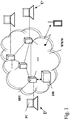
- FIG. 1 is shown schematically the structure of an information network WWW, here the form of the im Internet has established hyper-media system "WorldWideWeb".
- the WWW provides a uniform interface for the presentation of information and interfaces for various Internet services.
- the WWW is the most popular information access medium for its ease of use and multimedia capabilities.
- FIG. 1 By way of example, two users U and U 'are shown, who browse via their respective personal computer PC via a browser in the WWW and retrieve the information of interest to them. It can also be used mobile devices with browser function.
- the WWW offers a large number of linked documents in the form of HTML pages.
- the hyperlinks provide the link between the informational documents. These are links that are built into the HTML pages. For example, text documents, graphics, audio and video clips are built into HTML pages.
- the information is provided by servers, of which in the FIG. 1 an example of a server SRV is shown. As a possible application of such a server, reference is made to the portal operated by the applicant www.web.de.
- the WWW users will find a variety of websites (websites) and websites (web pages) with all sorts of information, such as catalog pages, websites of directory services, travel services, search engine results, etc.
- websites web pages
- information such as catalog pages, websites of directory services, travel services, search engine results, etc.
- advertising especially in Form of advertising banners, presented.
- the actual information is preferably located on so-called content servers.
- the banner ads can be there or on a separate server, the so-called AdServer, where the AdServer controls the appearance of the advertisement.
- FIG. 1 It is shown how a server SRV configured according to the invention for controlling advertising is now connected to a server SRV.
- the structure of the system itself is in the FIG. 3 shown.
- the process by which the system operates is determined by the FIGS. 4 and 5 clarified.
- FIG. 2 shows a user U specifically using an Internet service, namely the above-mentioned email service www.freemail.de.
- the FIG. 2 should also illustrate the display of an ad banner AD1 according to the invention:
- the user is called “Max Muster” and has set up an email user account with the service "FreeMail”. His email address is m.muster@web.de.
- Max Muster visits the website of the email service "FreeMail” via a browser and logs in, he sees the one in the FIG. 2 illustrated application with actual control and information fields.
- the user U still sees an advertising field in which the service provider displays banner ads, here the banner AD1.
- the insertion takes place automatically by the system according to the invention and according to the proposed method for controlling the advertising.
- the data evaluation and control of the advertising now cause the user "Max Muster” an ad banner AD1 with advertising for a financial institution called "123 Bank” is displayed.
- a user profile was created, according to which the user U has a particular interest in financial services, in particular in information about shares (cf. Fig. 4 ).
- the system generates such control data for the AdServer, which precisely effects the display of the banner AD1.
- This specifically tailored to the user advertising is very efficient, because it is also on the socio-demographic background of the user (data D3) and the interests he asked for (data D2) is turned off.
- FIG. 3 a system 100 having a plurality of system components, such as a data processing device 110 corresponding to a configured as a profiler computer, and an associated control device 120 corresponding to a set up as an AdServer computer that controls a configured as ContentServer CS computer and supplied with advertising forms in order to integrate user-dependent and targeted advertising in the form of advertising banners in the web pages displayed to the user.
- a data processing device 110 corresponding to a configured as a profiler computer
- an associated control device 120 corresponding to a set up as an AdServer computer that controls a configured as ContentServer CS computer and supplied with advertising forms in order to integrate user-dependent and targeted advertising in the form of advertising banners in the web pages displayed to the user.
- This happens if necessary also by controlling further servers (comp. Fig. 1 "SRV")
- the data processing device first of all evaluates 110 different input data D1, D2 and D3 and prepares a user profile for the respective user, which is processed in the form of control data D * for the control device (AdServer or AdServerControl) 120.
- the user profiles are managed anonymously.
- the profiler 110 specifies a user identification (user identity UID) for each user, to which the respective user profile is then also assigned.
- the UID is a pseudorandom-generated code (anonymous identifier) that is anonymous. In this case, references such as name and first name of the user are discarded, so that in the profiler 110 itself all user-specific data is treated only under the respective UID, which represents an anonymous identifier for external systems.
- UID user identity
- the person of the user remains anonymous, yet the user profile allows a targeted and tailored to the user control of advertising.
- Profiler 110 evaluates various input data D1, D2 and D3, which are obtained from the following data sources: A first device LOGW, which corresponds to a so-called. Logwriter and logs the online access of users, records first records 101 in the form of so-called. LogFiles.
- the data D1 contained therein essentially comprise information about the access behavior of the individual users, in particular Data such as access times, URL, page assignment, etc. (see also Fig. 4 ).
- a second device INTR which in this example corresponds to an online query device, collects survey data records 102 with information about the user interests.
- data D2 is collected via online questionnaire and prepared for the profiler, which reproduces selected preferred subject categories from various areas of interest (see also Fig. 4 ).
- a user U is interested in eg stocks, sports, especially football, and cars.
- Another user is interested in travel, especially traveling to India, languages, history, etc.
- data D3 are evaluated, which are personal data in the strict sense.
- These data D3 originate from the user database UDB of a service provider system SOZD and are made available as data records 103 which are actually used for the user administration of the offered service (eg email service).
- this data D3 is information about the name (possibly with first name), age and gender of the respective service user.
- the data regarding age, gender and postal code are processed. Further data can be added.
- the number of these service users ie all email users) is smaller than the number of WWW users considered here.
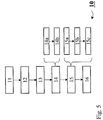
- the profiler 110 processes the data D1 to D3 after that in the Fig. 5 illustrated method 10, wherein it first assigns a user identifier for each user in a first step 11 (s. Figure 4 the field "UID").
- the first data D1 are detected, that is, the access data obtained from the log files, such as access times, URL, page assignment or IP address etc.
- the second data D2 are detected, that is the above survey data indicating user-preferred interests.
- the data D1 are supplemented by the above-mentioned third data D3, as far as these data, in particular age and gender, are available.
- the personal data D3 are incorporated into the log files of the users and are therefore included in the data D1.
- a data processing stage 111 which is designed in the form of a LogProzessors. There, the input data are filtered and, if necessary, decrypted. Subsequently, in a stage 112 (also called PFF component), a pre-aggregation and, if necessary, a further filtering of the data.
- a stage 112 also called PFF component
- a pre-aggregation and, if necessary, a further filtering of the data In a downstream stage 113 and in conjunction with the core component of the profiler, namely with the profiling stage 114, data in a compressed data format, namely in the so-called. TAB delimited ASCII format, generated that already reflect the desired user profiles.
- the user profiles are then over a profile editing stage 115 (also called DB_Builder) in the form of control data D * passed to the AdServer 120.
- a profile editing stage 115 also called DB_Builder
- the data can also be forwarded to an analysis stage 130 (also called analysis DB), which analyzes and if necessary documents the profiling process for system maintenance purposes and optimization purposes.
- the method 10 and the system 110 operating thereafter are further configured in such a way that the created user profiles are compared with one another and checked for completeness and commonality of the data by means of predefinable check criteria (step 15b).
- predefinable check criteria possibly incomplete user profiles are recognized and then supplemented with data from complete user profiles.
- a user profile that has a sufficient commonality determined by the test criteria with another user profile is incomplete, then it is completed with data from the other user profile (step 15c).
- This has the great advantage that, even with a possibly small database, a high-quality targeting of advertising succeeds.
- especially the socio-demographic data D3 are to be seen, for which a rather small database is to be expected - because not all WWW users are at the same time service users (here, for example, users of the email service).
- the user profile PU was calculated, which shows among other things that he is 31 years old and male as well as Interest in stocks, in sports, especially football, and in cars.
- the system recognizes that there is a similar user profile PU 'calculated for another user U'. Also this user U 'is 31 years old and male. Therefore, the system compares the two profiles PU and PU 'even more in detail and states that there is at least one common interest, namely "sport".
- the system now makes a data comparison among the data D2, which means that the user U is now also assumed to have an interest in politics just like the user U '.
- a relatively small database can offer a wide variety of ways to effectively evaluate user profiles for controlling advertising. For example, it can also be determined via the data D1 when the user is particularly receptive to which area of interest. Taking U as an example, you can see that he likes to visit websites in the morning in the area of equities and only then informs himself about sports and cars in the evening. So the system is preferred for this user in the morning advertising on financial services, etc. switch (see in Fig. 2 the banner AD1). Towards evening, however, the system will preferably deliver advertising about sports and / or automobiles to user U. Through this and similar measures will increase the affinity for online advertising even further.
- the method described here can also be modified in such a way that it extracts group data from the user profiles and combines them into a group profile, wherein the user identities assigned to the users are discarded.
- the advertising is less targeted to individual users than to typical user groups, such as the group of young singles, families, athletes, etc. This type of targeted advertising is particularly useful when group-specific events and offers to be advertised (single- Parties, family days, etc.).
- the system can supplement the advertising with additional information about the respective group, such as the number of group members: "Single-Party on Dec. 22 in Treffdorf - 212 singles from your region are invited - Come on, too". In all cases, the individual user remains anonymous, but is still targeted addressed.
- control data is provided via an API (Application Programming Interface) in the adserver and is preferably completely embedded in existing infrastructures.
- API Application Programming Interface
- a connection of external components to the adserver (callout) is realized and the necessary input data (input parameters) are made available as a log file.
- the actual input data can either come directly from the log file or from a specially prepared file from the LogFile.
- components Please refer Function (s) Content Server Fig. 4 "CS" Delivery of the information (content) - in particular for the parameterization of the SZM tag Unit tractor box Fig. 3 Part in "LOGW” Counting page impressions according to the AGOF standard Unit loghost Fig. 3 "101" Logging the log stream from the SZM box and writing to files Unit log processor Fig. 3 "111” Transformation of the log files of the loghostspe spec. for decrypting user-specific data (age, gender, ...) PFF component Fig. 3 "112” Preparing and filtering log data provided by the log processor (parsing, filtering, feeding) Unit profiler stage Fig.
- the conventional log file of the SZM box is extended by various data (general information on the SZM box and SZM tags can be found at http://www.infonline.de/support /szm.htm) .
- the user identifier (UID) in the cookie is transmitted to the SZM box call.
- the adclient will read this information from the cookie when generating the SZM tag and append it as a parameter to the call. This will be done during the upcoming revision of the adclient.
- the user data is added once as a parameter to the SZM tag. Since this is personal data of the user, they are encrypted and are therefore encrypted in the log file available. So that the algorithm used for this can not be communicated to external institutions, in particular advertising partners, and to protect the data against misuse, a decryption of the data is performed before the transfer of the log files to the external component (s).
- COPS is a CM technology developed by Cinetic (www.cinectic.de) of a “Corporate Online Publishing System ", in which basically all information is encapsulated in databases, which gives the user the opportunity to use the created content in many ways, in particular to use the same content on different platforms (multisite), but to maintain the content itself centrally in one place.
- COPS is not only the platform for pure content management (CM), but also an application server, which achieves high scalability and performance.
- a questionnaire is delivered via the adserver.
- the summary of the results will be provided in the formats CSV, SPSS, or Fixed-Length ASCII format.
- Each question refers to a question type whose result is displayed in the result file.
- the SZM box is a unit / component for counting page impressions. Via the port 9000/9001 the log stream of the box can be tapped and used for own analyzes. Two SZM boxes are preferably used and the availability of both boxes is secured by failover.
- the record separator is ⁇ NEWLINE> and the separator of the data fields is ⁇ TAB>.
- the files contain log data of one hour.
- the file name includes the date and time of the log rotation.
- parse codes are as follows: Parse Code description OK OK E1
- the request could not be completely parsed E2
- the URL does not match the required structure E3
- the type of pixel called does not meet the requirements ⁇ CP
- the cookie could not be parsed E5
- the user agent in the request is not valid E6
- the referrer in the request is not valid for this offer E7 No configuration for this host E8 No valid domain in the request E9 unknown error
- variable share Within the Requested Url are next to a so-called AGOF code a variable share. Within the variable portion there are freely definable key value pairs, which can vary in order and number.
- the referrer is usually set to "undefined".
- the user ID can take the following 2 formats: Internal services: 3e22b68fa3b4675c0ddc7ddb8a261d32-1089120173 External services: ac140269-25820-1090511593-1
- the rotation of the logs is controlled by exceeding a configurable number of log lines or a period of time.
- the log processor obtains the log files from the loghost.
- the transferred files are deleted after transfer to the log processor on the loghost.
- the loghost stores the cleaned log files for max. n days.
- the loghost of the PFF component makes the log files available via a mountpoint (see Fig. 3 Transition from "101" to "111" and "112").
- the PFF component deletes the processed files from the loghost.
- the e.g. questionnaire-generated data D3 is reviewed and provided in a tab-delimited ASCII file with headers.
- the DB dump created by the profiler / LDAP system is made available to the DB Builder on a defined mountpoint.
- the adserver has so-called callouts within which program extensions can be defined.
- Each request determines the UID used to obtain the profile information from the database provided by the DB Builder.
- the attributes provided by the services are extended by this profile information. It is transparent for the AdServer in possibly trailing, later processes and ultimately also for the user, where the segmentation variables come from. Thus, in the same way, an order targeting can be performed on the data supplied by the services or the profiler.
- the latency of access to the external database is kept as low as possible under 2ms.
- the request process should be aborted so that the requested profile information is not available for targeting (timeout).
- configuration can be used to prevent access to the database so that there is no negative impact on overall performance.
- any access to the database (defined by the system operator) may be time-out so that the response times do not exceed a maximum.
- a request timeout can be defined within the ad client, further increasing the reliability and security of the system.
- the external database is preferably created by the system operator is a simple file system DB, are stored in the key value pairs.
- the UID in this case is the key and the profile information is the value.
- the value does not have a structure predefined by the Berkeley DB, so that the structure is determined by the application.
- using the compressed format of the data does not require significant memory. Rather, the compressed data can all be stored in the main memory of the adserver process.
- the high performance will be achieved by the file system cache caching the last blocks requested. Within a user session, the requested data is thus served mainly from this cache.
- the ad servers are decoupled from the LDAP server.
- a failure of the LDAP server does not affect the delivery behavior Adserver.
- log stream can not be tapped from the box, log file is faulty, computer failure and the associated loss of log lines, ...), this does not affect the available profile since it is statistically significant seen a single log file is not relevant to the creation of the profiles.
- WWW WorldWideWeb
- WWW hypermedia system
- the users find on the WWW on many Internet platforms a variety of websites (websites) and websites (web pages) with all sorts of information, such as catalog pages, websites of directory services, travel services, search engine results, etc. This is often in addition to the actual information online Advertising, especially in the form of advertising banners.
- Each Internet platform can therefore be understood as a media offering, through which advertising is also transported in order to specifically advertise potential customers among the users.
- the FIG. 6 shows a schematic representation of the arrangement of two media offers A and B, which are also called here offers A and B and which are set in the WWW each as a website.
- a system TGP * or TGP ** is used, which is essentially the same as in the FIG. 3 shown system corresponds.
- both systems TGP * and TGP ** are now linked together or connected via a unit KE in order to optimally coordinate the control of the advertising on both offers A and B.
- the first offer A is, for example, the website of a well-known TV series www.gzsz.de, which comprises a user base of several hundred thousand people.
- a first system TGP * is used for the placement and placement of online advertising.
- This system TGP * achieves a targeted control of the online advertising by collecting certain data D1 to D3 and calculating control data D *, so that it is very efficient.
- the circuit of the advertisement can be controlled such that the control data D * are generated as a function of the user characteristics, represented here by the slot recognition UID *.
- Precise target groups can thus be defined and advertised in a targeted manner, whereby the user identifications UID * are anonymized in the system, so that no direct conclusions can be made about the person of the respective user.
- the system TGP * can determine, for example, that the respective user belongs to a certain age group and income group and is male. This allows the user to be assigned to a specific target group, eg "male, affluent seniors".
- Such a target group is also called “WOOF” (acronym for "Well off older Folks”).
- the system TGP * caused by the control data D * via AdServer running delivery of the appropriate online advertising, such as advertising for exclusive cruises, for seniors wellness offers or also for andrological medicine and preparations etc ..
- this user is not delivered "inappropriate” advertising, for example, on offers for family and children's holidays or toiletries for women o.ä. are directed.
- a special feature of the system TGP * and also of the TGP ** shown here is that user-dependent, a targeted online advertising can be controlled.
- personal data D3 are also recorded and processed in conjunction with anonymized user identifications UID *.
- TGP * and TGP ** The exact structure and function of such a system, here referred to as TGP * and TGP **, respectively, will be described in detail with reference to FIGS. 8 and 9 explained.
- FIGS. 6 and 7 it is about the arrangement and the interaction of several such systems using the example of the two shown systems TGP * and TGP **, each of which essentially follows the system FIG. 3 correspond.
- a device KE is proposed here, which is switched as a kind of communication unit between the systems TGP * and TGP ** and which achieves a transparent and convergent range extension from the first media offer A to a second, larger media offer B: Starting from the user base Ua reachable via the first offer A, which for example has a first reach of 500,000 users, is now to be extended to a planned reach of 4 million users.
- the second offer B will be used, which is for example the online portal www.web.de and which includes a user base Ub of approximately 18 million users (unique users). Like in the FIG. 6 is suggested by appropriate circles, the offer B is much larger than A, but an overlap of the two users Ua and Ub may occur and should be considered in the range extension.
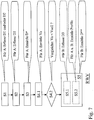
- the range extension is essentially carried out by the device KE, which is also in the FIG. 6 is shown and after the in the FIG. 7 shown method works. Therefore, following on both FIGS. 6 and 7 Referenced:
- the device KE has, as it were, the function of a communication unit which connects the two TGP systems to one another and thus merges and harmonizes the control of the online advertising on both platforms A and B.
- the device KE contains essentially data processing means PROC, which are designed as a computer or processor, and associated data storage means MEM, which include the actual working data memory (RAM) for the processor as well as data storage for the intermediate storage of the user data (hard drives o. ⁇ .) As well as for the data management (database) itself.
- the device KE provides under certain conditions, the input data D1 and D2 and possibly D3 for the second system TGP **, where it uses the corresponding input data of the first system TGP * this evaluates and / or modifies. Thus, the device KE controls the range extension.
- Steps S1 to S3 shown are generated by the system TGP * control data D * for the respective user under its anonymous identifier UID * and delivered to the offer A (not shown) AdServer.
- a tag is preferably inserted into the control data D **, such as e.g. a flag or flag. This ensures that the reach extension is aimed particularly at the not yet captured (new) user base, ie at the not yet reached part of the user base Ub.
- the aim of the procedure presented here is to fill the unavailable online media inventory on www.gzsz.de with convergent media service from another website (eg www.web.de), so that the advertising customer reaches the desired target group, no matter if on www .gzsz.de, ie on the offer A, or on the extension website www.web.de, ie on offer B.
- the reach extension is done automatically and measured from the behavior of advertising on the offer A ( www.gzsz.de) extrapolated to offer B (www.web.de).
- the "convergent range extension” solution presented here provides that with the aid of TGP systems, offer A has sufficient or at least expandable reach for marketing in the online area from the start, by entering into a logical combination with offer B becomes.
- offer A has sufficient or at least expandable reach for marketing in the online area from the start, by entering into a logical combination with offer B becomes.
- the interaction of the advertising campaign with offer A is analyzed and included in the design of the extension. This is from the beginning of the publication of Offer A to online marketing.
- a system TGP * is used on the offer A, which detects, analyzes and makes available the corresponding target groups that are delivered by the offer A adserver according to the TGP classification.
- the system TGP * on offer A uses the TGP analyzes based on the log files, the on-site survey and the user information that may be available through registration processes to deliver the advertising on A's online offer.
- the offer A defines the target group for the advertising customer and delivers it to the offer A using the media control system TGP *.
- a coupling process is initiated, which takes place with a second online offer B, on which the TGP classification is also implemented, namely in the form of a second system TGP **. This coupling process is ensured by the communication unit KE.
- the Data sources matched to contain a common variable set are socio-demographic information such as age, gender, household size, net household income, etc.
- the target groups of offer A can also be displayed on offer B.
- the tying process between offer A and offer B as part of the TGP system now controls the advertising volume booked by a customer and ensures that it is also completely delivered. This means that if the volume from offer A is exhausted, then on offer B the remainder is delivered until the advertising volume is filled in the same advertising target group.
- an offer A has the opportunity to extend its user base on an offer B, regardless of the condition whether the comparable target audience of the offer A is sufficient.
- corresponding advertising campaigns that start on offer A can be transparently extended within the scope of offer B.
- the option is also given to combine this over several offers, in which the communication unit KE processes the corresponding information and then makes the offers available in prepared form for the respective adserver.
- FIG. 9 shows in detail the structure of a TGP system (compare TGP * and TGP ** in Fig. 6 ).
- TGP has several system components, namely a data processing device 110, which corresponds to a computer configured as a profiler, and an associated control device 120, which corresponds to a set up as an AdServer computer that controls a set up as ContentServer CS computer and supplied with forms of advertising to user-dependent and purposefully integrate the advertising in the form of advertising banners in the web pages displayed to the user. This happens if necessary. Also by controlling other servers, as indicated by the arrow on "SRV".
- the data processing device (profiler) 110 acquires and evaluates the various input data D1, D2 and D3 in order to create a user profile for the respective user and to generate control data D * for the control device (AdServer) 120, which specifically delivers the online advertising .
- the user profiles are managed anonymously.
- the profiler 110 specifies a user identification (user identity) for each user, to which the respective user profile is then also assigned.
- the user identifier is a pseudo-random generated code (anonymous identifier) that is anonymous. In this case, references such as name and first name of the user are discarded, so that in the profiler 110 itself all user-specific data is treated only under the respective user ID, which represents an anonymous identifier for external systems.
- the user of the user can not be deduced from the control data D * generated by the profiler (compare user identifications UID * or UID ** in the Fig. 6 ).
- the person of User remains anonymous, yet the user profile allows a targeted and tailored to the user control of advertising.
- Profiler 110 evaluates various input data D1, D2 and D3, which are obtained from the following data sources: A first device LOGW, which corresponds to a so-called. Logwriter and logs the online access of users, records first records 101 in the form of so-called. LogFiles.
- the data D1 contained therein essentially contain information about the access behavior of the individual users, in particular data such as access times, URL, page assignment, etc.
- Further devices INTRa and INTRb which correspond to online polling facilities, preferably collect via online questionnaire information about the user interests, which are presented in corresponding survey records 102a and 102b.
- the data sets are summarized in an importer IMP to the data D2 and prepared for the profiler
- the data represent selected preferred subject categories from various areas of interest. A user is interested e.g. for stocks, sports, especially football, and for cars. Another user is interested in travel, especially for travel to India, and languages and history, etc.
- the second data D2 are determined by means of several online surveys.
- the data D2 goes back to a first data record 102a and a second data record 102b, which is determined by means of an online market research survey or by means of an offline target group survey.
- a first data record 102a and a second data record 102b which is determined by means of an online market research survey or by means of an offline target group survey.
- data D3 are personal data in the strict sense.
- These data D3 originate from the user database UDB of a service provider system SOZD and are made available as data records 103 which are actually used for the user administration of the offered service (eg email service).
- this data D3 is information about the name (possibly with first name), age and gender of the respective service user.
- at least the data regarding age, gender and postal code are processed. Further data can be added.
- the number of these service users ie all email users
- the profiler 110 processes the data D1 to D3 according to a special method, wherein in a first step it first assigns a user identifier for each user.
- the first data D1 are detected, that is, the access data obtained from the log files, such as access times, URL, page assignment or also IP address, etc.
- the second data D2 are recorded, that is, the above-mentioned survey data, which specify the interests preferred by the user.
- This step comprises several sub-steps, namely the collection of survey data from a market survey or customer survey (sub-step for the determination of data 102a) and the collection of survey data in the form of an online survey of customers or customer groups that are assigned to certain target groups (sub-step for determination the data 102b).
- the survey data (102a and 102b) are summarized (formation of the data D2).
- the data D1 are then supplemented by the above-mentioned third data D3, as far as these data, in particular age and gender, are available.
- the personal data D3 are incorporated into the log files of the users and are therefore included in the data D1.
- a data processing stage 111 which is designed in the form of a LogProzessors. There, the input data are filtered and, if necessary, decrypted. Subsequently, in a stage 112 (also called PFF component), a pre-aggregation and, if necessary, a further filtering of the data.
- a stage 112 also called PFF component
- a downstream stage 113 and in conjunction with the core component of the profiler namely with the profilreliform 114, data from it in a compressed data format, namely in the so-called. TAB delimited ASCII format, generated that already reflect the desired user profiles.
- the user profiles are then transferred via a profile editing stage 115 (also called DB_Builder) in the form of control data D * to the AdServer 120.
- a profile editing stage 115 also called DB_Builder
- the data can also be forwarded to an analysis stage 130 (also called analysis DB), which analyzes and if necessary documents the profiling process for system maintenance purposes and optimization purposes.
- the procedure and the TGP systems operating thereafter are further designed such that the created user profiles are compared with one another and checked for completeness and commonality of the data by means of specifiable test criteria.
- possibly incomplete user profiles are recognized and then supplemented with data from complete user profiles.
- a user profile that has a commonality determined by the test criteria with another user profile is incomplete, then it is completed with data from the other user profile.
- This has the great advantage that, even with a possibly small database, a high-quality targeting of advertising succeeds.
- especially the socio-demographic data D3 are to be seen, for which a rather small database is to be expected - because not all WWW users are at the same time service users (here, for example, users of the email service).
- the method also makes it possible to supplement individual incomplete user profiles with data from other, preferably complete user profiles, as far as the profiles For example, it follows from an already created user profile that the user is 31 years old and male and has an interest in stocks, in sports, especially football, and in cars. By comparing with other profiles, the system recognizes that there is a similar user profile associated with another user who is also 31 years old and male. Then the system compares the two profiles in more detail and states that there is at least one common interest, namely "sport". The system now makes a data comparison among the data D2, which now also assumes for the other user that he, like the first user, is interested in politics. In the opposite case, the other user is credited with being equally interested in football and cars as the first user. These measures complemented and improved both profiles, which in turn expanded the possibilities for accurate targeting of users U and U '. Control data D * for the AdServer are then generated from the respective profile under the corresponding user ID.
- the personal data D3 are preferably not processed under the generic user identifiers that uses the user management of the service provider (eg the user management of the email service), but under a user identity (see UID * or UID ** in Fig. 6 ), which is generated by the system proposed here specifically for the purpose of controlling advertising, preferably randomly generated as anonymous code in order to preclude a return of the data to individual persons.
- This anonymous code is stored eg in the form of a cookie on the user's PC, via which the user accesses the information network. In a later access of the user of the anonymous code and its associated user profile are recognized and used for the target control of advertising.
- the data entry of the input data is already carried out in a very targeted manner:
- an online survey is carried out.
- This online survey determines the user-specific data for the media offering.
- Basic variables are u.a. Age, gender, household size, household net income, etc.
- the procedure uses statistical methods (factor analysis, cluster analysis) and recoding the variables to determine the corresponding target persons in the online survey.
- the persons who are included in the target group user of the media offer are marked in a newly generated variable according to the specifications of the media tag. There is the possibility to subdivide the target group user of the media offer into further classes.
- This class information about the target group user of the media offer is made available in the data from the online survey to the media control technology TGP.
- the ad server is given the corresponding variable via the affiliation of the user of the online offer to the target group user of the media offer.
- media offers have the opportunity to extend their user base to an online offer, regardless of the condition whether the comparable target group on the online offer uses the media offer.
- corresponding advertising campaigns that run in the respective media offers can be transparently extended within reach.
- the invention is not limited to the embodiments described here. Rather, other embodiments of the invention are conceivable, especially in the field of telecommunications, especially in the mobile sector, where, for example, with the help of the invention targeted advertising via SMS, MMS or banner in the browser window on the terminals (mobile phone, PDA) of the participants can be switched.
- advertising by means of audible information and / or audio messages on the phones of subscribers, in particular in the area of telecommunications systems and call center technologies.
Landscapes
- Engineering & Computer Science (AREA)
- Business, Economics & Management (AREA)
- Accounting & Taxation (AREA)
- Strategic Management (AREA)
- Finance (AREA)
- Development Economics (AREA)
- Game Theory and Decision Science (AREA)
- Marketing (AREA)
- Entrepreneurship & Innovation (AREA)
- Theoretical Computer Science (AREA)
- Signal Processing (AREA)
- Computer Networks & Wireless Communication (AREA)
- Economics (AREA)
- General Physics & Mathematics (AREA)
- Physics & Mathematics (AREA)
- General Business, Economics & Management (AREA)
- General Engineering & Computer Science (AREA)
- Computer Hardware Design (AREA)
- Computer Security & Cryptography (AREA)
- Information Transfer Between Computers (AREA)
- Management, Administration, Business Operations System, And Electronic Commerce (AREA)
Claims (13)
- Procédé (10) pour contrôler la publicité en ligne dans un réseau d'information (WWW), qui fournit un accès à l'information à plusieurs utilisateurs (U, U'), le procédé ayant les étapes suivantes :- chaque utilisateur (U) se voit attribuer (étape 11) une identité d'utilisateur (ID), dans laquelle l'identité d'utilisateur (ID) est un code anonyme qui est généré de manière aléatoire,- pour chaque utilisateur (U), les premières données (D1) sont enregistrées, contenant les informations sur le comportement d'accès de l'utilisateur à l'information (étape 12),- pour chaque utilisateur respectif (U), une deuxième donnée est saisie qui contient des informations sur l'intérêt qu'il porte au type d'information (étape 13) ;- les première et deuxième données (D1, D2) sont complétées par des données tierces (D3) qui contiennent des informations sur la personne de l'utilisateur respectif (U) (étape 14); et- à partir des données, des premières données (D1), des deuxièmes données (D2) et des troisièmes données (D3), pour l'utilisateur respectif (U) des données de commande (D*) sont extraites (étape 15) et transmises à un dispositif de commande (120) pour commander la publicité (étape 16), dans lequel au moins pour chaque utilisateur (U) des données de commande extraites (D*) sont stockées (étape 15a) dans un profil d'utilisateur (UP) de l'utilisateur associé à l'identité d'utilisateur (ID) ;- les profils d'utilisateurs créés (UP, UP ') sont comparés entre eux et vérifiés pour vérifier l'exhaustivité et le caractère commun des données à l'aide de critères d'essai spécifiables.
- Procédé (10) selon la revendication 1, dans lequel un profil d'utilisateur incomplet (UP') qui a suffisamment de points communs avec un autre profil d'utilisateur (UP) déterminé par les critères d'essai spécifiables, est complété (étape 15) au moyen des données (D1, D2, D3) de l'autre profil d'utilisateur (UP).
- Procédé (10) selon l'une des revendications précédentes, dans lequel les données de contrôle extraites (D*) sont utilisées de manière anonyme en ce que pour chaque utilisateur (D*) les données de contrôle sont gérées sous les identités d'utilisateur associées (ID) mais sans référence au nom de la personne de l'utilisateur (U), en particulier sans référence aux informations de nom contenues dans les troisièmes données (D3) (étape 15a).
- Procédé (10) selon l'une des revendications précédentes, dans lequel la troisième donnée (D3) contient des informations personnelles sur l'utilisateur (U), en particulier son âge et son sexe.
- Méthode (10) selon l'une des revendications précédentes, dans le cas d'au moins une majorité des utilisateurs (U, U') utilise un service en ligne via le réseau d'information, le service en ligne étant offert par un fournisseur de services (WWW); et dans laquelle la troisième donnée (D3) est extraite d'une base de données (UDB) du prestataire de services (étape 14a).
- Procédé (10) selon l'une des revendications précédentes, dans lequel le réseau d'information est l'Internet, en particulier le WorldWideWeb (WWW);
dans laquelle les informations auxquelles les utilisateurs (U, U') accèdent, comprennent des informations visuelles présentées sur des pages Internet, en particulier des pages de portail, des pages de catalogue, des pages Internet de services d'information, des services de voyage et/ou des résultats de moteur de recherche; et
dans laquelle la publicité est intégrée (étape 16) en tant que bannière publicitaire (AD1) dans les informations représentées. - Procédé selon l'une des revendications précédentes, dans lequel des données de groupe sont extraites de profils d'utilisateurs et sont fusionnées dans un profil de groupe, les identités d'utilisateurs qui leur sont assignées étant rejetées.
- Procédé (RWV) selon l'une des revendications précédentes, dans lequel on étend la portée de la publicité en ligne d'une première plate-forme Internet (offre A) ayant une première base d'utilisateurs (Ua) avec une première gamme, sur une deuxième plate-forme Internet (offre B) ayant une deuxième base d'utilisateurs ("Ub") avec une deuxième gamme plus large, les étapes suivantes sont développées par :- pour la première base d'utilisateurs (Ua) enregistrant les première et / ou deuxième données (D1, D2), les informations sur le comportement d'accès des utilisateurs (D1 - LogFile) ou les informations sur l'intérêt des utilisateurs pour les informations en ligne (enquête D2) sont incluses (S1) et les troisièmes données (D3 socio-démographiques) collectées sont des informations personnelles sur les utilisateurs respectifs inclus (S2); et par- à partir de celles de la première base d'utilisateurs (Ua) données enregistrées (D1, D2, D3) premières données de contrôle (D*) pour la publicité en ligne - déterminée sur la première plate-forme Internet (A) devenir (S3); et par- un par le biais de ces publicités en ligne sur la première plate-forme Internet (A) le résultat obtenu le premier volume publicitaire (Va) devient (S4.1) et avec un volume publicitaire planifié ("Vsoll") est comparé (S4.2); et- si le premier volume publicitaire (Va) est inférieur au volume publicitaire prévu (Vsoll) est, à partir de celui de la première base d'utilisateurs (Ua) détectée première et / ou deuxième données (D1, D2) les deuxièmes données de contrôle (D**) pour la publicité en ligne sur la deuxième plate-forme Internet (B) peuvent être déterminées (S5), y compris pour la deuxième base d'utilisateurs (Ua) les troisièmes données (D3), les informations personnelles sur les utilisateurs respectifs contiennent détectées (S5).1), et pour les deux bases d'utilisateurs (Ua, Ub) des profils sont déterminés, qui indiquent des similitudes et/ou des différences afin d'harmoniser la publicité en ligne sur la deuxième plate-forme Internet (B) avec le profil de la première base d'utilisateurs (Ua) (S5.2).
- Procédé (RWV) selon la revendication 8, dans lequel on vérifie sur la base des troisièmes données (D3), si dans la deuxième base d'utilisateurs (Ub) ne sont pas déjà des utilisateurs de la première base d'utilisateurs (Ua), et dans lequel, sur la deuxième plate-forme Internet (B), la publicité en ligne n'est livrée qu'aux utilisateurs de la deuxième base d'utilisateurs (Ub), qui n'appartiennent pas à la première base d'utilisateurs (Ua) également.
- Procédé (RWV) selon l'une des revendications 8 ou 9, dans lequel on attribue à chaque utilisateur une identité d'utilisateur (UID) afin de créer des profils pour les bases d'utilisateurs (Ua, Ub) qui spécifient les similitudes et/ou les différences.
- Procédé (RWV) selon l'une des revendications 8 à 10, dans lequel la publicité en ligne est délivrée en fonction de l'utilisateur, dans lequel un drapeau, en particulier un bit indicateur (FLG), est inséré dans les deuxièmes données de commande (D**) indiquant le cas où un utilisateur de la deuxième base d'utilisateurs (Ub) appartient déjà à la première base d'utilisateurs (Ua), et dans lequel la livraison de publicité en ligne via la deuxième plate-forme Internet (B) pour cet utilisateur est alors empêchée.
- Système (100) pour contrôler la publicité en ligne dans un réseau d'information (WWW), au sujet duquel plusieurs utilisateurs (U, U') ont accès à l'information, le système ayant:Unité de traitement de données une direction (110) dans laquelle chaque utilisateur (U) assigne une identité d'utilisateur (ID), dans laquelle l'identité d'utilisateur est un code anonyme, qui est créé par un générateur de nombres aléatoires, etdans laquelle le traitement de données réuni évalue des premières données (D1) comprenant un premier dispositif (LOG W) fournit et contient des informations sur son comportement d'accès d'un uf de l'information,dans lequel le dispositif de traitement de données (110) pour l'utilisateur respectif (U) évalue des deuxièmes données (D2), qui fournissent un deuxième dispositif (INTR) et contiennent des informations sur l'intérêt de l'utilisateur (U) pour le type d'informations,et dans lequel le dispositif de traitement de données (110) première et / ou deuxième données s (D1, D2) par troisième données (D3) ajoute ce qu'un troisième dispositif (UDB) fournit et bien vérifier les informations sur la personne de l'utilisateur respectif (U) inclus;dans lequel le dispositif de traitement de données (110) extrait des données (D1, D2, D3) pour les données de commande de l'utilisateur respectif (U) (D*) et les transmet à un dispositif de commande (120) pour commander la publicité.
- Système (100) selon la revendication 12, dans lequel le réseau d'information est l'Internet, en particulier le World Wide Web (WWW), dans lequel l'information à laquelle les utilisateurs (U, U') accèdent à des pages visuelles est affichée sur des sites Web Information, en particulier des pages de portail, des pages de catalogue, des sites Web de services d'information, des services de voyage et/ou des résultats de moteur de recherche, dans lequel le dispositif de traitement de données en tant qu'ordinateur équipé d'un profileur (110) est au moins les données de commande extraites (D*) pour chaque utilisateur (U) dans un profil d'utilisateur (PU) sous lequel l'identité (ID) de l'utilisateur assigné stocke et dans lequel le contrôleur agit comme AdServer (120) commandant un serveur de contenu (CS) qui intègre la publicité en tant que bannière (AD1) dans les informations affichées.
Applications Claiming Priority (4)
| Application Number | Priority Date | Filing Date | Title |
|---|---|---|---|
| US61433904P | 2004-09-29 | 2004-09-29 | |
| DE200410047815 DE102004047815B4 (de) | 2004-09-29 | 2004-09-29 | Verfahren zum gezielten Steuern von Werbung und System dafür |
| DE102005044936 | 2005-09-20 | ||
| PCT/EP2005/010434 WO2006034844A1 (fr) | 2004-09-29 | 2005-09-27 | Procede de commande ciblee de publicite en ligne, dispositif et systeme associes |
Publications (2)
| Publication Number | Publication Date |
|---|---|
| EP1797699A1 EP1797699A1 (fr) | 2007-06-20 |
| EP1797699B1 true EP1797699B1 (fr) | 2019-03-20 |
Family
ID=35530816
Family Applications (1)
| Application Number | Title | Priority Date | Filing Date |
|---|---|---|---|
| EP05790068.0A Expired - Lifetime EP1797699B1 (fr) | 2004-09-29 | 2005-09-27 | Procede de commande ciblee de publicite en ligne, dispositif et systeme associes |
Country Status (5)
| Country | Link |
|---|---|
| US (1) | US20080140525A1 (fr) |
| EP (1) | EP1797699B1 (fr) |
| AU (1) | AU2005289059B2 (fr) |
| CA (1) | CA2581879A1 (fr) |
| WO (1) | WO2006034844A1 (fr) |
Cited By (1)
| Publication number | Priority date | Publication date | Assignee | Title |
|---|---|---|---|---|
| DE102020112072A1 (de) | 2020-05-05 | 2021-11-11 | byte:city Unternehmergesellschaft (haftungsbeschränkt) | Advertainment |
Families Citing this family (33)
| Publication number | Priority date | Publication date | Assignee | Title |
|---|---|---|---|---|
| US20050038699A1 (en) * | 2003-08-12 | 2005-02-17 | Lillibridge Mark David | System and method for targeted advertising via commitment |
| US7890857B1 (en) * | 2006-07-25 | 2011-02-15 | Hewlett-Packard Development Company, L.P. | Method and system for utilizing sizing directives for media |
| US8041806B2 (en) * | 2006-09-11 | 2011-10-18 | Alcatel Lucent | Targeted electronic content delivery control systems and methods |
| US8874465B2 (en) | 2006-10-02 | 2014-10-28 | Russel Robert Heiser, III | Method and system for targeted content placement |
| US10614459B2 (en) * | 2006-10-02 | 2020-04-07 | Segmint, Inc. | Targeted marketing with CPE buydown |
| US12243055B2 (en) * | 2006-10-02 | 2025-03-04 | Segmint Inc. | Anonymized targeted content delivery |
| EP3709248A1 (fr) * | 2006-10-02 | 2020-09-16 | Segmint Inc. | Placement publicitaire de consommation personnalisé |
| US20080177765A1 (en) * | 2007-01-22 | 2008-07-24 | Jook, Inc. | Profile management method and system |
| KR100913902B1 (ko) * | 2007-05-25 | 2009-08-26 | 삼성전자주식회사 | 지그비 개인영역 네트워크에서 이동통신 단말기를 이용하여데이터를 송수신하는 통신방법 및 그를 위한 통신 시스템 |
| DE102007046466A1 (de) * | 2007-09-28 | 2009-04-09 | Divolution Digital Revolution Technology Gmbh | Verfahren zum Identifizieren von Teilnehmern in einem Datennetzwerk |
| US20090138328A1 (en) * | 2007-11-26 | 2009-05-28 | Yahoo! Inc. | Targeted distribution of commercial incentives |
| US20090138348A1 (en) * | 2007-11-26 | 2009-05-28 | Yahoo! Inc. | Redistribution and redemption of commercial incentives |
| US20090138347A1 (en) * | 2007-11-26 | 2009-05-28 | Yahoo! Inc. | Dynamic augmentation of commercial incentives |
| US8248940B2 (en) * | 2008-01-30 | 2012-08-21 | Alcatel Lucent | Method and apparatus for targeted content delivery based on internet video traffic analysis |
| US8010628B2 (en) * | 2008-03-03 | 2011-08-30 | Bookit.Com, Inc. | Software to provide geographically relevant website content |
| US10885552B2 (en) | 2008-03-17 | 2021-01-05 | Segmint, Inc. | Method and system for targeted content placement |
| US8825520B2 (en) | 2008-03-17 | 2014-09-02 | Segmint Inc. | Targeted marketing to on-hold customer |
| US8239256B2 (en) * | 2008-03-17 | 2012-08-07 | Segmint Inc. | Method and system for targeted content placement |
| US8234159B2 (en) | 2008-03-17 | 2012-07-31 | Segmint Inc. | Method and system for targeted content placement |
| US11138632B2 (en) | 2008-03-17 | 2021-10-05 | Segmint Inc. | System and method for authenticating a customer for a pre-approved offer of credit |
| US11663631B2 (en) | 2008-03-17 | 2023-05-30 | Segmint Inc. | System and method for pulling a credit offer on bank's pre-approved property |
| US11120471B2 (en) | 2013-10-18 | 2021-09-14 | Segmint Inc. | Method and system for targeted content placement |
| US11669866B2 (en) | 2008-03-17 | 2023-06-06 | Segmint Inc. | System and method for delivering a financial application to a prospective customer |
| US20100100417A1 (en) * | 2008-10-20 | 2010-04-22 | Yahoo! Inc. | Commercial incentive presentation system and method |
| US20100179856A1 (en) * | 2009-01-14 | 2010-07-15 | Yahoo! Inc. | Conditional incentive presentation, tracking and redemption |
| US20110010563A1 (en) * | 2009-07-13 | 2011-01-13 | Kindsight, Inc. | Method and apparatus for anonymous data processing |
| US20120084153A1 (en) * | 2010-09-30 | 2012-04-05 | ANNONA CORP S.A., Societe Anonyme | System, method, and computer-readable medium for distributing targeted data using anonymous profiles |
| AU2011349435B2 (en) | 2010-12-20 | 2016-08-18 | The Nielsen Company (Us), Llc | Methods and apparatus to determine media impressions using distributed demographic information |
| AU2013204865B2 (en) | 2012-06-11 | 2015-07-09 | The Nielsen Company (Us), Llc | Methods and apparatus to share online media impressions data |
| US20140297419A1 (en) * | 2013-03-31 | 2014-10-02 | Prakasha Mandagaru Ramachandra | Method and system for inserting targeted advertisement by mobile network operators through website cue tones |
| US10152339B1 (en) | 2014-06-25 | 2018-12-11 | EMC IP Holding Company LLC | Methods and apparatus for server caching simulator |
| EP3398148A4 (fr) * | 2015-12-30 | 2019-08-07 | Verimatrix, Inc. | Systèmes et procédé d'attribution rétroactive d'informations personnellement identifiables dans une distribution d'un contenu numérique |
| US20220308869A1 (en) * | 2021-03-26 | 2022-09-29 | International Business Machines Corporation | Computer management of microservices for microservice based applications |
Family Cites Families (8)
| Publication number | Priority date | Publication date | Assignee | Title |
|---|---|---|---|---|
| US7240022B1 (en) * | 1998-05-19 | 2007-07-03 | Mypoints.Com Inc. | Demographic information gathering and incentive award system and method |
| AU1272201A (en) * | 1999-10-14 | 2001-04-23 | Joachim Schlafke | Method for the analysis of user behavior in a computer network in order to optimize web presence |
| DE19964253A1 (de) * | 1999-12-08 | 2002-01-03 | Cyberprofit Ag | Verfahren, Computerprogramm, Vorrichtung und System zum Übermitteln von Inhalten, insbesondere von Werbung |
| DE10036734A1 (de) * | 2000-07-27 | 2002-02-14 | Webvertising Ag | Verfahren zum interaktiven Kommunizieren zwischen einem internetfähigen Endgerät und einem internetfähigen Webserver |
| DE10045279A1 (de) * | 2000-09-13 | 2002-03-28 | Nutzwerk Informationsgmbh | Vorrichtung und Verfahren zur Bereitstellung von benutzerspezifischen Informationen in Datennetzen |
| DE10137677A1 (de) * | 2001-08-01 | 2003-02-20 | Mediaprocure Ag | Datenkommunikationssystem zur automatischen Planung von Werbekampagnen, Vorrichtung zur Verwendung in einem derartigen System, sowie Datenkommunikationsverfahren |
| DE10148985A1 (de) * | 2001-10-04 | 2003-04-10 | Deutsche Telekom Ag | Verfahren zur Ausgabe von personalisierten Informationen auf einer Website |
| EP1338995A1 (fr) * | 2002-02-21 | 2003-08-27 | GRETAG IMAGING Trading AG | Profil de contenu d'image photographique associé au client |
-
2005
- 2005-09-27 EP EP05790068.0A patent/EP1797699B1/fr not_active Expired - Lifetime
- 2005-09-27 US US11/664,239 patent/US20080140525A1/en not_active Abandoned
- 2005-09-27 CA CA002581879A patent/CA2581879A1/fr not_active Abandoned
- 2005-09-27 AU AU2005289059A patent/AU2005289059B2/en not_active Ceased
- 2005-09-27 WO PCT/EP2005/010434 patent/WO2006034844A1/fr not_active Ceased
Non-Patent Citations (1)
| Title |
|---|
| EAGLE N; PENTLAND A: "Social Serendipity: Proximity Sensing and Cueing", 31 May 2004 (2004-05-31), pages 1 - 18, XP002392394, Retrieved from the Internet <URL:http://www-static.cc.gatech.edu/gvu/ccg/paper_of_week/socialserendipidty.pdf> * |
Cited By (1)
| Publication number | Priority date | Publication date | Assignee | Title |
|---|---|---|---|---|
| DE102020112072A1 (de) | 2020-05-05 | 2021-11-11 | byte:city Unternehmergesellschaft (haftungsbeschränkt) | Advertainment |
Also Published As
| Publication number | Publication date |
|---|---|
| EP1797699A1 (fr) | 2007-06-20 |
| CA2581879A1 (fr) | 2006-04-06 |
| AU2005289059A1 (en) | 2006-04-06 |
| AU2005289059B2 (en) | 2010-09-02 |
| WO2006034844A1 (fr) | 2006-04-06 |
| US20080140525A1 (en) | 2008-06-12 |
Similar Documents
| Publication | Publication Date | Title |
|---|---|---|
| EP1797699B1 (fr) | Procede de commande ciblee de publicite en ligne, dispositif et systeme associes | |
| DE60108861T2 (de) | Gerät und verfahren zur überwachung der netzwerkauslastung | |
| DE60118712T2 (de) | Verfahren und system zur bereitstellung einer kundenspezifischen medienliste | |
| EP1332585B1 (fr) | Procede servant a rassembler et a transmettre des donnees multimedia | |
| DE10244974A1 (de) | Automatische Inserentenbenachrichtigung für ein System zum Bereitstellen eines Platz- und Preisschutzes in einer Suchergebnisliste, die durch eine Computernetzwerksuchmaschine erzeugt wird | |
| DE212010000052U1 (de) | Inhaltsyndizierung in web-basierten Medien über Anzeigemarkierung | |
| DE60133384T2 (de) | GEZIELTE NACHRICHTEN FüR EIN ENDBENUTZERGERÄT, DAS MIT EINEM DIENSTKNOTEN IN EINEM KOMMUNIKATIONSNETZ VERBUNDEN IST | |
| DE112020004978T5 (de) | System und Verfahren zum Ausliefern in Echtzeit eines zielgerichteten Inhalts in einem Streaming-Inhalt | |
| DE69836814T2 (de) | Zulieferausgewählte nachricht als antwort auf anwenderanfrage | |
| DE102004047815B4 (de) | Verfahren zum gezielten Steuern von Werbung und System dafür | |
| WO2007076897A1 (fr) | Procede pour le suivi de transactions reseau | |
| EP1239395A2 (fr) | Appareil et méthode pour envoyer des informations publicitaires | |
| DE102006015961A1 (de) | Vorrichtung, Verfahren und Computerprogramm zum Verarbeiten einer Suchanfrage | |
| EP2709053A1 (fr) | Détermination de la perception d'une publicité par un utilisateur et de son effet | |
| WO2005091184A1 (fr) | Systeme d'information | |
| EP2922009A1 (fr) | Procédé de suivi sur plusieurs terminaux d'un utilisateur d'une offre Internet, serveur de suivi permettant de mettre en oeuvre un tel procédé et réseau informatique doté d'un tel serveur de suivi | |
| EP2278544A1 (fr) | Procédé de transmission de contenus | |
| EP1222544A2 (fr) | Procede d'analyse du comportement utilisateur dans des reseaux informatiques pour l'optimisation de la presence web | |
| DE19914333A1 (de) | Methode und System für einen sponsorfinanzierten Internet-Zugang mit nicht abschaltbarer Werbebannerleiste und integrierter Gewinnung von marketing-relevanten Statistikinformationen über das Benutzerverhalten im Internet mittels Session-Tracking | |
| DE202008018096U1 (de) | Anordnung zur Anonymisierung von personenbezogenen Daten | |
| AT509566B1 (de) | Verfahren zur steuerung von werbeinhalten in informationsnetzwerken | |
| EP1752924A1 (fr) | Procédé de commande d'un produit chez un magasin en ligne connecté à un réseau de communication | |
| EP2685391A1 (fr) | Système de réseau informatique, ordinateur serveur, ordinateur prestataire de service, procédé déployé sur ordinateur et produit de programme informatique pour la transmission automatique sur un site Web spécifique à un utilisateur d'un ordinateur prestataire de service lorsqu'un utilisateur appel un site Internet d'un ordinateur prestataire | |
| DE10145074A1 (de) | Rollenbasierte Personalisierung neuer Medien | |
| DE10045279A1 (de) | Vorrichtung und Verfahren zur Bereitstellung von benutzerspezifischen Informationen in Datennetzen |
Legal Events
| Date | Code | Title | Description |
|---|---|---|---|
| PUAI | Public reference made under article 153(3) epc to a published international application that has entered the european phase |
Free format text: ORIGINAL CODE: 0009012 |
|
| 17P | Request for examination filed |
Effective date: 20070502 |
|
| AK | Designated contracting states |
Kind code of ref document: A1 Designated state(s): AT BE BG CH CY CZ DE DK EE ES FI FR GB GR HU IE IS IT LI LT LU LV MC NL PL PT RO SE SI SK TR |
|
| DAX | Request for extension of the european patent (deleted) | ||
| 17Q | First examination report despatched |
Effective date: 20080602 |
|
| GRAP | Despatch of communication of intention to grant a patent |
Free format text: ORIGINAL CODE: EPIDOSNIGR1 |
|
| STAA | Information on the status of an ep patent application or granted ep patent |
Free format text: STATUS: GRANT OF PATENT IS INTENDED |
|
| RIC1 | Information provided on ipc code assigned before grant |
Ipc: G06Q 30/02 20120101ALI20180409BHEP Ipc: H04L 29/08 20060101AFI20180409BHEP |
|
| INTG | Intention to grant announced |
Effective date: 20180423 |
|
| GRAS | Grant fee paid |
Free format text: ORIGINAL CODE: EPIDOSNIGR3 |
|
| GRAA | (expected) grant |
Free format text: ORIGINAL CODE: 0009210 |
|
| STAA | Information on the status of an ep patent application or granted ep patent |
Free format text: STATUS: THE PATENT HAS BEEN GRANTED |
|
| AK | Designated contracting states |
Kind code of ref document: B1 Designated state(s): AT BE BG CH CY CZ DE DK EE ES FI FR GB GR HU IE IS IT LI LT LU LV MC NL PL PT RO SE SI SK TR |
|
| REG | Reference to a national code |
Ref country code: GB Ref legal event code: FG4D Free format text: NOT ENGLISH |
|
| REG | Reference to a national code |
Ref country code: CH Ref legal event code: EP |
|
| REG | Reference to a national code |
Ref country code: DE Ref legal event code: R096 Ref document number: 502005016008 Country of ref document: DE |
|
| REG | Reference to a national code |
Ref country code: AT Ref legal event code: REF Ref document number: 1111691 Country of ref document: AT Kind code of ref document: T Effective date: 20190415 |
|
| REG | Reference to a national code |
Ref country code: IE Ref legal event code: FG4D Free format text: LANGUAGE OF EP DOCUMENT: GERMAN |
|
| REG | Reference to a national code |
Ref country code: NL Ref legal event code: MP Effective date: 20190320 |
|
| PG25 | Lapsed in a contracting state [announced via postgrant information from national office to epo] |
Ref country code: LT Free format text: LAPSE BECAUSE OF FAILURE TO SUBMIT A TRANSLATION OF THE DESCRIPTION OR TO PAY THE FEE WITHIN THE PRESCRIBED TIME-LIMIT Effective date: 20190320 Ref country code: FI Free format text: LAPSE BECAUSE OF FAILURE TO SUBMIT A TRANSLATION OF THE DESCRIPTION OR TO PAY THE FEE WITHIN THE PRESCRIBED TIME-LIMIT Effective date: 20190320 Ref country code: SE Free format text: LAPSE BECAUSE OF FAILURE TO SUBMIT A TRANSLATION OF THE DESCRIPTION OR TO PAY THE FEE WITHIN THE PRESCRIBED TIME-LIMIT Effective date: 20190320 |
|
| REG | Reference to a national code |
Ref country code: LT Ref legal event code: MG4D |
|
| PG25 | Lapsed in a contracting state [announced via postgrant information from national office to epo] |
Ref country code: NL Free format text: LAPSE BECAUSE OF FAILURE TO SUBMIT A TRANSLATION OF THE DESCRIPTION OR TO PAY THE FEE WITHIN THE PRESCRIBED TIME-LIMIT Effective date: 20190320 Ref country code: GR Free format text: LAPSE BECAUSE OF FAILURE TO SUBMIT A TRANSLATION OF THE DESCRIPTION OR TO PAY THE FEE WITHIN THE PRESCRIBED TIME-LIMIT Effective date: 20190621 Ref country code: BG Free format text: LAPSE BECAUSE OF FAILURE TO SUBMIT A TRANSLATION OF THE DESCRIPTION OR TO PAY THE FEE WITHIN THE PRESCRIBED TIME-LIMIT Effective date: 20190620 Ref country code: LV Free format text: LAPSE BECAUSE OF FAILURE TO SUBMIT A TRANSLATION OF THE DESCRIPTION OR TO PAY THE FEE WITHIN THE PRESCRIBED TIME-LIMIT Effective date: 20190320 |
|
| PG25 | Lapsed in a contracting state [announced via postgrant information from national office to epo] |
Ref country code: ES Free format text: LAPSE BECAUSE OF FAILURE TO SUBMIT A TRANSLATION OF THE DESCRIPTION OR TO PAY THE FEE WITHIN THE PRESCRIBED TIME-LIMIT Effective date: 20190320 Ref country code: PT Free format text: LAPSE BECAUSE OF FAILURE TO SUBMIT A TRANSLATION OF THE DESCRIPTION OR TO PAY THE FEE WITHIN THE PRESCRIBED TIME-LIMIT Effective date: 20190720 Ref country code: EE Free format text: LAPSE BECAUSE OF FAILURE TO SUBMIT A TRANSLATION OF THE DESCRIPTION OR TO PAY THE FEE WITHIN THE PRESCRIBED TIME-LIMIT Effective date: 20190320 Ref country code: IT Free format text: LAPSE BECAUSE OF FAILURE TO SUBMIT A TRANSLATION OF THE DESCRIPTION OR TO PAY THE FEE WITHIN THE PRESCRIBED TIME-LIMIT Effective date: 20190320 Ref country code: RO Free format text: LAPSE BECAUSE OF FAILURE TO SUBMIT A TRANSLATION OF THE DESCRIPTION OR TO PAY THE FEE WITHIN THE PRESCRIBED TIME-LIMIT Effective date: 20190320 Ref country code: SK Free format text: LAPSE BECAUSE OF FAILURE TO SUBMIT A TRANSLATION OF THE DESCRIPTION OR TO PAY THE FEE WITHIN THE PRESCRIBED TIME-LIMIT Effective date: 20190320 Ref country code: CZ Free format text: LAPSE BECAUSE OF FAILURE TO SUBMIT A TRANSLATION OF THE DESCRIPTION OR TO PAY THE FEE WITHIN THE PRESCRIBED TIME-LIMIT Effective date: 20190320 |
|
| PG25 | Lapsed in a contracting state [announced via postgrant information from national office to epo] |
Ref country code: PL Free format text: LAPSE BECAUSE OF FAILURE TO SUBMIT A TRANSLATION OF THE DESCRIPTION OR TO PAY THE FEE WITHIN THE PRESCRIBED TIME-LIMIT Effective date: 20190320 |
|
| PG25 | Lapsed in a contracting state [announced via postgrant information from national office to epo] |
Ref country code: IS Free format text: LAPSE BECAUSE OF FAILURE TO SUBMIT A TRANSLATION OF THE DESCRIPTION OR TO PAY THE FEE WITHIN THE PRESCRIBED TIME-LIMIT Effective date: 20190720 |
|
| REG | Reference to a national code |
Ref country code: DE Ref legal event code: R097 Ref document number: 502005016008 Country of ref document: DE |
|
| PLBE | No opposition filed within time limit |
Free format text: ORIGINAL CODE: 0009261 |
|
| STAA | Information on the status of an ep patent application or granted ep patent |
Free format text: STATUS: NO OPPOSITION FILED WITHIN TIME LIMIT |
|
| PG25 | Lapsed in a contracting state [announced via postgrant information from national office to epo] |
Ref country code: DK Free format text: LAPSE BECAUSE OF FAILURE TO SUBMIT A TRANSLATION OF THE DESCRIPTION OR TO PAY THE FEE WITHIN THE PRESCRIBED TIME-LIMIT Effective date: 20190320 |
|
| 26N | No opposition filed |
Effective date: 20200102 |
|
| PG25 | Lapsed in a contracting state [announced via postgrant information from national office to epo] |
Ref country code: SI Free format text: LAPSE BECAUSE OF FAILURE TO SUBMIT A TRANSLATION OF THE DESCRIPTION OR TO PAY THE FEE WITHIN THE PRESCRIBED TIME-LIMIT Effective date: 20190320 |
|
| PG25 | Lapsed in a contracting state [announced via postgrant information from national office to epo] |
Ref country code: TR Free format text: LAPSE BECAUSE OF FAILURE TO SUBMIT A TRANSLATION OF THE DESCRIPTION OR TO PAY THE FEE WITHIN THE PRESCRIBED TIME-LIMIT Effective date: 20190320 |
|
| PG25 | Lapsed in a contracting state [announced via postgrant information from national office to epo] |
Ref country code: MC Free format text: LAPSE BECAUSE OF FAILURE TO SUBMIT A TRANSLATION OF THE DESCRIPTION OR TO PAY THE FEE WITHIN THE PRESCRIBED TIME-LIMIT Effective date: 20190320 |
|
| PG25 | Lapsed in a contracting state [announced via postgrant information from national office to epo] |
Ref country code: LU Free format text: LAPSE BECAUSE OF NON-PAYMENT OF DUE FEES Effective date: 20190927 Ref country code: IE Free format text: LAPSE BECAUSE OF NON-PAYMENT OF DUE FEES Effective date: 20190927 |
|
| PGFP | Annual fee paid to national office [announced via postgrant information from national office to epo] |
Ref country code: FR Payment date: 20200528 Year of fee payment: 16 |
|
| REG | Reference to a national code |
Ref country code: BE Ref legal event code: MM Effective date: 20190930 |
|
| PG25 | Lapsed in a contracting state [announced via postgrant information from national office to epo] |
Ref country code: BE Free format text: LAPSE BECAUSE OF NON-PAYMENT OF DUE FEES Effective date: 20190930 |
|
| PGFP | Annual fee paid to national office [announced via postgrant information from national office to epo] |
Ref country code: CH Payment date: 20200925 Year of fee payment: 16 Ref country code: AT Payment date: 20200923 Year of fee payment: 16 |
|
| PGFP | Annual fee paid to national office [announced via postgrant information from national office to epo] |
Ref country code: GB Payment date: 20201216 Year of fee payment: 16 |
|
| PG25 | Lapsed in a contracting state [announced via postgrant information from national office to epo] |
Ref country code: CY Free format text: LAPSE BECAUSE OF FAILURE TO SUBMIT A TRANSLATION OF THE DESCRIPTION OR TO PAY THE FEE WITHIN THE PRESCRIBED TIME-LIMIT Effective date: 20190320 |
|
| PG25 | Lapsed in a contracting state [announced via postgrant information from national office to epo] |
Ref country code: HU Free format text: LAPSE BECAUSE OF FAILURE TO SUBMIT A TRANSLATION OF THE DESCRIPTION OR TO PAY THE FEE WITHIN THE PRESCRIBED TIME-LIMIT; INVALID AB INITIO Effective date: 20050927 |
|
| REG | Reference to a national code |
Ref country code: DE Ref legal event code: R079 Ref document number: 502005016008 Country of ref document: DE Free format text: PREVIOUS MAIN CLASS: H04L0029080000 Ipc: H04L0065000000 |
|
| REG | Reference to a national code |
Ref country code: CH Ref legal event code: PL |
|
| REG | Reference to a national code |
Ref country code: AT Ref legal event code: MM01 Ref document number: 1111691 Country of ref document: AT Kind code of ref document: T Effective date: 20210927 |
|
| GBPC | Gb: european patent ceased through non-payment of renewal fee |
Effective date: 20210927 |
|
| PG25 | Lapsed in a contracting state [announced via postgrant information from national office to epo] |
Ref country code: GB Free format text: LAPSE BECAUSE OF NON-PAYMENT OF DUE FEES Effective date: 20210927 Ref country code: FR Free format text: LAPSE BECAUSE OF NON-PAYMENT OF DUE FEES Effective date: 20210930 |
|
| PG25 | Lapsed in a contracting state [announced via postgrant information from national office to epo] |
Ref country code: LI Free format text: LAPSE BECAUSE OF NON-PAYMENT OF DUE FEES Effective date: 20210930 Ref country code: CH Free format text: LAPSE BECAUSE OF NON-PAYMENT OF DUE FEES Effective date: 20210930 Ref country code: AT Free format text: LAPSE BECAUSE OF NON-PAYMENT OF DUE FEES Effective date: 20210927 |
|
| PGFP | Annual fee paid to national office [announced via postgrant information from national office to epo] |
Ref country code: DE Payment date: 20241126 Year of fee payment: 20 |
|
| REG | Reference to a national code |
Ref country code: DE Ref legal event code: R071 Ref document number: 502005016008 Country of ref document: DE |