EP1798272B1 - Verfahren zur Herstellung eines optischen Artikels und so erhaltener Artikel - Google Patents
Verfahren zur Herstellung eines optischen Artikels und so erhaltener Artikel Download PDFInfo
- Publication number
- EP1798272B1 EP1798272B1 EP06291705A EP06291705A EP1798272B1 EP 1798272 B1 EP1798272 B1 EP 1798272B1 EP 06291705 A EP06291705 A EP 06291705A EP 06291705 A EP06291705 A EP 06291705A EP 1798272 B1 EP1798272 B1 EP 1798272B1
- Authority
- EP
- European Patent Office
- Prior art keywords
- coating
- absorber
- article
- layer
- fact
- Prior art date
- Legal status (The legal status is an assumption and is not a legal conclusion. Google has not performed a legal analysis and makes no representation as to the accuracy of the status listed.)
- Not-in-force
Links
- 230000003287 optical effect Effects 0.000 title claims abstract description 39
- 238000004519 manufacturing process Methods 0.000 title claims abstract description 6
- 238000000576 coating method Methods 0.000 claims abstract description 81
- 239000011248 coating agent Substances 0.000 claims abstract description 69
- 239000006096 absorbing agent Substances 0.000 claims abstract description 40
- 239000000243 solution Substances 0.000 claims abstract description 40
- 239000000758 substrate Substances 0.000 claims abstract description 29
- 229920000106 Liquid crystal polymer Polymers 0.000 claims abstract description 20
- 239000004977 Liquid-crystal polymers (LCPs) Substances 0.000 claims abstract description 20
- 238000005213 imbibition Methods 0.000 claims abstract description 20
- 238000007654 immersion Methods 0.000 claims abstract description 13
- 239000002270 dispersing agent Substances 0.000 claims abstract description 11
- 238000001782 photodegradation Methods 0.000 claims abstract description 10
- LFQSCWFLJHTTHZ-UHFFFAOYSA-N Ethanol Chemical compound CCO LFQSCWFLJHTTHZ-UHFFFAOYSA-N 0.000 claims abstract description 8
- 239000007864 aqueous solution Substances 0.000 claims abstract description 5
- 238000000034 method Methods 0.000 claims description 33
- 238000005299 abrasion Methods 0.000 claims description 15
- 229920000642 polymer Polymers 0.000 claims description 13
- 239000004973 liquid crystal related substance Substances 0.000 claims description 12
- 229920001577 copolymer Polymers 0.000 claims description 10
- 229920000058 polyacrylate Polymers 0.000 claims description 8
- 229920006243 acrylic copolymer Polymers 0.000 claims description 5
- MEZZCSHVIGVWFI-UHFFFAOYSA-N 2,2'-Dihydroxy-4-methoxybenzophenone Chemical group OC1=CC(OC)=CC=C1C(=O)C1=CC=CC=C1O MEZZCSHVIGVWFI-UHFFFAOYSA-N 0.000 claims description 4
- 239000004642 Polyimide Substances 0.000 claims description 4
- 230000004888 barrier function Effects 0.000 claims description 4
- IISBACLAFKSPIT-UHFFFAOYSA-N bisphenol A Chemical compound C=1C=C(O)C=CC=1C(C)(C)C1=CC=C(O)C=C1 IISBACLAFKSPIT-UHFFFAOYSA-N 0.000 claims description 4
- 229910052760 oxygen Inorganic materials 0.000 claims description 4
- 239000001301 oxygen Substances 0.000 claims description 4
- -1 poly(ethylene terephthalate) Polymers 0.000 claims description 4
- 229920000515 polycarbonate Polymers 0.000 claims description 4
- 239000004417 polycarbonate Substances 0.000 claims description 4
- 229920001721 polyimide Polymers 0.000 claims description 4
- 230000005855 radiation Effects 0.000 claims description 4
- WBIQQQGBSDOWNP-UHFFFAOYSA-N 2-dodecylbenzenesulfonic acid Chemical group CCCCCCCCCCCCC1=CC=CC=C1S(O)(=O)=O WBIQQQGBSDOWNP-UHFFFAOYSA-N 0.000 claims description 3
- 239000004593 Epoxy Substances 0.000 claims description 3
- QVGXLLKOCUKJST-UHFFFAOYSA-N atomic oxygen Chemical compound [O] QVGXLLKOCUKJST-UHFFFAOYSA-N 0.000 claims description 3
- 150000001565 benzotriazoles Chemical group 0.000 claims description 3
- HJIAMFHSAAEUKR-UHFFFAOYSA-N (2-hydroxyphenyl)-phenylmethanone Chemical class OC1=CC=CC=C1C(=O)C1=CC=CC=C1 HJIAMFHSAAEUKR-UHFFFAOYSA-N 0.000 claims description 2
- JHQVCQDWGSXTFE-UHFFFAOYSA-N 2-(2-prop-2-enoxycarbonyloxyethoxy)ethyl prop-2-enyl carbonate Chemical compound C=CCOC(=O)OCCOCCOC(=O)OCC=C JHQVCQDWGSXTFE-UHFFFAOYSA-N 0.000 claims description 2
- PQJZHMCWDKOPQG-UHFFFAOYSA-N 2-anilino-2-oxoacetic acid Chemical class OC(=O)C(=O)NC1=CC=CC=C1 PQJZHMCWDKOPQG-UHFFFAOYSA-N 0.000 claims description 2
- ZCILGMFPJBRCNO-UHFFFAOYSA-N 4-phenyl-2H-benzotriazol-5-ol Chemical compound OC1=CC=C2NN=NC2=C1C1=CC=CC=C1 ZCILGMFPJBRCNO-UHFFFAOYSA-N 0.000 claims description 2
- NJCDRURWJZAMBM-UHFFFAOYSA-N 6-phenyl-1h-1,3,5-triazin-2-one Chemical compound OC1=NC=NC(C=2C=CC=CC=2)=N1 NJCDRURWJZAMBM-UHFFFAOYSA-N 0.000 claims description 2
- JOYRKODLDBILNP-UHFFFAOYSA-N Ethyl urethane Chemical compound CCOC(N)=O JOYRKODLDBILNP-UHFFFAOYSA-N 0.000 claims description 2
- 239000004952 Polyamide Substances 0.000 claims description 2
- 230000002209 hydrophobic effect Effects 0.000 claims description 2
- 229920000636 poly(norbornene) polymer Polymers 0.000 claims description 2
- 229920002492 poly(sulfone) Polymers 0.000 claims description 2
- 229920002647 polyamide Polymers 0.000 claims description 2
- 229920000139 polyethylene terephthalate Polymers 0.000 claims description 2
- 239000005020 polyethylene terephthalate Substances 0.000 claims description 2
- 229920000098 polyolefin Polymers 0.000 claims description 2
- 125000000446 sulfanediyl group Chemical group *S* 0.000 claims description 2
- 150000003918 triazines Chemical class 0.000 claims description 2
- 238000004132 cross linking Methods 0.000 claims 1
- QEMSHZOGUJXBQA-UHFFFAOYSA-N sulfanyl carbamate Chemical compound NC(=O)OS QEMSHZOGUJXBQA-UHFFFAOYSA-N 0.000 claims 1
- 239000006097 ultraviolet radiation absorber Substances 0.000 abstract 1
- 239000010410 layer Substances 0.000 description 50
- 239000000975 dye Substances 0.000 description 28
- 239000000203 mixture Substances 0.000 description 10
- JLZIIHMTTRXXIN-UHFFFAOYSA-N 2-(2-hydroxy-4-methoxybenzoyl)benzoic acid Chemical compound OC1=CC(OC)=CC=C1C(=O)C1=CC=CC=C1C(O)=O JLZIIHMTTRXXIN-UHFFFAOYSA-N 0.000 description 8
- KFZMGEQAYNKOFK-UHFFFAOYSA-N Isopropanol Chemical compound CC(C)O KFZMGEQAYNKOFK-UHFFFAOYSA-N 0.000 description 8
- 230000005540 biological transmission Effects 0.000 description 8
- 238000005470 impregnation Methods 0.000 description 8
- 230000008569 process Effects 0.000 description 8
- XLYOFNOQVPJJNP-UHFFFAOYSA-N water Substances O XLYOFNOQVPJJNP-UHFFFAOYSA-N 0.000 description 7
- ZWEHNKRNPOVVGH-UHFFFAOYSA-N 2-Butanone Chemical compound CCC(C)=O ZWEHNKRNPOVVGH-UHFFFAOYSA-N 0.000 description 6
- FMRHJJZUHUTGKE-UHFFFAOYSA-N Ethylhexyl salicylate Chemical compound CCCCC(CC)COC(=O)C1=CC=CC=C1O FMRHJJZUHUTGKE-UHFFFAOYSA-N 0.000 description 6
- VYPSYNLAJGMNEJ-UHFFFAOYSA-N Silicium dioxide Chemical compound O=[Si]=O VYPSYNLAJGMNEJ-UHFFFAOYSA-N 0.000 description 6
- 239000000463 material Substances 0.000 description 6
- RDOXTESZEPMUJZ-UHFFFAOYSA-N anisole Chemical compound COC1=CC=CC=C1 RDOXTESZEPMUJZ-UHFFFAOYSA-N 0.000 description 5
- 239000006117 anti-reflective coating Substances 0.000 description 5
- 239000003086 colorant Substances 0.000 description 5
- 239000002904 solvent Substances 0.000 description 5
- CSCPPACGZOOCGX-UHFFFAOYSA-N Acetone Chemical compound CC(C)=O CSCPPACGZOOCGX-UHFFFAOYSA-N 0.000 description 4
- 238000005119 centrifugation Methods 0.000 description 4
- JHIVVAPYMSGYDF-UHFFFAOYSA-N cyclohexanone Chemical compound O=C1CCCCC1 JHIVVAPYMSGYDF-UHFFFAOYSA-N 0.000 description 4
- BGTOWKSIORTVQH-UHFFFAOYSA-N cyclopentanone Chemical compound O=C1CCCC1 BGTOWKSIORTVQH-UHFFFAOYSA-N 0.000 description 4
- 239000010408 film Substances 0.000 description 4
- 238000002360 preparation method Methods 0.000 description 4
- YMWUJEATGCHHMB-UHFFFAOYSA-N Dichloromethane Chemical compound ClCCl YMWUJEATGCHHMB-UHFFFAOYSA-N 0.000 description 3
- XEKOWRVHYACXOJ-UHFFFAOYSA-N Ethyl acetate Chemical compound CCOC(C)=O XEKOWRVHYACXOJ-UHFFFAOYSA-N 0.000 description 3
- OKKJLVBELUTLKV-UHFFFAOYSA-N Methanol Chemical compound OC OKKJLVBELUTLKV-UHFFFAOYSA-N 0.000 description 3
- HEMHJVSKTPXQMS-UHFFFAOYSA-M Sodium hydroxide Chemical compound [OH-].[Na+] HEMHJVSKTPXQMS-UHFFFAOYSA-M 0.000 description 3
- 230000032683 aging Effects 0.000 description 3
- 239000004816 latex Substances 0.000 description 3
- 229920000126 latex Polymers 0.000 description 3
- 229910044991 metal oxide Inorganic materials 0.000 description 3
- 150000004706 metal oxides Chemical class 0.000 description 3
- UZKWTJUDCOPSNM-UHFFFAOYSA-N methoxybenzene Substances CCCCOC=C UZKWTJUDCOPSNM-UHFFFAOYSA-N 0.000 description 3
- 238000006116 polymerization reaction Methods 0.000 description 3
- 239000004814 polyurethane Substances 0.000 description 3
- 229920002635 polyurethane Polymers 0.000 description 3
- 238000012360 testing method Methods 0.000 description 3
- ZIXLDMFVRPABBX-UHFFFAOYSA-N alpha-methylcyclopentanone Natural products CC1CCCC1=O ZIXLDMFVRPABBX-UHFFFAOYSA-N 0.000 description 2
- 230000003373 anti-fouling effect Effects 0.000 description 2
- 230000000703 anti-shock Effects 0.000 description 2
- 239000000987 azo dye Substances 0.000 description 2
- 230000015572 biosynthetic process Effects 0.000 description 2
- 239000003054 catalyst Substances 0.000 description 2
- 230000008859 change Effects 0.000 description 2
- 239000000470 constituent Substances 0.000 description 2
- WHGNXNCOTZPEEK-UHFFFAOYSA-N dimethoxy-methyl-[3-(oxiran-2-ylmethoxy)propyl]silane Chemical compound CO[Si](C)(OC)CCCOCC1CO1 WHGNXNCOTZPEEK-UHFFFAOYSA-N 0.000 description 2
- 239000006185 dispersion Substances 0.000 description 2
- 238000001035 drying Methods 0.000 description 2
- 238000001704 evaporation Methods 0.000 description 2
- 230000008020 evaporation Effects 0.000 description 2
- 230000004438 eyesight Effects 0.000 description 2
- 230000006870 function Effects 0.000 description 2
- 229910052500 inorganic mineral Inorganic materials 0.000 description 2
- 238000005259 measurement Methods 0.000 description 2
- 239000011707 mineral Substances 0.000 description 2
- 230000008520 organization Effects 0.000 description 2
- 230000010287 polarization Effects 0.000 description 2
- XOFYZVNMUHMLCC-ZPOLXVRWSA-N prednisone Chemical compound O=C1C=C[C@]2(C)[C@H]3C(=O)C[C@](C)([C@@](CC4)(O)C(=O)CO)[C@@H]4[C@@H]3CCC2=C1 XOFYZVNMUHMLCC-ZPOLXVRWSA-N 0.000 description 2
- 230000000750 progressive effect Effects 0.000 description 2
- 239000000377 silicon dioxide Substances 0.000 description 2
- 238000002791 soaking Methods 0.000 description 2
- 239000007787 solid Substances 0.000 description 2
- 239000000126 substance Substances 0.000 description 2
- RTTZISZSHSCFRH-UHFFFAOYSA-N 1,3-bis(isocyanatomethyl)benzene Chemical group O=C=NCC1=CC=CC(CN=C=O)=C1 RTTZISZSHSCFRH-UHFFFAOYSA-N 0.000 description 1
- CEUQYYYUSUCFKP-UHFFFAOYSA-N 2,3-bis(2-sulfanylethylsulfanyl)propane-1-thiol Chemical compound SCCSCC(CS)SCCS CEUQYYYUSUCFKP-UHFFFAOYSA-N 0.000 description 1
- XBIUWALDKXACEA-UHFFFAOYSA-N 3-[bis(2,4-dioxopentan-3-yl)alumanyl]pentane-2,4-dione Chemical compound CC(=O)C(C(C)=O)[Al](C(C(C)=O)C(C)=O)C(C(C)=O)C(C)=O XBIUWALDKXACEA-UHFFFAOYSA-N 0.000 description 1
- 229910018072 Al 2 O 3 Inorganic materials 0.000 description 1
- DQFBYFPFKXHELB-UHFFFAOYSA-N Chalcone Natural products C=1C=CC=CC=1C(=O)C=CC1=CC=CC=C1 DQFBYFPFKXHELB-UHFFFAOYSA-N 0.000 description 1
- 229910004298 SiO 2 Inorganic materials 0.000 description 1
- XUIMIQQOPSSXEZ-UHFFFAOYSA-N Silicon Chemical compound [Si] XUIMIQQOPSSXEZ-UHFFFAOYSA-N 0.000 description 1
- CDBYLPFSWZWCQE-UHFFFAOYSA-L Sodium Carbonate Chemical compound [Na+].[Na+].[O-]C([O-])=O CDBYLPFSWZWCQE-UHFFFAOYSA-L 0.000 description 1
- 229910010413 TiO 2 Inorganic materials 0.000 description 1
- RTAQQCXQSZGOHL-UHFFFAOYSA-N Titanium Chemical compound [Ti] RTAQQCXQSZGOHL-UHFFFAOYSA-N 0.000 description 1
- 241001639412 Verres Species 0.000 description 1
- QCWXUUIWCKQGHC-UHFFFAOYSA-N Zirconium Chemical compound [Zr] QCWXUUIWCKQGHC-UHFFFAOYSA-N 0.000 description 1
- 239000002253 acid Substances 0.000 description 1
- NIXOWILDQLNWCW-UHFFFAOYSA-N acrylic acid group Chemical group C(C=C)(=O)O NIXOWILDQLNWCW-UHFFFAOYSA-N 0.000 description 1
- 239000000654 additive Substances 0.000 description 1
- 230000000996 additive effect Effects 0.000 description 1
- 239000004411 aluminium Substances 0.000 description 1
- 229910052782 aluminium Inorganic materials 0.000 description 1
- XAGFODPZIPBFFR-UHFFFAOYSA-N aluminium Chemical compound [Al] XAGFODPZIPBFFR-UHFFFAOYSA-N 0.000 description 1
- 238000004873 anchoring Methods 0.000 description 1
- 239000001000 anthraquinone dye Substances 0.000 description 1
- 150000004056 anthraquinones Chemical class 0.000 description 1
- 125000003118 aryl group Chemical group 0.000 description 1
- ZYGHJZDHTFUPRJ-UHFFFAOYSA-N benzo-alpha-pyrone Natural products C1=CC=C2OC(=O)C=CC2=C1 ZYGHJZDHTFUPRJ-UHFFFAOYSA-N 0.000 description 1
- 239000012965 benzophenone Substances 0.000 description 1
- 150000008366 benzophenones Chemical class 0.000 description 1
- 230000008033 biological extinction Effects 0.000 description 1
- 229940106691 bisphenol a Drugs 0.000 description 1
- 125000004432 carbon atom Chemical group C* 0.000 description 1
- 230000015556 catabolic process Effects 0.000 description 1
- 150000001789 chalcones Chemical class 0.000 description 1
- 235000005513 chalcones Nutrition 0.000 description 1
- 238000006243 chemical reaction Methods 0.000 description 1
- 239000003795 chemical substances by application Substances 0.000 description 1
- 150000001851 cinnamic acid derivatives Chemical class 0.000 description 1
- WBYWAXJHAXSJNI-UHFFFAOYSA-N cinnamic acid group Chemical group C(C=CC1=CC=CC=C1)(=O)O WBYWAXJHAXSJNI-UHFFFAOYSA-N 0.000 description 1
- 239000008119 colloidal silica Substances 0.000 description 1
- 150000001875 compounds Chemical class 0.000 description 1
- 239000002537 cosmetic Substances 0.000 description 1
- 235000001671 coumarin Nutrition 0.000 description 1
- 125000000332 coumarinyl group Chemical class O1C(=O)C(=CC2=CC=CC=C12)* 0.000 description 1
- 238000006731 degradation reaction Methods 0.000 description 1
- 239000008367 deionised water Substances 0.000 description 1
- 229910021641 deionized water Inorganic materials 0.000 description 1
- 239000000412 dendrimer Substances 0.000 description 1
- 229920000736 dendritic polymer Polymers 0.000 description 1
- 238000000151 deposition Methods 0.000 description 1
- 230000008021 deposition Effects 0.000 description 1
- 238000003795 desorption Methods 0.000 description 1
- 238000011161 development Methods 0.000 description 1
- 230000018109 developmental process Effects 0.000 description 1
- 238000009792 diffusion process Methods 0.000 description 1
- 238000007598 dipping method Methods 0.000 description 1
- 239000012153 distilled water Substances 0.000 description 1
- 229940060296 dodecylbenzenesulfonic acid Drugs 0.000 description 1
- 230000000694 effects Effects 0.000 description 1
- 206010014801 endophthalmitis Diseases 0.000 description 1
- 230000004313 glare Effects 0.000 description 1
- 239000011521 glass Substances 0.000 description 1
- 230000009477 glass transition Effects 0.000 description 1
- 238000010438 heat treatment Methods 0.000 description 1
- 238000005286 illumination Methods 0.000 description 1
- 230000010354 integration Effects 0.000 description 1
- 238000001659 ion-beam spectroscopy Methods 0.000 description 1
- 238000010884 ion-beam technique Methods 0.000 description 1
- 150000002500 ions Chemical class 0.000 description 1
- 239000012948 isocyanate Substances 0.000 description 1
- 150000002513 isocyanates Chemical class 0.000 description 1
- 239000011159 matrix material Substances 0.000 description 1
- 125000005395 methacrylic acid group Chemical group 0.000 description 1
- 230000004048 modification Effects 0.000 description 1
- 238000012986 modification Methods 0.000 description 1
- 239000012299 nitrogen atmosphere Substances 0.000 description 1
- 239000005304 optical glass Substances 0.000 description 1
- 238000005457 optimization Methods 0.000 description 1
- NIEHEMAZEULEKB-UHFFFAOYSA-N ortho-ethylanisole Natural products CCC1=CC=CC=C1OC NIEHEMAZEULEKB-UHFFFAOYSA-N 0.000 description 1
- 150000002926 oxygen Chemical class 0.000 description 1
- RVTZCBVAJQQJTK-UHFFFAOYSA-N oxygen(2-);zirconium(4+) Chemical compound [O-2].[O-2].[Zr+4] RVTZCBVAJQQJTK-UHFFFAOYSA-N 0.000 description 1
- 230000008447 perception Effects 0.000 description 1
- 150000002979 perylenes Chemical class 0.000 description 1
- 150000002991 phenoxazines Chemical class 0.000 description 1
- 238000000623 plasma-assisted chemical vapour deposition Methods 0.000 description 1
- 239000004033 plastic Substances 0.000 description 1
- 229920003023 plastic Polymers 0.000 description 1
- 229920000728 polyester Polymers 0.000 description 1
- 229920006295 polythiol Polymers 0.000 description 1
- 229920002578 polythiourethane polymer Polymers 0.000 description 1
- 239000011253 protective coating Substances 0.000 description 1
- 238000005096 rolling process Methods 0.000 description 1
- 239000010703 silicon Substances 0.000 description 1
- 229910052710 silicon Inorganic materials 0.000 description 1
- 235000012239 silicon dioxide Nutrition 0.000 description 1
- LIVNPJMFVYWSIS-UHFFFAOYSA-N silicon monoxide Chemical compound [Si-]#[O+] LIVNPJMFVYWSIS-UHFFFAOYSA-N 0.000 description 1
- 229910052814 silicon oxide Inorganic materials 0.000 description 1
- 239000002356 single layer Substances 0.000 description 1
- 239000011877 solvent mixture Substances 0.000 description 1
- 238000004528 spin coating Methods 0.000 description 1
- 238000005507 spraying Methods 0.000 description 1
- 238000004544 sputter deposition Methods 0.000 description 1
- 238000010186 staining Methods 0.000 description 1
- 238000003756 stirring Methods 0.000 description 1
- 150000003553 thiiranes Chemical class 0.000 description 1
- 239000010936 titanium Substances 0.000 description 1
- 229910052719 titanium Inorganic materials 0.000 description 1
- 239000012780 transparent material Substances 0.000 description 1
- 238000002604 ultrasonography Methods 0.000 description 1
- 238000009281 ultraviolet germicidal irradiation Methods 0.000 description 1
- 238000001771 vacuum deposition Methods 0.000 description 1
- 239000002966 varnish Substances 0.000 description 1
- 230000000007 visual effect Effects 0.000 description 1
- 238000009736 wetting Methods 0.000 description 1
- 229910052726 zirconium Inorganic materials 0.000 description 1
- 229910001928 zirconium oxide Inorganic materials 0.000 description 1
Images

Classifications
-
- G—PHYSICS
- G02—OPTICS
- G02B—OPTICAL ELEMENTS, SYSTEMS OR APPARATUS
- G02B5/00—Optical elements other than lenses
- G02B5/30—Polarising elements
- G02B5/3025—Polarisers, i.e. arrangements capable of producing a definite output polarisation state from an unpolarised input state
- G02B5/3033—Polarisers, i.e. arrangements capable of producing a definite output polarisation state from an unpolarised input state in the form of a thin sheet or foil, e.g. Polaroid
- G02B5/3041—Polarisers, i.e. arrangements capable of producing a definite output polarisation state from an unpolarised input state in the form of a thin sheet or foil, e.g. Polaroid comprising multiple thin layers, e.g. multilayer stacks
- G02B5/305—Polarisers, i.e. arrangements capable of producing a definite output polarisation state from an unpolarised input state in the form of a thin sheet or foil, e.g. Polaroid comprising multiple thin layers, e.g. multilayer stacks including organic materials, e.g. polymeric layers
-
- C—CHEMISTRY; METALLURGY
- C09—DYES; PAINTS; POLISHES; NATURAL RESINS; ADHESIVES; COMPOSITIONS NOT OTHERWISE PROVIDED FOR; APPLICATIONS OF MATERIALS NOT OTHERWISE PROVIDED FOR
- C09K—MATERIALS FOR MISCELLANEOUS APPLICATIONS, NOT PROVIDED FOR ELSEWHERE
- C09K19/00—Liquid crystal materials
- C09K19/04—Liquid crystal materials characterised by the chemical structure of the liquid crystal components, e.g. by a specific unit
- C09K19/38—Polymers
-
- C—CHEMISTRY; METALLURGY
- C09—DYES; PAINTS; POLISHES; NATURAL RESINS; ADHESIVES; COMPOSITIONS NOT OTHERWISE PROVIDED FOR; APPLICATIONS OF MATERIALS NOT OTHERWISE PROVIDED FOR
- C09K—MATERIALS FOR MISCELLANEOUS APPLICATIONS, NOT PROVIDED FOR ELSEWHERE
- C09K19/00—Liquid crystal materials
- C09K19/52—Liquid crystal materials characterised by components which are not liquid crystals, e.g. additives with special physical aspect: solvents, solid particles
- C09K19/60—Pleochroic dyes
Definitions
- the invention relates to a method of manufacturing a polarized optical article, in particular a polarized ophthalmic lens, comprising a step of imbibing the article with a UV absorber under specified conditions. It also relates to a polarized optical article, in particular capable of being obtained according to the preceding method.
- WO 02/059054 discloses a process for impregnating a thin layer made of a latex polymer matrix (in particular optionally crosslinked polyurethane) deposited on an optical glass.
- the impregnating solution is applied by centrifugation to the thin layer and contains an additive such as a dye.
- Such a method makes it possible in particular to obtain an ophthalmic lens comprising a tinted coating.
- Requirement JP11-052101 discloses a method of impregnating the substrate of a lens with a solution containing a UV absorber and a dye for compensating for lens coloration induced by said UV absorber.
- the impregnation process is carried out at 90 ° C for 15 minutes.
- the demand JP09-145901 discloses a method of impregnating a plastic lens substrate, using two successive solutions containing, for the first, a UV absorber (intended to protect the eye and the lens material against UV) associated with a staining assistant and optionally a dispersant, and, for the second, a dye.
- EP 1 593 990 A1 discloses a polarized ophthalmic article comprising a substrate and a trilayer coating comprising a first photo-orientation layer (ie photoalignment) based on a polyacrylate or polyimide, a second layer of liquid crystal polymers comprising a dichroic dye, and a layer of protection.
- a first photo-orientation layer ie photoalignment
- a second layer of liquid crystal polymers comprising a dichroic dye
- the inventions described in the aforementioned applications made it possible to introduce UV absorbers in optical articles, and more particularly in the substrate constituting said article. However, they are not always adapted to protect dyes sensitive to photodegradation due to ultraviolet radiation.
- dyes sensitive to such reactions mention may be made of dichroic or photochromic dyes which contain, in particular, aromatic units, some of which may be sensitive to UV radiation.
- dichroic dyes are especially used in combination with liquid crystals to provide a property of polarization of the object that includes them, such as for example polarized ophthalmic lenses.
- Polarized lenses have experienced a great development in recent years, insofar as they greatly improve the comfort of vision by limiting the glare caused by reflections from reflective surface such as water. The result is a better perception of contrasts and depth.
- a polarization-functional bilayer coating containing a layer of liquid crystal polymer (LCP) containing dichroic dyes, and a "linear photopolymer (LPP)" layer to give the substrate comprising a function thereof.
- LCP liquid crystal polymer
- LPP linear photopolymer
- coatings are used in display screens, but can also be used with optical articles ( US 5,602,661 , US 2005/0151926 ; EP 1 593 990 ).
- the LPP layer consists of a material which, once polymerized under the effect of linearly polarized UV, will be structured and allow the organization of liquid crystal molecules and the alignment of dichroic dyes in a particular direction .
- ophthalmic lenses having a relative relative transmission factor in the visible range (T v ) of between 80% and 6%, associated with a contrast ratio which is greater than that generally observed for polarizing lenses obtained by bonding or rolling a polarizing film, and which commonly reaches values greater than 100.
- the coating of linear photopolymer type (LPP) and liquid crystal polymer type (LCP) can be deposited by centrifugation (spin) on an organic substrate. This process is fully integrated into the production lines and allows in particular to obtain ophthalmic lens whose lens is constituted by any type of substrate.
- the dichroic dyes present in these polarizing bilayer coatings are sensitive to UV, which generally results in a loss of polarizing performance, in particular by a drop in the contrast ratio (CR), an increase in transmission (Tv %) and a change in color ( ⁇ E), which is not acceptable for a polarizing lens that must be usable under conditions of strong sunlight.
- CR contrast ratio
- Tv increase in transmission
- ⁇ E change in color
- the present invention also relates to a polarized optical article that can be obtained according to the method defined above.
- lower alcohol means a mono-alcohol containing 2 to 4 carbon atoms such as ethanol or isopropanol and in particular isopropanol.
- the substrate of the optical article in particular of the ophthalmic lens, may be of mineral or organic type. As an indication but not limited to, there may be mentioned as an organic substrate that can be used in the context of the invention substrates conventionally used in optics and ophthalmia.
- substrates of the polycarbonate type are suitable; polyamide; polyimides; polysulfones; copolymers of poly (ethylene terephthalate) and polycarbonate; polyolefins, especially polynorbornenes; polymers and copolymers of diethylene glycol bis (allyl carbonate); (meth) acrylic polymers and copolymers, especially polymers and (meth) acrylic copolymers derived from bisphenol-A; thio (meth) acrylic polymers and copolymers; urethane and thiourethane polymers and copolymers; epoxy polymers and copolymers and episulfide polymers and copolymers.
- the invention is particularly well suited for ophthalmic lenses whose substrate is a poly (thio) urethane.
- the first step of the process according to the invention comprises the application of the bilayer coating.
- This coating comprises a layer of photopolymer (s) or photo-orientable polymer (s) deposited on the substrate and on which the layer of polymer (s) liquid crystal is deposited.
- Liquid crystal solutions and / or linear photopolymer can be applied by spin coating, dipping or spraying. Centrifugal application is preferred in the present invention.
- the linear photopolymer layer may thus consist of acrylic or methacrylic polymers, dendrimers or polyimides, having reactive groups of the cinnamic acid derivative type, chalcones or coumarins. These materials may be carried in a solvent such as acetone, dichloromethane, or in a solvent mixture such as methyl ethyl ketone / cyclopentanone.
- the photo-polymerization step can be carried out after a step possible drying of the solution, and be performed by exposure to polarized UV light.
- the liquid crystal polymers and the dichroic dyes may be carried in a solvent such as cyclohexanone or in mixtures such as anisole / acetone, anisole / ethyl acetate or anisole / cyclopentanone.
- the coating consisting of the mixture of liquid crystals and dichroic dyes may be subjected (possibly after a drying step) to UV irradiation to allow its polymerization.
- the dichroic dyes may or may not be polymerizable, preferably polymerizable.
- Preferred dichroic dyes have a high dichroic ratio, a high extinction coefficient, and good solubility. It can be azo dyes, perylenes, anthraquinones or phenoxazines. Azo and anthraquinone dyes are preferred because they are particularly well compatible with the liquid crystal polymers used in the context of the invention.
- this polarizing system although having a low glass transition temperature once crosslinked (Tg ⁇ 20 ° C), could be imbibed by a UV absorber solution at a temperature above 80 ° C without affecting noticeably the orientation of the dichroic dyes. This is easily demonstrated by contrast ratio measurements before and after the imbibition step. It is thus possible, with this system, to use high imbibition temperatures, of the order of 95 ° C, which allow a rapid diffusion of the UV absorber in the polarizing system and thus obtaining a UV cut close to 380 nm after 30 seconds of imbibition.
- the aforementioned polarizing system prevents the desorption of the UV absorber during the subsequent treatment of the optical article, for example when applying a double-layer anti-abrasion coating in the presence of soda and alcohol, and thus confers a good chemical resistance to the article.
- the coating thus obtained generally has a thickness of 1 to 20 microns (micrometer), and preferably 3 to 8 microns.
- the second step of the process according to the invention comprises the impregnation of at least one UV absorber in the polarized optical article.
- Non-limiting examples of UV absorbers used in the process according to the invention are chosen from benzotriazoles, in particular hydroxyphenylbenzotriazole; triazines such as hydroxyphenyl-S-triazine; hydroxybenzophenones; and oxalic anilides.
- the UV absorber is preferably selected from the absorbers of the family of benzophenones and benzotriazoles. These absorbers are particularly suitable for absorbing UV at the wavelengths generating the most photodegradation of the UV-sensitive dyes, in the range of interest within the scope of the invention.
- the preferably selected UV absorbers are the CYASORB ® UV 24, Cyasorb ® UV-1164L, Cyasorb ® UV-1164 A, CYASORB ® UV-2337, Cyasorb ® UV-531, Cyasorb ® UV-5411 and CYASORB ® UV-9, all commercially available from CYTEC.
- Other UV absorbers used in the present invention are Uvinul ® 300, Uvinul ® 3008, Uvinul ® 3040, UVINUL ® 3048, UVINUL ® 3049 and UVINUL ® 3050, available from BASF.
- UV absorbers are TINUVIN ® 1130, TINUVIN ® 292, TINUVIN ® 5151, TINUVIN ® 99-2, TINUVIN ® 384-2, TINUVIN ® 3050, TINUVIN ® 5055 and TINUVIN ® 5060 available from CIBA.
- Further examples of UV absorbers are SANDWOR ® 3041, the Sanduvor ® 3051, Sanduvor 3063 ®, 3070 ® Sanduvor and Sanduvor ® 3225 available from Clariant.
- the CYASORB UV ® 24 is particularly preferred in the present invention; it is 2,2'-dihydroxy-4-methoxybenzophenone.
- a dispersing agent such as dodecylbenzenesulphonic acid is introduced. This dispersing agent makes it possible to avoid the formation of aggregate of the UV absorber within said impregnation solution.
- the amount of UV absorber in the impregnating solution must be large enough to allow rapid impregnation of the polarizing coating present on the optical article, and low enough not to lead to the formation of aggregate within the optical article. impregnation solution.
- the rapid impregnation of the optical article is an important condition. Indeed, if the immersion time of the optical article is too long (greater than 2 minutes) there is a detachment of the coating of the substrate surface constituting the optical article.
- the method according to the invention makes it possible to introduce the UV absorber at least partially into the polarizing bilayer coating.
- the immersion time of the optical article in the immersion bath is between 10 seconds and 2 minutes. This is an optimal time to obtain an optical article having optimized photodegradation resistance, while retaining good cosmetic properties, a contrast ratio similar to that obtained for a polarized article that has not undergone the process. impregnation, as well as good adhesion properties on the optical article of both said bilayer and any coatings that can be deposited on this bilayer.
- An immersion time of about 30 seconds is particularly preferred.
- the temperature of the immersion bath which ranges from 80 ° C to 99 ° C, is preferably between 90 ° C and 96 ° C, more preferably equal to 94 ° C.
- the immersion bath is an aqueous solution.
- the optical article manufactured according to the invention may comprise one or more coatings such as for example: an anti-abrasion coating, for example of the bilayer type, optionally applied to a primer layer; a tinted coating; an oxygen barrier coating; an anti-reflective coating, for example four layers; a hydrophobic and oleophobic antifouling coating; or an antistatic coating.
- an anti-abrasion coating for example of the bilayer type, optionally applied to a primer layer
- a tinted coating an oxygen barrier coating
- an anti-reflective coating for example four layers
- a hydrophobic and oleophobic antifouling coating for example four layers
- an antistatic coating such as for example: an anti-abrasion coating, for example of the bilayer type, optionally applied to a primer layer; a tinted coating; an oxygen barrier coating; an anti-reflective coating, for example four layers; a hydrophobic and oleophobic antifouling coating; or an antistatic coating.
- the primer layer when used, improves the impact strength of the article on which it is deposited and also the anchoring of the abrasion-resistant layer.
- the primer layer may be any primer layer conventionally used in the optical field and in particular ophthalmic.
- these primers, in particular the anti-shock primers are coatings based on (meth) acrylic polymers, polyurethanes, polyesters, or based on epoxy / (meth) acrylate copolymers.
- the anti-abrasion coating may be any anti-abrasion coating conventionally used in the field of optics and in particular ophthalmic optics.
- an anti-abrasion coating is a coating that improves the abrasion resistance of the finished optical article compared to the same article without the abrasion-resistant coating.
- Preferred anti-abrasion coatings are those obtained by curing a composition including one or more epoxyalkoxysilanes or a hydrolyzate thereof, silica and a curing catalyst. Examples of such compositions are described in the international application WO 94/10230 and patents US 4,211,823 , US 5,015,523 , as well as in the European patent EP 614 957 and in particular in Example 3 of this patent. It is thus possible to use an anti-abrasion coating made from compounds marketed by ULTRA OPTICS under the reference UV-NV.
- the oxygen barrier coating generally comprises either a dense metal oxide layer, a non-dense metal oxide layer, or a system comprising a stack of 1 to 4 different metal oxide layers.
- a polarizing coating is applied to a high index lens whose substrate is a polythiourethane.
- the preferred polythiol is 1,2-bis (2'-mercaptoethylthio) -3-mercaptopropane (MDO).
- MDO 1,2-bis (2'-mercaptoethylthio) -3-mercaptopropane
- the preferred isocyanate is m-xylene diisocyanate. The procedure is as described in the patent application EP 1 593 990 .
- the lens is washed in a 5% sodium hydroxide solution in an ultrasound bath at 55 ° C. It is then soaked in water and then in deionized water (optionally in isopropanol).
- a 2% by weight solution comprising an acrylic polymer having cinnamic acid functions is prepared in a mixture of methyl ethyl ketone and cyclopentanone (10: 1). This solution is deposited by centrifugation (spin) on the substrate of the lens. The rotation speed is 500 rpm for 3 seconds, then 2500 rpm for 20 seconds.
- the solvent is evaporated by heating in an oven at 100 ° C for 20 minutes. This layer is irradiated under a UV polarizer at a dose of 100 mJ / cm 2 .
- a solution containing liquid crystal molecules and dichroic dyes sensitive to ultraviolet degradation is prepared in cyclohexanone.
- the solid part contained in this solution is typically 40% by weight.
- the amount of dichroic dye is about 10% by weight.
- the LCP layer is dried for 10 minutes at a temperature of 87 ° C. After evaporation of the solvents, this layer is crosslinked under a nitrogen atmosphere by irradiation in the presence of a UV source at a dose of 30 J / cm 2 .
- the lens is immersed for 30 seconds in the bath prepared as described above, before being rinsed in an isopropanol bath in order to remove the acid and UV absorber residues present on the surface of the lens.
- the UV cutoff (wavelength for which the transmission becomes less than 1%) of the polarized coating alone is equal to 380 nm. This UV cutoff is measured using a spectrometer on a polarized coating deposited on a mineral biplane.
- the figure 3 shows the UV breaks obtained for zero wetting times, 10 seconds and 30 seconds.
- the UV cutoff, initially 330 nm becomes equal to 345 nm after 10 seconds of imbibition then equal to 385 nm after 30 seconds.
- a traditional four-layer anti-reflective coating comprising alternating zirconium oxide and silicon oxide layers is then applied until a total stacking thickness of 200 nm is achieved.
- the different layers are made in a BAK machine, rotating under a high vacuum of 2 x 10 -5 .
- Example 1 Lens comprising a bilayer-coated bilayer, an anti-abrasion bilayer coating and a four-layer anti-reflective coating
- Example 2 Lens comprising a bi-layered, bilayer-impregnated coating, an anti-abrasion bilayer coating and a four-layer anti-reflective coating
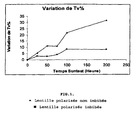
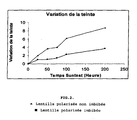
- the figures 1 and 2 illustrate the variations of the values of Tv and the hue ( ⁇ E).
Landscapes
- Chemical & Material Sciences (AREA)
- Crystallography & Structural Chemistry (AREA)
- Engineering & Computer Science (AREA)
- Materials Engineering (AREA)
- Organic Chemistry (AREA)
- Physics & Mathematics (AREA)
- General Physics & Mathematics (AREA)
- Optics & Photonics (AREA)
- Eyeglasses (AREA)
- Polarising Elements (AREA)
- Surface Treatment Of Optical Elements (AREA)
- Optical Integrated Circuits (AREA)
- Laminated Bodies (AREA)
- Paints Or Removers (AREA)
- Coating Of Shaped Articles Made Of Macromolecular Substances (AREA)
Claims (12)
- Verfahren zur Herstellung eines polarisierten optischen Artikels, insbesondere einer polarisierten ophthalmischen Linse, umfassend mindestens die aufeinanderfolgenden Schritte, jeweils bestehend aus:- dem Aufbringen auf ein Substrat des optischen Artikels einer polymerisierten Beschichtung, die mindestens einen Farbstoff umfasst, der empfindlich gegenüber Photoabbau ist, und- dem Einführen eines UV-Absorbers in die Beschichtung, dadurch gekennzeichnet, dass(a) die polymerisierte Beschichtung, die mindestens einen Farbstoff umfasst, der empfindlich gegenüber Photoabbau ist, eine zweischichtige Beschichtung ist, umfassend eine erste Schicht aus linearen Photopolymeren (LPP) und eine zweite Schicht aus flüssigkristallinen Polymeren (LCP), umfassend mindestens einen dichroitischen Farbstoff, und(b) der UV-Absorber mittels Imbibition in die Beschichtung eingeführt wird, wobei die Imbibition die folgenden Schritte umfasst:(b1) Eintauchen des Artikels in eine wässrige Lösung, die den UV-Absorber und mindestens ein Dispergiermittel umfasst, während einer Dauer von zwischen 10 Sekunden und 2 Minuten, wobei die Lösung bei einer Temperatur zwischen 80°C und 99°C gehalten wird, dann(b2) Spülen des Artikels mit einem niederen Alkohol.
- Verfahren gemäß Anspruch 1, dadurch gekennzeichnet, dass das Substrat ausgewählt ist aus: Substraten vom Polycarbonat-Typ; Polyamid; Polyimiden; Polysulfonen; Poly(ethylenterephtalat)/Polycarbonat-Copolymeren; Polyolefinen, insbesondere Polynorbornenen; Diethylenglycol-bis(allylcarbonat)-Polymeren und -Copolymeren; (Meth)acryl-Polymeren und - Copolymeren, insbesondere von Bisphenol A abgeleiteten (Meth)acryl-Polymeren und -Copolymeren; Thio(meth)acrylPolymeren und -Copolymeren; Urethan- und Thiourethan-Polymeren und -Copolymeren; Epoxy-Polymeren und -Copolymeren und Episulfid-Polymeren und -Copolymeren.
- Verfahren gemäß Anspruch 2, wobei das Substrat ein Poly(thio)urethan ist.
- Verfahren gemäß einem der Ansprüche 1 bis 3, dadurch gekennzeichnet, dass das Aufbringen der zweischichtigen Beschichtung gemäß einem Verfahren durchgeführt wird, umfassend die aufeinanderfolgenden allgemeinen Schritte, bestehend aus:1- Herstellen einer Lösung mindestens eines linearen Photopolymers,2- Aufbringen der Lösung auf das Substrat, um eine Photoalignment-Schicht zu bilden,3- Anwenden von UV-Strahlung in Anwesenheit eines Polarisators auf die Photoalignment-Schicht, um sie zu strukturieren,4- Herstellen einer Flüssigkristall-Lösung, die mindestens einen dichroitischen Farbstoff enthält,5- Aufbringen der Lösung auf die strukturierte Photoalignment-Schicht,6- Vernetzen der Flüssigkristall-Schicht mittels einer UV-Lichtquelle.
- Verfahren gemäß einem der Ansprüche 1 bis 4, dadurch gekennzeichnet, dass der UV-Absorber ausgewählt ist aus:Benzotriazolen, insbesondere Hydroxyphenylbenzotriazol; Triazinen, wie z. B. Hydroxyphenyl-S-triazin; Hydroxy-benzophenonen; und Oxalaniliden.
- Verfahren gemäß Anspruch 5, dadurch gekennzeichnet, dass der UV-Absorber 2,2'-Dihydroxy-4-methoxybenzophenon ist.
- Verfahren gemäß einem der Ansprüche 1 bis 6, dadurch gekennzeichnet, dass das Dispergiermittel Dodecylbenzolsulfonsäure ist.
- Verfahren gemäß einem der Ansprüche 1 bis 7, dadurch gekennzeichnet, dass die Dauer des Eintauchens des optischen Artikels in die Lösung, die den UV-Absorber enthält, ungefähr 30 Sekunden ist.
- Verfahren gemäß einem der Ansprüche 1 bis 8, dadurch gekennzeichnet, dass die Temperatur des Tauchbads zwischen 90°C und 96°C liegt.
- Verfahren gemäß Anspruch 8, dadurch gekennzeichnet, dass die Temperatur des Tauchbads gleich 94°C ist.
- Verfahren gemäß einem der Ansprüche 1 bis 10, dadurch gekennzeichnet, dass der optische Artikel eine oder mehrere Schichten umfasst, ausgewählt aus: einer abriebfesten Beschichtung, zum Beispiel vom zweischichtigen Typ, die gegebenenfalls auf eine Primerschicht aufgebracht wird; einer gefärbten Schicht; einer Sauerstoffsperrschicht; einer Antireflexschicht, zum Beispiel vierschichtig; einer hydrophoben und oleophoben schmutzabweisenden Beschichtung; und einer antistatischen Beschichtung.
- Optischer Artikel, erhältlich gemäß dem in einem der Ansprüche 1 bis 11 definierten Verfahren.
Applications Claiming Priority (1)
| Application Number | Priority Date | Filing Date | Title |
|---|---|---|---|
| FR0512277A FR2894340B1 (fr) | 2005-12-02 | 2005-12-02 | Procede de fabrication d'un article optique et article ainsi obtenu |
Publications (2)
| Publication Number | Publication Date |
|---|---|
| EP1798272A1 EP1798272A1 (de) | 2007-06-20 |
| EP1798272B1 true EP1798272B1 (de) | 2011-12-14 |
Family
ID=36910954
Family Applications (1)
| Application Number | Title | Priority Date | Filing Date |
|---|---|---|---|
| EP06291705A Not-in-force EP1798272B1 (de) | 2005-12-02 | 2006-11-03 | Verfahren zur Herstellung eines optischen Artikels und so erhaltener Artikel |
Country Status (5)
| Country | Link |
|---|---|
| US (1) | US20070126983A1 (de) |
| EP (1) | EP1798272B1 (de) |
| JP (1) | JP2007156464A (de) |
| AT (1) | ATE537239T1 (de) |
| FR (1) | FR2894340B1 (de) |
Families Citing this family (18)
| Publication number | Priority date | Publication date | Assignee | Title |
|---|---|---|---|---|
| FR2897694B1 (fr) * | 2006-02-23 | 2008-05-16 | Essilor Int | Procede de realisation d'un element optique polarisant |
| JP5714920B2 (ja) * | 2010-01-21 | 2015-05-07 | Hoya株式会社 | 偏光部材の製造方法 |
| US20110199680A1 (en) * | 2010-01-22 | 2011-08-18 | Oakley, Inc. | Eyewear with three-dimensional viewing capability |
| JP2013518301A (ja) * | 2010-01-22 | 2013-05-20 | オークリー インコーポレイテッド | 3dアイウェアのためのレンズ |
| US8770749B2 (en) | 2010-04-15 | 2014-07-08 | Oakley, Inc. | Eyewear with chroma enhancement |
| JP5568800B2 (ja) * | 2010-09-08 | 2014-08-13 | 日東電工株式会社 | 耐水化された光学異方性フィルムの製造方法、及び画像表示装置 |
| JP2013054275A (ja) * | 2011-09-06 | 2013-03-21 | Nikon-Essilor Co Ltd | 染色レンズおよびその製造方法 |
| EP3447563A1 (de) | 2011-10-20 | 2019-02-27 | Oakley, Inc. | Brille mit farbverstärkung |
| JP5887660B2 (ja) | 2011-12-07 | 2016-03-16 | 日東電工株式会社 | 耐水性光学異方性フィルムの製造方法 |
| WO2013169987A1 (en) | 2012-05-10 | 2013-11-14 | Oakley, Inc. | Eyewear with laminated functional layers |
| US9575335B1 (en) | 2014-01-10 | 2017-02-21 | Oakley, Inc. | Eyewear with chroma enhancement for specific activities |
| WO2016077431A2 (en) | 2014-11-13 | 2016-05-19 | Oakley, Inc. | Variable light attenuation eyewear with color enhancement |
| US10871661B2 (en) | 2014-05-23 | 2020-12-22 | Oakley, Inc. | Eyewear and lenses with multiple molded lens components |
| US9905022B1 (en) | 2015-01-16 | 2018-02-27 | Oakley, Inc. | Electronic display for demonstrating eyewear functionality |
| US12124116B2 (en) | 2017-10-20 | 2024-10-22 | Luxottica S.R.L. | Eyewear with variable transmission lens |
| US11112622B2 (en) | 2018-02-01 | 2021-09-07 | Luxottica S.R.L. | Eyewear and lenses with multiple molded lens components |
| EP3542956A1 (de) | 2018-03-23 | 2019-09-25 | Carl Zeiss Vision International GmbH | Verfahren zur herstellung von brillengläsern nach rezept |
| CN113835141A (zh) * | 2021-11-08 | 2021-12-24 | 厦门谨德光电科技有限公司 | 一种防褪色抗紫外线太阳眼镜片 |
Family Cites Families (12)
| Publication number | Priority date | Publication date | Assignee | Title |
|---|---|---|---|---|
| JPH01163703A (ja) * | 1987-09-30 | 1989-06-28 | Hoya Corp | プラスチックレンズ |
| DE3904371A1 (de) * | 1989-02-14 | 1990-08-16 | Basf Ag | Verfahren zur herstellung von 2,4-dihydroxybenzophenon |
| JP2503068B2 (ja) * | 1989-02-22 | 1996-06-05 | ホーヤ株式会社 | 水晶体摘出者用眼鏡レンズ |
| JP2813390B2 (ja) * | 1989-10-30 | 1998-10-22 | ホーヤ株式会社 | 水晶体摘出者用眼鏡レンズ |
| US5976638A (en) * | 1993-01-26 | 1999-11-02 | Akzo Nobel Nv | Optical recording medium comprising a homeotropically oriented liquid crystalline polymer film comprising dichroic dye |
| JP3898776B2 (ja) * | 1995-11-20 | 2007-03-28 | ペンタックス株式会社 | レンズの染色方法 |
| US5738803A (en) * | 1995-12-14 | 1998-04-14 | Hoechst Celanese Corp | Polarizer films comprising wholly aromatic liquid crystalline polymers and dichroic dyes |
| JPH1152101A (ja) * | 1997-08-01 | 1999-02-26 | Seiko Epson Corp | プラスチックレンズの製造方法 |
| CA2246505A1 (en) * | 1998-09-03 | 2000-03-03 | Christophe U. Ryser | Method for tinting tint-able plastic material using microwave energy |
| US20040135962A1 (en) * | 2001-04-24 | 2004-07-15 | Matthias Kuntz | Liquid crystal device exhibiting optical properties which are changeable after assembly |
| EP1462485A1 (de) * | 2003-03-26 | 2004-09-29 | Rolic AG | Polymerisierbare dichroitische Azofarbstoffe |
| DE602004010491T2 (de) * | 2004-05-07 | 2008-11-13 | Essilor International (Compagnie Generale D'optique) | Polarisierender kratzfester optischer Film und Herstellungsverfahren hierfür |
-
2005
- 2005-12-02 FR FR0512277A patent/FR2894340B1/fr not_active Expired - Fee Related
-
2006
- 2006-11-03 AT AT06291705T patent/ATE537239T1/de active
- 2006-11-03 EP EP06291705A patent/EP1798272B1/de not_active Not-in-force
- 2006-11-27 JP JP2006318191A patent/JP2007156464A/ja active Pending
- 2006-11-30 US US11/606,427 patent/US20070126983A1/en not_active Abandoned
Also Published As
| Publication number | Publication date |
|---|---|
| ATE537239T1 (de) | 2011-12-15 |
| FR2894340A1 (fr) | 2007-06-08 |
| US20070126983A1 (en) | 2007-06-07 |
| EP1798272A1 (de) | 2007-06-20 |
| JP2007156464A (ja) | 2007-06-21 |
| FR2894340B1 (fr) | 2008-02-15 |
Similar Documents
| Publication | Publication Date | Title |
|---|---|---|
| EP1798272B1 (de) | Verfahren zur Herstellung eines optischen Artikels und so erhaltener Artikel | |
| EP0953160B1 (de) | Ophthalmische kunststoff-linse mit stossschützender zwischenschicht und verfahren zur herstellung | |
| EP2167997B1 (de) | Beschichteter optischer artikel mit einer antireflexionsbeschichtung, die eine teilweise mit ionenunterstützung geformte unterschicht aufweist, und herstellungsverfahren dafür | |
| EP3432039B1 (de) | Optischer artikel, der mit einer antireflex- oder reflektierbeschichtung beschichtet ist, die eine elektrisch leitende schicht auf zinnoxidbasis umfasst, sowie entsprechendes herstellungsverfahren | |
| EP2122392B1 (de) | Prozess zur herstellung eines mit einer antireflex- oder reflektierenden beschichtung beschichteten optischen artikels mit verbesserten adhäsions- und abrasionsbeständigkeitseigenschaften | |
| EP2310883B1 (de) | Optischer artikel mit hervorragenden transmissionseigenschaften und mit antistatik-schicht zur begrenzung von interferenzsäumen, und sein herstellungsverfahren | |
| CA2193655C (fr) | Lentille ophtalmique en verre organique a intercouche anti-chocs et son procede de fabrication | |
| EP0100705A1 (de) | Transparente und polarisierende beschichtete Gläser und Verfahren zu deren Herstellung | |
| EP1785747B1 (de) | Haftschale, die eine Beschichtung zum Schutz vor Degradation durch Licht umfasst, und Verfahren zum Herstellen einer solchen Haftschale | |
| FR2874007A1 (fr) | Procede de fabrication d'un substrat revetu d'une couche mesoporeuse et son application en optique | |
| EP1110107A1 (de) | Opthalmische linse aus organischem glas mit einer schlagfesten grundierungsschicht aus polyurethanlatex und verfahren zu deren herstellung | |
| EP1362014B1 (de) | Verfahren zum beimengen von eines zusatzes in eine auf ein substrat gebildete dünnschicht und dessen verwendung in der ophthalmischen optik | |
| FR2977329A1 (fr) | Article optique comprenant un revetement anti-reflets ayant des proprietes de resistance aux fissures sous contrainte mecanique amelioree | |
| KR20070027544A (ko) | 편광 및 내마모성 광학 제품 및 이의 제조 방법 | |
| EP3016798B1 (de) | Verfahren zur herstellung einer ophthalmischen linse durch imprägnierung eines benzotriazolderivats | |
| FR2861852A1 (fr) | Prouits optiques transparents polarisants ; fabrication | |
| EP2535172B1 (de) | Herstellungsverfahren von Linsen | |
| EP2542924B1 (de) | Neues verbundmaterial zur optischen verwendung und verfahren zu seiner gewinnung | |
| FR2869039A1 (fr) | Latex colore par des pigments et procede de traitement d'un substrat transparent a l'aide dudit latex colore. | |
| JP3513954B2 (ja) | プラスチックレンズ |
Legal Events
| Date | Code | Title | Description |
|---|---|---|---|
| PUAI | Public reference made under article 153(3) epc to a published international application that has entered the european phase |
Free format text: ORIGINAL CODE: 0009012 |
|
| AK | Designated contracting states |
Kind code of ref document: A1 Designated state(s): AT BE BG CH CY CZ DE DK EE ES FI FR GB GR HU IE IS IT LI LT LU LV MC NL PL PT RO SE SI SK TR |
|
| AX | Request for extension of the european patent |
Extension state: AL BA HR MK YU |
|
| 17P | Request for examination filed |
Effective date: 20070612 |
|
| 17Q | First examination report despatched |
Effective date: 20070801 |
|
| AKX | Designation fees paid |
Designated state(s): AT BE BG CH CY CZ DE DK EE ES FI FR GB GR HU IE IS IT LI LT LU LV MC NL PL PT RO SE SI SK TR |
|
| GRAP | Despatch of communication of intention to grant a patent |
Free format text: ORIGINAL CODE: EPIDOSNIGR1 |
|
| GRAS | Grant fee paid |
Free format text: ORIGINAL CODE: EPIDOSNIGR3 |
|
| GRAA | (expected) grant |
Free format text: ORIGINAL CODE: 0009210 |
|
| AK | Designated contracting states |
Kind code of ref document: B1 Designated state(s): AT BE BG CH CY CZ DE DK EE ES FI FR GB GR HU IE IS IT LI LT LU LV MC NL PL PT RO SE SI SK TR |
|
| REG | Reference to a national code |
Ref country code: GB Ref legal event code: FG4D Free format text: NOT ENGLISH |
|
| REG | Reference to a national code |
Ref country code: CH Ref legal event code: EP |
|
| REG | Reference to a national code |
Ref country code: IE Ref legal event code: FG4D |
|
| REG | Reference to a national code |
Ref country code: DE Ref legal event code: R096 Ref document number: 602006026348 Country of ref document: DE Effective date: 20120308 |
|
| REG | Reference to a national code |
Ref country code: NL Ref legal event code: VDEP Effective date: 20111214 |
|
| PG25 | Lapsed in a contracting state [announced via postgrant information from national office to epo] |
Ref country code: LT Free format text: LAPSE BECAUSE OF FAILURE TO SUBMIT A TRANSLATION OF THE DESCRIPTION OR TO PAY THE FEE WITHIN THE PRESCRIBED TIME-LIMIT Effective date: 20111214 |
|
| LTIE | Lt: invalidation of european patent or patent extension |
Effective date: 20111214 |
|
| PG25 | Lapsed in a contracting state [announced via postgrant information from national office to epo] |
Ref country code: LV Free format text: LAPSE BECAUSE OF FAILURE TO SUBMIT A TRANSLATION OF THE DESCRIPTION OR TO PAY THE FEE WITHIN THE PRESCRIBED TIME-LIMIT Effective date: 20111214 Ref country code: SE Free format text: LAPSE BECAUSE OF FAILURE TO SUBMIT A TRANSLATION OF THE DESCRIPTION OR TO PAY THE FEE WITHIN THE PRESCRIBED TIME-LIMIT Effective date: 20111214 Ref country code: GR Free format text: LAPSE BECAUSE OF FAILURE TO SUBMIT A TRANSLATION OF THE DESCRIPTION OR TO PAY THE FEE WITHIN THE PRESCRIBED TIME-LIMIT Effective date: 20120315 Ref country code: NL Free format text: LAPSE BECAUSE OF FAILURE TO SUBMIT A TRANSLATION OF THE DESCRIPTION OR TO PAY THE FEE WITHIN THE PRESCRIBED TIME-LIMIT Effective date: 20111214 Ref country code: SI Free format text: LAPSE BECAUSE OF FAILURE TO SUBMIT A TRANSLATION OF THE DESCRIPTION OR TO PAY THE FEE WITHIN THE PRESCRIBED TIME-LIMIT Effective date: 20111214 |
|
| PG25 | Lapsed in a contracting state [announced via postgrant information from national office to epo] |
Ref country code: CY Free format text: LAPSE BECAUSE OF FAILURE TO SUBMIT A TRANSLATION OF THE DESCRIPTION OR TO PAY THE FEE WITHIN THE PRESCRIBED TIME-LIMIT Effective date: 20111214 |
|
| REG | Reference to a national code |
Ref country code: IE Ref legal event code: FD4D |
|
| PG25 | Lapsed in a contracting state [announced via postgrant information from national office to epo] |
Ref country code: IE Free format text: LAPSE BECAUSE OF FAILURE TO SUBMIT A TRANSLATION OF THE DESCRIPTION OR TO PAY THE FEE WITHIN THE PRESCRIBED TIME-LIMIT Effective date: 20111214 Ref country code: SK Free format text: LAPSE BECAUSE OF FAILURE TO SUBMIT A TRANSLATION OF THE DESCRIPTION OR TO PAY THE FEE WITHIN THE PRESCRIBED TIME-LIMIT Effective date: 20111214 Ref country code: CZ Free format text: LAPSE BECAUSE OF FAILURE TO SUBMIT A TRANSLATION OF THE DESCRIPTION OR TO PAY THE FEE WITHIN THE PRESCRIBED TIME-LIMIT Effective date: 20111214 Ref country code: BG Free format text: LAPSE BECAUSE OF FAILURE TO SUBMIT A TRANSLATION OF THE DESCRIPTION OR TO PAY THE FEE WITHIN THE PRESCRIBED TIME-LIMIT Effective date: 20120314 Ref country code: EE Free format text: LAPSE BECAUSE OF FAILURE TO SUBMIT A TRANSLATION OF THE DESCRIPTION OR TO PAY THE FEE WITHIN THE PRESCRIBED TIME-LIMIT Effective date: 20111214 Ref country code: IS Free format text: LAPSE BECAUSE OF FAILURE TO SUBMIT A TRANSLATION OF THE DESCRIPTION OR TO PAY THE FEE WITHIN THE PRESCRIBED TIME-LIMIT Effective date: 20120414 |
|
| PG25 | Lapsed in a contracting state [announced via postgrant information from national office to epo] |
Ref country code: RO Free format text: LAPSE BECAUSE OF FAILURE TO SUBMIT A TRANSLATION OF THE DESCRIPTION OR TO PAY THE FEE WITHIN THE PRESCRIBED TIME-LIMIT Effective date: 20111214 Ref country code: PT Free format text: LAPSE BECAUSE OF FAILURE TO SUBMIT A TRANSLATION OF THE DESCRIPTION OR TO PAY THE FEE WITHIN THE PRESCRIBED TIME-LIMIT Effective date: 20120416 Ref country code: PL Free format text: LAPSE BECAUSE OF FAILURE TO SUBMIT A TRANSLATION OF THE DESCRIPTION OR TO PAY THE FEE WITHIN THE PRESCRIBED TIME-LIMIT Effective date: 20111214 |
|
| REG | Reference to a national code |
Ref country code: AT Ref legal event code: MK05 Ref document number: 537239 Country of ref document: AT Kind code of ref document: T Effective date: 20111214 |
|
| PLBE | No opposition filed within time limit |
Free format text: ORIGINAL CODE: 0009261 |
|
| STAA | Information on the status of an ep patent application or granted ep patent |
Free format text: STATUS: NO OPPOSITION FILED WITHIN TIME LIMIT |
|
| PG25 | Lapsed in a contracting state [announced via postgrant information from national office to epo] |
Ref country code: DK Free format text: LAPSE BECAUSE OF FAILURE TO SUBMIT A TRANSLATION OF THE DESCRIPTION OR TO PAY THE FEE WITHIN THE PRESCRIBED TIME-LIMIT Effective date: 20111214 |
|
| 26N | No opposition filed |
Effective date: 20120917 |
|
| PG25 | Lapsed in a contracting state [announced via postgrant information from national office to epo] |
Ref country code: IT Free format text: LAPSE BECAUSE OF FAILURE TO SUBMIT A TRANSLATION OF THE DESCRIPTION OR TO PAY THE FEE WITHIN THE PRESCRIBED TIME-LIMIT Effective date: 20111214 |
|
| REG | Reference to a national code |
Ref country code: DE Ref legal event code: R097 Ref document number: 602006026348 Country of ref document: DE Effective date: 20120917 |
|
| PG25 | Lapsed in a contracting state [announced via postgrant information from national office to epo] |
Ref country code: AT Free format text: LAPSE BECAUSE OF FAILURE TO SUBMIT A TRANSLATION OF THE DESCRIPTION OR TO PAY THE FEE WITHIN THE PRESCRIBED TIME-LIMIT Effective date: 20111214 |
|
| PGFP | Annual fee paid to national office [announced via postgrant information from national office to epo] |
Ref country code: FR Payment date: 20121207 Year of fee payment: 7 Ref country code: DE Payment date: 20121113 Year of fee payment: 7 |
|
| PGFP | Annual fee paid to national office [announced via postgrant information from national office to epo] |
Ref country code: GB Payment date: 20121127 Year of fee payment: 7 |
|
| PG25 | Lapsed in a contracting state [announced via postgrant information from national office to epo] |
Ref country code: ES Free format text: LAPSE BECAUSE OF FAILURE TO SUBMIT A TRANSLATION OF THE DESCRIPTION OR TO PAY THE FEE WITHIN THE PRESCRIBED TIME-LIMIT Effective date: 20120325 |
|
| BERE | Be: lapsed |
Owner name: ESSILOR INTERNATIONAL (COMPAGNIE GENERALE D'OPTIQ Effective date: 20121130 |
|
| PG25 | Lapsed in a contracting state [announced via postgrant information from national office to epo] |
Ref country code: FI Free format text: LAPSE BECAUSE OF FAILURE TO SUBMIT A TRANSLATION OF THE DESCRIPTION OR TO PAY THE FEE WITHIN THE PRESCRIBED TIME-LIMIT Effective date: 20111214 |
|
| REG | Reference to a national code |
Ref country code: CH Ref legal event code: PL |
|
| PG25 | Lapsed in a contracting state [announced via postgrant information from national office to epo] |
Ref country code: CH Free format text: LAPSE BECAUSE OF NON-PAYMENT OF DUE FEES Effective date: 20121130 Ref country code: LI Free format text: LAPSE BECAUSE OF NON-PAYMENT OF DUE FEES Effective date: 20121130 |
|
| PG25 | Lapsed in a contracting state [announced via postgrant information from national office to epo] |
Ref country code: BE Free format text: LAPSE BECAUSE OF NON-PAYMENT OF DUE FEES Effective date: 20121130 |
|
| PG25 | Lapsed in a contracting state [announced via postgrant information from national office to epo] |
Ref country code: TR Free format text: LAPSE BECAUSE OF FAILURE TO SUBMIT A TRANSLATION OF THE DESCRIPTION OR TO PAY THE FEE WITHIN THE PRESCRIBED TIME-LIMIT Effective date: 20111214 Ref country code: MC Free format text: LAPSE BECAUSE OF NON-PAYMENT OF DUE FEES Effective date: 20121130 |
|
| PG25 | Lapsed in a contracting state [announced via postgrant information from national office to epo] |
Ref country code: LU Free format text: LAPSE BECAUSE OF NON-PAYMENT OF DUE FEES Effective date: 20121103 |
|
| GBPC | Gb: european patent ceased through non-payment of renewal fee |
Effective date: 20131103 |
|
| PG25 | Lapsed in a contracting state [announced via postgrant information from national office to epo] |
Ref country code: HU Free format text: LAPSE BECAUSE OF FAILURE TO SUBMIT A TRANSLATION OF THE DESCRIPTION OR TO PAY THE FEE WITHIN THE PRESCRIBED TIME-LIMIT Effective date: 20061103 |
|
| REG | Reference to a national code |
Ref country code: FR Ref legal event code: ST Effective date: 20140731 |
|
| REG | Reference to a national code |
Ref country code: DE Ref legal event code: R119 Ref document number: 602006026348 Country of ref document: DE Effective date: 20140603 |
|
| PG25 | Lapsed in a contracting state [announced via postgrant information from national office to epo] |
Ref country code: DE Free format text: LAPSE BECAUSE OF NON-PAYMENT OF DUE FEES Effective date: 20140603 |
|
| PG25 | Lapsed in a contracting state [announced via postgrant information from national office to epo] |
Ref country code: GB Free format text: LAPSE BECAUSE OF NON-PAYMENT OF DUE FEES Effective date: 20131103 Ref country code: FR Free format text: LAPSE BECAUSE OF NON-PAYMENT OF DUE FEES Effective date: 20131202 |