EP1798351A2 - Clapet anti-retour - Google Patents
Clapet anti-retour Download PDFInfo
- Publication number
- EP1798351A2 EP1798351A2 EP06022973A EP06022973A EP1798351A2 EP 1798351 A2 EP1798351 A2 EP 1798351A2 EP 06022973 A EP06022973 A EP 06022973A EP 06022973 A EP06022973 A EP 06022973A EP 1798351 A2 EP1798351 A2 EP 1798351A2
- Authority
- EP
- European Patent Office
- Prior art keywords
- check valve
- valve
- housing
- backflow preventer
- sealing
- Prior art date
- Legal status (The legal status is an assumption and is not a legal conclusion. Google has not performed a legal analysis and makes no representation as to the accuracy of the status listed.)
- Withdrawn
Links
Images


Classifications
-
- E—FIXED CONSTRUCTIONS
- E03—WATER SUPPLY; SEWERAGE
- E03C—DOMESTIC PLUMBING INSTALLATIONS FOR FRESH WATER OR WASTE WATER; SINKS
- E03C1/00—Domestic plumbing installations for fresh water or waste water; Sinks
- E03C1/02—Plumbing installations for fresh water
- E03C1/10—Devices for preventing contamination of drinking-water pipes, e.g. means for aerating self-closing flushing valves
- E03C1/106—Devices for preventing contamination of drinking-water pipes, e.g. means for aerating self-closing flushing valves using two or more check valves
-
- E—FIXED CONSTRUCTIONS
- E03—WATER SUPPLY; SEWERAGE
- E03C—DOMESTIC PLUMBING INSTALLATIONS FOR FRESH WATER OR WASTE WATER; SINKS
- E03C1/00—Domestic plumbing installations for fresh water or waste water; Sinks
- E03C1/02—Plumbing installations for fresh water
- E03C1/10—Devices for preventing contamination of drinking-water pipes, e.g. means for aerating self-closing flushing valves
- E03C1/108—Devices for preventing contamination of drinking-water pipes, e.g. means for aerating self-closing flushing valves having an aerating valve
-
- F—MECHANICAL ENGINEERING; LIGHTING; HEATING; WEAPONS; BLASTING
- F16—ENGINEERING ELEMENTS AND UNITS; GENERAL MEASURES FOR PRODUCING AND MAINTAINING EFFECTIVE FUNCTIONING OF MACHINES OR INSTALLATIONS; THERMAL INSULATION IN GENERAL
- F16K—VALVES; TAPS; COCKS; ACTUATING-FLOATS; DEVICES FOR VENTING OR AERATING
- F16K15/00—Check valves
- F16K15/02—Check valves with guided rigid valve members
- F16K15/06—Check valves with guided rigid valve members with guided stems
- F16K15/063—Check valves with guided rigid valve members with guided stems the valve being loaded by a spring
- F16K15/066—Check valves with guided rigid valve members with guided stems the valve being loaded by a spring with a plurality of valve members
Definitions
- the invention relates to a non-return valve having a housing which has an inlet opening, an outlet opening and arranged in the flow direction between the inlet and the outlet opening and which receives a first and a second check valve, which are arranged one behind the other in the flow direction, wherein the first check valve a valve housing having a valve seat and a resiliently biased against the valve seat closing body and is slidably reciprocated in the housing between a release position and a locking position and by moving the first check valve, a flow connection between an arranged between the two check valves interior of the housing and the leakage opening is releasable or lockable.
- Such backflow preventers are known from the patent DE 103 35 379 B3 known. With their help, it can be ensured that, when connecting cleaning devices, for example high-pressure cleaning devices or washing machines, cleaning fluid contaminated with a drinking water supply line can not be returned from the cleaning device to the drinking water supply line.
- a backflow preventer of the type mentioned is switched between the drinking water supply line and the cleaning device. This has two successively arranged check valves with identical closing direction to prevent the return of the dirty cleaning liquid in the drinking water supply line.
- the first check valve is slidably held in the outer housing. If the first check valve assumes its blocking position, this closes off a flow connection between an interior space of the housing arranged between the two check valves and the leakage opening. If the first check valve assumes its release, the flow connection between the interior and the leakage opening is released. The interior can be emptied via the leakage opening if the differential pressure between the pressure prevailing in the region of the inlet opening and the pressure prevailing in the region between the two non-return valves falls below a predetermined value.
- the first check valve is slidably held in a portion of the housing and sealed by means of a arranged at the upstream end of the first check valve sealing ring against the inside of the housing flow-tight.
- Object of the present invention is to develop a backflow preventer of the type mentioned in such a way that the risk of tilting of the first check valve can be reduced.
- valve housing of the first check valve on the outside has two spaced in the flow direction spaced apart annular grooves, in each of which a sealing ring is arranged.
- the sealing rings are effective in the radial direction and support the valve housing of the first check valve to ensure an unobstructed mobility in the radial direction.
- the inlet area of the outer housing can be reliably sealed off from the area of the leakage opening.
- first annular groove in an upstream end region and the second annular groove in a downstream end region of the valve housing of the first check valve are arranged.
- the two annular grooves have as great a distance as possible from each other and, by means of the sealing rings arranged in the annular grooves, the valve housing can be aligned optimally to avoid tilting.
- the two sealing rings are profiled, they may for example have a U-shaped profile. As a result, the radial sealing effect of the sealing rings can be improved.
- the two sealing rings each form a sealing lip, because a particularly effective sealing function can be achieved thereby.
- the two sealing rings have the same outer diameter.
- the downstream sealing ring is surrounded in the blocking position of the first check valve by a sealing surface on which it bears to form an annular, closed sealing area.
- the downstream sealing ring assumes in such a configuration not only the function of preventing tilting of the first check valve in its displacement movement, but in addition can be interrupted by means of the downstream sealing ring in the blocking position of the first check valve, the flow connection between the interior of the housing and the leakage opening.
- the backflow preventer has a cylinder jacket-shaped guide section, in which the first check valve is held displaceably, and if the sealing surface is designed as a cylinder jacket, wherein the inner diameter of the guide section is identical to the inner diameter of the sealing surface.
- Guide portion and sealing surface are aligned coaxially with each other in such a configuration, so that in the blocking position of the first check valve, the downstream sealing ring on the sealing surface and the upstream sealing ring on the guide portion may abut sealingly. If the first check valve moves into its release position, the downstream sealing ring can dip into the guide section arranged at a distance from the sealing surface
- a contact surface which narrows in the direction of flow is adjacent.
- the contact surface forms a guide for the downstream end region and arranged on this sealing ring, so that it can be optimally positioned in the blocking position of the first check valve on the sealing surface.
- the contact surface is preferably conical.
- the first check valve assumes its blocking position during operation of the cleaning device and both non-return valves are opened so that drinking water can flow through the non-return valve. If the cleaning device is subsequently switched off, then the two non-return valves close and the first check valve remains in its blocking position due to the water pressure which continues to act in the inlet region of the non-return valve. If the first check valve has a leak, for example due to damage from its valve seat, water will penetrate into the interior space between the two non-return valves over time, despite the closed position of the first check valve, so that the pressure there will increase.
- the first check valve When falling below a predetermined differential pressure between the pressure prevailing in the region of the inlet opening and the pressure prevailing in the region between the two check valves then the first check valve automatically goes into its release position, so that the interior of the housing between the two check valves abruptly on the leakage opening can be emptied. This leads to a pressure drop in the interior of the housing, which in turn has the consequence that the first check valve opens.
- the cleaning device is switched off, water from the drinking water supply line can then flow unhindered from the drinking water supply line to the leakage opening and flow out of the backflow preventer.
- the contact surface adjoining the sealing surface upstream in a preferred embodiment has at least one recess extending over a partial area of the contact surface in the circumferential direction.
- water can then pass from the interior of the outer housing at a low flow rate, for example at a flow rate of approximately 30 liters per hour, to the leakage opening.
- This low flow rate is usually sufficient to avoid further pressure increase in the interior of the housing at a leak of the first check valve.
- a further displacement movement of the first check valve in the direction of its release position is thereby prevented, the first check valve remains rather in by the positioning of the downstream sealing ring on the contact surface predetermined intermediate position. In this intermediate position, the flow connection between the interior of the housing between the two check valves and the leakage opening is partially released by the size of the recess predetermined manner to avoid an inadmissible pressure increase in the interior of the housing. If the cleaning device connected to the backflow preventer is switched on again at a later time, the first check valve moves into its blocking position and both check valves open so that water can flow through the backflow preventer.
- the contact surface of the introduction section has a plurality of equidistant recesses, because this allows a uniformly distributed over the circumference of the contact surface drainage of the water from the interior of the housing to the leakage opening.
- the second check valve comprises a valve housing having a recess into which the valve housing of the first check valve dips into its blocking position and which forms the sealing surface.
- the recess of the valve housing of the second check valve also forms the above-mentioned contact surface, so that the immersion of the valve housing of the first check valve is simplified into the receptacle.
- the second check valve in each case in its front and its rear end position can be applied to a stop surface. It is advantageous in this case if upstream of the contact surface, a collar adjacent, which has at least one radial passage and which abuts in the rear end position of the second check valve to a stop surface.
- a stop surface for example, the end face of a housing part of the backflow preventer can be used.
- a backflow preventer 10 is shown with a housing 11 having a first housing part 12 and a second housing part 13, which are screwed together in the illustrated embodiment.
- the housing 11 defines a flow channel which connects an inlet opening 15 in the first housing part 12 with an outlet opening 16 in the second housing part 13.
- the housing 11 has at least one, preferably a plurality of leakage openings 19 distributed over the circumference of the housing 12.
- the first housing part 12 is formed as a pipe section and comprises an adjoining the inlet opening 15 inlet channel 21 to which a step 22 a cylinder jacket-shaped guide portion 23 connects.
- the inlet channel 21 carries an external thread 25 for connecting the non-return valve 10 to a drinking water supply line, and the guide section 23 faces away from the inlet opening 15 has an end face 26 whose surface normal is aligned parallel to the flow direction 18.
- the second housing part 13 is likewise designed as a pipe section and comprises an outlet channel 28 opening into the outlet opening 16 with an internal thread 29.
- the backflow preventer 10 can be connected on the outlet side, for example, to a cleaning device, in particular to a high-pressure cleaning device.
- a radially inwardly directed collar 31 adjoins the outlet channel 28, counter to the throughflow direction 18, and a receiving section 32, which merges via a step 33 into a guide section 34.
- the guide portion 34 of the second housing part 13 has an internal thread for screwing the second housing part 13 with the first housing part 12.
- the internal thread adjacent the leakage openings 19 are arranged in the guide portion 34.
- the housing 11 receives a first check valve 37 and a second check valve 39, which are arranged one behind the other in the flow direction 18.
- the first check valve 37 is arranged in the region of the guide section 23 of the first housing part 12 and comprises a cup-shaped valve housing 41 with a valve housing jacket 42 and a valve housing 43.
- the latter has a passage opening 45, to which a conically widening valve seat 46 adjoins in the flow direction 18 .
- the valve housing jacket 42 has on the outside a first annular groove 48 and a second annular groove 49 which receive a first sealing element in the form of a first profiled sealing ring 51 and a second sealing element in the form of a second profiled sealing ring 52.
- the first annular groove 48 is located in a rear end region relative to the throughflow direction 18 and the second annular groove 49 is arranged in a front end region of the valve housing jacket 42 relative to the throughflow direction 18.
- the two Sealing rings 51 and 52 each have a sealing lip 53 and 54, wherein the sealing lip 53 irrespective of the position of the first check valve 37 rests against the inside of the guide portion 23 of the first housing part 12 to form a circular sealing line.
- the valve housing 41 surrounds a closing body in the form of a valve piston 56, which has a conical sealing surface 57, to which an O-ring 58 which surrounds the valve piston 56 in the circumferential direction in the flow direction 18 follows.
- the valve piston 56 Facing the inlet opening 15, the valve piston 56 carries four guide ribs 59 oriented perpendicular to one another, which pass through the passage opening 45 and are guided in a sliding manner in the latter. Facing away from the guide ribs 59, the valve piston 56 carries a guide pin 60, which is surrounded by a closing spring 61.
- the second non-return valve 39 has a valve housing 64, which comprises a valve housing jacket 65, which tapers stepwise in the flow direction 18 in accordance with the step 33, with a rear jacket section 66 and a front jacket section 67.
- the rear shell portion 66 is guided in the guide portion 34 of the second housing part 13 and passes via a stepped constriction 68 in the front shell portion 67 which is slidably guided in the region of the receiving portion 32 and the outside has an annular groove 69 in which a profiled sealing ring 70th is arranged.
- the latter forms a sealing lip 71, which abuts against the inside of the receiving portion 32 in a flow-tight manner.
- Adjoining the front jacket section 67 is a valve housing bottom 72 with a central passage opening 73, which widens in the throughflow direction 18 via a conical valve seat 74.
- valve housing 64 of the second check valve 39 is followed by a support sleeve 76 which is latched to the valve housing 64 and at a distance from the passage opening 73 carries four perpendicularly oriented support arms 77 integral with a guide sleeve 78 coaxial with the passage opening 73 are connected.
- the second check valve 39 also has a closing body in the form of a valve piston 81, which is configured identically as the valve piston 56 of the first check valve 37 and a conical sealing surface 82, to which in the flow direction 18, a valve piston 81 surrounding in the circumferential direction O-ring 83 connects. Facing the inlet opening 15, the valve piston 81 carries four guide ribs 84 which are oriented perpendicular to one another and are guided in a sliding manner in the passage opening 73 of the valve housing 64.
- valve piston 81 Facing away from the inlet opening 15, the valve piston 81 carries a guide pin 85, which passes through the guide sleeve 78 and is surrounded by a closing spring 86, which is supported on the one hand on the valve piston 81 and on the other hand on the support arms 77.
- the second check valve 39 forms with its valve housing 64 a guide for the guide pin 60 of the first check valve 37.
- the guide pin 60 immersed in a coaxial with the passage opening 45 of the first check valve 37 aligned guide sleeve 89, the valve housing 64 of the second check valve 39th is formed.
- the the guide pin 60 surrounding closing spring 61 is supported on the one hand on the valve housing 41 of the first check valve 37 and on the other hand on the valve housing 64 of the second check valve 39 from.
- the flow direction 18 opposite direction adjoins the rear shell portion 66 of the valve housing shell 65 of the second check valve 39 in a direction toward the first housing part 12 aligned collar 91, whose inner diameter is greater than the outer diameter of the valve housing shell 42 of the first check valve 37.
- the collar 91 defines in combination with the rear shell portion 66, a receptacle 93 which extends from the collar 91 via a conically tapering in the flow direction 18 contact surface 94 and a subsequent thereto cylinder jacket-shaped sealing surface 95 to a stop surface 96, the surface normal parallel to the flow direction 18 is aligned ,
- the contact surface 94 has a plurality of recesses or recesses 98 arranged at equal intervals in the circumferential direction, to which slots 91 connect in the region of the collar 91 and extend as far as the free end face of the collar 91.
- Both the first check valve 37 and the second check valve 39 are held in the housing 11 in the flow direction back and forth displaceable.
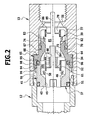
- the first check valve 37 can in this case between a release position shown in Figure 1, in which the valve housing bottom 43 rests against the step 22 of the first housing part 12, and a blocking position shown in Figure 2, in which the free end portion of the valve housing shell 42 dips into the receptacle 93 wherein the second sealing ring 52 rests with its sealing lip 54 on the sealing surface 95, forming a circular sealing line, be moved back and forth.
- the first check valve 37 has, at a slight distance from the blocking position shown in FIG. 2, an intermediate position shown in FIG. 3, in which the second sealing ring 52 is positioned at the level of the contact surface 94. In this case, the second sealing ring 52 forms an interrupted by the recesses 98 sealing line.
- the second check valve 39 can between the front end position shown in Figures 1, 2 and 3, in which it bears against the step 33 of the second housing part 13, and a rear end position, not shown in the drawing, in which the collar 91 on the end face 26 of the first housing part 12 abuts, be moved back and forth.
- the non-return valve 10 assumes the position shown in Figure 1, in which the two check valves 37 and 39 are closed, that is, the valve piston 56 and 81 abut with their O-rings 58 and 83 at the corresponding valve seats 46 and 74, respectively.
- the first check valve 37 assumes its release position in this state, so that a flow connection consists of an arranged between the two check valves 37 and 39 interior 101 of the housing 11 and the leakage openings 19, and the second check valve 39 assumes its already explained front end position ,
- a drinking water supply line can be connected to the inlet opening 15 and a high-pressure cleaning device can be connected to the outlet opening 16 so that water can flow through the non-return valve 10.
- the first check valve 37 is moved forward in the flow direction 18 due to the pressure prevailing in the region of the inlet channel 21 in the flow direction until the second sealing ring 52 is flow-tight against the sealing surface 95, so that the first check valve 37 assumes its blocking position.
- the two check valves 37 and 39 retain their current positions; in particular, the first check valve 37 remains in its blocking position. If there is a leak in this state of the first check valve 37, for example, because the O-ring 58 is damaged, over time a certain amount of water flows through the closed first check valve 37 into the interior 101. This has the consequence that the water pressure increases in the interior 101 and consequently, with the cooperation of the closing spring 61, the first check valve 37 is displaced counter to the direction of flow 18.
- Such a displacement movement has the consequence that the second sealing ring 52, starting from the sealing surface 95, reaches the contact surface 94, in which, due to the recesses 98, no fluid-tight contact of the sealing ring 52 with the contact surface 94 is ensured. Rather, the provision of the recesses 98, the flow connection between the interior 101 and the leakage openings 19 in a predetermined manner so far released that water at a low flow rate, for example, with a flow rate of 30 liters per hour, from the interior 101 via the recesses 98th can get to the leakage openings 19.
Landscapes
- Engineering & Computer Science (AREA)
- Health & Medical Sciences (AREA)
- Life Sciences & Earth Sciences (AREA)
- Hydrology & Water Resources (AREA)
- Public Health (AREA)
- Water Supply & Treatment (AREA)
- General Engineering & Computer Science (AREA)
- Mechanical Engineering (AREA)
- Check Valves (AREA)
Applications Claiming Priority (1)
| Application Number | Priority Date | Filing Date | Title |
|---|---|---|---|
| DE200510062517 DE102005062517B3 (de) | 2005-12-15 | 2005-12-15 | Rückflussverhinderer |
Publications (2)
| Publication Number | Publication Date |
|---|---|
| EP1798351A2 true EP1798351A2 (fr) | 2007-06-20 |
| EP1798351A3 EP1798351A3 (fr) | 2013-06-26 |
Family
ID=37781701
Family Applications (1)
| Application Number | Title | Priority Date | Filing Date |
|---|---|---|---|
| EP06022973.9A Withdrawn EP1798351A3 (fr) | 2005-12-15 | 2006-11-04 | Clapet anti-retour |
Country Status (2)
| Country | Link |
|---|---|
| EP (1) | EP1798351A3 (fr) |
| DE (1) | DE102005062517B3 (fr) |
Cited By (2)
| Publication number | Priority date | Publication date | Assignee | Title |
|---|---|---|---|---|
| DE102017217606A1 (de) * | 2017-10-04 | 2019-04-04 | Honeywell Technologies Sarl | Sicherungsarmatur |
| EP4265946A1 (fr) * | 2022-04-20 | 2023-10-25 | ZF CV Systems Europe BV | Clapet de retenue et clapet de retenue double à amortissement amélioré |
Families Citing this family (1)
| Publication number | Priority date | Publication date | Assignee | Title |
|---|---|---|---|---|
| CN111810683B (zh) * | 2020-07-07 | 2025-05-27 | 浙江瑞立空压装备有限公司 | 一种稳流止回结构 |
Family Cites Families (4)
| Publication number | Priority date | Publication date | Assignee | Title |
|---|---|---|---|---|
| US2335814A (en) * | 1943-05-08 | 1943-11-30 | Merit Engineering Inc | Check valve |
| WO2004044466A1 (fr) * | 2002-11-12 | 2004-05-27 | Dunlop Aerospace Limited | Soupape |
| DE10311251B3 (de) * | 2003-03-14 | 2005-01-05 | Alfred Kärcher GmbH & Co KG | Rückflussverhinderer |
| DE10335379B9 (de) * | 2003-07-28 | 2005-03-24 | Alfred Kärcher Gmbh & Co. Kg | Rückflußverhinderer |
-
2005
- 2005-12-15 DE DE200510062517 patent/DE102005062517B3/de not_active Expired - Fee Related
-
2006
- 2006-11-04 EP EP06022973.9A patent/EP1798351A3/fr not_active Withdrawn
Cited By (3)
| Publication number | Priority date | Publication date | Assignee | Title |
|---|---|---|---|---|
| DE102017217606A1 (de) * | 2017-10-04 | 2019-04-04 | Honeywell Technologies Sarl | Sicherungsarmatur |
| DE102017217606B4 (de) * | 2017-10-04 | 2025-07-03 | Pittway Sàrl | Sicherungsarmatur |
| EP4265946A1 (fr) * | 2022-04-20 | 2023-10-25 | ZF CV Systems Europe BV | Clapet de retenue et clapet de retenue double à amortissement amélioré |
Also Published As
| Publication number | Publication date |
|---|---|
| DE102005062517B3 (de) | 2007-05-31 |
| EP1798351A3 (fr) | 2013-06-26 |
Similar Documents
| Publication | Publication Date | Title |
|---|---|---|
| EP1350896B1 (fr) | Arrangement de soupapes pour un disjoncteur hydraulique | |
| DE2219445C2 (de) | Hochdruckventil | |
| DE3039380A1 (de) | Vorrichtung zum verbinden einer druckfluessigkeitsquelle mit einem hydraulikmotor | |
| DE2103948A1 (de) | Automatisches Ventil | |
| EP0088861B1 (fr) | Soupape anti-retour spécialement pour des conduites d'eau potable | |
| DE10335380B3 (de) | Rückflußverhinderer | |
| EP2131970B1 (fr) | Appareil de nettoyage à haute pression | |
| EP3268544A2 (fr) | Soupape d'inversion sanitaire ainsi que module pourvu d'une telle soupape d'inversion | |
| EP1649113B1 (fr) | Dispositif anti-reflux | |
| DE3323324C2 (de) | Verfahren und Vorrichtung zum Steuern eines Rohrtrenners in Abhängigkeit einer an einer Vergleichsstelle vorgegebenen Druckdifferenz | |
| DE102004044850B3 (de) | Rückflußverhinderer | |
| EP4060210B1 (fr) | Clapet anti-retour | |
| EP1801298A2 (fr) | Dispositif anti-retour avec soupage de décharge et dispositif anti-reflux en aval | |
| EP0401633A2 (fr) | Armature de filtre lavable à contre-courant | |
| DE102005062517B3 (de) | Rückflussverhinderer | |
| EP1793176B1 (fr) | Disjoncteur hydraulique avec étanchéité renforcée | |
| EP1798350B1 (fr) | Dispositif anti-reflux | |
| EP2719841B1 (fr) | Soupape d'aération destinée à être utilisée dans un système d'eau potable | |
| EP3418436A1 (fr) | Dispositif de tuyau et agencement | |
| EP0179271A2 (fr) | Dispositif d'alimentation pour le remplissage d'installations de chauffage fermées | |
| DE102004031952B4 (de) | Hochdruckschlauch | |
| EP4308765A1 (fr) | Unité sanitaire dotée d'un détenteur de pression | |
| DE20320356U1 (de) | Rückflussverhinderer | |
| DE102021106480A1 (de) | Sanitäre Einheit mit einem Druckreduzierventil | |
| DE3347805A1 (de) | Vorrichtung zum anpassen des ansprechdruckes an die in der abflussleitung gegebenen druckverhaeltnisse bei einer einrichtung zum verhindern des rueckflusses eines mediums aus einer abflussleitung zurueck in die zuflussleitung |
Legal Events
| Date | Code | Title | Description |
|---|---|---|---|
| PUAI | Public reference made under article 153(3) epc to a published international application that has entered the european phase |
Free format text: ORIGINAL CODE: 0009012 |
|
| AK | Designated contracting states |
Kind code of ref document: A2 Designated state(s): AT BE BG CH CY CZ DE DK EE ES FI FR GB GR HU IE IS IT LI LT LU LV MC NL PL PT RO SE SI SK TR |
|
| AX | Request for extension of the european patent |
Extension state: AL BA HR MK YU |
|
| PUAL | Search report despatched |
Free format text: ORIGINAL CODE: 0009013 |
|
| AK | Designated contracting states |
Kind code of ref document: A3 Designated state(s): AT BE BG CH CY CZ DE DK EE ES FI FR GB GR HU IE IS IT LI LT LU LV MC NL PL PT RO SE SI SK TR |
|
| AX | Request for extension of the european patent |
Extension state: AL BA HR MK RS |
|
| RIC1 | Information provided on ipc code assigned before grant |
Ipc: F16K 15/06 20060101ALI20130517BHEP Ipc: E03C 1/10 20060101AFI20130517BHEP |
|
| AKY | No designation fees paid | ||
| REG | Reference to a national code |
Ref country code: DE Ref legal event code: R108 |
|
| REG | Reference to a national code |
Ref country code: DE Ref legal event code: R108 Effective date: 20140305 |
|
| STAA | Information on the status of an ep patent application or granted ep patent |
Free format text: STATUS: THE APPLICATION IS DEEMED TO BE WITHDRAWN |
|
| 18D | Application deemed to be withdrawn |
Effective date: 20140103 |