EP1798655A2 - DRM in einem Informationsendgerät - Google Patents
DRM in einem Informationsendgerät Download PDFInfo
- Publication number
- EP1798655A2 EP1798655A2 EP06016104A EP06016104A EP1798655A2 EP 1798655 A2 EP1798655 A2 EP 1798655A2 EP 06016104 A EP06016104 A EP 06016104A EP 06016104 A EP06016104 A EP 06016104A EP 1798655 A2 EP1798655 A2 EP 1798655A2
- Authority
- EP
- European Patent Office
- Prior art keywords
- terminal
- information
- content
- key
- acting
- Prior art date
- Legal status (The legal status is an assumption and is not a legal conclusion. Google has not performed a legal analysis and makes no representation as to the accuracy of the status listed.)
- Withdrawn
Links
Images









Classifications
-
- G—PHYSICS
- G06—COMPUTING OR CALCULATING; COUNTING
- G06F—ELECTRIC DIGITAL DATA PROCESSING
- G06F21/00—Security arrangements for protecting computers, components thereof, programs or data against unauthorised activity
- G06F21/10—Protecting distributed programs or content, e.g. vending or licensing of copyrighted material ; Digital rights management [DRM]
-
- H—ELECTRICITY
- H04—ELECTRIC COMMUNICATION TECHNIQUE
- H04N—PICTORIAL COMMUNICATION, e.g. TELEVISION
- H04N21/00—Selective content distribution, e.g. interactive television or video on demand [VOD]
- H04N21/20—Servers specifically adapted for the distribution of content, e.g. VOD servers; Operations thereof
- H04N21/25—Management operations performed by the server for facilitating the content distribution or administrating data related to end-users or client devices, e.g. end-user or client device authentication, learning user preferences for recommending movies
- H04N21/254—Management at additional data server, e.g. shopping server, rights management server
- H04N21/2541—Rights Management
-
- H—ELECTRICITY
- H04—ELECTRIC COMMUNICATION TECHNIQUE
- H04N—PICTORIAL COMMUNICATION, e.g. TELEVISION
- H04N21/00—Selective content distribution, e.g. interactive television or video on demand [VOD]
- H04N21/40—Client devices specifically adapted for the reception of or interaction with content, e.g. set-top-box [STB]; Operations thereof
- H04N21/43—Processing of content or additional data, e.g. demultiplexing additional data from a digital video stream; Elementary client operations, e.g. monitoring of home network or synchronising decoder's clock; Client middleware
- H04N21/436—Interfacing a local distribution network, e.g. communicating with another STB or one or more peripheral devices inside the home
- H04N21/4367—Establishing a secure communication between the client and a peripheral device or smart card
-
- H—ELECTRICITY
- H04—ELECTRIC COMMUNICATION TECHNIQUE
- H04N—PICTORIAL COMMUNICATION, e.g. TELEVISION
- H04N21/00—Selective content distribution, e.g. interactive television or video on demand [VOD]
- H04N21/40—Client devices specifically adapted for the reception of or interaction with content, e.g. set-top-box [STB]; Operations thereof
- H04N21/45—Management operations performed by the client for facilitating the reception of or the interaction with the content or administrating data related to the end-user or to the client device itself, e.g. learning user preferences for recommending movies, resolving scheduling conflicts
- H04N21/462—Content or additional data management e.g. creating a master electronic programme guide from data received from the Internet and a Head-end or controlling the complexity of a video stream by scaling the resolution or bit-rate based on the client capabilities
- H04N21/4627—Rights management associated to the content
-
- H—ELECTRICITY
- H04—ELECTRIC COMMUNICATION TECHNIQUE
- H04N—PICTORIAL COMMUNICATION, e.g. TELEVISION
- H04N21/00—Selective content distribution, e.g. interactive television or video on demand [VOD]
- H04N21/60—Network structure or processes for video distribution between server and client or between remote clients; Control signalling between clients, server and network components; Transmission of management data between server and client, e.g. sending from server to client commands for recording incoming content stream; Communication details between server and client
- H04N21/63—Control signaling related to video distribution between client, server and network components; Network processes for video distribution between server and clients or between remote clients, e.g. transmitting basic layer and enhancement layers over different transmission paths, setting up a peer-to-peer communication via Internet between remote STB's; Communication protocols; Addressing
- H04N21/633—Control signals issued by server directed to the network components or client
- H04N21/6332—Control signals issued by server directed to the network components or client directed to client
- H04N21/6334—Control signals issued by server directed to the network components or client directed to client for authorisation, e.g. by transmitting a key
- H04N21/63345—Control signals issued by server directed to the network components or client directed to client for authorisation, e.g. by transmitting a key by transmitting keys
-
- H—ELECTRICITY
- H04—ELECTRIC COMMUNICATION TECHNIQUE
- H04N—PICTORIAL COMMUNICATION, e.g. TELEVISION
- H04N21/00—Selective content distribution, e.g. interactive television or video on demand [VOD]
- H04N21/80—Generation or processing of content or additional data by content creator independently of the distribution process; Content per se
- H04N21/83—Generation or processing of protective or descriptive data associated with content; Content structuring
- H04N21/835—Generation of protective data, e.g. certificates
- H04N21/8355—Generation of protective data, e.g. certificates involving usage data, e.g. number of copies or viewings allowed
-
- H—ELECTRICITY
- H04—ELECTRIC COMMUNICATION TECHNIQUE
- H04N—PICTORIAL COMMUNICATION, e.g. TELEVISION
- H04N7/00—Television systems
- H04N7/16—Analogue secrecy systems; Analogue subscription systems
- H04N7/167—Systems rendering the television signal unintelligible and subsequently intelligible
- H04N7/1675—Providing digital key or authorisation information for generation or regeneration of the scrambling sequence
Definitions
- the present invention relates to an information terminal used in a content playing back system. And that the content playing system shares rights of content acquired from, for example, a content server by a plurality of information terminals to enable playback by the respective information terminals.
- rights information for protecting a copyrights or the like is assigned to content.
- the kind of content are encoded and stored, and, at the time of playback, the encoded content are decoded and played back under a condition specified by rights information.
- the playback condition includes, for example, a playback count or a playback period.
- an encoding system there is used, for example, a system of encoding content by a content key made of random numbers or a system of encoding the content key by a binding key.
- a binding key is generated by, for example, specific identification information of a device of content and a secret key of the device.
- techniques for transferring a rights include: transferring content bound by specific identification information of a device from a device serving as a transfer source to another device serving as a transfer destination and transferring the specific identification information via a secure transmission channel, thereby enabling use of the specific identification information by a device serving as a transfer destination after transferred and disabling use of the specific identification information by the terminal serving as a transfer source (refer to, for example, Jpn. Pat. Appln. KOKAI Publication No. 2003-303137 ).
- a content distribution standard using a PKI is standardized as a method for sharing rights.
- a Digital Rights Management v2 specification or the like standardized by an Open Mobile Alliance (TM) can be exemplified.
- content are defined by encoded content and a rights object that includes rights information for using the encoded content and a key used at the time of encoding content.
- the encoded content are distributed from a rights server, and the associated rights information is distributed from the rights server to a client server, respectively.
- the client device has a pair of public keys that is composed of certificates with a secret key and a public key, and the rights information is encoded by using a public key of the client device.
- a content sharing function called a domain In this standard, a content sharing function called a domain is introduced. This function regards a set of the client devices registered in the rights server as a domain, and can share content as long as they are in the domain.
- a specific mechanism is configured as follows, for example.
- the client device registers a domain by sending the client device's certificate to the rights server.
- the rights server issues a domain key encoded by the client device's public key from the rights server after checking validity of the client server's certificate.
- the client device decodes the domain key by the secret key, and securely stores it.
- rights information for domains is encoded by using the domain key described previously, and the client device acquires participating rights information for domains, thereby decoding a content key by using the securely stored domain key.
- content of a plain text can be acquired by decoding content by using the content key. As a result, the acquired content can be played back.
- Jpn. Pat. Appln. KOKAI Publication No. 2003-303137 disables use of specific identification information by a terminal serving as a transfer source with transfer of the rights of content.
- the device serving as the transfer source as well, there is a problem that a change of the specific identification information is unavoidable.
- the present invention has been made in view of the above-described circumstance. It is an object of the present invention to provide an information terminal that enables one content playback or execution every time key information is transferred when shared content are played back or executed in a rendering terminal.
- a secure session is first established between a source terminal and a rendering terminal to generate a common key when content owned by the source terminal are played back in the rendering terminal.
- the source terminal encodes, by the common key, key information included in a rights object that corresponds to encoded content targeted for the playback, and transfers the encoded key information to the rendering terminal via the secure session.
- the rendering terminal first decodes the encoded key information transferred from the source terminal by using the common key, and decodes and plays back the encoded content by using the decoded encode key information. After terminating playback of the decoded content, the encoded key information is discarded.
- the source terminal when content owned by a source terminal are played back in a rendering terminal, acquires a public key of the rendering terminal from the rendering terminal, encodes, by the public key, key information included in a rights object that corresponds to encoded content targeted for playback, and transmits the encoded key information to the rendering terminal.
- the rendering terminal decodes the encode key information transmitted from the source terminal by a secret key paired with the public key, and decodes and plays back the encoded content targeted for playback by using the decoded key information. After terminating playback of the decoded content, the key information is discarded.
- public keys are exchanged and stored between a source terminal and a rendering terminal in advance.
- the source terminal encodes key information included in a rights object that corresponds to encoded content targeted for playback by using the stored public key of the rendering terminal, and transmits the encoded key information to the rendering terminal.
- the rendering terminal first decodes the encode key information transmitted from the source terminal by a secret key paired with the public key of the rendering terminal, and decodes and plays back the encoded content targeted for playback by using the decoded key information. After terminating playback of the decoded content, the key information is discarded.
- FIG. 1 is a schematic diagram showing a configuration of a content playing back system according to a first embodiment of the present invention, wherein SDa denotes a source terminal (source device) serving as a rights assignment source and RDa denotes a rendering terminal (rendering device) serving as a rights assignment destination, respectively.
- source device SDa and rendering device RDa each are composed of, for example, a mobile terminal or a personal computer, which is accessible to a content server CSV and a rights server RSV via a communication network NW.
- the source device SDa holds a public key pair of a secret key for use in distribution of content and a public key with a certificate. Then, the source device SDa delivers a certificate including a public key to the rights server RSV in order to register one's own in the rights server RSV.
- the rights server RSV checks validity of a certificate. In the case where the validity has been certificated, registration processing of the source device SDa is carried out.
- the source device SDa downloads desired encoded content EC from the content server CSV and downloads a rights object (RO) that corresponds to the downloaded encoded content EC from the rights server RSV. Then, the downloaded encoded content EC and the rights object RO are stored in a storage medium.
- RO rights object
- the rights object is encoded entirely or partly by using a public key of the source device SDa. That is, decoding can be carried out only by a secret key paired with the public key utilized for the encoding. Therefore, the encoded rights object RO enters a state in which the object is bound with the source device SDa. For this reason, utilization of the rights object RO is limited to the source device SDa.
- the rights object RO houses, for example, information representing the content of rights assigned to the corresponding encoded content and a content key Kc for decoding the encoded content EC. As described previously, the rights object RO is encoded entirely or partly by a public key of the source device SDa, and enters a state in which its validity and secrecy are protected.
- Examples of a mechanism of distributing the encoded content include a Digital Rights Management v2 specification standardized by an Open Mobile Alliance (TM).
- TM Digital Rights Management
- the rendering device RDa downloads the encoded content EC from the content server CSV and acquires a content key Kc of the encoded content EC from the source device SDa via a signal cable CB such as a universal serial bus (USB) cable, in order to share desired content in the encoded content owned by the source device SDa.
- a signal cable CB such as a universal serial bus (USB) cable
- the communication network NW is composed of an Internet protocol (IP) network represented by, for example, the Internet, and a plurality of access networks for providing an access to the IP network.
- IP Internet protocol
- the access network there is employed a wired subscriber network using a digital subscriber line (DSL) or an optical transmission channel, a wireless local area network (LAN), or a mobile communication network.
- DSL digital subscriber line
- LAN wireless local area network
- the rendering device RDa is directly connected to the source device SDa via the signal cable CB, whereby encoded content EC may be shared.
- the sharing of encoded content between the source device SDa and the rendering device RDa may be carried out via a removable medium of mount/demount type.
- the signal cable C interposed between the source device SDa and the rendering device RDa may be a serial connection cable, a parallel connection cable, an IIEEE1394 cable, an Ethernet (registered trademark) cable or the like without being limited to the USB cable.
- the signal cable may be wirelessly connected without being limited to wired cable connection.
- it may be, for example, a peer-to-peer type wireless connection mode such as infrared-ray communication, or a network type connection mode such as Bluetooth (registered trademark) or wireless LAN.
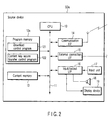
- FIG. 2 is a block diagram depicting a configuration of the device.
- a program memory 12a and a content memory 13 are connected to a central processing unit (CPU) 10 via a bus 11, and further, a communication interface 14, an external connection interface 15, and an input/output interface 16 are connected thereto, respectively.
- CPU central processing unit
- the content memory 13 uses, for example, a NAND type flash memory, a hard disk, or a removable medium as a storage medium.
- the content memory 13 stores the encoded content EC downloaded from the content server CSV and the rights object RO downloaded from the rights server RSV so to be associated with each other.
- the communication interface 14 comprises, for example, a wireless interface for making communication with a cellular wireless communication system or a wireless LAN, and makes wireless communication with the communication network NW under the control of the CPU 10.
- the external communication interface 15 comprises, for example, a USB interface function and transfers an encoded content key EKc to the rendering device RDa via the communication cable CB.
- An input unit 17 such as a keyboard or a mouse, an audio output speaker 18, and a display device 19 such as an LCD display are connected to the input/output interface 16.
- the input unit 17 is used for a user to input operation information.
- the speaker 18 and the display device 19 are used to vocally output or display music content or video content, respectively.
- the display device 19 is also used for displaying a variety of operation states of a device.
- the program memory 12a is configured by a nonvolatile memory such as a hard disk or a ROM.
- the program memory 12a stores a download control program 121 and a content key secure transfer control program 122 as control application programs according to the present invention.
- the download control program 121 first provides an access to the content server CSV and the rights server RSV via the communication network NW, and downloads the desired encoded content EC and rights object RO, respectively, from these servers CSV and RSV. Then, the downloaded encoded content EC and the rights object RO are associated with each other to cause the CPU 10 to execute a processing of storing them in the content memory 13.
- the content key secure transfer control program 122 causes the CPU 10 to execute a processing of securely transferring the corresponding content key Kc to the rendering device RDa in the case where a request for playing back content from the rendering device RDa has occurred.
- the rights object RO is first read out from the content memory 13, the read-out object is decoded by a source device secrete key, and the content key Kc is extracted from the decoded rights object RO.
- a secure session is established with respect to the rendering device RDa, the content key Kc is encoded by using the session key Sk, and then, the encoded key is transmitted to the rendering device RDa.
- FIG. 3 is a block diagram depicting a configuration of the device.
- the rendering device RDa also includes a CPU 20 in the same manner as the source device SDa.
- a program memory 22a and a content memory 23 are connected to the CPU 20 via a bus 21, and further, a communication interface 24, an external connection interface 25, and an input/output interface 26 are connected thereto, respectively.
- the content memory 23 is used to store downloaded encoded content EC from the content server CSV, the source device SDa and the like.
- the communication interface 14 comprises a wireless interface for making communication with a cellular wireless communication system or a wireless LAN, and makes wireless communication with the communication network NW under the control of the CPU 20.
- the external communication interface 25 comprises a USB interface function, and is used to receive an encoded content key EKc from the source device SDa.
- An input unit 27 such as a keyboard or a mouse, an audio output speaker 28, and a display device 29 such as an LCD display are connected to the input/output interface 26.
- the program memory 22a is configured by a nonvolatile memory such as a hard disk or a ROM.
- the program memory 22a stores a download control program 221, a content key secure transfer control program 222, and a content decoding/playing back control program 223 as control application programs according to the present invention.
- the download control program 221 causes the CPOU 20 to execute the following processing. That is, an access is provided to the content server CSV via the communication network NW or an access is provided to the source device SDa via the signal cable CB. Then, encoded content EC targeted to be shared are downloaded from the content server CSV, and the downloaded encoded content EC are stored in the content memory 23.
- the content key secure transfer control program 222 causes the CPU 20 to execute the following processing. That is, when an attempt is made to play back the encoded content EC shared with the source device SDa by means of its own device RDa, a secure session is established with respect to the source device SDa, and a content key Kc of the encode content EC is acquired from the source device SDa. Then, the acquired encoded content key EKc is decoded by using a session key Sk.
- the content decoding/playing back control program 223 causes the CPU 20 to execute the following processing. That is, first, the encoded content EC stored in the content memory 23 are decoded by using the decoded content key Kc. Then, the decoded content C are supplied to the input/output interface 16 to be loudly outputted or displayed from the speaker 18 or the display device 19.
- FIG. 4 is a sequence diagram showing an operation of the system
- FIGS. 5 and 6 are flow charts each showing control procedures for, and content of, the source device SDa and the rendering device RDa.
- step S51 If a user makes an operation of downloading content in a source device SDa, the source device SDa moves from step S51 to step S52 as shown in FIG. 5. Then, an access is provided to a content server CSV. In step S53, desired encoded content EC are downloaded as shown in FIG. 4(1) from the content server CSV, and the downloaded encoded content EC are stored in the content memory 13. Subsequently, the source device SDa provides an access to a rights server RSV in step S54, and downloads a rights object RO that corresponds to the received encoded content from the rights server RSV in step S55, as shown in FIG. 4(2). Then, the downloaded rights object RO is stored in the content memory 13 so as to be associated with the encoded content.
- step S57 an access is provided to the content server CSV, and in step S58, encoded content EC targeted to be shared are downloaded from the content server CSV, as shown in FIG. 4(3). Then, the downloaded encoded content EC are stored in the content memory 13.
- the rendering device RDa is connected to the source device SDa via the signal cable CB. Then, the rendering device RDa makes an operation of playing back the downloaded content targeted to be shared.
- the rendering device RDa moves the processing from step S59 to step S60, in which a request for playing back shared content is transmitted to the source device SDa via the signal cable CB.
- the source device SDa receives the playing back request in step S61.
- the source device SDa and the rendering device RDa establish a secure session, as shown in FIG. 4(4), in accordance with step S63 and step S62.
- An operation of playing back content targeted to be shared may be made from the source device SDa.
- the playing back request is transmitted from the source device SDa to the rendering device RDa.
- the rendering device SDa has received the playing back request, the source device SDa and the rendering device RDa establish a secure session, as shown in FIG. 4(4), in accordance with step S63 and step S62.
- the source device SDa reads out the rights object RO that corresponds to the content targeted to be shared from the content memory 13 in step S64, as shown in FIG. 6. Then, the rights object RO is decoded by the source device secret key that is secretly held. Next, in step S65, a content key Kc is extracted from the decoded rights object RO, and the content key Kc is decoded in step S66 by the session key Sk generated in the secure session.
- An AES Advanced Encryption Standard
- AES_WRAP AES key wrapping algorithm
- IETF standard RFC REQUEST FOR COMMENT
- the source device SDa transmits the encoded content key EKc to the rendering device RDa via the signal cable CB, as shown in FIG. 4(5), in accordance with step S67.
- the source device SDa eliminates the session key Sk.
- the rendering device RDa receives the encoded content key EKc transferred from the source device SDa in step S68. Subsequently, the rendering device RDa decodes the received encoded content key EKc by the session key Sk in step S69, and temporarily stores the decoded content key Kc. In addition, the rendering device RDa eliminates the stored session key Sk at a time point of temporarily storing the content key Kc.
- playback limitation information of a target rights object RO includes a count limit
- the source device SDa makes a change of that state. For example, assume that the ofject TO has been downloaded from the rights server RSV while up to three playbacks are specified as a playback count.
- the processing of decrementing its playback count limit is also carried out in the same manner as that in playback in the source device SDa itself at a time point at which the source device SDa has sent out the encoded content key EKc to the rendering device RDa.
- a processing may be carried out for decrementing a playback count limit at a time point of the receipt of notification of playback start or playback completion from the rendering device RDa.
- the rendering device RDa reads out encoded content EC targeted for playback from the content memory 13 in step S70, and decodes the read-out encoded content EC by the decoded content key Kc. Then, content C obtained by this decoding are decoded in step S71, and the decoded content are played back and output as shown in FIG. 4(6). For example, if content are music content, such music content are decoded by an audio decoder to be loudly outputted from the speaker 18 by the input/output interface 16. In contrast, if content are video content, such video content are decoded by a video decoder, and then, the decoded content are displayed on the display device 19 by the input/output interface 16.
- the rendering device RDa monitors the end of playback of content in step S72.
- the processing moves to step S73 in which the content key Kc used for decoding the encoded content EC is discarded.
- the content key Kc is securely transferred again from the source device SDa, and encoded content EC are decoded by the securely transferred content key Kc, thereby enabling playback of the content again.
- one-time playback of shared content can be carried out in a state in which connection to the source device SDa is established.
- a secure session has been established every time the encoded content key EKc is transferred.
- a secure session may exist in the source device SDa and the rendering device RDa for a predetermined period, and while such a session exists, there may be eliminated a need for newly establishing a secure session.
- the rendering device RDa can store only one content key.
- the source device SDa transfers an invalid key to the rendering device RDa.
- the rendering device RDa forcibly rewrites a stored content key into the received invalid key upon the receipt of the invalid key.
- information representing a playback count or a playback period is added to a content key to be transferred, and when the content playback count or playback period exceeds a specified value of the playback count or playback period added to the content key in the rendering device RDa, the content key is erased.
- the content key Kc is transferred from the source device SDa to the rendering device RDa via a secure session for every playback in the case where the content owned by the source device SDa are shared and played back in the rendering device RDa. Then, the encoded content EC are decoded, played back, and outputted by using the transferred content key Kc, and the content key Kc is discarded after the end of playback.
- the rendering device RDa connected to the source device SDa, content can be played back only once every time a content key transferred.
- the present invention is effective for domain extension.
- a content key is transferred from the source device SDa to the rendering device RDa by using a common key system with a session key, thus making it possible to share a content key in accordance with a comparatively light processing.
- a content key is transferred from a source device to a rendering device by using a public key encoding system.
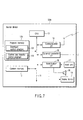
- FIGS. 7 and 8 are block diagrams depicting configurations of a source device SDb and a rendering device RDb that configure a content playing back system according to the second embodiment of the invention, respectively.
- the rendering device RDb holds a public key pair of a secret key for transferring a content key Kc and a public key with a certificate.
- like constituent elements shown in FIGS. 2 and 3 are designated by like reference numerals, and a detailed description is omitted here.
- a program memory 12b of the source device SDb newly stores a content key transfer control program 123.
- the content key transfer control program 123 causes the CPU 10 to execute the following processing. That is, first, a public key with a certificate is received from the rendering device RDb. At the time of transfer of the content key Kc, the validity of the certificate is checked in a rights server RSV, and then, the content key Kc is encoded by the public key to be transferred to the rendering device RDb.
- a content key transfer control program 224 is stored in a program memory 22b of the rendering device RDb.
- the content key transfer control program 224 causes the CPU 10 to execute the following processing. That is, first, a rendering device public key and a rendering device secret key paired with this public key are acquired from the rights server RSV. The public key is then notified to the source device SDb. Subsequently, in the case where the content key encoded by the public key has been transferred from the source device SDb, the transferred encoded content key is decoded by using the rendering device secret key.
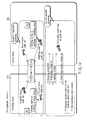
- FIG. 9 is a sequence diagram showing an operation of the system
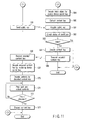
- FIGS. 10 and 11 are flow charts showing control procedures for, and content of, the source device SDb and the rendering device RDb.
- FIGS. 10 and 11 like constituent elements shown in FIGS. 5 and 6 are designated by like reference numerals.
- the source device SDb moves the processing from step S51 to step S52, as shown in FIG. 10. Then, an access is provided to a content server CSV.
- desired encoded content EC are downloaded from the content server CSV as shown in FIG. 9(1), and the downloaded encoded content EC are stored in the content memory 13.
- the source device SDb provides an access to a rights server RSV in step S54; downloads a rights object RO that corresponds to the received encoded content from the rights server RSV in step S55 as shown in FIG. 9(2); and stores the downloaded rights object RO in the content memory 13 so as to be associated with the encoded content.
- the rendering device RDb moves the processing from step S56 to step S57 as shown in FIG. 10. Then, an access is provided to the content server CSV in the step S57. Encoded content EC targeted to be shared are downloaded from the content server CSV as shown in FIG. 9(3) in step S57, and the downloaded encoded content EC are stored in the content memory 13.
- the rendering device RDb In the case of playing back shared content, the rendering device RDb is first connected to the source device SDb via the signal cable CB. In the rendering device RDb, an operation of playing back the downloaded content targeted to be shared is made. By doing so, the rendering device RDb moves the processing from step S59 to step S60 in which a request for playing back shared content is transmitted to the source device SDb via the signal cable CB. In addition, in step S80 shown in FIG. 11, a rendering device public key (with a certificate) acquired in advance is sent to the source device SDb as shown in FIG. 9(4).
- the source device SDb receives the playing back request in step S61.
- a rights object RO corresponding to the content targeted to be shared is first read out from the content memory 13 in step S64, as shown in FIG. 11.
- the rights object RO is decoded by a source device secret key, and from the decoded rights object RO, a content key Kc is extracted in step S65.
- the operation of playing back content targeted to be shared may be made from the source device SDb.
- a sequence is carried out as follows, although not shown.
- the playback request is transmitted from the source device SDb to the rendering device RDb.
- a rendering device public key (with a certificate) is sent to the source device SDb.
- the source device SDb reads out the rights object RO that corresponds to the content targeted to be shared from the content memory 13 in step S64, as shown in FIG. 11, and decodes the rights object RO by the source device secret key.
- a content key Kc is extracted from the decoded rights object RO.
- the source device SDb receives the rendering device public key sent from the rendering device RDb in step S81. Then, in step S82, an access is provided to the rights server RSV as shown in FIG. 9(5), and a status check is made for the certificate attached to the received public key.
- the processing moves from step S83 to step S84 in which the content key Kc is encoded by the public key.
- a public key encoding system using an RSA encode key or the like is used as an encoding system.
- the encoded content key EKc is transmitted to the rendering device RDb as shown in FIG. 9(6) in S85. Thereafter, at a time point of transmission, the source device SDb deletes the rendering device public key.
- step S86 the rendering device RDb receives the encoded content key EKc transmitted from the source device SDb.
- step S87 the rendering device RDb decodes the received encoded content key EKc by the rendering device secrete key, and temporarily stores the content key Kc obtained by this decoding.
- the source device SDb carries out a processing of changing that state. For example, assume that the rights object RO has been downloaded from the rights server RSV after up to three playbacks have been specified as a playback count.
- the processing of decrementing the playback count limit is also made in the same manner as the playback by the source device SDb described previously at a time point at which the source device SDb has been sent out the encoded content key EKc to the rendering device RDb.
- the processing of decrementing the playback count limit may be made at a time point at which the notification of playback start or playback completion has been received from the rendering device RDb, instead of carrying out the processing of decrementing the playback count limit at a time point at which the source device SDa has sent out the encoded content key EKc to the rendering device RDb.
- step S70 the rendering device RDb reads out encoded content EC targeted for playback from the content memory 13, and decodes the read-out encoded content EC by the decoded content key Kc. Then, content C obtained by this decoding are decoded in step S71, and the decoded content are played back to be outputted by the speaker 18 or the display device 19, as shown in FIG. 9(7).
- step S72 When the content playback starts, the rendering device RDb monitors the end of playback of content in step S72. When playback terminates, the processing moves to step S73 in which the content key Kc used for a processing of decoding encoded content EC is discarded.
- means for discarding the content key Kc as described in the first embodiment, there can be applied: means for transferring an invalid key from the source device SDb, and forcibly rewriting a content key being stored in the rendering device RDb; and means for adding information representing a playback count or a playback period to a content key, and erasing the content key at a time point at which, in the rendering device RDb, the playback count or playback period of content has exceeded a specified value of the playback count or playback period added to the content key.
- the content key Kc is securely transferred again from the source device SDb, and the encoded content EC are decoded by the securely transferred content key Kc, thereby enabling such playback again.
- the rendering device RDb connected to the source device SDb, one-time playback of shared content is enabled.
- the content key Kc is transferred from the source device SDb to the rendering device RDb by using a public key encoding system. Then, encoded content EC are decoded, played back, and outputted by using the transferred content key Kc so as to discard the content key Kc after the end of playback.
- content can be played back only once every time a content key is transferred with the rendering device RDb connected to the source device SDb. For this reason, it becomes possible to share and play back content in a plurality of devices while rights are reliably protected.
- Thin embodiment has shown that a rendering device public key is transferred in order to establish a secure session every time the encoded content key EKc is transferred.
- secure sessions exist in the source device SDa and the rendering device RDa for a predetermined period, and while the sessions exist, there may be no need for newly establishing a secure session.
- a rendering device public key with a certificate is sent to the source device SDb.
- the source device SDb it becomes possible to make a revocation check of the rendering device RDb, i.e., to eliminate leak of content or leak of confidential information and an invalid device for making another breach of trust operation for a content holder.
- a third embodiment of the present invention further improves the second embodiment.
- a source device public key and a rendering device public key are exchanged and stored in advance.
- FIGS. 12 and 13 are block diagrams depicting configurations of a source device SDc and a rendering device RDc that configure a content playing back system according to the third embodiment of the invention, respectively.
- like constituent elements shown in FIGS. 2 and 3 are designated by like reference numerals, and a detailed description is omitted here.
- the source device SDc has: a public key pair composed of a secret key and a public key with a certificate, for receiving distribution of content; and a public key pair composed of a secret key and a public key with a certificate, for exchanging the content key Kc with the rendering device. Namely, these keys may be the same key pair.
- the rendering device RDc has a public key pair composed of a secret key and a public key with a certificate, for exchanging the content key Kc.
- a public key exchange control program 124 is stored in a program memory 12c of the source device SDc.
- the public key exchange control program 124 causes the CPU 10 to execute the following processing. That is, prior to playback of content, a source device public key with a certificate and a rendering device public key with a certificate are exchanged with the rendering device RDc via the signal cable CB.
- a public key exchange control program 225 is stored in a program memory 22c of the rendering device RDc as well.
- the public key exchange control program 225 causes the CPU 20 to execute the following processing. That is, prior to playback of content, a source device public key with a certificate and a rendering device public key with a certificate are exchanged with the source device SDc via the signal cable CB.
- FIG. 14 is a sequence diagram showing the operation of the system
- FIGS. 15 and 16 are flow charts showing control procedures for, and content of, the source device SDc and the rendering device RDc.
- a user starts up a register mode in, for example, a source device SDc after connection has been made between the source device SDc and a rendering device RDc via a signal cable CB. Then, as shown in FIG. 15, the source device SDc determined whether or not a state of connection with the rendering device RDc exists in a mutually visible range, namely, whether or not a short distance connection is made. When a short distance connection is made, a register mode startup command is transmitted to the rendering device RDc. Then, in the step S112, a source device public key (with a certificate) acquired in advance from the rights server RSV is transferred to the rendering device RDc via the signal cable CB.
- step S110 it is determined whether or not a state of connection with the source device SDc is in a short distance connection. Then, in the case of a short distance connection using a USB cable or the like, the source device public key (with a certificate) transferred from the source device SDc is received in step S113.
- a register mode startup operation may be made in the rendering device RDc instead of the source device SDc.
- the rendering device RDc Upon the receipt of the source device public key (with a certificate), the rendering device RDc transfers, in step S114, the rendering device public key (with a certificate) acquired in advance from the rights server RSV to the source device SDc via the signal cable CB.
- step S116 the content of a certificate attached to the source device public key received previously are inquired to the rights server RSV, thereby making a status check for the source device public key.
- the processing moves from step S118 to step S120 in which the source device public key is stored.
- the source device SDc also inquires to the rights server RSV the content of a certificate attached to the rendering device public key received previously, thereby making a status check for the rendering device public key.
- the processing moves from step S118 to step S120 in which the rendering device public key is stored.
- the content memory 13 of the source device SDc has already stored encoded content and its rights object downloaded from the content server CSV and the rights server RSV.
- the rendering device RDc moves the processing from step S91 to step S92 as shown in FIG. 16, in which a request for acquiring a content list is first sent to the source device SDc, as shown in FIG. 14(1).
- the source device SDc upon the receipt of the request for acquiring the content list in step S93, produces a content list in step S94, and transmits the content list to the rendering device RDc, as shown in FIG. 14(2).
- the rendering device RDc receives the content list in step S95, and displays the received content on the display device 29.
- the rendering device RDc acquires in advance the information corresponding to the content list of the source device SDc, whereby the step of acquiring the content list may be eliminated.
- the rendering device RDc moves the processing from step S96 to step S97 in which a list of the selected content is produced to be transmitted to the source device SDc, as shown in FIG. 14(3).
- the source device SDc reads out the rights object RO corresponding to the selected content from the content memory 13, and decodes the rights object RO by a source device secret key. Then, a content key is extracted from the decoded rights object RO.
- step S99 the source device SDc encodes the extracted content key by the rendering device public key registered in advance, as shown in FIG. 14(4).
- the decoding used here may be a public key encoding system by RSA encoding or the like.
- the encoded content key is transmitted to the rendering device RDc in step S100, as shown in FIG. 14 (5) .
- the source device SDc and the rendering device RDc may be connected to each other via the signal cable CB.
- These devices may be connected to each other via the communication network NW. This is because, when public keys are exchanged with each other, the devices have made a registration work in proximity.
- the source device SDc may check the validity of the rendering device public key of the rendering device RDc for the rights server RSV. This is because a rendering device public key may be lost, in effect, after registering the rendering device public key.
- the rendering device RDc receives the encoded content key transmitted from the source device SDc in step S101.
- the rendering device RDc may check the validity of the source device public key of the source device SDc for the rights server RSV. This is because the source device public key may be lost, in effect, after registering the source device public key.
- the received encoded content key is decoded by the rendering device public key in the step S102, as shown in FIG. 14(6).
- the rendering device RDc reads out encoded content targeted for playback from the content memory 13 in step S103, and decodes the read-out encoded content by the decoded content key.
- the content obtained by this decoding are decoded, and then, as shown in FIG. 14 (7), the decoded content are played back and outputted by the speaker 18 or the display device 19.
- step S104 When the content playback starts, the rendering device RDc monitors the end of playback of content in step S104. When playback terminates, the processing moves to step S105 in which a content key used for a processing of decoding encoded content is discarded.
- means for discarding the content key as has been described in the first embodiment, there can be applied: means for transferring an invalid key from the source device SDb, and forcibly rewriting a content key being stored in the rendering device RDb; or means for adding information representing a playback count or a playback period to a content key, and erasing the content key at a time point at which, in the rendering device RDb, the playback count or playback period of content has exceeded a specified value of the playback count or playback period added to the content key.
- playback limitation information of a target rights object RO includes a count limit
- the source device SDc makes a change of that state. For example, assume that the ofject TO has been downloaded from the rights server RSV while up to three playbacks are specified as a playback count.
- the processing of decrementing its playback count limit is carried out in playback in the source device SDc itself, the processing of decrementing its playback count limit is carried out in the same manner as that in playback in the source device SDc itself at a time point at which the source device SDc has sent out the encoded content key EKc to the rendering device RDc.
- a processing may be carried out for decrementing a playback count limit at a time point of the receipt of notification of playback start or playback completion from the rendering device RDc, instead of carrying out a processing of decrementing its playback count limit at a time point at which the source device SDa has sent out the encoded content key EKc to the rendering device RDc.
- the source device public key and the rendering device public key are exchanged between the source device and the rendering device and stored in advance.
- the content key corresponding to the content targeted for playback in the source device SDc is encoded by the rendering device public key to be transferred to the rendering device RDc.
- the transferred encoded content key is decoded by the rendering device secret key so as to decode, play back, and output the content by using the decoded content key.
- content can be played back only once in a plurality of devices every time a content key is transferred.
- This makes it possible to share and play back content in a plurality of devices while rights are reliably protected.
- by exchanging the public keys it becomes possible to make a revocation check of both the source device SDc and the rendering device RDc, i.e., to eliminate leak of content or leak of confidential information and an invalid device for making another breach of trust operation for a content holder.
- content and rights objects that have been already encoded are downloaded from a content server CSV and a rights server RSV to be stored.
- content and rights information before encoded are downloaded, whereby these items of information may be encoded in a source device.
- a connection is made between a source device and a rendering device via a signal cable CB such as a USB cable so as to transfer an encoded content key or the like via the signal cable CB.
- a signal cable CB such as a USB cable
- the invention is not limited thereto.
- a connection may be made between the source device and the rendering device by using an IrDA or IEEE1394 interface using infrared rays or a wireless interface with a communication distance of 10 m so as to make communication.
- the present invention is not limited to the above-described embodiments as they are.
- the present invention can be embodied by modifying constituent elements without deviating from the spirit of the invention.
- a variety of inventions can be formed by a proper combination of a plurality of constituent elements disclosed in the above-described embodiments. For example, some constituent elements may be eliminated from all the constituent elements disclosed in the embodiments. Further, constituent elements according to different embodiments may be properly combined.
- a source device and a render device are described as a separate apparatus; however one device, for example, an information terminal can implement both functions executed by the source device and those executed by the render device.
Landscapes
- Engineering & Computer Science (AREA)
- Multimedia (AREA)
- Computer Security & Cryptography (AREA)
- Signal Processing (AREA)
- Databases & Information Systems (AREA)
- Theoretical Computer Science (AREA)
- Software Systems (AREA)
- Technology Law (AREA)
- Computer Hardware Design (AREA)
- Physics & Mathematics (AREA)
- General Engineering & Computer Science (AREA)
- General Physics & Mathematics (AREA)
- Computer Networks & Wireless Communication (AREA)
- Storage Device Security (AREA)
- Two-Way Televisions, Distribution Of Moving Picture Or The Like (AREA)
- Reverberation, Karaoke And Other Acoustics (AREA)
Applications Claiming Priority (1)
| Application Number | Priority Date | Filing Date | Title |
|---|---|---|---|
| JP2005343995A JP2007150846A (ja) | 2005-11-29 | 2005-11-29 | コンテンツ再生システム |
Publications (2)
| Publication Number | Publication Date |
|---|---|
| EP1798655A2 true EP1798655A2 (de) | 2007-06-20 |
| EP1798655A3 EP1798655A3 (de) | 2009-08-26 |
Family
ID=37887998
Family Applications (1)
| Application Number | Title | Priority Date | Filing Date |
|---|---|---|---|
| EP06016104A Withdrawn EP1798655A3 (de) | 2005-11-29 | 2006-08-02 | DRM in einem Informationsendgerät |
Country Status (3)
| Country | Link |
|---|---|
| US (1) | US8064603B2 (de) |
| EP (1) | EP1798655A3 (de) |
| JP (1) | JP2007150846A (de) |
Families Citing this family (20)
| Publication number | Priority date | Publication date | Assignee | Title |
|---|---|---|---|---|
| JP4537882B2 (ja) * | 2005-04-18 | 2010-09-08 | 株式会社東芝 | 情報端末装置 |
| JP2007156523A (ja) * | 2005-11-30 | 2007-06-21 | Toshiba Corp | 情報端末装置 |
| US8554868B2 (en) | 2007-01-05 | 2013-10-08 | Yahoo! Inc. | Simultaneous sharing communication interface |
| JP5052616B2 (ja) * | 2007-08-24 | 2012-10-17 | 三菱電機株式会社 | 限定受信装置 |
| CN101527731A (zh) * | 2008-03-03 | 2009-09-09 | 株式会社Ntt都科摩 | 移动通信终端及其受数字版权保护内容的获取、分发方法及系统 |
| KR20100036575A (ko) * | 2008-09-30 | 2010-04-08 | 삼성전자주식회사 | 이동통신 단말기에서 컨텐츠 리스트의 화면 표시를 위한 장치 및 방법 |
| US10410222B2 (en) | 2009-07-23 | 2019-09-10 | DISH Technologies L.L.C. | Messaging service for providing updates for multimedia content of a live event delivered over the internet |
| CA2822185C (en) * | 2009-08-14 | 2014-04-22 | Azuki Systems, Inc. | Method and system for unified mobile content protection |
| US8751799B2 (en) * | 2010-05-20 | 2014-06-10 | Absio Corporation | Method and apparatus for providing content |
| WO2013085920A2 (en) * | 2011-12-06 | 2013-06-13 | DISH Digital L.L.C. | Remote storage digital video recorder and related operating methods |
| US9049484B2 (en) | 2011-12-06 | 2015-06-02 | Echostar Technologies L.L.C. | Efficient assignment of program copies in a network digital video recorder |
| WO2014106206A1 (en) | 2012-12-28 | 2014-07-03 | DISH Digital L.L.C. | Adaptive multicast delivery of media streams |
| US10051025B2 (en) | 2012-12-31 | 2018-08-14 | DISH Technologies L.L.C. | Method and apparatus for estimating packet loss |
| US10104141B2 (en) | 2012-12-31 | 2018-10-16 | DISH Technologies L.L.C. | Methods and apparatus for proactive multi-path routing |
| US10708319B2 (en) | 2012-12-31 | 2020-07-07 | Dish Technologies Llc | Methods and apparatus for providing social viewing of media content |
| US9210560B2 (en) * | 2013-03-15 | 2015-12-08 | Rf Venue, Inc. | Systems and methods for a cellular enabled content playback device |
| US9537860B2 (en) * | 2013-09-18 | 2017-01-03 | Kabushiki Kaisha Toshiba | Display control apparatus, display control method and server system |
| EP3398336B1 (de) | 2015-12-29 | 2024-09-11 | Dish Technologies L.L.C. | Verfahren und systeme zur unterstützten inhaltsbereitstellung |
| EP3293980A1 (de) * | 2016-09-09 | 2018-03-14 | Nagravision S.A. | Verfahren zur erstellung eines sicheren kanals zwischen einer hostvorrichtung und einer externen vorrichtung |
| SG10201906806XA (en) * | 2019-07-23 | 2021-02-25 | Mastercard International Inc | Methods and computing devices for auto-submission of user authentication credential |
Family Cites Families (60)
| Publication number | Priority date | Publication date | Assignee | Title |
|---|---|---|---|---|
| JP2518919B2 (ja) | 1989-03-31 | 1996-07-31 | 日本電信電話株式会社 | 通信装置 |
| CN1312549C (zh) * | 1995-02-13 | 2007-04-25 | 英特特拉斯特技术公司 | 用于安全交易管理和电子权利保护的系统和方法 |
| US5758069A (en) * | 1996-03-15 | 1998-05-26 | Novell, Inc. | Electronic licensing system |
| JPH10208388A (ja) | 1997-01-21 | 1998-08-07 | Victor Co Of Japan Ltd | 光ディスク、暗号鍵生成方法、暗号鍵記録方法、暗号鍵記録装置、情報再生方法、情報再生許可方法、並びに情報再生装置 |
| US5925127A (en) * | 1997-04-09 | 1999-07-20 | Microsoft Corporation | Method and system for monitoring the use of rented software |
| US5982889A (en) * | 1997-04-30 | 1999-11-09 | Demont; Jason Paul | Method and apparatus for distributing information products |
| US6173403B1 (en) * | 1997-04-30 | 2001-01-09 | Achates Reference Publishing, Inc. | Method and apparatus for distributing information products |
| US6144959A (en) * | 1997-08-18 | 2000-11-07 | Novell, Inc. | System and method for managing user accounts in a communication network |
| US6141754A (en) * | 1997-11-28 | 2000-10-31 | International Business Machines Corporation | Integrated method and system for controlling information access and distribution |
| US7263497B1 (en) * | 1998-02-06 | 2007-08-28 | Microsoft Corporation | Secure online music distribution system |
| US6170014B1 (en) * | 1998-03-25 | 2001-01-02 | Community Learning And Information Network | Computer architecture for managing courseware in a shared use operating environment |
| US6219652B1 (en) * | 1998-06-01 | 2001-04-17 | Novell, Inc. | Network license authentication |
| US6718470B1 (en) * | 1998-06-05 | 2004-04-06 | Entrust Technologies Limited | System and method for granting security privilege in a communication system |
| US6343280B2 (en) * | 1998-12-15 | 2002-01-29 | Jonathan Clark | Distributed execution software license server |
| JP2001309332A (ja) | 2000-04-25 | 2001-11-02 | Hitachi Ltd | 総合情報レンタルサービスシステム |
| US6581044B1 (en) * | 2000-06-12 | 2003-06-17 | Sun Microsystems, Inc. | Method and apparatus for encoding license parameters within a license number for authentication purposes |
| US6961858B2 (en) * | 2000-06-16 | 2005-11-01 | Entriq, Inc. | Method and system to secure content for distribution via a network |
| JP4581246B2 (ja) * | 2000-12-26 | 2010-11-17 | ソニー株式会社 | 情報処理システム、および情報処理方法、並びにプログラム記録媒体 |
| CN1165049C (zh) | 2000-12-28 | 2004-09-01 | 日本胜利株式会社 | 内容记录装置、重放装置、传送方法及接收方法 |
| US8099364B2 (en) * | 2001-05-31 | 2012-01-17 | Contentguard Holdings, Inc. | Digital rights management of content when content is a future live event |
| JP2003008563A (ja) | 2001-06-21 | 2003-01-10 | Sony Corp | コンテンツ配信システム、コンテンツ配信方法、およびデータ処理装置、データ処理方法、並びにプログラム |
| US7203966B2 (en) | 2001-06-27 | 2007-04-10 | Microsoft Corporation | Enforcement architecture and method for digital rights management system for roaming a license to a plurality of user devices |
| US7421411B2 (en) | 2001-07-06 | 2008-09-02 | Nokia Corporation | Digital rights management in a mobile communications environment |
| JP2003110541A (ja) | 2001-09-26 | 2003-04-11 | Ntt Docomo Inc | 著作物利用方法、著作物利用システム、移動機及びサーバ |
| CN100508448C (zh) | 2001-10-12 | 2009-07-01 | 松下电器产业株式会社 | 内容处理装置 |
| US7487363B2 (en) | 2001-10-18 | 2009-02-03 | Nokia Corporation | System and method for controlled copying and moving of content between devices and domains based on conditional encryption of content key depending on usage |
| US7571143B2 (en) * | 2002-01-15 | 2009-08-04 | Hewlett-Packard Development Company, L.P. | Software pay-per-use pricing |
| US7191343B2 (en) | 2002-01-25 | 2007-03-13 | Nokia Corporation | Voucher driven on-device content personalization |
| JP2003303137A (ja) | 2002-04-09 | 2003-10-24 | Matsushita Electric Ind Co Ltd | 情報処理装置、情報処理方法および情報処理プログラム |
| US7502945B2 (en) * | 2002-06-28 | 2009-03-10 | Microsoft Corporation | Using a flexible rights template to obtain a signed rights label (SRL) for digital content in a rights management system |
| JP3699696B2 (ja) | 2002-07-09 | 2005-09-28 | 株式会社エヌ・ティ・ティ・ドコモ | コンテンツ管理方法、コンテンツ管理システム、バックアップサーバ、管理サーバ、コンテンツサーバ、通信端末、プログラムおよび記録媒体 |
| JP4080283B2 (ja) | 2002-09-13 | 2008-04-23 | 日本放送協会 | コンテンツ配信システム |
| US7334043B2 (en) * | 2002-09-17 | 2008-02-19 | At&T Delaware Intellectual Property, Inc. | Extending functionality of workflow applications using instant messaging (IM) |
| JP2004133576A (ja) * | 2002-10-09 | 2004-04-30 | Sony Corp | 情報処理装置、コンテンツ配信サーバ、ライセンスサーバ、および方法、並びにコンピュータ・プログラム |
| US7827156B2 (en) * | 2003-02-26 | 2010-11-02 | Microsoft Corporation | Issuing a digital rights management (DRM) license for content based on cross-forest directory information |
| US7260557B2 (en) * | 2003-02-27 | 2007-08-21 | Avaya Technology Corp. | Method and apparatus for license distribution |
| JP4247044B2 (ja) | 2003-05-23 | 2009-04-02 | 株式会社東芝 | コンテンツ配信サービス提供装置及びコンテンツ配信サービス端末装置 |
| CN1802813A (zh) | 2003-06-05 | 2006-07-12 | 松下电器产业株式会社 | 用于接收许可的用户终端 |
| US7512798B2 (en) * | 2003-06-27 | 2009-03-31 | Microsoft Corporation | Organization-based content rights management and systems, structures, and methods therefor |
| US7814551B2 (en) * | 2003-09-09 | 2010-10-12 | Microsoft Corporation | System and method for manifest generation |
| JP2005094481A (ja) | 2003-09-18 | 2005-04-07 | Mitsubishi Electric Corp | コンテンツ提供システム、サーバ装置及びクライアント端末 |
| US7392420B2 (en) * | 2003-09-29 | 2008-06-24 | International Business Machines Corporation | Automated error recovery of a licensed internal code update on a storage controller |
| US7266815B2 (en) * | 2003-09-29 | 2007-09-04 | International Business Machines Corporation | Automated control of a licensed internal code update on a storage controller |
| KR101254209B1 (ko) | 2004-03-22 | 2013-04-23 | 삼성전자주식회사 | 디바이스와 휴대용 저장장치간에 권리 객체를 이동,복사하는 방법 및 장치 |
| US7664966B2 (en) * | 2004-05-17 | 2010-02-16 | Microsoft Corporation | Secure storage on recordable medium in a content protection system |
| US8363835B2 (en) * | 2004-07-21 | 2013-01-29 | Sanyo Electric Co., Ltd. | Method for transmission/reception of contents usage right information in encrypted form, and device thereof |
| US8238554B2 (en) * | 2004-07-22 | 2012-08-07 | Sanyo Electric Co., Ltd. | Method for transmission/reception of contents usage right information in encrypted form, and device thereof |
| US7963847B2 (en) * | 2004-08-19 | 2011-06-21 | Igt | Gaming system having multiple gaming machines which provide bonus awards |
| JP2006085482A (ja) * | 2004-09-16 | 2006-03-30 | Sony Corp | ライセンス処理装置,プログラムおよびライセンス複製方法 |
| US20060174110A1 (en) * | 2005-01-31 | 2006-08-03 | Microsoft Corporation | Symmetric key optimizations |
| JP4563450B2 (ja) * | 2005-02-28 | 2010-10-13 | 三菱電機株式会社 | コンテンツ配信システム |
| US7849100B2 (en) * | 2005-03-01 | 2010-12-07 | Microsoft Corporation | Method and computer-readable medium for generating usage rights for an item based upon access rights |
| JP4537882B2 (ja) | 2005-04-18 | 2010-09-08 | 株式会社東芝 | 情報端末装置 |
| ATE418149T1 (de) | 2005-05-19 | 2009-01-15 | Samsung Electronics Co Ltd | Tastatur und tastaturanordnung |
| EP1921554A1 (de) * | 2005-09-01 | 2008-05-14 | Mitsubishi Electric Corporation | Datenabliefersystem, ausgabevorrichtung, endgerätevorrichtung und zwischenknoten |
| US8137188B2 (en) * | 2005-09-09 | 2012-03-20 | Igt | Server based gaming system having multiple progressive awards |
| US7841939B2 (en) * | 2005-09-09 | 2010-11-30 | Igt | Server based gaming system having multiple progressive awards |
| JP2007156523A (ja) | 2005-11-30 | 2007-06-21 | Toshiba Corp | 情報端末装置 |
| US7788181B2 (en) * | 2005-12-27 | 2010-08-31 | Microsoft Corporation | Software licensing using certificate issued by authorized authority |
| US7862430B2 (en) * | 2006-09-27 | 2011-01-04 | Igt | Server based gaming system having system triggered loyalty award sequences |
-
2005
- 2005-11-29 JP JP2005343995A patent/JP2007150846A/ja active Pending
-
2006
- 2006-08-02 EP EP06016104A patent/EP1798655A3/de not_active Withdrawn
- 2006-08-02 US US11/497,734 patent/US8064603B2/en not_active Expired - Fee Related
Also Published As
| Publication number | Publication date |
|---|---|
| US8064603B2 (en) | 2011-11-22 |
| EP1798655A3 (de) | 2009-08-26 |
| US20070124245A1 (en) | 2007-05-31 |
| JP2007150846A (ja) | 2007-06-14 |
Similar Documents
| Publication | Publication Date | Title |
|---|---|---|
| US8064603B2 (en) | Information terminal | |
| KR100593768B1 (ko) | 콘텐츠 송신 장치, 콘텐츠 수신 장치 및 콘텐츠 전송 방법 | |
| KR101086399B1 (ko) | 홈 네트워크 구성 기기의 정보를 담고 있는 스마트 카드를이용하여 홈 도메인을 구축하는 시스템 및 방법 | |
| CN101938461B (zh) | 信息处理服务器、信息处理设备、以及信息处理方法 | |
| US8930696B2 (en) | System and method for exchanging secure information between secure removable media (SRM) devices | |
| KR100787292B1 (ko) | 콘텐츠 송신 장치, 콘텐츠 수신 장치 및 콘텐츠 전송 방법 | |
| CN102577454B (zh) | 在安全元件与网络接入点之间互通数据的方法和相对应的安全元件 | |
| JP6326173B1 (ja) | データ送受信システム及びデータ送受信方法 | |
| JP2002140304A (ja) | 無線通信システム、送信装置、受信装置及びコンテンツデータ転送方法 | |
| KR101837188B1 (ko) | 비디오 보호 시스템 | |
| WO2010035490A1 (ja) | データ送受信制御装置、データ送受信システム、方法、およびプログラム | |
| RU2685975C2 (ru) | Обеспечение безопасности связи с расширенными мультимедийными платформами | |
| JP2006065660A (ja) | 端末機器、情報配信サーバ、および情報配信方法 | |
| WO2017069155A1 (ja) | 通信装置、通信方法、およびコンピュータプログラム | |
| JP4344783B2 (ja) | シード配信型ワンタイムid認証 | |
| KR20140058196A (ko) | 모바일 메시지 데이터의 보안 장치 및 방법 | |
| CN101547101A (zh) | 分别用于生成、传输以及接收权限对象的方法和装置 | |
| JP4470573B2 (ja) | 情報配信システム、情報配信サーバ、端末機器、情報配信方法、情報受信方法、情報処理プログラム、及び記憶媒体 | |
| KR101810904B1 (ko) | 비디오 보호 시스템 | |
| JP6813030B2 (ja) | 通信システム | |
| JP2023138927A (ja) | データファイル送信及びデータファイルへのアクセス権を管理するためのシステム及び方法 | |
| KR20100096490A (ko) | 보안 통신 수행 방법 및 그 장치 | |
| US20050021469A1 (en) | System and method for securing content copyright | |
| WO2012065422A1 (zh) | 移动终端密钥的更新方法及移动终端 | |
| CN119701371A (zh) | 道具数据的传输方法、装置、设备、系统和存储介质 |
Legal Events
| Date | Code | Title | Description |
|---|---|---|---|
| PUAI | Public reference made under article 153(3) epc to a published international application that has entered the european phase |
Free format text: ORIGINAL CODE: 0009012 |
|
| 17P | Request for examination filed |
Effective date: 20060802 |
|
| AK | Designated contracting states |
Kind code of ref document: A2 Designated state(s): AT BE BG CH CY CZ DE DK EE ES FI FR GB GR HU IE IS IT LI LT LU LV MC NL PL PT RO SE SI SK TR |
|
| AX | Request for extension of the european patent |
Extension state: AL BA HR MK YU |
|
| PUAL | Search report despatched |
Free format text: ORIGINAL CODE: 0009013 |
|
| AK | Designated contracting states |
Kind code of ref document: A3 Designated state(s): AT BE BG CH CY CZ DE DK EE ES FI FR GB GR HU IE IS IT LI LT LU LV MC NL PL PT RO SE SI SK TR |
|
| AX | Request for extension of the european patent |
Extension state: AL BA HR MK RS |
|
| 17Q | First examination report despatched |
Effective date: 20091102 |
|
| AKX | Designation fees paid |
Designated state(s): DE FR GB |
|
| STAA | Information on the status of an ep patent application or granted ep patent |
Free format text: STATUS: THE APPLICATION IS DEEMED TO BE WITHDRAWN |
|
| 18D | Application deemed to be withdrawn |
Effective date: 20100313 |