EP1798677A1 - Kontextbewusste Mitteilungsbenachrichtigung - Google Patents
Kontextbewusste Mitteilungsbenachrichtigung Download PDFInfo
- Publication number
- EP1798677A1 EP1798677A1 EP05292519A EP05292519A EP1798677A1 EP 1798677 A1 EP1798677 A1 EP 1798677A1 EP 05292519 A EP05292519 A EP 05292519A EP 05292519 A EP05292519 A EP 05292519A EP 1798677 A1 EP1798677 A1 EP 1798677A1
- Authority
- EP
- European Patent Office
- Prior art keywords
- user
- message
- message notification
- context
- information
- Prior art date
- Legal status (The legal status is an assumption and is not a legal conclusion. Google has not performed a legal analysis and makes no representation as to the accuracy of the status listed.)
- Ceased
Links
Images

Classifications
-
- G—PHYSICS
- G06—COMPUTING OR CALCULATING; COUNTING
- G06Q—INFORMATION AND COMMUNICATION TECHNOLOGY [ICT] SPECIALLY ADAPTED FOR ADMINISTRATIVE, COMMERCIAL, FINANCIAL, MANAGERIAL OR SUPERVISORY PURPOSES; SYSTEMS OR METHODS SPECIALLY ADAPTED FOR ADMINISTRATIVE, COMMERCIAL, FINANCIAL, MANAGERIAL OR SUPERVISORY PURPOSES, NOT OTHERWISE PROVIDED FOR
- G06Q10/00—Administration; Management
- G06Q10/10—Office automation; Time management
- G06Q10/107—Computer-aided management of electronic mailing [e-mailing]
Definitions
- the present invention relates to the field of message notification.
- the present invention relates to the management of message notification to a user.
- Messaging applications such as Microsoft Outlook, MSNMessager, or Gmail offer the possibility to the user to receive a notification when a new email message is received. Every time the user receives an incoming message, a notification is generated and delivered to the user.
- Mobile Context Aware Systems http://www.cs.bham.ac.uk/ ⁇ rxb/Online%20papers/context.pdf discloses a mobile phone scenario, where the mobile phone is aware of a user's context and transmits information suitable to the user's context.
- This aspect is achieved by a method for managing message notification to a user according to independent claim 1, a computer readable storage medium according to claim 10, a computer program product according to claim 11, and an apparatus for managing message notification to a user according to independent claim 12.
- a method for managing message notification to a user may comprise the steps of:
- the step of selectively generating and delivering a message notification may be only performed if the user's preference indicates that a message notification should be performed.
- Context is hereby understood as being any information which can be used to characterize the state of an entity, like the user.
- the user's preference may be set in advance.
- a message notification may be different from the message itself.
- a user can be notified that a new message has been received.
- the message notification it can be e.g. indicated from whom the message was received and what the subject of the message is.
- the entire message may be viewed e.g. by clicking on the message notification or opening the message application and selecting the respective message.
- the steps of obtaining context information and obtaining the user's preference may be performed periodically, wherein these steps can be performed at least once when the system is started. Moreover, the steps of obtaining context information and obtaining the user's preference may be performed before or after a message is received. Furthermore, the steps of obtaining context information and obtaining the user's preference may be performed more often than step of receiving.
- the method may further comprise a step of setting a message notification function depending on the obtained user's preference and the step of selectively generating and delivering a message notification is performed depending on the set message notification function.
- the step of setting the message notification function may be performed by an API (application programming interface or application program interface), a modification of a properties file or native methods.
- API application programming interface or application program interface
- the steps of obtaining context information and obtaining the user's preference may be performed substantially every time a message is received.
- the step of obtaining context information may comprise determining at least one of location information, environmental information, temporal information, user information and computing information.
- the location information may comprise information about the location of user, e.g. determined by GPS or via any other suitable network.
- the environmental information may comprise information relating to e.g. temperature, lightness, etc.
- the temporal information may comprise information relating to e.g. time, date, etc.
- the user information may comprise information relating to e.g. email, name, etc.
- the computing information may comprise information relating to e.g. IP address of the user's computer, whether a beamer plugged into the user's computer is detected, etc.
- the step of delivering a message notification may comprise a step of displaying a message notification to user and/or a step of outputting a sound to the user.
- the received message may be an email message or a workflow notification.
- Computer-readable storage medium may store a computer program containing computer readable instructions which, when loaded and executed in a suitable computing environment, performs a method according to anyone of the preceding claims.
- Computer program product may contain computer readable instructions which, when loaded and executed in a suitable computing environment, performs a method according to anyone of claims 1 to 9.
- An apparatus for managing message notification to a user may comprise:
- Fig. 1 shows a first example of an apparatus 10 for managing message notification.
- the apparatus 10 for managing message notification to a user comprises an application program 20 and a context aware message notification architecture 30.
- the application program 20 is suitable for receiving messages, e.g. email messages, addressed to the user.
- messages e.g. email messages
- the application program 20 When a new message addressed to the user is received, the application program 20 generates and delivers a message notification to the user in order to notify the user of the received message.
- the message notification is performed selectively as will be described later.
- the message notification can be performed by a message notification function of the application program.
- the context aware message notification architecture 30 comprises a context-aware message notification component 32 and a user preference component 34.
- the context-aware message notification component 32 is suitable for obtaining context information based on the context the user is in. Moreover, context-aware message notification component 32 can communicate with the application program 20 as will be described later.
- the user preference component 34 can store user's preferences for different contexts.
- Context information may comprise location information, environmental information, temporal information, user information and/or computing information.
- the location information may comprise information about the location of user, e.g. determined by GPS or via any other suitable network.
- the environmental information may comprise information relating to e.g. temperature, lightness, etc.
- the temporal information may comprise information relating to e.g. time, date, etc.
- the user information may comprise information relating to e.g. email, name, etc.
- the computing information may comprise information relating to e.g. IP address of the user's computer, whether a beamer plugged into the user's computer is detected, etc.
- context information is received by the context-aware message notification component 32. Based on the context information and a user's preference for the respective context information, the message notification function of the application program 20 is set.
- Fig. 2 shows a schematic representation of a method for managing message notification performed in an apparatus according to the first example of Fig. 1.
- Step S10 it is determined, whether context information is received.
- context information can e.g. be provided by the mobile phone of the user (e.g. user's location), or by a context aware architecture which collects or acquires information about the context the user is in.
- the context information can refer to environmental (e.g. temperature, lightness), user (e.g. email, name), computing (e.g. IP address, beamer detected), temporal information (e.g. time, date) or any other information suitable for defining a user's context.
- Step S10 If no context information is received ("NO” in Step S10), the process again queries whether context information is received. If context information is received (“YES” in Step S10), a query is sent to the user preference component 34 (Step S12). In the user preference component 34 it is then checked whether a preference set by the user for the particular context information is stored. In other words, the context aware message notification component checks if the received context information are referenced in the message filtering preferences stored in the user preference component.
- the user's preference which matches the context information is then sent to and received by the context-aware message notification component 32 (Step S14).
- the context-aware message notification component 32 In case no user's preference is stored for a particular context, it can be provided that a respective message is output to the context-aware message notification component 32 (not shown).
- the message notification function of the application program 20 is set according to the user's preference determined from the user preference component 34 (Step S16).
- the automatic setting of the notification function of the application program 20 or application program's customization, based on the context information, can be performed by an API (application programming interface or application program interface), by modification of properties file or by native methods.
- the modification of a properties file can e.g. relate to the modification of java properties files.
- the modification of native methods can be made by a model-view controller, aspect oriented programming or object oriented programming.
- a model-view-controller (MVC) is a software architecture that separates an application's data model, user interface, and control logic into three distinct components so that modifications to one component can be made with minimal impact to the others.
- step S10 the process returns to step S10 and waits for new context information.
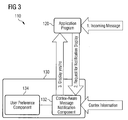
- Fig. 3 shows a second example of an apparatus 110 for managing message notification.
- the apparatus 110 for managing message notification to a user comprises an application program 120 and a context aware message notification architecture 130.
- the application program 120 is suitable for receiving messages, e.g. email messages, addressed to the user. When a new message addressed to the user is received, the application program 120 generates and delivers a message notification to the user in order to notify the user of the received message.
- the message notification is performed selectively as will be described later. In particular, the message notification can be performed by a message notification function of the application program.
- the context aware message notification architecture 130 comprises a context-aware message notification component 132 and a user preference component 134.
- the context-aware message notification component 132 is suitable for obtaining context information based on the context the user is in.
- context-aware message notification component 132 can communicate with the application program 120 as will be described later.
- the user preference component 134 can store user's preferences for different contexts.
- context information is received by the context-aware message notification component 132.
- the context information may be received at any suitable time and/or when the context the user is in changes.
- an incoming message is received by the application program 120.
- the application program then send a request to the context-aware message notification component 132 whether a notification for notifying the user of the received message shall be displayed to the user.
- the context-aware message notification component 132 queries the user preference component 134 using the context information to determine the user's preference for the context the user is in.
- the context aware message notification architecture 130 acts as a kind of firewall for message notification display.
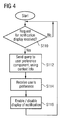
- Fig. 4 shows a schematic representation of a method for managing message notification performed in an apparatus according to the first example of Fig. 3.
- Step S110 it is determined whether a request for notification display is received from the application program 120. If no request for notification display is received ("NO" in Step S110), the process again queries whether a request for notification display is received.
- a query is sent to the user preference component 34 (Step S112).
- the query contains context information which had been received previously and may be stored in the context-aware message notification component 32. Moreover the query may contain message information about the message received by the application program 120. Such message information can be e.g. the sender of the message, the time the message was sent, etc.
- the context information can e.g. be provided by the mobile phone of the user (e.g. user's location), or by a context aware architecture which collects or acquires information about the context the user is in.
- the context information can refer to environmental (e.g. temperature, lightness), user (e.g. email, name), computing (e.g. IP address, beamer detected), temporal information (e.g. time, date) or any other information suitable for defining a user's context.
- the user preference component 34 it is then checked whether a preference set by the user for the particular context information is stored.
- the user's preference which matches the context information is then sent to and received by the context-aware message notification component 32 (Step S114).
- a respective message is output to the context-aware message notification component 32 (not shown).
- Step S116 information is returned to the application program 120 whether the message notification shall be displayed to the user or not.
- the returned information is based on the received context information and the respective user preference matching the context information. Moreover the returned information can also be based on the message information.
- step S110 the process returns to step S110 and waits for a new request for notification display.
- the user does not want to be bothered with any notification of new emails or new updates. Thus, the user sets his preferences accordingly.
- the user is considered to the Context Aware Message Notification architechture as "in meeting” if his laptop is connected to a beamer or if his agenda indicates that he is in a meeting.
- An inference rule can be defined to express "user_in_meeting" condition as follows:
- the user could e.g. also specify a further preference that as soon as the user is in meeting, he would like to be notified only of any messages coming from attendee of the meeting.
- Workflow notifications are often made via email. For example, when an employee makes a leave request, his/her manager receives a leave request notification via email. Based on the manager's context and the urge of the leave request, the notification of the leave request is performed or not.
- the invention can be implemented in digital electronic circuitry, or in computer hardware, firmware, software, or in combinations of them.
- the invention can be implemented as a computer program product, i.e., a computer program tangibly embodied in an information carrier, e.g., in a machine-readable storage device or in a propagated signal, for execution by, or to control the operation of, data processing apparatus, e.g., a programmable processor, a computer, or multiple computers.
- a computer program can be written in any form of programming language, including compiled or interpreted languages, and it can be deployed in any form, including as a stand-alone program or as a module, component, subroutine, or other unit suitable for use in a computing environment.
- a computer program can be deployed to be executed on one computer or on multiple computers at one site or distributed across multiple sites and interconnected by a communication network.
- Method steps of the invention can be performed by one or more programmable processors executing a computer program to perform functions of the invention by operating on input data and generating output. Method steps can also be performed by, and apparatus of the invention can be implemented as, special purpose logic circuitry, e.g., an FPGA (field programmable gate array) or an ASIC (application-specific integrated circuit).
- FPGA field programmable gate array
- ASIC application-specific integrated circuit
- processors suitable for the execution of a computer program include, by way of example, both general and special purpose microprocessors, and any one or more processors of any kind of digital computer.
- a processor will receive instructions and data from a read-only memory or a random access memory or both.
- the essential elements of a computer are a processor for executing instructions and one or more memory devices for storing instructions and data.
- a computer will also include, or be operatively coupled to receive data from or transfer data to, or both, one or more mass storage devices for storing data, e.g., magnetic, magneto-optical disks, or optical disks.
- Information carriers suitable for embodying computer program instructions and data include all forms of non-volatile memory, including by way of example semiconductor memory devices, e.g., EPROM, EEPROM, and flash memory devices; magnetic disks such as internal hard disks and removable disks; magneto-optical disks; and CD-ROM and DVD-ROM disks.
- semiconductor memory devices e.g., EPROM, EEPROM, and flash memory devices
- magnetic disks such as internal hard disks and removable disks
- magneto-optical disks and CD-ROM and DVD-ROM disks.
- the processor and the memory can be supplemented by, or incorporated in special purpose logic circuitry.
- the invention can be implemented on a computer having a display device such as a CRT (cathode ray tube) or LCD (liquid crystal display) monitor for displaying information to the user and a keyboard and a pointing device such as a mouse or a trackball by which the user can provide input to the computer.
- a display device such as a CRT (cathode ray tube) or LCD (liquid crystal display) monitor for displaying information to the user and a keyboard and a pointing device such as a mouse or a trackball by which the user can provide input to the computer.
- Other kinds of devices can be used to provide for interaction with a user as well; for example, feedback provided to the user can be any form of sensory feedback, such as visual feedback, auditory feedback, or tactile feedback; and input from the user can be received in any form, including acoustic, speech, or tactile input.
- the invention can be implemented in a computing system that includes a back-end component, e.g., as a data server, or that includes a middleware component, e.g., an application server, or that includes a front-end component, e.g., a client computer having a graphical user interface or an Web browser through which a user can interact with an implementation of the invention, or any combination of such back-end, middleware, or front-end components.
- the components of the system can be interconnected by any form or medium of digital data communication, e.g., a communication network. Examples of communication networks include a local area network ("LAN”), a wide area network (“WAN”), and the Internet.
- LAN local area network
- WAN wide area network
- the Internet the global information network
- the computing system can include clients and servers.
- a client and server are generally remote from each other and typically interact through a communication network.
- the relationship of client and server arises by virtue of computer programs running on the respective computers and having a client-server relationship to each other.
Landscapes
- Engineering & Computer Science (AREA)
- Business, Economics & Management (AREA)
- Human Resources & Organizations (AREA)
- Entrepreneurship & Innovation (AREA)
- Strategic Management (AREA)
- Marketing (AREA)
- Data Mining & Analysis (AREA)
- Economics (AREA)
- Computer Hardware Design (AREA)
- Operations Research (AREA)
- Quality & Reliability (AREA)
- Tourism & Hospitality (AREA)
- Physics & Mathematics (AREA)
- General Business, Economics & Management (AREA)
- General Physics & Mathematics (AREA)
- Theoretical Computer Science (AREA)
- Information Transfer Between Computers (AREA)
Priority Applications (2)
| Application Number | Priority Date | Filing Date | Title |
|---|---|---|---|
| EP05292519A EP1798677A1 (de) | 2005-11-29 | 2005-11-29 | Kontextbewusste Mitteilungsbenachrichtigung |
| US11/606,430 US20070180036A1 (en) | 2005-11-29 | 2006-11-29 | Context aware message notification |
Applications Claiming Priority (1)
| Application Number | Priority Date | Filing Date | Title |
|---|---|---|---|
| EP05292519A EP1798677A1 (de) | 2005-11-29 | 2005-11-29 | Kontextbewusste Mitteilungsbenachrichtigung |
Publications (1)
| Publication Number | Publication Date |
|---|---|
| EP1798677A1 true EP1798677A1 (de) | 2007-06-20 |
Family
ID=35840607
Family Applications (1)
| Application Number | Title | Priority Date | Filing Date |
|---|---|---|---|
| EP05292519A Ceased EP1798677A1 (de) | 2005-11-29 | 2005-11-29 | Kontextbewusste Mitteilungsbenachrichtigung |
Country Status (2)
| Country | Link |
|---|---|
| US (1) | US20070180036A1 (de) |
| EP (1) | EP1798677A1 (de) |
Cited By (2)
| Publication number | Priority date | Publication date | Assignee | Title |
|---|---|---|---|---|
| US9794355B2 (en) | 2014-04-08 | 2017-10-17 | Samsung Electronics Co., Ltd. | Systems and methods for adaptive notification networks |
| CN112631697A (zh) * | 2019-10-08 | 2021-04-09 | 富士施乐株式会社 | 信息处理装置、记录媒体及信息处理方法 |
Families Citing this family (10)
| Publication number | Priority date | Publication date | Assignee | Title |
|---|---|---|---|---|
| US7970829B2 (en) * | 2007-10-09 | 2011-06-28 | Sap Ag | Managing a relationship network |
| US20090177601A1 (en) * | 2008-01-08 | 2009-07-09 | Microsoft Corporation | Status-aware personal information management |
| US9621619B2 (en) | 2013-02-21 | 2017-04-11 | International Business Machines Corporation | Enhanced notification for relevant communications |
| US10764379B2 (en) | 2013-09-06 | 2020-09-01 | Nokia Technologies Oy | Method, apparatus and system for enhancing a user's engagement with a service |
| US9591143B2 (en) | 2014-06-11 | 2017-03-07 | Koninklijke Philips N.V. | Mobile communication device connectable to a vital sign monitoring system |
| US9350749B2 (en) | 2014-10-06 | 2016-05-24 | Sap Se | Application attack monitoring |
| US10038674B2 (en) | 2014-10-17 | 2018-07-31 | Sap Se | Secure mobile data sharing |
| US9935906B2 (en) | 2015-06-08 | 2018-04-03 | International Business Machines Corporation | Selectively unmuting electronic messaging conversations |
| US9894090B2 (en) | 2015-07-14 | 2018-02-13 | Sap Se | Penetration test attack tree generator |
| US10084872B2 (en) | 2015-07-16 | 2018-09-25 | International Business Machines Corporation | Behavior based notifications |
Citations (4)
| Publication number | Priority date | Publication date | Assignee | Title |
|---|---|---|---|---|
| US20020142792A1 (en) * | 2001-04-03 | 2002-10-03 | Telefonaktiebolaget L M Ericsson(Publ) | Method and apparatus for automated selection of user preference information |
| US6748195B1 (en) * | 2000-09-29 | 2004-06-08 | Motorola, Inc. | Wireless device having context-based operational behavior |
| WO2004110040A1 (en) * | 2003-06-10 | 2004-12-16 | Symbian Software Limited | A method of enabling a wireless information device to automatically modify its behaviour |
| US20040259536A1 (en) * | 2003-06-20 | 2004-12-23 | Keskar Dhananjay V. | Method, apparatus and system for enabling context aware notification in mobile devices |
-
2005
- 2005-11-29 EP EP05292519A patent/EP1798677A1/de not_active Ceased
-
2006
- 2006-11-29 US US11/606,430 patent/US20070180036A1/en not_active Abandoned
Patent Citations (4)
| Publication number | Priority date | Publication date | Assignee | Title |
|---|---|---|---|---|
| US6748195B1 (en) * | 2000-09-29 | 2004-06-08 | Motorola, Inc. | Wireless device having context-based operational behavior |
| US20020142792A1 (en) * | 2001-04-03 | 2002-10-03 | Telefonaktiebolaget L M Ericsson(Publ) | Method and apparatus for automated selection of user preference information |
| WO2004110040A1 (en) * | 2003-06-10 | 2004-12-16 | Symbian Software Limited | A method of enabling a wireless information device to automatically modify its behaviour |
| US20040259536A1 (en) * | 2003-06-20 | 2004-12-23 | Keskar Dhananjay V. | Method, apparatus and system for enabling context aware notification in mobile devices |
Non-Patent Citations (1)
| Title |
|---|
| SCHILIT B N ET AL: "CONTEXT-AWARE COMMUNICATION", IEEE WIRELESS COMMUNICATIONS, IEEE SERVICE CENTER, PISCATAWAY, NJ, US, vol. 9, no. 5, 1 October 2002 (2002-10-01), pages 46 - 54, XP001132256, ISSN: 1536-1284 * |
Cited By (3)
| Publication number | Priority date | Publication date | Assignee | Title |
|---|---|---|---|---|
| US9794355B2 (en) | 2014-04-08 | 2017-10-17 | Samsung Electronics Co., Ltd. | Systems and methods for adaptive notification networks |
| CN112631697A (zh) * | 2019-10-08 | 2021-04-09 | 富士施乐株式会社 | 信息处理装置、记录媒体及信息处理方法 |
| CN112631697B (zh) * | 2019-10-08 | 2024-11-08 | 富士胶片商业创新有限公司 | 信息处理装置、记录媒体及信息处理方法 |
Also Published As
| Publication number | Publication date |
|---|---|
| US20070180036A1 (en) | 2007-08-02 |
Similar Documents
| Publication | Publication Date | Title |
|---|---|---|
| US11711329B2 (en) | Occasionally-connected computing interface | |
| US8275839B2 (en) | Methods and systems for processing email messages | |
| US7743095B2 (en) | Device, method and computer program product for providing an alert indication | |
| KR101843604B1 (ko) | 전자 통신 분류 | |
| US20050165785A1 (en) | Social network surfing | |
| US8788602B1 (en) | Method and system for providing notifications for specific messages | |
| US20100325207A1 (en) | Conditional communication access based on user status | |
| KR101366426B1 (ko) | 모바일 장치의 금전적 가치 환산 | |
| WO2017214212A1 (en) | Dynamic outgoing message modification | |
| US20090070419A1 (en) | Administering Feeds Of Presence Information Of One Or More Presentities | |
| EP1798677A1 (de) | Kontextbewusste Mitteilungsbenachrichtigung | |
| EP2388977A1 (de) | Präsenzbewusster Erinnerer | |
| US10296509B2 (en) | Method, system and apparatus for managing contact data | |
| US20180131644A1 (en) | Structured Communication Framework | |
| US8380794B2 (en) | Generating context aware data and conversation's mood level to determine the best method of communication | |
| EP3171541A1 (de) | Verwaltung von nachrichtendiensten | |
| US20050223074A1 (en) | System and method for providing user selectable electronic message action choices and processing | |
| US8204943B2 (en) | Large distribution message handling | |
| KR20150017378A (ko) | 이메일 콘텐츠 공유 | |
| US8635299B2 (en) | Multi-application follow-up | |
| CN102272748A (zh) | 用于增强数字内容的系统和方法 | |
| US8903907B2 (en) | Relationship support apparatus, relationship support method, and storage medium | |
| US20140108959A1 (en) | Collaboration Network Platform Providing Virtual Rooms with Indication of Number and Identity of Users in the Virtual Rooms |
Legal Events
| Date | Code | Title | Description |
|---|---|---|---|
| PUAI | Public reference made under article 153(3) epc to a published international application that has entered the european phase |
Free format text: ORIGINAL CODE: 0009012 |
|
| 17P | Request for examination filed |
Effective date: 20060720 |
|
| AK | Designated contracting states |
Kind code of ref document: A1 Designated state(s): AT BE BG CH CY CZ DE DK EE ES FI FR GB GR HU IE IS IT LI LT LU LV MC NL PL PT RO SE SI SK TR |
|
| AX | Request for extension of the european patent |
Extension state: AL BA HR MK YU |
|
| AKX | Designation fees paid |
Designated state(s): AT BE BG CH CY CZ DE DK EE ES FI FR GB GR HU IE IS IT LI LT LU LV MC NL PL PT RO SE SI SK TR |
|
| 17Q | First examination report despatched |
Effective date: 20100118 |
|
| STAA | Information on the status of an ep patent application or granted ep patent |
Free format text: STATUS: THE APPLICATION HAS BEEN REFUSED |
|
| 18R | Application refused |
Effective date: 20100513 |