EP1800541A1 - Weichweizenmehl mit hohem Kleieanteil, Verfahren zu Herstellung und dieses enthaltende Backwaren - Google Patents
Weichweizenmehl mit hohem Kleieanteil, Verfahren zu Herstellung und dieses enthaltende Backwaren Download PDFInfo
- Publication number
- EP1800541A1 EP1800541A1 EP05425911A EP05425911A EP1800541A1 EP 1800541 A1 EP1800541 A1 EP 1800541A1 EP 05425911 A EP05425911 A EP 05425911A EP 05425911 A EP05425911 A EP 05425911A EP 1800541 A1 EP1800541 A1 EP 1800541A1
- Authority
- EP
- European Patent Office
- Prior art keywords
- bran
- weight
- flour
- layers
- soft wheat
- Prior art date
- Legal status (The legal status is an assumption and is not a legal conclusion. Google has not performed a legal analysis and makes no representation as to the accuracy of the status listed.)
- Granted
Links
Images
Classifications
-
- A—HUMAN NECESSITIES
- A21—BAKING; EDIBLE DOUGHS
- A21D—TREATMENT OF FLOUR OR DOUGH FOR BAKING, e.g. BY ADDITION OF MATERIALS; BAKING; BAKERY PRODUCTS
- A21D13/00—Finished or partly finished bakery products
- A21D13/02—Products made from whole meal; Products containing bran or rough-ground grain
-
- A—HUMAN NECESSITIES
- A21—BAKING; EDIBLE DOUGHS
- A21D—TREATMENT OF FLOUR OR DOUGH FOR BAKING, e.g. BY ADDITION OF MATERIALS; BAKING; BAKERY PRODUCTS
- A21D2/00—Treatment of flour or dough by adding materials thereto before or during baking
- A21D2/08—Treatment of flour or dough by adding materials thereto before or during baking by adding organic substances
- A21D2/36—Vegetable material
-
- B—PERFORMING OPERATIONS; TRANSPORTING
- B02—CRUSHING, PULVERISING, OR DISINTEGRATING; PREPARATORY TREATMENT OF GRAIN FOR MILLING
- B02B—PREPARING GRAIN FOR MILLING; REFINING GRANULAR FRUIT TO COMMERCIAL PRODUCTS BY WORKING THE SURFACE
- B02B3/00—Hulling; Husking; Decorticating; Polishing; Removing the awns; Degerming
-
- B—PERFORMING OPERATIONS; TRANSPORTING
- B02—CRUSHING, PULVERISING, OR DISINTEGRATING; PREPARATORY TREATMENT OF GRAIN FOR MILLING
- B02C—CRUSHING, PULVERISING, OR DISINTEGRATING IN GENERAL; MILLING GRAIN
- B02C9/00—Other milling methods or mills specially adapted for grain
Definitions
- the present invention regards the food industry sector and in particular refers to a soft wheat flour ( Triticum aestivum L. ) having a high bran content, a process for the production thereof and bakery products including it.
- Cereals mainly wheat, rice, corn, barley, oat and rye
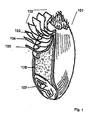
- Cereals are consumed across the world as staple food, because they are a primary source of carbohydrates thanks to the high starch content of the endosperm, which is situated in the central part of the caryopsis (see Fig. 1) and represents its major constituent.
- the structure of the soft wheat caryopsis 101 is briefly reviewed. Going from the outside inwards, there are the following layers composing the bran: four cell layers (longitudinal, transverse, crossed and tubular) which together compose the coating of the fruit or pericarp 102 (3-6% in weight of the total weight of the caryopsis), and then testa 103, nucellar layer (or hyaline layer) 104 and aleurone 105, which together form the coat of the seed (1,2,3).
- the inner part is composed of endosperm 106 and germ 107.
- the aleuronic layer which makes up 5-7% in weight of the total weight of the caryopsis, is composed of a layer of polygonal cells of large size in contact with the endosperm (1, 2).
- Flour is the main product of the soft wheat milling process, the primary objective of which is the achievement of a final product with a high degree of purity (sifted). It is composed of the starchy, innermost parts of the caryopsis (endosperm) following separation from the outermost parts (the bran, which composes about 15% of the total content of the caryopsis, and the germ, which composes about 3%), traditionally intended for animal feed.
- a complex series of micro-nutrients are located in the bran, such as dietary fibres (insoluble and soluble), minerals, vitamins, lipids and a class of components known as "phytochemicals", having protective activity (anti-oxidant) in cell metabolism and in phenomena linked to ageing (8,9,10,11,12).
- the available whole grain products are penalised by a number of negative organoleptic elements including appearance (dark colour), texture (rough, heavy), a marked flavour often associated to the development of off-flavours over time (cardboard taste), which strongly limit their use.
- the whole grain flours thus obtained therefore contain bran which substantially originates from all the layers of the caryopsis external to the endosperm.
- Semolina or cereal flour production processes which comprise a preliminary removal step of the outer layers of the caryopsis through process phases involving friction and abrasion, prior to the milling of the caryopses have been known for many years.
- bran fractions are collected, corresponding to as many steps of friction or abrasion carried out on the caryopses.
- the first is the richest in cellulosic fibres, since it corresponds to the outermost layers of the caryopsis whereas the latter is the richest in protein, since it contains the innermost bran layers, including part of the aleuronic layer.
- the whole grain flours available on the market even when they are obtained by means of one of the aforementioned processes, contain nearly all of the bran present in the caryopses, possibly previously subjected to further milling treatments in order to reduce the size of the particles, and heat stabilisation treatments in order to forestall oxidative phenomena caused by enzymatic degradations.
- the problem underlying the present invention was that of providing a soft wheat flour with a high content of dietary bran and preferably such as to be defined whole grain (on the basis of the Italian law, a flour is defined as whole grain when it has an ash content comprised between 1.30 and 1.70% in weight of the dry weight and a minimum protein content of 12.0% in weight of the dry weight) but with organoleptic characteristics such that it results substantially comparable to those of a refined flour.
- a similar problem has been solved by a soft wheat flour containing bran having a total fibre content comprised between 20 and 30% in weight of the total weight of the bran and a protein content comprised between 12.0 and 18.0% in weight of the total weight of the bran.
- the flour according to the invention has a bran content comprised between 5 and 30%, advantageously between 10 and 20%, in weight of its total weight (considering an average humidity content of 10%).
- the aforementioned bran mainly contains the aleuronic, nucellar and testa layers of the starting caryopses.
- the flour according to the present invention is produced by means of a process which comprises the steps of:
- the aforementioned soft wheat flour is obtained by the milling of the caryopses from which the outermost bran coating has been substantially removed, and conveniently such milling step is carried out in the same facility in which the aforementioned process phases involving abrasion take place, continuously pooling the flows of soft wheat flour and the aforementioned latter bran fraction.
- the aforementioned process phases involving abrasion are preferably carried out on caryopses which have been previously wetted with a quantity of water such as to bring their humidity content to at least 15% and then subjected to conditioning.
- the aforementioned wetting step of the caryopses is preferably carried out by subjecting the caryopses to intense vibrations of a frequency comprised between 50 and 300 Hz.
- the invention relates to bakery products containing a bran with a total fibre content comprised between 20 and 30% in weight of the total weight of the bran and a protein content comprised between 12.0 and 18.0% in weight of the total weight of the bran.
- Such bakery products generally have a bran content comprised between 2 and 24%, preferably 4-16%, in weight of their total weight.
- the present invention also refers to the use of a fraction of soft wheat bran containing essentially the layers of the starting caryopses, consisting of the aleurone, nucellar and testa layers, in the production of whole grain bakery products.
- Such fraction of soft wheat bran may be utilised as obtained from the abrasion step of the process according to the invention, and could be utilized without additional heat stabilization or other treatments and the final products therefrom obtained (pasta shapes, bakery products) exhibit optimal organoleptic properties, which they maintain substantially unaltered throughout their shelf-life.
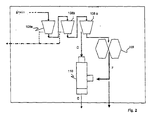
- the process for the production of a soft wheat flour according to the invention involves the wheat caryopses 101 undergoing, prior to their rupture (milling), progressive removal of the bran layers, by subjecting the outer surface of the caryopsis to the abrasive action of a plurality of decortication or abrasion machines 108a, 108b, 108c (for example 2 or 3), which a flow of wheat passes in series, one after the other.
- a plurality of decortication or abrasion machines 108a, 108b, 108c for example 2 or 3
- the decortication or abrasion machines 108a, 108b, 108c consist of a vertical axis rotating shaft, on which the abrasive Carborundum grindstones are mounted.
- Examples of decortication machines apt for use in the present process are provided in the applications EP 0 373 274 and EP 0 335 174 .
- One machine which is commercially available and useful in the present process is the machine model DECO 420R from T.A.E.. The wheat, upon entering the upper part of the machine, is pushed toward the outlet situated in the lower part.
- the wheat is forced to spread itself out in the restricted space between the rotating grindstones and a metallic containment baffle, thus undergoing an abrasive action which causes the removal of the outermost bran layers, which are recovered in the form of powder by suction.
- This operation is repeated, for example, three consecutive times, thus permitting the progressive separation of increasingly internal bran layers.
- the most superficial bran layers are removed, with the second the intermediate layers and finally with the third passing the innermost layers, those nearest to the endosperm and essentially originating from aleurone 105, nucellar 104 and testa 103 layers, are removed.
- the caryopses (101) exiting from the third abrasion machine 108c are fed into a conventional mill 109, in which they are ground, producing a flour F consisting essentially of endosperm.
- the third bran fraction D be pooled, during the milling process, with the aforementioned flour F essentially consisting of endosperm.
- a typical composition of the third bran fraction D obtained by means of the process according to the present invention is shown in table 1 below.
- the data represent the average values obtained by the processing of both "soft” soft wheats (category of soft wheats having caryopsis texture which may be easily made into flour by milling) and the “hard” type (category of soft wheat the milled caryopsis of which generates sharp-edged flours).
- the third decortication fraction D is transported to a doser (for example screw-type), and the same is done for the flow of the product F obtained by the milling of the caryopses from which the bran coating has been removed by the above described abrasion steps.
- the two dosers converge in a mixer 110, which gives an effective mixing in order to provide a flour C having a good content of dietary bran according to the invention.
- the flour according to the invention is conveyed towards a storage system.
- the soft wheat flour thus obtained proves to be particularly suitable for the production of bakery products, in which the maintenance of the nutritional benefits deriving from the presence of the bran components (fibre, minerals, phytochemicals, vitamins) is associated with organoleptic characteristics (colour, flavour, texture) similar to those of corresponding products obtained from sifted flours, that is, completely free of bran. Moreover, such organoleptic characteristics are maintained substantially unaltered for the entire shalf-life of the finished product.
- the bran obtained by the conventional milling processes is indeed subject to deterioration even after a short period of time, due to the triggering of oxidation reactions (rancidity) of the lipid components present in the bran, in which there may also be present parts of the germ, which is very rich in lipids (1,3,28).
- rancidity leads to the formation, as oxidation products, of volatile and non-volatile chemical products imparting off-odours and off-flavours (peroxides and secondary oxidation products such as aldehydes, alcohols and ketones) (28).
- rancidity can be caused by the activation of enzymes (lipases and lipoxygenases) found in the bran, which attack the lipid portion present (28).
- bran obtained in the conventional way, one tries to contain and prevent this phenomenon by destroying (inactivating) such enzymes by heat (heat treatment), in order to avoid the bran fractions triggering oxidation reactions over time in the finished products in which they are utilised.
- the heat treatment of the bran in addition to representing an additional cost, if done at excessively high temperatures may lead to a further darkening of the bran, the development of odd flavours (toasted, burnt and bitter) and the triggering of a chemical degradation (by heat) of the lipid part (28).
- the treatment does not permit the blocking of the lipolytic enzymes.
- the particular stability to oxidation of the bran fraction of the food composition according to the present invention compared to the traditional bran may be due to the fact that it is obtained with a process which involves lower mechanical and thermal stress compared to those involved in conventional processes.
- the bran obtained with the conventional processes in fact undergo a greater number of milling steps (grindings, separations) through which they are separated from the endosperm and separated.
- the greater processing to which the bran is subjected in the conventional milling process may favour the creation of a number of conditions (28) (increased exposure to oxygen, increased damage to the cell structures containing the lipid deposits, freeing of or contamination with metal ions acting as catalysts of the oxidation reactions, damage to components protecting from oxidation reactions) which render such bran more susceptible to oxidation.
- the bran fraction of the flour according to the present invention has the additional advantage, compared to traditional bran, of supplying a greater quantity of the important nutrients contained in the aleuronic layer (1,2,11,29) and a smaller quantity of the pigmented components, which are present especially in the outermost layers of the bran coating and which are capable of causing a darkening of the products obtained with the conventional whole grain flours.
- the progressive application of the abrasive action ensured by the described decortication or abrasion machines, permits the isolation and the use of a more internal bran fraction and therefore, from a hygienic-sanitary standpoint, the first two decortication passings may be considered as an additional and significant extension of the selection and cleaning steps which constitute the initial part, upstream of any milling process.
- the caryopses exiting from the third decorticator machine 108c were subjected to a dynamic air current cooling, prior to being fed to a conventional mill 109 for milling.
- the decorticated caryopses were milled according to the standard working modes used for the milling of whole caryopses, finally obtaining 89 kg of a flour consisting essentially of endosperm with an ash content of 0.58% in weight of the total weight and a protein content of 11.50% in weight of the total weight.
- the third powder exiting from the last decorticator 108c was a bran fraction characterised by the composition shown in the following table 2.
- Table 2 Component Unit Value Humidity % 9.8 Proteins (N x 5.70) % w/w 16.5 Lipids % w/w 3.8 Ash % w/w 4.2 Phosphorus mg / 100 g 880 Magnesium mg / 100 g 310 Total Dietary Fibre % w/w 27.0 Insoluble Dietary Fibre % w/w 23.5 Cellulose % w/w 4.8 Soluble Dietary Fibre % w/w 2.1 B-glucans % w/w 2.8 Vitamin E (tocopherol) mg / 100 g 1.7 Vitamin B1 (thiamine) mg / 100 g 0.9 Vitamin B2 (riboflavin) mg / 100 g 0.5 Folic acid ⁇ g / 100 g 35 Niacin mg / 100 g 17
- Bread loaves were prepared using the soft whole grain flour thus produced, which were then sliced and packaged in sealed polypropylene food packaging. The bread was then stored for 45 days at room temperature. Bread samples thus stored were periodically assessed by a trained panel of tasters, throughout its entire shelf-life. During such assessments, neither significant variations in the organoleptic properties nor development of off-flavours were detected.
- the mentioned bread loaf (AB) was moreover compared with another bread (STD) obtained by an analogous recipe but by using conventional whole grain flour, utilised in a percentage such that it had a fibre content (about 8%) comparable to the former.
- the bread obtained according to the present claim (AB) was significantly softer and more elastic compared to that produced using conventional whole grain flour (STD).
Landscapes
- Engineering & Computer Science (AREA)
- Food Science & Technology (AREA)
- Life Sciences & Earth Sciences (AREA)
- Bakery Products And Manufacturing Methods Therefor (AREA)
- Cereal-Derived Products (AREA)
- Coloring Foods And Improving Nutritive Qualities (AREA)
Priority Applications (10)
| Application Number | Priority Date | Filing Date | Title |
|---|---|---|---|
| DK05425911.4T DK1800541T3 (da) | 2005-12-23 | 2005-12-23 | Blødt hvedemel med højt klidindhold, fremgangsmåde for dets fremstilling og bagværk, der indeholder det |
| EP05425911A EP1800541B1 (de) | 2005-12-23 | 2005-12-23 | Weichweizenmehl mit hohem Kleieanteil, Verfahren zu Herstellung und dieses enthaltende Backwaren |
| PL05425911T PL1800541T3 (pl) | 2005-12-23 | 2005-12-23 | Mąka z pszenicy miękkiej z dużą zawartością otrębów, sposób jej wytwarzania i pieczywo zawierające tę mąkę |
| AT05425911T ATE525910T1 (de) | 2005-12-23 | 2005-12-23 | Weichweizenmehl mit hohem kleieanteil, verfahren zu herstellung und dieses enthaltende backwaren |
| SI200531381T SI1800541T1 (sl) | 2005-12-23 | 2005-12-23 | Mehka pšenična moka z visoko vsebnostjo otrobov, postopek izdelave le-te in pekarski izdelki, vsebujoči le-to |
| PT05425911T PT1800541E (pt) | 2005-12-23 | 2005-12-23 | Farinha de trigo macio com alto teor de farelo, processo para a sua produção e produtos de pastelaria que o contêm. |
| ES05425911T ES2374404T3 (es) | 2005-12-23 | 2005-12-23 | Harina de trigo blando con alto contenido en salvado, procedimiento para su producción y productos de panadería que lo contienen. |
| MXPA06015179A MXPA06015179A (es) | 2005-12-23 | 2006-12-20 | Harina de trigo suave con alto contenido de salvado proceso para su produccion y productos para hornear que los contienen. |
| CA2571797A CA2571797C (en) | 2005-12-23 | 2006-12-20 | Soft wheat flour with high bran content, process for its production and bakery products containing it |
| US11/614,280 US8043646B2 (en) | 2005-12-23 | 2006-12-21 | Soft wheat flour with high bran content, process for its production and bakery products containing it |
Applications Claiming Priority (1)
| Application Number | Priority Date | Filing Date | Title |
|---|---|---|---|
| EP05425911A EP1800541B1 (de) | 2005-12-23 | 2005-12-23 | Weichweizenmehl mit hohem Kleieanteil, Verfahren zu Herstellung und dieses enthaltende Backwaren |
Publications (2)
| Publication Number | Publication Date |
|---|---|
| EP1800541A1 true EP1800541A1 (de) | 2007-06-27 |
| EP1800541B1 EP1800541B1 (de) | 2011-09-28 |
Family
ID=37487570
Family Applications (1)
| Application Number | Title | Priority Date | Filing Date |
|---|---|---|---|
| EP05425911A Expired - Lifetime EP1800541B1 (de) | 2005-12-23 | 2005-12-23 | Weichweizenmehl mit hohem Kleieanteil, Verfahren zu Herstellung und dieses enthaltende Backwaren |
Country Status (10)
| Country | Link |
|---|---|
| US (1) | US8043646B2 (de) |
| EP (1) | EP1800541B1 (de) |
| AT (1) | ATE525910T1 (de) |
| CA (1) | CA2571797C (de) |
| DK (1) | DK1800541T3 (de) |
| ES (1) | ES2374404T3 (de) |
| MX (1) | MXPA06015179A (de) |
| PL (1) | PL1800541T3 (de) |
| PT (1) | PT1800541E (de) |
| SI (1) | SI1800541T1 (de) |
Cited By (1)
| Publication number | Priority date | Publication date | Assignee | Title |
|---|---|---|---|---|
| US9795157B2 (en) | 2009-07-01 | 2017-10-24 | General Mills, Inc. | Method for pretreating grain before milling |
Families Citing this family (2)
| Publication number | Priority date | Publication date | Assignee | Title |
|---|---|---|---|---|
| US8309830B2 (en) * | 2009-04-23 | 2012-11-13 | Board Of Trustees Of Michigan State University | Wheat variety MSU line E0028 |
| CA3019473C (en) | 2016-04-01 | 2024-05-28 | Nestec S.A. | Ingredient for foodstuffs |
Citations (5)
| Publication number | Priority date | Publication date | Assignee | Title |
|---|---|---|---|---|
| US3995065A (en) * | 1975-09-04 | 1976-11-30 | International Telephone And Telegraph Corporation | Composition for preparing a high complete protein wheat bread |
| GB2005982A (en) * | 1977-10-21 | 1979-05-02 | Joulin G | Bran bread and method for making same |
| EP0379144A1 (de) * | 1989-01-17 | 1990-07-25 | Pizza World Sas | Mischung aus Mehlsorten und Kleie für die Herstellung von Soja-Pizza |
| DE3603086C1 (de) * | 1986-02-01 | 1993-05-13 | Wendeln Gmbh B Jr | Weizenvollkornmehl,Verfahren zu dessen Herstellung und dessen Verwendung |
| WO2004028694A1 (en) * | 2002-09-30 | 2004-04-08 | Barilla G. E R. Fratelli S.P.A. | A process for the production of wheat flour |
Family Cites Families (4)
| Publication number | Priority date | Publication date | Assignee | Title |
|---|---|---|---|---|
| CA1313330C (en) | 1988-12-16 | 1993-02-02 | Joseph Tkac | Process for removing bran layers from wheat kernels |
| CA1321525C (en) * | 1987-06-18 | 1993-08-24 | Joseph John Tkac | Process for use in milling flour |
| JPH0767540B2 (ja) | 1988-03-31 | 1995-07-26 | 株式会社佐竹製作所 | 堅軸型摩擦切削式精穀機 |
| US20060275536A1 (en) * | 2005-06-02 | 2006-12-07 | Joshua Reid | Grain product with increased soluble fiber content and associated methods |
-
2005
- 2005-12-23 DK DK05425911.4T patent/DK1800541T3/da active
- 2005-12-23 EP EP05425911A patent/EP1800541B1/de not_active Expired - Lifetime
- 2005-12-23 SI SI200531381T patent/SI1800541T1/sl unknown
- 2005-12-23 PT PT05425911T patent/PT1800541E/pt unknown
- 2005-12-23 AT AT05425911T patent/ATE525910T1/de active
- 2005-12-23 ES ES05425911T patent/ES2374404T3/es not_active Expired - Lifetime
- 2005-12-23 PL PL05425911T patent/PL1800541T3/pl unknown
-
2006
- 2006-12-20 MX MXPA06015179A patent/MXPA06015179A/es active IP Right Grant
- 2006-12-20 CA CA2571797A patent/CA2571797C/en active Active
- 2006-12-21 US US11/614,280 patent/US8043646B2/en active Active
Patent Citations (5)
| Publication number | Priority date | Publication date | Assignee | Title |
|---|---|---|---|---|
| US3995065A (en) * | 1975-09-04 | 1976-11-30 | International Telephone And Telegraph Corporation | Composition for preparing a high complete protein wheat bread |
| GB2005982A (en) * | 1977-10-21 | 1979-05-02 | Joulin G | Bran bread and method for making same |
| DE3603086C1 (de) * | 1986-02-01 | 1993-05-13 | Wendeln Gmbh B Jr | Weizenvollkornmehl,Verfahren zu dessen Herstellung und dessen Verwendung |
| EP0379144A1 (de) * | 1989-01-17 | 1990-07-25 | Pizza World Sas | Mischung aus Mehlsorten und Kleie für die Herstellung von Soja-Pizza |
| WO2004028694A1 (en) * | 2002-09-30 | 2004-04-08 | Barilla G. E R. Fratelli S.P.A. | A process for the production of wheat flour |
Non-Patent Citations (3)
| Title |
|---|
| BELITZ/GROSCH: "Lehrbuch der Lebensmittelchemie", 1987, SPRINGER, BERLIN, HEIDELBERG, XP002411190 * |
| DATABASE FSTA [online] INTERNATIONAL FOOD INFORMATION SERVICE (IFIS), FRANkFURT-MAIN, DE; SEIBEL W ET AL: "Möglichkeiten der Ballaststoffanreicherung bei Feinen Backwaren.", XP002411132, Database accession no. 83-2-12-m1897 * |
| GETREIDE, MEHL UND BROT, vol. 34, no. 12, 1980, BUNDESFORSCHUNGSANSTALT FÜR GETREIDE- & KARTOFFELVERARBEITUNG, POSTFACH 23, 4930 DETMOLD, FEDERAL REPUBLIC OF GERMANY, pages 333 - 336 * |
Cited By (1)
| Publication number | Priority date | Publication date | Assignee | Title |
|---|---|---|---|---|
| US9795157B2 (en) | 2009-07-01 | 2017-10-24 | General Mills, Inc. | Method for pretreating grain before milling |
Also Published As
| Publication number | Publication date |
|---|---|
| PL1800541T3 (pl) | 2012-04-30 |
| DK1800541T3 (da) | 2012-01-16 |
| MXPA06015179A (es) | 2008-10-09 |
| EP1800541B1 (de) | 2011-09-28 |
| SI1800541T1 (sl) | 2011-12-30 |
| CA2571797C (en) | 2013-09-10 |
| US8043646B2 (en) | 2011-10-25 |
| ATE525910T1 (de) | 2011-10-15 |
| CA2571797A1 (en) | 2007-06-23 |
| ES2374404T3 (es) | 2012-02-16 |
| PT1800541E (pt) | 2012-01-03 |
| US20070148319A1 (en) | 2007-06-28 |
Similar Documents
| Publication | Publication Date | Title |
|---|---|---|
| US8771777B2 (en) | Durum wheat pasta with high alimentary bran content and process for the production thereof | |
| US7425344B2 (en) | Process for producing a milled whole-grain wheat flour and products thereof | |
| CA2553287C (en) | A process for producing an ultrafine-milled whole-grain wheat flour and products thereof | |
| CA3029517C (en) | Stabilized whole grain flour and method of making | |
| CN101605462B (zh) | 包含荞麦壳的零食片 | |
| Puramshetty et al. | Physical and milling properties | |
| Rao et al. | Sorghum | |
| EP1800541B1 (de) | Weichweizenmehl mit hohem Kleieanteil, Verfahren zu Herstellung und dieses enthaltende Backwaren | |
| Khetarpaul | Bakery science and cereal technology | |
| Beukes | Effect of stone and roller milling on physicochemical, functional and structural properties of sifted wheat flour | |
| US20250325990A1 (en) | Process for the production of whole semolina | |
| Inamdar et al. | Wheat | |
| ACCEPTABILITY et al. | EFFECTS OF VARIETIES ON PHYSICAL AND FUNCTIONAL | |
| Cauvain et al. | Dry milling of wheat and other cereals | |
| Sots et al. | Some features of oats processing | |
| Kunkulberga et al. | Development of wholegrain products. | |
| Balázs | Cereal processing and cereal based foods | |
| WO2015114501A1 (en) | Process for the production of an edible pasta from durum wheat having a high nutritional potential and edible past from durum wheat having a high nutritional potential |
Legal Events
| Date | Code | Title | Description |
|---|---|---|---|
| PUAI | Public reference made under article 153(3) epc to a published international application that has entered the european phase |
Free format text: ORIGINAL CODE: 0009012 |
|
| AK | Designated contracting states |
Kind code of ref document: A1 Designated state(s): AT BE BG CH CY CZ DE DK EE ES FI FR GB GR HU IE IS IT LI LT LU LV MC NL PL PT RO SE SI SK TR |
|
| AX | Request for extension of the european patent |
Extension state: AL BA HR MK YU |
|
| 17P | Request for examination filed |
Effective date: 20071219 |
|
| 17Q | First examination report despatched |
Effective date: 20080129 |
|
| AKX | Designation fees paid |
Designated state(s): AT BE BG CH CY CZ DE DK EE ES FI FR GB GR HU IE IS IT LI LT LU LV MC NL PL PT RO SE SI SK TR |
|
| GRAP | Despatch of communication of intention to grant a patent |
Free format text: ORIGINAL CODE: EPIDOSNIGR1 |
|
| GRAS | Grant fee paid |
Free format text: ORIGINAL CODE: EPIDOSNIGR3 |
|
| GRAA | (expected) grant |
Free format text: ORIGINAL CODE: 0009210 |
|
| RAP1 | Party data changed (applicant data changed or rights of an application transferred) |
Owner name: BARILLA G. E R. FRATELLI S.P.A. |
|
| AK | Designated contracting states |
Kind code of ref document: B1 Designated state(s): AT BE BG CH CY CZ DE DK EE ES FI FR GB GR HU IE IS IT LI LT LU LV MC NL PL PT RO SE SI SK TR |
|
| REG | Reference to a national code |
Ref country code: GB Ref legal event code: FG4D |
|
| REG | Reference to a national code |
Ref country code: CH Ref legal event code: EP |
|
| REG | Reference to a national code |
Ref country code: IE Ref legal event code: FG4D |
|
| REG | Reference to a national code |
Ref country code: CH Ref legal event code: NV Representative=s name: ING. MARCO ZARDI C/O M. ZARDI & CO. S.A. |
|
| REG | Reference to a national code |
Ref country code: NL Ref legal event code: T3 |
|
| REG | Reference to a national code |
Ref country code: DE Ref legal event code: R096 Ref document number: 602005030225 Country of ref document: DE Effective date: 20111222 |
|
| REG | Reference to a national code |
Ref country code: PT Ref legal event code: SC4A Free format text: AVAILABILITY OF NATIONAL TRANSLATION Effective date: 20111121 |
|
| REG | Reference to a national code |
Ref country code: DK Ref legal event code: T3 |
|
| REG | Reference to a national code |
Ref country code: SE Ref legal event code: TRGR |
|
| REG | Reference to a national code |
Ref country code: EE Ref legal event code: FG4A Ref document number: E005987 Country of ref document: EE Effective date: 20111227 |
|
| REG | Reference to a national code |
Ref country code: ES Ref legal event code: FG2A Ref document number: 2374404 Country of ref document: ES Kind code of ref document: T3 Effective date: 20120216 |
|
| PG25 | Lapsed in a contracting state [announced via postgrant information from national office to epo] |
Ref country code: CY Free format text: LAPSE BECAUSE OF FAILURE TO SUBMIT A TRANSLATION OF THE DESCRIPTION OR TO PAY THE FEE WITHIN THE PRESCRIBED TIME-LIMIT Effective date: 20110928 |
|
| REG | Reference to a national code |
Ref country code: GR Ref legal event code: EP Ref document number: 20110402767 Country of ref document: GR Effective date: 20120117 |
|
| REG | Reference to a national code |
Ref country code: SK Ref legal event code: T3 Ref document number: E 10831 Country of ref document: SK |
|
| REG | Reference to a national code |
Ref country code: PL Ref legal event code: T3 |
|
| PG25 | Lapsed in a contracting state [announced via postgrant information from national office to epo] |
Ref country code: RO Free format text: LAPSE BECAUSE OF FAILURE TO SUBMIT A TRANSLATION OF THE DESCRIPTION OR TO PAY THE FEE WITHIN THE PRESCRIBED TIME-LIMIT Effective date: 20110928 |
|
| REG | Reference to a national code |
Ref country code: HU Ref legal event code: AG4A Ref document number: E012939 Country of ref document: HU |
|
| PG25 | Lapsed in a contracting state [announced via postgrant information from national office to epo] |
Ref country code: MC Free format text: LAPSE BECAUSE OF NON-PAYMENT OF DUE FEES Effective date: 20111231 |
|
| PLBE | No opposition filed within time limit |
Free format text: ORIGINAL CODE: 0009261 |
|
| STAA | Information on the status of an ep patent application or granted ep patent |
Free format text: STATUS: NO OPPOSITION FILED WITHIN TIME LIMIT |
|
| 26N | No opposition filed |
Effective date: 20120629 |
|
| REG | Reference to a national code |
Ref country code: DE Ref legal event code: R097 Ref document number: 602005030225 Country of ref document: DE Effective date: 20120629 |
|
| PG25 | Lapsed in a contracting state [announced via postgrant information from national office to epo] |
Ref country code: BG Free format text: LAPSE BECAUSE OF FAILURE TO SUBMIT A TRANSLATION OF THE DESCRIPTION OR TO PAY THE FEE WITHIN THE PRESCRIBED TIME-LIMIT Effective date: 20111228 |
|
| REG | Reference to a national code |
Ref country code: FR Ref legal event code: PLFP Year of fee payment: 11 |
|
| REG | Reference to a national code |
Ref country code: FR Ref legal event code: PLFP Year of fee payment: 12 |
|
| REG | Reference to a national code |
Ref country code: FR Ref legal event code: PLFP Year of fee payment: 13 |
|
| PGFP | Annual fee paid to national office [announced via postgrant information from national office to epo] |
Ref country code: PT Payment date: 20241125 Year of fee payment: 20 |
|
| PGFP | Annual fee paid to national office [announced via postgrant information from national office to epo] |
Ref country code: NL Payment date: 20241121 Year of fee payment: 20 Ref country code: LU Payment date: 20241121 Year of fee payment: 20 |
|
| PGFP | Annual fee paid to national office [announced via postgrant information from national office to epo] |
Ref country code: LT Payment date: 20241121 Year of fee payment: 20 |
|
| PGFP | Annual fee paid to national office [announced via postgrant information from national office to epo] |
Ref country code: DE Payment date: 20241121 Year of fee payment: 20 |
|
| PGFP | Annual fee paid to national office [announced via postgrant information from national office to epo] |
Ref country code: DK Payment date: 20241121 Year of fee payment: 20 |
|
| PGFP | Annual fee paid to national office [announced via postgrant information from national office to epo] |
Ref country code: BE Payment date: 20241121 Year of fee payment: 20 Ref country code: FI Payment date: 20241121 Year of fee payment: 20 Ref country code: GR Payment date: 20241122 Year of fee payment: 20 Ref country code: PL Payment date: 20241125 Year of fee payment: 20 |
|
| PGFP | Annual fee paid to national office [announced via postgrant information from national office to epo] |
Ref country code: GB Payment date: 20241122 Year of fee payment: 20 |
|
| PGFP | Annual fee paid to national office [announced via postgrant information from national office to epo] |
Ref country code: FR Payment date: 20241121 Year of fee payment: 20 |
|
| PGFP | Annual fee paid to national office [announced via postgrant information from national office to epo] |
Ref country code: EE Payment date: 20241122 Year of fee payment: 20 Ref country code: LV Payment date: 20241121 Year of fee payment: 20 |
|
| PGFP | Annual fee paid to national office [announced via postgrant information from national office to epo] |
Ref country code: HU Payment date: 20241209 Year of fee payment: 20 Ref country code: IS Payment date: 20241128 Year of fee payment: 20 Ref country code: AT Payment date: 20241122 Year of fee payment: 20 |
|
| PGFP | Annual fee paid to national office [announced via postgrant information from national office to epo] |
Ref country code: CZ Payment date: 20241127 Year of fee payment: 20 Ref country code: IE Payment date: 20241122 Year of fee payment: 20 |
|
| PGFP | Annual fee paid to national office [announced via postgrant information from national office to epo] |
Ref country code: SK Payment date: 20241127 Year of fee payment: 20 |
|
| PGFP | Annual fee paid to national office [announced via postgrant information from national office to epo] |
Ref country code: IT Payment date: 20241202 Year of fee payment: 20 |
|
| PGFP | Annual fee paid to national office [announced via postgrant information from national office to epo] |
Ref country code: SE Payment date: 20241121 Year of fee payment: 20 |
|
| PGFP | Annual fee paid to national office [announced via postgrant information from national office to epo] |
Ref country code: TR Payment date: 20241126 Year of fee payment: 20 |
|
| PGFP | Annual fee paid to national office [announced via postgrant information from national office to epo] |
Ref country code: SI Payment date: 20241129 Year of fee payment: 20 |
|
| PGFP | Annual fee paid to national office [announced via postgrant information from national office to epo] |
Ref country code: ES Payment date: 20250102 Year of fee payment: 20 |
|
| PGFP | Annual fee paid to national office [announced via postgrant information from national office to epo] |
Ref country code: CH Payment date: 20250101 Year of fee payment: 20 |
|
| REG | Reference to a national code |
Ref country code: CH Ref legal event code: H14 Free format text: ST27 STATUS EVENT CODE: U-0-0-H10-H14 (AS PROVIDED BY THE NATIONAL OFFICE) Effective date: 20251223 Ref country code: DE Ref legal event code: R071 Ref document number: 602005030225 Country of ref document: DE |
|
| REG | Reference to a national code |
Ref country code: NL Ref legal event code: MK Effective date: 20251222 |
|
| REG | Reference to a national code |
Ref country code: ES Ref legal event code: FD2A Effective date: 20260105 Ref country code: DK Ref legal event code: EUP Expiry date: 20251223 |
|
| REG | Reference to a national code |
Ref country code: LT Ref legal event code: MM9A Effective date: 20251223 |
|
| REG | Reference to a national code |
Ref country code: SK Ref legal event code: MK4A Ref document number: E 10831 Country of ref document: SK Expiry date: 20251223 Ref country code: GB Ref legal event code: PE20 Expiry date: 20251222 |
|
| REG | Reference to a national code |
Ref country code: BE Ref legal event code: MK Effective date: 20251223 |
|
| PG25 | Lapsed in a contracting state [announced via postgrant information from national office to epo] |
Ref country code: CZ Free format text: LAPSE BECAUSE OF EXPIRATION OF PROTECTION Effective date: 20251223 |
|
| PG25 | Lapsed in a contracting state [announced via postgrant information from national office to epo] |
Ref country code: SK Free format text: LAPSE BECAUSE OF EXPIRATION OF PROTECTION Effective date: 20251223 |
|
| REG | Reference to a national code |
Ref country code: IE Ref legal event code: MK9A |
|
| PG25 | Lapsed in a contracting state [announced via postgrant information from national office to epo] |
Ref country code: ES Free format text: LAPSE BECAUSE OF EXPIRATION OF PROTECTION Effective date: 20251224 |
|
| REG | Reference to a national code |
Ref country code: SE Ref legal event code: EUG |
|
| REG | Reference to a national code |
Ref country code: AT Ref legal event code: MK07 Ref document number: 525910 Country of ref document: AT Kind code of ref document: T Effective date: 20251223 |
|
| PG25 | Lapsed in a contracting state [announced via postgrant information from national office to epo] |
Ref country code: IE Free format text: LAPSE BECAUSE OF EXPIRATION OF PROTECTION Effective date: 20251223 |
|
| PG25 | Lapsed in a contracting state [announced via postgrant information from national office to epo] |
Ref country code: PT Free format text: LAPSE BECAUSE OF EXPIRATION OF PROTECTION Effective date: 20260107 |