EP1801209B1 - Modifizierte genomische rna des menschlichen hepatitis-c-virus mit autonomer replikationskompetenz - Google Patents
Modifizierte genomische rna des menschlichen hepatitis-c-virus mit autonomer replikationskompetenz Download PDFInfo
- Publication number
- EP1801209B1 EP1801209B1 EP05781421A EP05781421A EP1801209B1 EP 1801209 B1 EP1801209 B1 EP 1801209B1 EP 05781421 A EP05781421 A EP 05781421A EP 05781421 A EP05781421 A EP 05781421A EP 1801209 B1 EP1801209 B1 EP 1801209B1
- Authority
- EP
- European Patent Office
- Prior art keywords
- hcv
- virus
- hepatitis
- rna
- chromatography
- Prior art date
- Legal status (The legal status is an assumption and is not a legal conclusion. Google has not performed a legal analysis and makes no representation as to the accuracy of the status listed.)
- Expired - Lifetime
Links
Images







Classifications
-
- C—CHEMISTRY; METALLURGY
- C12—BIOCHEMISTRY; BEER; SPIRITS; WINE; VINEGAR; MICROBIOLOGY; ENZYMOLOGY; MUTATION OR GENETIC ENGINEERING
- C12N—MICROORGANISMS OR ENZYMES; COMPOSITIONS THEREOF; PROPAGATING, PRESERVING, OR MAINTAINING MICROORGANISMS; MUTATION OR GENETIC ENGINEERING; CULTURE MEDIA
- C12N7/00—Viruses; Bacteriophages; Compositions thereof; Preparation or purification thereof
-
- A—HUMAN NECESSITIES
- A61—MEDICAL OR VETERINARY SCIENCE; HYGIENE
- A61K—PREPARATIONS FOR MEDICAL, DENTAL OR TOILETRY PURPOSES
- A61K39/00—Medicinal preparations containing antigens or antibodies
- A61K39/12—Viral antigens
- A61K39/29—Hepatitis virus
-
- A—HUMAN NECESSITIES
- A61—MEDICAL OR VETERINARY SCIENCE; HYGIENE
- A61K—PREPARATIONS FOR MEDICAL, DENTAL OR TOILETRY PURPOSES
- A61K48/00—Medicinal preparations containing genetic material which is inserted into cells of the living body to treat genetic diseases; Gene therapy
-
- A—HUMAN NECESSITIES
- A61—MEDICAL OR VETERINARY SCIENCE; HYGIENE
- A61P—SPECIFIC THERAPEUTIC ACTIVITY OF CHEMICAL COMPOUNDS OR MEDICINAL PREPARATIONS
- A61P1/00—Drugs for disorders of the alimentary tract or the digestive system
- A61P1/16—Drugs for disorders of the alimentary tract or the digestive system for liver or gallbladder disorders, e.g. hepatoprotective agents, cholagogues, litholytics
-
- A—HUMAN NECESSITIES
- A61—MEDICAL OR VETERINARY SCIENCE; HYGIENE
- A61P—SPECIFIC THERAPEUTIC ACTIVITY OF CHEMICAL COMPOUNDS OR MEDICINAL PREPARATIONS
- A61P31/00—Antiinfectives, i.e. antibiotics, antiseptics, chemotherapeutics
- A61P31/12—Antivirals
- A61P31/14—Antivirals for RNA viruses
-
- C—CHEMISTRY; METALLURGY
- C12—BIOCHEMISTRY; BEER; SPIRITS; WINE; VINEGAR; MICROBIOLOGY; ENZYMOLOGY; MUTATION OR GENETIC ENGINEERING
- C12N—MICROORGANISMS OR ENZYMES; COMPOSITIONS THEREOF; PROPAGATING, PRESERVING, OR MAINTAINING MICROORGANISMS; MUTATION OR GENETIC ENGINEERING; CULTURE MEDIA
- C12N15/00—Mutation or genetic engineering; DNA or RNA concerning genetic engineering, vectors, e.g. plasmids, or their isolation, preparation or purification; Use of hosts therefor
- C12N15/09—Recombinant DNA-technology
- C12N15/63—Introduction of foreign genetic material using vectors; Vectors; Use of hosts therefor; Regulation of expression
- C12N15/79—Vectors or expression systems specially adapted for eukaryotic hosts
- C12N15/85—Vectors or expression systems specially adapted for eukaryotic hosts for animal cells
- C12N15/86—Viral vectors
-
- C—CHEMISTRY; METALLURGY
- C12—BIOCHEMISTRY; BEER; SPIRITS; WINE; VINEGAR; MICROBIOLOGY; ENZYMOLOGY; MUTATION OR GENETIC ENGINEERING
- C12N—MICROORGANISMS OR ENZYMES; COMPOSITIONS THEREOF; PROPAGATING, PRESERVING, OR MAINTAINING MICROORGANISMS; MUTATION OR GENETIC ENGINEERING; CULTURE MEDIA
- C12N5/00—Undifferentiated human, animal or plant cells, e.g. cell lines; Tissues; Cultivation or maintenance thereof; Culture media therefor
- C12N5/10—Cells modified by introduction of foreign genetic material
-
- C—CHEMISTRY; METALLURGY
- C12—BIOCHEMISTRY; BEER; SPIRITS; WINE; VINEGAR; MICROBIOLOGY; ENZYMOLOGY; MUTATION OR GENETIC ENGINEERING
- C12Q—MEASURING OR TESTING PROCESSES INVOLVING ENZYMES, NUCLEIC ACIDS OR MICROORGANISMS; COMPOSITIONS OR TEST PAPERS THEREFOR; PROCESSES OF PREPARING SUCH COMPOSITIONS; CONDITION-RESPONSIVE CONTROL IN MICROBIOLOGICAL OR ENZYMOLOGICAL PROCESSES
- C12Q1/00—Measuring or testing processes involving enzymes, nucleic acids or microorganisms; Compositions therefor; Processes of preparing such compositions
- C12Q1/68—Measuring or testing processes involving enzymes, nucleic acids or microorganisms; Compositions therefor; Processes of preparing such compositions involving nucleic acids
- C12Q1/6876—Nucleic acid products used in the analysis of nucleic acids, e.g. primers or probes
- C12Q1/6883—Nucleic acid products used in the analysis of nucleic acids, e.g. primers or probes for diseases caused by alterations of genetic material
-
- C—CHEMISTRY; METALLURGY
- C12—BIOCHEMISTRY; BEER; SPIRITS; WINE; VINEGAR; MICROBIOLOGY; ENZYMOLOGY; MUTATION OR GENETIC ENGINEERING
- C12Q—MEASURING OR TESTING PROCESSES INVOLVING ENZYMES, NUCLEIC ACIDS OR MICROORGANISMS; COMPOSITIONS OR TEST PAPERS THEREFOR; PROCESSES OF PREPARING SUCH COMPOSITIONS; CONDITION-RESPONSIVE CONTROL IN MICROBIOLOGICAL OR ENZYMOLOGICAL PROCESSES
- C12Q1/00—Measuring or testing processes involving enzymes, nucleic acids or microorganisms; Compositions therefor; Processes of preparing such compositions
- C12Q1/70—Measuring or testing processes involving enzymes, nucleic acids or microorganisms; Compositions therefor; Processes of preparing such compositions involving virus or bacteriophage
- C12Q1/701—Specific hybridization probes
- C12Q1/706—Specific hybridization probes for hepatitis
-
- A—HUMAN NECESSITIES
- A61—MEDICAL OR VETERINARY SCIENCE; HYGIENE
- A61K—PREPARATIONS FOR MEDICAL, DENTAL OR TOILETRY PURPOSES
- A61K39/00—Medicinal preparations containing antigens or antibodies
- A61K2039/51—Medicinal preparations containing antigens or antibodies comprising whole cells, viruses or DNA/RNA
- A61K2039/525—Virus
-
- C—CHEMISTRY; METALLURGY
- C12—BIOCHEMISTRY; BEER; SPIRITS; WINE; VINEGAR; MICROBIOLOGY; ENZYMOLOGY; MUTATION OR GENETIC ENGINEERING
- C12N—MICROORGANISMS OR ENZYMES; COMPOSITIONS THEREOF; PROPAGATING, PRESERVING, OR MAINTAINING MICROORGANISMS; MUTATION OR GENETIC ENGINEERING; CULTURE MEDIA
- C12N2770/00—MICROORGANISMS OR ENZYMES; COMPOSITIONS THEREOF; PROPAGATING, PRESERVING, OR MAINTAINING MICROORGANISMS; MUTATION OR GENETIC ENGINEERING; CULTURE MEDIA ssRNA viruses positive-sense
- C12N2770/00011—Details
- C12N2770/24011—Flaviviridae
- C12N2770/24211—Hepacivirus, e.g. hepatitis C virus, hepatitis G virus
- C12N2770/24221—Viruses as such, e.g. new isolates, mutants or their genomic sequences
-
- C—CHEMISTRY; METALLURGY
- C12—BIOCHEMISTRY; BEER; SPIRITS; WINE; VINEGAR; MICROBIOLOGY; ENZYMOLOGY; MUTATION OR GENETIC ENGINEERING
- C12N—MICROORGANISMS OR ENZYMES; COMPOSITIONS THEREOF; PROPAGATING, PRESERVING, OR MAINTAINING MICROORGANISMS; MUTATION OR GENETIC ENGINEERING; CULTURE MEDIA
- C12N2770/00—MICROORGANISMS OR ENZYMES; COMPOSITIONS THEREOF; PROPAGATING, PRESERVING, OR MAINTAINING MICROORGANISMS; MUTATION OR GENETIC ENGINEERING; CULTURE MEDIA ssRNA viruses positive-sense
- C12N2770/00011—Details
- C12N2770/24011—Flaviviridae
- C12N2770/24211—Hepacivirus, e.g. hepatitis C virus, hepatitis G virus
- C12N2770/24241—Use of virus, viral particle or viral elements as a vector
- C12N2770/24243—Use of virus, viral particle or viral elements as a vector viral genome or elements thereof as genetic vector
-
- C—CHEMISTRY; METALLURGY
- C12—BIOCHEMISTRY; BEER; SPIRITS; WINE; VINEGAR; MICROBIOLOGY; ENZYMOLOGY; MUTATION OR GENETIC ENGINEERING
- C12N—MICROORGANISMS OR ENZYMES; COMPOSITIONS THEREOF; PROPAGATING, PRESERVING, OR MAINTAINING MICROORGANISMS; MUTATION OR GENETIC ENGINEERING; CULTURE MEDIA
- C12N2840/00—Vectors comprising a special translation-regulating system
- C12N2840/20—Vectors comprising a special translation-regulating system translation of more than one cistron
- C12N2840/203—Vectors comprising a special translation-regulating system translation of more than one cistron having an IRES
Definitions
- the present invention relates to: a method for autonomously replicating human hepatitis C viruses (HCV) with various genotypes in a cultured cell system; modified HCV genomic RNA used therefor; and a cell that replicates the above-described HCV genomic RNA.
- HCV human hepatitis C viruses
- HCV hepatitis C virus is classified into a large number of types, depending on genotype or serotype.
- HCV is classified into the following 6 types: genotype 1a, genotype 1b, genotype 2a, genotype 2b, genotype 3a, and genotype 3b (Non-Patent Document 1). These types are further classified into several subtypes.
- the nucleotide sequences of the full-length genomes of a plurality of genotypes of HCV have also been determined (Patent Document 1 and Non-Patent Documents 2 to 4).
- HCV causes chronic hepatitis as a result of persistent infection.
- approximately 50% of persistently infected patients develop chronic hepatitis, and approximately 20% of the patients shift to hepatocirrhosis over 10 to 20 years.
- some patients thereof develop fatal pathologic conditions such as liver cancer.
- the main treatments for hepatitis C include the use of interferon- ⁇ or interferon- ⁇ , and the combined use of interferon- ⁇ with ribavirin, which is a purine-nucleoside derivative.
- interferon- ⁇ or interferon- ⁇ which is a purine-nucleoside derivative.
- these treatments are performed on patients, the therapeutic effects thereof are observed only in approximately 60% of such patients. If the treatments are terminated after such therapeutic effects have been obtained, more than half of the patients develop recurrent disease.
- the therapeutic effects of interferon depend on the genotype of HCV. That is, it is said that the effects of interferon are low on genotype 1b and that the effects thereof are high on genotype 2a (Non-Patent Document 5).
- the substrate specificity of protease of HCV is different depending on genotype.
- the inhibitory activity of an inhibitor developed using NS3 protease of genotype 1b is 50 times or more inferior to those developed using NS3 proteases of other genotypes (Non-Patent Document 6). Accordingly, in order to develop an HCV therapeutic agent with efficiency, it is required to develop the agent, while confirming the reactivity of each of the genotypes of HCV.
- RNA derived from HCV which can be autonomously replicated
- Patent Documents 2 and 3 and Non-Patent Documents 7 to 9 an HCV subgenomic RNA replicon has been produced as RNA derived from HCV which can be autonomously replicated.
- Such an HCV subgenomic RNA replicon is produced by substituting a structural protein existing downstream of HCV IRES, in the 5' untranslated region of HCV genomic RNA, with a neomycin resistance gene and EMCV-IRES that is ligated downstream thereof.
- This RNA replicon was introduced into human liver cancer cells Huh7, and the cells were then cultured in the presence of neomycin.
- RNA replicon autonomously replicates in Huh7 cells.
- HCV subgenomic RNA replicons autonomously replicate in cells other than Huh7, such as human cervical cancer cells HeLa, or human liver cancer cells HepG2 (Patent Document 3).
- RNA replicon is an experimental system, which is only useful for evaluating the replication of virus RNA during the growth and replication process of an HCV virus. Hence, it is impossible for such an RNA replicon to evaluate processes, such as formation of HCV virus particles in an infected cell, the release thereof out of the cell, or infection of a new cell.
- Non-Patent Document 10 Non-Patent Document 10
- an experimental system in which living animal bodies are directly used, involves complicated operations, and thus it is extremely difficult to conduct analyses with such an experimental system.
- an extremely simplified experimental system capable of replicating such processes; namely, an HCV virus particle replication system using a cultured cell system.
- Non-Patent Document 11 HCV virus particles with various genotypes be stably produced in a cultured cell system.
- HCV is a spherical particle with a size between 55 and 65 nm, which exists in the blood of a patient infected with HCV.
- affinity chromatography using lectin Non-Patent Document 12
- chromatography using heparin Non-Patent Document 13
- Patent Documents 4, 5, and 6, for example Several methods for purifying virus particles other than HCV have been created to date (Patent Documents 4, 5, and 6, for example). However, as is clear from these publications, virus particles have various properties, and thus the particles give no useful information regarding an optimal method for purifying human hepatitis C virus.
- Patent Document 7 discloses that human hepatitis A virus, which is also a hepatitis virus, can be purified by eliminating DNA according to anion exchange chromatography. However, although hepatitis A virus is also a hepatitis virus, it is a virus having DNA as a gene.
- hepatitis C virus has RNA as a gene
- RNA as a gene
- the present inventors have produced modified hepatitis C virus genomic RNA by combining genomic RNA of an HCV JFH1 strain that can be autonomously replicated with genomic RNA of an HCV strain that cannot be autonomously replicated in vitro.
- the inventors have found that the thus produced genomic RNA can be autonomously replicated in a cultured cell system.
- the present inventors have found that introduction of a genomic portion ranging from the NS3 protein coding sequence of the JFH1 strain to the 3'-terminus thereof enables modification of HCV 1b genomic RNA that cannot be autonomously replicated in vitro to result in RNA that can be autonomously replicated in a cultured cell system.
- the present invention relates to modified hepatitis C virus genomic RNA, comprising nucleotide sequences of genomic RNA portions of two or more types of hepatitis C viruses, which comprises a 5' untranslated region, a core protein coding sequence, an E1 protein coding sequence, an E2 protein coding sequence, a p7 protein coding sequence, an NS2 protein coding sequence, coding sequences of NS3, NS4A, NS4B, NS5A, and NS5B proteins of a JFH1 strain, and a 3' untranslated region, and which can be autonomously replicated, where one of the hepatitis C virus strains is a virus of genotype 1b.
- the present invention provides modified hepatitis C virus genomic RNA, which is produced by substituting a hepatitis C virus 1b genomic RNA portion ranging from an NS3 protein coding sequence to an NS5B protein coding sequence, which is a genome sequence at the 3'-terminus, with a partial RNA sequence encoding the NS3, NS4, NS5A, and NS5B proteins of a JFH1 strain shown in SEQ ID NO: 1 (RNA sequence obtained by substituting T with U in a sequence corresponding to 3867-9678 of the DNA sequence deposited under Genbank Accession No. AB047639), and which can be autonomously replicated.
- SEQ ID NO: 1 RNA sequence obtained by substituting T with U in a sequence corresponding to 3867-9678 of the DNA sequence deposited under Genbank Accession No. AB047639
- the present invention provides modified hepatitis C virus genomic RNA, which is produced by substituting the NS5B protein coding sequence of hepatitis C virus genomic RNA with the NS5B protein coding sequence of a JFH1 strain shown in SEQ ID NO: 2, and which can be autonomously replicated, wherein one of the hepatitis C virus strains is a virus of genotype 1b.
- the strains of two or more types of hepatitis C viruses used herein include a hepatitis C virus with genotype 1b and a hepatitis C virus with genotype 2a.
- examples of the virus strain with genotype 1b may include an HCV-con1strain, an HCV-TH strain, an HCV-J strain, an HCV-JT strain, and an HCV-BK strain.
- the virus strain with genotype 2a is an HCV-JFH1 strain.
- the modified hepatitis C virus genomic RNA of the present invention may further comprise at least one selective marker gene and/or at least one reporter gene, and at least one IRES sequence.
- the modified hepatitis C virus genomic RNA comprises the above-described 5' untranslated region, at least one selective marker gene and/or at least one reporter gene, at least one IRES sequence, a core protein coding sequence, an E1 protein coding sequence, an E2 protein coding sequence, a p7 protein coding sequence, an NS2 protein coding sequence, an NS3 protein coding sequence, an NS4A protein sequence, an NS4B protein coding sequence, an NS5A protein coding sequence, an NS5B protein coding sequence, and a 3' untranslated region, in this order, in the direction from the 5'-terminus to the 3'-terminus.
- modified hepatitis C virus genomic RNA which comprises:
- the present invention also provides a cell into which the modified hepatitis C virus genomic RNA of the present invention is introduced, and which replicates the above-described hepatitis C virus genomic RNA and can generate virus particles.
- a proliferative cell is preferably used as a host cell.
- a host cell may include eukaryotic cells, including human liver-derived cells such as Huh7 cells, HepG2 cells, IMY-N9 cells, HeLa cells, or 293 cells, human cervical cells, and human fetal kidney-derived cells.
- the present invention also provides: a method for producing hepatitis C virus particles, which is characterized in that the method comprises culturing the aforementioned cell and recovering virus particles from the culture; and hepatitis C virus particles produced by the above method.
- the present invention also provides: a method for producing a hepatitis C virus-infected cell, which is characterized in that the method comprises culturing the aforementioned cell and infecting another cell with virus particles contained in the culture; and a hepatitis C virus-infected cell produced by the above method.
- HCV particles are purified by column chromatography and/or density gradient centrifugation, so as to obtain HCV particles with purity that allows for industrial use for pharmaceuticals.
- Chromatography used herein is one or more types of chromatography selected from ion exchange chromatography, gel filtration chromatography, and affinity chromatography. Density gradient centrifugation is carried out using one or more solutes selected from cesium chloride, sucrose, and polymers of sugar, so as to purify HCV.
- the present invention also provides a method for screening an anti-hepatitis C virus substance using the cell of the present invention or a hepatitis C virus-infected cell.
- This method is characterized in that the method comprises culturing the cell of the present invention or a hepatitis C virus-infected cell in the presence of a test substance and detecting hepatitis C virus RNA or virus particles in the culture, thereby evaluating the effects of anti-hepatitis C virus in the above-described test substance.
- the present invention also provides a method for producing a hepatitis C vaccine using the hepatitis C virus particles of the present invention or a portion thereof as an antigen.
- the present invention also provides: a method for replicating and/or expressing a foreign gene in a cell, which is characterized in that the method comprises inserting RNA encoding the foreign gene into the modified hepatitis C virus genomic RNA of the present invention and introducing genomic RNA into a cell of interest, so as to replicate or express the foreign gene therein; and a hepatic cell-directed virus vector, which comprises the modified hepatitis C virus genomic RNA of the present invention.
- HCV virus particles having infectivity can be produced using a cultured cell system. Moreover, even in the case of an HCV strain that cannot be autonomously replicated and that is isolated from patients, a region thereof corresponding to the region from the NS3 region to the 3'-terminus is substituted with JFH1 virus genomic RNA, or the NS5B region is substituted with JFH1 NS5B, so that the above HCV strain can autonomously replicate in vitro. Accordingly, HCV virus particles with various genotypes can be produced in a cultured cell system, and these virus particles are effectively used for studies regarding the HCV infection process, or for production of a screening system for various substances that affect such an HCV infection process and an HCV vaccine.
- the genome of a hepatitis C virus is single-stranded RNA that is (+) strand consisting of approximately 9,600 nucleotides.
- This genomic RNA comprises a 5' untranslated region (which is also referred to as 5'-NTR or 5'-UTR), a translated region composed of a structural region and a nonstructural region, and a 3' untranslated region (which is also referred to as 3'-NTR or 3'-UTR).
- the structural region encodes HCV structural proteins
- the nonstructural region encodes a plurality of nonstructural proteins.
- HCV structural proteins core, E1, and E2
- HCV nonstructural proteins NS2, NS3, NS4A, NS4B, NS5A, and NS5B
- core is a core protein
- E1 and E2 are envelope proteins.
- the nonstructural protein is a protein associated with replication of a virus per se.
- NS2 has metalloprotease activity and that NS3 has serine protease activity (one third of the N-terminal side) and helicase activity (two thirds of the C-terminal side).
- NS4A is a cofactor to the protease activity of NS3 and that NS5B has RNA-dependent RNA polymerase activity.
- HCV genotypes of HCV are classified into at least type 1 to type 6.
- HCV is classified into various genotypes (HCV1a, HCV1b, HCV2a, HCV2b, etc.) depending on its sequence, in accordance with the international classification of Simmonds et al. (refer to Simmonds P. et al., Hepatology, (1994) 10, pp. 1321-1324 ).
- HCV genomic RNA that cannot be autonomously replicated is not limited to the aforementioned known virus types, but it includes all types of HCV genomic RNA that cannot be autonomously replicated, that is, ability to release infectious particles out of the cell.
- RNA can be autonomously replicated” or “is autonomously replicated” is used to mean that when HCV genomic RNA is introduced into a cell, the HCV genomic RNA autonomously replicates, that is, it can release infectious particles out of the cell.
- RNA including the aforementioned HCV genomic RNA that can be autonomously replicated in a cultured cell system is referred to as "replicon RNA" or "RNA replicon.”
- replicon RNA or "RNA replicon.”
- the replicon RNA of the present invention comprising the full-length replicon RNA is referred to as "full-length HCV replicon RNA.”
- the full-length HCV replicon RNA of the present invention has ability to generate virus particles.
- the modified hepatitis C virus genomic RNA of the present invention is full-length HCV replicon RNA.
- the modified hepatitis C virus genomic RNA of the present invention includes modified hepatitis C virus genomic RNA, which has the nucleotide sequences of genomic RNA portions of two or more types of hepatitis C viruses, comprising a 5' untranslated region, a core protein coding sequence, an E1 protein coding sequence, an E2 protein coding sequence, a p7 protein coding sequence, an NS2 protein coding sequence, the protein coding sequence of each of NS3, NS4A, NS4B, NS5A, and NS5B of a JFH1 strain, and a 3' untranslated region, and which can be autonomously replicated.
- modified hepatitis C virus genomic RNA which has the nucleotide sequences of genomic RNA portions of two or more types of hepatitis C viruses, comprising a 5' untranslated region, a core protein coding sequence, an E1 protein coding sequence, an E2 protein coding sequence, a p7 protein
- the present invention includes modified hepatitis C virus genomic RNA, which is produced by substituting a hepatitis C virus genomic RNA portion ranging from the NS3 protein coding sequence to the NS5B protein coding sequence that is a genome sequence at the 3'-terminus, with a partial RNA sequence encoding the NS3, NS4, NS5A, and NS5B proteins of the JFH1 strain shown in SEQ ID NO: 1 (RNA sequence obtained by substituting T with U in a sequence corresponding to 3867-9678 of the DNA sequence deposited under Genbank Accession No. AB047639), and which can be autonomously replicated.
- SEQ ID NO: 1 RNA sequence obtained by substituting T with U in a sequence corresponding to 3867-9678 of the DNA sequence deposited under Genbank Accession No. AB047639
- the present invention provides modified hepatitis C virus genomic RNA, which is produced by substituting the NS5B protein coding sequence of hepatitis C virus genomic RNA with the NS5B protein coding sequence of the JFH1 strain shown in SEQ ID NO: 2, and which can be autonomously replicated.
- the present invention includes modified hepatitis C virus genomic RNA obtained using hepatitis C viruses with genotypes 1b and 2a, which has a nucleotide sequence, comprising a 5' untranslated region, a core protein coding sequence, an E1 protein coding sequence, an E2 protein coding sequence, a p7 protein coding sequence, an NS2 protein coding sequence, the protein coding sequence of each of NS3, NS4A, NS4B, NS5A, and NS5B of the JFH1 strain, and a 3' untranslated region, and which can be autonomously replicated.
- a nucleotide sequence comprising a 5' untranslated region, a core protein coding sequence, an E1 protein coding sequence, an E2 protein coding sequence, a p7 protein coding sequence, an NS2 protein coding sequence, the protein coding sequence of each of NS3, NS4A, NS4B, NS5A, and NS5B of the
- modified hepatitis C virus genomic RNA may further comprise at least one selective marker gene and/or at least one reporter gene, and at least one IRES sequence.
- the HCV strain that cannot be autonomously replicated can be modified to be made autonomously replicated. Otherwise, a virus strain that is autonomously replicated efficiently can be modified to be made autonomously replicated very efficiently.
- a known HCV strain with type 1a may include an HCV-1 strain, an HCV-H strain, and an HCV-J1 strain.
- Specific examples of a known HCV strain with type 1b may include an HCV-con1 strain, an HCV-TH strain, an HCV-J strain, an HCV-JT strain, and an HCV-BK strain.
- Specific examples of a known HCV strain with type 2a may include an HCV-J6 strain, a JFH-1 strain, and JCH1 strain.
- An example of a known HCV strain with type 2b may be an HC-J8 strain.
- An example of a known HCV strain with type 3a may be an E-bl strain.
- the structure of these viruses is basically composed of 5'-UTR, core, E1, E2, p7, NS2, NS3, NS4a, NS4b, NS5a, NS5b, and 3'-UTR (as described above).
- the nucleotide sequence of each region of the aforementioned each HCV strain has been determined.
- the nucleotide sequences of regions corresponding to core, E1, E2, p7, and NS2 have been determined on the full-length sequence of the TH strain.
- regions corresponding to core, E1, E2, p7, and NS2 have been determined.
- replicon RNA of the present invention may be chimeric HCV replicon RNA, which is obtained, using a JFH1 strain with HCV type 2a, and strains other than the JFH1 strain with type HCV type 2a, such as an HCV- strain, an HCV-H strain, an HCV-J1 strain, an HCV-con1 strain, an HCV-TH strain ( Wakita et al., J. Biol. Chem., (1994) 269, pp. 14205-14210 ; and Moradpour et al., Biochem. Biophys. Res. Commun., (1998) 246, pp. 920-924 ), an HCV-J strain, an HCV-JT strain, an HCV-BK strain, an HCV-J6 strain, a JCH1 strain, an HC-J8 strain, or an E-b1 strain.
- modified HCV genomic RNA of the present invention may be HCV genomic RNA obtained by substituting a region corresponding to the region from the NS3 region to the 3'-tenninal side in the HCV genomic RNA of the hepatitis C virus JFH1 strain with the virus genomic RNA of JFH 1, or by substituting the NS5B protein coding sequence with the NS5B protein coding sequence of another HCV genomic RNA or inserting the above sequence therein.
- HCV genomic RNA JCH1(ref) that has been known as being incapable of replicating in vitro
- a region corresponding to the region from the NS3 region thereof to the 3'-terminal side is substituted with the virus genomic RNA of JFH1, so that the HCV genomic RNA can be modified to result in HCV genomic RNA that can autonomously replicate.
- HCV genomic RNA Con-1 clone (ref) with HCV genotype 1b EBL Accession No. AJ238799
- an RNA sequence portion thereof encoding NS3, NS4, NS5A, and NS5B proteins is substituted with the RNA sequence of a JFH1 strain that encodes NS3, NS4, NS5A, and NS5B proteins, or only the RNA sequence portion encoding the NS5B protein of the Con-1 clone (ref) with HCV genotype 1b is substituted with the RNA sequence that encodes the NS5B protein of the JFH1 strain, so that the HCV genomic RNA can be modified to result in HCV genomic RNA that can autonomously replicate.
- HCV particles can be formed by substituting an RNA sequence portion encoding NS3, NS4, NS5A, and NS5B proteins with the RNA sequence that encodes the NS3, NS4, NS5A, and NS5B proteins of the JFH1 strain. That is to say, according to the method of the present invention, hepatitis C virus genomic RNA that can be autonomously replicated but is unable to form HCV particles can be converted to modified hepatitis C virus genomic RNA that can form particles.
- HCV particles are formed by producing a chimeric gene thereof with the JFH-1 strain, as described in the example of the present invention. Accordingly, the present invention enables conversion of HCV genomic RNA that cannot be autonomously replicated to modified hepatitis C virus genomic RNA that can form HCV particles.
- NS5B plays an important role in allowing the HCV genomic RNA to be autonomously replicated and generate particles.
- HCV is classified into various genotypes (HCV1a,HCV1b, HCV2a, HCV2b, etc.) depending on its sequence, in accordance with the international classification of Simmonds et al. (refer to Simmonds P. et al., Hepatology, (1994) 10, pp. 1321-1324 ).
- HCV genomic RNA that cannot be autonomously replicated is not limited to the aforementioned known virus types, but it includes all types of HCV genomic RNA that cannot be autonomously replicated.
- the NS5B protein coding sequence is the coding sequence of the NS5B protein derived from the JFH1 strain (SEQ ID NO: 3), and it has the nucleotide sequence shown in SEQ ID NO: 2.
- the NS5B protein coding sequence of the present invention also includes nucleotide sequences that can hybridize with the nucleotide sequence shown in SEQ ID NO: 2 under stringent conditions, as long as such nucleotide sequences encode amino acids that function as an NS5B protein (for example, an NS5B protein comprising conservative substitution).
- stringent conditions is used to mean, for example, conditions consisting of a sodium concentration between 300 and 2,000 mM and a temperature between 40°C and 75°C, and more preferably, a sodium concentration between 600 and 900 mM and a temperature of 65°C.
- a sodium concentration between 300 and 2,000 mM and a temperature between 40°C and 75°C, and more preferably, a sodium concentration between 600 and 900 mM and a temperature of 65°C.
- Persons skilled in the art can easily obtain the aforementioned NS5B homolog, with reference to Molecular Cloning ( Sambrook J. et al., Molecular Cloning: A Laboratory Manual 2nd ed., Cold Spring Harbor Laboratory Press, 10 Skyline Drive Plainview, NY (1989 )).
- the HCV genomic RNA of the present invention has an RNA sequence portion that encodes NS3, NS4, NS5A, and NS5B proteins in the JFH1 HCV genomic RNA, or an NS5B protein coding sequence.
- the HCV genomic RNA of the present invention is RNA, which has a nucleotide sequence that includes a 5' untranslated region, a core protein coding sequence, an E1 protein coding sequence, an E2 protein coding sequence, an NS2 protein coding sequence, an NS3 protein coding sequence, an NS4A protein coding sequence, an NS4B protein coding sequence, an NS5A protein coding sequence, an NS5B protein coding sequence, and a 3' untranslated region, on hepatitis C virus strain genomic RNA.
- the aforementioned RNA sequence portion encoding NS3, NS4, NS5A, and NS5B proteins is an RNA sequence portion encoding NS3, NS4, NSSA, and NS5B proteins, which is derived from extraneously introduced JFH1 HCV genomic RNA.
- this is RNA, wherein the NS5B protein coding sequence thereof is an NS5B protein coding sequence derived from extraneously introduced JFH1 HCV genomic RNA.
- the aforementioned regions or sites of an unknown HCV strain can easily be determined by aligning the full-length genomic RNA sequence of a known HCV with that of the above HCV strain.
- selective marker gene is used in the present invention to mean a gene, which can impart to cells, selectivity for selecting only the cells wherein the gene has been expressed.
- a common example of such a selective marker gene may be an antibiotic resistance gene.
- examples of such a selective marker gene that can preferably be used in the present invention may include a neomycin resistance gene, a thymidine kinase gene, a kanamycin resistance gene, a pyrithiamin resistance gene, an adenylyl transferase gene, a zeocin resistance gene, and a puromycin resistance gene. Of these, a neomycin resistance gene and a thymidine kinase gene are preferable, and a neomycin resistant gene is more preferable.
- selective marker genes used in the present invention are not limited thereto.
- reporter gene is used in the present invention to mean a marker gene that encodes a gene product that acts as an indicator of the expression of the gene.
- a common example of such a reporter gene may be a structural gene of enzyme that catalyzes a luminous reaction or a color reaction.
- Examples of a reporter gene that can preferably be used in the present invention may include a chloramphenicol acetyl transferase gene derived from transposon Tn9, a ⁇ -glucuronidase or ⁇ -galactosidase gene derived from Escherichia coli, a luciferase gene, a green fluorescent protein gene, an aequorin gene derived from jellyfish, and a secreted form of human placental alkaline phosphatase (SEAP) gene.
- reporter genes used in the present invention are not limited thereto.
- Either one of the aforementioned selective marker gene and reporter gene may be contained in replicon RNA, or both of them may also be contained therein.
- a selective marker gene or reporter gene one gene may be contained in modified hepatitis C virus genomic RNA, or two or more genes may also be contained therein.
- the HCV genomic RNA of the present invention may further comprise RNA encoding any foreign gene that is to be expressed in cells, into which the full-length HCV genomic RNA is introduced.
- RNA encoding a foreign gene may be ligated downstream of the 5' untranslated region, or may be ligated upstream of the 3' untranslated region.
- RNA may be inserted into any space among a core protein coding sequence, an E1 protein coding sequence, an E2 protein coding sequence, an NS2 protein coding sequence, an NS3 protein coding sequence, an NS4A protein coding sequence, an NS4B protein coding sequence, an NS5A protein coding sequence, and an NS5B protein coding sequence.
- HCV genomic RNA comprising RNA encoding a foreign gene When HCV genomic RNA comprising RNA encoding a foreign gene is translated in cells, into which the RNA has been introduced, it allows a gene product encoded by the foreign gene to express. Accordingly, such HCV genomic RNA comprising RNA encoding a foreign gene can preferably be used also for the purpose of generating the gene product of the foreign gene in cells.
- the aforementioned virus protein coding sequences, a foreign gene and others are ligated to one another, such that they can be translated from the HCV genomic RNA, using a correct reading frame.
- Proteins encoded by the HCV genomic RNA are preferably ligated to one another via protease cleavage sites or the like, such that the proteins are translated in the form of a continuous polypeptide and it is allowed to express, and such that the polypeptide is then cleaved with protease into each protein and then released.
- HCV genomic RNA comprising an RNA sequence portion encoding the NS3, NS4, NS5A, and NS5B proteins of the JFH1 strain is introduced into suitable host cells, so as to obtain recombinant cells that can autonomously replicate the HCV genomic RNA, and preferably can persistently autonomously replicate the HCV genomic RNA (that is, can replicate HCV genomic RNA).
- recombinant cells that can replicate HCV genomic RNA comprising an RNA sequence portion encoding the NS3, NS4, NS5A, and NS5B proteins of the JFH1 strain is referred to as "HCV genomic RNA-replicating cells.”
- HCV genomic RNA-replicating cells The type of host cells used for such "HCV genomic RNA-replicating cells” is not particularly limited, as long as they can be subcultured. Eukaryotic cells are preferable. Human cells are more preferable, and human liver-derived cells, human cervical cells, and human fetal kidney-derived cells are further more preferable. Moreover, proliferative cells including cancer cell strains or stem cell strains are preferable. Among others, Huh7 cells, HepG2 cells, IMY-N9 cells, HeLa cells, 293 cells, and the like, are particularly preferable. Commercially available cells may be used as such cells, or such cells may also be procured from cell depository institutions. Otherwise, cells established from any cells (cancer cells or stem cells, for example) may also be used.
- HCV genomic RNA can be introduced into host cells using any known technique.
- introduction method may include electroporation, the particle gun method, the lipofection method, the calcium phosphate method, the microinjection method, and the DEAE sepharose method. Of these, a method involving electroporation is particularly preferable.
- HCV genomic RNA may be introduced singly, or it may be mixed with another nucleic acid and then introduced.
- a certain amount of HCV genomic RNA may be mixed with total cellular RNA extracted from cells, into which the HCV genomic RNA is to be introduced, so as to prepare a certain total amount of RNA, and thereafter, the total amount of RNA may be introduced into cells.
- the amount of HCV genomic RNA introduced into cells may be determined depending on an introduction method used.
- the amount of such HCV genomic RNA introduced is preferably between 1 picogram and 100 micrograms, and more preferably between 10 picograms and 10 micrograms.
- HCV genomic RNA-replicating cells Replication of HCV genomic RNA in the "HCV genomic RNA-replicating cells" can be confirmed by any known RNA detection method. For example, total RNA extracted from cells is subjected to the Northern hybridization method using a DNA fragment specific to the introduced HCV genomic RNA as a probe, or to the RT-PCR method using primers specific to the introduced HCV genomic RNA.
- an HCV protein when an HCV protein is detected in proteins extracted from the "HCV genomic RNA-replicating cells," it can be determined that the cells replicate HCV genomic RNA.
- Such an HCV protein can be detected by any known method for detecting protein.
- such an HCV protein can be detected by allowing an antibody reacting with an HCV protein that must be expressed from the introduced HCV genomic RNA to react with a protein extracted from the cells. More specifically, a protein sample extracted from the cells is blotted on a nitrocellulose membrane, an anti-HCV protein antibody (e.g., an anti-NS3-specific antibody, or an antiserum collected from a patient with hepatitis C) is then allowed to react therewith, and the anti-HCV protein antibody is then detected, for example.
- an anti-HCV protein antibody e.g., an anti-NS3-specific antibody, or an antiserum collected from a patient with hepatitis C
- HCV genomic RNA can be autonomously replicated can be confirmed, for example, by transfecting Huh7 cells with RNA as a target, culturing the Huh7 cells, and subjecting RNA extracted from the cells in the obtained culture to Northern blot hybridization, using a probe capable of specifically detecting the introduced RNA, but such confirmation method is not limited thereto.
- Specific operations to confirm that the RNA can be autonomously replicated are found in descriptions regarding confirmation of expression of HCV protein or detection of HCV genomic RNA in the example of the present specification.
- the HCV genomic RNA-replicating cells produced as described above are able to generate HCV virus particles in vitro. That is to say, the HCV genomic RNA-replicating cells of the present invention are cultured in a suitable medium, and the generated virus particles are then collected from a culture (preferably, a culture solution), thereby easily obtaining HCV particles.
- the virus particle-generating ability of the HCV genomic RNA-replicating cells can be confirmed by any known virus detection method. For example, a culture solution containing cells that presumably generate virus particles is fractionated in a sucrose density gradient manner, and the density, HCV core protein concentration, and HCV genomic RNA amount of each fraction are then measured.
- the peak of the HCV core protein corresponds to that of the HCV genomic RNA
- the density of a fraction in which the peak is detected is lower than the density of the same fraction, which is fractionated after the culture supernatant has been treated with 0.25% NP40 (polyoxyethylene(9)octylphenyl ether) (for example, between 1.15 mg and 1.22 mg)
- NP40 polyoxyethylene(9)octylphenyl ether
- HCV virus particles released into the culture solution can also be detected using an antibody reacting with a core protein, an E1 protein, or an E2 protein. Moreover, it is also possible to indirectly detect the existence of HCV virus particles by amplifying HCV genomic RNA contained in HCV virus particles in the culture solution and then detecting the amplified product according to the RT-PCR method using specific primers.
- the HCV virus particles generated by the method of the present invention has infectious ability to cells (preferably, HCV-sensitive cells).
- the present invention also provides a method for producing a hepatitis C virus-infected cell, which comprises culturing HCV genomic RNA-replicating cells and then infecting other cells (preferably, HCV-sensitive cells) with virus particles contained in the obtained culture (preferably, a culture solution).
- HCV-sensitive cells is used herein to mean cells having infectivity to HCV. Such HCV-sensitive cells are preferably hepatic cells or lymphocyte cells, but examples are not limited thereto.
- hepatic cells may include primary hepatic cells, Huh7 cells, HepG2 cells, IMY-N9 cells, HeLa cells, and 293 cells.
- lymphocyte cells may include Molt4 cells, HPB-Ma cells, and Daudi cells. However, examples are not limited thereto.
- HCV genomic RNA When cells (for example, HCV-sensitive cells) are infected with HCV particles generated in the HCV genomic RNA-replicating cells of the present invention, HCV genomic RNA is replicated in the infected cells, and virus particles are then formed. Thereafter, by allowing cells to be infected with the virus particles generated in the HCV genomic RNA-replicating cells of the present invention, HCV genomic RNA can be replicated in the cells, and virus particles can be further produced.
- the particles may cause hepatitis derived from HCV to the animals.
- a solution containing HCV viruses used in purification of the HCV particles may be derived from one or more selected from the blood derived from patient infected with HCV, HCV-infected cultured cells, a cell culture medium containing cells that generate HCV particles as a result of genetic recombination, and a solution obtained from homogenate of the cells.
- a solution containing HCV viruses is subjected to centrifugation and/or filtration through a filter, so as to eliminate cells and cell residues.
- the solution obtained by elimination of such residues can be concentrated at a magnification between 10 and 100 times, using an ultrafiltration membrane with molecular weight cut-off between 100,000 and 500,000.
- the solution containing HCV, from which residues have been eliminated, can be purified by either one of chromatography and density gradient centrifugation as described below, or by the combined use of chromatography with density gradient centrifugation in any order. Representative chromatography and density gradient centrifugation methods will be described below, but the present invention is not limited thereto.
- Gel filtration chromatography can be used to purify HCV particles, preferably using a chromatography carrier having, as a gel matrix, a crosslinked polymer consisting of allyl dextran and N,N'-methylenebisacrylamide, and more preferably using Sephacryl(R) S-300, S-400, or S-500.
- a chromatography carrier having, as a gel matrix, a crosslinked polymer consisting of allyl dextran and N,N'-methylenebisacrylamide, and more preferably using Sephacryl(R) S-300, S-400, or S-500.
- Ion exchange chromatography can be used to purify HCV particles, preferably using Q-Sepharose(R) as an anion exchange resin, and preferably using SP Sepharose(R) as a cation exchange resin.
- Affinity chromatography can be used to purify HCV particles, preferably using, as a carrier, a resin as a ligand to which a substrate selected from heparin, sulfated cellulofine, lectin, and various pigments is allowed to bind.
- affinity chromatography can be used to purify HCV particles, more preferably using HiTrap Heparin HP(R), HiTrap Blue HP(R), HiTrap Benzamidine FF(R), sulfated cellulofine, or carriers to which LCA, ConA, RCA-120, and WGA bind.
- affinity chromatography can be used to purify HCV particles, most preferably using sulfated cellulofine as a carrier.
- HCV particles have been purified at a magnification of 30 times, with regard to the ratio of the total protein mass in the solution to the number of HCV RNA copies before and after the purification.
- a solute that forms a density gradient cesium chloride, sucrose, Nycodenz(R), or a sugar polymer such as Ficoll(R) or Percoll(R), can preferably be used. More preferably, sucrose can be used.
- sucrose can be used as a solvent used herein.
- water or a buffer solution such as a phosphate buffer, a Tris buffer, an acetate buffer, or glycine buffer, can preferably be used.
- the temperature applied to purification is preferably between 0°C and 40°C, more preferably between 0°C and 25°C, and most preferably between 0°C and 10°C.
- the centrifugal force applied to the purification is preferably between 1 ⁇ 10 4 and I ⁇ 10 9 g, more preferably between 5 ⁇ 10 4 and 1 ⁇ 10 7 g, and most preferably between 5 ⁇ 10 4 and 5 ⁇ 10 5 g.
- density gradient centrifugation and column chromatography may be combined in any order.
- the resultant is subjected to density gradient centrifugation.
- anion exchange column chromatography, and then, affinity chromatography are performed, so as to obtain a fraction containing HCV particles, and thereafter, the obtained fraction is purified by density gradient centrifugation.
- a fraction containing HCV particles obtained by column chromatography using Q-Sepharose(R) is further purified using a column with sulfated cellulofine, and thereafter, the obtained fraction containing HCV particles are purified by density gradient centrifugation.
- dialysis or ultrafiltration can be carried out between the process of column chromatography and the process of density gradient centrifugation, so as to conduct substitution of a solute in the solution containing HCV particles and/or concentration of the HCV particles.
- HCV genomic RNA is replicated at high efficiency in the HCV genomic RNA-replicating cells of the present invention. Accordingly, using the HCV genomic RNA-replicating cells of the present invention, HCV genomic RNA can be produced at high efficiency.
- HCV genomic RNA-replicating cells are cultured, and RNA is extracted from the culture (cultured cells and/or a culture medium). The extracted RNA is then electrophoresed, so as to isolate and purify the separated HCV genomic RNA, thereby producing HCV genomic RNA.
- the thus produced RNA comprises an HCV genomic sequence.
- the HCV genomic RNA-replicating cells of the present invention can preferably be used to produce an HCV protein.
- Such an HCV protein may be produced by any known method.
- HCV genomic RNA is introduced into cells, so as to produce recombinant cells. Thereafter, the recombinant cells are cultured, and a protein is recovered from the obtained culture (cultured cells and/or a culture medium) by common methods.
- HCV virus particles may have hepatic cell directivity.
- a hepatic cell-directed virus vector can be produced using the HCV genomic RNA of the present invention.
- This virus vector is preferably used for gene therapy.
- RNA encoding a foreign gene is incorporated into HCV genomic RNA, and the RNA is then introduced into cells, so as to introduce the above foreign gene into the cells. Thereafter, the foreign gene can be replicated and then expressed in the cells.
- RNA is produced by exchanging the E1 protein coding sequence and/or E2 protein coding sequence in the HCV genomic RNA with the coat protein of a virus derived from other living species. The produced RNA is then introduced into cells, so as to produce virus particles. Thus, it becomes also possible to allow the cells of various living species to be infected with the RNA.
- a foreign gene is further incorporated into the HCV genomic RNA, and the obtained RNA can be used as a cell-directed virus vector for allowing the foreign gene to express in various types of cells, depending on the directivity of a recombinant virus coat protein.
- the present invention also relates to a method for producing a virus vector containing a foreign gene, which comprises inserting RNA encoding the foreign gene into HCV genomic RNA, introducing genomic RNA into cells, and culturing the cells, so as to allow the cells to generate virus particles.
- the present invention also provides a method for producing a hepatitis C vaccine or a vaccine against the virus used for genetic recombination of a coat protein, using the HCV particles of the present invention or a portion thereof as an antigen, or using particles produced by genetic recombination of the virus coat protein for alteration of cell directivity or a portion thereof as an antigen.
- a neutralizing antibody to HCV infection can also be produced, using the HCV particles of the present invention or a portion thereof as an antigen, or using particles produced by genetic recombination of the virus coat protein for altering of cell directivity or a portion thereof as an antigen.
- the HCV genomic RNA-replicating cells of the present invention or HCV-infected cells that are infected with virus particles generated in the HCV genomic RNA-replicating cells can be used, for example, for replication of HCV or reconstruction of the virus particles, or as a test system for screening for a substance that promotes or inhibits the release of the virus particles (an anti-hepatitis C virus substance).
- a test substance for example, such cells are cultured in the presence of a test substance, and HCV genomic RNA or virus particles contained in the obtained culture is detected.
- HCV genomic RNA contained in the culture may be detected by measuring the amount of the HCV genomic RNA in the RNA extracted from the aforementioned cells, the ratio thereof, or the presence or absence thereof.
- Virus particles contained in the culture (mainly, a culture solution) may be detected by measuring the amount of an HCV protein contained in the culture solution, the ratio thereof, or the presence or absence thereof.
- HCV particles generated in the HCV genomic RNA-replicating cells of the present invention and HCV-sensitive cells can be used as test systems for screening for a substance that promotes or inhibits the binding of HCV to cells.
- HCV-sensitive cells are cultured together with HCV particles generated in the HCV genomic RNA-replicating cells of the present invention in the presence of a test substance. Thereafter, HCV genomic RNA or virus particles is detected in the obtained culture. It is determined whether or not the above test substance promotes or inhibits the replication of the HCV genomic RNA or the formation of the virus particles, thereby screening for a substance that promotes or inhibits the growth of hepatitis C viruses.
- Such HCV genomic RNA or virus particles can be detected in accordance with the aforementioned means or the examples that will be described later.
- the above-described test system can be used for production or evaluation of a preventive agent, a therapeutic agent, or a diagnostic agent for hepatitis C virus infection.
- Examples of a substance that inhibits the growth of HCV and the infection therewith may include: an organic compound that directly or indirectly affects the growth of HCV and the infection therewith; and an antisense oligonucleotide that hybridizes with the target sequence of HCV genome or a complementary strand thereof, so as to directly or indirectly affect the growth of HCV or the translation of an HCV protein.
- An example of the aforementioned various substances may be a substance obtained using rational drug design or high throughput screening (for example, isolated and purified enzyme).
- the HCV genomic RNA-replicating cells of the present invention can be used, for example.
- DNA corresponding to the total virus genomic region of a hepatitis C virus JFH1 strain (genotype 2a) isolated from patients suffering from fulminant hepatitis was obtained from a JFH1 clone comprising the full-length genomic cDNA of the above virus strain ( Kato T. et al., J. Med. Virol. 64 (2001) pp. 334-339 ).
- the obtained DNA was then inserted downstream of a T7 RNA promoter sequence that had been inserted into a pUC19 plasmid.
- an RT-PCR fragment obtained by amplification of the virus RNA of the JFH1 strain was cloned into a pGEM-T EASY vector (Promega), so as to obtain various plasmid DNA such as pGEM1-258, pGEM44-486, pGEM317-849, pGEM617-1323, pGEM1141-2367, pGEM2285-3509, pGEM3471-4665, pGEM4547-5970, pGEM5883-7003, pGEM6950-8035, pGEM7984-8892, pGEM8680-9283, pGEM9231-9634, and pGEM9594-9678 ( Kato T.
- an amino acid motif GDD corresponding to the active center of RNA polymerase encoded by the above region was mutated to GND, so as to produce a mutant plasmid clone pJFH1/GND. Since the amino acid sequence of the active center of an NS5B protein encoded by the mutant plasmid clone pJFH1/GND is mutated, this clone cannot express an active NS5B protein necessary for replication of HCV RNA.
- each of the pJFH1, pJFH1/GND, pJFH1/ ⁇ E1-E2, pJ6CF, pJCH1, and pJCH1/NS5B(jfh1) was cleaved with the restriction enzyme XbaI. Thereafter, 10 to 20 ⁇ g of each of these XbaI cleavage fragments was incubated with Mung Bean Nuclease 20 U (the total amount of reaction solution: 50 ⁇ l) at 30°C for 30 minutes.
- Mung Bean Nuclease is an enzyme that catalyzes a reaction of selectively digesting a single-stranded portion in double-stranded DNA.
- RNA when RNA is synthesized directly using the aforementioned XbaI cleavage fragment as a template, replicon RNA, to the 3'-terminus of which 4 nucleotides CUGA that constitute a part of an XbaI recognition sequence are redundantly added, is synthesized.
- XbaI cleavage fragment was treated with Mung Bean NuClease, so as to eliminate the 4 nucleotides CUGA from XbaI cleavage the fragment.
- the thus Mung Bean Nuclease-treated solution containing an XbaI cleavage fragment was subjected to a protein elimination treatment according to common methods, so that the XbaI cleavage fragment, from which the 4 nucleotides CUGA had been eliminated, could be purified.
- the purified fragment was used as template DNA.
- RNA was synthesized in vitro from the above template DNA.
- Such RNA was synthesized by reacting 20 ⁇ l of a reaction solution containing 0.5 to 1.0 ⁇ g of the template DNA at 37°C for 3 to 16 hours, using MEGAscript manufactured by Ambion.
- RNA synthesized from the aforementioned template DNA derived from pJFH1 and pJFH1/GND were named as rJFH1, rJFH1/GND, rJFH1/ ⁇ E1-E2, rJ6CF, rJCH1, and rJCH1/NS5B(jfh1).
- rJFH1 is RNA produced using DNA under GenBank Accession No. AB047639 as a template
- JFH1/GND is RNA produced using, as a template, DNA obtained by substituting G at nucleotide 8618 with A, with respect to the DNA under GenBank Accession No. AB047639
- rJFH1/ ⁇ E1-E2 is RNA produced using, as a template, DNA comprising a deletion of the DNA sequence portion 989-2041, with respect to the DNA under GenBank Accession No. AB047639
- rJ6CF is RNA produced using DNA under GenBank Accession No.
- rJCH1 is RNA produced using DNA under GenBank Accession No. AB047640 as a template
- rJCH1/NS5B(jfh1) is RNA produced using, as a template, DNA obtained by ligating the DNA sequence portion 1-3866 of the DNA under GenBank Accession No. AB047640, to the DNA sequence portion 3867-9678 of the DNA under GenBank Accession No. AB047639, using the restriction enzyme Avr II site. The nucleotide sequences of these RNA can be confirmed. This latter modified hepatitis C virus genomic RNA is an embodiment of the present invention.
- Each of the above-synthesized full-length HCV genomic RNA (rJFH1 and rJFH1/GND) was adjusted such that the total RNA level became 10 ⁇ g.
- the mixed RNA was introduced into Huh7 cells by the electroporation method.
- the Huh7 cells treated by electroporation were inoculated into a culture dish, and they were then cultured for 12 hours, 24 hours, 48 hours, and 72 hours. Thereafter, the cells were recovered, and RNA was then extracted from the cells.
- the extracted RNA was analyzed by the Northern blot method.
- Such Northern blot analysis was carried out in accordance with Molecular Cloning, A laboratory Manual, 2nd edition, J. Sambrook, E. F. Fritsch, T.
- RNA extracted from the cells was subjected to denatured agarose electrophoresis. After completion of the electrophoresis, the RNA was transcribed on a positive charge nylon membrane. A 32P-labeled DNA or RNA probe produced from pJFH1 was allowed to hybridize with the RNA transcribed on the membrane, as described above. Thereafter, the membrane was washed, and then exposed to a film, thereby detecting an RNA band specific to HCV genome.
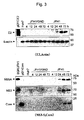
- a protein was extracted in time course dependent manner from cells transfected with rJFH1 or rJFH1/GND RNA according to common methods, and it was then analyzed by SDS-PAGE and the Western blot method.
- Huh7 cells were transiently transfected with expression plasmid DNA including an NS3, NS5A, core, or E2 gene, and the obtained cell extract was used as a positive control (NS3 protein).
- NS3 protein a protein extracted from untransfected Huh7 cells was used as a negative control.
- a protein sample extracted from each cell clone was blotted onto a PVDF membrane (Immobilon-P, manufactured by Millipore). Thereafter, an anti-NS3-specific antibody (furnished from Dr.
- an anti-NS5A-specific antibody produced by inserting the NS5A region of JFH1 into an expression vector and using it to a mouse according to DNA immunization procedures
- an anti-core-specific antibody clone 2H9 antibody
- an anti-E2-specific antibody produced by synthesizing the peptide of GTTTVGGAVARSTN (SEQ ID NO: 4) in the JFH1 E2 region and the peptide of CDLEDRDRSQLSPL (SEQ ID NO: 5) therein, and then immunizing a rabbit with the two synthetic peptides), were used to detect NS3, NS5A, core, and E2 proteins encoded by JFH1 RNA. Furthermore, as an intrinsic control, an actin protein was detected using an anti-actin antibody.
- Huh7 cells into which rJFH1, rJFH1/GND, rJFH1/ ⁇ E1-E2, rJ6CF, and rJCH1 had been introduced by electroporation, were inoculated into a culture dish. The cells were then cultured therein for 2 hours, 12 hours, 24 hours, 48 hours, and 72 hours. Thereafter, an HCV core protein contained in the culture medium was measured. Such measurement was carried out using Ortho HCV antigen IRMA test ( Aoyagi et al., J. Clin. Microbiol., 37(1999) pp.1802-1808 ).
- a core protein was detected in the culture medium, 48 to 72 hours after the transfection with rJFH1.
- the culture medium of the cells transfected with rJFH1/GND, rJ6CF, and rJCH1 no HCV core proteins were detected.
- rJFH1/GND, rJ6CF, and rJCH1 cannot autonomously replicate in Huh7 cells, whereas rJFH1 and rJFH1/ ⁇ E1-E2 can autonomously replicate therein.
- autonomous replication of the introduced HCV RNA is essential for the release of such a core protein, and further that E1 and E2 are necessary for allowing a large amount of core protein to stably release out of the cells.
- the culture medium obtained 6 days after the transfection with rJFH1 was fractionated in a sucrose density gradient manner. That is, 2 ml of 60% (weight/weight) sucrose solution (dissolved in 50 mM Tris, pH 7.5/0.1 M NaCl/l mM EDTA), 1 ml of 50% sucrose solution, 1 ml of 40% sucrose solution, 1 ml of 30% sucrose solution, 1 ml of 20% sucrose solution, and 1 ml of 10% sucrose solution were laminated on a centrifuge tube, and further, 4 ml of the culture supernatant of a sample was laminated thereon.
- This tube was then centrifuged at 400,000 RPM at 4°C for 16 hours, using Beckmann rotor SW41Ti. After completion of the centrifugation, 0.5 ml each of fraction was recovered from the bottom of the centrifuge tube. The density, the HCV core protein concentration, and the number of HCV RNA copies were assayed for each fraction. Detection of replicon RNA by quantitative RT-PCR was carried out by detecting RNA in the 5' untranslated region of HCV RNA according to the method of Takeuchi et al. ( Takeuchi T. et al., Gastroenterology 116: 636-642 (1999 )).
- replicon RNA contained in RNA extracted from the cells was amplified by PCR using the following synthetic primers and the EZ rTth RNA PCR kit (Applied Biosystems), and it was then detected using the ABI Prism 7700 sequence detector system (Applied Biosystems).
- R6-130-S17 5'-CGGGAGAGCCATAGTGG-3' (SEQ ID NO: 6)
- R6-290-R19 5'-AGTACCACAAGGCCTTTCG-3'
- TaqMan Probe R6-148-S21FT: 5'-CTGCGGAACCGGTGAGTACAC-3' (SEQ ID NO: 8)
- the peak of the core protein corresponded to that of HCV RNA in a fraction of 1.17 mg/ml.
- the density of this fraction was found to be approximately 1.17 mg/ml. This was a specific gravity lighter than that of a bound product consisting of a core protein and nucleic acid, which had previously been reported. If the core protein and HCV RNA existing in the 1.17 mg/ml fraction form HCV particles structure, it is considered that this fraction is resistant to nuclease.
- a culture solution obtained 6 days after the transfection with JFH 1 was treated with 10 ⁇ g/ml RNAse A for 20 minutes, and it was then fractionated in a sucrose density gradient manner.
- HCV RNA was decomposed, and the peak of a core protein and that of HCV RNA were detected in a fraction of 1.17 mg/ml, as in the case of being untreated with RNase A. That is to say, it was confirmed that the core protein and HCV RNA existing in the 1.17 mg/ml fraction formed HCV particles-like structure.
- virus RNA was replicated by transfection of Huh7 cells with rJFH1, and that virus particles are thereby formed and released into the culture solution.
- Huh7 cells were transfected with rJFH1, and the infectivity of HCV particles secreted into a culture medium was examined. The culture supernatant was recovered, 3 days after transfection of Huh7 cells with rJFH1 or rJFH1/ ⁇ E1-E2. The recovered culture medium was centrifuged, and the centrifuged supernatant was recovered, followed by filtration through a 0.45 ⁇ m filter. In the presence of this culture medium, Huh7 cells that had not been transfected with RNA were cultured. 48 hours later, the cells were fluorescently immunostained with an anti-core antibody or an anti-NS5A antibody.
- a culture supernatant was recovered 3 days after transfection of rHuh7 cells with JFH1, and it was then concentrated at a magnification of 30 times using an ultrafilter (cut off: 1 ⁇ 10 5 Da).
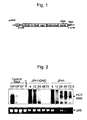
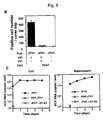
- Huh7 cells that had not been transfected with RNA were cultured in 100 ⁇ l of a culture medium containing the concentrated HCV particles on a 15-mm cover slip. 48 hours later, the cells were immunostained with an anti-core antibody, and the number of core antibody-stained positive cells, namely, infected cells was then counted. As a result, as shown in Figure 6B , 394.0 ⁇ 26.5 infected cells were confirmed (approximately 0.51 % in the total cells).
- HCV particles secreted into the culture medium have infectivity as a result of the transfection of Huh7 cells with rJFH1 and also has ability to amplify HCV RNA in the infected cells and to produce new HCV particles.
- HCV particles are secreted into a culture medium as a result of transfection of Huh7 cells with rJCH1/NS5B(jfh1), or whether or not the secreted HCV particles have infectivity.
- a culture solution obtained 6 days after transfection of Huh7 cells with rJCH1/NS5B(jfh1) was concentrated by the method described in section 5 above.
- Huh7 cells that had not been transfected with RNA were cultured, and time dependent changes of the amount of HCV RNA in the cells were assayed. From 12 hours after initiation of the culture, the amount of HCV RNA in the cells increased with time dependent manner ( Figure 7A ).
- Huh7 cells which had not been transfected with RNA, were cultured on a 15-mm cover slip, and the cells were then cultured in the presence of the concentrated culture medium. 48 hours later, the cells were immunostained with an anti-core antibody, and the number of core antibody-stained positive cells, namely, infected cells was then counted. As a result, as shown in Figure 7B , infected cells were observed. From these results, it was revealed that HCV particles secreted into a culture medium acquire infectivity as a result of the transfection of Huh7 cells with rJCH1/NS5B(jfh1) and also has ability to amplify HCV RNA in the infected cells and to produce new HCV particles.
- substitution of the HS5B region thereof with rJFH1 NS5B enables autonomous replication thereof in a culture cell system and generation of HCV particles.
- Huh7 cells were transfected with chimeric HCV RNA comprising the NS5B portion of a Con-1 strain with HCV genotype 1 b and that of JFH-1, and then, it was examined whether or not HCV particles are secreted into a culture solution, and whether or not the secreted HCV particles have infectivity.
- Huh7 cells were transfected with the above RNA by the method described in Example 2-1 above.
- Huh7 cells were transfected with HCV RNA, and a core protein contained in a supernatant was measured over time. From approximately 48 hours onward, such a core protein was detected in the supernatant, and thus it could be confirmed that HCV particles were generated in the cell supernatant. Subsequently, the supernatant was concentrated at a magnification of 20 times by ultrafiltration, and the concentrate was then added to Huh7 cells. 48 hours after the culture, the cells were stained with a rabbit anti-NS3 antibody.
- JFH-1 clone SEQ ID NO: 9 containing the full-length genomic cDNA of a JFH-1 strain (genotype 2a), which is a hepatitis C virus isolated from patients suffering from fulminant hepatitis, was inserted downstream of a T7 RNA promoter sequence in a pUC19 plasmid, so as to produce plasmid DNA.
- an RT-PCR fragment obtained by amplification of the virus RNA of the JFH-1 strain was cloned into a pGEM-T EASY vector (Promega), so as to obtain various plasmid DNA such as pGEM1-258, pGEM44-486, pGEM317-849, pGEM617-1323, pGEM1141-2367, pGEM2285-3509, pGEM3471-4665, pGEM4547-5970, pGEM5883-7003, pGEM6950-8035, pGEM7984-8892, pGEM8680-9283, pGEM9231-9634, and pGEM9594-9678 ( Kato et al., Gastroenterology , (2003) 125: pp.1808-1817 ).
- the virus genomic RNA-derived cDNA contained in each plasmid was ligated to one another by the PCR method and the use of restriction enzymes, and thus the full-length genomic cDNA was cloned.
- a T7 RNA promoter sequence was inserted upstream of the full-length virus genome.
- pJFH1 the thus constructed plasmid DNA is referred to as pJFH1.
- production of the aforementioned JFH-1 clone is described in JP Patent Publication (Kokai) No. 2002-171978 A and the document of Kato et al. ( Kato et al., J. Med. Virol., (2001) 64(3): pp. 334-339 ).
- the nucleotide sequence of the full-length cDNA of the JFH-1 clone has been registered with International DNA Databank (DDBJ/EMBL/GenBank) under Accession No. AB047639.
- EMCV-IRES the internal ribosome entry site for encephalomyocarditis virus
- a neomycin resistance gene (neo; also referred to as a neomycin phosphotransferase gene) were inserted between the 5' untranslated region and core region of pJFH1, which was plasmid DNA, so as to construct pFGREP-JFH1, which was plasmid DNA.
- the JFH1 strain is HCV derived from HCV with type 2a.
- a TH strain derived from HCV with type 1b Wakita et al., J. Biol. Chem., (1994) 269, pp. 14205-14210 ; and Moradpour et al., Biochem. Biophys. Res. Commun., (1998) 246, pp. 920-924 ) was used, so as to produce a chimeric HCV vector.
- the core, E1, E2, and p7 portions of the pFGREP-JFH1 as produced above were substituted with those of the TH strain, so as to produce chimeric HCV, pFGREP-TH/JFH1.
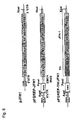
- RNA sequence of the aforementioned JFH 1 strain (derived from a JFH-1 clone), and the partial RNA sequence of the TH strain used for producing the above chimeric body (partial genomic RNA (1-3748) comprising a portion corresponding to the region from the 5' untranslated region of the HCV TH strain to the NS3 region thereof), are shown in SEQ ID NOS: 9 and 10, respectively.
- the "5' untranslated region” corresponds to 1-340
- the "core protein coding sequence” corresponds to 341-913
- the "E1 protein coding sequence” corresponds to 914-1489
- the "E2 protein coding sequence” corresponds to 1490-2590
- the "NS2 protein coding sequence” corresponds to 2780-3430
- the "NS3 protein coding sequence” corresponds to 3431-5323
- the "NS4A protein coding sequence” corresponds to 5324-5486
- the "NS4B protein coding sequence” corresponds to 5487-6268
- the "NS5A protein coding sequence” corresponds to 6269-7663
- the "NS5B protein coding sequence” corresponds to 7664-9442.
- the expression vector pFGREP-TH/JFH1 as constructed above was cleaved with the restriction enzyme XbaI. Thereafter, 10 to 20 ⁇ g of the XbaI cleavage fragment was mixed into 50 ⁇ l of a reaction solution, and the obtained mixture was incubated with Mung Bean Nuclease 20 U at 30°C for 30 minutes.
- Mung Bean Nuclease is an enzyme that catalyzes a reaction of selectively digesting a single-stranded portion in double-stranded DNA.
- RNA when RNA is synthesized directly using the aforementioned XbaI cleavage fragment as a template, replicon RNA, to the 3'-terminus of which 4 nucleotides CUGA that constitute a part of an XbaI recognition sequence are redundantly added, is synthesized.
- XbaI cleavage fragment was treated with Mung Bean NuClease, so as to eliminate the 4 nucleotides CUGA from the XbaI fragment.
- the thus Mung Bean Nuclease-treated solution containing the XbaI cleavage fragment was subjected to a protein elimination treatment according to common methods, so that the XbaI cleavage fragment, from which the 4 nucleotides CUGA had been eliminated, was purified.
- the purified fragment was used as template DNA.
- RNA was synthesized from the template DNA in vitro using T7 RNA polymerase.
- MEGAscript manufactured by Ambion was used for such RNA synthesis. 20 ⁇ l of a reaction solution containing 0.5 to 1.0 ⁇ g of the template DNA was allowed to react in accordance with instructions provided from manufacturer.
- RNA synthesized from the aforementioned template DNA derived from pFGREP-TH/JFH1 was named as rFGREP-TH/JFH1.
- the nucleotide sequence of chimeric HCV genomic RNA in the rFGREP-TH/JFH is shown in SEQ ID NO: 11.
- Such rFGREP-TH/JFH is an example of the full-length chimeric HCV replicon RNA of the present invention.
- RNA full-length chimeric HCV genomic RNA (rFGREP-TH/JFH1) as synthesized above were mixed with total cellular RNA extracted from Huh7 cells, resulting in the total amount of RNA of 10 ⁇ g. Subsequently, the mixed RNA was introduced into Huh7 cells by the electroporation method. After the cells had been cultured for 16 to 24 hours, G418 was added thereto at different amounts. The culture was continued while the culture solution was exchanged with a fresh one, twice a week. After completion of the culture for 21 days, surviving cells were stained with crystal violet. The number of the stained colonies was counted, and the number of colonies obtained per weight of RNA used for transfection was then calculated.
- RNA, genomic DNA, and a protein were extracted from the cloned cells, and thereafter, detection of full-length chimeric HCV replicon RNA, the presence or absence of incorporation of a neomycin resistance gene into genomic DNA, and expression of an HCV protein were examined. The results are shown in detail below.
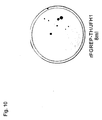
- Huh7 cells were transfected with rFGREP-TH/JFH1, and a culture supernatant containing the established full-length chimeric HCV replicon RNA-replicating cell clones was then recovered. The culture supernatant was added to Huh7 cells that had not been infected, so that the Huh7 cells were infected with virus particles in the culture supernatant. On the day following infection, 0.3 mg/ml G418 was added to the culture medium containing the infected Huh7 cells, and the mixture was further cultured for 21 days. After completion of the culture, the cells were fixed and then strained with crystal violet.
- Figure 11 shows distribution of HCV particles in each fraction by gel filtration chromatography.
- the used gel carriers were Sephacryl(R) S300, S400, and S500.
- a solution containing HCV particles used for column chromatography was purified using column chromatography containing each of the above gel carriers.
- a buffer used for purification comprised 10 mM Tris-hydrochloride, 1 mM ethylenediaminetetraacetic acid, and 100 mM sodium chloride (pH 8.0).
- a buffer used for purification comprised 10 mM Tris-hydrochloride, 1 mM ethylenediaminetetraacetic acid, and 100 mM sodium chloride (pH 8.0).
- Figure 12 shows distribution of HCV particles in each fraction by ion exchange chromatography.
- the used gel carriers were SP Sepharose HP(R) and Q Sepharose HP(R).
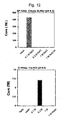
- Figure 13 shows distribution of HCV particles in each fraction by lectin affinity chromatography.
- affinity chromatography carriers, to which each of RCA-120, ConA, LCA, and WGA binds, were used.
- the column was equilibrated with a phosphate buffered saline.
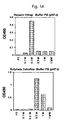
- Figure 14 shows distribution of HCV particles in each fraction by heparin and sulfated cellulofine affinity chromatography.
- the column was equilibrated with a 20 mM phosphate buffer (pH 7.0).
- a phosphate buffer (pH 7.0) was passed through the column, at a volume approximately 10 times larger than that of the column.
- phosphate buffers (pH 7.0) to which any one of 0.1 M, 0.3 M, 0.5 M, and 1 M NaCl had been added, were successively passed through the column, at a volume approximately 3 times larger than that of the column.
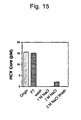
- Figure 15 shows distribution of HCV particles in each fraction by blue dye affinity chromatography.
- a carrier obtained by binding Cibacron Blue F3G-A to agarose particles was used for the column.
- the column was equilibrated with a 20 mM phosphate buffer (pH 7.0).
- HCV particles were purified by the combined use of column chromatography with sucrose density gradient centrifugation, with reference to the aforementioned examples.
- HCV particles were purified using Q Sepharose HP(R).
- the column was equilibrated with a 50 mM Tris-HCI buffer (pH 8.0).
- HCV particles were eluted in the fraction of the 50 mM Tris-HCl buffer (pH 8.0), to which 0.3 M NaCl had been added; the fraction of the 50 mM Tris-HCl buffer (pH 8.0), to which 1 M NaCl had been added; and the 1 M NaClW fraction. Fractions containing HCV particles were collected. The ratio of the HCV core protein to the total protein mass was 2.29 when compared with the HCV particles before column purification, and thus, the ratio of the HCV particles to the total protein increased.
- HCV particles were purified by sulfated cellulofine chromatography.
- the column was equilibrated with a 20 mM phosphate buffer (pH 7.0).
- a solution containing HCV particles obtained by concentrating using an ultrafilter with a molecular weight cut-off between 100,000 and 500,000, the fractions containing HCV particles purified with Q Sepharose HP(R), and then diluting the resultant with a 20 mM phosphate buffer (pH 7.0), was added to the column. Thereafter, a phosphate buffer (pH 7.0) was passed through the column, at a volume approximately 10 times larger than that of the column.
- HCV particles were purified by sucrose density gradient centrifugation.
- a TEN buffer 10 mM Tris-HCl buffer (pH 8.0), 0.1 M sodium chloride, and mM ethylenediaminetetraacetic acid (pH 8.0)
- a solution containing HCV particles was laminated on a solution obtained by lamination of 60%, 50%, 40%, 30%, 20%, and 10% sucrose solutions, and the obtained solution was centrifuged at 390 k g for 18 hours at 4°C. Since the HCV particles were gathered to a fraction with a specific gravity of approximately 1.2, the fraction was collected. The ratio of the HCV core protein to the total protein mass in the collected fraction was 1.69 when compared with the HCV particles before column purification. Thus, the ratio of the HCV particles to the total protein increased.
- the ratio of the HCV core protein to the total protein mass was approximately 120 times purified, when compared with that before initiation of column chromatography.
- the final fraction contained 10 9 copies/ml HCV particles.
- the present invention enables production of HCV virus particles with various genotypes in a cultured cell system. That is to say, even in the case of an HCV strain that cannot be autonomously replicated in vitro, such as HCV strains isolated from patients, the RNA sequence portion thereof encoding NS3, NS4, NS5A, and NS5B proteins is substituted with an RNA sequence portion encoding the NS3, NS4, NS5A, and NS5B proteins of JFH1, so that the above HSV strain can be autonomously replicated in a cultured cell system, thereby producing HCV particles.
- the HCV particles purified by the present invention can be directly used as a vaccine for medical use.
- the HCV genomic RNA or virus particles provided by the present invention can also be used as a virus vector for a foreign gene.
- the method of the present invention can also be used for studies regarding an HCV infection process, or for production of a screening system for various substances that affect such an HCV infection process.
Landscapes
- Health & Medical Sciences (AREA)
- Life Sciences & Earth Sciences (AREA)
- Chemical & Material Sciences (AREA)
- Genetics & Genomics (AREA)
- Organic Chemistry (AREA)
- Engineering & Computer Science (AREA)
- Zoology (AREA)
- Wood Science & Technology (AREA)
- Bioinformatics & Cheminformatics (AREA)
- Biotechnology (AREA)
- General Health & Medical Sciences (AREA)
- General Engineering & Computer Science (AREA)
- Microbiology (AREA)
- Biochemistry (AREA)
- Biomedical Technology (AREA)
- Virology (AREA)
- Proteomics, Peptides & Aminoacids (AREA)
- Immunology (AREA)
- Molecular Biology (AREA)
- Physics & Mathematics (AREA)
- Analytical Chemistry (AREA)
- Biophysics (AREA)
- Medicinal Chemistry (AREA)
- Veterinary Medicine (AREA)
- Public Health (AREA)
- Animal Behavior & Ethology (AREA)
- Pharmacology & Pharmacy (AREA)
- Plant Pathology (AREA)
- Pathology (AREA)
- Communicable Diseases (AREA)
- Epidemiology (AREA)
- Chemical Kinetics & Catalysis (AREA)
- General Chemical & Material Sciences (AREA)
- Nuclear Medicine, Radiotherapy & Molecular Imaging (AREA)
- Oncology (AREA)
- Cell Biology (AREA)
- Gastroenterology & Hepatology (AREA)
- Mycology (AREA)
- Micro-Organisms Or Cultivation Processes Thereof (AREA)
- Peptides Or Proteins (AREA)
Claims (30)
- Modifizierte genomische Hepatitis-C-Virus-RNA, umfassend genomische RNA-Bereiche von zwei oder mehreren Hepatitis-C-Virus-Stämmen, welche eine 5'-untranslantierte Region, eine Kernprotein-kodierende Sequenz, eine E1-Protein-kodierende Sequenz, eine E2-Protein-kodierende Sequenz, eine p7-Protein-kodierende Sequenz, eine NS2-Protein-kodierende Sequenz, eine in SEQ ID NO: 1 gezeigte RNA-Teilsequenz eines JFH1-Stammes, die NS3-, NS4-, NS5A- und NS5B-Proteine kodiert, und eine 3'-untranslantierte Region umfasst, und welche autonom repliziert werden kann, wobei einer der Hepatitis-C-Virus-Stämme ein Virus-Stamm des Genotyps 1b ist.
- Modifizierte genomische Hepatitis-C-Virus-RNA, umfassend genomische RNA-Bereiche von zwei oder mehreren Hepatitis-C-Virus-Stämmen, welche eine 5'-untranslatierte Region, eine Kernprotein-kodierende Sequenz, eine E1-Protein-kodierende Sequenz, eine E2-Protein-kodierende Sequenz, eine p7-Protein-kodierende Sequenz, eine NS2-Protein-kodierende Sequenz, eine NS3-Protein-kodierende Sequenz, eine NS4A-Protein-kodierende Sequenz, eine NS4B-Protein-kodierende Sequenz, eine NS5A-Protein-kodierende Sequenz, eine in SEQ ID NO: 2 gezeigte NS5B-Protein-kodierende Sequenz eines JFH1-Stammes und eine 3'-untranslatierte Region umfasst, und welche autonom repliziert werden kann, wobei einer der Hepatitis-C-Virus-Stämme ein Virusstamm des Genotyps 1b ist.
- Modifizierte genomische Hepatitis-C-Virus-RNA gemäß Anspruch 1 oder 2, wobei der Virusstamm des Genotyps 1b aus einem HCV-con1-Stamm, einem HCV-TH-Stamm, einem HCV-J-Stamm, einem HCV-JT-Stamm und einem HCV-BK-Stamm ausgewählt ist.
- Modifizierte genomische Hepatitis-C-Virus-RNA gemäß Anspruch 1 oder 2, wobei einer der Hepatitis-C-Virus-Stämme ein HCV-conl-Stamm des Genotyps 1b ist.
- Modifizierte genomische Hepatitis-C-Virus-RNA gemäß Anspruch 4, in welcher die Sequenz, die E1-Protein, E2-Protein, p7-Protein und NS2-Protein des HCV-conl-Stammes kodiert, strangabwärts der 5'-untranslatierten Region des JFH1-Stammes ligiert ist, und strangabwärts davon die Sequenz, die die NS3-, NS4A-, NS4B-, NS5A- und NSSB-Proteine des JFH1-Stammes kodiert, und strangabwärts davon die 3'-untranslatierte Region des JFH1-Stammes.
- Modifizierte genomische Hepatitis-C-Virus-RNA gemäß Anspruch 1 oder 2, wobei einer der Hepatitis-C-Virus-Stämme ein HCV-TH-Stamm des Genotyps 1b ist.
- Modifizierte genomische Hepatitis-C-Virus-RNA gemäß Anspruch 6, welche die wie in SEQ ID NO: 11 gezeigte Nukleotid-Sequenz umfasst.
- Modifizierte genomische Hepatitis-C-Virus-RNA, umfassend genomische RNA-Bereiche von zwei Hepatitis-C-Virus-Stämmen, wobei die Hepatitis-C-Virus-Stämme ein JFH1-Stamm und JCH1-Stamm sind, und die modifizierte Hepatitis-C-Virus genomische RNA eine Sequenz umfasst, die 1 bis 3866 der Sequenz mit der GenBank Accession No. AB047640 entspricht, ligiert an eine Sequenz, die 3867 bis 9678 der Sequenz mit der GenBank Accession No. AB 047639 entspricht, und welche autonom repliziert werden kann.
- Virusvektor, der auf hepatische Zellen gerichtet ist, der die modifizierte genomische Hepatitis-C-Virus-RNA gemäß einem der Ansprüche 1 bis 8 umfasst.
- Zelle, in die die modifizierte genomische Hepatitis-C-Virus-RNA gemäß einem der Ansprüche 1 bis 8 eingeführt ist, und die die genomische Hepatitis-C-Virus-RNA repliziert und Viruspartikel generieren kann.
- Hepatitis-C-Viruspartikel, die aus einer Kultur erhalten werden, erhalten durch Kultivierung der Zelle gemäß Anspruch 10.
- Verfahren zur Aufreinigung von HCV-Partikel durch Unterwerfen einer Flüssigkeit oder eines Produkts, das aus einem Zellhomogenat erhalten ist und die HCV-Partikel gemäß Anspruch 11 enthält, einer Säulenchromatographie und/oder einer Dichtegradientenzentrifugation, die in Kombination damit verwendet wird.
- Verfahren gemäß Anspruch 12, wobei die Säulenchromatographie eine oder mehrere Art(en) von Chromatographie(n), ausgewählt aus Ionenaustauschchromatographie, Gelfiltrations-Chromatographie und Affinitätschromatographie, ist.
- Verfahren gemäß Anspruch 13, wobei die Ionenaustauschchromatographie eine oder mehrere Art(en) von Chromatographie(n) ist, ausgewählt aus Anionenchromatographie und Kationenchromatographie, die Gelfiltrations-Chromatographie eine oder mehrere Art(en) von Chromatographie(n) ist, die eine Säule, ausgewählt aus Sephacryl-S300(R), Sephacryl-S400(R) und Sephacryl-S500(R) verwendet (verwenden), und die Affinitätschromatographie eine oder mehrere Art(en) von Chromatographie(n) ist, die eine Säule, ausgewählt aus sulfatiertem Cellulofine, Heparin und Lektin, verwendet (verwenden).
- Verfahren gemäß Anspruch 13, wobei die Chromatographie sulfatierte Cellulofinechromatographie ist.
- Verfahren gemäß Anspruch 12, wobei die Dichtegradientenzentrifugation unter Verwendung von einem oder mehreren löslichen Stoff(en), ausgewählt aus Cäsiumchlorid, Saccharose und Zuckerpolymeren, ausgeführt wird.
- Verfahren gemäß Anspruch 12, wobei bei dem Aufreinigungsverfahren Anionenaustauschchromatographie, sulfatierte Cellulofinechromatographie und Saccharose-Dichtezentrifugation jeweils mindestens einmal und in irgendeiner Reihenfolge kombiniert ausgeführt werden.
- HCV-Partikel, die nach einem Verfahren zur Aufreinigung von HCV-Partikel erhalten werden, wobei eine aus dem Zellhomogenat erhaltene Flüssigkeit oder Lösung, enthaltend die HCV-Partikel gemäß Anspruch 11, einer Säulenchromatographie und einer in Kombination damit verwendeten Dichtegradientenzentrifugation unterworfen wurde.
- HCV-Partikel gemäß Anspruch 18, wobei die Säulenchromatographie eine oder mehrere Art(en) von Chromatographie(n) ist, ausgewählt aus Ionenaustauschchromatographie, Gelfiltrations-Chromatographie und Affinitätschromatographie.
- HCV-Partikel gemäß Anspruch 18, wobei die Ionenaustauschchromatographie eine oder mehrere Art(en) von Chromatographie(n) ist, ausgewählt aus Anionenchromatographie und Kationenchromatographie, die Gelfiltrations-Chromatographie eine oder mehrere Art (en) von Chromatographie(n) ist, die eine Säule, ausgewählt aus Sephacryl-S300(R), Sephacryl-S400(R) und Sepacryl-S500(R) verwendet (verwenden), und die Affinitätschromatographie eine oder mehrere Art(en) von Chromatographie(n) ist, die eine Säule, ausgewählt aus sulfatiertem Cellulofine, Heparin und Lektin, verwendet (verwenden).
- HCV-Partikel gemäß Anspruch 18, wobei die Chromatographie eine sulfatierte Cellulofinechromatographie ist.
- HCV-Partikel gemäß Anspruch 18, wobei die Dichtegradientenzentrifugation unter Verwendung von einem oder mehreren löslichen Stoff(en), ausgewählt aus Cäsiumchlorid, Saccharose und Zuckerpolymeren, ausgeführt wurde.
- HCV-Partikel gemäß Anspruch 18, die durch das Aufreinigungsverfahren aufgereinigt sind, bei dem Anionenaustauschchromatographie, sulfatierte Cellulofinechromatographie und Saccharosedichtegradientenzentrifugation in Kombination miteinander durchgeführt wurden.
- Verwendung von Hepatitis-C-Viruspartikel gemäß Anspruch 11 oder 18 als ein Antigen zur Herstellung eines Hepatitis-C-Vakzins und/oder eines neutralisierenden Antikörpers.
- Hepatitis-C-Virus-infizierte Zelle, die mit den Hepatitis-C-Viruspartikeln gemäß Anspruch 11 oder 18 infiziert ist.
- Verfahren zur Herstellung eines Hepatitis-C-Viruspartikels, dadurch gekennzeichnet, dass das Verfahren das Kultivieren der Zelle gemäß Anspruch 10 und das Rückgewinnen der Viruspartikel aus der Kultur umfasst.
- Verfahren zur Herstellung einer Hepatitis-C-Virus infizierten Zelle, dadurch gekennzeichnet, dass das Verfahren das Kultivieren der Zelle gemäß Anspruch 10, das Rückgewinnen eines Kulturüberstandes der Zelle und das Anwenden des Überstands auf eine andere Zelle, um diese andere Zelle mit Virenpartikel, die in dem Kulturüberstand enthalten sind, zu infizieren, umfasst.
- Verfahren zum Screenen einer Anti-Hepatitis-C-Virus-Substanz, dadurch gekennzeichnet, dass das Verfahren das Kultivieren der Zelle gemäß Anspruch 10 oder 25 in Gegenwart einer Testsubstanz und das Detektieren einer Hepatitis-C-Virus-RNA oder Viruspartikels in der Kultur umfasst, dadurch die Wirkungen des Anti-Hepatitis-C-Virus bei der Testsubstanz beurteilend.
- Verfahren zur Herstellung eines Hepatitis-C-Vakzins und/oder neutralisierenden Antikörpers durch die Verwendung von Hepatitis-C-Viruspartikel gemäß Anspruch 11 oder 18 als ein Antigen.
- Verfahren zum Replizieren und/oder Exprimieren eines fremden Gens in einer Zelle, das dadurch gekennzeichnet ist, dass das Verfahren das Inserieren einer RNA, die das fremde Gen kodiert, in die modifizierte Hepatitis-C-Virus genomische RNA gemäß einem der Ansprüche 1 bis 8, und das Einführen der genomischen RNA in eine interessierende Zelle umfasst, um das fremde Gen darin zu replizieren oder zu exprimieren.
Priority Applications (1)
| Application Number | Priority Date | Filing Date | Title |
|---|---|---|---|
| PL05781421T PL1801209T3 (pl) | 2004-08-24 | 2005-08-24 | Zmodyfikowany genomowy RNA ludzkiego wirusa zapalenia wątroby typu C posiadający zdolność replikacji autonomicznej |
Applications Claiming Priority (5)
| Application Number | Priority Date | Filing Date | Title |
|---|---|---|---|
| JP2004243975 | 2004-08-24 | ||
| JP2004290801 | 2004-10-01 | ||
| JP2005069527 | 2005-03-11 | ||
| JP2005069725 | 2005-03-11 | ||
| PCT/JP2005/015833 WO2006022422A1 (ja) | 2004-08-24 | 2005-08-24 | 自律複製能を有する改変されたヒトc型肝炎ウイルスゲノムrna |
Publications (3)
| Publication Number | Publication Date |
|---|---|
| EP1801209A1 EP1801209A1 (de) | 2007-06-27 |
| EP1801209A4 EP1801209A4 (de) | 2007-12-05 |
| EP1801209B1 true EP1801209B1 (de) | 2011-02-23 |
Family
ID=35967617
Family Applications (1)
| Application Number | Title | Priority Date | Filing Date |
|---|---|---|---|
| EP05781421A Expired - Lifetime EP1801209B1 (de) | 2004-08-24 | 2005-08-24 | Modifizierte genomische rna des menschlichen hepatitis-c-virus mit autonomer replikationskompetenz |
Country Status (12)
| Country | Link |
|---|---|
| US (2) | US8454973B2 (de) |
| EP (1) | EP1801209B1 (de) |
| JP (1) | JP4931591B2 (de) |
| KR (1) | KR101262773B1 (de) |
| CN (1) | CN101048502B (de) |
| AT (1) | ATE499442T1 (de) |
| AU (1) | AU2005275713B2 (de) |
| CA (1) | CA2578021C (de) |
| DE (1) | DE602005026545D1 (de) |
| PL (1) | PL1801209T3 (de) |
| PT (1) | PT1801209E (de) |
| WO (1) | WO2006022422A1 (de) |
Families Citing this family (44)
| Publication number | Priority date | Publication date | Assignee | Title |
|---|---|---|---|---|
| JP5086082B2 (ja) * | 2004-10-01 | 2012-11-28 | ノバルティス ヴァクシンズ アンド ダイアグノスティクス エスアールエル | C型肝炎ウイルス複製系 |
| EP1863941B1 (de) | 2005-03-04 | 2013-05-08 | The Rockefeller University | Infektiöses chimäres hepatitis-c-virus, verfahren zur herstellung davon und verwendungsverfahren dafür |
| US8301394B2 (en) * | 2006-02-16 | 2012-10-30 | 454 Life Sciences Corporation | System and method for correcting primer extension errors in nucleic acid sequence data |
| US8364417B2 (en) | 2007-02-15 | 2013-01-29 | 454 Life Sciences Corporation | System and method to correct out of phase errors in DNA sequencing data by use of a recursive algorithm |
| JP2008161080A (ja) * | 2006-12-27 | 2008-07-17 | Japan Health Science Foundation | C型肝炎ウイルス阻害剤を検出するためのアッセイ方法 |
| WO2008125119A1 (en) | 2007-04-13 | 2008-10-23 | Hvidovre Hospital | Adaptive mutations allow establishment of jfh1-based cell culture systems for hepatitis c virus genotype 4a |
| US8945584B2 (en) | 2007-04-13 | 2015-02-03 | Hvidovre Hospital | Cell culture system of a hepatitis C genotype 3a and 2a chimera |
| EP2151495A4 (de) * | 2007-04-27 | 2010-06-02 | Advanced Life Science Inst Inc | Hcv-gen |
| US8618275B2 (en) | 2007-05-18 | 2013-12-31 | Hvidovre Hospital | Efficient cell culture system for hepatitis C virus genotype 5A |
| CA2696437A1 (en) * | 2007-07-13 | 2009-01-22 | Toray Industries, Inc. | Production and use of epitope-tagged hepatitis c virus particle |
| US20100291545A1 (en) | 2007-07-25 | 2010-11-18 | Takaji Wakita | Antibody having inhibitory activity on infection with hepatitis c virus (hcv) and use thereof |
| US8563706B2 (en) | 2007-12-20 | 2013-10-22 | Hvidovre Hospital | Efficient cell culture system for hepatitis C virus genotype 1A and 1B |
| WO2009080052A1 (en) | 2007-12-20 | 2009-07-02 | Hvidovre Hospital | Efficient cell culture system for hepatitis c virus genotype 6a |
| JP5593220B2 (ja) * | 2008-04-25 | 2014-09-17 | 東レ株式会社 | C型肝炎ウイルス由来のキメラ遺伝子を含む核酸 |
| US8506969B2 (en) | 2008-08-15 | 2013-08-13 | Hvidovre Hospital | Efficient cell culture system for hepatitis C virus genotype 7a |
| US8663653B2 (en) | 2008-08-15 | 2014-03-04 | Hvidovre Hospital | Efficient cell culture system for hepatitis C virus genotype 2B |
| CN102227445B (zh) | 2008-09-30 | 2014-12-17 | 东丽株式会社 | 结合丙型肝炎病毒的包膜蛋白2的抗体以及利用所述抗体鉴定丙型肝炎病毒的基因型的方法 |
| WO2010037403A1 (en) | 2008-10-03 | 2010-04-08 | Hvidovre Hospital | Hepatitis c virus expressing reporter tagged ns5a protein |
| JP5692738B2 (ja) * | 2009-07-28 | 2015-04-01 | 国立大学法人 鹿児島大学 | ウイルスの濃縮方法および磁性体組成物 |
| JPWO2011040535A1 (ja) | 2009-09-30 | 2013-02-28 | 東レ株式会社 | C型肝炎ウイルスワクチン組成物 |
| EP2495256A4 (de) | 2009-10-30 | 2013-09-25 | Toray Industries | Antikörper mit hemmender wirkung auf infektionen mit hepatitis-c-virus (hcv) und seine verwendung |
| AU2011226792A1 (en) | 2010-06-11 | 2012-01-12 | Life Technologies Corporation | Alternative nucleotide flows in sequencing-by-synthesis methods |
| WO2012046836A1 (ja) * | 2010-10-08 | 2012-04-12 | 株式会社先端生命科学研究所 | C型肝炎ウイルス遺伝子 |
| US8666678B2 (en) | 2010-10-27 | 2014-03-04 | Life Technologies Corporation | Predictive model for use in sequencing-by-synthesis |
| US10273540B2 (en) | 2010-10-27 | 2019-04-30 | Life Technologies Corporation | Methods and apparatuses for estimating parameters in a predictive model for use in sequencing-by-synthesis |
| EP2659408B1 (de) | 2010-12-29 | 2019-03-27 | Life Technologies Corporation | Zeitverzerrtes hintergrundsignal für sequenzierung-mit-synthese-operationen |
| US20130060482A1 (en) | 2010-12-30 | 2013-03-07 | Life Technologies Corporation | Methods, systems, and computer readable media for making base calls in nucleic acid sequencing |
| EP3582224B1 (de) | 2010-12-30 | 2026-04-29 | Life Technologies Corporation | Modelle zur analyse von daten aus sequenzierung-mit-synthese-operationen |
| US10241075B2 (en) | 2010-12-30 | 2019-03-26 | Life Technologies Corporation | Methods, systems, and computer readable media for nucleic acid sequencing |
| WO2012133735A1 (ja) | 2011-03-31 | 2012-10-04 | 国立感染症研究所長が代表する日本国 | 遺伝子型1bのC型肝炎ウイルスゲノム由来の核酸を含む核酸構築物、及び該核酸構築物が導入されたC型肝炎ウイルスゲノム複製細胞、並びに感染性C型肝炎ウイルス粒子の製造方法 |
| CN103764845B (zh) | 2011-04-08 | 2016-02-17 | 生命科技股份有限公司 | 用于合成测序中的相保护试剂流排序 |
| CA2837279A1 (en) | 2011-05-31 | 2012-12-06 | Japan As Represented By Director-General Of National Institute Of Infectious Diseases | Mutant replicon derived from genome of hepatitis c virus j6cf strain |
| US10704164B2 (en) | 2011-08-31 | 2020-07-07 | Life Technologies Corporation | Methods, systems, computer readable media, and kits for sample identification |
| WO2013031956A1 (ja) | 2011-08-31 | 2013-03-07 | 国立感染症研究所長が代表する日本国 | 遺伝子型3aのC型肝炎ウイルスゲノム由来の核酸を含む核酸構築物 |
| US20150087537A1 (en) | 2011-08-31 | 2015-03-26 | Life Technologies Corporation | Methods, Systems, Computer Readable Media, and Kits for Sample Identification |
| US20150087045A1 (en) * | 2012-01-13 | 2015-03-26 | Gilead Pharmassset Llc | Crystal structure of hcv polymerase complexes and methods of use |
| US9646132B2 (en) | 2012-05-11 | 2017-05-09 | Life Technologies Corporation | Models for analyzing data from sequencing-by-synthesis operations |
| US10329608B2 (en) | 2012-10-10 | 2019-06-25 | Life Technologies Corporation | Methods, systems, and computer readable media for repeat sequencing |
| US20140296080A1 (en) | 2013-03-14 | 2014-10-02 | Life Technologies Corporation | Methods, Systems, and Computer Readable Media for Evaluating Variant Likelihood |
| US9926597B2 (en) | 2013-07-26 | 2018-03-27 | Life Technologies Corporation | Control nucleic acid sequences for use in sequencing-by-synthesis and methods for designing the same |
| CN105683980B (zh) | 2013-10-04 | 2018-08-24 | 生命科技股份有限公司 | 在使用终止化学物质的测序中建立分阶段效应模型的方法和系统 |
| WO2016060974A1 (en) | 2014-10-13 | 2016-04-21 | Life Technologies Corporation | Methods, systems, and computer-readable media for accelerated base calling |
| EP4220645A3 (de) | 2015-05-14 | 2023-11-08 | Life Technologies Corporation | Barcodesequenzen sowie zugehörige systeme und verfahren |
| US10619205B2 (en) | 2016-05-06 | 2020-04-14 | Life Technologies Corporation | Combinatorial barcode sequences, and related systems and methods |
Family Cites Families (10)
| Publication number | Priority date | Publication date | Assignee | Title |
|---|---|---|---|---|
| CA2269097C (en) * | 1996-11-08 | 2007-01-09 | The Government Of The United States Of America, Represented By The Secretary, Department Of Health And Human Services | Synthesis and purification of hepatitis c virus-like particles |
| WO2000075338A2 (en) * | 1999-06-04 | 2000-12-14 | The Government Of The United States Of America As Represented By The Secretary, Department Of Health And Human Services | CLONED GENONE OF INFECTIOUS HEPATITIS C VIRUS OF GENOTYPE 2a AND USES THEREOF |
| US7329408B2 (en) | 1999-12-01 | 2008-02-12 | Novartis Vaccines And Diagnostics, Inc. | Eliciting HCV-specific antibodies |
| IL137522A (en) | 2000-07-26 | 2007-06-17 | Drk Blutspendediendst Baden Wu | Human monoclonal antibody against hepatitis c virus e2 glycoprotein |
| JP4880116B2 (ja) * | 2000-12-01 | 2012-02-22 | 財団法人 東京都医学総合研究所 | 劇症c型肝炎ウイルス株の遺伝子 |
| AU2003230790A1 (en) | 2002-04-03 | 2003-10-20 | Smithkline Beecham Corporation | Hepatitis c virus sub-genomic replicons |
| CN1833024B (zh) | 2003-05-26 | 2011-08-31 | 东丽株式会社 | 含有衍生自基因型2a丙肝病毒(HCV)基因组的核酸的核酸构建体和具有转移入其中的这样的核酸构建体的细胞 |
| JP5086082B2 (ja) * | 2004-10-01 | 2012-11-28 | ノバルティス ヴァクシンズ アンド ダイアグノスティクス エスアールエル | C型肝炎ウイルス複製系 |
| EP1863941B1 (de) * | 2005-03-04 | 2013-05-08 | The Rockefeller University | Infektiöses chimäres hepatitis-c-virus, verfahren zur herstellung davon und verwendungsverfahren dafür |
| JP5593220B2 (ja) * | 2008-04-25 | 2014-09-17 | 東レ株式会社 | C型肝炎ウイルス由来のキメラ遺伝子を含む核酸 |
-
2005
- 2005-08-24 DE DE602005026545T patent/DE602005026545D1/de not_active Expired - Lifetime
- 2005-08-24 AU AU2005275713A patent/AU2005275713B2/en not_active Expired
- 2005-08-24 PT PT05781421T patent/PT1801209E/pt unknown
- 2005-08-24 CN CN2005800364134A patent/CN101048502B/zh not_active Expired - Lifetime
- 2005-08-24 WO PCT/JP2005/015833 patent/WO2006022422A1/ja not_active Ceased
- 2005-08-24 CA CA2578021A patent/CA2578021C/en not_active Expired - Lifetime
- 2005-08-24 KR KR1020077006497A patent/KR101262773B1/ko not_active Expired - Lifetime
- 2005-08-24 AT AT05781421T patent/ATE499442T1/de not_active IP Right Cessation
- 2005-08-24 PL PL05781421T patent/PL1801209T3/pl unknown
- 2005-08-24 JP JP2006532743A patent/JP4931591B2/ja not_active Expired - Lifetime
- 2005-08-24 EP EP05781421A patent/EP1801209B1/de not_active Expired - Lifetime
- 2005-08-24 US US11/660,794 patent/US8454973B2/en active Active
-
2013
- 2013-01-04 US US13/734,630 patent/US9175269B2/en not_active Expired - Lifetime
Also Published As
| Publication number | Publication date |
|---|---|
| EP1801209A4 (de) | 2007-12-05 |
| CN101048502A (zh) | 2007-10-03 |
| JPWO2006022422A1 (ja) | 2008-05-08 |
| AU2005275713B2 (en) | 2010-08-05 |
| WO2006022422A1 (ja) | 2006-03-02 |
| CN101048502B (zh) | 2012-03-21 |
| HK1112481A1 (en) | 2008-09-05 |
| AU2005275713A1 (en) | 2006-03-02 |
| CA2578021A1 (en) | 2006-03-02 |
| US8454973B2 (en) | 2013-06-04 |
| PL1801209T3 (pl) | 2011-07-29 |
| JP4931591B2 (ja) | 2012-05-16 |
| ATE499442T1 (de) | 2011-03-15 |
| EP1801209A1 (de) | 2007-06-27 |
| DE602005026545D1 (de) | 2011-04-07 |
| US20130115592A1 (en) | 2013-05-09 |
| CA2578021C (en) | 2014-11-18 |
| KR101262773B1 (ko) | 2013-05-10 |
| US9175269B2 (en) | 2015-11-03 |
| US20090176200A1 (en) | 2009-07-09 |
| KR20070045333A (ko) | 2007-05-02 |
| PT1801209E (pt) | 2011-05-26 |
Similar Documents
| Publication | Publication Date | Title |
|---|---|---|
| EP1801209B1 (de) | Modifizierte genomische rna des menschlichen hepatitis-c-virus mit autonomer replikationskompetenz | |
| US8383371B2 (en) | Nucleic acid construct containing a nucleic acid derived from the genome of hepatitis C virus (HCV) of genotype 2a, and a cell having such nucleic acid construct introduced therein | |
| US8460912B2 (en) | Nucleic acid construct containing full length genome of human hepatitis C virus, recombinant full length virus genome-replicating cells having the nucleic acid construct transferred thereinto and method of producing hepatitis C virus particle | |
| CN1882690B (zh) | 从新hcv株衍生的核酸和基因以及使用所述基因的复制子-复制细胞 | |
| JP5030065B2 (ja) | 感染性c型肝炎ウイルス粒子高産生系 | |
| ES2360808T3 (es) | Arn genómico del virus humano mofificado de la hepatitis c con capacidad replicativa autónoma. | |
| HK1112481B (en) | Modified human hepatitis c virus genomic rna having autonomous replicative competence |
Legal Events
| Date | Code | Title | Description |
|---|---|---|---|
| PUAI | Public reference made under article 153(3) epc to a published international application that has entered the european phase |
Free format text: ORIGINAL CODE: 0009012 |
|
| 17P | Request for examination filed |
Effective date: 20070316 |
|
| AK | Designated contracting states |
Kind code of ref document: A1 Designated state(s): DE ES FR GB IT |
|
| RBV | Designated contracting states (corrected) |
Designated state(s): DE ES FR GB IT |
|
| RBV | Designated contracting states (corrected) |
Designated state(s): AT BE BG CH CY CZ DE DK EE ES FI FR GB GR HU IE IS IT LI LT LU LV MC NL PL PT RO SE SI SK TR |
|
| DAX | Request for extension of the european patent (deleted) | ||
| A4 | Supplementary search report drawn up and despatched |
Effective date: 20071107 |
|
| 17Q | First examination report despatched |
Effective date: 20080219 |
|
| GRAP | Despatch of communication of intention to grant a patent |
Free format text: ORIGINAL CODE: EPIDOSNIGR1 |
|
| GRAS | Grant fee paid |
Free format text: ORIGINAL CODE: EPIDOSNIGR3 |
|
| GRAA | (expected) grant |
Free format text: ORIGINAL CODE: 0009210 |
|
| AK | Designated contracting states |
Kind code of ref document: B1 Designated state(s): AT BE BG CH CY CZ DE DK EE ES FI FR GB GR HU IE IS IT LI LT LU LV MC NL PL PT RO SE SI SK TR |
|
| REG | Reference to a national code |
Ref country code: GB Ref legal event code: FG4D |
|
| REG | Reference to a national code |
Ref country code: CH Ref legal event code: EP |
|
| REG | Reference to a national code |
Ref country code: IE Ref legal event code: FG4D |
|
| REG | Reference to a national code |
Ref country code: CH Ref legal event code: NV Representative=s name: NOVAGRAAF INTERNATIONAL SA |
|
| REF | Corresponds to: |
Ref document number: 602005026545 Country of ref document: DE Date of ref document: 20110407 Kind code of ref document: P |
|
| REG | Reference to a national code |
Ref country code: DE Ref legal event code: R096 Ref document number: 602005026545 Country of ref document: DE Effective date: 20110407 |
|
| REG | Reference to a national code |
Ref country code: RO Ref legal event code: EPE |
|
| REG | Reference to a national code |
Ref country code: NL Ref legal event code: T3 |
|
| REG | Reference to a national code |
Ref country code: PT Ref legal event code: SC4A Free format text: AVAILABILITY OF NATIONAL TRANSLATION Effective date: 20110512 |
|
| REG | Reference to a national code |
Ref country code: CH Ref legal event code: PFA Owner name: TOKYO METROPOLITAN ORGANIZATION FOR MEDICAL RESEA Free format text: TOKYO METROPOLITAN ORGANIZATION FOR MEDICAL RESEARCH#8-1, NISHISHINJUKU 2-CHOME#SHINJUKU-KU, TOKYO 163-8001 (JP) $ TORAY INDUSTRIES, INC.#1-1, NIHONBASHI-MUROMACHI 2-CHOME CHUO-KU#TOKYO 103-8666 (JP) -TRANSFER TO- TOKYO METROPOLITAN ORGANIZATION FOR MEDICAL RESEARCH#8-1, NISHISHINJUKU 2-CHOME#SHINJUKU-KU, TOKYO 163-8001 (JP) $ TORAY INDUSTRIES, INC.#1-1, NIHONBASHI-MUROMACHI 2-CHOME CHUO-KU#TOKYO 103-8666 (JP) |
|
| REG | Reference to a national code |
Ref country code: ES Ref legal event code: FG2A Ref document number: 2360808 Country of ref document: ES Kind code of ref document: T3 Effective date: 20110609 |
|
| REG | Reference to a national code |
Ref country code: GR Ref legal event code: EP Ref document number: 20110400982 Country of ref document: GR Effective date: 20110513 |
|
| LTIE | Lt: invalidation of european patent or patent extension |
Effective date: 20110223 |
|
| PG25 | Lapsed in a contracting state [announced via postgrant information from national office to epo] |
Ref country code: SE Free format text: LAPSE BECAUSE OF FAILURE TO SUBMIT A TRANSLATION OF THE DESCRIPTION OR TO PAY THE FEE WITHIN THE PRESCRIBED TIME-LIMIT Effective date: 20110223 Ref country code: LT Free format text: LAPSE BECAUSE OF FAILURE TO SUBMIT A TRANSLATION OF THE DESCRIPTION OR TO PAY THE FEE WITHIN THE PRESCRIBED TIME-LIMIT Effective date: 20110223 Ref country code: LV Free format text: LAPSE BECAUSE OF FAILURE TO SUBMIT A TRANSLATION OF THE DESCRIPTION OR TO PAY THE FEE WITHIN THE PRESCRIBED TIME-LIMIT Effective date: 20110223 |
|
| REG | Reference to a national code |
Ref country code: PL Ref legal event code: T3 |
|
| PG25 | Lapsed in a contracting state [announced via postgrant information from national office to epo] |
Ref country code: SI Free format text: LAPSE BECAUSE OF FAILURE TO SUBMIT A TRANSLATION OF THE DESCRIPTION OR TO PAY THE FEE WITHIN THE PRESCRIBED TIME-LIMIT Effective date: 20110223 Ref country code: CY Free format text: LAPSE BECAUSE OF FAILURE TO SUBMIT A TRANSLATION OF THE DESCRIPTION OR TO PAY THE FEE WITHIN THE PRESCRIBED TIME-LIMIT Effective date: 20110223 Ref country code: AT Free format text: LAPSE BECAUSE OF FAILURE TO SUBMIT A TRANSLATION OF THE DESCRIPTION OR TO PAY THE FEE WITHIN THE PRESCRIBED TIME-LIMIT Effective date: 20110223 Ref country code: FI Free format text: LAPSE BECAUSE OF FAILURE TO SUBMIT A TRANSLATION OF THE DESCRIPTION OR TO PAY THE FEE WITHIN THE PRESCRIBED TIME-LIMIT Effective date: 20110223 Ref country code: BG Free format text: LAPSE BECAUSE OF FAILURE TO SUBMIT A TRANSLATION OF THE DESCRIPTION OR TO PAY THE FEE WITHIN THE PRESCRIBED TIME-LIMIT Effective date: 20110523 |
|
| REG | Reference to a national code |
Ref country code: NL Ref legal event code: TD Effective date: 20111013 |
|
| PG25 | Lapsed in a contracting state [announced via postgrant information from national office to epo] |
Ref country code: DK Free format text: LAPSE BECAUSE OF FAILURE TO SUBMIT A TRANSLATION OF THE DESCRIPTION OR TO PAY THE FEE WITHIN THE PRESCRIBED TIME-LIMIT Effective date: 20110223 Ref country code: EE Free format text: LAPSE BECAUSE OF FAILURE TO SUBMIT A TRANSLATION OF THE DESCRIPTION OR TO PAY THE FEE WITHIN THE PRESCRIBED TIME-LIMIT Effective date: 20110223 |
|
| REG | Reference to a national code |
Ref country code: CH Ref legal event code: PFA Owner name: TORAY INDUSTRIES, INC. Free format text: TOKYO METROPOLITAN ORGANIZATION FOR MEDICAL RESEARCH#8-1, NISHISHINJUKU 2-CHOME#SHINJUKU-KU, TOKYO 163-8001 (JP) $ TORAY INDUSTRIES, INC.#1-1, NIHONBASHI-MUROMACHI 2-CHOME CHUO-KU#TOKYO 103-8666 (JP) -TRANSFER TO- TORAY INDUSTRIES, INC.#1-1, NIHONBASHI-MUROMACHI 2-CHOME CHUO-KU#TOKYO 103-8666 (JP) $ TOKYO METROPOLITAN INSTITUTE OF MEDICAL SCIENCE#1-6, KAMIKITAZAWA 2-CHOME SETAGAYA-KU#TOKYO (JP) |
|
| REG | Reference to a national code |
Ref country code: DE Ref legal event code: R097 Ref document number: 602005026545 Country of ref document: DE |
|
| PG25 | Lapsed in a contracting state [announced via postgrant information from national office to epo] |
Ref country code: CZ Free format text: LAPSE BECAUSE OF FAILURE TO SUBMIT A TRANSLATION OF THE DESCRIPTION OR TO PAY THE FEE WITHIN THE PRESCRIBED TIME-LIMIT Effective date: 20110223 Ref country code: SK Free format text: LAPSE BECAUSE OF FAILURE TO SUBMIT A TRANSLATION OF THE DESCRIPTION OR TO PAY THE FEE WITHIN THE PRESCRIBED TIME-LIMIT Effective date: 20110223 |
|
| PLBE | No opposition filed within time limit |
Free format text: ORIGINAL CODE: 0009261 |
|
| STAA | Information on the status of an ep patent application or granted ep patent |
Free format text: STATUS: NO OPPOSITION FILED WITHIN TIME LIMIT |
|
| RAP2 | Party data changed (patent owner data changed or rights of a patent transferred) |
Owner name: TORAY INDUSTRIES, INC. Owner name: TOKYO METROPOLITAN ORGANIZATION FOR MEDICAL RESEAR |
|
| RAP2 | Party data changed (patent owner data changed or rights of a patent transferred) |
Owner name: TORAY INDUSTRIES, INC. Owner name: TOKYO METROPOLITAN INSTITUTE OF MEDICAL SCIENCE |
|
| 26N | No opposition filed |
Effective date: 20111124 |
|
| REG | Reference to a national code |
Ref country code: DE Ref legal event code: R082 Ref document number: 602005026545 Country of ref document: DE Representative=s name: PRUEFER & PARTNER GBR, DE |
|
| REG | Reference to a national code |
Ref country code: ES Ref legal event code: PC2A Owner name: TOKYO METROPOLITAN INSTITUTE OF MEDICAL SCIENCE Effective date: 20120214 |
|
| REG | Reference to a national code |
Ref country code: DE Ref legal event code: R097 Ref document number: 602005026545 Country of ref document: DE Effective date: 20111124 Ref country code: DE Ref legal event code: R082 Ref document number: 602005026545 Country of ref document: DE Representative=s name: PRUEFER & PARTNER MBB PATENTANWAELTE RECHTSANW, DE Effective date: 20120201 Ref country code: DE Ref legal event code: R082 Ref document number: 602005026545 Country of ref document: DE Representative=s name: PRUEFER & PARTNER GBR, DE Effective date: 20120201 Ref country code: DE Ref legal event code: R081 Ref document number: 602005026545 Country of ref document: DE Owner name: TOKYO METROPOLITAN INSTITUTE OF MEDICAL SCIENC, JP Free format text: FORMER OWNERS: TOKYO METROPOLITAN ORGANIZATION FOR MEDICAL RESEARCH, TOKIO/TOKYO, JP; TORAY INDUSTRIES, INC., TOKIO/TOKYO, JP Effective date: 20120201 Ref country code: DE Ref legal event code: R081 Ref document number: 602005026545 Country of ref document: DE Owner name: TORAY INDUSTRIES, INC., JP Free format text: FORMER OWNERS: TOKYO METROPOLITAN ORGANIZATION FOR MEDICAL RESEARCH, TOKIO/TOKYO, JP; TORAY INDUSTRIES, INC., TOKIO/TOKYO, JP Effective date: 20120201 Ref country code: DE Ref legal event code: R081 Ref document number: 602005026545 Country of ref document: DE Owner name: TOKYO METROPOLITAN INSTITUTE OF MEDICAL SCIENC, JP Free format text: FORMER OWNER: TOKYO METROPOLITAN ORGANIZATION, TORAY INDUSTRIES, INC., , JP Effective date: 20120201 Ref country code: DE Ref legal event code: R081 Ref document number: 602005026545 Country of ref document: DE Owner name: TORAY INDUSTRIES, INC., JP Free format text: FORMER OWNER: TOKYO METROPOLITAN ORGANIZATION, TORAY INDUSTRIES, INC., , JP Effective date: 20120201 |
|
| PG25 | Lapsed in a contracting state [announced via postgrant information from national office to epo] |
Ref country code: MC Free format text: LAPSE BECAUSE OF NON-PAYMENT OF DUE FEES Effective date: 20110831 |
|
| PG25 | Lapsed in a contracting state [announced via postgrant information from national office to epo] |
Ref country code: LU Free format text: LAPSE BECAUSE OF NON-PAYMENT OF DUE FEES Effective date: 20110824 |
|
| PG25 | Lapsed in a contracting state [announced via postgrant information from national office to epo] |
Ref country code: IS Free format text: LAPSE BECAUSE OF FAILURE TO SUBMIT A TRANSLATION OF THE DESCRIPTION OR TO PAY THE FEE WITHIN THE PRESCRIBED TIME-LIMIT Effective date: 20110223 |
|
| PG25 | Lapsed in a contracting state [announced via postgrant information from national office to epo] |
Ref country code: TR Free format text: LAPSE BECAUSE OF FAILURE TO SUBMIT A TRANSLATION OF THE DESCRIPTION OR TO PAY THE FEE WITHIN THE PRESCRIBED TIME-LIMIT Effective date: 20110223 |
|
| PG25 | Lapsed in a contracting state [announced via postgrant information from national office to epo] |
Ref country code: HU Free format text: LAPSE BECAUSE OF FAILURE TO SUBMIT A TRANSLATION OF THE DESCRIPTION OR TO PAY THE FEE WITHIN THE PRESCRIBED TIME-LIMIT Effective date: 20110223 |
|
| REG | Reference to a national code |
Ref country code: FR Ref legal event code: PLFP Year of fee payment: 12 |
|
| REG | Reference to a national code |
Ref country code: FR Ref legal event code: PLFP Year of fee payment: 13 |
|
| REG | Reference to a national code |
Ref country code: FR Ref legal event code: PLFP Year of fee payment: 14 |
|
| P01 | Opt-out of the competence of the unified patent court (upc) registered |
Effective date: 20230515 |
|
| PGFP | Annual fee paid to national office [announced via postgrant information from national office to epo] |
Ref country code: NL Payment date: 20240821 Year of fee payment: 20 |
|
| PGFP | Annual fee paid to national office [announced via postgrant information from national office to epo] |
Ref country code: DE Payment date: 20240821 Year of fee payment: 20 Ref country code: IE Payment date: 20240821 Year of fee payment: 20 |
|
| PGFP | Annual fee paid to national office [announced via postgrant information from national office to epo] |
Ref country code: GR Payment date: 20240821 Year of fee payment: 20 |
|
| PGFP | Annual fee paid to national office [announced via postgrant information from national office to epo] |
Ref country code: GB Payment date: 20240823 Year of fee payment: 20 Ref country code: PT Payment date: 20240816 Year of fee payment: 20 |
|
| PGFP | Annual fee paid to national office [announced via postgrant information from national office to epo] |
Ref country code: BE Payment date: 20240821 Year of fee payment: 20 |
|
| PGFP | Annual fee paid to national office [announced via postgrant information from national office to epo] |
Ref country code: FR Payment date: 20240828 Year of fee payment: 20 |
|
| PGFP | Annual fee paid to national office [announced via postgrant information from national office to epo] |
Ref country code: CH Payment date: 20240901 Year of fee payment: 20 Ref country code: ES Payment date: 20240927 Year of fee payment: 20 |
|
| PGFP | Annual fee paid to national office [announced via postgrant information from national office to epo] |
Ref country code: PL Payment date: 20240819 Year of fee payment: 20 |
|
| PGFP | Annual fee paid to national office [announced via postgrant information from national office to epo] |
Ref country code: RO Payment date: 20240823 Year of fee payment: 20 Ref country code: IT Payment date: 20240827 Year of fee payment: 20 |
|
| REG | Reference to a national code |
Ref country code: DE Ref legal event code: R071 Ref document number: 602005026545 Country of ref document: DE |
|
| REG | Reference to a national code |
Ref country code: NL Ref legal event code: MK Effective date: 20250823 |
|
| REG | Reference to a national code |
Ref country code: ES Ref legal event code: FD2A Effective date: 20250829 Ref country code: CH Ref legal event code: PL |
|
| REG | Reference to a national code |
Ref country code: GB Ref legal event code: PE20 Expiry date: 20250823 |
|
| REG | Reference to a national code |
Ref country code: IE Ref legal event code: MK9A |
|
| PG25 | Lapsed in a contracting state [announced via postgrant information from national office to epo] |
Ref country code: ES Free format text: LAPSE BECAUSE OF EXPIRATION OF PROTECTION Effective date: 20250825 Ref country code: PT Free format text: LAPSE BECAUSE OF EXPIRATION OF PROTECTION Effective date: 20250903 |
|
| REG | Reference to a national code |
Ref country code: BE Ref legal event code: MK Effective date: 20250824 |
|
| PG25 | Lapsed in a contracting state [announced via postgrant information from national office to epo] |
Ref country code: IE Free format text: LAPSE BECAUSE OF EXPIRATION OF PROTECTION Effective date: 20250824 |