EP1801809B1 - Synchronisation d'enregistrement d'images additionnelles pendant la reproduction de l'image principale e.g. pour incrustation d' image. - Google Patents
Synchronisation d'enregistrement d'images additionnelles pendant la reproduction de l'image principale e.g. pour incrustation d' image. Download PDFInfo
- Publication number
- EP1801809B1 EP1801809B1 EP20060256315 EP06256315A EP1801809B1 EP 1801809 B1 EP1801809 B1 EP 1801809B1 EP 20060256315 EP20060256315 EP 20060256315 EP 06256315 A EP06256315 A EP 06256315A EP 1801809 B1 EP1801809 B1 EP 1801809B1
- Authority
- EP
- European Patent Office
- Prior art keywords
- image
- audio data
- reproduction
- time information
- standard time
- Prior art date
- Legal status (The legal status is an assumption and is not a legal conclusion. Google has not performed a legal analysis and makes no representation as to the accuracy of the status listed.)
- Active
Links
Images



Classifications
-
- G—PHYSICS
- G11—INFORMATION STORAGE
- G11B—INFORMATION STORAGE BASED ON RELATIVE MOVEMENT BETWEEN RECORD CARRIER AND TRANSDUCER
- G11B27/00—Editing; Indexing; Addressing; Timing or synchronising; Monitoring; Measuring tape travel
- G11B27/10—Indexing; Addressing; Timing or synchronising; Measuring tape travel
- G11B27/19—Indexing; Addressing; Timing or synchronising; Measuring tape travel by using information detectable on the record carrier
- G11B27/28—Indexing; Addressing; Timing or synchronising; Measuring tape travel by using information detectable on the record carrier by using information signals recorded by the same method as the main recording
- G11B27/30—Indexing; Addressing; Timing or synchronising; Measuring tape travel by using information detectable on the record carrier by using information signals recorded by the same method as the main recording on the same track as the main recording
- G11B27/3027—Indexing; Addressing; Timing or synchronising; Measuring tape travel by using information detectable on the record carrier by using information signals recorded by the same method as the main recording on the same track as the main recording used signal is digitally coded
-
- H—ELECTRICITY
- H04—ELECTRIC COMMUNICATION TECHNIQUE
- H04N—PICTORIAL COMMUNICATION, e.g. TELEVISION
- H04N21/00—Selective content distribution, e.g. interactive television or video on demand [VOD]
- H04N21/20—Servers specifically adapted for the distribution of content, e.g. VOD servers; Operations thereof
- H04N21/23—Processing of content or additional data; Elementary server operations; Server middleware
- H04N21/234—Processing of video elementary streams, e.g. splicing of video streams or manipulating encoded video stream scene graphs
- H04N21/2343—Processing of video elementary streams, e.g. splicing of video streams or manipulating encoded video stream scene graphs involving reformatting operations of video signals for distribution or compliance with end-user requests or end-user device requirements
- H04N21/234318—Processing of video elementary streams, e.g. splicing of video streams or manipulating encoded video stream scene graphs involving reformatting operations of video signals for distribution or compliance with end-user requests or end-user device requirements by decomposing into objects, e.g. MPEG-4 objects
-
- H—ELECTRICITY
- H04—ELECTRIC COMMUNICATION TECHNIQUE
- H04N—PICTORIAL COMMUNICATION, e.g. TELEVISION
- H04N21/00—Selective content distribution, e.g. interactive television or video on demand [VOD]
- H04N21/20—Servers specifically adapted for the distribution of content, e.g. VOD servers; Operations thereof
- H04N21/23—Processing of content or additional data; Elementary server operations; Server middleware
- H04N21/236—Assembling of a multiplex stream, e.g. transport stream, by combining a video stream with other content or additional data, e.g. inserting a URL [Uniform Resource Locator] into a video stream, multiplexing software data into a video stream; Remultiplexing of multiplex streams; Insertion of stuffing bits into the multiplex stream, e.g. to obtain a constant bit-rate; Assembling of a packetised elementary stream
- H04N21/23614—Multiplexing of additional data and video streams
-
- H—ELECTRICITY
- H04—ELECTRIC COMMUNICATION TECHNIQUE
- H04N—PICTORIAL COMMUNICATION, e.g. TELEVISION
- H04N21/00—Selective content distribution, e.g. interactive television or video on demand [VOD]
- H04N21/20—Servers specifically adapted for the distribution of content, e.g. VOD servers; Operations thereof
- H04N21/23—Processing of content or additional data; Elementary server operations; Server middleware
- H04N21/236—Assembling of a multiplex stream, e.g. transport stream, by combining a video stream with other content or additional data, e.g. inserting a URL [Uniform Resource Locator] into a video stream, multiplexing software data into a video stream; Remultiplexing of multiplex streams; Insertion of stuffing bits into the multiplex stream, e.g. to obtain a constant bit-rate; Assembling of a packetised elementary stream
- H04N21/2368—Multiplexing of audio and video streams
-
- H—ELECTRICITY
- H04—ELECTRIC COMMUNICATION TECHNIQUE
- H04N—PICTORIAL COMMUNICATION, e.g. TELEVISION
- H04N21/00—Selective content distribution, e.g. interactive television or video on demand [VOD]
- H04N21/40—Client devices specifically adapted for the reception of or interaction with content, e.g. set-top-box [STB]; Operations thereof
- H04N21/41—Structure of client; Structure of client peripherals
- H04N21/4104—Peripherals receiving signals from specially adapted client devices
- H04N21/4135—Peripherals receiving signals from specially adapted client devices external recorder
-
- H—ELECTRICITY
- H04—ELECTRIC COMMUNICATION TECHNIQUE
- H04N—PICTORIAL COMMUNICATION, e.g. TELEVISION
- H04N21/00—Selective content distribution, e.g. interactive television or video on demand [VOD]
- H04N21/40—Client devices specifically adapted for the reception of or interaction with content, e.g. set-top-box [STB]; Operations thereof
- H04N21/43—Processing of content or additional data, e.g. demultiplexing additional data from a digital video stream; Elementary client operations, e.g. monitoring of home network or synchronising decoder's clock; Client middleware
- H04N21/4302—Content synchronisation processes, e.g. decoder synchronisation
- H04N21/4307—Synchronising the rendering of multiple content streams or additional data on devices, e.g. synchronisation of audio on a mobile phone with the video output on the TV screen
- H04N21/43072—Synchronising the rendering of multiple content streams or additional data on devices, e.g. synchronisation of audio on a mobile phone with the video output on the TV screen of multiple content streams on the same device
-
- H—ELECTRICITY
- H04—ELECTRIC COMMUNICATION TECHNIQUE
- H04N—PICTORIAL COMMUNICATION, e.g. TELEVISION
- H04N21/00—Selective content distribution, e.g. interactive television or video on demand [VOD]
- H04N21/40—Client devices specifically adapted for the reception of or interaction with content, e.g. set-top-box [STB]; Operations thereof
- H04N21/43—Processing of content or additional data, e.g. demultiplexing additional data from a digital video stream; Elementary client operations, e.g. monitoring of home network or synchronising decoder's clock; Client middleware
- H04N21/434—Disassembling of a multiplex stream, e.g. demultiplexing audio and video streams, extraction of additional data from a video stream; Remultiplexing of multiplex streams; Extraction or processing of SI; Disassembling of packetised elementary stream
- H04N21/4341—Demultiplexing of audio and video streams
-
- H—ELECTRICITY
- H04—ELECTRIC COMMUNICATION TECHNIQUE
- H04N—PICTORIAL COMMUNICATION, e.g. TELEVISION
- H04N21/00—Selective content distribution, e.g. interactive television or video on demand [VOD]
- H04N21/40—Client devices specifically adapted for the reception of or interaction with content, e.g. set-top-box [STB]; Operations thereof
- H04N21/43—Processing of content or additional data, e.g. demultiplexing additional data from a digital video stream; Elementary client operations, e.g. monitoring of home network or synchronising decoder's clock; Client middleware
- H04N21/434—Disassembling of a multiplex stream, e.g. demultiplexing audio and video streams, extraction of additional data from a video stream; Remultiplexing of multiplex streams; Extraction or processing of SI; Disassembling of packetised elementary stream
- H04N21/4348—Demultiplexing of additional data and video streams
-
- H—ELECTRICITY
- H04—ELECTRIC COMMUNICATION TECHNIQUE
- H04N—PICTORIAL COMMUNICATION, e.g. TELEVISION
- H04N21/00—Selective content distribution, e.g. interactive television or video on demand [VOD]
- H04N21/80—Generation or processing of content or additional data by content creator independently of the distribution process; Content per se
- H04N21/83—Generation or processing of protective or descriptive data associated with content; Content structuring
- H04N21/84—Generation or processing of descriptive data, e.g. content descriptors
-
- H—ELECTRICITY
- H04—ELECTRIC COMMUNICATION TECHNIQUE
- H04N—PICTORIAL COMMUNICATION, e.g. TELEVISION
- H04N7/00—Television systems
- H04N7/24—Systems for the transmission of television signals using pulse code modulation
- H04N7/52—Systems for transmission of a pulse code modulated video signal with one or more other pulse code modulated signals, e.g. an audio signal or a synchronizing signal
- H04N7/54—Systems for transmission of a pulse code modulated video signal with one or more other pulse code modulated signals, e.g. an audio signal or a synchronizing signal the signals being synchronous
- H04N7/56—Synchronising systems therefor
Definitions
- the present invention relates to an image and audio recording/reproducing apparatus for coding and recording an image and audio signal.
- Japanese Patent Laying-Open No. Hei 11-238359 (1999 ) describes "providing an image recording/recording apparatus for obtaining a superior utility, such as, obtaining high degree of freedom relating to recording", as a problem to be solved and an image recording/reproducing apparatus as a means for solving this problem.
- the image recording/reproducing apparatus is so constructed that it can record sub-image data relating to a main image data by conducting reproduction of the main image data in parallel with recording the sub-image data relating to the main image data, the main image data having already been recorded in a recording medium 6 made from a solid memory, and it can reproduce the sub-image data by linking it to reproduction of the main image data".
- both systems are standardized in "MPEG2-Audio ISO/IEC13818-3 1998 and "MPEG2-Audio ISO/IEC13818-2-2 2000, as an international standard.
- a video and audio signal which are coded by each coding system are bit streams called as "Elementary Stream: ES”, and there is a standardized system that such signals are further packetized and multiplexed.
- ISO/IEC13818-1 OR N801rev.25 April 1995 is exemplified as a standard of MPEG2.
- Japanese Patent Laying-Open No. Hei 11-238359 (1999 ) describes that its image recording/reproducing apparatus can "record sub-image data relating to main image data by conducting reproduction of the main image data in parallel with recording the sub-image data relating to the main image data, the main image data having already been recorded in a recording medium 6 made from a solid memory, and it can reproduce the sub-image data by linking it to reproduction of the main image data".
- a recording medium 6 made from a solid memory
- Recording of the sub-image only at portions of the main image and/or changing the timing for reproduction of the sub-images can be important function(s), which may appear or be frequently needed, when using an image and audio recording/reproducing apparatus. It can be said that an image and audio recording/reproducing apparatus achieving such function(s) would be superior in usability.
- a preferred aim is, according to the present invention, to provide a method of recording and reproducing image/audio data using an image and audio recording/reproducing apparatus to achieve an improvement in usability.
- the aim mentioned above is accomplished, for example, by a method of recording and reproducing image/audio data as set out in claim 1.
- the present embodiment relates to a digital video camera, using an optical disk as a recording medium.
- the digital video camera has a function of reproducing a first coded image/audio data which was previously recorded on the optical disk, and of recording a second coded image/audio data on the optical disk during the reproducing operation.
- the digital video camera also has a function of outputting the first and second image/audio data in the form of a picture-in-picture screen, when reproducing them.
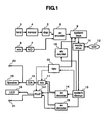
- Fig. 1 shows the block diagram of Embodiment 1.
- a CPU 22 controls each of blocks 1 through 11 to conduct the recording operation.
- An image signal taken or picked up through a lens portion 3 is converted into an electric signal through a sensor portion 4, such as a CCD or the like, and is processed within a signal processor portion 5 in the form of a digital image signal, to be transmitted to an Audio/Video coding block 8.
- Audio/Video coding block 8 the image and the audio signals are coded into an elementary stream (ES), in accordance with a standard such as MPEG 2 and MPEG 1 Layer II.
- ES elementary stream
- the coded ES is treated with a packetizing process within a system-multiplexing portion 9, so that it can be recorded onto the optical disk 12.
- PS program stream
- a system time clock STC
- a standard clock for example, 27 MHz
- a reproduction time information which is called a decoding time stamp (DTS) is added to both the image and audio, based on the standard time information STC mentioned above.
- the DTS is indicative of the timing at which the image and audio signals should be decoded.
- decoding in a similar manner to when encoding, the STC is counted up from the time of starting reproduction. Decoding is carried out on the stream of image and audio having a DTS coincident with the STC, thereby enabling to synchronization between the reproduced image and audio signals (e.g. a lip sync).
- the DTS information is added within Packetized Elementary Stream (PES) of image and audio.
- PES Packetized Elementary Stream
- the data packetized within the system-multiplexing portion 9 is transferred to a media drive 11, together with management information for managing recorded data within a disk (i.e. inner-medium logical block information indicating start and end points of each recording or time correspondence information).
- the media drive 11 controls rotation number (or speed) of the optical disk 12, laser strength, and a pickup device, thereby recording data onto the optical disk 12 mentioned above.
- the data recorded on the optical disk 12 is read out from the optical disk 12 by means of the media drive 11 when a user instructs the reproduction thereof.
- the data is then transferred to a system separation portion 13.
- management information is read out from the optical disk 12 and is transferred to the CPU 22.
- data streams can be transferred from the media drive 11 to the system separation portion 13 at any time.
- the image and audio data in the form of the ES are recovered by removing the header or the like of the packet within system separation portion 13 and are transferred to an AudioVideo decoder 14. Counting up of the STC is started from the time when the decoding started.
- decoding of the respective image and audio data is started from the time at which the image and audio data have a DTS that coincides with the STC, thereby outputting decoded image and audio in a synchronous condition.
- the decoded image is transferred to a picture-in-picture (PinP) block 151. Since only one set of image/audio signals are outputted when conducting this operation, the image is outputted to a liquid crystal display 16 to an external monitor via an output terminal 21 without being treated by the PinP block 151.
- the audio is outputted to a mixer 17 and then to a speaker block 19 or an audio output terminal 20 through a digital/analog converter circuit 18.
- the reproducing operation of the first image/audio data is similar to that mentioned above.
- the user While viewing the first image/audio which are being reproduced by the liquid crystal display 16 or the external monitor, the user pushes down a second image/audio start button at the time when she/he wishes to add the second image/audio data to the first image/audio data.
- the CPU causes the blocks 3 through 11 to conduct the encoding operation as described above.
- the STC counter is already counting for decoding of the first image/audio data.
- the DTS to be added to the second image/audio data by the system-multiplexing portion 9 is calculated to correspond to the STC being counted for decoding of the first image/audio data.
- an adjustment is made so that the DTS added to the second image/audio data is the same as the DTS of the frame of the first image/audio signal which was displayed on the LCD when the second image/audio signal was inputted into the lens 3.
- a read request for the first image/audio data and a write request for the second image/audio data are inputted to the media drive 11 from the decoder side and encoder side respectively.
- the optical disk 12 needs time for the media drive 11 to switch between read and write operations (to move the pickup, etc.) thereby bringing about a time overhead.
- the CPU 22 provides buffering before transferring the data on the reproducing side and the recording side to the media drive 11, and thereby conducts the process so as to reduce the number of times the media drive 11 switches between read and write operations.
- time correspondence information is recorded into the management information to be recorded onto the optical disk 12, the time correspondence information being information indicative of which of the first image/audio data and the second image/audio data should be outputted in synchronism with the common STC.
- reproduction of the first and second image data is started from the media drive 11. Since the STC is held in common to the first and second image/audio data, and the data to be outputted simultaneously is described in the management information on the optical disk 12, the CPU 22 controls the reading of the first and second image/audio data by switching the media drive 11.
- the first and second image data are inputted into the system separation portion 13 and are then inputted into the AudioVideo decoder portion 14 and the AudioVideo decoder portion 15 respectively.
- Each of the AudioVideo decoders 14, 15 compares the STC value of the STC counter 10 (which started counting when the decoding started) with the DTS of the first and second image data, thereby starting the decoding at the stage when they coincide with each other.
- the image signal outputted by the AudioVideo decoders 14, 15 is treated using PinP processing by the PinP circuit 151.
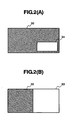
- the PinP processing may have a mode of outputting in which the first image signal has a full-screen size with the second image signal having a small-screen size as shown by reference numerals 30 and 31 in Fig. 2 , or may have a mode of outputting in which the first and second image signals are aligned in parallel with each other as shown by reference numerals 32 and 33 in Fig. 2 .
- the first and second audio signals are mixed into stereo signals, for example by the mixer circuit 17, and are outputted therefrom.
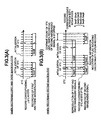
- Fig. 3 shows each of the image/audio signals (Seq A, B, P, Q, R) and times when it is recorded or reproduced.
- Fig. 3a shows the recording of the first image/audio signal (Seq A) and the third image/audio signal (Seq B).
- Fig. 3b shows the time of recording three second image/audio signals (Seq P, Q, R) when the first and third image/audio signals (Seq A, B) are being reproduced.
- Fig. 3c shows the reproducing of the first, second and third image/audio signals.
- Fig. 3a recording of the first image/audio signal (Seq A) is started. Being initialized with this start of recording, the STC starts counting up and, the first image/audio signal (Seq A) records the STC corresponding to the first image/audio signal as the DTS. This is similar to the encoding shown in Embodiment 1.
- the STC is initialized again and the counting up is started again since the first and third image/audio signals are independent. And then, recording is made of the DTS of the third image/audio signal (Seq B) as the STC corresponding to the third image/audio signal.
- recording of the second one of the second image/audio signals is basically similar to the Embodiment 1, it differs from Embodiment 1 in the following aspects: during recording of the second one of the second image/audio signals (Seq Q), reproduction of the first image/audio signal (Seq A) finishes and reproduction of the third image/audio signal (Seq B) starts, and the STC corresponding to the third image/audio signal is initialized. Before reproduction of the first image/audio signal is finished, the STC corresponding to the first image/audio signal (Seq A) is recorded as the DTS of the second one of the second image/audio signals (Seq Q).
- the STC corresponding to the third image/audio signal (Seq B) is recorded as the DTS of the second one of the second image/audio signals (Seq Q).
- the second one of the second image/audio signals (Seq Q) is decoded, it becomes inconvenient to compare the DTS of the second one of the second image/audio signals (Seq Q) and the STC, because there is a discontinuity between the DTS and PTS presentation time stamp. For that reason, in the present embodiment, when detecting the discontinuous point of the STC on the reproduction side, a flag indicating the discontinuity of the STC is added into a packet of the corresponding time within data of the second image/audio signal.
- recording of the third one of the second image/audio signals is basically similar to the Embodiment 1, it differs from Embodiment 1 in the following aspect: during recording of the third one of the second image/audio signals (Seq R), reproducing of the third image/audio signal (SeqB) finishes. Then, in this case, the STC corresponding to the third image/audio signal continues to count up even after reproduction of the third image/audio signal (Seq B) has finished, and the STC corresponding to the third image/audio signal is recorded to be the DTS, so that the third one of the second image/audio signals is in synchronism with the STC corresponding to the third image/audio signal.
- reproduction of the first, second and third image/audio signals is executed in the following manner.
- reproduction of the first and second image/audio signals (Seq A, P) are similar to that in the Embodiment 1.
- reproduction of the first image/audio signal (Seq A) is achieved by initializing the STC is to start the counting up and reproducing the first image/audio signal (Seq A) so that the DTS and the STC are in synchronism with each other.
- reproduction is started on the second one of the second image/audio signals (Seq Q), in a similar manner, however it differs from Embodiment 1 in the following aspect: during reproduction of the second one of the second image/audio signals, the reproduction of the first image/audio signal (Seq A) is finished, reproduction is started on the third image/audio signal (Seq B), and the STC corresponding to the third one of the second image/audio signals is initialized.
- the second image/audio signal (Seq Q) is reproduced in synchronism with the STC of the first image/audio signal (Seq A) until finishing of reproduction of the first image/audio signal (Seq A), and thereafter, it is reproduced in synchronism with the STC of the third image/audio signal (Seq B).
- reproduction is started on the third one of the second image/audio signals (Seq R), and during this reproduction, the reproduction of the third image/audio signal (Seq B) finishes.
- the STC corresponding to the third image/audio signal is counted up continuously even if the reproduction of the third image/audio signal (Seq B) is finished, and the second image/audio signal (Seq R) continues to be reproduced in synchronism with the STC corresponding to the third image/audio signal (Seq B).
- Embodiment 3 which is a variation of Embodiment 2.
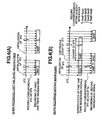
- Fig. 4 shows the respective image/audio signals (Seq A, B, P, Q and R) and times when they are recorded or reproduced, in the similar manner to that in Fig. 3 .
- Fig. 4a shows times when the first image/audio signal (Seq A) and the third image/audio signal (Seq B)are recorded.
- Fig. 4b shows times when three pieces of the second image/audio signals (Seq P, Q and R) are recorded during reproduction of the first and third image/audio signals (Seq A, B).
- Fig. 4c shows the times when reproducing the first, the second and the third image/audio signals. Explanation will be omitted about those parts which are the same as in the Embodiment shown in Fig. 3 .
- FIG. 4b A difference from the Embodiment shown in Fig. 3 can be seen in Fig. 4b .
- the STC is initialized upon starting the reproduction of the third image/audio signal (Seq B) whilst the second of the second image/audio signals (Seq Q) is being recorded.
- the STC is counted up continuously.
- the DTS of the third image/audio signal (Seq B) must be changed so that it is in synchronism with the STC, which is counted up continuously. Also, since the STC is discontinuous in Fig. 3 , then the information indicative of this is added to the DTS of the second one of the second image/audio signal (Seq Q). This information is unnecessary in Fig. 4 .
- Fig. 5 shows the first, second and third image/audio signals (Seq A, B, P, Q and R) and the times when they are recorded or reproduced, and further of the fourth image/audio signal (Seq C).
- the fourth image/audio signal (Seq C) separately from the first, second and third image/audio signals (Seq A, B, P, Q and R)
- the last image/audio signal (Seq R) among the first, second and third image/audio signals (Seq A, B, P, Q and R) is stopped, the STC is initialized, and then the fourth image/audio signal (Seq C) is recorded or reproduced.
Landscapes
- Engineering & Computer Science (AREA)
- Multimedia (AREA)
- Signal Processing (AREA)
- Signal Processing For Digital Recording And Reproducing (AREA)
- Television Signal Processing For Recording (AREA)
- Indexing, Searching, Synchronizing, And The Amount Of Synchronization Travel Of Record Carriers (AREA)
Claims (12)
- Procédé d'enregistrement et de reproduction de données d'image/de son utilisant un dispositif d'enregistrement/reproduction d'image et de son, le dispositif comportant :une partie d'entrée (3, 6) dans laquelle des données d'image/de son sont entrées, etun module d'enregistrement/reproduction (11) lequel est configuré pour enregistrer les données d'image/de son sur un support d'enregistrement (12) et reproduire celles-ci à partir du support d'enregistrement (12), etun module de contrôleur (22),le support d'enregistrement (12) incluant des informations de correspondance temporelle indiquant les données d'image/de son à reproduire en synchronisme avec un compteur d'informations temporelles standard, etle module de contrôleur (22) est utilisé pour commander le dispositif afin de reproduire des premières données d'image/de son en synchronisme avec le compteur d'informations temporelles standard conformément aux informations de correspondance temporelle, le compteur d'informations temporelles standard comptant en progressant depuis l'instant de début de reproduction des premières données d'image/de son,caractérisé en ce que :le procédé inclut en outre l'utilisation du module de contrôleur (22) afin de commander le dispositif pour :produire une estampille temporelle de décodage DTS représentant un instant par rapport au démarrage du compteur d'informations temporelles standard STC auquel des deuxièmes données d'image/de son sont entrées dans la partie d'entrée (3, 6) au moment de la reproduction des premières données d'image/de son,enregistrer lesdites secondes de données d'image/de son sur ledit support d'enregistrement (12) conjointement avec ladite estampille temporelle de décodage DTS et séparément desdites première données d'image/de son, etreproduire lesdites premières données d'image/de son et lesdites deuxièmes données d'image/de son simultanément de sorte que la reproduction des deuxièmes données d'image/audio commence avec l'estampille temporelle de décodage DTS et les deuxièmes données d'image/de son sont reproduites pendant la reproduction desdites premières données d'image/de son.
- Procédé selon la revendication 1, dans lequel :ledit module de contrôleur (22) est en outre utilisé afin de commander le dispositif pour :enregistrer des informations temporelles de reproduction correspondant à l'instant de fin de l'entrée des deuxièmes données d'image/de son dans ladite partie d'entrée, etterminer la reproduction desdites deuxièmes données d'image/de son sur la base desdites informations temporelles de reproduction, une fois que lesdites premières données d'image/de son ont été reproduites.
- Procédé selon la revendication 1, dans lequel :une pluralité des deuxièmes données d'image/de son sont toutes enregistrées conjointement avec des informations d'instant de reproduction respectives indicatives de l'instant respectif d'entrée desdites deuxièmes données d'image/de son pendant le temps de reproduction d'un élément des premières données d'image/de son.
- Procédé selon la revendication 1, dans lequel :ladite estampille temporelle de décodage DTS est produite en synchronisme avec des informations temporelles standards, lesquelles sont produites lorsque lesdites premières données d'image/de son sont reproduites.
- Procédé selon la revendication 4, comportant l'étape consistant à :changer ladite estampille temporelle de décodage DTS, laquelle est ajoutée et enregistrée dans lesdites deuxièmes données d'image/de son après l'enregistrement desdites deuxièmes données d'image/de son, afin qu'elle corresponde aux informations temporelles de reproduction lesquelles sont en synchronisme avec les informations temporelles standards qui sont indicatives d'un instant de reproduction d'une partie des premières données d'image/de son qui sont reproduites lorsque les deuxièmes données d'image/de son sont entrées.
- Procédé selon la revendication 5, dans lequel :les informations temporelles standards produites lors de la reproduction desdites premières données d'image/de son sont produites en continu et ladite estampille temporelle de décodage DTS ajoutée auxdites deuxièmes données d'image/de son est produite en synchronisme avec lesdites informations temporelles standards produites en continu, lorsque la reproduction desdites premières données d'image/de son se termine pendant l'entrée et l'enregistrement des deuxièmes données d'image/de son depuis ladite partie d'entrée.
- Procédé selon la revendication 6, dans lequel :lesdites informations temporelles standards sont produites en continu et lesdites deuxièmes données d'image/de son sont reproduites en synchronisme avec les informations temporelles standards produites en continu de sorte que l'estampille temporelle de décodage DTS ajoutée auxdites deuxièmes données d'image/de son sont en synchronisme avec les informations temporelles standards concernant lesdites premières données d'image/de son, lorsque la reproduction desdites premières données d'image/de son se termine pendant la reproduction des deuxièmes données d'image/de son.
- Procédé selon la revendication 5, dans lequel :une fois que la production des informations temporelles standards concernant lesdites premières données d'image/de son est terminée, la production d'informations temporelles standards concernant des troisièmes données d'image/de son est lancée, et l'estampille temporelle de décodage DTS ajoutée auxdites deuxièmes données d'image/de son une fois que la reproduction desdites premières données d'image/de son est terminée est produite pour être en synchronisme avec les informations temporelles standards concernant lesdites troisièmes données d'images/de son, lorsque la reproduction des premières données d'image/de son se termine et que la reproduction des troisième données d'image/de son commence pendant l'entrée des deuxièmes données d'image/de son enregistrées depuis ladite partie d'entrée.
- Procédé selon la revendication 8, dans lequel :des informations indicatives d'une discontinuité des informations temporelles standards sont ajoutées à l'estampille temporelle de décodage DTS à ajouter auxdites deuxième données d'image/de son.
- Procédé selon la revendication 8, dans lequel :une fois que la reproduction desdites premières données d'image/de son est terminée et que la production des informations temporelles standards desdites troisièmes données d'image/de son est lancée, les deuxième données d'image/de son sont reproduites de sorte que l'estampille temporelle de décodage (DTS) ajoutée auxdites deuxième données d'image/de son est en synchronisme avec les informations temporelles standards desdites troisièmes données d'image/de son, lorsque la reproduction desdites premières données d'image/de son se termine et que la reproduction desdites troisièmes données d'image/de son commence pendant la reproduction des deuxièmes données d'image/de son.
- Procédé selon la revendication 4, dans lequel :les informations temporelles standards concernant lesdites premières données d'image/de son sont produites en continu, une estampille temporelle de décodage DTS ajoutée auxdites deuxièmes données d'image/de son est produite pour être en synchronisme avec lesdites informations temporelles standards produites en continu, et une estampille temporelle de décodage DTS ajoutée à des troisième données d'image/de son est en synchronisme avec lesdites informations temporelles standards produites en continu, lorsque la reproduction desdites premières données d'image/de son se termine et que la reproduction des troisième données d'image/de son commence pendant l'entrée et l'enregistrement des deuxièmes données d'image/de son depuis ladite partie d'entrée.
- Procédé selon la revendication 11, dans lequel :les informations temporelles standards desdites premières données d'image/de son sont produites en continu, les deuxième données d'image/de son sont reproduites de sorte que l'estampille temporelle de décodage DTS ajoutée auxdites deuxièmes données d'image/de son est en synchronisme avec lesdites informations temporelles standards produites en continu, et les troisièmes données d'image/de son sont reproduites de sorte que l'estampille temporelle de décodage DTS ajoutée auxdites troisièmes données d'image/de son est en synchronisme avec lesdites informations temporelles standards produites en continu, lorsque la reproduction desdites premières données d'image/de son se termine et que la reproduction desdites troisièmes données d'image/de son commence pendant la reproduction des deuxièmes données d'image/de son.
Applications Claiming Priority (1)
| Application Number | Priority Date | Filing Date | Title |
|---|---|---|---|
| JP2005369023A JP4501854B2 (ja) | 2005-12-22 | 2005-12-22 | 映像音声記録装置 |
Publications (3)
| Publication Number | Publication Date |
|---|---|
| EP1801809A2 EP1801809A2 (fr) | 2007-06-27 |
| EP1801809A3 EP1801809A3 (fr) | 2007-07-18 |
| EP1801809B1 true EP1801809B1 (fr) | 2011-05-25 |
Family
ID=37888020
Family Applications (1)
| Application Number | Title | Priority Date | Filing Date |
|---|---|---|---|
| EP20060256315 Active EP1801809B1 (fr) | 2005-12-22 | 2006-12-12 | Synchronisation d'enregistrement d'images additionnelles pendant la reproduction de l'image principale e.g. pour incrustation d' image. |
Country Status (4)
| Country | Link |
|---|---|
| US (1) | US7907812B2 (fr) |
| EP (1) | EP1801809B1 (fr) |
| JP (1) | JP4501854B2 (fr) |
| CN (1) | CN1988641B (fr) |
Families Citing this family (3)
| Publication number | Priority date | Publication date | Assignee | Title |
|---|---|---|---|---|
| JP2003199045A (ja) * | 2001-12-26 | 2003-07-11 | Victor Co Of Japan Ltd | 情報記録信号の生成方法、情報信号の再生方法、情報信号の伝送方法、情報記録信号生成装置、情報信号再生装置、情報信号伝送装置、情報信号記録媒体、及び情報信号伝送用プログラム |
| US8250410B2 (en) * | 2007-07-04 | 2012-08-21 | Panasonic Corporation | Video recording and reproducing apparatus and method thereof |
| JP6066712B2 (ja) * | 2012-12-19 | 2017-01-25 | キヤノン株式会社 | 記録装置、記録方法およびプログラム |
Family Cites Families (9)
| Publication number | Priority date | Publication date | Assignee | Title |
|---|---|---|---|---|
| US5583652A (en) * | 1994-04-28 | 1996-12-10 | International Business Machines Corporation | Synchronized, variable-speed playback of digitally recorded audio and video |
| JPH09293330A (ja) * | 1996-04-23 | 1997-11-11 | Victor Co Of Japan Ltd | データ記録済ディスク、複数データ同期再生方法、複数データ同期記録・再生方法及び複数データ同期記録方法 |
| JP4058154B2 (ja) * | 1998-02-19 | 2008-03-05 | キヤノン株式会社 | ビデオ記録再生装置およびビデオ記録再生方法 |
| JP2001245292A (ja) * | 2000-02-29 | 2001-09-07 | Japan Radio Co Ltd | データ受信装置、データ送受信システム及び記録媒体 |
| JP2002152688A (ja) * | 2000-11-13 | 2002-05-24 | Sony Corp | デジタル放送記録再生装置 |
| EP2602790A3 (fr) * | 2001-03-08 | 2016-08-10 | Sony Corporation | Appareil d'enregistrement de données |
| JP3863528B2 (ja) * | 2001-11-30 | 2006-12-27 | 松下電器産業株式会社 | ストリーム変換装置及び方法、情報記録装置及び方法、並びに情報記録媒体 |
| JP2004362723A (ja) * | 2003-06-09 | 2004-12-24 | Funai Electric Co Ltd | 情報再生装置 |
| CN100542251C (zh) * | 2003-07-21 | 2009-09-16 | 汤姆森许可贸易公司 | 修改多媒体内容流来实现特技模式回放的方法和系统 |
-
2005
- 2005-12-22 JP JP2005369023A patent/JP4501854B2/ja not_active Expired - Lifetime
-
2006
- 2006-12-12 US US11/637,988 patent/US7907812B2/en active Active
- 2006-12-12 EP EP20060256315 patent/EP1801809B1/fr active Active
- 2006-12-22 CN CN2006101699076A patent/CN1988641B/zh active Active
Also Published As
| Publication number | Publication date |
|---|---|
| US7907812B2 (en) | 2011-03-15 |
| JP4501854B2 (ja) | 2010-07-14 |
| CN1988641B (zh) | 2011-11-30 |
| US20070154183A1 (en) | 2007-07-05 |
| EP1801809A2 (fr) | 2007-06-27 |
| CN1988641A (zh) | 2007-06-27 |
| JP2007174256A (ja) | 2007-07-05 |
| EP1801809A3 (fr) | 2007-07-18 |
Similar Documents
| Publication | Publication Date | Title |
|---|---|---|
| US6859612B2 (en) | Decoder and reproducing unit | |
| US20090322858A1 (en) | Picture signal processing device, television receiving apparatus and method of controlling apparatus | |
| US20120179475A1 (en) | Reproducing apparatus and method, and recording medium | |
| KR20020008013A (ko) | 화상 기록 장치, 화상 기록 방법 및 저장 매체 | |
| US7266288B2 (en) | Video/audio playback apparatus and video/audio playback method | |
| JP4257478B2 (ja) | 記録再生装置 | |
| EP2200299B1 (fr) | Système comprenant un appareil de reproduction de données vidéo et un support d'enregistrement et appareil de génération de données vidéo pour mode de lecture spéciale dans un mode d'affichage en deux images. | |
| JPH10262208A (ja) | 同期ずれ制御装置及び方法 | |
| EP1134974B1 (fr) | Procédé et appareil pour l'enregistrement et reproduction des images | |
| EP1801809B1 (fr) | Synchronisation d'enregistrement d'images additionnelles pendant la reproduction de l'image principale e.g. pour incrustation d' image. | |
| KR20050010747A (ko) | 복호 장치 및 복호 방법 | |
| WO2004086396A1 (fr) | Appareil et methode de reproduction, et support d'enregistrement associe | |
| JP4998574B2 (ja) | 映像音声記録装置 | |
| JP4288442B2 (ja) | 記録再生装置および映像処理方法 | |
| US20050259973A1 (en) | Recording/reproducing apparatus with digital interface | |
| WO2005122568A1 (fr) | Dispositif de traitement de données et méthode de traitement de données | |
| CA2725177A1 (fr) | Appareil et methode de reproduction, et support d'enregistrement associe | |
| JP2000090566A (ja) | 再生装置 | |
| EP2075795A1 (fr) | Appareil d'affichage et son procédé de commande | |
| HK1084489B (en) | Reproducing apparatus and method, and recording medium | |
| HK1098867B (en) | Reproducing method |
Legal Events
| Date | Code | Title | Description |
|---|---|---|---|
| PUAI | Public reference made under article 153(3) epc to a published international application that has entered the european phase |
Free format text: ORIGINAL CODE: 0009012 |
|
| PUAL | Search report despatched |
Free format text: ORIGINAL CODE: 0009013 |
|
| 17P | Request for examination filed |
Effective date: 20061227 |
|
| AK | Designated contracting states |
Kind code of ref document: A2 Designated state(s): AT BE BG CH CY CZ DE DK EE ES FI FR GB GR HU IE IS IT LI LT LU LV MC NL PL PT RO SE SI SK TR |
|
| AX | Request for extension of the european patent |
Extension state: AL BA HR MK YU |
|
| AK | Designated contracting states |
Kind code of ref document: A3 Designated state(s): AT BE BG CH CY CZ DE DK EE ES FI FR GB GR HU IE IS IT LI LT LU LV MC NL PL PT RO SE SI SK TR |
|
| AX | Request for extension of the european patent |
Extension state: AL BA HR MK YU |
|
| 17Q | First examination report despatched |
Effective date: 20080222 |
|
| AKX | Designation fees paid |
Designated state(s): DE FR GB |
|
| RIC1 | Information provided on ipc code assigned before grant |
Ipc: G11B 27/30 20060101AFI20081010BHEP Ipc: H04N 7/26 20060101ALI20081010BHEP Ipc: G11B 27/34 20060101ALN20081010BHEP |
|
| RTI1 | Title (correction) |
Free format text: ADDITIONAL IMAGES RECORDING SYNCHRONISATION WHILE REPRODUCING MAIN IMAGE FOR PIP. |
|
| RIC1 | Information provided on ipc code assigned before grant |
Ipc: G11B 27/30 20060101AFI20100803BHEP Ipc: H04N 5/45 20060101ALN20100803BHEP |
|
| RTI1 | Title (correction) |
Free format text: ADDITIONAL IMAGES RECORDING SYNCHRONISATION WHILE REPRODUCING MAIN IMAGE FOR PICTURE IN PICTURE PINP. |
|
| GRAP | Despatch of communication of intention to grant a patent |
Free format text: ORIGINAL CODE: EPIDOSNIGR1 |
|
| RTI1 | Title (correction) |
Free format text: ADDITIONAL IMAGES RECORDING SYNCHRONISATION WHILE REPRODUCING MAIN IMAGE E.G. FOR PICTURE IN PICTURE PIP. |
|
| GRAS | Grant fee paid |
Free format text: ORIGINAL CODE: EPIDOSNIGR3 |
|
| GRAA | (expected) grant |
Free format text: ORIGINAL CODE: 0009210 |
|
| AK | Designated contracting states |
Kind code of ref document: B1 Designated state(s): DE FR GB |
|
| REG | Reference to a national code |
Ref country code: GB Ref legal event code: FG4D |
|
| REG | Reference to a national code |
Ref country code: DE Ref legal event code: R096 Ref document number: 602006022151 Country of ref document: DE Effective date: 20110707 |
|
| PLBE | No opposition filed within time limit |
Free format text: ORIGINAL CODE: 0009261 |
|
| STAA | Information on the status of an ep patent application or granted ep patent |
Free format text: STATUS: NO OPPOSITION FILED WITHIN TIME LIMIT |
|
| 26N | No opposition filed |
Effective date: 20120228 |
|
| REG | Reference to a national code |
Ref country code: DE Ref legal event code: R097 Ref document number: 602006022151 Country of ref document: DE Effective date: 20120228 |
|
| REG | Reference to a national code |
Ref country code: DE Ref legal event code: R082 Ref document number: 602006022151 Country of ref document: DE Representative=s name: STREHL, SCHUEBEL-HOPF & PARTNER, DE |
|
| REG | Reference to a national code |
Ref country code: DE Ref legal event code: R082 Ref document number: 602006022151 Country of ref document: DE Representative=s name: STREHL SCHUEBEL-HOPF & PARTNER MBB PATENTANWAE, DE Effective date: 20130604 Ref country code: DE Ref legal event code: R081 Ref document number: 602006022151 Country of ref document: DE Owner name: HITACHI CONSUMER ELECTRONICS CO., LTD., JP Free format text: FORMER OWNER: HITACHI, LTD., TOKYO, JP Effective date: 20130604 Ref country code: DE Ref legal event code: R082 Ref document number: 602006022151 Country of ref document: DE Representative=s name: STREHL, SCHUEBEL-HOPF & PARTNER, DE Effective date: 20130604 Ref country code: DE Ref legal event code: R082 Ref document number: 602006022151 Country of ref document: DE Representative=s name: PATENTANWAELTE STREHL, SCHUEBEL-HOPF & PARTNER, DE Effective date: 20130604 Ref country code: DE Ref legal event code: R081 Ref document number: 602006022151 Country of ref document: DE Owner name: HITACHI MAXELL, LTD., IBARAKI-SHI, JP Free format text: FORMER OWNER: HITACHI, LTD., TOKYO, JP Effective date: 20130604 Ref country code: DE Ref legal event code: R081 Ref document number: 602006022151 Country of ref document: DE Owner name: MAXELL, LTD., OYAMAZAKI, JP Free format text: FORMER OWNER: HITACHI, LTD., TOKYO, JP Effective date: 20130604 |
|
| REG | Reference to a national code |
Ref country code: GB Ref legal event code: 732E Free format text: REGISTERED BETWEEN 20130822 AND 20130828 |
|
| REG | Reference to a national code |
Ref country code: FR Ref legal event code: TP Owner name: HITACHI CONSUMER ELECTRONICS CO., LTD., JP Effective date: 20130906 |
|
| REG | Reference to a national code |
Ref country code: DE Ref legal event code: R082 Ref document number: 602006022151 Country of ref document: DE Representative=s name: PATENTANWAELTE STREHL, SCHUEBEL-HOPF & PARTNER, DE |
|
| REG | Reference to a national code |
Ref country code: GB Ref legal event code: 732E Free format text: REGISTERED BETWEEN 20150305 AND 20150311 |
|
| REG | Reference to a national code |
Ref country code: DE Ref legal event code: R082 Ref document number: 602006022151 Country of ref document: DE Representative=s name: STREHL SCHUEBEL-HOPF & PARTNER MBB PATENTANWAE, DE Effective date: 20150317 Ref country code: DE Ref legal event code: R081 Ref document number: 602006022151 Country of ref document: DE Owner name: HITACHI MAXELL, LTD., IBARAKI-SHI, JP Free format text: FORMER OWNER: HITACHI CONSUMER ELECTRONICS CO., LTD., TOKIO/TOKYO, JP Effective date: 20150317 Ref country code: DE Ref legal event code: R082 Ref document number: 602006022151 Country of ref document: DE Representative=s name: PATENTANWAELTE STREHL, SCHUEBEL-HOPF & PARTNER, DE Effective date: 20150317 Ref country code: DE Ref legal event code: R081 Ref document number: 602006022151 Country of ref document: DE Owner name: MAXELL, LTD., OYAMAZAKI, JP Free format text: FORMER OWNER: HITACHI CONSUMER ELECTRONICS CO., LTD., TOKIO/TOKYO, JP Effective date: 20150317 |
|
| REG | Reference to a national code |
Ref country code: FR Ref legal event code: TP Owner name: HITACHI MAXELL LTD., JP Effective date: 20150504 |
|
| REG | Reference to a national code |
Ref country code: FR Ref legal event code: PLFP Year of fee payment: 10 |
|
| REG | Reference to a national code |
Ref country code: FR Ref legal event code: PLFP Year of fee payment: 11 |
|
| REG | Reference to a national code |
Ref country code: FR Ref legal event code: PLFP Year of fee payment: 12 |
|
| REG | Reference to a national code |
Ref country code: DE Ref legal event code: R082 Ref document number: 602006022151 Country of ref document: DE Representative=s name: STREHL SCHUEBEL-HOPF & PARTNER MBB PATENTANWAE, DE Ref country code: DE Ref legal event code: R081 Ref document number: 602006022151 Country of ref document: DE Owner name: MAXELL, LTD., OYAMAZAKI, JP Free format text: FORMER OWNER: HITACHI MAXELL, LTD., IBARAKI-SHI, OSAKA, JP |
|
| REG | Reference to a national code |
Ref country code: FR Ref legal event code: TP Owner name: MAXELL LTD, JP Effective date: 20180329 |
|
| REG | Reference to a national code |
Ref country code: DE Ref legal event code: R081 Ref document number: 602006022151 Country of ref document: DE Owner name: MAXELL, LTD., OYAMAZAKI, JP Free format text: FORMER OWNER: MAXELL, LTD., OYAMAZAKI, KYOTO, JP |
|
| REG | Reference to a national code |
Ref country code: DE Ref legal event code: R081 Ref document number: 602006022151 Country of ref document: DE Owner name: MAXELL, LTD., OYAMAZAKI, JP Free format text: FORMER OWNER: MAXELL HOLDINGS, LTD., OYAMAZAKI, KYOTO, JP |
|
| PGFP | Annual fee paid to national office [announced via postgrant information from national office to epo] |
Ref country code: DE Payment date: 20251211 Year of fee payment: 20 |
|
| PGFP | Annual fee paid to national office [announced via postgrant information from national office to epo] |
Ref country code: GB Payment date: 20251219 Year of fee payment: 20 |
|
| PGFP | Annual fee paid to national office [announced via postgrant information from national office to epo] |
Ref country code: FR Payment date: 20251222 Year of fee payment: 20 |