EP1803244B1 - Procédé de chiffrement - Google Patents
Procédé de chiffrement Download PDFInfo
- Publication number
- EP1803244B1 EP1803244B1 EP05815218.2A EP05815218A EP1803244B1 EP 1803244 B1 EP1803244 B1 EP 1803244B1 EP 05815218 A EP05815218 A EP 05815218A EP 1803244 B1 EP1803244 B1 EP 1803244B1
- Authority
- EP
- European Patent Office
- Prior art keywords
- key
- data
- plaintext
- ciphertext
- intermediate result
- Prior art date
- Legal status (The legal status is an assumption and is not a legal conclusion. Google has not performed a legal analysis and makes no representation as to the accuracy of the status listed.)
- Expired - Lifetime
Links
Images


Classifications
-
- H—ELECTRICITY
- H04—ELECTRIC COMMUNICATION TECHNIQUE
- H04L—TRANSMISSION OF DIGITAL INFORMATION, e.g. TELEGRAPHIC COMMUNICATION
- H04L9/00—Cryptographic mechanisms or cryptographic arrangements for secret or secure communications; Network security protocols
- H04L9/06—Cryptographic mechanisms or cryptographic arrangements for secret or secure communications; Network security protocols the encryption apparatus using shift registers or memories for block-wise or stream coding, e.g. DES systems or RC4; Hash functions; Pseudorandom sequence generators
- H04L9/0618—Block ciphers, i.e. encrypting groups of characters of a plain text message using fixed encryption transformation
- H04L9/0637—Modes of operation, e.g. cipher block chaining [CBC], electronic codebook [ECB] or Galois/counter mode [GCM]
-
- H—ELECTRICITY
- H04—ELECTRIC COMMUNICATION TECHNIQUE
- H04L—TRANSMISSION OF DIGITAL INFORMATION, e.g. TELEGRAPHIC COMMUNICATION
- H04L9/00—Cryptographic mechanisms or cryptographic arrangements for secret or secure communications; Network security protocols
- H04L9/002—Countermeasures against attacks on cryptographic mechanisms
-
- H—ELECTRICITY
- H04—ELECTRIC COMMUNICATION TECHNIQUE
- H04L—TRANSMISSION OF DIGITAL INFORMATION, e.g. TELEGRAPHIC COMMUNICATION
- H04L2209/00—Additional information or applications relating to cryptographic mechanisms or cryptographic arrangements for secret or secure communication H04L9/00
- H04L2209/12—Details relating to cryptographic hardware or logic circuitry
-
- H—ELECTRICITY
- H04—ELECTRIC COMMUNICATION TECHNIQUE
- H04L—TRANSMISSION OF DIGITAL INFORMATION, e.g. TELEGRAPHIC COMMUNICATION
- H04L2209/00—Additional information or applications relating to cryptographic mechanisms or cryptographic arrangements for secret or secure communication H04L9/00
- H04L2209/20—Manipulating the length of blocks of bits, e.g. padding or block truncation
Definitions
- the present invention generally relates to data processing.
- the invention relates more specifically to computer-implemented cryptography.
- An encryption method is length-preserving if the ciphertext has exactly the same number of bits as the plaintext. Such a method must be deterministic, since it is impossible to accommodate random data (such as an initialization vector) within the ciphertext. Further, deterministic length-preserving encryption is well suited to certain applications. For example, in some encrypted database applications, determinism is essential to ensure that plaintext values in a lookup operation exactly correspond to previously stored ciphertext values.
- SRTP Secure Real Time Protocol
- Length-preserving algorithms essentially implement a codebook; repeated encryptions of the same plaintext with the same key result in identical ciphertext. An adversary gains knowledge about the plaintext by seeing which ciphertext values match. Nevertheless, in some scenarios length-preserving encryption is still useful. For example, length preservation may enable encryption to be introduced into data processing systems that are already implemented and deployed, or used in protocols that have fixed-width fields, or in systems that limit the allowed amount of data expansion. In these situations, as an alternative to message authentication, a length-preserving, deterministic, nonmalleable encryption method is desirable.
- a cipher is nonmalleable if changing a single bit of a ciphertext value affects all of the bits of the corresponding plaintext.
- a desirable nonmalleable cipher implements a pseudorandom permutation; it is indistinguishable from a permutation on the set of messages to a computationally bounded adversary.
- Nonmalleable encryption is a significant improvement over conventional modes of operation, such as cipher block chaining and counter-mode encryption, whenever adding a message authentication tag is impossible.
- a nonmalleable cipher can also accept an additional input value that can be used to prevent ciphertext-substitution attacks.
- an SRTP sequence number can be used in implementations that are associated with network elements running SRTP.
- Nonmalleable encryption also is useful for disk-block encryption. Such encryption is often used in remote storage systems, since it allows storage area networks to be used in applications in which the administrator of the network is trusted only to a limited extent.
- XCB extended codebook
- LR Luby and Rackoff in the 1980s
- XCB relies on the invertibility of the block cipher, while LR does not.
- LR needs four rounds to be secure, while XCB is secure with three.
- ABL Advanced Block Length Mode
- Section 3 has only a single hash function application and a single block cipher invocation, outside of the "counter mode" used in round 3. Because of this, it is not secure against chosen plaintext/ciphertext attacks.
- Section 3 approach provides only a pseudorandom permutation, not a "super pseudorandom permutation.”
- XCB has two hash invocations and two block cipher invocations, and is a super pseudorandom permutation.
- an enciphering method comprising the computer-implemented steps of receiving plaintext data; separating the plaintext data into a first plaintext data segment A and a second plaintext data segment B ; encrypting the first plaintext data segment A using block cipher encryption and a first key, resulting in creating a first encrypted segment C ; applying an exclusive OR operation to the first encrypted segment C and a hash of the second plaintext data segment B and an associated data element Z based on a second key, resulting in creating a first intermediate result datum D ; applying an encryption operation to the first intermediate result datum D and a third key, resulting in creating an encryption output; applying an exclusive OR operation to the encryption output and the second plaintext data segment B , resulting in creating a second intermediate result datum E ; applying an exclusive OR operation to the first intermediate result datum D and a hash of the second intermediate result
- the second key, third key, fourth key, and fifth key are determined based on the first key and a key derivation process.
- deciphering the ciphertext involves performing the steps above in inverse order.
- the plaintext comprises a block of data for storage in a non-volatile memory, and the ciphertext is stored in the non-volatile memory. Additionally or alternatively, the plaintext comprises a block of data for storage in a disk drive device, and the ciphertext is stored in the disk drive device.
- the plaintext comprises a data payload of a packet that conforms to a non-expandable data protocol, and the ciphertext is stored in the packet.
- the plaintext comprises a data payload of a packet that conforms to Secure RTP, and the ciphertext is stored in the packet.
- the encryption operation used to compute D from C and to compute F from D may be AES counter-mode encryption, or AES OFB block cipher mode.
- the invention encompasses a computer apparatus and a computer-readable medium configured to carry out the foregoing steps.
- a block cipher mode of operation implements a block cipher with an arbitrary block length and provides output ciphertext that is always the same size as the input plaintext.
- the mode can provide the best possible security in systems that cannot allow data expansion, such as disk-block encryption and some network protocols.
- the mode accepts an additional input, which can be used to protect against attacks that manipulate the ciphertext by rearranging the ciphertext blocks.
- the universal hash function from Galois/Counter Mode of operation for block ciphers may be used in an embodiment for hardware and software efficiency.
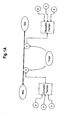
- FIG. 1A is a block diagram providing a model of a communication system that can use the approach herein.
- a first node Alice is coupled to a second node Bob by a non-secure communications link L.
- a third node Frank can intercept messages sent on link L.
- Alice sends Bob a series of messages, each of which is associated with certain additional data Z, which may contain a nonce, and which may contain information about how the message is to be routed, processed, or handled by the network and other intermediate systems between the sender and receiver.
- Alice encrypts a plaintext message P using a secret key K and using Z as an auxiliary input to an encryption function, yielding a ciphertext C.
- Alice sends C to Bob on link L; however, Frank intercepts C and sends a substitute message C' to Bob.
- Message C' is equal to C if Frank does not change the ciphertext.
- Bob decrypts C' to P' with a decryption function using the secret key K shared with Alice and the value Z of the associated data.
- an extended codebook mode of operation acts as an arbitrary length block cipher with associated data.
- the description herein assumes that a 128-bit block cipher is used.
- Embodiments can be used with other block cipher widths if a finite field of the appropriate size is defined.
- FIG. 1B is a data flow diagram illustrating steps and elements of an encryption process, according to one embodiment.
- the process of FIG. 1B receives information for enciphering, and enciphers such Plaintext 101 using the computational operations and transformations shown in FIG. 1B , to result in creating output Ciphertext 132.
- Both the Plaintext 101 and Ciphertext 132 may comprise any form of data representation, such as a string of bits, a block of disk storage, etc.
- the Plaintext 101 is separated into two portions denoted A and B.
- A is the first 128 bits of the plaintext and B is the remainder of the plaintext.
- An additional data value Z is also received.
- the additional value Z may be received in the clear and may comprise any auxiliary input value.
- the additional value Z may have any length. This approach prevents some attacks that rely on the codebook property, since identical plaintext values encrypted with distinct values of Z yield unrelated ciphertext values.
- Z is a disk block number.
- Z may be a message sequence number, and in such an embodiment the use of Z protects against replay attacks.
- step 104 portion A is encrypted with an encryption operation 116 and a first key value to yield a first intermediate value C.
- step 104 is: C ⁇ E (K 0 , A).
- a second intermediate value D is computed as: D ⁇ C XOR H (K l , B, Z) using a first XOR operation 120 and a first hash operation 124.
- H is a hash function.
- the GHASH algorithm as defined by Galois in Galois/Counter Mode (GCM) of operation for block ciphers may be used for hashing in the hash operations 124, 128.
- GCM Galois in Galois/Counter Mode
- the use of the GCM hash function provides efficiency in both hardware and software and allows for the potential re-use of prior implementation efforts.
- any pseudo-random hash function may be used for hash operations 124, 128.
- a first ciphertext portion E is computed as: E ⁇ B XOR CTR(K 2 , D), using second XOR operation 130 and encryption operation 126.
- CTR and encryption operation 126 comprise use of Advanced Encryption Standard (AES) counter-mode encryption.
- AES Advanced Encryption Standard
- OFB may be used at step 108 and for encryption operation 126; OFB is one of the four DES modes of operation.
- the counter mode encryption operation is configured to generate an output having a size that is identical to the target data into which the counter mode output is combined with an XOR operation, as described next.
- operation 126 may be any block cipher.
- a third intermediate value F is computed as F ⁇ D XOR H(K 3 , E, Z), using a second hash function 128 and a third XOR operation 122.
- Second hash operation 128, and H in the immediately preceding expression, is the same hash function as used in step 106.
- a second ciphertext portion G is determined using a decryption operation 118 as G ⁇ D (K 4 , F).
- Ciphertext 132 is created by concatenating G and E.
- the resulting ciphertext 132 may be stored in a network protocol message, stored in a disk storage device, or used in a variety of other computer-based applications.
- the ciphertext 132 has the same length as the plaintext 101.
- E represents the block cipher encryption of the value X as an element of the set ⁇ 0, 1 ⁇ w with the key K as an element of the set ⁇ 0, 1 ⁇ k
- D (K, X) represents the block cipher decryption of the value X as an element of the set ⁇ 0, 1 ⁇ w with the key K as an element of the set ⁇ 0, 1 ⁇ k
- the decryption operation D is identical to the encryption operation E , except that the three rounds are run in reverse order.
- the encryption and decryption operations 116, 118 may comprise any pseudorandom permutation; they need not have a relationship as encryption and decryption operations.
- the encryption and decryption operations 116, 118 may be implemented in hardware, software, firmware, or a combination. In a hardware implementation, the same circuit can implement both encryption and decryption operations 116, 118 if the keys K 1 , K 4 are inverted in the respective operations. Further, in another embodiment, the encryption and decryption operations 116,118 each may comprise any pseudo-random permutation operation and need not have an encryption-decryption relationship.
- Each of the keys K 0 to K 4 described in the approach herein may comprise a first key and a plurality of other keys that are mathematically or computationally derived from the first key. In this approach, fewer key sharing operations are needed before enciphering begins. Alternatively, all keys may be provisioned to the participating processing elements in advance, using any known key distribution mechanism.
- an extended codebook mode of operation acts as an arbitrary length block cipher with associated data, but a single key is used rather than a key per round.
- FIG. 2A is a block diagram of an encryption operation of the second embodiment and FIG. 2B is a block diagram of a multiplication operation.
- the description herein assumes that a 128-bit block cipher is used.
- Embodiments can be used with other block cipher widths if a finite field of the appropriate size is defined.
- the two main functions used in the second embodiment are block cipher encryption and multiplication over the field GF (2 128 ).
- the block cipher encryption of the value X with the key K is denoted as e( K , X ) and the block cipher decryption is denoted as d( K , X ).
- the symbols E and D denote encryption and decryption according to the extended codebook mode of operation described herein.
- the number of bits in the block cipher inputs and outputs is denoted w .
- the value of w is 128 when AES is used.
- the multiplication of two elements X , Y ⁇ GF (2 128 ) is denoted as X • Y, and the addition of X and Y is denoted X ⁇ Y. Addition in this field is equivalent to the bitwise exclusive-or operation.
- An example multiplication operation is defined in a separate section below.
- the function len( S ) returns a 64-bit string containing the non-negative integer describing the number of bits in its argument S , with the least significant bit on the right.
- the expression 0 l denotes a string of l zero bits
- a ⁇ B denotes the concatenation of two bit strings A and B. Bit strings are considered indexed starting on the left, so that bit zero of S is the leftmost bit.
- S [ a; b ] denotes the length b-a substring of S consisting of bits a through b of S.
- the symbol ⁇ denotes the bit string with zero length.
- An extended codebook encryption operation is defined in Table 1, a decryption operation is defined in Table 2, and the encryption operation is also illustrated in FIG. 2A .
- the algorithms of Table 1 and Table 2 use the block cipher encryption functions e and d, as well as the hash function h and the pseudorandom function c.
- the variables H , I , J , and L are derived from K by running the function e in counter mode, as shown in FIG. 2B .
- the values of variables H, I, J, and L are stored between evaluations of the algorithms, to trade off a small amount of storage for a decreased computational load.
- n ⁇ l / w ⁇ is the number of w -bit blocks in the output
- t l mod w is the number of bits in the trailing block.
- the function incr ⁇ 0, 1 ⁇ w ⁇ ⁇ 0, 1 ⁇ w is the increment operation that is used to generate successive counter values.
- the increment function treats the rightmost 32 bits of its argument as a non-negative integer with the least significant bit on the right, and increments this value modulo 2 32 .
- a i denotes the w -bit substring A [( i - 1 ) w ; iw -1], and C i denotes C [( i -1) w ; iw-i ].
- a i and C i are the i th blocks of A and C , respectively, if those bit strings are decomposed into w -bit blocks.
- GCM Galois/Counter Mode
- Multiplication over the field GF (2 128 ) is defined as an operation on bit vectors in order to simplify the specification herein. Such a definition precludes the need to use finite field mathematics in the definition of the approach. Background information on this field and its representation, and strategies for efficient implementation, are provided in the GCM specification in D. McGrew et al., "The Galois/Counter Mode of Operation (GCM),” submission to NIST Modes of Operation Process, January 2004 , sections 3 and 4 (available online in the directory CryptoToolkit/modes/proposed modes of domain csrc.nist.gov on the World Wide Web.
- Each field element is a vector of 128 bits.
- the i th bit of an element X is denoted as X i .
- the leftmost bit is X 0
- the rightmost bit is X 127 .
- FIG. 3A is a block diagram showing a secure telecommunication system
- FIG. 3B is a block diagram showing a secure storage management system.
- a network element 304 comprises XCB logic 306 that implements the approach of FIG. 1B , and the network element is coupled to a first network 305A and a second network 305B.
- a second network element 310 is also coupled to network 305B.
- Networks 305A, 305B may comprise the same network.
- Network element 304 receives a secure real-time protocol (SRTP) message 302 from an upstream network element (not shown) through network 305A.
- SRTP secure real-time protocol
- Message 302 is considered a plaintext message.
- Network element 304 applies extended code block mode of operation, as described herein, to SRTP message 302 using XCB logic 306.
- the resulting ciphertext is packaged as enciphered SRTP message 308, which has the same length or size as the plaintext message.
- Network element 304 then forwards the enciphered message 308 to network element 310, which decrypts the message using the techniques herein or otherwise consumes the message.
- the techniques herein can be applied to any network communication scenario in which a particular messaging protocol cannot tolerate message expansion as a result of encryption.
- a storage management element 322 hosts or implements XCB logic 306.
- the storage management element 322 is coupled to a mass storage device 330, such as a disk array or disk drive.
- Storage management element 322 receives, from the storage device 330, an operating system, central processor, or other processing element, a disk block 320 for storage in the storage device 330.
- Storage management element 322 applies extended code block mode of operation, as described herein, to the disk block 320 using XCB logic 306, to result in creating an enciphered disk block 324.
- the enciphered disk block 324 has a length or size that is the same as that of the disk block 320.
- Storage management element 322 then stores the enciphered disk block 324 in storage device 330.
- each of the plaintext data, segments, intermediate result data, associated data, and ciphertext may comprise a digital value stored in an electronic digital memory device.
- the separating, encrypting, hashing, XOR, and other operations described above may be performed in an electronic digital data processing apparatus coupled to the electronic digital memory device and interacting with the digital data values.
- the approaches herein also provide a useful, concrete and tangible result.
- the approaches receive data values that may be represented in a computer as transitory electronic signals.
- the approaches use an electronic digital data processor to manipulate the signals according to the data processing steps described herein.
- the input plaintext is changed to output ciphertext in a particular way.
- the output ciphertext is also represented as transitory electronic signals that may be stored in electronic digital devices, such as digital memory.
- the machine-implemented data manipulation steps described herein may operate on data stored in electronic computer memory; changing data causes a change in the state of cells, gates, and transistors of the electronic memory; changing the state of these devices means, at the atomic level, that an electron charge is applied to certain semiconductor materials associated with particular memory bit locations and not to others; and this change in charge is a concrete and tangible result.
- the disclosed approach is unique in its efficiency, its ability to work with arbitrary plaintext lengths, and its ability to accept additional inputs.
- the approach provides a block cipher mode of operation that implements a nonmalleable cipher with an additional input.
- the approach herein makes three passes over the plaintext data to result in generating ciphertext. Two passes use universal hashing over GF(2 128 ), and one pass uses counter mode encryption.
- the approach herein relies in part on the invertibility of the block cipher for security, unlike all of the Luby-Rackoff and Naor-Reingold based designs.
- the mode disclosed herein can be implemented in both hardware and software, and it has a computational cost that is relatively low compared to similar modes: it only requires n + 1 block cipher invocations and 2 n multiplications in GF (2 w ), where w is the number of bits in the block cipher inputs and outputs.
- the mode also has several useful properties: it accepts arbitrarily-sized plaintexts and associated data, including any plaintexts with lengths of at least w bits. This property allows the mode herein to protect short data, such as the common 20-byte G.729 voice codec in Secure RTP.
- XCB is more efficient than any other nonmalleable cipher, in that it requires less computation.
- the next best mode of operation is the EME mode, which takes nearly twice the computation.
- XCB is more suitable for an efficient hardware implementation, because it can be more easily parallelized and pipelined.
- XCB also accepts an additional input, which can be used to prevent ciphertext-substitution attacks.
- the approach herein is nearly twice as efficient as the best competitor.
- the approach herein also is provably secure under the reasonable assumption that AES is indistinguishable from a pseudorandom permutation.
- the approach herein has many applications.
- the approach can be used in Secure RTP, where it would be especially appropriate for wireless voice, or in CET, or in any other protocol in which expansion of a packet or data payload is infeasible or not permitted by the protocol.
- the approach also can be used in storage networking or in data-storage systems in which expansion is infeasible.
- the approach can be used in disk block encryption for both local and remote storage.
- FIG. 4 is a block diagram that illustrates a computer system 200 upon which an embodiment of the invention may be implemented.
- Computer system 200 includes a bus 202 or other communication mechanism for communicating information, and a processor 204 coupled with bus 202 for processing information.
- Computer system 200 also includes a main memory 206, such as a random access memory (“RAM”) or other dynamic storage device, coupled to bus 202 for storing information and instructions to be executed by processor 204.
- Main memory 206 also may be used for storing temporary variables or other intermediate information during execution of instructions to be executed by processor 204.
- computer system 200 further includes a read only memory (“ROM”) 208 or other static storage device coupled to bus 202 for storing static information and instructions for processor 204.
- ROM read only memory
- a storage device 210 such as a magnetic disk or optical disk, is provided and coupled to bus 202 for storing information and instructions.
- Computer system 200 may be coupled via bus 202 to a display 212, such as a cathode ray tube ("CRT"), for displaying information to a computer user.
- a display 212 such as a cathode ray tube ("CRT")
- An input device 214 is coupled to bus 202 for communicating information and command selections to processor 204.
- cursor control 216 is Another type of user input device
- cursor control 216 such as a mouse, trackball, stylus, or cursor direction keys for communicating direction information and command selections to processor 204 and for controlling cursor movement on display 212.
- This input device typically has two degrees of freedom in two axes, a first axis (e.g., x) and a second axis (e.g., y), that allows the device to specify positions in a plane.
- the invention is related to the use of computer system 200 for an enciphering method.
- an enciphering method is provided by computer system 200 in response to processor 204 executing one or more sequences of one or more instructions contained in main memory 206.
- Such instructions may be read into main memory 206 from another computer-readable medium, such as storage device 210.
- Execution of the sequences of instructions contained in main memory 206 causes processor 204 to perform the process steps described herein.
- hard-wired circuitry may be used in place of or in combination with software instructions to implement the invention.
- embodiments of the invention are not limited to any specific combination of hardware circuitry and software.
- Non-volatile media includes, for example, optical or magnetic disks, such as storage device 210.
- Volatile media includes dynamic memory, such as main memory 206.
- Transmission media includes coaxial cables, copper wire and fiber optics, including the wires that comprise bus 202. Transmission media can also take the form of acoustic or light waves, such as those generated during radio wave and infrared data communications.
- Computer-readable media include, for example, a floppy disk, a flexible disk, hard disk, magnetic tape, or any other magnetic medium, a CD-ROM, any other optical medium, punch cards, paper tape, any other physical medium with patterns of holes, a RAM, a PROM, and EPROM, a FLASH-EPROM, any other memory chip or cartridge, a carrier wave as described hereinafter, or any other medium from which a computer can read.
- Various forms of computer readable media may be involved in carrying one or more sequences of one or more instructions to processor 204 for execution.
- the instructions may initially be carried on a magnetic disk of a remote computer.
- the remote computer can load the instructions into its dynamic memory and send the instructions over a telephone line using a modem.
- a modem local to computer system 200 can receive the data on the telephone line and use an infrared transmitter to convert the data to an infrared signal.
- An infrared detector can receive the data carried in the infrared signal and appropriate circuitry can place the data on bus 202.
- Bus 202 carries the data to main memory 206, from which processor 204 retrieves and executes the instructions.
- the instructions received by main memory 206 may optionally be stored on storage device 210 either before or after execution by processor 204.
- Computer system 200 also includes a communication interface 218 coupled to bus 202.
- Communication interface 218 provides a two-way data communication coupling to a network link 220 that is connected to a local network 222.
- communication interface 218 may be an integrated services digital network ("ISDN") card or a modem to provide a data communication connection to a corresponding type of telephone line.
- ISDN integrated services digital network
- communication interface 218 may be a local area network (“LAN”) card to provide a data communication connection to a compatible LAN.
- LAN local area network
- Wireless links may also be implemented.
- communication interface 218 sends and receives electrical, electromagnetic or optical signals that carry digital data streams representing various types of information.
- Network link 220 typically provides data communication through one or more networks to other data devices.
- network link 220 may provide a connection through local network 222 to a host computer 224 or to data equipment operated by an Internet Service Provider ("ISP") 226.
- ISP 226 in turn provides data communication services through the worldwide packet data communication network now commonly referred to as the "Internet” 228.
- Internet 228 uses electrical, electromagnetic or optical signals that carry digital data streams.
- the signals through the various networks and the signals on network link 220 and through communication interface 218, which carry the digital data to and from computer system 200, are exemplary forms of carrier waves transporting the information.
- Computer system 200 can send messages and receive data, including program code, through the network(s), network link 220 and communication interface 218.
- a server 230 might transmit a requested code for an application program through Internet 228, ISP 226, local network 222 and communication interface 218.
- one such downloaded application provides for providing an enciphering method as described herein.
- Processor 204 may execute the received code as it is received, and/or stored in storage device 210, or other non-volatile storage for later execution. In this manner, computer system 200 may obtain application code in the form of a carrier wave.
Landscapes
- Engineering & Computer Science (AREA)
- Computer Security & Cryptography (AREA)
- Computer Networks & Wireless Communication (AREA)
- Signal Processing (AREA)
- Storage Device Security (AREA)
Claims (17)
- Procédé, comportant les étapes mises en ouvre par un ordinateur consistant à :recevoir des données de texte en clair (101) ;séparer (102) les données de texte en clair en un premier segment de données de texte en clair A et un deuxième segment de données de texte en clair B ;chiffrer (104) le premier segment de données de texte en clair A au moyen d'un chiffrement à cryptage par blocs (116) et d'une première clé, pour donner lieu à la création d'un premier segment chiffré C ;appliquer une opération de OU exclusif (120) sur le premier segment chiffré C et un hachage (124) du deuxième segment de données de texte en clair B et d'un élément de données associé ou peaufinage Z en fonction d'une deuxième clé, pour donner lieu à la création (106) d'une première donnée de résultat intermédiaire D ;appliquer une opération de chiffrement (126) sur la première donnée de résultat intermédiaire D et une troisième clé, pour donner lieu à la création d'une sortie de chiffrement ;appliquer une opération de OU exclusif (130) sur la sortie de chiffrement et le deuxième segment de données de texte en clair B, pour donner lieu à la création (108) d'une deuxième donnée de résultat intermédiaire E ;appliquer une opération de OU exclusif (122) sur la première donnée de résultat intermédiaire D et un hachage (128) du deuxième résultat intermédiaire et de l'élément de données associé ou peaufinage Z au moyen d'une quatrième clé, pour donner lieu à la création (110) d'une troisième donnée de résultat intermédiaire F ; etcréer (114), comme texte chiffré de sortie (132), une concaténation de la deuxième donnée de résultat intermédiaire E et un déchiffrement (112) de la troisième donnée de résultat intermédiaire F au moyen d'une cinquième clé.
- Procédé selon la revendication 1, dans lequel les données de texte en clair sont reçues par le biais d'une liaison de télécommunication numérique électronique qui accouple un émetteur et un récepteur l'un par rapport à l'autre, le procédé comportant par ailleurs :l'étape consistant à envoyer le texte chiffré de sortie au récepteur par le biais de la liaison dans un deuxième message ;dans lequel chacun des segments de données de texte en clair (102), des données de résultat intermédiaires, des données associées, et du texte chiffré (132) est une valeur numérique stockée dans un dispositif de mémoire numérique électronique ;dans lequel les opérations consistant à séparer (102), à chiffrer (104), à appliquer, et à créer (106, 108, 110) sont effectuées dans un appareil de traitement de données numérique électronique accouplé au dispositif de mémoire numérique électronique et en interaction avec les valeurs de données numériques.
- Procédé selon la revendication 1 ou 2, dans lequel la deuxième clé, la troisième clé, la quatrième clé, et la cinquième clé sont déterminées en fonction de la première clé et d'un processus de dérivation de clé.
- Procédé selon la revendication 1, 2 ou 3, comportant par ailleurs l'étape consistant à déchiffrer le texte chiffré (132) en effectuant les étapes de la revendication 1 dans l'ordre inverse.
- Procédé selon l'une quelconque des revendications précédentes, dans lequel le texte en clair comporte un bloc de données à des fins de stockage dans un dispositif de lecteur de disque (330), et comportant par ailleurs l'étape consistant à stocker le texte chiffré (132) dans le dispositif de lecteur de disque.
- Procédé selon l'une quelconque des revendications précédentes, dans lequel le texte en clair comporte une charge utile de données d'un paquet qui est conforme à un protocole de données non expansibles, et comportant par ailleurs l'étape consistant à stocker le texte chiffré dans le paquet.
- Procédé selon l'une quelconque des revendications 1 à 6, dans lequel le texte en clair comporte une charge utile de données d'un paquet qui est conforme au protocole Secure RTP, et comportant par ailleurs l'étape consistant à stocker le texte chiffré dans le paquet.
- Procédé selon l'une quelconque des revendications précédentes, dans lequel l'opération de chiffrement est un chiffrement en mode compteur AES.
- Appareil de type ordinateur, comportant :un moyen permettant de recevoir des données de texte en clair (218) ;un moyen permettant de séparer les données de texte en clair en un premier segment de données de texte en clair et un deuxième segment de données de texte en clair (204) ;un moyen permettant de chiffrer le premier segment de données de texte en clair au moyen d'un chiffrement à cryptage par blocs et d'une première clé, pour donner lieu à la création d'un premier segment chiffré ;un moyen permettant d'appliquer une opération de OU exclusif sur le premier segment chiffré et un hachage du deuxième segment de données de texte en clair et d'un élément de données associé ou peaufinage en fonction d'une deuxième clé, pour donner lieu à la création d'une première donnée de résultat intermédiaire ;un moyen permettant d'appliquer une opération de chiffrement en mode compteur sur la première donnée de résultat intermédiaire et une troisième clé, pour donner lieu à la création d'une sortie en mode compteur ;un moyen permettant d'appliquer une opération de OU exclusif sur la sortie en mode compteur et le deuxième segment de données de texte en clair, pour donner lieu à la création d'une deuxième donnée de résultat intermédiaire ;un moyen permettant d'appliquer une opération de OU exclusif sur la première donnée de résultat intermédiaire et un hachage du deuxième résultat intermédiaire et de l'élément de données associé ou peaufinage au moyen d'une quatrième clé, pour donner lieu à la création d'une troisième donnée de résultat intermédiaire ; etun moyen permettant de créer, comme texte chiffré de sortie, une concaténation de la deuxième donnée de résultat intermédiaire et un déchiffrement de la troisième donnée de résultat intermédiaire au moyen d'une cinquième clé.
- Appareil selon la revendication 9, dans lequel la deuxième clé, la troisième clé, la quatrième clé, et la cinquième clé sont déterminées en fonction de la première clé et d'un processus de dérivation de clé.
- Appareil selon la revendication 9 ou 10, comportant le déchiffrement du texte chiffré (132) en effectuant les étapes de la revendication 1 dans l'ordre inverse.
- Appareil selon l'une quelconque des revendications 9 à 11, dans lequel le texte en clair comporte un bloc de données à des fins de stockage dans un dispositif de lecteur de disque (210), et comportant par ailleurs l'étape consistant à stocker le texte chiffré dans le dispositif de lecteur de disque.
- Appareil selon l'une quelconque des revendications 9 à 12, dans lequel le texte en clair comporte une charge utile de données d'un paquet qui est conforme à un protocole de données non expansibles, et comportant par ailleurs l'étape consistant à stocker le texte chiffré dans le paquet.
- Appareil selon l'une quelconque des revendications 9 à 12, dans lequel le texte en clair comporte une charge utile de données d'un paquet qui est conforme au protocole Secure RTP, et comportant par ailleurs l'étape consistant à stocker le texte chiffré dans le paquet.
- Appareil selon l'une quelconque des revendications 9 à 14, dans lequel l'opération de chiffrement est un chiffrement en mode compteur AES.
- Appareil de type ordinateur selon l'une quelconque des revendications 9 à 15
dans lequel le moyen permettant de recevoir des données de texte en clair comporte une interface de réseau (218) qui est accouplée au réseau de données (222) pour recevoir un ou plusieurs flux de paquets en provenance de celui-ci ;
l'appareil de type ordinateur comportant par ailleurs au moins un processeur (204) comportant un moyen permettant la mise en ouvre de chacun des éléments selon l'une quelconque des revendications 9 à 15. - Procédé selon la revendication 1, comportant par ailleurs
l'étape consistant à générer une première valeur de hachage d'après le deuxième segment de données de texte en clair et l'élément de données associé au moyen d'une fonction de hachage universel sur GF (2128) ; et
l'étape consistant à effectuer un chiffrement en mode compteur sur le premier segment de données de texte en clair en combinaison avec la première valeur de données pour fournir une sortie chiffrée.
Applications Claiming Priority (3)
| Application Number | Priority Date | Filing Date | Title |
|---|---|---|---|
| US62087704P | 2004-10-20 | 2004-10-20 | |
| US11/201,626 US7418100B2 (en) | 2004-10-20 | 2005-08-10 | Enciphering method |
| PCT/US2005/037877 WO2006045038A2 (fr) | 2004-10-20 | 2005-10-18 | Procede de chiffrement |
Publications (3)
| Publication Number | Publication Date |
|---|---|
| EP1803244A2 EP1803244A2 (fr) | 2007-07-04 |
| EP1803244A4 EP1803244A4 (fr) | 2007-12-12 |
| EP1803244B1 true EP1803244B1 (fr) | 2014-10-15 |
Family
ID=36203708
Family Applications (1)
| Application Number | Title | Priority Date | Filing Date |
|---|---|---|---|
| EP05815218.2A Expired - Lifetime EP1803244B1 (fr) | 2004-10-20 | 2005-10-18 | Procédé de chiffrement |
Country Status (4)
| Country | Link |
|---|---|
| US (1) | US7418100B2 (fr) |
| EP (1) | EP1803244B1 (fr) |
| CN (1) | CN101061661B (fr) |
| WO (1) | WO2006045038A2 (fr) |
Families Citing this family (62)
| Publication number | Priority date | Publication date | Assignee | Title |
|---|---|---|---|---|
| KR100675837B1 (ko) * | 2004-12-13 | 2007-01-29 | 한국전자통신연구원 | 고속 gcm-aes 블록 암호화 장치 및 방법 |
| US8094814B2 (en) * | 2005-04-05 | 2012-01-10 | Broadcom Corporation | Method and apparatus for using counter-mode encryption to protect image data in frame buffer of a video compression system |
| JP2007086170A (ja) * | 2005-09-20 | 2007-04-05 | Nec Corp | 汎用ハッシュ関数族計算装置、方法、プログラム、および共有鍵生成システム |
| US9361617B2 (en) * | 2008-06-17 | 2016-06-07 | Verifone, Inc. | Variable-length cipher system and method |
| US8036377B1 (en) * | 2006-12-12 | 2011-10-11 | Marvell International Ltd. | Method and apparatus of high speed encryption and decryption |
| US9209967B2 (en) * | 2007-03-12 | 2015-12-08 | Exelis, Inc. | Precalculated encryption key |
| US7773753B2 (en) * | 2007-06-28 | 2010-08-10 | Aladdin Knowledge Systems Ltd. | Efficient remotely-keyed symmetric cryptography for digital rights management |
| US7827408B1 (en) * | 2007-07-10 | 2010-11-02 | The United States Of America As Represented By The Director Of The National Security Agency | Device for and method of authenticated cryptography |
| US20090080646A1 (en) * | 2007-09-21 | 2009-03-26 | Chih-Hsu Yen | Method And Architecture For Parallel Calculating Ghash Of Galois Counter Mode |
| US20090168994A1 (en) * | 2007-12-26 | 2009-07-02 | Heuss Michael R | Method for providing stronger encryption using conventional ciphers |
| US8548171B2 (en) * | 2009-02-27 | 2013-10-01 | Cisco Technology, Inc. | Pair-wise keying for tunneled virtual private networks |
| US8983066B2 (en) * | 2009-02-27 | 2015-03-17 | Cisco Technology, Inc. | Private pairwise key management for groups |
| US8687802B2 (en) * | 2009-03-30 | 2014-04-01 | The Regents Of The University Of California | Method and system for accelerating the deterministic enciphering of data in a small domain |
| US8867747B2 (en) * | 2009-03-31 | 2014-10-21 | Cisco Technology, Inc. | Key generation for networks |
| US8526605B2 (en) * | 2009-10-09 | 2013-09-03 | Seagate Technology Llc | Data encryption to provide data security and memory cell bit wear leveling |
| DE102009050493A1 (de) * | 2009-10-23 | 2011-04-28 | Röllgen, Bernd | Blockdatenverschlüsselungsverfahren |
| JP5365750B2 (ja) * | 2011-01-31 | 2013-12-11 | 日本電気株式会社 | ブロック暗号化装置、復号装置、暗号化方法、復号方法およびプログラム |
| JP5845824B2 (ja) * | 2011-11-04 | 2016-01-20 | 富士通株式会社 | 暗号化プログラム、復号化プログラム、暗号化方法、復号化方法、システム、コンテンツの生成方法およびコンテンツの復号化方法 |
| US8879731B2 (en) * | 2011-12-02 | 2014-11-04 | Adobe Systems Incorporated | Binding of protected video content to video player with block cipher hash |
| US8903088B2 (en) | 2011-12-02 | 2014-12-02 | Adobe Systems Incorporated | Binding of protected video content to video player with encryption key |
| US20130168450A1 (en) * | 2011-12-30 | 2013-07-04 | Clay W. von Mueller | Format preserving cipher system and method |
| GB201206636D0 (en) * | 2012-04-16 | 2012-05-30 | Maidsafe Net Ltd | Method of encrypting data |
| JP6007975B2 (ja) * | 2012-04-24 | 2016-10-19 | 日本電気株式会社 | フォーマット保存暗号化装置、方法およびプログラム、復号化装置、方法およびプログラム |
| US20140044262A1 (en) * | 2012-08-09 | 2014-02-13 | Cisco Technology, Inc. | Low Latency Encryption and Authentication in Optical Transport Networks |
| US9064318B2 (en) | 2012-10-25 | 2015-06-23 | Adobe Systems Incorporated | Image matting and alpha value techniques |
| US10638221B2 (en) | 2012-11-13 | 2020-04-28 | Adobe Inc. | Time interval sound alignment |
| US9201580B2 (en) | 2012-11-13 | 2015-12-01 | Adobe Systems Incorporated | Sound alignment user interface |
| US9355649B2 (en) | 2012-11-13 | 2016-05-31 | Adobe Systems Incorporated | Sound alignment using timing information |
| CN103810439B (zh) | 2012-11-14 | 2016-06-08 | 纬创资通股份有限公司 | 密码输入系统与密码输入方法 |
| US9076205B2 (en) | 2012-11-19 | 2015-07-07 | Adobe Systems Incorporated | Edge direction and curve based image de-blurring |
| US8897588B2 (en) | 2012-11-20 | 2014-11-25 | Adobe Systems Incorporated | Data-driven edge-based image de-blurring |
| US10249321B2 (en) | 2012-11-20 | 2019-04-02 | Adobe Inc. | Sound rate modification |
| US9451304B2 (en) | 2012-11-29 | 2016-09-20 | Adobe Systems Incorporated | Sound feature priority alignment |
| US9135710B2 (en) | 2012-11-30 | 2015-09-15 | Adobe Systems Incorporated | Depth map stereo correspondence techniques |
| US10455219B2 (en) | 2012-11-30 | 2019-10-22 | Adobe Inc. | Stereo correspondence and depth sensors |
| US9208547B2 (en) | 2012-12-19 | 2015-12-08 | Adobe Systems Incorporated | Stereo correspondence smoothness tool |
| US10249052B2 (en) | 2012-12-19 | 2019-04-02 | Adobe Systems Incorporated | Stereo correspondence model fitting |
| US9214026B2 (en) | 2012-12-20 | 2015-12-15 | Adobe Systems Incorporated | Belief propagation and affinity measures |
| JP6740902B2 (ja) * | 2014-08-20 | 2020-08-19 | 日本電気株式会社 | 認証暗号化方法、認証復号方法および情報処理装置 |
| US10305689B2 (en) * | 2014-12-04 | 2019-05-28 | Nec Corporation | Encryption apparatus, decryption apparatus, cryptography processing system, encryption method, decryption method, encryption program, and decryption program |
| WO2016153457A1 (fr) * | 2015-03-20 | 2016-09-29 | Hewlett Packard Enterprise Development Lp | Cryptage par bloc de flux de données |
| US10075291B1 (en) | 2015-05-27 | 2018-09-11 | Citigroup Technology, Inc. | Data deduplication and compression evaluation methods and systems |
| US9887834B1 (en) | 2015-05-27 | 2018-02-06 | Citigroup Technology, Inc. | Data deduplication and compression evaluation methods and systems |
| WO2017095435A1 (fr) * | 2015-12-04 | 2017-06-08 | Hewlett Packard Enterprise Development Lp | Combinaison de hachages de blocs de données |
| US10262164B2 (en) * | 2016-01-15 | 2019-04-16 | Blockchain Asics Llc | Cryptographic ASIC including circuitry-encoded transformation function |
| CN107615702A (zh) * | 2016-03-24 | 2018-01-19 | 慧与发展有限责任合伙企业 | 文本加密 |
| US9614668B1 (en) * | 2016-09-14 | 2017-04-04 | ISARA Corporation | Conversion schemes for cryptography systems |
| CN106850219B (zh) * | 2017-01-16 | 2020-06-05 | 宇龙计算机通信科技(深圳)有限公司 | 一种数据处理方法及终端 |
| JP6735926B2 (ja) * | 2017-09-01 | 2020-08-05 | 三菱電機株式会社 | 暗号化装置、復号装置、暗号化方法、復号方法、暗号化プログラム及び復号プログラム |
| US10454681B1 (en) | 2017-11-17 | 2019-10-22 | ISARA Corporation | Multi-use key encapsulation processes |
| RU2666303C1 (ru) * | 2017-12-14 | 2018-09-06 | Открытое Акционерное Общество "Информационные Технологии И Коммуникационные Системы" | Способ и устройство для вычисления хэш-функции |
| US10031795B1 (en) * | 2017-12-22 | 2018-07-24 | ISARA Corporation | Using conversion schemes in public key cryptosystems |
| US10061636B1 (en) * | 2017-12-22 | 2018-08-28 | ISARA Corporation | Conversion schemes for public key cryptosystems |
| KR102515357B1 (ko) | 2018-01-25 | 2023-03-29 | 프라운호퍼 게젤샤프트 쭈르 푀르데룽 데어 안겐반텐 포르슝 에. 베. | 효율적인 서브 픽처 추출 |
| US10841086B2 (en) | 2018-02-06 | 2020-11-17 | Wickr, Inc. | Facilitating communications using hybrid cryptography |
| US10819510B2 (en) * | 2018-02-06 | 2020-10-27 | Wickr Inc. | Facilitating communications using hybrid cryptography |
| US11153094B2 (en) * | 2018-04-27 | 2021-10-19 | EMC IP Holding Company LLC | Secure data deduplication with smaller hash values |
| US10904217B2 (en) | 2018-05-31 | 2021-01-26 | Cisco Technology, Inc. | Encryption for gateway tunnel-based VPNs independent of wan transport addresses |
| CN111310211A (zh) * | 2020-02-19 | 2020-06-19 | 成都三零凯天通信实业有限公司 | 一种商密sm4算法加密数据库的方法 |
| EP3923512A1 (fr) * | 2020-06-08 | 2021-12-15 | Barclays Execution Services Limited | Procédé de traitement de données chiffrées |
| CN113076562A (zh) * | 2021-05-08 | 2021-07-06 | 北京炼石网络技术有限公司 | 基于gcm加密模式的数据库加密字段模糊检索方法 |
| CN115484131B (zh) * | 2022-08-31 | 2024-04-12 | 江苏奥立信数字科技有限公司 | 物联网网关以及用于该物联网网关的设备数据存储系统 |
Family Cites Families (9)
| Publication number | Priority date | Publication date | Assignee | Title |
|---|---|---|---|---|
| US6266771B1 (en) * | 1997-02-10 | 2001-07-24 | The Regents Of The University Of California | Probabilistic signature scheme |
| US6061449A (en) * | 1997-10-10 | 2000-05-09 | General Instrument Corporation | Secure processor with external memory using block chaining and block re-ordering |
| US6081598A (en) * | 1997-10-20 | 2000-06-27 | Microsoft Corporation | Cryptographic system and method with fast decryption |
| US20020051537A1 (en) * | 2000-09-13 | 2002-05-02 | Rogaway Phillip W. | Method and apparatus for realizing a parallelizable variable-input-length pseudorandom function |
| US7046802B2 (en) * | 2000-10-12 | 2006-05-16 | Rogaway Phillip W | Method and apparatus for facilitating efficient authenticated encryption |
| US6959346B2 (en) * | 2000-12-22 | 2005-10-25 | Mosaid Technologies, Inc. | Method and system for packet encryption |
| ATE465571T1 (de) * | 2001-08-13 | 2010-05-15 | Univ Leland Stanford Junior | Systeme und verfahren zur verschlüsselung auf identitätsbasis und damit zusammenhängende kryptografische techniken |
| US20030123667A1 (en) * | 2001-12-28 | 2003-07-03 | Cable Television Laboratories, Inc. | Method for encryption key generation |
| US20040131182A1 (en) * | 2002-09-03 | 2004-07-08 | The Regents Of The University Of California | Block cipher mode of operation for constructing a wide-blocksize block cipher from a conventional block cipher |
-
2005
- 2005-08-10 US US11/201,626 patent/US7418100B2/en not_active Expired - Fee Related
- 2005-10-18 WO PCT/US2005/037877 patent/WO2006045038A2/fr not_active Ceased
- 2005-10-18 CN CN2005800316037A patent/CN101061661B/zh not_active Expired - Fee Related
- 2005-10-18 EP EP05815218.2A patent/EP1803244B1/fr not_active Expired - Lifetime
Also Published As
| Publication number | Publication date |
|---|---|
| US20070081668A1 (en) | 2007-04-12 |
| WO2006045038A3 (fr) | 2007-06-07 |
| CN101061661A (zh) | 2007-10-24 |
| CN101061661B (zh) | 2010-10-27 |
| EP1803244A2 (fr) | 2007-07-04 |
| WO2006045038A2 (fr) | 2006-04-27 |
| EP1803244A4 (fr) | 2007-12-12 |
| US7418100B2 (en) | 2008-08-26 |
Similar Documents
| Publication | Publication Date | Title |
|---|---|---|
| EP1803244B1 (fr) | Procédé de chiffrement | |
| US7949129B2 (en) | Method and apparatus for facilitating efficient authenticated encryption | |
| US7200232B2 (en) | Method and apparatus for symmetric-key decryption | |
| Jakimoski et al. | Chaos and cryptography: block encryption ciphers based on chaotic maps | |
| US7046802B2 (en) | Method and apparatus for facilitating efficient authenticated encryption | |
| US7110539B1 (en) | Method and apparatus for encrypting and decrypting data | |
| Daemen et al. | Xoodoo cookbook | |
| Karakra et al. | A-rsa: augmented rsa | |
| McGrew et al. | The extended codebook (XCB) mode of operation | |
| US12174971B1 (en) | System and method for secure electronic transmission | |
| Djordjevic | Conventional cryptography fundamentals | |
| JP3517663B2 (ja) | 暗号通信方法及び暗号通信システム | |
| WO2003049363A1 (fr) | Systeme et procede de cryptographie symetrique | |
| JP4664692B2 (ja) | 暗号化方法、復号方法、暗号化装置、復号装置、暗号装置、およびプログラム | |
| CN119325082B (zh) | 一种新能源场站涉网检测数据加密无线传输存储管理系统及方法 | |
| Almuhammadi et al. | Double-hashing operation mode for encryption | |
| Hasan et al. | Variable Rounds Block Cipher Algorithm Design | |
| Joshi et al. | Computational complexity analysis of block ciphers of transport layer security | |
| Alwashahi et al. | Securing the Internet of Things (IoT) in the Quantum Era: Challenges and Future Directions for Quantum-Resistant Cryptography | |
| Kuang | QPP and HPPK: Unifying Non-Commutativity for Quantum-Secure Cryptography with Galois Permutation Group | |
| AlSa'deh et al. | A-RSA: augmented RSA | |
| McGrew et al. | Arbitrary block length (ABL) mode: security without data expansion | |
| Singh et al. | ENHANCEMENT OF WIRED EQUIVALENT PRIVACY | |
| Smyshlyaev | Internet-Draft CryptoPro Intended status: Informational July 3, 2017 Expires: January 4, 2018 | |
| Smyshlyaev | Internet-Draft CryptoPro Intended status: Informational June 30, 2017 Expires: January 1, 2018 |
Legal Events
| Date | Code | Title | Description |
|---|---|---|---|
| PUAI | Public reference made under article 153(3) epc to a published international application that has entered the european phase |
Free format text: ORIGINAL CODE: 0009012 |
|
| 17P | Request for examination filed |
Effective date: 20070328 |
|
| AK | Designated contracting states |
Kind code of ref document: A2 Designated state(s): AT BE BG CH CY CZ DE DK EE ES FI FR GB GR HU IE IS IT LI LT LU LV MC NL PL PT RO SE SI SK TR |
|
| AX | Request for extension of the european patent |
Extension state: AL BA HR MK YU |
|
| R17D | Deferred search report published (corrected) |
Effective date: 20070607 |
|
| RIC1 | Information provided on ipc code assigned before grant |
Ipc: H04L 9/32 20060101ALI20070702BHEP Ipc: H04L 9/28 20060101AFI20070702BHEP |
|
| A4 | Supplementary search report drawn up and despatched |
Effective date: 20071108 |
|
| DAX | Request for extension of the european patent (deleted) | ||
| GRAP | Despatch of communication of intention to grant a patent |
Free format text: ORIGINAL CODE: EPIDOSNIGR1 |
|
| INTG | Intention to grant announced |
Effective date: 20140227 |
|
| GRAP | Despatch of communication of intention to grant a patent |
Free format text: ORIGINAL CODE: EPIDOSNIGR1 |
|
| INTG | Intention to grant announced |
Effective date: 20140806 |
|
| GRAS | Grant fee paid |
Free format text: ORIGINAL CODE: EPIDOSNIGR3 |
|
| GRAA | (expected) grant |
Free format text: ORIGINAL CODE: 0009210 |
|
| AK | Designated contracting states |
Kind code of ref document: B1 Designated state(s): AT BE BG CH CY CZ DE DK EE ES FI FR GB GR HU IE IS IT LI LT LU LV MC NL PL PT RO SE SI SK TR |
|
| REG | Reference to a national code |
Ref country code: GB Ref legal event code: FG4D Ref country code: CH Ref legal event code: EP |
|
| REG | Reference to a national code |
Ref country code: IE Ref legal event code: FG4D |
|
| REG | Reference to a national code |
Ref country code: AT Ref legal event code: REF Ref document number: 692070 Country of ref document: AT Kind code of ref document: T Effective date: 20141115 |
|
| REG | Reference to a national code |
Ref country code: DE Ref legal event code: R096 Ref document number: 602005044955 Country of ref document: DE Effective date: 20141127 |
|
| REG | Reference to a national code |
Ref country code: NL Ref legal event code: VDEP Effective date: 20141015 |
|
| REG | Reference to a national code |
Ref country code: AT Ref legal event code: MK05 Ref document number: 692070 Country of ref document: AT Kind code of ref document: T Effective date: 20141015 |
|
| REG | Reference to a national code |
Ref country code: LT Ref legal event code: MG4D |
|
| PG25 | Lapsed in a contracting state [announced via postgrant information from national office to epo] |
Ref country code: NL Free format text: LAPSE BECAUSE OF FAILURE TO SUBMIT A TRANSLATION OF THE DESCRIPTION OR TO PAY THE FEE WITHIN THE PRESCRIBED TIME-LIMIT Effective date: 20141015 |
|
| PG25 | Lapsed in a contracting state [announced via postgrant information from national office to epo] |
Ref country code: ES Free format text: LAPSE BECAUSE OF FAILURE TO SUBMIT A TRANSLATION OF THE DESCRIPTION OR TO PAY THE FEE WITHIN THE PRESCRIBED TIME-LIMIT Effective date: 20141015 Ref country code: LT Free format text: LAPSE BECAUSE OF FAILURE TO SUBMIT A TRANSLATION OF THE DESCRIPTION OR TO PAY THE FEE WITHIN THE PRESCRIBED TIME-LIMIT Effective date: 20141015 Ref country code: PT Free format text: LAPSE BECAUSE OF FAILURE TO SUBMIT A TRANSLATION OF THE DESCRIPTION OR TO PAY THE FEE WITHIN THE PRESCRIBED TIME-LIMIT Effective date: 20150216 Ref country code: FI Free format text: LAPSE BECAUSE OF FAILURE TO SUBMIT A TRANSLATION OF THE DESCRIPTION OR TO PAY THE FEE WITHIN THE PRESCRIBED TIME-LIMIT Effective date: 20141015 Ref country code: IS Free format text: LAPSE BECAUSE OF FAILURE TO SUBMIT A TRANSLATION OF THE DESCRIPTION OR TO PAY THE FEE WITHIN THE PRESCRIBED TIME-LIMIT Effective date: 20150215 |
|
| PG25 | Lapsed in a contracting state [announced via postgrant information from national office to epo] |
Ref country code: GR Free format text: LAPSE BECAUSE OF FAILURE TO SUBMIT A TRANSLATION OF THE DESCRIPTION OR TO PAY THE FEE WITHIN THE PRESCRIBED TIME-LIMIT Effective date: 20150116 Ref country code: CY Free format text: LAPSE BECAUSE OF FAILURE TO SUBMIT A TRANSLATION OF THE DESCRIPTION OR TO PAY THE FEE WITHIN THE PRESCRIBED TIME-LIMIT Effective date: 20141015 Ref country code: SE Free format text: LAPSE BECAUSE OF FAILURE TO SUBMIT A TRANSLATION OF THE DESCRIPTION OR TO PAY THE FEE WITHIN THE PRESCRIBED TIME-LIMIT Effective date: 20141015 Ref country code: AT Free format text: LAPSE BECAUSE OF FAILURE TO SUBMIT A TRANSLATION OF THE DESCRIPTION OR TO PAY THE FEE WITHIN THE PRESCRIBED TIME-LIMIT Effective date: 20141015 Ref country code: PL Free format text: LAPSE BECAUSE OF FAILURE TO SUBMIT A TRANSLATION OF THE DESCRIPTION OR TO PAY THE FEE WITHIN THE PRESCRIBED TIME-LIMIT Effective date: 20141015 Ref country code: LV Free format text: LAPSE BECAUSE OF FAILURE TO SUBMIT A TRANSLATION OF THE DESCRIPTION OR TO PAY THE FEE WITHIN THE PRESCRIBED TIME-LIMIT Effective date: 20141015 |
|
| REG | Reference to a national code |
Ref country code: CH Ref legal event code: PL |
|
| PG25 | Lapsed in a contracting state [announced via postgrant information from national office to epo] |
Ref country code: BE Free format text: LAPSE BECAUSE OF NON-PAYMENT OF DUE FEES Effective date: 20141031 |
|
| REG | Reference to a national code |
Ref country code: DE Ref legal event code: R097 Ref document number: 602005044955 Country of ref document: DE |
|
| REG | Reference to a national code |
Ref country code: IE Ref legal event code: MM4A |
|
| PG25 | Lapsed in a contracting state [announced via postgrant information from national office to epo] |
Ref country code: EE Free format text: LAPSE BECAUSE OF FAILURE TO SUBMIT A TRANSLATION OF THE DESCRIPTION OR TO PAY THE FEE WITHIN THE PRESCRIBED TIME-LIMIT Effective date: 20141015 Ref country code: CZ Free format text: LAPSE BECAUSE OF FAILURE TO SUBMIT A TRANSLATION OF THE DESCRIPTION OR TO PAY THE FEE WITHIN THE PRESCRIBED TIME-LIMIT Effective date: 20141015 Ref country code: RO Free format text: LAPSE BECAUSE OF FAILURE TO SUBMIT A TRANSLATION OF THE DESCRIPTION OR TO PAY THE FEE WITHIN THE PRESCRIBED TIME-LIMIT Effective date: 20141015 Ref country code: LI Free format text: LAPSE BECAUSE OF NON-PAYMENT OF DUE FEES Effective date: 20141031 Ref country code: DK Free format text: LAPSE BECAUSE OF FAILURE TO SUBMIT A TRANSLATION OF THE DESCRIPTION OR TO PAY THE FEE WITHIN THE PRESCRIBED TIME-LIMIT Effective date: 20141015 Ref country code: SK Free format text: LAPSE BECAUSE OF FAILURE TO SUBMIT A TRANSLATION OF THE DESCRIPTION OR TO PAY THE FEE WITHIN THE PRESCRIBED TIME-LIMIT Effective date: 20141015 Ref country code: CH Free format text: LAPSE BECAUSE OF NON-PAYMENT OF DUE FEES Effective date: 20141031 Ref country code: MC Free format text: LAPSE BECAUSE OF FAILURE TO SUBMIT A TRANSLATION OF THE DESCRIPTION OR TO PAY THE FEE WITHIN THE PRESCRIBED TIME-LIMIT Effective date: 20141015 |
|
| PLBE | No opposition filed within time limit |
Free format text: ORIGINAL CODE: 0009261 |
|
| STAA | Information on the status of an ep patent application or granted ep patent |
Free format text: STATUS: NO OPPOSITION FILED WITHIN TIME LIMIT |
|
| PG25 | Lapsed in a contracting state [announced via postgrant information from national office to epo] |
Ref country code: IT Free format text: LAPSE BECAUSE OF FAILURE TO SUBMIT A TRANSLATION OF THE DESCRIPTION OR TO PAY THE FEE WITHIN THE PRESCRIBED TIME-LIMIT Effective date: 20141015 |
|
| 26N | No opposition filed |
Effective date: 20150716 |
|
| REG | Reference to a national code |
Ref country code: FR Ref legal event code: PLFP Year of fee payment: 11 |
|
| PG25 | Lapsed in a contracting state [announced via postgrant information from national office to epo] |
Ref country code: IE Free format text: LAPSE BECAUSE OF NON-PAYMENT OF DUE FEES Effective date: 20141018 |
|
| PG25 | Lapsed in a contracting state [announced via postgrant information from national office to epo] |
Ref country code: SI Free format text: LAPSE BECAUSE OF FAILURE TO SUBMIT A TRANSLATION OF THE DESCRIPTION OR TO PAY THE FEE WITHIN THE PRESCRIBED TIME-LIMIT Effective date: 20141015 |
|
| PG25 | Lapsed in a contracting state [announced via postgrant information from national office to epo] |
Ref country code: BG Free format text: LAPSE BECAUSE OF FAILURE TO SUBMIT A TRANSLATION OF THE DESCRIPTION OR TO PAY THE FEE WITHIN THE PRESCRIBED TIME-LIMIT Effective date: 20141015 |
|
| PG25 | Lapsed in a contracting state [announced via postgrant information from national office to epo] |
Ref country code: TR Free format text: LAPSE BECAUSE OF FAILURE TO SUBMIT A TRANSLATION OF THE DESCRIPTION OR TO PAY THE FEE WITHIN THE PRESCRIBED TIME-LIMIT Effective date: 20141015 Ref country code: HU Free format text: LAPSE BECAUSE OF FAILURE TO SUBMIT A TRANSLATION OF THE DESCRIPTION OR TO PAY THE FEE WITHIN THE PRESCRIBED TIME-LIMIT; INVALID AB INITIO Effective date: 20051018 Ref country code: LU Free format text: LAPSE BECAUSE OF NON-PAYMENT OF DUE FEES Effective date: 20141018 |
|
| REG | Reference to a national code |
Ref country code: FR Ref legal event code: PLFP Year of fee payment: 12 |
|
| REG | Reference to a national code |
Ref country code: FR Ref legal event code: PLFP Year of fee payment: 13 |
|
| REG | Reference to a national code |
Ref country code: FR Ref legal event code: PLFP Year of fee payment: 14 |
|
| PGFP | Annual fee paid to national office [announced via postgrant information from national office to epo] |
Ref country code: GB Payment date: 20201027 Year of fee payment: 16 Ref country code: FR Payment date: 20201026 Year of fee payment: 16 Ref country code: DE Payment date: 20201028 Year of fee payment: 16 |
|
| REG | Reference to a national code |
Ref country code: DE Ref legal event code: R119 Ref document number: 602005044955 Country of ref document: DE |
|
| GBPC | Gb: european patent ceased through non-payment of renewal fee |
Effective date: 20211018 |
|
| PG25 | Lapsed in a contracting state [announced via postgrant information from national office to epo] |
Ref country code: GB Free format text: LAPSE BECAUSE OF NON-PAYMENT OF DUE FEES Effective date: 20211018 Ref country code: DE Free format text: LAPSE BECAUSE OF NON-PAYMENT OF DUE FEES Effective date: 20220503 |
|
| PG25 | Lapsed in a contracting state [announced via postgrant information from national office to epo] |
Ref country code: FR Free format text: LAPSE BECAUSE OF NON-PAYMENT OF DUE FEES Effective date: 20211031 |
|
| P01 | Opt-out of the competence of the unified patent court (upc) registered |
Effective date: 20230525 |