EP1804488A2 - Bewegungsschätzer und Bewegungsverfahren - Google Patents
Bewegungsschätzer und Bewegungsverfahren Download PDFInfo
- Publication number
- EP1804488A2 EP1804488A2 EP06126728A EP06126728A EP1804488A2 EP 1804488 A2 EP1804488 A2 EP 1804488A2 EP 06126728 A EP06126728 A EP 06126728A EP 06126728 A EP06126728 A EP 06126728A EP 1804488 A2 EP1804488 A2 EP 1804488A2
- Authority
- EP
- European Patent Office
- Prior art keywords
- motion vector
- reference block
- blocks
- candidate motion
- previous
- Prior art date
- Legal status (The legal status is an assumption and is not a legal conclusion. Google has not performed a legal analysis and makes no representation as to the accuracy of the status listed.)
- Withdrawn
Links
Images


Classifications
-
- H—ELECTRICITY
- H04—ELECTRIC COMMUNICATION TECHNIQUE
- H04N—PICTORIAL COMMUNICATION, e.g. TELEVISION
- H04N5/00—Details of television systems
- H04N5/14—Picture signal circuitry for video frequency region
- H04N5/144—Movement detection
- H04N5/145—Movement estimation
-
- H—ELECTRICITY
- H04—ELECTRIC COMMUNICATION TECHNIQUE
- H04N—PICTORIAL COMMUNICATION, e.g. TELEVISION
- H04N19/00—Methods or arrangements for coding, decoding, compressing or decompressing digital video signals
- H04N19/50—Methods or arrangements for coding, decoding, compressing or decompressing digital video signals using predictive coding
- H04N19/503—Methods or arrangements for coding, decoding, compressing or decompressing digital video signals using predictive coding involving temporal prediction
- H04N19/51—Motion estimation or motion compensation
-
- G—PHYSICS
- G06—COMPUTING OR CALCULATING; COUNTING
- G06T—IMAGE DATA PROCESSING OR GENERATION, IN GENERAL
- G06T7/00—Image analysis
- G06T7/20—Analysis of motion
- G06T7/223—Analysis of motion using block-matching
-
- H—ELECTRICITY
- H04—ELECTRIC COMMUNICATION TECHNIQUE
- H04N—PICTORIAL COMMUNICATION, e.g. TELEVISION
- H04N19/00—Methods or arrangements for coding, decoding, compressing or decompressing digital video signals
- H04N19/50—Methods or arrangements for coding, decoding, compressing or decompressing digital video signals using predictive coding
- H04N19/503—Methods or arrangements for coding, decoding, compressing or decompressing digital video signals using predictive coding involving temporal prediction
- H04N19/51—Motion estimation or motion compensation
- H04N19/527—Global motion vector estimation
-
- H—ELECTRICITY
- H04—ELECTRIC COMMUNICATION TECHNIQUE
- H04N—PICTORIAL COMMUNICATION, e.g. TELEVISION
- H04N19/00—Methods or arrangements for coding, decoding, compressing or decompressing digital video signals
- H04N19/50—Methods or arrangements for coding, decoding, compressing or decompressing digital video signals using predictive coding
- H04N19/503—Methods or arrangements for coding, decoding, compressing or decompressing digital video signals using predictive coding involving temporal prediction
- H04N19/51—Motion estimation or motion compensation
- H04N19/533—Motion estimation using multistep search, e.g. two-dimensional [2D]-log search or one-at-a-time search [OTS]
-
- H—ELECTRICITY
- H04—ELECTRIC COMMUNICATION TECHNIQUE
- H04N—PICTORIAL COMMUNICATION, e.g. TELEVISION
- H04N19/00—Methods or arrangements for coding, decoding, compressing or decompressing digital video signals
- H04N19/50—Methods or arrangements for coding, decoding, compressing or decompressing digital video signals using predictive coding
- H04N19/503—Methods or arrangements for coding, decoding, compressing or decompressing digital video signals using predictive coding involving temporal prediction
- H04N19/51—Motion estimation or motion compensation
- H04N19/56—Motion estimation with initialisation of the vector search, e.g. estimating a good candidate to initiate a search
-
- H—ELECTRICITY
- H04—ELECTRIC COMMUNICATION TECHNIQUE
- H04N—PICTORIAL COMMUNICATION, e.g. TELEVISION
- H04N19/00—Methods or arrangements for coding, decoding, compressing or decompressing digital video signals
- H04N19/60—Methods or arrangements for coding, decoding, compressing or decompressing digital video signals using transform coding
- H04N19/61—Methods or arrangements for coding, decoding, compressing or decompressing digital video signals using transform coding in combination with predictive coding
-
- G—PHYSICS
- G06—COMPUTING OR CALCULATING; COUNTING
- G06T—IMAGE DATA PROCESSING OR GENERATION, IN GENERAL
- G06T2207/00—Indexing scheme for image analysis or image enhancement
- G06T2207/10—Image acquisition modality
- G06T2207/10016—Video; Image sequence
-
- H—ELECTRICITY
- H04—ELECTRIC COMMUNICATION TECHNIQUE
- H04N—PICTORIAL COMMUNICATION, e.g. TELEVISION
- H04N7/00—Television systems
- H04N7/01—Conversion of standards, e.g. involving analogue television standards or digital television standards processed at pixel level
- H04N7/0127—Conversion of standards, e.g. involving analogue television standards or digital television standards processed at pixel level by changing the field or frame frequency of the incoming video signal, e.g. frame rate converter
- H04N7/0132—Conversion of standards, e.g. involving analogue television standards or digital television standards processed at pixel level by changing the field or frame frequency of the incoming video signal, e.g. frame rate converter the field or frame frequency of the incoming video signal being multiplied by a positive integer, e.g. for flicker reduction
Definitions
- Apparatus and methods consistent with the present invention relate to motion estimators and motion estimating methods.
- a frame rate conversion refers to converting a frequency of an input video signal to a frequency matching an output format.
- additional frames are inserted between original frames to convert a video signal of 50 Hz to a video signal of 100 Hz. If the original frames are merely repeated or a temporal linear interpolation method is used for the frame rate conversion, a motion blur effect or the like may occur. Therefore, it is common that a motion estimation and compensation technique is used as one of high quality frame rate convertion methods effective in reducing such a motion blur effect.
- Related art motion estimation methods define a plurality of candidate motion vectors, select a final motion vector on the basis of a motion prediction error value, and generate an interpolation frame based on the selected final motion vector.
- the related art motion estimation methods estimate motion on the assumption that a candidate motion vector represents expected motion for a reference block provided in a current frame and the final motion vector corresponding to real motion of the frame has a minimal motion prediction error value.
- a vector which does not represent real motion, may be wrongly estimated as the final motion vector, and if the candidate motion vectors predict motion of the reference block wrongly, motion vectors may continue to be wrongly estimated.
- the above-mentioned motion blur effect may be further increased.
- Preferred embodiments of the present invention aim to provide a motion estimator and a motion estimating method, which are capable of generating a motion vector closest to real motion, on the basis of which an interpolation frame is generated.
- the present invention provides a motion estimator for generating an interpolation frame based on a current frame and a previous frame, comprising: a first candidate motion vector calculating unit which divides the current frame into a plurality of blocks and generates a plurality of first candidate motion vector groups, each of the first candidate motion vector group comprising a first candidate motion vector for each of the plurality of the blocks calculated based on a previous motion vector previously estimated; a second candidate motion vector calculating unit which calculates a plurality of second candidate motion vectors for each of the plurality of the blocks, each of the plurality of the second candidate motion vectors being calculated based on a respective first candidate motion vector included in each of the first candidate motion vector group; and a final motion vector deciding unit which selects a final motion vector for each of the plurality of the blocks from among the plurality of the second candidate motion vectors.
- the interpolation frame is generated based on the final motion vector.
- the previous motion vector comprises a final motion vector for the previous frame.
- the first candidate motion vector calculating unit sets each of the plurality of the blocks as a reference block, and averages previous motion vectors for the reference block and a plurality of blocks adjacent to the reference block to calculate a resultant average value as the first candidate motion vector for the reference block.
- the first candidate motion vector calculating unit sets each of the plurality of the blocks as a reference block, and averages previous motion vectors for a plurality of blocks included in a row in which the reference block is placed to calculate a resultant average value as the first candidate motion vector for the reference block.
- the magnitude of each of the previous motion vectors for the plurality of the blocks included in the row in which the reference block is placed is greater than a first threshold.
- a difference between the previous motion vectors for the plurality of the blocks included in the row in which the reference block is placed, and previous motion vectors for blocks adjacent to the reference block is smaller than a second threshold.
- the first candidate motion vector calculating unit outputs the previous motion vector to the second candidate motion vector calculating unit as the first candidate motion vector.
- the previous motion vector is a null vector.
- the first candidate motion vector calculating unit sets each of the plurality of the blocks as a reference block, and calculates the first candidate motion vector for the reference block according to a global vector calculation equation.
- the first candidate motion vector calculating unit sets each of the plurality of the blocks as a reference block, and selects one of previous motion vectors for a plurality of adjacent blocks provided in one direction of the reference block as the first candidate motion vector for the reference block.
- a previous motion vector having a median magnitude of the previous motion vectors for the plurality of the adjacent blocks provided in the one direction of the reference block is selected as the first candidate motion vector for the reference block.
- Vc if Vc - Va ⁇
- Va, Vb and Vc denote the previous motion vectors corresponding to three adjacent blocks provided in the one direction of the reference block.
- the plurality of the adjacent blocks provided in the one direction of the reference block comprises one of a plurality of blocks included in a column provided in the left of the reference block and a plurality of blocks included in a column provided in the right of the reference block.
- the second candidate motion vector calculating unit divides the current frame into the plurality of blocks, sets each of the plurality of blocks as a reference block, compares the reference block with a search region set in the previous frame based on the respective first candidate motion vector included in each of the first candidate motion vector group, and calculates each of the second candidate motion vectors based on a result of the comparison.
- the second candidate motion vector calculating unit determines similarity between the reference block and the search region.
- the similarity between the reference block and the search region is determined based on a motion prediction error value with respect to the reference block.
- the motion prediction error value is calculated according to a block matching algorithm.
- the final motion vector deciding unit selects the final motion vector for each of the plurality of the blocks based on a motion prediction error value of each of the second candidate motion vectors.
- the final motion vector deciding unit selects the final motion vector based on a motion prediction error value of each of the second candidate motion vectors and a vector difference between each of the second candidate motion vectors and previous motion vectors corresponding to blocks adjacent to the reference block.
- the final motion vector deciding unit calculates the vector difference by giving different weights to the previous motion vectors corresponding to the adjacent blocks based on distances between the reference block and the adjacent blocks.
- the final motion vector deciding unit selects a second candidate motion vector, having a minimum value of a cost function determined by the following equation, as the final motion vector:
- D V ⁇ ⁇ Vi ⁇ S Wi ⁇ V ⁇ - Vi
- E(V') denotes the cost function
- Fn denotes the current frame
- Fn-1 denotes the previous frame
- ⁇ (V') denotes the motion prediction error value
- ⁇ denotes an adjustment factor for adjusting weights of the motion prediction error value and the vector difference
- D(V') denotes the vector difference
- B denotes the reference block
- S denotes the search region
- V' denotes each of the second candidate motion vectors
- X denotes a coordinate of a pixel belonging to the reference block
- Vi denotes the previous motion
- the motion estimator further comprises a frame interpolating unit which generates an interpolation frame inserted between the current frame and the previous frame based on the final motion vector.
- the present invention also provides a motion estimator for generating an interpolation frame based on a current frame and a previous frame, the motion estimator comprising: a candidate motion vector calculating unit which divides the current frame into a plurality of blocks and calculates a plurality of candidate motion vectors for each of the plurality of the blocks based on a previous motion vector previously estimated; and a final motion vector deciding unit which selects a final motion vector based on a motion prediction error value of each of the plurality of candidate motion vectors and a vector difference between each of the plurality of the candidate motion vectors and previous motion vectors corresponding to blocks adjacent to a reference block which is set from among the plurality of the blocks.
- the interpolation frame is generated based on the final motion vector.
- the final motion vector deciding unit calculates the vector difference by giving different weights to the previous motion vectors corresponding to the adjacent blocks based on distances between the reference block and the adjacent blocks.
- the final motion vector deciding unit selects a candidate motion vector, having a minimum value of a cost function determined by the following equation, as the final motion vector:
- D V ⁇ ⁇ Vi ⁇ S Wi ⁇ V ⁇ - Vi
- E(V') denotes the cost function
- Fn denotes the current frame
- Fn-1 denotes the previous frame
- ⁇ (V') denotes the motion prediction error value
- ⁇ denotes an adjustment factor for adjusting weights of the motion prediction error value
- D(V') denotes the vector difference
- B denotes the reference block
- S denotes a search region used to calculate the plurality of the candidate motion vectors
- V' denotes each of the plurality of the candidate motion vectors
- X denotes a coordinate of a pixel belonging to the
- the present invention also provides a control method of a motion estimator for generating an interpolation frame based on a current frame and a previous frame, the method comprising: dividing the current frame into a plurality of blocks; generating a plurality of first candidate motion vector groups, each of the first candidate motion vector group comprising a first candidate motion vector for each of the plurality of the blocks calculated based on a previous motion vector previously estimated; calculating a plurality of second candidate motion vectors for each of the plurality of the blocks, each of the plurality of the second candidate motion vectors being calculated based on a respective first candidate motion vector included in each of the first candidate motion vector group; and selecting a final motion vector for each of the plurality of the blocks among the plurality of second candidate motion vectors.
- the interpolation frame is generated based on the final motion vector.
- the previous motion vector comprises a final motion vector for the previous frame.
- the calculating the plurality of first candidate motion vector groups comprises: setting each of the plurality of the blocks as a reference block; averaging previous motion vectors for a plurality of blocks included in a row in which the reference block is placed; and calculating a resultant average value as the first candidate motion vector for the reference block.
- the calculating the plurality of first candidate motion vector groups comprises: setting each of the plurality of the blocks as a reference block; and selecting one of previous motion vectors for a plurality of adjacent blocks provided in one direction of the reference block as the first candidate motion vector for the reference block.
- the selecting the final motion vector comprises selecting the final motion vector based on a motion prediction error value of each of the second candidate motion vectors and a vector difference between each of the second candidate motion vectors and previous motion vectors corresponding to blocks adjacent to a reference block which is set from among the plurality of the blocks.
- the selecting the final motion vector comprises calculating the vector difference by giving different weights to the previous motion vectors corresponding to the adjacent blocks based on distances between the reference block and the adjacent blocks.
- a motion estimator generates an interpolation frame based on a current frame and a previous frame.
- the motion estimator includes a motion estimating unit 150 including a first candidate motion vector calculating part 10, a second candidate motion vector calculating part 30 and a final motion vector deciding part 50.
- the motion estimator may further include a signal receiving unit 110, a signal processing unit 130 and a frame interpolating unit 170.
- the motion estimator may further include a display unit 190 if necessary.
- the signal receiving unit 110 receives a video signal from an external video source.
- the signal receiving unit 110 may include terminals through which different video signals of different formats may be input, for example, at least one of a composite input terminal for composite signals, an S-video input terminal for S-video signals, a component input terminal for component signals, a personal computer (PC) input terminal for PC signals, and a television (TV) input terminal for TV signals.
- the video signal received in the signal receiving unit 110 is displayed on the display unit 190 for each frame.
- the signal processing unit 130 processes the video signal input from the signal receiving unit 110 into a format which can be displayed on the display unit 190. Specifically, the signal processing unit 130 processes an image corresponding to the video signal such that the image can be displayed on the display unit 190, under control of a control unit (not shown).
- the signal processing unit 130 is placed at an input side of the motion estimating unit 150, it should be understood that the signal processing unit 130 may be provided at an output side of the motion estimating unit 150 if necessary.
- the motion estimating unit 150 includes a memory 70, in addition to the first candidate motion vector calculating part 10, the second candidate motion vector calculating part 30 and the final motion vector deciding part 50 described above.
- the memory 70 stores final motion vectors calculated for each frame.
- the memory 70 may store final motion vectors for a plurality of frames as previous motion vectors, or store only final motion vectors for a frame immediately before a current frame as previous motion vectors.
- the first candidate motion vector calculating part 10 divides a frame into a plurality of blocks and calculates a plurality of first candidate motion vector groups for each of the blocks based on the previous motion vector(s) estimated previously.
- the final motion vectors for the previous frame are stored as the previous motion vectors and the first candidate motion vector calculating part 10 calculates the plurality of first candidate motion vector groups based on the previous motion vectors stored in the memory 70.
- the first candidate motion vector calculating part 10 calculates first candidate motion vectors for each of the plurality of blocks according to a predetermined motion vector calculating method.
- the calculated first candidate motion vectors for each block by one motion vector calculating method define a first candidate motion vector group.
- a method by which the first candidate motion vector calculating part 10 calculates the first candidate motion vectors will be described in detail later with reference to FIGS. 2, 3A and 3B.
- the second candidate motion vector calculating part 30 calculates second candidate motion vectors for each block for each of the plurality of first candidate motion vector groups calculated in the first candidate motion vector calculating part 10. Accordingly, a plurality of second candidate motion vectors are provided as the plurality of first candidate motion vector groups are provided.
- the final motion vector deciding part 50 selects one of the plurality of second candidate motion vectors output from the second candidate motion vector calculating part 30 and outputs the selected one as a final motion vector for a block to be interpolated. At this time, the final motion vector deciding part 50 selects one second candidate motion vector according to a predetermined criterion. In this case, the criterion on which the final motion vector deciding part 50 decides the final motion vector is to select a vector having a minimum value of a cost function. Various error estimating methods may be used for the purpose of selecting the vector having the minimum value of a cost function.
- An interpolation frame is generated based on the decided final motion vector. That is, the final motion vector decided by the final motion vector deciding part 50 is used to enable the frame interpolating unit 170 to generate an interpolation frame. Specifically, the frame interpolating unit 170 interpolates the interpolation frame between the current frame and the previous frame based on the final motion vector.
- the display unit 190 is input with the video signal received through the signal receiving unit 110 and displays an image on a screen for each frame.
- the display unit 190 includes a display module (not shown) on which the image is displayed and a module driver (not shown) for processing the input video signal to enable the image to be displayed on the display module.
- the display module may include various types of display modules such as Cathode Ray Tube (CRT), Digital Light Processing (DLP), Liquid Crystal Display (LCD), Plasma Display Panel (PDP), and the like.
- the module driver includes an optical engine.
- the module driver includes a printed circuit board for converting an input video signal into a data signal and a gate signal.
- the display unit 190 may include corresponding configuration of the module driver.
- the motion estimating unit 150 includes the first candidate motion vector calculating part 10, the second candidate motion vector calculating part 30 and the final motion vector deciding part 50.
- the first candidate motion vector calculating part 10 may include an average filtering part 11, a line average filtering part 12, a null (0) vector filtering part 13, a global vector calculating part 14, a left block filtering part 15 and a right block filtering part 16, as shown in FIG. 2. However, only if the first candidate motion vector calculating unit 10 can calculate the first candidate motion vectors, configuration thereof and a method for calculating the first candidate motion vectors are not limitative.
- Previous motion vectors stored in the memory 70 are input to the average filtering part 11 of the first candidate motion vector calculating unit 10.
- the average filtering part 11 divides a frame into a plurality of blocks and sets one of the plurality of blocks as a reference block (a block B used to estimate motion of the frame).
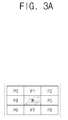
- the average filtering part 11 averages previous motion vectors for the reference block B and a plurality of predetermined blocks P0, P1, P2, P3, P5, P6, P7, and P8 adjacent to the reference block B, and produces the resultant average value as a first candidate motion vector for the reference block B. That is, in FIG. 3A, an average of the previous motion vectors for nine blocks becomes the first candidate motion vector.
- the number of blocks may be randomly varied by a designer.
- the average filtering part 11 sets each of the plurality of blocks as the reference block B and produces the first candidate motion vector Vaa for each block.
- the first candidate motion vectors Vaa produced in the average filtering part 11 are output to the second candidate motion vector calculating part 30 as one first candidate motion vector group.
- the previous motion vectors stored in the memory 70 are input to the line average filtering part 12 of the first candidate motion vector calculating unit 10.
- the line average filtering part 12 divides a frame into a plurality of blocks and sets one of the plurality of blocks as a reference block B.
- the line average filtering part 12 averages previous motion vectors for the reference block B and a plurality of blocks included in a line to which the reference block B belongs and produces the resultant average value as a first candidate motion vector Vbb.
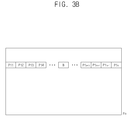
- the line average filtering part 12 averages previous motion vectors for a plurality of blocks P11, P12, P13, P14, ..., P1n-3, P1n-2, P1n-1 and P1n included in a row in which the reference block B is placed and produces the resultant average value as the first candidate motion vector Vbb for the reference block B.
- previous motion vectors for the plurality of blocks included in a column may be averaged.
- the previous motion vectors for the plurality of blocks included in the row in which the reference block B is placed is hereinafter referred to as previous row motion vectors for the plurality of blocks.
- the line average filtering part 12 may average only previous row motion vectors for the plurality of blocks included in the row in which the reference block B is placed, which are greater than a first threshold ⁇ v, and produce the resultant average value as the first candidate motion vector Vbb for the reference block B.
- the line average filtering part 12 may average only previous row motion vectors having a difference between the previous row motion vectors and previous motion vectors for blocks adjacent to the reference block B, smaller than a second threshold ⁇ m, and produces the resultant average value as the first candidate motion vector Vbb for the reference block B. This is because there is a possibility that the previous row motion vectors have errors if the previous row motion vectors have a great difference from the previous motion vectors for the adjacent blocks.
- ⁇ ⁇ v and ⁇ i 0 N - 1
- the line average filtering part 12 sets each of the plurality of blocks as the reference block B and produces the first candidate motion vector Vbb for each block.
- the first candidate motion vectors Vbb produced in the line average filtering part 12 are output to the second candidate motion vector calculating part 30 as one first candidate motion vector group.
- the previous motion vectors stored in the memory 70 are input to the null vector filtering part 13 of the first candidate motion vector calculating unit 10.
- the null vector filtering part 13 divides a frame into a plurality of blocks and sets one of the plurality of blocks as a reference block B.
- the null vector filtering part 13 may output the previous motion vectors, which are provided from the memory 70, to the second candidate motion vector calculating part 30 as a first motion vector Vcc. That is, the null vector filtering part 13 may bypass the input previous motion vectors to output it to the second candidate motion vector calculating part 30.
- the null vector filtering part 13 may not be separately prepared and the previous motion vectors stored in the memory 70 may be directly applied from the memory 70 to the second candidate motion vector calculating part 30.
- the previous motion vectors filtered in the null vector filtering part 13 are preferably, but not necessarily, vectors whose magnitude is 0, but this is not limitative.
- the previous motion vectors stored in the memory 70 are input to the global vector calculating part 14 of the first candidate motion vector calculating unit 10.
- the global vector calculating part 14 divides a frame into a plurality of blocks and sets one of the plurality of blocks as a reference block B.
- the global vector calculating part 14 may calculate a first candidate motion vector Vdd of the reference block B according to a predetermined global vector calculation equation.
- Motion vectors according to the global vector calculation equation may be usefully applied in representing motion of an overall screen by motion of a camera or the like.
- the global vector calculation equation may be provided in various ways.
- Vy a y ⁇ m + b y
- Vx and Vy as horizontal and vertical components of the first candidate motion vector Vdd according to the global vector calculation equation denote a motion magnitude in an x direction of the first candidate motion vector Vdd and a motion magnitude in a y direction of the first candidate motion vector Vdd, respectively, and n and m denote indexes with respect to a reference block, respectively.
- a x and a y denote zooming factors in the x and y directions, respectively
- b x and b y denote panning factors in the x and y directions, respectively.
- the global vector calculating part 14 sets each of the plurality of blocks as the reference block B and calculates the first candidate motion vector Vdd for each block.
- the first candidate motion vectors Vdd calculated in the global vector calculating part 14 are output to the second candidate motion vector calculating part 30 as one first candidate motion vector group.
- the previous motion vectors stored in the memory 70 are input to a one-directional block filtering part (not shown) of the first candidate motion vector calculating unit 10.
- the one-directional block filtering part divides a frame into a plurality of blocks and sets one of the plurality of blocks as a reference block B.
- the one-directional block filtering part produces one of the previous motion vectors for the plurality of adjacent blocks provided in one direction of the reference block B as the first candidate motion vector for the reference block B.
- the one-directional block filtering part may produce a previous motion vector having a median magnitude among the previous motion vectors for the plurality of adjacent blocks provided in one direction of the reference block B as the first candidate motion vector for the reference block B.
- the one-directional block filtering part may include at least one of the left block filtering part 15 and the right block filtering part 16 shown in FIG. 2.
- the left block filtering part 15 filters previous motion vectors for some of blocks, which are provided in the left of the reference block B, as left adjacent vectors. Accordingly, the left block filtering part 15 produces a previous motion vector for one of the blocks, which are provided in the left of the reference block B, as a first candidate motion vector Vee.
- V0, V3 and V6 denote previous motion vectors corresponding to adjacent blocks provided in the left of the reference block B, respectively.
- the right block filtering part 16 filters previous motion vectors for some of blocks, which are provided in the right of the reference block B, as right adjacent vectors. Accordingly, the right block filtering part 16 produces a previous motion vector for one of the blocks, which are provided in the right of the reference block B, as a first candidate motion vector Vff.
- V ⁇ 5 if V ⁇ 5 - V ⁇ 2 ⁇
- V2 and V8 denote previous motion vectors corresponding to adjacent blocks provided in the right of the reference block B, respectively.
- the second candidate motion vector calculating part 30 calculates a second candidate motion vector for each block for each first candidate motion vector group.
- one first candidate motion vector group includes 1350 first candidate motion vectors. Accordingly, if there are six first candidate motion vector groups, the first candidate motion vector calculating part 10 may calculate 8100 first candidate motion vectors.
- the second candidate motion vector calculating part 30 sets each block as the reference block B and compares the set reference block B with a predetermined search region set in a previous frame, based on a plurality of first candidate motion vectors included in each first candidate motion vector group, to calculate the second candidate motion vectors for each block.
- the second candidate motion vector calculating part 30 may compare the reference block B with the search region, based on the plurality of first candidate motion vectors included in each first candidate motion vector group, to determine similarity between the reference block B corresponding to the first candidate motion vectors and the search region.
- the second candidate motion vector calculating part 30 may calculate the second candidate motion vectors for each block using a block matching algorithm.
- the second candidate motion vector calculating part 30 may include a candidate vector calculator for calculating a plurality of motion prediction error values using the block matching algorithm and estimating the second candidate motion vectors for each block from a position having a minimum motion prediction error value.
- the second candidate motion vector calculating part 30 may divide a current frame into a plurality of blocks, find a block most similar to the reference block B in the search region of the previous frame, and then calculate a position relative to the reference block B as the second candidate motion vectors.
- the motion prediction error values may be calculated according to various ways such as Sum of Absolute Difference (SAD), Mean Absolute Difference (MAD), or the like.
- the second candidate motion vector calculating part 30 makes a local search around a position shifted by the first candidate motion vectors from a position of the reference block B (a block B of the current frame Fn whose motion is to be estimated) of the current frame.
- the second candidate motion vector calculating part 30 compares the reference block B, by use of which a final motion vector is to be estimated, with the predetermined search region set in the previous frame to calculate a plurality of motion prediction error values.
- Equation 6 Fn denotes the current frame, Fn-1 denotes the previous frame, ⁇ (Vi) denotes the motion prediction error value, B denotes the reference block, S denotes the search region, Vi denotes a vector representing a position relative to the reference block in the search region, and X denotes a coordinate of a pixel belonging to the reference block.
- the second candidate motion vector calculating part 30 may set a search region in the reference block after applying the first candidate motion vectors.
- the second candidate motion vector calculating part 30 may select a vector having the minimum value of the motion prediction error value ⁇ (Vi) in the search region S as a second candidate motion vector.
- a first calculating part 31 of the second candidate motion vector calculating part 30 calculates second candidate motion vectors Va based on the first candidate motion vectors Vaa output from the average filtering part 11 and outputs the calculated second candidate motion vector Va to the final motion vector deciding part 50.
- second to sixth calculating parts 32 to 36 of the second candidate motion vector calculating part 30 calculates respective second candidate motion vectors Vb to Vf based on the respective first candidate motion vectors Vbb to Vff output from the first candidate motion vector calculating part 10 and outputs the calculated second candidate motion vectors Vb to Vf to the final motion vector deciding part 50.
- the final motion vector deciding part 50 decides a final motion vector for each block based on motion prediction error values of the plurality of second candidate motion vectors Va to Vf.
- the final motion vector deciding part 50 may decide the final motion vector based on the motion prediction error values of the second candidate motion vectors and vector differences between the second candidate motion vectors and the previous motion vectors corresponding to blocks adjacent to the reference block.
- the final motion vector deciding part 50 may decide one of the six second candidate motion vectors as the final motion vector for one block.
- the final motion vector deciding part 50 may calculate the vector differences based on distance differences between the reference block B corresponding to the second candidate motion vectors and the adjacent blocks. In this case, the final motion vector deciding part 50 may calculate the vector differences by giving different weights to the previous motion vectors corresponding to the adjacent blocks.
- weights W0, W1, W2, W3, W5, W6, W7 and W8 are given to the adjacent blocks P0, P1, P2, P3, P5, P6, P7 and P8, respectively, and a weight W4 is given to the reference block B.
- W4 is the highest weight and P2 and P6 are relatively low weights.
- the vector differences represent values accumulated by weighting differences between the second candidate motion vectors and the stored previous motion vectors for the adjacent blocks of the previous frames with values proportional to distances between the reference block B and the adjacent blocks.
- the vector differences may be used to represent correlation between the adjacent blocks and the reference block B. In general, since actual motion vectors between adjacent blocks for each frame are mutually similar, it can be said that motion vectors for the reference block B are correctly estimated as the vector differences become smaller.
- Equation 7 D(V') denotes a vector difference, Wi denotes a weight of each of the adjacent block, V' denotes a second candidate motion vector, Vi denotes a previous motion vector corresponding to each adjacent block, and S denotes a search region.
- the final motion vector deciding part 50 selects one of the plurality of second candidate motion vectors and outputs the selected one as a final motion vector for a block to be interpolated. Such selection may be made by using a predetermined criterion, that is, finding a second candidate motion vector having a minimum value of a specified cost function by applying various error estimation methods.
- Equation 8 E(V') denotes the cost function, ⁇ (V') denotes a motion prediction error value, ⁇ denotes an adjustment factor for adjusting weights of the motion prediction error value and the vector difference, D(V') denotes the vector difference, V' denotes a second candidate motion vector, and Vi denotes a previous motion vector for a block to which a weight is given.
- ⁇ is preferably smaller than 1, but this is not limitative.
- the final motion vector deciding part 50 outputs the decided final motion vector to the memory 70 and the frame interpolating unit 170.
- the decided final motion vector is used as a basis for generating an interpolation frame inserted between a current frame and a previous frame.
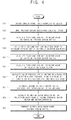
- the first candidate motion vector calculating part 10 divides a frame into a plurality of blocks.
- the first candidate motion vector calculating part 10 calculate a based on the input previous motion vectors at operation.
- the first candidate motion vector calculating part 10 may include the average filtering part 11, the line average filtering part 12, the null vector filtering part 13, the global vector calculating part 14, and the one-directional block filtering part which may further include the left block filtering part 15 and the right block filtering part 16. Since a method of calculating the first candidate motion vector groups has been described earlier, explanation thereof will be here omitted for the sake of brevity.
- the average filtering part 11 averages previous motion vectors corresponding to the reference block B and adjacent blocks of the previous frame to produce a first candidate motion vector group.
- the line average filtering part 12 averages the previous motion vectors for adjacent row blocks included in a row in which the reference block B is placed, for example, to produce a first candidate motion vector group.
- the null vector filtering part 13 bypasses the previous motion vectors to calculate the first candidate motion vector group.
- the previous motion vectors may include only vectors whose magnitude is 0.
- the global vector calculating part 14 calculates a first candidate motion vector group according to a global vector calculation equation based on the previous motion vectors.
- the one-directional block filtering part calculates one of the previous motion vectors for a plurality of adjacent blocks provided in one direction of the reference block B as a first candidate motion vector group.
- the second candidate motion vector calculating part 30 calculates a plurality of second candidate motion vectors based on first candidate motion vectors included in the first candidate motion vector groups.
- the second candidate motion vector calculating part 30 may calculate the second candidate motion vectors based on search regions determined with respect to the first candidate motion vectors.
- the final motion vector deciding part 50 decides a final motion vector for each block based on the second candidate motion vectors calculated in the second candidate motion vector calculating part 30.
- the final motion vector deciding part 50 may decide a final motion vector for each block based on motion prediction error values and vector differences of the second candidate motion vectors.
- the frame interpolating unit 170 generates an interpolation frame based on the decided final motion vector.
- the display unit 190 displays the previous frame, the interpolation frame and the current frame.
- the motion estimator of an exemplary embodiment of the present invention can more precisely predict motion of frames using final motion vectors for previous frames.
- the first candidate motion vector calculating part 10 of the motion estimator of an exemplary embodiment of the present invention calculates the first candidate motion vectors based on the previous motion vectors in various ways, the final motion vector can be more precisely calculated in accord with various changes of images.
- the final motion vector deciding part 50 of the motion estimator of the present invention decides the final motion vector based on the motion prediction error values and the vector differences, the final motion vector can be more precisely calculated.
- preferred embodiments of the present invention provide a motion estimator and a motion estimating method, which are capable of generating a motion vector closest to real motion, on the basis of which an interpolation frame is generated.
Landscapes
- Engineering & Computer Science (AREA)
- Multimedia (AREA)
- Signal Processing (AREA)
- Computer Vision & Pattern Recognition (AREA)
- Physics & Mathematics (AREA)
- General Physics & Mathematics (AREA)
- Theoretical Computer Science (AREA)
- Compression Or Coding Systems Of Tv Signals (AREA)
- Television Systems (AREA)
- Image Analysis (AREA)
Applications Claiming Priority (1)
| Application Number | Priority Date | Filing Date | Title |
|---|---|---|---|
| KR1020050131937A KR20070069615A (ko) | 2005-12-28 | 2005-12-28 | 움직임 추정장치 및 움직임 추정방법 |
Publications (2)
| Publication Number | Publication Date |
|---|---|
| EP1804488A2 true EP1804488A2 (de) | 2007-07-04 |
| EP1804488A3 EP1804488A3 (de) | 2009-08-26 |
Family
ID=37989086
Family Applications (1)
| Application Number | Title | Priority Date | Filing Date |
|---|---|---|---|
| EP06126728A Withdrawn EP1804488A3 (de) | 2005-12-28 | 2006-12-20 | Bewegungsschätzer und Bewegungsverfahren |
Country Status (4)
| Country | Link |
|---|---|
| US (1) | US8325812B2 (de) |
| EP (1) | EP1804488A3 (de) |
| KR (1) | KR20070069615A (de) |
| CN (1) | CN1992789B (de) |
Cited By (2)
| Publication number | Priority date | Publication date | Assignee | Title |
|---|---|---|---|---|
| CN102823256A (zh) * | 2010-04-09 | 2012-12-12 | 夏普株式会社 | 帧内预测的方法和系统 |
| CN102823256B (zh) * | 2010-04-09 | 2016-12-14 | 夏普株式会社 | 帧内预测的方法和系统 |
Families Citing this family (27)
| Publication number | Priority date | Publication date | Assignee | Title |
|---|---|---|---|---|
| US20080285656A1 (en) * | 2007-05-17 | 2008-11-20 | The Hong Kong University Of Science And Technology | Three-loop temporal interpolation for error concealment of multiple description coding |
| EP2071852A1 (de) * | 2007-12-11 | 2009-06-17 | Alcatel Lucent | Verfahren zum Zustellen eines Videostroms über einen drahtlosen, bidirektionalen Kanal zwischen einem Videokodierer und einem Videodekodierer |
| EP2071851B1 (de) * | 2007-12-11 | 2011-09-28 | Alcatel Lucent | Verfahren zum Zustellen eines Videostroms über einen drahtlosen Kanal |
| TWI353562B (en) * | 2008-02-04 | 2011-12-01 | Mstar Semiconductor Inc | A video processing apparatus and related method to |
| US20090244388A1 (en) * | 2008-03-27 | 2009-10-01 | Siou-Shen Lin | Motion estimation method and related apparatus for determining target motion vector according to motion of neighboring image blocks |
| KR101377660B1 (ko) * | 2008-09-30 | 2014-03-26 | 에스케이텔레콤 주식회사 | 복수 개의 움직임 벡터 추정을 이용한 움직임 벡터 부호화/복호화 방법 및 장치와 그를 이용한 영상 부호화/복호화 방법 및 장치 |
| WO2010046854A1 (en) * | 2008-10-22 | 2010-04-29 | Nxp B.V. | Device and method for motion estimation and compensation |
| TWI408620B (zh) * | 2008-12-12 | 2013-09-11 | Mstar Semiconductor Inc | 用以決定插補畫面之移動向量的影像處理方法及其相關裝置 |
| JP2010288098A (ja) * | 2009-06-12 | 2010-12-24 | Sony Corp | 画像フレーム補間装置、画像フレーム補間方法及び画像フレーム補間プログラム |
| US8411750B2 (en) * | 2009-10-30 | 2013-04-02 | Qualcomm Incorporated | Global motion parameter estimation using block-based motion vectors |
| CN102340663B (zh) * | 2010-07-22 | 2013-02-27 | 华为技术有限公司 | 图像运动估计方法和装置 |
| US8823809B1 (en) * | 2010-09-27 | 2014-09-02 | Rockwell Collins, Inc. | Methods and systems for increasing image sensor sensitivity |
| US8976873B2 (en) * | 2010-11-24 | 2015-03-10 | Stmicroelectronics S.R.L. | Apparatus and method for performing error concealment of inter-coded video frames |
| TW201306568A (zh) | 2011-07-20 | 2013-02-01 | Novatek Microelectronics Corp | 移動估測方法 |
| CN102905124A (zh) * | 2011-07-29 | 2013-01-30 | 联咏科技股份有限公司 | 移动估测方法 |
| KR101939628B1 (ko) | 2012-05-30 | 2019-01-17 | 삼성전자주식회사 | 모션 검출 방법 및 모션 검출기 |
| US10602175B2 (en) * | 2012-12-21 | 2020-03-24 | Nvidia Corporation | Using an average motion vector for a motion search |
| CN103118256B (zh) * | 2013-01-29 | 2017-02-15 | 北京大学深圳研究生院 | 基于方向和距离判别的运动矢量预测方法 |
| KR102260146B1 (ko) | 2014-03-31 | 2021-06-03 | 인텔렉추얼디스커버리 주식회사 | 시점 간 움직임 병합 후보 유도 방법 및 장치 |
| CN104811726B (zh) * | 2015-04-24 | 2018-12-18 | 宏祐图像科技(上海)有限公司 | 帧率转换中运动估计的候选运动矢量选择方法 |
| KR102192488B1 (ko) * | 2015-11-25 | 2020-12-17 | 삼성전자주식회사 | 프레임 레이트 변환 장치 및 그 프레임 레이트 변환 방법 |
| CN114449288B (zh) * | 2016-03-16 | 2025-04-29 | 联发科技股份有限公司 | 视频编码的样式基础的运动向量推导之方法及装置 |
| FR3057130B1 (fr) * | 2016-10-03 | 2019-08-02 | B<>Com | Procede de codage d'une image, procede de decodage, dispositifs, equipement terminal et programmes d'ordinateurs associes |
| KR102066012B1 (ko) * | 2017-06-27 | 2020-01-14 | 한양대학교 산학협력단 | 보간 프레임을 생성하기 위한 움직임 예측 방법 및 장치 |
| CN110636311B (zh) * | 2019-09-18 | 2021-10-15 | 浙江大华技术股份有限公司 | 运动矢量的获取方法及相关预测方法、装置 |
| CN113742288B (zh) * | 2020-05-29 | 2024-09-24 | 伊姆西Ip控股有限责任公司 | 用于数据索引的方法、电子设备和计算机程序产品 |
| US20250191120A1 (en) * | 2023-12-11 | 2025-06-12 | Advanced Micro Devices, Inc. | Motion vector field generation for frame interpolation |
Citations (5)
| Publication number | Priority date | Publication date | Assignee | Title |
|---|---|---|---|---|
| GB2205706A (en) | 1987-06-09 | 1988-12-14 | Sony Corp | Motion vector reduction in television images |
| US5317397A (en) | 1991-05-31 | 1994-05-31 | Kabushiki Kaisha Toshiba | Predictive coding using spatial-temporal filtering and plural motion vectors |
| WO2004014060A2 (en) | 2002-08-06 | 2004-02-12 | Motorola, Inc. | Method and apparatus for determining block match quality |
| EP1548647A2 (de) | 2003-12-23 | 2005-06-29 | Genesis Microchip, Inc. | Zeitliche Bewegungsvektorfilterung |
| EP1592248A1 (de) | 2004-04-30 | 2005-11-02 | Matsushita Electric Industrial Co., Ltd. | Bewegungsvektorschätzung durch adaptive zeitliche Vorhersage |
Family Cites Families (13)
| Publication number | Priority date | Publication date | Assignee | Title |
|---|---|---|---|---|
| US5506622A (en) * | 1994-05-02 | 1996-04-09 | Daewoo Electronics Co., Ltd. | Block matching type motion vector determination using correlation between error signals |
| JP3540142B2 (ja) * | 1998-01-30 | 2004-07-07 | 株式会社東芝 | 動きベクトル検出回路および動きベクトル検出方法 |
| KR100275694B1 (ko) | 1998-03-02 | 2000-12-15 | 윤덕용 | 실시간 동영상 부호화를 위한 초고속 움직임 벡터 추정방법 |
| JP4004653B2 (ja) * | 1998-08-03 | 2007-11-07 | カスタム・テクノロジー株式会社 | 動きベクトル検出方法および装置、記録媒体 |
| JP3738631B2 (ja) * | 1999-09-27 | 2006-01-25 | 三菱電機株式会社 | 画像検索システムおよび画像検索方法 |
| KR100727910B1 (ko) | 2000-10-11 | 2007-06-13 | 삼성전자주식회사 | 하이브리드형 고속 움직임 추정 방법 및 그 장치 |
| KR100412501B1 (ko) | 2001-11-30 | 2003-12-31 | 삼성전자주식회사 | 움직임 보상을 위한 화소값 선택 장치 및 방법 |
| ATE369701T1 (de) * | 2002-01-17 | 2007-08-15 | Koninkl Philips Electronics Nv | Einheit und verfahren zur schätzung eines aktuellen bewegungsvektors |
| US6925123B2 (en) | 2002-08-06 | 2005-08-02 | Motorola, Inc. | Method and apparatus for performing high quality fast predictive motion search |
| US20040076333A1 (en) * | 2002-10-22 | 2004-04-22 | Huipin Zhang | Adaptive interpolation filter system for motion compensated predictive video coding |
| KR100541953B1 (ko) * | 2003-06-16 | 2006-01-10 | 삼성전자주식회사 | 움직임 보상을 위한 화소값 선택 장치 및 방법 |
| KR100579542B1 (ko) | 2003-07-29 | 2006-05-15 | 삼성전자주식회사 | 블럭 간의 상관성을 고려한 움직임 추정 장치 및 방법 |
| KR100597397B1 (ko) * | 2003-11-06 | 2006-07-07 | 삼성전자주식회사 | 고속 움직임추정 알고리즘을 갖는 동영상 코딩방법 및 장치 |
-
2005
- 2005-12-28 KR KR1020050131937A patent/KR20070069615A/ko not_active Ceased
-
2006
- 2006-12-20 US US11/641,863 patent/US8325812B2/en active Active
- 2006-12-20 EP EP06126728A patent/EP1804488A3/de not_active Withdrawn
- 2006-12-28 CN CN2006101565688A patent/CN1992789B/zh not_active Expired - Fee Related
Patent Citations (5)
| Publication number | Priority date | Publication date | Assignee | Title |
|---|---|---|---|---|
| GB2205706A (en) | 1987-06-09 | 1988-12-14 | Sony Corp | Motion vector reduction in television images |
| US5317397A (en) | 1991-05-31 | 1994-05-31 | Kabushiki Kaisha Toshiba | Predictive coding using spatial-temporal filtering and plural motion vectors |
| WO2004014060A2 (en) | 2002-08-06 | 2004-02-12 | Motorola, Inc. | Method and apparatus for determining block match quality |
| EP1548647A2 (de) | 2003-12-23 | 2005-06-29 | Genesis Microchip, Inc. | Zeitliche Bewegungsvektorfilterung |
| EP1592248A1 (de) | 2004-04-30 | 2005-11-02 | Matsushita Electric Industrial Co., Ltd. | Bewegungsvektorschätzung durch adaptive zeitliche Vorhersage |
Cited By (2)
| Publication number | Priority date | Publication date | Assignee | Title |
|---|---|---|---|---|
| CN102823256A (zh) * | 2010-04-09 | 2012-12-12 | 夏普株式会社 | 帧内预测的方法和系统 |
| CN102823256B (zh) * | 2010-04-09 | 2016-12-14 | 夏普株式会社 | 帧内预测的方法和系统 |
Also Published As
| Publication number | Publication date |
|---|---|
| CN1992789A (zh) | 2007-07-04 |
| KR20070069615A (ko) | 2007-07-03 |
| US20070147506A1 (en) | 2007-06-28 |
| CN1992789B (zh) | 2011-04-06 |
| US8325812B2 (en) | 2012-12-04 |
| EP1804488A3 (de) | 2009-08-26 |
Similar Documents
| Publication | Publication Date | Title |
|---|---|---|
| US8325812B2 (en) | Motion estimator and motion estimating method | |
| EP2011342B1 (de) | Bewegungsschätzung an bildrändern | |
| US8144778B2 (en) | Motion compensated frame rate conversion system and method | |
| US7042512B2 (en) | Apparatus and method for adaptive motion compensated de-interlacing of video data | |
| US7936950B2 (en) | Apparatus for creating interpolation frame | |
| EP1351502A1 (de) | Verfahren und Vorrichtung zur Erzeugung von Video mit erhöhter Auflösung | |
| US20030086498A1 (en) | Apparatus and method of converting frame and/or field rate using adaptive motion compensation | |
| US20040246374A1 (en) | Method of generating frame interpolation image and an apparatus therefor | |
| US20090129688A1 (en) | Interpolation image generating method and apparatus | |
| US8300145B2 (en) | Apparatus and method of frame rate up-conversion with dynamic quality control | |
| US20060222077A1 (en) | Method, apparatus and computer program product for generating interpolation frame | |
| US20060045365A1 (en) | Image processing unit with fall-back | |
| EP1811454A2 (de) | Vorrichtung und Verfahren zur Randbereichsbestimmung | |
| US20100177239A1 (en) | Method of and apparatus for frame rate conversion | |
| US20080239144A1 (en) | Frame rate conversion device and image display apparatus | |
| CN102918830B (zh) | 图像处理装置和方法、图像显示装置和方法 | |
| EP1742485A2 (de) | Bewegungsschätzer und Bewegungsschätzungsverfahren | |
| US20060285595A1 (en) | Intermediate vector interpolation method and three-dimensional (3D) display apparatus performing the method | |
| AU2004200237B2 (en) | Image processing apparatus with frame-rate conversion and method thereof | |
| JP5448983B2 (ja) | 解像度変換装置及び方法、走査線補間装置及び方法、並びに映像表示装置及び方法 | |
| JP4354799B2 (ja) | 補間画像生成方法および装置 | |
| US20070242750A1 (en) | Motion Estimation In Interlaced Video Images | |
| US8340350B2 (en) | Information processing device and method, and program | |
| US20050068465A1 (en) | Adjustment of motion vectors in digital image processing systems | |
| US20110007211A1 (en) | Image processing method, image processing apparatus and image processing program |
Legal Events
| Date | Code | Title | Description |
|---|---|---|---|
| PUAI | Public reference made under article 153(3) epc to a published international application that has entered the european phase |
Free format text: ORIGINAL CODE: 0009012 |
|
| 17P | Request for examination filed |
Effective date: 20061220 |
|
| AK | Designated contracting states |
Kind code of ref document: A2 Designated state(s): AT BE BG CH CY CZ DE DK EE ES FI FR GB GR HU IE IS IT LI LT LU LV MC NL PL PT RO SE SI SK TR |
|
| AX | Request for extension of the european patent |
Extension state: AL BA HR MK YU |
|
| PUAL | Search report despatched |
Free format text: ORIGINAL CODE: 0009013 |
|
| AK | Designated contracting states |
Kind code of ref document: A3 Designated state(s): AT BE BG CH CY CZ DE DK EE ES FI FR GB GR HU IE IS IT LI LT LU LV MC NL PL PT RO SE SI SK TR |
|
| AX | Request for extension of the european patent |
Extension state: AL BA HR MK RS |
|
| RIC1 | Information provided on ipc code assigned before grant |
Ipc: H04N 5/14 20060101AFI20070510BHEP |
|
| 17Q | First examination report despatched |
Effective date: 20091103 |
|
| AKX | Designation fees paid |
Designated state(s): DE GB NL |
|
| RAP1 | Party data changed (applicant data changed or rights of an application transferred) |
Owner name: SAMSUNG ELECTRONICS CO., LTD. |
|
| STAA | Information on the status of an ep patent application or granted ep patent |
Free format text: STATUS: THE APPLICATION IS DEEMED TO BE WITHDRAWN |
|
| 18D | Application deemed to be withdrawn |
Effective date: 20130326 |