EP1804532A1 - Système permettant dýaméliorer la durée de vie des batteries dýun dispositif de communication GSM - Google Patents
Système permettant dýaméliorer la durée de vie des batteries dýun dispositif de communication GSM Download PDFInfo
- Publication number
- EP1804532A1 EP1804532A1 EP06026929A EP06026929A EP1804532A1 EP 1804532 A1 EP1804532 A1 EP 1804532A1 EP 06026929 A EP06026929 A EP 06026929A EP 06026929 A EP06026929 A EP 06026929A EP 1804532 A1 EP1804532 A1 EP 1804532A1
- Authority
- EP
- European Patent Office
- Prior art keywords
- cell
- mobile terminal
- wireless device
- cells
- battery
- Prior art date
- Legal status (The legal status is an assumption and is not a legal conclusion. Google has not performed a legal analysis and makes no representation as to the accuracy of the status listed.)
- Granted
Links
Images


Classifications
-
- H—ELECTRICITY
- H04—ELECTRIC COMMUNICATION TECHNIQUE
- H04W—WIRELESS COMMUNICATION NETWORKS
- H04W52/00—Power management, e.g. Transmission Power Control [TPC] or power classes
- H04W52/02—Power saving arrangements
- H04W52/0209—Power saving arrangements in terminal devices
- H04W52/0225—Power saving arrangements in terminal devices using monitoring of external events, e.g. the presence of a signal
- H04W52/0245—Power saving arrangements in terminal devices using monitoring of external events, e.g. the presence of a signal according to signal strength
-
- H—ELECTRICITY
- H04—ELECTRIC COMMUNICATION TECHNIQUE
- H04B—TRANSMISSION
- H04B1/00—Details of transmission systems, not covered by a single one of groups H04B3/00 - H04B13/00; Details of transmission systems not characterised by the medium used for transmission
- H04B1/38—Transceivers, i.e. devices in which transmitter and receiver form a structural unit and in which at least one part is used for functions of transmitting and receiving
- H04B1/40—Circuits
-
- H—ELECTRICITY
- H04—ELECTRIC COMMUNICATION TECHNIQUE
- H04W—WIRELESS COMMUNICATION NETWORKS
- H04W48/00—Access restriction; Network selection; Access point selection
- H04W48/16—Discovering, processing access restriction or access information
-
- H—ELECTRICITY
- H04—ELECTRIC COMMUNICATION TECHNIQUE
- H04W—WIRELESS COMMUNICATION NETWORKS
- H04W52/00—Power management, e.g. Transmission Power Control [TPC] or power classes
- H04W52/02—Power saving arrangements
- H04W52/0209—Power saving arrangements in terminal devices
- H04W52/0212—Power saving arrangements in terminal devices managed by the network, e.g. network or access point is leader and terminal is follower
- H04W52/0216—Power saving arrangements in terminal devices managed by the network, e.g. network or access point is leader and terminal is follower using a pre-established activity schedule, e.g. traffic indication frame
-
- H—ELECTRICITY
- H04—ELECTRIC COMMUNICATION TECHNIQUE
- H04W—WIRELESS COMMUNICATION NETWORKS
- H04W64/00—Locating users or terminals or network equipment for network management purposes, e.g. mobility management
-
- Y—GENERAL TAGGING OF NEW TECHNOLOGICAL DEVELOPMENTS; GENERAL TAGGING OF CROSS-SECTIONAL TECHNOLOGIES SPANNING OVER SEVERAL SECTIONS OF THE IPC; TECHNICAL SUBJECTS COVERED BY FORMER USPC CROSS-REFERENCE ART COLLECTIONS [XRACs] AND DIGESTS
- Y02—TECHNOLOGIES OR APPLICATIONS FOR MITIGATION OR ADAPTATION AGAINST CLIMATE CHANGE
- Y02D—CLIMATE CHANGE MITIGATION TECHNOLOGIES IN INFORMATION AND COMMUNICATION TECHNOLOGIES [ICT], I.E. INFORMATION AND COMMUNICATION TECHNOLOGIES AIMING AT THE REDUCTION OF THEIR OWN ENERGY USE
- Y02D30/00—Reducing energy consumption in communication networks
- Y02D30/70—Reducing energy consumption in communication networks in wireless communication networks
Definitions
- This invention relates to a wireless communication system, and more particularly to a system for improving the overall battery life of a mobile terminal based on the GSM (Global System for Mobile Communication) Radio Access Technology.
- GSM Global System for Mobile Communication
- GSM Global System for Mobile communications
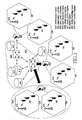
- Fig. 1 indicates the overall GSM system in use. Referring to Fig.1, we can see the various network elements which together constitute the GSM communication system.
- the Network Sub System (“NSS”) Domain is responsible for all network control decisions.
- BSS Base Station Subsystem
- BSS Base Station Subsystem
- the BSS is responsible for controlling the connectivity with the end-user terminals.
- BSC Base station Controller
- Each of these cells caters to a group of end-user terminals. All these cells are connected with the BSC. That is, the BSC manages a plurality of cells in one BSS and controls reselections and handovers between cells.
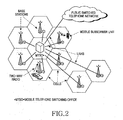
- Fig. 2 illustrates the architecture of a cell, in detail.
- These cells are service areas; each equipped with a Radio Frequency ("RF") transmitter and an RF receiver. They are commonly constructed within a BTS (Base Transceiver Station). Each of these cells is designed to support a fixed set of UEs and has a region over which it can provide acceptable service.
- RF Radio Frequency
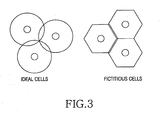
- Fig. 3 where an ideal cell and a fictitious cell are illustrated.
- a fictitious cell used for purpose of mathematical computations, has pure hexagonal shape and has well-defined boundaries, without any overlap. In reality, however, this is not the case and the ideal cells do have overlapped coverage areas.
- the mobile terminal is catered to by one unique 'cell BTS'.
- the quality of service provided by the currently serving cell might deteriorate, for reasons that include the UE moving to the boundary of the current cell or an obstruction in the reception of signal due to an un-even terrain.
- the UE might "camp” on the adjacent cell where it is able to receive better signal and thus can decode downlink information at a more acceptable success rate. This process is called "Cell Reselection".
- the UE can have a maximum of 32 neighboring cells, as dictated by the protocol specifications.
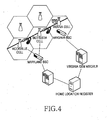
- This cell reselection process is indicated in Fig. 4.
- the signal strength and/or signal to noise ratio will decrease and might result in some deterioration of the received message. That is when the mobile terminal reselects to the "Bethesda cell”.
- the "Rockville cell” as part of its system information parameters, sends the list of all the neighbor cells which any UE present in its area must monitor.
- the UE during its time in the current serving cell, must monitor and determine which the neighboring cells are. Furthermore, it also needs to know which one, among all the neighboring cells, has the best 'received signal level' strength. This process is called "Neighbor Cell Monitoring”.
- Standby Time Battery Capacity in miliampere hours Average Current in milliampere
- the UE at each wake-up, also schedules the monitoring of the neighboring cells and updates its neighboring cell information database. Due to processor speed and timing constraints, the UE schedules the monitoring of 6 to 8 neighbor cells every time it wakes up. Typically 7 cells are monitored, as suggested by the protocol standards. After all the neighboring cells have been monitored, up to a maximum of 32, the UE maintains a sorted list of the six best cells. The sorting is done in terms of received signal level only. This updated list enables the UE to make quick shifts to a neighbor cell whenever the service quality of the current cell falls below an acceptable limit.
- Certain aspects of conventional systems have attempted to cut down the scanning of neighbor cells, thereby RF reception, based on received signal level and received signal quality of serving cell; their fluctuations and the rate of fluctuations; vehicular speed estimation of the UE by making use of sensors and finally decides whether the UE can avoid the scanning of the neighbor cells.
- Conventional schemes base their decision to scan neighbor cells based on the speed of the UE and what the UE perceives at its antenna. An UE with lower speeds need less scanning of neighbor cells. UE with high fluctuation in the raw signal parameters will resort back to the normal behavior and will not attempt to reduce the neighbor cell scanning.
- U.S. Patent No. 6,526,286 monitors variations of raw signal parameters (e.g., RSSI, SNR); estimating vehicular speed to decide if the frequency of neighbor cell scanning could be reduced.
- raw signal parameters e.g., RSSI, SNR
- U.S. Patent No. 6,292,660 suggests an adaptive site scanning based on the fading rate of the received signal level.
- the frequency of site scanning has been suggested to be proportional to the fading rate.
- An increased fading rate increases the rate of site scanning.
- this conventional system attempts to conserve battery by monitoring the fluctuations of raw signal parameters and vehicular speed estimation.
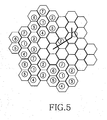
- Fig. 5 illustrates a network configuration where a set of seven frequencies, numbered 1 through 7, are re-used to form a meshed network.
- This set of cells where a unique set of ARFCNs is used is called "Cluster Size - K" and the distance at which the re-use occurs is called "Reuse Distance - D”. This re-use distance is kept such that the signal interference caused by like-frequencies is below tolerant limits.
- Fig. 6 illustrates this concept.
- co-channel interference is the scenario which occurs when signals corresponding to one of the neighboring cells of the UE interferes with signals of the same frequency that are being re-used in the adjacent cluster as a different cell. Standard equations known in the art are also used to determine the cluster size.
- an object of this invention is to provide a system for improving the overall battery life of a GSM communication device that ensures that the battery drain is reduced by allowing the UE intelligently monitor neighboring cells on an "as-needed" basis, with minimal impact to the UE reselection performance.
- UE-NW User Equipment Network
- An embodiment of the invention relates to the UE making use of a running DSC counter as the new measuring yardstick for making decisions as to whether to suspend neighbor cell scanning and the associated behavior.
- the running DSC counter is a good measure of the UE's ability to meet process goals.
- Another embodiment of the invention allows the UE to select the decrement/increment interval of this running DSC counter, allowing flexibly during the course of optimization, i.e., when the UE has started the scan suspension procedure by satisfying the scan suspension criterion. The UE will resort to the default intervals on termination of the process.
- Yet another embodiment of the invention relates to defining a threshold parameter DSC_MIN_DROP for the drop of running DSC counter, depending on the paging periodicity, BS_PA_MFRMS, as defined by the implementer, as described below.
- An embodiment of the invention defines two threshold parameters RXLEV_MIN and SNR_MIN, which represent the optimization floor value for the last received signal level and the signal to noise ratio. The invention expects the optimization process to continue as long as the latest received signal level and SNR is at least above the floor values. These two parameters act as predictors and serve to indicate to the UE about the degradation in service and an imminent loss of service. No attempt is made in the scan suspension criterion to monitor the fluctuation of the received signal level or SNR.
- Another embodiment of the invention defines a threshold parameter MAX_WAIT, which represents the number of attempts/instances the UE is going to tolerate the above embodiment to be unfavorable.
- An embodiment of the invention defines a threshold parameter MAX_SUCCESSIVE_FAILURE_COUNT, which represents the maximum attempts of failure of the UE to meet the process goal, i.e. to read the paging message successfully.
- MAX_SUCCESSIVE_FAILURE_COUNT represents the maximum attempts of failure of the UE to meet the process goal, i.e. to read the paging message successfully.
- the choice of this threshold is based on the paging periodicity, BS_PA_MFRMS, as defined by the skilled implementer, as described below.
- Another embodiment of the invention defines a threshold parameter MAX_FLUCTUATION_COUNT, which represents the maximum attempts of fluctuation; not of the raw signal level or SNR as exemplified in conventional systems, but of the UE's ability to meet the process goal. In other words, the fluctuation of UE's ability to read the paging data at the periodic intervals is monitored now.
- This embodiment serves to absorb the spikes and shocks of raw parameters experienced at the UE's antenna and thereby pave the way for a generic solution for all UEs of variant makes, irrespective of RF antenna sensitivity etc., which varies from UE to UE and from one manufacturer to another.
- An embodiment of the invention defines a threshold parameter MAX_STALE_NCELL_DATA_TIMER, which represents the maximum time the UE is allowed to not keep the database of neighbor cells updated.
- MAX_STALE_NCELL_DATA_TIMER represents the maximum time the UE is allowed to not keep the database of neighbor cells updated.
- the selection of this value can be made adaptive based on the desired amount of optimization as can be seen from the judgment in the detailed description section that follows. A forced update will ensue on exceeding this maximum time.
- This embodiment opens up a reselection window to the higher layers of the GSM protocol standards and enables the higher layers to make reselections during this time. For all other times, when the scan suspension criterion is satisfied, the reselection window is kept closed. This embodiment helps to balance the battery optimization with the reselection performance.
- the present invention makes use of the above embodiments and defines a new criterion of scan suspension.
- the scan suspension criterion described in detail below, ensures that the running values of all the afore-mentioned embodiments provide favorable conditions and only if all of them vote in favor of suspension will the UE resort to suspending the scan of the neighbor cells.
- the UE before invoking the criterion, the UE must meet the pre-conditions of having performed a minimum of one to a maximum of five (as given in protocol specifications) updates of the entire "neighbor cell" list and has decoded the BSIC of the top six neighbor cells. This ensures that the UE has a list of top six neighbor cells ready should an emergency arise.
- a preferred embodiment of the invention provides that if the running DSC counter is more than DSC_MIN_DROP; and if the running successive failure count is less than MAX_SUCCESSIVE_FAILURE_COUNT; and if the running fluctuation count is less than MAX_FLUCTUATION_COUNT; and if the time since last update is less than MAX_STALE_NCELL_DATA_TIMER; and finally, if the UE has been doing well in terms of meeting the process goal by satisfying the above checks, an additional check is performed to predict any imminent degradation of service by checking if the running received signal level and SNR is more than floor values, RXLEV_MIN and SNR_MIN, for at least a minimum of MAX_WAIT times. If all these checks are satisfactory, the UE can be considered to have satisfied the scan suspension criterion.
- An embodiment of the invention relates to allowing the UE to temporarily suspend the procedure of BSIC re-confirmation of the top six cells every 30 seconds, as known in conventional systems, during the time when the scan suspension is in progress.
- the UE shall resort to normal BSIC re-confirmation procedure once the afore-mentioned criterion is dissatisfied.
- This embodiment results in additional power saving by preventing un-necessary BSIC re-confirmations during the battery-save duration.
- Yet another embodiment of the invention makes use of the new measuring yardstick to slow down the frequency of cell re-selections during the time when the afore-mentioned criterion is satisfied and the UE has suspended neighbor cell scanning.
- This embodiment ensures that the UE refrains from making hasty and frequent cell re-selections in search of the best possible cell all the time.
- the UE will always try to maximize its stay in a cell as long as its chief process goal of decoding NW messages is not compromised. Behavior of the UE has been found to be very greedy in nature whereby the UE was always looking for an opportunity to relocate to the best cell, all the time, even if the UE was doing pretty well in the given serving cell.
- the UE If the UE is able to successfully decode NW messages and if there are hardly any fluctuations in meeting the goal, then there is little need for the UE to act greedy and hence it attempts to take shelter from the best cell. Thus, even if there is a neighbor cell, which is offering better signal reception level, the UE will hold on to the re-selection as long as the afore-mentioned criterion is satisfied.
- the manifestation of this embodiment boils down to opening and closing of a reselection window at layer one of the GSM layered architecture. The UE's higher layers can make a reselection decision only when the scan suspension criterion has opened up a reselection window.
- Another embodiment of the invention relates to adding a separate data collection module inside the UE whereby the UE will store important air interface parameters viz. signal level, signal quality, success rate in meeting the process goal, fluctuation rate of meeting the process goal over a specified period of time. Analysis of the stored data will enable the UE to determine how the air-interface environment had been in the past averaging duration. But, more importantly, the UE will be able to implement standard interpolation/extrapolation methods, known in the mathematical domain, to predict what the air-interface environment is going to be like in the very near future, i.e., until the next averaging duration. With the knowledge of the same, the UE can adaptively optimize the entire optimization process itself by increasing or decreasing the extent of optimization.
- important air interface parameters viz. signal level, signal quality, success rate in meeting the process goal, fluctuation rate of meeting the process goal over a specified period of time. Analysis of the stored data will enable the UE to determine how the air-interface environment had been in the past averaging duration. But,
- This tuning can be achieved by adaptive selection of values for the plurality of thresholds as indicated in all the afore-mentioned embodiments.
- This feedback controlled mechanism will ensure that the gain of the optimization is continuously monitored and adapted accordingly.
- the implementation of program logic is left to the skilled implementer but the general trend can be understood from the detailed description section.
- the invention provides a system for improving an overall battery life of a GSM device in a wireless communication system, powered by GSM standards, which maximizes battery lifetime of mobile terminals thereof according to an optimization mechanism for suspending neighbor-cells scanning, the system having a wireless device including a central processing unit (“CPU") executing software programs intended to comply with GSM protocol specifications; an RF transmission unit and an RF reception unit functioning either independently or as a single unit; a specialized Digital Signal Processor being able to process received signal at a corresponding receiving antenna and offering estimates of the received signal level and quality; a logic algorithm by which the mobile terminal powers off an RF module thereof for a definite period of time and wakes up at pre-determined interval to listen to paging messages transmitted thereto; and firmware/software performing neighbor cell monitoring in compliance with a protocol mandated by GSM standards.
- CPU central processing unit
- RF transmission unit and an RF reception unit functioning either independently or as a single unit
- a specialized Digital Signal Processor being able to process received signal at a corresponding receiving
- the present invention defines a comprehensive scan suspension criterion which is not dependent on the fluctuations of the above described raw signal parameters or speed estimation techniques. Instead, this invented criterion is dependent on a network sent parameter, BS_PA_MFRMS, and thereby defines a new measurement yardstick in the decision-making process.
- Each cell as part of its cell identity, broadcasts a unique id called BSIC, the base station identity code. This "identity" is used for uniquely identifying a given cell in the entire network.
- the UE maintains a list of the six best neighboring cells based on their received signal strength.
- the overall battery life of a UE is not just a function of standby-mode power consumption. Battery consumption in idle mode is indeed a function RF reception. But the more severe factor is RF energy utilized during transmission, when the UE is in the process of making/receiving a call or during a call. The higher the RF transmission power, the greater the battery drains.
- the decision for reselection as indicated by C1 and C2 criterion defined above and, as known in the art, is chiefly based on the measure of overall received signal levels from the plurality of neighbor cells, which the UE monitors. Out of the plurality of cells, the one providing higher overall received signal level is the best candidate for reselection, ignoring the fact that the reselected cell might command the UE to transmit at a much higher RF power when it attempts to initiate an active call connection.
- the reselection decision as prevalent in the art, computes C1/C2 values for each of the top six neighbor cells and checks if there is any neighbor cell whose C1/C2 values are greater than that of the serving cell, subject to certain timing constraints.
- the top six cells that are considered for re-selection have been computed and sorted based only on their "received signal strengths".
- periodic monitoring of the Paging Channel is done in the idle mode. This provides the UE with a measure of RXLEV, the received signal level, and SNR, the received signal to noise ratio, of the serving cell. More importantly, the UE maintains a count of success / failure in decoding the received data correctly.
- This data is the paging data, which the UE uses to determine if there is an incoming call for itself. This counter is called the "Downlink Signaling Counter" or "DSC”, as known in the. Which mandates the usage of this parameter, typically its initial value, its increments and decrements.
- this counter needs to increase by one every time the UE decodes the paging message successfully; however, never beyond the initial value. Furthermore, this counter would be decreased by four every time the UE fails to decode the paging message. A fall of this counter below zero is an indication that the UE can no longer continue in the current cell and needs to re-select to a better cell immediately.
- the typical initial value of this counter is given by (90/BS_PA_MFRMS).
- This DSC counter value is an indication of how well the GSM UE is able to keep up with the process goal of reading NW messages successfully at every paging interval. This counter will serve to be the "new measurement yardstick" in the current invention, as will be seen in the following discourse. Every time the UE fails to meet the process goal of reading the paging data NW message, this counter decreases by four and increases by one.
- UEs In conventional systems, UEs always try to take shelter with the best possible cell, all the time. Continuous monitoring is done to check if the UE can re-select to a better cell even if the neighbor cell is only slightly better. This is done even if the UE might not be facing any difficulties in meeting the process goal of decoding NW paging messages at all although it could be facing non-trivial signal fluctuations and SNR fluctuations.
- the UE will attempt re-selection at the earliest possible opportunity.
- the UE resorts to continuous update of the neighbor cell database.
- the UE resorts to continuous re-confirmation of the BSIC of the top six cells. In a span of 10 minutes, the UE makes close to 120 attempts of reconfirming BSIC. The UE never tries to maximize its stay in a given cell, resulting in frequent reselections thereby wasting battery capacity.
- the UE was measuring the neighbor cells constantly and, after each measurement, was sorting the neighbor cells in the descending order of received signal strength only to determine the top six neighbor cells surrounding the UE. Based on the list of these top six cells, the UE was evaluating the C1/C2 conditions, as known in the art. Given other similar conditions across the neighbor cells, the best cell in the top six cell list was the automatic choice all the time, regardless of the fact that the best cell might command the UE to make RF transmissions at a higher power than the other neighbor cells. The cell-reselection is based chiefly on the received signal strength only. A cell requiring the UE to transmit at a higher power, compared to other cells, is an indication of the cell's lower tolerance to received signal level. A UE in that cell will end up wasting more battery power due to higher levels of RF transmissions.
- the present invention describes a scheme, or a comprehensive criterion, which achieves the final goal of reduction of battery consumption.
- the present invention also focuses on an enhanced wireless communication system to improve the overall battery life of the UE, not just the standby battery life, but with minimal changes in the UE-NW interface.
- the invention describes a method to achieve the final goal, of reduced neighbor cell monitoring, by making use of a novel decision-making yardstick not seen in the known art.
- the UE exploits this new measuring yardstick to maximize the stay of an UE in a given cell for a longer time, thereby reducing the frequency of cell-reselections and thereby saving battery power.
- This invention strives to rid the UE of its otherwise greedy behavior as long as it can without affecting the UE's process goal.
- This invention improves the overall battery life of a GSM UE by optimizing three areas where considerable draining of battery occurs:
- the inventive technique used for the intelligent scanning is based on real-time data received by the UE at any point of time and is intrinsically linked to the "success of the UE in making sense of the received data". Received signal level and quality are just raw measuring yardsticks inevitably fluctuating with time. The important point is for the UE to decipher and make sense of the information and not bias its decision with how strong or stable the signal level or quality was. Furthermore, the technique ensures that UE predicts an imminent degradation of service quality and prepares itself for a change of service area.
- This new measuring yardstick is a high-level criterion to be implemented in the layer ONE of the GSM layered protocol architecture will provide a solution, generic across all UE manufactures and across antenna-sensitivities.
- the invention will trigger the second level optimization whereby the UE will, with the aid of the NW, obtain the NW design parameters viz., cluster-size, cell-radius and the power at which the re-used frequencies are being transmitted at in the adjacent cluster.
- the UE Prevalent practices the UE to re-confirm the BSIC of the top six neighbor cells at least every 30 seconds. This would result in significant power drain over a period of time.
- the UE will be able to find out if there is a need, at all, to re-confirm the BSICs of the top six cells. In most of the cases, this will result in the UE being able to circumvent the incessant re-confirmation and thereby save battery power.
- An alternate embodiment of the invention relates to the NW sending additional parameters to the UE in the serving cell by which the UE can estimate the cell planning and the re-use distance.
- the additional parameters would be the cluster-size, the cell-radius and the powers at which the re-used frequencies in the adjacent cluster are being transmitted.
- Another embodiment of the invention relates to the UE being able to make sense of the additional parameters and work out the re-use distance, with the services provided by the underlying DSP and well known signal algorithms.
- One embodiment of the invention defines a threshold parameter MIN_REUSE_FADING_EXTENT, which represents the minimum degradation or fading, in percentage, of the distant re-used frequency that should appear at the UE's antenna for the UE to skip BSIC re-verification for that neighbor cell, out of the 6 neighbor cells, which corresponds to the same frequency.
- MIN_REUSE_FADING_EXTENT represents the minimum degradation or fading, in percentage, of the distant re-used frequency that should appear at the UE's antenna for the UE to skip BSIC re-verification for that neighbor cell, out of the 6 neighbor cells, which corresponds to the same frequency.
- the UE when UE realizes that it cannot survive in the current cell, it will decide to move over and re-select to one of the top six neighbor cells, the choice of which is subject to C1/C2 criteria. As per standard practices, the UE will always select to that cell, out of the plurality of six neighbor cells, which has the highest received signal level. It is probable that the reselected cell might ask the UE to make RF transmissions at a power level much higher than the other neighbor cells. Eventually, if the UE were to initiate an active connection, it will end up using more battery power.
- the invention provides a mechanism to fine tune the reselection decision so that the UE moves to the most optimum cell, based on a weighted combination of "the received signal level” and “the cell's tolerance to RF transmissions from the UE”; not just based on the received signal level.
- the UE accesses the various cell parameters of the neighboring cells. This substantiates the fact that, at any point of time, the UE has idea of the MS_TXPWR_MAX_CCH of all the top 6 neighboring cells.
- This parameter which is a cell parameter, indicates the RF TX power at which the UE should transmit while accessing the NW for the first time. Higher value of this parameter indicates the cell's lower tolerance to RF transmissions from the served UEs.
- Another embodiment of the invention relates to making use of the MS_TXPWR_MAX_CCH parameter in the decision of cell re-selection instead of plain C1/C2 criterion as typically done. Instead of looking for the best cell in terms of received signal only, the UE can assign specific weights to received signal level and the afore-mentioned parameter, MS_TXPWR_MAX_CCH, to create a sorted list of top six cells where the sorting will not be on the basis of received signal level only, but on a weighted measure of "received signal level" and the afore-mentioned parameters.
- beacon frequency of a cell is that frequency which carries system information about the cell. At the air interface, there are many radio frequencies present, some of which are beacon frequencies though most are not. Per cell, there is just one beacon frequency and a plurality of other radio frequencies which are used primarily for traffic data. It is essential for a wireless device to identify the beacon frequencies from the general-traffic radio frequencies.
- GSM is a time-division multiplexed system where each radio frequency is sliced into eight Time Slots (TS). Slicing into eight time slots essentially means that the eight different unique information elements, intended for eight different users, can be transmitted on just one single frequency. Each unique user just needs to know which slot is intended for it.
- Item 101 of Fig. 7 illustrates each slot uniquely identifying a physical channel of information. Thus for a single radio frequency, we get eight separate physical channels of information. These 8 slots make up one Frame of information, also known as one TDMA Frame. This TDMA frame is 4.616 milliseconds in duration, after which the second frame starts. Item 101 of Fig. 7 serves to show a GSM TDMA frame. For the sake of brevity, we can say that any one wireless device, assigned the time slot 2, will exchange data with the NW only when its time slot occurs. Every 4.616 milliseconds later, the wireless device will send/receive data to/from the NW.
- Each radio frequency in a GSM system is sliced up by eight slots thereby allowing eight users, ideally, to be served on one radio frequency.
- Each user accesses the NW at an interval of 4.616 milliseconds.
- the beacon frequency is distinctly different which enables any wireless device to identify it without any fore-knowledge.
- the 0th time slot is reserved for the cell information, which leaves additional 7 time slots for traffic data.
- 51 TDMA frames are used up, all in the 0th time slot, to convey one Multi-Frame (MF) of information.
- Item 102 of Fig. 7 serves to indicate the presence of the 51-multiframe in the beacon frequency. After the 51 st TDMA frame, the entire structure repeats, all on the 0th time slot only. In Item 102, four different types of information elements can be seen: FCCH, SCH, BCCH, and CCCH.
- FCCH the frequency correction channel
- FCCH comprises of a particular data sequence, 142 zeroes to be precise.
- the wireless device scans the air interface, it always tries to look for a data of 142 zeroes on all the radio frequencies. If not found, the wireless device concludes that the radio frequency is not a beacon frequency. Otherwise, the wireless device attempts to read the identity of the cell from which the signal transmitted it.
- the cell identity information, BSIC to be precise, is present in the SCH information block.
- SCH synchronization channel, carries information which uniquely identifies the cell.
- BCCH next block of information
- This data is spread in 4 TDMA frames, on the 0th time slot only, and is commonly known as the Broadcast Control Channel.
- the wireless device gets to know all the cell parameters, including MS_TXPWR_MAX_CCH and BS_PA_MFRMS, the foundation aspect of this invention.
- 4 TDMA frames, on the 0th time slot comprise one block of information.
- the next block is CCCH, Common Control Channel, and is the most germane to this invention discussion, as indicated in 102 of Fig 7.
- 4 TDMA frames, occurring on the 0th time slot, comprise one block of information.
- Each block can be considered as a Paging Block and hence numbered 1 through 9 as PCH 1 through PCH 9 where PCH stands for Paging Channel.
- PCH stands for Paging Channel.
- Every wireless device present under the current cell needs to monitor the PCH on this beacon frequency to listen for any incoming call notification.
- For each Per 51-multiframe there are 9 PCH blocks. Without the concept of DRX, a wireless device had to monitor all those 9 PCH blocks continuously to listen for an incoming call notification.
- Item 103 of Fig. 7 shows the scenario where the paging periodicity is five.
- the wireless device in that cell will read the PCH block 2 in the 0th multi-frame as it belongs to that specific paging group. The wireless device will then skip all the remaining PCH blocks in the 0th multi-frame. Additionally, the wireless device will skip monitoring of all the 9 PCH blocks in the 1st, 2nd, 3rd and 4th multi-frame, as none of the PCH blocks correspond to its paging group. On the 5th occurrence of the multi-frame, the wireless device will again monitor the second PCH block to read incoming call notifications for its own paging group.
- the wireless device shuts off its RF reception unit, after reading its own PCH block, for the entire duration until its own paging block repeats.
- This repetition period is controlled by the NW parameter, BS_PA_MFRMS.
- the minimum repetition period is two and the maximum possible is nine.
- the wireless device typically wakes up and monitors its own paging information. And then it monitors at the least seven neighbor cells and then shuts off the RF reception again.
- a wireless device is considered camped, a term that we will come across quite frequently in the foregoing discussion, on a particular cell when:
- the wireless device compares the received signal level of the serving cell with the received signal levels of the top six neighbor cells and ascertains if any one of the neighbor cells is better than the serving cell and keeps looking for opportunities to re-select to a better cell.
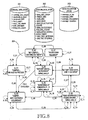
- Fig. 8 illustrates modules added and the generic flow of information during implementation of the present invention. For conciseness it is assumed that the periodicity interval ofNW paging is 2. Otherwise stated, the BS_PA_MFRMS is 2.
- Item 201 of Fig. 8 illustrates running data store which shows the various measurement yardsticks required for implementation of the present invention.
- the running parameters therein will be updated from time to time and will serve to indicate the ability of the wireless device in meeting the process goal. Additionally, each of these running parameters finally aid up in evaluation of the invented scan suspension criterion.
- Item 202 of Fig. 8 illustrates a session data store which shows the various measurement thresholds required for implementation of the present invention. These session parameters are chosen based on the desired effectiveness of the battery-saving mechanism and can be re-adjusted at appropriate durations to achieve higher or lower gain from the battery-saving process. The selection of appropriate values for the thresholds depends on the paging periodicity. Each preceding running parameter has a corresponding threshold here in this session data store. Per battery-save session, these parameters remain constant while the running values keep changing frequently.
- Item 203 of Fig. 8 illustrates a data collection store which shows the various parameters required for calculating and making judgments on the air interface.
- the average signal level, the average SNR and the average fluctuations of the wireless device's attempt to meet the process goal are stored herein.
- the additional parameter is the averaging duration which represents the time over which the data will be collected before making a judgment.
- the judgment of this module would represent the air interface environment over the past averaging duration and could be any of the following: “worst", “bad”, “very good” and “excellent”. This module will additionally interpolate/extrapolate, from the previous data, what the air-interface environment is going to be like in the very near future, typically until the next averaging duration.
- this module will re-evaluate the values for the parameters present in the session data store thereby lowering or heightening the degree of battery-saving.
- This continuous feedback-controlled processing will be invoked at the end of averaging duration and the wireless device will continuously modulate the degree of battery-saving gain.
- Item 204 of Fig. 8 illustrates the state machine or the control flow in the wireless device to implement the current invention.
- the wireless device is considered “camped” if the requirements 1 through 6, mentioned above are met.
- the wireless device is not camped to the NW.
- the wireless device has not identified the FCCH/SCH of any cell and has not started listening to the Paging Channel, or the paging group, of any given cell.
- the wireless device has not read the cell's system information parameters from the BCCH data blocks, as can be seen from Item 102 of Fig. 7, and has no knowledge ofBS_PA_MFRMS or the paging periodicity interval.
- A_00 which serves to force the wireless device to look for opportunities where it can start the process of camping.
- This process includes turning on the radio frequency unit, the antenna, and initializing all hardware units and software units so that reading of the FCCH/SCH is performed and then subsequent reading of BCCH is done.
- This state can be reached only once per session of the wireless device.
- the wireless device starts scanning radio frequencies at the air interface and starts the subsequent search for the beacon frequencies.
- the process indicated at the start of the section is performed here and finally gets camped.
- the wireless device reads the BCCH data and gathers all the cell information.
- the wireless device gets to know the BS_PA_MFRMS or the paging periodicity.
- the wireless device also determines its paging group in this state and becomes ready to perform the DRX operation. This being a transitory state, the wireless device quickly moves into the new state after completion of the preferred actions.
- the wireless device additionally initializes the battery-saving module elements, typically the running data store, session data store and the data collection store.
- A_01 This action serves to initialize all the system information for the given camped cell.
- the wireless device monitors the BCCH data blocks in the serving cell's "beacon frequency" and thereby obtains the whole set of cell information.
- BS_PA_MFRMS is read in this process, the parameter which is the most germane to the invention.
- this action modifies certain state variables of the state S_05, the neighbor cell monitoring state, to indicate that the neighbor cell list has not been completely scanned yet. This is done so that the condition C_05 in state S_03 evaluates to FALSE and the wireless device resorts to a full scanning of the neighbor cell list at least once. This is done to handle the scenarios where the wireless device has re-selected into a new cell and has to perform, at the least, one complete round of monitoring of the entire neighbor cell list.
- mapping of signal level strengths to a unique integer value, as known in GSM systems.
- zero represents the nadir of -110 dBm signal level whereas 63 represent the zenith of -48 dBm of the signal level, As indicated in t Table 1 below.
- the above initialization has been done at 0, the absolute minimum.
- the unit "dBm” is a measure of the signal strength in units of millidecibels. Any other choice of unit is applicable and is not restricted to the integer values.
- A_03 This action serves to initialize the parameters present in the session data store or Item 202 of Fig. 8. This section represents the thresholds and hence is the most important decision of all. The gain or effectiveness of the battery-saving process depends on values of these parameters.
- the BS_PA_MFRMS we have assumed the BS_PA_MFRMS to be 2. From existing systems, we know that running_dsc_count will be initialized to 45, as seen above. Also, from existing systems, we know that, at every failure to decode the paging data, this running_dsc_count will be decremented by 4 and, at every successful decoding, it will be incremented by 1, however never beyond its initial value of 45.
- a paging periodicity of "2" indicates that the wireless device's paging group will occur very fast, i.e. once in 2 multi-frames. This can be understood from Item 103 of Fig. 7 where a periodicity is "5" has been illustrated.
- the wireless device When the running_dsc_count attains a value of zero, it is an indication that the wireless device has failed to meet the GSM process goal beyond the desired limits. The wireless device would then perform a conventional re-selection. To perform a re-selection, we need to ensure that the wireless device has a neighbor cell database, as updated as possible. We also know, from conventional systems, that the wireless device, at each attempt, usually monitors from six to eight neighbor cells, typically seven. Given this knowledge, we can deduce the following, for this example implementation:
- the maximum neighbor cell list can be 32 and if seven neighbor cells are monitored at each attempt, we need at least five scanning attempts. Most of the time, we do not need to monitor all the 32 cells and most of the time, the total length of the neighbor cell list is less than 32. Accordingly, we can tailor the number of scanning attempts that we require.
- the 3rd top cell cannot suddenly become the 31 st top cell in a sudden instant and vice-versa. Such drastic falls or rises don't happen in real environment. Instead, the top 3rd cell will gradually deteriorate and shift to the tail ending positions.
- This implementation will capitalize on this principle and will be contented with scanning just the top 40% of cell, instead of the full 100% of neighbor cell list. With a very high degree of accuracy and practical results, it can be justified that the top 40% of the neighbor cell list will actually provide the right reselection cell. And the choice of that right re-selection cell will not have altered even if we scanned the entire neighbor cell list.
- RXLEV_MIN, SNR_MIN, MAX_FLUCTUATION_COUNT, and MAX_STALE_NCELL_DATA_TIMER are chosen a bit extreme to achieve higher levels of battery-saving. However, the choices of these values are not dependent on the paging periodicity and they would be modified based on the feedback from the data collection store. If the air-interface environment is doing well, these thresholds can be tuned in favor of greater battery-saving. If not, these thresholds will be downgraded to achieve lower gain so that the wireless device does not suffer from performance issues. In this case, since the paging periodicity is very fast, we have a lot of time in hand before we need to move out of the serving cell. Hence, slightly extreme values have been chosen to start with, for BS_PA_MFRMS as two.
- A_04 This action serves to initialize the data collection store parameters before the averaging process can ensue.
- the most important parameters which require decision here is the averaging_duration.
- the data collection store will pronounce judgment about the air-interface environment as “worst”, “bad”, “good”, “very good” and “excellent” at the end of each averaging period. Based on the judgment pronounced, the wireless device will decide whether to increase the gain of the optimization or to lower the gain. The choice of this duration is left to the implementer. For this implementation, we can choose a heuristic value of 15 seconds.
- the averaging duration be also made a function of the air interface. For air interfaces of "Excellent” and “Very Good", a lower averaging duration is better to catch sudden comer-case changes in the air interface, and a higher averaging duration for the other air interfaces.
- the wireless device will analyze the data collected over the previous 15 seconds and determine how the air-interface environment had been. Based on standard interpolation/extrapolation methods, known in the mathematical domain, the wireless device will predict what the air-interface is going to be like for the next 15 seconds and accordingly modify the thresholds.
- Completion of all the actions A_01 through A_04 makes the condition C_02 true indicating that all initialization has been done. Following this the wireless device changes its state and goes to S_02. At the new state, it awaits for new actions and a subsequent shift into the next state.
- the wireless device saves the maximum amount of battery power as it shuts down many units, including the DSP and the CPU, at times. It should be the aim of any battery-saving invention to return back to this state as soon as possible and stay here as long as it can.
- A_06 This action serves to reduce the consumption of battery power by shutting down several peripherals. This action checks the output of A_05 and determines how much of time, or how many TDMA frames, the wireless device has before it becomes active again. Accordingly, this action shuts down the RF antenna unit for that duration; also, this unit takes care of shutting down the DSP chip among other things. By doing this, this particular state achieves considerable battery power savings.
- the wireless device remains in this state, S_02, as long as it has nothing to do.
- A_05 provides the duration of non-activity and when the duration is about to get over.
- the condition C_03 becomes true typically 1 to 2 TDMA frames before the actual occurrence of the serving cell's paging TDMA frame.
- the wireless device thereafter, makes a transition to S_03 where it reads the NW paging message.
- This state reads the paging information for the serving cell and provides the new yardstick of measurement upon which this invention criterion is based off. Apart from indicating whether the wireless device was successful in meeting the process goal of decoding the NW paging message, this state also provides a measure of the serving cell's signal strength and signal quality.
- the running parameters of the running data store, Item 201 of Fig. 8 are updated in this state whenever an indication of the serving cell's received signal level and quality is obtained along with the measure of the wireless device's compliance towards meeting the process goal of decoding NW paging message. Additionally, this state updates the data collection store, Item 203 of Fig. 8, to provide air-interface environment history.
- This state houses a data variable, battery_save_on, which indicates if the battery-save mechanism is on-going or not.
- This state-shared variable is updated from the state S_06 which sets this data variable to "ON" when the scan suspension criterion in satisfied. Other times, this retains an OFF status.
- A_07 This action serves to make the wireless device read the paging data block from serving cell's paging channel.
- the outcome of this action is either a SUCCESS or a FAILURE in decoding the NW paging message.
- the rest of the actions take care of updating the running parameters and the data collection parameters.
- the outcome of SUCCESS or FAILURE indicates whether the wireless device was successful in meeting the process goal.
- A_08 During the process of reading the NW paging message from the serving cell's beacon frequency, the wireless device, using the standard services of the underlying hardware unit, typically the RF unit and the DSP, will be able to get a measure of the received signal level, in the range of 0 to 63, as seen in Table 1, and received signal quality, in the range of 0 to 7, as seen in Table 2.
- the wireless device as part of this action, will update the running parameters, received_rx_level and received_SNR, of running data store, Item 201 of Fig. 8, with the received signal level and received signal quality of the serving cell. Additionally, the wireless device, will update the data collection store, Item 203 of Fig. 8, with the currently received values to aid the averaging process of the parameters average_rx_lev and average_SNR.
- A_09 This action serves to update the running data store parameter, succ_fail_count, based on whether the wireless device was able to read the paging message successfully, which is the outcome of A_07. As we are tracking the successive failure count, any successful decoding should reset this running counter to zero. This counter tracks the number of successive times the wireless device failed to meet its process goal. Therefore:
- A_10 This action serves to update the running data store parameter, fluct_count, based on whether the wireless device was able to read the current and the previous paging message successfully, which is the outcome of current and the previous A_07.
- This counter tracks the fluctuation of the wireless device's failure to meet the process goal.
- a fluctuation cycle is counted as 2 when a SUCCESS-FAILURE-SUCCESS-FAILURE cycle or a FAILURE-SUCCESS-FAILURE-SUCCESS cycle occurs. Basically, any toggling of the success and failure cases will increment this counter. Additionally, two successively similar behaviours will reset this counter to 0 as toggling/fluctuation has stopped.
- A_11 This action serves to update the running data store parameter, running_dsc_count, based on the outcome of action A_07. Additionally, this action evaluates if the battery-save optimization process is already activated and running. This information is gathered by analyzing the state variable battery_save_on, which is updated to "ON" from the S_06 state. If the battery-saving process is not on-going, the running_dsc_count is incremented by a default value of 1 if the outcome of A_07 was a SUCCESS; however, never beyond the maximum value of 90 / BS_PA_MFRMS. Otherwise, the running_dsc_count is decremented by four if the outcome of A_07 was a FAILURE. If the battery-saving process is on-going, the decrement and increment intervals are replaced by the custom-defined values, which is an embodiment of the invention.
- A_12 This action serves to update the running data store parameter, wait_attempts, based on the information gathered by A_08 about the received signal level and quality of the serving cell. If any one of the running parameters received_rx_level and received_SNR, updated by action A_08, indicate values lower than the respective floor value present in the session data store, RXLEV_MIN and SNR_MIN, the running parameter wait_attempts will be incremented. If both the running values are higher than the respective thresholds, the wait_attempts will be reset to zero immediately. This embodiment attempts to predict the air interface and allows the optimization to continue as long as the running values are above the floor values of the optimization.
- received_rx_level is less than RXLEV_MIN, computed from 0 to 63 as in Table 1
- received_SNR computed from 0 to 7 as in Table 2 is greater than SNR_MIN, computed from 0 to 7 as in Table 2, then:
- the wireless device Upon completion of all the pre-defined actions, the wireless device will evaluate the validity of the conditions C_04 and C_05 and make a state transition accordingly.
- C_05 evaluates to TRUE if the following conditions are met.
- the wireless device has completed scanning of all the neighbor cells present in the neighbor cell list at least 1 time up to a maximum of 5, as in conventional systems, times. AND,
- the wireless device After scanning the entire set of neighbor cells, the wireless device decoded the BSIC of the top six sorted neighboring cells.
- clauses A and B can be evaluated by checking certain state variables of the state S_05, the state which is responsible for scanning of neighbor cells and decoding of their BSIC.
- the state variables of S_05 will be set to TRUE when the above two clauses are met.
- the state S_05 can, at any point of time, set those certain state variables to FALSE resulting in failure of the clauses A and/or B.
- C_04 is a complement of C_05 and attains the value of TRUE if C_05 evaluates FALSE and vice-versa. Basically, C_04 evaluates to TRUE if any of the above 2 clauses turn out FALSE.
- C_05 is TRUE, we have met the prerequisite of the battery-save mechanism. We will make a transition to state S_04 where the scan suspension criterion will be evaluated and the wireless device will check if it can avoid going to the power consuming state S_05. Let us, for the sake of illustration, assume that we have transitioned to state S_04.
- C_04 If C_04 is TRUE, we have not met the pre-requisite of the battery-save mechanism. We will make a transition to state S_05 where the wireless device start the monitoring of the next batch of neighbor cells and update the neighbor cell database with new measured values. Additionally, the wireless device will attempt to decode the BSIC of the top six cells, if they have not been decoded yet, or schedule BSIC re-verification, if it has been decoded already.
- This state makes use of the running data store parameters and session data store parameters to evaluate if the invented scan suspension criterion is satisfied. Reaching this state is an indication that the basic pre-requisite of the battery-save mechanism has been met, i.e., the wireless device has scanned all the cells in the neighbor cell list at least 1 times and has decoded the BSIC of the top six cells. However, it is not guaranteed yet that the criterion will be satisfied. It is just that the basic pre-requisite of the algorithm has been met. From this state, based on the outcome of the scan suspension criterion, the wireless device will make a transition to power-save state S_06 or to power-consuming state S_05.
- A_13 The only action, in this state is to evaluate the scan suspension criterion and decide whether it allows the wireless device to go into power-save mode or not.
- the outcome of this evaluation is an indication of the wireless device's service conditions in the serving cell. If the outcome of the evaluation is favorable towards power-saving, it is an indication that the wireless device is doing well in the serving cell and the new measurement yardstick of meeting the GSM process goal is not grossly compromised at all. Interpreted otherwise, this means that the wireless device can maximize its stay in the serving cell and need not make hasty re-selections as the current cell is serving it well, if not in the best way.
- the scan suspension criterion of the present invention pays attention to a plurality of other high-lever factors, rather than to the raw signal parameters.
- the plurality of other high-lever factors are all intrinsically linked to the new measurement yardstick of the wireless device's conformance with the process goals.
- the description of the criterion provided below is to be read in conjunction with the other preferred embodiments summarised in the document and respective claims.
- This wireless device will initiate a suspension of the neighboring cells if, and only if the scan suspension criterion is satisfied. Once satisfied, the wireless device will periodically check if the scan suspension criterion is still holding good and, if so, will continue with the suspension process and, if not, will discontinue the suspension process and revert back to the traditional specifications-driven behaviour.
- the criterion makes use of the constituent elements, described in the running data store, Item 201 of Figure 8, and performs a check against the respective thresholds present in the session data store, Item 202 of Figure 8, and pronounces the judgment.
- the criterion will be considered TRUE/SATISFIED, if the all the following checks return a TRUE status:
- the criterion does not make any decisions based on the fluctuations/variations of the raw signal parameters, but instead on the comprehensive conditional checks of a plurality of factors, all of which are linked to the new measurement yardstick of the wireless device's conformance to the process goal of decoding paging message.
- the wireless device will make a transition to the power consuming state S_05 if the scan suspension criterion evaluates to FALSE. Otherwise, the wireless device will transition to the power-saving transitory state S_06 which will take the wireless device automatically to the most stable state S_02.
- the wireless device then attempts to read the BSIC of the top six cells. This process is indicated in the beginning of this section as the process of reading FCCH/SCH, as seen in Item 101 of Fig. 7. The wireless device always attempts to keep the BSIC information ready for the top six cells, should there be any urgent need to re-select.
- This state also schedules the re-verification procedure of BSIC for the top six cells, at periodic intervals. Finally, upon receiving the neighbor cell measurement, this state looks for opportunities of making a re-selection. This state houses a state variable battery_save_on which indicates if the battery-save mechanism is on-going. If this variable indicates "ON" and we reach this state, it is an indication that the scan suspension criterion check in state S_04 was just now dissatisfied and we resorted to normal behaviour.
- A_14 This action serves to monitor a group of neighbor cells, typically seven at each attempt.
- the neighbor cells monitoring is the process of instructing the RF antenna unit to tune into those neighbor cell frequencies and read the amount of received signal level measured at the wireless device's antenna. This action is the primary cause of battery drain in idle mode of the wireless device.
- A_15 This action serves to extract the received signal values for the set of neighboring cells monitored by the action A_14 and sort the neighbor cells in the descending order of signal strength. This primary goal of this action is to keep a sorted list all the time so that at every measurement attempt, the wireless device knows which the top 6 neighboring cells are.
- A_16 This action serves to check, at every measurement attempt, whether the top six cells, obtained from the outcome of A_15, have got their BSIC decoded or not. If the BSIC has not been decoded, this action schedules the BSIC decoding process at the earliest possible opportunity. Additionally, this action keeps note of the time that has elapsed since the last time the BSIC was decoded for all the top six cells.
- the second level optimization technique which has been a claim of this invention, comes into effect in this action.
- the wireless device will evaluate the invention claim to check if there is a need to perform the BSIC re-verification or can it avoid the process and thereby save battery.
- the process is outlined below:
- the NW can send these additional parameters, cluster size, cell radius and the power level at which the re-used frequencies are being transmitted at in the adjacent cluster, as part of the system information elements which come in the BCCH data blocks that we had seen earlier.
- Knowledge of the same will enable the UE, using services of its DSP, to compute what the reuse distance is and thereby estimate the fading or degradation percent for that reused frequency.
- A_17 This action serves to perform some house keeping work for the battery-saving mechanism and helps the invention implementation to work smoothly.
- This action checks the state variable battery_save_on. This state variable is switched “ON” or “OFF” by the state S_06. If the wireless device has arrived into this state S_05 when the state variable battery_save_on is "ON", it is an indication that the battery-saving mechanism was on-going and the wireless device just now dissatisfied the scan suspension criterion.
- This action will reset certain running data store parameters and set/unset certain other conditions in this state machine, such as to ensure a smooth operational flow of the algorithm.
- the chief aim of this action to ensure that the wireless device, which has resorted to normal behaviour, completes monitoring of the entire neighbor cell list at least once and ensures that the top six cell's BSIC is decoded before invoking the battery-save process again. It can be mentioned, at this point, that the UE will set certain state variables which will cause the condition C_05, of state S_03, to evaluate to FALSE until a fresh wrap around is made on the entire neighbor cells.
- A_18 This action serves to check if the wireless device can make a re-selection to a better neighboring cell. Reaching this state S_05 is an indication that the battery-saving process is not ongoing or was just relinquished and the wireless device has resorted back to its greedy behaviour of taking shelter from the best possible cell all the time. This action, will evaluate the outcome of the action A_15, and check if there is any cell in the top 6 list which is better than the current cell. If it finds any cell or a plurality of contending cells, the wireless device will initiate the process of cell reselection.
- the wireless device will look for the presence of the most optimum cell in the top 6 cell by doing a weighted comparison, based on the received signal level and the MS_TXPWR_MAX_CCH, of all the top 6 cells with the current serving cell.
- a weighted comparison based on the received signal level and the MS_TXPWR_MAX_CCH, of all the top 6 cells with the current serving cell.
- the weights to be 'X' and 1.25X' for MS_TXPWR_MAX_CCH and received signal level respectively.
- 'X' is a generic constant to be chosen. The generic process, without imposing restrictions on any alternate process by anyone skilled in this art, is shown below:
- neighboring cells have their received signal levels, represented as 0...63, as follows: 41 (-70dbM), 40 (-71dbM), 38 (-73dbM), 38 (-73dbM), 32 (-79dbM), and 31 (-80dbM).
- the serving cell's signal level be 39 (-72 dBm).
- the wireless device is power class 4 which has the capability to transmit a maximum power of 33 dBm.
- the top 2nd and top 6th cells have the minimum transmission power requirements.
- the wireless device will find that the serving cell's signal level has gone down and will evaluate C1/C2 criterion for the neighboring cells.
- the top cell having the highest received signal power, will be the natural choice, out of the plurality, even though the MS_TXPWR_MAX_CCH is pretty high for that cell.
- the wireless device will now use the neighbor cell list of Table 4 and perform the C1/C2 criteria to evaluate if cell re-selection is required.
- the invention does not modify the C1/C2 criteria at all, but attempts to modify the top six list based only on a weighted comparison.
- C_08 is satisfied if the outcome of the action A_18 indicates that a cell reselection is required. This decision is derived at by evaluating C1/C2 criteria. The wireless device transitions to state S_07 and attempts to move into the new cell.
- C_09 evaluates to TRUE if the outcome of A_18 indicates that no cell-reselection is required. The wireless device falls back to the most stable state of the system, S_02.
- this state updates the state variable, battery_save_on, to "ON" in the states S_03, S_05 and S_06, wherever it is being used. Additionally, this state starts updating the running data store parameter time_tick_count to track the duration the battery-save mechanism has been executing un-interrupted.
- time_tick_count to track the duration the battery-save mechanism has been executing un-interrupted.
- this state does nothing at all and takes the wireless device back to the stable state S_02 almost instantly. Additionally, this state suppresses the greedy behaviour of the wireless device and avoids all opportunities of cell re-selection by closing the reselection window and BSIC re-verification.
- A_19 This action serves to track the time elapsed since the last time the neighbor cell database was updated. Basically, these action increments the running parameter time_tick_count to track the duration the battery-save mechanism has been executing without any interruption. This parameter controls the maximum time the battery-save mechanism can execute without making a forced-update of the neighbor cell database.
- the corresponding system threshold parameter for this is MAX_STALE_NCELL_DATA_TIMER.
- A_20 This action serves to inform all the related modules that the battery-save mechanism has initiated by updating the respective state variable in the states S_03, S_05 and S_06. This action sets a value of "ON" to the state variable battery_save_on in all the three states. Additionally, this state performs a very important aspect of the invention, which is the continuous-feedback processing. At the completion of every 15 seconds or whatever the value of averaging_duration parameter of data collection store is, this action will process all the stored data in the data collection module and analyze them. Based on the analysis, this action will derive what the air-interface had been in the past averaging duration.
- the decision could be one of the following: “worst”, “bad”, “good”, “very good” or “excellent”. Furthermore, based on the decision and the past data, this action will apply standard mathematical interpolation/extrapolation methods to predict the future service conditions, the future being the duration until the next averaging duration. Based on the results of the interpolation, the wireless device will try to fine tune the limits of the threshold parameters contained in session data store to achieve higher or lower gains from the battery-save process. If the future is predicted to be "excellent", the wireless device will set the extreme thresholds to its session parameters.
- the wireless device will increase the MAX_STALE_NCELL_DATA_TIMER from 2 minutes to 5 minutes, mentioned for the sake of an example, if the prediction is "excellent” or bring it down from 4 minutes to 2 minutes if the prediction is "bad” or "good”.
- Any implementer of ordinary skill in the art can modify more than one of the threshold parameters, based on the output of the interpolation method to achieve higher degree of feedback control.
- This state defaults to state S_02 after completion of all the associated actions.
- This state is reached on satisfying the condition C_08 where the state S_05 realizes the need for a cell re-selection.
- This state performs exit procedure from the current cell, resets the battery-save mechanism and tries to perform camping on the new cell. On completion of the exit procedures, this state transitions to the start of the state machine, S_00.
- A_21 This action serves to perform all the exit procedures from the current cell. Typically, this action resets the battery-saving mechanism and stops the camping on the current cell.
- the Present Invention provides numerous benefits and advantages, such as:
- This invention improves the overall battery life of a basic GSM UE by optimizing the RF transmission and RF reception factors.
- the invention would result in more standby time of the UE, which would result in a better end-user experience, manifested as lowered frequency of battery re-charge.
- This invention capitalizes on the UE's ability to meet the process goal and not on the ever-fluctuating, RF-receiver dependent raw signal parameters. As a result, this invention will generate better battery-efficient results, at the same time with minimal impact to the reselection performance due to a very strong scan suspension criterion.
- this invention dictates several associated behaviour, like abandoning the greediness for cell re-selection, when the scan suspension is in progress, leading to higher battery-saving and a highly robust technique. Moreover, this invention offers a generic solution to reduction of battery consumption independent of the RF-antenna sensitivity and the UE make and manufacturer.
- the invention also results in improved talk-time of the UE due to the UE's effort to re-select to that cell which offers higher tolerance to received signals from the UEs at the cell's antenna.
- the UE tries tremendous to re-select to that cell which allows the UE to make RF transmissions at a lower power.
- This invention can also be marketed to provide a new end-user option in the Power Management applications of the wireless device, which the user can turn on or off, and could serve for market differentiation. There are times when the end user is running very low on battery and is expecting an urgent call from someone. The user, under such scenario, choose the extreme optimization thresholds of the invented scan suspension criterion to achieve the maximum battery saving.
- the present invention outlines a three-tier scheme, triggered sequentially at the failure of the preceding one, which provides best ways to mitigate the power consumption.
- the host for storing the applications include but are not limited to a microchip, microprocessor, handheld communication device, computer, rendering device or a multi function device.
Landscapes
- Engineering & Computer Science (AREA)
- Computer Networks & Wireless Communication (AREA)
- Signal Processing (AREA)
- Computer Security & Cryptography (AREA)
- Mobile Radio Communication Systems (AREA)
Applications Claiming Priority (2)
| Application Number | Priority Date | Filing Date | Title |
|---|---|---|---|
| IN1987CH2005 | 2005-12-30 | ||
| KR1020060112786A KR100796850B1 (ko) | 2005-12-30 | 2006-11-15 | Gsm 통신 장치의 총 배터리 수명을 개선하는 시스템 |
Publications (2)
| Publication Number | Publication Date |
|---|---|
| EP1804532A1 true EP1804532A1 (fr) | 2007-07-04 |
| EP1804532B1 EP1804532B1 (fr) | 2009-07-08 |
Family
ID=38507372
Family Applications (1)
| Application Number | Title | Priority Date | Filing Date |
|---|---|---|---|
| EP06026929A Not-in-force EP1804532B1 (fr) | 2005-12-30 | 2006-12-27 | Système permettant d'améliorer la durée de vie des batteries d'un dispositif de communication GSM |
Country Status (4)
| Country | Link |
|---|---|
| US (1) | US7761122B2 (fr) |
| EP (1) | EP1804532B1 (fr) |
| KR (1) | KR100796850B1 (fr) |
| DE (1) | DE602006007671D1 (fr) |
Cited By (8)
| Publication number | Priority date | Publication date | Assignee | Title |
|---|---|---|---|---|
| WO2011131466A1 (fr) * | 2010-04-23 | 2011-10-27 | Telefonaktiebolaget L M Ericsson (Publ) | Suivi de cellules pour re-sélection de cellule dans un système de communication cellulaire |
| US8855632B2 (en) | 2012-02-09 | 2014-10-07 | Telefonaktiebolaget L M Ericsson (Publ) | Measurement termination of higher-prioritized layers for priority-based cell reselection algorithms in cellular communication systems |
| US9264914B2 (en) | 2009-11-30 | 2016-02-16 | Mediatek Inc. | Methods for monitoring paging messages with reduced power consumption and communications apparatuses utilizing the same |
| CN106797616A (zh) * | 2014-10-16 | 2017-05-31 | 高通股份有限公司 | 用于使射频(rf)和基带处理解耦合的方法和装置 |
| US9794759B2 (en) | 2009-11-30 | 2017-10-17 | Mediatek Inc. | Methods for monitoring paging messages with reduced power consumption and communications apparatuses utilizing the same |
| US10362540B2 (en) | 2009-11-30 | 2019-07-23 | Mediatek Inc. | Methods for monitoring paging messages with reduced power consumption and communications apparatuses utilizing the same |
| WO2020159481A1 (fr) * | 2019-01-29 | 2020-08-06 | Google Llc | Gestion de connexion adaptative pour des conditions de réseau marginales |
| US11109299B2 (en) | 2019-12-12 | 2021-08-31 | Google Llc | Adaptive public land mobile network management for varying network conditions |
Families Citing this family (32)
| Publication number | Priority date | Publication date | Assignee | Title |
|---|---|---|---|---|
| ES2733007T3 (es) | 2007-02-05 | 2019-11-27 | Nec Corp | Método de traspaso entre estaciones base, sistema de radiocomunicación, método de control de DRX, estación base y terminal de comunicación |
| JP4932521B2 (ja) * | 2007-02-09 | 2012-05-16 | 株式会社エヌ・ティ・ティ・ドコモ | 移動通信システムで使用される基地局装置及び方法 |
| US8195204B1 (en) * | 2007-07-25 | 2012-06-05 | Sprint Spectrum L.P. | Method and apparatus for scanning sectors in order of distance from mobile station |
| ES2727668T3 (es) * | 2008-02-08 | 2019-10-17 | Guangdong Oppo Mobile Telecommunications Corp Ltd | Sistema y método para distribución de paginación uniforme |
| US8175567B2 (en) * | 2008-05-30 | 2012-05-08 | Qualcomm Incorporated | Method and apparatus for searching for signals in a wireless communication system |
| KR101188960B1 (ko) * | 2008-06-30 | 2012-10-08 | 후지쯔 가부시끼가이샤 | 이동 단말기, 기지국 장치 및 이동 통신 시스템 |
| US8185138B2 (en) * | 2008-10-13 | 2012-05-22 | Qualcomm Incorporated | Paging messages for power saving in a mobile WiMAX system |
| US7974626B2 (en) * | 2008-12-23 | 2011-07-05 | Motorola Mobility, Inc. | Method and apparatus for improving success rate and time of call setup for a mobile station experiencing high interference |
| US8831555B2 (en) * | 2009-04-03 | 2014-09-09 | Qualcomm Incorporated | Reestablishment procedure for an emergency call |
| US8611277B2 (en) * | 2009-06-22 | 2013-12-17 | Motorola Mobility Llc | Reselection in a wireless communication system |
| US20110136456A1 (en) * | 2009-12-07 | 2011-06-09 | Qualcomm, Incorporated | System and method for signal detection using a dynamic threshold |
| CN102104934A (zh) * | 2009-12-18 | 2011-06-22 | 鸿富锦精密工业(深圳)有限公司 | 无线通讯终端及其节能方法 |
| KR20110123445A (ko) * | 2010-05-07 | 2011-11-15 | 삼성전자주식회사 | 무선통신 시스템에서 유휴모드에서 전력소모를 최소화하기 위한 방법 및 장치 |
| JP2012049923A (ja) * | 2010-08-27 | 2012-03-08 | Kyocera Corp | 無線通信機器、通信システム及び制御方法 |
| US8830848B1 (en) | 2010-12-09 | 2014-09-09 | Sprint Communications Company L.P. | Adjusting a control channel timer in a wireless communication |
| KR20120109666A (ko) * | 2011-03-23 | 2012-10-08 | 삼성전자주식회사 | 네트워크 접속 방법 및 장치 |
| US8649791B1 (en) * | 2011-06-23 | 2014-02-11 | Cellco Partnership | Automatic neighbor list generation for long-term evolution (LTE) |
| US20130044659A1 (en) * | 2011-08-16 | 2013-02-21 | Renesas Mobile Corporation | Wireless Devices and Base Stations and Methods of Operating |
| US9478857B2 (en) * | 2012-03-02 | 2016-10-25 | Samsung Electronics Co., Ltd. | Apparatus and method for controlling adaptive beamforming gain in wireless communication system |
| US8897188B2 (en) * | 2012-03-19 | 2014-11-25 | Qualcomm Incorporated | Method and apparatus for discontinuous reception in user equipment for power savings |
| JP5895692B2 (ja) * | 2012-05-08 | 2016-03-30 | 富士通株式会社 | 無線通信プログラム、携帯装置および無線通信システム |
| JP5715599B2 (ja) * | 2012-07-20 | 2015-05-07 | 株式会社Nttドコモ | 無線通信システムおよび通信制御方法 |
| US20150257103A1 (en) * | 2012-09-27 | 2015-09-10 | Google Technology Holdings LLC | Method and device with an augmented rules engine |
| US20140169246A1 (en) * | 2012-12-17 | 2014-06-19 | Qualcomm Incorporated | Devices and methods for facilitating dynamic power reduction during discontinous reception |
| US9204396B2 (en) | 2013-02-08 | 2015-12-01 | Qualcomm Incorporated | Systems and methods for adapting a network search algorithm |
| US8886241B2 (en) * | 2013-03-01 | 2014-11-11 | Qualcomm Incorporated | GSM base station identity code (BSIC) method for irat cell reselection to conserve UE battery power |
| KR102071372B1 (ko) * | 2013-09-16 | 2020-01-30 | 삼성전자 주식회사 | 무선 통신 시스템에서 빔 포밍을 고려한 drx 제어 방법 및 장치 |
| US20160295548A1 (en) * | 2015-04-03 | 2016-10-06 | Hyundai Motor Company | Apparatus for Controlling Message Receiving Mode and Method Thereof |
| CN105979577A (zh) * | 2016-05-11 | 2016-09-28 | 百度在线网络技术(北京)有限公司 | 一种获取用户到访信息的方法和系统 |
| US10887727B2 (en) * | 2018-12-07 | 2021-01-05 | Microsoft Technology Licensing, Llc | Computer-implemented detection of a work-related visit based on data from movement-sensing mechanism(s) |
| US11080629B2 (en) | 2019-03-22 | 2021-08-03 | Microsoft Technology Licensing, Llc | Automatically generating activity summaries based on signals obtained from plural devices and logic components |
| US11062272B2 (en) * | 2019-07-15 | 2021-07-13 | Microsoft Technology Licensing, Llc | Recommending meeting spaces using automatically-generated visit data, with geo-tagging of the meeting spaces |
Citations (7)
| Publication number | Priority date | Publication date | Assignee | Title |
|---|---|---|---|---|
| US5794146A (en) * | 1996-08-14 | 1998-08-11 | Sharp Microelectronics Technology, Inc. | System and method for conserving battery power in a mobile station searching to select a serving cell |
| GB2346293A (en) * | 1998-11-25 | 2000-08-02 | Nec Corp | Mobile station with intelligent control of scan time between home band scans when roaming |
| EP1069794A2 (fr) * | 1999-07-14 | 2001-01-17 | NTT DoCoMo, Inc. | Procédé, station mobile et système de communication pour la commande de la recherche de cellules |
| US6252868B1 (en) * | 1992-10-05 | 2001-06-26 | Telefonaktiebolaget Lm Ericsson (Publ) | Digital control channels having logical channels supporting broadcast SMS |
| WO2001060103A1 (fr) * | 2000-02-09 | 2001-08-16 | Ericsson Inc. | Systemes, procedes et programmes informatiques permettant un reglage dynamique de frequence de surveillance de canal de recherche d'un terminal mobile fonde sur l'environnement d'exploitation |
| US20020082010A1 (en) * | 2000-12-22 | 2002-06-27 | Havish Koorapaty | Wireless terminals and methods including power efficient intelligent roaming and scanning for a communication service provider |
| EP1313336A2 (fr) * | 2001-10-10 | 2003-05-21 | Samsung Electronics Co., Ltd. | Procédé de recherche de cellule en mode de réception discontinu dans un système de communication mobile |
Family Cites Families (6)
| Publication number | Priority date | Publication date | Assignee | Title |
|---|---|---|---|---|
| US6385460B1 (en) | 1998-05-26 | 2002-05-07 | Conexant Systems, Inc. | Power management system for a mobile unit by reduced neighbor cell scanning |
| US6292660B1 (en) | 1998-09-29 | 2001-09-18 | Ericsson Inc. | Adaptive site scanning based on fade base estimation |
| DE60030740T2 (de) * | 1999-08-23 | 2007-09-13 | Ericsson Inc., Plano | Unterbrechungsfreie kanalauswahl beim umschalten von einem kanal in einer ersten zelle zu einem zweiten kanal in einer zweiten zelle für mobile daten-dienste |
| US7212843B2 (en) * | 2003-05-15 | 2007-05-01 | Motorola Inc. | Current reduction in a communication device |
| KR20050015746A (ko) * | 2003-08-07 | 2005-02-21 | 주식회사 팬택 | 지에스엠 이동통신 단말기의 배터리 절약 방법 |
| US7215956B2 (en) | 2003-11-04 | 2007-05-08 | Qualcomm, Incorporated | Method and apparatus for scanning frequency channels for handoff candidates while minimizing battery consumption |
-
2006
- 2006-11-15 KR KR1020060112786A patent/KR100796850B1/ko not_active Expired - Fee Related
- 2006-12-27 DE DE602006007671T patent/DE602006007671D1/de active Active
- 2006-12-27 EP EP06026929A patent/EP1804532B1/fr not_active Not-in-force
- 2006-12-29 US US11/647,709 patent/US7761122B2/en not_active Expired - Fee Related
Patent Citations (7)
| Publication number | Priority date | Publication date | Assignee | Title |
|---|---|---|---|---|
| US6252868B1 (en) * | 1992-10-05 | 2001-06-26 | Telefonaktiebolaget Lm Ericsson (Publ) | Digital control channels having logical channels supporting broadcast SMS |
| US5794146A (en) * | 1996-08-14 | 1998-08-11 | Sharp Microelectronics Technology, Inc. | System and method for conserving battery power in a mobile station searching to select a serving cell |
| GB2346293A (en) * | 1998-11-25 | 2000-08-02 | Nec Corp | Mobile station with intelligent control of scan time between home band scans when roaming |
| EP1069794A2 (fr) * | 1999-07-14 | 2001-01-17 | NTT DoCoMo, Inc. | Procédé, station mobile et système de communication pour la commande de la recherche de cellules |
| WO2001060103A1 (fr) * | 2000-02-09 | 2001-08-16 | Ericsson Inc. | Systemes, procedes et programmes informatiques permettant un reglage dynamique de frequence de surveillance de canal de recherche d'un terminal mobile fonde sur l'environnement d'exploitation |
| US20020082010A1 (en) * | 2000-12-22 | 2002-06-27 | Havish Koorapaty | Wireless terminals and methods including power efficient intelligent roaming and scanning for a communication service provider |
| EP1313336A2 (fr) * | 2001-10-10 | 2003-05-21 | Samsung Electronics Co., Ltd. | Procédé de recherche de cellule en mode de réception discontinu dans un système de communication mobile |
Cited By (12)
| Publication number | Priority date | Publication date | Assignee | Title |
|---|---|---|---|---|
| US9264914B2 (en) | 2009-11-30 | 2016-02-16 | Mediatek Inc. | Methods for monitoring paging messages with reduced power consumption and communications apparatuses utilizing the same |
| US9794759B2 (en) | 2009-11-30 | 2017-10-17 | Mediatek Inc. | Methods for monitoring paging messages with reduced power consumption and communications apparatuses utilizing the same |
| US10362540B2 (en) | 2009-11-30 | 2019-07-23 | Mediatek Inc. | Methods for monitoring paging messages with reduced power consumption and communications apparatuses utilizing the same |
| WO2011131466A1 (fr) * | 2010-04-23 | 2011-10-27 | Telefonaktiebolaget L M Ericsson (Publ) | Suivi de cellules pour re-sélection de cellule dans un système de communication cellulaire |
| US8185115B2 (en) | 2010-04-23 | 2012-05-22 | Telefonaktiebolaget L M Ericsson (Publ) | Tracking cells for cell-reselection in a cellular communications system |
| US8855632B2 (en) | 2012-02-09 | 2014-10-07 | Telefonaktiebolaget L M Ericsson (Publ) | Measurement termination of higher-prioritized layers for priority-based cell reselection algorithms in cellular communication systems |
| CN106797616A (zh) * | 2014-10-16 | 2017-05-31 | 高通股份有限公司 | 用于使射频(rf)和基带处理解耦合的方法和装置 |
| CN106797616B (zh) * | 2014-10-16 | 2020-04-07 | 高通股份有限公司 | 用于使射频(rf)和基带处理解耦合的方法和装置 |
| WO2020159481A1 (fr) * | 2019-01-29 | 2020-08-06 | Google Llc | Gestion de connexion adaptative pour des conditions de réseau marginales |
| US11368907B2 (en) | 2019-01-29 | 2022-06-21 | Google Llc | Adaptive connection management for marginal network conditions |
| US11109299B2 (en) | 2019-12-12 | 2021-08-31 | Google Llc | Adaptive public land mobile network management for varying network conditions |
| US11871331B2 (en) | 2019-12-12 | 2024-01-09 | Google Llc | Adaptive user equipment capability management for varying network conditions |
Also Published As
| Publication number | Publication date |
|---|---|
| DE602006007671D1 (de) | 2009-08-20 |
| US7761122B2 (en) | 2010-07-20 |
| KR100796850B1 (ko) | 2008-01-22 |
| US20070184836A1 (en) | 2007-08-09 |
| KR20070072351A (ko) | 2007-07-04 |
| EP1804532B1 (fr) | 2009-07-08 |
Similar Documents
| Publication | Publication Date | Title |
|---|---|---|
| US7761122B2 (en) | System for improving overall battery life of a GSM communication device | |
| US9980225B2 (en) | Methods and apparatus for power saving in discontinuous reception-adaptive neighbor cell search duration | |
| JP5135438B2 (ja) | 移動電気通信システムにおける相対閾値の使用に基づくセル再選択 | |
| US9955427B2 (en) | Methods and apparatus for improving power consumption in a wireless network | |
| US7676214B2 (en) | Method and system for increasing the standby battery life of a mobile device | |
| CN101822097B (zh) | 非连续接收中事件触发的自适应小区检测活动性等级的方法和配置 | |
| US8369857B2 (en) | Speed-dependent adaptation of mobility parameters with dual speed measurement | |
| US6067460A (en) | Mobile station having enhanced standby mode | |
| US9301235B2 (en) | Method, apparatus and computer program for controlling a communications state of an apparatus | |
| CN101547484A (zh) | 移动通信系统中移动设备实现小区重选的方法 | |
| US7299045B2 (en) | Cell reselection method for a mobile subscriber |
Legal Events
| Date | Code | Title | Description |
|---|---|---|---|
| PUAI | Public reference made under article 153(3) epc to a published international application that has entered the european phase |
Free format text: ORIGINAL CODE: 0009012 |
|
| 17P | Request for examination filed |
Effective date: 20061227 |
|
| AK | Designated contracting states |
Kind code of ref document: A1 Designated state(s): AT BE BG CH CY CZ DE DK EE ES FI FR GB GR HU IE IS IT LI LT LU LV MC NL PL PT RO SE SI SK TR |
|
| AX | Request for extension of the european patent |
Extension state: AL BA HR MK YU |
|
| 17Q | First examination report despatched |
Effective date: 20070817 |
|
| AKX | Designation fees paid |
Designated state(s): DE FR GB |
|
| GRAP | Despatch of communication of intention to grant a patent |
Free format text: ORIGINAL CODE: EPIDOSNIGR1 |
|
| GRAS | Grant fee paid |
Free format text: ORIGINAL CODE: EPIDOSNIGR3 |
|
| GRAA | (expected) grant |
Free format text: ORIGINAL CODE: 0009210 |
|
| AK | Designated contracting states |
Kind code of ref document: B1 Designated state(s): DE FR GB |
|
| REG | Reference to a national code |
Ref country code: GB Ref legal event code: FG4D |
|
| REF | Corresponds to: |
Ref document number: 602006007671 Country of ref document: DE Date of ref document: 20090820 Kind code of ref document: P |
|
| PLBE | No opposition filed within time limit |
Free format text: ORIGINAL CODE: 0009261 |
|
| STAA | Information on the status of an ep patent application or granted ep patent |
Free format text: STATUS: NO OPPOSITION FILED WITHIN TIME LIMIT |
|
| 26N | No opposition filed |
Effective date: 20100409 |
|
| REG | Reference to a national code |
Ref country code: FR Ref legal event code: ST Effective date: 20100831 |
|
| PG25 | Lapsed in a contracting state [announced via postgrant information from national office to epo] |
Ref country code: FR Free format text: LAPSE BECAUSE OF NON-PAYMENT OF DUE FEES Effective date: 20091231 |
|
| PGFP | Annual fee paid to national office [announced via postgrant information from national office to epo] |
Ref country code: DE Payment date: 20171121 Year of fee payment: 12 |
|
| PGFP | Annual fee paid to national office [announced via postgrant information from national office to epo] |
Ref country code: GB Payment date: 20171121 Year of fee payment: 12 |
|
| REG | Reference to a national code |
Ref country code: DE Ref legal event code: R119 Ref document number: 602006007671 Country of ref document: DE |
|
| GBPC | Gb: european patent ceased through non-payment of renewal fee |
Effective date: 20181227 |
|
| PG25 | Lapsed in a contracting state [announced via postgrant information from national office to epo] |
Ref country code: DE Free format text: LAPSE BECAUSE OF NON-PAYMENT OF DUE FEES Effective date: 20190702 |
|
| PG25 | Lapsed in a contracting state [announced via postgrant information from national office to epo] |
Ref country code: GB Free format text: LAPSE BECAUSE OF NON-PAYMENT OF DUE FEES Effective date: 20181227 |