EP1806002B1 - Procede de gestion de ressources dans une plate-forme de gestion de services et / ou de reseaux de telecommunication, plate-forme correspondante et programme informatique associe - Google Patents
Procede de gestion de ressources dans une plate-forme de gestion de services et / ou de reseaux de telecommunication, plate-forme correspondante et programme informatique associe Download PDFInfo
- Publication number
- EP1806002B1 EP1806002B1 EP04822335A EP04822335A EP1806002B1 EP 1806002 B1 EP1806002 B1 EP 1806002B1 EP 04822335 A EP04822335 A EP 04822335A EP 04822335 A EP04822335 A EP 04822335A EP 1806002 B1 EP1806002 B1 EP 1806002B1
- Authority
- EP
- European Patent Office
- Prior art keywords
- agents
- platform
- resources
- executions
- agent
- Prior art date
- Legal status (The legal status is an assumption and is not a legal conclusion. Google has not performed a legal analysis and makes no representation as to the accuracy of the status listed.)
- Expired - Lifetime
Links
Images



Classifications
-
- H—ELECTRICITY
- H04—ELECTRIC COMMUNICATION TECHNIQUE
- H04Q—SELECTING
- H04Q3/00—Selecting arrangements
- H04Q3/0016—Arrangements providing connection between exchanges
- H04Q3/0062—Provisions for network management
- H04Q3/0087—Network testing or monitoring arrangements
-
- G—PHYSICS
- G06—COMPUTING OR CALCULATING; COUNTING
- G06F—ELECTRIC DIGITAL DATA PROCESSING
- G06F15/00—Digital computers in general; Data processing equipment in general
- G06F15/16—Combinations of two or more digital computers each having at least an arithmetic unit, a program unit and a register, e.g. for a simultaneous processing of several programs
-
- H—ELECTRICITY
- H04—ELECTRIC COMMUNICATION TECHNIQUE
- H04L—TRANSMISSION OF DIGITAL INFORMATION, e.g. TELEGRAPHIC COMMUNICATION
- H04L41/00—Arrangements for maintenance, administration or management of data switching networks, e.g. of packet switching networks
- H04L41/50—Network service management, e.g. ensuring proper service fulfilment according to agreements
- H04L41/5003—Managing SLA; Interaction between SLA and QoS
-
- H—ELECTRICITY
- H04—ELECTRIC COMMUNICATION TECHNIQUE
- H04L—TRANSMISSION OF DIGITAL INFORMATION, e.g. TELEGRAPHIC COMMUNICATION
- H04L41/00—Arrangements for maintenance, administration or management of data switching networks, e.g. of packet switching networks
- H04L41/50—Network service management, e.g. ensuring proper service fulfilment according to agreements
- H04L41/5003—Managing SLA; Interaction between SLA and QoS
- H04L41/5009—Determining service level performance parameters or violations of service level contracts, e.g. violations of agreed response time or mean time between failures [MTBF]
-
- H—ELECTRICITY
- H04—ELECTRIC COMMUNICATION TECHNIQUE
- H04L—TRANSMISSION OF DIGITAL INFORMATION, e.g. TELEGRAPHIC COMMUNICATION
- H04L41/00—Arrangements for maintenance, administration or management of data switching networks, e.g. of packet switching networks
- H04L41/04—Network management architectures or arrangements
- H04L41/046—Network management architectures or arrangements comprising network management agents or mobile agents therefor
Definitions
- the present invention relates to a method for managing resources in a platform directed to manage telecommunication networks and/or services.
- the invention concerns a method for allocating resources in platforms for management of telecommunications networks and/or services and a corresponding management platform.
- management platforms which include a plurality of components such as Operations Support Systems (OSS) organized on hierarchical architectures, sometimes based on agents.
- OSS Operations Support Systems
- US 6 243 396 discloses, for example, a communication network management system or platform having a multi-layer hierarchical architecture of interconnected management authorities controlling telecommunication network resources.
- Each authority has a number of agents responsible for the execution of processes, which may be intelligent or simply reactive agents.
- the reactive agents are located within a platform part of the authority and the intelligent agents are located within a controlling part of the authority.
- the intelligent and reactive agents are grouped into functional components to provide FCAPS (Fault, Configuration, Accounting, Performance, Security) functionalities to the platform.
- FCAPS ault, Configuration, Accounting, Performance, Security
- WO 01/02973 teaches use a platform comprising a centralised process coordinator for coordination of distributed agents, typically realized with a workflow engine running workflow descriptions (similar to flowcharts) which comprise delegation of jobs to components (the agents), collection of responses from agents, and so on.
- a task can be the completion of a determined process in an average time shorter than a predefined time duration, or the completion of a determined number of processes within a fixed deadline.
- Huge workload on an agent may prevent the agent from completing the task in a predefined average time or within the fixed deadline therefore causing the business goal not to be reached.
- US 2003/0036886 discloses a monitoring and control engine for multi-tiered service-level-management of distributed web-application servers.
- Web site provides services to users over the Internet.
- End-user service-level objectives (SLOs) such as availability and performance are measured and reported to a SLO agent.
- SLOs service-level objectives
- User requests pass through several tiers at the web site, such as a firewall tier, a web-server tier, an application-server tier, and a database-server tier. Each tier has several redundant service components that can process requests for that tier.
- Local agents operating with any local resource managers, monitor running service components and report to a service agent. Node monitors also monitor network-node status and report to the service agent.
- the service agent When a node or service component fails, the service agent attempts to restart it using the local agent, or replicates the service component to other nodes.
- the SLO agent determines that a SLO is not being met, it instructs the service agent to replicate more of the constraining service components or increase resources.
- US2003/0233391 discloses a method and system for allocating computer resources.
- the method may be implemented in software instructions in a resource allocator that allocates resources among workloads operating on the system.
- Parameters defining service level objectives for the execution of workloads are received from a user input device.
- At least one of the service level objectives is a utilization cap that limits the overall allocation of system resources among the workloads.
- the parameters include priorities for the service level objectives, including the utilization cap.
- utilization data is received indicating usage of system resources. Resources are allocated to the workloads according to the priorities of the service level objectives and based on the utilization data.
- Object of the present invention is therefore to provide a method for managing resources of an agent-based platform for managing telecommunications services and/or networks, which improves the efficiency of the platform by achieving the optimal performance in resource utilization in order to fulfil predetermined business goals.
- Another object of the invention is a management platform having a decentralized process logic in order to achieve better performances of the platform while improving its flexibility.
- the invention discloses a method and a corresponding platform based on a predictive and adaptive mechanism driven by predetermined indicators (e.g. business key indicators) and goals, which provides for the measuring and automatic control of IT resources utilization in a management platform.
- predetermined indicators e.g. business key indicators
- the architectural features of the platform according to the invention are:
- a Re-allocator Console is provided as a Graphical User Interface to define resource reallocation rules, and a Monitoring Console is provided, which allows to control SLA fulfilment trends and corresponding IT resources utilization and related costs.
- Process engines inside agents proves to be an advantageous feature for dynamic allocation of IT resources between agents, improving flexibility without introducing bottlenecks, which is the case when all engines are placed in a centralized process coordinator.
- Process engines inside agents allow to measure resource utilization in the agents analytically (for example CPU time or RAM used) for each functionality execution (i.e. process execution).
- Process descriptions in the centralized database are distributed across the platform to each agent for use within their process engines, achieving automatic synchronization with all operating functionalities of the platform, so that it is possible to tune the resource management procedures working with the semantic of the jobs.
- an administrator of the platform for managing telecommunications services and networks can build any FCAPS (Fault, Configuration, Accounting, Performance, Security) functionality defining in the process database one or more workflows and/or rules or combining existing ones; then automatically the agents acquire the new process (workflow and rules) definitions and run them when needed.
- FCAPS fault, Configuration, Accounting, Performance, Security
- the Goal Console permits to define SLA and priority on new processes.
- the Control Agents allow to control SLA trends and corresponding IT resources utilization for the new processes so that the Re-allocator module may optimize the overall configuration, i.e. change workflows priorities at an agent or supply it with more computational resources (CPU, memory, etc).
- Resource management is preferably implemented in the platform by a centralized module (a Manager Module) together with distributed modules (Control Agents).
- a Manager Module a centralized module
- Control Agents distributed modules
- the combination of centralized and distributed functionalities is the basis of the adaptive mechanism of the solution.
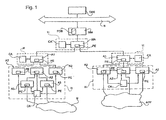
- Figure 1 depicts an exemplary architecture of a system for managing telecommunications services and networks according to the invention.
- the system is preferably implemented on a distributed processing architecture comprising a plurality of processing host machines H, each of which may include one or more software agents (A1, A2, A3).
- the system (or platform) comprises a centralized control module or Manager Module MM including a program or set of programs running on a host machine and interacting with distributed agents for various coordination actions, like distribution of process descriptions, invocation of operations, administrative controls, etc.
- the Manager module MM may also preferably include a graphical user interface for interaction with a user such as a system administrator.
- the term process is used for representing one or more workflows, one or more rules or, preferably, a combination of one or more workflows and one or more rules.
- the workflow can be defined as the automation of a business procedure during which information or tasks are passed from one agent to another for action, according to a set of procedural rules.
- the workflow can be represented through a flowchart with a sequence of tasks as well as time and logical dependencies between tasks including alternative or parallel branches.
- the rules are declarations of which actions have to be executed when a specific set of conditions/events occurs.
- the manager module MM comprises a process description database PDB, which is arranged to store all the processes, i.e. workflows and rules, representing the behavioural and functional aspects of the platform.
- the database PDB further comprises, for example, data models handled by workflows and rules.
- the process description database PDB can be associated with, for example, the catalogue part of any conventional Network Inventory system as known to a man skilled in the art.
- the architecture of figure 1 includes a plurality of multi-layered Agent Modules, three layers having been shown as a way of example including some agents A1, A2, A3 respectively. Agents belonging to the same level may be connected to each other or may be independent from each other. They are coupled to an agent of higher level, if any. At the lower level an agent is coupled to a network element under control (generally shown as the communication network N), for example to an ATM switch, or to other service applications APP, such as mail server applications or VAS server applications, i.e. value added service applications such as mobile phones answering machine services.
- a network element under control generally shown as the communication network N
- service applications APP such as mail server applications or VAS server applications, i.e. value added service applications such as mobile phones answering machine services.
- the manager module MM itself is connected, for example, through a communication bus B to other operations support systems OSS of the platform.
- a master agent MA or, depending on the type of implementation, a plurality of master agents MA (not disclosed in figure 1 ), acting as coordinators are provided at the root of the multi-layered agent architecture, associated to the manager module MM.
- Each agent A1, A2, A3 includes a process engine PE and is responsible for the execution of some processes using process engine PE.
- the process engine is the software module that executes workflows and/or rules.
- Process engines PE are advantageously embedded within each agent since an external location of the process engine would mean having remote invocations that can cause performance degradations.
- processes of each agent can be externally invoked by other agents having the same level or an higher level, and correspond to the services that each agent offers to the invoking agents.
- Process engines for any layer are intended to be a combination, for example, of a workflow and a rule engine able to manage, respectively, workflows and rules.
- a provisioning process is better represented as a workflow, while an alarm correlation could be better represented as a combination of rules.
- the use of workflows is preferred because it does not involve the complexity of dealing with rule conflicts and rule management.
- the multi-layer architecture shown in figure 1 allows the segmentation of a process in different levels. There are no constraints on the number of levels in which the agents can be arranged. In this way it is possible to set up the architecture in order to find the trade-off between having the lowest possible number of layers and allowing free allocation of processes between a distributed and a centralized organization. This segmentation also enables providing different service views, from a business view to a system view. In the following, workflows engines are considered as preferred, but rules engines are also applicable.
- Each host machine running agents preferably includes one or more Control Agents CA. They are modules responsible for measuring the resource utilization and the performance of local agents (i.e. agents running on that host) as well as performing local optimization of resource management.
- the Control Agents CA are coupled to the Manager Module and to other Control Agents and send measured data to the Manager Module and/or to other Control Agents.
- the manager module MM whereof the structure will be described later on, is responsible for administration, configuration and control of the platform. It is arranged for analyzing incoming data from human operators and from external OSSs and deciding how to tune the platform configuration in order to meet business performance goals. Its main tasks are the following:
- the master agent MA is responsible for top level coordination of process execution.
- processes charged to agent of the top layer can involve sub-processes charged to sub-layers agents.
- Processes to be executed by an agent are those ones that must be executed in a distributed way.
- Each Agent can support any network and service management functionality (i.e. process), such as any FCAPS (Fault, Configuration, Accounting, Performance, Security) functionality.
- FCAPS fault, Configuration, Accounting, Performance, Security
- This enables runtime task-customization of agents and functionality reallocation on agents based on task priority and resources needs, like for example dedicating more agents during daytime to service provisioning and more agents during the night-time to network optimization.
- process engines PE in agents enables monitoring the utilization of resources by each functionality (i.e. process) execution as well as the occurrences of functionality invocations. These data are the primary source of information for automatic platform control operated by the manager module MM.
- Each Agent shows both a reactive and a proactive behavior, being triggered on events but also giving the spontaneous start to processes.
- an agent module is movable, by a Control Agent or the Manager Module, across processing machines for easier deployment, for example for fault tolerance issues fulfilment.
- Figure 2 shows the internal structure of the manager module MM according to the preferred embodiment of the invention.
- the centralized manager module MM is organized, for example, in sub-modules.
- One of the sub-modules is the MNG_CNS console, generally indicated as Management Console MNG_CNS;
- the Management Console MNG_CNS in the preferred embodiment, includes:
- the Goal Console GC, the Administrative Console AC and the Service Creation Console SCC are all coupled to the process description database PDB.
- the manager module MM comprises a Resource Allocator RA directly coupled to the Goal and Constraints Console GC and to the Re-Allocator Console RC.
- the Resource Allocator RA is also coupled, for example, to the Administrative Database ADB, as well as to the Performance Database PFM_DB holding platform performance data.
- the manager module MM further comprises, in the preferred embodiment, a Monitoring Data Acquisition Module MDM and a platform controller PC.
- the Monitoring Data Acquisition Module MDM is arranged for transferring performance data from the platform controller PC to the Performance Database PFM_DB.
- the Resource Allocator for example, may be coupled to an external interface module I for monitoring interactions among external OSSs and the management platform.
- the platform controller PC operates, in general, as a mediator between the manager module and the agents.
- the platform controller PC implements connection with the Master Agent MA (not shown) external to the Manager Module and with the Resource Allocator Module RA and is coupled with the Monitoring Console MC, the Monitoring Data Acquisition Module MDM, the Administrative Console AC and the Administrative Database ADB, so as with the Process Description Database PDB.
- the Goal and Constraints Console GC is intended for definition of business goals (e.g. Service Level Agreements or SLA) and constraints, jointly referred to as target data, associated to processes stored in the process description database PDB.
- business goals e.g. Service Level Agreements or SLA
- constraints jointly referred to as target data, associated to processes stored in the process description database PDB.
- Service Level Agreements or SLAs are a (contractual or simply agreed) quantification of the business process level quality.
- the SLAs are based on performance indicators (average execution time, percentiles, or others) and declare the values for these indicators to be guaranteed on the platform.
- a SLA can be described through a specific language (a "grammar") identifying a SLA goal (a performance indicator) and a SLA penalty clause (a SLA cost function based on the comparison between the SLA goal and the collected performance data), for example, an estimate of economical penalty of SLA violation.
- a SLA can be associated to a general business process (e.g. workflow) or to one of its specializations (identifiable in one or more workflow attributes), wherein the SLA for specializations typically overwrites the root business process ones, if any.
- Constraints concern data about resource utilization. They preferably include:
- the Resource Allocator RA (hereinafter Re-Allocator), according to a preferred embodiment of present invention, is centralized and manages allocation of resources to agents in order to adaptively control the platform. It is arranged to receive, for example:
- the Re-allocator RA preferably comprises two sub-modules: an Evaluate module and a Decide module, whose exemplary description and functionalities are given in the following of the specification.
- the Evaluate module is arranged to receive data about
- the Decide module is arranged to decide, on the basis of the previous information, if the platform is able to handle all the requests according to some criteria as will be specified later on. If the platform is not able to manage all the requests, the Decide module is arranged, for example, to send a warning message and decide which action can improve the situation. In particular, if resources are enough, but SLAs are not completely met, the Decide module is arranged to redistribute processing (i.e. workflow execution) across the platform. Preferably, these actions take care of the constraints and the priorities associated to the different instances of workflows.
- the Administrative Console AC is intended to define and monitor, for example, at least a set of the following:
- the Re-allocator Console RC is arranged for definition of resource reallocation policies, i.e. instruction of when and how re-allocate resources in order to optimize business goal satisfaction on the basis of business constraints and monitored data.
- the Re-allocator Console allows to enter policies both for centralized and distributed control. In particular, it allows definition of:
- the Monitoring Console MC is arranged for browsing monitoring information such as:
- the Monitoring Console MC enables to browse, in a hierarchical way, performances and resource utilization of workflows (in particular, every block of workflow). For every SLA, it is possible to issue reports about workflows which, due to a heavy utilization of resources, are worth being optimized. If other points of measure are set on different level of workflows, they are presented on the MC too. Besides, the MC shows information about billing, in terms of resources used by the workflows.
- the Service Creation Environment Console SCC is arranged for definition, creation and modification of the processes in the PDB, thus of every business functionality provided in the management platform. It is based on a graphical interface to facilitate this task. This console also allows the insertion of new monitoring points on the workflows.
- the data managed by the MM modules are also used to achieve a useful capacity planning by adding to the MM modules a Forecast Console and a Capacity Planning Module.
- the Forecast Console is arranged to set utilization forecasts in order to achieve a useful capacity planning activity. Input of this console are:
- the Capacity Planning Module is arranged to assure hardware resources over the time. It is arranged to receive inputs from the Forecast Console and other Consoles (the Goal & Constraints Console, the Administrative Console and the Re-Allocator Console) and to verify availability of resources. If resources are not enough, the Capacity Planning Module is arranged to warn an operator of the console about the amount of hardware needed to meet the expected increased trend. This module bases its analysis on a set of parameters including at least one of the following:
- Capacity Planning Module is based on uncertain data (especially, long term data) it is arranged mainly for information purposes. It may highlight future needs, but it does preferably not interact with the Resource Allocator RA.
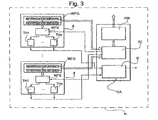
- Figure 3 shows an example of the internal structure of a host machine including agent modules A and a control agent CA responsible for the overall performance of the host and the control of all the agents that run on that host.
- Each agent A includes at least a set of the following components:
- the control agent CA includes at least a set of the following components, preferably software implemented:
- control agents CA by their side, preferably have an important feature according to a preferred embodiment. They are able to actively manage the parallelism of their process threads (local optimization). The two capabilities of queue re-ordering and parallelism management joint together are the basis of the adaptive mechanism according to an aspect of the invention.
- the Resource Monitor RM, the Thread Controller TC and the Dispatcher D can be annexed to the agent module, for example if there are is a single agent module A on a host machine H.
- a preferred embodiment of the system of the invention is implemented using JADE (Java Agent Development framework) for implementing agents with mobility features, XPDL (XML Process Definition Language) for process definition, and an XPDL workflow engine as Shark.
- JADE Java Agent Development framework
- XPDL XML Process Definition Language
- Shark an XPDL workflow engine
- the Reallocator RA can be implemented as an expert rule-based system with functionalities of constraints processing, data manipulation and configuration changes. All the data, constraints and rules coming from the managed network, external systems, human knowledge and internal analysis constitute its knowledge base, which may be materially represented by an associated knowledge database.
- the Re-Allocator module RA executes the Evaluate and Decide modules at predetermined intervals of analysis, which can be set on a case by case basis depending upon the context of the scenario.
- Reallocator gets data about process requests from external systems through bus B in order to evaluate the number of service/function requests forecasted for the subsequent time interval and maintains this information in the associated knowledge database.
- the Decide module activates the resource reallocation rules in order to find out the actions to be taken in order to achieve predetermined business goals in an optimised way.
- the resource allocator module At each interval T, the resource allocator module considers the number of queued requests and the number of forecast requests based on historical basis. It performs a first evaluation of the amount of available hardware resources (mainly CPU and RAM). These data are possibly tuned using actual measured data at the end of the interval, considering a "Background error correction", which will be described later.
- the collected information are correlated to the length and composition of the queues at a time t and to the number of requests expected (by forecast) during the interval [t, t+T] to calculate the total request of CPU power for the subsequent intervals, intended as a set comprising the following interval or a set of intervals located after a plurality of intervals.
- the total amount of CPU i.e. the requested computing power for the new interval (considering level and geographical constraints), is then compared to the available CPU power. If it is not enough, a warning (requesting new hardware) is generated to the console and priorities of workflows will determine how the load will be handled.
- the method and system according to the invention use a policy based on priorities, whereby there are different levels of priorities.
- the Decide module can manipulate priority queues to achieve business goals. To avoid starvation, if a workflow request spends too much time into a low-priority queue, its priority is automatically updated so that the request is moved to a higher priority queue.
- the management algorithm is based on an adaptive solution for improving the resource configuration at every step and trying to reach the best configuration with an incremental behavior.
- the results of the present approach are guaranteed by using an interval of analysis which is at least two or three times the average workflow execution time (a reasonable interval will depend on the context of the application and can vary from 5 minutes to 1 hour or more).
- a priority is associated to every execution of workflow, taking into consideration:
- any means to define and measure execution of functionalities can be used, for example CPU estimation with statistical techniques.
- the resource to be optimised is CPU load.
- top level workflows are services associated with an SLA characterized by a priority property, expressed in terms of percentage of workflows to be completed within a time t >> ⁇ T , where ⁇ T is the observation interval time.
- Last assumption is required in order to give the platform enough time to recalibrate within the period t.
- Top level workflows consist in a composition of many sub-workflows. All workflows have a priority property that affects their queue waiting time before execution and workflow CPU time slice.
- Input data are:
- the performance adaptation process is based on monitoring performed every ⁇ T time interval, which represents the minimum platform adaptation time.
- CpuTimeP g ⁇ wf ⁇ WF g ⁇ l wf ⁇ NEP wf g
- NSLA wfl1 In order to forecast if computational resources are enough to be SLA complaint, for each SLA defined on a first level workflow wfl1, the number of wfl1 to be executed in the subsequent ⁇ T in order to be SLA compliant, NSLA wfl1 is calculated:
- the methodology consists in various actions, at least some examples of which are described in the following, ordered by complexity:
- Actions d) and e) are based on a function that tries to minimize the cost impact of SLA penalties, defined through the Goal & Constraint Console GC.
- this methodology keeps into account the constraints on resources utilization, like the maximum amount of CPU time to be allocated for each workflows. This means that the priority of a workflow that is already using the maximum amount of reserved CPU time cannot be increased.
- an alternative possibility is that the agent collects at predetermined intervals (for example every five minutes) the number of "building block" executed and makes a correlation with the system resource utilization (for example CPU utilization).
- Multivariate regressive techniques are often employed to estimate performance of computer systems under overload conditions. This choice rests upon the analysis of the behaviour of a number of in-field OSS that were exercised beyond their capacity. The outcome was that most of the common performance metrics for OSS, such as CPU utilization, may be modeled by linear regression. System response time, for example, grows according to a moderate exponential law. Thus, a lower bound for predicting system performance may be obtained by a multivariate linear regression technique based on system resource data and workflow execution data.
- all the measures should be translated in an economical quantity in order to optimize the adaptation in a consistent way.
- Figure 6 shows, by way of example, the setup of a three-layers service provisioning scenario according to the invention, characterised by flexibility and scalability.
- the bottom layer agents are responsible for interaction with the network element and are called Resource Proxy and indicated RP1, RP2, RP3.
- a broadband service named "Offer 1" shall be delivered in a telecommunications network that includes access devices (e.g. an ADSL Equipment), an ATM backbone and BASs (Broadband Access Servers) in order to gain IP connectivity.
- access devices e.g. an ADSL Equipment
- ATM backbone e.g. an ATM backbone
- BASs Broadband Access Servers
- Examples of services offered by RP are configuration of ports, creation of cross-connections, modification of connection attributes. Each of them can include sequences of basic commands to be sent and/or received to/by the equipments.
- AA1, AA2, AA3 are the agents that manage, respectively, the Resource Proxy RP1 representing the image of the ADSL Equipment E (endpoint A of the end-to-end circuit), the Resource Proxy RP2 representing the image of the ATM Switch SW connected to the ADSL Equipment E and the Resource Proxy RP3 representing the image of the BAS (endpoint Z of the end-to-end circuit).
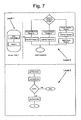
- Level 1 or top level workflow comprises two steps or tasks and is executed by Master Agent MA.
- the first one (ADSL Connectivity) requests execution of a level 2 workflow that is executed at the agent level (AA1, AA2, AA3) while the second one, i.e. the Mailbox task (not detailed in this example) can be performed by an external platform.
- the ADSL Connectivity Task is thus a Level 2 workflow that comprises a sequence of Level 3 workflows, technology and vendor dependent, that are executed at Resource Proxy Level (RP1, RP2, RP3).
- the level 3 workflows comprises sequences of the commands that must be performed on a communication network equipment by the Resource Proxy.
- An example of level 3 workflow is given in figure 7 by expanding level 2 workflow "Create ADSL Port Vendor A".
- the Monitoring Console MC highlights if there are problems on a particular Vendor or on a particular workflow.
- the Goal Console allows to define SLA on Offer1 and Offer2 with a SLA control rule and a related cost function. If the SLA on service “Offer2" is more important (for example the cost function associated to "Offer2" is equal to the number of seconds that exceed an average execution time of 1 second and the cost function associate to "Offer1" is equal to the number of second that exceed an average execution time of 4 second) then priority on “Offer2" grows faster than the priority of "Offer1". This means that when the hardware resource (e.g. CPU) are scarce with the same number of requests, the throughput of "Offer2" will be higher then the throughput of "Offer1".
- the hardware resource e.g. CPU
- the platform adjusts resource utilization to reach its target, be it a requirement set by an external operator or due to agent saturation.
Landscapes
- Engineering & Computer Science (AREA)
- Computer Networks & Wireless Communication (AREA)
- Signal Processing (AREA)
- Theoretical Computer Science (AREA)
- Computer Hardware Design (AREA)
- Software Systems (AREA)
- General Engineering & Computer Science (AREA)
- General Physics & Mathematics (AREA)
- Physics & Mathematics (AREA)
- Management, Administration, Business Operations System, And Electronic Commerce (AREA)
- Telephonic Communication Services (AREA)
- Financial Or Insurance-Related Operations Such As Payment And Settlement (AREA)
- Exchange Systems With Centralized Control (AREA)
- Mobile Radio Communication Systems (AREA)
- Data Exchanges In Wide-Area Networks (AREA)
- Multi Processors (AREA)
- Computer And Data Communications (AREA)
Claims (29)
- Procédé de gestion de ressources pour des services et/ou des réseaux de télécommunications, le procédé comprenant l'exploitation d'agents distribués (A1, A2, A3), lesdits agents comprenant des moteurs de processus (PE) pour exécuter des processus de gestion,
le procédé étant caractérisé par ;- la définition de données cible à respecter, dans lequel lesdites données cible comprennent des objectifs sur les exécutions de processus par les agents distribués et des contraintes d'utilisation de ressources,- la surveillance, au moyen desdits moteurs de processus inclus dans lesdits agents distribués, des exécutions de processus par les agents distribués (A1, A2, A3) et de l'utilisation de ressources,- la collecte de données de performance représentatives desdites exécutions de processus et de ladite utilisation de ressources,- la comparaison des données de performance collectées et des données cible définies,- l'établissement d'au moins une clause de pénalité sur la base d'une comparaison entre les données de performance collectées desdits agents et les données cible définies et- la réaffectation de ressources auxdits agents (A1, A2, A3) pour des exécutions de processus par des agents (A1, A2, A3) sur la base de ladite ou desdites clause(s) de pénalité établie(s). - Procédé selon la revendication 1, dans lequel l'étape de réaffectation de ressources comprend la modification des priorités de processus au niveau des agents distribués (A1, A2, A3).
- Procédé selon la revendication 1, dans lequel l'étape de réaffectation de ressources comprend- l'exécution d'une étape d'évaluation et d'une étape de décision à des intervalles d'observation déterminés, dans lequel-- l'étape d'évaluation comprend--- la collecte de données représentatives des exécutions de processus et du nombre d'exécutions de processus prévues pour l'un au moins des intervalles d'observation suivants, et--- l'évaluation, sur la base desdites données collectées, des ressources nécessaires aux dits agents, et-- l'étape de décision comprend--- la comparaison des ressources nécessaires aux ressources disponibles pour chacun desdits agents (A1, A2, A3), et--- l'application de règles de réaffectation de ressources déterminées aux dits agents (A1, A2, A3) pour modifier l'utilisation de ressources parmi les agents (A1, A2, A3) et/ou changer les priorités de processus au niveau des agents (A1, A2, A3) et/ou réaffecter des exécutions de processus parmi les agents (A1, A2, A3).
- Procédé selon l'une quelconque des revendications précédentes, caractérisé par la mémorisation de descriptions de processus représentatives de processus dans une base de données de descriptions de processus (PDB) associée aux dits moteurs de processus (PE).
- Procédé selon la revendication 4, dans lequel les descriptions de processus comprennent des flux de travail et/ou des règles.
- Procédé selon l'une quelconque des revendications précédentes, comprenant- la fourniture des agents (A1, A2, A3) à des niveaux hiérarchiques en fonction d'une configuration multicouche des agents (A1, A2, A3).
- Procédé selon la revendication 6, dans lequel les exécutions de processus sont affectées à la configuration multicouche des agents (A1, A2, A3) par un module gestionnaire centralisé (MM).
- Procédé selon la revendication 7, dans lequel- l'étape de collecte de données de performance comprend :-- la transmission desdites données de performance au module gestionnaire centralisé (MM) et/ou à une pluralité d'agents de commande de performance locaux (CA) associés aux agents (A1, A2, A3).
- Procédé selon la revendication 7, comprenant- la fourniture d'au moins un agent maître (MA) au niveau de la couche supérieure de ladite configuration multicouche des agents (A1, A2, A3), l'agent maître (tala) affectant des exécutions de processus des agents (A1, A2, A3) situés dans des sous-couches de ladite configuration multicouche.
- Procédé selon l'une quelconque des revendications précédentes, comprenant, pour chaque agent (A1, A2, A3), les étapes de- l'insertion d'une demande d'exécution de processus dans une file d'attente de processus de priorité multiniveau (WFQ) en fonction d'un critère de priorité ;- l'ordonnancement des exécutions de processus sur la base de la file d'attente de processus de priorité multiniveau (WFQ).
- Procédé selon la revendication 10, comprenant l'ordonnancement des exécutions de processus par au moins un fil de moteur de processus (TH1, ..., THn) associé chaque agent.
- Procédé selon la revendication 10, dans lequel les demandes d'exécution de processus dans la file d'attente de processus de priorité multiniveau (WFQ) sont passées à un niveau supérieur sur la base d'un critère d'expiration.
- Procédé selon les revendications 8 à 11, dans lequel chaque agent de commande (CA) commande le nombre de fils de moteur de processus (TH1, ..., THn) et l'utilisation de ressources par les agents.
- Procédé selon la revendication 8, dans lequel- l'agent de commande (CA) exécute un algorithme d'équilibrage de charge pour déterminer la charge des agents et- chaque agent (A1, A2, A3) envoie des demandes d'exécution de processus d'autres agents (A1, A2, A3) sur la base d'un critère, y compris au moins une évaluation de la charge des agents qui est déterminée par l'agent de commande (CA),
- Plate-forme de gestion de ressources pour des services et/ou des réseaux de télécommunications, comprenant :- une pluralité d'agents distribués (A1, A2, A3) comprenant des moteurs de processus (PE) aptes à gérer l'exécution de processus de gestion (WF1, ..., WFn), dans lequel lesdits moteurs de processus (PE) inclus dans les agents distribués sont configurés pour surveiller les exécutions de processus et l'utilisation de ressources par les agents distribués (A1, A2, A3), et- un module gestionnaire centralisé (MM) configuré pour-- la définition de données cible respecter par la plate-forme, dans laquelle lesdites données cible comprennent des objectifs sur les exécutions de processus (WF1, ..., WFn) par les agents distribués et des contraintes d'utilisation de ressources de plate-forme à respecter par la plate-forme,-- la collecte de données de performance représentatives desdites exécutions de processus et de ladite utilisation de ressources par les agents distribués (A1, A2, A3),-- la comparaison des données de performance collectées et des données cible définies,-- l'établissement d'au moins une clause de pénalité sur la base d'une comparaison entre les données de performance collectées desdits agents et les données cible définies et-- la réaffectation de ressources aux dits agents (A1, A2, A3) pour des exécutions de processus par des agents (A1, A2, A3) sur la base de ladite ou desdites clause(s) de pénalité établie(s).
- Plate-forme selon la revendication 15, caractérisée en ce que le module gestionnaire centralisé (MM) comprend un module d'affectation de ressources (RA) comprenant :- un module d'évaluation configuré pour-- la collecte de données représentatives des exécutions de processus et du nombre d'exécutions de processus prévues pour au moins un intervalle d'observation suivant, et-- l'évaluation, sur la base desdites données collectées, des ressources nécessaires aux dits agents, et- un module de décision configuré pour-- la comparaison des ressources nécessaires aux ressources disponibles pour chacun desdits agents (A1, A2, A3), et-- l'application de règles de réaffectation de ressources déterminées aux dits agents (A1, A2, A3) pour modifier l'utilisation de ressources parmi les agents (A1, A2, A3) et/ou changer les priorités de processus au niveau des agents (A1, A2, A3) et/ou réaffecter des exécutions de processus parmi les agents (A1, A2, A3).
- Plate-forme selon l'une quelconque des revendications 15 et 16, caractérisée en ce que ledit module gestionnaire centralisé (MM) comprend :- une base de données de descriptions de processus (PDB) pour la mémorisation de descriptions de processus représentatives d'aspects comportementaux et fonctionnels de la plate-forme.
- Plate-forme selon la revendication 17, caractérisée en ce que ledit module gestionnaire centralisé (MM) comprend, en outre :- une console de création de service (SCC) agencée pour la définition, la création et la modification des descriptions de processus dans la base de données de descriptions de processus (PDB),
- Plate-forme selon la revendication 17, caractérisée en ce que les descriptions de processus comprennent des flux de travail et/ou des règles.
- Plate-forme selon l'une quelconque des revendications 15 à 19, caractérisée en ce que- ladite pluralité d'agents distribués (A1, A2, A3) sont organisés à des niveaux hiérarchiques en fonction d'une configuration multicouche, et en ce que- ledit module gestionnaire centralisé (MM) est configuré pour affecter des exécutions de processus à ladite configuration multicouche d'agents.
- Plate-forme selon l'une quelconque des revendications 15 à 20, caractérisée par- des agents de commande de performance locaux (CA) associés à au moins un ensemble d'agents distribués (A1, A2, A3) et en ce que- lesdits moteurs de processus (PE) comprennent des modules de surveillance de ressources (RM) configurés pour- la transmission desdites données de performance au module gestionnaire centralisé (MM) et/ou aux agents de commande de performance locaux (CA) associés aux agents (A1, A2, A3).
- Plate-forme selon la revendication 20, caractérisée par- au moins un agent maître (MA) situé au niveau de la couche supérieure de ladite configuration multicouche des agents (A1, A2, A3) et configuré pour affecter des exécutions de processus à des agents (A1, A2, A3) situés dans des sous-couches de ladite configuration multicouche.
- Plate-forme selon l'une quelconque des revendications 15 à 22, caractérisée par- au moins une machine de traitement (H) comprenant au moins un ensemble de ladite pluralité d'agents distribués (A1, A2, A3).
- Plate-forme selon la revendication 23, caractérisée en ce qu'au moins un agent de commande de performance local (CA) est associé à ladite ou auxdites machine(s) de traitement (H).
- Plate-forme selon la revendication 24, caractérisée en ce que ledit ou lesdits agent(s) de commande de performance local(aux) (CA) comprend :- un module de surveillance de performance local commun (RM) agencé pour la collecte de données de performance représentatives de l'utilisation de ressources et de l'exécution de processus par les agents (A1, A2, A3) et la transmission des données de performance au module gestionnaire centralisé (MM),- un contrôleur de fils commun (TC) couplé au moniteur de ressources (RM) agencé pour créer des fils de moteur de processus (TH1, ..., THn) pour exécuter des processus d'attente (WF1, ..., WFn) et- un module dispatcheur commun (D) couplé aux fils de moteur de processus (TH1, ..., THn) et agencé pour envoyer des demandes d'exécution de processus à d'autres agents (A1, A2, A3) en fonction d'un algorithme d'équilibrage de charge prédéterminé.
- Plate-forme selon la revendication 15, caractérisé en ce que le module gestionnaire (MM) comprend- un module de planification de capacité configuré pour-- la prévision de la disponibilité des ressources dans un intervalle d'observation sur la base de performances historiques et de données représentatives de l'utilisation actuelle des ressources.
- Plate-forme selon la revendication 15, caractérisée en ce que le module gestionnaire (MM) comprend- une console administrative (AC) configurée pour :-- la définition de la configuration matérielle de la plate-forme et- la définition des contraintes des exécutions de processus.
- Réseau de télécommunications comprenant une plate-forme selon l'une quelconque des revendications 15 à 27.
- Produit de programme informatique ou ensemble de programmes informatiques de produits de programmes informatiques pouvant être chargés dans la mémoire d'au moins un ordinateur et comprenant des parties de code logiciel pour réaliser les étapes selon l'une quelconque des revendications 1 à 14.
Applications Claiming Priority (1)
| Application Number | Priority Date | Filing Date | Title |
|---|---|---|---|
| PCT/EP2004/012224 WO2006045337A1 (fr) | 2004-10-28 | 2004-10-28 | Procede de gestion de ressources dans une plate-forme de gestion de services et / ou de reseaux de telecommunication, plate-forme correspondante et programme informatique associe |
Publications (2)
| Publication Number | Publication Date |
|---|---|
| EP1806002A1 EP1806002A1 (fr) | 2007-07-11 |
| EP1806002B1 true EP1806002B1 (fr) | 2010-08-25 |
Family
ID=34959408
Family Applications (1)
| Application Number | Title | Priority Date | Filing Date |
|---|---|---|---|
| EP04822335A Expired - Lifetime EP1806002B1 (fr) | 2004-10-28 | 2004-10-28 | Procede de gestion de ressources dans une plate-forme de gestion de services et / ou de reseaux de telecommunication, plate-forme correspondante et programme informatique associe |
Country Status (11)
| Country | Link |
|---|---|
| US (1) | US8264971B2 (fr) |
| EP (1) | EP1806002B1 (fr) |
| JP (1) | JP2008519322A (fr) |
| KR (1) | KR101096000B1 (fr) |
| CN (1) | CN101084680B (fr) |
| AT (1) | ATE479287T1 (fr) |
| BR (1) | BRPI0419152B1 (fr) |
| DE (1) | DE602004028877D1 (fr) |
| ES (1) | ES2351604T3 (fr) |
| IL (1) | IL182824A (fr) |
| WO (1) | WO2006045337A1 (fr) |
Cited By (1)
| Publication number | Priority date | Publication date | Assignee | Title |
|---|---|---|---|---|
| WO2015070588A1 (fr) * | 2013-11-12 | 2015-05-21 | 中兴通讯股份有限公司 | Procédé et serveur pour collecter des données de performances d'un système de gestion de réseau de télécommunications |
Families Citing this family (74)
| Publication number | Priority date | Publication date | Assignee | Title |
|---|---|---|---|---|
| US20080034090A1 (en) * | 2005-09-29 | 2008-02-07 | Nortel Networks Limited | Tender-Bid Method and Architecture For Intelligent Network Resource Deployment |
| JP5065050B2 (ja) | 2005-12-28 | 2012-10-31 | インターナショナル・ビジネス・マシーンズ・コーポレーション | クライアント・サーバ・システムにおける負荷分散 |
| GB0610532D0 (en) * | 2006-05-26 | 2006-07-05 | Abilisoft Ltd | Monitoring of network management systems |
| JP4240062B2 (ja) * | 2006-05-31 | 2009-03-18 | 日本電気株式会社 | 計算機システムおよび性能計測方法ならびに管理サーバ装置 |
| EP1916621A1 (fr) * | 2006-10-26 | 2008-04-30 | Hewlett-Packard Development Company, L.P. | Adapter des reseaux informatiques |
| US8160594B2 (en) * | 2006-12-28 | 2012-04-17 | Hitachi, Ltd. | Radio propagation estimating method and radio propagation estimating apparatus |
| US20080270653A1 (en) * | 2007-04-26 | 2008-10-30 | Balle Susanne M | Intelligent resource management in multiprocessor computer systems |
| JP2008282185A (ja) * | 2007-05-10 | 2008-11-20 | Hitachi Ltd | 物理条件が作業に影響する場合を支援するワークフローシステムおよび、それを用いた輸送方法および保守方法 |
| US20090006170A1 (en) * | 2007-06-26 | 2009-01-01 | Wachovia Corporation | Production center system |
| EP2031799B1 (fr) | 2007-08-29 | 2009-12-02 | Alcatel, Lucent | Procédé d'attribution de ressources pour effectuer une opération de gestion dans un réseau de télécommunication |
| WO2009033500A1 (fr) * | 2007-09-14 | 2009-03-19 | Nec Europe Ltd. | Procédé et système permettant d'optimiser le fonctionnement d'un réseau |
| US9977721B2 (en) | 2007-12-20 | 2018-05-22 | Netapp, Inc. | Evaluating and predicting computer system performance using kneepoint analysis |
| WO2009086326A1 (fr) * | 2007-12-20 | 2009-07-09 | Akorri Networks, Inc. | Évaluation et prédiction de la performance d'un système informatique utilisant une analyse de point de coude |
| WO2009096519A1 (fr) * | 2008-01-31 | 2009-08-06 | Nec Corporation | Procédé de précompensation, dispositif de contrôle qualité de fourniture de services, système, programme et support d'enregistrement associé |
| US8112366B2 (en) | 2008-09-30 | 2012-02-07 | Microsoft Corporation | Expert system and visualization for multi-server capacity management |
| US8656404B2 (en) * | 2008-10-16 | 2014-02-18 | Palo Alto Research Center Incorporated | Statistical packing of resource requirements in data centers |
| US10185646B2 (en) * | 2008-12-16 | 2019-01-22 | Red Hat, Inc. | Getting performance saturation point of an event driven system |
| WO2010089900A1 (fr) * | 2009-02-05 | 2010-08-12 | Nec Corporation | Procédé, système et programme de contrôle et de planification d'admission de tâches à contrainte d'échéance au moyen d'une approche génétique |
| WO2010131778A1 (fr) * | 2009-05-15 | 2010-11-18 | 日本電気株式会社 | Systeme de commande de surveillance de flux de travaux, procede de commande de surveillance, et programme de commande de surveillance |
| CN101931609B (zh) * | 2009-06-22 | 2014-07-30 | Sap股份公司 | 多租户数据库应用的遵守服务等级协议的布局 |
| US10185594B2 (en) * | 2009-10-29 | 2019-01-22 | International Business Machines Corporation | System and method for resource identification |
| US8260958B2 (en) * | 2010-02-24 | 2012-09-04 | F5 Networks, Inc. | Reducing energy consumption of servers |
| US8255529B2 (en) * | 2010-02-26 | 2012-08-28 | Red Hat, Inc. | Methods and systems for providing deployment architectures in cloud computing environments |
| JP5471859B2 (ja) * | 2010-06-10 | 2014-04-16 | 富士通株式会社 | 解析プログラム、解析方法、および解析装置 |
| JP5414663B2 (ja) * | 2010-12-24 | 2014-02-12 | 株式会社東芝 | サービス提供システム、装置及びプログラム |
| US20120278513A1 (en) * | 2011-02-01 | 2012-11-01 | Michel Prevost | Priority scheduling for multi-channel context aware communication technology |
| JP5569424B2 (ja) * | 2011-02-14 | 2014-08-13 | 富士通株式会社 | 更新装置、更新方法、および更新プログラム |
| US8630959B2 (en) | 2011-02-23 | 2014-01-14 | International Business Machines Corporation | Determining costs for workflows |
| US20120215582A1 (en) * | 2011-02-23 | 2012-08-23 | International Business Machines Corporation | Executing workflows based on service level agreements |
| CN102308540B (zh) | 2011-06-15 | 2013-12-18 | 华为技术有限公司 | 业务处理资源的调度方法以及装置 |
| US8539074B2 (en) | 2011-07-19 | 2013-09-17 | International Business Machines Corporation | Prioritizing data packets associated with applications running in a networked computing environment |
| CN102915254B (zh) * | 2011-08-02 | 2018-04-06 | 中兴通讯股份有限公司 | 任务管理方法及装置 |
| US8660949B2 (en) | 2011-09-09 | 2014-02-25 | Sap Ag | Method and system for working capital management |
| US8874974B2 (en) | 2011-11-15 | 2014-10-28 | International Business Machines Corporation | Synchronizing a distributed communication system using diagnostic heartbeating |
| US8903893B2 (en) * | 2011-11-15 | 2014-12-02 | International Business Machines Corporation | Diagnostic heartbeating in a distributed data processing environment |
| US8756453B2 (en) | 2011-11-15 | 2014-06-17 | International Business Machines Corporation | Communication system with diagnostic capabilities |
| US9244796B2 (en) | 2011-11-15 | 2016-01-26 | International Business Machines Corporation | Diagnostic heartbeat throttling |
| US8769089B2 (en) * | 2011-11-15 | 2014-07-01 | International Business Machines Corporation | Distributed application using diagnostic heartbeating |
| CN103491115A (zh) * | 2012-06-12 | 2014-01-01 | 华为软件技术有限公司 | 资源调度方法、装置及系统 |
| US10032136B1 (en) * | 2012-07-30 | 2018-07-24 | Verint Americas Inc. | System and method of scheduling work within a workflow with defined process goals |
| GB2507338A (en) * | 2012-10-26 | 2014-04-30 | Ibm | Determining system topology graph changes in a distributed computing system |
| US9154398B1 (en) * | 2013-03-01 | 2015-10-06 | Emc Corporation | Method and system for identifying root causes of application underachievement in a virtually provisioned environment |
| WO2015027465A1 (fr) * | 2013-08-30 | 2015-03-05 | 华为技术有限公司 | Procédé, dispositif et système d'attribution de ressources |
| US9998332B2 (en) | 2013-11-15 | 2018-06-12 | Massachusetts Institute Of Technology | Signal-flow architecture for cooperative control and resource allocation |
| CN105873070B (zh) | 2015-01-20 | 2020-04-10 | 中兴通讯股份有限公司 | 一种授权共享接入系统干扰自适应发现方法与装置 |
| JP6425561B2 (ja) * | 2015-01-23 | 2018-11-21 | Kddi株式会社 | 分散型ネットワーク管理システム、ネットワーク管理装置、ネットワーク装置、分散型ネットワーク管理方法およびプログラム |
| CN104573993A (zh) * | 2015-01-29 | 2015-04-29 | 北京京东尚科信息技术有限公司 | 多流程执行方法和系统 |
| EP3118784A1 (fr) | 2015-07-14 | 2017-01-18 | Tata Consultancy Services Limited | Procédé et système permettant une planification de capacité dynamique |
| US10332018B2 (en) | 2016-03-01 | 2019-06-25 | International Business Machines Corporation | Service level agreement risk analysis with exogenous architecture |
| CN105824703B (zh) * | 2016-03-30 | 2019-03-29 | 联想(北京)有限公司 | 一种线程管理方法和线程管理器 |
| US10374872B2 (en) * | 2016-05-24 | 2019-08-06 | Apstra, Inc. | Configuring system resources for different reference architectures |
| CN109643090B (zh) * | 2016-06-24 | 2022-04-26 | 施耐德电子系统美国股份有限公司 | 动态地促进m:n工作配置系统管理的方法、系统和设备 |
| US10698954B2 (en) * | 2016-06-30 | 2020-06-30 | Facebook, Inc. | Computation platform agnostic data classification workflows |
| JP6717092B2 (ja) | 2016-07-14 | 2020-07-01 | 富士通株式会社 | 制御装置および制御装置における処理方法 |
| EP3270598A3 (fr) * | 2016-07-15 | 2018-03-21 | Intraway R&D S.A. | Système et procédé pour la fourniture d'informations |
| US10545951B1 (en) | 2016-12-15 | 2020-01-28 | Amazon Technologies, Inc. | Workflow dependency management system |
| CN116450291A (zh) * | 2018-01-16 | 2023-07-18 | Qsc公司 | 基于云的音频/视频操作系统 |
| US11356315B2 (en) | 2018-03-28 | 2022-06-07 | Intel Corporation | Methods and apparatus to dynamically control devices based on distributed data |
| US10572316B2 (en) * | 2018-05-14 | 2020-02-25 | International Business Machines Corporation | Adaptable pages, widgets and features based on real time application performance |
| JP7155605B2 (ja) * | 2018-05-22 | 2022-10-19 | 富士フイルムビジネスイノベーション株式会社 | 情報処理装置及びプログラム |
| US10990441B2 (en) * | 2018-07-31 | 2021-04-27 | Nutanix, Inc. | Multi-level job processing queues |
| EP3983894B1 (fr) * | 2019-06-12 | 2024-10-30 | Arigato Machine, Inc., dba Manifold | Mise à l'échelle automatique prédictive et optimisation de ressources |
| JP7410379B2 (ja) * | 2019-11-27 | 2024-01-10 | 富士通株式会社 | 資源使用量予測方法および資源使用量予測プログラム |
| US11824784B2 (en) | 2019-12-20 | 2023-11-21 | Intel Corporation | Automated platform resource management in edge computing environments |
| WO2021164857A1 (fr) * | 2020-02-18 | 2021-08-26 | Telefonaktiebolaget Lm Ericsson (Publ) | Dimensionnement dynamique de ressources pour une assurance de service |
| JP2022021026A (ja) * | 2020-07-21 | 2022-02-02 | キオクシア株式会社 | メモリシステムおよびコマンドをフェッチする方法 |
| KR102427473B1 (ko) * | 2020-09-29 | 2022-08-01 | 한국전자기술연구원 | 마이크로 데이터센터내 가용 자원상태 기반 워크로드 예측 정확도 증가 방법 |
| WO2022109351A1 (fr) * | 2020-11-20 | 2022-05-27 | Okta, Inc. | Gestion de flux de travaux sur serveur utilisant des priorités |
| US12236280B2 (en) * | 2021-04-06 | 2025-02-25 | Intuit Inc. | Orchestration layer for user defined automation workflows |
| US12386672B2 (en) * | 2022-01-14 | 2025-08-12 | Dell Products L.P. | Intelligent orchestration of classic-quantum computational graphs |
| JP7837782B2 (ja) * | 2022-04-12 | 2026-03-31 | 株式会社日立製作所 | データ処理管理システム、データ処理管理方法 |
| WO2024005681A1 (fr) * | 2022-07-01 | 2024-01-04 | Telefonaktiebolaget Lm Ericsson (Publ) | Procédé et système d'optimisation de système à l'aide de facteurs de pondération d'attribution de service |
| US12411621B2 (en) | 2022-07-07 | 2025-09-09 | Dell Products L.P. | Intelligent classical/quantum extended memory fabric |
| EP4718797A1 (fr) * | 2024-09-25 | 2026-04-01 | Ntt Docomo, Inc. | Procédé de gestion d'une tâche de gestion d'un réseau de communication |
Family Cites Families (10)
| Publication number | Priority date | Publication date | Assignee | Title |
|---|---|---|---|---|
| IE77337B1 (en) | 1995-08-15 | 1997-12-03 | Broadcom Eireann Research Limi | A communication network management system |
| AU4938799A (en) * | 1998-06-25 | 2000-01-10 | Telefonaktiebolaget Lm Ericsson (Publ) | Service provider access to operation and maintenance information within a telecommunications system |
| ATE235774T1 (de) * | 1998-09-25 | 2003-04-15 | Soma Networks Inc | System und verfahren zur durchführung einer auktion über ein kommunikationsnetzwerk |
| WO2001002973A1 (fr) | 1999-07-02 | 2001-01-11 | Covad Communications Group, Inc. | Systemes et procedes d'execution de processus utilisant une architecture distribuee de gestion de flux des travaux |
| US6516337B1 (en) * | 1999-10-14 | 2003-02-04 | Arcessa, Inc. | Sending to a central indexing site meta data or signatures from objects on a computer network |
| JP3664021B2 (ja) * | 2000-01-05 | 2005-06-22 | 日本電気株式会社 | サービスレベルによる資源割当方式 |
| US7171654B2 (en) | 2000-05-25 | 2007-01-30 | The United States Of America As Represented By The Secretary Of The Navy | System specification language for resource management architecture and corresponding programs therefore |
| US6823382B2 (en) * | 2001-08-20 | 2004-11-23 | Altaworks Corporation | Monitoring and control engine for multi-tiered service-level management of distributed web-application servers |
| JP3772713B2 (ja) * | 2001-09-12 | 2006-05-10 | 日本電気株式会社 | プライオリティ動的制御方式、プライオリティ動的制御方法およびプライオリティ動的制御用プログラム |
| US7322034B2 (en) | 2002-06-14 | 2008-01-22 | Hewlett-Packard Development Company, L.P. | Method and system for dynamically allocating computer system resources |
-
2004
- 2004-10-28 US US11/666,509 patent/US8264971B2/en not_active Expired - Lifetime
- 2004-10-28 AT AT04822335T patent/ATE479287T1/de not_active IP Right Cessation
- 2004-10-28 EP EP04822335A patent/EP1806002B1/fr not_active Expired - Lifetime
- 2004-10-28 JP JP2007538274A patent/JP2008519322A/ja not_active Withdrawn
- 2004-10-28 WO PCT/EP2004/012224 patent/WO2006045337A1/fr not_active Ceased
- 2004-10-28 KR KR1020077011953A patent/KR101096000B1/ko not_active Expired - Lifetime
- 2004-10-28 BR BRPI0419152-8A patent/BRPI0419152B1/pt active IP Right Grant
- 2004-10-28 ES ES04822335T patent/ES2351604T3/es not_active Expired - Lifetime
- 2004-10-28 CN CN2004800446483A patent/CN101084680B/zh not_active Expired - Lifetime
- 2004-10-28 DE DE602004028877T patent/DE602004028877D1/de not_active Expired - Lifetime
-
2007
- 2007-04-26 IL IL182824A patent/IL182824A/en active IP Right Grant
Cited By (1)
| Publication number | Priority date | Publication date | Assignee | Title |
|---|---|---|---|---|
| WO2015070588A1 (fr) * | 2013-11-12 | 2015-05-21 | 中兴通讯股份有限公司 | Procédé et serveur pour collecter des données de performances d'un système de gestion de réseau de télécommunications |
Also Published As
| Publication number | Publication date |
|---|---|
| ES2351604T3 (es) | 2011-02-08 |
| US20090122706A1 (en) | 2009-05-14 |
| BRPI0419152B1 (pt) | 2018-02-06 |
| WO2006045337A1 (fr) | 2006-05-04 |
| KR101096000B1 (ko) | 2011-12-19 |
| DE602004028877D1 (de) | 2010-10-07 |
| US8264971B2 (en) | 2012-09-11 |
| IL182824A0 (en) | 2007-08-19 |
| CN101084680B (zh) | 2012-03-14 |
| BRPI0419152A (pt) | 2008-01-22 |
| CN101084680A (zh) | 2007-12-05 |
| ATE479287T1 (de) | 2010-09-15 |
| JP2008519322A (ja) | 2008-06-05 |
| EP1806002A1 (fr) | 2007-07-11 |
| IL182824A (en) | 2011-12-29 |
| KR20070084594A (ko) | 2007-08-24 |
Similar Documents
| Publication | Publication Date | Title |
|---|---|---|
| EP1806002B1 (fr) | Procede de gestion de ressources dans une plate-forme de gestion de services et / ou de reseaux de telecommunication, plate-forme correspondante et programme informatique associe | |
| US12079667B2 (en) | Virtual systems management | |
| Appleby et al. | Oceano-SLA based management of a computing utility | |
| KR100570141B1 (ko) | 복수의 애플리케이션 레벨 사용자를 위한 접속 제공 방법, 시스템, 및 기록 매체 | |
| US8346909B2 (en) | Method for supporting transaction and parallel application workloads across multiple domains based on service level agreements | |
| EP2667541B1 (fr) | Orchestration de services de connectivité | |
| US6349325B1 (en) | Prioritized agent-based hierarchy structure for handling performance metrics data in a telecommunication management system | |
| US20060294238A1 (en) | Policy-based hierarchical management of shared resources in a grid environment | |
| Wang et al. | Virtualization-based autonomic resource management for multi-tier web applications in shared data center | |
| US20060218551A1 (en) | Jobstream planner considering network contention & resource availability | |
| Antonescu et al. | Dynamic topology orchestration for distributed cloud-based applications | |
| Kecskemeti et al. | Facilitating self-adaptable Inter-Cloud management | |
| US8972579B2 (en) | Resource sharing in computer clusters according to objectives | |
| US20100274621A1 (en) | Method and System for Integration of Systems Management with Project and Portfolio Management | |
| Van Do et al. | Properties of horizontal pod autoscaling algorithms and application for scaling cloud-native network functions | |
| JP5670290B2 (ja) | 通信サービスのためのプロセスの実行のためのリソースを管理する方法、システム及びコンピュータ・プログラム | |
| WO2025069101A1 (fr) | Procédé et système permettant de gérer des ressources de réseau | |
| Macías et al. | Enforcing service level agreements using an economically enhanced resource manager | |
| Sohani et al. | Fault tolerance using self-healing SLA and load balanced dynamic resource provisioning in cloud computing | |
| Johnston-Watt | Under New Management: Autonomic computing is revolutionizing the way we manage complex systems. | |
| Magaña et al. | Autonomic management architecture for flexible grid services deployment based on policies | |
| CN121193970A (zh) | 一种视频处理方法、装置、设备以及存储介质 | |
| CN121597414A (zh) | 分布式边缘计算资源调度方法、系统、设备、介质和产品 | |
| CN119597586A (zh) | Serverless平台实例健康管理方法及系统 | |
| De Sarkar et al. | Achieving guaranteed performance on computational Grid |
Legal Events
| Date | Code | Title | Description |
|---|---|---|---|
| PUAI | Public reference made under article 153(3) epc to a published international application that has entered the european phase |
Free format text: ORIGINAL CODE: 0009012 |
|
| 17P | Request for examination filed |
Effective date: 20070430 |
|
| AK | Designated contracting states |
Kind code of ref document: A1 Designated state(s): AT BE BG CH CY CZ DE DK EE ES FI FR GB GR HU IE IT LI LU MC NL PL PT RO SE SI SK TR |
|
| DAX | Request for extension of the european patent (deleted) | ||
| 17Q | First examination report despatched |
Effective date: 20080221 |
|
| GRAP | Despatch of communication of intention to grant a patent |
Free format text: ORIGINAL CODE: EPIDOSNIGR1 |
|
| GRAS | Grant fee paid |
Free format text: ORIGINAL CODE: EPIDOSNIGR3 |
|
| GRAA | (expected) grant |
Free format text: ORIGINAL CODE: 0009210 |
|
| AK | Designated contracting states |
Kind code of ref document: B1 Designated state(s): AT BE BG CH CY CZ DE DK EE ES FI FR GB GR HU IE IT LI LU MC NL PL PT RO SE SI SK TR |
|
| REG | Reference to a national code |
Ref country code: GB Ref legal event code: FG4D |
|
| REG | Reference to a national code |
Ref country code: CH Ref legal event code: EP |
|
| REG | Reference to a national code |
Ref country code: IE Ref legal event code: FG4D |
|
| REF | Corresponds to: |
Ref document number: 602004028877 Country of ref document: DE Date of ref document: 20101007 Kind code of ref document: P |
|
| REG | Reference to a national code |
Ref country code: NL Ref legal event code: VDEP Effective date: 20100825 |
|
| PG25 | Lapsed in a contracting state [announced via postgrant information from national office to epo] |
Ref country code: FI Free format text: LAPSE BECAUSE OF FAILURE TO SUBMIT A TRANSLATION OF THE DESCRIPTION OR TO PAY THE FEE WITHIN THE PRESCRIBED TIME-LIMIT Effective date: 20100825 Ref country code: AT Free format text: LAPSE BECAUSE OF FAILURE TO SUBMIT A TRANSLATION OF THE DESCRIPTION OR TO PAY THE FEE WITHIN THE PRESCRIBED TIME-LIMIT Effective date: 20100825 |
|
| REG | Reference to a national code |
Ref country code: ES Ref legal event code: FG2A Effective date: 20110127 |
|
| PG25 | Lapsed in a contracting state [announced via postgrant information from national office to epo] |
Ref country code: SI Free format text: LAPSE BECAUSE OF FAILURE TO SUBMIT A TRANSLATION OF THE DESCRIPTION OR TO PAY THE FEE WITHIN THE PRESCRIBED TIME-LIMIT Effective date: 20100825 Ref country code: PL Free format text: LAPSE BECAUSE OF FAILURE TO SUBMIT A TRANSLATION OF THE DESCRIPTION OR TO PAY THE FEE WITHIN THE PRESCRIBED TIME-LIMIT Effective date: 20100825 Ref country code: CY Free format text: LAPSE BECAUSE OF FAILURE TO SUBMIT A TRANSLATION OF THE DESCRIPTION OR TO PAY THE FEE WITHIN THE PRESCRIBED TIME-LIMIT Effective date: 20100825 Ref country code: PT Free format text: LAPSE BECAUSE OF FAILURE TO SUBMIT A TRANSLATION OF THE DESCRIPTION OR TO PAY THE FEE WITHIN THE PRESCRIBED TIME-LIMIT Effective date: 20101227 Ref country code: BG Free format text: LAPSE BECAUSE OF FAILURE TO SUBMIT A TRANSLATION OF THE DESCRIPTION OR TO PAY THE FEE WITHIN THE PRESCRIBED TIME-LIMIT Effective date: 20101125 |
|
| PG25 | Lapsed in a contracting state [announced via postgrant information from national office to epo] |
Ref country code: SE Free format text: LAPSE BECAUSE OF FAILURE TO SUBMIT A TRANSLATION OF THE DESCRIPTION OR TO PAY THE FEE WITHIN THE PRESCRIBED TIME-LIMIT Effective date: 20100825 Ref country code: GR Free format text: LAPSE BECAUSE OF FAILURE TO SUBMIT A TRANSLATION OF THE DESCRIPTION OR TO PAY THE FEE WITHIN THE PRESCRIBED TIME-LIMIT Effective date: 20101126 Ref country code: BE Free format text: LAPSE BECAUSE OF FAILURE TO SUBMIT A TRANSLATION OF THE DESCRIPTION OR TO PAY THE FEE WITHIN THE PRESCRIBED TIME-LIMIT Effective date: 20100825 Ref country code: NL Free format text: LAPSE BECAUSE OF FAILURE TO SUBMIT A TRANSLATION OF THE DESCRIPTION OR TO PAY THE FEE WITHIN THE PRESCRIBED TIME-LIMIT Effective date: 20100825 |
|
| PG25 | Lapsed in a contracting state [announced via postgrant information from national office to epo] |
Ref country code: DK Free format text: LAPSE BECAUSE OF FAILURE TO SUBMIT A TRANSLATION OF THE DESCRIPTION OR TO PAY THE FEE WITHIN THE PRESCRIBED TIME-LIMIT Effective date: 20100825 |
|
| PG25 | Lapsed in a contracting state [announced via postgrant information from national office to epo] |
Ref country code: SK Free format text: LAPSE BECAUSE OF FAILURE TO SUBMIT A TRANSLATION OF THE DESCRIPTION OR TO PAY THE FEE WITHIN THE PRESCRIBED TIME-LIMIT Effective date: 20100825 Ref country code: RO Free format text: LAPSE BECAUSE OF FAILURE TO SUBMIT A TRANSLATION OF THE DESCRIPTION OR TO PAY THE FEE WITHIN THE PRESCRIBED TIME-LIMIT Effective date: 20100825 Ref country code: EE Free format text: LAPSE BECAUSE OF FAILURE TO SUBMIT A TRANSLATION OF THE DESCRIPTION OR TO PAY THE FEE WITHIN THE PRESCRIBED TIME-LIMIT Effective date: 20100825 Ref country code: CZ Free format text: LAPSE BECAUSE OF FAILURE TO SUBMIT A TRANSLATION OF THE DESCRIPTION OR TO PAY THE FEE WITHIN THE PRESCRIBED TIME-LIMIT Effective date: 20100825 Ref country code: MC Free format text: LAPSE BECAUSE OF NON-PAYMENT OF DUE FEES Effective date: 20101031 |
|
| REG | Reference to a national code |
Ref country code: CH Ref legal event code: PL |
|
| PLBE | No opposition filed within time limit |
Free format text: ORIGINAL CODE: 0009261 |
|
| STAA | Information on the status of an ep patent application or granted ep patent |
Free format text: STATUS: NO OPPOSITION FILED WITHIN TIME LIMIT |
|
| PG25 | Lapsed in a contracting state [announced via postgrant information from national office to epo] |
Ref country code: LI Free format text: LAPSE BECAUSE OF NON-PAYMENT OF DUE FEES Effective date: 20101031 Ref country code: CH Free format text: LAPSE BECAUSE OF NON-PAYMENT OF DUE FEES Effective date: 20101031 |
|
| 26N | No opposition filed |
Effective date: 20110526 |
|
| REG | Reference to a national code |
Ref country code: DE Ref legal event code: R097 Ref document number: 602004028877 Country of ref document: DE Effective date: 20110526 |
|
| PG25 | Lapsed in a contracting state [announced via postgrant information from national office to epo] |
Ref country code: IE Free format text: LAPSE BECAUSE OF NON-PAYMENT OF DUE FEES Effective date: 20101028 |
|
| PG25 | Lapsed in a contracting state [announced via postgrant information from national office to epo] |
Ref country code: HU Free format text: LAPSE BECAUSE OF FAILURE TO SUBMIT A TRANSLATION OF THE DESCRIPTION OR TO PAY THE FEE WITHIN THE PRESCRIBED TIME-LIMIT Effective date: 20110226 Ref country code: LU Free format text: LAPSE BECAUSE OF NON-PAYMENT OF DUE FEES Effective date: 20101028 |
|
| PG25 | Lapsed in a contracting state [announced via postgrant information from national office to epo] |
Ref country code: TR Free format text: LAPSE BECAUSE OF FAILURE TO SUBMIT A TRANSLATION OF THE DESCRIPTION OR TO PAY THE FEE WITHIN THE PRESCRIBED TIME-LIMIT Effective date: 20100825 |
|
| REG | Reference to a national code |
Ref country code: FR Ref legal event code: PLFP Year of fee payment: 12 |
|
| REG | Reference to a national code |
Ref country code: FR Ref legal event code: PLFP Year of fee payment: 13 |
|
| REG | Reference to a national code |
Ref country code: FR Ref legal event code: PLFP Year of fee payment: 14 |
|
| REG | Reference to a national code |
Ref country code: FR Ref legal event code: PLFP Year of fee payment: 15 |
|
| P01 | Opt-out of the competence of the unified patent court (upc) registered |
Effective date: 20230529 |
|
| P02 | Opt-out of the competence of the unified patent court (upc) changed |
Effective date: 20230602 |
|
| PGFP | Annual fee paid to national office [announced via postgrant information from national office to epo] |
Ref country code: GB Payment date: 20231027 Year of fee payment: 20 |
|
| PGFP | Annual fee paid to national office [announced via postgrant information from national office to epo] |
Ref country code: ES Payment date: 20231102 Year of fee payment: 20 |
|
| PGFP | Annual fee paid to national office [announced via postgrant information from national office to epo] |
Ref country code: IT Payment date: 20231023 Year of fee payment: 20 Ref country code: FR Payment date: 20231025 Year of fee payment: 20 Ref country code: DE Payment date: 20231027 Year of fee payment: 20 |
|
| REG | Reference to a national code |
Ref country code: DE Ref legal event code: R071 Ref document number: 602004028877 Country of ref document: DE |
|
| REG | Reference to a national code |
Ref country code: ES Ref legal event code: FD2A Effective date: 20241105 |
|
| REG | Reference to a national code |
Ref country code: GB Ref legal event code: PE20 Expiry date: 20241027 |
|
| PG25 | Lapsed in a contracting state [announced via postgrant information from national office to epo] |
Ref country code: GB Free format text: LAPSE BECAUSE OF EXPIRATION OF PROTECTION Effective date: 20241027 |
|
| PG25 | Lapsed in a contracting state [announced via postgrant information from national office to epo] |
Ref country code: ES Free format text: LAPSE BECAUSE OF EXPIRATION OF PROTECTION Effective date: 20241029 |
|
| PG25 | Lapsed in a contracting state [announced via postgrant information from national office to epo] |
Ref country code: GB Free format text: LAPSE BECAUSE OF EXPIRATION OF PROTECTION Effective date: 20241027 Ref country code: ES Free format text: LAPSE BECAUSE OF EXPIRATION OF PROTECTION Effective date: 20241029 |