EP1806329A2 - Composition de liant céramique et article lié par céramique - Google Patents
Composition de liant céramique et article lié par céramique Download PDFInfo
- Publication number
- EP1806329A2 EP1806329A2 EP07000069A EP07000069A EP1806329A2 EP 1806329 A2 EP1806329 A2 EP 1806329A2 EP 07000069 A EP07000069 A EP 07000069A EP 07000069 A EP07000069 A EP 07000069A EP 1806329 A2 EP1806329 A2 EP 1806329A2
- Authority
- EP
- European Patent Office
- Prior art keywords
- ceramic
- composition
- hollow particles
- bonding
- bonding layer
- Prior art date
- Legal status (The legal status is an assumption and is not a legal conclusion. Google has not performed a legal analysis and makes no representation as to the accuracy of the status listed.)
- Withdrawn
Links
Images
Classifications
-
- C—CHEMISTRY; METALLURGY
- C04—CEMENTS; CONCRETE; ARTIFICIAL STONE; CERAMICS; REFRACTORIES
- C04B—LIME, MAGNESIA; SLAG; CEMENTS; COMPOSITIONS THEREOF, e.g. MORTARS, CONCRETE OR LIKE BUILDING MATERIALS; ARTIFICIAL STONE; CERAMICS; REFRACTORIES; TREATMENT OF NATURAL STONE
- C04B37/00—Joining burned ceramic articles with other burned ceramic articles or other articles by heating
- C04B37/003—Joining burned ceramic articles with other burned ceramic articles or other articles by heating by means of an interlayer consisting of a combination of materials selected from glass, or ceramic material with metals, metal oxides or metal salts
- C04B37/005—Joining burned ceramic articles with other burned ceramic articles or other articles by heating by means of an interlayer consisting of a combination of materials selected from glass, or ceramic material with metals, metal oxides or metal salts consisting of glass or ceramic material
-
- C—CHEMISTRY; METALLURGY
- C04—CEMENTS; CONCRETE; ARTIFICIAL STONE; CERAMICS; REFRACTORIES
- C04B—LIME, MAGNESIA; SLAG; CEMENTS; COMPOSITIONS THEREOF, e.g. MORTARS, CONCRETE OR LIKE BUILDING MATERIALS; ARTIFICIAL STONE; CERAMICS; REFRACTORIES; TREATMENT OF NATURAL STONE
- C04B28/00—Compositions of mortars, concrete or artificial stone, containing inorganic binders or the reaction product of an inorganic and an organic binder, e.g. polycarboxylate cements
- C04B28/24—Compositions of mortars, concrete or artificial stone, containing inorganic binders or the reaction product of an inorganic and an organic binder, e.g. polycarboxylate cements containing alkyl, ammonium or metal silicates; containing silica sols
-
- C—CHEMISTRY; METALLURGY
- C04—CEMENTS; CONCRETE; ARTIFICIAL STONE; CERAMICS; REFRACTORIES
- C04B—LIME, MAGNESIA; SLAG; CEMENTS; COMPOSITIONS THEREOF, e.g. MORTARS, CONCRETE OR LIKE BUILDING MATERIALS; ARTIFICIAL STONE; CERAMICS; REFRACTORIES; TREATMENT OF NATURAL STONE
- C04B35/00—Shaped ceramic products characterised by their composition; Ceramics compositions; Processing powders of inorganic compounds preparatory to the manufacturing of ceramic products
- C04B35/515—Shaped ceramic products characterised by their composition; Ceramics compositions; Processing powders of inorganic compounds preparatory to the manufacturing of ceramic products based on non-oxide ceramics
- C04B35/56—Shaped ceramic products characterised by their composition; Ceramics compositions; Processing powders of inorganic compounds preparatory to the manufacturing of ceramic products based on non-oxide ceramics based on carbides or oxycarbides
- C04B35/565—Shaped ceramic products characterised by their composition; Ceramics compositions; Processing powders of inorganic compounds preparatory to the manufacturing of ceramic products based on non-oxide ceramics based on carbides or oxycarbides based on silicon carbide
-
- C—CHEMISTRY; METALLURGY
- C04—CEMENTS; CONCRETE; ARTIFICIAL STONE; CERAMICS; REFRACTORIES
- C04B—LIME, MAGNESIA; SLAG; CEMENTS; COMPOSITIONS THEREOF, e.g. MORTARS, CONCRETE OR LIKE BUILDING MATERIALS; ARTIFICIAL STONE; CERAMICS; REFRACTORIES; TREATMENT OF NATURAL STONE
- C04B35/00—Shaped ceramic products characterised by their composition; Ceramics compositions; Processing powders of inorganic compounds preparatory to the manufacturing of ceramic products
- C04B35/515—Shaped ceramic products characterised by their composition; Ceramics compositions; Processing powders of inorganic compounds preparatory to the manufacturing of ceramic products based on non-oxide ceramics
- C04B35/58—Shaped ceramic products characterised by their composition; Ceramics compositions; Processing powders of inorganic compounds preparatory to the manufacturing of ceramic products based on non-oxide ceramics based on borides, nitrides, i.e. nitrides, oxynitrides, carbonitrides or oxycarbonitrides or silicides
- C04B35/584—Shaped ceramic products characterised by their composition; Ceramics compositions; Processing powders of inorganic compounds preparatory to the manufacturing of ceramic products based on non-oxide ceramics based on borides, nitrides, i.e. nitrides, oxynitrides, carbonitrides or oxycarbonitrides or silicides based on silicon nitride
-
- C—CHEMISTRY; METALLURGY
- C04—CEMENTS; CONCRETE; ARTIFICIAL STONE; CERAMICS; REFRACTORIES
- C04B—LIME, MAGNESIA; SLAG; CEMENTS; COMPOSITIONS THEREOF, e.g. MORTARS, CONCRETE OR LIKE BUILDING MATERIALS; ARTIFICIAL STONE; CERAMICS; REFRACTORIES; TREATMENT OF NATURAL STONE
- C04B35/00—Shaped ceramic products characterised by their composition; Ceramics compositions; Processing powders of inorganic compounds preparatory to the manufacturing of ceramic products
- C04B35/622—Forming processes; Processing powders of inorganic compounds preparatory to the manufacturing of ceramic products
- C04B35/626—Preparing or treating the powders individually or as batches ; preparing or treating macroscopic reinforcing agents for ceramic products, e.g. fibres; mechanical aspects section B
- C04B35/63—Preparing or treating the powders individually or as batches ; preparing or treating macroscopic reinforcing agents for ceramic products, e.g. fibres; mechanical aspects section B using additives specially adapted for forming the products, e.g.. binder binders
- C04B35/6303—Inorganic additives
- C04B35/6316—Binders based on silicon compounds
-
- C—CHEMISTRY; METALLURGY
- C04—CEMENTS; CONCRETE; ARTIFICIAL STONE; CERAMICS; REFRACTORIES
- C04B—LIME, MAGNESIA; SLAG; CEMENTS; COMPOSITIONS THEREOF, e.g. MORTARS, CONCRETE OR LIKE BUILDING MATERIALS; ARTIFICIAL STONE; CERAMICS; REFRACTORIES; TREATMENT OF NATURAL STONE
- C04B35/00—Shaped ceramic products characterised by their composition; Ceramics compositions; Processing powders of inorganic compounds preparatory to the manufacturing of ceramic products
- C04B35/71—Ceramic products containing macroscopic reinforcing agents
- C04B35/78—Ceramic products containing macroscopic reinforcing agents containing non-metallic materials
- C04B35/80—Fibres, filaments, whiskers, platelets, or the like
-
- C—CHEMISTRY; METALLURGY
- C04—CEMENTS; CONCRETE; ARTIFICIAL STONE; CERAMICS; REFRACTORIES
- C04B—LIME, MAGNESIA; SLAG; CEMENTS; COMPOSITIONS THEREOF, e.g. MORTARS, CONCRETE OR LIKE BUILDING MATERIALS; ARTIFICIAL STONE; CERAMICS; REFRACTORIES; TREATMENT OF NATURAL STONE
- C04B35/00—Shaped ceramic products characterised by their composition; Ceramics compositions; Processing powders of inorganic compounds preparatory to the manufacturing of ceramic products
- C04B35/71—Ceramic products containing macroscopic reinforcing agents
- C04B35/78—Ceramic products containing macroscopic reinforcing agents containing non-metallic materials
- C04B35/80—Fibres, filaments, whiskers, platelets, or the like
- C04B35/82—Asbestos; Glass; Fused silica
-
- C—CHEMISTRY; METALLURGY
- C04—CEMENTS; CONCRETE; ARTIFICIAL STONE; CERAMICS; REFRACTORIES
- C04B—LIME, MAGNESIA; SLAG; CEMENTS; COMPOSITIONS THEREOF, e.g. MORTARS, CONCRETE OR LIKE BUILDING MATERIALS; ARTIFICIAL STONE; CERAMICS; REFRACTORIES; TREATMENT OF NATURAL STONE
- C04B38/00—Porous mortars, concrete, artificial stone or ceramic ware; Preparation thereof
- C04B38/08—Porous mortars, concrete, artificial stone or ceramic ware; Preparation thereof by adding porous substances
-
- B—PERFORMING OPERATIONS; TRANSPORTING
- B32—LAYERED PRODUCTS
- B32B—LAYERED PRODUCTS, i.e. PRODUCTS BUILT-UP OF STRATA OF FLAT OR NON-FLAT, e.g. CELLULAR OR HONEYCOMB, FORM
- B32B2315/00—Other materials containing non-metallic inorganic compounds not provided for in groups B32B2311/00 - B32B2313/04
- B32B2315/02—Ceramics
-
- C—CHEMISTRY; METALLURGY
- C04—CEMENTS; CONCRETE; ARTIFICIAL STONE; CERAMICS; REFRACTORIES
- C04B—LIME, MAGNESIA; SLAG; CEMENTS; COMPOSITIONS THEREOF, e.g. MORTARS, CONCRETE OR LIKE BUILDING MATERIALS; ARTIFICIAL STONE; CERAMICS; REFRACTORIES; TREATMENT OF NATURAL STONE
- C04B2235/00—Aspects relating to ceramic starting mixtures or sintered ceramic products
- C04B2235/02—Composition of constituents of the starting material or of secondary phases of the final product
- C04B2235/30—Constituents and secondary phases not being of a fibrous nature
- C04B2235/34—Non-metal oxides, non-metal mixed oxides, or salts thereof that form the non-metal oxides upon heating, e.g. carbonates, nitrates, (oxy)hydroxides, chlorides
- C04B2235/3418—Silicon oxide, silicic acids or oxide forming salts thereof, e.g. silica sol, fused silica, silica fume, cristobalite, quartz or flint
-
- C—CHEMISTRY; METALLURGY
- C04—CEMENTS; CONCRETE; ARTIFICIAL STONE; CERAMICS; REFRACTORIES
- C04B—LIME, MAGNESIA; SLAG; CEMENTS; COMPOSITIONS THEREOF, e.g. MORTARS, CONCRETE OR LIKE BUILDING MATERIALS; ARTIFICIAL STONE; CERAMICS; REFRACTORIES; TREATMENT OF NATURAL STONE
- C04B2235/00—Aspects relating to ceramic starting mixtures or sintered ceramic products
- C04B2235/02—Composition of constituents of the starting material or of secondary phases of the final product
- C04B2235/30—Constituents and secondary phases not being of a fibrous nature
- C04B2235/36—Glass starting materials for making ceramics, e.g. silica glass
-
- C—CHEMISTRY; METALLURGY
- C04—CEMENTS; CONCRETE; ARTIFICIAL STONE; CERAMICS; REFRACTORIES
- C04B—LIME, MAGNESIA; SLAG; CEMENTS; COMPOSITIONS THEREOF, e.g. MORTARS, CONCRETE OR LIKE BUILDING MATERIALS; ARTIFICIAL STONE; CERAMICS; REFRACTORIES; TREATMENT OF NATURAL STONE
- C04B2235/00—Aspects relating to ceramic starting mixtures or sintered ceramic products
- C04B2235/02—Composition of constituents of the starting material or of secondary phases of the final product
- C04B2235/50—Constituents or additives of the starting mixture chosen for their shape or used because of their shape or their physical appearance
- C04B2235/52—Constituents or additives characterised by their shapes
- C04B2235/5208—Fibers
- C04B2235/5216—Inorganic
- C04B2235/522—Oxidic
- C04B2235/5228—Silica and alumina, including aluminosilicates, e.g. mullite
-
- C—CHEMISTRY; METALLURGY
- C04—CEMENTS; CONCRETE; ARTIFICIAL STONE; CERAMICS; REFRACTORIES
- C04B—LIME, MAGNESIA; SLAG; CEMENTS; COMPOSITIONS THEREOF, e.g. MORTARS, CONCRETE OR LIKE BUILDING MATERIALS; ARTIFICIAL STONE; CERAMICS; REFRACTORIES; TREATMENT OF NATURAL STONE
- C04B2235/00—Aspects relating to ceramic starting mixtures or sintered ceramic products
- C04B2235/02—Composition of constituents of the starting material or of secondary phases of the final product
- C04B2235/50—Constituents or additives of the starting mixture chosen for their shape or used because of their shape or their physical appearance
- C04B2235/52—Constituents or additives characterised by their shapes
- C04B2235/5208—Fibers
- C04B2235/526—Fibers characterised by the length of the fibers
-
- C—CHEMISTRY; METALLURGY
- C04—CEMENTS; CONCRETE; ARTIFICIAL STONE; CERAMICS; REFRACTORIES
- C04B—LIME, MAGNESIA; SLAG; CEMENTS; COMPOSITIONS THEREOF, e.g. MORTARS, CONCRETE OR LIKE BUILDING MATERIALS; ARTIFICIAL STONE; CERAMICS; REFRACTORIES; TREATMENT OF NATURAL STONE
- C04B2235/00—Aspects relating to ceramic starting mixtures or sintered ceramic products
- C04B2235/02—Composition of constituents of the starting material or of secondary phases of the final product
- C04B2235/50—Constituents or additives of the starting mixture chosen for their shape or used because of their shape or their physical appearance
- C04B2235/52—Constituents or additives characterised by their shapes
- C04B2235/5208—Fibers
- C04B2235/5264—Fibers characterised by the diameter of the fibers
-
- C—CHEMISTRY; METALLURGY
- C04—CEMENTS; CONCRETE; ARTIFICIAL STONE; CERAMICS; REFRACTORIES
- C04B—LIME, MAGNESIA; SLAG; CEMENTS; COMPOSITIONS THEREOF, e.g. MORTARS, CONCRETE OR LIKE BUILDING MATERIALS; ARTIFICIAL STONE; CERAMICS; REFRACTORIES; TREATMENT OF NATURAL STONE
- C04B2235/00—Aspects relating to ceramic starting mixtures or sintered ceramic products
- C04B2235/02—Composition of constituents of the starting material or of secondary phases of the final product
- C04B2235/50—Constituents or additives of the starting mixture chosen for their shape or used because of their shape or their physical appearance
- C04B2235/54—Particle size related information
- C04B2235/5418—Particle size related information expressed by the size of the particles or aggregates thereof
- C04B2235/5436—Particle size related information expressed by the size of the particles or aggregates thereof micrometer sized, i.e. from 1 to 100 micron
-
- C—CHEMISTRY; METALLURGY
- C04—CEMENTS; CONCRETE; ARTIFICIAL STONE; CERAMICS; REFRACTORIES
- C04B—LIME, MAGNESIA; SLAG; CEMENTS; COMPOSITIONS THEREOF, e.g. MORTARS, CONCRETE OR LIKE BUILDING MATERIALS; ARTIFICIAL STONE; CERAMICS; REFRACTORIES; TREATMENT OF NATURAL STONE
- C04B2235/00—Aspects relating to ceramic starting mixtures or sintered ceramic products
- C04B2235/70—Aspects relating to sintered or melt-casted ceramic products
- C04B2235/74—Physical characteristics
- C04B2235/77—Density
-
- C—CHEMISTRY; METALLURGY
- C04—CEMENTS; CONCRETE; ARTIFICIAL STONE; CERAMICS; REFRACTORIES
- C04B—LIME, MAGNESIA; SLAG; CEMENTS; COMPOSITIONS THEREOF, e.g. MORTARS, CONCRETE OR LIKE BUILDING MATERIALS; ARTIFICIAL STONE; CERAMICS; REFRACTORIES; TREATMENT OF NATURAL STONE
- C04B2235/00—Aspects relating to ceramic starting mixtures or sintered ceramic products
- C04B2235/70—Aspects relating to sintered or melt-casted ceramic products
- C04B2235/96—Properties of ceramic products, e.g. mechanical properties such as strength, toughness, wear resistance
-
- C—CHEMISTRY; METALLURGY
- C04—CEMENTS; CONCRETE; ARTIFICIAL STONE; CERAMICS; REFRACTORIES
- C04B—LIME, MAGNESIA; SLAG; CEMENTS; COMPOSITIONS THEREOF, e.g. MORTARS, CONCRETE OR LIKE BUILDING MATERIALS; ARTIFICIAL STONE; CERAMICS; REFRACTORIES; TREATMENT OF NATURAL STONE
- C04B2237/00—Aspects relating to ceramic laminates or to joining of ceramic articles with other articles by heating
- C04B2237/02—Aspects relating to interlayers, e.g. used to join ceramic articles with other articles by heating
- C04B2237/04—Ceramic interlayers
- C04B2237/08—Non-oxidic interlayers
-
- C—CHEMISTRY; METALLURGY
- C04—CEMENTS; CONCRETE; ARTIFICIAL STONE; CERAMICS; REFRACTORIES
- C04B—LIME, MAGNESIA; SLAG; CEMENTS; COMPOSITIONS THEREOF, e.g. MORTARS, CONCRETE OR LIKE BUILDING MATERIALS; ARTIFICIAL STONE; CERAMICS; REFRACTORIES; TREATMENT OF NATURAL STONE
- C04B2237/00—Aspects relating to ceramic laminates or to joining of ceramic articles with other articles by heating
- C04B2237/02—Aspects relating to interlayers, e.g. used to join ceramic articles with other articles by heating
- C04B2237/04—Ceramic interlayers
- C04B2237/08—Non-oxidic interlayers
- C04B2237/083—Carbide interlayers, e.g. silicon carbide interlayers
-
- C—CHEMISTRY; METALLURGY
- C04—CEMENTS; CONCRETE; ARTIFICIAL STONE; CERAMICS; REFRACTORIES
- C04B—LIME, MAGNESIA; SLAG; CEMENTS; COMPOSITIONS THEREOF, e.g. MORTARS, CONCRETE OR LIKE BUILDING MATERIALS; ARTIFICIAL STONE; CERAMICS; REFRACTORIES; TREATMENT OF NATURAL STONE
- C04B2237/00—Aspects relating to ceramic laminates or to joining of ceramic articles with other articles by heating
- C04B2237/02—Aspects relating to interlayers, e.g. used to join ceramic articles with other articles by heating
- C04B2237/10—Glass interlayers, e.g. frit or flux
-
- C—CHEMISTRY; METALLURGY
- C04—CEMENTS; CONCRETE; ARTIFICIAL STONE; CERAMICS; REFRACTORIES
- C04B—LIME, MAGNESIA; SLAG; CEMENTS; COMPOSITIONS THEREOF, e.g. MORTARS, CONCRETE OR LIKE BUILDING MATERIALS; ARTIFICIAL STONE; CERAMICS; REFRACTORIES; TREATMENT OF NATURAL STONE
- C04B2237/00—Aspects relating to ceramic laminates or to joining of ceramic articles with other articles by heating
- C04B2237/30—Composition of layers of ceramic laminates or of ceramic or metallic articles to be joined by heating, e.g. Si substrates
- C04B2237/32—Ceramic
- C04B2237/36—Non-oxidic
- C04B2237/368—Silicon nitride
-
- Y—GENERAL TAGGING OF NEW TECHNOLOGICAL DEVELOPMENTS; GENERAL TAGGING OF CROSS-SECTIONAL TECHNOLOGIES SPANNING OVER SEVERAL SECTIONS OF THE IPC; TECHNICAL SUBJECTS COVERED BY FORMER USPC CROSS-REFERENCE ART COLLECTIONS [XRACs] AND DIGESTS
- Y02—TECHNOLOGIES OR APPLICATIONS FOR MITIGATION OR ADAPTATION AGAINST CLIMATE CHANGE
- Y02W—CLIMATE CHANGE MITIGATION TECHNOLOGIES RELATED TO WASTEWATER TREATMENT OR WASTE MANAGEMENT
- Y02W30/00—Technologies for solid waste management
- Y02W30/50—Reuse, recycling or recovery technologies
- Y02W30/91—Use of waste materials as fillers for mortars or concrete
-
- Y—GENERAL TAGGING OF NEW TECHNOLOGICAL DEVELOPMENTS; GENERAL TAGGING OF CROSS-SECTIONAL TECHNOLOGIES SPANNING OVER SEVERAL SECTIONS OF THE IPC; TECHNICAL SUBJECTS COVERED BY FORMER USPC CROSS-REFERENCE ART COLLECTIONS [XRACs] AND DIGESTS
- Y10—TECHNICAL SUBJECTS COVERED BY FORMER USPC
- Y10T—TECHNICAL SUBJECTS COVERED BY FORMER US CLASSIFICATION
- Y10T428/00—Stock material or miscellaneous articles
- Y10T428/249921—Web or sheet containing structurally defined element or component
- Y10T428/249953—Composite having voids in a component [e.g., porous, cellular, etc.]
- Y10T428/249967—Inorganic matrix in void-containing component
-
- Y—GENERAL TAGGING OF NEW TECHNOLOGICAL DEVELOPMENTS; GENERAL TAGGING OF CROSS-SECTIONAL TECHNOLOGIES SPANNING OVER SEVERAL SECTIONS OF THE IPC; TECHNICAL SUBJECTS COVERED BY FORMER USPC CROSS-REFERENCE ART COLLECTIONS [XRACs] AND DIGESTS
- Y10—TECHNICAL SUBJECTS COVERED BY FORMER USPC
- Y10T—TECHNICAL SUBJECTS COVERED BY FORMER US CLASSIFICATION
- Y10T428/00—Stock material or miscellaneous articles
- Y10T428/249921—Web or sheet containing structurally defined element or component
- Y10T428/249953—Composite having voids in a component [e.g., porous, cellular, etc.]
- Y10T428/249967—Inorganic matrix in void-containing component
- Y10T428/24997—Of metal-containing material
Definitions
- the present invention relates to a composition for ceramic bonding and a ceramic bonded article having a ceramic bonding layer formed from the composition.
- DPFS diesel particulate filters
- filters are used for cleaning exhaust gases discharged from the engines of motor vehicles, etc.
- filters ceramic honeycomb filters (hereinafter abbreviated as filters) made of cordierite, which is an oxide ceramic
- filters made of a non-oxide such as a silicon carbide or silicon nitride are used as the DPFs. Since soot and other substances contained in the exhaust gas accumulate in this kind of filter during use thereof, there is an unavoidable problem that the amount of the deposit increases with the lapse of driving time and the pressure loss of the filter increases accordingly.
- a known technique for returning the increased pressure loss to an initial value to improve the filter efficiency is to burn the soot and the like, for example, by elevating the temperature of the exhaust gas (e.g., to 500-1,000°C) and to thereby regenerate the filter.
- the soot combustion for regeneration results in an increased thermal stress.
- repetitions of such a high-temperature treatment are apt to cause a thermal shock and the molded body cracks and becomes unusable as a filter.
- a ceramic bonded article comprising a plurality of ceramic molded bodies bonded together through a bonding layer made of a ceramic material has been proposed as a filter capable of withstanding the thermal stress caused in regeneration.
- An example of such ceramic bonded articles is proposed in, e.g., patent document 1.
- This ceramic bonded article comprises a plurality of porous ceramic molded bodies bonded together through a bonding layer.
- This bonding layer is required to have the property of relieving the thermal stress.
- a technique which has been employed for attaining that property is to incorporate inorganic fibers into a composition to thereby form a bonding layer having a reduced modulus of elasticity and relieving the thermal stress, as shown in patent documents 2 to 4.
- this technique is used for forming a bonding layer having a reduced modulus of elasticity, the reduction in modulus of elasticity attained by this technique has a limitation.
- the bonding layer described above suffers a kind of sintering when exposed for a prolonged time period to a high temperature such as those at which DPFs are used, and bonding among the ceramic particles contained in the bonding layer or between the ceramic particles and the inorganic fibers is enhanced disadvantageously.
- a ceramic bonded article comprising a plurality of ceramic molded bodies bonded together through a bonding layer has higher thermal stress resistance than filters each composed of one ceramic molded body.
- the bonding layer part does not contribute to the filtering function inherent in the filter. Consequently, such ceramic bonded articles have a problem that the total mass per DPF is larger as compared with filters each composed of one ceramic molded body.
- they further have problems, for example, that regeneration requires much time and necessitates a large amount of energy. Consequently, to reduce the mass of the bonding layer per DPF is coming to be a subject in recent years.
- Patent Document 1 JP-A-2002-102627 (Claims)
- Patent Document 2 Japanese Patent No. 3121497 (Claims)
- Patent Document 3 JP-A-2003-155908 (Claims)
- Patent Document 4 JP-A-2001-190916 (Claims)
- An object of the invention is to provide a composition for forming a bonding layer having a low modulus of elasticity and high thermal-shock resistance when an exhaust gas purification filter is to be obtained by bonding ceramic molded main bodies.
- Another object of the invention is to provide a ceramic bonding layer formed from the composition and a ceramic bonded article having the ceramic bonding layer.
- a composition for ceramic bonding which comprises 3-55% by volume of ceramic particles, 1-25% by volume of inorganic binder, and a liquid medium, wherein the composition further contains hollow particles.
- composition for ceramic bonding according to any one of [1] to [4] above, wherein the proportion of the total volume of the hollow particles to the total volume of all solid ingredients in the composition is 5-90%.
- a ceramic bonded article comprising a ceramic bonding layer formed by applying the composition for ceramic bonding according to any one of [1] to [5] above to a bonding surface of a ceramic molded body and then heating the composition applied.
- a bonding layer having a low modulus of elasticity and high thermal-shock resistance is obtained.
- the composition is hence suitable for use in obtaining a ceramic bonded article capable of withstanding long-term use as a DPF.
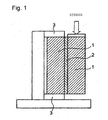
- Fig. 1 is a view illustrating a method of measuring the bonding strength of a ceramic bonded article obtained according to the invention.
- Ceramic molded body 2 Ceramic bonding layer 3: Holding member
- composition of the invention contains ceramic particles as an essential ingredient.
- the ceramic particles are not particularly limited as long as they have sufficient heat resistance at filter use temperatures. However, it is preferred that the ceramic particles be made of a material which is of the same kind as or similar in property to the ceramic molded bodies to be bonded, because use of such ceramic particles brings about high thermal-shock resistance. Examples thereof include oxides such as cordierite, aluminum titanate, aluminum silicate represented by mullite, and lithium aluminum silicate and non-oxide ceramics such as silicon carbide, silicon nitride, and boron nitride.
- the shape of the ceramic particles is not particularly limited. However, from the standpoint of maintaining the strength of the bonding layer, it is preferred to use nearly spherical solid particles.
- inorganic fibers such as alumina-silica glass fibers or flaky particles such as diatomaceous earth may be added as ceramic particles to the composition of the invention.
- the composition of the invention further contains an inorganic binder.
- This inorganic binder not only serves as an adhesive for bonding the ceramic particles to one another when the composition of the invention is applied to a bonding surface of a ceramic molded body and heated to form a ceramic bonding layer (hereinafter often referred to simply as "bonding layer"), but also can retain excellent adhesiveness during high-temperature use.
- Preferred examples of the inorganic binder include colloidal sols such as silica sol and alumina sol. Besides these, clay minerals such as sepiolite may be used.
- the composition of the invention When applied to a bonding surface of a ceramic molded body, the composition of the invention is used as a flowable composition.
- a liquid medium is used in the invention besides the ceramic particles and the inorganic binder.
- Preferred as the liquid medium is water or any of various organic solvents (in which neither the ceramic particles nor the hollow particles which will be described later dissolve).
- the hollow particles to be used preferably are organic hollow particles and/or inorganic hollow particles.
- organic hollow particles When organic hollow particles are used, pores can be uniformly dispersed in the bonding layer in a constant amount because the organic hollow particles decompose and uniformly scatter upon heating.
- inorganic hollow particles has advantages that the hollows as they are can be utilized as pores and that a component of the inorganic hollow particles gasifies upon heating to thereby uniformly form pores in the bonding layer in a constant amount.
- inorganic hollow particles function like a sintering agent for other ceramic particles to impart strength to the bonding layer. Because of these, when inorganic hollow particles are used, the effect of reducing the modulus of elasticity of the bonding layer while sufficiently maintaining the bonding strength of the layer is apt to be obtained.
- the parts corresponding to the shells may be either dense or porous.
- the hollows preferably are present in the form of closed cells, they may comprise both of open cells and closed cells.
- the outer shape of the hollow particles is not particularly limited. However, a spherical outer shape is preferred because such hollow particles are apt to be uniformly mixed with other particles during mixing and are easily available.
- the shape of the pores formed with spherical hollow particles in the bonding layer also is apt to be spherical and, hence, it is easy to inhibit strength from decreasing with increasing porosity.
- the average particle diameter of the hollow particles is preferably 5-300 ⁇ m. Average particle diameters thereof smaller than 5 ⁇ m are undesirable because the addition of such hollow particles is less apt to produce the effect of reducing the modulus of elasticity. On the other hand, average particle diameters thereof exceeding 300 ⁇ m are undesirable because there is a possibility that the strength of the bonding layer might be considerably low even when the amount of such hollow particles added is small. More preferably, the average particle diameter thereof is in the range of 10-150 ⁇ m.
- the specific gravity of the hollow particles is preferably 0.005-1.5.
- Use of hollow particles having a specific gravity lower than 0.005 is effective because a large reduction in modulus of elasticity can be attained by adding the hollow particles only in a slight amount.
- hollow particles having a specific gravity lower than 0.005 show poor handleability in preparing the composition of the invention and are hence not undesirable.
- the specific gravity thereof exceeds 1.5 the thickness of the shell part which forms the hollow particles becomes relatively thicker undesirably.
- the glass ingredient increases and this might excessively enhance the sintering agent-like function and also might weaken the effect of decreasing the modulus of elasticity because of the increased strength of the shell part.
- organic hollow particles when employed and added in a large amount, it is essential to conduct a step for removing a resinous ingredient after application of the composition of the invention. In this case, not only the steps are complicated but also there is a possibility that the presence of a large amount of the resinous ingredient might cause bonding layer shrinkage, etc.
- a more preferred range of the specific gravity thereof is 0.01-1.0.
- the proportion of the total volume of the hollow particles to the total volume of all solid ingredients which are the ceramic particles, the inorganic binder, and all solid ingredients optionally added is preferably 5-90%. Especially preferably, the proportion thereof to the total volume of the ceramic particles and the inorganic binder is regulated to 5-90%.
- volume of a hollow particle herein means the volume of both the shell and the whole part surrounded by the shell (i.e., the sum of the volume of the shell part and the volume of the hollow part). In case where the proportion of the total volume of the hollow particles is lower than the lower limit, it is difficult to sufficiently reduce the modulus of elasticity. In case where the proportion of the total volume of the hollow particles exceeds 90%, there is a possibility that the material strength and bonding strength of the bonding layer itself might decrease unavoidably.
- the proportion thereof is more preferably in the range of 10-85%.
- the proportion of the total mass of the hollow particles to the total mass of all solid ingredients in the composition of the invention is preferably 0.1-50% by mass. In case where the proportion of the total mass of the hollow particles is lower than the lower limit, it is difficult to sufficiently reduce the modulus of elasticity. In case where the proportion of the total mass of the hollow particles exceeds 50%, there is a possibility that the material strength and bonding strength of the bonding layer itself might decrease unavoidably.
- the proportion thereof is more preferably in the range of 0.2-30%.
- a dispersant and a thickener may be added to the composition of the invention in order to uniformly disperse solid ingredients including the ceramic particles, inorganic binder, and hollow particles in the liquid medium.
- the dispersant include homopolymers of monomers having a carboxy group, such as acrylic acid, methacrylic acid, and maleic acid, and homopolymers having the same structures as those polymers except that the carboxy group parts have been converted to a salt, e.g., ammonium salt.
- copolymers of a monomer having a carboxy group and a monomer having a carboxylic acid salt group and copolymers of a monomer having a carboxylic acid salt group and a carboxylic acid derivative, e.g., an alkyl ester.
- the thickener can be advantageously used either of an organic thickener (e.g., methyl cellulose, polyethylene glycol, poly(vinyl alcohol), or poly(vinyl acetate)) and an inorganic thickener (e.g., bentonite).
- the composition of the invention comprises 3-55% by volume of ceramic particles, 1-25% by volume of inorganic binder, and a liquid medium. Contents of the ceramic particles lower than 3% by volume are undesirable because there is a possibility that after application of the composition, the coating layer might abruptly shrinks and cracks in a heating step, resulting in a considerably reduced bonding strength. On the other hand, contents thereof exceeding 55% by volume are undesirable because there is a possibility that such too high ceramic-particle contents might impair the flowability of the composition for bonding. In case where the content of the inorganic binder is lower than 1% by volume, there is a possibility that the property of bonding the ceramic particles to one another cannot be sufficiently obtained.
- the content of the ceramic particles in the composition of the invention is more preferably 5-50% by volume.
- the content of the inorganic binder in the composition of the invention is more preferably 3-20% by volume.
- the content of the liquid medium in the composition of the invention is not particularly limited. However, the content thereof is preferably 20-96% by volume. By regulating the content of the liquid medium to 20% by volume or higher, the composition can be made to retain flowability and give a homogeneous bonding layer. On the other hand, by regulating the content thereof to 96% by volume or lower, the composition of the invention can be made to have a high concentration. As a result, it is easy to obtain a bonding layer having a desired thickness through one process comprising applying and heating the composition of the invention.
- the content of the liquid medium in the composition of the invention is more preferably 25-70% by volume.
- Step A A step in which the composition of the invention is applied to a bonding surface of a ceramic molded body to obtain a coating layer.
- Step B A step in which another ceramic molded body is superposed on that ceramic molded body so that the bonding surface thereof overlies the coating layer to thereby obtain an assemblage.
- Step C A step in which the assemblage is heated at 100-800°C.
- the heating temperature in step C is suitably regulated according to properties of the bonded object to be obtained.
- the hollow particles used are organic hollow particles, it is preferred to heat the assemblage at a temperature higher than the decomposition temperature of the organic polymer constituting the organic hollow particles.
- the material of the ceramic molded bodies preferably is one which comprises as main crystals any member selected from the group consisting of oxides such as cordierite, aluminum titanate, aluminum silicate represented by mullite, and lithium aluminum silicate and non-oxide ceramics such as silicon carbide and silicon nitride. It is preferred that the periphery of the bonded object thus obtained be processed, preferably, the peripheral wall thereof be coated with a paste of the same kind as the composition of the invention, before the bonded object is used as an exhaust gas purification filter.
- the porosity of the bonding layer obtained according to the invention (hereinafter referred to also as overall porosity) is preferably 30-90%. Porosities thereof lower than 30% are undesirable because there is a possibility that the modulus of elasticity cannot be sufficiently reduced. On the other hand, porosities thereof exceeding 90% are undesirable because such a bonding layer itself is brittle and there is a possibility that the filter might break at the bonding part during use due to, e.g., vibrations of the motor vehicle.
- the porosity of the bonding layer is more preferably 35-85%.
- the proportion by volume of the closed pores in the bonding layer to the total volume of all pores in the layer (hereinafter referred to as "closed-pore proportion") is 5% or higher, the modulus of elasticity can be effectively reduced and the strength can be inhibited from decreasing because the proportion of open pores, at which stresses are apt to concentrate when a stress is imposed on the bonding layer, is low. Closed-pore proportions of 5% and higher are hence preferred.
- the closed-pore proportion is lower than 5%, this bonding layer can be almost equal in modulus of elasticity-reducing effect to bonding layers having the same porosity and having closed-pore proportions not lower than 5%.
- the closed-pore proportion is preferably 10% or higher, more preferably 15% or higher.
- Tables 1 to 3 all of the units of the amounts of silicon nitride powder, silicon carbide powder, inorganic hollow particles, inorganic fibers, inorganic binder, organic hollow particles, and thickener and of the total volume of all solid ingredients are % by volume. Furthermore, the content of hollow particles in Tables 1 to 3 means each of the proportion of the total volume of the hollow particles to the total volume of all solid ingredients (% by volume) and the proportion of the total mass of the hollow particles to the total mass of all solid ingredients (% by mass).
- Silicon nitride powder silicon nitride powder having a specific gravity of 3.19 and an average particle diameter of 2 ⁇ m (trade name, SN-B; manufactured by Denki Kagaku Kogyo Kabushiki Kaisha).
- Silicon carbide powder silicon carbide powder having a specific gravity of 3.21 and an average particle diameter of 2.3 ⁇ m (trade name, 6S; manufactured by Taiheiyo Rundum Corp.).
- Inorganic hollow particles hollow spherical particles of silica-alumina glass which have a specific gravity of 0.6 and an average particle diameter of 45 ⁇ m (trade name, SL75; manufactured by Taiheiyo Cement Corp.).
- Inorganic fibers alumina-silica glass fibers having a specific gravity of 3.0, average fiber diameter of about 10 ⁇ m, and average fiber length of about 50 ⁇ m (trade name, HMS; manufactured by Saint-Gobain TM K.K.).
- Inorganic binder colloidal silica having a solid concentration of 40% by mass (trade name, Snowtex N-40; manufactured by Nissan Chemical Industries, Ltd.).
- Organic hollow particles hollow spherical particles of acrylonitrile resin which have a resin concentration of 14% by mass, specific gravity of 0.02, and average particle diameter of 40 ⁇ m (trade name, F-50E; manufactured by Matsumoto Yushi-Seiyaku Co., Ltd.).
- Thickener bentonite having a specific gravity of 2.5 (trade name, Kunipia F; manufactured by Kunimine Industries Co., Ltd.).
- compositions for ceramic bonding obtained above was applied to one side of a prismatic ceramic molded body (crystal phase, ⁇ -form Si 3 N 4 ; average pore diameter, 20 ⁇ m; porosity, 65%; cell thickness, 0.3 mm; cell pitch, 1.5 mm) having dimensions of 56 mm by 56 mm by 152.4 mm (length) and dried at 200°C to obtain a bonding layer having a thickness of 2 mm.
- Example 13 The bonding layer of Example 13, which had been formed without adding any hollow particles, was examined for apparent density ⁇ 0 (g/cm 3 ) and bulk density ⁇ 1 (g/cm 3 ) by the Archimedes method. Subsequently, a rectangular sample having a thickness of 1 mm, width of 10 mm, and length of 60 mm was cut out of each of the bonding layers formed from the compositions containing hollow particles (Examples 1 to 12). Each sample was examined for mass W (g), and the overall porosity P 0 (%) and the closed-pore proportion P 1 (%) were calculated using the following equations 1 and 2.
- Both ends of one of the ceramic molded bodies 1 constituting the bonded object A obtained were held with holding members 3. Thereafter, a load was vertically applied on the upper part of the other ceramic molded body 1 (not held with the holding members 3). The shearing stress was determined by dividing the resulting maximum load by the bonding area (56 mm x 152.4 mm). This was taken as the bonding strength between the bonding layer and each ceramic molded body.
- Example 1 Example 2
- Example 3 Example 4
- Ceramic particles Silicon nitride powder - - - - - Silicon carbide powder 30 25 12 9 19 Inorganic hollow particles - - - - 19 Inorganic fibers 29 23 12 9 38
- Inorganic binder 18 15 7 5
- Organic hollow particles 22 36 67 76 - Thickener 1 1 1 1 1 1
- Total volume of all solid ingredients 100 100 100 100 100 100 Content of hollow particles (% by volume) 22 36 67 76 19 (% by mass) 0.2 0.4 1.5 2.3 5.4
- Overall porosity 42 59 65 73 60 Closed-pore proportion 24 46 52 65 49 Bending strength 5.1 3.4 2.3 1.3 3.0 Young's modulus 5.8 3.0 1.7 0.4 2.5 Bonding strength 500 350 422 430 350
- Example 6 Example 7
- Example 8 Example 9
- Ceramic particles Silicon nitride powder - 32 20 10
- Silicon carbide powder 19 - - 10 - Inorganic hollow particles 10 - 60 60 33 Inorganic fibers 38 28 12 11 10 Inorganic binder 23 19 8 8 6
- Organic hollow particles 9 20 - - 40
- Thickener 1 1 - 1 1 Total volume of all solid ingredients 100 100 100 100 100 100 Content of hollow particles (% by volume) 19 20 60 60 73 (% by mass) 3.0 0.2 25.0 25.1 22.6 Overall porosity 58 40 65 60 70 Closed-pore proportion 48 21 48 50 60 Bending strength 3.0 8.0 2.5 3.0 1.5 Young's modulus 2.6 5.0 2.0 3.5 0.4 Bonding strength 330 650 400 400 350
- the invention can be advantageously applied to the bonding of ceramic molded bodies in obtaining a DPF.
Landscapes
- Chemical & Material Sciences (AREA)
- Engineering & Computer Science (AREA)
- Ceramic Engineering (AREA)
- Materials Engineering (AREA)
- Structural Engineering (AREA)
- Organic Chemistry (AREA)
- Manufacturing & Machinery (AREA)
- Chemical Kinetics & Catalysis (AREA)
- Inorganic Chemistry (AREA)
- Ceramic Products (AREA)
- Filtering Materials (AREA)
Applications Claiming Priority (1)
| Application Number | Priority Date | Filing Date | Title |
|---|---|---|---|
| JP2006000637 | 2006-01-05 |
Publications (2)
| Publication Number | Publication Date |
|---|---|
| EP1806329A2 true EP1806329A2 (fr) | 2007-07-11 |
| EP1806329A3 EP1806329A3 (fr) | 2008-09-03 |
Family
ID=38007322
Family Applications (1)
| Application Number | Title | Priority Date | Filing Date |
|---|---|---|---|
| EP20070000069 Withdrawn EP1806329A3 (fr) | 2006-01-05 | 2007-01-03 | Composition de liant céramique et article lié par céramique |
Country Status (2)
| Country | Link |
|---|---|
| US (1) | US20070160825A1 (fr) |
| EP (1) | EP1806329A3 (fr) |
Cited By (1)
| Publication number | Priority date | Publication date | Assignee | Title |
|---|---|---|---|---|
| EP2083001A1 (fr) | 2008-01-28 | 2009-07-29 | Ibiden Co., Ltd. | Corps structuré en nid d'abeille |
Families Citing this family (11)
| Publication number | Priority date | Publication date | Assignee | Title |
|---|---|---|---|---|
| JP2006289237A (ja) * | 2005-04-08 | 2006-10-26 | Ibiden Co Ltd | ハニカム構造体 |
| JP5469305B2 (ja) * | 2005-12-14 | 2014-04-16 | 日本碍子株式会社 | 接合材とその製造方法、及びそれを用いたハニカム構造体 |
| KR101081638B1 (ko) | 2006-03-30 | 2011-11-09 | 엔지케이 인슐레이터 엘티디 | 접합체, 허니컴 세그먼트 접합체, 및 그것을 이용한 허니컴 구조체 |
| EP1930061B1 (fr) * | 2006-12-07 | 2018-10-03 | NGK Insulators, Ltd. | Composition en matériau de liaison et son procédé de fabrication, et corps assemblé et son procédé de fabrication |
| EP1939261B1 (fr) * | 2006-12-25 | 2010-03-31 | Ngk Insulators, Ltd. | Corps assemblé et son procédé de fabrication |
| WO2009101691A1 (fr) * | 2008-02-14 | 2009-08-20 | Ibiden Co., Ltd. | Structure en nid d'abeilles |
| US20090274866A1 (en) * | 2008-04-30 | 2009-11-05 | Michelle Dawn Fabian | Ceramic article and method for making it |
| IL191258A0 (en) * | 2008-05-05 | 2009-05-04 | Gigi Simovich | Composite ballistic ceramic armor and method for making the same |
| MY166035A (en) * | 2011-04-25 | 2018-05-21 | Ngk Insulators Ltd | Method for cleaning ceramic filter |
| WO2013145243A1 (fr) * | 2012-03-29 | 2013-10-03 | イビデン株式会社 | Structure en nid d'abeilles, filtre en nid d'abeilles pour purification de gaz d'échappement et dispositif de purification de gaz d'échappement |
| JP5990572B2 (ja) * | 2012-03-29 | 2016-09-14 | イビデン株式会社 | ハニカム構造体、排ガス浄化用ハニカムフィルタ及び排ガス浄化装置 |
Family Cites Families (10)
| Publication number | Priority date | Publication date | Assignee | Title |
|---|---|---|---|---|
| US3904377A (en) * | 1970-03-06 | 1975-09-09 | Agency Ind Science Techn | Lightweight composite containing hollow glass microspheres |
| US3888691A (en) * | 1972-10-06 | 1975-06-10 | Lockheed Aircraft Corp | Porous ceramic |
| US4305758A (en) * | 1979-06-11 | 1981-12-15 | Standard Oil Company (Indiana) | Low density cement slurry and its use |
| US6025048A (en) * | 1995-06-29 | 2000-02-15 | The Regents Of The University Of California | Hybrid ceramic matrix composite laminates |
| JP3889194B2 (ja) * | 2000-01-13 | 2007-03-07 | 日本碍子株式会社 | ハニカム構造体 |
| GB0009731D0 (en) * | 2000-04-18 | 2000-06-07 | Dytech Corp Ltd | Mouldable E G extrudable ceramic compositions |
| JPWO2003067041A1 (ja) * | 2002-02-05 | 2005-06-02 | イビデン株式会社 | 排気ガス浄化用ハニカムフィルタ、接着剤、塗布材、及び、排気ガス浄化用ハニカムフィルタの製造方法 |
| EP1479882B2 (fr) * | 2002-02-05 | 2012-08-22 | Ibiden Co., Ltd. | Filtre a nids d'abeille pour la decontamination des gaz d'echappement |
| JPWO2005089901A1 (ja) * | 2004-03-23 | 2008-01-31 | 日本碍子株式会社 | ハニカム構造体及びその製造方法 |
| CN1906141B (zh) * | 2004-12-27 | 2010-11-03 | 揖斐电株式会社 | 蜂窝状结构体和密封材料层 |
-
2007
- 2007-01-03 EP EP20070000069 patent/EP1806329A3/fr not_active Withdrawn
- 2007-01-05 US US11/620,313 patent/US20070160825A1/en not_active Abandoned
Cited By (3)
| Publication number | Priority date | Publication date | Assignee | Title |
|---|---|---|---|---|
| EP2083001A1 (fr) | 2008-01-28 | 2009-07-29 | Ibiden Co., Ltd. | Corps structuré en nid d'abeille |
| US7993740B2 (en) | 2008-01-28 | 2011-08-09 | Ibiden Co., Ltd. | Honeycomb structure |
| EP2966052A1 (fr) * | 2008-01-28 | 2016-01-13 | Ibiden Co., Ltd. | Corps structuré en nid d'abeille |
Also Published As
| Publication number | Publication date |
|---|---|
| US20070160825A1 (en) | 2007-07-12 |
| EP1806329A3 (fr) | 2008-09-03 |
Similar Documents
| Publication | Publication Date | Title |
|---|---|---|
| EP1769838B1 (fr) | Filtre en nid d'abeilles | |
| EP1598102B1 (fr) | Structure ceramique en nids d'abeilles | |
| US7540898B2 (en) | Honeycomb structured body | |
| EP1703096B1 (fr) | Stucture en nid d abeille | |
| EP1736642A1 (fr) | Structure en nid d'abeille | |
| EP1437168B1 (fr) | Filtre en nid d'abeilles | |
| EP2006010B1 (fr) | Corps à structure de nid d'abeille et son procédé de fabrication | |
| EP1679109B1 (fr) | Filtre ceramique en nid d'abeilles et son procede de production, et materiau d'obturation pour filtre ceramique en nid d'abeilles | |
| EP1930061B1 (fr) | Composition en matériau de liaison et son procédé de fabrication, et corps assemblé et son procédé de fabrication | |
| EP2090351B1 (fr) | Corps à structure en nid d'abeilles, appareil de purification de gaz d'échappement et méthode de fabrication de corps à structure en nid d'abeilles | |
| US20060292336A1 (en) | Honeycomb structured body and method of manufacturing the same | |
| EP1752631A1 (fr) | Structure en nid d' abeille | |
| EP1780187A1 (fr) | Structure en nid d'abeille | |
| EP1738813A1 (fr) | Structure en nid d'abeille | |
| US20150013284A1 (en) | Honeycomb structured body, exhaust gas purifying honeycomb filter, and exhaust gas purifying device | |
| EP2767527A1 (fr) | Procédé de fabrication d'une structure en nid d'abeilles céramique et structure en nid d'abeilles céramique | |
| EP2123617B1 (fr) | Composition de matière de liaison, procédé de fabrication de la composition de matière de liaison, article assemblé et procédé de fabrication de l'article assemblé | |
| JPWO2003067042A1 (ja) | 排気ガス浄化用ハニカムフィルタ | |
| JP5469305B2 (ja) | 接合材とその製造方法、及びそれを用いたハニカム構造体 | |
| JPWO2005026074A1 (ja) | セラミック焼結体およびセラミックフィルタ | |
| EP1806329A2 (fr) | Composition de liant céramique et article lié par céramique | |
| EP1600433B1 (fr) | Structure en nid d'abeilles | |
| CN102665854B (zh) | 用于制备耐热冲击性陶瓷蜂窝状结构体的改良接合剂及其制备方法 | |
| JP4997064B2 (ja) | 接合材組成物及びその製造方法並びに接合体及びその製造方法 | |
| JP2007204360A (ja) | セラミックス接合用組成物およびセラミックス接合体 |
Legal Events
| Date | Code | Title | Description |
|---|---|---|---|
| PUAI | Public reference made under article 153(3) epc to a published international application that has entered the european phase |
Free format text: ORIGINAL CODE: 0009012 |
|
| AK | Designated contracting states |
Kind code of ref document: A2 Designated state(s): AT BE BG CH CY CZ DE DK EE ES FI FR GB GR HU IE IS IT LI LT LU LV MC NL PL PT RO SE SI SK TR |
|
| AX | Request for extension of the european patent |
Extension state: AL BA HR MK YU |
|
| PUAL | Search report despatched |
Free format text: ORIGINAL CODE: 0009013 |
|
| AK | Designated contracting states |
Kind code of ref document: A3 Designated state(s): AT BE BG CH CY CZ DE DK EE ES FI FR GB GR HU IE IS IT LI LT LU LV MC NL PL PT RO SE SI SK TR |
|
| AX | Request for extension of the european patent |
Extension state: AL BA HR MK RS |
|
| AKX | Designation fees paid | ||
| STAA | Information on the status of an ep patent application or granted ep patent |
Free format text: STATUS: THE APPLICATION IS DEEMED TO BE WITHDRAWN |
|
| 18D | Application deemed to be withdrawn |
Effective date: 20090304 |
|
| REG | Reference to a national code |
Ref country code: DE Ref legal event code: 8566 |