EP1807965B1 - Verfahren, server und computerlesbares medium zur verschleierung einer kryptographischen funktion - Google Patents
Verfahren, server und computerlesbares medium zur verschleierung einer kryptographischen funktion Download PDFInfo
- Publication number
- EP1807965B1 EP1807965B1 EP05795025.5A EP05795025A EP1807965B1 EP 1807965 B1 EP1807965 B1 EP 1807965B1 EP 05795025 A EP05795025 A EP 05795025A EP 1807965 B1 EP1807965 B1 EP 1807965B1
- Authority
- EP
- European Patent Office
- Prior art keywords
- tables
- composition
- obfuscated
- function
- server
- Prior art date
- Legal status (The legal status is an assumption and is not a legal conclusion. Google has not performed a legal analysis and makes no representation as to the accuracy of the status listed.)
- Expired - Lifetime
Links
Images

Classifications
-
- H—ELECTRICITY
- H04—ELECTRIC COMMUNICATION TECHNIQUE
- H04L—TRANSMISSION OF DIGITAL INFORMATION, e.g. TELEGRAPHIC COMMUNICATION
- H04L9/00—Cryptographic mechanisms or cryptographic arrangements for secret or secure communications; Network security protocols
- H04L9/06—Cryptographic mechanisms or cryptographic arrangements for secret or secure communications; Network security protocols the encryption apparatus using shift registers or memories for block-wise or stream coding, e.g. DES systems or RC4; Hash functions; Pseudorandom sequence generators
-
- H—ELECTRICITY
- H04—ELECTRIC COMMUNICATION TECHNIQUE
- H04L—TRANSMISSION OF DIGITAL INFORMATION, e.g. TELEGRAPHIC COMMUNICATION
- H04L9/00—Cryptographic mechanisms or cryptographic arrangements for secret or secure communications; Network security protocols
- H04L9/002—Countermeasures against attacks on cryptographic mechanisms
-
- G—PHYSICS
- G06—COMPUTING OR CALCULATING; COUNTING
- G06F—ELECTRIC DIGITAL DATA PROCESSING
- G06F17/00—Digital computing or data processing equipment or methods, specially adapted for specific functions
-
- H—ELECTRICITY
- H04—ELECTRIC COMMUNICATION TECHNIQUE
- H04L—TRANSMISSION OF DIGITAL INFORMATION, e.g. TELEGRAPHIC COMMUNICATION
- H04L9/00—Cryptographic mechanisms or cryptographic arrangements for secret or secure communications; Network security protocols
- H04L9/06—Cryptographic mechanisms or cryptographic arrangements for secret or secure communications; Network security protocols the encryption apparatus using shift registers or memories for block-wise or stream coding, e.g. DES systems or RC4; Hash functions; Pseudorandom sequence generators
- H04L9/0618—Block ciphers, i.e. encrypting groups of characters of a plain text message using fixed encryption transformation
-
- H—ELECTRICITY
- H04—ELECTRIC COMMUNICATION TECHNIQUE
- H04L—TRANSMISSION OF DIGITAL INFORMATION, e.g. TELEGRAPHIC COMMUNICATION
- H04L2209/00—Additional information or applications relating to cryptographic mechanisms or cryptographic arrangements for secret or secure communication H04L9/00
- H04L2209/12—Details relating to cryptographic hardware or logic circuitry
-
- H—ELECTRICITY
- H04—ELECTRIC COMMUNICATION TECHNIQUE
- H04L—TRANSMISSION OF DIGITAL INFORMATION, e.g. TELEGRAPHIC COMMUNICATION
- H04L2209/00—Additional information or applications relating to cryptographic mechanisms or cryptographic arrangements for secret or secure communication H04L9/00
- H04L2209/16—Obfuscation or hiding, e.g. involving white box
Definitions
- the invention relates to a method of obfuscating a cascaded cryptographic function.
- the invention also relates to a system for supplying a cascaded cryptographic function to an execution device in an obfuscated way.
- the invention further relates to an execution device for executing a cascaded cryptographic function provided in an obfuscated way.
- the Internet provides users with convenient and ubiquitous access to digital content. Because of the potential of the Internet as a powerful distribution channel, many CE products strive to directly access the Internet or to interoperate with the PC platform - the predominant portal to the Internet.
- the CE products include, but are not limited to, digital set top boxes, digital TVs, game consoles, PCs and, increasingly, hand-held devices such as PDAs, mobile phones, and mobile storage and rendering devices, such as Apple's iPod.
- the use of the Internet as a distribution medium for copyrighted content creates the compelling challenge to secure the interests of the content provider. In particular it is required to warrant the copyrights and business models of the content providers.
- CE platforms are operated using a processor loaded with suitable software.
- Such software may include the main part of functionality for rendering (playback) of digital content, such as audio and/or video.
- Control of the playback software is one way to enforce the interests of the content owner including the terms and conditions under which the content may be used.
- CE platforms with the exception of a PC and PDA
- more and more platforms at least partially are open.
- some users may be assumed to have complete control over the hardware and software that provides access to the content and a large amount of time and resources to attack and bypass any content protection mechanisms.
- content providers must deliver content to legitimate users across a hostile network to a community where not all users can be trusted.
- the general approach in digital rights management for protected content distributed to CE platforms is to encrypt the digital content (for instance using DES or AES) and to store the decryption key (or the "license") in a so-called License database (for a PC, the License database is typically stored on the PC's hard disk).
- License database for a PC, the License database is typically stored on the PC's hard disk.
- the largest vulnerability of digital rights management relying on encryption is the key distribution and handling. For playback, a software player has to retrieve a decryption key from the license database, it then has to store this decryption key somewhere in memory for the decryption of the encrypted content.
- digital rights management systems use an encryption technique based on block ciphers that process the data stream in blocks using a sequence of encryption/decryption steps, referred to as rounds.
- a round-specific function is performed.
- the round-specific function may be based on a same round function that is executed under control of a round-specific sub-key.
- the round function is specified using mapping tables for different parts of the domain of the function. Even if no explicit tables were used, nevertheless frequently tables are used for different parts of the domain of the function for efficient execution in software of encryption/decryption functions.
- the computer code accesses or combines table values into the range value of the function.
- US 6,658,569 relates to a secret-key cryptographic calculation process for protecting a computer system against physical attacks.
- WO 01/31422 discusses a method of processing of and storing data to reduce the risk of unauthorized access to the data, especially through side-channel observations.
- the cryptographic function F can be implemented as an Abelian composition of tables is used to compensate for the disturbance caused by the table O .
- a table C that is the inverse of table O under the Abelian operator is also included in the new composition of the tables, canceling out the effect of O .
- Preferably all of the original tables are obfuscated.
- the compensation table(s) may be included in one or more of the tables T ' i , 0 ⁇ i ⁇ n or in an additional table T ' n +1 .
- the tables O and C represent a same non-trivial constant b 1 ;
- the step of creating the obfuscated table T ' o 1 , 0 ⁇ o 1 ⁇ n includes using the Abelian group operator to combine the constant b 1 with each element of the corresponding table T o 1 ;
- the step of creating the compensating table T ' c 1 , 0 ⁇ c 1 ⁇ m, c 1 ⁇ o 1 includes using the Abelian group operator to combine the constant b i with each element of the corresponding table T c 1 .
- Using a constant is a simple way to hide the table T o 1 .
- the constant is combined with the table values and thus has the same range (for example, a typical range of 0 ⁇ 2 64-1 can be represented by 64-bits, giving a 64-bit constant).
- the constant can be seen as a key for obfuscating the table. By obfuscating several of the tables, preferably each using a respective constant, an even more secure system can be built.
- This additional table may represent one or more of the obfuscation tables. Using an additional table gives additional freedom, resulting in further possibilities for the obfuscation that can now be compensated for.
- each disturbed domain part could be included as a separate extended domain part.
- O is a homomorphism
- Digital content on the PC is typically rendered using media players, such as Microsoft's Media Player, Real's RealOne Player, Apple's QuickTime or iTunes player.
- Such players can load for a specific content format a respective plug-in for performing the format-specific decoding.
- Those content formats may include AVI, DV, Motion JPEG, MPEG-1, MPEG-2, MPEG-4 (AAC), WMV, Audio CD, MP3, WMA, WAV, AIFF/AIFC, AU, etc.
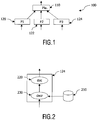
- the player and plug-in structure is illustrated in Fig. 1 , where a media player 100 includes a core player 110 and several format-specific plug-ins (shown are plug-ins 120, 122 and 124).
- the core player 110 may, for example, provide the user interface for controlling the player.
- Each plug-in includes a respective decoder. It may send the decoded content directly to rendering HW/SW, such as a sound-card, or pass it on to the core player 110 for further processing.
- rendering HW/SW such as a sound-card
- a secure plug-in is used that not only decodes the content in the specific format but also decrypts the content. This is illustrated in Fig.2 , where the encrypted content is first fed through a decryptor 230 and next the decrypted content is fed through the format-specific decoder 220.
- the decryptor 230 may receive a decryption key/license from a license database 210.
- the input and output for an encryption/decryption algorithm usually consists of a sequence of a predetermined number of N bits (digits with values of 0 or 1). These sequences will be referred to as blocks and the number of bits they contain will be referred to as their length. The bits within such sequences may be numbered starting at zero and ending at one less than the sequence length (block length or key length).
- the number i attached to a bit is known as its index and will be in the range 0 ⁇ i ⁇ N for an N -bit block.
- the basic unit for processing in an encryption/decryption algorithm is smaller than the block length.
- Commonly used unit lengths are 4-bit (a 4-bit unit is normally referred to as a nibble) or 8-bit (normally referred to as a byte). Those unit lengths can be processed more easily on conventional processors. If so desired also other unit lengths may be used.
- x i nibble i
- x x 2 4 i mod 2 4
- i byte i
- x x 2 8 i mod 2 8
- a round function F is typically constructed using tables ( T i [ x ]) for the different units of the input (i.e. different parts of the domain of the function).
- a role of such a table may be to perform a non-linear substitution; such tables are also referred to as S-boxes.
- the table may also represent pre-processing and/or post-processing with respect to such an S-box.
- the table maps n input bits to m output bits. Such a table is referred to as an n * m table.
- DES uses eight different 6*4 S-boxes.
- composition of the output of these often-small tables is done with an Abelian group operator ⁇ on the ranges of these functions. Any Abelian group operator may be chosen. A frequently used operator is the bit-wise XOR operator.
- the system according to the invention uses this Abelian composition to hide the actual values of the tables without changing the functional behavior of F .
- at least one of the tables is obfuscated. This table will be referred to as obfuscated table.
- the other tables may also be obfuscated or kept unmodified.
- a plurality of tables T ' i , 0 ⁇ i ⁇ n are created, where for each table T ' i represents the respective corresponding table T i in a modified or unmodified form. As described at least one of those created tables is an obfuscated version of a corresponding original table.
- This table is referred to as T ' o 1 , 0 ⁇ o 1 ⁇ n . According to the invention this obfuscated table is formed through a composition, using the Abelian group operator, of the corresponding table T o 1 and a table O .
- T ' o 1 O ⁇ T o 1 .
- More complex compositions e.g. using additional tables that are also composed using the Abelian operator
- T ' o 1 [ x ] O [ x ] ⁇ T o 1 [ x ] for x in the relevant domain to which it is applied.
- the short notation will be used in several places in the description and a skilled person will with above explanation understand the meaning.
- the table O may be chosen in any suitable way. Some preferred choices will be described below.
- the system and method according to the invention use the Abelian composition in such a way that an obfuscation of one or more of the tables is compensated for in the Abelian composition of the created tables T ' i . At least one of those tables T ' i thus compensates (in the Abelian composition) for the obfuscating caused by table O . In this way the Abelian composition of the tables T ' i thus still performs the function F , although some or all of the tables differ from the original tables T i .
- the table that compensates for O will be indicated as T ' c 1 , 0 ⁇ c 1 ⁇ m, c 1 ⁇ o 1 , and referred to as compensating table.
- This table is formed through a composition, using the Abelian group operator, that includes a table C .
- the compensating table may be one of the tables T ' i described above, or an additional table may be used.
- T ' i 0 ⁇ i ⁇ m ; n ⁇ m ⁇ n +1. It will be appreciated that preferably all original tables are changed.
- an obfuscated function F ' is formed that is functionally equivalent to the cryptographic function F by composing the plurality of tables T ' i , 0 ⁇ i ⁇ m, using the Abelian group operator, where the composition is such that the tables O and C compensate each other through the composition. It will be understood that instead of regarding table O as the table causing the obfuscating and C causing the compensation, these roles can equally well be seen as reverse.
- function F F : 0 ⁇ 2 64-1 ⁇ 0 ⁇ 2 64-1
- the function F may be a round function of a block cipher, such as a Feistel cipher.
- the tables O and C represent a same non-trivial constant b 0 .
- the obfuscated table T ' o 1 , 0 ⁇ o 1 ⁇ n is created by using the Abelian group operator to combine the constant b 1 with each element of the corresponding table T o 1 .
- the compensating table T ' c 1 , 0 ⁇ c 1 ⁇ m , c 1 ⁇ o 1 is created by using the Abelian group operator to combine the constant b 0 with each element of the corresponding table T c 1 . It can be observed that in this scenario, two identical tables are used.
- the constant is combined with the table values and thus has the same range (in the example, 0 ⁇ 2 64-1 ) and is represented by the same number of bits (in the example, 64 bits).
- the constant may be combined with 2, 4, 6, etc. number of tables. In the example, a total of 16 tables are used. So, it is possible to obfuscate all tables with just one constant.
- the constant in the example has 64 bits; this constant can be seen as a 64 bit key.
- the tables 0 ⁇ 1 means that an input value 0 is mapped to an output value 1, 1 ⁇ 2 that 1 is mapped to 2, etc.
- the tables O and C depend on the input x.
- T ' 0 [ x ] O [ x ] ⁇ T 0 [ x ]
- T ' 1 [ x ] C [ x ] ⁇ T 1 [ x ]
- security is improved further by using at least one more key (i.e. more constants may be used).
- two distinct tables are combined with the constant b 0 as shown above and two different tables are combined with the constant b 1 .
- more tables may be protected using the constant b 1 . For example, it is then also possible to combine half of the tables with b 0 and half of the tables b 1 .
- T ' o 2 O 2 ⁇ T o 2
- the existing compensating table T ' c 1 is used to also compensate for O 2 .
- T ' c 1 C 2 ⁇ C ⁇ T c 1 .
- T ' c 1 C 2 ⁇ C ⁇ T c 1 .
- all, but one, of the original tables T i are obfuscated with a respective constant and the one remaining table is obfuscated with the Abelian composition of all constants.
- all constants are used twice (i.e. an even number) and all tables are obfuscated.
- n constants For a system where F is an Abelian composition of n tables, one to n constants may be used. Each constant is combined with an even number of tables. It will be appreciated that in principle any number of constants may be used. However, by associating every table with its own constant, using more than n constants will not increase security any further.
- the constants are chosen 'randomly' using a suitable random or pseudo-random generator.
- the compensation C is combined with one or more of the original tables.
- the number m of created tables T' will be the same as the number n of original tables T.
- all constants are used twice (i.e. an even number) giving an automatic compensation through the Abelian composition.
- all sixteen original tables ( i 0...
- combining an original table T with a constant b means that every entry in the table T is combined with the same value b using the Abelian group operator ⁇ .
- the obfuscation depends at least partly on the input to the table.
- the compensation table needs access to the input.
- the domain is extended.
- the original tables T i (0 ⁇ i ⁇ n ; n ⁇ 1), each operate on a respective part D i of the domain D.
- the obfuscated table T ' o 1 is applied to the domain part D o 1 and O is a mapping table that is applied to D o 1 .
- C [ x ] ⁇ O [ x ] 0, ⁇ x ⁇ D o 1 .
- At least one table is obfuscated through a combination with a table O that at least partly depends on the same input; the combination being performed by the Abelian group operator.
- the compensation is achieved by using at least one additional table that covers the terms that need to be compensated with respect to the Abelian group operator.
- the domain of F " is extended compared to the domain of F to supply input for the additional table.
- the domain of the F " is now 0...2 (64+4)-1 .
- F " is functionally equivalent to F :
- H ( x ) the non-trivial homomorphism
- Any such homomorphism may be chosen.
- each of the tables T [ x i ] can be obfuscated by a respective H ( x i ). How many tables are obfuscated is a choice that can be made by the skilled person depending on the security requirements.
- extension is the last part of the extended domain, in fact the extension may be anywhere, i.e. the tables and the respective domain parts may be mixed.
- extension of the domain might be observed and used to attack the obfuscated tables. Any suitable technique may be used to hide details of the extension.
- the domain extension i.e. the part that has been extended
- F j ⁇ j j ⁇ 1...
- FC F N ⁇ ⁇ ⁇ F 1 ⁇ F 0
- FC F " N ⁇ E N ⁇ ⁇ F " 1 ⁇ E 1 ⁇ F 0
- FC F " N ⁇ E N ⁇ F " N ⁇ 1 ⁇ ⁇ ⁇ E 1 ⁇ F 0
- the E i ⁇ F " i -1 ⁇ i : 1... N -1 can be computed upfront, turning every T j,i [ x ] of F j in a mapping 0...15 ⁇ 0...2 (32+4)-1 (hiding the domain extension function by composition).
- approach 1 and 2 are combined.
- tables T" are combined with a respective constant.
- the table with the domain extension in the example T 16
- Fig.3 illustrates a system in which the invention may be employed.
- the system 300 includes a server 310 and at least one executing device 320.
- the server 310 provides a cryptographic function F to the execution device 320 in an obfuscated form.
- the function F cryptographically converts an input x from a predetermined domain D to an output y using a plurality of non-linear mapping tables T i (0 ⁇ i ⁇ n ; n ⁇ 1), each with key-like information and operating on a respective part D i of the domain D.
- the server may be implemented on a conventional computer platform, for example on a platform used as a server, such as a web server, or file server.
- the server includes a processor 312.
- the processor 312 is operated under control of a program.
- the program may be permanently embedded in the processor in an embedded storage, like embedded ROM, but may also be loaded from a background storage, such as a hard disk (not shown). Under control of the program, the processor 312:
- the server includes means 314 for providing the plurality of tables T ' i , 0 ⁇ i ⁇ m ; n ⁇ m ⁇ n + 1, to the executing device.
- the server may do this in any suitable form.
- the tables may be stored in a storage module of the executing device during the manufacturing of the executing device 320.
- Fig.3 shows that the tables are downloaded through the Internet 330 directly to the executing device 320.
- the executing device 320 includes means 324 for receiving the plurality of tables T ' i , 0 ⁇ i ⁇ m ; n ⁇ m ⁇ n +1, from the server 310. These means 326 cooperate with the means 314 of the server and will not be described further.
- the executing device 320 further includes a processor 322.
- the processor may be of any suitable type, such as a processor known from personal computers or an embedded microcontroller.
- the processor 322 is operated under control of a program.
- the program may be permanently embedded in the processor 322 using an embedded storage, like embedded ROM, but may also be loaded from a background storage, such as a hard disk (not shown).
- the processor 322 forms a function F' that is functionally equivalent to the cryptographic function F by composing the plurality of tables T ' i , 0 ⁇ i ⁇ m , using the Abelian group operator, such that the tables O and C are compensated through the composition.
- the executing device 320 includes means 324 for retrieving the tables, for example, through the Internet 330 or from a storage medium 350. Similarly, the executing device 320 may retrieve encrypted content 352 from the medium 350, and decrypt this using the processor 322. The processor may also decode the decrypted content.
- the server 310 may have stored the encrypted content 342 in the medium 350 possibly together with the tables 344.
- Fig.4 shows a preferred embodiment wherein the tables T ' are provided to the executing device 320 embedded in a software program 410 for execution by the processor 322.
- the software program 410 may be a plug-in for a program like a media player.
- the means 314 of Fig.4 may supply this plug-in 410 via the Internet (e.g. item 330 of Fig.4 ) or embed it directly into the executing device 320 during manufacturing.
- the invention also extends to computer programs, particularly computer programs on or in a carrier, adapted for putting the invention into practice.
- the program may be in the form of source code, object code, a code intermediate source and object code such as partially compiled form, or in any other form suitable for use in the implementation of the method according to the invention.
- the carrier be any entity or device capable of carrying the program.
- the carrier may include a storage medium, such as a ROM, for example a CD ROM or a semiconductor ROM, or a magnetic recording medium, for example a floppy disc or hard disk.
- the carrier may be a transmissible carrier such as an electrical or optical signal that may be conveyed via electrical or optical cable or by radio or other means.
- the carrier may be constituted by such cable or other device or means.
- the carrier may be an integrated circuit in which the program is embedded, the integrated circuit being adapted for performing, or for use in the performance of, the relevant method.
Landscapes
- Engineering & Computer Science (AREA)
- Computer Security & Cryptography (AREA)
- Computer Networks & Wireless Communication (AREA)
- Signal Processing (AREA)
- Physics & Mathematics (AREA)
- Theoretical Computer Science (AREA)
- Databases & Information Systems (AREA)
- Mathematical Physics (AREA)
- Software Systems (AREA)
- General Engineering & Computer Science (AREA)
- General Physics & Mathematics (AREA)
- Data Mining & Analysis (AREA)
- Storage Device Security (AREA)
- Computer And Data Communications (AREA)
- Data Exchanges In Wide-Area Networks (AREA)
Claims (15)
- Verfahren zur Verschleierung einer kryptographischen Funktion F, die kryptographisch eine Eingabe x aus einer vorbestimmten Domäne D in eine Ausgabe y, unter Verwendung einer Vielzahl von nichtlinearen Zuordnungstabellen Ti(0 ≤ i ≤ n; n ≥ 1), jeweils mit schlüsselartigen Informationen und auf einem entsprechenden Teil Di der Domäne D arbeitend, umwandelt, wobei die Funktion F die Ausgaben der Zuordnungstabellen unter Verwendung eines abelschen Gruppenoperators (⊗) zusammensetzt; wobei das Verfahren das Durchführen der folgenden Schritte auf einem Server (310) einschließt:Auswählen einer Tabelle O und einer Tabelle C;Erzeugen einer Vielzahl von Tabellen

 Bereitstellen der Vielzahl von Tabellen
 wobei die Tabellen O und C so gewählt sind, dass die Tabellen O und C durch die Zusammensetzung, die F' bildet, kompensiert werden.
 - Verfahren nach Anspruch 1, wobei:


- Verfahren nach Anspruch 1 oder 2, wobei die Tabellen O und C eine gleiche nicht-triviale Konstante b1 darstellen; der Schritt des Erzeugens der verschleierten Tabelle, T'o1 , 0 ≤ o1 ≤ n, die Verwendung des abelschen Gruppenoperators zum Kombinieren der Konstante b1 mit jedem Element der entsprechenden Tabelle To1 einschließt; und der Schritt des Erzeugens der Kompensationstabelle T'c1 , 0 ≤ c1 ≤ m, c1 ≠ o1 , die Verwendung des abelschen Gruppenoperators zum Kombinieren der Konstanten bi mit jedem Element der entsprechenden Tabelle Tc1 einschließt.
- Verfahren nach Anspruch 3, wobei m=n.
- Verfahren nach Anspruch 3, das die Durchführung, auf dem Server (310), der folgenden Schritte einschließt:Auswählen einer weiteren Tabelle O2 und einer weiteren Tabelle C2 , wobei sich O2 von O unterscheidet,wobei die Tabellen O2 und C2 eine gleiche nicht-triviale Konstante b2 darstellen; Bilden mindestens einer weiteren verschleierten Tabelle T'o2 , 0 ≤ o2 ≤ n, o1 ≠ o2 , durch eine Zusammensetzung unter Verwendung des abelschen Gruppenoperators der entsprechenden Tabelle To2 und der Tabelle O2 ; undBilden der Kompensationstabelle T'c1 durch eine Zusammensetzung, die auch die Tabelle C2 einschließt,wobei die weiteren Tabellen O2 und C2 so gewählt sind, dass die Tabellen O2 und C2 durch die Zusammensetzung, die F' bildet, kompensiert werden.
- Verfahren nach Anspruch 5, wobei:


- Verfahren nach Anspruch 1 oder 2, wobei m = n+1 und c1 = m.
- Verfahren nach Anspruch 7, wobei die verschleierte Tabelle T'o1 auf den Domänenteil Do1 angewandt wird; O eine Zuordnungstabelle ist, die auf Do1 , C[x]⊗O[x] = 0, ∀x ∈ Do1 angewandt wird; wobei das Verfahren das Ausweiten der Domäne D' = (D'o, ..., D'n, D' n+ 1) der Funktion F' einschließt, wobei Di = D'i für i ≤ n und D' n+1 eine Darstellung von Do1 einschließt, derart dass die Zusammensetzung, die die Kompensationstabelle T'c1 bildet, C[x], x ∈ Do1 einschließt.
- Verfahren nach Anspruch 8, wobei O ein Homomorphismus ist und das Verfahren das Durchführen des folgenden Schrittes auf dem Server (310) einschließt: Bilden einer Vielzahl von verschleierten Tabellen T'oj durch eine Zusammensetzung unter Verwendung der entsprechenden Tabelle T oj und der Tabelle O unter Verwendung des abelschen Gruppenoperators und Bilden der Domänenerweiterung D'n+1 durch eine Zusammensetzung unter Verwendung des abelschen Operators der entsprechenden Subdomänen der Tabellen Ti .
- Verfahren nach Anspruch 9, wobei:


- Server (320), der angeordnet ist, um eine kryptographische Funktion F zu verschleiern, die kryptographisch eine Eingabe x aus einer vorbestimmten Domäne D in eine Ausgabe y unter Verwendung einer Vielzahl von nichtlinearen Zuordnungstabellen Ti (0 ≤ i ≤ n; n ≥ 1), die jeweils schlüsselartige Informationen enthalten und auf einem entsprechenden Teil Di , der Domäne D arbeiten, überführt, wobei die Funktion F die Ausgaben der Zuordnungstabellen unter Verwendung eines abelschen Gruppenoperators ⊗ zusammensetzt; wobei der Server (320) einen Prozessor (312) und ein Bereitstellungsmittel (314) umfasst,
wobei der Prozessor (312) angeordnet ist, um eine Tabelle O und eine Tabelle C zu wählen und die Vielzahl von Tabellen T'i , 0 ≤ i ≤ m; n ≤ m ≤ n+1 zu erzeugen, wobei für 0 ≤ i ≤ n jede Tabelle T'i die jeweils entsprechende Tabelle Ti darstellt, und mindestens eine dieser Tabellen T'o1 , 0 ≤ o1 ≤ n, hierin im Folgenden als verschleierte Tabelle bezeichnet, aus einer Zusammensetzung unter Verwendung des abelschen Gruppenoperators, der entsprechenden Tabelle To1 und der Tabelle O gebildet wird,
und mindestens eine der anderen Tabellen T'c1 , 0 ≤ c1 ≤m, c1 ≠ o1 , hierin im Folgenden als Kompensationstabelle bezeichnet, aus einer Zusammensetzung, unter Verwendung des abelschen Gruppenoperators, die die Tabelle C einschließt, gebildet wird; und
wobei die Bereitstellungsmittel (314) angeordnet sind, um die Vielzahl von Tabellen T'i , 0 ≤ i ≤ m, einer Ausführungsvorrichtung (320) bereitzustellen, so dass die Ausführungsvorrichtung (320) eine Funktion F' bilden kann, die der kryptographischen Funktion F funktionell gleichwertig ist, indem sie die Vielzahl von Tabellen T'i, 0 ≤ i ≤ m unter Verwendung des abelschen Gruppenoperators zusammensetzt,
wobei die Tabellen O und C unter Verwendung des Prozessors (312) gewählt werden, derart dass die Tabellen O und C durch die Zusammensetzung, die F' bildet, kompensiert werden. - Server (310) nach Anspruch 11, wobei:


- System (300), umfassend einen Server (310) nach Anspruch 11 oder 12 und eine Ausführungsvorrichtung (320), wobei die Ausführungsvorrichtung (320) Folgendes umfasst:ein Tabellenaufnahmemittel (324), das angeordnet ist, um eine Vielzahl von Tabellen T'i, 0 ≤ i ≤ m; n ≤ m ≤ n+1, aus dem Server (310) aufzunehmen; undeinen Prozessor (322), der angeordnet ist, um eine Funktion F' durch Zusammensetzen der Vielzahl von Tabellen T'i , 0 ≤ i ≤ m, unter Verwendung des abelschen Gruppenoperators bilden.
- System (300) nach Anspruch 12 oder 13, wobei der Server (310) angeordnet ist, um ein Programm für die Ausführungsvorrichtung (320) zu bilden, wobei das Programm für die Ausführungsvorrichtung die Vielzahl von Tabellen T'i, 0 ≤ i ≤ m; n ≤ m ≤ n+1 einschließt, und Anweisungen einschließt, um den Prozessor der Ausführungsvorrichtung zu veranlassen, die verschleierte Funktion F' zu bilden.
- Computerlesbares Medium mit einem darauf gespeicherten Computerprogramm, das Anweisungen umfasst, die, wenn sie von einem Prozessor ausgeführt werden, so angeordnet sind, dass der Prozessor die Schritte eines Verfahrens nach einem der Ansprüche 1-10 ausführt.
Priority Applications (1)
| Application Number | Priority Date | Filing Date | Title |
|---|---|---|---|
| EP05795025.5A EP1807965B1 (de) | 2004-10-28 | 2005-10-24 | Verfahren, server und computerlesbares medium zur verschleierung einer kryptographischen funktion |
Applications Claiming Priority (3)
| Application Number | Priority Date | Filing Date | Title |
|---|---|---|---|
| EP04105373 | 2004-10-28 | ||
| EP05795025.5A EP1807965B1 (de) | 2004-10-28 | 2005-10-24 | Verfahren, server und computerlesbares medium zur verschleierung einer kryptographischen funktion |
| PCT/IB2005/053468 WO2006046187A1 (en) | 2004-10-28 | 2005-10-24 | Method and system for obfuscating a cryptographic function |
Publications (2)
| Publication Number | Publication Date |
|---|---|
| EP1807965A1 EP1807965A1 (de) | 2007-07-18 |
| EP1807965B1 true EP1807965B1 (de) | 2019-01-30 |
Family
ID=35517605
Family Applications (1)
| Application Number | Title | Priority Date | Filing Date |
|---|---|---|---|
| EP05795025.5A Expired - Lifetime EP1807965B1 (de) | 2004-10-28 | 2005-10-24 | Verfahren, server und computerlesbares medium zur verschleierung einer kryptographischen funktion |
Country Status (6)
| Country | Link |
|---|---|
| US (1) | US7881466B2 (de) |
| EP (1) | EP1807965B1 (de) |
| JP (1) | JP5026275B2 (de) |
| KR (1) | KR101226167B1 (de) |
| CN (1) | CN101048969B (de) |
| WO (1) | WO2006046187A1 (de) |
Families Citing this family (18)
| Publication number | Priority date | Publication date | Assignee | Title |
|---|---|---|---|---|
| US20110064214A1 (en) * | 2003-09-09 | 2011-03-17 | Ternarylogic Llc | Methods and Apparatus in Alternate Finite Field Based Coders and Decoders |
| US8577026B2 (en) | 2010-12-29 | 2013-11-05 | Ternarylogic Llc | Methods and apparatus in alternate finite field based coders and decoders |
| US7772999B2 (en) * | 2007-12-10 | 2010-08-10 | Peter Lablans | N-state ripple adder scheme coding with corresponding n-state ripple adder scheme decoding |
| JP5249053B2 (ja) * | 2006-03-10 | 2013-07-31 | イルデト・コーポレート・ビー・ヴイ | データ処理システムの完全性 |
| WO2008010119A2 (en) | 2006-07-12 | 2008-01-24 | Koninklijke Philips Electronics N.V. | Tamper resistance of a digital data processing unit |
| JP5113169B2 (ja) * | 2006-07-12 | 2013-01-09 | イルデト・コーポレート・ビー・ヴイ | 暗号関数を難読化する方法およびシステム |
| JP4882598B2 (ja) * | 2006-07-28 | 2012-02-22 | ソニー株式会社 | 暗号処理装置、暗号処理アルゴリズム構築方法、および暗号処理方法、並びにコンピュータ・プログラム |
| JP5023624B2 (ja) * | 2006-09-01 | 2012-09-12 | ソニー株式会社 | 暗号処理装置、および暗号処理方法、並びにコンピュータ・プログラム |
| CN101321059B (zh) * | 2007-06-07 | 2011-02-16 | 管海明 | 一种用于编码和译码数字消息的方法和系统 |
| CN101321060B (zh) * | 2007-06-07 | 2011-06-08 | 管海明 | 一种用于编码和译码数字消息的方法和系统 |
| FR2924879B1 (fr) | 2007-12-07 | 2009-12-18 | Sagem Securite | Procede de codage d'un secret forme par une valeur numerique |
| US10339570B2 (en) | 2010-04-21 | 2019-07-02 | Fox Entertainment Group, Inc. | Customized billboard website advertisements |
| US8584256B2 (en) * | 2010-04-21 | 2013-11-12 | Fox Entertainment Group, Inc. | Digital delivery system and user interface for enabling the digital delivery of media content |
| JP5682527B2 (ja) * | 2011-03-28 | 2015-03-11 | ソニー株式会社 | 暗号処理装置、および暗号処理方法、並びにプログラム |
| US10148285B1 (en) | 2012-07-25 | 2018-12-04 | Erich Schmitt | Abstraction and de-abstraction of a digital data stream |
| WO2015091583A1 (en) * | 2013-12-20 | 2015-06-25 | Koninklijke Philips N.V. | Operator lifting in cryptographic algorithm |
| US10795858B1 (en) | 2014-02-18 | 2020-10-06 | Erich Schmitt | Universal abstraction and de-abstraction of a digital data stream |
| CN110995433A (zh) * | 2019-10-28 | 2020-04-10 | 北京三快在线科技有限公司 | 数据加密方法、装置、电子设备及计算机可读存储介质 |
Family Cites Families (7)
| Publication number | Priority date | Publication date | Assignee | Title |
|---|---|---|---|---|
| US6668325B1 (en) * | 1997-06-09 | 2003-12-23 | Intertrust Technologies | Obfuscation techniques for enhancing software security |
| IL139935A (en) * | 1998-06-03 | 2005-06-19 | Cryptography Res Inc | Des and other cryptographic processes with leak minimization for smartcards and other cryptosystems |
| FR2789535B1 (fr) | 1999-02-04 | 2001-09-28 | Bull Cp8 | Procede de securisation d'un ensemble electronique de cryptographie a cle secrete contre les attaques par analyse physique |
| CA2388971A1 (en) * | 1999-10-25 | 2001-05-03 | Cypherix (Pty) Limited | Method for making data processing resistant to extraction of data by analysis of unintended side-channel signals |
| CA2327911A1 (en) * | 2000-12-08 | 2002-06-08 | Cloakware Corporation | Obscuring functions in computer software |
| FR2820576B1 (fr) * | 2001-02-08 | 2003-06-20 | St Microelectronics Sa | Procede de cryptage protege contre les analyses de consommation energetique, et composant utilisant un tel procede de cryptage |
| GB0211812D0 (en) * | 2002-05-23 | 2002-07-03 | Koninkl Philips Electronics Nv | S-box encryption in block cipher implementations |
-
2005
- 2005-10-24 EP EP05795025.5A patent/EP1807965B1/de not_active Expired - Lifetime
- 2005-10-24 WO PCT/IB2005/053468 patent/WO2006046187A1/en not_active Ceased
- 2005-10-24 US US11/577,829 patent/US7881466B2/en active Active
- 2005-10-24 CN CN2005800373576A patent/CN101048969B/zh not_active Expired - Fee Related
- 2005-10-24 JP JP2007538564A patent/JP5026275B2/ja not_active Expired - Fee Related
- 2005-10-24 KR KR1020077012027A patent/KR101226167B1/ko not_active Expired - Fee Related
Non-Patent Citations (1)
| Title |
|---|
| None * |
Also Published As
| Publication number | Publication date |
|---|---|
| KR101226167B1 (ko) | 2013-01-24 |
| US20090122978A1 (en) | 2009-05-14 |
| US7881466B2 (en) | 2011-02-01 |
| CN101048969B (zh) | 2012-04-04 |
| JP2008518262A (ja) | 2008-05-29 |
| KR20070070252A (ko) | 2007-07-03 |
| CN101048969A (zh) | 2007-10-03 |
| JP5026275B2 (ja) | 2012-09-12 |
| EP1807965A1 (de) | 2007-07-18 |
| WO2006046187A1 (en) | 2006-05-04 |
Similar Documents
| Publication | Publication Date | Title |
|---|---|---|
| EP1997265B1 (de) | Integrität eines datenverarbeitungssystems unter verwendung von white-box für den schutz digitaler inhalte | |
| EP1807965B1 (de) | Verfahren, server und computerlesbares medium zur verschleierung einer kryptographischen funktion | |
| JP5113169B2 (ja) | 暗号関数を難読化する方法およびシステム | |
| EP2044724B1 (de) | Manipulationsschutz für eine digitale datenverarbeitungseinheit | |
| EP3174238B1 (de) | Schutz einer white-box-feistelnetz-implementierung gegen fehlerangriff | |
| US10097342B2 (en) | Encoding values by pseudo-random mask | |
| US20100303231A1 (en) | Updating cryptographic key data | |
| US9602273B2 (en) | Implementing key scheduling for white-box DES implementation | |
| US20060023875A1 (en) | Enhanced stream cipher combining function | |
| US9654279B2 (en) | Security module for secure function execution on untrusted platform | |
| EP1712032B1 (de) | Blockchiffriersystem unter verwendung von permutationen zum verbergen der kernchiffrierfunktion jeder verschlüsselungsrunde | |
| CN107273724B (zh) | 为白盒实施方案的输入和输出加水印 | |
| US9025765B2 (en) | Data security | |
| US9639674B2 (en) | Using single white-box implementation with multiple external encodings | |
| WO2007031894A2 (en) | Improved cryptographic method and system |
Legal Events
| Date | Code | Title | Description |
|---|---|---|---|
| PUAI | Public reference made under article 153(3) epc to a published international application that has entered the european phase |
Free format text: ORIGINAL CODE: 0009012 |
|
| 17P | Request for examination filed |
Effective date: 20070529 |
|
| AK | Designated contracting states |
Kind code of ref document: A1 Designated state(s): AT BE BG CH CY CZ DE DK EE ES FI FR GB GR HU IE IS IT LI LT LU LV MC NL PL PT RO SE SI SK TR |
|
| DAX | Request for extension of the european patent (deleted) | ||
| RAP1 | Party data changed (applicant data changed or rights of an application transferred) |
Owner name: IRDETO B.V. |
|
| RAP1 | Party data changed (applicant data changed or rights of an application transferred) |
Owner name: IRDETO CORPORATE B.V. |
|
| RAP1 | Party data changed (applicant data changed or rights of an application transferred) |
Owner name: IRDETO B.V. |
|
| 17Q | First examination report despatched |
Effective date: 20160503 |
|
| RIC1 | Information provided on ipc code assigned before grant |
Ipc: H04L 9/06 20060101AFI20180615BHEP Ipc: H04L 9/00 20060101ALI20180615BHEP |
|
| GRAP | Despatch of communication of intention to grant a patent |
Free format text: ORIGINAL CODE: EPIDOSNIGR1 |
|
| STAA | Information on the status of an ep patent application or granted ep patent |
Free format text: STATUS: GRANT OF PATENT IS INTENDED |
|
| INTG | Intention to grant announced |
Effective date: 20180807 |
|
| GRAS | Grant fee paid |
Free format text: ORIGINAL CODE: EPIDOSNIGR3 |
|
| GRAA | (expected) grant |
Free format text: ORIGINAL CODE: 0009210 |
|
| STAA | Information on the status of an ep patent application or granted ep patent |
Free format text: STATUS: THE PATENT HAS BEEN GRANTED |
|
| AK | Designated contracting states |
Kind code of ref document: B1 Designated state(s): AT BE BG CH CY CZ DE DK EE ES FI FR GB GR HU IE IS IT LI LT LU LV MC NL PL PT RO SE SI SK TR |
|
| REG | Reference to a national code |
Ref country code: GB Ref legal event code: FG4D |
|
| REG | Reference to a national code |
Ref country code: CH Ref legal event code: EP |
|
| REG | Reference to a national code |
Ref country code: AT Ref legal event code: REF Ref document number: 1094093 Country of ref document: AT Kind code of ref document: T Effective date: 20190215 |
|
| REG | Reference to a national code |
Ref country code: IE Ref legal event code: FG4D |
|
| REG | Reference to a national code |
Ref country code: DE Ref legal event code: R096 Ref document number: 602005055348 Country of ref document: DE |
|
| REG | Reference to a national code |
Ref country code: NL Ref legal event code: FP |
|
| REG | Reference to a national code |
Ref country code: LT Ref legal event code: MG4D |
|
| PG25 | Lapsed in a contracting state [announced via postgrant information from national office to epo] |
Ref country code: SE Free format text: LAPSE BECAUSE OF FAILURE TO SUBMIT A TRANSLATION OF THE DESCRIPTION OR TO PAY THE FEE WITHIN THE PRESCRIBED TIME-LIMIT Effective date: 20190130 Ref country code: PT Free format text: LAPSE BECAUSE OF FAILURE TO SUBMIT A TRANSLATION OF THE DESCRIPTION OR TO PAY THE FEE WITHIN THE PRESCRIBED TIME-LIMIT Effective date: 20190530 Ref country code: FI Free format text: LAPSE BECAUSE OF FAILURE TO SUBMIT A TRANSLATION OF THE DESCRIPTION OR TO PAY THE FEE WITHIN THE PRESCRIBED TIME-LIMIT Effective date: 20190130 Ref country code: PL Free format text: LAPSE BECAUSE OF FAILURE TO SUBMIT A TRANSLATION OF THE DESCRIPTION OR TO PAY THE FEE WITHIN THE PRESCRIBED TIME-LIMIT Effective date: 20190130 Ref country code: LT Free format text: LAPSE BECAUSE OF FAILURE TO SUBMIT A TRANSLATION OF THE DESCRIPTION OR TO PAY THE FEE WITHIN THE PRESCRIBED TIME-LIMIT Effective date: 20190130 Ref country code: ES Free format text: LAPSE BECAUSE OF FAILURE TO SUBMIT A TRANSLATION OF THE DESCRIPTION OR TO PAY THE FEE WITHIN THE PRESCRIBED TIME-LIMIT Effective date: 20190130 |
|
| REG | Reference to a national code |
Ref country code: AT Ref legal event code: MK05 Ref document number: 1094093 Country of ref document: AT Kind code of ref document: T Effective date: 20190130 |
|
| PG25 | Lapsed in a contracting state [announced via postgrant information from national office to epo] |
Ref country code: IS Free format text: LAPSE BECAUSE OF FAILURE TO SUBMIT A TRANSLATION OF THE DESCRIPTION OR TO PAY THE FEE WITHIN THE PRESCRIBED TIME-LIMIT Effective date: 20190530 Ref country code: GR Free format text: LAPSE BECAUSE OF FAILURE TO SUBMIT A TRANSLATION OF THE DESCRIPTION OR TO PAY THE FEE WITHIN THE PRESCRIBED TIME-LIMIT Effective date: 20190501 Ref country code: LV Free format text: LAPSE BECAUSE OF FAILURE TO SUBMIT A TRANSLATION OF THE DESCRIPTION OR TO PAY THE FEE WITHIN THE PRESCRIBED TIME-LIMIT Effective date: 20190130 Ref country code: BG Free format text: LAPSE BECAUSE OF FAILURE TO SUBMIT A TRANSLATION OF THE DESCRIPTION OR TO PAY THE FEE WITHIN THE PRESCRIBED TIME-LIMIT Effective date: 20190430 |
|
| PG25 | Lapsed in a contracting state [announced via postgrant information from national office to epo] |
Ref country code: CZ Free format text: LAPSE BECAUSE OF FAILURE TO SUBMIT A TRANSLATION OF THE DESCRIPTION OR TO PAY THE FEE WITHIN THE PRESCRIBED TIME-LIMIT Effective date: 20190130 Ref country code: RO Free format text: LAPSE BECAUSE OF FAILURE TO SUBMIT A TRANSLATION OF THE DESCRIPTION OR TO PAY THE FEE WITHIN THE PRESCRIBED TIME-LIMIT Effective date: 20190130 Ref country code: IT Free format text: LAPSE BECAUSE OF FAILURE TO SUBMIT A TRANSLATION OF THE DESCRIPTION OR TO PAY THE FEE WITHIN THE PRESCRIBED TIME-LIMIT Effective date: 20190130 Ref country code: EE Free format text: LAPSE BECAUSE OF FAILURE TO SUBMIT A TRANSLATION OF THE DESCRIPTION OR TO PAY THE FEE WITHIN THE PRESCRIBED TIME-LIMIT Effective date: 20190130 Ref country code: DK Free format text: LAPSE BECAUSE OF FAILURE TO SUBMIT A TRANSLATION OF THE DESCRIPTION OR TO PAY THE FEE WITHIN THE PRESCRIBED TIME-LIMIT Effective date: 20190130 Ref country code: SK Free format text: LAPSE BECAUSE OF FAILURE TO SUBMIT A TRANSLATION OF THE DESCRIPTION OR TO PAY THE FEE WITHIN THE PRESCRIBED TIME-LIMIT Effective date: 20190130 |
|
| REG | Reference to a national code |
Ref country code: DE Ref legal event code: R097 Ref document number: 602005055348 Country of ref document: DE |
|
| PLBE | No opposition filed within time limit |
Free format text: ORIGINAL CODE: 0009261 |
|
| STAA | Information on the status of an ep patent application or granted ep patent |
Free format text: STATUS: NO OPPOSITION FILED WITHIN TIME LIMIT |
|
| PG25 | Lapsed in a contracting state [announced via postgrant information from national office to epo] |
Ref country code: AT Free format text: LAPSE BECAUSE OF FAILURE TO SUBMIT A TRANSLATION OF THE DESCRIPTION OR TO PAY THE FEE WITHIN THE PRESCRIBED TIME-LIMIT Effective date: 20190130 |
|
| 26N | No opposition filed |
Effective date: 20191031 |
|
| PG25 | Lapsed in a contracting state [announced via postgrant information from national office to epo] |
Ref country code: SI Free format text: LAPSE BECAUSE OF FAILURE TO SUBMIT A TRANSLATION OF THE DESCRIPTION OR TO PAY THE FEE WITHIN THE PRESCRIBED TIME-LIMIT Effective date: 20190130 |
|
| PG25 | Lapsed in a contracting state [announced via postgrant information from national office to epo] |
Ref country code: TR Free format text: LAPSE BECAUSE OF FAILURE TO SUBMIT A TRANSLATION OF THE DESCRIPTION OR TO PAY THE FEE WITHIN THE PRESCRIBED TIME-LIMIT Effective date: 20190130 |
|
| PG25 | Lapsed in a contracting state [announced via postgrant information from national office to epo] |
Ref country code: MC Free format text: LAPSE BECAUSE OF FAILURE TO SUBMIT A TRANSLATION OF THE DESCRIPTION OR TO PAY THE FEE WITHIN THE PRESCRIBED TIME-LIMIT Effective date: 20190130 |
|
| REG | Reference to a national code |
Ref country code: CH Ref legal event code: PL |
|
| PG25 | Lapsed in a contracting state [announced via postgrant information from national office to epo] |
Ref country code: LU Free format text: LAPSE BECAUSE OF NON-PAYMENT OF DUE FEES Effective date: 20191024 Ref country code: LI Free format text: LAPSE BECAUSE OF NON-PAYMENT OF DUE FEES Effective date: 20191031 Ref country code: CH Free format text: LAPSE BECAUSE OF NON-PAYMENT OF DUE FEES Effective date: 20191031 |
|
| REG | Reference to a national code |
Ref country code: BE Ref legal event code: MM Effective date: 20191031 |
|
| PG25 | Lapsed in a contracting state [announced via postgrant information from national office to epo] |
Ref country code: BE Free format text: LAPSE BECAUSE OF NON-PAYMENT OF DUE FEES Effective date: 20191031 |
|
| GBPC | Gb: european patent ceased through non-payment of renewal fee |
Effective date: 20191024 |
|
| PG25 | Lapsed in a contracting state [announced via postgrant information from national office to epo] |
Ref country code: IE Free format text: LAPSE BECAUSE OF NON-PAYMENT OF DUE FEES Effective date: 20191024 Ref country code: FR Free format text: LAPSE BECAUSE OF NON-PAYMENT OF DUE FEES Effective date: 20191031 Ref country code: GB Free format text: LAPSE BECAUSE OF NON-PAYMENT OF DUE FEES Effective date: 20191024 |
|
| PG25 | Lapsed in a contracting state [announced via postgrant information from national office to epo] |
Ref country code: CY Free format text: LAPSE BECAUSE OF FAILURE TO SUBMIT A TRANSLATION OF THE DESCRIPTION OR TO PAY THE FEE WITHIN THE PRESCRIBED TIME-LIMIT Effective date: 20190130 |
|
| PG25 | Lapsed in a contracting state [announced via postgrant information from national office to epo] |
Ref country code: HU Free format text: LAPSE BECAUSE OF FAILURE TO SUBMIT A TRANSLATION OF THE DESCRIPTION OR TO PAY THE FEE WITHIN THE PRESCRIBED TIME-LIMIT; INVALID AB INITIO Effective date: 20051024 |
|
| PGFP | Annual fee paid to national office [announced via postgrant information from national office to epo] |
Ref country code: NL Payment date: 20241016 Year of fee payment: 20 |
|
| PGFP | Annual fee paid to national office [announced via postgrant information from national office to epo] |
Ref country code: DE Payment date: 20241018 Year of fee payment: 20 |
|
| REG | Reference to a national code |
Ref country code: DE Ref legal event code: R071 Ref document number: 602005055348 Country of ref document: DE |
|
| REG | Reference to a national code |
Ref country code: NL Ref legal event code: MK Effective date: 20251023 |