EP1808832A1 - Distributeur automatique de marchandises doté d'une unité de calcul en vue du calcul du prix - Google Patents
Distributeur automatique de marchandises doté d'une unité de calcul en vue du calcul du prix Download PDFInfo
- Publication number
- EP1808832A1 EP1808832A1 EP06020346A EP06020346A EP1808832A1 EP 1808832 A1 EP1808832 A1 EP 1808832A1 EP 06020346 A EP06020346 A EP 06020346A EP 06020346 A EP06020346 A EP 06020346A EP 1808832 A1 EP1808832 A1 EP 1808832A1
- Authority
- EP
- European Patent Office
- Prior art keywords
- goods
- dispenser
- time
- unit
- purchase price
- Prior art date
- Legal status (The legal status is an assumption and is not a legal conclusion. Google has not performed a legal analysis and makes no representation as to the accuracy of the status listed.)
- Withdrawn
Links
- 238000000034 method Methods 0.000 claims abstract description 20
- 230000006870 function Effects 0.000 claims description 8
- 238000001816 cooling Methods 0.000 claims description 6
- 235000013305 food Nutrition 0.000 claims description 5
- 238000011156 evaluation Methods 0.000 abstract 2
- 230000008569 process Effects 0.000 description 10
- 241000220225 Malus Species 0.000 description 8
- 235000013365 dairy product Nutrition 0.000 description 5
- 235000013399 edible fruits Nutrition 0.000 description 5
- 230000006399 behavior Effects 0.000 description 4
- 230000032258 transport Effects 0.000 description 4
- 235000015173 baked goods and baking mixes Nutrition 0.000 description 3
- 230000002349 favourable effect Effects 0.000 description 3
- 235000015895 biscuits Nutrition 0.000 description 2
- 235000009508 confectionery Nutrition 0.000 description 2
- 230000007423 decrease Effects 0.000 description 2
- 239000000945 filler Substances 0.000 description 2
- 239000008267 milk Substances 0.000 description 2
- 235000013336 milk Nutrition 0.000 description 2
- 210000004080 milk Anatomy 0.000 description 2
- 230000001105 regulatory effect Effects 0.000 description 2
- 230000001932 seasonal effect Effects 0.000 description 2
- 230000007723 transport mechanism Effects 0.000 description 2
- 244000138502 Chenopodium bonus henricus Species 0.000 description 1
- 235000008645 Chenopodium bonus henricus Nutrition 0.000 description 1
- 240000008790 Musa x paradisiaca Species 0.000 description 1
- 230000004913 activation Effects 0.000 description 1
- 238000013459 approach Methods 0.000 description 1
- 235000021015 bananas Nutrition 0.000 description 1
- 230000033228 biological regulation Effects 0.000 description 1
- 238000006243 chemical reaction Methods 0.000 description 1
- 238000004140 cleaning Methods 0.000 description 1
- 238000010586 diagram Methods 0.000 description 1
- 235000015203 fruit juice Nutrition 0.000 description 1
- 238000009413 insulation Methods 0.000 description 1
- 230000003993 interaction Effects 0.000 description 1
- 230000000737 periodic effect Effects 0.000 description 1
- 230000009467 reduction Effects 0.000 description 1
- 150000003839 salts Chemical class 0.000 description 1
- 235000013311 vegetables Nutrition 0.000 description 1
Images

Classifications
-
- G—PHYSICS
- G07—CHECKING-DEVICES
- G07F—COIN-FREED OR LIKE APPARATUS
- G07F9/00—Details other than those peculiar to special kinds or types of apparatus
- G07F9/02—Devices for alarm or indication, e.g. when empty; Advertising arrangements in coin-freed apparatus
-
- G—PHYSICS
- G07—CHECKING-DEVICES
- G07F—COIN-FREED OR LIKE APPARATUS
- G07F11/00—Coin-freed apparatus for dispensing, or the like, discrete articles
- G07F11/004—Restocking arrangements therefor
Definitions
- the invention relates to a cash dispenser with at least one goods compartment, a selection unit for selecting a product, a payment unit for paying a purchase price, an output unit for outputting the goods and a clock unit for indicating a time. Furthermore, the invention relates to a method for programming a dispenser, having at least a goods compartment and a clock unit for indicating a time.
- Conventional automatic tote machines have a goods space for storing the goods and control elements that are activated during a purchase process.
- the control elements usually include a keypad, a display, a payment unit, and an output device.
- a customer chooses a product via the keypad, whereupon the purchase price of the selected product is displayed.
- the customer pays the displayed purchase price via the payment unit in the automatic tote machine.
- the payment can, for example, a coin, bills or also card payment. If the displayed purchase price is paid in full, transport mechanisms within the automatic tote machine are put into operation in order to transport the goods into an output tray. The selected and paid goods are there provided to the customer for removal. With removal of the goods from the output tray, the purchase process is completed.
- a dispenser which has a transport mechanism for mechanically easily damaged goods, is from the DE 199 46 609 A1 known.
- Such a dispensing machine has a plurality of superimposed goods compartments having the output means to be able to deliver an item from the respective goods compartment upon activation.
- An arranged in the automatic tote dispenser transport device takes the goods to be dispensed by the dispensing means, on the respective goods compartment and transports them to a removal position, from which the goods can be removed by the customer.
- a goods dispensing machine In the DE 195 32 728 A1 a goods dispensing machine is described, the goods space is partially cooled. In such machines also perishable goods, such as dairy products, fruits and the like, stored and offered to the customer over a longer period of time for sale. Such machines usually have a particularly good insulation, as provided for example in the machine, the in EP 0 393 527 is described.
- a disadvantage of the known automatic dispensing machines that perishable goods must be disposed of in good time if they have not been sold until their expiration date; it must be avoided that the automatic tote dispenses spoiled goods.
- Customers show a buying behavior that depends on the type of goods, daytime and / or season and the like. Due to fluctuations in the buying behavior and in the preferences of the customer's audience, it may happen that, for example, only a particular type of product is purchased from the automatic teller machine. Other types of perishable goods must then be disposed of. Also, it can be seasonal, for example, that a product group is temporarily sold more than another department. As a result, the remaining department exceeds its expiration date.
- the dispenser also has a memory unit for storing a numerical value, which identifies the goods, and a computing unit for calculating the purchase price of the goods as a function of time and the numerical value.
- a numerical value is stored, which is assigned to a specific product. If a customer selects a product, the automatic tote dispenser retrieves the numerical value assigned to this item from the storage unit. This numerical value is entered in the arithmetic unit. Furthermore, the current time in time and / or date of the arithmetic unit is supplied. The calculation unit then calculates the purchase price of the goods depending on the numerical value and the time. After the customer has paid the calculated purchase price, the goods will be issued to them.
- the operator of the automatic tote dispenser according to the invention by entering a numerical value that identifies the goods, it is possible to give special discounts on special goods. If, for example, a new product is to be introduced to the market, it can assign a numerical value to these products, which causes the automatic teller to deliver this product within a certain period of time or at certain times at a specific, generally reduced purchase price. This increases the attractiveness of the product at the customer, whereby this product is increasingly sold.
- the operator of the automatic tote machine can program in this way the machine so that the purchase price flexibly adapts to certain circumstances.
- a according to the invention is particularly advantageous for a customer, as this gets the opportunity to obtain goods at a special purchase price, which differs from the usual purchase price of the goods.
- this newly calculated purchase price will be below the commercial purchase price, ie the customer will receive discounted goods on special goods depending on the time and the numerical value stored in the storage unit.
- the customer is motivated to buy the discounted goods.
- the vending machine operator can directly influence the sales of individual product groups or goods by specifying the purchase price depending on a numerical value and the time. In this way, the operator of an automatic teller machine according to the invention achieves automatic stock cleaning of the goods in the machine.
- the operator of the automatic tote machine can reduce goods to a price such that almost all perishable goods are sold before the expiration of the minimum shelf life. This greatly facilitates the filling of the automatic tote dispenser, since it is not necessary to distinguish between old goods and new goods.
- the machine can be completely filled with the new stock. Furthermore, the disposal of any expired goods in the dispenser is significantly reduced. This means an effort and cost savings on the operator side of the automatic tote dispenser.
- the numerical value is a time indication, wherein the arithmetic unit calculates a difference between the time and the time indication and the purchase price of the product as a function of the difference.
- the operator of such a vending machine may specify by means of the numerical value that goods are sold at special times of the day or on special days of the week at a purchase price calculated as a function of the difference.
- dairy products can be sold in the morning at particularly favorable prices, and salt products can be sold in the evening at particularly favorable prices.
- the filler of such a dispensing machine can thus, for example, set up that dairy products are sold particularly strong in the morning, which means that the milk stocks must be replenished to a large extent at lunchtime. It is thus possible to estimate the delivery of goods at certain times or over certain periods, so that the stocks can be replenished targeted. This considerably simplifies the effort involved in transporting the goods from the warehouse to the automatic vending machine, since the stock of automatic vending machines can be effectively regulated by means of the time specification.
- the time indication is advantageously an expiration date. If the expiration date of the time approaches, that is, the difference between time and time decreases, the purchase price is recalculated and the customers are animated to buy the goods.
- the purchase price can be regulated as required, depending on the difference between the current time and the expiration date. For example, the lower the difference between time and expiration date, the more the purchase price decreases.
- the customers of the automatic tote machine can safely purchase and consume / consume the goods, which will expire in a short time and are offered at a mostly reduced purchase price. They are encouraged by the low purchase price almost to buy just these goods.
- the dispensing unit is designed so that it does not spend the goods when the time has exceeded the time.
- Certain goods can be blocked from sale in this way. These may be, for example, goods whose expiration date has already expired at the time of the customer's selection.
- the expired products may be disposed of properly at the next filling and the customer is protected from consuming / using expired products.
- the arithmetic unit for calculating the purchase price of the goods is designed so that the purchase price of the goods is cheaper each closer time and numerical value lie together. This can be set in a linear, exponential or other function. It is also possible that a calculation of a discounted purchase price only shortly before expiration, that is, for example, 24 hours, the expiration date begins.
- a dispenser with an input unit for inputting the numerical value is to be provided in the memory unit.
- This input unit allows the machine operator to directly influence the purchasing behavior of the customers. Depending on the filled inventory and the buying behavior of the customer audience for a particular automatic teller machines, he sets the numerical values of the individual goods or groups of goods, in order to regulate the stock of this particular dispenser.
- a preferred embodiment of the automatic dispenser according to the invention is determined by the fact that the machine is designed for the sale of food. Especially for foodstuffs, strict requirements are placed on the seller, so that no goods are sold when the expiration date is exceeded. Therefore, the dispensing machine according to the invention is particularly advantageous for the filling and sale of food.
- the automatic tote dispenser on a cooling unit for cooling at least a part of the automatic tote dispenser. If easily perishable foods, such as dairy products, fruits, vegetables, fruit juices, are stored and offered for sale in the automatic teller machine, such a cooling unit is particularly advantageous for prolonging or enabling the shelf life of the products.
- the automatic tote machine further comprises a display unit for displaying the calculated purchase price and / or for displaying an indication of a reduced price. Via this display unit, a potential customer is notified of a reduced price and / or the customer who has already selected a product, the calculated purchase price.
- any price information may be the Customers are communicated on the display, without changing the signage of the individual goods compartments is required to adjust the prices of goods stored in these goods compartments each time they are filled.
- the automatic teller machine so that a display unit indicates that certain goods are offered at a reduced discount price in order to motivate the potential customer to purchase just this product.
- This special promotion of the goods helps the operator of the machine as well as the customer.
- Customers receive discounted goods, which, if consumed immediately, are of good quality, and for the operator of the machine, the risk of not selling perishable goods before the expiry date is reduced.
- the dispenser has a display unit for displaying a message when the time has exceeded the time. In this way, the customer is informed that the goods are not issued and the customer can make another selection of goods.
- the numerical value is a period value of the goods.
- the operator of the automatic tote dispenser according to the invention can assign a period value to special goods and / or special product groups. This may be done depending on how the inventory of the vending machine operator is, specific seasonal preferences of the customers, whether a product is to be made more attractive to customers because of re-introduction or product conversion, and the like.
- This period value is entered into the memory unit of the automatic article dispenser according to the invention. If a customer selects a product with a certain period value, the arithmetic unit receives the information of the period value from the storage unit. The arithmetic unit - now calculates the purchase price of the goods based on this information and the current time that it derives from the clock unit. In this way, the dispenser operator can effectively intervene in the regulation of the machine inventory within a period of time or even within periodic periods.
- a preferred embodiment of the invention provides for the arithmetic unit to be designed such that the purchase price of a product is also calculated on the basis of the instantaneous fill level and the sale for a predetermined time. It is also advantageous to calculate the calculation of the purchase price also depending on the sale of other goods offered in the automatic tote dispenser. In this way, an attempt can be made to achieve as even as possible a sale of perishable goods. If it is determined that a certain product is doing poorly, the machine itself can intervene with a reduction of the sales price. It is also advantageous to design the arithmetic unit in such a way that the prices of particularly good products are increased.
- the invention relates to a method of programming a dispenser of the type mentioned, the method comprising the steps of inputting a numerical value indicative of a commodity, storing a count value, and calculating a purchase price of the commodity as a function of the time and the numerical value includes.
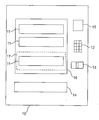
- the dispensing machine 10 illustrated in FIG. 1 has a front wall in which a viewing window 16 is embedded. Through this viewing window 16, it is possible for the customer to view the goods stored in the goods compartments 11.
- the goods compartments 11 arranged inside the automatic tote dispenser 10 can be filled with different goods.
- the goods compartments 11 are arranged within a cooling area 17, foods are stored, which are stable only at cooler temperatures over a reasonable period of time.
- the dispenser 10 can influence the customer in the selection of the goods by displaying in the display 15 an indication of which goods have been reduced. A customer then preferably chooses these goods.
- FIG. 2 shows the interaction of the individual functional parts of the automatic teller machine 10.
- the selection made by the customer via the keyboard 12 is sent to the arithmetic unit 21.
- a clock unit 22 is further coupled, indicating a real-time clock time including date.
- the arithmetic unit 21 is coupled to a memory unit 20 from which it receives the numerical value associated with the selected item. This is determined by the operator or the manufacturer of the automatic teller machine 10 and entered by means of input unit 23 in the memory unit 20.
- the input unit 23 generally consists of a 10-number keypad and control keys such as "input”, “delete”, etc. Alternatively, the input unit 23 can also consist of a complete alphanumeric keyboard.
- the arithmetic unit 21 calculates the difference between the expiration date of the commodity and the current clock or date time as received from clock unit 22.
- the arithmetic unit 21 After the arithmetic unit 21 has calculated the new purchase price of the goods, taking into account the expiration date and the current time, it gives a corresponding information to the display unit 15, which displays the calculated purchase price to the customer.
- the goods have not expired and may be sold to the customer.
- the computing unit 21 calculates a purchase price depending on the information that the product is only stable for a further 3 days and can only be sold for as long. For example, it calculates a price reduced by 50%. The customer pays the reduced purchase price for this selected product. The goods are issued, the purchase process is completed.
- a customer selects a product from the automatic teller machine 10 on 17.03.2006 at 17:00 o'clock, however, the selected product is assigned the expiration date 12.03.2006.
- a message "Expiry date expired, please make new selection" appears in display 15 informing the customer of the expiry date. The expired goods are not issued to the customer, but replaced at the next filling of the automatic teller machine 10 with fresh goods. The customer can choose another product and the buying process starts again.
- the automatic teller 10 also recognizes how many hours a product is still stable.
- a goods compartment 11 for example, fruit can be offered to the customer.
- Fruit is often edible only within a relatively short period of time, so that an indication of the duration of the sellability in hours is more meaningful than one in days.
- an apple will be stored in the automatic teller machine 10 at 18:00 on 14.03.2006.
- the filler in the storage unit 20 indicates that the apple should be sold only 72 hours long, so until 17.03.2006 at 1759 clock, because this apple variety already tends to rot after a few days.
- a customer chooses now on 17.03.2006 at 17:00 clock this apple from the dispenser 10 from.
- the arithmetic unit 21 receives from the memory unit 20 the information that the apple is assigned an expiry date including expiration time on 17.03.2006 at 17:59 o'clock.
- the arithmetic unit 21 continues to receive the current time from the clock unit 22.
- the arithmetic unit 21 calculates the purchase price and displays it to the customer via the display unit 15.
- the arithmetic unit 21 receives from the storage unit 20 corresponding information about the selected product.
- the arithmetic unit 21 receives from the memory unit 20 information about the time value of the selected product.
- this calculates the purchase price.
- the period value specifies special price conditions for special times of the day, weekdays or the like.
- the purchase price calculated in this way is also output to the display unit 15 as information for the customer.
- a customer selects a product with a period value of 2.
- the storage unit 20 stores the meaning of a period value.
- the period value 2 means, for example, that the one characterized by this value Goods sold on Mondays reduced by 30% compared to the usual retail price. If the customer calls up this commodity, the period value 2 is output from the storage unit 20 to the arithmetic unit 21.
- the arithmetic unit 21 also receives the current time Monday, 14.03.2006 at 11:00 clock.
- the computing unit 21 now checks whether the time is Monday, 14.03.2006 at 11:00 clock within the period defined by 2. In this example, this is the case, whereupon the computing unit 21 calculates the new purchase price for the selected product, which is 30% below the usual.
- the price is displayed to the customer. Once he has paid the price, the dispenser 10 dispatches the goods to him.
- a period value of 1 means, for example, that all goods characterized with it are sold between 8:00 and 10:00 in the morning at particularly favorable prices. For example, if a customer selects a commodity characterized by a period value at 9:00 am, he will receive it at the discounted purchase price. If the current time is outside the time period defined by 1, for example 11:00. Clock, calculates the arithmetic unit 21 no discounted purchase price and shows the customer the normal price. The commodity in such a case becomes the normal, i. unsold, selling price sold.
- the automatic teller machine 10 can adjust the price of a selected product as a function of the current fill level. For example, a numerical value is entered into the storage unit 20, which states that the automatic teller machine 10 is filled with confectionery at 13:00. For example, if a customer selects a pack of biscuits at 12:00, the dispenser 10 checks the current level of the same type of product. If the automatic teller machine 10 determines that there are still many packages of biscuits, for example ten, the arithmetic unit 21 calculates a particularly reduced price for the "baked goods" type of goods. In this way, customers are motivated to buy more baked goods. The next filling the dispenser 10 with confectionery is simplified in this way, since no or little packets of baked goods must be disposed of or rearranged within the dispenser 10.
- the automatic teller machine 10 can calculate the purchase price depending on how many goods of a kind of goods have been sold in a past time interval. If, for example, many dairy products are sold within a few hours, the arithmetic unit 21 calculates no reduced or even increased purchase price for the next milk product selected by a customer.
- the arithmetic unit 21 of the automatic teller machine 10 can also adjust the purchase price of a selected product to the number of sales of other goods. For example, if bananas are increasingly sold, the apple calculating unit 21 may charge a reduced price to achieve even fruit sales.
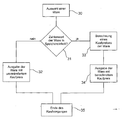
- FIG. 3 shows the schematic sequence of the process within the automatic tote dispenser 10 according to the invention.
- the process begins with the customer selecting a product via the selection unit 12 in step 30.
- the dispenser 10 checks whether there is a numerical value for the selected item in the storage unit 20. If this is not the case, the dispenser 10 according to the invention proceeds to step 32.
- step 32 an issue of the selected product is initiated without changing the purchase price. The goods are dispensed and the purchase process is completed in step 35.
- step 33 the purchase price of the selected product is calculated in arithmetic unit 21 based on the numerical value stored in storage unit 20 and the time of the clock unit 22 is calculated. The purchase price is, as already described with reference to Figures 1 and 2, displayed to the customer.
- method step 34 the goods selected and paid for by the customer are finally output. The purchase process is completed in step 35.
- An inventive dispensing machine thus allows the sale of one or more goods for which a specific purchase price has been individually or for the entire product group.
- the purchase price is calculated as a function of the current time, whereby the calculated price within a certain period of time remain constant or can vary.
Landscapes
- Physics & Mathematics (AREA)
- General Physics & Mathematics (AREA)
- Control Of Vending Devices And Auxiliary Devices For Vending Devices (AREA)
Applications Claiming Priority (1)
| Application Number | Priority Date | Filing Date | Title |
|---|---|---|---|
| DE10602152 | 2006-01-17 |
Publications (1)
| Publication Number | Publication Date |
|---|---|
| EP1808832A1 true EP1808832A1 (fr) | 2007-07-18 |
Family
ID=38015340
Family Applications (1)
| Application Number | Title | Priority Date | Filing Date |
|---|---|---|---|
| EP06020346A Withdrawn EP1808832A1 (fr) | 2006-01-17 | 2006-09-28 | Distributeur automatique de marchandises doté d'une unité de calcul en vue du calcul du prix |
Country Status (1)
| Country | Link |
|---|---|
| EP (1) | EP1808832A1 (fr) |
Cited By (2)
| Publication number | Priority date | Publication date | Assignee | Title |
|---|---|---|---|---|
| WO2012164041A1 (fr) * | 2011-06-02 | 2012-12-06 | Nokia Siemens Networks Oy | Dispositif de commande de distributeur automatique à distance |
| CN109598844A (zh) * | 2018-10-29 | 2019-04-09 | 广州易购智能设备股份有限公司 | 一种无人售货机及其控制方法 |
Citations (5)
| Publication number | Priority date | Publication date | Assignee | Title |
|---|---|---|---|---|
| JPH103569A (ja) * | 1996-06-14 | 1998-01-06 | Matsushita Refrig Co Ltd | 自動販売機の制御装置 |
| DE19705245A1 (de) * | 1997-02-12 | 1998-08-27 | Ibm | Auktionsautomat |
| WO1999038125A1 (fr) * | 1998-01-22 | 1999-07-29 | Walker Digital, Llc | Procede et appareil pour la collecte et l'utilisation d'informations relatives a la demande associee a un distributeur automatique |
| WO2001003087A1 (fr) * | 1999-06-30 | 2001-01-11 | Walker Digital, Llc | Systeme de distributeur automatique et procede visant a encourager l'achat d'articles rentables |
| JP2006195866A (ja) * | 2005-01-17 | 2006-07-27 | Matsushita Electric Ind Co Ltd | 自動販売機、および、そのプログラム |
-
2006
- 2006-09-28 EP EP06020346A patent/EP1808832A1/fr not_active Withdrawn
Patent Citations (5)
| Publication number | Priority date | Publication date | Assignee | Title |
|---|---|---|---|---|
| JPH103569A (ja) * | 1996-06-14 | 1998-01-06 | Matsushita Refrig Co Ltd | 自動販売機の制御装置 |
| DE19705245A1 (de) * | 1997-02-12 | 1998-08-27 | Ibm | Auktionsautomat |
| WO1999038125A1 (fr) * | 1998-01-22 | 1999-07-29 | Walker Digital, Llc | Procede et appareil pour la collecte et l'utilisation d'informations relatives a la demande associee a un distributeur automatique |
| WO2001003087A1 (fr) * | 1999-06-30 | 2001-01-11 | Walker Digital, Llc | Systeme de distributeur automatique et procede visant a encourager l'achat d'articles rentables |
| JP2006195866A (ja) * | 2005-01-17 | 2006-07-27 | Matsushita Electric Ind Co Ltd | 自動販売機、および、そのプログラム |
Cited By (2)
| Publication number | Priority date | Publication date | Assignee | Title |
|---|---|---|---|---|
| WO2012164041A1 (fr) * | 2011-06-02 | 2012-12-06 | Nokia Siemens Networks Oy | Dispositif de commande de distributeur automatique à distance |
| CN109598844A (zh) * | 2018-10-29 | 2019-04-09 | 广州易购智能设备股份有限公司 | 一种无人售货机及其控制方法 |
Similar Documents
| Publication | Publication Date | Title |
|---|---|---|
| DE19705245C2 (de) | Verfahren zur automatischen Absatzsteuerung und Verkaufsautomat | |
| DE69507143T2 (de) | Verfahren und system zum ausliefern von produktempfehlungen | |
| DE69713223T2 (de) | Automatisches Transaktionssystem mit einem automatischen Display und Verfahren für seinen Betrieb | |
| US4654800A (en) | Control and monitoring apparatus for vending machines | |
| KR101743353B1 (ko) | 유통기한 관리 기능 및 할인 기능을 갖는 자동판매기 | |
| DE69807326T2 (de) | System zur förderung der rückgabe von dienstleistungswagen,z.b. einkaufswagen für den transport von artikeln in einem aktivitäten zentrum, z.b.einkaufzentren | |
| US20080052175A1 (en) | Method and apparatus for vending products | |
| WO2006097448A1 (fr) | Procede et dispositif de stockage, traitement et distribution d'aliments par l'intermediaire de supports | |
| DE19650079A1 (de) | Verfahren zum Ausgeben eines Service-Tickets bei Warengeschäften unter Benutzung von Kommunikation | |
| US20100017022A1 (en) | Method and apparatus for vending products | |
| DE3226323A1 (de) | Steuersystem zum steuern der zeitlichen konditionierung von produkten | |
| DE3615110A1 (de) | Selbstverkaeufer | |
| JPH08147545A (ja) | 自動販売機 | |
| EP2612284A1 (fr) | Système automatique de vente | |
| EP1808832A1 (fr) | Distributeur automatique de marchandises doté d'une unité de calcul en vue du calcul du prix | |
| DE19511649A1 (de) | Elektronisches System-Kaufhaus | |
| DE69814383T2 (de) | Geldverarbeitungsvorrichtung | |
| DE102006002152A1 (de) | Warenabgabeautomat mit Recheneinheit zur Preisberechnung | |
| DE19725180A1 (de) | Stromsparvorrichtung eines Verkaufsautomaten und Verfahren dafür | |
| EP1680961B1 (fr) | Dispositif de cuisson notamment pour magasins libre-service | |
| JP3407235B2 (ja) | 自動販売機の制御装置 | |
| DE60210248T2 (de) | Verfahren zur Verfügungstellung einer Auswahl von Produkten aus einem oder mehreren Verkaufsautomaten, und Verkaufsautomaten welche dieses Verfahren benutzen | |
| DE102005016769B4 (de) | Automatische Backvorrichtung | |
| DE102017203538A1 (de) | Leergut-Rücknahmeautomat, Leergut-Rücknahmesystem und Verfarhen zum Betreiben eines Leergut-Rücknahmeautomaten bzw. Leergut-Rücknahmesystems | |
| JPH0877429A (ja) | 自動販売機の販売制御方法 |
Legal Events
| Date | Code | Title | Description |
|---|---|---|---|
| PUAI | Public reference made under article 153(3) epc to a published international application that has entered the european phase |
Free format text: ORIGINAL CODE: 0009012 |
|
| AK | Designated contracting states |
Kind code of ref document: A1 Designated state(s): AT BE BG CH CY CZ DE DK EE ES FI FR GB GR HU IE IS IT LI LT LU LV MC NL PL PT RO SE SI SK TR |
|
| AX | Request for extension of the european patent |
Extension state: AL BA HR MK YU |
|
| 17P | Request for examination filed |
Effective date: 20071004 |
|
| 17Q | First examination report despatched |
Effective date: 20071113 |
|
| AKX | Designation fees paid |
Designated state(s): AT BE BG CH CY CZ DE DK EE ES FI FR GB GR HU IE IS IT LI LT LU LV MC NL PL PT RO SE SI SK TR |
|
| STAA | Information on the status of an ep patent application or granted ep patent |
Free format text: STATUS: THE APPLICATION HAS BEEN WITHDRAWN |
|
| 18W | Application withdrawn |
Effective date: 20080529 |