EP1808906A2 - Actionneur piézo-électrique avec protection améliorée contre les courts-circuits - Google Patents
Actionneur piézo-électrique avec protection améliorée contre les courts-circuits Download PDFInfo
- Publication number
- EP1808906A2 EP1808906A2 EP06124372A EP06124372A EP1808906A2 EP 1808906 A2 EP1808906 A2 EP 1808906A2 EP 06124372 A EP06124372 A EP 06124372A EP 06124372 A EP06124372 A EP 06124372A EP 1808906 A2 EP1808906 A2 EP 1808906A2
- Authority
- EP
- European Patent Office
- Prior art keywords
- piezoelectric actuator
- sheath
- actuator according
- internal electrodes
- electrodes
- Prior art date
- Legal status (The legal status is an assumption and is not a legal conclusion. Google has not performed a legal analysis and makes no representation as to the accuracy of the status listed.)
- Withdrawn
Links
Images
Classifications
-
- H—ELECTRICITY
- H10—SEMICONDUCTOR DEVICES; ELECTRIC SOLID-STATE DEVICES NOT OTHERWISE PROVIDED FOR
- H10N—ELECTRIC SOLID-STATE DEVICES NOT OTHERWISE PROVIDED FOR
- H10N30/00—Piezoelectric or electrostrictive devices
- H10N30/80—Constructional details
- H10N30/88—Mounts; Supports; Enclosures; Casings
- H10N30/883—Additional insulation means preventing electrical, physical or chemical damage, e.g. protective coatings
-
- H—ELECTRICITY
- H10—SEMICONDUCTOR DEVICES; ELECTRIC SOLID-STATE DEVICES NOT OTHERWISE PROVIDED FOR
- H10N—ELECTRIC SOLID-STATE DEVICES NOT OTHERWISE PROVIDED FOR
- H10N30/00—Piezoelectric or electrostrictive devices
- H10N30/01—Manufacture or treatment
- H10N30/02—Forming enclosures or casings
-
- H—ELECTRICITY
- H10—SEMICONDUCTOR DEVICES; ELECTRIC SOLID-STATE DEVICES NOT OTHERWISE PROVIDED FOR
- H10N—ELECTRIC SOLID-STATE DEVICES NOT OTHERWISE PROVIDED FOR
- H10N30/00—Piezoelectric or electrostrictive devices
- H10N30/50—Piezoelectric or electrostrictive devices having a stacked or multilayer structure
Definitions
- the invention relates to a piezoelectric actuator, for example for actuating a mechanical component, with the generic features of the main claim.
- Piezo actuators are being used with great success, for example, in injectors of modern fuel injection systems for internal combustion engines, but also in electrically operated valves for driving safety systems, such as ABS or anti-slip control.
- the piezoelectrically active region of a piezoelectric actuator consists of a multiplicity of layers of metallized piezoceramics stacked on top of one another. These metallized piezoceramics form a so-called multilayer actuator. Between the layers of the piezoelectric actuator inner electrodes of a metallic material, such as silver or copper, arranged with the aid of an electric field can be applied in the piezoelectric ceramic layers of the piezoelectric actuator. The electric field causes a change in length of the piezoceramic.
- a piezoelectric actuator which has the multilayer structure described above. At the top and bottom of this piezoelectric actuator piezoelectric inactive areas are provided in which no internal electrodes are present. As a result, no electrical voltage is applied in these inactive areas.
- the piezoelectrically non-active regions consist of a material which, with regard to its mechanical and thermal properties, is largely matched to the properties of the piezoelectrically active region of the piezoactuator.
- the invention is based on the object of further improving the known from the prior art piezo actuators in terms of short-circuit safety and to increase the life of the piezoelectric actuators of the invention.
- a piezoelectric actuator having a plurality of layers, wherein in a piezoelectrically active region between the layers inner electrodes are provided and wherein the internal electrodes are acted upon by an electrical voltage, achieved in that the piezoelectrically active region with an electrically non-conductive sheath against electrical short circuits is protected, and that the sheath consists of a material whose mechanical and thermal properties largely correspond to the properties of the piezoelectrically active region.
- the sheath With the help of the sheath according to the invention, it is possible to completely encase the actual piezoelectric actuator and, since the sheath consists of an electrically non-conductive material, to be electrically reliably insulated against the stresses occurring during operation. As a result, shorts between the piezoelectric actuator and a housing surrounding the piezoelectric actuator or its other environment can be avoided over the entire life of the piezoelectric actuator with high reliability.
- the sheath consists of a same base material, such as the piezoelectrically active region of the piezoelectric actuator.
- the base material is relatively inexpensive, so that the cost of the sheath are relatively low.
- the sheath can be integrated with relatively little additional effort in an existing series production of piezo actuators. This results in significant economic benefits, which can be crucial for market success, especially in the production of large series.
- an important mechanical property is the Young's modulus
- an important thermal property is the thermal expansion. If the modulus of elasticity and thermal expansion of the cladding correspond as closely as possible to the properties of the piezoelectrically active region, the advantages according to the invention are achieved to the greatest extent. It goes without saying that in many cases not one hundred percent agreement can be achieved in one or both of these properties, but even if the most important mechanical and thermal properties are largely matched, a drastic reduction in fractures or cracks in the jacket of the piezoactuator has already taken place , As long as the sheath remains free of cracks or cracks, its insulating effect is unabated.
- the mechanical and thermal properties of the piezoelectrically active region are determined by the layers of piezoelectric material and the internal electrodes and their interactions with each other. This is all the more so as the piezoelectric actuators are usually made of ceramic materials by sintering and during sintering so high temperatures occur that traces of the metallic internal electrodes diffuse into the piezoelectric material and cause a doping of the piezoelectric material there. As a rule, this doping causes significant changes in the mechanical and / or thermal properties of the piezoelectric material and must therefore be taken into account when adapting the material of the casing to the piezoelectric actuator.
- the piezoelectric actuator comprises external electrodes, preferably two external electrodes, that each internal electrode is electrically conductively connected to an external electrode and that the external electrodes are arranged substantially outside the sheath.
- the sheath is produced by immersing the blank (also referred to as a green compact) of a piezoelectric actuator in a casting slip and then sintering the blank. This allows the sheathing take any shape. In addition, the sheath has no joints and is of very uniform thickness.
- the sheath consists of a film which is wound around the piezoelectric actuator.
- the invention provides that the internal electrodes do not fall below a minimum distance to the shock.
- the shock can be closed by a bar, a plug or a potting compound.
- piezo actuators whose inner electrodes are made of silver or a silver alloy, in particular a silver-palladium alloy, the sheath and / or the piezoelectrically inactive regions consist of a silver-doped ceramic material.
- the cladding and / or the piezoelectrically inactive regions are preferably made of a copper-doped ceramic material.
- the objects underlying the invention are also achieved by a method for producing a jacket of a piezoelectric actuator, in which a green compact (green blank) of the piezoelectric actuator is immersed in a casting slip, and then the green compact is sintered.
- a green compact (green blank) of the piezoelectric actuator is immersed in a casting slip, and then the green compact is sintered.
- the casting slurry consists of a ceramic material mixed with a metal salt, in particular of lead zirconate titanate.
- the casting slip is mixed with silver salts and / or copper salts.
- the metal salts cause a doping of the ceramic material of the sheath.
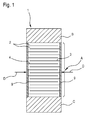
- a conventional piezoelectric actuator is shown in longitudinal section.
- the piezoactuator 1 shown in FIG. 1 is constructed from different layers 2 of a piezoelectric ceramic material.
- the layers 2 are produced in known manner from so-called green sheets. These green sheets may be, for example, ceramics based on lead zirconate titanate (PZT).
- PZT lead zirconate titanate
- a casing 9 which effects an electrical insulation of the region A and shields this region against external influences.
- piezoelectrically inactive regions B and C are arranged above and below the piezoelectrically active region A. These inactive areas attached to the top and bottom serve both for electrical insulation and for absorbing pressure forces or for discharging the actuating force exerted by the piezoactuator 1 on, for example, the actuator of an internal combustion engine injector. They are usually made of the same base material as the piezoelectrically active region A.
- the base material of the piezoelectrically active region A, the piezoelectrically inactive regions B and C and the cladding 9 may be a ceramic based on lead zirconate titanate (PZT), for example. These or other ceramics can be modified in their thermal and mechanical properties to produce the sheath 9 by adding suitable dopants, such as silver or copper, that the sheath 9 in their thermal and mechanical properties of the piezoelectric active region A of the piezoelectric actuator. 1 with the layers 2 and the inner electrodes 3 and 4 largely corresponds. In the adaptation of the material of the sheath 9 by doping or other measures, the shrinkage during sintering is taken into account. The thermal expansion and the elasticity of the ceramic of the active region A in conjunction with the thermal and mechanical properties of the internal electrodes 3 and 4 must also be compatible with the jacket 9.
- PZT lead zirconate titanate
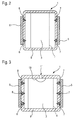
- FIG. 2 shows a first exemplary embodiment of a piezoelectric actuator 1 according to the invention along the line DD.
- the inner electrode 3 is visible.
- the underlying inner electrode 4 is not visible and represented by a dashed line.
- the inner electrode 3 is electrically contacted via a first outer electrode 5 and webs 7.
- the inner electrode 4 is also electrically contacted via a second outer electrode 6 and webs 8.
- the first outer electrode 5 and the second outer electrode 6 have a different polarity.
- the internal electrodes 3 and 4 also have different polarities when voltage is applied to the external electrodes 5 and 6, and the desired electric field is generated in the ceramic layers 2.
- the piezoelectric actuator is surrounded on all sides by the casing 9.
- the jacket 9 serves to protect the internal electrodes 3 and 4 on the one hand against mechanical damage and on the other hand to prevent short circuits between the internal electrodes 3 and 4 and a housing surrounding the piezoelectric actuator, not shown in FIG.
- the sheath 9 is broken by the webs 7 and 8.
- the sheath 9 is made by immersion in a G manschlicker.
- the sheath 9 may preferably consist of a ceramic material whose basic substance corresponds to the base material of the piezoelectric actuator 1.
- this base material is doped in the casing 9 with a metal. It is advisable to dope the sheath 9 with the metal or the metal alloy, of which the inner electrodes 3 and 4 are made. It has been found that when sintering piezo actuators, the base material of the piezoelectrically active region is doped with metal atoms diffusing out of the inner electrodes 3 and 4. This doping influences the mechanical and thermal properties of the base material.
- the jacket 9 also consists of a doped base material, and the doping is almost identical to that of the internal electrodes 3 and 4 doped piezoelectric actuator 1, this leads to the mechanical and thermal properties of the jacket 9 the mechanical and thermal properties of the Correspond to piezoelectric actuator 1 and thus no thermal stresses or other undesirable effects cause the sheathing gets cracked or even partially peeled off from the piezoelectric actuator 1.
- FIG. 3 another embodiment of a piezoelectric actuator 1 according to the invention is also shown along a line D cut. Identical components have the same reference numerals and it is the case with respect to the previous figures said accordingly.
- the casing 9 consists of a film of a ceramic material wound around the piezoactuator 1. This film is flexible before sintering.
- the inner electrode 3 is recessed in a semicircular manner there. This recess is provided in Figure 3 by the reference numeral 13. It goes without saying that the underlying and overlying inner electrodes 3 and 4 in the region of the joint 11, which indeed extends over the entire length of the piezoelectric actuator 1, corresponding recesses 13, which are not visible in Figure 3.
- three webs 7 and three webs 8 are present between the external electrodes 5 and 6 on the one hand and the internal electrodes 3 and 4 on the other hand.
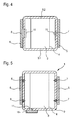
- the sheath 9 is formed double-shelled.
- the two shells are designated in Figure 4 with 9.1 and 9.2.
- two impacts 11 occur in this embodiment.
- the electrical connection between external electrodes 5 and 6 on the one hand and the internal electrodes 3 and 4 is made. This is done by a respective web 7 between the first outer electrode 5 and the inner electrodes 3 and a web 8 between the second outer electrode 6 and the inner electrodes 4.
- the piezoelectric actuator 1 completely from the Enclosed 9 enclosed.
- FIG. 5 shows a further exemplary embodiment of a piezoactuator 1 according to the invention.
- the shock 11 is closed by a sealing strip 15.
- the short-circuit safety in the region of the joint 11 is also increased to such an extent by this measure that the short-circuit safety in the region of the joint 11 is just as great as in the remaining regions of the jacket 9.
Landscapes
- Engineering & Computer Science (AREA)
- Manufacturing & Machinery (AREA)
- General Electrical Machinery Utilizing Piezoelectricity, Electrostriction Or Magnetostriction (AREA)
- Fuel-Injection Apparatus (AREA)
Applications Claiming Priority (1)
| Application Number | Priority Date | Filing Date | Title |
|---|---|---|---|
| DE102006001573A DE102006001573A1 (de) | 2006-01-12 | 2006-01-12 | Piezoaktor mit verbesserter Sicherheit gegen Kurzschlüsse |
Publications (2)
| Publication Number | Publication Date |
|---|---|
| EP1808906A2 true EP1808906A2 (fr) | 2007-07-18 |
| EP1808906A3 EP1808906A3 (fr) | 2011-01-05 |
Family
ID=37989098
Family Applications (1)
| Application Number | Title | Priority Date | Filing Date |
|---|---|---|---|
| EP06124372A Withdrawn EP1808906A3 (fr) | 2006-01-12 | 2006-11-20 | Actionneur piézo-électrique avec protection améliorée contre les courts-circuits |
Country Status (2)
| Country | Link |
|---|---|
| EP (1) | EP1808906A3 (fr) |
| DE (1) | DE102006001573A1 (fr) |
Cited By (4)
| Publication number | Priority date | Publication date | Assignee | Title |
|---|---|---|---|---|
| DE102009043220A1 (de) * | 2009-05-29 | 2010-12-02 | Epcos Ag | Piezoelektrisches Bauelement |
| DE102010047302B3 (de) * | 2010-10-01 | 2012-03-29 | Epcos Ag | Piezoelektrisches Vielschichtbauelement und Verfahren zu dessen Herstellung |
| WO2013026764A3 (fr) * | 2011-08-19 | 2013-05-16 | Siemens Aktiengesellschaft | Procédé de passivation électrique de composants électromécaniques |
| DE102012207276B4 (de) | 2011-08-01 | 2018-04-05 | Continental Automotive Gmbh | Vollaktiver Piezostack mit Passivierung |
Family Cites Families (4)
| Publication number | Priority date | Publication date | Assignee | Title |
|---|---|---|---|---|
| DE10021919C2 (de) * | 2000-02-04 | 2002-03-07 | Pi Ceramic Gmbh | Verfahren zur Herstellung monolithischer piezokeramischer Vielschichtaktoren sowie monolithischer piezokeramischer Vielschichtaktor |
| DE10033588C2 (de) * | 2000-07-11 | 2002-05-16 | Bosch Gmbh Robert | Keramisches Mehrlagenbauteil und Verfahren zu dessen Herstellung |
| DE10329028A1 (de) * | 2002-07-11 | 2004-01-29 | Ceram Tec Ag Innovative Ceramic Engineering | Isolierung für piezokeramische Vielschichtaktoren |
| DE10260853A1 (de) * | 2002-12-23 | 2004-07-08 | Robert Bosch Gmbh | Piezoaktor und ein Verfahren zu dessen Herstellung |
-
2006
- 2006-01-12 DE DE102006001573A patent/DE102006001573A1/de not_active Withdrawn
- 2006-11-20 EP EP06124372A patent/EP1808906A3/fr not_active Withdrawn
Cited By (9)
| Publication number | Priority date | Publication date | Assignee | Title |
|---|---|---|---|---|
| DE102009043220A1 (de) * | 2009-05-29 | 2010-12-02 | Epcos Ag | Piezoelektrisches Bauelement |
| US8541930B2 (en) | 2009-05-29 | 2013-09-24 | Epcos Ag | Piezoelectric component |
| DE102010047302B3 (de) * | 2010-10-01 | 2012-03-29 | Epcos Ag | Piezoelektrisches Vielschichtbauelement und Verfahren zu dessen Herstellung |
| WO2012041854A1 (fr) | 2010-10-01 | 2012-04-05 | Epcos Ag | Composant piézoélectrique multicouche et procédé de fabrication dudit composant piézoélectrique multicouche |
| CN103210514A (zh) * | 2010-10-01 | 2013-07-17 | 埃普科斯股份有限公司 | 压电多层器件及其制造方法 |
| US9299909B2 (en) | 2010-10-01 | 2016-03-29 | Epcos Ag | Piezoelectric multilayer component and method for producing the same |
| CN103210514B (zh) * | 2010-10-01 | 2016-04-06 | 埃普科斯股份有限公司 | 压电多层器件及其制造方法 |
| DE102012207276B4 (de) | 2011-08-01 | 2018-04-05 | Continental Automotive Gmbh | Vollaktiver Piezostack mit Passivierung |
| WO2013026764A3 (fr) * | 2011-08-19 | 2013-05-16 | Siemens Aktiengesellschaft | Procédé de passivation électrique de composants électromécaniques |
Also Published As
| Publication number | Publication date |
|---|---|
| EP1808906A3 (fr) | 2011-01-05 |
| DE102006001573A1 (de) | 2007-07-19 |
Similar Documents
| Publication | Publication Date | Title |
|---|---|---|
| EP1597780B1 (fr) | Composant electrique multicouche et empilement de couches | |
| EP1502310B1 (fr) | Piezoactionneur et son procede de production | |
| EP1908131B1 (fr) | Procede de fabrication d'un actionneur piezoelectrique monolithique a sections d'empilement, actionneur piezoelectrique monolithique a sections d'empilement et utilisation dudit actionneur piezoelectrique | |
| DE10208417A1 (de) | Laminierte piezoelektrische Vorrichtung | |
| DE102012105287B4 (de) | Verfahren zur Herstellung eines elektrischen Bauelements und Elektrisches Bauelement | |
| EP2543085B1 (fr) | Composant piézoélectrique | |
| DE102007015457B4 (de) | Piezoelektrisches Bauteil mit Sicherheitsschicht, Verfahren zu dessen Herstellung und Verwendung | |
| WO2007087912A1 (fr) | Procédé de mise en contact électrique d'un composant électronique | |
| EP2319102B1 (fr) | Piézoactionneur doté d'une couche de rupture préférentielle | |
| EP2740163B1 (fr) | Empilement piézoélectrique entièrement actif à passivation | |
| DE102009034099A1 (de) | Piezoaktor mit elektrischer Kontaktierung | |
| EP2191483B1 (fr) | Composant électrique multicouche | |
| EP1741162B1 (fr) | Unite fonctionnelle electrique et procede pour sa production | |
| EP1384272B1 (fr) | Systeme de contact supplementaire pour composant electrique et composant piezo-electrique a structure multicouche | |
| EP1808906A2 (fr) | Actionneur piézo-électrique avec protection améliorée contre les courts-circuits | |
| EP1405372B1 (fr) | Systeme de contact supplementaire pour un composant electrique et composant piezo-electrique a structure multicouche | |
| EP2054951B1 (fr) | Composant piézoélectrique | |
| EP2798679B1 (fr) | Pile piézo-électrique avec passivation et procédé de passivation d'une pile piézo-électrique | |
| DE112010002244T5 (de) | Piezoelektrische gestapelte Stellanordnung | |
| DE102006001656A1 (de) | Piezoaktor und Verfahren zur Herstellung desselben | |
| DE102011109008A1 (de) | Verfahren zur Herstellung eines piezoelektrischen Vielschichtbauelements | |
| DE102009020238B4 (de) | Piezoaktor mit elektrischen Kontaktierungsstiften und Verfahren zum Kontaktieren eines Piezoaktors | |
| DE102012105517A1 (de) | Vielschichtbauelement mit einer Außenkontaktierung und Verfahren zur Herstellung eines Vielschichtbauelements mit einer Außenkontaktierung | |
| DE102019110736B4 (de) | Aktuator | |
| EP1798782B1 (fr) | Actionneur piézo-électrique et méthode de fabrication d'un empilement piézo-électrique |
Legal Events
| Date | Code | Title | Description |
|---|---|---|---|
| PUAI | Public reference made under article 153(3) epc to a published international application that has entered the european phase |
Free format text: ORIGINAL CODE: 0009012 |
|
| AK | Designated contracting states |
Kind code of ref document: A2 Designated state(s): AT BE BG CH CY CZ DE DK EE ES FI FR GB GR HU IE IS IT LI LT LU LV MC NL PL PT RO SE SI SK TR |
|
| AX | Request for extension of the european patent |
Extension state: AL BA HR MK YU |
|
| PUAL | Search report despatched |
Free format text: ORIGINAL CODE: 0009013 |
|
| AK | Designated contracting states |
Kind code of ref document: A3 Designated state(s): AT BE BG CH CY CZ DE DK EE ES FI FR GB GR HU IE IS IT LI LT LU LV MC NL PL PT RO SE SI SK TR |
|
| AX | Request for extension of the european patent |
Extension state: AL BA HR MK RS |
|
| 17P | Request for examination filed |
Effective date: 20110705 |
|
| AKX | Designation fees paid |
Designated state(s): DE ES FR IT |
|
| STAA | Information on the status of an ep patent application or granted ep patent |
Free format text: STATUS: THE APPLICATION IS DEEMED TO BE WITHDRAWN |
|
| 18D | Application deemed to be withdrawn |
Effective date: 20110706 |