EP1808919A1 - Matériau de carbone pour électrode négative de batterie secondaire au lithium et son procédé de preparation - Google Patents
Matériau de carbone pour électrode négative de batterie secondaire au lithium et son procédé de preparation Download PDFInfo
- Publication number
- EP1808919A1 EP1808919A1 EP06250214A EP06250214A EP1808919A1 EP 1808919 A1 EP1808919 A1 EP 1808919A1 EP 06250214 A EP06250214 A EP 06250214A EP 06250214 A EP06250214 A EP 06250214A EP 1808919 A1 EP1808919 A1 EP 1808919A1
- Authority
- EP
- European Patent Office
- Prior art keywords
- negative electrode
- rice
- carbon material
- lithium ion
- ion secondary
- Prior art date
- Legal status (The legal status is an assumption and is not a legal conclusion. Google has not performed a legal analysis and makes no representation as to the accuracy of the status listed.)
- Granted
Links
- 239000003575 carbonaceous material Substances 0.000 title claims abstract description 70
- HBBGRARXTFLTSG-UHFFFAOYSA-N Lithium ion Chemical compound [Li+] HBBGRARXTFLTSG-UHFFFAOYSA-N 0.000 title claims abstract description 62
- 229910001416 lithium ion Inorganic materials 0.000 title claims abstract description 62
- 238000004519 manufacturing process Methods 0.000 title claims abstract description 35
- 241000209094 Oryza Species 0.000 claims abstract description 95
- 235000007164 Oryza sativa Nutrition 0.000 claims abstract description 94
- 235000009566 rice Nutrition 0.000 claims abstract description 94
- 229940100486 rice starch Drugs 0.000 claims abstract description 60
- 238000001354 calcination Methods 0.000 claims abstract description 41
- 238000000034 method Methods 0.000 claims abstract description 21
- 239000000843 powder Substances 0.000 claims abstract description 5
- 238000005498 polishing Methods 0.000 claims description 33
- 108010050181 aleurone Proteins 0.000 claims description 6
- 238000000227 grinding Methods 0.000 claims description 3
- 229910016523 CuKa Inorganic materials 0.000 abstract 1
- 229920002472 Starch Polymers 0.000 description 19
- 235000019698 starch Nutrition 0.000 description 19
- 239000002994 raw material Substances 0.000 description 18
- 239000008107 starch Substances 0.000 description 18
- 239000002245 particle Substances 0.000 description 17
- 239000000047 product Substances 0.000 description 17
- 230000000052 comparative effect Effects 0.000 description 16
- 239000010410 layer Substances 0.000 description 16
- KXGFMDJXCMQABM-UHFFFAOYSA-N 2-methoxy-6-methylphenol Chemical compound [CH]OC1=CC=CC([CH])=C1O KXGFMDJXCMQABM-UHFFFAOYSA-N 0.000 description 8
- 239000000203 mixture Substances 0.000 description 8
- 239000005011 phenolic resin Substances 0.000 description 8
- 229920001568 phenolic resin Polymers 0.000 description 8
- 238000010586 diagram Methods 0.000 description 7
- 238000002441 X-ray diffraction Methods 0.000 description 5
- OKTJSMMVPCPJKN-UHFFFAOYSA-N Carbon Chemical compound [C] OKTJSMMVPCPJKN-UHFFFAOYSA-N 0.000 description 4
- 238000012423 maintenance Methods 0.000 description 4
- 239000011255 nonaqueous electrolyte Substances 0.000 description 4
- 239000008188 pellet Substances 0.000 description 4
- IJGRMHOSHXDMSA-UHFFFAOYSA-N Atomic nitrogen Chemical compound N#N IJGRMHOSHXDMSA-UHFFFAOYSA-N 0.000 description 3
- 241000196324 Embryophyta Species 0.000 description 3
- SECXISVLQFMRJM-UHFFFAOYSA-N N-Methylpyrrolidone Chemical compound CN1CCCC1=O SECXISVLQFMRJM-UHFFFAOYSA-N 0.000 description 3
- 229910001873 dinitrogen Inorganic materials 0.000 description 3
- 210000002706 plastid Anatomy 0.000 description 3
- 238000012360 testing method Methods 0.000 description 3
- 210000001519 tissue Anatomy 0.000 description 3
- 230000003245 working effect Effects 0.000 description 3
- XKRFYHLGVUSROY-UHFFFAOYSA-N Argon Chemical compound [Ar] XKRFYHLGVUSROY-UHFFFAOYSA-N 0.000 description 2
- KMTRUDSVKNLOMY-UHFFFAOYSA-N Ethylene carbonate Chemical compound O=C1OCCO1 KMTRUDSVKNLOMY-UHFFFAOYSA-N 0.000 description 2
- 229910002097 Lithium manganese(III,IV) oxide Inorganic materials 0.000 description 2
- 239000002033 PVDF binder Substances 0.000 description 2
- 239000004743 Polypropylene Substances 0.000 description 2
- 239000013543 active substance Substances 0.000 description 2
- 239000011230 binding agent Substances 0.000 description 2
- 239000006227 byproduct Substances 0.000 description 2
- QHGJSLXSVXVKHZ-UHFFFAOYSA-N dilithium;dioxido(dioxo)manganese Chemical compound [Li+].[Li+].[O-][Mn]([O-])(=O)=O QHGJSLXSVXVKHZ-UHFFFAOYSA-N 0.000 description 2
- 239000010419 fine particle Substances 0.000 description 2
- 239000007789 gas Substances 0.000 description 2
- 229910021385 hard carbon Inorganic materials 0.000 description 2
- 210000001161 mammalian embryo Anatomy 0.000 description 2
- -1 polypropylene Polymers 0.000 description 2
- 229920001155 polypropylene Polymers 0.000 description 2
- 229920002981 polyvinylidene fluoride Polymers 0.000 description 2
- 238000003908 quality control method Methods 0.000 description 2
- 229920005989 resin Polymers 0.000 description 2
- 239000011347 resin Substances 0.000 description 2
- 229920001187 thermosetting polymer Polymers 0.000 description 2
- XLYOFNOQVPJJNP-UHFFFAOYSA-N water Substances O XLYOFNOQVPJJNP-UHFFFAOYSA-N 0.000 description 2
- RYGMFSIKBFXOCR-UHFFFAOYSA-N Copper Chemical compound [Cu] RYGMFSIKBFXOCR-UHFFFAOYSA-N 0.000 description 1
- 229910001290 LiPF6 Inorganic materials 0.000 description 1
- 239000006230 acetylene black Substances 0.000 description 1
- XAGFODPZIPBFFR-UHFFFAOYSA-N aluminium Chemical compound [Al] XAGFODPZIPBFFR-UHFFFAOYSA-N 0.000 description 1
- 229910052782 aluminium Inorganic materials 0.000 description 1
- 229910052786 argon Inorganic materials 0.000 description 1
- 230000000712 assembly Effects 0.000 description 1
- 238000000429 assembly Methods 0.000 description 1
- 229910052799 carbon Inorganic materials 0.000 description 1
- 239000003795 chemical substances by application Substances 0.000 description 1
- 235000009508 confectionery Nutrition 0.000 description 1
- 239000011889 copper foil Substances 0.000 description 1
- 238000011161 development Methods 0.000 description 1
- IEJIGPNLZYLLBP-UHFFFAOYSA-N dimethyl carbonate Chemical compound COC(=O)OC IEJIGPNLZYLLBP-UHFFFAOYSA-N 0.000 description 1
- 230000000694 effects Effects 0.000 description 1
- 238000005516 engineering process Methods 0.000 description 1
- 238000011156 evaluation Methods 0.000 description 1
- 238000003306 harvesting Methods 0.000 description 1
- 239000011261 inert gas Substances 0.000 description 1
- 239000000463 material Substances 0.000 description 1
- 239000012046 mixed solvent Substances 0.000 description 1
- 239000011301 petroleum pitch Substances 0.000 description 1
- 238000002360 preparation method Methods 0.000 description 1
- 239000011164 primary particle Substances 0.000 description 1
- 238000011084 recovery Methods 0.000 description 1
- 239000002904 solvent Substances 0.000 description 1
- 239000002344 surface layer Substances 0.000 description 1
- 235000013311 vegetables Nutrition 0.000 description 1
Images

Classifications
-
- H—ELECTRICITY
- H01—ELECTRIC ELEMENTS
- H01M—PROCESSES OR MEANS, e.g. BATTERIES, FOR THE DIRECT CONVERSION OF CHEMICAL ENERGY INTO ELECTRICAL ENERGY
- H01M4/00—Electrodes
- H01M4/02—Electrodes composed of, or comprising, active material
- H01M4/04—Processes of manufacture in general
- H01M4/0471—Processes of manufacture in general involving thermal treatment, e.g. firing, sintering, backing particulate active material, thermal decomposition, pyrolysis
-
- H—ELECTRICITY
- H01—ELECTRIC ELEMENTS
- H01M—PROCESSES OR MEANS, e.g. BATTERIES, FOR THE DIRECT CONVERSION OF CHEMICAL ENERGY INTO ELECTRICAL ENERGY
- H01M10/00—Secondary cells; Manufacture thereof
- H01M10/05—Accumulators with non-aqueous electrolyte
- H01M10/052—Li-accumulators
- H01M10/0525—Rocking-chair batteries, i.e. batteries with lithium insertion or intercalation in both electrodes; Lithium-ion batteries
-
- H—ELECTRICITY
- H01—ELECTRIC ELEMENTS
- H01M—PROCESSES OR MEANS, e.g. BATTERIES, FOR THE DIRECT CONVERSION OF CHEMICAL ENERGY INTO ELECTRICAL ENERGY
- H01M4/00—Electrodes
- H01M4/02—Electrodes composed of, or comprising, active material
- H01M4/36—Selection of substances as active materials, active masses, active liquids
- H01M4/58—Selection of substances as active materials, active masses, active liquids of inorganic compounds other than oxides or hydroxides, e.g. sulfides, selenides, tellurides, halogenides or LiCoFy; of polyanionic structures, e.g. phosphates, silicates or borates
- H01M4/583—Carbonaceous material, e.g. graphite-intercalation compounds or CFx
- H01M4/587—Carbonaceous material, e.g. graphite-intercalation compounds or CFx for inserting or intercalating light metals
-
- H—ELECTRICITY
- H01—ELECTRIC ELEMENTS
- H01M—PROCESSES OR MEANS, e.g. BATTERIES, FOR THE DIRECT CONVERSION OF CHEMICAL ENERGY INTO ELECTRICAL ENERGY
- H01M4/00—Electrodes
- H01M4/02—Electrodes composed of, or comprising, active material
- H01M2004/026—Electrodes composed of, or comprising, active material characterised by the polarity
- H01M2004/027—Negative electrodes
-
- H—ELECTRICITY
- H01—ELECTRIC ELEMENTS
- H01M—PROCESSES OR MEANS, e.g. BATTERIES, FOR THE DIRECT CONVERSION OF CHEMICAL ENERGY INTO ELECTRICAL ENERGY
- H01M4/00—Electrodes
- H01M4/02—Electrodes composed of, or comprising, active material
- H01M4/36—Selection of substances as active materials, active masses, active liquids
- H01M4/48—Selection of substances as active materials, active masses, active liquids of inorganic oxides or hydroxides
- H01M4/50—Selection of substances as active materials, active masses, active liquids of inorganic oxides or hydroxides of manganese
- H01M4/505—Selection of substances as active materials, active masses, active liquids of inorganic oxides or hydroxides of manganese of mixed oxides or hydroxides containing manganese for inserting or intercalating light metals, e.g. LiMn2O4 or LiMn2OxFy
-
- Y—GENERAL TAGGING OF NEW TECHNOLOGICAL DEVELOPMENTS; GENERAL TAGGING OF CROSS-SECTIONAL TECHNOLOGIES SPANNING OVER SEVERAL SECTIONS OF THE IPC; TECHNICAL SUBJECTS COVERED BY FORMER USPC CROSS-REFERENCE ART COLLECTIONS [XRACs] AND DIGESTS
- Y02—TECHNOLOGIES OR APPLICATIONS FOR MITIGATION OR ADAPTATION AGAINST CLIMATE CHANGE
- Y02E—REDUCTION OF GREENHOUSE GAS [GHG] EMISSIONS, RELATED TO ENERGY GENERATION, TRANSMISSION OR DISTRIBUTION
- Y02E60/00—Enabling technologies; Technologies with a potential or indirect contribution to GHG emissions mitigation
- Y02E60/10—Energy storage using batteries
Definitions
- the present invention relates to a negative electrode carbon material for a lithium ion secondary battery and to a manufacturing method thereof. More specifically, the present invention relates to a negative electrode carbon material for a lithium ion secondary battery which is manufactured from a rice starch portion as a raw material and has an excellent effect on reducing the raw material cost, and relates to a manufacturing method thereof.
- the term "rice starch portion” indicates a starch portion derived from rice which is called “middle-grade white bran" or "high-grade white bran” and an albumen portion containing a large amount of starch particles.
- JP-A-2001-266,850 discloses a technology in which rice bran is used as a raw material for a negative electrode carbon material for a lithium ion secondary battery.
- the lees of rice bran obtained after oil is extracted from the rice bran that is, the pericarp and testa in the rice bran, commonly called “red bran”
- a thermosetting resin such as a phenolic resin
- the step for extracting oil from rice bran is indispensable. Without it, a large amount of volatile matter other than water floats at the time of calcinating, adheres to the inside wall of a furnace, and generates a bad smell, thus making the method impractical. In addition, the maintenance of an electric furnace after calcinating is necessary and the cost for this is indispensable. Further, a thermosetting resin such as a phenolic resin which is used in combination with rice bran is more expensive than rice bran. As a result, the merit of reducing the cost by using rice bran as one of the vegetable residues cannot be enjoyed.
- Unhulled rice is the seed of a rice plant, and unpolished rice is obtained by removing the hull of this unhulled rice.
- the unpolished rice is composed of the pericarp, testa, embryo, and albumen, and the albumen is composed of an outer aleurone layer and an inner layer of a starch storing tissue.
- the pericarp and the testa are also called "red bran".
- the red bran accounts for 5 to 7 %
- the embryo accounts for 2 to 3 %
- the albumen accounts for 90 to 93 % of the total.
- the surface layer of the unpolished rice having a polished rice percentage L of 100 to 91 % may be called “red bran layer”
- the exterior portion of the albumen having a polished rice percentage L of 91 to 81% may be called “sapio layer”
- the interior portion of the albumen having a polished rice percentage L of 81 to 66 % may be called “white bran layer”.
- the degree of polishing rice can be expressed by polished rice percentage L.
- the polished rice percentage L herein refers to the percentage of the mass of polished rice to the mass of unpolished rice as shown by the following expression 1.
- Polished rice percentage L % mass of polished rice ⁇ mass of unpolished rice ⁇ 100
- the polishing percentage refers to the percentage of the mass of grounds to the mass of unpolished rice as expressed by the following expression 2.
- Polished percentage L % mass of grounds ⁇ mass of unpolished rice ⁇ 100
- the mass of unpolished rice is the total of the mass of polished rice and the mass of grounds as expressed by the following expression 3.
- the polished rice percentage L of rice to be eaten as cooked rice is generally about 92 to 90 %.
- Polished rice having a polished rice percentage L of 70 to 50 % is generally used for the brewing of sake, and the quality of sake is generally improved by reducing the polished rice percentage L.
- a portion having a polished rice percentage L of 90 to 70 % (polishing percentage of 10 to 30 %) is called “middle-grade white bran", and a portion having a polished rice percentage L of 70 to 50 % (polishing percentage of 30 to 50 %) is called “high-grade white bran”.
- the middle-grade white bran and the high-grade white bran are used as fodder and raw materials for confectionery.
- the development of new applications is desired for the effective use of the rice bran.
- the inventors of the present invention have conducted intensive studies on a negative electrode carbon material for a lithium ion secondary battery which is free from problems such as a bad smell at the time of calcinating and the maintenance of an electric furnace, can be produced at a low cost, and has the same or higher performance than that of the prior art products, and a manufacturing method thereof. They have found that the above objects can be attained by obtaining a rice starch portion from unpolished rice and calcinating it, thus accomplished the present invention.
- the present invention provides a negative electrode carbon material for a lithium ion secondary battery which is manufactured by calcinating a rice starch portion obtained by removing the pericarp and testa from unpolished rice. Further, the present invention provides a method for manufacturing a negative electrode carbon material for a lithium ion secondary battery, including a first step for obtaining a rice starch portion by removing the pericarp and testa from unpolished rice and a second step for calcinating the rice starch portion.
- the starch storing tissue of the albumen which is a starch portion derived from rice
- one amyloplast is densely filled with 50 to 80 starch particles.
- the diameter of the starch particle is about 6 to 10 ⁇ m for a relatively large amyloplast having a long diameter of about 40 ⁇ m and about 1 ⁇ m for a relatively small amyloplast.
- the starch particle of rice is generally as large as 10 ⁇ m or less and much smaller than starches derived from other plants. Therefore, by calcinating the starch particles of rice, carbon particles having a small primary particle diameter and a large specific surface area can be obtained and a carbon material suitable for the manufacture of a negative electrode for lithium ion secondary batteries can be manufactured.
- the rice starch portion used in the present invention is middle-grade white bran or high-grade white bran obtained by polishing unpolished rice
- the negative electrode carbon material of the present invention has a relatively broad peak at a 2 ⁇ of 40 to 50° and a sharp peak at a 2 ⁇ of 42 to 44° in its powder X-ray (CuK ⁇ ) diffraction diagram.
- CuK ⁇ powder X-ray
- the A/B ratio of the intensity A of the sharp peak at a 2 ⁇ of 42 to 44° to the intensity B of the relatively broad peak at a 2 ⁇ of 40 to 50° is preferably 1.2 or more, more preferably 1. 4 or more.
- the half-value width of the above relatively broad peak is preferably 3.5 to 5.5° and the half-value width of the sharp peak is preferably 0.30 to 0.45°.
- the negative electrode carbon material for a lithium ion secondary battery of the present invention is formed from a starch portion composed of starch particles smaller than starch particles derived from other plants. Fine particles constituting the negative electrode carbon material for a lithium ion secondary battery can be made finer even after they are calcinated, thereby making it possible to shorten the distance between particles and make the microstructure finer. Therefore, the microstructure forms a plane (110) and the sharp peak at 42 to 44°. If the fine particles after calcinating can be made finer and the distance between particles can be made short to form a fine structure such as a network structure like hard carbon, a negative electrode for lithium ion secondary batteries can be manufactured from a thinner carbon material. When compared with a negative electrode of the same volume, the number of network structures increases and the capacity of a space which lithium ions easily enter increases owing to the fine microstructure of the carbon material, thus a large capacity can be expected.
- the negative electrode carbon material of the present invention is advantageous in terms of production cost over a carbon material manufactured from petroleum pitch.
- the method for manufacturing a negative electrode carbon material for a lithium ion secondary battery of the present invention includes a first step for obtaining a rice starch portion by removing the pericarp and the testa from unpolished rice and a second step for calcinating the rice starch portion. Since the pericarp and the testa are removed in the first step, the rice starch portion to be calcinated in the second step does not contain oil, thus a large amount of volatile matter does not float at the time of calcinating.
- the rice bran collected in a step for polishing rice for the manufacture of sake is simply divided into a portion consisting of the pericarp and the testa and the other rice starch portion, thereby making possible the acquisition of a rice starch portion as the by-produced middle-grade white bran or high-grade white bran. Thereby, the raw material cost can be significantly cut.
- the rice starch portion is calcinated to obtain a negative electrode carbon material for a lithium ion secondary battery having a fine network structure with excellent lithium ion holding properties.
- the calcinating of the second step can be carried out in an inert gas atmosphere such as nitrogen gas or argon gas.
- the first step preferably includes a sub-step for removing an aleurone layer after the pericarp and the testa is removed from the unpolished rice.
- the middle-grade white bran contains a partial aleurone layer and an albumen.
- the high-grade white bran composed of an albumen alone is preferred because the structure of the negative electrode carbon material obtained after calcinating is uniform and fine.
- the cost for acquiring the high-grade white bran is higher than that of the middle-grade white bran, and whether the middle-grade white bran or the high-grade white bran should be used as a raw material or a mixture thereof should be used depends on balance between the cost and the obtained structure.
- the first step is a step for acquiring a rice starch portion corresponding to middle-grade white bran or high-grade white bran obtained when unpolished rice is polished.
- the second step preferably includes a sub-step for calcinating the rice starch portion corresponding to the middle-grade white bran or high-grade white bran.
- the rice starch portion is powdery.
- the first step can be a step for acquiring a powdery rice starch portion by removing the pericarp and the testa from the unpolished rice. Further, this powdery rice starch portion is molded into a pellet, and the pellet rice starch portion is calcinated. Thus, it is possible to bake the rice starch portion uniformly in a short period of time.
- the method for manufacturing the negative electrode carbon material for a lithium ion secondary battery of the present invention it is preferable to: acquire a rice starch portion having a polishing percentage of 7 % or more to 65 % or less by removing the pericarp and the testa corresponding at least to a polishing percentage of less than 7% (polished rice percentage of more than 93 %) in the first step; and bake the rice starch portion in the second step.
- the method for manufacturing the negative electrode carbon material for a lithium ion secondary battery of the present invention it is particularly preferable to: acquire a rice starch portion corresponding to a polishing percentage of 12 % or more to 65 % or less by removing the pericarp, testa and aleurone layer corresponding at least to a polishing percentage of less than 12 % (polished rice percentage of more than 88 %) in the first step; and bake the rice starch portion in the second step.
- the lower limit of polishing percentage of the obtained rice starch portion needs to be at least 7 % to remove the pericarp and the testa from the unpolished rice, preferably 9 % or more to remove the pericarp and the testa from the unpolished rice more completely, particularly preferably 12 % or more to obtain a uniform and fine structure of a carbide obtained by removing the aleurone layer.
- the upper limit of polishing percentage of the obtained rice starch portion is preferably 65 % or less because when the polishing percentage is higher than 65 %, rice is broken, more preferably 60 % or less to obtain the rice starch portion at a low cost, particularly preferably 55 % or less.
- the first step is preferably a step for acquiring bran by-produced in a rice polishing step for the manufacture of sake.
- a rice starch portion having a polishing percentage of 65 % or less can be used as a raw material to be calcinated in the second step.
- a rice starch portion having a polishing percentage of 60 % or less can be used as a raw material to be calcinated in the second step.
- a rice starch portion having a polishing percentage of 50 % or less can be used as a raw material to be calcinated in the second step.
- a rice starch portion having a polishing percentage of 35 % or less can be used as raw material to be calcinated in the second step.
- the second step preferably includes: a sub-step for precalcinating the rice starch portion to thereby obtain a precalcinated product; a sub-step for grinding the precalcinated product into a ground product; and a sub-step for post-calcinating the ground product at a temperature higher than the temperature of the precalcinating step.
- the rice starch portion can be uniformly calcinated by performing the second step in such a manner, therefore a negative electrode carbon material for a lithium ion secondary battery having excellent powder characteristics can be obtained.
- the precalcinated product is ground into particles each having an average diameter of, for example, 5 ⁇ m or more to 40 ⁇ m or less.
- the second step can be, for example, a step for calcinating the rice starch portion at 500 to 2,700°C for 0.5 to 50 hours.
- the precalcinating sub-step is preferably a sub-step for calcinating the rice starch portion at 500 to 1,000°C for 0.5 to 10 hours
- the post-calcinating sub-step is preferably a sub-step for calcinating the ground product at 700 to 1,600°C for 0.5 to 50 hours.
- the post-calcinating sub-step is more preferably a sub-step for calcinating the ground product at 1, 100 to 1, 400°C, particularly preferably the sub-step for calcinating the ground product at 1,200 to 1,300°C.
- the powder X-ray (CuK ⁇ ) diffraction diagram of the negative electrode carbon material for a lithium ion secondary battery can have a relatively broader peak at a 2 ⁇ of 40 to 50° and a sharper peak at a 2 ⁇ of 42 to 44° when the rice starch portion is calcinated at 1,100 to 1,400°C for 0.5 to 50 hours.
- the method for manufacturing the negative electrode carbon material for a lithium ion secondary battery of the present invention working properties are excellent because volatile matters rarely float at the time of calcination as the pericarp and the testa are removed from unpolished rice, and the raw material cost can be cut as a starch portion derived from rice obtained as a by-product in the manufacture of sake is used. Therefore, the working properties and cost can be improved as compared with the prior art in which a mixture of red bran and a phenolic resin is calcinated.
- the performance of the obtained negative electrode carbon material for a lithium ion secondary battery can be made equal to or higher than that of the prior art because the pericarp portion is removed.
- the raw material cost can be reduced because a starch portion derived from rice obtained as a by-product in the manufacture of sake is used, and volatile matters rarely float at the time of calcinating because the testa is removed from unpolished rice. Therefore, working properties are excellent and the total production cost of the negative electrode carbon material for a lithium ion secondary battery can be greatly cut.
- the micro-structure of the negative electrode carbon material for a lithium ion secondary battery can be made finer after calcinating compared with a negative electrode carbon material for a lithium ion secondary battery obtained by calcinating a starch portion derived from other plant, thereby making it possible to form a thinner and smaller negative electrode for secondary batteries. Asa result, the charge/discharge capacity per unit volume can be increased.
- a red bran portion out of rice bran is apt to change in composition depending on the producing district of the used unpolished rice, climate changes, the harvest time, etc., and the quality control of the obtained negative electrode carbon material for a lithium ion secondary battery is difficult.
- a component derived from a raw material rarely changes and quality control is easy because a red bran portion out of rice bran is removed in the method for manufacturing the negative electrode carbon material for a lithium ion secondary battery of the present invention.
- a granulating machine (Desk Pelleter, F20/330)
- Each of the obtained pellet rice starch portions was precalcinated in a rotary kiln in a nitrogen gas atmosphere at 450 to 900°C for 0.4 to 9 hours. Thereafter, the precalcinated product was ground to obtain a ground product having an average particle diameter of 20 to 30 ⁇ m, and this ground product was put into a crucible and post-calcinated at 650 to 2,700°C for 0.45 to 48 hours to obtain a negative electrode carbon material for a lithium ion secondary battery. Those conditions are shown in Table 1.
- FIG. 1 An X-ray diffraction diagram of the negative electrode carbon material for a lithium ion secondary battery (Example 1) obtained by post-calcinating at 1,200°C for 5 hours out of those is shown in Fig. 1.
- the X-ray source is CuK ⁇ (40 kV, 30 mA)
- the width of a divergence slit was 1/2 deg.
- the width of a scattering slit was 1/2 deg.
- the width of a light receiving slit was 0.15 mm.
- a K ⁇ filter was used to measure at a scanning range of 10 to 90°.
- the horizontal axis of the obtained X-ray diffraction diagram shows 2 ⁇ (°) and the vertical axis shows the detected intensity (cps).
- the carbon material has a relatively broad peak at a 2 ⁇ of 40 to 50° and a sharp peak at a 2 ⁇ of 42 to 44°. More specifically, the half-value width of the relatively broad peak at a 2 ⁇ of 40 to 50° (peak top is at a 2 ⁇ of 44°) was 4.6° and the height of the peak was 24 cps. The half-value width of the sharp peak at a 2 ⁇ of 42 to 44° (peak top is at a 2 ⁇ of 42.9°) was 0.36° and the height of the peak was 46 cps. The ratio of the intensity of the sharp peak to the intensity of the broad peak was 1.92.
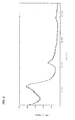
- the negative electrode carbon materials for lithium ion secondary batteries of Examples 2, 3, 10 and 12 each had a relatively broad peak at a 2 ⁇ of 40 to 50° and a sharp peak at a 2 ⁇ of 42 to 44° like Example 1.
- the negative electrode carbon materials for lithium ion secondary batteries of Examples 4 to 9, 11 and 13 each had a relatively broad peak at a 2 ⁇ of 40 to 50°, but the half-value width of a peak at a 2 ⁇ of 42 to 44° was less than 0.30° and the A/B ratio of the intensity A of this peak to the intensity B of the broad peak was less than 1.2. Therefore, it could not be distinguished from noise (Table 2).
- An X-ray diffraction diagram of the negative electrode carbon material of Example 8 is shown in Fig. 2.
- the negative electrode carbon material for a lithium ion secondary battery of Example 7 which was post-calcinated at 2,700°C had a graphite structure.
- the other negative electrode carbon materials for lithium ion secondary batteries had an amorphous-based hard carbon structure.
- secondary batteries each including lithium manganate LiMn 2 O 4 as a positive electrode active substance were manufactured by using those negative electrode carbon materials for lithium ion secondary batteries in accordance with the following procedure.
- Each of the above negative electrode carbon materials for a lithium ion secondary battery and polyvinylidene fluoride (binder) were mixed together uniformly in an N-methylpyrrolidinone solvent in a mass ratio of 91:9.
- Each of the mixtures was applied to both surfaces of a 14 ⁇ m-thick copper foil (assembly of negative electrodes) to a thickness of about 80 ⁇ m and dried to manufacture a sheet-like negative electrode.
- Those negative electrodes were cut into a 1.48cm x 13.0 cm piece, respectively.
- lithium manganate LiMn 2 O 4 positive electrode active substance, average particle diameter of 10 ⁇ m
- acetylene black conducting agent
- polyvinylidene fluoride binder
- LiPF 6 was dissolved in a mixed solvent of ethylene carbonate (EC) and dimethyl carbonate (DMC) in a mass ratio of 50:50 to a concentration of 1 mol/L to prepare a non-aqueous electrolyte.
- EC ethylene carbonate
- DMC dimethyl carbonate
- a commercially available porous stretched polypropylene sheet (UP3025 manufactured by Ube Corporation) was used as a separator. This separator was cut into a 14. 8 cmx 12. 8 cmpiece.
- a laminate composed of the positive electrode, the negative electrode, and the above separator sandwiched between the electrodes was the basic structure of a test battery.
- the laminate was immersed in the prepared non-aqueous electrolyte for 10 minutes to impregnate the porous stretched polypropylene sheet with the non-aqueous electrolyte to thereby assemble a lithium ion secondary battery.
- Lead wires were attached to the assemblies of the positive electrode and the negative electrode, respectively, to carry out a charge/discharge cycle test at a constant current at 30°C.
- the initial charge/discharge capacity was measured using a charge end voltage of 4.2 V, a discharge end voltage of 2.9V, and a charge/discharge current density of 1 mA/cm 2 .
- the initial charge/discharge efficiency of the negative electrode carbon material for a lithium ion secondary battery of the present invention was equal to ( ⁇ ) or superior ( ⁇ , o) to that of the prior art product.
- the charge/discharge performance of the negative electrode carbon material for a lithium ion secondary battery of the present invention which had a relatively broad peak at a 2 ⁇ of 40 to 50° and a sharp peak at a 2 ⁇ of 42 to 44° was particularly excellent ( ⁇ ).
- a pelleted raw material was precalcinated in a rotary kiln at 800 to 900°C for 6 hours in a nitrogen gas atmosphere. This precalcinated product was ground to a ground product having an average particle diameter of 20 to 30 ⁇ m, and the ground product was placed in a crucible and post-calcinated at 900 to 1, 550°C for 5 to 10 hours to obtain a negative electrode carbon material for a lithium ion secondary battery (Table 1).
- a lithium ion secondary battery was assembled in the same manner as in Example 1 to evaluate its charge/discharge performance. The evaluation is shown in Table 2.
- Red bran (Comparative Example 4) corresponding to the pericarp and the testa, middle-grade white bran (Comparative Example 5), and high-grade white bran (Comparative Example 6) each exists in the step for polishing unpolished rice were calcinated as samples in an electric furnace. About 50 g of each sample was tested in an Ar gas atmosphere at 1,600°C for 2 hours. In the case of red bran (Comparative Example 4), volatile matters adhered to the top plate in the electric furnace in an amount larger than 10 mass% of the sample and a very bad smell was generated during calcinating.
Landscapes
- Chemical & Material Sciences (AREA)
- Engineering & Computer Science (AREA)
- Chemical Kinetics & Catalysis (AREA)
- Electrochemistry (AREA)
- General Chemical & Material Sciences (AREA)
- Manufacturing & Machinery (AREA)
- Materials Engineering (AREA)
- Inorganic Chemistry (AREA)
- Battery Electrode And Active Subsutance (AREA)
Priority Applications (1)
| Application Number | Priority Date | Filing Date | Title |
|---|---|---|---|
| EP06250214A EP1808919B1 (fr) | 2006-01-16 | 2006-01-16 | Matériau de carbone pour électrode négative de batterie secondaire au lithium et son procédé de preparation |
Applications Claiming Priority (1)
| Application Number | Priority Date | Filing Date | Title |
|---|---|---|---|
| EP06250214A EP1808919B1 (fr) | 2006-01-16 | 2006-01-16 | Matériau de carbone pour électrode négative de batterie secondaire au lithium et son procédé de preparation |
Publications (2)
| Publication Number | Publication Date |
|---|---|
| EP1808919A1 true EP1808919A1 (fr) | 2007-07-18 |
| EP1808919B1 EP1808919B1 (fr) | 2011-08-24 |
Family
ID=38006859
Family Applications (1)
| Application Number | Title | Priority Date | Filing Date |
|---|---|---|---|
| EP06250214A Ceased EP1808919B1 (fr) | 2006-01-16 | 2006-01-16 | Matériau de carbone pour électrode négative de batterie secondaire au lithium et son procédé de preparation |
Country Status (1)
| Country | Link |
|---|---|
| EP (1) | EP1808919B1 (fr) |
Citations (3)
| Publication number | Priority date | Publication date | Assignee | Title |
|---|---|---|---|---|
| US5834138A (en) * | 1995-03-06 | 1998-11-10 | Sony Corporation | Negative electrode material for non-aqueous liquid electrolyte secondary cell and non-aqueous liquid electrolyte secondary cell employing same |
| JP2001266850A (ja) | 2000-03-17 | 2001-09-28 | Kazuo Horikirigawa | リチウムイオン二次電池とその製造方法 |
| US6335122B1 (en) * | 1997-04-03 | 2002-01-01 | Sony Corporation | Carbonaceous electrode material for non-aqueous secondary battery |
-
2006
- 2006-01-16 EP EP06250214A patent/EP1808919B1/fr not_active Ceased
Patent Citations (3)
| Publication number | Priority date | Publication date | Assignee | Title |
|---|---|---|---|---|
| US5834138A (en) * | 1995-03-06 | 1998-11-10 | Sony Corporation | Negative electrode material for non-aqueous liquid electrolyte secondary cell and non-aqueous liquid electrolyte secondary cell employing same |
| US6335122B1 (en) * | 1997-04-03 | 2002-01-01 | Sony Corporation | Carbonaceous electrode material for non-aqueous secondary battery |
| JP2001266850A (ja) | 2000-03-17 | 2001-09-28 | Kazuo Horikirigawa | リチウムイオン二次電池とその製造方法 |
Also Published As
| Publication number | Publication date |
|---|---|
| EP1808919B1 (fr) | 2011-08-24 |
Similar Documents
| Publication | Publication Date | Title |
|---|---|---|
| DE69508523T2 (de) | Lithium-Sekundärbatterie mit nichtwässrigem Elektrolyten | |
| EP3011618B1 (fr) | Carbones conducteurs pour batteries ion-lithium | |
| KR101433976B1 (ko) | 리튬이온 이차전지 음극용 탄소재료, 저결정성 탄소 함침 리튬이온 이차 전지 음극용 탄소재료, 음극 전극판, 및 리튬이온 이차전지 | |
| JP3362564B2 (ja) | 非水電解液二次電池およびその正極活物質と正極板の製造方法 | |
| CN1078015C (zh) | 锂蓄电池 | |
| JP5670104B2 (ja) | 正極活物質及びリチウム二次電池 | |
| KR20120099108A (ko) | 활물질 입자 및 그 이용 | |
| EP3214673B1 (fr) | Matériau actif positif pour batterie rechargeable au lithium, son procédé de préparation et batterie rechargeable au lithium le comprenant | |
| KR101417588B1 (ko) | 고전도성 음극활물질 및 이의 제조방법 | |
| US10199640B2 (en) | Negative electrode material for secondary battery and secondary battery using the same | |
| KR20180009571A (ko) | 음극 활물질, 이를 포함하는 리튬 전지, 및 상기 음극 활물질의 제조방법 | |
| US20090130558A1 (en) | Optimised Positive Electrode Material for Lithium Cell Batteries, Method for the Production Thereof, Electrode, and Battery for Implementing Said Method | |
| EP3709397B1 (fr) | Électrode positive pour batterie à électrolyte non aqueux et batterie à électrolyte non aqueux | |
| EP4112555A1 (fr) | Matériau actif d'électrode positive pour batterie secondaire à électrolyte non aqueux et batterie secondaire à électrolyte non aqueux | |
| JP2006202724A (ja) | 非水電解質二次電池用正極及びその製造方法 | |
| JPH07335216A (ja) | 非水電解質二次電池 | |
| US7981395B2 (en) | Negative electrode carbon material for lithium ion secondary battery and manufacturing method thereof | |
| JP4724390B2 (ja) | リチウムイオン二次電池用負極炭素材料、及びその製造方法 | |
| CN1132259C (zh) | 阳极材料,它的制作方法和使用这种阳极材料的非水电解质电池 | |
| JP2007134286A (ja) | リチウム二次電池用負極材料及びリチウム二次電池 | |
| EP1808919B1 (fr) | Matériau de carbone pour électrode négative de batterie secondaire au lithium et son procédé de preparation | |
| EP4365977A1 (fr) | Procédé de fabrication d'un matériau carboné pour anode et batterie rechargeable au lithium-ion | |
| EP4398325A1 (fr) | Procédé de fabrication d'électrode sèche de batterie secondaire | |
| KR101530686B1 (ko) | 리튬 이차 전지용 음극 활물질, 이의 제조 방법, 이를 포함하는 음극, 및 상기 음극을 포함하는 리튬 이차 전지 | |
| KR20080009135A (ko) | 비수 2차 전지용 활성 물질 및 이의 제조방법 |
Legal Events
| Date | Code | Title | Description |
|---|---|---|---|
| PUAI | Public reference made under article 153(3) epc to a published international application that has entered the european phase |
Free format text: ORIGINAL CODE: 0009012 |
|
| AK | Designated contracting states |
Kind code of ref document: A1 Designated state(s): AT BE BG CH CY CZ DE DK EE ES FI FR GB GR HU IE IS IT LI LT LU LV MC NL PL PT RO SE SI SK TR |
|
| AX | Request for extension of the european patent |
Extension state: AL BA HR MK YU |
|
| 17P | Request for examination filed |
Effective date: 20070730 |
|
| 17Q | First examination report despatched |
Effective date: 20071105 |
|
| AKX | Designation fees paid |
Designated state(s): DE FR GB |
|
| R17C | First examination report despatched (corrected) |
Effective date: 20090119 |
|
| REG | Reference to a national code |
Ref country code: DE Ref legal event code: R079 Ref document number: 602006023955 Country of ref document: DE Free format text: PREVIOUS MAIN CLASS: H01M0004580000 Ipc: H01M0010052500 |
|
| GRAP | Despatch of communication of intention to grant a patent |
Free format text: ORIGINAL CODE: EPIDOSNIGR1 |
|
| RIC1 | Information provided on ipc code assigned before grant |
Ipc: H01M 10/0525 20100101AFI20110201BHEP |
|
| GRAS | Grant fee paid |
Free format text: ORIGINAL CODE: EPIDOSNIGR3 |
|
| GRAA | (expected) grant |
Free format text: ORIGINAL CODE: 0009210 |
|
| AK | Designated contracting states |
Kind code of ref document: B1 Designated state(s): DE FR GB |
|
| REG | Reference to a national code |
Ref country code: GB Ref legal event code: FG4D |
|
| REG | Reference to a national code |
Ref country code: DE Ref legal event code: R096 Ref document number: 602006023955 Country of ref document: DE Effective date: 20111027 |
|
| PLBE | No opposition filed within time limit |
Free format text: ORIGINAL CODE: 0009261 |
|
| STAA | Information on the status of an ep patent application or granted ep patent |
Free format text: STATUS: NO OPPOSITION FILED WITHIN TIME LIMIT |
|
| 26N | No opposition filed |
Effective date: 20120525 |
|
| REG | Reference to a national code |
Ref country code: DE Ref legal event code: R097 Ref document number: 602006023955 Country of ref document: DE Effective date: 20120525 |
|
| REG | Reference to a national code |
Ref country code: FR Ref legal event code: PLFP Year of fee payment: 11 |
|
| REG | Reference to a national code |
Ref country code: FR Ref legal event code: PLFP Year of fee payment: 12 |
|
| REG | Reference to a national code |
Ref country code: FR Ref legal event code: PLFP Year of fee payment: 13 |
|
| PGFP | Annual fee paid to national office [announced via postgrant information from national office to epo] |
Ref country code: DE Payment date: 20200121 Year of fee payment: 15 Ref country code: GB Payment date: 20200120 Year of fee payment: 15 |
|
| PGFP | Annual fee paid to national office [announced via postgrant information from national office to epo] |
Ref country code: FR Payment date: 20200120 Year of fee payment: 15 |
|
| REG | Reference to a national code |
Ref country code: DE Ref legal event code: R082 Ref document number: 602006023955 Country of ref document: DE Representative=s name: DEHNSGERMANY PARTNERSCHAFT VON PATENTANWAELTEN, DE |
|
| REG | Reference to a national code |
Ref country code: DE Ref legal event code: R119 Ref document number: 602006023955 Country of ref document: DE |
|
| GBPC | Gb: european patent ceased through non-payment of renewal fee |
Effective date: 20210116 |
|
| PG25 | Lapsed in a contracting state [announced via postgrant information from national office to epo] |
Ref country code: FR Free format text: LAPSE BECAUSE OF NON-PAYMENT OF DUE FEES Effective date: 20210131 |
|
| PG25 | Lapsed in a contracting state [announced via postgrant information from national office to epo] |
Ref country code: GB Free format text: LAPSE BECAUSE OF NON-PAYMENT OF DUE FEES Effective date: 20210116 Ref country code: DE Free format text: LAPSE BECAUSE OF NON-PAYMENT OF DUE FEES Effective date: 20210803 |