EP1808964A2 - Procédé et appareil de gestion du stockage de données - Google Patents
Procédé et appareil de gestion du stockage de données Download PDFInfo
- Publication number
- EP1808964A2 EP1808964A2 EP07250081A EP07250081A EP1808964A2 EP 1808964 A2 EP1808964 A2 EP 1808964A2 EP 07250081 A EP07250081 A EP 07250081A EP 07250081 A EP07250081 A EP 07250081A EP 1808964 A2 EP1808964 A2 EP 1808964A2
- Authority
- EP
- European Patent Office
- Prior art keywords
- data
- stored
- fault
- storage device
- protection
- Prior art date
- Legal status (The legal status is an assumption and is not a legal conclusion. Google has not performed a legal analysis and makes no representation as to the accuracy of the status listed.)
- Withdrawn
Links
Images
Classifications
-
- G—PHYSICS
- G06—COMPUTING OR CALCULATING; COUNTING
- G06F—ELECTRIC DIGITAL DATA PROCESSING
- G06F11/00—Error detection; Error correction; Monitoring
- G06F11/008—Reliability or availability analysis
-
- G—PHYSICS
- G06—COMPUTING OR CALCULATING; COUNTING
- G06F—ELECTRIC DIGITAL DATA PROCESSING
- G06F11/00—Error detection; Error correction; Monitoring
- G06F11/07—Responding to the occurrence of a fault, e.g. fault tolerance
- G06F11/0703—Error or fault processing not based on redundancy, i.e. by taking additional measures to deal with the error or fault not making use of redundancy in operation, in hardware, or in data representation
- G06F11/0706—Error or fault processing not based on redundancy, i.e. by taking additional measures to deal with the error or fault not making use of redundancy in operation, in hardware, or in data representation the processing taking place on a specific hardware platform or in a specific software environment
- G06F11/0727—Error or fault processing not based on redundancy, i.e. by taking additional measures to deal with the error or fault not making use of redundancy in operation, in hardware, or in data representation the processing taking place on a specific hardware platform or in a specific software environment in a storage system, e.g. in a DASD or network based storage system
-
- G—PHYSICS
- G11—INFORMATION STORAGE
- G11B—INFORMATION STORAGE BASED ON RELATIVE MOVEMENT BETWEEN RECORD CARRIER AND TRANSDUCER
- G11B20/00—Signal processing not specific to the method of recording or reproducing; Circuits therefor
- G11B20/10—Digital recording or reproducing
- G11B20/18—Error detection or correction; Testing, e.g. of drop-outs
-
- H—ELECTRICITY
- H03—ELECTRONIC CIRCUITRY
- H03M—CODING; DECODING; CODE CONVERSION IN GENERAL
- H03M13/00—Coding, decoding or code conversion, for error detection or error correction; Coding theory basic assumptions; Coding bounds; Error probability evaluation methods; Channel models; Simulation or testing of codes
- H03M13/35—Unequal or adaptive error protection, e.g. by providing a different level of protection according to significance of source information or by adapting the coding according to the change of transmission channel characteristics
-
- G—PHYSICS
- G06—COMPUTING OR CALCULATING; COUNTING
- G06F—ELECTRIC DIGITAL DATA PROCESSING
- G06F11/00—Error detection; Error correction; Monitoring
- G06F11/07—Responding to the occurrence of a fault, e.g. fault tolerance
- G06F11/0703—Error or fault processing not based on redundancy, i.e. by taking additional measures to deal with the error or fault not making use of redundancy in operation, in hardware, or in data representation
- G06F11/0793—Remedial or corrective actions
Definitions
- the present invention relates to a method and apparatus for managing storage of data.
- data has been classed as being one of two types.
- For the first type it is determined that it is not important if the data is lost such that no particular protection or error correction (beyond that typically applied by the data storage devices themselves) is applied to the data.
- For the other type of data it is determined that the data must not be lost. In that case, protection can be applied to the data.
- a well known and effective type of protection is provided by the various types of RAID (Redundant Array of Inexpensive Disks). Protection of data, using for example RAID, is inevitably relatively expensive. This is becoming a growing problem given that increasing amounts of data is stored electronically, not only because of the increasing use of computers but also because file sizes are increasing.
- Particular examples include audio and visual files, including static and video images, for which the data files are increasing in size owing to customer expectations of improved sound quality and higher resolution of the images.
- Much data is currently being archived with the requirement that it persist for very long periods of time, such as one hundred years or more. The cost of providing adequate protection for that data over such a period is growing and is likely to become prohibitive on a practical basis.
- US-B-6828967 discloses a system that is intended to deal with the problem of the cost of providing access to stored image data.
- a relatively low resolution version of the image data is stored on-line in order to be accessible relatively quickly.
- Data relating to higher resolution versions of the images is stored offline, and therefore more cheaply but less readily accessible. Nevertheless, in the system of US-B-6828967 , it is still practically assumed that the stored data will persist perfectly for all time.
- a method of managing storage of data comprising: storing data; checking the stored data for development of a fault in the stored data; and, if a fault is detected, applying to at least some of the remaining fault-free data at least one of: (i) increased protection and (ii) increased error correction.
- the present invention is predicated on the realisation that not all data has to be stored perfectly over extended periods of time or in perpetuity.
- some of the stored data can be lost and yet the remaining fault-free data can be used as a usable data set. It will be appreciated that this is a separation of the interpretation of the data and the data itself.
- the data set is preserved such that the interpretation remains the same, or at least similar or "the same" within predefined bounds, even though some of the data is or may be lost.
- the preferred embodiments of the present invention do not (necessarily) provide for 100% persistence of the data in perpetuity but instead provide for a known and acceptable degradation over time, with measures being taken as necessary to protect remaining data to ensure that a useable data set remains.
- a particular example is stored image data. For example, if the data representing only a few of the pixels is lost, then the viewer is unlikely to notice the loss at all. If the loss is greater, for example if many pixels or a whole row of pixels or even a whole frame of a video image is lost, then interpolation can be used to allow the image or sequence of images to be presented to a viewer with little or no loss of perceptible quality of the image, the interpretation of the data remaining constant. This ability to mask a loss of data characterises graceful degradation of the data, and can be contrasted with prior art techniques that try to prevent any data being lost at all (e.g.
- the checking of the stored data for development of a fault in the stored data may be carried out periodically or in reaction to attempted data access.
- the checking may be at regular intervals of any appropriate time period, which will depend on the nature of the data and its expected storage lifetime. Thus, the data could be checked every second, every hour, every day, once a month or even once a year, depending on the nature of the data and its importance in providing a usable data set and the nature of the storage of the data.
- the frequency of checking may be varied over time. For example, if it is found that a fault has developed, the checking interval may be reduced in order to minimise the chance of further faults developing that would cause the data as a whole to be unusable.
- said data is stored in at least one data storage device, said at least one of (i) increased protection and (ii) increased error correction being applied to at least some of the data that is physically adjacent the faulty data in said at least one data storage device.
- said at least one of (i) increased protection and (ii) increased error correction is applied to at least some of the data that is adjacent the faulty data in a file that is made up of said data. For example, if the data is image data and it is found that data relating to a certain pixel, or row of pixels, or frame of a moving image, is faulty, then increased protection and/or error correction can be applied around neighbouring pixels, rows of pixels, or frames, respectively. These neighbouring pixels or rows may be logical neighbours in time as well as physically within a single image frame. This maximises the possibility of the remaining fault-free data being usable over an extended period to reconstruct the image, either as a slightly degraded version or through interpolation.
- the method comprises classifying the data according to its importance in providing a usable data set, and storing the data according to the importance of the data. It is a fact that some data is more important than other data. Many examples of this exist, as will be discussed further below. In this embodiment, increased protection and/or error correction, for example, can be applied to the more important data, with lesser or no protection and/or error correction being applied to the less important data.
- the method comprises, after a fault has been detected, analysing the remaining fault-free data and reassessing its classification according to its importance in providing a usable data set from the remaining fault-free data, and storing the remaining fault-free data according to the importance of the remaining fault-free data.
- the importance of the remaining fault-free data will typically change and it will typically become more important to preserve the remaining fault-free data to allow a usable data set to be maintained.
- proximity may be in the sense of proximate on the storage device or proximate in the image or other file that is constructed from the data.
- data that is classed as being of relatively low importance is stored with a relatively low level of protection or no protection
- data that is classed as being of relatively high importance is stored with a relatively high level of protection
- data that is classed as being of relatively low importance is stored with a relatively low level of error correction or no error correction
- data that is classed as being of relatively high importance is stored with a relatively high level of error correction
- the data is stored in at least one storage device, the method comprising, when a fault in the data stored in said at least one storage device is detected, said data storage device returning information about why the fault in the data occurred.
- the data is stored in at least one storage device, the method comprising, when a fault in the data stored in said at least one storage device is detected, determining the likelihood of said at least one data storage device suffering complete failure within a certain time period and moving the data from said at least one data storage device to another data storage device if said likelihood exceeds a threshold. For example, if a hard disk reports repeated checksum errors, as an example 10 out of the past 100 accesses reporting such a failure, whilst not failing completely, the device may be considered as being in the process of failing and the data moved.
- the method comprises sending a prompt to a user to check that the remaining fault-free data provides a useable data set.
- a method of managing storage of data comprising: storing data in at least one storage device; monitoring the at least one storage device to determine whether the at least one storage device has failed or is likely to fail within a certain time period; and, if it is determined that the at least one storage device has failed or is likely to fail within a certain time period, changing the manner in which the data is stored in accordance with at least one property of the data.
- the monitoring may effectively be pro-active or reactive.
- the at least one property of the data is the importance of the data in providing a usable data set.
- the manner in which the data is stored is changed by increasing protection that is applied to at least some of the stored data.
- the manner in which the data is stored is changed by increasing error protection that is applied to at least some of the stored data.
- apparatus for managing storage of data comprising: a data storage manager arranged to check the stored data for development of a fault in the stored data, and, if a fault is detected, to cause application to at least some of the remaining fault-free data at least one of: (i) increased protection and (ii) increased error correction.
- the data storage manager is arranged to check the stored data periodically and/or on data access for development of a fault in the stored data.
- said data is stored in at least one data storage device, and wherein the data storage manager is arranged to cause said at least one of (i) increased protection and (ii) increased error correction to be applied to at least some of the data that is physically adjacent the faulty data in said at least one data storage device.
- the data storage manager is arranged to cause said at least one of (i) increased protection and (ii) increased error correction to be applied to at least some of the data that is adjacent the faulty data in a file that is made up of said data.
- the data storage manager is arranged to cause said at least one of (i) increased protection and (ii) increased error correction to be applied to at least some of the data that is logically temporally adjacent the faulty data in a data stream that is made up of said data.
- the apparatus comprises a classifier arranged to classify the data according to its importance in providing a usable data set, the data storage manager being arranged to cause the data to be stored according to the importance of the data.
- the classifier is arranged to reclassify at least some of the remaining fault-free data according to its importance in providing a usable data set from the remaining fault-free data after a fault has been detected, the data storage manager being arranged to cause the remaining fault-free data to be stored according to the importance of the remaining fault-free data.
- the data storage manager is arranged so that data that is classed as being of relatively low importance is stored with a relatively low level of protection or no protection, and data that is classed as being of relatively high importance is stored with a relatively high level of protection.
- the data storage manager is arranged so that data that is classed as being of relatively low importance is stored with a relatively low level of error correction or no error correction, and data that is classed as being of relatively high importance is stored with a relatively high level of error correction.
- the data is stored in at least one storage device, the data storage device being arranged so that, when a fault in the data stored in said at least one storage device is detected, said data storage device returns information about why the fault in the data occurred.
- the data is stored in at least one storage device, the data storage device being arranged so that, when a fault in the data stored in said at least one storage device is detected, the likelihood of said at least one data storage device suffering complete failure within a certain time period is determined and so that the data is moved from said at least one data storage device to another data storage device if said likelihood exceeds a threshold.
- the data storage manager is arranged so that a prompt is sent to a user to check that the remaining fault-free data provides a useable data set.
- apparatus for managing storage of data comprising: at least one storage device in which data can be stored; and, a data storage manager arranged to monitor the at least one storage device to determine whether the at least one storage device has failed or is likely to fail within a certain time period, and, if it is determined that the at least one storage device has failed or is likely to fail within a certain time period, to cause the manner in which the data is stored to be changed in accordance with at least one property of the data.
- the at least one property of the data is the importance of the data in providing a usable data set.
- the data storage manager is arranged so that the manner in which the data is stored is changed by increasing protection that is applied to at least some of the stored data.
- the data storage manager is arranged so that the manner in which the data is stored is changed by increasing error protection that is applied to at least some of the stored data.
- a particular aim of the preferred embodiments is therefore to permit data to be stored relatively inexpensively, for example by avoiding having to apply protection, such as RAID, to the entire data set, and to manage loss of any data over time so that the remaining fault-free data is usable.
- the preferred embodiments provide for graceful degradation of stored data using a number of techniques, which in general can be used individually or in combination. Examples will be discussed below.
- parameters are set that describe the manner in which the data can be permitted to fail and the likely required lifetime of the data. It should be noted that in principle the lifetime could be infinite, though this is not preferred. These parameters determine how the data is stored and what error correction and protection mechanisms should be used.
- a data storage manager which may be implemented in software or hardware or a combination, then manages the data to ensure that the data is checked so that it can be preserved in an acceptable manner in accordance with the set parameters. Typically, the data storage manager checks the data for corruption on data access and/or on a periodic basis.
- the data might be checked every second, every minute, every hour, once a day, once a month, etc., at least if the data has not been accessed in the meantime. If a fault in the data is detected, measures can then be taken in order to better preserve the remaining fault-free data.
- the data storage manager can cause at least some of the remaining fault-free data to be subject to increased protection.
- the data might initially be stored without any protection (for example of the RAID type or the like), which keeps down costs. If a fault in the data is detected, or if a sufficient number of faults is detected, such that the data storage manager determines that measures need to be taken, then the data storage manager can cause protection to be provided to at least some of the remaining data.
- protection can be provided for the data of at least one of the adjacent rows of pixels.
- an increased level of protection can be provided to at least some of the remaining fault-free data. For example, initially RAID 5 protection might initially be provided, and this can be increased to RAID 6 protection on detection of a fault.
- the protection can be provided on a sliding scale that depends on the importance of the data.
- a high level of protection such as RAID 6
- RAID 5 can be applied by the data storage manager to the one or two frames on either side of a corrupted frame, with a lower level of protection, such as RAID 5, being provided to the next several frames, such as frames 3 to 20, on either side of the corrupted frame, and so on.
- Another technique for managing the stored data is to apply increased error correction to remaining fault-free data.
- storage devices such as hard disks and the like typically already use error correction codes on blocks of data as they are read from the storage device.
- (increased) error correction is preferentially applied to the data that is in some sense adjacent the faulty data so as to maximise the likelihood that the remaining data remains useful over an extended period of time.
- the error correction techniques that are applied may be different according to the nature of the data, so that the error correction is tailored so as to keep down costs whilst providing adequate error correction. For example, for audio data, it is preferable to use a system that provides good burst error correction but for which a relatively low level of bit error correction can be applied.
- the data storage manager can determine the likelihood that there is an uncorrected error in the data. For example, a likelihood prediction can be made based on previous data to determine the likelihood that a particular bit is erroneous.
- the data storage device or devices on which the data is stored may return what data it knows to be valid from a block that has suffered corruption, together with an indicator of how failed the data might be. This information is useful to the data storage manager because, as already explained above, even though there may be faulty data, the remaining fault-free data can be usable. Thus, even at the sub-block level, there may be data in a failed block that is nevertheless useful depending on the nature of the data and the extent to which it has become corrupted.
- object-based storage systems may be used to store the data on the one or more storage devices.
- object-based storage facilitates the ordering of the stored data, which is particularly helpful in the present context.
- a flag or some other prompt can be generated so that a human user can be prompted to check that the remaining data is useful.
- the data storage manager can take steps to increase the protection or error correction applied to the remaining fault-free data.
- the preferred embodiments typically allow data to degrade over time, the cost of storage of the data can be reduced further by using storage devices that would otherwise not be useful.
- the devices are subject to quality control during which the devices are checked inter alia for their ability to store data to a certain specification.
- some will normally be discarded by the manufacturer because for example the surface of the disk is partially damaged such that the manufacturer cannot certify the hard disk as providing a normally adequate storage of data over time.
- the preferred embodiments permit data to be lost over time, albeit in a managed way, these otherwise "failed" disks can be used to store data that is permitted to degrade over time. If errors in the stored data are detected over time, this is not generally a particular concern because of the measures taken by the preferred embodiments to preserve the remaining fault-free data.
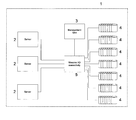
- FIG. 1 shows schematically an example of apparatus 1 according to an embodiment of the present invention.
- Plural servers 2 are provided, which may be standard storage servers that run additional software to provide interaction with a data storage manager 3 and to provide the additional functionality required to store data in the manner requested by data storage manager 3.
- this may be in regularly sized chunks, split by frequency range, split by instrument type, or any other characteristic way.
- video data it may be by frame, or by row of pixels, or any other characteristic way.
- FIG. 1 Also shown in Figure 1 are storage sub-systems 4 that are capable of implementing a level of error correction or data protection as required by the data storage manager 3.
- These storage sub-systems 4 consists of one or more storage devices and zero or more low level storage controllers (not shown) operating to implement one or more protection and/or correction techniques.
- the full system for the examples described below will contain two or more storage sub-systems 4 although this need not be the case with alternative valid management approaches.
- the data storage manager 3, the server(s) 2 and the storage sub-system(s) 4 are all interconnected via a suitable network 5 or similar, which may include one or more of system level interconnect, a LAN, a WAN, and the internet.
- the data storage manager 3 may be a processor (either general purpose or application specific) running software to enable it to "exercise" data and to respond to server enquiries as to how given data files should be broken up for storage.
- the data storage manager 3 maintains a map of the attached storage sub-system(s) 4 along with a map of the used and unused potions of the attached storage sub-system(s) 4.
- the protection and correction mechanisms that can be used in conjunction with the attached storage sub-system(s) 4 and in conjunction with the servers 2. This can include protection and correction mechanisms that a server 2 can implement, the storage that is provided by the storage sub-system(s) 4 being used simply as a data store, and those that are native to the storage sub-system(s) 4.
- the video data is accompanied by data that is input by the user and that gives information about the level of data persistence required and the importance of the data. For example a user may say that frame level reconstruction techniques are acceptable for 1 frame in 24 but that the start and end six frames must remain for these techniques to be applied. Similarly the user may specify that pixel failure correction techniques may be applied from the corresponding pixels in preceding frames or from the neighbouring pixels within a frame. Such rules may be specified by a user or automatically applied by the controller based on the data type in question.
- the user also provides to the server 2 (and so to the data storage manager 3) details of the data type and content through meta-data to be stored in the system.
- the rule set used to determine the importance of data may be derived directly from the data type by the storage manager instead of directly by the user.
- the server 2 communicates initially with the data storage manager 3 to determine the storage mechanisms that are appropriate for this data.
- the data storage manager 3 directs the server 2 to store consecutive images on different storage sub-systems 4, possibly in a rotating manner using the error correction and protection levels required by the user.
- the first and last six frames may be designated as stored using RAID level 5 encoding whilst the remaining frames are stored un-encoded over an array of 24 sub-systems.
- the server 2 notifies the data storage manager 3 through the network 5 that the data has been stored and the locations in the storage sub-systems 4 of the images.
- the data storage manager 3 exercises this data periodically, either in response to user request or at a given minimum exercise rate set either by the user or by the storage manager based on the data type. This exercising will involve the data storage manager 3 requesting that the storage sub-system 4 returns the data to the data storage manager 3.
- the storage sub-systems 4 will either return data they believe to be correct or they will return an error code. This code will give the data storage manager 3 information concerning the nature of a failure, for example the fact that there is a failed disk in the sub-system or that a checksum revealed a data error. If the data storage manager 3 gets data from the storage sub-system 4, it is able to perform basic analysis on it to confirm that it still conforms to the characteristics described in the meta-data provided when the data was originally stored.
- the original storage mechanism used no error correction or data protection scheme when the data was stored, in order to maximise the usable volume of the system. If, upon exercising the data, the data storage manager 3 obtains erroneous or no data from one of the sub-systems 4, it is then able to add error correction to the still-usable data from the other sub-systems 4 and save it back to these sub-systems 4, at the same time directing the sub-systems 4 to use a higher level of data protection (e.g. RAID 5). This then reduces the likelihood of the remaining data becoming unusable. With this approach and n sub-systems, it is likely that only 1/nth of the data will become non-valid during the lifetime of the data.
- a higher level of data protection e.g. RAID 5
- the data storage manager 3 instructs the server 2 to add new months of data to different storage sub-systems 4 than the previous months' data. Once this is accomplished, the system is able to operate in a similar manner to ensure that the maximum usage of the storage sub-systems is obtained and that there will be at most 1/nth data loss.
- the data storage manager is able to measure the importance of a given month's data through analysis of the trends illustrated by the currently existing fault-free data set and the change in both the trends and the statistical confidence in those trends if a given month's data is lost. In this way, the storage manager is able to direct that data that has high importance to the interpretation of the full set is stored with high protection, for example RAID level 6, and that data with low importance is stored with low, or no, protection.
- the data storage manager 3 will also interrogate the storage sub-systems 4 to request functional checks as well as data requests.
- the storage sub-systems 4 will then perform self-check operations (such as actuator response times, surface scans, etc.) to determine whether there is a localised failure or whether there is likely to be a localised failure soon.
- the data storage manager 3 then instructs the storage sub-systems 4 to increase the protection and correction levels applied to the remaining data (which may be both within and without an individual sub-system 4).
- the data storage manager 3 both increases the protection and/or correction level applied to the data and sends the server 2 a message for the user to inform the user of the increased likelihood of hardware failure. The user is then free to act in a way to mitigate against this predicted failure.
- a data storage manager This may be implemented in software or hardware (such as ASICs) or a combination.
- the data storage manager may be a single entity.
- the function of the data storage manager may be spread over a number of discrete devices, including for example the data storage devices on which the data is stored, network controllers that control flow of data between for example a user and the data storage devices, etc.
- the data storage manager whether a single entity or spread over plural devices, manages the stored data through knowledge about the data, including the type of data (e.g.
- One such approach for determining the criticality of data is to determine the ability of the system to meet the user criteria for data degradation level in the event that a given data portion becomes non valid. If the criteria are still met, then the data storage manager will not change the importance setting for that data. If the criteria become breached, then the criticality level will be increased.
Landscapes
- Engineering & Computer Science (AREA)
- Theoretical Computer Science (AREA)
- Physics & Mathematics (AREA)
- Quality & Reliability (AREA)
- General Engineering & Computer Science (AREA)
- General Physics & Mathematics (AREA)
- Probability & Statistics with Applications (AREA)
- Signal Processing (AREA)
- Information Retrieval, Db Structures And Fs Structures Therefor (AREA)
- Techniques For Improving Reliability Of Storages (AREA)
- Debugging And Monitoring (AREA)
Applications Claiming Priority (1)
| Application Number | Priority Date | Filing Date | Title |
|---|---|---|---|
| US75905606P | 2006-01-17 | 2006-01-17 |
Publications (2)
| Publication Number | Publication Date |
|---|---|
| EP1808964A2 true EP1808964A2 (fr) | 2007-07-18 |
| EP1808964A3 EP1808964A3 (fr) | 2008-04-16 |
Family
ID=37103114
Family Applications (1)
| Application Number | Title | Priority Date | Filing Date |
|---|---|---|---|
| EP07250081A Withdrawn EP1808964A3 (fr) | 2006-01-17 | 2007-01-10 | Procédé et appareil de gestion du stockage de données |
Country Status (2)
| Country | Link |
|---|---|
| US (1) | US8020047B2 (fr) |
| EP (1) | EP1808964A3 (fr) |
Families Citing this family (188)
| Publication number | Priority date | Publication date | Assignee | Title |
|---|---|---|---|---|
| US7711995B1 (en) * | 2006-06-23 | 2010-05-04 | Alan Morris | Method and system for digital preservation having long term error-free storage, retrieval, and interpretation of digital files |
| US12008266B2 (en) | 2010-09-15 | 2024-06-11 | Pure Storage, Inc. | Efficient read by reconstruction |
| US11614893B2 (en) | 2010-09-15 | 2023-03-28 | Pure Storage, Inc. | Optimizing storage device access based on latency |
| US8589640B2 (en) | 2011-10-14 | 2013-11-19 | Pure Storage, Inc. | Method for maintaining multiple fingerprint tables in a deduplicating storage system |
| US9417628B2 (en) * | 2013-03-13 | 2016-08-16 | Western Digital Technologies, Inc. | Production failure analysis system |
| US11652884B2 (en) | 2014-06-04 | 2023-05-16 | Pure Storage, Inc. | Customized hash algorithms |
| US12137140B2 (en) | 2014-06-04 | 2024-11-05 | Pure Storage, Inc. | Scale out storage platform having active failover |
| US9367243B1 (en) | 2014-06-04 | 2016-06-14 | Pure Storage, Inc. | Scalable non-uniform storage sizes |
| US9836234B2 (en) | 2014-06-04 | 2017-12-05 | Pure Storage, Inc. | Storage cluster |
| US9612952B2 (en) | 2014-06-04 | 2017-04-04 | Pure Storage, Inc. | Automatically reconfiguring a storage memory topology |
| US10574754B1 (en) | 2014-06-04 | 2020-02-25 | Pure Storage, Inc. | Multi-chassis array with multi-level load balancing |
| US11399063B2 (en) | 2014-06-04 | 2022-07-26 | Pure Storage, Inc. | Network authentication for a storage system |
| US11068363B1 (en) | 2014-06-04 | 2021-07-20 | Pure Storage, Inc. | Proactively rebuilding data in a storage cluster |
| US9003144B1 (en) | 2014-06-04 | 2015-04-07 | Pure Storage, Inc. | Mechanism for persisting messages in a storage system |
| US9213485B1 (en) | 2014-06-04 | 2015-12-15 | Pure Storage, Inc. | Storage system architecture |
| US8850108B1 (en) | 2014-06-04 | 2014-09-30 | Pure Storage, Inc. | Storage cluster |
| US12341848B2 (en) | 2014-06-04 | 2025-06-24 | Pure Storage, Inc. | Distributed protocol endpoint services for data storage systems |
| US11960371B2 (en) | 2014-06-04 | 2024-04-16 | Pure Storage, Inc. | Message persistence in a zoned system |
| US9218244B1 (en) * | 2014-06-04 | 2015-12-22 | Pure Storage, Inc. | Rebuilding data across storage nodes |
| US10114757B2 (en) | 2014-07-02 | 2018-10-30 | Pure Storage, Inc. | Nonrepeating identifiers in an address space of a non-volatile solid-state storage |
| US9836245B2 (en) | 2014-07-02 | 2017-12-05 | Pure Storage, Inc. | Non-volatile RAM and flash memory in a non-volatile solid-state storage |
| US11604598B2 (en) | 2014-07-02 | 2023-03-14 | Pure Storage, Inc. | Storage cluster with zoned drives |
| US9021297B1 (en) | 2014-07-02 | 2015-04-28 | Pure Storage, Inc. | Redundant, fault-tolerant, distributed remote procedure call cache in a storage system |
| US11886308B2 (en) | 2014-07-02 | 2024-01-30 | Pure Storage, Inc. | Dual class of service for unified file and object messaging |
| US8868825B1 (en) | 2014-07-02 | 2014-10-21 | Pure Storage, Inc. | Nonrepeating identifiers in an address space of a non-volatile solid-state storage |
| US8874836B1 (en) | 2014-07-03 | 2014-10-28 | Pure Storage, Inc. | Scheduling policy for queues in a non-volatile solid-state storage |
| US9747229B1 (en) | 2014-07-03 | 2017-08-29 | Pure Storage, Inc. | Self-describing data format for DMA in a non-volatile solid-state storage |
| US9811677B2 (en) | 2014-07-03 | 2017-11-07 | Pure Storage, Inc. | Secure data replication in a storage grid |
| US12182044B2 (en) | 2014-07-03 | 2024-12-31 | Pure Storage, Inc. | Data storage in a zone drive |
| US10853311B1 (en) | 2014-07-03 | 2020-12-01 | Pure Storage, Inc. | Administration through files in a storage system |
| US9558069B2 (en) | 2014-08-07 | 2017-01-31 | Pure Storage, Inc. | Failure mapping in a storage array |
| US9082512B1 (en) | 2014-08-07 | 2015-07-14 | Pure Storage, Inc. | Die-level monitoring in a storage cluster |
| US9483346B2 (en) | 2014-08-07 | 2016-11-01 | Pure Storage, Inc. | Data rebuild on feedback from a queue in a non-volatile solid-state storage |
| US12158814B2 (en) | 2014-08-07 | 2024-12-03 | Pure Storage, Inc. | Granular voltage tuning |
| US9766972B2 (en) | 2014-08-07 | 2017-09-19 | Pure Storage, Inc. | Masking defective bits in a storage array |
| US9495255B2 (en) | 2014-08-07 | 2016-11-15 | Pure Storage, Inc. | Error recovery in a storage cluster |
| US10983859B2 (en) | 2014-08-07 | 2021-04-20 | Pure Storage, Inc. | Adjustable error correction based on memory health in a storage unit |
| US10079711B1 (en) | 2014-08-20 | 2018-09-18 | Pure Storage, Inc. | Virtual file server with preserved MAC address |
| US9948615B1 (en) | 2015-03-16 | 2018-04-17 | Pure Storage, Inc. | Increased storage unit encryption based on loss of trust |
| US11294893B2 (en) | 2015-03-20 | 2022-04-05 | Pure Storage, Inc. | Aggregation of queries |
| US9940234B2 (en) | 2015-03-26 | 2018-04-10 | Pure Storage, Inc. | Aggressive data deduplication using lazy garbage collection |
| US10082985B2 (en) | 2015-03-27 | 2018-09-25 | Pure Storage, Inc. | Data striping across storage nodes that are assigned to multiple logical arrays |
| US10178169B2 (en) | 2015-04-09 | 2019-01-08 | Pure Storage, Inc. | Point to point based backend communication layer for storage processing |
| US12379854B2 (en) | 2015-04-10 | 2025-08-05 | Pure Storage, Inc. | Two or more logical arrays having zoned drives |
| US9672125B2 (en) | 2015-04-10 | 2017-06-06 | Pure Storage, Inc. | Ability to partition an array into two or more logical arrays with independently running software |
| US10140149B1 (en) | 2015-05-19 | 2018-11-27 | Pure Storage, Inc. | Transactional commits with hardware assists in remote memory |
| US9817576B2 (en) | 2015-05-27 | 2017-11-14 | Pure Storage, Inc. | Parallel update to NVRAM |
| US10846275B2 (en) | 2015-06-26 | 2020-11-24 | Pure Storage, Inc. | Key management in a storage device |
| US10983732B2 (en) | 2015-07-13 | 2021-04-20 | Pure Storage, Inc. | Method and system for accessing a file |
| US11232079B2 (en) | 2015-07-16 | 2022-01-25 | Pure Storage, Inc. | Efficient distribution of large directories |
| US10108355B2 (en) | 2015-09-01 | 2018-10-23 | Pure Storage, Inc. | Erase block state detection |
| US11341136B2 (en) | 2015-09-04 | 2022-05-24 | Pure Storage, Inc. | Dynamically resizable structures for approximate membership queries |
| US11269884B2 (en) | 2015-09-04 | 2022-03-08 | Pure Storage, Inc. | Dynamically resizable structures for approximate membership queries |
| US9768953B2 (en) | 2015-09-30 | 2017-09-19 | Pure Storage, Inc. | Resharing of a split secret |
| US10853266B2 (en) | 2015-09-30 | 2020-12-01 | Pure Storage, Inc. | Hardware assisted data lookup methods |
| US10762069B2 (en) | 2015-09-30 | 2020-09-01 | Pure Storage, Inc. | Mechanism for a system where data and metadata are located closely together |
| US12271359B2 (en) | 2015-09-30 | 2025-04-08 | Pure Storage, Inc. | Device host operations in a storage system |
| US9843453B2 (en) | 2015-10-23 | 2017-12-12 | Pure Storage, Inc. | Authorizing I/O commands with I/O tokens |
| US10007457B2 (en) | 2015-12-22 | 2018-06-26 | Pure Storage, Inc. | Distributed transactions with token-associated execution |
| US10133503B1 (en) | 2016-05-02 | 2018-11-20 | Pure Storage, Inc. | Selecting a deduplication process based on a difference between performance metrics |
| US10261690B1 (en) | 2016-05-03 | 2019-04-16 | Pure Storage, Inc. | Systems and methods for operating a storage system |
| US11231858B2 (en) | 2016-05-19 | 2022-01-25 | Pure Storage, Inc. | Dynamically configuring a storage system to facilitate independent scaling of resources |
| US10691567B2 (en) | 2016-06-03 | 2020-06-23 | Pure Storage, Inc. | Dynamically forming a failure domain in a storage system that includes a plurality of blades |
| US12235743B2 (en) | 2016-06-03 | 2025-02-25 | Pure Storage, Inc. | Efficient partitioning for storage system resiliency groups |
| US11706895B2 (en) | 2016-07-19 | 2023-07-18 | Pure Storage, Inc. | Independent scaling of compute resources and storage resources in a storage system |
| US12210476B2 (en) | 2016-07-19 | 2025-01-28 | Pure Storage, Inc. | Disaggregated compute resources and storage resources in a storage system |
| US11861188B2 (en) | 2016-07-19 | 2024-01-02 | Pure Storage, Inc. | System having modular accelerators |
| US9672905B1 (en) | 2016-07-22 | 2017-06-06 | Pure Storage, Inc. | Optimize data protection layouts based on distributed flash wear leveling |
| US10768819B2 (en) | 2016-07-22 | 2020-09-08 | Pure Storage, Inc. | Hardware support for non-disruptive upgrades |
| US11449232B1 (en) | 2016-07-22 | 2022-09-20 | Pure Storage, Inc. | Optimal scheduling of flash operations |
| US12487884B1 (en) | 2017-10-31 | 2025-12-02 | Pure Storage, Inc. | Writing parity data to a targeted wordline |
| US11604690B2 (en) | 2016-07-24 | 2023-03-14 | Pure Storage, Inc. | Online failure span determination |
| US10216420B1 (en) | 2016-07-24 | 2019-02-26 | Pure Storage, Inc. | Calibration of flash channels in SSD |
| US11080155B2 (en) | 2016-07-24 | 2021-08-03 | Pure Storage, Inc. | Identifying error types among flash memory |
| US11734169B2 (en) | 2016-07-26 | 2023-08-22 | Pure Storage, Inc. | Optimizing spool and memory space management |
| US10366004B2 (en) | 2016-07-26 | 2019-07-30 | Pure Storage, Inc. | Storage system with elective garbage collection to reduce flash contention |
| US11886334B2 (en) | 2016-07-26 | 2024-01-30 | Pure Storage, Inc. | Optimizing spool and memory space management |
| US11797212B2 (en) | 2016-07-26 | 2023-10-24 | Pure Storage, Inc. | Data migration for zoned drives |
| US10203903B2 (en) | 2016-07-26 | 2019-02-12 | Pure Storage, Inc. | Geometry based, space aware shelf/writegroup evacuation |
| US11422719B2 (en) | 2016-09-15 | 2022-08-23 | Pure Storage, Inc. | Distributed file deletion and truncation |
| US10613974B2 (en) | 2016-10-04 | 2020-04-07 | Pure Storage, Inc. | Peer-to-peer non-volatile random-access memory |
| US10756816B1 (en) | 2016-10-04 | 2020-08-25 | Pure Storage, Inc. | Optimized fibre channel and non-volatile memory express access |
| US20180095788A1 (en) | 2016-10-04 | 2018-04-05 | Pure Storage, Inc. | Scheduling operations for a storage device |
| US12039165B2 (en) | 2016-10-04 | 2024-07-16 | Pure Storage, Inc. | Utilizing allocation shares to improve parallelism in a zoned drive storage system |
| US9747039B1 (en) | 2016-10-04 | 2017-08-29 | Pure Storage, Inc. | Reservations over multiple paths on NVMe over fabrics |
| US10481798B2 (en) | 2016-10-28 | 2019-11-19 | Pure Storage, Inc. | Efficient flash management for multiple controllers |
| US10359942B2 (en) | 2016-10-31 | 2019-07-23 | Pure Storage, Inc. | Deduplication aware scalable content placement |
| US11550481B2 (en) | 2016-12-19 | 2023-01-10 | Pure Storage, Inc. | Efficiently writing data in a zoned drive storage system |
| US11307998B2 (en) | 2017-01-09 | 2022-04-19 | Pure Storage, Inc. | Storage efficiency of encrypted host system data |
| US9747158B1 (en) | 2017-01-13 | 2017-08-29 | Pure Storage, Inc. | Intelligent refresh of 3D NAND |
| US11955187B2 (en) | 2017-01-13 | 2024-04-09 | Pure Storage, Inc. | Refresh of differing capacity NAND |
| US10979223B2 (en) | 2017-01-31 | 2021-04-13 | Pure Storage, Inc. | Separate encryption for a solid-state drive |
| US10528488B1 (en) | 2017-03-30 | 2020-01-07 | Pure Storage, Inc. | Efficient name coding |
| US11016667B1 (en) | 2017-04-05 | 2021-05-25 | Pure Storage, Inc. | Efficient mapping for LUNs in storage memory with holes in address space |
| US10944671B2 (en) | 2017-04-27 | 2021-03-09 | Pure Storage, Inc. | Efficient data forwarding in a networked device |
| US10516645B1 (en) | 2017-04-27 | 2019-12-24 | Pure Storage, Inc. | Address resolution broadcasting in a networked device |
| US10141050B1 (en) | 2017-04-27 | 2018-11-27 | Pure Storage, Inc. | Page writes for triple level cell flash memory |
| US11467913B1 (en) | 2017-06-07 | 2022-10-11 | Pure Storage, Inc. | Snapshots with crash consistency in a storage system |
| US11947814B2 (en) | 2017-06-11 | 2024-04-02 | Pure Storage, Inc. | Optimizing resiliency group formation stability |
| US11138103B1 (en) | 2017-06-11 | 2021-10-05 | Pure Storage, Inc. | Resiliency groups |
| US11782625B2 (en) | 2017-06-11 | 2023-10-10 | Pure Storage, Inc. | Heterogeneity supportive resiliency groups |
| US10425473B1 (en) | 2017-07-03 | 2019-09-24 | Pure Storage, Inc. | Stateful connection reset in a storage cluster with a stateless load balancer |
| US10402266B1 (en) | 2017-07-31 | 2019-09-03 | Pure Storage, Inc. | Redundant array of independent disks in a direct-mapped flash storage system |
| US10831935B2 (en) | 2017-08-31 | 2020-11-10 | Pure Storage, Inc. | Encryption management with host-side data reduction |
| US10210926B1 (en) | 2017-09-15 | 2019-02-19 | Pure Storage, Inc. | Tracking of optimum read voltage thresholds in nand flash devices |
| US10877827B2 (en) | 2017-09-15 | 2020-12-29 | Pure Storage, Inc. | Read voltage optimization |
| US10789211B1 (en) | 2017-10-04 | 2020-09-29 | Pure Storage, Inc. | Feature-based deduplication |
| US10884919B2 (en) | 2017-10-31 | 2021-01-05 | Pure Storage, Inc. | Memory management in a storage system |
| US12032848B2 (en) | 2021-06-21 | 2024-07-09 | Pure Storage, Inc. | Intelligent block allocation in a heterogeneous storage system |
| US10496330B1 (en) | 2017-10-31 | 2019-12-03 | Pure Storage, Inc. | Using flash storage devices with different sized erase blocks |
| US11024390B1 (en) | 2017-10-31 | 2021-06-01 | Pure Storage, Inc. | Overlapping RAID groups |
| US11520514B2 (en) | 2018-09-06 | 2022-12-06 | Pure Storage, Inc. | Optimized relocation of data based on data characteristics |
| US10515701B1 (en) | 2017-10-31 | 2019-12-24 | Pure Storage, Inc. | Overlapping raid groups |
| US12067274B2 (en) | 2018-09-06 | 2024-08-20 | Pure Storage, Inc. | Writing segments and erase blocks based on ordering |
| US10545687B1 (en) | 2017-10-31 | 2020-01-28 | Pure Storage, Inc. | Data rebuild when changing erase block sizes during drive replacement |
| US11354058B2 (en) | 2018-09-06 | 2022-06-07 | Pure Storage, Inc. | Local relocation of data stored at a storage device of a storage system |
| US10860475B1 (en) | 2017-11-17 | 2020-12-08 | Pure Storage, Inc. | Hybrid flash translation layer |
| US10990566B1 (en) | 2017-11-20 | 2021-04-27 | Pure Storage, Inc. | Persistent file locks in a storage system |
| US10929053B2 (en) | 2017-12-08 | 2021-02-23 | Pure Storage, Inc. | Safe destructive actions on drives |
| US10719265B1 (en) | 2017-12-08 | 2020-07-21 | Pure Storage, Inc. | Centralized, quorum-aware handling of device reservation requests in a storage system |
| US10929031B2 (en) | 2017-12-21 | 2021-02-23 | Pure Storage, Inc. | Maximizing data reduction in a partially encrypted volume |
| US10976948B1 (en) | 2018-01-31 | 2021-04-13 | Pure Storage, Inc. | Cluster expansion mechanism |
| US10733053B1 (en) | 2018-01-31 | 2020-08-04 | Pure Storage, Inc. | Disaster recovery for high-bandwidth distributed archives |
| US10467527B1 (en) | 2018-01-31 | 2019-11-05 | Pure Storage, Inc. | Method and apparatus for artificial intelligence acceleration |
| US11036596B1 (en) | 2018-02-18 | 2021-06-15 | Pure Storage, Inc. | System for delaying acknowledgements on open NAND locations until durability has been confirmed |
| US11494109B1 (en) | 2018-02-22 | 2022-11-08 | Pure Storage, Inc. | Erase block trimming for heterogenous flash memory storage devices |
| US11847331B2 (en) | 2019-12-12 | 2023-12-19 | Pure Storage, Inc. | Budgeting open blocks of a storage unit based on power loss prevention |
| US11416144B2 (en) | 2019-12-12 | 2022-08-16 | Pure Storage, Inc. | Dynamic use of segment or zone power loss protection in a flash device |
| US12393340B2 (en) | 2019-01-16 | 2025-08-19 | Pure Storage, Inc. | Latency reduction of flash-based devices using programming interrupts |
| US12001688B2 (en) | 2019-04-29 | 2024-06-04 | Pure Storage, Inc. | Utilizing data views to optimize secure data access in a storage system |
| US12175124B2 (en) | 2018-04-25 | 2024-12-24 | Pure Storage, Inc. | Enhanced data access using composite data views |
| US11995336B2 (en) | 2018-04-25 | 2024-05-28 | Pure Storage, Inc. | Bucket views |
| US10931450B1 (en) | 2018-04-27 | 2021-02-23 | Pure Storage, Inc. | Distributed, lock-free 2-phase commit of secret shares using multiple stateless controllers |
| US11385792B2 (en) | 2018-04-27 | 2022-07-12 | Pure Storage, Inc. | High availability controller pair transitioning |
| US12079494B2 (en) | 2018-04-27 | 2024-09-03 | Pure Storage, Inc. | Optimizing storage system upgrades to preserve resources |
| US10853146B1 (en) | 2018-04-27 | 2020-12-01 | Pure Storage, Inc. | Efficient data forwarding in a networked device |
| US11436023B2 (en) | 2018-05-31 | 2022-09-06 | Pure Storage, Inc. | Mechanism for updating host file system and flash translation layer based on underlying NAND technology |
| US11438279B2 (en) | 2018-07-23 | 2022-09-06 | Pure Storage, Inc. | Non-disruptive conversion of a clustered service from single-chassis to multi-chassis |
| US11500570B2 (en) | 2018-09-06 | 2022-11-15 | Pure Storage, Inc. | Efficient relocation of data utilizing different programming modes |
| US11868309B2 (en) | 2018-09-06 | 2024-01-09 | Pure Storage, Inc. | Queue management for data relocation |
| GB2577120B (en) * | 2018-09-14 | 2022-06-01 | Siemens Ind Software Inc | Error detection within an integrated circuit chip |
| US10454498B1 (en) | 2018-10-18 | 2019-10-22 | Pure Storage, Inc. | Fully pipelined hardware engine design for fast and efficient inline lossless data compression |
| US10976947B2 (en) | 2018-10-26 | 2021-04-13 | Pure Storage, Inc. | Dynamically selecting segment heights in a heterogeneous RAID group |
| US11194473B1 (en) | 2019-01-23 | 2021-12-07 | Pure Storage, Inc. | Programming frequently read data to low latency portions of a solid-state storage array |
| US12547317B2 (en) | 2019-03-29 | 2026-02-10 | Pure Storage, Inc. | Managing voltage threshold shifts |
| US11334254B2 (en) | 2019-03-29 | 2022-05-17 | Pure Storage, Inc. | Reliability based flash page sizing |
| US12373340B2 (en) | 2019-04-03 | 2025-07-29 | Pure Storage, Inc. | Intelligent subsegment formation in a heterogeneous storage system |
| US11775189B2 (en) | 2019-04-03 | 2023-10-03 | Pure Storage, Inc. | Segment level heterogeneity |
| US12087382B2 (en) | 2019-04-11 | 2024-09-10 | Pure Storage, Inc. | Adaptive threshold for bad flash memory blocks |
| US11099986B2 (en) | 2019-04-12 | 2021-08-24 | Pure Storage, Inc. | Efficient transfer of memory contents |
| US11487665B2 (en) | 2019-06-05 | 2022-11-01 | Pure Storage, Inc. | Tiered caching of data in a storage system |
| US11714572B2 (en) | 2019-06-19 | 2023-08-01 | Pure Storage, Inc. | Optimized data resiliency in a modular storage system |
| US11281394B2 (en) | 2019-06-24 | 2022-03-22 | Pure Storage, Inc. | Replication across partitioning schemes in a distributed storage system |
| US11893126B2 (en) | 2019-10-14 | 2024-02-06 | Pure Storage, Inc. | Data deletion for a multi-tenant environment |
| US12475041B2 (en) | 2019-10-15 | 2025-11-18 | Pure Storage, Inc. | Efficient data storage by grouping similar data within a zone |
| US11157179B2 (en) | 2019-12-03 | 2021-10-26 | Pure Storage, Inc. | Dynamic allocation of blocks of a storage device based on power loss protection |
| US11704192B2 (en) | 2019-12-12 | 2023-07-18 | Pure Storage, Inc. | Budgeting open blocks based on power loss protection |
| US12001684B2 (en) | 2019-12-12 | 2024-06-04 | Pure Storage, Inc. | Optimizing dynamic power loss protection adjustment in a storage system |
| US11188432B2 (en) | 2020-02-28 | 2021-11-30 | Pure Storage, Inc. | Data resiliency by partially deallocating data blocks of a storage device |
| US11507297B2 (en) | 2020-04-15 | 2022-11-22 | Pure Storage, Inc. | Efficient management of optimal read levels for flash storage systems |
| US11256587B2 (en) | 2020-04-17 | 2022-02-22 | Pure Storage, Inc. | Intelligent access to a storage device |
| US11474986B2 (en) | 2020-04-24 | 2022-10-18 | Pure Storage, Inc. | Utilizing machine learning to streamline telemetry processing of storage media |
| US12056365B2 (en) | 2020-04-24 | 2024-08-06 | Pure Storage, Inc. | Resiliency for a storage system |
| US11416338B2 (en) | 2020-04-24 | 2022-08-16 | Pure Storage, Inc. | Resiliency scheme to enhance storage performance |
| US11768763B2 (en) | 2020-07-08 | 2023-09-26 | Pure Storage, Inc. | Flash secure erase |
| US11681448B2 (en) | 2020-09-08 | 2023-06-20 | Pure Storage, Inc. | Multiple device IDs in a multi-fabric module storage system |
| US11513974B2 (en) | 2020-09-08 | 2022-11-29 | Pure Storage, Inc. | Using nonce to control erasure of data blocks of a multi-controller storage system |
| US12153818B2 (en) | 2020-09-24 | 2024-11-26 | Pure Storage, Inc. | Bucket versioning snapshots |
| US11487455B2 (en) | 2020-12-17 | 2022-11-01 | Pure Storage, Inc. | Dynamic block allocation to optimize storage system performance |
| US12229437B2 (en) | 2020-12-31 | 2025-02-18 | Pure Storage, Inc. | Dynamic buffer for storage system |
| US12067282B2 (en) | 2020-12-31 | 2024-08-20 | Pure Storage, Inc. | Write path selection |
| US11614880B2 (en) | 2020-12-31 | 2023-03-28 | Pure Storage, Inc. | Storage system with selectable write paths |
| US11847324B2 (en) | 2020-12-31 | 2023-12-19 | Pure Storage, Inc. | Optimizing resiliency groups for data regions of a storage system |
| US12093545B2 (en) | 2020-12-31 | 2024-09-17 | Pure Storage, Inc. | Storage system with selectable write modes |
| US12061814B2 (en) | 2021-01-25 | 2024-08-13 | Pure Storage, Inc. | Using data similarity to select segments for garbage collection |
| US11630593B2 (en) | 2021-03-12 | 2023-04-18 | Pure Storage, Inc. | Inline flash memory qualification in a storage system |
| US12099742B2 (en) | 2021-03-15 | 2024-09-24 | Pure Storage, Inc. | Utilizing programming page size granularity to optimize data segment storage in a storage system |
| US11507597B2 (en) | 2021-03-31 | 2022-11-22 | Pure Storage, Inc. | Data replication to meet a recovery point objective |
| US11832410B2 (en) | 2021-09-14 | 2023-11-28 | Pure Storage, Inc. | Mechanical energy absorbing bracket apparatus |
| US11994723B2 (en) | 2021-12-30 | 2024-05-28 | Pure Storage, Inc. | Ribbon cable alignment apparatus |
| US12439544B2 (en) | 2022-04-20 | 2025-10-07 | Pure Storage, Inc. | Retractable pivoting trap door |
| US12314163B2 (en) | 2022-04-21 | 2025-05-27 | Pure Storage, Inc. | Die-aware scheduler |
| US12481442B2 (en) | 2023-02-28 | 2025-11-25 | Pure Storage, Inc. | Data storage system with managed flash |
| US12204788B1 (en) | 2023-07-21 | 2025-01-21 | Pure Storage, Inc. | Dynamic plane selection in data storage system |
| US12572421B2 (en) | 2024-03-13 | 2026-03-10 | Pure Storage, Inc. | Wear-efficient error correction in a storage system |
| US12524309B2 (en) | 2024-04-30 | 2026-01-13 | Pure Storage, Inc. | Intelligently forming data stripes including multiple shards in a single failure domain |
| US12487920B2 (en) | 2024-04-30 | 2025-12-02 | Pure Storage, Inc. | Storage system with dynamic data management functions |
| CN119184717B (zh) * | 2024-09-29 | 2025-10-21 | 明峰医疗系统股份有限公司 | 一种ct机影像存储方法 |
Family Cites Families (19)
| Publication number | Priority date | Publication date | Assignee | Title |
|---|---|---|---|---|
| US5761411A (en) * | 1995-03-13 | 1998-06-02 | Compaq Computer Corporation | Method for performing disk fault prediction operations |
| JP3394119B2 (ja) * | 1995-10-17 | 2003-04-07 | 沖電気工業株式会社 | 誤り訂正符号化装置、誤り訂正復号化装置及び通信システム |
| US6799206B1 (en) * | 1998-03-31 | 2004-09-28 | Qualcomm, Incorporated | System and method for the intelligent management of archival data in a computer network |
| US6754277B1 (en) * | 1998-10-06 | 2004-06-22 | Texas Instruments Incorporated | Error protection for compressed video |
| GB9916819D0 (en) | 1999-07-20 | 1999-09-22 | Telemedia Systems Ltd | Method of and apparatus for digital data storage |
| JP2001189713A (ja) * | 1999-12-28 | 2001-07-10 | Toshiba Corp | データ伝送装置およびデータ伝送方法 |
| EP1172958A1 (fr) * | 2000-07-11 | 2002-01-16 | Koninklijke Philips Electronics N.V. | Système de communication, émetteur, mèthode de protection contre des erreurs de transmission |
| US6965916B1 (en) * | 2000-12-14 | 2005-11-15 | Bellsouth Intellectual Property Corp. | System and method for data distribution and recovery |
| US6804799B2 (en) * | 2001-06-26 | 2004-10-12 | Advanced Micro Devices, Inc. | Using type bits to track storage of ECC and predecode bits in a level two cache |
| EP1417769A2 (fr) * | 2001-07-27 | 2004-05-12 | Koninklijke Philips Electronics N.V. | Codage de signaux |
| US6904540B2 (en) * | 2001-10-29 | 2005-06-07 | Hewlett-Packard Development Company, L.P. | Targeted data protection |
| US6931576B2 (en) * | 2002-01-07 | 2005-08-16 | Sun Microsystems, Inc. | Data integrity device providing heightened error protection in a data processing system |
| US20030161324A1 (en) * | 2002-01-16 | 2003-08-28 | Aviom, Inc. | System and method for transmitting and reconstructing audio or video data using intelligent sample interleaving of transmitted data requiring fewer orders of interpolation to accurately reconstruct audio or video data at the receiver in the event of data lost |
| US7552373B2 (en) * | 2002-01-16 | 2009-06-23 | Syntest Technologies, Inc. | Method and apparatus for broadcasting scan patterns in a scan-based integrated circuit |
| US7117423B2 (en) * | 2002-04-24 | 2006-10-03 | Georgia Tech Research Corp. | Methods and systems for multiple substream unequal error protection and error concealment |
| EP1549593B1 (fr) | 2002-06-17 | 2006-02-15 | YARA International ASA | Procede de production d'un engrais d'uree a partir de soufre elementaire et produit correspondant |
| US7373559B2 (en) * | 2003-09-11 | 2008-05-13 | Copan Systems, Inc. | Method and system for proactive drive replacement for high availability storage systems |
| US7100004B2 (en) * | 2004-04-06 | 2006-08-29 | International Business Machines Corporation | Method for scrubbing regions in central storage |
| US7502961B2 (en) * | 2004-09-09 | 2009-03-10 | Microsoft Corporation | Method, system, and apparatus for providing alert synthesis in a data protection system |
-
2007
- 2007-01-09 US US11/650,975 patent/US8020047B2/en not_active Expired - Fee Related
- 2007-01-10 EP EP07250081A patent/EP1808964A3/fr not_active Withdrawn
Non-Patent Citations (4)
| Title |
|---|
| BERGMANS J W M: "DIGITAL BASEBAND TRANSMISSION AND RECORDING" 1996, KLUWER ACADEMIC PUBL , NL , XP002471640 * pages XI-XVI * * |
| CHEN P M ET AL: "RAID: HIGH-PERFORMANCE, RELIABLE SECONDARY STORAGE" ACM COMPUTING SURVEYS, NEW YORK, NY, US, vol. 26, no. 2, 1 June 1994 (1994-06-01), pages 145-185, XP000672139 ISSN: 0360-0300 * |
| HAGENAUER J: "RATE-COMPATIBLE PUNCTURED CONVOLUTIONAL CODES (RCPC CODES) AND THEIR APPLICATIONS" IEEE TRANSACTIONS ON COMMUNICATIONS, IEEE SERVICE CENTER, PISCATAWAY, NJ, US, vol. 36, no. 4, April 1988 (1988-04), pages 389-400, XP000670428 ISSN: 0090-6778 * |
| KALLEL S: "EFFICIENT HYBRID ARQ PROTOCOLS WITH ADAPTIVE FORWARD ERROR CORRECTION" IEEE TRANSACTIONS ON COMMUNICATIONS, IEEE SERVICE CENTER, PISCATAWAY, NJ, US, vol. 42, no. 2/3/4, 1 February 1994 (1994-02-01), pages 281-289, XP000445942 ISSN: 0090-6778 * |
Also Published As
| Publication number | Publication date |
|---|---|
| EP1808964A3 (fr) | 2008-04-16 |
| US8020047B2 (en) | 2011-09-13 |
| US20070180337A1 (en) | 2007-08-02 |
Similar Documents
| Publication | Publication Date | Title |
|---|---|---|
| US8020047B2 (en) | Method and apparatus for managing storage of data | |
| US7225368B2 (en) | Efficient real-time analysis method of error logs for autonomous systems | |
| US8190945B2 (en) | Method for maintaining track data integrity in magnetic disk storage devices | |
| Bairavasundaram et al. | An analysis of latent sector errors in disk drives | |
| US7543178B2 (en) | Low cost RAID with seamless disk failure recovery | |
| US7734867B1 (en) | Data storage using disk drives in accordance with a schedule of operations | |
| US10248505B2 (en) | Issue escalation by management unit | |
| US10013325B1 (en) | Providing resiliency to a raid group of storage devices | |
| Tang et al. | Assessment of the effect of memory page retirement on system RAS against hardware faults | |
| EP1031928B1 (fr) | Procédé permettant d'assurer la parité dans un sous-système raid au moyen d'une mémoire remanente | |
| US9274902B1 (en) | Distributed computing fault management | |
| US6950836B2 (en) | Method, system, and program for a transparent file restore | |
| EP0608344B1 (fr) | Systeme de sauvegarde de donnees pour repositionnement avec restauration | |
| Levy et al. | Lessons learned from memory errors observed over the lifetime of cielo | |
| US20230168814A1 (en) | Firmware-based ssd block failure prediction and avoidance scheme | |
| US9317349B2 (en) | SAN vulnerability assessment tool | |
| CN112148204B (zh) | 用于管理独立冗余盘阵列的方法、设备和介质 | |
| US10606722B2 (en) | Method and system for diagnosing remaining lifetime of storages in data center | |
| US20050283654A1 (en) | Method and apparatus for decreasing failed disk reconstruction time in a raid data storage system | |
| US7363532B2 (en) | System and method for recovering from a drive failure in a storage array | |
| US20100100765A1 (en) | Estimating data availability on managed storage devices | |
| CN101960429A (zh) | 视频媒体数据存储系统以及相关方法 | |
| US11010072B2 (en) | Data storage, distribution, reconstruction and recovery methods and devices, and data processing system | |
| Kari | Latent sector faults and reliability of disk arrays | |
| US20230136274A1 (en) | Ceph Media Failure and Remediation |
Legal Events
| Date | Code | Title | Description |
|---|---|---|---|
| PUAI | Public reference made under article 153(3) epc to a published international application that has entered the european phase |
Free format text: ORIGINAL CODE: 0009012 |
|
| AK | Designated contracting states |
Kind code of ref document: A2 Designated state(s): AT BE BG CH CY CZ DE DK EE ES FI FR GB GR HU IE IS IT LI LT LU LV MC NL PL PT RO SE SI SK TR |
|
| AX | Request for extension of the european patent |
Extension state: AL BA HR MK YU |
|
| PUAL | Search report despatched |
Free format text: ORIGINAL CODE: 0009013 |
|
| AK | Designated contracting states |
Kind code of ref document: A3 Designated state(s): AT BE BG CH CY CZ DE DK EE ES FI FR GB GR HU IE IS IT LI LT LU LV MC NL PL PT RO SE SI SK TR |
|
| AX | Request for extension of the european patent |
Extension state: AL BA HR MK RS |
|
| 17P | Request for examination filed |
Effective date: 20081009 |
|
| 17Q | First examination report despatched |
Effective date: 20081124 |
|
| AKX | Designation fees paid |
Designated state(s): GB |
|
| REG | Reference to a national code |
Ref country code: DE Ref legal event code: 8566 |
|
| STAA | Information on the status of an ep patent application or granted ep patent |
Free format text: STATUS: THE APPLICATION IS DEEMED TO BE WITHDRAWN |
|
| 18D | Application deemed to be withdrawn |
Effective date: 20090605 |