EP1809121B1 - Verfahren und vorrichtung zur herstellung von teilweise gefrorenen wässrigen mischungen - Google Patents
Verfahren und vorrichtung zur herstellung von teilweise gefrorenen wässrigen mischungen Download PDFInfo
- Publication number
- EP1809121B1 EP1809121B1 EP05798861A EP05798861A EP1809121B1 EP 1809121 B1 EP1809121 B1 EP 1809121B1 EP 05798861 A EP05798861 A EP 05798861A EP 05798861 A EP05798861 A EP 05798861A EP 1809121 B1 EP1809121 B1 EP 1809121B1
- Authority
- EP
- European Patent Office
- Prior art keywords
- freezing
- freezing surface
- oscillation
- aqueous mixture
- ice
- Prior art date
- Legal status (The legal status is an assumption and is not a legal conclusion. Google has not performed a legal analysis and makes no representation as to the accuracy of the status listed.)
- Expired - Lifetime
Links
Images

Classifications
-
- A—HUMAN NECESSITIES
- A23—FOODS OR FOODSTUFFS; TREATMENT THEREOF, NOT COVERED BY OTHER CLASSES
- A23G—COCOA; COCOA PRODUCTS, e.g. CHOCOLATE; SUBSTITUTES FOR COCOA OR COCOA PRODUCTS; CONFECTIONERY; CHEWING GUM; ICE-CREAM; PREPARATION THEREOF
- A23G9/00—Frozen sweets, e.g. ice confectionery, ice-cream; Mixtures therefor
- A23G9/04—Production of frozen sweets, e.g. ice-cream
- A23G9/08—Batch production
- A23G9/12—Batch production using means for stirring the contents in a non-moving container
-
- A—HUMAN NECESSITIES
- A23—FOODS OR FOODSTUFFS; TREATMENT THEREOF, NOT COVERED BY OTHER CLASSES
- A23G—COCOA; COCOA PRODUCTS, e.g. CHOCOLATE; SUBSTITUTES FOR COCOA OR COCOA PRODUCTS; CONFECTIONERY; CHEWING GUM; ICE-CREAM; PREPARATION THEREOF
- A23G9/00—Frozen sweets, e.g. ice confectionery, ice-cream; Mixtures therefor
- A23G9/04—Production of frozen sweets, e.g. ice-cream
- A23G9/045—Production of frozen sweets, e.g. ice-cream of slush-ice, e.g. semi-frozen beverage
-
- A—HUMAN NECESSITIES
- A23—FOODS OR FOODSTUFFS; TREATMENT THEREOF, NOT COVERED BY OTHER CLASSES
- A23G—COCOA; COCOA PRODUCTS, e.g. CHOCOLATE; SUBSTITUTES FOR COCOA OR COCOA PRODUCTS; CONFECTIONERY; CHEWING GUM; ICE-CREAM; PREPARATION THEREOF
- A23G9/00—Frozen sweets, e.g. ice confectionery, ice-cream; Mixtures therefor
- A23G9/04—Production of frozen sweets, e.g. ice-cream
- A23G9/08—Batch production
-
- A—HUMAN NECESSITIES
- A23—FOODS OR FOODSTUFFS; TREATMENT THEREOF, NOT COVERED BY OTHER CLASSES
- A23G—COCOA; COCOA PRODUCTS, e.g. CHOCOLATE; SUBSTITUTES FOR COCOA OR COCOA PRODUCTS; CONFECTIONERY; CHEWING GUM; ICE-CREAM; PREPARATION THEREOF
- A23G9/00—Frozen sweets, e.g. ice confectionery, ice-cream; Mixtures therefor
- A23G9/04—Production of frozen sweets, e.g. ice-cream
- A23G9/14—Continuous production
- A23G9/18—Continuous production the products being on the outer wall of a cooled body, e.g. drum or endless band
-
- A—HUMAN NECESSITIES
- A23—FOODS OR FOODSTUFFS; TREATMENT THEREOF, NOT COVERED BY OTHER CLASSES
- A23G—COCOA; COCOA PRODUCTS, e.g. CHOCOLATE; SUBSTITUTES FOR COCOA OR COCOA PRODUCTS; CONFECTIONERY; CHEWING GUM; ICE-CREAM; PREPARATION THEREOF
- A23G9/00—Frozen sweets, e.g. ice confectionery, ice-cream; Mixtures therefor
- A23G9/04—Production of frozen sweets, e.g. ice-cream
- A23G9/22—Details, component parts or accessories of apparatus insofar as not peculiar to a single one of the preceding groups
-
- F—MECHANICAL ENGINEERING; LIGHTING; HEATING; WEAPONS; BLASTING
- F25—REFRIGERATION OR COOLING; COMBINED HEATING AND REFRIGERATION SYSTEMS; HEAT PUMP SYSTEMS; MANUFACTURE OR STORAGE OF ICE; LIQUEFACTION SOLIDIFICATION OF GASES
- F25C—PRODUCING, WORKING OR HANDLING ICE
- F25C1/00—Producing ice
- F25C1/12—Producing ice by freezing water on cooled surfaces, e.g. to form slabs
Definitions
- the present invention relates to a method and an apparatus for partially freezing an aqueous mixture to form a dispersion of ice crystals, and hence to produce a water ice slush, frozen milkshake, ice cream or similar product.
- ice cream or water ice slushes are produced by placing a mixture, which is an aqueous solution and / or suspension of the ingredients, in contact with a freezing surface.
- a layer of ice forms on the surface.
- This has been achieved by mechanically scraping the ice layer from the freezing surface for example in factory ice cream freezers (also known as scraped surface heat exchangers), domestic ice cream freezers, and in water ice slush machines such as those used in cafes and convenience stores.
- This requires the provision of a scraping mechanism and a driving mechanism.
- EP0584127 describes an alternative means of de-icing a freezing surface using high frequency sound waves (ultrasound). Ultrasound is believed to set up a resonance in the freezing surface causing it to flex and bend thereby detaching the ice. This allows ice generation without scraping and has the advantage of simplifying the equipment since it does require moving parts.
- this method has several drawbacks. Engineering the freezing surface to allow ultrasonic resonance presents severe restrictions on the size and design of the device. Also, the use of ultrasound can lead to unpleasant high-pitched noise, which may not be acceptable in a factory or public environment.
- US 4170881 and DE 2916310 describe both a method and apparatus for freezing aqueous liquids by using an oscillating freezing surface.
- Partial freezing of an aqueous mixture means freezing the mixture such that only part of the water in the mixture is converted into ice crystals, such that the partially frozen product is suitable for pumping, moulding, extruding, pouring, drinking, spooning and the like.
- the freezing point of the aqueous mixture means the equilibrium freezing point of a solution of the initial concentration.
- the equilibrium freezing point of a solution is lower than the equilibrium freezing point of the pure solvent due to freezing point depression.
- freeze concentration the concentration of the solution increases because water is removed in the form of pure ice crystals (this is known as freeze concentration). Therefore the freezing point decreases further.
- the freezing point of an aqueous mixture can be determined by methods well known to those skilled in the art.
- milk shake has the meanings as stated in Chapter 1 of Ice Cream 4th Edition - W.S. Arbuckle - AVI Publishing, 1986 , except that in the context of the present invention, “ice cream” also encompasses compositions comprising vegetable fats.
- the angle between the direction of oscillation and the freezing surface at any particular point on the surface means (90 - theta) where theta is the smaller of the two angles between the vector normal to the surface at that point and the oscillation direction, as shown in Figure 1 .
- the temperature of the freezing surface is measured by attaching a self-adhesive thermocouple (T-type, Omega Engineering Ltd, 1 Omega Drive, Riverbound Technology Centre, Northbank, Irlam, Manchester, M44 5BD, UK) to the freezing surface.
- T-type Omega Engineering Ltd, 1 Omega Drive, Riverbound Technology Centre, Northbank, Irlam, Manchester, M44 5BD, UK
- Ice release is assessed by visual inspection of the freezing surface. Ice release is judged to be successful when no ice adheres to the surface at the end of the freezing process.
- the concentration of a solution in equilibrium at a temperature between its freezing point and its glass transition temperature is given by the freezing point curve on the phase diagram.
- the phase diagram for sucrose solutions can be found in S. Ablett, M.J. Izzard, P.J. Lillford J. Chem Soc Faraday Trans. 88 (1992) 789 ).
- the sucrose concentration in equilibrium with ice is 22% (w/w). If the initial concentration of the solution was 20% w/w then the amount of ice formed can be estimated as follows.
- It is the first object of the present invention to provide a method for partially freezing an aqueous mixture comprising simultaneously or in either order the steps of: placing said aqueous mixture in contact with at least part of a freezing surface, cooling said freezing surface to below the freezing point of said aqueous mixture, so that ice forms at the freezing surface; and oscillating said freezing surface relative to said aqueous mixture in a direction that is not perpendicular to at least part of the freezing surface and wherein the angle between the direction of oscillation and the majority of the freezing surface is less than 45°, characterised in that the oscillation is linear with a frequency of between 20 and 200Hz.
- the frequency of the oscillation is between 40Hz and 100Hz. More preferably the frequency of the oscillation is between 50Hz and 80Hz. It has been found that the higher the frequency of the oscillation within these ranges, the better is the removal of ice from the freezing surface.
- the amplitude of the oscillation is between 0.2mm and 20mm. More preferably the amplitude of the oscillation is between 1mm and 15mm. Most preferably the amplitude of the oscillation is between 4mm and 10mm. It has been found that the larger the amplitude of the oscillation within these ranges, the better is the removal of ice from the freezing surface.
- the oscillation may be of any suitable waveform, for example sinusoidal, square wave or saw tooth. Preferably the oscillation is sinusoidal.
- the rate of partial freezing of the aqueous mixture should be as rapid as possible, so that the rate of production of the partially frozen product, such as water ice slush, ice cream or frozen milkshake, is maximized. It is believed that the rate of partial freezing depends on (at least) three factors: the rate of formation of ice at the freezing surface, the area of the freezing surface and the rate of release of ice from the freezing surface.
- the freezing surface comprises the surface of a rod with its axis is parallel to the direction of oscillation.
- the freezing surface is the surface of a cylinder with its axis parallel to the direction of oscillation. More preferably, the cylinder is vertical and the lower end of the cylinder comprises a protrusion. Most preferably the protrusion is a hemisphere or a cone.
- the shape of the freezing surface is chosen to have a large surface area.
- the freezing surface comprises the inner and outer surfaces of a cylindrical tube with its axis parallel to the direction of oscillation.
- the freezing surface can comprise the surfaces of a plurality of members which are rigidly mounted onto a single base.
- the members comprise cylinders with their axes parallel to the direction of oscillation. More preferably the cylinders are vertical and lower end of the cylinder comprises a protrusion. Most preferably the protrusion is a hemisphere or a cone.
- the members comprise cylindrical tubes with their axes parallel to the direction of oscillation.
- the area of the freezing surface can be increased by the addition of fins.
- the fins may be flat plates or may be shaped, for example twisted, to enhance axial mixing in the aqueous mixture.
- Preferably one or more fins are attached to the freezing surface.
- the strength of the adhesion of the ice to the freezing surface depends on the temperature of the freezing surface, and also on the type of solute in the aqueous mixture. It has been found that for temperatures in the range of 0°C to -20°C, the lower the temperature of the freezing surface, the stronger the adhesion. However, the higher the temperature of the freezing surface, the slower the rate of formation of ice (The temperature of the freezing surface must be below the freezing point of the aqueous mixture in order to form ice.). Thus the optimal temperature of the freezing surface for a particular aqueous mixture is determined by a compromise between these two opposing effects. It has been found that a rapid rate of ice formation and easy release is achieved when the temperature of the freezing surface is between -1°C and -20°C. Preferably the temperature of the freezing surface is below -5°C. Equally preferably the temperature of the freezing surface is above -10°C. Most preferably the temperature of the freezing surface is between -5°C and -10°C.
- the ice removal can be enhanced without significantly reducing the rate of ice formation by cycling the temperature of the freezing surface from a temperature between 5°C and 25°C below the freezing point of the aqueous mixture to a temperature more than 0°C and less than 5°C below the freezing point of the aqueous mixture.
- the freezing surface is cooled by any suitable cooling means, for example by flowing a coolant, such as aqueous ethylene glycol or Freon, through the interior of the member whose surface comprises the freezing surface.
- a coolant such as aqueous ethylene glycol or Freon
- the method of the present invention can be used to produce partially frozen foods or drinks when a suitable aqueous mixture is used.
- the aqueous mixture comprises an aqueous solution and / or suspension of edible ingredients selected from the group consisting of sugars, food acids, colours, flavours, proteins, fats emulsifiers and stabilisers. More preferably the aqueous mixture is a milk shake, water ice mix or an ice cream mix.
- It is a second object of the invention to provide an apparatus for partially freezing an aqueous mixture comprising a freezing surface, a cooling means capable of cooling said freezing surface to below -1°C, and an oscillation means coupled to said freezing surface characterised in that said oscillating means is capable of linearly oscillating said freezing surface relative in a direction that is not perpendicular to at least part of the freezing surface and wherein the angle between the direction of oscillation and the majority of the freezing surface is less than 45°, with a frequency of between 20 and 200Hz.
- the oscillation means is capable of oscillating the freezing surface with an amplitude of between 1 mm and 20mm.
- the cooling means is capable of cooling the freezing surface to below -5°C, more preferably to below -10°C.
- the oscillation means is a loud speaker, a magnetic coil, an electrodynamic shaker or a reciprocating electric motor.
- the oscillation means may be coupled to the freezing surface by direct coupling, or by a resilient member, or by a cantilever beam. It has been found that direct coupling provides a simple, inexpensive means of coupling. It has been further found that a cantilever beam is suitable for oscillating heavy freezing surfaces. It has also been found that by coupling the freezing surface to the oscillation means with a resilient member, such as a flexible beam or a spring, and oscillating at its resonant frequency, large amplitude oscillations can be obtained.
- the shape of the freezing surface is chosen so that the angle between the direction of oscillation and the majority of the freezing surface is less than 45°.
- the freezing surface comprises the surface of a rod with its axis is parallel to the direction of oscillation.
- the freezing surface is the surface of a cylinder with its axis parallel to the direction of oscillation.
- the cylinder is vertical and the lower end of the cylinder comprises a protrusion.
- the protrusion is a hemisphere or a cone.
- the freezing surface can comprise the surfaces of a plurality of members which are rigidly mounted onto a single base which is oscillated by a single oscillation means.
- the members comprise cylinders with their axes parallel to the direction of oscillation. More preferably the cylinders are vertical and lower end of the cylinder comprises a protrusion. Most preferably the protrusion is a hemisphere or a cone.
- the members comprise cylindrical tubes with their axes parallel to the direction of oscillation.
- Figure 1 shows freezing surface 3, the vector 30 normal to a point on the freezing surface 3 and the direction of oscillation 5.
- the angle 31 is the smaller of the two angles between the vector 30 normal to the surface and the oscillation direction 5.
- the angle between the direction of oscillation and the freezing surface is given by (90°- angle 31).
- FIG 2 represents a schematic view of the apparatus, together with an aqueous mixture.
- the oscillation means 1 is coupled to the freezing surface 3 by means of a coupling 2.
- the freezing surface 3 is immersed in an aqueous mixture 4.
- the oscillation means 1 oscillates freezing surface 3 in direction 5.
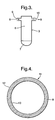
- Figure 3 represents a freezing surface 3 comprising a cylinder 6 with a hemispherical protrusion 7 on its lower end.
- the temperature of freezing surface 3 is controlled by flowing a coolant liquid 8 through cylinder 6 via inlet 9 and outlet 10.
- Figure 4 shows a cross-sectional view of a cylindrical tube 11.
- the tube has outer surface 12 and inner surface 13 which together comprise the freezing surface.
- the tube is hollow to allow the freezing surface to be cooled with coolant liquid 8.
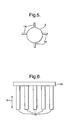
- Figure 5 shows a top view of a freezing surface 3 to which fins 14 are attached. They may consist of flat plates or may be shaped so as to enhance mixing of the aqueous mixture.
- Figure 6 represents a freezing surface comprising a plurality of members 16 rigidly mounted on a single base 15 which can be oscillated in direction 5 by a single oscillation means.
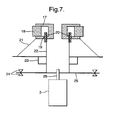
- Figure 7 shows an oscillation means consisting of a loudspeaker (with its speaker cone removed) comprising a magnet 17, pole pieces 18, coil 19 and frame 20.
- a lightweight tube 21 is attached to the tube 22 around which the coil is wrapped.
- a linear bearing 23 provides axial alignment for the tube 21.
- the tube is coupled to the freezing surface 3 by means of a resilient beam 25 and rod 26. The beam is supported at both ends on knife edges 24 and the freezing surface 3 is attached to the centre of the beam.
- Example 1 freezing surfaces of various shapes
- Example 2 amplitude and frequency of oscillation
- the ice is removed from the surface by the shear force between the ice layer on the freezing surface and the aqueous mixture. This is related to the maximum acceleration of the surface during the oscillation in the direction parallel to the surface. The larger the maximum acceleration, the greater the ice removal force. Increasing both the amplitude and frequency of the oscillation increases the maximum acceleration.
- the amplitude and frequency of the oscillation required to remove the ice from the freezing surface depends on the strength of the adhesion of the ice, which in turn depends on the temperature of the surface and the nature and concentration of the solutes in the aqueous mixture. Increasing the frequency or the amplitude of the oscillation has been found to increase the de-icing ability of the freezing surface.
- the cylindrical tube was used as described in Example 1(c) to partially freeze a 20% w/w sucrose solution using a 50% w/w ethylene glycol at -20°C as the coolant.
- the frequency and amplitude of oscillation were varied. At each frequency the minimum amplitude required to release ice from the freezing surface was as follows:
- ice release can be achieved when the amplitude of the oscillation is increased above a certain value.
- Example 2 The experiment of example 2 was repeated using a 30% w/w sucrose solution. Ice release was achieved under the following conditions:
- Example 2 The experiment of example 2 was repeated but with the flow of ethylene glycol through the finger stopped periodically (20s on, 20s off) causing the temperature of the freezing surface to rise and fall periodically.
- the temperature was measured as specified above using a thermocouple placed on the outside surface of the cylinder, approximately 40mm from the upper end and close to the coolant inlet port.
- the ice was released more easily when the surface temperature was periodically cycled. This is due to the lower adhesion at higher surface temperatures. This enabled a 10% sucrose solution to be partially frozen using the amplitude and frequency corresponding to that which enabled a 20% sucrose solution to be partially frozen without temperature cycling.
- Ice release occurs with approximately the same conditions for 8 % w/w glycerol as for 20% w/w sucrose.
- Example 7 Ice content after 2 minutes freezing
- Example 2 The experiment of example 2 was repeated.
- the cylinder was placed in the 20% sucrose solution and oscillated at a frequency of 60Hz.
- Three experiments were performed with different amplitudes. In each case the cylinder was placed in the solution for a period of 2 minutes, after which the partially frozen mixture was gently stirred and its temperature was measured using a Comark temperature probe.
- the ice content was estimated from the temperature using the method described above and the results were as follows. Amplitude (mm) Temperature (°C) Ice content (%w/w) 4 -1.6 5 6 -1.7 10 8 -1.8 13
- a mixture was prepared with the following composition: (%w/w) Sucrose 10 Dextrose monohydrate 6 63 DE low fructose corn syrup 6 Citric acid 0.6 Potassium sorbate 0.03 Lemon and lime flavour 0.03 Water to 100
- a basic ice cream mix was prepared with the following composition: (%w/w) Sucrose 20 Skim milk powder 10 Milk fat 10 Water to 100
- a larger freezing surface consisting of a cylindrical tube was constructed from copper.
- the mass of the cylinder when empty was approximately 1 kg.
- the directly coupled electrodynamic shaker was not capable of oscillating the heavy tube with sufficiently large amplitude. Instead the tube was coupled to the shaker by a steel cantilever beam (255mm x 75mm x 10mm). One end of the beam was clamped to a large block of steel (the fixed end) and the other was attached to the tube (the free end). The beam was driven by a pushrod attached to the shaker between the fixed end and the free end. The system was tuned to resonance by sweeping the oscillation frequency until maximum amplitude was obtained.
- the resonant frequency depends on the length of the beam, so the beam was chosen such that its first bending resonant frequency was the chosen operating frequency (50Hz). Ice release was obtained in a 20% sucrose solution with using an ethylene glycol solution at -10°C as the coolant at amplitudes of 2.4mm and above.
- Example 11 Loudspeaker with a resilient beam coupling
- An alternative oscillation means was constructed from a 100W loudspeaker with the speaker cone removed.
- a lightweight tube was attached to the tube around which the coil is wrapped.
- a linear bearing was provided to provide axial alignment for the tube.
- the linear bearing consisted of two perspex plates spaced 20mm vertically apart with concentric holes through which the tube could slide.
- the tube was coupled to the freezing surface which consisted of a copper cylinder (diameter 22mm, length 110mm) by means of a resilient beam and rod.
- the beam was supported at both ends on knife edges and the freezing surface was attached to the centre of the beam.
- the beam was chosen so that its resonant frequency matched the operating frequency (50Hz). Large oscillation amplitudes (> 10mm) could be achieved with this arrangement.
Landscapes
- Engineering & Computer Science (AREA)
- Life Sciences & Earth Sciences (AREA)
- Chemical & Material Sciences (AREA)
- Food Science & Technology (AREA)
- Polymers & Plastics (AREA)
- Manufacturing & Machinery (AREA)
- Physics & Mathematics (AREA)
- Mechanical Engineering (AREA)
- Thermal Sciences (AREA)
- General Engineering & Computer Science (AREA)
- Confectionery (AREA)
- Freezing, Cooling And Drying Of Foods (AREA)
Claims (18)
- Verfahren zum teilweisen Gefrieren eines wässrigen Gemischs, das gleichzeitig oder in irgendeiner Reihenfolge die folgenden Schritte umfasst:Herstellen eines Kontakts zwischen dem wässrigen Gemisch und wenigstens einem Teil einer Gefrieroberfläche;Abkühlen der Gefrieroberfläche unter den Gefrierpunkt des wässrigen Gemischs, so dass sich an der Gefrieroberfläche Eis bildet; undVersetzen der Gefrieroberfläche in Oszillationen in Bezug auf das wässrige Gemisch in einer Richtung, die zu wenigstens einem Teil der Gefrieroberfläche nicht senkrecht ist; wobei der Winkel zwischen der Oszillationsrichtung und dem größten Teil der Gefrieroberfläche kleiner als 45° ist,dadurch gekennzeichnet, dass die Oszillation linear ist und eine Frequenz im Bereich von 20 bis 200 Hz hat.
- Verfahren nach Anspruch 1, wobei die Oszillationsfrequenz im Bereich von 40 bis 100 Hz liegt.
- Verfahren nach Anspruch 1, wobei die Amplitude der Oszillation im Bereich von 0,2 mm bis 20 mm liegt.
- Verfahren nach Anspruch 1, wobei die Amplitude der Oszillation im Bereich von 4 mm bis 10 mm liegt.
- Verfahren nach Anspruch 1, wobei die Gefrieroberfläche die Oberfläche eines Zylinders ist, dessen Achse zu der Oszillationsrichtung parallel ist.
- Verfahren nach Anspruch 5, wobei die Gefrieroberfläche die Oberfläche eines vertikalen Zylinders ist, dessen unteres Ende einen halbkugelförmigen Vorsprung aufweist.
- Verfahren nach Anspruch 1, wobei die Gefrieroberfläche die innere und die äußere Oberfläche eines zylindrischen Rohrs umfasst, dessen Achse zu der Oszillationsachse parallel ist.
- Verfahren nach Anspruch 1, wobei die Gefrieroberfläche die Oberflächen mehrerer Elemente umfasst, die an einer einzigen Basis starr montiert sind.
- Verfahren nach Anspruch 8, wobei die Elemente Zylinder oder zylindrische Rohre sind, deren Achsen zu der Oszillationsrichtung parallel sind.
- Verfahren nach einem vorhergehenden Anspruch, wobei die Temperatur der Gefrieroberfläche im Bereich von -1 °C bis -20 °C liegt.
- Verfahren nach einem der Ansprüche 1 bis 9, wobei die Temperatur der Gefrieroberfläche von einer Temperatur im Bereich von 5 °C bis 25 °C unterhalb des Gefrierpunkts des wässrigen Gemischs bis zu einer Temperatur von mehr als 0 °C und weniger als 5 °C unterhalb des Gefrierpunkts des wässrigen Gemischs zyklisch geändert wird.
- Verfahren nach einem vorhergehenden Anspruch, wobei das wässrige Gemisch eine wässrige Lösung und/oder eine Suspension von Nahrungszutaten umfasst, die aus der Gruppe ausgewählt sind, die aus Zuckern, Lebensmittelsäuren, Farben, Aromastoffen, Proteinen, Fettemulgatoren und Stabilisierern besteht.
- Verfahren nach Anspruch 12, wobei das wässrige Gemisch ein Milchshake, ein Wasser/Eis-Gemisch oder ein Eiskremgemisch ist.
- Vorrichtung zum teilweisen Gefrieren eines wässrigen Gemischs, die umfasst:eine Gefrieroberfläche;ein Kühlungsmittel, das die Gefrieroberfläche auf unterhalb von -1 °C abkühlen kann, undein Oszillationsmittel, das mit der Gefrieroberfläche gekoppelt ist,dadurch gekennzeichnet, dass das Oszillationsmittel die Gefrieroberfläche in einer Richtung, die wenigstens zu einem Teil der Gefrieroberfläche nicht senkrecht ist, mit einer Frequenz im Bereich von 20 bis 200 Hz linear oszillieren lassen kann, wobei der Winkel zwischen der Oszillationsrichtung und dem größeren Teil der Gefrieroberfläche kleiner als 45° ist.
- Vorrichtung nach Anspruch 14, wobei das Oszillationsmittel die Gefrieroberfläche mit einer Amplitude im Bereich von 1 mm bis 20 mm oszillieren lassen kann.
- Vorrichtung nach Anspruch 14, wobei das Oszillationsmittel aus der Gruppe ausgewählt ist, die aus einem Lautsprecher, einer Magnetspule, einem elektrodynamischen Schüttler und einem hin und her beweglichen Elektromotor besteht.
- Vorrichtung nach Anspruch 14, wobei das Oszillationsmittel mit der Gefrieroberfläche durch ein Kopplungsmittel gekoppelt ist, das aus der Gruppe ausgewählt ist, die aus einer direkten Kopplung, einem elastischen Element und einem Ausleger besteht.
- Vorrichtung nach Anspruch 14, wobei die Gefrieroberfläche die Oberflächen mehrerer Elemente umfasst, die an einer einzigen Basis starr angebracht sind und durch ein einziges Oszillationsmittel zu Oszillationen veranlasst werden können.
Priority Applications (1)
| Application Number | Priority Date | Filing Date | Title |
|---|---|---|---|
| EP05798861A EP1809121B1 (de) | 2004-11-08 | 2005-10-26 | Verfahren und vorrichtung zur herstellung von teilweise gefrorenen wässrigen mischungen |
Applications Claiming Priority (3)
| Application Number | Priority Date | Filing Date | Title |
|---|---|---|---|
| EP04256913 | 2004-11-08 | ||
| EP05798861A EP1809121B1 (de) | 2004-11-08 | 2005-10-26 | Verfahren und vorrichtung zur herstellung von teilweise gefrorenen wässrigen mischungen |
| PCT/EP2005/011558 WO2006048190A1 (en) | 2004-11-08 | 2005-10-26 | Method and apparatus for partially freezing an aqueous mixture |
Publications (2)
| Publication Number | Publication Date |
|---|---|
| EP1809121A1 EP1809121A1 (de) | 2007-07-25 |
| EP1809121B1 true EP1809121B1 (de) | 2008-08-27 |
Family
ID=34930779
Family Applications (1)
| Application Number | Title | Priority Date | Filing Date |
|---|---|---|---|
| EP05798861A Expired - Lifetime EP1809121B1 (de) | 2004-11-08 | 2005-10-26 | Verfahren und vorrichtung zur herstellung von teilweise gefrorenen wässrigen mischungen |
Country Status (6)
| Country | Link |
|---|---|
| US (1) | US20080087026A1 (de) |
| EP (1) | EP1809121B1 (de) |
| AT (1) | ATE406109T1 (de) |
| DE (1) | DE602005009390D1 (de) |
| ES (1) | ES2312027T3 (de) |
| WO (1) | WO2006048190A1 (de) |
Families Citing this family (14)
| Publication number | Priority date | Publication date | Assignee | Title |
|---|---|---|---|---|
| EP1906119A1 (de) * | 2006-09-29 | 2008-04-02 | Electrolux Home Products Corporation N.V. | Haushaltsgerät zur Lieferung von kaltem Wasser oder anderen Getränken und Verfahren zu seinem Betrieb |
| MX373775B (es) * | 2014-12-02 | 2020-04-21 | Unilever Ip Holdings B V | Proceso para la manufactura de confitura congelada recubierta. |
| US10674742B2 (en) * | 2015-01-06 | 2020-06-09 | Tangent Foods International Limited | System and method for making ice cream |
| US11871765B2 (en) | 2020-12-31 | 2024-01-16 | Sharkninja Operating Llc | Micro puree machine |
| US11641978B2 (en) | 2020-12-31 | 2023-05-09 | Sharkninja Operating Llc | Micro puree machine |
| US12016493B2 (en) | 2020-12-31 | 2024-06-25 | Sharkninja Operating Llc | Micro puree machine |
| USD985331S1 (en) | 2020-12-31 | 2023-05-09 | Sharkninja Operating Llc | Housing for a micro puree machine |
| US12016496B2 (en) | 2020-12-31 | 2024-06-25 | Sharkninja Operating Llc | Micro puree machine |
| US11154163B1 (en) | 2020-12-31 | 2021-10-26 | Sharkninja Operating Llc | Micro puree machine |
| US11925298B2 (en) | 2020-12-31 | 2024-03-12 | Sharkninja Operating Llc | Micro puree machine |
| USD985334S1 (en) | 2020-12-31 | 2023-05-09 | Sharkninja Operating Llc | Nested bowl for a micro puree machine |
| US12064056B2 (en) | 2020-12-31 | 2024-08-20 | Sharkninja (Hong Kong) Company Limited | Micro puree machine |
| USD983603S1 (en) | 2020-12-31 | 2023-04-18 | Sharkninja Operating Llc | Blade for a micro puree machine |
| US12575698B2 (en) | 2021-07-12 | 2026-03-17 | Sharkninja Operating Llc | Micro puree machine with selectable food processing routines and automated motor control |
Family Cites Families (15)
| Publication number | Priority date | Publication date | Assignee | Title |
|---|---|---|---|---|
| US1296741A (en) * | 1918-04-15 | 1919-03-11 | Harry E Bester | Vibrator. |
| US2489799A (en) * | 1943-04-15 | 1949-11-29 | Borg Warner | Inflatable ice removing apparatus for aircraft |
| US3224213A (en) * | 1964-07-17 | 1965-12-21 | Jr Earl E Hoyt | Method for making and harvesting ice using ultrasonic vibrators |
| US3411309A (en) * | 1967-02-13 | 1968-11-19 | Ici Ltd | Fractional freeze separation apparatus and process |
| DE2625297A1 (de) * | 1976-06-04 | 1977-12-22 | Linde Ag | Verfahren und vorrichtung zum eindicken von loesungen |
| DE2916310C2 (de) * | 1979-04-23 | 1984-02-16 | geb. Schorp Ute 8000 München Thimm-Dorner | Verfahren bzw. Einrichtung zur Kühlung von Flüssigkeiten auf Temperaturen unterhalb ihres Kristallisationspunktes |
| US4878523A (en) * | 1988-04-04 | 1989-11-07 | Balsamico William A | Ice measuring and dispensing machine |
| US4843827A (en) * | 1988-10-28 | 1989-07-04 | Peppers James M | Method and apparatus for making ice blocks |
| FR2667256A1 (fr) * | 1990-10-02 | 1992-04-03 | Thomson Csf | Dispositif pour eliminer le givre forme en surface d'une paroi, notamment d'une fenetre optique ou radioelectrique. |
| US6129093A (en) * | 1996-01-31 | 2000-10-10 | Kelly; Michael J. | Method of removing frozen material from a wiper |
| JP4135049B2 (ja) * | 1999-03-25 | 2008-08-20 | ソニー株式会社 | 不揮発性メモリ |
| US6431144B1 (en) * | 1999-09-02 | 2002-08-13 | Siemens Vdo Automotive Inc. | Electronic throttle control system |
| US6263680B1 (en) * | 2000-01-18 | 2001-07-24 | The Boc Group, Inc. | Modular apparatus for cooling and freezing of food product on a moving substrate |
| JP3448653B2 (ja) * | 2001-05-07 | 2003-09-22 | 東京工業大学長 | 低過冷度の液体を凝固する方法および装置、並びに氷結液体を循環させる方法およびシステム |
| KR20040039091A (ko) * | 2002-10-31 | 2004-05-10 | 히데오 나까조 | 제빙기 |
-
2005
- 2005-10-26 EP EP05798861A patent/EP1809121B1/de not_active Expired - Lifetime
- 2005-10-26 AT AT05798861T patent/ATE406109T1/de not_active IP Right Cessation
- 2005-10-26 ES ES05798861T patent/ES2312027T3/es not_active Expired - Lifetime
- 2005-10-26 US US11/667,287 patent/US20080087026A1/en not_active Abandoned
- 2005-10-26 DE DE602005009390T patent/DE602005009390D1/de not_active Expired - Lifetime
- 2005-10-26 WO PCT/EP2005/011558 patent/WO2006048190A1/en not_active Ceased
Also Published As
| Publication number | Publication date |
|---|---|
| EP1809121A1 (de) | 2007-07-25 |
| WO2006048190A1 (en) | 2006-05-11 |
| ES2312027T3 (es) | 2009-02-16 |
| DE602005009390D1 (de) | 2008-10-09 |
| US20080087026A1 (en) | 2008-04-17 |
| ATE406109T1 (de) | 2008-09-15 |
Similar Documents
| Publication | Publication Date | Title |
|---|---|---|
| EP1809121B1 (de) | Verfahren und vorrichtung zur herstellung von teilweise gefrorenen wässrigen mischungen | |
| EP0584127B1 (de) | Verfahren und vorrichtung zum regeln der erstarrung von flüssigkeiten | |
| CN105682469B (zh) | 用于制备具有充气质构的冷却糖食产品的机器、系统和方法 | |
| US5383342A (en) | Method and installation for continuous production of liquid ice | |
| Zhang et al. | Enhancement of crystallization processes by power ultrasound: current state‐of‐the‐art and research advances | |
| CA2574161C (en) | Ice-containing products | |
| Zheng et al. | Innovative applications of power ultrasound during food freezing processes—a review | |
| JP2020039358A (ja) | 空気混入した、又は泡立った質感を備える低温食品を、制御された方法で調製するためのマシン及びシステム | |
| RU2014136527A (ru) | Продукты, содержащие лед | |
| US20070012051A1 (en) | Method and apparatus of freezing large volumes | |
| KR20140099901A (ko) | 액체 제품의 거품을 감소 및 제거하기 위한 소노트로드 및 장치 | |
| Zheng et al. | Ultrasonic assistance of food freezing | |
| AU2005263383B2 (en) | Ice-containing products | |
| CN1988807A (zh) | 供应泥浆状饮料的方法和在其中使用的产品 | |
| Kiani et al. | Ultrasonic assistance for food freezing | |
| EP1786270B1 (de) | System und verfahren zur herstellung von gefrorenen essbaren produkten | |
| CA2574164A1 (en) | Ice-containing products | |
| Morel | Development of a rapid liquid freezer: a thesis presented in partial fulfilment of the requirements for the degree of Doctor of Philosophy in Food Technology at Massey University, Manawatū, New Zealand | |
| JP2017035649A (ja) | 凍結分離装置および凍結分離方法 | |
| EA018295B1 (ru) | Замороженные аэрированные кондитерские изделия и способы их получения | |
| Briley | Scraped surface heat exchangers | |
| CN113720059A (zh) | 一种高浓度臭氧冰快速制备装置及方法 | |
| ITFO20000023A1 (it) | Uso degli ultrasuoni al fine di migliorare la conservazione del lattenello stabilimento di produzione. |
Legal Events
| Date | Code | Title | Description |
|---|---|---|---|
| PUAI | Public reference made under article 153(3) epc to a published international application that has entered the european phase |
Free format text: ORIGINAL CODE: 0009012 |
|
| 17P | Request for examination filed |
Effective date: 20070416 |
|
| AK | Designated contracting states |
Kind code of ref document: A1 Designated state(s): AT BE BG CH CY CZ DE DK EE ES FI FR GB GR HU IE IS IT LI LT LU LV MC NL PL PT RO SE SI SK TR |
|
| RIN1 | Information on inventor provided before grant (corrected) |
Inventor name: JARVIS, DANIEL ANTHONY,UNILEVER R&D VLAARDINGEN Inventor name: MARRIOTT, CHRISTOPHER DONALD Inventor name: ALLIN, JONATHAN, MARK Inventor name: RUSSELL, ANDREW BAXTER |
|
| RIN1 | Information on inventor provided before grant (corrected) |
Inventor name: JARVIS, DANIEL ANTHONY,UNILEVER R&D VLAARDINGEN Inventor name: RUSSELL, ANDREW BAXTER Inventor name: MARRIOTT, CHRISTOPHER DONALD Inventor name: ALLIN, JONATHAN, MARK |
|
| DAX | Request for extension of the european patent (deleted) | ||
| 17Q | First examination report despatched |
Effective date: 20071010 |
|
| RAP1 | Party data changed (applicant data changed or rights of an application transferred) |
Owner name: UNILEVER PLC Owner name: UNILEVER N.V. |
|
| GRAP | Despatch of communication of intention to grant a patent |
Free format text: ORIGINAL CODE: EPIDOSNIGR1 |
|
| GRAS | Grant fee paid |
Free format text: ORIGINAL CODE: EPIDOSNIGR3 |
|
| GRAA | (expected) grant |
Free format text: ORIGINAL CODE: 0009210 |
|
| AK | Designated contracting states |
Kind code of ref document: B1 Designated state(s): AT BE BG CH CY CZ DE DK EE ES FI FR GB GR HU IE IS IT LI LT LU LV MC NL PL PT RO SE SI SK TR |
|
| REG | Reference to a national code |
Ref country code: GB Ref legal event code: FG4D |
|
| REG | Reference to a national code |
Ref country code: CH Ref legal event code: EP |
|
| REG | Reference to a national code |
Ref country code: IE Ref legal event code: FG4D |
|
| REF | Corresponds to: |
Ref document number: 602005009390 Country of ref document: DE Date of ref document: 20081009 Kind code of ref document: P |
|
| PG25 | Lapsed in a contracting state [announced via postgrant information from national office to epo] |
Ref country code: NL Free format text: LAPSE BECAUSE OF FAILURE TO SUBMIT A TRANSLATION OF THE DESCRIPTION OR TO PAY THE FEE WITHIN THE PRESCRIBED TIME-LIMIT Effective date: 20080827 Ref country code: IS Free format text: LAPSE BECAUSE OF FAILURE TO SUBMIT A TRANSLATION OF THE DESCRIPTION OR TO PAY THE FEE WITHIN THE PRESCRIBED TIME-LIMIT Effective date: 20081227 Ref country code: LT Free format text: LAPSE BECAUSE OF FAILURE TO SUBMIT A TRANSLATION OF THE DESCRIPTION OR TO PAY THE FEE WITHIN THE PRESCRIBED TIME-LIMIT Effective date: 20080827 |
|
| REG | Reference to a national code |
Ref country code: ES Ref legal event code: FG2A Ref document number: 2312027 Country of ref document: ES Kind code of ref document: T3 |
|
| PG25 | Lapsed in a contracting state [announced via postgrant information from national office to epo] |
Ref country code: FI Free format text: LAPSE BECAUSE OF FAILURE TO SUBMIT A TRANSLATION OF THE DESCRIPTION OR TO PAY THE FEE WITHIN THE PRESCRIBED TIME-LIMIT Effective date: 20080827 Ref country code: SI Free format text: LAPSE BECAUSE OF FAILURE TO SUBMIT A TRANSLATION OF THE DESCRIPTION OR TO PAY THE FEE WITHIN THE PRESCRIBED TIME-LIMIT Effective date: 20080827 Ref country code: AT Free format text: LAPSE BECAUSE OF FAILURE TO SUBMIT A TRANSLATION OF THE DESCRIPTION OR TO PAY THE FEE WITHIN THE PRESCRIBED TIME-LIMIT Effective date: 20080827 Ref country code: LV Free format text: LAPSE BECAUSE OF FAILURE TO SUBMIT A TRANSLATION OF THE DESCRIPTION OR TO PAY THE FEE WITHIN THE PRESCRIBED TIME-LIMIT Effective date: 20080827 |
|
| PG25 | Lapsed in a contracting state [announced via postgrant information from national office to epo] |
Ref country code: BE Free format text: LAPSE BECAUSE OF FAILURE TO SUBMIT A TRANSLATION OF THE DESCRIPTION OR TO PAY THE FEE WITHIN THE PRESCRIBED TIME-LIMIT Effective date: 20080827 |
|
| PG25 | Lapsed in a contracting state [announced via postgrant information from national office to epo] |
Ref country code: BG Free format text: LAPSE BECAUSE OF FAILURE TO SUBMIT A TRANSLATION OF THE DESCRIPTION OR TO PAY THE FEE WITHIN THE PRESCRIBED TIME-LIMIT Effective date: 20081127 Ref country code: DK Free format text: LAPSE BECAUSE OF FAILURE TO SUBMIT A TRANSLATION OF THE DESCRIPTION OR TO PAY THE FEE WITHIN THE PRESCRIBED TIME-LIMIT Effective date: 20080827 |
|
| PG25 | Lapsed in a contracting state [announced via postgrant information from national office to epo] |
Ref country code: CZ Free format text: LAPSE BECAUSE OF FAILURE TO SUBMIT A TRANSLATION OF THE DESCRIPTION OR TO PAY THE FEE WITHIN THE PRESCRIBED TIME-LIMIT Effective date: 20080827 Ref country code: MC Free format text: LAPSE BECAUSE OF NON-PAYMENT OF DUE FEES Effective date: 20081031 Ref country code: RO Free format text: LAPSE BECAUSE OF FAILURE TO SUBMIT A TRANSLATION OF THE DESCRIPTION OR TO PAY THE FEE WITHIN THE PRESCRIBED TIME-LIMIT Effective date: 20080827 Ref country code: SK Free format text: LAPSE BECAUSE OF FAILURE TO SUBMIT A TRANSLATION OF THE DESCRIPTION OR TO PAY THE FEE WITHIN THE PRESCRIBED TIME-LIMIT Effective date: 20080827 |
|
| PLBE | No opposition filed within time limit |
Free format text: ORIGINAL CODE: 0009261 |
|
| STAA | Information on the status of an ep patent application or granted ep patent |
Free format text: STATUS: NO OPPOSITION FILED WITHIN TIME LIMIT |
|
| REG | Reference to a national code |
Ref country code: IE Ref legal event code: MM4A |
|
| PG25 | Lapsed in a contracting state [announced via postgrant information from national office to epo] |
Ref country code: EE Free format text: LAPSE BECAUSE OF FAILURE TO SUBMIT A TRANSLATION OF THE DESCRIPTION OR TO PAY THE FEE WITHIN THE PRESCRIBED TIME-LIMIT Effective date: 20080827 |
|
| 26N | No opposition filed |
Effective date: 20090528 |
|
| PG25 | Lapsed in a contracting state [announced via postgrant information from national office to epo] |
Ref country code: IE Free format text: LAPSE BECAUSE OF NON-PAYMENT OF DUE FEES Effective date: 20081026 |
|
| PG25 | Lapsed in a contracting state [announced via postgrant information from national office to epo] |
Ref country code: SE Free format text: LAPSE BECAUSE OF FAILURE TO SUBMIT A TRANSLATION OF THE DESCRIPTION OR TO PAY THE FEE WITHIN THE PRESCRIBED TIME-LIMIT Effective date: 20081127 |
|
| PGFP | Annual fee paid to national office [announced via postgrant information from national office to epo] |
Ref country code: DE Payment date: 20091028 Year of fee payment: 5 Ref country code: ES Payment date: 20091026 Year of fee payment: 5 Ref country code: TR Payment date: 20091006 Year of fee payment: 5 |
|
| PGFP | Annual fee paid to national office [announced via postgrant information from national office to epo] |
Ref country code: FR Payment date: 20091029 Year of fee payment: 5 Ref country code: GB Payment date: 20091026 Year of fee payment: 5 Ref country code: IT Payment date: 20091026 Year of fee payment: 5 |
|
| PG25 | Lapsed in a contracting state [announced via postgrant information from national office to epo] |
Ref country code: PL Free format text: LAPSE BECAUSE OF FAILURE TO SUBMIT A TRANSLATION OF THE DESCRIPTION OR TO PAY THE FEE WITHIN THE PRESCRIBED TIME-LIMIT Effective date: 20080827 |
|
| REG | Reference to a national code |
Ref country code: CH Ref legal event code: PL |
|
| PG25 | Lapsed in a contracting state [announced via postgrant information from national office to epo] |
Ref country code: CY Free format text: LAPSE BECAUSE OF FAILURE TO SUBMIT A TRANSLATION OF THE DESCRIPTION OR TO PAY THE FEE WITHIN THE PRESCRIBED TIME-LIMIT Effective date: 20080827 Ref country code: HU Free format text: LAPSE BECAUSE OF FAILURE TO SUBMIT A TRANSLATION OF THE DESCRIPTION OR TO PAY THE FEE WITHIN THE PRESCRIBED TIME-LIMIT Effective date: 20090228 Ref country code: LU Free format text: LAPSE BECAUSE OF NON-PAYMENT OF DUE FEES Effective date: 20081026 |
|
| PG25 | Lapsed in a contracting state [announced via postgrant information from national office to epo] |
Ref country code: LI Free format text: LAPSE BECAUSE OF NON-PAYMENT OF DUE FEES Effective date: 20091031 Ref country code: GR Free format text: LAPSE BECAUSE OF FAILURE TO SUBMIT A TRANSLATION OF THE DESCRIPTION OR TO PAY THE FEE WITHIN THE PRESCRIBED TIME-LIMIT Effective date: 20081128 Ref country code: CH Free format text: LAPSE BECAUSE OF NON-PAYMENT OF DUE FEES Effective date: 20091031 |
|
| GBPC | Gb: european patent ceased through non-payment of renewal fee |
Effective date: 20101026 |
|
| PG25 | Lapsed in a contracting state [announced via postgrant information from national office to epo] |
Ref country code: FR Free format text: LAPSE BECAUSE OF NON-PAYMENT OF DUE FEES Effective date: 20101102 |
|
| REG | Reference to a national code |
Ref country code: FR Ref legal event code: ST Effective date: 20110630 |
|
| PG25 | Lapsed in a contracting state [announced via postgrant information from national office to epo] |
Ref country code: GB Free format text: LAPSE BECAUSE OF NON-PAYMENT OF DUE FEES Effective date: 20101026 |
|
| REG | Reference to a national code |
Ref country code: DE Ref legal event code: R119 Ref document number: 602005009390 Country of ref document: DE Effective date: 20110502 |
|
| PG25 | Lapsed in a contracting state [announced via postgrant information from national office to epo] |
Ref country code: PT Free format text: LAPSE BECAUSE OF FAILURE TO SUBMIT A TRANSLATION OF THE DESCRIPTION OR TO PAY THE FEE WITHIN THE PRESCRIBED TIME-LIMIT Effective date: 20080827 |
|
| REG | Reference to a national code |
Ref country code: ES Ref legal event code: FD2A Effective date: 20111118 |
|
| PG25 | Lapsed in a contracting state [announced via postgrant information from national office to epo] |
Ref country code: IT Free format text: LAPSE BECAUSE OF NON-PAYMENT OF DUE FEES Effective date: 20101026 |
|
| PG25 | Lapsed in a contracting state [announced via postgrant information from national office to epo] |
Ref country code: ES Free format text: LAPSE BECAUSE OF NON-PAYMENT OF DUE FEES Effective date: 20101027 |
|
| PG25 | Lapsed in a contracting state [announced via postgrant information from national office to epo] |
Ref country code: TR Free format text: LAPSE BECAUSE OF NON-PAYMENT OF DUE FEES Effective date: 20101026 |
|
| PG25 | Lapsed in a contracting state [announced via postgrant information from national office to epo] |
Ref country code: DE Free format text: LAPSE BECAUSE OF NON-PAYMENT OF DUE FEES Effective date: 20110502 |