EP1809653B1 - Nonadepsipeptides substitues - Google Patents
Nonadepsipeptides substitues Download PDFInfo
- Publication number
- EP1809653B1 EP1809653B1 EP05790976A EP05790976A EP1809653B1 EP 1809653 B1 EP1809653 B1 EP 1809653B1 EP 05790976 A EP05790976 A EP 05790976A EP 05790976 A EP05790976 A EP 05790976A EP 1809653 B1 EP1809653 B1 EP 1809653B1
- Authority
- EP
- European Patent Office
- Prior art keywords
- membered
- substituted
- arylcarbonyl
- heteroarylcarbonyl
- represents hydrogen
- Prior art date
- Legal status (The legal status is an assumption and is not a legal conclusion. Google has not performed a legal analysis and makes no representation as to the accuracy of the status listed.)
- Expired - Lifetime
Links
- 0 CC[C@](C)[C@@](C(N[C@@]([C@](C)O)C(NCC(N[C@@]([C@@](C(N)=O)O)C(N[C@@](CO)C(O[C@@]([C@@](C(N[C@@]([C@@](C(C)C)O)C(N[C@@](CC(C)C)C(N[C@@]1CCCNC(N)=N)=O)=O)O)NC([C@@](*)N*)=O)c2ccccc2)=O)=O)=O)=O)=O)NC1O Chemical compound CC[C@](C)[C@@](C(N[C@@]([C@](C)O)C(NCC(N[C@@]([C@@](C(N)=O)O)C(N[C@@](CO)C(O[C@@]([C@@](C(N[C@@]([C@@](C(C)C)O)C(N[C@@](CC(C)C)C(N[C@@]1CCCNC(N)=N)=O)=O)O)NC([C@@](*)N*)=O)c2ccccc2)=O)=O)=O)=O)=O)NC1O 0.000 description 2
- RZMUSAJVZXOWPB-UEUZUPGWSA-N CC[C@H](C)[C@@H](C(N[C@@H]([C@H](C)O)C(NCC(N[C@@H]([C@@H](C(N)=O)O)C(N[C@@H](C)C(O[C@@H]([C@@H](C(N[C@@H]([C@@H](C(C)C=C(C(C)C)[C@@H](C(N[C@@H]1CCCNC(NC(Nc2cc(OC)ccc2)=O)=N)O)N2)O)C2O)=O)NC([C@H](CC(C)C)NC([C@@H](CC(C)C)N)=O)=O)c(cc2)ccc2OC(C(F)(F)F)=O)=O)=O)=O)=O)=O)NC1O Chemical compound CC[C@H](C)[C@@H](C(N[C@@H]([C@H](C)O)C(NCC(N[C@@H]([C@@H](C(N)=O)O)C(N[C@@H](C)C(O[C@@H]([C@@H](C(N[C@@H]([C@@H](C(C)C=C(C(C)C)[C@@H](C(N[C@@H]1CCCNC(NC(Nc2cc(OC)ccc2)=O)=N)O)N2)O)C2O)=O)NC([C@H](CC(C)C)NC([C@@H](CC(C)C)N)=O)=O)c(cc2)ccc2OC(C(F)(F)F)=O)=O)=O)=O)=O)=O)NC1O RZMUSAJVZXOWPB-UEUZUPGWSA-N 0.000 description 1
- VOZXRBXACHYNTP-OBJRLAIVSA-N CC[C@H](C)[C@@H](C(N[C@@H]([C@H](C)O)C(NCC(N[C@@H]([C@@H](C(N)=O)OC(Nc1cc(OC)ccc1)=O)C(N[C@@H](CO)C(O[C@@H]([C@@H](C(N[C@@H]([C@@H](C(C)C)O)C(N[C@@H](CC(C)C)C(N[C@@H]1CCCNC(N)=N)=O)=O)=O)NC([C@H](CC(C)C)NC([C@@H](CC(C)C)N)=O)=O)c2ccccc2)=O)=O)=O)=O)=O)NC1=O Chemical compound CC[C@H](C)[C@@H](C(N[C@@H]([C@H](C)O)C(NCC(N[C@@H]([C@@H](C(N)=O)OC(Nc1cc(OC)ccc1)=O)C(N[C@@H](CO)C(O[C@@H]([C@@H](C(N[C@@H]([C@@H](C(C)C)O)C(N[C@@H](CC(C)C)C(N[C@@H]1CCCNC(N)=N)=O)=O)=O)NC([C@H](CC(C)C)NC([C@@H](CC(C)C)N)=O)=O)c2ccccc2)=O)=O)=O)=O)=O)NC1=O VOZXRBXACHYNTP-OBJRLAIVSA-N 0.000 description 1
Classifications
-
- C—CHEMISTRY; METALLURGY
- C07—ORGANIC CHEMISTRY
- C07K—PEPTIDES
- C07K7/00—Peptides having 5 to 20 amino acids in a fully defined sequence; Derivatives thereof
- C07K7/04—Linear peptides containing only normal peptide links
- C07K7/06—Linear peptides containing only normal peptide links having 5 to 11 amino acids
-
- A—HUMAN NECESSITIES
- A61—MEDICAL OR VETERINARY SCIENCE; HYGIENE
- A61P—SPECIFIC THERAPEUTIC ACTIVITY OF CHEMICAL COMPOUNDS OR MEDICINAL PREPARATIONS
- A61P31/00—Antiinfectives, i.e. antibiotics, antiseptics, chemotherapeutics
- A61P31/04—Antibacterial agents
Definitions
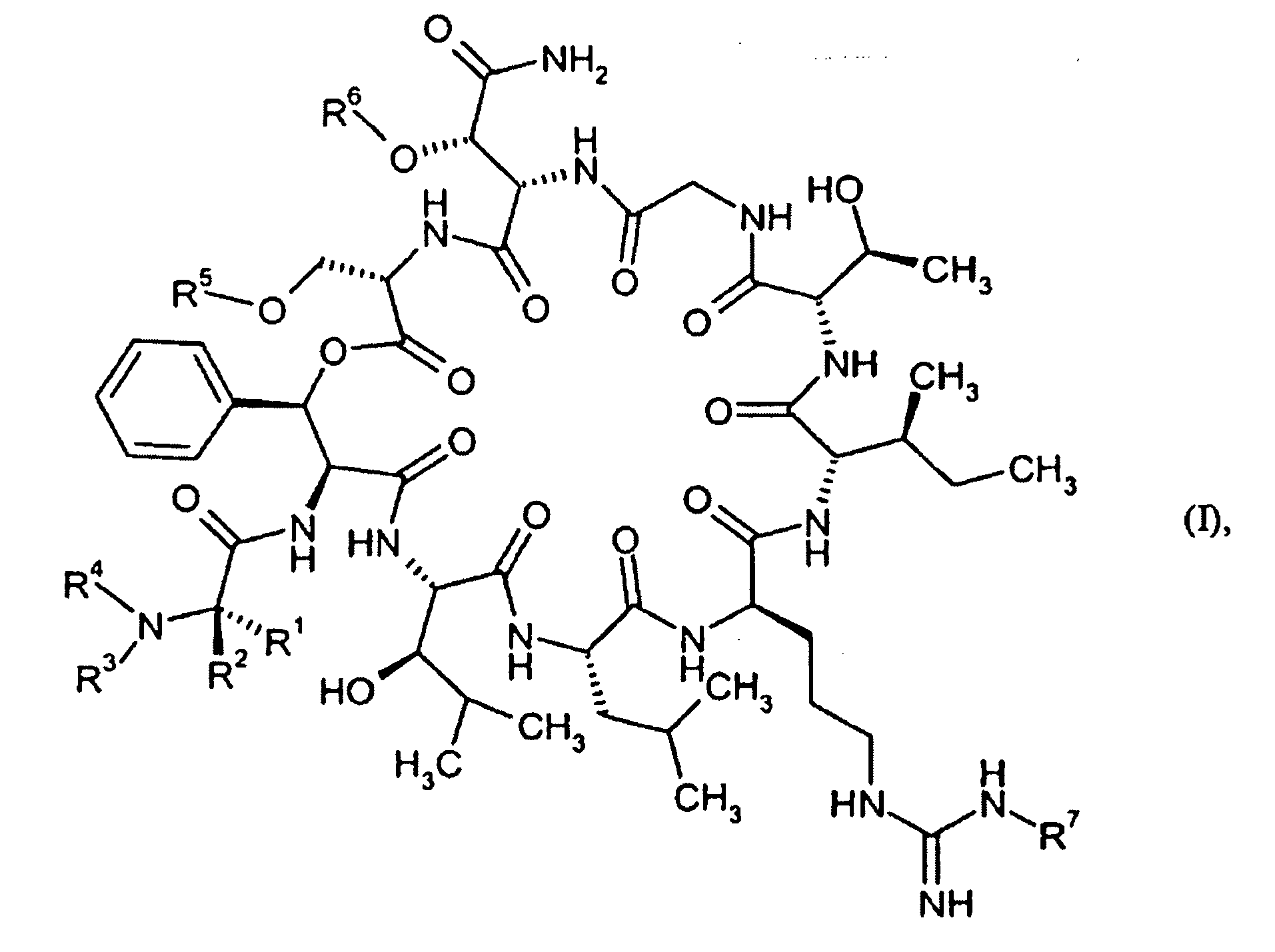
- the invention relates to nonadepsipeptides of the formula (I) and to processes for their preparation and to their use for the production of medicaments for the treatment and / or prophylaxis of diseases, in particular bacterial infectious diseases.
- the bacterial cell wall is synthesized by a number of enzymes (cell wall biosynthesis) and is essential for the survival or multiplication of microorganisms.
- the structure of this macromolecule, as well as the proteins involved in its synthesis, are highly conserved within the bacteria. Due to their essential nature and uniformity, cell wall biosynthesis is an ideal target for new antibiotics ( DWGreen, The bacterial cell wall as a source of antibacterial targets, Expert Opin. Ther. Targets, 2002, 6, 1-19 ).
- Vancomycin and penicillins are inhibitors of bacterial cell wall biosynthesis and are successful examples of the antibiotic potency of this principle. They have been used for several decades in the clinic for the treatment of bacterial infections, especially with Gram positive pathogens. Due to the increasing occurrence of resistant germs, eg methicillin-resistant staphylococci, penicillin-resistant pneumococci and vancomycin-resistant enterococci ( F. Baquero, Gram-positive resistance: challenge for the development of new antibiotics, J. Antimicrob. Chemother., 1997, 39, Suppl A: 1-6 ; AP Johnson, DM Livermore, GS Tillotson, Antimicrobial susceptibility of Gram-positive bacteria: what's current, what's anticipated ?, J. Hosp.
- the present invention describes a new class of cell wall biosynthesis inhibitors without cross-resistance to known antibiotic classes.
- lysobactin and some derivatives are described as having antibacterial activity in US 4,754,018 ,
- the isolation and antibacterial activity of lysobactin is also in EP-A-196 042 and JP 01132600 described.
- WO04 / 099239 describes derivatives of lysobactin having antibacterial activity.
- An object of the present invention is to provide alternative compounds having comparable or improved antibacterial activity, better solubility and better compatibility, e.g. less nephrotoxicity, to treat bacterial diseases in humans and animals.
- Compounds according to the invention are the compounds of the formula (I) and their salts, solvates, solvates of the salts and prodrugs, the compounds of the formulas below and their salts, solvates, solvates of the salts and prodrugs and of the formula (I) I), hereinafter referred to as exemplary compounds and their salts, solvates, solvates of the salts and prodrugs, as far as those of formula (I) included, The following compounds are not already salts, solvates, solvates of the salts and prodrugs.
- the compounds of the invention may exist in stereoisomeric forms (enantiomers, diastereomers).
- the invention therefore relates to the enantiomers or diastereomers and their respective mixtures. From such mixtures of enantiomers and / or diastereomers, the stereoisomerically uniform components can be isolated in a known manner.
- the present invention encompasses all tautomeric forms.
- Salts used in the context of the present invention are physiologically acceptable salts of the compounds according to the invention. However, also included are salts which are not suitable for pharmaceutical applications themselves but can be used, for example, for the isolation or purification of the compounds according to the invention.
- Physiologically acceptable salts of the compounds of the invention include acid addition salts of mineral acids, carboxylic acids and sulfonic acids, e.g. Salts of hydrochloric, hydrobromic, sulfuric, phosphoric, methanesulfonic, ethanesulfonic, toluenesulfonic, benzenesulfonic, naphthalenedisulfonic, acetic, trifluoroacetic, propionic, lactic, tartaric, malic, citric, fumaric, maleic and benzoic acids.
- Salts of hydrochloric, hydrobromic, sulfuric, phosphoric, methanesulfonic, ethanesulfonic, toluenesulfonic, benzenesulfonic, naphthalenedisulfonic acetic, trifluoroacetic, propionic, lactic, tartaric, malic, citric, fumaric, maleic and benzoic acids.
- Physiologically acceptable salts of the compounds according to the invention also include salts of customary bases, such as, by way of example and by way of preference, alkali metal salts (for example sodium and potassium salts), alkaline earth salts (for example calcium and magnesium salts) and ammonium salts derived from ammonia or organic amines having 1 to 16 carbon atoms, such as, by way of example and by way of illustration, ethylamine, diethylamine, triethylamine, ethyldiisopropylamine, monoethanolamine, diethanolamine, triethanolamine, dicyclohexylamine, dimethylaminoethanol, procaine, dibenzylamine, N- methylmorpholine, arginine, lysine, ethylenediamine and N- methylpiperidine.
- customary bases such as, by way of example and by way of preference, alkali metal salts (for example sodium and potassium salts), alkaline earth salts (for example calcium and magnesium
- Solvates in the context of the invention are those forms of the compounds according to the invention which form a complex in the solid or liquid state by coordination with solvent molecules. Hydrates are a special form of solvates that coordinate with water.
- R 1 is 2-methylprop-1-yl
- R 2 is hydrogen
- R 3 is 1-amino-3-methylbut-1-ylcarbonyl
- R 4 is hydrogen
- R 5 , R 6 and R 7 have the meaning given above.
- R 6 and R 7 are hydrogen and R 5 is phenylaminocarbonyl, phenylcarbonyl, pyridylaminocarbonyl or pyridylcarbonyl, where phenylaminocarbonyl, phenylcarbonyl, pyridylaminocarbonyl and pyridylcarbonyl may be substituted by 0, 1, 2 or 3
- Substituents independently selected from the group consisting of pyrrolidinyl, piperidinyl, tetrahydropyranyl, piperazinyl, morpholinyl, 2-oxo-pyrrolidinyl and 2-oxo-piperidinyl, and R 1 , R 2 , R 3 and R 4 have the meaning given above.
- R 5 and R 7 are hydrogen and R 6 is phenylaminocarbonyl, phenylcarbonyl, pyridylaminocarbonyl or pyridylcarbonyl, where phenylaminocarbonyl, phenylcarbonyl, pyridylaminocarbonyl and pyridylcarbonyl may be substituted by 0, 1, 2 or 3 substituents independently of one another selected from the group consisting of pyrrolidinyl, piperidinyl, tetrahydropyranyl, piperazinyl, morpholinyl, 2-oxopyrrolidinyl and 2-oxopiperidinyl, and R 1 , R 2 , R 3 and R 4 are as defined above.
- R 5 and R 6 are hydrogen and R 7 is phenylaminocarbonyl, phenylcarbonyl, pyridylaminocarbonyl or pyridylcarbonyl, where phenylaminocarbonyl, phenylcarbonyl, pyridylaminocarbonyl and pyridylcarbonyl may be substituted by 0, 1, 2 or 3
- Substituents independently selected from the group consisting of pyrrolidinyl, piperidinyl, tetrahydropyranyl, piperazinyl, morpholinyl, 2-oxo-pyrrolidinyl and 2-oxo-piperidinyl, and R 1 , R 2 , R 3 and R 4 have the meaning given above.
- radical definitions given in detail in the respective combinations or preferred combinations of radicals are also replaced, irrespective of the particular combinations of the radicals indicated, by radical definitions of other combinations.
- the invention further provides a process for the preparation of the compounds of the formulas (I), where compounds of the formula in which R 1 , R 2 , R 3 and R 4 have the abovementioned meaning, from 1 to 10 equivalents, preferably from 2 to 5 equivalents, of an aryl or heteroarylcarbonyl chloride, an aryl or heteroaryl isocyanate, an aryl or heteroarylthio-carboxylic acid chloride, an aryl or heteroaryl isothiocyanate or an arylsulfonyl isocyanate, where the aryl and heteroaryl Radicals correspond to the aryl and heteroaryl radicals in the radicals R 5 , R 6 and R 7 , which have the abovementioned meaning, to be implemented and then separating the resulting mixture of compounds of formula (I) by chromatography into the individual compounds of formula (I).
- Free amino groups in the radicals R 1, R 2, R 3 and R 4 are, for example, with a Boc protecting group by methods known prior to the reaction to the skilled person, which is cleaved again after the reaction and before the chromatography.
- the reaction with aryl and heteroarylcarbonyl chlorides, aryl and heteroaryl isocyanates, aryl and Heteroarylthiocarbonklarechloriden, aryl and Heteroarylisothiocyanaten and Arylsulfonylisocyanaten is generally carried out in inert solvents, optionally in the presence of a base, preferably in a temperature range from -30 ° C to 50 ° C. at normal pressure.
- Inert solvents are, for example, tetrahydrofuran, methylene chloride, pyridine, dioxane, dimethylformamide or a mixture of the specified solvents.
- inert solvents tetrahydrofuran, methylene chloride and dimethylformamide are preferred.
- bases are triethylamine, diisopropylethylamine or N-methylmorpholine, preference is given to diisopropylethylamine.
- the compounds of the formula (I) which are present as salts can be converted into a salt with another counterion, for example, by reaction with hydrochloric acid or methanesulfonic acid.
- aryl and heteroarylene chlorides, aryl and heteroaryl isocyanates, aryl and heteroaryl thiocarboxylic acid chlorides, aryl and heteroaryl isothiocyanates and arylsulfonyl isocyanates are known or can be prepared analogously to known processes.
- reaction is generally carried out in inert solvents, if appropriate in the presence of a base, preferably in a temperature range from -30 ° C to 50 ° C at atmospheric pressure.
- Inert solvents are, for example, tetrahydrofuran, methylene chloride, pyridine, dioxane or dimethylformamide.
- inert solvents tetrahydrofuran or methylene chloride are preferred.
- bases are triethylamine, diisopropylethylamine or N-methylmorpholine, preference is given to diisopropylethylamine.
- the reaction is generally carried out in inert solvents, in the presence of a dehydrating reagent, if appropriate in the presence of a base, preferably in a temperature range from -30 ° C to 50 ° C at atmospheric pressure.
- Inert solvents are, for example, halogenated hydrocarbons, such as dichloromethane or trichloromethane, hydrocarbons, such as benzene, nitromethane, dioxane, dimethylformamide or acetonitrile. It is likewise possible to use mixtures of the solvents. Particularly preferred is dichloromethane or dimethylformamide.
- Suitable dehydrating here for example, carbodiimides such as N, N'-diethyl, N, N, are - N '-ethyl lcarbodiimid hydrochloride (EDC), N -Cyclohexylcarbodiimid- N' -propyloxymethyl polystyrene (PS-carbodiimide) or carbonyl compounds such as carbonyldiimidazole, or 1,2-oxazolium compounds such as 2-ethyl-5-phenyl-1,2- oxazolium-3-sulfate or 2- tert- butyl-5- methylisoxazolium perchlorate, or acylamino compounds such as 2-ethoxy-1-ethoxycarbonyl-1,2-
- bases are alkali metal carbonates, such as, for example, sodium or potassium carbonate or bicarbonate, or organic bases such as trialkylamines, for example triethylamine, N- methylmorpholine, N- methylpiperidine, 4-dimethylaminopyridine or diisopropylethylamine.
- alkali metal carbonates such as, for example, sodium or potassium carbonate or bicarbonate
- organic bases such as trialkylamines, for example triethylamine, N- methylmorpholine, N- methylpiperidine, 4-dimethylaminopyridine or diisopropylethylamine.
- the condensation is carried out with HATU or with EDC in the presence of HOBt.
- the compounds of the formula (IV) optionally carry protective groups, so that in these cases the reaction of the compound of the formula (III) with compounds of the formula (IV) is followed by splitting off of the protective groups with, for example, trifluoroacetic acid by methods known to the person skilled in the art.
- the compound of formula (III) can be synthesized by double Edmann degradation from lysobactin (Example 1A).
- the compounds of the formula (IV) are known or can be synthesized by known processes from the corresponding starting materials.
- the compounds of the invention show an unpredictable, valuable spectrum of pharmacological activity. They show an antibacterial effect.
- the compounds of the invention are characterized by a lower nephrotoxicity to lysobactin.
- the compounds of the invention are characterized by a better solubility to lysobactin.
- the described nonadepsipeptides act as inhibitors of bacterial cell wall biosynthesis.
- the preparations according to the invention are particularly effective against bacteria and bacteria-like microorganisms. They are therefore particularly well suited for the prophylaxis and chemotherapy of local and systemic infections in human and veterinary medicine, which are caused by these pathogens.
- the preparations according to the invention can be used against all bacteria and bacteria-like microorganisms which are in the possession of a bacterial cell wall (murein sacculus) or the associated enzyme systems, for example by the following pathogens or by mixtures of the following pathogens:
- Gram-negative cocci Neisseria gonorrhoeae
- Gram-negative rods such as Enterobacteriaceae, eg Escherichia coli, Hemophilus influenzae, Pseudomonas, Klebsiella, Citrobacter ( C. freundii, C. divernis ), Salmonella and Shigella; also Enterobacter ( E. aerogenes, E. agglomerans ), Hafnia, Serratia (S. marcescens), Providencia, Yersinia, and the genus Acinetobacter, Branhamella and Chlamydia.
- Enterobacteriaceae eg Escherichia coli
- Hemophilus influenzae Pseudomonas
- Klebsiella Citrobacter ( C. freundii, C. divernis )
- Salmonella and Shigella also Enterobacter ( E. aerogenes, E. agglomerans
- the antibacterial spectrum includes strictly anaerobic bacteria such as Bacteroides fragilis, members of the genus Peptococcus, Peptostreptococcus and the genus Clostridium; furthermore mycobacteria, eg M. tuberculosus.
- the compounds according to the invention exhibit particularly pronounced activity against gram-positive cocci, for example staphylococci (S. aureus, S. epidermidis, S. haemolyticus, S. carnosus), enterococci (E. faecalis, E. faecium) and streptococci (S. agalactiae, S. pneumoniae, S. pyogenes).
- pathogens are merely exemplary and by no means limiting.
- diseases which are caused by the named pathogens or mixed infections and which can be prevented, ameliorated or cured by the preparations according to the invention are:
- Infectious diseases in humans such as uncomplicated and complicated Hamwegsin Stamme, uncomplicated skin and surface infections, complicated skin and soft tissue infections, hospital and community-acquired pneumonia, nosocomial pneumonia, acute exacerbations and secondary bacterial infections of chronic bronchitis, acute otitis media, acute sinusitis, streptococcal Pharyngitis, bacterial meningitis, uncomplicated gonococcal and non-gonococcal urethritis / cervicitis, acute prostatitis, endocarditis, uncomplicated and complicated intra-abdominal infections, gynecological infections, pelvic inflammatory disease, bacterial vaginosis, acute and chronic osteomyelitis, acute bacterial arthritis, empiric therapy in febrile neutropenic patients, also bacteraemias, MRSA infections, acute infectious diarrhea, Helicobacter pylori infections, postoperative infections, odontogenic infections, ophthalmological infections n, postoperative infections
- bacterial infections can also be treated in other species. Examples include:
- Pig diarrhea, enterotoxemia, sepsis, dysentery, salmonellosis, metritis-mastitis-agalactiae syndrome, mastitis;
- Ruminants (cattle, sheep, goats): diarrhea, sepsis, bronchopneumonia, salmonellosis, pasteurellosis, genital infections;
- Horse bronchopneumonia, foal disease, puerperal and postpuerperal infections, salmonellosis;
- Dog and cat bronchopneumonia, diarrhea, dermatitis, otitis, urinary tract infections, prostatitis;
- Poultry (chicken, turkey, quail, pigeon, ornamental birds and others): E. coli infections, chronic airway diseases, salmonellosis, pasteurellosis, psittacosis.
- bacterial diseases in the rearing and keeping of farmed and ornamental fish can be treated, with the antibacterial spectrum on the aforementioned pathogen addition to other pathogens such.
- Pasteurella Brucella, Campylobacter, Listeria, Erysipelothris, Corynebacteria, Borellia, Treponema, Nocardia, Rikettsia, Yersinia.
- Another object of the present invention is the use of the compounds of the invention for the manufacture of a medicament for the treatment and / or prophylaxis of diseases, in particular the aforementioned diseases.
- the compounds according to the invention are preferably used for the preparation of medicaments which are suitable for the prophylaxis and / or treatment of bacterial diseases.
- compositions containing at least one compound of the invention and at least one or more other active ingredients, in particular for the treatment and / or prophylaxis of the aforementioned diseases.
- Preferred combination active ingredients are antibacterial compounds which have a different spectrum of activity, in particular complementary activity spectrum, and / or are synergistic with the compounds according to the invention.
- the compounds according to the invention can act systemically and / or locally.
- they may be applied in a suitable manner, e.g. oral, parenteral, pulmonary, nasal, sublingual, lingual, buccal, rectal, dermal, transdermal, conjunctival, otic or as an implant or stent.
- the compounds according to the invention can be administered in suitable administration forms.
- Parenteral administration can be accomplished by bypassing a resorption step (e.g., intravenously, intraarterially, intracardially, intraspinal, or intralumbar) or by resorting to absorption (e.g., intramuscularly, subcutaneously, intracutaneously, percutaneously, or intraperitoneally).
- a resorption step e.g., intravenously, intraarterially, intracardially, intraspinal, or intralumbar
- absorption e.g., intramuscularly, subcutaneously, intracutaneously, percutaneously, or intraperitoneally.
- parenteral administration are suitable as application forms u.a. Injection and infusion preparations in the form of solutions, suspensions, emulsions, lyophilisates or sterile powders.
- inhalant medicines including powder inhalers, nebulizers
- nasal drops solutions, sprays
- lingual, sublingual or buccal tablets to be applied
- films / wafers or capsules films / wafers or capsules, suppositories, ear or eye preparations
- vaginal capsules aqueous suspensions (lotions, shake mixtures), lipophilic suspensions, ointments, creams, transdermal therapeutic systems (such as patches), milk, pastes, foams, powdered powders, implants or stents.
- the compounds according to the invention can be converted into the stated administration forms. This can be done in a conventional manner by mixing with inert, non-toxic, pharmaceutically suitable excipients.
- These adjuvants include, among others. Carriers (for example microcrystalline cellulose, lactose, mannitol), solvents (eg liquid polyethylene glycols), emulsifiers and dispersing or wetting agents (for example sodium dodecyl sulfate, polyoxysorbitanoleate), binders (for example polyvinylpyrrolidone), synthetic and natural polymers (for example albumin), stabilizers (eg antioxidants such as ascorbic acid), dyes (eg, inorganic pigments such as iron oxides), and flavor and / or odor remedies.
- Carriers for example microcrystalline cellulose, lactose, mannitol
- solvents eg liquid polyethylene glycols
- emulsifiers and dispersing or wetting agents for example sodium dodecyl
- compositions containing at least one compound of the invention usually together with one or more inert, non-toxic, pharmaceutically suitable excipients, and their use for the purposes mentioned above.
- Method 1 Device Type HPLC: HP 1100 Series; UV DAD column: Zorbax Eclipse XBD-C8 (Agilent), 150 mm x 4.6 mm, 5 ⁇ m; Eluent A: 5 ml HClO 4/1 of water, eluent B: acetonitrile; Gradient: 0-1 min 10% B, 1-4 min 10-90% B, 4-5 min 90% B; Flow: 2.0 ml / min; Oven: 30 ° C; UV detection: 210 and 254 nm.
- Method 3 Device Type MS: Micromass ZQ; Device type HPLC: HP 1100 Series; UV DAD; Column: Phenomenex Synergi 2 ⁇ Hydro-RP Mercury 20 mm x 4 mm; Eluent A: 1 l of water + 0.5 ml of 50% formic acid, eluent B: 1 l of acetonitrile + 0.5 ml of 50% formic acid; Gradient: 0.0 min 90% A ⁇ 2.5 min 30% A ⁇ 3.0 min 5% A ⁇ 4.5 min 5% A; Flow: 0.0 min 1 ml / min, 2.5 min / 3.0 min / 4.5 min. 2 ml / min; Oven: 50 ° C; UV detection: 210 nm.
- MALDI-MS Method 7
- the MALDI-MS / MS assays are performed on a 4700 proteomics analyzer (Applied Biosystems, Framingham, MA) using TOF / TOF ion optics and 200 Hz Nd: YAG laser (355 nm ) Is provided.
- the quasimolecule ions are accelerated in the ion source at 8 kV, selected with an electric deflector (MS1), and collided with argon atoms in a collision cell located between MS1 and MS2.
- MS1 electric deflector
- the resulting fragment ions are post-accelerated at 15 kV and characterized by the second time-of-flight mass analyzer (MS2).
- TOF-HR-MS-ESI + spectra are performed with a Micromass LCT instrument (capillary voltage: 3.2 KV, cone voltage: 42 V, source temperature: 120 ° C, desolvation temperature: 280 ° C ).
- a syringe pump Hard Apparatus
- the standard is leucine-enkephalin (Tyr-Gly-Gly-Phe-Leu).
- Method 9 Gel Chromatography Sephadex LH-20: Gel chromatography is performed without pressure on Sephadex LH-20 (Pharmacia). It is fractionated after UV activity (UV detector for 210 nm, Knauer company) (fraction collector ISCO Foxy 200). Column dimensions: 60 x 21 cm (2500-5000 ⁇ mol scale); 50 x 10 cm (500-2500 ⁇ mol scale); 30 x 5 cm (250-500 ⁇ mol scale); 25 x 4 cm (50-250 ⁇ mol scale); 40 x 2 cm (5-50 ⁇ mol scale).
- Method 10 (Reprosil): Column: Gilson Abimed HPLC; Varian binary pump system; Reprosil ODS-A 5 ⁇ 250mm x 20mm; Flow: 25 ml / min; Oven: RT; UV detection: 210 nm; Eluent A: water / 0.2% TFA, eluent B: acetonitrile; Gradient: 0-10 min 5-95% B, then regeneration of the chromatography column.
- Method 11 (Reprosil): Column: Gilson Abimed HPLC; Varian binary pump system; Reprosil ODS-A 5 ⁇ 250mm x 20mm; Flow: 25 ml / min; Oven: RT; UV detection: 210 nm; Eluent A: water / 0.2% TFA, eluent B: acetonitrile; Gradient: 0-10 min 15-65% B, then regeneration of the chromatography column.
- Method 12 (Phenomenex Luna): column: Gilson Abimed HPLC; Varian binary pump system; Phenomenex Luna C18 5 ⁇ 250mm x 20mm; Flow: 25 ml / min; Oven: RT; UV detection: 210 nm; Eluent A: water / 0.2% TFA, eluent B: acetonitrile; Isocratic 50% B.
- Method 13 (Kromasil): Column: Gilson Abimed HPLC; Varian binary pump system; Kromasil 100 C18 5 ⁇ 250 mm x 20 mm; Flow: 25 ml / min; Oven: RT; UV detection: 210 nm; Eluent A: water / 0.2% TFA, eluent B: acetonitrile; Isocratic 65% B.
- Method 14 (Reprosil): Column: Gilson Abimed HPLC; Varian binary pump system; Reprosil ODS-A 5 ⁇ 250mm x 20mm; Flow: 25 ml / min; Oven: RT; UV detection: 210 nm; Eluent A: water / 0.2% TFA, eluent B: acetonitrile; Gradient: 0-15 min 10-90% B, then regeneration of the chromatography column.
- Method 15 Column: Gilson Abimed HPLC; Varian binary pump system; Kromasil 100 C18 5 ⁇ 250 mm x 20 mm; Flow: 25 ml / min; Oven: 40 ° C; UV detection: 210 nm; Eluent A: water / 0.2% TFA, eluent B: acetonitrile; Gradient: 0-15 min 70-55% A, 15.1-20 min 70% A, followed by regeneration of the chromatography column
- Method 16 (Reprosil): Column: Gilson Abimed HPLC; Varian binary pump system; Reprosil ODS-A 5 ⁇ 250mm x 20mm; Flow: 25 ml / min; Oven: RT; UV detection: 210 nm; Eluent A: water / 0.2% TFA, eluent B: acetonitrile; Isocratic 57% A.
- Method 17 ( symmetry prep ): Device: Gilson Abimed HPLC; UV detector 210 nm; binary pump system; Column: SymmetryPrep TM C 18 , Waters, 7 ⁇ m; 300mm x 19mm; Flow: 7 ml / min; Eluent A: water / 0.5% TFA, eluent B: acetonitrile / 0.5% TFA; Gradient: 0-5 min 5% B, 5-30 min 5-60% B, 30-35 min 60-98% B, 35-40 min 98% B, then regeneration of the chromatography column.
- Method 18 (cHPLC-MALDI-MS) : The MALDI-MS / MS assays are performed with a 4700 proteomics analyzer (Applied Biosystems, Framingham, MA, USA) equipped with TOF / TOF ion optics and 200 Hz Nd: YAG lasers ( 355 nm). The quasimolecule ions are accelerated in the ion source at 8 kV, selected with an electric deflector (MS1), and collided with argon atoms in a collision cell located between MS1 and MS2. The resulting fragment ions are post-accelerated at 15 kV and characterized by the second time-of-flight mass analyzer (MS2). The cHPLC-MALDI-TOF / TOF coupling is performed offline by means of a PROBOT system (Dionex).
- the depsipeptide to be opened (eg lysobactin, 0.05 ⁇ mol) is first mixed in a microvial (500 ⁇ l to 1000 ⁇ l) with a borate hydrochloric acid buffer (from Merck) pH 8 (250 ⁇ l). It is left to stand overnight, mixed with acetic acid (100 .mu.l) and the sample is freeze-dried. The crude product is analyzed by MALDI-MS sequencing without further purification steps.
- 30 l Fermentation 300 ml of the piston fermentation (HPM medium) are used to inoculate a sterile 30 l culture medium solution (1 ml Antifoam SAG 5693/1). This culture is allowed to grow for 21 hours at 28 ° C, 300 rpm and aeration with sterile air of 0.3 vvm.
- the culture broth of the main culture is separated at 17000 rpm in supernatant and sediment.
- the supernatant (183 1) is adjusted to pH 6.5-7 with concentrated trifluoroacetic acid or sodium hydroxide solution and applied to a Lewapol column (OC 1064, 60 l content). It is then eluted with pure water, water / methanol 1: 1 and then with pure methanol (with 0.1% trifluoroacetic acid). This organic phase is concentrated in vacuo to a residual aqueous residue of 11.51.
- aqueous phase is bound to silica gel C 18 and separated (MPLC, Biotage Flash 75, 75 ⁇ 30 cm, KP-C18-WP, 15-20 ⁇ m, flow: 30 ml, eluent: acetonitrile / water with 0.1% trifluoroacetic acid; Gradient: 10%, 15% and 40% acetonitrile).
- MPLC Biotage Flash 75, 75 ⁇ 30 cm, KP-C18-WP, 15-20 ⁇ m, flow: 30 ml, eluent: acetonitrile / water with 0.1% trifluoroacetic acid; Gradient: 10%, 15% and 40% acetonitrile).
- the 40% acetonitrile phase containing the majority of Example 1A is concentrated in vacuo and then lyophilized (approximately 13 g).
- Example 1A is then purified by gel filtration (Sephadex LH-20, 5 ⁇ 68 cm, water / acetonitrile 9: 1 (with 0.05% trifluoroacetic acid), flow: 2.7 ml / min, fraction size 13.5 ml) to give the pure substance.
- Example 1A 10.0 g (5.18 mmol, 78%) of lysobactin (Example 1A) are dissolved in a mixture of tert- butanol / buffer solution (pH 6) / buffer solution (pH 7) (2: 1: 1). At 20.degree. C., first 6.7 mmol (1.2 equivalents) of di- tert- butyldicarbonate in 5 ml of tert- butanol / buffer mixture and then 6.7 mmol (1.2 equivalents) of DIEA in 5 ml of tert- butanol / buffer mixture are added dropwise. After 12 hours, no complete conversion is observed by analytical HPLC (Method 1).
- Example 2A 250 mg (0.17 mmol) of Example 2A are reacted according to General Procedure 2. After reaction with phenyl isocyanate, 105 mg of a mixture of several mono-substituted Boc-protected lysobactin derivatives are isolated.
- Example 2A 500 mg (0.35 mmol) of Example 2A are reacted according to General Procedure 2. After reaction with 3-methoxyphenyl isocyanate, 125.7 mg of a mixture of several mono-substituted derivatives of Example 2A are isolated.
- Example 2A 500 mg (0.35 mmol) of Example 2A are reacted according to General Procedure 2. After reaction with 3-bromophenyl isocyanate, 202 mg of a mixture of several mono-substituted derivatives of Example 2A are isolated.
- HR-TOF-MS (Method 8): C 65 H 102 N 16 O 18 (MH + ) calc. 1473.6741, m.p. 1473.6750.
- HR-TOF-MS (Method 8): C 65 H 102 N 16 O 18 (MH + ) calc. 1473.6741, m.p. 1473.6781.
- HR-TOF-MS (Method 8): C 65 H 102 N 16 O 18 (MH + ) calc. 1473.6741, m.p. 1473.6766.
- Example 2A 500 mg (0.35 mmol) of Example 2A are reacted according to General Procedure 2. After reaction with 3- ( N, N- dimethylsulfonyl) phenyl isocyanate, 40 mg of a mixture of several mono-substituted derivatives of Example 2A are isolated.
- Example 2A 500 mg (0.35 mmol) of Example 2A are reacted according to General Procedure 2. After reaction with 4-morpholino-phenyl isocyanate, 66 mg of a mixture of several mono-substituted derivatives of Example 2A are isolated.
- Example 11 The mixture is initially charged as a suspension in 5 ml of DCM, admixed with 1.7 ml of TFA and stirred at RT for 15 min until complete conversion is indicated by analytical HPLC (method 1). The crude product is freed from solvent in vacuo. Finally, the crude product is coarsely purified by gel chromatography (method 9, methanol: acetone: TFA / 80: 20: 0.1) and finely purified by preparative HPLC (method 15) and separated. 5.7 mg (9% of theory) are obtained Example 11, 3.7 mg (5% of theory) Example 12 and 1.2 mg (2% of theory) Example 13.
- HPLC (Method 1): R t 3.62 min.
- HR-TOF-MS (Method 8): C 69 H 110 N 17 O 19 (MH + ) calc. 1480.8164, ref. 1480.8188.
- Example 2A 300 mg (0.21 mmol) of Example 2A are reacted according to General Procedure 1. After reaction with phenylcarboxylic acid chloride, 221 mg of a mixture of two mono-substituted derivatives of Example 2A are isolated.
- Example 2A 23 mg (0.02 mmol) of Example 2A are reacted according to General Procedure 1. After the reaction with phenylcarboxylic chloride, in addition to the two mono-substituted Boc-protected lysobactin derivatives (Examples 14 and 15), 3.2 mg of a compound having two benzoyl groups are isolated in this reaction.
- Example 2A 500 mg (0.35 mmol) of Example 2A are reacted according to General Procedure 1. After reaction with 6- (morpholin-4-yl) -pyridine-3-carboxylic acid chloride, 151 mg of a mono-substituted derivative of Example 2A are isolated.
- Example 2A 500 mg (0.35 mmol) of Example 2A are reacted according to General Procedure 1. After reaction with 3-methoxyphenylcarboxylic acid chloride, 115 mg of a mixture of two mono-substituted derivatives of Example 2A are isolated.
- Example 2A 53 mg (0.035 mmol) of Example 2A are reacted according to General Procedure 1. After the reaction with 3-methoxyphenylcarboxylic chloride, in addition to the two mono-substituted derivatives of Example 2A (Examples 18 and 19), 11 mg of a compound having two benzoyl groups are isolated in this reaction.
- Example 2A 500 mg (0.35 mmol) of Example 2A are reacted according to General Procedure 2. After reaction with phenylsulfonyl isocyanate, 318 mg of a mono-substituted Boc-protected lysobactin derivative are isolated.
- the MIC is determined in the liquid dilution test according to the NCCLS guidelines. Overnight cultures of Staphylococcus aureus 133, Entercococcus faecalis 27159, E. faecium 4147 and Streptococcus pneumoniae G9a are incubated with the described test substances in a 1: 2 dilution series. The MIC determination is carried out with a cell count of 10 5 germs per ml in Isosensitest medium (Difco, Irvine / USA), with the exception of S. pneumoniae, which is in BHI broth (Difco, Irvine / USA). is tested with 10% bovine serum at a cell count of 10 6 germs per ml. The cultures are incubated at 37 ° C for 18-24 hours, S. pneumoniae in the presence of 10% CO 2 .
- the lowest substance concentration at which no visible bacterial growth occurs is defined as MIC.
- the MIC values are given in ⁇ g / ml.
- S. aureus 133 cells are grown overnight in BHI broth (Oxoid, New York / USA). The overnight culture is diluted 1: 100 in fresh BHI broth and incubated for 3 hours. The cells, which are then in the logarithmic growth phase, are centrifuged off and washed twice with buffered, physiological saline. Thereafter, a cell suspension is adjusted photometrically in saline solution with an extinction of 50 units. After a dilution step (1:15), this suspension is mixed 1: 1 with a 10% mucin solution. 0.25 ml / 20 g of mouse are administered intraperitoneally from this infectious solution (corresponding to 1 ⁇ 10 6 germs / mouse). Therapy is intraperitoneal or intravenous 30 minutes after infection. For the infection trial female CFW1 mice are used. The survival of the animals is recorded over 6 days.
- Nephrotoxic side effects of nonadepsipeptides are analyzed by histopathological examination of the kidneys in mice and / or rats after multiple doses of a given dose. 5-6 animals are treated daily either intravenously (i.v.) or intraperitoneally (i.p.) with substances which are dissolved in aqueous solution or with the addition of solutol. Kidney toxic effects are determined by light microscopic evaluation, hematoxylin and eosin (H & E) stained paraffin sections of the kidneys. A Periodic Acid Schiff (PAS) reaction is optionally carried out to better display glycoproteins.
- PAS Periodic Acid Schiff
- the average severity of tubular degeneration / regeneration and the incidence (number of affected animals) are calculated per animal group or derivative. Further kidney changes such as tubular dilatation, necrosis and necrotic material accumulation are also listed.
- solubility of a compound is determined by methods known to those skilled in the art.
- the compounds according to the invention can be converted into pharmaceutical preparations as follows:
- Example 1 100 mg of the compound of Example 1, 50 mg of lactose (monohydrate), 50 mg of corn starch (native), 10 mg of polyvinylpyrrolidone (PVP 25) (BASF, Ludwigshafen, Germany) and 2 mg of magnesium stearate.
- the mixture of active ingredient, lactose and starch is granulated with a 5% solution (m / m) of the PVP in water.
- the granules are mixed after drying with the magnesium stearate for 5 min.
- This mixture is compressed with a conventional tablet press (for the tablet format see above).
- a pressing force of 15 kN is used as a guideline for the compression.
- a single dose of 100 mg of the compound of the invention corresponds to 10 ml of oral suspension.
- the rhodigel is suspended in ethanol, the active ingredient is added to the suspension. While stirring, the addition of water. Until the swelling of the Rhodigels is complete, it is stirred for about 6 hours.
- Example 1 The compound of Example 1 is dissolved together with polyethylene glycol 400 in the water with stirring.
- the solution is sterile-filtered (pore diameter 0.22 ⁇ m) and filled under aseptic conditions into heat-sterilized infusion bottles. These are closed with infusion stoppers and crimp caps.
Landscapes
- Chemical & Material Sciences (AREA)
- Health & Medical Sciences (AREA)
- Organic Chemistry (AREA)
- Life Sciences & Earth Sciences (AREA)
- General Health & Medical Sciences (AREA)
- Medicinal Chemistry (AREA)
- Biochemistry (AREA)
- Biophysics (AREA)
- Genetics & Genomics (AREA)
- Molecular Biology (AREA)
- Proteomics, Peptides & Aminoacids (AREA)
- Oncology (AREA)
- Public Health (AREA)
- Chemical Kinetics & Catalysis (AREA)
- General Chemical & Material Sciences (AREA)
- Nuclear Medicine, Radiotherapy & Molecular Imaging (AREA)
- Pharmacology & Pharmacy (AREA)
- Animal Behavior & Ethology (AREA)
- Communicable Diseases (AREA)
- Veterinary Medicine (AREA)
- Pharmaceuticals Containing Other Organic And Inorganic Compounds (AREA)
- Medicines That Contain Protein Lipid Enzymes And Other Medicines (AREA)
- Peptides Or Proteins (AREA)
- Hydrogenated Pyridines (AREA)
- Luminescent Compositions (AREA)
Claims (10)
- Composé de la formule
R1 signifie un hydrogène, un alkyle en C1 à C6, un alcényle en C2 à C6, un cycloalkyle en C3 à C6 ou un aryle en C6 à C10,
sachant que l'alkyle, l'alcényle, le cycloalkyle et l'aryle peuvent être substitués par 0, 1, 2 ou 3 substituants choisis indépendamment l'un de l'autre parmi le groupe consistant en un halogène, un hydroxyle, un amino, un cyano, un triméthylsilyle, un alkyle en C1-C6, un alcoxyle en C1-C6, un benzyloxyle, un cycloalkyle en C3 à C6, un aryle en C6 à C10, un hétérocyclyle à 5 à 7 atomes dans le cycle, un hétéroaryle à 5 à 10 atomes dans le cycle, un alkylamino en C1 à C6, un arylamino en C6 à C10, un alkylcarbonylamino en C1 à C6, un arylcarbonylamino en C6 à C10, un alkylcarbonyle en C1 à C6, un alcoxycarbonyle en C1 à C6, un arylcarbonyle en C6 à C10 et un benzyloxycarbonylamino,
où le cycloalkyle, l'aryle, l'hétérocyclyle et l'hétéroaryle peuvent être substitués de leur côté par 0, 1, 2 ou 3 substituants choisis indépendamment l'un de l'autre parmi le groupe consistant en un halogène, un hydroxyle, un amino, un cyano, un nitro, un trifluorométhyle, un alkyle en C1à C6, un alcoxyle en C1 à C6, un phényle et un hétérocyclyle à 5 à 7 atomes dans le cycle,
R2 signifie un hydrogène ou un alkyle en C1 à C4,
R3 signifie un alkyle en C1 à C6, un cycloalkyle en C3 à C6, hétérocyclyle à 5 à 7 atomes dans le cycle, un aryle en C6 à C10, un hétéroaryle à 5 ou 6 atomes dans le cycle, un alkylcarbonyle en C1 à C6, un alcoxycarbonyle en C1 à C6, un cycloalkylcarbonyle en C3 à C6, un hétérocyclylcarbonyle à 5 à 7 atomes dans le cycle, un arylcarbonyle en C6 à C10, un hétéroarylcarbonyle à 5 ou 6 atomes dans le cycle ou un alkylaminocarbonyle en C1 à C6,
sachant que l'alkyle, le cycloalkyle, l'hétérocyclyle, l'aryle, l'hétéroaryle, l'alcoxycarbonyle, le cycloalkylcarbonyle, l'hétérocyclylcarbonyle, l'arylcarbonyle, l'hétéroarylcarbonyle et l'alkylaminocarbonyle peuvent être substitués par 0, 1, 2 ou 3 substituants choisis indépendamment l'un de l'autre parmi le groupe consistant en un halogène, un hydroxyle, un amino, un alkylamino en C1 à C6 et un phényle,
et
sachant que l'alkylcarbonyle est substitué par un substituant amino ou alkylamino en C1 à C6,
et
sachant que l'alkylcarbonyle peut être substitué par 0, 1 ou 2 autres substituants choisis indépendamment l'un de l'autre parmi le groupe consistant en un halogène, un hydroxyle, un triméthylsilyle, un alcoxyle en C1 à C6, un alkylthio en C1 à C6, un benzyloxyle, un cycloalkyle en C3 à C6, un phényle, un naphthyle, un hétéroaryle à 5 à 10 atomes dans le cycle, un alkylcarbonylamino en C1 à C6, un alcoxylcarbonylamino en C1 à C6, un arylcarbonylamino en C6 à C10, un arylcarbonyloxyle en C6 à C10, un benzyloxycarbonyle et un benzyloxycarbonylamino,
où le phényle et l'hétéroaryle peuvent être substitués de leur côté par 0, 1, 2 ou 3 substituants choisis indépendamment l'un de l'autre parmi le groupe consistant en un halogène, un hydroxyle, un nitro, un alkyle en C1 à C6, un alcoxyle en C1 à C6 et un phényle,
R4 signifie un hydrogène, un alkyle en C1 à C4, un cyclopropyle ou un cyclopropylméthyle,
et
R5 signifie un arylaminocarbonyle en C6 à C10, un arylcarbonyle en C6 à C10, un arylaminothiocarbonyle en C6 à C10, un arylthiocarbonyle en C6 à C10, un arylsulfonylaminocarbonyle en C6 à C10, un hétéroarylaminocarbonyle à 5 à 10 atomes dans le cycle, un hétéroarylcarbonyle à 5 à 10 atomes dans le cycle, un hétéroarylaminothiocarbonyle à 5 à 10 atomes dans le cycle ou un hétéroarylthiocarbonyle à 5 à 10 atomes dans le cycle,
sachant que l'arylaminocarbonyle, l'arylcarbonyle, l'arylaminothiocarbonyle, l'arylthiocarbonyle, l'arylsulfonylaminocarbonyle, l'hétéroarylaminocarbonyle, l'hétéroarylcarbonyle, l'hétéroarylaminothiocarbonyle et l'hétéroarylthiocarbonyle peuvent être substitués par 0, 1, 2 ou 3 substituants choisis indépendamment l'un de l'autre parmi le groupe consistant en un halogène, un alkyle en C1 à C6, un alcoxyle en C1 à C6, un alkylamino en C1 à C6, un alcoxycarbonyle en C1 à C6, un alkylaminocarbonyle en C1 à C6, un alkylaminosulfonyle en C1 à C6, un hétérocyclyle à 5 à 7 atomes dans le cycle, le cas échéant substitués par oxo, et un hétéroaryle à 5 à 10 atomes dans le cycle,
R6 signifie un hydrogène,
R7 signifie un hydrogène,
ou
R5 signifie un hydrogène,
R6 signifie un arylaminocarbonyle en C6 à C10, un arylcarbonyle en C6 à C10, un arylaminothiocarbonyle en C6 à C10, un arylthiocarbonyle en C6 à C10, un arylsulfonylaminocarbonyle en C6 à C10, un hétéroarylaminocarbonyle à 5 à 10 atomes dans le cycle, un hétéroarylcarbonyle à 5 à 10 atomes dans le cycle, un hétéroarylaminothiocarbonyle à 5 à 10 atomes dans le cycle ou un hétéroarylthiocarbonyle à 5 à 10 atomes dans le cycle,
sachant que l'arylaminocarbonyle, l'arylcarbonyle, l'arylaminothiocarbonyle, l'arylthiocarbonyle, l'arylsulfonylaminocarbonyle, l'hétéroarylaminocarbonyle, l'hétéroarylcarbonyle, l'hétéroarylaminothiocarbonyle et l'hétéroarylthiocarbonyle peuvent être substitués par 0, 1, 2 ou 3 substituants choisis indépendamment l'un de l'autre parmi le groupe consistant en un halogène, un alkyle en C1 à C6, un alcoxyle en C1 à C6, un alkylamino en C1 à C6, un alcoxycarbonyle en C1 à C6, un alkylaminocarbonyle en C1 à C6, un alkylaminosulfonyle en C1 à C6, un hétérocyclyle à 5 à 7 atomes dans le cycle, le cas échéant substitué par oxo, et un hétéroaryle à 5 à 10 atomes dans le cycle,
R7 signifie un hydrogène,
ou
R5 signifie un hydrogène,
R6 signifie un hydrogène,
R7 signifie un arylaminocarbonyle en C6 à C10, arylcarbonyle en C6 à C10, un arylaminothiocarbonyle en C6 à C10, un arylthiocarbonyle en C6 à C10, un hétéroarylaminocarbonyle à 5 à 10 atomes dans le cycle, un hétéroarylcarbonyle à 5 à 10 atomes dans le cycle, un hétéroarylaminothiocarbonyle à 5 à 10 atomes dans le cycle ou un hétéroarylthiocarbonyle à 5 à 10 atomes dans le cycle,
sachant que l'arylaminocarbonyle, l'arylcarbonyle, l'arylaminothiocarbonyle, l'arylthiocarbonyle, l'hétéroarylaminocarbonyle, l'hétéroarylcarbonyle, l'hétéroarylaminothiocarbonyle et l'hétéroarylthiocarbonyle peuvent être substitués par 0, 1, 2 ou 3 substituants choisis indépendamment l'un de l'autre parmi le groupe consistant en un halogène, un alkyle en C1 à C6, un alcoxyle en C1 à C6, un alkylamino en C1 à C6, un alcoxycarbonyle en C1 à C6, un alkylaminocarbonyle en C1 à C6, un alkylaminosulfonyle en C1 à C6, un hétérocyclyle à 5 à 7 atomes dans le cycle, le cas échéant substitué par oxo, et un hétéroaryle à 5 à 10 atomes dans le cycle,
ou
R5 et R6 sont identiques et
signifient un arylaminocarbonyle en C6 à C10, un arylcarbonyle en C6 à C10, un arylaminothiocarbonyle en C6 à C10, un arylthiocarbonyle en C6 à C10, un arylsulfonylaminocarbonyle en C6 à C10, un hétéroarylaminocarbonyle à 5 à 10 atomes dans le cycle, un hétéroarylcarbonyle à 5 à 10 atomes dans le cycle, un hétéroarylaminothiocarbonyle à 5 à 10 atomes dans le cycle ou un hétéroarylthiocarbonyle à 5 à 10 atomes dans le cycle,
sachant que l'arylaminocarbonyle, l'arylcarbonyle, l'arylaminothiocarbonyle, l'arylthiocarbonyle, l'arylsulfonylaminocarbonyle, l'hétéroarylaminocarbonyle, l'hétéroarylcarbonyle, l'hétéroarylaminothiocarbonyle et l'hétéroarylthiocarbonyle peuvent être substitués par 0, 1, 2 ou 3 substituants choisis indépendamment l'un de l'autre parmi le groupe consistant en un halogène, un alkyle en C1 à C6, un alcoxyle en C1 à C6, un alkylamino en C1 à C6, un alcoxycarbonyle en C1 à C6, un alkylaminocarbonyle en C1 à C6, un alkylaminosulfonyle en C1 à C6, un hétérocyclyle à 5 à 7 atomes dans le cycle, le cas échéant substitué par oxo, et un hétéroaryle à 5 à 10 atomes dans le cycle,
R7 signifie un hydrogène,
ou un de leurs sels, de leurs solvates ou des solvates de leurs sels. - Composé selon la revendication 1, caractérisé en ce que
R1 signifie un 2-méthylprop-1-yle, un 2,2-diméthylprop-1-yle, un 2-pyridylméthyle ou un 3-pyridylméthyle,
sachant que le 2-pyridylméthyle ou le 3-pyridylméthyle peuvent être substitués par 0, 1, 2 ou 3 substituants choisis indépendamment l'un de l'autre parmi le groupe consistant en un hydroxyle, un amino, un trifluorométhyle, un méthyle, un méthoxyle et un morpholinyle,
R2 signifie un hydrogène,
R3 signifie un 1-amino-3-méthylbut-1-ylcarbonyle, un 1-amino-3,3-diméthylbut-1-ylcarbonyle ou un 1-amino-2-triméthylsilyléth-1-ylcarbonyle,
R4 signifie un hydrogène,
et
R5 signifie un arylaminocarbonyle en C6 à C10, un arylcarbonyle en C6 à C10, un arylaminothiocarbonyle en C6 à C10, un arylthiocarbonyle en C6 à C10, un arylsulfonylaminocarbonyle en C6 à C10, un hétéroarylaminocarbonyle à 5 à 10 atomes dans le cycle, un hétéroarylcarbonyle à 5 à 10 atomes dans le cycle, un hétéroarylaminothiocarbonyle à 5 à 10 atomes dans le cycle ou un hétéroarylthiocarbonyle à 5 à 10 atomes dans le cycle,
sachant que l'arylaminocarbonyle, l'arylcarbonyle, l'arylaminothiocarbonyle, l'arylthiocarbonyle, l'arylsulfonylaminocarbonyle, l'hétéroarylaminocarbonyle, l'hétéroarylcarbonyle, l'hétéroarylaminothiocarbonyle et l'hétéroarylthiocarbonyle peuvent être substitués par 0, 1, 2 ou 3 substituants choisis indépendamment l'un de l'autre parmi le groupe consistant en un halogène, un alkyle en C1 à C6, un alcoxyle en C1 à C6, un alkylamino en C1 à C6, un alcoxycarbonyle en C1 à C6, un alkylaminocarbonyle en C1 à C6, un alkylaminosulfonyle en C1 à C6, un hétérocyclyle à 5 à 7 atomes dans le cycle, le cas échéant substitué par oxo, et un hétéroaryle à 5 à 10 atomes dans le cycle,
R6 signifie un hydrogène,
R2 signifie un hydrogène,
ou
R5 signifie un hydrogène,
R6 signifie un arylaminocarbonyle en C6 à C10, un arylcarbonyle en C6 à C10, un arylaminothiocarbonyle en C6 à C10, un arylthiocarbonyle en C6 à C10, un arylsulfonylaminocarbonyle en C6 à C10, un hétéroarylaminocarbonyle à 5 à 10 atomes dans le cycle, un hétéroarylcarbonyle à 5 à 10 atomes dans le cycle, un hétéroarylaminothiocarbonyle à 5 à 10 atomes dans le cycle ou un hétéroarylthiocarbonyle à 5 à 10 atomes dans le cycle,
sachant que l'arylaminocarbonyle, l'arylcarbonyle, l'arylaminothiocarbonyle, l'arylthiocarbonyle, l'arylsulfonylaminocarbonyle, l'hétéroarylaminocarbonyle, l'hétéroarylcarbonyle, l'hétéroarylaminothiocarbonyle et l'hétéroarylthiocarbonyle peuvent être substitués par 0, 1, 2 ou 3 substituants choisis indépendamment l'un de l'autre parmi le groupe consistant en un halogène, un alkyle en C1 à C6, un alcoxyle en C1 à C6, un alkylamino en C1 à C6, alcoxycarbonyle en C1 à C6, un alkylaminocarbonyle en C1 à C6, un alkylaminosulfonyle en C1 à C6, un hétérocyclyle à 5 à 7 atomes dans le cycle, le cas échéant substitué par oxo, et un hétéroaryle à 5 à 10 atomes dans le cycle,
R7 signifie un hydrogène,
ou
R5 signifie un hydrogène,
R6 signifie un hydrogène,
R7 signifie un arylaminocarbonyle en C6 à C10, un arylcarbonyle en C6 à C10, un arylaminothiocarbonyle en C6 à C10, un arylthiocarbonyle en C6 à C10, un hétéroarylaminocarbonyle à 5 à 10 atomes dans le cycle, un hétéroarylcarbonyle à 5 à 10 atomes dans le cycle, un hétéroaryleaminothiocarbonyle à 5 à 10 atomes dans le cycle ou un hétéroarylthiocarbonyle à 5 à 10 atomes dans le cycle,
sachant que l'arylaminocarbonyle, l'arylcarbonyle, l'arylaminothiocarbonyle, l'arylthiocarbonyle, l'hétéroarylaminocarbonyle, l'hétéroarylcarbonyle, l'hétéroarylaminothiocarbonyle et l'hétéroarylthiocarbonyle peuvent être substitués par 0, 1, 2 ou 3 substituants choisis indépendamment l'un de l'autre parmi le groupe consistant en un halogène, un alkyle en C1 à C6, a un alcoxyle en C1 à C6, un alkylamino en C1 à C6, un alcoxylcarbonyle en C1 à C6, un alkylaminocarbonyle en C1 à C6, un alkylaminosulfonyle en C1 à C6, un hétérocyclyle à 5 à 7 atomes dans le cycle, le cas échéant substitué par oxo, et un hétéroaryle à 5 à 10 atomes dans le cycle,
ou
R5 et R6 sont identiques, et
signifient un arylaminocarbonyle en C6 à C10, un arylcarbonyle en C6 à C10, un arylaminothiocarbonyle en C6 à C10, un arylthiocarbonyle en C6 à C10, un arylsulfonylaminocarbonyle en C6 à C10, un hétéroarylaminocarbonyle à 5 à 10 atomes dans le cycle, un hétéroarylcarbonyle à 5 à 10 atomes dans le cycle, un hétéroarylaminothiocarbonyle à 5 à 10 atomes dans le cycle ou un hétéroarylthiocarbonyle à 5 à 10 atomes dans le cycle,
sachant que l'arylaminocarbonyle, l'arylcarbonyle, l'arylaminothiocarbonyle, l'arylthiocarbonyle, l'arylsulfonylaminocarbonyle, l'hétéroarylaminocarbonyle, l'hétéroarylcarbonyle, l'hétéroarylaminothiocarbonyle et l'hétéroarylthiocarbonyle peuvent être substitués par 0, 1, 2 ou 3 substituants choisis indépendamment l'un de l'autre parmi le groupe consistant en un halogène, un alkyle en C1 à C6, un alcoxyle en C1 à C6, un alkylamino en C1 à C6, un alcoxycarbonyle en C1 à C6, un alkylaminocarbonyle en C1 à C6, un alkylaminosulfonyle en C1 à C6, un hétérocyclyle à 5 à 7 atomes dans le cycle, le cas échéant substitué par oxo, et un hétéroaryle à 5 à 10 atomes dans le cycle,
R7 signifie un hydrogène,
ou un de leurs sels, de leurs solvates ou des solvates de leurs sels. - Composé selon l'une quelconque des revendications 1 ou 2, caractérisé en ce que
R1 signifie un 2-méthylprop-1-yle,
R2 signifie un hydrogène,
R3 signifie un 1-amino-3-méthylbut-1-ylcarbonyle,
R4 signifie un hydrogène,
et
R5 signifie un hydrogène,
R6 signifie un arylaminocarbonyle en C6 à C10, un arylcarbonyle en C6 à C10, un arylaminothiocarbonyle en C6 à C10, un arylthiocarbonyle en C6 à C10, un arylsulfonylaminocarbonyle en C6 à C10, un hétéroarylaminocarbonyle à 5 à 10 atomes dans le cycle, un hétéroarylcarbonyle à 5 à 10 atomes dans le cycle, un hétéroarylaminothiocarbonyle à 5 à 10 atomes dans le cycle ou un hétéroarylthiocarbonyle à 5 à 10 atomes dans le cycle,
sachant que l'arylaminocarbonyle, l'arylcarbonyle, l'arylaminothiocarbonyle, l'arylthiocarbonyle, l'arylsulfonylaminocarbonyle, l'hétéroarylaminocarbonyle, l'hétéroarylcarbonyle, l'hétéroarylaminothiocarbonyle et l'hétéroarylthiocarbonyle peuvent être substitués par 0, 1, 2 ou 3 substituants choisis indépendamment l'un de l'autre parmi le groupe consistant en un halogène, un alkyle en C1 à C6, un alcoxyle en C1 à C6, un alkylamino en C1 à C6, un alcoxycarbonyle en C1 à C6, un alkylaminocarbonyle en C1 à C6, un alkylaminosulfonyle en C1 à C6, un hétérocyclyle à 5 à 7 atomes dans le cycle, le cas échéant substitué par oxo, et un hétéroaryle à 5 à 10 atomes dans le cycle,
R7 signifie un hydrogène,
ou
R5 signifie un hydrogène,
R6 signifie un hydrogène,
R7 signifie un arylaminocarbonyle en C6 à C10, un arylcarbonyle en C6 à C10, un arylaminothiocarbonyle en C6 à C10, un arylthiocarbonyle en C6 à C10, un hétéroarylaminocarbonyle à 5 à 10 atomes dans le cycle, hétéroarylcarbonyle à 5 à 10 atomes dans le cycle, un hétéroarylaminothiocarbonyle à 5 à 10 atomes dans le cycle ou un hétéroarylthiocarbonyle à 5 à 10 atomes dans le cycle,
sachant que l'arylaminocarbonyle, l'arylcarbonyle, l'arylaminothiocarbonyle, l'arylthiocarbonyle, l'hétéroarylaminocarbonyle, l'hétéroarylcarbonyle, l'hétéroarylaminothiocarbonyle et l'hétéroarylthiocarbonyle peuvent être substitués par 0, 1, 2 ou 3 substituants choisis indépendamment l'un de l'autre parmi le groupe consistant en un halogène, un alkyle en C1 à C6, un alcoxyle en C1 à C6, un alkylamino en C1 à C6, un alcoxycarbonyle en C1 à C6, un alkylaminocarbonyle en C1 à C6, un alkylaminosulfonyle en C1 à C6, un hétérocyclyle à 5 à 7 atomes dans le cycle, le cas échéant substitué oxo, et un hétéroaryle à 5 à 10 atomes dans le cycle,
ou un de leurs sels, de leurs solvates ou des solvates de leurs sels. - Composé selon l'une quelque des revendications 1 à 3, caractérisé en ce que
R1 signifie un 2-méthylprop-1-yle,
R2 signifie un hydrogène,
R3 signifie un 1-amino-3-méthylbut-1-ylcarbonyle,
R4 signifie un hydrogène,
et
R5 signifie un hydrogène,
R6 signifie un phénylaminocarbonyle, un phénylcarbonyle, un pyridylaminocarbonyle ou un pyridylcarbonyle,
sachant que le phénylaminocarbonyle, le phénylcarbonyle, le pyridylaminocarbonyle et le pyridylcarbonyle peuvent être substitués par 0, 1, 2 ou 3 substituants choisis indépendamment l'un de l'autre parmi le groupe consistant en un pyrrolidinyle, un pipéridinyle, un tétrahydropyranyle, un pipérazinyle, un morpholinyle, un 2-oxopyrrolidinyle et un 2-oxopipéridinyle,
R7 signifie un hydrogène,
ou
R5 signifie un hydrogène,
R6 signifie un hydrogène,
R7 signifie un phénylaminocarbonyle, un phénylcarbonyle, un pyridylaminocarbonyle ou un pyridylcarbonyle,
sachant que le phénylaminocarbonyle, le phénylcarbonyle, le pyridylaminocarbonyle et le pyridylcarbonyle peuvent être substitués par 0,1,2 ou 3 substituants choisis indépendamment l'un de l'autre parmi le groupe consistant en un pyrrolidinyle, un pipéridinyle, un tétrahydropyranyle, un pipérazinyle, un morpholinyle, un 2-oxopyrrolidinyle et un 2-oxopipéridinyle,
ou un de leurs sels, de leurs solvates ou des solvates de leurs sels. - Procédé pour la préparation d'un composé de la formule (I) selon la revendication 1, caractérisé en ce que l'on fait réagir un composé de la formule

R1, R2, R3 et R4 ont la signification spécifiée dans la revendication 1,
avec 1 à 10 équivalents d'un chlorure d'acide aryl- ou hétéroarylcarboxylique, d'un aryl- ou hétéroarylisocyanate, d'un chlorure d'acide aryl- ou hétéroarylthiocarboxylique, d'un aryl- ou hétéroarylisothiocyanate ou d'un arylsulfonylisocyanate, sachant que les radicaux aryle et hétéroaryle correspondent aux radicaux aryle et hétéroaryle dans les radicaux R5, R6 et R7, qui ont la signification spécifiée dans la revendication 1,
et en ce qu'on sépare ensuite le mélange de composés de la formule (I) par chromatographie en les composés individuels de la formule (I). - Composé selon l'une quelconque des revendications 1 à 4 pour le traitement et/ou la prophylaxie des maladies.
- Utilisation un composé selon l'une quelconque des revendications 1 à 4 à la préparation d'un produit pharmaceutique pour le traitement et/ou la prophylaxie d'infections bactériennes.
- Produit pharmaceutique contenant un composé selon l'une quelconque des revendications 1 à 4 en combinaison avec une substance inerte, non toxique, pharmaceutiquement appropriée.
- Produit pharmaceutique selon la revendication 8 pour le traitement et/ou la prophylaxie d'infections bactériennes.
- Utilisation d'une quantité efficace du point de vue antibactérien d'au moins un composé selon l'une quelconque des revendications 1 à 4, d'un produit pharmaceutique selon la revendication 8 ou 9 ou d'un produit pharmaceutique obtenu selon la revendication 7 à la préparation d'un médicament pour la lutte contre les infections bactériennes chez l'homme et l'animal.
Applications Claiming Priority (2)
| Application Number | Priority Date | Filing Date | Title |
|---|---|---|---|
| DE102004051025A DE102004051025A1 (de) | 2004-10-20 | 2004-10-20 | Substituierte Nonadepsipeptide |
| PCT/EP2005/010857 WO2006042654A1 (fr) | 2004-10-20 | 2005-10-08 | Nonadepsipeptides substitues |
Publications (2)
| Publication Number | Publication Date |
|---|---|
| EP1809653A1 EP1809653A1 (fr) | 2007-07-25 |
| EP1809653B1 true EP1809653B1 (fr) | 2010-01-20 |
Family
ID=35986141
Family Applications (1)
| Application Number | Title | Priority Date | Filing Date |
|---|---|---|---|
| EP05790976A Expired - Lifetime EP1809653B1 (fr) | 2004-10-20 | 2005-10-08 | Nonadepsipeptides substitues |
Country Status (7)
| Country | Link |
|---|---|
| US (1) | US7786079B2 (fr) |
| EP (1) | EP1809653B1 (fr) |
| JP (1) | JP2008517005A (fr) |
| AT (1) | ATE455789T1 (fr) |
| DE (2) | DE102004051025A1 (fr) |
| ES (1) | ES2337806T3 (fr) |
| WO (1) | WO2006042654A1 (fr) |
Families Citing this family (7)
| Publication number | Priority date | Publication date | Assignee | Title |
|---|---|---|---|---|
| DE102004051024A1 (de) * | 2004-10-20 | 2006-04-27 | Bayer Healthcare Ag | Heterocyclyl-substituierte Nonadepsipeptide |
| DE102004051023A1 (de) * | 2004-10-20 | 2006-05-04 | Bayer Healthcare Ag | Desoxo-Nonadepsipeptide |
| DE102004053410A1 (de) * | 2004-11-05 | 2006-05-11 | Bayer Healthcare Ag | Cyclische Nonadepsipeptidamide |
| DE102006018250A1 (de) * | 2006-04-13 | 2007-10-18 | Aicuris Gmbh & Co. Kg | Verfahren zum Herstellen von cyclischen Depsipeptiden |
| DE102006018080A1 (de) * | 2006-04-13 | 2007-10-18 | Aicuris Gmbh & Co. Kg | Lysobactinamide |
| TW201717991A (zh) | 2015-08-17 | 2017-06-01 | 拜耳動物保健有限公司 | 用於治療牛乳房炎之溶桿菌素 |
| EP3363452A1 (fr) | 2017-02-17 | 2018-08-22 | Bayer Animal Health GmbH | Combinaisons de lysobactine et d'aminoglycosides contre des maladies provoquées par des bactéries à gram positif et à gram négatif chez des animaux non humains |
Family Cites Families (12)
| Publication number | Priority date | Publication date | Assignee | Title |
|---|---|---|---|---|
| CA1266247C (fr) | 1985-03-25 | 1990-02-27 | Antibiotique prepare par lysobacter sp. sc14,067 | |
| JPH01132600A (ja) | 1987-11-17 | 1989-05-25 | Shionogi & Co Ltd | カタノシンaおよびbならびにその製造法 |
| US6380156B1 (en) | 1996-10-24 | 2002-04-30 | The Board Of Trustees Of The University Of Illnois | Total synthesis of the amino hip analogue of didemnin A |
| JP2003505397A (ja) | 1999-07-15 | 2003-02-12 | イーライ・リリー・アンド・カンパニー | プソイドマイシンのn−アシル側鎖アナログ |
| JP2004501191A (ja) * | 2000-06-28 | 2004-01-15 | テバ ファーマシューティカル インダストリーズ リミティド | カルベジロール |
| DE10320781A1 (de) | 2003-05-09 | 2004-11-25 | Bayer Healthcare Ag | Acylierte Nonadepsipeptide |
| US7169756B2 (en) | 2004-04-16 | 2007-01-30 | Mcmaster University | Streptogramin antibiotics |
| DE102004051024A1 (de) | 2004-10-20 | 2006-04-27 | Bayer Healthcare Ag | Heterocyclyl-substituierte Nonadepsipeptide |
| DE102004051023A1 (de) | 2004-10-20 | 2006-05-04 | Bayer Healthcare Ag | Desoxo-Nonadepsipeptide |
| DE102004053410A1 (de) | 2004-11-05 | 2006-05-11 | Bayer Healthcare Ag | Cyclische Nonadepsipeptidamide |
| DE102004053407A1 (de) | 2004-11-05 | 2006-05-11 | Bayer Healthcare Ag | Acylierte Nonadepsipeptide II |
| DE102006003443A1 (de) | 2006-01-25 | 2007-07-26 | Aicuris Gmbh & Co. Kg | Asparagin-10-substituierte Nonadepsipeptide |
-
2004
- 2004-10-20 DE DE102004051025A patent/DE102004051025A1/de not_active Withdrawn
-
2005
- 2005-10-08 WO PCT/EP2005/010857 patent/WO2006042654A1/fr not_active Ceased
- 2005-10-08 EP EP05790976A patent/EP1809653B1/fr not_active Expired - Lifetime
- 2005-10-08 JP JP2007537154A patent/JP2008517005A/ja not_active Ceased
- 2005-10-08 DE DE502005008925T patent/DE502005008925D1/de not_active Expired - Lifetime
- 2005-10-08 AT AT05790976T patent/ATE455789T1/de not_active IP Right Cessation
- 2005-10-08 ES ES05790976T patent/ES2337806T3/es not_active Expired - Lifetime
-
2007
- 2007-04-19 US US11/788,590 patent/US7786079B2/en not_active Expired - Fee Related
Also Published As
| Publication number | Publication date |
|---|---|
| DE102004051025A1 (de) | 2006-04-27 |
| WO2006042654A1 (fr) | 2006-04-27 |
| EP1809653A1 (fr) | 2007-07-25 |
| US20080058251A1 (en) | 2008-03-06 |
| ATE455789T1 (de) | 2010-02-15 |
| JP2008517005A (ja) | 2008-05-22 |
| DE502005008925D1 (de) | 2010-03-11 |
| US7786079B2 (en) | 2010-08-31 |
| ES2337806T3 (es) | 2010-04-29 |
Similar Documents
| Publication | Publication Date | Title |
|---|---|---|
| EP1981903B1 (fr) | Nonadepsipeptide 10 substitue par de l'asparagine | |
| EP1625153B1 (fr) | Nonadepsipeptides acyles du type lysobactine | |
| US7786079B2 (en) | Substituted nonadepsipeptides | |
| DE102004053410A1 (de) | Cyclische Nonadepsipeptidamide | |
| US20080051424A1 (en) | Heterocyclyl-substituted nonadepsipeptides | |
| DE102004053407A1 (de) | Acylierte Nonadepsipeptide II | |
| DE10358824A1 (de) | Antibakterielle Makrozyklen mit substituiertem Biphenyl | |
| WO2005033129A1 (fr) | Macrocycles d'amide antibacteriens | |
| EP1805212B1 (fr) | Desoxo-nonadepsipeptides | |
| EP1866291B1 (fr) | Macrocycles d'amide antibacteriens vi | |
| DE102004025731A1 (de) | Antibakterielle Amid-Makrozyklen III | |
| DE102006018080A1 (de) | Lysobactinamide | |
| WO2005100380A1 (fr) | Amide-macrocycles antibacteriens ii | |
| DE102005055944A1 (de) | Neue cyclische Iminopeptid-Derivate und ein Verfahren zur Herstellung von cyclischen Iminopeptid-Derivate | |
| EP1907413A2 (fr) | Macrocycles d'amide vii antibacteriens |
Legal Events
| Date | Code | Title | Description |
|---|---|---|---|
| PUAI | Public reference made under article 153(3) epc to a published international application that has entered the european phase |
Free format text: ORIGINAL CODE: 0009012 |
|
| 17P | Request for examination filed |
Effective date: 20070511 |
|
| AK | Designated contracting states |
Kind code of ref document: A1 Designated state(s): AT BE BG CH CY CZ DE DK EE ES FI FR GB GR HU IE IS IT LI LT LU LV MC NL PL PT RO SE SI SK TR |
|
| RIN1 | Information on inventor provided before grant (corrected) |
Inventor name: TELSER, JOACHIM Inventor name: VON NUSSBAUM, FRANZ Inventor name: ENDERMANN, RAINER Inventor name: SVENSTRUP, NIELS Inventor name: RAGOT, JACQUES Inventor name: SCHUHMACHER, JOACHIM Inventor name: BRUNNER, NINA Inventor name: HARTMANN, ELKE Inventor name: ANLAUF, SONJA Inventor name: SCHIFFER, GUIDO Inventor name: FUERSTNER, CHANTAL Inventor name: BRUENING, MICHAEL-ALEXANDER |
|
| RIN1 | Information on inventor provided before grant (corrected) |
Inventor name: TELSER, JOACHIM Inventor name: VON NUSSBAUM, FRANZ Inventor name: BRUENING, MICHAEL-ALEXANDER Inventor name: FUERSTNER, CHANTAL Inventor name: SVENSTRUP, NIELS Inventor name: SCHIFFER, GUIDO Inventor name: RAGOT, JACQUES Inventor name: ANLAUF, SONJA Inventor name: SCHUHMACHER, JOACHIM Inventor name: HARTMANN, ELKE Inventor name: ENDERMANN, RAINER Inventor name: BRUNNER, NINA |
|
| DAX | Request for extension of the european patent (deleted) | ||
| 17Q | First examination report despatched |
Effective date: 20080213 |
|
| GRAP | Despatch of communication of intention to grant a patent |
Free format text: ORIGINAL CODE: EPIDOSNIGR1 |
|
| GRAS | Grant fee paid |
Free format text: ORIGINAL CODE: EPIDOSNIGR3 |
|
| GRAA | (expected) grant |
Free format text: ORIGINAL CODE: 0009210 |
|
| AK | Designated contracting states |
Kind code of ref document: B1 Designated state(s): AT BE BG CH CY CZ DE DK EE ES FI FR GB GR HU IE IS IT LI LT LU LV MC NL PL PT RO SE SI SK TR |
|
| REG | Reference to a national code |
Ref country code: GB Ref legal event code: FG4D Free format text: NOT ENGLISH |
|
| REG | Reference to a national code |
Ref country code: CH Ref legal event code: EP |
|
| REG | Reference to a national code |
Ref country code: CH Ref legal event code: NV Representative=s name: TROESCH SCHEIDEGGER WERNER AG |
|
| REG | Reference to a national code |
Ref country code: IE Ref legal event code: FG4D |
|
| REF | Corresponds to: |
Ref document number: 502005008925 Country of ref document: DE Date of ref document: 20100311 Kind code of ref document: P |
|
| REG | Reference to a national code |
Ref country code: ES Ref legal event code: FG2A Ref document number: 2337806 Country of ref document: ES Kind code of ref document: T3 |
|
| REG | Reference to a national code |
Ref country code: NL Ref legal event code: VDEP Effective date: 20100120 |
|
| LTIE | Lt: invalidation of european patent or patent extension |
Effective date: 20100120 |
|
| PG25 | Lapsed in a contracting state [announced via postgrant information from national office to epo] |
Ref country code: NL Free format text: LAPSE BECAUSE OF FAILURE TO SUBMIT A TRANSLATION OF THE DESCRIPTION OR TO PAY THE FEE WITHIN THE PRESCRIBED TIME-LIMIT Effective date: 20100120 Ref country code: LT Free format text: LAPSE BECAUSE OF FAILURE TO SUBMIT A TRANSLATION OF THE DESCRIPTION OR TO PAY THE FEE WITHIN THE PRESCRIBED TIME-LIMIT Effective date: 20100120 Ref country code: IS Free format text: LAPSE BECAUSE OF FAILURE TO SUBMIT A TRANSLATION OF THE DESCRIPTION OR TO PAY THE FEE WITHIN THE PRESCRIBED TIME-LIMIT Effective date: 20100520 |
|
| REG | Reference to a national code |
Ref country code: IE Ref legal event code: FD4D |
|
| PG25 | Lapsed in a contracting state [announced via postgrant information from national office to epo] |
Ref country code: LV Free format text: LAPSE BECAUSE OF FAILURE TO SUBMIT A TRANSLATION OF THE DESCRIPTION OR TO PAY THE FEE WITHIN THE PRESCRIBED TIME-LIMIT Effective date: 20100120 Ref country code: PL Free format text: LAPSE BECAUSE OF FAILURE TO SUBMIT A TRANSLATION OF THE DESCRIPTION OR TO PAY THE FEE WITHIN THE PRESCRIBED TIME-LIMIT Effective date: 20100120 Ref country code: SI Free format text: LAPSE BECAUSE OF FAILURE TO SUBMIT A TRANSLATION OF THE DESCRIPTION OR TO PAY THE FEE WITHIN THE PRESCRIBED TIME-LIMIT Effective date: 20100120 Ref country code: FI Free format text: LAPSE BECAUSE OF FAILURE TO SUBMIT A TRANSLATION OF THE DESCRIPTION OR TO PAY THE FEE WITHIN THE PRESCRIBED TIME-LIMIT Effective date: 20100120 |
|
| PG25 | Lapsed in a contracting state [announced via postgrant information from national office to epo] |
Ref country code: CY Free format text: LAPSE BECAUSE OF FAILURE TO SUBMIT A TRANSLATION OF THE DESCRIPTION OR TO PAY THE FEE WITHIN THE PRESCRIBED TIME-LIMIT Effective date: 20100120 Ref country code: EE Free format text: LAPSE BECAUSE OF FAILURE TO SUBMIT A TRANSLATION OF THE DESCRIPTION OR TO PAY THE FEE WITHIN THE PRESCRIBED TIME-LIMIT Effective date: 20100120 Ref country code: SE Free format text: LAPSE BECAUSE OF FAILURE TO SUBMIT A TRANSLATION OF THE DESCRIPTION OR TO PAY THE FEE WITHIN THE PRESCRIBED TIME-LIMIT Effective date: 20100120 Ref country code: RO Free format text: LAPSE BECAUSE OF FAILURE TO SUBMIT A TRANSLATION OF THE DESCRIPTION OR TO PAY THE FEE WITHIN THE PRESCRIBED TIME-LIMIT Effective date: 20100120 Ref country code: IE Free format text: LAPSE BECAUSE OF FAILURE TO SUBMIT A TRANSLATION OF THE DESCRIPTION OR TO PAY THE FEE WITHIN THE PRESCRIBED TIME-LIMIT Effective date: 20100120 Ref country code: GR Free format text: LAPSE BECAUSE OF FAILURE TO SUBMIT A TRANSLATION OF THE DESCRIPTION OR TO PAY THE FEE WITHIN THE PRESCRIBED TIME-LIMIT Effective date: 20100421 |
|
| PLBE | No opposition filed within time limit |
Free format text: ORIGINAL CODE: 0009261 |
|
| STAA | Information on the status of an ep patent application or granted ep patent |
Free format text: STATUS: NO OPPOSITION FILED WITHIN TIME LIMIT |
|
| PG25 | Lapsed in a contracting state [announced via postgrant information from national office to epo] |
Ref country code: CZ Free format text: LAPSE BECAUSE OF FAILURE TO SUBMIT A TRANSLATION OF THE DESCRIPTION OR TO PAY THE FEE WITHIN THE PRESCRIBED TIME-LIMIT Effective date: 20100120 Ref country code: BG Free format text: LAPSE BECAUSE OF FAILURE TO SUBMIT A TRANSLATION OF THE DESCRIPTION OR TO PAY THE FEE WITHIN THE PRESCRIBED TIME-LIMIT Effective date: 20100420 Ref country code: SK Free format text: LAPSE BECAUSE OF FAILURE TO SUBMIT A TRANSLATION OF THE DESCRIPTION OR TO PAY THE FEE WITHIN THE PRESCRIBED TIME-LIMIT Effective date: 20100120 |
|
| 26N | No opposition filed |
Effective date: 20101021 |
|
| PG25 | Lapsed in a contracting state [announced via postgrant information from national office to epo] |
Ref country code: DK Free format text: LAPSE BECAUSE OF FAILURE TO SUBMIT A TRANSLATION OF THE DESCRIPTION OR TO PAY THE FEE WITHIN THE PRESCRIBED TIME-LIMIT Effective date: 20100120 |
|
| PGFP | Annual fee paid to national office [announced via postgrant information from national office to epo] |
Ref country code: FR Payment date: 20101104 Year of fee payment: 6 |
|
| PGFP | Annual fee paid to national office [announced via postgrant information from national office to epo] |
Ref country code: CH Payment date: 20101025 Year of fee payment: 6 Ref country code: DE Payment date: 20101124 Year of fee payment: 6 |
|
| PGFP | Annual fee paid to national office [announced via postgrant information from national office to epo] |
Ref country code: IT Payment date: 20101022 Year of fee payment: 6 Ref country code: GB Payment date: 20101021 Year of fee payment: 6 |
|
| BERE | Be: lapsed |
Owner name: AICURIS G.M.B.H. & CO. KG Effective date: 20101031 |
|
| PG25 | Lapsed in a contracting state [announced via postgrant information from national office to epo] |
Ref country code: MC Free format text: LAPSE BECAUSE OF NON-PAYMENT OF DUE FEES Effective date: 20101031 |
|
| PGFP | Annual fee paid to national office [announced via postgrant information from national office to epo] |
Ref country code: ES Payment date: 20101025 Year of fee payment: 6 |
|
| PG25 | Lapsed in a contracting state [announced via postgrant information from national office to epo] |
Ref country code: BE Free format text: LAPSE BECAUSE OF NON-PAYMENT OF DUE FEES Effective date: 20101031 |
|
| REG | Reference to a national code |
Ref country code: AT Ref legal event code: MM01 Ref document number: 455789 Country of ref document: AT Kind code of ref document: T Effective date: 20101008 |
|
| PG25 | Lapsed in a contracting state [announced via postgrant information from national office to epo] |
Ref country code: AT Free format text: LAPSE BECAUSE OF NON-PAYMENT OF DUE FEES Effective date: 20101008 |
|
| REG | Reference to a national code |
Ref country code: CH Ref legal event code: PL |
|
| GBPC | Gb: european patent ceased through non-payment of renewal fee |
Effective date: 20111008 |
|
| REG | Reference to a national code |
Ref country code: FR Ref legal event code: ST Effective date: 20120629 |
|
| PG25 | Lapsed in a contracting state [announced via postgrant information from national office to epo] |
Ref country code: LI Free format text: LAPSE BECAUSE OF NON-PAYMENT OF DUE FEES Effective date: 20111031 Ref country code: DE Free format text: LAPSE BECAUSE OF NON-PAYMENT OF DUE FEES Effective date: 20120501 Ref country code: CH Free format text: LAPSE BECAUSE OF NON-PAYMENT OF DUE FEES Effective date: 20111031 |
|
| REG | Reference to a national code |
Ref country code: DE Ref legal event code: R119 Ref document number: 502005008925 Country of ref document: DE Effective date: 20120501 |
|
| PG25 | Lapsed in a contracting state [announced via postgrant information from national office to epo] |
Ref country code: GB Free format text: LAPSE BECAUSE OF NON-PAYMENT OF DUE FEES Effective date: 20111008 Ref country code: FR Free format text: LAPSE BECAUSE OF NON-PAYMENT OF DUE FEES Effective date: 20111102 Ref country code: IT Free format text: LAPSE BECAUSE OF NON-PAYMENT OF DUE FEES Effective date: 20111008 |
|
| PG25 | Lapsed in a contracting state [announced via postgrant information from national office to epo] |
Ref country code: LU Free format text: LAPSE BECAUSE OF NON-PAYMENT OF DUE FEES Effective date: 20101008 Ref country code: HU Free format text: LAPSE BECAUSE OF FAILURE TO SUBMIT A TRANSLATION OF THE DESCRIPTION OR TO PAY THE FEE WITHIN THE PRESCRIBED TIME-LIMIT Effective date: 20100721 |
|
| PG25 | Lapsed in a contracting state [announced via postgrant information from national office to epo] |
Ref country code: TR Free format text: LAPSE BECAUSE OF FAILURE TO SUBMIT A TRANSLATION OF THE DESCRIPTION OR TO PAY THE FEE WITHIN THE PRESCRIBED TIME-LIMIT Effective date: 20100120 |
|
| REG | Reference to a national code |
Ref country code: ES Ref legal event code: FD2A Effective date: 20130531 |
|
| PG25 | Lapsed in a contracting state [announced via postgrant information from national office to epo] |
Ref country code: ES Free format text: LAPSE BECAUSE OF NON-PAYMENT OF DUE FEES Effective date: 20111009 Ref country code: PT Free format text: LAPSE BECAUSE OF NON-PAYMENT OF DUE FEES Effective date: 20100120 |