EP1810708A1 - Synchronisation d'un appareil d'assistance respiratoire à détecteur double phase - Google Patents
Synchronisation d'un appareil d'assistance respiratoire à détecteur double phase Download PDFInfo
- Publication number
- EP1810708A1 EP1810708A1 EP07000322A EP07000322A EP1810708A1 EP 1810708 A1 EP1810708 A1 EP 1810708A1 EP 07000322 A EP07000322 A EP 07000322A EP 07000322 A EP07000322 A EP 07000322A EP 1810708 A1 EP1810708 A1 EP 1810708A1
- Authority
- EP
- European Patent Office
- Prior art keywords
- phase
- respiratory
- effort
- airflow
- revolutions
- Prior art date
- Legal status (The legal status is an assumption and is not a legal conclusion. Google has not performed a legal analysis and makes no representation as to the accuracy of the status listed.)
- Granted
Links
- 230000009977 dual effect Effects 0.000 title 1
- 230000000241 respiratory effect Effects 0.000 claims abstract description 93
- 238000009423 ventilation Methods 0.000 claims abstract description 32
- 238000000034 method Methods 0.000 claims abstract description 25
- 230000003519 ventilatory effect Effects 0.000 claims abstract description 18
- 230000008859 change Effects 0.000 claims abstract description 17
- 230000001360 synchronised effect Effects 0.000 claims abstract description 5
- 230000003247 decreasing effect Effects 0.000 claims description 18
- 230000029058 respiratory gaseous exchange Effects 0.000 claims description 14
- 230000003434 inspiratory effect Effects 0.000 claims description 7
- 230000036387 respiratory rate Effects 0.000 claims description 5
- 230000008569 process Effects 0.000 abstract description 4
- 230000004913 activation Effects 0.000 description 7
- 230000000694 effects Effects 0.000 description 3
- 201000010099 disease Diseases 0.000 description 2
- 208000037265 diseases, disorders, signs and symptoms Diseases 0.000 description 2
- 238000007429 general method Methods 0.000 description 2
- 238000005259 measurement Methods 0.000 description 2
- 238000012986 modification Methods 0.000 description 2
- 230000004048 modification Effects 0.000 description 2
- 210000000779 thoracic wall Anatomy 0.000 description 2
- 206010019280 Heart failures Diseases 0.000 description 1
- 208000019693 Lung disease Diseases 0.000 description 1
- 238000013459 approach Methods 0.000 description 1
- QVGXLLKOCUKJST-UHFFFAOYSA-N atomic oxygen Chemical compound [O] QVGXLLKOCUKJST-UHFFFAOYSA-N 0.000 description 1
- 230000006399 behavior Effects 0.000 description 1
- 210000000038 chest Anatomy 0.000 description 1
- 230000001419 dependent effect Effects 0.000 description 1
- 238000011156 evaluation Methods 0.000 description 1
- 239000007789 gas Substances 0.000 description 1
- 230000036039 immunity Effects 0.000 description 1
- 230000006872 improvement Effects 0.000 description 1
- 230000001788 irregular Effects 0.000 description 1
- 210000004072 lung Anatomy 0.000 description 1
- 238000005399 mechanical ventilation Methods 0.000 description 1
- 208000018360 neuromuscular disease Diseases 0.000 description 1
- 230000003287 optical effect Effects 0.000 description 1
- 239000001301 oxygen Substances 0.000 description 1
- 229910052760 oxygen Inorganic materials 0.000 description 1
- 238000012545 processing Methods 0.000 description 1
- 230000003014 reinforcing effect Effects 0.000 description 1
- 230000001020 rhythmical effect Effects 0.000 description 1
- 230000002269 spontaneous effect Effects 0.000 description 1
Images

Classifications
-
- A—HUMAN NECESSITIES
- A61—MEDICAL OR VETERINARY SCIENCE; HYGIENE
- A61M—DEVICES FOR INTRODUCING MEDIA INTO, OR ONTO, THE BODY; DEVICES FOR TRANSDUCING BODY MEDIA OR FOR TAKING MEDIA FROM THE BODY; DEVICES FOR PRODUCING OR ENDING SLEEP OR STUPOR
- A61M16/00—Devices for influencing the respiratory system of patients by gas treatment, e.g. ventilators; Tracheal tubes
- A61M16/0057—Pumps therefor
- A61M16/0066—Blowers or centrifugal pumps
- A61M16/0069—Blowers or centrifugal pumps the speed thereof being controlled by respiratory parameters, e.g. by inhalation
-
- A—HUMAN NECESSITIES
- A61—MEDICAL OR VETERINARY SCIENCE; HYGIENE
- A61M—DEVICES FOR INTRODUCING MEDIA INTO, OR ONTO, THE BODY; DEVICES FOR TRANSDUCING BODY MEDIA OR FOR TAKING MEDIA FROM THE BODY; DEVICES FOR PRODUCING OR ENDING SLEEP OR STUPOR
- A61M16/00—Devices for influencing the respiratory system of patients by gas treatment, e.g. ventilators; Tracheal tubes
- A61M16/021—Devices for influencing the respiratory system of patients by gas treatment, e.g. ventilators; Tracheal tubes operated by electrical means
- A61M16/022—Control means therefor
- A61M16/024—Control means therefor including calculation means, e.g. using a processor
-
- A—HUMAN NECESSITIES
- A61—MEDICAL OR VETERINARY SCIENCE; HYGIENE
- A61M—DEVICES FOR INTRODUCING MEDIA INTO, OR ONTO, THE BODY; DEVICES FOR TRANSDUCING BODY MEDIA OR FOR TAKING MEDIA FROM THE BODY; DEVICES FOR PRODUCING OR ENDING SLEEP OR STUPOR
- A61M16/00—Devices for influencing the respiratory system of patients by gas treatment, e.g. ventilators; Tracheal tubes
- A61M16/0057—Pumps therefor
- A61M16/0066—Blowers or centrifugal pumps
-
- A—HUMAN NECESSITIES
- A61—MEDICAL OR VETERINARY SCIENCE; HYGIENE
- A61M—DEVICES FOR INTRODUCING MEDIA INTO, OR ONTO, THE BODY; DEVICES FOR TRANSDUCING BODY MEDIA OR FOR TAKING MEDIA FROM THE BODY; DEVICES FOR PRODUCING OR ENDING SLEEP OR STUPOR
- A61M16/00—Devices for influencing the respiratory system of patients by gas treatment, e.g. ventilators; Tracheal tubes
- A61M16/0003—Accessories therefor, e.g. sensors, vibrators, negative pressure
- A61M2016/0015—Accessories therefor, e.g. sensors, vibrators, negative pressure inhalation detectors
- A61M2016/0018—Accessories therefor, e.g. sensors, vibrators, negative pressure inhalation detectors electrical
- A61M2016/0021—Accessories therefor, e.g. sensors, vibrators, negative pressure inhalation detectors electrical with a proportional output signal, e.g. from a thermistor
-
- A—HUMAN NECESSITIES
- A61—MEDICAL OR VETERINARY SCIENCE; HYGIENE
- A61M—DEVICES FOR INTRODUCING MEDIA INTO, OR ONTO, THE BODY; DEVICES FOR TRANSDUCING BODY MEDIA OR FOR TAKING MEDIA FROM THE BODY; DEVICES FOR PRODUCING OR ENDING SLEEP OR STUPOR
- A61M16/00—Devices for influencing the respiratory system of patients by gas treatment, e.g. ventilators; Tracheal tubes
- A61M16/0003—Accessories therefor, e.g. sensors, vibrators, negative pressure
- A61M2016/003—Accessories therefor, e.g. sensors, vibrators, negative pressure with a flowmeter
- A61M2016/0033—Accessories therefor, e.g. sensors, vibrators, negative pressure with a flowmeter electrical
- A61M2016/0036—Accessories therefor, e.g. sensors, vibrators, negative pressure with a flowmeter electrical in the breathing tube and used in both inspiratory and expiratory phase
-
- A—HUMAN NECESSITIES
- A61—MEDICAL OR VETERINARY SCIENCE; HYGIENE
- A61M—DEVICES FOR INTRODUCING MEDIA INTO, OR ONTO, THE BODY; DEVICES FOR TRANSDUCING BODY MEDIA OR FOR TAKING MEDIA FROM THE BODY; DEVICES FOR PRODUCING OR ENDING SLEEP OR STUPOR
- A61M2230/00—Measuring parameters of the user
- A61M2230/60—Muscle strain, i.e. measured on the user
Definitions
- This invention relates to a method and device for providing ventilatory assistance to a patient. More specifically, the invention involves an improved method and device that provides ventilation in phase with a paetient's respiratory efforts through the use of a respiratory effort sensor.
- a ventilator provides air or oxygen-enriched air to a patient at pressures that are higher during inspiration and lower during expiration.
- P t P 0
- Proportional assist ventilators represent an attempt to provide support more closely in phase with the patient's respiratory efforts.
- One method of ensuring an adequate degree of ventilatory support is to use a servo ventilator, which adjusts the degree of support A to servo-control instantaneous ventilation V(t) to equal a target ventilation V TGT :
- the AutoVPAP apparatus uses a respiratory airflow signal and its derivative as input data for a set of fuzzy logic rules that are associated with particular phases of respiration.
- a single phase value is derived and used as the instantaneous respiratory phase.
- the degree of ventilatory support is varied in phase with the patient's respiration.
- a guaranteed level of ventilation is provided.
- An objective of the present invention is to provide a method and apparatus to supply ventilatory assistance precisely in phase with a patient's spontaneous ventilatory efforts provided these efforts are adequate to maintain a specified target ventilation.
- a further objective of the present invention is to provide a method and apparatus to guarantee at least a specified target ventilation, even in the event that the patient's efforts become irregular or cease.
- the present invention involves an improved ventilator which delivers ventilatory support that is synchronized with the phase of a patient's respiratory efforts and guarantees a targeted minimum ventilation.
- the device provides ventilatory support to a patient based in part upon a calculated instantaneous mask pressure using a general method similar to that of the previously described AutoVPAP system.
- the respiratory phase determination is improved by using data representing both respiratory airflow and respiratory effort.
- the device utilizes a respiratory airflow signal and preferably its rate of change.
- the degree of membership of the respiratory airflow signal in each of the fuzzy sets zero, positive, large positive, negative, and large negative is calculated using suitable membership functions.
- the degree of membership of the derivative of the respiratory airflow signal in each of the fuzzy sets steady, increasing, increasing fast, decreasing and decreasing fast is calculated using suitable membership functions.
- the degrees of membership in these classes are used in a set of fuzzy logic inference rules. Each fuzzy inference rule is associated with a particular phase of respiration.
- the inference rules relating to respiratory airflow are as follows:
- the effort sensor is a suprasternal notch sensor.
- alternative embodiments of the invention may utilize other effort sensors including, for example, an esophageal pressure sensor or an electromyograph.
- a servo-controlled ventilator useful for accomplishing the present invention is shown in Fig. 1.
- a blower 10 supplies air under pressure via delivery tube 12 to a mask 11. Exhaust gas is vented via exhaust 13.
- Mask flow is measured using pneumotachograph 14 and differential pressure transducer 15 to derive flow signal f(t).
- Mask pressure is measured at pressure tap 17 using pressure transducer 18.
- Respiratory effort is measured by an effort sensor 22 to yield an effort signal E 98 (t).
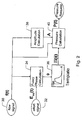
- Flow, effort and pressure signals are sent to microcontroller 16 which implements the processing shown in Fig. 2 to derive a pressure request signal P(t).
- the actual measured pressure and pressure request signal P(t) are fed to motor servo 19 which controls blower motor 20 to produce the desired instantaneous mask pressure.
- a suprasternal notch sensor is used as the effort sensor 22 to generate the effort signal.
- the sensor is more fully described in a commonly owned patent application entitled "Measurement of Respiratory Effort Using a Suprasternal Sensor,' Application Serial No. 09/396,031 filed on September 15, 1999 .
- the suprasternal notch sensor measures changes in the suprasternal notch. Increasing inspiratory efforts cause the skin of the suprasternal notch to retract.
- An optical sensor generates an electrical signal that is an increasing function of inspiratory effort derived by measuring changes in the depth of the skin of the suprasternal notch.
- step 30 an instantaneous airflow signal f(t) and an effort signal E 33 (t) are generated.
- step 34 labeled Fuzzy Phase Calculation, the system calculates the phase ⁇ in the respiratory cycle as a continuous variable using a set of fuzzy inference rules.
- the fuzzy inference rules are based upon both respiratory airflow and respiratory effort.
- the preferred rules with respect to respiratory airflow are those described above, rules 1-9, although many other inference rules can be developed based upon respiratory airflow.
- the fuzzy extents, or the degrees of truth, to which the airflow is in fuzzy sets zero, positive, large positive, negative, and large negative, and the 5-second low-pass filtered absolute value is small and large, are determined with suitable membership functions using the measured respiratory airflow f(t).
- the fuzzy extents to which the airflow is in fuzzy sets steady, increasing fast and decreasing fast are determined with suitable membership functions using the change in respiratory airflow df(t)/dt.
- the fuzzy extents to which the phase is a member of the fuzzy sets expiratory and inspiratory is determined by membership functions using a previously calculated instantaneous phase. This approach using respiratory airflow to determine phase is that disclosed in International Publication Nos. WO 98/12965 and WO 99/61088 .
- Rules 1-4 estimate the phase directly from the instantaneous respiratory airflow.
- Rule 5 permits an expiratory pause, whose length may be long if the patient has recently been breathing adequately, and short or zero if the patient is not breathing.
- Rules 6-7 provide for quick resynchronization in the event that the patient breathes irregularly.
- Rule 8 provides the equivalent of a timed backup, in which, to the extent that the patient has stopped breathing or is not adequately breathing, the ventilator will cycle at a suitable fixed rate.
- Rule 9 provides that to the extent that the patient is breathing adequately, the ventilator will tend to track the patient's recent average respiratory rate. This is particularly appropriate for patients with cardiac failure and Cheyne-Stokes breathing, whose respiratory rates tend to be extremely steady despite rhythmic changes in amplitude.
- An effect of the changing degree of activation of rules 8 and 9 is that, to the fuzzy extent that the instantaneous ventilation equals or exceeds the target ventilation, ventilatory support will be provided in phase with the patient's own respiratory efforts, and to the extent that the instantaneous ventilation is less than the target ventilation, ventilatory support will be provided at a pre-set rate.
- the weighting of rules 1-6 can be made proportional to the fuzzy extent that the instantaneous ventilation is large compared with the target ventilation, thereby reinforcing the behavior described in the previous paragraph.
- the weighting of rules 1-6 and also of rule 9 can be made smaller and the weighting of rule 8 can be made larger, if the leak is large or if there is a sudden change in the leak.
- ventilatory support will be provided as described in the preceding paragraphs, but to the extent that the respiratory airflow signal is of poor quality and it is difficult to synchronize reliably with the patient's efforts, or to know if the patient's efforts are adequate, ventilatory support will be provided in an orderly manner at a predetermined fixed rate.
- the Fuzzy Phase Calculation of step 34 also involves fuzzy inference rules relating to respiratory effort.
- the invention takes the effort signal E 33 (t) from the effort sensor 22 and processes additional fuzzy inference rules.
- the maximum activation will be at a phase shortly after the actual moment of start of inspiration, say 0.05 revolutions, and this is the best phase to associate with the rule.
- the smoother Will be the resultant determination of phase.
- the illustrative additional fuzzy inference rules relating to the effort signal E 33 (t) from the suprasternal effort sensor and the rate of change in the signal, dE 33 (t)/dt, are rules 10-13 provided above.
- the fuzzy extents to which the effort signal is in fuzzy sets zero, medium and large are calculated with appropriate membership functions using E 33 (t).
- the fuzzy extents to which the effort signal is in fuzzy sets increasing moderately, increasing fast, decreasing moderately or decreasing fast are determined with appropriate membership functions using the rate of change of the effort signal, dE 33 (t)/dt.
- the effort signal is normalized for amplitude prior to calculation of degrees of membership, for example, by dividing by the amplitude of the effort signal calculated over a long period compared with a breath, for example, 10-30 seconds.
- each of the rules in the combined set of fuzzy inference rules is evaluated to determine a degree of activation G(n) by using a standard fuzzy inference method. For example, with respect to rule 12, using one such method assuming a unit weighting of rules, if (a) the degree of truth for the membership function "the effort signal is large” evaluates to 0.6 and (b) the degree of truth for the membership function "the effort signal is decreasing fast” evaluates to 0.4, and a fuzzy logic "AND” operator is applied, then the degree of activation for G(12) would be 0.4.
- each of the 13 fuzzy inference rules associates a particular rule with a particular phase ⁇ (n).
- G(n) degree of activation
- the phase ⁇ is then used in step 36 of Fig. 2 to derive a value from the smooth pressure waveform template ⁇ ( ⁇ ).
- the Amplitude Calculation and Pressure Calculation steps as just described are comparable to the steps in International Publication Nos. WO 98/12965 and WO 99/61088 .
- the effort sensor is an accessory that can be added or removed at will from a ventilator such as an AutoVPAP system in order to achieve improved synchronization with the patient, If the effort sensor falls off the patient, fails, is electrically unplugged or is otherwise removed, then rules (10) to (13) will have no effect on the phase determination or, in other words, the rules will have no degree of activation. In this event, the device will behave as a simple servo-controlled ventilator such as the AutoVPAP device. The patient will continue to be ventilated, with ventilatory support provided approximately in phase with respiratory airflow and therefore approximately in phase with respiratory effort. Thus, the degree of support will be sufficient to guarantee that instantaneous ventilation on average equals or exceeds the target ventilation, but the precise timing information and improved immunity to the effects of leaks will be lost.
- a ventilator such as an AutoVPAP system in order to achieve improved synchronization with the patient
- effort signals from other sensors may also be utilized.
- Other forms of effort signal include, for example, an effort signal derived from esophageal pressure generated by a pressure transducer implanted in the chest that sends a signal via telemetry.
- an electromyogram signal from an electromyograph could be used without requiring any modification to the invention.
- multiple effort sensors can be utilized simply with the addition of extra fuzzy inference rules relating to the additional effort sensors.
- one embodiment of the invention might utilize a set of rules to determine phase in which some of the rules determine phase based solely upon the magnitude of the respiratory airflow and the rate of change of an effort signal. Alternatively, some rules may determine phase based upon the magnitude of the effort signal and the rate of change of respiratory airflow. Numerous modifications, in addition to the illustrative embodiments of the invention discussed herein may be made and other arrangements may be devised without departing from the spirit and scope of the invention.
Landscapes
- Health & Medical Sciences (AREA)
- Emergency Medicine (AREA)
- Pulmonology (AREA)
- Engineering & Computer Science (AREA)
- Anesthesiology (AREA)
- Biomedical Technology (AREA)
- Heart & Thoracic Surgery (AREA)
- Hematology (AREA)
- Life Sciences & Earth Sciences (AREA)
- Animal Behavior & Ethology (AREA)
- General Health & Medical Sciences (AREA)
- Public Health (AREA)
- Veterinary Medicine (AREA)
- Measurement Of The Respiration, Hearing Ability, Form, And Blood Characteristics Of Living Organisms (AREA)
Applications Claiming Priority (2)
| Application Number | Priority Date | Filing Date | Title |
|---|---|---|---|
| US15419699P | 1999-09-15 | 1999-09-15 | |
| EP00963813A EP1229956B1 (fr) | 1999-09-15 | 2000-09-15 | Synchronisation d'une soufflante d'assistance respiratoire a detecteur double de phase |
Related Parent Applications (1)
| Application Number | Title | Priority Date | Filing Date |
|---|---|---|---|
| EP00963813A Division EP1229956B1 (fr) | 1999-09-15 | 2000-09-15 | Synchronisation d'une soufflante d'assistance respiratoire a detecteur double de phase |
Publications (2)
| Publication Number | Publication Date |
|---|---|
| EP1810708A1 true EP1810708A1 (fr) | 2007-07-25 |
| EP1810708B1 EP1810708B1 (fr) | 2009-11-18 |
Family
ID=38171450
Family Applications (1)
| Application Number | Title | Priority Date | Filing Date |
|---|---|---|---|
| EP07000322A Expired - Lifetime EP1810708B1 (fr) | 1999-09-15 | 2000-09-15 | Synchronisation d'un appareil d'assistance respiratoire à détecteur double phase |
Country Status (1)
| Country | Link |
|---|---|
| EP (1) | EP1810708B1 (fr) |
Cited By (2)
| Publication number | Priority date | Publication date | Assignee | Title |
|---|---|---|---|---|
| CN112451819A (zh) * | 2020-11-12 | 2021-03-09 | 闽南理工学院 | 一种呼吸机用涡轮风机的周期重复控制方法 |
| CN115052515A (zh) * | 2019-12-05 | 2022-09-13 | 迪萨蒂医疗公司 | 用于确定患者呼吸时所付出的呼吸努力程度的系统和方法 |
Citations (3)
| Publication number | Priority date | Publication date | Assignee | Title |
|---|---|---|---|---|
| EP0452001A2 (fr) * | 1990-03-30 | 1991-10-16 | University Of Manitoba | Respirateur artificiel |
| US5803065A (en) * | 1989-09-22 | 1998-09-08 | Respironics Inc. | Breathing gas delivery method and apparatus |
| EP1083953A1 (fr) * | 1998-05-22 | 2001-03-21 | Resmed Limited | Assistance ventilatoire utilisee pour traiter l'insuffisance cardiaque et la respiration de cheyne-stokes |
-
2000
- 2000-09-15 EP EP07000322A patent/EP1810708B1/fr not_active Expired - Lifetime
Patent Citations (3)
| Publication number | Priority date | Publication date | Assignee | Title |
|---|---|---|---|---|
| US5803065A (en) * | 1989-09-22 | 1998-09-08 | Respironics Inc. | Breathing gas delivery method and apparatus |
| EP0452001A2 (fr) * | 1990-03-30 | 1991-10-16 | University Of Manitoba | Respirateur artificiel |
| EP1083953A1 (fr) * | 1998-05-22 | 2001-03-21 | Resmed Limited | Assistance ventilatoire utilisee pour traiter l'insuffisance cardiaque et la respiration de cheyne-stokes |
Non-Patent Citations (1)
| Title |
|---|
| WARD M E; EIDELMAN D; STUBBING D G; BELLEMARE F; MACKLEM P T: "Respiratory sensation and pattern of respiratory muscle activation during diaphragm fatigue", JOURNAL OF APPLIED PHYSIOLOGY, vol. 65, no. 5, 1988, UNITED STATES, pages 2181 - 2189, XP009038387 * |
Cited By (3)
| Publication number | Priority date | Publication date | Assignee | Title |
|---|---|---|---|---|
| CN115052515A (zh) * | 2019-12-05 | 2022-09-13 | 迪萨蒂医疗公司 | 用于确定患者呼吸时所付出的呼吸努力程度的系统和方法 |
| CN112451819A (zh) * | 2020-11-12 | 2021-03-09 | 闽南理工学院 | 一种呼吸机用涡轮风机的周期重复控制方法 |
| CN112451819B (zh) * | 2020-11-12 | 2024-03-01 | 闽南理工学院 | 一种呼吸机用涡轮风机的周期重复控制方法 |
Also Published As
| Publication number | Publication date |
|---|---|
| EP1810708B1 (fr) | 2009-11-18 |
Similar Documents
| Publication | Publication Date | Title |
|---|---|---|
| EP1229956B1 (fr) | Synchronisation d'une soufflante d'assistance respiratoire a detecteur double de phase | |
| US7055522B2 (en) | Patient-ventilator synchronization using dual phase sensors | |
| EP1004325B1 (fr) | Dispositif de distribution de gaz respiratoire | |
| EP1328305B1 (fr) | Dispositif destine a creer une pression positive et variable dans les voies aeriennes | |
| JP3902781B2 (ja) | 患者の換気の必要性と調和するアシストされた換気装置 | |
| EP1810708B1 (fr) | Synchronisation d'un appareil d'assistance respiratoire à détecteur double phase | |
| JP2926392B2 (ja) | 検出装置 | |
| CA2259795C (fr) | Methode de determination des composants d'une fuite d'un flux gazeux |
Legal Events
| Date | Code | Title | Description |
|---|---|---|---|
| PUAI | Public reference made under article 153(3) epc to a published international application that has entered the european phase |
Free format text: ORIGINAL CODE: 0009012 |
|
| AC | Divisional application: reference to earlier application |
Ref document number: 1229956 Country of ref document: EP Kind code of ref document: P |
|
| AK | Designated contracting states |
Kind code of ref document: A1 Designated state(s): DE FR GB SE |
|
| 17P | Request for examination filed |
Effective date: 20080110 |
|
| 17Q | First examination report despatched |
Effective date: 20080215 |
|
| AKX | Designation fees paid |
Designated state(s): DE FR GB SE |
|
| GRAP | Despatch of communication of intention to grant a patent |
Free format text: ORIGINAL CODE: EPIDOSNIGR1 |
|
| GRAS | Grant fee paid |
Free format text: ORIGINAL CODE: EPIDOSNIGR3 |
|
| GRAA | (expected) grant |
Free format text: ORIGINAL CODE: 0009210 |
|
| AC | Divisional application: reference to earlier application |
Ref document number: 1229956 Country of ref document: EP Kind code of ref document: P |
|
| AK | Designated contracting states |
Kind code of ref document: B1 Designated state(s): DE FR GB SE |
|
| REG | Reference to a national code |
Ref country code: GB Ref legal event code: FG4D |
|
| REF | Corresponds to: |
Ref document number: 60043362 Country of ref document: DE Date of ref document: 20091231 Kind code of ref document: P |
|
| REG | Reference to a national code |
Ref country code: SE Ref legal event code: TRGR |
|
| PLBE | No opposition filed within time limit |
Free format text: ORIGINAL CODE: 0009261 |
|
| STAA | Information on the status of an ep patent application or granted ep patent |
Free format text: STATUS: NO OPPOSITION FILED WITHIN TIME LIMIT |
|
| 26N | No opposition filed |
Effective date: 20100819 |
|
| REG | Reference to a national code |
Ref country code: FR Ref legal event code: CA |
|
| REG | Reference to a national code |
Ref country code: DE Ref legal event code: R082 Ref document number: 60043362 Country of ref document: DE Representative=s name: VOSSIUS & PARTNER PATENTANWAELTE RECHTSANWAELT, DE |
|
| REG | Reference to a national code |
Ref country code: DE Ref legal event code: R082 Ref document number: 60043362 Country of ref document: DE Representative=s name: VOSSIUS & PARTNER PATENTANWAELTE RECHTSANWAELT, DE |
|
| PGFP | Annual fee paid to national office [announced via postgrant information from national office to epo] |
Ref country code: SE Payment date: 20150911 Year of fee payment: 16 |
|
| REG | Reference to a national code |
Ref country code: FR Ref legal event code: PLFP Year of fee payment: 17 |
|
| PG25 | Lapsed in a contracting state [announced via postgrant information from national office to epo] |
Ref country code: SE Free format text: LAPSE BECAUSE OF NON-PAYMENT OF DUE FEES Effective date: 20160916 |
|
| REG | Reference to a national code |
Ref country code: SE Ref legal event code: EUG |
|
| REG | Reference to a national code |
Ref country code: FR Ref legal event code: PLFP Year of fee payment: 18 |
|
| REG | Reference to a national code |
Ref country code: FR Ref legal event code: PLFP Year of fee payment: 19 |
|
| REG | Reference to a national code |
Ref country code: DE Ref legal event code: R082 Ref document number: 60043362 Country of ref document: DE Representative=s name: VOSSIUS & PARTNER PATENTANWAELTE RECHTSANWAELT, DE Ref country code: DE Ref legal event code: R081 Ref document number: 60043362 Country of ref document: DE Owner name: RES MED PTY LTD, BELLA VISTA, AU Free format text: FORMER OWNER: RESMED LTD., BELLA VISTA, NEW SOUTH WALES, AU |
|
| PGFP | Annual fee paid to national office [announced via postgrant information from national office to epo] |
Ref country code: FR Payment date: 20190815 Year of fee payment: 20 Ref country code: DE Payment date: 20190903 Year of fee payment: 20 |
|
| PGFP | Annual fee paid to national office [announced via postgrant information from national office to epo] |
Ref country code: GB Payment date: 20190912 Year of fee payment: 20 |
|
| REG | Reference to a national code |
Ref country code: DE Ref legal event code: R071 Ref document number: 60043362 Country of ref document: DE |
|
| REG | Reference to a national code |
Ref country code: GB Ref legal event code: PE20 Expiry date: 20200914 |
|
| PG25 | Lapsed in a contracting state [announced via postgrant information from national office to epo] |
Ref country code: GB Free format text: LAPSE BECAUSE OF EXPIRATION OF PROTECTION Effective date: 20200914 |