EP1811296A1 - Verfahren und Vorrichtungen zum Messen des Oberflächenzustands einer Außenhaut - Google Patents
Verfahren und Vorrichtungen zum Messen des Oberflächenzustands einer Außenhaut Download PDFInfo
- Publication number
- EP1811296A1 EP1811296A1 EP07008527A EP07008527A EP1811296A1 EP 1811296 A1 EP1811296 A1 EP 1811296A1 EP 07008527 A EP07008527 A EP 07008527A EP 07008527 A EP07008527 A EP 07008527A EP 1811296 A1 EP1811296 A1 EP 1811296A1
- Authority
- EP
- European Patent Office
- Prior art keywords
- skin
- measuring
- culture solution
- stimulation
- potential difference
- Prior art date
- Legal status (The legal status is an assumption and is not a legal conclusion. Google has not performed a legal analysis and makes no representation as to the accuracy of the status listed.)
- Withdrawn
Links
- 238000000034 method Methods 0.000 title claims abstract description 70
- 230000000638 stimulation Effects 0.000 claims abstract description 113
- 229940079593 drug Drugs 0.000 claims abstract description 59
- 239000003814 drug Substances 0.000 claims abstract description 59
- 239000000243 solution Substances 0.000 claims description 192
- 239000000126 substance Substances 0.000 claims description 44
- 230000004936 stimulating effect Effects 0.000 claims description 36
- 230000005764 inhibitory process Effects 0.000 claims description 25
- 239000011248 coating agent Substances 0.000 claims description 22
- 238000000576 coating method Methods 0.000 claims description 22
- 239000007788 liquid Substances 0.000 claims description 22
- 239000002504 physiological saline solution Substances 0.000 claims description 16
- 208000003251 Pruritus Diseases 0.000 claims description 9
- 238000004891 communication Methods 0.000 claims description 9
- 150000001413 amino acids Chemical class 0.000 claims description 7
- 238000005259 measurement Methods 0.000 abstract description 15
- 208000002193 Pain Diseases 0.000 abstract description 12
- 230000000694 effects Effects 0.000 abstract description 6
- 238000011161 development Methods 0.000 abstract description 2
- 210000003491 skin Anatomy 0.000 description 250
- YKPUWZUDDOIDPM-SOFGYWHQSA-N capsaicin Chemical compound COC1=CC(CNC(=O)CCCC\C=C\C(C)C)=CC=C1O YKPUWZUDDOIDPM-SOFGYWHQSA-N 0.000 description 16
- QDZOEBFLNHCSSF-PFFBOGFISA-N (2S)-2-[[(2R)-2-[[(2S)-1-[(2S)-6-amino-2-[[(2S)-1-[(2R)-2-amino-5-carbamimidamidopentanoyl]pyrrolidine-2-carbonyl]amino]hexanoyl]pyrrolidine-2-carbonyl]amino]-3-(1H-indol-3-yl)propanoyl]amino]-N-[(2R)-1-[[(2S)-1-[[(2R)-1-[[(2S)-1-[[(2S)-1-amino-4-methyl-1-oxopentan-2-yl]amino]-4-methyl-1-oxopentan-2-yl]amino]-3-(1H-indol-3-yl)-1-oxopropan-2-yl]amino]-1-oxo-3-phenylpropan-2-yl]amino]-3-(1H-indol-3-yl)-1-oxopropan-2-yl]pentanediamide Chemical compound C([C@@H](C(=O)N[C@H](CC=1C2=CC=CC=C2NC=1)C(=O)N[C@@H](CC(C)C)C(=O)N[C@@H](CC(C)C)C(N)=O)NC(=O)[C@@H](CC=1C2=CC=CC=C2NC=1)NC(=O)[C@H](CCC(N)=O)NC(=O)[C@@H](CC=1C2=CC=CC=C2NC=1)NC(=O)[C@H]1N(CCC1)C(=O)[C@H](CCCCN)NC(=O)[C@H]1N(CCC1)C(=O)[C@H](N)CCCNC(N)=N)C1=CC=CC=C1 QDZOEBFLNHCSSF-PFFBOGFISA-N 0.000 description 14
- 102100024304 Protachykinin-1 Human genes 0.000 description 14
- 101800003906 Substance P Proteins 0.000 description 14
- 230000002401 inhibitory effect Effects 0.000 description 9
- 230000001502 supplementing effect Effects 0.000 description 9
- VEXZGXHMUGYJMC-UHFFFAOYSA-M Chloride anion Chemical compound [Cl-] VEXZGXHMUGYJMC-UHFFFAOYSA-M 0.000 description 8
- FAPWRFPIFSIZLT-UHFFFAOYSA-M Sodium chloride Chemical compound [Na+].[Cl-] FAPWRFPIFSIZLT-UHFFFAOYSA-M 0.000 description 8
- 229960002504 capsaicin Drugs 0.000 description 8
- 235000017663 capsaicin Nutrition 0.000 description 8
- 239000011521 glass Substances 0.000 description 8
- KWGKDLIKAYFUFQ-UHFFFAOYSA-M lithium chloride Chemical compound [Li+].[Cl-] KWGKDLIKAYFUFQ-UHFFFAOYSA-M 0.000 description 8
- NTYJJOPFIAHURM-UHFFFAOYSA-N Histamine Chemical compound NCCC1=CN=CN1 NTYJJOPFIAHURM-UHFFFAOYSA-N 0.000 description 6
- 229920000298 Cellophane Polymers 0.000 description 5
- 239000002390 adhesive tape Substances 0.000 description 5
- 150000003927 aminopyridines Chemical class 0.000 description 5
- 239000005557 antagonist Substances 0.000 description 5
- 150000002500 ions Chemical class 0.000 description 5
- 229920003023 plastic Polymers 0.000 description 5
- 239000004033 plastic Substances 0.000 description 5
- 231100000241 scar Toxicity 0.000 description 5
- CFMYXEVWODSLAX-QOZOJKKESA-N tetrodotoxin Chemical compound O([C@@]([C@H]1O)(O)O[C@H]2[C@@]3(O)CO)[C@H]3[C@@H](O)[C@]11[C@H]2[C@@H](O)N=C(N)N1 CFMYXEVWODSLAX-QOZOJKKESA-N 0.000 description 5
- 229950010357 tetrodotoxin Drugs 0.000 description 5
- CFMYXEVWODSLAX-UHFFFAOYSA-N tetrodotoxin Natural products C12C(O)NC(=N)NC2(C2O)C(O)C3C(CO)(O)C1OC2(O)O3 CFMYXEVWODSLAX-UHFFFAOYSA-N 0.000 description 5
- 229920000936 Agarose Polymers 0.000 description 4
- 229940075397 calomel Drugs 0.000 description 4
- DRCMAZOSEIMCHM-UHFFFAOYSA-N capsazepine Chemical compound C1C=2C=C(O)C(O)=CC=2CCCN1C(=S)NCCC1=CC=C(Cl)C=C1 DRCMAZOSEIMCHM-UHFFFAOYSA-N 0.000 description 4
- 239000000919 ceramic Substances 0.000 description 4
- GTKRFUAGOKINCA-UHFFFAOYSA-M chlorosilver;silver Chemical compound [Ag].[Ag]Cl GTKRFUAGOKINCA-UHFFFAOYSA-M 0.000 description 4
- 239000004020 conductor Substances 0.000 description 4
- ZOMNIUBKTOKEHS-UHFFFAOYSA-L dimercury dichloride Chemical compound Cl[Hg][Hg]Cl ZOMNIUBKTOKEHS-UHFFFAOYSA-L 0.000 description 4
- 229920001971 elastomer Polymers 0.000 description 4
- 229920002457 flexible plastic Polymers 0.000 description 4
- 229920001296 polysiloxane Polymers 0.000 description 4
- 239000011780 sodium chloride Substances 0.000 description 4
- 208000024891 symptom Diseases 0.000 description 4
- SGTNSNPWRIOYBX-UHFFFAOYSA-N 2-(3,4-dimethoxyphenyl)-5-{[2-(3,4-dimethoxyphenyl)ethyl](methyl)amino}-2-(propan-2-yl)pentanenitrile Chemical compound C1=C(OC)C(OC)=CC=C1CCN(C)CCCC(C#N)(C(C)C)C1=CC=C(OC)C(OC)=C1 SGTNSNPWRIOYBX-UHFFFAOYSA-N 0.000 description 3
- 239000006144 Dulbecco’s modified Eagle's medium Substances 0.000 description 3
- 102000003797 Neuropeptides Human genes 0.000 description 3
- 108090000189 Neuropeptides Proteins 0.000 description 3
- 210000002615 epidermis Anatomy 0.000 description 3
- 229960001340 histamine Drugs 0.000 description 3
- 150000007524 organic acids Chemical class 0.000 description 3
- 239000004094 surface-active agent Substances 0.000 description 3
- 229960001722 verapamil Drugs 0.000 description 3
- 229920001817 Agar Polymers 0.000 description 2
- 108010010803 Gelatin Proteins 0.000 description 2
- 239000008272 agar Substances 0.000 description 2
- 230000004888 barrier function Effects 0.000 description 2
- 239000013078 crystal Substances 0.000 description 2
- 230000006378 damage Effects 0.000 description 2
- 210000004207 dermis Anatomy 0.000 description 2
- 238000010586 diagram Methods 0.000 description 2
- 239000008273 gelatin Substances 0.000 description 2
- 229920000159 gelatin Polymers 0.000 description 2
- 235000019322 gelatine Nutrition 0.000 description 2
- 235000011852 gelatine desserts Nutrition 0.000 description 2
- 238000007654 immersion Methods 0.000 description 2
- 238000011835 investigation Methods 0.000 description 2
- JVTAAEKCZFNVCJ-UHFFFAOYSA-N lactic acid Chemical compound CC(O)C(O)=O JVTAAEKCZFNVCJ-UHFFFAOYSA-N 0.000 description 2
- 229940125422 potassium channel blocker Drugs 0.000 description 2
- 239000003450 potassium channel blocker Substances 0.000 description 2
- 229920000742 Cotton Polymers 0.000 description 1
- 241001465754 Metazoa Species 0.000 description 1
- 239000007864 aqueous solution Substances 0.000 description 1
- 239000003795 chemical substances by application Substances 0.000 description 1
- 238000012790 confirmation Methods 0.000 description 1
- 238000007796 conventional method Methods 0.000 description 1
- 238000002316 cosmetic surgery Methods 0.000 description 1
- 230000003247 decreasing effect Effects 0.000 description 1
- 230000002950 deficient Effects 0.000 description 1
- 208000037265 diseases, disorders, signs and symptoms Diseases 0.000 description 1
- 208000035475 disorder Diseases 0.000 description 1
- CXPOFJRHCFPDRI-UHFFFAOYSA-N dodecylbenzene;sulfuric acid Chemical compound OS(O)(=O)=O.CCCCCCCCCCCCC1=CC=CC=C1 CXPOFJRHCFPDRI-UHFFFAOYSA-N 0.000 description 1
- 230000007803 itching Effects 0.000 description 1
- 235000014655 lactic acid Nutrition 0.000 description 1
- 239000004310 lactic acid Substances 0.000 description 1
- 238000004519 manufacturing process Methods 0.000 description 1
- 239000002547 new drug Substances 0.000 description 1
- 229920002379 silicone rubber Polymers 0.000 description 1
- 229940125794 sodium channel blocker Drugs 0.000 description 1
- 239000003195 sodium channel blocking agent Substances 0.000 description 1
- 239000013589 supplement Substances 0.000 description 1
Images




Classifications
-
- G—PHYSICS
- G01—MEASURING; TESTING
- G01N—INVESTIGATING OR ANALYSING MATERIALS BY DETERMINING THEIR CHEMICAL OR PHYSICAL PROPERTIES
- G01N33/00—Investigating or analysing materials by specific methods not covered by groups G01N1/00 - G01N31/00
- G01N33/48—Biological material, e.g. blood, urine; Haemocytometers
- G01N33/50—Chemical analysis of biological material, e.g. blood, urine; Testing involving biospecific ligand binding methods; Immunological testing
-
- A—HUMAN NECESSITIES
- A61—MEDICAL OR VETERINARY SCIENCE; HYGIENE
- A61K—PREPARATIONS FOR MEDICAL, DENTAL OR TOILETRY PURPOSES
- A61K49/00—Preparations for testing in vivo
- A61K49/0004—Screening or testing of compounds for diagnosis of disorders, assessment of conditions, e.g. renal clearance, gastric emptying, testing for diabetes, allergy, rheuma, pancreas functions
- A61K49/0006—Skin tests, e.g. intradermal testing, test strips, delayed hypersensitivity
-
- A—HUMAN NECESSITIES
- A61—MEDICAL OR VETERINARY SCIENCE; HYGIENE
- A61B—DIAGNOSIS; SURGERY; IDENTIFICATION
- A61B5/00—Measuring for diagnostic purposes; Identification of persons
- A61B5/44—Detecting, measuring or recording for evaluating the integumentary system, e.g. skin, hair or nails
- A61B5/441—Skin evaluation, e.g. for skin disorder diagnosis
- A61B5/442—Evaluating skin mechanical properties, e.g. elasticity, hardness, texture, wrinkle assessment
-
- A—HUMAN NECESSITIES
- A61—MEDICAL OR VETERINARY SCIENCE; HYGIENE
- A61B—DIAGNOSIS; SURGERY; IDENTIFICATION
- A61B5/00—Measuring for diagnostic purposes; Identification of persons
- A61B5/48—Other medical applications
- A61B5/4848—Monitoring or testing the effects of treatment, e.g. of medication
Definitions
- the present invention relates to methods and apparatus for measuring the skin surface condition. More particularly, the present invention relates to, first, a method of making a skin model on the surface of which a skin section is floated with its surface upward, and measuring the potential condition of the skin surface from the potential difference between the skin surface and the culture solution, a method of measuring the degree of stimulation from the potential difference, which changes after a stimulating factor is imparted to the skin surface or a culture solution, and a method of measuring the degree of inhibition of the skin stimulation having changed after drug is added to the stimulated skin, as well as an apparatus which is suitable for practicing these methods.
- the present invention relates to a method of measuring the potential condition of the skin surface simply from the potential difference between the skin surface and a sublingual, without giving pain to human, and an apparatus which is suitable for practicing the method.
- the skin surface of a human receives various kinds of stimulation from the natural world.
- a symptom appears on the skin, and at the same time, an itch, a pain, a smarting pain and the like which are expressed by human senses are affected in many cases. Also in many cases, no symptom appears but only the sense is produced.
- Such stimulation is pleasant in some cases, but are unpleasant in many cases. For example, stimulation such as an itch is unpleasant to human.
- Such stimulation belongs to the category of human senses and is a nuisance because other people do not feel or see it.
- information about the human skin surface condition is useful in the field of dermatology.
- the dermis layer and the skin which has been vigorously rubbed with a file have been used as a standard.
- the latter case was defective in that the potential of a standard point changes in time, and in both cases, a severe disorder was imparted to the skin due to opening in the skin a hole reaching to the dermis layer, or rubbing the skin.
- an objective of the present invention is to provide methods and apparatus for measuring the skin surface condition
- the first objective of the present invention is to provide a method for measuring the potential condition of the skin surface , a method for measuring and digitalizing human senses caused by stimulation on the skin surface, and furthermore, where the senses have a mentally negative effect on a human, to provide a method for measuring the effect of drugs for warding off the negativity, and an apparatus used thereof.
- the second objective of the present invention is to provide a method and apparatus for simply measuring potential condition of the skin surface without giving pain to the human.
- the present inventors studied intensively, and as a result, paid attention to the skin surface potential and discovered that the aforementioned problems can be solved by making a simple skin model, in which a skin section is floated on the surface of a culture solution with its surface upward, and measuring the potential difference between the skin surface and the culture solution, utilizing the measured value, measuring the potential condition of the skin surface using the sublingual potential as a standard, and so on, and led to the completion of the present invention.
- the present invention provides methods for measuring the skin surface condition, characterized by floating a skin section, with its surface upward, on the surface of a culture solution accommodated in a container, and measuring the potential difference between the skin surface of this skin section and said culture solution.
- This skin surface condition may be the potential condition of the skin surface.
- the present invention is a method of floating a skin section, with its surface upward, on the surface of a culture solution accommodated in a container, and upon measuring the potential difference between the skin surface of this skin section and said culture solution, measuring the potential difference by imparting stimulation to the skin surface to determine a difference between the measured potential difference and the potential difference when no stimulation is imparted, in order to measure the degree of skin stimulation.
- the stimulation may be caused by a stimulating substance or physical stimulation.
- the present invention is a method of floating a skin section, with its surface upward, on the surface of the culture solution accommodated in a container, and upon measuring the potential difference between the skin surface of this skin section and said culture solution, measuring the potential difference by adding a stimulating substance to the culture solution to determine a difference between themeasuredpotential and the potential difference when no stimulating substance is added, in order to measure the degree of skin stimulation.
- the stimulating substance most typically used upon measuring said degree of skin stimulation is a substance which generates an itch.
- the present invention is a method of floating a skin section, with its surface upward, on the surface of the culture solution accommodated in a container, and upon measuring the potential difference between the skin surface of this skin section and said culture solution, measuring the potential difference by coating the skin surface with a drug, either before or after the stimulation is imparted to the skin surface, too determine a difference between the measured potential difference and the potential difference when the skin surface is coated with no drug, in order to measure the degree of inhibition of the skin stimulation by a drug.
- the present invention is a method of floating a skin section, with its surface upward, on the surface of a culture solution accommodated in a container, and upon measuring the potential difference between the skin surface of this skin section and said culture solution, measuring the potential difference by adding a drug to the culture solution, either before or after imparting stimulation to the skin surface, to determine a difference between the measured potential difference and the potential difference when no drug is added, in order to measure the degree of inhibition of skin stimulation by a drug.
- the stimulation may be caused by a stimulating substance or physical stimulation.
- the present invention is a method of floating a skin section, with its surface upward, on a culture solution accommodated in a container, to which a stimulating substance is added, and upon measuring the potential difference between the skin surface of this skin section and said culture solution, measuring the potential difference by coating the skin surface with a drug, either before or after a stimulating substance is added to the culture solution, to determine a difference between the measured potential difference and the potential difference when the skin surface is coated with no drug, in order to measure the degree of inhibition of skin stimulation by a drug.
- the present invention is a method of floating a skin section, with its surface upward, on the surface of a culture solution accommodated in a container, to which a stimulating substance is added, and upon measuring the potential difference between the skin surface of this skin section and said culture solution, measuring the potential difference by adding a drug to the culture solution, either before or after a stimulating substance is added to the culture solution, to determine a difference between the measured potential and the potential when no stimulating substance is added, in order to determine the degree of inhibition of skin stimulation by a drug.
- the stimulating substance most typically used upon measuring said degree of inhibition of skin stimulation is a substance which generates an itch.
- the present invention is a skin surface condition measuring apparatus comprising a culture solution, a container accommodating a skin section floating, with its surface upward, on the surface of the culture solution, a standard electrode part communicated to said culture solution , a measuring electrode part communicated to the skin surface of said skin section, and a potential difference detecting part for detecting the potential difference between said standard electrode part and said measuring electrode part.
- said standard electrode part used in the skin surface condition measuring apparatus using a culture solution is provided with an inner tube accommodating an internal solution immersed with a standard electrode, and an outer tube accommodating an internal solution which accommodates this inner tube to form a double tube, and that a liquid junction is attached to the wall of the inner tube.
- the communication between the culture solution and the standard electrode part is made by a salt bridge connected between the culture solution and the internal solution of the outer tube.
- said measuring electrode part used in the skin surface condition measuring apparatus may comprise an inner tube accommodating an internal solution immersed with a measuring electrode, and an outer tube accommodating an internal solution which accommodates this inner tube to form a double tube, and a liquid junction attached to the wall of the inner tube.
- the communication between the skin surface of the skin section and the measuring electrode part is made by a salt bridge connected between the skin surface of the skin section and the internal solution in the outer tube.
- Said skin surface condition in the apparatus of the present invention may be the potential condition of the skin surface.
- the culture solutions used in each of the aforementioned methods and each apparatus all contain physiological saline or amino acids.
- the condition of the skin surface may be measured simply by measuring the potential difference between the skin surface of the skin section and the culture solution on which a skin section is floated using a suitable apparatus. Furthermore, by measuring the change in the said potential difference by imparting a stimulating factor to the skin surface or the culture solution, stimulation may be expressed objectively without directly employing a human yet exceeding human subjectivity.
- the present invention may be utilized in investigating a drug which is effective to skin stimulation due to a change in the aforementioned potential difference caused by adding a drug, and which can produce a considerable effect on the investigation of new drugs, and is very useful.
- the present invention is a method for measuring the skin surface condition, characterized by using a sublingual potential as a standard potential upon measuring of the potential condition of the skin surface.
- this measuring method there can be adopted a method for measuring the skin surface condition from a potential difference between a standard electrode part communicating with a sublingual part and a measuring electrode part communicating with the skin surface.
- the present invention is the skin surface condition measuring apparatus, which is provided with a standard electrode part communicating with a sublingual part, a measuring electrode part communicating with the skin surface, and a potential difference detecting part for detecting a potential difference between the standard electrode part and the measuring electrode part.
- a standard electrode part used in this skin surface condition measuring apparatus using a sublingual potential as a standard potential is provided with an inner tube accommodating an internal solution with a standard electrode immersed therein, and an outer tube accommodating an internal solution which accommodates this inner tube to form a double tube, and a liquid junction is attached to the wall of the inner tube.
- communication between the sublingual part and the standard electrode part is made by a salt bridge connecting the sublingual part and the internal solution in the outer tube of the standard electrode part.
- the measuring electrode part used in the skin surface condition measuring apparatus using a sublingual potential as a standard potential may be provided with an inner tube accommodating an internal solution with a measuring electrode part immersed therein, and an outer tube accommodating an internal solution which accommodates this inner tube to form a double tube, and a liquid junction attached to the wall of the inner tube.
- communication between the skin surface and the measuring electrode part is made by a salt bridge connecting the skin surface and the internal solution in the outer tube of the measuring electrode part.
- the skin surface condition using said sublingual potential of the present invention as a standard potential may be a potential condition of the skin surface.
- the skin surface condition measuring method and apparatus using a sublingual potential as a standard potential by using a suitable apparatus to measure the potential difference between the skin surface and the sublingual part, the skin surface condition can be measured simply without causing pain to a human.
- the concept of the skin surface condition includes, in addition to the potential condition of skin surface, various changes in condition occurring on skin surface, for example, the change in condition and the degree thereof due to stimulation, inhibition of stimulation and the like.
- Embodiments of the present invention will be described in detail below. First, a method and apparatus for measuring the skin surface condition using a culture solution will be explained.
- This method of the present invention includes several methods.
- a skin section is floated, with its surface upward, on the surface of a culture solution accommodated in a container, and a potential difference (mV) between the skin surface of this skin section and the culture solution is measured, thereby measuring the surface condition of skin.
- mV potential difference
- a second method upon measuring the skin surface condition of the first method, stimulation is imparted further to the skin model comprising a skin section and a culture solution to measure aforementioned potential difference.
- This potential difference changes as stimulation is imparted.
- This change means that a stream of ions has occurred in the epidermis.
- the direction of a stream of ions differs depending on stimulation.
- stimulation producing mobility of ions is imparted to the epidermis.
- the degree of skin stimulation is measured from the changed value.
- the place of stimulation may be on skin surface or culture solution.
- examples of methods for imparting stimulation include coating skin with a stimulating substance and physical stimulation.
- the method used is addition of stimulating substances.
- these stimulating substances include neuropeptide, histamine, surfactant, organic acid, and capsaicin.
- neuropeptide includes substance P.
- the stimulating substance generates an itch.
- examples of said physical stimulation include barrier destruction by a cellophane adhesive tape and the like.
- a third method is a method for measuring the degree of inhibition by addition of a drug to the stimulated skin in the second method.
- a drug is added to measure the aforementioned potential difference, and the degree of inhibition of skin stimulation by a drug is measured from the value of potential difference which changes by addition.
- the present method can take various methods depending on a method of drug addition. More specifically, (1): A skin section, the surface of which has been stimulated, is floated with its surface upward, on a culture solution, a potential difference is measured by coating skin surface with a drug, either before or after imparting skin stimulation, and the degree of inhibition of skin stimulation by a drug is determined from a value of a potential difference changed by drug coating.
- the aforementioned coating of a drug may be performed either before or after imparting stimulation.
- the drug is coated after imparting stimulation, the effect of alleviating the stimulation can be measured, and when the drug is coated before imparting stimulation, the effect of warding off the stimulation beforehand can be measured.
- the culture solution used in the measuring methods 1 through 3 may be physiological saline and an aqueous solution containing amino acids and the like.
- the skin section used in the measurement may be a cultured skin, a human skin obtained upon plastic surgery and the like, and a skin derived from an animal such as a hairless mouse.
- Fig. 1 shows an embodiment of the skin surface condition measuring apparatus using a culture solution in the present invention.
- the skin surface condition measuring apparatus has a culture solution 1, a container 3 accommodating a skin section 2 floated, with its surface upward, on the surface of the culture solution, a standard electrode part 4 communicating the culture solution 1, a measuring electrode part 5 communicating to the skin surface of the skin section 2, and a potential difference detecting part 6 for detecting a potential difference between the standard electrode part 4 and the measuring electrode part 5.
- the standard electrode part 4 has a double outer tube 41 and inner tube 42 which are made of a plastic, and a tube wall of the inner tube 42 has a liquid junction 43 composed of a porous ceramic having the function of not permeating a solution but permeating electrons or ions.
- the interiors of the double outer tube 41 and inner tube 42 are filled with internal solutions 44, 45 comprising a KCl solution having the predetermined concentration, respectively, and a standard electrode 46 comprising silver-silver chloride is immersed in the internal solution 45 of the inner tube 42.
- This standard electrode 46 is attached to an electrode holder 47 which also functions as a cap and closes upper ends of the double outer tube 41 and inner tube 42, and in the condition where the electrode is suspended from there via a conductor, the electrode is immersed in the internal solution 45 in the inner tube 42.
- a solution supplementing port 48 for supplementing the internal solution 44 in the outer tube 41 is provided on a circumferential plane near an upper end of the outer tube 41.
- the double outer tube 41 and inner tube 42 may all be made of glass.
- the liquid junction 43 used may be a known liquid junction such as a solution having a pseudo-crystal structure such as gelatin and agar, and may include a liquid junction used as a salt bridge such as a porous Bicoll glass.
- the standard electrode 46 used maybe an electrode comprising of calomel.
- the internal solution 45 used may be, other than a KC1 solution, a solution of chloride such as sodium chloride, lithium chloride and the like.
- the internal solution 44 in the outer tube 41 used may be, in addition to chloride used in the internal solution 45 in the inner tube 42, physiological saline.
- the measuring electrode part 5 has the similar structure as that of the standard electrode part 4. More specifically, the measuring electrode part 5 has a double outer tube 51 and an inner tube 52 made of a plastic, and the tube wall of an inner tube 52 has a liquid junction 53 composed of a porous ceramic. The interiors of the double outer tube 51 and the inner tube 52 are filled with internal solutions 54 and 55, respectively, comprising of a KCl solution of a predetermined concentration, and a measuring electrode 56 composed of silver-silver chloride is immersed in the internal solution 55 of the inner tube 52.
- This measuring electrode 56 is attached to an electrode holder 57 which also functions as a cap to close upper ends of the double outer tube 51 and the inner tube 52, and is immersed in the internal solution 55 in the inner tube 52 in a state of being suspended from the electrode holder via conductor.
- a solution supplementing port 58 for supplementing the internal solution 54 in the outer tube 51 is provided on a circumferential plane near an upper end of the outer tube 51.
- the measuring electrode part 5 in Fig. 1 may also take an embodiment which is similar to that of the standard electrode part 4. More specifically, the double outer tube 51 and the inner tube 52 used may be all made of glass. In addition, the liquid injunction 53 used may be the porous Bicoll glass. In addition, the aforementioned measuring electrode 56 used may comprise of calomel. In addition, the internal solution 55 used may be, other than a KC1 solution, a solution of chloride such as sodium chloride and lithium chloride. The internal solution 55 used in the outer tube 51 may be, other than chloride used in said internal solution 55, physiological saline.
- the standard electrode part 4 in Fig. 1 is communicated to the culture solution 1 , which comprises of DMEM (Dulbecco's modified Eagle's medium), via a salt bridge 7, in which a flexible plastic tube immersed in the internal solution 44 in its outer tube 41 is filled with agarose containing physiological saline.
- DMEM Dulbecco's modified Eagle's medium
- the salt bridge 7 may be a known one, and for example, rubber tubes such as silicone and the like may be used.
- the measuring electrode part 5 is communicated to the skin surface of the skin section 2 through a filter 9 placed on the skin surface via a salt bridge 8 in which a flexible plastic tube immersed in an internal solution 54 in the outer tube 51 is filled with agarose containing physiological saline.
- This filter 9 achieves uniformity in the contact of the salt bridge 8 with the skin surface of skin section 2.
- the salt bridge 8 may be a known one, and may for example use rubber tubes such as silicone and the like.
- the standard electrode 46 of the aforementioned standard electrode part 4 and the measuring electrode 56 of the measuring electrode 5 are connected to a potential differential detecting part 6 to measure a potential difference thereof.
- the standard electrode part used in the skin surface condition measuring apparatus may be provided with a liquid junction on the tube wall of the outer tube 41 of the standard electrode part 4 in Fig. 1.
- the outer tube may be provided with a solution supplementing port, which, like in Fig. 1, supplements an internal solution.
- This standard electrode part has a function similar to that of the standard electrode part 4 of the skin surface condition measuring apparatus in Fig. 1, and it can be used in place of the standard electrode part 4 in Fig. 1., provided that communication is performed by immersion of this standard electrode part in the culture solution and via a liquid junction provided on an outer tube wall. Note that, embodiments of this standard electrode part are the same as those in Fig. 1.
- the standard electrode part in the skin surface condition measuring apparatus may comprise of only the inner tube 42 of the standard electrode part 4 in Fig. 1 , namely, the inner tube 42, the liquid junction 43, the internal solution 45 and the standard electrode 46.
- This standard electrode part also has a function similar to that of a standard electrode part 4 of the skin surface condition measuring apparatus in Fig. 1, and it can be used in place of the standard electrode part 4 in Fig. 1, provided that, communication with a culture solution is performed by immersion of this standard electrode part into the culture solution and via a liquid junction provided on the tube wall.
- embodiments in this standard electrode part are the same as in Fig. 1.
- a sublingual area is used as a standard to measure the potential difference (mV) between the skin surface and the sublingual area. As a result, the skin surface condition is measured.
- Fig. 2 shows an example of the skin surface condition (potential condition of the skin surface) using a sublingual potential as a standard potential in the present invention.
- the skin surface condition measuring apparatus has a standard electrode part 101 communicating to a sublingual area (not shown), a measuring electrode part 102 communicating to the skin surface (not shown), and a potential difference detecting part 103 for detecting a potential difference between the standard electrode part 101 and the measuring electrode part 102.
- the standard electrode part 101 has double outer tube 111 and inner tube 112 made of a plastic, and a tube wall of the inner tube 112 has a liquid junction 113 comprising a porous ceramic having the function of not permeating a solution but permeating electrons or ions.
- the interiors of the double outer tube 111 and inner tube 112 are filled with internal solutions 114, 115 comprising a KCl solution having the prescribed concentration, respectively, and a standard electrode 116 composed of silver-silver chloride is immersed in the internal solution 115 of the inner tube 112.
- This standard electrode 116 is attached to an electrode holder 117 which also functions as a cap and closes upper ends of the double outer tube 111 and inner tube 112, and in the condition where the electrode is suspended from there via a conductor, the electrode is immersed in the internal solution 115 in the inner tube 112.
- a solution supplementing port 118 for supplementing the internal solution 114 in the outer tube 111 is provided on a circumferential plane near an upper end of the outer tube 111.
- the double outer tube 111 and inner tube 112 all made of glass may be used.
- the liquid junction 113 the known liquid junctions such as solutions having the pseudo-crystal structure such as gelatin, agar and the like and liquid junctions including those used as a salt bridge such as porous Bicoll glass and the like may be used.
- the standard electrode 116 an electrode comprising calomel may be used.
- the internal solution 115 a solution of chloride such as sodium chloride, lithium chloride and the like can be used in addition to a KC1 solution.
- physiological saline may be used in addition to chloride used in the internal solution 115 in the inner tube 112.
- the measuring electrode part 102 has the similar structure to that of the standard electrode part 101. That is, the measuring electrode part 102 has double outer tube 121 and inner tube 122 made of a plastic, and a tube wall of the inner tube 122 has a liquid junction 123 composed of a porous ceramic.
- the interiors of the double outer tube 121 and inner tube 122 are filled with internal solutions 124, 125 comprising aKCl solution having the prescribed concentration, respectively, and a measuring electrode 126 composed of silver-silver chloride is immersed in the internal solution 125 of the inner tube 122.
- This measuring electrode 126 is attached to an electrode holder 127 which also functions as a cap and closes upper ends of the double outer tube 121 and inner tube 122, and in the condition where the electrode is suspended from there via a conductor, the electrode is immersed in the internal solution 125 in the inner tube 122.
- a solution supplementing port 128 for supplementing the internal solution 124 in the outer tube 121 is provided on a circumferential plane near an upper end of the outer tube 121.
- the measuring electrode part 102 in Fig. 2 can also take the similar embodiment to that of the standard electrode part 101. That is, the double outer tube 121 and inner tube 122 all made of glass may be used. In addition, porous Bicoll glass may be used in the liquid junction 123. In addition, as the measuring electrode 126, an electrode comprising calomel may be used. In addition, as the internal solution 125, a solution of chloride such as sodium chloride, lithium chloride and the like can be used in addition to a KC1 solution. As the internal solution 124 in the outer tube 121, physiological saline may be used in addition to chloride used in the internal solution 125.
- the standard electrode part 101 in Fig. 2 is communicated to a sublingual area via a salt bridge 104 immersed in the internal solution 114 in its outer tube 111.
- the salt bridge 104 may be the known one, and for example, flexible plastic tubes, rubber tubes such as silicone and the like, and the like which are filled with agarose containing physiological saline are used.
- the measuring electrode part 102 is communicated to the skin surface via a salt bridge 105 immersed in the inner solution 124 in its outer tube 121.
- the salt bridge 105 may be the known one, and for example, flexible plastic tubes, rubber tubes such as silicone and the like, and the like which are filled with agarose containing physiologicalsaline are used.
- the standard electrode 116 of the standard electrode 101 and the measuring electrode 126 of the measuring electrode part 102 are connected to the potential difference detecting part 103, respectively.
- one end of a salt bridge In order to measure the skin surface condition (potential condition) using the aforementioned apparatus, one end of a salt bridge, the other end of which is communicated to a standard electrode part, is placed in mouth of a subject to be measured, and is fixed sublingual.
- a salt bridge is not directly placed in mouth, but a tube such as a plastic, a silicon rubber and the like containing therein a cotton or the like containing exchangeable physiological saline is connected to an end of a salt bridge, and the tube may be placed in mouth and fixed sublingual.
- a potential difference between the standard electrode part and the measuring electrode part is measured with a potential difference detecting part. Note that it is preferable that communication between the salt bridge and the skin surface is through a filter in order to contact both uniformly.
- a number of information which are useful for dermatology can be obtained. For example, physical stimulation such as barrier destruction with a cellophane adhesive tape and the like is given to the skin surface, or chemical stimulation is given to the skin surface by coating a stimulating substance such as neuropeptide, histamine, surfactant, organic acid, capsaicin and the like, a potential of the skin surface having subjective sense such as itching and the like is measured, and the skin surface condition can be measured by expressing a change in the skin surface condition as an objective numerical value from comparison of potential differences before and after stimulation.
- a stimulating substance such as neuropeptide, histamine, surfactant, organic acid, capsaicin and the like
- a potential difference is measured by coating a drug on the stimulated skin surface, and the degree of inhibition of skin stimulation by a drug may be measured from a value of a potential difference changed by drug coating.
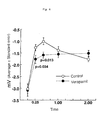
- a potential difference (mV) of the skin surface relative to a culture solution was measured using the skin surface condition measuring apparatus shown in Fig. 1.
- the skin samples used in measurement are three kinds of skin sections of a hairless mouse, which are (1) a sample in which the skin surface is not treated, (2) a sample in which substance P (SP) of a stimulating substance is added to a culture solution, and (3) a sample in which SP antagonist ([D-Argl, D-Trp7, 9, Leull]-SubstanceP), which, together with SP, is known as a substance for warding off stimulation, is added to a culture solution.
- SP substance P
- SP antagonist [D-Argl, D-Trp7, 9, Leull]-SubstanceP
- the horizontal axis indicates the elapsed time after addition of SP.
- the time point of addition is indicated as zero.
- the vertical axis indicates potential differences.
- a measured value is expressed as an average of five measurements, and the fluctuation is indicated simultaneously.
- a potential difference (mV) of the skin surface relative to a culture solution was measured using the skin surface condition measuring apparatus shown in Fig. 1.
- the skin samples used in measurement are two kinds of skin sections of a hairless mouse, which are (1) a skin with its surface barrier-destructed with a cellophane adhesive tape (tape stripping), and (2) a skin after tape stripping, with verapamil, which is a potassium channel blocker known to function as an agent for inhibiting stimulation, added to a culture solution afterwards.
- verapamil which is a potassium channel blocker known to function as an agent for inhibiting stimulation
- the horizontal axis indicates the elapsed time after tape stripping.
- the measured value at time zero is the value of skin before applying tape stripping.
- the time of addition is indicated as zero, and the measured value at a time point zero indicates the value of skin before applying tape stripping.
- the vertical axis indicates potential differences. A measured value is expressed as an average of five measurements, and the fluctuation is indicated simultaneously.
- a potential difference (mV) of the skin surface relative to a culture solution was measured using the skin surface condition measuring apparatus shown in Fig. 1.
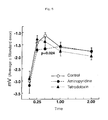
- the skin samples used in measurement are three kinds of skin sections of a hairless mouse, which are (1) a skin with its surface barrier-destructed with a cellophane adhesive tape (tape stripping), (2) a skin after tape stripping, with aminopyridine (AP), which is a potassium channel blocker and is known to show the stimulation inhibiting effect, added to a culture solution afterwards, and (3) a skin after tape stripping, with tetrodotoxin (TTX), which is a sodium channel blocker known not to show the stimulation inhibiting effect, added to a culture solution.
- AP aminopyridine
- TTX tetrodotoxin
- the horizontal axis indicates the elapsed time after tape stripping. Note that the measured value at time zero is the value of skin before applying tape stripping. In addition , when AP or TTX is added to a culture solution, the time of addition is indicated as zero, and the measured value at time point zero indicates the value of skin before applying tape stripping.
- the vertical axis indicates potential differences. A measured value is expressed as an average of five measurements, and its fluctuation is indicated simultaneously.
- the tape stripping stimulation produces a rapid change in a potential difference as compared with before stimulation.
- adding AP to a culture solution after tape stripping inhibits the potential difference.
- adding TTX to a culture solution does not inhibit the change in a potential difference. From these, it can be seen that AP reduces the change in potential difference as a result of inhibiting tape stripping stimulation, and that TTX does not reduce the change in potential difference because it does not inhibit tape stripping stimulation.
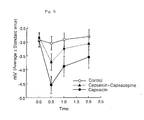
- a potential difference (mV) of the skin surface relative to a culture solution was measured using the skin surface condition measuring apparatus shown in Fig. 1.
- the skin samples used in measurement are three kinds of skin sections of a hairless mouse, which are (1) a sample in which the skin surface is not treated, (2) a sample in which the skin surface is coated with capsaicin of a stimulating substance, and (3) a sample in which capsaicin is coated on the skin surface, and capsazepine known as a stimulation-defending substance is coated thereon afterwards.
- the results are shown in Fig. 6.
- the horizontal axis indicates the elapsed time after coating of capsaicin.
- the time point of coating is indicated as zero.
- the vertical axis indicates a potential difference.
- the measured value is expressed as an average of five measurements, and the fluctuation is indicated simultaneously.
- Fig. 2 The potential differences of skin surface relative to a sublingual area and a scar on the skin (epidermis) were measured using the skin surface measuring apparatus shown in Fig. 2.
- the skin used in measurement is a skin in a state of 2 hours after skin surface was barrier-destructed (tape stripped) with a cellophane adhesive tape.
- Fig. 7 shows potentials at several places of skin using each of a sublingual potential and a skin scar potential as a standard potential.
- letters A to G in the figure denote measurement points, and AVE. denotes an average value.
- Fig. 8 plots the results of Fig. 7 in connection with the relationship between a skin surface potential using a skin scar as a standard and a skin surface potential using a sublingual area as a standard. It can be seen that there is significant correlation between both potentials, and also when a sublingual area is used as a standard in place of the previous method using a skin scar as a standard, a skin surface potential can be stably measured.
- the skin surface condition measuring apparatus of the present invention by making a skin model, in which a skin section is floated with its surface upward on the surface of a culture solution, a potential difference between the skin surface and the culture solution can be measured simply. Furthermore, by adding a stimulating factor to the skin surface or a culture solution, a potential difference between the skin surface and a culture solution is increased, and as a result, the degree of stimulation given to skin can be confirmed.
- the skin surface condition (potential condition) measuring apparatus which uses a sublingual potential as a standard, the skin surface condition can be measured simply without imparting pain to a human. From this result, a number of useful applications can be expected such as confirmation of the degree of stimulation to be imparted to skin, investigation of an inhibiting substance to skin stimulation from a change in a potential difference by coating a substance for warding off stimulation on skin, and the like.
Landscapes
- Health & Medical Sciences (AREA)
- Life Sciences & Earth Sciences (AREA)
- Engineering & Computer Science (AREA)
- Biomedical Technology (AREA)
- Pathology (AREA)
- General Health & Medical Sciences (AREA)
- Animal Behavior & Ethology (AREA)
- Veterinary Medicine (AREA)
- Public Health (AREA)
- Molecular Biology (AREA)
- Physics & Mathematics (AREA)
- Biophysics (AREA)
- Surgery (AREA)
- Medical Informatics (AREA)
- Heart & Thoracic Surgery (AREA)
- Dermatology (AREA)
- Immunology (AREA)
- Urology & Nephrology (AREA)
- Endocrinology (AREA)
- Hematology (AREA)
- Rheumatology (AREA)
- Toxicology (AREA)
- Diabetes (AREA)
- Epidemiology (AREA)
- Chemical & Material Sciences (AREA)
- Gastroenterology & Hepatology (AREA)
- Microbiology (AREA)
- Cell Biology (AREA)
- Biotechnology (AREA)
- Food Science & Technology (AREA)
- Medicinal Chemistry (AREA)
- Analytical Chemistry (AREA)
- Biochemistry (AREA)
- General Physics & Mathematics (AREA)
- Investigating Or Analysing Biological Materials (AREA)
- Measurement And Recording Of Electrical Phenomena And Electrical Characteristics Of The Living Body (AREA)
Applications Claiming Priority (3)
| Application Number | Priority Date | Filing Date | Title |
|---|---|---|---|
| JP2000252732A JP3860956B2 (ja) | 2000-08-23 | 2000-08-23 | 皮膚表面状態の測定方法及び装置 |
| JP2000378581A JP4608085B2 (ja) | 2000-12-13 | 2000-12-13 | 皮膚表面の電位状態の測定方法及び装置 |
| EP01956991A EP1314979B1 (de) | 2000-08-23 | 2001-08-21 | Verfahren und vorrichtung zum bestimmen des zustandes der hautoberfläche |
Related Parent Applications (1)
| Application Number | Title | Priority Date | Filing Date |
|---|---|---|---|
| EP01956991A Division EP1314979B1 (de) | 2000-08-23 | 2001-08-21 | Verfahren und vorrichtung zum bestimmen des zustandes der hautoberfläche |
Publications (1)
| Publication Number | Publication Date |
|---|---|
| EP1811296A1 true EP1811296A1 (de) | 2007-07-25 |
Family
ID=26598319
Family Applications (2)
| Application Number | Title | Priority Date | Filing Date |
|---|---|---|---|
| EP07008527A Withdrawn EP1811296A1 (de) | 2000-08-23 | 2001-08-21 | Verfahren und Vorrichtungen zum Messen des Oberflächenzustands einer Außenhaut |
| EP01956991A Expired - Lifetime EP1314979B1 (de) | 2000-08-23 | 2001-08-21 | Verfahren und vorrichtung zum bestimmen des zustandes der hautoberfläche |
Family Applications After (1)
| Application Number | Title | Priority Date | Filing Date |
|---|---|---|---|
| EP01956991A Expired - Lifetime EP1314979B1 (de) | 2000-08-23 | 2001-08-21 | Verfahren und vorrichtung zum bestimmen des zustandes der hautoberfläche |
Country Status (6)
| Country | Link |
|---|---|
| US (1) | US20040106877A1 (de) |
| EP (2) | EP1811296A1 (de) |
| KR (1) | KR100880560B1 (de) |
| DE (1) | DE60136195D1 (de) |
| TW (1) | TW584725B (de) |
| WO (1) | WO2002016933A1 (de) |
Families Citing this family (3)
| Publication number | Priority date | Publication date | Assignee | Title |
|---|---|---|---|---|
| US7270800B2 (en) | 2000-08-24 | 2007-09-18 | University Of Pittsburgh | Thioflavin derivatives for use in antemortem diagnosis of Alzheimer's disease and in vivo imaging and prevention of amyloid deposition |
| FR2845265A1 (fr) * | 2002-10-08 | 2004-04-09 | Cognis France Sa | Procede et dispositif de caracterisation et d'analyse de la reactivite et/ou l'hypersensibilite de la peau et application au domaine de la cosmetique |
| KR102120643B1 (ko) | 2018-10-23 | 2020-06-10 | 한국표준과학연구원 | 눈 운동 저항과 힘 측정기 |
Citations (1)
| Publication number | Priority date | Publication date | Assignee | Title |
|---|---|---|---|---|
| US5738826A (en) * | 1996-08-12 | 1998-04-14 | Lloyd; Mary Beth | Ussing chamber |
Family Cites Families (15)
| Publication number | Priority date | Publication date | Assignee | Title |
|---|---|---|---|---|
| US3282818A (en) * | 1963-03-12 | 1966-11-01 | Beckman Instruments Inc | Electrochemical liquid junction structure and method for producing same |
| US3267016A (en) * | 1963-12-26 | 1966-08-16 | Beckman Instruments Inc | Leak structure and method for producing same |
| US3423304A (en) * | 1964-11-17 | 1969-01-21 | Beckman Instruments Inc | Leak structure and method for producing same |
| US3492216A (en) * | 1967-03-09 | 1970-01-27 | Orion Research | Electrochemical device |
| US3498289A (en) * | 1967-10-20 | 1970-03-03 | Beckman Instruments Inc | Method for in vivo potentiometric measurements |
| USRE31333E (en) * | 1977-10-11 | 1983-08-02 | Electrochemical reference cell with improved liquid junction | |
| JPS63229029A (ja) * | 1987-03-17 | 1988-09-22 | シチズン時計株式会社 | 心拍計付電子体温計 |
| JP2744659B2 (ja) * | 1989-11-21 | 1998-04-28 | 科学技術振興事業団 | バイオセンサー装置 |
| US5042498A (en) * | 1990-04-06 | 1991-08-27 | Hewlett-Packard Company | Intelligent electrocardiogram system |
| DE4410691A1 (de) * | 1994-03-28 | 1995-10-05 | Pierre Nicolas Dr Med Foss | Gerät zur Analyse und Dokumentation von Hautveränderungen durch Messungen der Impedanzen und Phasenverschiebungen (CEIOS) |
| US6108570A (en) * | 1995-10-10 | 2000-08-22 | Yissum Research Development Company Of The Hebrew University Of Jerusalem | Non-invasive device and method for quantitative determination of oxidants and/or antioxidants in the skin |
| JPH1170090A (ja) * | 1997-08-29 | 1999-03-16 | Sekisui Chem Co Ltd | 生体電気インピーダンス測定装置 |
| US6351666B1 (en) * | 1998-02-27 | 2002-02-26 | Biofield Corp. | Method and apparatus for sensing and processing biopotentials |
| DE69923183T2 (de) * | 1998-07-06 | 2006-02-23 | Pastor, Aleksander | Gerät zur feststellung von hautimpedanzveränderungen |
| US6264615B1 (en) * | 1999-01-21 | 2001-07-24 | Diamond General Development Corporation | Method for diagnosing the presence and extent of halitosis activity |
-
2001
- 2001-08-21 DE DE60136195T patent/DE60136195D1/de not_active Expired - Lifetime
- 2001-08-21 US US10/362,127 patent/US20040106877A1/en not_active Abandoned
- 2001-08-21 WO PCT/JP2001/007142 patent/WO2002016933A1/ja not_active Ceased
- 2001-08-21 EP EP07008527A patent/EP1811296A1/de not_active Withdrawn
- 2001-08-21 EP EP01956991A patent/EP1314979B1/de not_active Expired - Lifetime
- 2001-08-21 KR KR10-2003-7002542A patent/KR100880560B1/ko not_active Expired - Fee Related
- 2001-08-22 TW TW090120657A patent/TW584725B/zh not_active IP Right Cessation
Patent Citations (1)
| Publication number | Priority date | Publication date | Assignee | Title |
|---|---|---|---|---|
| US5738826A (en) * | 1996-08-12 | 1998-04-14 | Lloyd; Mary Beth | Ussing chamber |
Non-Patent Citations (5)
| Title |
|---|
| AWAYDA MOUHAMED S ET AL: "Frequency-dependent capacitance of the apical membrane of frog skin: Dielectric relaxation processes", BIOPHYSICAL JOURNAL, vol. 76, no. 1 PART A, January 1999 (1999-01-01), pages 219 - 232, XP002336412, ISSN: 0006-3495 * |
| DENDA M ET AL: "Skin surface electric potential induced by ion-flux through epidermal cell layers.", BIOCHEMICAL AND BIOPHYSICAL RESEARCH COMMUNICATIONS 1 JUN 2001, vol. 284, no. 1, 1 June 2001 (2001-06-01), pages 112 - 117, XP002437119, ISSN: 0006-291X * |
| GRIMNES S: "IMPEDANCE MEASUREMENT OF INDIVIDUAL SKIN SURFACE ELECTRODES", MEDICAL AND BIOLOGICAL ENGINEERING AND COMPUTING, SPRINGER, HEILDELBERG, DE, vol. 21, no. 6, November 1983 (1983-11-01), pages 750 - 755, XP008076782, ISSN: 0140-0118 * |
| HILLYARD STANLEY D ET AL: "K+ transport and capacitance of the basolateral membrane of the larval frog skin", AMERICAN JOURNAL OF PHYSIOLOGY, vol. 273, no. 6 PART 1, December 1997 (1997-12-01), pages C1995 - C2001, XP002336413, ISSN: 0002-9513 * |
| YAMAMOTO Y ET AL: "MEASUREMENT PRINCIPLE FOR EVALUATING THE PERFORMANCE OF DRUGS AND COSMETICS BY SKIN IMPEDANCE", MEDICAL AND BIOLOGICAL ENGINEERING AND COMPUTING, SPRINGER, HEILDELBERG, DE, vol. 16, no. 6, November 1978 (1978-11-01), pages 623 - 632, XP002332620, ISSN: 0140-0118 * |
Also Published As
| Publication number | Publication date |
|---|---|
| DE60136195D1 (de) | 2008-11-27 |
| EP1314979A4 (de) | 2006-06-07 |
| KR20030036715A (ko) | 2003-05-09 |
| US20040106877A1 (en) | 2004-06-03 |
| EP1314979A1 (de) | 2003-05-28 |
| TW584725B (en) | 2004-04-21 |
| WO2002016933A1 (en) | 2002-02-28 |
| KR100880560B1 (ko) | 2009-01-30 |
| EP1314979B1 (de) | 2008-10-15 |
Similar Documents
| Publication | Publication Date | Title |
|---|---|---|
| CN1606461B (zh) | 一种用制剂作皮肤治疗的装置、一种成套器具及皮肤贴片 | |
| Niedergerke et al. | The dual effect of calcium on the action potential of the frog's heart | |
| CN108780085A (zh) | 先进的电穿孔装置和用于获得生物流体中的分析物的方法 | |
| Perez-Armendariz et al. | Glucose-evoked changes in [K+] and [Ca2+] in the intercellular spaces of the mouse islet of Langerhans | |
| Crew et al. | Development of an anodic stripping voltammetric assay, using a disposable mercury-free screen-printed carbon electrode, for the determination of zinc in human sweat | |
| Denda et al. | Skin surface electric potential induced by ion-flux through epidermal cell layers | |
| Dagostino et al. | Neutral carrier Na+-and Ca2+-selective microelectrodes for intracellular application | |
| Smith et al. | Principles, development and applications of self-referencing electrochemical microelectrodes to the determination of fluxes at cell membranes | |
| EP1811296A1 (de) | Verfahren und Vorrichtungen zum Messen des Oberflächenzustands einer Außenhaut | |
| JP3860956B2 (ja) | 皮膚表面状態の測定方法及び装置 | |
| US6383138B1 (en) | Method for transdermal sampling of analytes | |
| JP4608085B2 (ja) | 皮膚表面の電位状態の測定方法及び装置 | |
| Schelter et al. | Combination of amperometric and potentiometric sensor principles for on-line blood monitoring | |
| Zhu et al. | Investigation of properties of human epidermal membrane under constant conductance alternating current iontophoresis | |
| Ashley et al. | Measurements of intracellular pH in Necturus antral mucosa by microelectrode technique | |
| Nakaya et al. | β-Adrenoceptor-mediated depolarization of the resting membrane in guinea-pig papillary muscles: changes in intracellular Na+, K+ and Cl− activities | |
| Kullnick | Influence of weak non-thermic high-frequency electromagnetic fields on the membrane potential of nerve cells | |
| RU2106799C1 (ru) | Способ съема данных о состоянии биологически активных точек тела человека и устройство для его реализации | |
| Stuesse et al. | Carboxylate modification of neuromuscular transmission in the frog | |
| Carey et al. | Permselectivity of sound and carious human dental enamel as measured by membrane potential | |
| US20220381723A1 (en) | Architectures and Methods for Electrochemical Neuromodulation | |
| Asif et al. | Biosensors For Intracellular And Less Invasive Measurements Based On Nanostructured Metal Oxides | |
| Yoda et al. | Analysis of glycolysis relevant compounds in saliva by microbiosensors | |
| Donnelly | Cystic fibrosis patient monitor | |
| Mooney et al. | Double-barreled K+-selective microelectrodes based on dibenzo-18-crown-6 |
Legal Events
| Date | Code | Title | Description |
|---|---|---|---|
| PUAI | Public reference made under article 153(3) epc to a published international application that has entered the european phase |
Free format text: ORIGINAL CODE: 0009012 |
|
| AC | Divisional application: reference to earlier application |
Ref document number: 1314979 Country of ref document: EP Kind code of ref document: P |
|
| AK | Designated contracting states |
Kind code of ref document: A1 Designated state(s): DE FR GB IT |
|
| AKX | Designation fees paid | ||
| STAA | Information on the status of an ep patent application or granted ep patent |
Free format text: STATUS: THE APPLICATION IS DEEMED TO BE WITHDRAWN |
|
| 18D | Application deemed to be withdrawn |
Effective date: 20080126 |
|
| REG | Reference to a national code |
Ref country code: DE Ref legal event code: 8566 |