EP1814355A1 - Dispositif de reglage acoustique et procede de reglage acoustique - Google Patents
Dispositif de reglage acoustique et procede de reglage acoustique Download PDFInfo
- Publication number
- EP1814355A1 EP1814355A1 EP05781392A EP05781392A EP1814355A1 EP 1814355 A1 EP1814355 A1 EP 1814355A1 EP 05781392 A EP05781392 A EP 05781392A EP 05781392 A EP05781392 A EP 05781392A EP 1814355 A1 EP1814355 A1 EP 1814355A1
- Authority
- EP
- European Patent Office
- Prior art keywords
- sound
- state
- audio control
- different
- unit
- Prior art date
- Legal status (The legal status is an assumption and is not a legal conclusion. Google has not performed a legal analysis and makes no representation as to the accuracy of the status listed.)
- Withdrawn
Links
Images




Classifications
-
- H—ELECTRICITY
- H04—ELECTRIC COMMUNICATION TECHNIQUE
- H04S—STEREOPHONIC SYSTEMS
- H04S7/00—Indicating arrangements; Control arrangements, e.g. balance control
- H04S7/30—Control circuits for electronic adaptation of the sound field
-
- H—ELECTRICITY
- H04—ELECTRIC COMMUNICATION TECHNIQUE
- H04M—TELEPHONIC COMMUNICATION
- H04M1/00—Substation equipment, e.g. for use by subscribers
- H04M1/60—Substation equipment, e.g. for use by subscribers including speech amplifiers
- H04M1/6016—Substation equipment, e.g. for use by subscribers including speech amplifiers in the receiver circuit
-
- H—ELECTRICITY
- H04—ELECTRIC COMMUNICATION TECHNIQUE
- H04S—STEREOPHONIC SYSTEMS
- H04S2400/00—Details of stereophonic systems covered by H04S but not provided for in its groups
- H04S2400/11—Positioning of individual sound objects, e.g. moving airplane, within a sound field
-
- H—ELECTRICITY
- H04—ELECTRIC COMMUNICATION TECHNIQUE
- H04S—STEREOPHONIC SYSTEMS
- H04S2400/00—Details of stereophonic systems covered by H04S but not provided for in its groups
- H04S2400/13—Aspects of volume control, not necessarily automatic, in stereophonic sound systems
Definitions
- the present invention relates to an audio control device and an audio control method, which controls the sound state of a plurality of sounds having different sound sources, such as the volume, the frequency characteristic, and the pan.
- Such electronic equipment capable of outputting a plurality of sounds, for example, the ring tone in case of mobile phone, the audio sound in playing, and the TV sound in watching exist.
- Such electronic equipment has a function that controls the volume of each of the plurality of sounds, while the user of the electronic equipment controls the volume of them, thereby the voice output environment of the user adjusted electronic equipment can be set.
- a device having such audio control function for example, an information terminal which can control the volume balance of the audio sound in playing and the telephone call sound through moving the mark in the volume balance bar (the bar indicating the ratio of the volume of the audio sound and the telephone call sound) indicated in the display to right and left (for example, refer to Patent Document 1).
- the information terminal since the balance of the volume can be visually identified, the volume of the audio sound in playing and the telephone call sound can be simply controlled.
- a broadcasting receiving device including a function that can extract just only the sound of the center channel from the sound of the whole channel for independently controlling is suggested(for example, refer to Patent Document 2).
- the volume balance bar when multiple sounds with three or more are outputted, the correspondence should be performed by the volume balance bar. Further, in case the volume balance bar is not watched, the control of the volume balance of two can not be performed, therefore, in case it is difficult to watch, for example, in driving a car, there is a problem in that it is not available,
- the volume of the adjusted center channel when the volume of the adjusted center channel is identified in the state that the volume of the whole channel is outputted, in case the volume of the center channel is required to be controlled again, the sound of the adjusted center channel is extracted again to adjust independently, then, the volume of the adjusted center channel s identified in the state that the sound of the whole channel is outputted.
- the volume control of the extracted center channel and the manipulation of the output of the sound of the whole channel are alternately repeatedly performed, it takes a time for a user.
- the combination of the multiple sounds that are simultaneously outputted is changed, for example, in case a ringtone is added to the multiple sounds by suddenly ringing the ringtone, there is a problem in that it is not suitable for the sudden volume control.
- the invention has been designed to solve the above-mentioned problems. It is an object of the invention to provide an audio control device and an audio control method capable of easily controlling the sound state even though the sound source is three or more, since the desired sound source can be promptly controlled by simply selecting the sound where the sound state should be adjusted among multiple sounds, without displaying the sound state of multiple sounds on a display for identifying.
- An audio control device includes an input unit that receives various input manipulations; a plurality of generating units that generate a sound having a different sound source; and a control unit that controls the sound state generated by the plurality of generating units, wherein the input unit selects a first generating unit among the plurality of generating units, wherein the control unit controls the other generating units to generate a sound having a sound state which is different from that of the first generating unit.
- An audio control method controls a sound state of a plurality of sounds having different sound sources, which includes a first output step of outputting the plurality of sounds; a selection step of selecting a first sound among the plurality of sounds; and a second output step of outputting a sound which is different from the first sound with a different sound state.
- the input unit may select a second generating unit that is different from the first generating unit among the plurality of generating units, after selecting the first generating unit, and the control unit may control the other generating units to generate a sound having a sound state which is different from that of the second generating unit.
- a second sound different from the first sound among the plurality of sounds may be selected in the selection step.
- a sound different from the second sound with a different sound state may be output in the second output step.
- the input unit may select a third generating unit that is not selected yet among the plurality of generating units, after selecting the second generating unit, and the control unit may control the other generating units to generate a sound having a sound state which is different from that of the third generating unit.
- a third sound among the plurality of sounds may not be selected yet the selection step, and a sound different from the third sound with a different sound state may be output in the second output step.
- the input unit may control the sound states of the first, second, or third generating unit selected among the plurality of generating units, and the control unit may generate a sound having a sound state that is controlled by the input unit in the first, the second or the third generating unit, while the control unit controls the other generating units to generate a sound having a sound state which is different from that of the first, the second or the third generating unit.
- An audio control method includes a control step of controlling the sound state of the sound of the first, the second or the third that is selected in the selection step, after the output in the second output step; and a third output step of outputting the first, the second or the third sound with the controlled sound state.
- the invention is capable of easily controlling the sound state even though the sound source is three or more, since the desired sound source can be promptly controlled by simply selecting the sound where the sound state should be adjusted among multiple sounds, without displaying the sound state of multiple sounds on a display for identifying.
- the input unit may select the generating unit which generates a sound in the nearest time point as the first generating unit, in the time point when one of the plurality of generating units is selected.
- the single sound outputted last in the first step may be selected as the first sound in the selection step.
- the invention is capable of promptly selecting the sound that commenced rapid ringing.
- control unit may generate a sound having a sound state which is adjusted by each of the plurality of generating units in the plurality of generating units, when the input unit selects all of the plurality of generating units to finish.
- the plurality of sounds with a sound state which is adjusted to each of the plurality of sounds may be output in the third selection step, when all of the plurality of sounds is selected to finish in the selection step.
- the invention is capable of controlling the sound state of each sound and identifying the balance of the whole sound state by one operation.
- the control unit may generate a sound having a sound state which is adjusted by the plurality of generating units.
- An audio control method includes a count step of counting the elapse of time, after selecting the first, the second or the third sound in the selection step, or, after controlling the first, the second or the third sound in the control step, wherein the third output step outputs the plurality of sounds with a sound state which is adjusted to each of the plurality of sounds, in case of counting after the elapse of a predetermined time in the count step.
- the invention is capable of manipulating the whole sound state automatically, after selecting one sound, thereby, the convenience of a user can be enhanced.
- control unit may generate a sound having a sound image location which is different from that of the first, second, and third generating unit in the other generating units,
- a sound different from the first, second, and third sounds in the other sound image location may be output in the second output step.
- the invention is capable of simply selecting the sound where the sound state should be controlled, since the sound image location of the sound where the sound state should be controlled is differently positioned from the sound image location of the other sound such that it can be easily identified with hearing.
- control unit may generate a sound having a sound tone different from that of the first, second, and third generating unit in the other generating units.
- a sound different from the first, second, and third sounds with a different sound tone may be output in the second output step
- the invention is capable of simply selecting the sound where the sound state should be controlled, since the sound tone of the sound where the sound state should be controlled is different from the sound tone of the other sound such that it can be easily identified with hearing.
- control unit may generate a sound in a sound image location opposed to the first, second, or third generating unit in the other generating units,
- another sound in a sound image location opposed to the first, second, or third sound may be output in the second output step.
- the invention is capable of exactly selecting the sound where the sound state should be controlled, since the sound image location of the sound where the sound state should be controlled is differently positioned from the sound image location of the other sound such that it can be easily identified with hearing,
- the audio control device has an advantage that a desired sound source can be promptly controlled, by simply selecting the sound where the sound state should be adjusted among multiple sounds, without displaying the sound state of multiple sounds on a display for identifying.
- the basic configuration of an audio control device is shown in Fig. 1.
- the audio control device includes an input receiver 1 that receives various input manipulations from a user, an overlap controller 2 that controls input-output signals of each unit, signal overlap unit 3 that overlaps the sound from a plurality of sound sources, and a signal generator 4 having three or more sound sources.
- the input receiver 1 receives the manipulation of a user or the control signal(such as remote controller output, manipulation command), and outputs a manipulation information based on such information.
- the overlap controller 2 calculates the parameters(sound image location, sound tone) of sound signal, based on the manipulation information from the input receiver 1 and the signal generation information(information on the channel of the signal overlap unit 3 to which the sound signal is inputted) from the signal overlap unit 3 or , to output to the signal overlap unit 3, the signal generator 4.
- the signal overlap unit 3 overlaps the sound signal inputted from the signal generator 4 according to the output of the overlap controller 2.
- the signal generator 4 outputs the sound signal from the plurality of sound sources to the overlap controller 2 and the signal overlap unit 3.
- Fig. 2 is a block diagram illustrating a detailed configuration of an audio control device according to an embodiment of the invention.
- 12 represents CPU that controls the whole, while a cross-key manipulation detection module 11 and an audio mixer 13 are coupled to it.
- an audio player 14a, an alarm notification unit 14b, and a receiving notification unit 14c are provided as a multiple sound source.
- a decoder 14d, an encoder 14e are provided, while they perform the decoding, encoding of the signal for a communication controller 19 that controls a wireless controller 20, then, output the sound of the counterpart of telephone call through a headphone 21 (HP OUT) and a speaker 22(SP OUT), and input the sound of the apparatus user through a microphone 23(MIC IN) to be able to perform a sound communication.
- the cross-key manipulation detection module 11 corresponds to the input unit(input receiver 1 of Fig. 1) of claims, and selects any sound among sounds outputted from the audio player 14a that outputs sound signals having different sound sources, the alarm notification unit 14b, the receiving notification unit 14c, the decoder 14d, and the encoder 14e(a plurality of generating units of claims, corresponding to signal generator 4 of Fig. 1).
- CPU 12 corresponds to a first function(overlap controller 2 of Fig. 1) of the control unit of claims, configured to control the sound state(such as sound image location, sound tone, volume)of sound inputted from the audio player 14a, the alarm notification unit 14b, and the receiving notification unit 14c.
- the audio mixer 13 corresponds to a first function(signal overlap unit 3 of Fig. 1) of the control unit of claims, and overlaps the sound inputted from the audio player 14a, the alarm notification unit 14b, and the receiving notification unit 14c. Additionally, the audio mixer 13 outputs the overlapped sound signal to the headphone 21 (HP OUT) or the speaker 22(SP OUT).
- CPU 12 and the audio mixer 13 are described with a different configuration, CPU 12 may simultaneously perform the function of the audio mixer. Further, the audio mixer 13 is described to input the sound from the audio player 14a, the alarm notification unit 14b, and the receiving notification unit 14c, however, various sound sources such as audio player 14a, alarm notification unit 14b, receiving notification unit 14c can be built in to the audio mixer 13 itself.
- FIG. 3 The flowchart illustrating the manipulation of an audio control device in the embodiment of the invention is shown in Fig. 3.
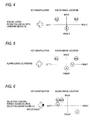
- Fig. 4 to Fig. 15 the relation of the manipulation(center of drawing) of the cross-key, the sound image location B(L) and B(R) of audio sound outputted from the audio player 14a, the sound image location C of the alarm sound outputted from the alarm notification unit 14b, and the sound image location(right of drawing) of the communication sound outputted from the decoder 14d is shown.
- the manipulation sequence will be described according to the flow chart illustrating the manipulation of the audio control device in the embodiment of the invention shown in Fig. 3.
- CPU12 inquires of the cross-key manipulation detection module 11, and identifies whether the input manipulation from the user is performed or not(S1). At this time, the alarm notification unit 14b renewedly commences the ringing of the alarm sound in the sound image location shown in Fig. 5. As shown in Fig. 6, in case the user presses the right of the cross-key, CPU12 detects the input manipulation of the cross-key(S2, YES), and identifies the pressing of the right of the cross-key(S3, right).
- CPU12 in case one of the plurality of sound sources is not selected(S4, NO), by pressing the right of the cross-key, selects the alarm sound that begins a ringing in the time point which is most close to the time point when the input manipulation of the cross-key in the step 2 is detected as a sound source of control target, and as shown in Fig. 6, commands the audio mixer 13 in order that the sound image location of the audio sound, communication sound is changed to the location far from the sound image location of the alarm of the sound source of control target to output(S5).
- the state that one of the plurality of sound sources is selected is defined as a selection state, while, on the contrary, the state that it is not selected is defined as a normal state.
- the sound image location of the alarm that is the sound source of control target is far from the sound image location of the sound from the other sound source to be outputted, thereby, the user can easily select the sound to be selected among the plurality of sound sources by hearing.
- the alarm sound that begins a ringing in the time point which is most close to the time point when the input manipulation of the cross-key in the step 2 is detected is set as the first sound source to be selected, thereby, a prompt response can be performed for the sound that commenced a rapid ringing.
- CPU12 determines that the top and the bottom of the cross-key are pressed in step 3(S3, top or bottom)
- CPU12 commands the audio mixer 13 so as to increase or decrease the whole volume of the plurality of the sound sources to output(S6, S7) as shown in Fig. 7, and goes back to the step 1, thereby, it becomes the normal state shown in Fig. 8 where the whole volume of the plurality of the sound sources is controlled.
- CPU12 detects the input manipulation of the cross-key (S12, YES), and determines that the bottom of the cross-key is pressed(S13, bottom), and commands the audio mixer 13 so as to decrease the volume of the alarm sound of the sound source of control target to output(S14).
- the audio mixer 13 is commanded to increase the volume of the alarm sound of the sound source of control target(S15).
- step 10 in case the alarm sound of the sound source of control target does not continue ringing(S10, NO), the step 9 proceeds to absolve the alarm sound from the sound source of control target. Additionally, in the step 12, in case the input manipulation of the cross-key is not detected(S12, NO), it goes back to the step 8, the processing of the step 8 to the step 12 is repeatedly performed.
- the selection state and the normal state are changed, thereby, the user can identify the sound outputted from the plurality of sound sources, by simply changing into the normal state, without performing the input manipulation, when the sound outputted from all the plurality of sound sources is identified after the control of any sound source.
- CPU12 determines that the user pressed the right of the cross-key within t1 second after the release of the cross-key pressed in the step 13(S13, right), it goes back to the step 4. At this time, since one of the plurality of sound sources is already selected(S4, YES), CPU12 determines that the whole of the plurality of sound sources are selected by taking a round. In case it is determined that not all the plurality of sound sources are selected(S16, NO), the sound source that commenced ringing in the time point which is most close to the time point of the step 2, among the plurality of sound sources excepting the sound source of control target which is selected in that time point, the communication sound is selected as a next sound source of control target in Fig. 12(S17), the processing of the step 8 to the step 15 is performed.
- CPU12 determines that the user pressed again the right of the cross-key within t1 second after the release of the cross-key pressed in the step 13(S13, right).
- the audio sound selected as a sound source of control target is absolved from the selection state, and it goes back to the normal state where the sound source of control target of the step 1 is not selected(S18), then, the user identifies the balance of the whole of the plurality of sound sources.
- the sound source selected as a sound source of control target is absolved from the selection state to automatically go back to the normal state, thereby, the user can identify the balance of the whole of the plurality of sound sources without the effort for the manipulation.
- the audio control device of the embodiment without identifying by indicating the sound state of the plurality of sounds on a display, the sound which should be adjusted in the sound state is simply selected among the plurality of sounds, thereby, the desired sound state can be promptly controlled. Further, without increasing the number of the component for controlling, it can be easily controlled though the sound source is three or more.
- the input unit and the control unit of claims can be configured with a separate case.
- the manipulation input(input receiver) corresponding to the input unit of claims can be configured as a controller of embedded head set, while the sound selection, the sound state control(overlap controller) and the mixing(signal overlap unit) corresponding to the control unit of claims can be configured in the main body of a mobile phone.
- control unit and the generating units of claims can be configured with a separate case.
- the manipulation input(input receiver), the sound image location and the calculation of volume control(overlap controller) are performed with a remote controller, thereby, the calculation result that what sound source should be positioned in what point of sound image location with what volume can be sent to the mixer(signal overlap unit) built in to a digital broadcasting receiver or an internet TV, while the mixer performs mixing the sound from the sound source(signal generator) according to the calculation result to output.
- the overlap controller directly controls the plurality of sound sources(signal generator), and inputs the sound having adjusted sound state into the mixer(signal overlap unit), thereby, the mixer can perform overlapping. Otherwise, after the sound from plurality of sound sources is inputted into the mixer, the sound state can be controlled by the mixer to perform overlapping again.
- the sound source (signal generator) can be configured with a built-in mixer(signal overlap unit).
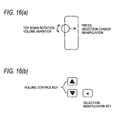
- FIG. 16 is a drawing illustrating an example of another manipulation input.
- the variation of the sound volume are adjusted by the up and down rotation of a rotation body, and a selection change manipulation can be executed by pressing the rotation body.
- a control key of volume and a selection manipulation key are arranged separately. Besides, an operation to swing a terminal is detected by using an acceleration velocity sensor, and thus a selection change can be performed. Further, the selection manipulation and the manipulation for the variation of volume may be executed by voice recognition.
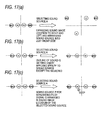
- FIG. 17 is a drawing of an example illustrating change of an sound state of a sound source, and in particular, shows the case that a sound source of communication sound (A) is selected.
- FIG. 17a shows an example in which a sound source of control target selected by expanding the sound image location in the left and the right direction is arranged at a just front side
- FIG. 17b shows an example in which outline of a sound is getting dim by applying BPF/LPF to the sound source except the selected
- FIG. 17c shows an example in which a sound source P for generating a pilot signal is arranged in the sound image location of the selected sound source. In this case, in response to adjustment of volume, the volume of the pilot sound source is increased.
- the sound image location can be expanded more extensively in case of output of a speaker as compared with output of a headphone. It is possible to excellently identify the sounds outputted from the plurality of sound sources by changing the sound image location or a sound tone of the output unit such as a headphone, or a speaker.
- a suitable setting can be established for switching as follows.
- the plurality of the sound sources are selected according to a descending/ascending order of sound volume.
- a sound source which is complicated ⁇ unpleasant sound sources/easily eliminated sound source can be initially adjusted.
- a sound source where audibly unmasking/masking is performed is selected sequentially.
- a sound source which is complicated unpleasant sound sources/easily eliminated sound source can be initially adjusted.
- a predetermined bandwidth can be selected according to a descending order of power level. In this case, if the sound bandwidth of 1 kHz to 4kMz is set as a predetermined bandwidth, the sound sources including human voices can be initially adjusted, thereby, it is possible to listen conversation or speech without omitting them.
- the right key of the cross-key is pressed, it is set as a ⁇ rotary method ⁇ in which selection is changed with the type of A-B-C-A-B-C-..., or a ⁇ return method ⁇ in which selection is changed with the type of A-B-C by pressing the right key, and with the type of C-B-A by pressing the left key.
- the sound source can be selected sequentially by pressing the right key, the selection is absolved after a predetermined time is elapsed, however, the selection can be absolved immediately by pressing the left key. In this case, the selection can be absolved even though a predetermined time is not elapsed, thereby, it is possible to complete the adjustment of the sound state rapidly.
- the sound state of the sound source can be controlled by just only the press of an up and down key. That is because people sometimes may be surprised due to an alarm ringing when carelessly the entire sound volume is increased in increasing the sound volume.
- condition where a plurality of sound sources becomes the selection state is set in advance, thereby, even if the input manipulation for selecting one of the plurality of sound sources is not executed, it may be possible to automatically select a sound source satisfying the condition as a sound source of control target.
- examples of the condition will be illustrated.
- the sound source that commenced an alarm ringing is configured such that it can be automatically in a selection state immediately after the ringing or after a predetermined time.
- the sound state can be controlled just only by manipulating a cross key into up and down. Therefore, as illustrated above, when a ringtone begins to ring suddenly with a high volume, it is very effective for an instant volume control.
- an alarm begins to ring, it is automatically set as a sound source of control target, thereby, it is possible to promptly control the sound source having a high possibility of an unexpected alarm ringing.
- the selection state is set for the plurality of sound sources whether the selection state can be made or not, thus, by limiting the sound source where the selection state can be made, an useless sound source can not be selected.
- the user sets the priority for the plurality of sound sources, then, selects the sound source of control target in the sequence of the priority, thereby, the sound source that becomes the sound source of control target among the plurality of sound sources by adjusting to the using type of the user.
- the priority can be automatically controlled by learning the input manipulation of the user.
- the example of the input manipulation with the cross-key is described as an input manipulation which is performed when the sound source of control target is selected, and, when the whole of the plurality of sound sources is selected by absolving the selection state of the sound source of control target, however, it is not limited to this. That is, through performing the selecting with a long pressing or a double click, the input manipulation by the operator excepting the cross key such as a numeric keypad, a mouse can be used.
- volume control it will be set as follows.
- the volume of the selected sound source is increased, the volume of the other sound source is configured to be decreased, on the contrary, in case the volume of the selected sound source is decreased, the volume of the other sound source is configured to be increased. Otherwise, the balance of the whole volume is configured to be constant. In this case, it is effective when one wants to change only the balance promptly without changing the whole volume.
- the sound source can be mute by the press of the key of other key including a long press of the key or a double click. In this case, it is effective for a prompt volume control when the ringtone begins to ring with a high volume.
- the volume of the plurality of sound sources is controlled, however, the sound signal such as frequency characteristic, pan, effect (reverb, echo, flanger, compressor, limiter, etc)can be controlled like the volume.
- the value such as program number (sound color), control change(transpose, expression, volume, pan, pitch bend) also can be controlled.
- the present invention is based on Japanese Patent Application No. 2004-289983) filed on October 1, 2004 , which is hereby incorporated by reference.
- the audio control device of the invention has the effect that a desired sound source can be promptly controlled, by simply selecting the sound where the sound state should be adjusted among multiple sounds, without displaying the sound state of multiple sounds on a display for identifying. Additionally, it is available for the audio control device and the audio control method that controls the sound state such as the volume of the plurality of sounds having different sound sources, frequency characteristic, and pan.
Landscapes
- Physics & Mathematics (AREA)
- Engineering & Computer Science (AREA)
- Acoustics & Sound (AREA)
- Signal Processing (AREA)
- Circuit For Audible Band Transducer (AREA)
- Telephone Function (AREA)
Applications Claiming Priority (2)
| Application Number | Priority Date | Filing Date | Title |
|---|---|---|---|
| JP2004289983 | 2004-10-01 | ||
| PCT/JP2005/016126 WO2006038402A1 (fr) | 2004-10-01 | 2005-09-02 | Dispositif de reglage acoustique et procede de reglage acoustique |
Publications (2)
| Publication Number | Publication Date |
|---|---|
| EP1814355A1 true EP1814355A1 (fr) | 2007-08-01 |
| EP1814355A4 EP1814355A4 (fr) | 2010-06-02 |
Family
ID=36142485
Family Applications (1)
| Application Number | Title | Priority Date | Filing Date |
|---|---|---|---|
| EP05781392A Withdrawn EP1814355A4 (fr) | 2004-10-01 | 2005-09-02 | Dispositif de reglage acoustique et procede de reglage acoustique |
Country Status (4)
| Country | Link |
|---|---|
| US (1) | US8019102B2 (fr) |
| EP (1) | EP1814355A4 (fr) |
| JP (1) | JP5074766B2 (fr) |
| WO (1) | WO2006038402A1 (fr) |
Cited By (1)
| Publication number | Priority date | Publication date | Assignee | Title |
|---|---|---|---|---|
| CN101933342A (zh) * | 2007-11-23 | 2010-12-29 | 郑元燮 | 具有多种音响的音响装置 |
Families Citing this family (10)
| Publication number | Priority date | Publication date | Assignee | Title |
|---|---|---|---|---|
| CN100466864C (zh) * | 2007-03-29 | 2009-03-04 | 宇龙计算机通信科技(深圳)有限公司 | 移动终端中自动调节并发业务提示铃声音量的方法及装置 |
| US20080298610A1 (en) * | 2007-05-30 | 2008-12-04 | Nokia Corporation | Parameter Space Re-Panning for Spatial Audio |
| US8509454B2 (en) * | 2007-11-01 | 2013-08-13 | Nokia Corporation | Focusing on a portion of an audio scene for an audio signal |
| EP2250821A1 (fr) * | 2008-03-03 | 2010-11-17 | Nokia Corporation | Appareil de capture et de rendu d'une pluralité de canaux audio |
| JP2012163861A (ja) * | 2011-02-08 | 2012-08-30 | Yamaha Corp | 信号処理装置 |
| US9167368B2 (en) * | 2011-12-23 | 2015-10-20 | Blackberry Limited | Event notification on a mobile device using binaural sounds |
| US9288604B2 (en) * | 2012-07-25 | 2016-03-15 | Nokia Technologies Oy | Downmixing control |
| US10182303B1 (en) * | 2017-07-12 | 2019-01-15 | Google Llc | Ambisonics sound field navigation using directional decomposition and path distance estimation |
| CN110177176B (zh) * | 2019-05-27 | 2021-06-08 | 深圳市万普拉斯科技有限公司 | 提升通话音质的方法、装置及移动终端 |
| JP2021145291A (ja) * | 2020-03-13 | 2021-09-24 | サクサ株式会社 | 電話装置 |
Family Cites Families (18)
| Publication number | Priority date | Publication date | Assignee | Title |
|---|---|---|---|---|
| JPH033462A (ja) * | 1989-05-31 | 1991-01-09 | Nec Corp | 端末装置 |
| JPH0823366A (ja) | 1994-07-08 | 1996-01-23 | Nippon Ido Tsushin Kk | 携帯電話機用音響信号制御装置 |
| JPH0851699A (ja) | 1994-08-03 | 1996-02-20 | Taito Corp | 疑似ステレオ音発生装置 |
| JP3834848B2 (ja) * | 1995-09-20 | 2006-10-18 | 株式会社日立製作所 | 音情報提供装置、及び音情報選択方法 |
| US6011851A (en) * | 1997-06-23 | 2000-01-04 | Cisco Technology, Inc. | Spatial audio processing method and apparatus for context switching between telephony applications |
| JP4567111B2 (ja) * | 1999-02-15 | 2010-10-20 | シャープ株式会社 | 情報選択方法、情報選択装置及び記録媒体 |
| JP2001245237A (ja) * | 2000-02-28 | 2001-09-07 | Victor Co Of Japan Ltd | 放送受信装置 |
| JP2001282261A (ja) * | 2000-03-30 | 2001-10-12 | Canon Inc | 音声データ設定装置及び方法、音声データ生成装置及び方法、記録媒体 |
| US7298852B2 (en) * | 2001-07-11 | 2007-11-20 | American Technology Corporation | Dynamic power sharing in a multi-channel sound system |
| JP2002149163A (ja) * | 2000-11-10 | 2002-05-24 | Taito Corp | ドルビーサラウンドを利用した娯楽機械 |
| JP2003005905A (ja) | 2001-06-22 | 2003-01-10 | Matsushita Electric Ind Co Ltd | 電子機器 |
| JP3661622B2 (ja) | 2001-09-21 | 2005-06-15 | ヤマハ株式会社 | 音声信号編集装置の制御方法、音声信号編集装置およびプログラム |
| JP4003424B2 (ja) | 2001-09-21 | 2007-11-07 | ヤマハ株式会社 | 音声信号編集方法、音声信号編集装置およびプログラム |
| JP2003140536A (ja) | 2001-11-07 | 2003-05-16 | Ryozo Kawahara | 外部拡張方法、カラオケ練習方法、英会話練習方法、外部拡張機器、カラオケ練習装置及び英会話練習装置 |
| JP2003258988A (ja) | 2002-02-28 | 2003-09-12 | Toshiba Corp | 情報端末装置および同情報端末装置に適用される再生音量制御方法 |
| JP2003304600A (ja) * | 2002-04-10 | 2003-10-24 | Nissan Motor Co Ltd | 音情報提供/選択装置 |
| JP2004201195A (ja) * | 2002-12-20 | 2004-07-15 | Pioneer Electronic Corp | ヘッドホン装置 |
| JP4127172B2 (ja) * | 2003-09-22 | 2008-07-30 | ヤマハ株式会社 | 音像定位設定装置及びそのプログラム |
-
2005
- 2005-09-02 WO PCT/JP2005/016126 patent/WO2006038402A1/fr not_active Ceased
- 2005-09-02 US US11/576,390 patent/US8019102B2/en not_active Expired - Fee Related
- 2005-09-02 JP JP2006539191A patent/JP5074766B2/ja not_active Expired - Fee Related
- 2005-09-02 EP EP05781392A patent/EP1814355A4/fr not_active Withdrawn
Cited By (2)
| Publication number | Priority date | Publication date | Assignee | Title |
|---|---|---|---|---|
| CN101933342A (zh) * | 2007-11-23 | 2010-12-29 | 郑元燮 | 具有多种音响的音响装置 |
| CN101933342B (zh) * | 2007-11-23 | 2013-06-12 | 郑元燮 | 具有多种音响的音响装置 |
Also Published As
| Publication number | Publication date |
|---|---|
| US20070213858A1 (en) | 2007-09-13 |
| JP5074766B2 (ja) | 2012-11-14 |
| EP1814355A4 (fr) | 2010-06-02 |
| WO2006038402A1 (fr) | 2006-04-13 |
| US8019102B2 (en) | 2011-09-13 |
| JPWO2006038402A1 (ja) | 2008-05-15 |
Similar Documents
| Publication | Publication Date | Title |
|---|---|---|
| US8379871B2 (en) | Personalized hearing profile generation with real-time feedback | |
| KR101585793B1 (ko) | 스마트 보청기 | |
| US7106870B2 (en) | Method for adjusting a hearing device to a momentary acoustic surround situation and a hearing device system | |
| US6477390B1 (en) | Apparatus and method for intuitive audio keypad navigation for a wireless communication device | |
| US8019102B2 (en) | Acoustic adjustment device and acoustic adjustment method | |
| US9288604B2 (en) | Downmixing control | |
| US6999922B2 (en) | Synchronization and overlap method and system for single buffer speech compression and expansion | |
| US7460664B2 (en) | Handsfree system and incoming call answering method in handsfree system | |
| US10379507B2 (en) | Voice control type bath system and operating method thereof | |
| US8340972B2 (en) | Psychoacoustic method and system to impose a preferred talking rate through auditory feedback rate adjustment | |
| KR20060058013A (ko) | 다지점 회의에서의 통신 단말기의 용이한 음량 조절 | |
| US20050176384A1 (en) | Communication device and communication device ringing method | |
| JP2006352250A (ja) | 音響出力装置、携帯電話端末装置、及び音響出力プログラム | |
| JP4457986B2 (ja) | 語学学習システム及び端末装置 | |
| JP7710637B1 (ja) | 情報処理方法、情報処理装置、及びプログラム | |
| KR20040042768A (ko) | 전자장치 및 그 제어방법 | |
| JP2003060737A (ja) | 携帯電子機器及びその制御プログラム | |
| KR100925424B1 (ko) | 음량 및 진동량 조절 기능을 갖는 이동 단말기 | |
| CN1713647A (zh) | 移动通信终端的铃声发生装置和方法 | |
| JP4429210B2 (ja) | カラオケ施設のインターホンシステム | |
| KR100650938B1 (ko) | 디지털 오디오 기기에서의 노래방 시스템 및 구동 방법 | |
| JP2008306372A (ja) | 音響信号制御装置 | |
| KR200335452Y1 (ko) | 디스플레이 장치 | |
| JP4437463B2 (ja) | カラオケ施設のインターホンシステム | |
| JP3412188B2 (ja) | 音声自動ダイアル電話機 |
Legal Events
| Date | Code | Title | Description |
|---|---|---|---|
| PUAI | Public reference made under article 153(3) epc to a published international application that has entered the european phase |
Free format text: ORIGINAL CODE: 0009012 |
|
| 17P | Request for examination filed |
Effective date: 20070402 |
|
| AK | Designated contracting states |
Kind code of ref document: A1 Designated state(s): DE FR GB |
|
| RBV | Designated contracting states (corrected) |
Designated state(s): DE FR GB |
|
| RIN1 | Information on inventor provided before grant (corrected) |
Inventor name: HATANO, KOUJI |
|
| DAX | Request for extension of the european patent (deleted) | ||
| RBV | Designated contracting states (corrected) |
Designated state(s): DE FR GB |
|
| RAP1 | Party data changed (applicant data changed or rights of an application transferred) |
Owner name: PANASONIC CORPORATION |
|
| A4 | Supplementary search report drawn up and despatched |
Effective date: 20100506 |
|
| RIC1 | Information provided on ipc code assigned before grant |
Ipc: H04R 3/04 20060101ALI20100428BHEP Ipc: H04R 3/00 20060101AFI20060822BHEP Ipc: H04S 7/00 20060101ALI20100428BHEP Ipc: H04M 1/247 20060101ALI20100428BHEP Ipc: H04S 5/02 20060101ALI20100428BHEP |
|
| 17Q | First examination report despatched |
Effective date: 20110929 |
|
| STAA | Information on the status of an ep patent application or granted ep patent |
Free format text: STATUS: THE APPLICATION IS DEEMED TO BE WITHDRAWN |
|
| 18D | Application deemed to be withdrawn |
Effective date: 20150401 |