EP1815014B1 - Indicateurs moléculaires de pronostic du cancer du sein et prédiction de réponse du traitement - Google Patents
Indicateurs moléculaires de pronostic du cancer du sein et prédiction de réponse du traitement Download PDFInfo
- Publication number
- EP1815014B1 EP1815014B1 EP05821698A EP05821698A EP1815014B1 EP 1815014 B1 EP1815014 B1 EP 1815014B1 EP 05821698 A EP05821698 A EP 05821698A EP 05821698 A EP05821698 A EP 05821698A EP 1815014 B1 EP1815014 B1 EP 1815014B1
- Authority
- EP
- European Patent Office
- Prior art keywords
- esr1
- estrogen
- expression
- treatment
- patient
- Prior art date
- Legal status (The legal status is an assumption and is not a legal conclusion. Google has not performed a legal analysis and makes no representation as to the accuracy of the status listed.)
- Expired - Lifetime
Links
Images

Classifications
-
- G—PHYSICS
- G01—MEASURING; TESTING
- G01N—INVESTIGATING OR ANALYSING MATERIALS BY DETERMINING THEIR CHEMICAL OR PHYSICAL PROPERTIES
- G01N33/00—Investigating or analysing materials by specific methods not covered by groups G01N1/00 - G01N31/00
- G01N33/48—Biological material, e.g. blood, urine; Haemocytometers
- G01N33/50—Chemical analysis of biological material, e.g. blood, urine; Testing involving biospecific ligand binding methods; Immunological testing
- G01N33/53—Immunoassay; Biospecific binding assay; Materials therefor
- G01N33/575—Immunoassay; Biospecific binding assay; Materials therefor for cancer
- G01N33/57515—Immunoassay; Biospecific binding assay; Materials therefor for cancer of the breast
-
- A—HUMAN NECESSITIES
- A61—MEDICAL OR VETERINARY SCIENCE; HYGIENE
- A61P—SPECIFIC THERAPEUTIC ACTIVITY OF CHEMICAL COMPOUNDS OR MEDICINAL PREPARATIONS
- A61P35/00—Antineoplastic agents
-
- C—CHEMISTRY; METALLURGY
- C12—BIOCHEMISTRY; BEER; SPIRITS; WINE; VINEGAR; MICROBIOLOGY; ENZYMOLOGY; MUTATION OR GENETIC ENGINEERING
- C12Q—MEASURING OR TESTING PROCESSES INVOLVING ENZYMES, NUCLEIC ACIDS OR MICROORGANISMS; COMPOSITIONS OR TEST PAPERS THEREFOR; PROCESSES OF PREPARING SUCH COMPOSITIONS; CONDITION-RESPONSIVE CONTROL IN MICROBIOLOGICAL OR ENZYMOLOGICAL PROCESSES
- C12Q1/00—Measuring or testing processes involving enzymes, nucleic acids or microorganisms; Compositions therefor; Processes of preparing such compositions
- C12Q1/68—Measuring or testing processes involving enzymes, nucleic acids or microorganisms; Compositions therefor; Processes of preparing such compositions involving nucleic acids
- C12Q1/6876—Nucleic acid products used in the analysis of nucleic acids, e.g. primers or probes
- C12Q1/6883—Nucleic acid products used in the analysis of nucleic acids, e.g. primers or probes for diseases caused by alterations of genetic material
- C12Q1/6886—Nucleic acid products used in the analysis of nucleic acids, e.g. primers or probes for diseases caused by alterations of genetic material for cancer
-
- G—PHYSICS
- G16—INFORMATION AND COMMUNICATION TECHNOLOGY [ICT] SPECIALLY ADAPTED FOR SPECIFIC APPLICATION FIELDS
- G16B—BIOINFORMATICS, i.e. INFORMATION AND COMMUNICATION TECHNOLOGY [ICT] SPECIALLY ADAPTED FOR GENETIC OR PROTEIN-RELATED DATA PROCESSING IN COMPUTATIONAL MOLECULAR BIOLOGY
- G16B20/00—ICT specially adapted for functional genomics or proteomics, e.g. genotype-phenotype associations
-
- G—PHYSICS
- G16—INFORMATION AND COMMUNICATION TECHNOLOGY [ICT] SPECIALLY ADAPTED FOR SPECIFIC APPLICATION FIELDS
- G16B—BIOINFORMATICS, i.e. INFORMATION AND COMMUNICATION TECHNOLOGY [ICT] SPECIALLY ADAPTED FOR GENETIC OR PROTEIN-RELATED DATA PROCESSING IN COMPUTATIONAL MOLECULAR BIOLOGY
- G16B20/00—ICT specially adapted for functional genomics or proteomics, e.g. genotype-phenotype associations
- G16B20/20—Allele or variant detection, e.g. single nucleotide polymorphism [SNP] detection
-
- G—PHYSICS
- G16—INFORMATION AND COMMUNICATION TECHNOLOGY [ICT] SPECIALLY ADAPTED FOR SPECIFIC APPLICATION FIELDS
- G16B—BIOINFORMATICS, i.e. INFORMATION AND COMMUNICATION TECHNOLOGY [ICT] SPECIALLY ADAPTED FOR GENETIC OR PROTEIN-RELATED DATA PROCESSING IN COMPUTATIONAL MOLECULAR BIOLOGY
- G16B25/00—ICT specially adapted for hybridisation; ICT specially adapted for gene or protein expression
- G16B25/10—Gene or protein expression profiling; Expression-ratio estimation or normalisation
-
- C—CHEMISTRY; METALLURGY
- C12—BIOCHEMISTRY; BEER; SPIRITS; WINE; VINEGAR; MICROBIOLOGY; ENZYMOLOGY; MUTATION OR GENETIC ENGINEERING
- C12Q—MEASURING OR TESTING PROCESSES INVOLVING ENZYMES, NUCLEIC ACIDS OR MICROORGANISMS; COMPOSITIONS OR TEST PAPERS THEREFOR; PROCESSES OF PREPARING SUCH COMPOSITIONS; CONDITION-RESPONSIVE CONTROL IN MICROBIOLOGICAL OR ENZYMOLOGICAL PROCESSES
- C12Q2600/00—Oligonucleotides characterized by their use
- C12Q2600/106—Pharmacogenomics, i.e. genetic variability in individual responses to drugs and drug metabolism
-
- C—CHEMISTRY; METALLURGY
- C12—BIOCHEMISTRY; BEER; SPIRITS; WINE; VINEGAR; MICROBIOLOGY; ENZYMOLOGY; MUTATION OR GENETIC ENGINEERING
- C12Q—MEASURING OR TESTING PROCESSES INVOLVING ENZYMES, NUCLEIC ACIDS OR MICROORGANISMS; COMPOSITIONS OR TEST PAPERS THEREFOR; PROCESSES OF PREPARING SUCH COMPOSITIONS; CONDITION-RESPONSIVE CONTROL IN MICROBIOLOGICAL OR ENZYMOLOGICAL PROCESSES
- C12Q2600/00—Oligonucleotides characterized by their use
- C12Q2600/118—Prognosis of disease development
-
- G—PHYSICS
- G16—INFORMATION AND COMMUNICATION TECHNOLOGY [ICT] SPECIALLY ADAPTED FOR SPECIFIC APPLICATION FIELDS
- G16B—BIOINFORMATICS, i.e. INFORMATION AND COMMUNICATION TECHNOLOGY [ICT] SPECIALLY ADAPTED FOR GENETIC OR PROTEIN-RELATED DATA PROCESSING IN COMPUTATIONAL MOLECULAR BIOLOGY
- G16B25/00—ICT specially adapted for hybridisation; ICT specially adapted for gene or protein expression
Definitions
- the present invention relates to quantitative molecular indicators that can guide clinical decisions in breast cancer, such as estrogen receptor (ESR1)-positive, lymph node-negative breast cancer.
- ESR1 estrogen receptor
- the invention concerns certain genes, the varied expression of which indicates the likelihood of recurrence of surgically resected breast cancer in patients who are not treated with a therapeutic agent in the adjuvant setting.
- the invention concerns the use of quantitative measurement of the expression of certain genes, including the ESR1 gene, that measure as a continuous variable, to determine (a) the likelihood of a beneficial response to the anti-estrogen therapeutic agent, such as tamoxifen; and (b) the potential magnitude of beneficial response to chemotherapy.
- Oncologists have a number of treatment options available to them, including different combinations of chemotherapeutic drugs that are characterized as "standard of care,” and a number of drugs that do not carry a label claim for the treatment of a particular cancer, but for which there is evidence of efficacy in that cancer. Best likelihood of good treatment outcome requires that patients at highest risk of metastatic disease be identified and assigned to optimal available cancer treatment. In particular, it is important to determine the likelihood of patient response to "standard of care" therapeutic drugs, such as cyclophosphamide, methotrexate, 5-fluorouracil, anthracyclines, taxanes, and anti-estrogen drugs, such as tamoxifen, because these have limited efficacy and a spectrum of often severe side effects. The identification of patients who are most or least likely to need and respond to available drugs thus could increase the net benefit these drugs have to offer, and decrease net morbidity and toxicity, via more intelligent patient selection.
- standard of care therapeutic drugs
- RNA-based tests while potentially highly quantitative, have not been used because of the perception that RNA is destroyed in tumor specimens as routinely prepared, namely fixed in formalin and embedded in paraffin (FPE), and because it is inconvenient to obtain and store fresh tissue samples from patients for analysis.
- ESR1 and PGR progesterone receptor proteins
- TAM tamoxifen
- ErbB2 (Her2) immunochemistry or fluorescence in situ hybridization which measure protein and DNA, respectively
- trastuzumab Herceptin®; Genentech, Inc., South San Francisco, CA
- ESR1 positive patients are treated with an anti-estrogen drug, such as TAM, and patients whose tumors are found to be ESR1 negative are treated with chemotherapy.
- ESR1 positive patients are also prescribed chemotherapy in addition to anti-estrogen therapy, accepting the toxic side effects of chemotherapy in order to modestly decrease the risk of cancer recurrence.
- Toxicities include, neuropathy, nausea and other gastrointestinal symptoms, hair loss and cognitive impairment.
- Recurrence is to be feared because recurrent breast cancer is usually metastatic and poorly responsive to treatment.
- a need exists to identify those patients who are at substantial risk of recurrence (i.e., to provide prognostic information) and likely to respond to chemotherapy (i.e., to provide predictive information).
- a need exists to identify those patients who do not have a significant risk of recurrence, or who are unlikely to respond to chemotherapy, as these patients should be spared needless exposure to these toxic drugs.
- Prognostic factors differ from treatment predictive factors in breast cancer.
- Prognostic factors are those variables related to the natural history of breast cancer, which influence the recurrence rates and outcome of patients once they have developed breast cancer.
- Clinical parameters that have been associated with a worse prognosis include, for example, lymph node involvement, increasing tumor size, and high grade tumors.
- Prognostic factors are frequently used to categorize patients into subgroups with different baseline relapse risks.
- treatment predictive factors are variables related to the likelihood of an individual patient's beneficial response to a treatment, such as anti-estrogen or chemotherapy, independent of prognosis.
- WO 2004/065583 discloses gene sets, the expression of which is important in the diagnosis and/or prognosis of breast cancer.
- WO 03/078662 discloses methods to measure mRNA levels in biopsied tumour tissues, including archived paraffin-embedded biopsy material. It also discloses breast cancer gene sets important in the diagnosis and treatment of breast cancer, and methods for assigning the most optimal treatment options to a breast cancer patient based upon knowledge derived from gene expression studies.
- the anti-estrogen drug is TAM.
- the treatment predictive method of the present invention may comprising the step of preparing a report for the patient, including a treatment recommendation.
- anti-estrogen drug treatment without chemotherapy is recommended when ESR1 expression for the patient is higher than the expression value measured in the same test for percentage of ER-positive, node-negative breast cancer patients, and the patient is otherwise known to be in a low risk group.
- variable is the expression level of the RNA transcript of ESR1, or its expression product.
- the method includes the step of determining the Recurrence Score for the patient.
- a treatment comprising chemotherapy is recommended when ESR1 expression for the patient is non-zero but is lower than the expression value measured in the same test for a particular percentage of ER-positive, node-negative breast cancer patients and the patient is otherwise known to be in a group having a high risk of recurrence.
- the term "beneficial response” means an improvement in any measure of patient status, including those measures ordinarily used in the art, such as overall survival, progression free survival, recurrence-free survival, and distant recurrence-free survival.
- Recurrence-free survival RFS
- DFRS distant recurrence-free survival
- the calculation of these measures in practice may vary from study to study depending on the definition of events to be either censored or not considered.
- microarray refers to an ordered arrangement of hybridizable array elements, preferably polynucleotide probes, on a substrate.
- polynucleotide when used in singular or plural, generally refers to any polyribonucleotide or polydeoxribonucleotide, which may be unmodified RNA or DNA or modified RNA or DNA.
- polynucleotides as defmed herein include, without limitation, single- and double-stranded DNA, DNA including single- and double-stranded regions, single- and double-stranded RNA, and RNA including single- and double-stranded regions, hybrid molecules comprising DNA and RNA that may be single-stranded or, more typically, double-stranded or include single- and double-stranded regions.
- polynucleotide refers to triple-stranded regions comprising RNA or DNA or both RNA and DNA.
- the strands in such regions may be from the same molecule or from different molecules.
- the regions may include all of one or more of the molecules, but more typically involve only a region of some of the molecules.
- One of the molecules of a triple-helical region often is an oligonucleotide.
- polynucleotide specifically includes cDNAs.
- the term includes DNAs (including cDNAs) and RNAs that contain one or more modified bases.
- DNAs or RNAs with backbones modified for stability or for other reasons are "polynucleotides" as that term is intended herein.
- DNAs or RNAs comprising unusual bases, such as inosine, or modified bases, such as tritiated bases are included within the term “polynucleotides” as defined herein.
- polynucleotide embraces all chemically, enzymatically and/or metabolically modified forms of unmodified polynucleotides, as well as the chemical forms of DNA and RNA characteristic of viruses and cells, including simple and complex cells.
- oligonucleotide refers to a relatively short polynucleotide, including, without limitation, single-stranded deoxyribonucleotides, single- or double-stranded ribonucleotides, RNA:DNA hybrids and double-stranded DNAs. Oligonucleotides, such as single-stranded DNA probe oligonucleotides, are often synthesized by chemical methods, for example using automated oligonucleotide synthesizers that are commercially available. However, oligonucleotides can be made by a variety of other methods, including in vitro recombinant DNA-mediated techniques and by expression of DNAs in cells and organisms.
- Gene expression describes the conversion of the DNA gene sequence information into transcribed RNA (the initial unspliced RNA transcript or the mature mRNA) or the encoded protein product. Gene expression can be monitored by measuring the levels of either the entire RNA or protein products of the gene or subsequences.
- gene amplification refers to a process by which multiple copies of a gene or gene fragment are formed in a particular cell or cell line.
- the duplicated region (a stretch of amplified DNA) is often referred to as "amplicon.”
- amplicon a stretch of amplified DNA
- the amount of the messenger RNA (mRNA) produced i.e. , the level of gene expression, also increases in the proportion of the number of copies made of the particular gene expressed.
- Prognostic factors are those variables related to the natural history of breast cancer, which influence the recurrence rates and outcome of patients once they have developed breast cancer. Clinical parameters that have been associated with a worse prognosis include, for example, lymph node involvement, increasing tumor size, and high grade tumors. Prognostic factors are frequently used to categorize patients into subgroups with different baseline relapse risks. In contrast, treatment predictive factors are variables related to the likelihood of an individual patient's beneficial response to a treatment, such as anti-estrogen or chemotherapy, independent of prognosis.
- prognosis is used herein to refer to the likelihood of cancer-attributable death or cancer progression, including recurrence and metastatic spread of a neoplastic disease, such as breast cancer, during the natural history of the disease.
- Prognostic factors are those variables related to the natural history of a neoplastic diseases, such as breast cancer, which influence the recurrence rates and disease outcome once the patient developed the neoplastic disease, such as breast cancer.
- naturally outcome means outcome in the absence of further treatment.
- natural outcome means outcome following surgical resection of the tumor, in the absence of further treatment (such as, chemotherapy or radiation treatment).
- Prognostic factors are frequently used to categorize patients into subgroups with different baseline risks, such as baseline relapse risks.
- treatment predictive factors are those variables related to the response of an individual patient to a specific treatment, independent of prognosis.
- the predictive methods of the present invention can be used clinically to make treatment decisions by choosing the most appropriate treatment modalities for any particular patient.
- the predictive methods of the present invention are valuable tools in predicting if a patient is likely to respond favorably to a treatment regimen, such as anti-estrogen therapy, such as TAM treatment alone or in combination with chemotherapy and/or radiation therapy.
- long-term survival is used herein to refer to survival for at least 3 years, more preferably for at least 8 years, most preferably for at least 10 years following surgery or other treatment.
- tumor refers to all neoplastic cell growth and proliferation, whether malignant or benign, and all pre-cancerous and cancerous cells and tissues.
- cancer and “cancerous” refer to or describe the physiological condition in mammals that is typically characterized by unregulated cell growth.
- examples of cancer include, but are not limited to, breast cancer, ovarian cancer, colon cancer, lung cancer, prostate cancer, hepatocellular cancer, gastric cancer, pancreatic cancer, cervical cancer, liver cancer, bladder cancer, cancer of the urinary tract, thyroid cancer, renal cancer, carcinoma, melanoma, and brain cancer.
- the "pathology" of cancer includes all phenomena that compromise the well-being of the patient. This includes, without limitation, abnormal or uncontrollable cell growth, metastasis, interference with the normal functioning of neighboring cells, release of cytokines or other secretory products at abnormal levels, suppression or aggravation of inflammatory or immunological response, neoplasia, premalignancy, malignancy, invasion of surrounding or distant tissues or organs, such as lymph nodes, etc.
- references to "at least one,” “at least two,” “at least three,” “at least four,” “at least five,” etc. of the genes listed in any particular gene set means any one or any and all combinations of the genes listed.
- node negative cancer such as “node negative” breast cancer, is used herein to refer to cancer that has not spread to the lymph nodes.
- splicing and "RNA splicing” are used interchangeably and refer to RNA processing that removes introns and joins exons to produce mature mRNA with continuous coding sequence that moves into the cytoplasm of an eukaryotic cell.
- exon refers to any segment of an interrupted gene that is represented in the mature RNA product ( B. Lewin. Genes IV Cell Press, Cambridge Mass. 1990 ).
- intron refers to any segment of DNA that is transcribed but removed from within the transcript by splicing together the exons on either side of it.
- exon sequences occur in the mRNA sequence of a gene as defined by Ref. SEQ ID numbers.
- intron sequences are the intervening sequences within the genomic DNA of a gene, bracketed by exon sequences and having GT and AG splice consensus sequences at their 5' and 3' boundaries.
- RS Recurrence Score
- Pre-specified cut-off points of Recurrence Score classified patients into one of three categories: low risk, intermediate risk, and high risk of distant disease recurrence.
- the proportion of the 668 patients categorized as low, intermediate, and high risk by the RT-PCR assay were 51%, 23%, and 27%, respectively.
- the Kaplan-Meier estimates and 95% confidence intervals for the rates of distant recurrence at 10 years were 6.8% (4.0%, 9.6%), 14.3% (8.3%, 20.3%) 30.5% (23.6%, 37.4%), respectively, for the low, intermediate, and high risk groups; the rate for the low risk group was significantly lower than the rate for the high risk group (p ⁇ 0.001).
- Recurrence Score provides significant (p ⁇ 0.001) predictive power that goes beyond age and tumor size. This study validated the Recurrence Score as a powerful predictor of distant recurrence in patients without involved nodes who have tumors that are ESR1 positive and treated with TAM ( Paik et al. Breast Cancer Research and Treatment 82, Supplement 1: page S10, 2003 (Abstract 16).
- the invention disclosed herein derives, in part, from study of patients in the placebo arm of the NSABP B-14 clinical study (B-14) and, in part, from comparison of patients in the B-14 placebo arm to TAM-treated patients with patients in the randomized and registration arms of NSABP Study B-14.
- Breast cancer tissue derived from placebo-treated patients was quantitatively analyzed, using a RT-PCR assay to quantify the expression of sixteen cancer-related genes and five reference genes.
- the quantitative gene expression analysis resulted in the identification of molecular indicators of prognosis. Based on analysis of the relationship between gene expression and distant recurrence-free survival in the placebo arm of the NSABP B-14 trial, a set of genes has been identified, the expression levels of which are indicative of outcome if no further treatment is provided to the patient. Outcome may be manifest in various measurements including survival, recurrence-free survival and distant recurrence-free survival, all of which are within the scope of the invention.
- prognostic indicators include, specifically, the proliferation group (BIRC5 + MKI + MYBL2 + CCNB1 + STK6), the invasion group (CTSL2 + MMP11), and one or more of the individual genes: CCNB1, BIRC5, MYBL2, PGR, STK6, MKI, GSTM1, GAPD, RPLPO, and MMP11.
- the gene expression analysis disclosed herein resulted in the identification of molecular indicators of beneficial response to anti-estrogen drugs, such as TAM, based on analysis of the relationship between gene expression and distant recurrence-free survival in untreated patients from the placebo arm of B-14 as well as TAM treated patients from both registration and randomization arms of B-14.
- genes and gene groups Based on interaction analysis of the relationship between gene expression and distant recurrence-free survival in the combined placebo and treatment cohorts, a set of genes and gene groups has been identified, the expression levels of which are indicative of beneficial response to treatment TAM. These genes and gene groups are used in particular combinations to predict likelihood of beneficial response to treatment with TAM, or another anti-estrogen drug, for individual patients. Specifically, these genes/gene groups are: the ESR1 group (ESR1 + PGR + BCL2 + SCUBE2).
- a significant finding of the invention is that quantitative levels of ESR1 relate to likelihood of TAM benefit as a continuous variable across a 14 point expression scale. Thus, for an individual patient it is possible to provide a quantitative estimate of likelihood of benefit for this therapeutic agent, with higher ESR1 gene expression levels correlating with a greater chance of response.
- This information can be utilized in several ways. It provides a more refined assessment of the probability of a beneficial response to TAM treatment, and other anti-estrogen therapies, than has been available previously.
- TAM has significant side effects, including development of uterine cancer, deep vein thrombosis, pulmonary embolism, and cataracts (Physicians Desk Reference 2002).
- ESR1 is routinely used in clinical practice to determine whether a patient should be treated with TAM, based on "ESR1 positive” or “ESR1 negative” status
- the findings underlying the present invention relate to patients who are already defined as “ESR1 positive” by the conventional criteria. According to the present invention, it is possible to determine the likelihood of a beneficial response to TAM treatment, or treatment with other anti-estrogen drugs, among this group of patients.
- ESR1 levels can be used in conjunction with the Recurrence Score (discussed below) to determine whether individual patients should be prescribed TAM (or another anti-estrogen drug) alone, or TAM (or another anti-estrogen drug) plus chemotherapy.
- the invention additionally allows the design of a particular test, an example of which is given in the Example below, with precise ESR1 expression cut points that predict a high, intermediate of low level of benefit from TAM treatment, or treatment with other anti-estrogen drugs.
- various technological approaches are available for determination of expression levels of the disclosed genes, including, without limitation, RT-PCR, microarrays, serial analysis of gene expression (SAGE) and Gene Expression Analysis by Massively Parallel Signature Sequencing (MPSS), which will be discussed in detail below.
- the expression level of each gene may be determined in relation to various features of the expression products of the gene including exons, introns, protein epitopes and protein activity.
- methods of gene expression profiling can be divided into two large groups: methods based on hybridization analysis of polynucleotides, and methods based on sequencing of polynucleotides.
- the most commonly used methods known in the art for the quantification of mRNA expression in a sample include northern blotting and in situ hybridization ( Parker & Barnes, Methods in Molecular Biology 106:247-283 (1999 )); RNAse protection assays ( Hod, Biotechniques 13:852-854 (1992 )); and reverse transcription polymerase chain reaction (RT-PCR) ( Weis et al., Trends in Genetics 8:263-264 (1992 )).
- antibodies may be employed that can recognize specific duplexes, including DNA duplexes, RNA duplexes, and DNA-RNA hybrid duplexes or DNA-protein duplexes.
- Representative methods for sequencing-based gene expression analysis include Serial Analysis of Gene Expression (SAGE), and gene expression analysis by massively parallel signature sequencing (MPSS).
- DNA methylation has also been shown to be a common alteration in cancer leading to elevated or decreased expression of a broad spectrum of genes ( Jones, P.A. Cancer Res. 65:2463 (1996 )). In general, hypomethylation of CpG islands in the promoter regions and regulatory elements results in increased gene expression, including many oncogenes ( Hanada, M., et al., Blood 82:1820 (1993 ), Feinberg, A.P. and Vogelstein, B. Nature 301:89 (1983 )). Because DNA methylation correlates with the level of specific gene expression in many cancers, it serves as a useful surrogate to expression profiling of tumors ( Toyota, M. et al., Blood 97: 2823 (2001 ), Adorjan, P. et al. Nucl. Acids. Res. 10:e21 (2002 )).
- RT-PCR Reverse Transcriptase PCR
- RT-PCR which can be used to compare mRNA levels in different sample populations, in normal and tumor tissues, with or without drug treatment, to characterize patterns of gene expression, to discriminate between closely related mRNAs, and to analyze RNA structure.
- the first step is the isolation of mRNA from a target sample.
- the starting material is typically total RNA isolated from human tumors or tumor cell lines, and corresponding normal tissues or cell lines, respectively.
- RNA can be isolated from a variety of primary tumors, including breast, lung, colon, prostate, brain, liver, kidney, pancreas, spleen, thymus, testis, ovary, uterus, etc., tumor, or tumor cell lines, with pooled DNA from healthy donors.
- mRNA can be extracted, for example, from frozen or archived paraffin-embedded and fixed (e.g. formalin-fixed) tissue samples.
- RNA isolation can be performed using purification kit, buffer set and protease from commercial manufacturers, such as Qiagen, according to the manufacturer's instructions. For example, total RNA from cells in culture can be isolated using Qiagen RNeasy mini-columns.
- RNA isolation kits include MasterPureTM Complete DNA and RNA Purification Kit (EPICENTRE®, Madison, WI), and Paraffin Block RNA Isolation Kit (Ambion, Inc.). Total RNA from tissue samples can be isolated using RNA Stat-60 (Tel-Test). RNA prepared from tumor can be isolated, for example, by cesium chloride density gradient centrifugation.
- RNA cannot serve as a template for PCR
- the first step in gene expression profiling by RT-PCR is the reverse transcription of the RNA template into cDNA, followed by its exponential amplification in a PCR reaction.
- the two most commonly used reverse transcriptases are avilo myeloblastosis virus reverse transcriptase (AMV-RT) and Moloney murine leukemia virus reverse transcriptase (MMLV-RT).
- AMV-RT avilo myeloblastosis virus reverse transcriptase
- MMLV-RT Moloney murine leukemia virus reverse transcriptase
- the reverse transcription step is typically primed using specific primers, random hexamers, or oligo-dT primers, depending on the circumstances and the goal of expression profiling.
- extracted RNA can be reverse-transcribed using a GeneAmp RNA PCR kit (Perkin Elmer, CA, USA), following the manufacturer's instructions.
- the derived cDNA can then be used as a template in
- the PCR step can use a variety of thermostable DNA-dependent DNA polymerases, it typically employs the Taq DNA polymerase, which has a 5'-3' nuclease activity but lacks a 3'-5' proofreading endonuclease activity.
- TaqMan® PCR typically utilizes the 5'-nuclease activity of Taq or Tth polymerase to hydrolyze a hybridization probe bound to its target amplicon, but any enzyme with equivalent 5' nuclease activity can be used.
- Two oligonucleotide primers are used to generate an amplicon typical of a PCR reaction.
- a third oligonucleotide, or probe is designed to detect nucleotide sequence located between the two PCR primers.
- the probe is non-extendible by Taq DNA polymerase enzyme, and is labeled with a reporter fluorescent dye and a quencher fluorescent dye. Any laser-induced emission from the reporter dye is quenched by the quenching dye when the two dyes are located close together as they are on the probe.
- the Taq DNA polymerase enzyme cleaves the probe in a template-dependent manner.
- the resultant probe fragments disassociate in solution, and signal from the released reporter dye is free from the quenching effect of the second fluorophore.
- One molecule of reporter dye is liberated for each new molecule synthesized, and detection of the unquenched reporter dye provides the basis for quantitative interpretation of the data.
- TaqMan® RT-PCR can be performed using commercially available equipment, such as, for example, ABI PRISM 7700 TM Sequence Detection System TM (Perkin-Elmer-Applied Biosystems, Foster City, CA, USA), or Lightcycler (Roche Molecular Biochemicals, Mannheim, Germany).
- the 5' nuclease procedure is run on a real-time quantitative PCR device such as the ABI PRISM 7700 TM Sequence Detection System TM .
- the system consists of a thermocycler, laser, charge-coupled device (CCD), camera and computer.
- the system amplifies samples in a 96-well format on a thermocycler. During amplification, laser-induced fluorescent signal is detected at the CCD.
- the system includes software for running the instrument and for analyzing the data.
- 5'-Nuclease assay data are initially expressed as C T , or the threshold cycle.
- C T fluorescence values are recorded during every cycle and represent the amount of product amplified to that point in the amplification reaction. The point when the fluorescent signal is first recorded as statistically significant is the threshold cycle (C T ).
- RT-PCR is usually performed using one or more reference genes as internal standards.
- the ideal internal standard is expressed at a constant level among different tissues, and is unaffected by the experimental treatment.
- RNAs most frequently used to normalize patterns of gene expression are mRNAs for the housekeeping genes glyceraldehyde-3-phosphate-dehydrogenase (GAPD) and ⁇ -actin (ACTB).
- GPD glyceraldehyde-3-phosphate-dehydrogenase
- ACTB ⁇ -actin
- RT-PCR measures PCR product accumulation through a dual-labeled fluorigenic probe (i.e., TaqMan® probe).
- Real time PCR is compatible both with quantitative competitive PCR, where internal competitor for each target sequence is used for normalization, and with quantitative comparative PCR using a normalization gene contained within the sample, or a housekeeping gene for RT-PCR.
- quantitative competitive PCR where internal competitor for each target sequence is used for normalization
- quantitative comparative PCR using a normalization gene contained within the sample, or a housekeeping gene for RT-PCR.
- RNA isolation, purification, primer extension and amplification are given in various published journal articles ⁇ for example: T.E. Godfrey et al. J. Molec. Diagnostics 2: 84-91 (2000 ); K. Specht et al., Am. J. Pathol. 158: 419-29 (2001 ); Cronin et al., Am J Pathol 164:35-42 (2004 ) ⁇ .
- a representative process starts with cutting about 10 ⁇ m thick sections of paraffin-embedded tumor tissue samples. The RNA is then extracted, and protein and DNA are removed. After analysis of the RNA concentration, RNA repair and/or amplification steps may be included, if necessary, and RNA is reverse transcribed using gene specific promoters followed by RT-PCR.
- the expression profile of breast cancer-associated genes can be measured in either fresh or paraffin-embedded tumor tissue, using microarray technology.
- polynucleotide sequences of interest including cDNAs and oligonucleotides
- the arrayed sequences are then hybridized with specific DNA probes from cells or tissues of interest.
- the source of mRNA typically is total RNA isolated from human tumors or tumor cell lines, and corresponding normal tissues or cell lines.
- RNA can be isolated from a variety of primary tumors or tumor cell lines. If the source of mRNA is a primary tumor, mRNA can be extracted, for example, from frozen or archived paraffin-embedded and fixed (e.g. formalin-fixed) tissue samples, which are routinely prepared and preserved in everyday clinical practice.
- PCR amplified inserts of cDNA clones are applied to a substrate in a dense array.
- the microarrayed genes, immobilized on the microchip at 10,000 elements each, are suitable for hybridization under stringent conditions.
- Fluorescently labeled cDNA probes may be generated through incorporation of fluorescent nucleotides by reverse transcription of RNA extracted from tissues of interest. Labeled cDNA probes applied to the chip hybridize with specificity to each spot of DNA on the array. After stringent washing to remove non-specifically bound probes, the chip is scanned by confocal laser microscopy or by another detection method, such as a CCD camera.
- Quantitation of hybridization of each arrayed element allows for assessment of corresponding mRNA abundance.
- dual color fluorescence separately labeled cDNA probes generated from two sources of RNA are hybridized pairwise to the array. The relative abundance of the transcripts from the two sources corresponding to each specified gene is thus determined simultaneously.
- the miniaturized scale of the hybridization affords a convenient and rapid evaluation of the expression pattern for large numbers of genes.
- Such methods have been shown to have the sensitivity required to detect rare transcripts, which are expressed at a few copies per cell, and to reproducibly detect at least approximately two-fold differences in the expression levels ( Schena et al., Proc. Natl. Acad. Sci. USA 93(2):106-149 (1996 )).
- Microarray analysis can be performed by commercially available equipment, following manufacturer's protocols, such as by using the Affymetrix GenChip technology, or Incyte's microarray technology.
- microarray methods for large-scale analysis of gene expression makes it possible to search systematically for molecular markers of cancer classification and outcome prediction in a variety of tumor types.
- Serial analysis of gene expression is a method that allows the simultaneous and quantitative analysis of a large number of gene transcripts, without the need of providing an individual hybridization probe for each transcript.
- a short sequence tag (about 10-14 bp) is generated that contains sufficient information to uniquely identify a transcript, provided that the tag is obtained from a unique position within each transcript.
- many transcripts are linked together to form long serial molecules, that can be sequenced, revealing the identity of the multiple tags simultaneously.
- the expression pattern of any population of transcripts can be quantitatively evaluated by determining the abundance of individual tags, and identifying the gene corresponding to each tag. For more details see, e.g. Velculescu et al., Science 270:484-487 (1995 ); and Velculescu et al., Cell 88:243-51 (1997 ).
- This method is a sequencing approach that combines non-gel-based signature sequencing with in vitro cloning of millions of templates on separate 5 ⁇ m diameter microbeads.
- a microbead library of DNA templates is constructed by in vitro cloning. This is followed by the assembly of a planar array of the template-containing microbeads in a flow cell at a high density (typically greater than 3 x 10 6 microbeads/cm 2 ).
- the free ends of the cloned templates on each microbead are analyzed simultaneously, using a fluorescence-based signature sequencing method that does not require DNA fragment separation. This method has been shown to simultaneously and accurately provide, in a single operation, hundreds of thousands of gene signature sequences from a yeast cDNA library.
- RNA isolation, purification, primer extension and amplification are provided in various published journal articles (for example: T.E. Godfrey et al,. J. Molec. Diagnostics 2: 84-91 [2000 ]; K. Specht et al., Am. J. Pathol. 158: 419-29 [2001 ]).
- a representative process starts with cutting about 10 ⁇ m thick sections of paraffin-embedded tumor tissue samples. The RNA is then extracted, and protein and DNA are removed.
- RNA repair and/or amplification steps may be included, if necessary, and RNA is reverse transcribed using gene specific promoters followed by RT-PCR. Finally, the data are analyzed to identify the best treatment option(s) available to the patient on the basis of the characteristic gene expression pattern identified in the tumor sample examined, dependent on the predicted likelihood of cancer recurrence.
- An important aspect of the present invention is to use the measured expression of certain genes by breast cancer tissue to provide prognostic or predictive information. For this purpose it is necessary to correct for (normalize away) both differences in the amount of RNA assayed and variability in the quality of the RNA used. Therefore, the assay typically measures and incorporates the expression of certain normalizing genes, including well known housekeeping genes, such as ⁇ -actin, GAPD, GUS, RPLO, and TFRC, as shown in the Example below. Alternatively, normalization can be based on the mean or median signal (C T ) of all of the assayed genes or a large subset thereof (global normalization approach). Below, unless noted otherwise, gene expression means normalized expression.
- C T mean or median signal
- PCR primers and probes are designed based upon intron sequences present in the gene to be amplified. Accordingly, the first step in the primer/probe design is the delineation of intron sequences within the genes. This can be done by publicly available software, such as the DNA BLAT software developed by Kent, W.J., Genome Res. 12(4):656-64 (2002 ), or by the BLAST software including its variations. Subsequent steps follow well established methods of PCR primer and probe design.
- PCR primer design The most important factors considered in PCR primer design include primer length, melting temperature (Tm), and G/C content, specificity, complementary primer sequences, and 3'-end sequence.
- optimal PCR primers are generally 17-30 bases in length, and contain about 20-80%, such as, for example, about 50-60% G+C bases. Tm's between 50 and 80 °C, e.g. about 50 to 70 °C are typically preferred.
- the present invention takes advantage of certain algorithms and statistical methods, which are described in copending application Serial No. 10/883,303 .
- mRNA amounts are expressed in C T (threshold cycle) units ( Held et al., Genome Research 6:986-994 (1996 )).
- C T threshold cycle
- the averaged sum of reference mRNA C T s is set as a fixed number such as zero, and each measured test mRNA C T is given relative to this fixed point. For example, if, for a certain patient tumor specimen the average of C T s of the 5 reference genes found to be 31 and C T of the test gene X is found to be 35, the reported value for gene X is -4 (i.e. 31-35).
- genes identified in the tumor specimen and known to be associated with the molecular pathology of cancer are grouped into subsets.
- genes known to be associated with proliferation will constitute the “Proliferation Group” (axis, or subset).
- Genes known to be associated with invasion of cancer will constitute the “Invasion Group” (axis, or subset).
- Genes associated with key growth factor receptor pathway(s) will constitute the “Growth Factor Group” (axis, or subset), also referred to as GRB7 Group.
- subsets are, of course, not limiting.
- the subsets (axes) created will depend on the particular cancer, i.e. breast, prostate, pancreatic, lung, etc. cancer.
- genes the expression of which is known to correlate with each other, or which are known to be involved in the same pathway are grouped together.
- the measured tumor level of each mRNA in a subset is multiplied by a coefficient reflecting its relative intra-set contribution to the risk of cancer recurrence and this product is added to the other products between mRNA levels in the subset and their coefficients, to yield a term, e.g. a proliferation term, an invasion term, a growth factor term, etc.
- a term e.g. a proliferation term, an invasion term, a growth factor term, etc.
- the growth factor term is (0.45 to 1.35) x GRB7 + (0.05 to 0.15) x ErbB2, such as, for example 0.9 x GRB7 + 0.1 x ERBB2 (see Example below).
- each term contributes to the overall recurrence score by use of a coefficient.
- the coefficient of the growth factor term can be between 0.23 and 0.70.
- a further step is performed. If the relationship between the term and the risk of recurrence is non-linear, a non-linear functional transform of the term, such as a threshold is used Thus, in lymph node-negative invasive breast cancer, when the growth factor term is found at ⁇ 8 the value is fixed at 8.
- RS recurrence score
- the RS scale generated by the algorithm of the present invention can be adjusted in various ways.
- the range could be selected such that the scale run from 0 to 10, 0 to 50, or 0 to 100, for example.
- scaled recurrence score is calculated on a scale of 0 to 100.
- 10 C T units are added to each measured C T value, and unscaled RS is calculated as described before. Equations for calculating unscaled RS and scaled RS are provided in the following Example.
- any gene can be substituted by another gene that coexpresses in a set of at least 30 different patient specimens of that tumor type (such as breast cancer) with the first gene in the particular cancer tested with a Pearson's coefficient of ⁇ 0.5.
- any individual gene, or gene within a gene group (subset) included in the prognostic and predictive methods of the present invention can be substituted by another gene that coexpresses with the first gene in the particular cancer tested with a Pearson's coefficient of ⁇ 0.5.
- Estrogen is known to promote the growth of some cancers, such as breast cancers, especially those that express the estrogen receptor (ESR1).
- ESR1 estrogen receptor
- Several therapies have been developed to block the effect of estrogen, or to lower estrogen levels in such patient, especially in ESR1 positive breast cancer patients.
- Anti-estrogen drugs can be generally classified as either antagonists of estrogen binding to the estrogen receptor, or are inhibitors of estrogen biosynthesis, such as aromatase inhibitors.
- TAM anti-estrogen drug
- anti-estrogen drugs include raloxifene, which, like TAM, blocks the effect of estrogen on breast tissue and breast cancer; and toremifene citrate, which is closely related to TAM, and may be an option for post menopausal women with metastatic breast cancer.
- Anastrozole an aromatase inhibitor, acts by preventing estrogen from activating its receptor, blocking an enzyme needed for production of estrogen. Anastrozole is currently an option for women whose advanced breast cancer continues to grow during or after TAM treatment.
- Megesterol acetate is typically used for hormonal treatment of advanced breast cancer, usually for women whose cancers fail to respond to TAM.
- Chemotherapeutic agents used in cancer treatment can be divided into several groups, depending on their mechanism of action. Some chemotherapeutic agents directly damage DNA and RNA. By disrupting replication of the DNA such chemotherapeutics either completely halt replication, or result in the production of nonsense DNA or RNA. This category includes, for example, cisplatin (Platinol®), daunorubicin (Cerubidine®), doxorubicin (Adriamycin®), and etoposide (VePesid®). Another group of cancer chemotherapeutic agents interfere with the formation of nucleotides or deoxyribonucleotides, so that RNA synthesis and cell replication is blocked.
- drugs in this class include methotrexate (Abitrexate®), mercaptopurine (Purinethol®), fluorouracil (Adrucil®), and hydroxyurea (Hydrea®).
- a third class of chemotherapeutic agents effects the synthesis or breakdown of mitotic spindles, and, as a result, interrupt cell division.
- Examples of drugs in this class include Vinblastine (Velban®), Vincristine (Oncovin®) and taxenes, such as, Pacitaxel (Taxol®), and Tocetaxel (Taxotere®) Tocetaxel is currently approved in the United States to treat patients with locally advanced or metastatic breast cancer after failure of prior chemotherapy, and patients with locally advanced or metastatic non-small cell lung cancer after failure of prior platinum-based chemotherapy. The prediction of patient response to all of these, and other chemotherapeutic agents is specifically within the scope of the present invention.
- chemotherapy includes treatment with a taxane derivative.
- Taxanes include, without limitation,. paclitaxel (Taxol®) and docetaxel (Taxotere®), which are widely used in the treatment of cancer.
- Taxanes affect cell structures called microtubules, which play an important role in cell functions. In normal cell growth, microtubules are formed when a cell starts dividing. Once the cell stops dividing, the microtubules are broken down or destroyed. Taxanes stop the microtubules from breaking down; which blocks cancer cell division.
- chemotherapy includes treatment with an anthracycline derivative, such as, for example, doxorubicin, daunorubicin, and aclacinomycin.
- anthracycline derivative such as, for example, doxorubicin, daunorubicin, and aclacinomycin.
- chemotherapy includes treatment with a topoisomerase inhibitor, such as, for example, camptothecin, topotecan, irinotecan, 20-S-camptothecin, 9-nitro-camptothecin, 9-amino-camptothecin, or GI147211.
- a topoisomerase inhibitor such as, for example, camptothecin, topotecan, irinotecan, 20-S-camptothecin, 9-nitro-camptothecin, 9-amino-camptothecin, or GI147211.
- neoadjuvant therapy Most patients receive chemotherapy immediately following surgical removal of tumor. This approach is commonly referred to as adjuvant therapy.
- chemotherapy can be administered also before surgery, as so called neoadjuvant treatment.
- neo-adjuvant chemotherapy originates from the treatment of advanced and inoperable breast cancer, it has gained acceptance in the treatment of other types of cancers as well.
- the efficacy of neoadjuvant chemotherapy has been tested in several clinical trials. In the multi-center National Surgical Adjuvant Breast and Bowel Project B-18 (NSAB B-18) trial ( Fisher et al., J. Clin. Oncology 15:2002-2004 (1997 ); Fisher et al., J. Clin.
- neoadjuvant therapy was performed with a combination of adriamycin and cyclophosphamide ("AC regimen”).
- AC regimen a combination of adriamycin and cyclophosphamide
- FEC regimen 5-fluorouracil, epirubicin and cyclophosphamide
- Newer clinical trials have also used taxane-containing neoadjuvant treatment regiments. See, e.g. Holmes et al., J. Natl. Cancer Inst.
- kits thus comprise agents, which may include gene-specific or gene-selective probes and/or primers, for quantitating the expression of the disclosed genes for predicting prognostic outcome or response to treatment.
- agents may include gene-specific or gene-selective probes and/or primers, for quantitating the expression of the disclosed genes for predicting prognostic outcome or response to treatment.
- kits may optionally contain reagents for the extraction of RNA from tumor samples, in particular fixed paraffin-embedded tissue samples and/or reagents for RNA amplification.
- the kits may optionally comprise the reagent(s) with an identifying description or label or instructions relating to their use in the methods of the present invention.
- kits may comprise containers (including microtiter plates suitable for use in an automated implementation of the method), each with one or more of the various reagents (typically in concentrated form) utilized in the methods, including, for example, pre-fabricated microarrays, buffers, the appropriate nucleotide triphosphates (e.g., dATP, dCTP, dGTP and dTTP; or rATP, rCTP, rGTP and UTP), reverse transcriptase, DNA polymerase, RNA polymerase, and one or more probes and primers of the present invention (e.g., appropriate length poly(T) or random primers linked to a promoter reactive with the RNA polymerase).
- the appropriate nucleotide triphosphates e.g., dATP, dCTP, dGTP and dTTP; or rATP, rCTP, rGTP and UTP
- reverse transcriptase DNA polymerase
- RNA polymerase e.g
- the methods provided by the present invention may also be automated in whole or in part.
- RS ⁇ 0 if 20 ⁇ RS U - 6.7 ⁇ 0 20 ⁇ RS U - 6.7 if 0 ⁇ 20 ⁇ RS U - 6.7 ⁇ 100 100 if 20 ⁇ RS U - 6.7 > 100
- the correlation between cancer recurrence and Recurrence Score was evaluated as a continuous variable.
- the evaluation additionally included the Proliferation Group, GRB7 Group, ESR1 Group, Invasion Group, and each of the sixteen cancer-related genes as continuous variables.
- DRFS distant recurrence-free survival
- OS overall survival
- Table 2 reports the hazard ratio (H.R.) for recurrence versus variation in expression of genes and gene groups (axes), from analysis of the untreated NSABP B-14 trial patients (placebo arm). Table 2. Univariate Analysis B14 Placebo Arm Variable Estimate P-value (LR) H.R.
- the prognostic variables are: Proliferation Group; CCNB1; BIRC5; MYBL2; PGR; STK6; MKI67; GSTM1; GAPD; Invasion Group; RPLP0; Proliferation Threshold; MMP11.
- the Proliferation Group, Invasion Group, and Proliferation Threshold are defined components of the Recurrence Score algorithm.
- Increased expression of ten of these prognostic factors correlates with increased H.R.: Proliferation Group; CCNB1; BIRC5; MYBL2; STK6; MKI67; GAPD; Invasion Group; Proliferation threshold; MMP11. Seven of the ten markers for poor prognosis are are genes or gene sets that mark proliferating cells. Among these, the Proliferation Group (as defined in the Recurrence Score algorithm) is the top variable with respect to P-value. Increased expression three of the thirteen prognostic factors correlates with decreased H.R.: PGR, GSTM1, and RPLP0.
- Table 2 The results shown in Table 2 are significant not only statistically but also in their H.R. magnitudes. It should be noted that for any marker a two fold change in H.R. from 1.0 changes the H.R. by 50%, and that each HR value describes the impact of a two fold change in expression of the marker variable relative to the average expression in the patient population. Thus, for example, Table 2 shows that for every two fold increase in expression of Proliferation Group or CCNB1 H.R. increases by approximately 50% (95% confidence limits span ⁇ 20% to ⁇ 90%).
- Table 3 reports interaction analysis using results from both the placebo and TAM treatment arms of NSABP B14, carried out to identify variables that predict senstivity or resistance to TAM. Table 3. B14 Placebo and TAM Combined Analysis of Interaction (Int) Variable Estimate P-value H.R. 95% CI for H.R.
- ESR1 ESR1
- SCUBE2 ESR1 Group
- TFRC TFRC
- BCL2 BCL2
- ESR1 expression can be either represented in quartiles, tertiles or other divisions.
- ESR1 score cutpoints that categorize ESR1 expression by tertiles, using assay data from B-14 patients. ER neg 0-33%ile 33-67%ile 67-100%ile ESR1 ⁇ 6.5 [6.5,10.375) [10.375,11.41) ER ⁇ 11.41
- FIG. 2 shows the absolute benefit of TAM amongst these three groups of patients as a function of ESR1 Expression (Horizontal lines through bars represent 95% confidence limits.)
- TAM has substantial absolute benefit in the two-thirds of patients who express ESR1 at the highest levels, but has much less impact in patients in the lowest tertile of ESR1 expression.
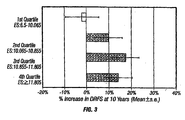
- ESR1 expression and TAM benefit can be represented as a function of breaking ESR1 expression into quartiles.
- Figure 3 shows the absolute benefit of TAM treatment as a function of quartiles of ESR1 expression (horizontal lines through bars represent 95% confidence limits).
- the cutpoints for ESR1 expression are reference-normalized C T s derived from analysis of the NSABP B14 patient population. As shown, patients in the lowest quartile of ESR1 expression experience little benefit from TAM.
- ESR1 expression data can be used in conjunction with Recurrence Score to simultaneously determine whether a patient should be prescribed TAM or TAM plus chemotherapy.
- RS recurrence risk category
- Patients in the low recurrence risk category as defined by RS, who express ESR1 in the upper 75 th percentile are logical candidates to be treated with TAM alone.
- Patients who have low recurrence risk, but are in the lower 25 th percentile in ESR1 expression and for whom risk of TAM side effects is a particular concern may reasonably be considered patients for whom TAM treatment is less appropriate.
- Table 5 can be used to make decisions about treatment of a patient with anti-estrogen and/or chemotherapy.
Landscapes
- Health & Medical Sciences (AREA)
- Life Sciences & Earth Sciences (AREA)
- Engineering & Computer Science (AREA)
- Chemical & Material Sciences (AREA)
- Physics & Mathematics (AREA)
- Molecular Biology (AREA)
- Bioinformatics & Cheminformatics (AREA)
- Genetics & Genomics (AREA)
- General Health & Medical Sciences (AREA)
- Proteomics, Peptides & Aminoacids (AREA)
- Analytical Chemistry (AREA)
- Immunology (AREA)
- Biotechnology (AREA)
- Biophysics (AREA)
- Organic Chemistry (AREA)
- Evolutionary Biology (AREA)
- Bioinformatics & Computational Biology (AREA)
- Theoretical Computer Science (AREA)
- Spectroscopy & Molecular Physics (AREA)
- Medical Informatics (AREA)
- Pathology (AREA)
- Biochemistry (AREA)
- Urology & Nephrology (AREA)
- Microbiology (AREA)
- Hematology (AREA)
- Zoology (AREA)
- Wood Science & Technology (AREA)
- Biomedical Technology (AREA)
- Medicinal Chemistry (AREA)
- Food Science & Technology (AREA)
- Cell Biology (AREA)
- General Physics & Mathematics (AREA)
- General Engineering & Computer Science (AREA)
- Oncology (AREA)
- Hospice & Palliative Care (AREA)
- Public Health (AREA)
- Chemical Kinetics & Catalysis (AREA)
- Veterinary Medicine (AREA)
- General Chemical & Material Sciences (AREA)
- Animal Behavior & Ethology (AREA)
Claims (19)
- Procédé pour la détermination quantitative de la probabilité d'une réponse bénéfique d'un patient atteint de cancer du sein positif pour le récepteur d'oestrogène 1 (ESR1) à un traitement avec un médicament antiestrogène, comprenant la détermination quantitative, dans un échantillon biologique comprenant des cellules de cancer du sein obtenues à partir dudit patient d'un score de groupe ESR1 qui est basé sur les niveaux d'expression de ESR1, PGR, BCL2 et SCUBE2, ou les produits d'expression de ceux-ci dans lequel ledit score de groupe ESR1 est représenté sous la forme d'une variable continue ou en tant que plages d'expression et où des augmentations desdits niveaux d'expression sont utilisées en tant qu'indication quantitative que ledit patient a une probabilité augmentée de réponse bénéfique au traitement avec un médicament antiestrogène.
- Procédé selon la revendication 1, dans lequel le médicament antiestrogène est choisi dans le groupe constitué des tamoxifène, torémifène, anastrozole, et acétate de mégastérol.
- Procédé selon la revendication 1, dans lequel le médicament antiestrogène est un antagoniste de liaison d'oestrogène au récepteur d'oestrogène.
- Procédé selon la revendication 2 ou 3 dans lequel le médicament antiestrogène est le tamoxifène.
- Procédé selon la revendication 2, dans lequel le médicament antiestrogène est l'anastrozole.
- Procédé selon la revendication 1, comprenant en outre l'étape de préparation d'un rapport pour ledit patient, comprenant une recommandation indiquant si ledit patient doit recevoir un traitement avec ledit médicament antiestrogène seul, une chimiothérapie seule, ou une chimiothérapie plus un médicament antiestrogène.
- Procédé selon la revendication 6, dans lequel ledit traitement avec un antiestrogène seul, une chimiothérapie seule, ou une chimiothérapie plus un antiestrogène est recommandé en consultant un graphique ou un tableau le long d'un axe sur lequel le niveau d'expression de ESR1 est représenté, en tant que variable continue ou dans des plages d'expression de ESR1, et le long de l'autre axe sur lequel la probabilité de récurrence du cancer est représentée, sous la forme d'une variable continue ou dans des plages de risque.
- Procédé selon la revendication 7, dans lequel lesdites plages d'expression de ESR1 sont des tertiles dans une population de valeurs ESR1 de patient atteint de cancer du sein, et sont divisées en plages de ESR1 faible, intermédiaire et élevé.
- Procédé selon la revendication 8, dans lequel lesdites plages de risque sont des plages de risque faible, intermédiaire et élevé.
- Procédé selon la revendication 9, dans lequel auxdits patients dans les plages de ESR1 élevé et de risque faible, il est recommandé un traitement avec un médicament antiestrogène seul.
- Procédé selon la revendication 9, dans lequel auxdits patients dans les plages de ESR1 faible et de risque élevé, il est recommandé un traitement par chimiothérapie seul.
- Procédé selon la revendication 9, dans lequel auxdits patients dans les plages de ESR1 et de risque intermédiaires, il est recommandé à la fois un traitement avec un médicament antiestrogène et un traitement par chimiothérapie.
- Procédé selon la revendication 1, dans lequel ladite variable est le niveau d'expression du produit de transcription ARN de ESR1, ou son produit d'expression.
- Procédé selon la revendication 1, comprenant en outre l'étape de détermination d'un score de récurrence pour ledit patient, qui prédit la probabilité de récurrence du cancer chez le sujet.
- Procédé selon la revendication 14, dans lequel le médicament antiestrogène est choisi dans le groupe constitué des tamoxifène, torémifène, anastrozole, et acétate de mégastérol.
- Procédé selon la revendication 14, dans lequel le médicament antiestrogène est un antagoniste de liaison d'oestrogène au récepteur d'oestrogène.
- Procédé selon la revendication 15 ou 16, dans lequel le médicament antiestrogène est le tamoxifène.
- Procédé selon la revendication 15, dans lequel le médicament antiestrogène est l'anastrozole.
- Procédé selon la revendication 14, comprenant en outre l'étape de préparation d'un rapport pour ledit patient, comprenant une recommandation indiquant si ledit patient doit recevoir un traitement avec ledit médicament antiestrogène seul, une chimiothérapie seule, ou une chimiothérapie plus un médicament antiestrogène.
Applications Claiming Priority (2)
| Application Number | Priority Date | Filing Date | Title |
|---|---|---|---|
| US62544204P | 2004-11-05 | 2004-11-05 | |
| PCT/US2005/039970 WO2006052731A2 (fr) | 2004-11-05 | 2005-11-04 | Indicateurs moleculaires de pronostic de cancer du sein et prediction de reponse de traitement |
Publications (2)
| Publication Number | Publication Date |
|---|---|
| EP1815014A2 EP1815014A2 (fr) | 2007-08-08 |
| EP1815014B1 true EP1815014B1 (fr) | 2012-03-21 |
Family
ID=36337021
Family Applications (1)
| Application Number | Title | Priority Date | Filing Date |
|---|---|---|---|
| EP05821698A Expired - Lifetime EP1815014B1 (fr) | 2004-11-05 | 2005-11-04 | Indicateurs moléculaires de pronostic du cancer du sein et prédiction de réponse du traitement |
Country Status (10)
| Country | Link |
|---|---|
| US (2) | US7622251B2 (fr) |
| EP (1) | EP1815014B1 (fr) |
| JP (1) | JP4939425B2 (fr) |
| AT (1) | ATE550440T1 (fr) |
| AU (1) | AU2005304878B2 (fr) |
| CA (1) | CA2585561C (fr) |
| DK (1) | DK1815014T3 (fr) |
| ES (1) | ES2384107T3 (fr) |
| IL (1) | IL182930A (fr) |
| WO (1) | WO2006052731A2 (fr) |
Families Citing this family (76)
| Publication number | Priority date | Publication date | Assignee | Title |
|---|---|---|---|---|
| DK2258872T3 (da) * | 2002-03-13 | 2013-11-18 | Genomic Health Inc | Genekspressionsprofilering i biopsier af tumorvæv |
| US20040231909A1 (en) | 2003-01-15 | 2004-11-25 | Tai-Yang Luh | Motorized vehicle having forward and backward differential structure |
| EP3170906B1 (fr) * | 2003-06-24 | 2018-08-22 | Genomic Health, Inc. | Prédiction de probabilité de récurrence de cancer |
| US7871769B2 (en) * | 2004-04-09 | 2011-01-18 | Genomic Health, Inc. | Gene expression markers for predicting response to chemotherapy |
| CA2585571C (fr) * | 2004-11-05 | 2020-01-21 | Genomic Health, Inc. | Prediction de reaction a la chimiotherapie au moyen de marqueurs d'expression genique |
| US20060134243A1 (en) * | 2004-12-17 | 2006-06-22 | Bionovo, Inc. | Method of using extracts of epimedium species |
| US7482029B2 (en) * | 2005-04-01 | 2009-01-27 | Bionovo, Inc. | Composition for treatment of menopause |
| JP2009507496A (ja) * | 2005-09-09 | 2009-02-26 | ボード オブ リージェンツ オブ ザ ユニバーシティ オブ テキサス システム | エストロゲン受容体(er)遺伝子およびer関連遺伝子のゲノム発現の算出された指標 |
| US7700136B2 (en) * | 2005-11-14 | 2010-04-20 | Bionovo, Inc. | Scutellaria barbata extract for the treatment of cancer |
| EP1873258A1 (fr) * | 2006-06-26 | 2008-01-02 | Universitätsklinikum Hamburg-Eppendorf | Détection de l'amplification de ESR1 dans le cancer du sein |
| US20080076134A1 (en) * | 2006-09-21 | 2008-03-27 | Nuclea Biomarkers, Llc | Gene and protein expression profiles associated with the therapeutic efficacy of irinotecan |
| EP3135773A1 (fr) * | 2006-09-27 | 2017-03-01 | Sividon Diagnostics GmbH | Procédés pour le pronostic de cancer du sein |
| SG142186A1 (en) * | 2006-10-20 | 2008-05-28 | Agency Science Tech & Res | Breast tumour grading |
| EP2090588A4 (fr) | 2006-10-23 | 2010-04-07 | Neocodex S L | Methode de pronostic et/ou de diagnostic in vitro de l'hypersensibilite aux oestrogenes ou a des substances ayant une activite oestrogenique |
| US8470534B2 (en) * | 2006-12-01 | 2013-06-25 | Erik S. Knudsen | Methods of predicting resistance or sensitivity to therapies for cancer |
| WO2008115561A2 (fr) * | 2007-03-21 | 2008-09-25 | Bristol-Myers Squibb Company | Biomarqueurs et méthodes permettant de déterminer la sensibilité à des agents stabilisant les microtubules |
| EP1978106A1 (fr) * | 2007-04-07 | 2008-10-08 | Universitätsklinikum Hamburg-Eppendorf | Amplificateur ayant une protection de sortie, en particulier un amplificateur opérationnel pour une application audio |
| US20090070138A1 (en) * | 2007-05-15 | 2009-03-12 | Jason Langheier | Integrated clinical risk assessment system |
| CA2688049A1 (fr) * | 2007-05-31 | 2008-12-04 | Dako Denmark A/S | Procedes d'utilisation des changements du nombre de copies d'esr dans les traitements et les pronostics du cancer du sein |
| US20080319051A1 (en) * | 2007-06-22 | 2008-12-25 | Bionovo, Inc. | Liquiritigenin and derivatives as selective estrogen receptor beta agonists |
| US20090042818A1 (en) * | 2007-06-22 | 2009-02-12 | Bionovo, Inc. | Liquiritigenin and Derivatives as Selective Estrogen Receptor Beta Agonists |
| AU2008285325A1 (en) * | 2007-08-08 | 2009-02-12 | Bionovo, Inc. | Extracts of Ligustrum lucidum and uses thereof |
| US20090125247A1 (en) * | 2007-08-16 | 2009-05-14 | Joffre Baker | Gene expression markers of recurrence risk in cancer patients after chemotherapy |
| WO2009030029A1 (fr) * | 2007-09-05 | 2009-03-12 | Laurentian University | Procédé d'utilisation de l'intégrité d'arn tumoral pour mesurer la réponse à la chimiothérapie chez des patients atteints de cancer |
| AU2008296136A1 (en) * | 2007-09-07 | 2009-03-12 | Bionovo. Inc. | Estrogenic extracts of Scuttelaria barbata D. Don of the Labiatae Family and uses thereof |
| WO2009033103A1 (fr) * | 2007-09-07 | 2009-03-12 | Bionovo, Inc. | Extraits oestrogénies de pueraria lobata willd, ohwi de la famille leguminosae et leurs utilisations |
| AU2008296072A1 (en) * | 2007-09-07 | 2009-03-12 | Bionovo, Inc. | Estrogenic extracts of Astragalus membranaceus Fisch.Bge.Var.mongolicus Bge. of the Leguminosae Family and uses thereof |
| AU2008296176A1 (en) * | 2007-09-07 | 2009-03-12 | Bionovo, Inc. | Estrogenic extracts of Asparagus conchinchinensis (Lour.) Merr of the Liliaceae Family and uses thereof |
| US20090130118A1 (en) * | 2007-11-19 | 2009-05-21 | Bionovo, Inc. | Scutellaria barbata extract and combinations for the treatment of cancer |
| EP2222323A4 (fr) * | 2007-11-19 | 2012-07-25 | Bionovo Inc | Procédé de fabrication d'extrait purifié de la scutellaria barbata d.don |
| US8512961B2 (en) * | 2007-11-19 | 2013-08-20 | Bionovo, Inc. | Methods of detecting and treatment of cancers using Scutellaria barbata extract |
| CA2706315A1 (fr) * | 2007-11-19 | 2009-05-28 | Bionovo, Inc. | Therapie anticancereuse utilisant un extrait de scutellaria barbata |
| EP2065473A1 (fr) * | 2007-11-28 | 2009-06-03 | Siemens Healthcare Diagnostics GmbH | Procédé d'évaluation de pronostic et de prédiction de succès thérapeutique dans un cancer gynécologique |
| EP2065474A1 (fr) * | 2007-11-28 | 2009-06-03 | Siemens Healthcare Diagnostics GmbH | Méthode pour le prognostic de la réponse thérapeutique au traitement endocrinien |
| WO2009068423A2 (fr) | 2007-11-30 | 2009-06-04 | Siemens Healthcare Diagnostics Gmbh | Procédé de prédiction d'une sensibilité à une thérapie dans des tumeurs de type basales |
| WO2009095319A1 (fr) * | 2008-01-28 | 2009-08-06 | Siemens Healthcare Diagnostics Gmbh | Pronostic de cancer par vote majoritaire |
| CA2721191A1 (fr) * | 2008-04-14 | 2009-10-22 | Bionovo, Inc. | Calycosine et ses analogues utilises dans le traitement des maladies induites par les recepteurs beta des oestrogenes |
| WO2009132028A1 (fr) * | 2008-04-21 | 2009-10-29 | Complete Genomics, Inc. | Structures pour puces de détection d'acides nucléiques |
| AU2009244315A1 (en) * | 2008-05-06 | 2009-11-12 | Bionovo, Inc. | Estrogenic extracts for use in treating vaginal and vulvar atrophy |
| US20090311349A1 (en) * | 2008-06-05 | 2009-12-17 | Bionovo, Inc., A Delaware Corporation | Method of quantification of multiple bioactives from botanical compositions |
| CA2727018A1 (fr) * | 2008-06-06 | 2009-12-10 | Bionovo, Inc. | Anthraquinones et analogues provenant de rheum palmatum pour le traitement d'etats a mediation par le recepteur beta de l'estrogene |
| TW201000119A (en) * | 2008-06-10 | 2010-01-01 | Oncotherapy Science Inc | MYBL2 epitope peptides and vaccines containing the same |
| ES2338843B1 (es) * | 2008-07-02 | 2011-01-24 | Centro De Investigaciones Energeticas, Medioambientales Y Tecnologicas | Huella genomica de cancer de mama. |
| JP2012501974A (ja) * | 2008-09-03 | 2012-01-26 | バイオノボ・インコーポレーテッド | 癌の処置のための方法および組成物 |
| US10359425B2 (en) * | 2008-09-09 | 2019-07-23 | Somalogic, Inc. | Lung cancer biomarkers and uses thereof |
| JP5550060B2 (ja) * | 2008-10-03 | 2014-07-16 | 独立行政法人産業技術総合研究所 | そうか病病原菌種のpcr定量用試薬キット |
| US20100221752A2 (en) * | 2008-10-06 | 2010-09-02 | Somalogic, Inc. | Ovarian Cancer Biomarkers and Uses Thereof |
| US20110195995A1 (en) * | 2008-10-14 | 2011-08-11 | Wittliff James L | Methods of Optimizing Treatment of Estrogen-Receptor Positive Breast Cancers |
| ES2343996B1 (es) | 2008-12-11 | 2011-06-20 | Fundacion Para La Investigacion Biomedica Del Hospital Universitario La Paz | Metodo para la subclasificacion de tumores. |
| US20120041274A1 (en) | 2010-01-07 | 2012-02-16 | Myriad Genetics, Incorporated | Cancer biomarkers |
| AU2010246233A1 (en) * | 2009-04-28 | 2011-12-22 | Bionovo, Inc. | Method of reducing fat accumulation and inducing weight loss |
| EP2425015B1 (fr) * | 2009-04-29 | 2018-01-10 | Ralph Wirtz | Procédé permettant d'évaluer un pronostic et de prévoir le succès d'un traitement contre le cancer par détermination des niveaux d'expression d'un récepteur hormonal |
| EP2425021A4 (fr) * | 2009-05-01 | 2013-03-06 | Nuvera Biosciences Inc | Indice d'expression génomique du récepteur d' strogènes (er) et gènes liés auxdits er |
| EP2253715A1 (fr) * | 2009-05-14 | 2010-11-24 | RWTH Aachen | Nouvelles cibles pour la thérapie et/ou le diagnostic du cancer |
| WO2011120984A1 (fr) | 2010-03-31 | 2011-10-06 | Sividon Diagnostics Gmbh | Procédé pour prédire la récurrence du cancer du sein sous traitement endocrinien |
| CA2804391A1 (fr) | 2010-07-07 | 2012-01-12 | Myriad Genetics, Inc. | Signatures genetiques utilisees pour le pronostic du cancer |
| MX2012014268A (es) | 2010-07-09 | 2013-02-12 | Somalogic Inc | Biomarcadores de cancer de pulmon y usos de los mismos. |
| EP2603622A4 (fr) | 2010-08-13 | 2015-04-22 | Somalogic Inc | Biomarqueurs du cancer du pancréas et leurs utilisations |
| WO2012030840A2 (fr) | 2010-08-30 | 2012-03-08 | Myriad Genetics, Inc. | Signatures génétiques pour le diagnostic et le pronostic du cancer |
| RU2486518C1 (ru) * | 2012-01-10 | 2013-06-27 | Учреждение Российской академии медицинских наук Научно-исследовательский институт онкологии Сибирского отделения Российской академии медицинских наук (НИИ онкологии СО РАМН) | Способ прогнозирования возникновения местных рецидивов в послеоперационном рубце при уницентрическом инвазивном протоковом раке молочной железы у больных с сохраненной менструальной функцией |
| CA2871195C (fr) | 2012-04-24 | 2023-01-10 | Rna Diagnostics Inc. | Dosages, methodes et appareil pour l'evaluation de la disruption d'un arn |
| EP4190918A1 (fr) | 2012-11-16 | 2023-06-07 | Myriad Genetics, Inc. | Signatures géniques pour le pronostic du cancer |
| HK1215875A1 (zh) | 2012-12-03 | 2016-09-23 | Rna Diagnostics Inc. | 用於监视放射治疗癌症反应的方法和试剂盒 |
| ES2654469T3 (es) | 2013-02-01 | 2018-02-13 | Sividon Diagnostics Gmbh | Procedimiento de predicción del beneficio de la inclusión de taxano en un régimen de quimioterapia en pacientes con cáncer de mama |
| US10731222B2 (en) | 2013-10-04 | 2020-08-04 | Rna Diagnostics Inc. | RNA disruption assay for predicting survival |
| EP2910645A1 (fr) * | 2014-02-25 | 2015-08-26 | STRATIFYER Molecular Pathology GmbH | Procédés et compositions pour la prédiction de l'efficacité thérapeutique de traitements du cancer et le pronostic du cancer lors d'un traitement à base d'anticorps |
| WO2015175692A1 (fr) | 2014-05-13 | 2015-11-19 | Myriad Genetics, Inc. | Signatures génétiques utilisées en vue du pronostic d'un cancer |
| CN104004844A (zh) * | 2014-05-28 | 2014-08-27 | 杭州美中疾病基因研究院有限公司 | 乳腺癌21基因联合检测试剂盒及其制备方法 |
| WO2015195949A2 (fr) | 2014-06-18 | 2015-12-23 | Clear Gene, Inc. | Méthodes, compositions et dispositifs pour l'analyse rapide de marqueurs biologiques |
| US10980519B2 (en) | 2015-07-14 | 2021-04-20 | Duke University | Systems and methods for extracting prognostic image features |
| CA3008273A1 (fr) | 2015-12-18 | 2017-06-22 | Clear Gene, Inc. | Methodes, compositions, kits et dispositifs pour l'analyse rapide de marqueurs biologiques |
| US12275994B2 (en) * | 2017-06-22 | 2025-04-15 | Clear Gene, Inc. | Methods and compositions for the analysis of cancer biomarkers |
| WO2019051266A2 (fr) | 2017-09-08 | 2019-03-14 | Myriad Genetics, Inc. | Procédé d'utilisation de biomarqueurs et de variables cliniques pour prédire l'intérêt d'une chimiothérapie |
| US12008747B2 (en) * | 2019-07-29 | 2024-06-11 | Case Western Reserve University | Population-specific prediction of prostate cancer recurrence based on stromal morphology features |
| CN111500724B (zh) * | 2020-04-28 | 2023-11-21 | 启程医学科技(山东)有限公司 | 用于乳腺癌六基因同时检测的引物组与探针组合 |
| WO2023081988A1 (fr) * | 2021-11-09 | 2023-05-19 | Coelho Guilherme Portela | Méthode de prédiction d'efficacité d'un traitement contre le cancer du sein |
Citations (2)
| Publication number | Priority date | Publication date | Assignee | Title |
|---|---|---|---|---|
| WO2003078662A1 (fr) * | 2002-03-13 | 2003-09-25 | Genomic Health | Profilage d'expression genique dans des tissus tumoraux ponctionnes |
| WO2005100606A2 (fr) * | 2004-04-09 | 2005-10-27 | Genomic Health, Inc. | Marqueurs d'expression genique permettant de predire la reponse a la chimiotherapie |
Family Cites Families (73)
| Publication number | Priority date | Publication date | Assignee | Title |
|---|---|---|---|---|
| US4699877A (en) | 1982-11-04 | 1987-10-13 | The Regents Of The University Of California | Methods and compositions for detecting human tumors |
| USRE35491E (en) | 1982-11-04 | 1997-04-08 | The Regents Of The University Of California | Methods and compositions for detecting human tumors |
| IE56509B1 (en) | 1982-11-04 | 1991-08-28 | Univ California | Methods for oncogenic detection |
| US7838216B1 (en) | 1986-03-05 | 2010-11-23 | The United States Of America, As Represented By The Department Of Health And Human Services | Human gene related to but distinct from EGF receptor gene |
| US5015568A (en) | 1986-07-09 | 1991-05-14 | The Wistar Institute | Diagnostic methods for detecting lymphomas in humans |
| US5202429A (en) | 1986-07-09 | 1993-04-13 | The Wistar Institute | DNA molecules having human BCL-2 gene sequences |
| US4968603A (en) | 1986-12-31 | 1990-11-06 | The Regents Of The University Of California | Determination of status in neoplastic disease |
| US5831066A (en) | 1988-12-22 | 1998-11-03 | The Trustees Of The University Of Pennsylvania | Regulation of bcl-2 gene expression |
| US5858678A (en) | 1994-08-02 | 1999-01-12 | St. Louis University | Apoptosis-regulating proteins |
| US5830753A (en) | 1994-09-30 | 1998-11-03 | Ludwig Institute For Cancer Research | Isolated nucleic acid molecules coding for tumor rejection antigen precursor dage and uses thereof. |
| US5620981A (en) * | 1995-05-03 | 1997-04-15 | Warner-Lambert Company | Pyrido [2,3-D]pyrimidines for inhibiting protein tyrosine kinase mediated cellular proliferation |
| US6716575B2 (en) | 1995-12-18 | 2004-04-06 | Sugen, Inc. | Diagnosis and treatment of AUR1 and/or AUR2 related disorders |
| PT868519E (pt) | 1995-12-18 | 2006-05-31 | Sugen Inc | Diagnostico e tratamento de disturbios relacionados com aur-1 e/ou aur-2 |
| US5670325A (en) | 1996-08-14 | 1997-09-23 | Exact Laboratories, Inc. | Method for the detection of clonal populations of transformed cells in a genomically heterogeneous cellular sample |
| US5741650A (en) | 1996-01-30 | 1998-04-21 | Exact Laboratories, Inc. | Methods for detecting colon cancer from stool samples |
| US5821082A (en) | 1996-05-23 | 1998-10-13 | St. Louis University Health Sciences Center | Anti-proliferation domain of a human Bcl-2 and DNA encoding the same |
| US6143529A (en) | 1996-08-14 | 2000-11-07 | Exact Laboratories, Inc. | Methods for improving sensitivity and specificity of screening assays |
| US5928870A (en) | 1997-06-16 | 1999-07-27 | Exact Laboratories, Inc. | Methods for the detection of loss of heterozygosity |
| US6020137A (en) | 1996-08-14 | 2000-02-01 | Exact Laboratories, Inc. | Methods for the detection of loss of heterozygosity |
| US6100029A (en) | 1996-08-14 | 2000-08-08 | Exact Laboratories, Inc. | Methods for the detection of chromosomal aberrations |
| US6203993B1 (en) | 1996-08-14 | 2001-03-20 | Exact Science Corp. | Methods for the detection of nucleic acids |
| US5952178A (en) | 1996-08-14 | 1999-09-14 | Exact Laboratories | Methods for disease diagnosis from stool samples |
| US6146828A (en) | 1996-08-14 | 2000-11-14 | Exact Laboratories, Inc. | Methods for detecting differences in RNA expression levels and uses therefor |
| US5861278A (en) | 1996-11-01 | 1999-01-19 | Genetics Institute, Inc. | HNF3δ compositions |
| CA2271783C (fr) | 1996-11-20 | 2013-04-16 | Yale University | La survivine, proteine inhibant l'apoptose cellulaire, et sa modulation |
| US6498163B1 (en) * | 1997-02-05 | 2002-12-24 | Warner-Lambert Company | Pyrido[2,3-D]pyrimidines and 4-aminopyrimidines as inhibitors of cellular proliferation |
| US5830665A (en) | 1997-03-03 | 1998-11-03 | Exact Laboratories, Inc. | Contiguous genomic sequence scanning |
| US6033893A (en) | 1997-06-26 | 2000-03-07 | Incyte Pharmaceuticals, Inc. | Human cathepsin |
| WO1999002714A1 (fr) | 1997-07-07 | 1999-01-21 | Abbott Laboratories | Reactifs et procedes utilises pour detecter les maladies du sein |
| US6020135A (en) | 1998-03-27 | 2000-02-01 | Affymetrix, Inc. | P53-regulated genes |
| GB2339200B (en) | 1998-06-06 | 2001-09-12 | Genostic Pharma Ltd | Genostics |
| US6696558B2 (en) | 1998-09-09 | 2004-02-24 | The Burnham Institute | Bag proteins and nucleic acid molecules encoding them |
| WO2000050595A2 (fr) | 1999-02-25 | 2000-08-31 | Ivan Gout | Molecules d'acide nucleique associees aux melanomes et aux tumeurs de la thyroide |
| AU3395900A (en) | 1999-03-12 | 2000-10-04 | Human Genome Sciences, Inc. | Human lung cancer associated gene sequences and polypeptides |
| US20020039764A1 (en) | 1999-03-12 | 2002-04-04 | Rosen Craig A. | Nucleic, acids, proteins, and antibodies |
| US6692916B2 (en) | 1999-06-28 | 2004-02-17 | Source Precision Medicine, Inc. | Systems and methods for characterizing a biological condition or agent using precision gene expression profiles |
| US6960439B2 (en) | 1999-06-28 | 2005-11-01 | Source Precision Medicine, Inc. | Identification, monitoring and treatment of disease and characterization of biological condition using gene expression profiles |
| US6326148B1 (en) | 1999-07-12 | 2001-12-04 | The Regents Of The University Of California | Detection of copy number changes in colon cancer |
| US6710170B2 (en) | 1999-09-10 | 2004-03-23 | Corixa Corporation | Compositions and methods for the therapy and diagnosis of ovarian cancer |
| US6271002B1 (en) | 1999-10-04 | 2001-08-07 | Rosetta Inpharmatics, Inc. | RNA amplification method |
| WO2001025250A1 (fr) | 1999-10-06 | 2001-04-12 | The Regents Of The University Of California | Genes a expression differentielle associes a la surexpression de her-2/neu |
| EP1666494A1 (fr) | 1999-12-01 | 2006-06-07 | Genentech, Inc. | Polypeptides secretés et transmembranaires et acides nucléiques les codant |
| US6750013B2 (en) | 1999-12-02 | 2004-06-15 | Protein Design Labs, Inc. | Methods for detection and diagnosing of breast cancer |
| US6248535B1 (en) | 1999-12-20 | 2001-06-19 | University Of Southern California | Method for isolation of RNA from formalin-fixed paraffin-embedded tissue specimens |
| AU2001232485A1 (en) | 2000-01-13 | 2001-07-24 | Amsterdam Support Diagnostics B.V. | A universal nucleic acid amplification system for nucleic acids in a sample |
| US6322986B1 (en) | 2000-01-18 | 2001-11-27 | Albany Medical College | Method for colorectal cancer prognosis and treatment selection |
| WO2001055454A1 (fr) | 2000-01-28 | 2001-08-02 | Althea Technologies, Inc. | Procedes d'analyse de l'expression genique |
| WO2001055321A2 (fr) | 2000-01-31 | 2001-08-02 | Human Genome Sciences, Inc. | Acides nucleiques, proteines et anticorps |
| WO2001070979A2 (fr) | 2000-03-21 | 2001-09-27 | Millennium Pharmaceuticals, Inc. | Nouveaux genes, compositions, trousses et methodes d'identification, de verification, de prevention et de traitement du cancer des ovaires |
| AU2001251086A1 (en) | 2000-03-31 | 2001-10-15 | Sir Mortimer B. Davis Jewish General Hospital | Microchip arrays of regulatory genes |
| WO2002000677A1 (fr) | 2000-06-07 | 2002-01-03 | Human Genome Sciences, Inc. | Acides nucleiques, proteines et anticorps |
| AU2001280008A1 (en) | 2000-07-21 | 2002-02-05 | Global Genomics Ab | A method and an algorithm for mRNA expression analysis |
| AU2001278011A1 (en) | 2000-07-26 | 2002-02-05 | Applied Genomics, Inc. | Bstp-ecg1 protein and related reagents and methods of use thereof |
| AU2001277202A1 (en) | 2000-07-26 | 2002-02-05 | Applied Genomics, Inc. | Bstp-ras/rerg protein and related reagents and methods of use thereof |
| US7118853B2 (en) | 2000-07-26 | 2006-10-10 | Applied Genomics, Inc. | Methods of classifying, diagnosing, stratifying and treating cancer patients and their tumors |
| US7795232B1 (en) | 2000-08-25 | 2010-09-14 | Genta Incorporated | Methods of treatment of a bcl-2 disorder using bcl-2 antisense oligomers |
| US6582919B2 (en) | 2001-06-11 | 2003-06-24 | Response Genetics, Inc. | Method of determining epidermal growth factor receptor and HER2-neu gene expression and correlation of levels thereof with survival rates |
| US6602670B2 (en) | 2000-12-01 | 2003-08-05 | Response Genetics, Inc. | Method of determining a chemotherapeutic regimen based on ERCC1 expression |
| JP2004537261A (ja) | 2000-12-08 | 2004-12-16 | イプソゲン | 候補遺伝子のアレイを用いた原発性乳がんの遺伝子発現プロファイリング |
| AU2002255478A1 (en) | 2001-01-10 | 2002-09-12 | Pe Corporation (Ny) | Kits, such as nucleic acid arrays, comprising a majority of human exons or transcripts, for detecting expression and other uses thereof |
| US7776518B2 (en) | 2001-01-12 | 2010-08-17 | Yale University | Detection of survivin in the biological fluids of cancer patients |
| AU2002246970B2 (en) | 2001-01-12 | 2007-06-14 | Yale University | Detection of survivin in the biological fluids of cancer patients |
| EP1425302A2 (fr) | 2001-01-24 | 2004-06-09 | Protein Design Labs | Procedes de diagnostic du cancer du sein, compositions et procedes de criblage de modulateurs du cancer du sein |
| US6939670B2 (en) | 2001-03-12 | 2005-09-06 | Monogen, Inc. | Cell-based detection and differentiation of lung cancer |
| DE60239535D1 (de) | 2001-06-18 | 2011-05-05 | Rosetta Inpharmatics Llc | Diagnose und prognose von brustkrebspatientinnen |
| US7125680B2 (en) | 2001-07-27 | 2006-10-24 | The Regents Of The University Of California | Methods and materials for characterizing and modulating interaction between heregulin and HER3 |
| AU2002343443A1 (en) | 2001-09-28 | 2003-04-14 | Whitehead Institute For Biomedical Research | Classification of lung carcinomas using gene expression analysis |
| CN102402650A (zh) | 2001-11-09 | 2012-04-04 | 生命技术公司 | 利用基因表达分布图识别、监控和治疗疾病以及鉴定生物学状态 |
| US20030198972A1 (en) | 2001-12-21 | 2003-10-23 | Erlander Mark G. | Grading of breast cancer |
| US20050216961A1 (en) | 2002-03-28 | 2005-09-29 | Delaney Allen D | Cancer associated protein kinases and their uses |
| EP1365034A3 (fr) | 2002-05-21 | 2004-02-18 | Bayer HealthCare AG | Procédés et compositions pour la prédiction, le diagnostic, le pronostic, la prévention et le traitement de neoplasie maligne |
| US20040231909A1 (en) * | 2003-01-15 | 2004-11-25 | Tai-Yang Luh | Motorized vehicle having forward and backward differential structure |
| EP3330875B1 (fr) * | 2003-07-10 | 2021-12-01 | Genomic Health, Inc. | Algorithme de profil d'expression et de test pour le pronostic de la recurrence du cancer du sein |
-
2005
- 2005-11-04 CA CA2585561A patent/CA2585561C/fr not_active Expired - Lifetime
- 2005-11-04 AU AU2005304878A patent/AU2005304878B2/en not_active Expired
- 2005-11-04 DK DK05821698.7T patent/DK1815014T3/da active
- 2005-11-04 ES ES05821698T patent/ES2384107T3/es not_active Expired - Lifetime
- 2005-11-04 US US11/267,807 patent/US7622251B2/en not_active Expired - Lifetime
- 2005-11-04 JP JP2007540068A patent/JP4939425B2/ja not_active Expired - Lifetime
- 2005-11-04 AT AT05821698T patent/ATE550440T1/de active
- 2005-11-04 EP EP05821698A patent/EP1815014B1/fr not_active Expired - Lifetime
- 2005-11-04 WO PCT/US2005/039970 patent/WO2006052731A2/fr not_active Ceased
-
2007
- 2007-05-02 IL IL182930A patent/IL182930A/en active IP Right Grant
-
2009
- 2009-10-09 US US12/576,898 patent/US20100184041A1/en not_active Abandoned
Patent Citations (2)
| Publication number | Priority date | Publication date | Assignee | Title |
|---|---|---|---|---|
| WO2003078662A1 (fr) * | 2002-03-13 | 2003-09-25 | Genomic Health | Profilage d'expression genique dans des tissus tumoraux ponctionnes |
| WO2005100606A2 (fr) * | 2004-04-09 | 2005-10-27 | Genomic Health, Inc. | Marqueurs d'expression genique permettant de predire la reponse a la chimiotherapie |
Also Published As
| Publication number | Publication date |
|---|---|
| JP4939425B2 (ja) | 2012-05-23 |
| CA2585561C (fr) | 2018-07-17 |
| JP2008518620A (ja) | 2008-06-05 |
| WO2006052731A3 (fr) | 2007-04-19 |
| US20060166231A1 (en) | 2006-07-27 |
| CA2585561A1 (fr) | 2006-05-18 |
| US20100184041A1 (en) | 2010-07-22 |
| ATE550440T1 (de) | 2012-04-15 |
| IL182930A0 (en) | 2007-09-20 |
| ES2384107T3 (es) | 2012-06-29 |
| AU2005304878B2 (en) | 2010-07-08 |
| IL182930A (en) | 2013-03-24 |
| EP1815014A2 (fr) | 2007-08-08 |
| DK1815014T3 (da) | 2012-06-18 |
| US7622251B2 (en) | 2009-11-24 |
| WO2006052731A2 (fr) | 2006-05-18 |
| AU2005304878A1 (en) | 2006-05-18 |
Similar Documents
| Publication | Publication Date | Title |
|---|---|---|
| AU2005304878B2 (en) | Molecular indicators of breast cancer prognosis and prediction of treatment response | |
| EP1836629B1 (fr) | Prediction de reaction a la chimiotherapie au moyen de marqueurs d'expression genique | |
| EP1644858B1 (fr) | Algorithme de profile d'expression et test du pronostic du cancer | |
| AU2004248120B2 (en) | Gene expression markers for predicting response to chemotherapy | |
| EP3556867A1 (fr) | Procédés destinés à prédire l'issue clinique d'un cancer | |
| JP2006516897A (ja) | 乳癌予後診断のための遺伝子発現マーカー | |
| HK40014990A (en) | Methods to predict clinical outcome of cancer | |
| HK1254085B (en) | Expression profile algorithm and test for prognosing breast cancer recurrence | |
| AU2016210735A1 (en) | Gene expression markers for predicting response to chemotherapy | |
| HK1090693A (en) | Expression profile algorithm and test for cancer prognosis | |
| HK1090693B (en) | Expression profile algorithm and test for cancer prognosis |
Legal Events
| Date | Code | Title | Description |
|---|---|---|---|
| PUAI | Public reference made under article 153(3) epc to a published international application that has entered the european phase |
Free format text: ORIGINAL CODE: 0009012 |
|
| 17P | Request for examination filed |
Effective date: 20070531 |
|
| AK | Designated contracting states |
Kind code of ref document: A2 Designated state(s): AT BE BG CH CY CZ DE DK EE ES FI FR GB GR HU IE IS IT LI LT LU LV MC NL PL PT RO SE SI SK TR |
|
| AX | Request for extension of the european patent |
Extension state: AL BA HR MK YU |
|
| DAX | Request for extension of the european patent (deleted) | ||
| 17Q | First examination report despatched |
Effective date: 20080124 |
|
| GRAP | Despatch of communication of intention to grant a patent |
Free format text: ORIGINAL CODE: EPIDOSNIGR1 |
|
| GRAS | Grant fee paid |
Free format text: ORIGINAL CODE: EPIDOSNIGR3 |
|
| GRAA | (expected) grant |
Free format text: ORIGINAL CODE: 0009210 |
|
| AK | Designated contracting states |
Kind code of ref document: B1 Designated state(s): AT BE BG CH CY CZ DE DK EE ES FI FR GB GR HU IE IS IT LI LT LU LV MC NL PL PT RO SE SI SK TR |
|
| REG | Reference to a national code |
Ref country code: GB Ref legal event code: FG4D |
|
| REG | Reference to a national code |
Ref country code: CH Ref legal event code: EP |
|
| REG | Reference to a national code |
Ref country code: IE Ref legal event code: FG4D |
|
| REG | Reference to a national code |
Ref country code: AT Ref legal event code: REF Ref document number: 550440 Country of ref document: AT Kind code of ref document: T Effective date: 20120415 |
|
| REG | Reference to a national code |
Ref country code: DE Ref legal event code: R096 Ref document number: 602005033316 Country of ref document: DE Effective date: 20120516 |
|
| REG | Reference to a national code |
Ref country code: NL Ref legal event code: T3 |
|
| REG | Reference to a national code |
Ref country code: DK Ref legal event code: T3 |
|
| REG | Reference to a national code |
Ref country code: ES Ref legal event code: FG2A Ref document number: 2384107 Country of ref document: ES Kind code of ref document: T3 Effective date: 20120629 |
|
| PG25 | Lapsed in a contracting state [announced via postgrant information from national office to epo] |
Ref country code: LT Free format text: LAPSE BECAUSE OF FAILURE TO SUBMIT A TRANSLATION OF THE DESCRIPTION OR TO PAY THE FEE WITHIN THE PRESCRIBED TIME-LIMIT Effective date: 20120321 |
|
| LTIE | Lt: invalidation of european patent or patent extension |
Effective date: 20120321 |
|
| PG25 | Lapsed in a contracting state [announced via postgrant information from national office to epo] |
Ref country code: LV Free format text: LAPSE BECAUSE OF FAILURE TO SUBMIT A TRANSLATION OF THE DESCRIPTION OR TO PAY THE FEE WITHIN THE PRESCRIBED TIME-LIMIT Effective date: 20120321 Ref country code: FI Free format text: LAPSE BECAUSE OF FAILURE TO SUBMIT A TRANSLATION OF THE DESCRIPTION OR TO PAY THE FEE WITHIN THE PRESCRIBED TIME-LIMIT Effective date: 20120321 |
|
| REG | Reference to a national code |
Ref country code: GR Ref legal event code: EP Ref document number: 20120401428 Country of ref document: GR Effective date: 20120713 |
|
| PG25 | Lapsed in a contracting state [announced via postgrant information from national office to epo] |
Ref country code: CY Free format text: LAPSE BECAUSE OF FAILURE TO SUBMIT A TRANSLATION OF THE DESCRIPTION OR TO PAY THE FEE WITHIN THE PRESCRIBED TIME-LIMIT Effective date: 20120321 |
|
| PG25 | Lapsed in a contracting state [announced via postgrant information from national office to epo] |
Ref country code: IS Free format text: LAPSE BECAUSE OF FAILURE TO SUBMIT A TRANSLATION OF THE DESCRIPTION OR TO PAY THE FEE WITHIN THE PRESCRIBED TIME-LIMIT Effective date: 20120721 Ref country code: RO Free format text: LAPSE BECAUSE OF FAILURE TO SUBMIT A TRANSLATION OF THE DESCRIPTION OR TO PAY THE FEE WITHIN THE PRESCRIBED TIME-LIMIT Effective date: 20120321 Ref country code: PL Free format text: LAPSE BECAUSE OF FAILURE TO SUBMIT A TRANSLATION OF THE DESCRIPTION OR TO PAY THE FEE WITHIN THE PRESCRIBED TIME-LIMIT Effective date: 20120321 Ref country code: SE Free format text: LAPSE BECAUSE OF FAILURE TO SUBMIT A TRANSLATION OF THE DESCRIPTION OR TO PAY THE FEE WITHIN THE PRESCRIBED TIME-LIMIT Effective date: 20120321 Ref country code: SI Free format text: LAPSE BECAUSE OF FAILURE TO SUBMIT A TRANSLATION OF THE DESCRIPTION OR TO PAY THE FEE WITHIN THE PRESCRIBED TIME-LIMIT Effective date: 20120321 Ref country code: EE Free format text: LAPSE BECAUSE OF FAILURE TO SUBMIT A TRANSLATION OF THE DESCRIPTION OR TO PAY THE FEE WITHIN THE PRESCRIBED TIME-LIMIT Effective date: 20120321 Ref country code: CZ Free format text: LAPSE BECAUSE OF FAILURE TO SUBMIT A TRANSLATION OF THE DESCRIPTION OR TO PAY THE FEE WITHIN THE PRESCRIBED TIME-LIMIT Effective date: 20120321 |
|
| PG25 | Lapsed in a contracting state [announced via postgrant information from national office to epo] |
Ref country code: SK Free format text: LAPSE BECAUSE OF FAILURE TO SUBMIT A TRANSLATION OF THE DESCRIPTION OR TO PAY THE FEE WITHIN THE PRESCRIBED TIME-LIMIT Effective date: 20120321 Ref country code: PT Free format text: LAPSE BECAUSE OF FAILURE TO SUBMIT A TRANSLATION OF THE DESCRIPTION OR TO PAY THE FEE WITHIN THE PRESCRIBED TIME-LIMIT Effective date: 20120723 |
|
| PLBE | No opposition filed within time limit |
Free format text: ORIGINAL CODE: 0009261 |
|
| STAA | Information on the status of an ep patent application or granted ep patent |
Free format text: STATUS: NO OPPOSITION FILED WITHIN TIME LIMIT |
|
| 26N | No opposition filed |
Effective date: 20130102 |
|
| REG | Reference to a national code |
Ref country code: DE Ref legal event code: R097 Ref document number: 602005033316 Country of ref document: DE Effective date: 20130102 |
|
| PG25 | Lapsed in a contracting state [announced via postgrant information from national office to epo] |
Ref country code: BG Free format text: LAPSE BECAUSE OF FAILURE TO SUBMIT A TRANSLATION OF THE DESCRIPTION OR TO PAY THE FEE WITHIN THE PRESCRIBED TIME-LIMIT Effective date: 20120621 |
|
| PG25 | Lapsed in a contracting state [announced via postgrant information from national office to epo] |
Ref country code: TR Free format text: LAPSE BECAUSE OF FAILURE TO SUBMIT A TRANSLATION OF THE DESCRIPTION OR TO PAY THE FEE WITHIN THE PRESCRIBED TIME-LIMIT Effective date: 20120321 Ref country code: MC Free format text: LAPSE BECAUSE OF NON-PAYMENT OF DUE FEES Effective date: 20121130 |
|
| PG25 | Lapsed in a contracting state [announced via postgrant information from national office to epo] |
Ref country code: LU Free format text: LAPSE BECAUSE OF NON-PAYMENT OF DUE FEES Effective date: 20121104 |
|
| PG25 | Lapsed in a contracting state [announced via postgrant information from national office to epo] |
Ref country code: HU Free format text: LAPSE BECAUSE OF FAILURE TO SUBMIT A TRANSLATION OF THE DESCRIPTION OR TO PAY THE FEE WITHIN THE PRESCRIBED TIME-LIMIT Effective date: 20051104 |
|
| REG | Reference to a national code |
Ref country code: FR Ref legal event code: PLFP Year of fee payment: 11 |
|
| REG | Reference to a national code |
Ref country code: FR Ref legal event code: PLFP Year of fee payment: 12 |
|
| REG | Reference to a national code |
Ref country code: FR Ref legal event code: PLFP Year of fee payment: 13 |
|
| PGFP | Annual fee paid to national office [announced via postgrant information from national office to epo] |
Ref country code: NL Payment date: 20241126 Year of fee payment: 20 |
|
| PGFP | Annual fee paid to national office [announced via postgrant information from national office to epo] |
Ref country code: DE Payment date: 20241127 Year of fee payment: 20 |
|
| PGFP | Annual fee paid to national office [announced via postgrant information from national office to epo] |
Ref country code: DK Payment date: 20241126 Year of fee payment: 20 |
|
| PGFP | Annual fee paid to national office [announced via postgrant information from national office to epo] |
Ref country code: BE Payment date: 20241127 Year of fee payment: 20 Ref country code: GR Payment date: 20241127 Year of fee payment: 20 |
|
| PGFP | Annual fee paid to national office [announced via postgrant information from national office to epo] |
Ref country code: GB Payment date: 20241127 Year of fee payment: 20 |
|
| PGFP | Annual fee paid to national office [announced via postgrant information from national office to epo] |
Ref country code: FR Payment date: 20241126 Year of fee payment: 20 |
|
| PGFP | Annual fee paid to national office [announced via postgrant information from national office to epo] |
Ref country code: AT Payment date: 20241021 Year of fee payment: 20 |
|
| PGFP | Annual fee paid to national office [announced via postgrant information from national office to epo] |
Ref country code: IE Payment date: 20241127 Year of fee payment: 20 |
|
| PGFP | Annual fee paid to national office [announced via postgrant information from national office to epo] |
Ref country code: IT Payment date: 20241122 Year of fee payment: 20 Ref country code: ES Payment date: 20241202 Year of fee payment: 20 |
|
| PGFP | Annual fee paid to national office [announced via postgrant information from national office to epo] |
Ref country code: CH Payment date: 20241201 Year of fee payment: 20 |
|
| REG | Reference to a national code |
Ref country code: CH Ref legal event code: H14 Free format text: ST27 STATUS EVENT CODE: U-0-0-H10-H14 (AS PROVIDED BY THE NATIONAL OFFICE) Effective date: 20251104 Ref country code: DE Ref legal event code: R071 Ref document number: 602005033316 Country of ref document: DE |
|
| REG | Reference to a national code |
Ref country code: NL Ref legal event code: MK Effective date: 20251103 |
|
| REG | Reference to a national code |
Ref country code: DK Ref legal event code: EUP Expiry date: 20251104 |
|
| REG | Reference to a national code |
Ref country code: GB Ref legal event code: PE20 Expiry date: 20251103 |
|
| REG | Reference to a national code |
Ref country code: ES Ref legal event code: FD2A Effective date: 20251202 |
|
| REG | Reference to a national code |
Ref country code: BE Ref legal event code: MK Effective date: 20251104 |
|
| REG | Reference to a national code |
Ref country code: AT Ref legal event code: MK07 Ref document number: 550440 Country of ref document: AT Kind code of ref document: T Effective date: 20251104 |
|
| REG | Reference to a national code |
Ref country code: IE Ref legal event code: MK9A |
|
| PG25 | Lapsed in a contracting state [announced via postgrant information from national office to epo] |
Ref country code: IE Free format text: LAPSE BECAUSE OF EXPIRATION OF PROTECTION Effective date: 20251104 |
|
| PG25 | Lapsed in a contracting state [announced via postgrant information from national office to epo] |
Ref country code: ES Free format text: LAPSE BECAUSE OF EXPIRATION OF PROTECTION Effective date: 20251105 |