EP1815252B1 - Verfahren zum transport magnetischer teilchen und vorrichtungen dafür - Google Patents
Verfahren zum transport magnetischer teilchen und vorrichtungen dafür Download PDFInfo
- Publication number
- EP1815252B1 EP1815252B1 EP05808525A EP05808525A EP1815252B1 EP 1815252 B1 EP1815252 B1 EP 1815252B1 EP 05808525 A EP05808525 A EP 05808525A EP 05808525 A EP05808525 A EP 05808525A EP 1815252 B1 EP1815252 B1 EP 1815252B1
- Authority
- EP
- European Patent Office
- Prior art keywords
- magnetic
- sensor
- solution
- magnetic particles
- magnetic field
- Prior art date
- Legal status (The legal status is an assumption and is not a legal conclusion. Google has not performed a legal analysis and makes no representation as to the accuracy of the status listed.)
- Expired - Lifetime
Links
Images


Classifications
-
- G—PHYSICS
- G01—MEASURING; TESTING
- G01N—INVESTIGATING OR ANALYSING MATERIALS BY DETERMINING THEIR CHEMICAL OR PHYSICAL PROPERTIES
- G01N33/00—Investigating or analysing materials by specific methods not covered by groups G01N1/00 - G01N31/00
- G01N33/48—Biological material, e.g. blood, urine; Haemocytometers
- G01N33/50—Chemical analysis of biological material, e.g. blood, urine; Testing involving biospecific ligand binding methods; Immunological testing
- G01N33/53—Immunoassay; Biospecific binding assay; Materials therefor
- G01N33/543—Immunoassay; Biospecific binding assay; Materials therefor with an insoluble carrier for immobilising immunochemicals
- G01N33/54313—Immunoassay; Biospecific binding assay; Materials therefor with an insoluble carrier for immobilising immunochemicals the carrier being characterised by its particulate form
- G01N33/54326—Magnetic particles
-
- B—PERFORMING OPERATIONS; TRANSPORTING
- B82—NANOTECHNOLOGY
- B82Y—SPECIFIC USES OR APPLICATIONS OF NANOSTRUCTURES; MEASUREMENT OR ANALYSIS OF NANOSTRUCTURES; MANUFACTURE OR TREATMENT OF NANOSTRUCTURES
- B82Y15/00—Nanotechnology for interacting, sensing or actuating, e.g. quantum dots as markers in protein assays or molecular motors
-
- B—PERFORMING OPERATIONS; TRANSPORTING
- B82—NANOTECHNOLOGY
- B82Y—SPECIFIC USES OR APPLICATIONS OF NANOSTRUCTURES; MEASUREMENT OR ANALYSIS OF NANOSTRUCTURES; MANUFACTURE OR TREATMENT OF NANOSTRUCTURES
- B82Y30/00—Nanotechnology for materials or surface science, e.g. nanocomposites
-
- B—PERFORMING OPERATIONS; TRANSPORTING
- B03—SEPARATION OF SOLID MATERIALS USING LIQUIDS OR USING PNEUMATIC TABLES OR JIGS; MAGNETIC OR ELECTROSTATIC SEPARATION OF SOLID MATERIALS FROM SOLID MATERIALS OR FLUIDS; SEPARATION BY HIGH-VOLTAGE ELECTRIC FIELDS
- B03C—MAGNETIC OR ELECTROSTATIC SEPARATION OF SOLID MATERIALS FROM SOLID MATERIALS OR FLUIDS; SEPARATION BY HIGH-VOLTAGE ELECTRIC FIELDS
- B03C2201/00—Details of magnetic or electrostatic separation
- B03C2201/24—Details of magnetic or electrostatic separation for measuring or calculating of parameters, e.g. efficiency
Definitions
- the present invention is related to the field of microelectronic devices, designed to transport and manipulate magnetic beads, typically on chip.
- Some application domains are biochips and biosensors, used for molecular, in-vitro and point-of-care diagnostics in general; for the diagnosis of cancer, infectious diseases, auto-immune disorders, cardiovascular risk and neurodegenerative diseases, the detection of hormones, cytokines and acute phase reactants in particular; and for analysis in areas such as food quality and safety, animal diseases, environmental screening, etc. diagnostics, genetics and molecular studies.
- DNA microarrays enable the extent to which individual genes are switched on or off to be determined. Genetic variation among individuals also contributes to variation in the way genes behave in response to changes in the environment. Simultaneous detection of variation at thousands of locations (i.e. single nucleotide polymorphisms or SNPs) in the genome can also be achieved using DNA microarray technology.
- DNA microarrays therefore include gene expression profiling, gene sequencing, gene discovery, and genotyping, for users in healthcare, academia and the pharmaceutical and biotechnology industries.
- major factors limiting the uptake of DNA microarray technology include low sensitivity, the high cost of the technology, requirement for specialist operators and throughput.
- the same drawbacks are encountered in the development and use of technologies for the detection of proteins, cells and other biological species.
- Paramagnetic materials are materials that develop a magnetic moment parallel to any applied field. It contains microscopic permanent moments, like a ferromagnet, but the difference is they are only weakly interacting so that no long-ranged order can develop.
- Biomolecular bonds such as protein-protein protein-cell, nucleic acid - nucleic acid, etc. interactions are usually reversible and can be influenced in different ways, such as temperature, pH, solvent and other molecules or ions present. Regeneration of biomolecular recognition events using low/high pH, etc (see above) is known in biotechnology.
- the present invention relates to a method for measuring the concentration of magnetic particles by means of a sensor device.
- a method of the invention comprises the steps of:
- said external magnetic field is in-plane with respect to said surface, whereby the combination of said external in-plane magnetic field with the magnetic field generated by said current allows said magnetic particles to move towards the top and centre of each sensor.
- said external magnetic field is perpendicular with respect to said surface, whereby the combination of said external perpendicular magnetic field with the magnetic field generated by said current allows said magnetic particles to move towards one of the edges of each sensor.
- Said solution containing said magnetic particles can comprise one or more additives suitable for inducing a repulsive force between said magnetic particles and said surface of the device.
- the movement of said magnetic particles in said solution, on said surface, is then facilitated.
- Said repulsive interaction can consist mostly (i.e. more than 50%) of an electrostatic interaction, which can be induced by the presence of charges of equal sign on said surface and on said magnetic particles.
- Said repulsive interaction can be generated by the adsorption onto said magnetic particles and/or onto said surface of anionic or cationic surfactant(s) (which is/are specific example(s) of said additive(s)) added to said solution.
- Said additive(s) may also be selected to induce a change in the pH and/or ionic strength, whereby said repulsive interaction is generated. More particularly, said additive(s) is/are selected for providing a pH larger than 9 and/or a ionic strength between 1 mM and 1 M.
- the absolute values of the induced electrostatic potentials between said solution and said device surface and between said solution and each magnetic particle are respectively larger than 5 mV.
- a method according to the invention can be used for detecting and/or quantifying an analyte, said analyte being labelled by said magnetic particles.
- Said analyte can also be referred to as a ligand.
- Said analyte can be any molecule(s), in particular any biomolecule (e.g. sugar(s), protein(s), antigen(s), antibody (-ies), enzyme(s), oligonucleotide(s), DNA, RNA, hormones, neurotransmitters, etc.), or any combination thereof.
- Said analyte can also be a cell, a bacterium, a virus or any biological entity.
- said analyte is from one or more biospecimens.
- Said analyte can be labelled by binding directly with said magnetic particles through groups present on the surface of said magnetic particles and groups present on/in said analyte, or indirectly through one or more molecules, preferably biomolecules (e.g. biotin, avidin, strepavidin, protein A, protein G, receptor(s), antibody (-ies), enzyme(s), etc.), that are attached to said magnetic particles.
- biomolecules e.g. biotin, avidin, strepavidin, protein A, protein G, receptor(s), antibody (-ies), enzyme(s), etc.
- the presence and/or amount of said analyte (or ligand) can be correlated to the presence and/or number of said magnetic particles.
- Said step of measuring the magnetic field generated by said magnetic particles and relating this magnetic field to their presence and/or concentration can be performed while said analyte is bound to said magnetic particles. It can also be performed separately from said analyte, after the magnetic particles have reacted selectively (i.e. have been bound selectively) with said analyte, e.g. through one or more chemical groups or one or more receptors, and have been retrieved.
- said analyte can be added to said solution containing said magnetic particles before, during or after said solution is provided to said surface of said sensor device.
- Said analyte may thus be provided to said surface together with or separately from said magnetic particles.
- a method according to the invention can further comprise the step of immobilizing on said surface of the device one or more receptor(s), susceptible of binding, preferably selectively, with said analyte.
- Said receptor(s) can be any molecular structure susceptible of binding, preferably selectively, with said analyte (or ligand).
- said analyte can be brought on said surface separately from or together with said magnetic particles.
- Said analyte and/or said magnetic particles can be prevented from binding with said receptor(s) by adding one or more additives suitable for preventing and/or breaking the bond(s), or by physical means.
- said magnetic particles move towards said predetermined location, where the complex analyte - receptor(s) - magnetic particles are then allowed to form.
- said analyte can be brought on said surface separately from or together with said magnetic particles, and be allowed to bind with said receptor(s).
- an intermediary step of measuring the magnetic field generated by said magnetic particles can be performed.
- a further step is performed of breaking the molecular bond(s) between said analyte and said receptor by adding one or more suitable additives or by physical means.
- a method of the invention may then further comprise, during or after the step of applying said current and before the step of measuring the magnetic field, the step of allowing the bond(s) to form between said analyte and said receptor.
- Said additive(s) suitable for preventing or breaking the bond(s) between said analyte (or ligand) and said receptor(s) can be the same as the additive(s) selected for generating a repulsive interaction between said device surface and said magnetic particles.
- said additive(s) is/are selected for changing the pH and/or ionic strength.
- said device surface can be (in some cases should be) washed between some of the binding steps. Preferably washing steps are performed after each binding step.
- Said magnetic particles are any particles suitable for detection or diagnostic applications that are magnetically susceptible and capable of producing magnetic fields when magnetized by an external magnetic field and/or with a magnetic field generated by said current.
- Materials for said magnetic particles include, but are not limited to ferromagnetic, ferrimagnetic, paramagnetic, or superparamagnetic materials. These materials can be used as such or can be present in an inert/active material, which is not sensitive to magnetic field as such, comprising the magnetic particle.
- Said magnetic particles are preferably magnetic beads, but any shape particles can be used.
- the diameter of said magnetic particles is preferably comprised between about 1 nm and about 50 ⁇ m. They are not necessarily uniform in size.
- Another object of the invention relates to a sensor apparatus for carrying out a method according to the invention.
- a sensor apparatus of the invention can comprise:
- said structure underlying said sensor(s) can carry said current independently.
- said structure underlying said sensor(s) has the same size as said sensor(s) and/or is aligned to said sensor(s).
- a sensor apparatus can further comprise a solution containing magnetic particles and one or more additives suitable for providing a repulsive force between said magnetic particles and said surface.
- Said repulsive interaction can consist mostly (i.e. more than 50%) of an electrostatic interaction.
- Said electrostatic interaction can be induced by the presence of charges of equal sign on said surface and on said magnetic particles, which can be generated by the adsorption onto said particles and/or onto said surface of anionic or cationic surfactant added to said solution.
- said additive(s) is/are suitable for inducing a change in the pH and/or ionic strength whereby said repulsive interaction is generated.
- the absolute values of the induced electrostatic potentials between said solution and said surface and between said solution and each magnetic particle are respectively larger than 5 mV.
- a sensor apparatus of the invention further comprises a receptor immobilized on said surface, susceptible of binding with an analyte (which is to be labelled by said magnetic particles) contained in or brought to said solution.
- a sensor apparatus can further comprise one or more additive(s) suitable for allowing dissociation between said analyte and said receptor and/or between said analyte and said magnetic particles.
- a sensor apparatus can be adapted from a Giant Magneto Resistance (GMR) sensor device, from an Anisotropic Magneto-Resistance (AMR) sensor, from a Tunnel Magneto-Resistance (TMR) sensor, an preferably from a spin-valve sensor, by providing means for applying a current through the sensor(s) of said devices, and/or by providing means for applying a current through one or more underlying structures, preferably aligned to said sensor(s).
- GMR Giant Magneto Resistance
- AMR Anisotropic Magneto-Resistance
- TMR Tunnel Magneto-Resistance
- Another object of the present invention relates to a solution (also referred to as composition of the invention) to be used in a method and/or a sensor apparatus according to the invention, which can be any liquid mixture comprising one or more additives suitable for providing a repulsive force between said magnetic particles and said surface of the device (or apparatus). The movement of said magnetic particles in said solution, on top of said surface, is thus facilitated.
- a solution also referred to as composition of the invention
- Said composition is preferably compatible with an analyte and/or a receptor originating from biospecimens.
- Said additive(s) can be anionic or cationic surfactant(s) adsorbed onto said magnetic particles and/or onto said surface, whereby generating said repulsive interaction.
- Said additive(s) may also be selected to induce a change in the pH and/or ionic strength, whereby said repulsive interaction is generated. More particularly, said additive(s) is/are selected for providing a pH larger than 9 and/or a ionic strength between 1 mM and 1 M.
- Fig. 1 represents a simulated output signal from the sensor of the present invention.
- Fig. 1(a) represents a simulated output signal for an external magnetic field, with a perpendicular orientation with regard to the sensor surface, applied onto the magnetic particle.
- Fig. 1(b) represents a simulated output signal for an external magnetic field, with an in-plane orientation with regard to the sensor surface, applied onto the magnetic particle.
- Fig. 2 represents the position of magnetic particles towards the edge of the sensor.
- Fig. 3 (a) corresponds to the lay-out of a prior art sensing area.
- Fig. 3 (b) and (c) are possible means for applying a current through sensors in an apparatus according to the invention.
- the effective sensing area decreases in comparison with fig. 3(a) , but the change in resistance as a result of the magnetic field of the particles remains comparable to the apparatus described in fig. 3(a) decreases and the current is more efficiently controlled.
- the effective sensing area is not reduced and the sensor measures average particle distribution, which allows to correct for non-uniform immobilization of magnetic particles.
- Fig. 4(a) shows the location, i.e. the top and centre of each sensor, where the magnetic particles have been positioned with no external magnetic field applied or alternatively in case an in-plane magnetic field is applied, after applying a current through the sensors.
- Fig. 4(b) shows the location, i.e. the top and one single edge of each sensor, where the magnetic particles have been positioned after applying a current through the sensors in combination with an external magnetic field perpendicular with regard to the surface.
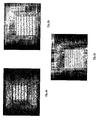
- Fig. 5 (a) shows a microscopic image of the sensor surface and surrounding area after the binding of magnetic particles via a sandwich assay as depicted in Fig. 5 (c) .
- Fig. 5 (b) shows a microscopic image of the sensor surface and surrounding area for a control experiment in which the ligand (i.e. the stroke marker S100 ⁇ , see Fig. 5 (c)) was not added, hence no magnetic particle binding was observed.
- Fig. 5 (c) represents a schematic representation of the sandwich assay applied for these experiments.
- a linking layer i.e. a Self-Assembled Monolayer of thiols/silanes
- the immobilisation of a receptor i.e.
- a primary antibody the binding of the ligand (i.e. the stroke marker S100 ⁇ ), the binding of a biotinylated secondary antibody, and, the binding of streptavidin-coated magnetic particles (i.e. 1 ⁇ m sizes particles, such as MyOne ® particles of Dynal).
- Fig. 6 (a) shows a microscopic image of the sensor surface and surrounding area after building up the sandwich assay of Fig. 5 (c) wherein the magnetic particles are submitted to an in-plane external field (with regard to the surface) combined with a magnetic field generated by the current applied (through the sensors). Following this method, the particles are located on the top and centre of each sensor.
- Fig. 6 (b) shows a microscopic image of the sensor surface and surrounding area after building up the sandwich assay of Fig. 5 (c) wherein the magnetic particles are submitted to a perpendicular external field (with regard to the surface) combined with a magnetic field generated by the current applied (through the sensors). Following this method, the particles are located on the top and one of the edges of each sensor.
- Fig. 6 (b) shows a microscopic image of the sensor surface and surrounding area after building up the sandwich assay of Fig. 5 (c) wherein the magnetic particles are submitted to a perpendicular external field (with regard to the surface) combined with a magnetic
- FIG. 6(c) shows a microscopic image of the sensor surface and surrounding area for a control experiment in which the ligand (i.e. the stroke marker S100 ⁇ , see Fig. 5 (c) ) was not added. Hence no magnetic particle binding was observed after submitting the magnetic particles to any external field (with regard to the surface) combined with a magnetic field generated by the current applied (through the sensors).
- the ligand i.e. the stroke marker S100 ⁇ , see Fig. 5 (c)
- a method for (re-)enabling transport by means of a magnetic field gradient transport mechanism of magnetic beads comprising a ligand in a solution on top of a surface comprising a receptor bound with the ligand comprising the step of changing the properties of the solution such that dissociation occurs between the ligand and the receptor, and such that a sufficient repulsive interaction is created between the surface and the bead to allow transport of the bead.
- a repulsive interaction that maintains mobility is dominated by an electrostatic interaction.
- the repulsive interaction comprises also a steric or structural interaction.
- the electrostatic interaction is at least partially induced by the presence of charges of equal sign on the device surface and/or the bead surface.
- the repulsive interaction is at least partially created by the adsorption of anionic or cationic surfactant onto at least one of the bead surface or device surface, the surfactant added to the solution.
- the step of changing the properties of the solution comprises, for a given surface and bead type, changing the pH and/or ionic strength appropriately in order to generate the repulsive interaction.
- the absolute values of the induced electrostatic potentials between the bulk solution and the surface and the bead surface respectively is larger than 5 mV.
- the ligands and/or receptors are biospecimen.
- the pH and ionic strength are selected to allow dissociation of the ligand and receptor.
- the pH and ionic strength can be further chosen in order to change the functionality of the ligand and/or the receptor.
- a method for determining an optimal pH and ionic strength of a solution for a given set of bead, device surface, and a biospecimen ligand and receptor, such that magnetic transport is allowed on top of the surface in the solution, comprising the steps of:
- the solution comprises at least one surfactant.
- the dissociation of the ligand and receptor in a solution may be assisted by physical means, such as heating the solution, flowing the solution over the device or stirring the solution on top of the device, applying ultrasonic forces, etc.
- a sensor apparatus comprising:
- the repulsive interaction is dominated by an electrostatic interaction.
- the repulsive interaction can also comprise mainly a steric or structural interaction.
- electrostatic interactions play a significant role or only steric or structural interactions play a significant role.
- the electrostatic interaction is at least partially induced by the presence of charges of equal sign on the surface and/or the bead surface.
- the solution can comprise additives such that the repulsive interaction is at least partially created by the adsorption of additives onto at least one of the bead surface or device surface.
- an apparatus wherein the pH of the solution is larger than 9.
- the ligands and/or receptors are biospecimen.
- the ionic strength of the solution is preferably between 1 mM and 1 M.
- the absolute value of the induced electrostatic potentials between the bulk solution and the surface and the bead surface respectively are both larger than 5 mV.
- the magnetic transport is performed with magnetic field strengths and magnetic field gradients that generate forces.
- Typical such forces are from about 0.05 pN to about 5 pN for in-plane transport and from 0.5 to 30 pN towards the surface, depending on the magnetic field gradient generating structure, the position of the particle and the current in the current carrying structure which is used to generate the magnetic field(s).
- a method for measuring magnetic beads wherein magnetic beads are transported towards a measurement location in the neighbourhood of said detection unit. It should be brought to the area from where the beads would generate a significant signal in the detection unit such that measurement is possible.
- the beads are transported such that they are substantially centred above the edges of the detector unit (e.g. a magnetoresistive sensor (MR), e.g. a GMR sensor (Giant MR), a spin valve sensor, an anisotropic MR (magnetic sensor).
- MR magnetoresistive sensor
- GMR GMR sensor
- spin valve sensor an anisotropic MR (magnetic sensor).
- a method for detection of biospecimen attached to magnetic beads in a solution comprising the steps of:
- the measurement location is substantially centred above the edges of the detector unit.
- the present invention builds on the idea of a dynamic sensor, to release and reposition immobilised particles by regenerating the biomolecular bond. For this, one needs to be able to transport magnetic particles and break biomolecular bonds in one step.
- Typical forces are from about 0.05 pN to about 5 pN for in-plane transport and from 0.5 to 30 pN towards the surface, depending on the magnetic field gradient generating structure, the position of the particle and the current in the current carrying structure which is used to generate the magnetic field(s).
- the invention therefore relates to methods for movement of magnetic particles in solutions other than pure water, e.g. solutions with pH values in the order of 2-12 and different from 7 in case the ionic strength is not 1E-7 M, and ionic strengths e.g. 1 mM-10 mM. (e.g. 10mM NaOH gives pH 12, ionic strength of 10E-2).
- ionic strengths e.g. 1 mM-10 mM. (e.g. 10mM NaOH gives pH 12, ionic strength of 10E-2).
- magnetic forces are not always the dominant forces acting on the particle and depending on the conditions particles can be immobilised or trapped onto the surface. It is believed that electrostatic and van der Waals interactions are at least partly responsible for these effects.
- the electrostatic force depends on the total charge of both the particle and device surface, which is a function of the pH, and the ionic content and strength, which screens these charges.
- the active substrate of the magnetic sensor can consist for instance of a metal (e.g. gold) surface or an oxide surface. These surfaces can be modified with, amongst others, self-assembled monolayers (SAMs) of thiols or silanes as coupling layers. These SAMs can be homogeneous or a mixture of different molecules, presenting different end-groups especially designed towards reduction of nonspecific binding of the analyte and towards good characteristics for coupling the receptor molecules. Different protein receptors, e.g.
- the biomolecular interactions need to be efficiently regenerated by the use of typical regeneration buffers, which are known by the skilled person in the field. These buffers will break one or more biomolecular bonds in the assay and have to be compatible with the release and repositioning of the magnetic particles sensor principle, which is based on the movement of magnetic particles.
- the substrate, coupling layer, type of assay, type of receptor/ligand interaction and regeneration are similar are based on similar principles, known by the skilled person in the field, for the detection of nucleic acids and whole cells.
- the present invention concerns a method for controlled manipulation of magnetically labelled biomolecules, in close proximity to a surface, in a solution with a given pH and ionic strength given that system is stabilised by repulsive forces.
- the solution used may depend on the type of application:
- repulsive forces are required to stabilise the system. These repulsive forces may be either:
- the particle When the particle is in the vicinity of the sensor, it will be attracted towards the edge of the sensor, maximising the signal ( fig 2 ). Particles on opposing edges of a detector unit may induce complementary signals in the unit such that the total signal may be reduced. Therefore it is advantageous to apply an external magnetic field perpendicular to the surface which will not be sensed by the sensor, but which will remove particles at one of the opposing edges (and possibly moves those beads to the other opposing edge). This way the signal strength will again be increased.
- Magnetic particles coated with streptavidin can be transported when dispersed in solution with pH 12, but stop moving when the pH drops below pH4. When ionic strength is lowered, particle mobility increases.
- Magnetic particles with acrylate surface move little or not at any pH value smaller then 6 and ionic strength of.10mM.
- the present invention thus provides a magnetic particle detector capable of breaking bonds and subsequently repositioning the particles to a better place so that a higher detection signal is obtained.
- An enhancing effect obtained by moving particles towards the sensor is only advantageous for low analyte/particle concentrations. If the concentration of particles is too high, particles will start to form clusters. This will make it more difficult to get a quantitative result from the sensor. The skilled person can easily determine a suitable particle concentration to obtain optimal results.
- Figure 1 shows a simulated output signal from the sensor when a magnetic particle with (a) an out-of-plane (perpendicular) or (b) in-plane magnetisation is moved along the sensitive axis of the sensor.
- Sensor width is 2 micron
- signal is maximised when the centre of the particle (2 micron diameter) is located above the edge of the sensor.
- 50% of the particle is covering the sensor.
- the signal is maximised when the particle is completely covering the sensor (centre of particle and centre of sensor are at the same position.
- Figure 2 draws the repositioning of magnetic particles towards the edge of the sensor. Only about 50% of the particle will cover the sensor, maximising in this way the signal measured by the sensor.
- magnetic particle detectors sense random magnetic fields coming from magnetic particles positioned at different locations from the sensor. This lowers the average signal contribution for one magnetic particle.
- the random contribution of each particle is removed: all particles contribute to the signal in the same amount since their distance to the sensor is constant.
- the signal from 1 particle is maximised by both placing the particle at the optimal position and by adjusting the sensor geometry for optimal performance (extra degree of freedom).
Landscapes
- Engineering & Computer Science (AREA)
- Health & Medical Sciences (AREA)
- Chemical & Material Sciences (AREA)
- Life Sciences & Earth Sciences (AREA)
- Immunology (AREA)
- Nanotechnology (AREA)
- Molecular Biology (AREA)
- Biomedical Technology (AREA)
- Physics & Mathematics (AREA)
- Hematology (AREA)
- Crystallography & Structural Chemistry (AREA)
- Urology & Nephrology (AREA)
- General Physics & Mathematics (AREA)
- General Health & Medical Sciences (AREA)
- Cell Biology (AREA)
- Analytical Chemistry (AREA)
- Biochemistry (AREA)
- Medicinal Chemistry (AREA)
- Food Science & Technology (AREA)
- Pathology (AREA)
- Composite Materials (AREA)
- Condensed Matter Physics & Semiconductors (AREA)
- Materials Engineering (AREA)
- Microbiology (AREA)
- Biotechnology (AREA)
- Investigating Or Analyzing Materials By The Use Of Magnetic Means (AREA)
- Measuring Or Testing Involving Enzymes Or Micro-Organisms (AREA)
Claims (48)
- Verfahren zum Messen der Konzentration von magnetischen Partikeln, das die folgenden Schritte umfasst:- Versehen der Oberfläche einer Vorrichtung, die einen Sensor umfasst, mit einer Lösung, die die magnetischen Partikel enthält, wobei eine oder mehrere Zusatzstoffe, die geeignet sind, um eine abstoßende Interaktion zwischen der Oberfläche und den magnetischen Partikeln zu erzeugen, zur Lösung hinzugefügt werden, und wobei die abstoßende Interaktion zu mehr als 50 % aus einer elektrostatischen Interaktion besteht,- Aussetzen der magnetischen Partikel gegenüber einem äußeren Magnetfeld,- Ermöglichen, dass sich die magnetischen Partikel hin zu einer vorab definierten Stelle in Bezug auf den Sensor der Vorrichtung bewegen, indem ein Strom durch den Sensor der Vorrichtung und/oder durch eine zugrunde liegende Struktur des Sensors angelegt wird, wobei die Kombination des äußeren Magnetfelds mit dem durch den Strom erzeugten Magnetfeld die Bewegung der magnetischen Partikel ermöglicht,- Messen des von den magnetischen Partikeln erzeugten Magnetfelds mithilfe des Sensors und Inverbindungbringen dieses Magnetfelds mit der Konzentration der magnetischen Partikel.
- Verfahren nach Anspruch 1, wobei das äußere Magnetfeld in Bezug auf die Oberfläche senkrecht verläuft, wobei die Kombination des äußeren senkrechten Magnetfelds mit dem durch den Strom erzeugten Magnetfeld ermöglicht, dass sich die magnetischen Partikel hin zu einem der Ränder jedes Sensors bewegen.
- Verfahren nach Anspruch 1, wobei das äußere Magnetfeld in Bezug auf die Oberfläche eben verläuft, wobei die Kombination des äußeren eben verlaufenden Magnetfelds mit dem durch den Strom erzeugten Magnetfeld ermöglicht, dass sich die magnetischen Partikel hin zum oberen Bereich und der Mitte jedes Sensors bewegen.
- Verfahren zum Quantifizieren eines Analyten, wobei der Analyt mit den magnetischen Partikeln markiert wird, wobei das Verfahren die folgenden Schritte umfasst:- Versehen der Oberfläche einer Vorrichtung, die einen Sensor umfasst, mit einer Lösung, die die magnetischen Partikel enthält, wobei eine oder mehrere Zusatzstoffe, die geeignet sind, um eine abstoßende Interaktion zwischen der Oberfläche und den magnetischen Partikeln zu erzeugen, zur Lösung hinzugefügt werden, und wobei die abstoßende Interaktion zu mehr als 50 % aus einer elektrostatischen Interaktion besteht,- Aussetzen der magnetischen Partikel gegenüber einem äußeren Magnetfeld,- Ermöglichen, dass sich die magnetischen Partikel hin zu einer vorab definierten Stelle in Bezug auf den Sensor der Vorrichtung bewegen, indem ein Strom durch den Sensor der Vorrichtung und/oder durch eine zugrunde liegende Struktur des Sensors angelegt wird, wobei die Kombination des äußeren Magnetfelds mit dem durch den Strom erzeugten Magnetfeld die Bewegung der magnetischen Partikel ermöglicht,- Messen des von den magnetischen Partikeln erzeugten Magnetfelds mithilfe des Sensors und Inverbindungbringen dieses Magnetfelds mit der Konzentration der magnetischen Partikel.
- Verfahren zum Quantifizieren eines Analyten nach Anspruch 4, wobei der Analyt der Oberfläche mit den magnetischen Partikeln oder von diesen getrennt bereitgestellt wird.
- Verfahren nach Anspruch 4 oder 5, wobei der Analyt direkt oder indirekt an die magnetischen Partikel gebunden wird.
- Verfahren nach einem der Ansprüche 4 bis 6, wobei ein Rezeptor, der für eine Bindung mit dem Analyten empfänglich ist, auf der Oberfläche immobilisiert wird.
- Verfahren nach Anspruch 7, ferner umfassend den Schritt des Verhinderns oder Aufbrechens der molekularen Bindung/en zwischen dem Analyten und dem Rezeptor vor dem Anlegen des Stroms durch Hinzufügen von einem oder mehreren geeigneten Zusatzstoffen oder mithilfe physikalischer Mittel.
- Verfahren nach Anspruch 7 oder 8, ferner umfassend den Schritt des Ermöglichens der Bildung der Bindung/en zwischen dem Analyten und dem Rezeptor während des Schrittes des Anlegens des Stroms oder danach und vor dem Schritt des Messens des Magnetfelds.
- Verfahren nach einem der Ansprüche 1 bis 9, wobei der Analyt ein (Makro-)Molekül, eine Zelle, ein Virus oder eine beliebige biologische Entität ist.
- Verfahren nach einem der Ansprüche 1 bis 10, wobei der Analyt und/oder der Rezeptor aus einer oder mehreren biologischen Proben stammen.
- Verfahren nach einem der Ansprüche 1 bis 11, wobei die elektrostatische Interaktion durch das Vorhandensein von gleichen Ladungen auf der Oberfläche und auf den Magnetpartikeln induziert wird.
- Verfahren nach Anspruch 12, wobei die abstoßende Interaktion durch die Adsorption auf die Partikel und/oder auf die Oberfläche eines anionischen oder kationischen Tensids bewirkt wird, das zur Lösung hinzugefügt wurde.
- Verfahren nach Anspruch 12 oder 13, wobei der eine oder die mehreren Zusatzstoffe eine Änderung des pH-Werts und/oder der Ionenstärke induzieren, wodurch die abstoßende Interaktion erzeugt wird.
- Verfahren nach einem der Ansprüche 12 bis 14, wobei die absoluten Werte der induzierten elektrostatischen Potenziale zwischen der Lösung und der Oberfläche und zwischen der Lösung und jeder magnetischen Perle jeweils größer als 5 mV sind.
- Verfahren nach Anspruch 14 oder 15, wobei der pH-Wert und/oder die Ionenstärke derart ausgewählt sind, dass eine Trennung des Analyten und des Rezeptors möglich ist.
- Verfahren nach Anspruch 1 zum Messen der Konzentration von magnetischen Perlen, wobei die Perlen an eine Messstelle transportiert werden, die sich im Wesentlichen mittig über den Rändern einer Detektoreinheit befindet, und an der die Perlen das größte Signal in der Detektionseinheit erzeugen.
- Verfahren nach Anspruch 17, wobei die Perlen einen Liganden in einer Lösung auf der Oberfläche der Messstelle umfassen, die einen an den Liganden gebundenen Rezeptor umfasst, wodurch die Messung der Konzentration der Liganden in einer Lösung möglich wird.
- Verfahren nach Anspruch 1 zum Messen der Konzentration von magnetischen Perlen, die einen Liganden in einer Lösung auf einer Oberfläche umfassen, die einen Rezeptor umfasst, wobei das Verfahren die folgenden Schritte umfasst:- Ermöglichen, dass der Ligand sich an den auf der Oberfläche immobilisierten Rezeptor bindet, wodurch Molekularbindungen gebildet werden, oder Ermöglichen, dass der Ligand sich an den auf der Oberfläche auf einer Detektionseinheit immobilisierten Rezeptor bindet, wodurch Molekularbindungen gebildet werden, um das Signal in der Detektionseinheit zu erhöhen;- Aufbrechen der Molekularbindung durch Zugeben von Zusatzstoffen zur Lösung:- Transportieren der magnetischen Perlen zu dem Bereich, in dem sich eine Detektoreinheit befindet, und Befördern der Perlen an eine Messstelle, an der sie das größte Signal in der Detektionseinheit erzeugen;- Messen des durch die magnetischen Perlen gebildeten Magnetfelds mit dem Sensor mithilfe der Detektionseinheit und Inverbindungbringen dieses Magnetfelds mit der Konzentration der magnetischen Perlen.
- Verfahren nach einem der Ansprüche 17 bis 19, wobei die Rezeptoren und/oder Liganden biologische Proben sind.
- Verfahren nach Anspruch 1 zum Ermöglichen des Transports von magnetischen Perlen, die einen Liganden in einer Lösung auf einer Oberfläche umfassen, die einen an diesen Liganden gebundenen Rezeptor umfasst, mithilfe eines Magnetfeldgradient-Transportmechanismus, wobei das Verfahren den Schritt des Änderns der Eigenschaften der Lösung umfasst, so dass eine Trennung zwischen dem Liganden und dem Rezeptor erfolgt, und so dass eine ausreichende abstoßende Interaktion zwischen der Oberfläche und der Perle erzeugt wird, um den Transport der Perle zu ermöglichen.
- Verfahren nach Anspruch 21, wobei die abstoßende Interaktion von einer elektrostatischen Interaktion dominiert wird.
- Verfahren nach Anspruch 22, wobei die elektrostatische Interaktion durch das Vorhandensein von gleichen Ladungen auf der Oberfläche und/oder der Perlenoberfläche induziert wird.
- Verfahren nach einem der Ansprüche 21 bis 23, wobei die abstoßende Interaktion durch Adsorption des anionischen oder kationischen Tensids auf zumindest eine die Perlenoberfläche oder die Oberfläche erzeugt wird, wobei das Tensid zur Lösung hinzugefügt wurde.
- Verfahren nach einem der Ansprüche 21 bis 24, wobei der Schritt des Änderns der Eigenschaften der Lösung das Ändern des pH-Werts und/oder der Ionenstärke für einen bestimmten Oberflächen- und Perlentyp umfasst, so dass die abstoßende Interaktion erzeugt wird.
- Verfahren nach einem der Ansprüche 23 bis 25, wobei die absoluten Werte der induzierten elektrostatischen Potenziale zwischen der Bulk-Lösung und der Oberfläche und der Perlenoberfläche jeweils größer als 5 mV sind.
- Verfahren nach einem der Ansprüche 21 bis 26, wobei der pH-Wert und die Ionenstärke derart ausgewählt werden, um eine Trennung des Liganden und des Rezeptors zu ermöglichen.
- Verfahren nach einem der Ansprüche 21 bis 27, wobei die Rezeptoren und/oder Liganden biologische Proben sind.
- Verfahren nach einem der Ansprüche 25 bis 27 zum Bestimmen eines optimalen pH-Werts und einer optimalen Ionenstärke einer Lösung für einen bestimmten Satz von Perle, Oberfläche, und Biologische-Probe-Liganden und -Rezeptor, so dass der magnetische Transport auf der Oberfläche in der Lösung ermöglicht wird, wobei das Verfahren die folgenden Schritte umfasst:- Definieren eines maximal zulässigen pH-Werts für den Biologische-Probe-Liganden und -Rezeptor, um zu ermöglichen, dass der Biologische-Probe-Ligand vom Rezeptor gelöst wird;- Definieren eines zulässigen Ionenstärkebereichs für den Biologische-Probe-Liganden und -Rezeptor;- Bereitstellen einer Lösung mit dem maximalen pH-Wert und innerhalb des Ionenstärkenbereichs, wobei ein magnetischer Transport möglich ist.
- Verfahren nach Anspruch 29, wobei die Lösung ein Tensid umfasst.
- Sensorvorrichtung, umfassend:- ein Substrat, das eine aktive Oberfläche umfasst, auf der magnetische Perlen in einer Lösung für Magnetfeldmessungen abgelagert sind,- einen oder mehrere Sensoren,- ein Mittel zum Bereitstellen eines äußeren Magnetfelds für die magnetischen Partikel, vorzugsweise eben, und besser noch senkrecht in Bezug auf die Oberfläche,- ein Mittel zum Anlegen eines Stroms durch den einen oder durch mehrere Sensoren oder durch eine Struktur, die dem einen oder den mehreren Sensoren zugrunde liegt,- ein Mittel zum Transportieren von magnetischen Partikeln hin zu einer Messstelle, die sich im Wesentlichen mittig über den Rändern des Sensors befindet, so dass die Magnetfeldmessung möglich wird,wobei der Sensor ferner eine Lösung umfasst, die magnetische Partikel und einen oder mehrere Zusatzstoffe enthält, die zum Bereitstellen einer abstoßenden Interaktion zwischen den magnetischen Partikeln und der Oberfläche geeignet sind, wobei die abstoßende Interaktion zu mehr als 50 % aus einer elektrostatischen Interaktion besteht.
- Sensorvorrichtung nach Anspruch 31, wobei die dem einen oder den mehreren Sensoren zugrunde liegende Struktur in Bezug auf den einen oder die mehreren Sensoren ausgerichtet ist.
- Sensorvorrichtung nach Anspruch 31 oder 32, wobei die elektrostatische Interaktion durch das Vorhandensein von gleichen Ladungen auf der Oberfläche und auf den Magnetpartikeln induziert wird.
- Sensorvorrichtung nach einem der Ansprüche 31 bis 33, wobei die abstoßende Interaktion durch die Adsorption auf die Partikel und/oder auf die Oberfläche eines anionischen oder kationischen Tensids erzeugt wird, das zur Lösung hinzugefügt wurde.
- Sensorvorrichtung nach einem der Ansprüche 31 bis 34, wobei der eine oder die mehreren Zusatzstoffe geeignet sind, um eine Änderung des pH-Werts und/oder der Ionenstärke zu induzieren, wodurch die abstoßende Interaktion erzeugt wird.
- Sensorvorrichtung nach einem der Ansprüche 33 bis 35, wobei die absoluten Werte der induzierten elektrostatischen Potenziale zwischen der Lösung und der Oberfläche und zwischen der Lösung und jedem magnetischen Partikel jeweils größer als 5 mV sind.
- Sensorvorrichtung nach einem der Ansprüche 31 bis 36, ferner umfassend einen auf der Oberfläche immobilisierten Rezeptor, der für eine Bindung mit einem Analyten empfänglich ist, der in der Lösung enthalten ist oder mit der Lösung in Kontakt gebracht wird, wobei der Analyt durch die magnetischen Partikel zu markieren ist.
- Sensorvorrichtung nach Anspruch 37, wobei der eine oder die mehreren Zusatzstoffe geeignet sind, um eine Trennung zwischen dem Analyten und dem Rezeptor und/oder zwischen den Analyten und den magnetischen Partikeln zu ermöglichen.
- Sensorvorrichtung nach Anspruch 31, umfassend:- ein Mittel für den kontrollierten magnetischen Transport von magnetischen Perlen auf einer Sensoroberfläche, die eine Rezeptor umfasst;- ein Mittel zum Abtasten des durch die magnetischen Perlen erzeugten Magnetfelds und zum Inverbindungbringen dieses Magnetfelds zur Konzentration der magnetischen Perlen;- eine Lösung, umfassend magnetische Perlen, umfassend einen an den Rezeptor gebundenen Liganden;wobei die Eigenschaften der Lösung ausgewählt sind, um eine Trennung des Liganden und des Rezeptors zu ermöglichen und um eine abstoßende Interaktion zwischen den Perlen und der Oberfläche vorzusehen, so dass ein magnetischer Transport der Perlen möglich wird.
- Vorrichtung nach Anspruch 39, wobei die abstoßende Interaktion von einer elektrostatischen Interaktion dominiert wird.
- Vorrichtung nach Anspruch 40, wobei die elektrostatische Interaktion durch das Vorhandensein von gleichen Ladungen auf der Oberfläche und/oder der Perlenoberfläche induziert wird.
- Vorrichtung nach einem der Ansprüche 39 bis 41, wobei die Lösung Zusatzstoffe umfasst, so dass die abstoßende Interaktion durch Adsorption von Zusatzstoffen auf zumindest eine die Perlenoberfläche oder die Oberfläche erzeugt wird.
- Vorrichtung nach einem der Ansprüche 39 bis 42, wobei der pH-Wert der Lösung höher als 9 ist.
- Vorrichtung nach einem der Ansprüche 39 bis 43, wobei die Ionenstärke der Lösung zwischen 1 mM und 1 M beträgt.
- Vorrichtung nach einem der Ansprüche 39 bis 44, wobei der absolute Wert der induzierten elektrostatischen Potenziale zwischen der Bulk-Lösung und der Oberfläche und der Perlenoberfläche jeweils größer als 5 mV ist.
- Vorrichtung nach einem der Ansprüche 39 bis 45, wobei der magnetische Transport mit Magnetfeldstärken und Magnetfeldgradienten durchgeführt wird, die typische Kräfte erzeugen.
- Vorrichtung nach einem der Ansprüche 39 bis 46, wobei die magnetischen Eigenschaften der magnetischen Perlen nach dem Transport der Perlen gemessen werden.
- Vorrichtung nach einem der Ansprüche 39 bis 47, wobei die Liganden und/oder Rezeptoren biologische Proben sind.
Priority Applications (1)
| Application Number | Priority Date | Filing Date | Title |
|---|---|---|---|
| EP05808525A EP1815252B1 (de) | 2004-11-05 | 2005-11-07 | Verfahren zum transport magnetischer teilchen und vorrichtungen dafür |
Applications Claiming Priority (4)
| Application Number | Priority Date | Filing Date | Title |
|---|---|---|---|
| US62523004P | 2004-11-05 | 2004-11-05 | |
| EP05447090 | 2005-04-22 | ||
| EP05808525A EP1815252B1 (de) | 2004-11-05 | 2005-11-07 | Verfahren zum transport magnetischer teilchen und vorrichtungen dafür |
| PCT/BE2005/000156 WO2006047840A1 (en) | 2004-11-05 | 2005-11-07 | Method for transport of magnetic particles and devices therefor |
Publications (2)
| Publication Number | Publication Date |
|---|---|
| EP1815252A1 EP1815252A1 (de) | 2007-08-08 |
| EP1815252B1 true EP1815252B1 (de) | 2012-10-10 |
Family
ID=34943282
Family Applications (1)
| Application Number | Title | Priority Date | Filing Date |
|---|---|---|---|
| EP05808525A Expired - Lifetime EP1815252B1 (de) | 2004-11-05 | 2005-11-07 | Verfahren zum transport magnetischer teilchen und vorrichtungen dafür |
Country Status (3)
| Country | Link |
|---|---|
| US (1) | US8623668B2 (de) |
| EP (1) | EP1815252B1 (de) |
| WO (1) | WO2006047840A1 (de) |
Families Citing this family (9)
| Publication number | Priority date | Publication date | Assignee | Title |
|---|---|---|---|---|
| US8133439B2 (en) | 2006-08-01 | 2012-03-13 | Magic Technologies, Inc. | GMR biosensor with enhanced sensitivity |
| US8283912B2 (en) * | 2007-04-03 | 2012-10-09 | Koninklijke Philips Electronics N.V. | Sensor device with magnetic washing means |
| US9304130B2 (en) * | 2010-12-16 | 2016-04-05 | International Business Machines Corporation | Trenched sample assembly for detection of analytes with electromagnetic read-write heads |
| US8752437B2 (en) | 2011-03-15 | 2014-06-17 | Kla-Tencor Corporation | Magnet strength measurement |
| US9040311B2 (en) | 2011-05-03 | 2015-05-26 | International Business Machines Corporation | Calibration assembly for aide in detection of analytes with electromagnetic read-write heads |
| US8855957B2 (en) | 2011-05-03 | 2014-10-07 | International Business Machines Corporation | Method for calibrating read sensors of electromagnetic read-write heads |
| US9435800B2 (en) | 2012-09-14 | 2016-09-06 | International Business Machines Corporation | Sample assembly with an electromagnetic field to accelerate the bonding of target antigens and nanoparticles |
| DE102021115952A1 (de) | 2021-06-21 | 2022-12-22 | Universidad Complutense Madrid | Sensorvorrichtungen, elektrische Verbindungssysteme und Verfahren zum Detektieren eines genetischen Materials |
| US12601672B2 (en) * | 2022-10-13 | 2026-04-14 | Western Digital Technologies, Inc. | Sensitivity amplification techniques for magnetochemical sensors |
Citations (1)
| Publication number | Priority date | Publication date | Assignee | Title |
|---|---|---|---|---|
| EP1469311A1 (de) * | 2002-01-29 | 2004-10-20 | Asahi Kasei Kabushiki Kaisha | Biosensor, magnetisches molekül messverfahren und messobjekt messverfahren |
Family Cites Families (11)
| Publication number | Priority date | Publication date | Assignee | Title |
|---|---|---|---|---|
| US4395746A (en) * | 1979-05-02 | 1983-07-26 | Ishikawajima-Harima Jukogyo Kabushiki Kaisha | Method and device for magnetically transporting |
| US5981297A (en) * | 1997-02-05 | 1999-11-09 | The United States Of America As Represented By The Secretary Of The Navy | Biosensor using magnetically-detected label |
| WO2001096857A2 (en) * | 2000-06-14 | 2001-12-20 | Board Of Regents, The University Of Texas System | Method and apparatus for combined magnetophoretic and dielectrophoretic manipulation of analyte mixtures |
| FR2817343B1 (fr) * | 2000-11-29 | 2003-05-09 | Commissariat Energie Atomique | Procede et dispositifs de transport et de concentration d'un analyte present dans un echantillon |
| US20020166760A1 (en) * | 2001-05-11 | 2002-11-14 | Prentiss Mara G. | Micromagentic systems and methods for microfluidics |
| US20020166800A1 (en) | 2001-05-11 | 2002-11-14 | Prentiss Mara G. | Micromagnetic systems and methods for microfluidics |
| JP2005530127A (ja) | 2001-11-27 | 2005-10-06 | バースタイン テクノロジーズ,インコーポレイティド | 光磁気バイオディスクおよび関連の方法を含むシステム |
| US20040018611A1 (en) * | 2002-07-23 | 2004-01-29 | Ward Michael Dennis | Microfluidic devices for high gradient magnetic separation |
| EP1462173A1 (de) | 2003-03-28 | 2004-09-29 | Interuniversitair Micro-Elektronica Centrum (IMEC) | Verfahren zu kontrolliertem Transport von magenetischen Partikeln und zugehörige Vorrichtung |
| EP1462174B1 (de) * | 2003-03-28 | 2006-08-30 | Interuniversitair Microelektronica Centrum Vzw | Verfahren zum kontrollierten Transport von magnetischen Partikeln und zugehörige Vorrichtung |
| WO2005010542A2 (en) | 2003-07-30 | 2005-02-03 | Koninklijke Philips Electronics N.V. | On-chip magnetic particle sensor with improved snr |
-
2005
- 2005-11-07 EP EP05808525A patent/EP1815252B1/de not_active Expired - Lifetime
- 2005-11-07 US US11/718,681 patent/US8623668B2/en not_active Expired - Fee Related
- 2005-11-07 WO PCT/BE2005/000156 patent/WO2006047840A1/en not_active Ceased
Patent Citations (1)
| Publication number | Priority date | Publication date | Assignee | Title |
|---|---|---|---|---|
| EP1469311A1 (de) * | 2002-01-29 | 2004-10-20 | Asahi Kasei Kabushiki Kaisha | Biosensor, magnetisches molekül messverfahren und messobjekt messverfahren |
Also Published As
| Publication number | Publication date |
|---|---|
| EP1815252A1 (de) | 2007-08-08 |
| US8623668B2 (en) | 2014-01-07 |
| WO2006047840A1 (en) | 2006-05-11 |
| US20090170065A1 (en) | 2009-07-02 |
Similar Documents
| Publication | Publication Date | Title |
|---|---|---|
| CN106198715B (zh) | 基于磁性传感器的定量结合动力学分析 | |
| EP1687634B1 (de) | Magnetische nanopartikel, magnetische detektor-arrays sowie verfahren zur verwendung davon beim nachweisen biologischer moleküle | |
| CN100343670C (zh) | 用于测量微阵列上磁性纳米粒子面密度的传感器和方法 | |
| Martins et al. | Challenges and trends in the development of a magnetoresistive biochip portable platform | |
| Dittmer et al. | Sensitive and rapid immunoassay for parathyroid hormone using magnetic particle labels and magnetic actuation | |
| CN101065661A (zh) | 校准磁传感器的传递函数的方法 | |
| CN101111763B (zh) | 磁性传感器 | |
| EP2274633B1 (de) | Magnetische spintronic-nanopartikelsensoren mit einem auf einer magnetischen domänenwand angeordneten aktiven bereich | |
| CN101896829A (zh) | 传感器盒 | |
| CN101490528A (zh) | 将可磁化对象磁吸引到传感器表面和磁排斥离开传感器表面 | |
| CN101490576A (zh) | 磁传感器装置 | |
| US20090309588A1 (en) | System and methods for actuation on magnetoresistive sensors | |
| EP1815252B1 (de) | Verfahren zum transport magnetischer teilchen und vorrichtungen dafür | |
| US20080309323A1 (en) | Method for biochemical analysis | |
| Lagae et al. | Magnetic biosensors for genetic screening of cystic fibrosis | |
| Freitas et al. | Magnetoresistive DNA chips | |
| Brückl et al. | Magnetic particles as markers and carriers of biomolecules | |
| Djamal | Giant magnetoresistance material and its potential for biosensor applications | |
| Martins et al. | Magnetoresistive DNA chips | |
| Ferreira | Magnetoresistive biochips |
Legal Events
| Date | Code | Title | Description |
|---|---|---|---|
| PUAI | Public reference made under article 153(3) epc to a published international application that has entered the european phase |
Free format text: ORIGINAL CODE: 0009012 |
|
| 17P | Request for examination filed |
Effective date: 20070604 |
|
| AK | Designated contracting states |
Kind code of ref document: A1 Designated state(s): AT BE BG CH CY CZ DE DK EE ES FI FR GB GR HU IE IS IT LI LT LU LV MC NL PL PT RO SE SI SK TR |
|
| RIN1 | Information on inventor provided before grant (corrected) |
Inventor name: REEKMANS, GUNTER Inventor name: WIRIX-SPEETJENS, ROEL Inventor name: FYEN, WIM |
|
| DAX | Request for extension of the european patent (deleted) | ||
| 17Q | First examination report despatched |
Effective date: 20080715 |
|
| RAP1 | Party data changed (applicant data changed or rights of an application transferred) |
Owner name: IMEC |
|
| GRAP | Despatch of communication of intention to grant a patent |
Free format text: ORIGINAL CODE: EPIDOSNIGR1 |
|
| GRAS | Grant fee paid |
Free format text: ORIGINAL CODE: EPIDOSNIGR3 |
|
| GRAA | (expected) grant |
Free format text: ORIGINAL CODE: 0009210 |
|
| AK | Designated contracting states |
Kind code of ref document: B1 Designated state(s): AT BE BG CH CY CZ DE DK EE ES FI FR GB GR HU IE IS IT LI LT LU LV MC NL PL PT RO SE SI SK TR |
|
| REG | Reference to a national code |
Ref country code: GB Ref legal event code: FG4D |
|
| REG | Reference to a national code |
Ref country code: CH Ref legal event code: EP Ref country code: AT Ref legal event code: REF Ref document number: 579183 Country of ref document: AT Kind code of ref document: T Effective date: 20121015 |
|
| REG | Reference to a national code |
Ref country code: IE Ref legal event code: FG4D |
|
| REG | Reference to a national code |
Ref country code: DE Ref legal event code: R096 Ref document number: 602005036518 Country of ref document: DE Effective date: 20121206 |
|
| PG25 | Lapsed in a contracting state [announced via postgrant information from national office to epo] |
Ref country code: SI Free format text: LAPSE BECAUSE OF FAILURE TO SUBMIT A TRANSLATION OF THE DESCRIPTION OR TO PAY THE FEE WITHIN THE PRESCRIBED TIME-LIMIT Effective date: 20121010 |
|
| REG | Reference to a national code |
Ref country code: NL Ref legal event code: VDEP Effective date: 20121010 |
|
| REG | Reference to a national code |
Ref country code: AT Ref legal event code: MK05 Ref document number: 579183 Country of ref document: AT Kind code of ref document: T Effective date: 20121010 |
|
| REG | Reference to a national code |
Ref country code: LT Ref legal event code: MG4D |
|
| PG25 | Lapsed in a contracting state [announced via postgrant information from national office to epo] |
Ref country code: SE Free format text: LAPSE BECAUSE OF FAILURE TO SUBMIT A TRANSLATION OF THE DESCRIPTION OR TO PAY THE FEE WITHIN THE PRESCRIBED TIME-LIMIT Effective date: 20121010 Ref country code: NL Free format text: LAPSE BECAUSE OF FAILURE TO SUBMIT A TRANSLATION OF THE DESCRIPTION OR TO PAY THE FEE WITHIN THE PRESCRIBED TIME-LIMIT Effective date: 20121010 Ref country code: ES Free format text: LAPSE BECAUSE OF FAILURE TO SUBMIT A TRANSLATION OF THE DESCRIPTION OR TO PAY THE FEE WITHIN THE PRESCRIBED TIME-LIMIT Effective date: 20130121 Ref country code: LT Free format text: LAPSE BECAUSE OF FAILURE TO SUBMIT A TRANSLATION OF THE DESCRIPTION OR TO PAY THE FEE WITHIN THE PRESCRIBED TIME-LIMIT Effective date: 20121010 Ref country code: IS Free format text: LAPSE BECAUSE OF FAILURE TO SUBMIT A TRANSLATION OF THE DESCRIPTION OR TO PAY THE FEE WITHIN THE PRESCRIBED TIME-LIMIT Effective date: 20130210 Ref country code: FI Free format text: LAPSE BECAUSE OF FAILURE TO SUBMIT A TRANSLATION OF THE DESCRIPTION OR TO PAY THE FEE WITHIN THE PRESCRIBED TIME-LIMIT Effective date: 20121010 |
|
| PG25 | Lapsed in a contracting state [announced via postgrant information from national office to epo] |
Ref country code: GR Free format text: LAPSE BECAUSE OF FAILURE TO SUBMIT A TRANSLATION OF THE DESCRIPTION OR TO PAY THE FEE WITHIN THE PRESCRIBED TIME-LIMIT Effective date: 20130111 Ref country code: BE Free format text: LAPSE BECAUSE OF FAILURE TO SUBMIT A TRANSLATION OF THE DESCRIPTION OR TO PAY THE FEE WITHIN THE PRESCRIBED TIME-LIMIT Effective date: 20121010 Ref country code: LV Free format text: LAPSE BECAUSE OF FAILURE TO SUBMIT A TRANSLATION OF THE DESCRIPTION OR TO PAY THE FEE WITHIN THE PRESCRIBED TIME-LIMIT Effective date: 20121010 Ref country code: PT Free format text: LAPSE BECAUSE OF FAILURE TO SUBMIT A TRANSLATION OF THE DESCRIPTION OR TO PAY THE FEE WITHIN THE PRESCRIBED TIME-LIMIT Effective date: 20130211 Ref country code: CY Free format text: LAPSE BECAUSE OF FAILURE TO SUBMIT A TRANSLATION OF THE DESCRIPTION OR TO PAY THE FEE WITHIN THE PRESCRIBED TIME-LIMIT Effective date: 20121010 Ref country code: PL Free format text: LAPSE BECAUSE OF FAILURE TO SUBMIT A TRANSLATION OF THE DESCRIPTION OR TO PAY THE FEE WITHIN THE PRESCRIBED TIME-LIMIT Effective date: 20121010 |
|
| PG25 | Lapsed in a contracting state [announced via postgrant information from national office to epo] |
Ref country code: AT Free format text: LAPSE BECAUSE OF FAILURE TO SUBMIT A TRANSLATION OF THE DESCRIPTION OR TO PAY THE FEE WITHIN THE PRESCRIBED TIME-LIMIT Effective date: 20121010 |
|
| REG | Reference to a national code |
Ref country code: CH Ref legal event code: PL |
|
| PG25 | Lapsed in a contracting state [announced via postgrant information from national office to epo] |
Ref country code: CH Free format text: LAPSE BECAUSE OF NON-PAYMENT OF DUE FEES Effective date: 20121130 Ref country code: EE Free format text: LAPSE BECAUSE OF FAILURE TO SUBMIT A TRANSLATION OF THE DESCRIPTION OR TO PAY THE FEE WITHIN THE PRESCRIBED TIME-LIMIT Effective date: 20121010 Ref country code: DK Free format text: LAPSE BECAUSE OF FAILURE TO SUBMIT A TRANSLATION OF THE DESCRIPTION OR TO PAY THE FEE WITHIN THE PRESCRIBED TIME-LIMIT Effective date: 20121010 Ref country code: CZ Free format text: LAPSE BECAUSE OF FAILURE TO SUBMIT A TRANSLATION OF THE DESCRIPTION OR TO PAY THE FEE WITHIN THE PRESCRIBED TIME-LIMIT Effective date: 20121010 Ref country code: LI Free format text: LAPSE BECAUSE OF NON-PAYMENT OF DUE FEES Effective date: 20121130 Ref country code: SK Free format text: LAPSE BECAUSE OF FAILURE TO SUBMIT A TRANSLATION OF THE DESCRIPTION OR TO PAY THE FEE WITHIN THE PRESCRIBED TIME-LIMIT Effective date: 20121010 Ref country code: BG Free format text: LAPSE BECAUSE OF FAILURE TO SUBMIT A TRANSLATION OF THE DESCRIPTION OR TO PAY THE FEE WITHIN THE PRESCRIBED TIME-LIMIT Effective date: 20130110 |
|
| REG | Reference to a national code |
Ref country code: IE Ref legal event code: MM4A |
|
| PLBE | No opposition filed within time limit |
Free format text: ORIGINAL CODE: 0009261 |
|
| STAA | Information on the status of an ep patent application or granted ep patent |
Free format text: STATUS: NO OPPOSITION FILED WITHIN TIME LIMIT |
|
| PG25 | Lapsed in a contracting state [announced via postgrant information from national office to epo] |
Ref country code: RO Free format text: LAPSE BECAUSE OF FAILURE TO SUBMIT A TRANSLATION OF THE DESCRIPTION OR TO PAY THE FEE WITHIN THE PRESCRIBED TIME-LIMIT Effective date: 20121010 Ref country code: IT Free format text: LAPSE BECAUSE OF FAILURE TO SUBMIT A TRANSLATION OF THE DESCRIPTION OR TO PAY THE FEE WITHIN THE PRESCRIBED TIME-LIMIT Effective date: 20121010 |
|
| 26N | No opposition filed |
Effective date: 20130711 |
|
| PG25 | Lapsed in a contracting state [announced via postgrant information from national office to epo] |
Ref country code: IE Free format text: LAPSE BECAUSE OF NON-PAYMENT OF DUE FEES Effective date: 20121107 |
|
| REG | Reference to a national code |
Ref country code: DE Ref legal event code: R097 Ref document number: 602005036518 Country of ref document: DE Effective date: 20130711 |
|
| PG25 | Lapsed in a contracting state [announced via postgrant information from national office to epo] |
Ref country code: TR Free format text: LAPSE BECAUSE OF FAILURE TO SUBMIT A TRANSLATION OF THE DESCRIPTION OR TO PAY THE FEE WITHIN THE PRESCRIBED TIME-LIMIT Effective date: 20121010 Ref country code: MC Free format text: LAPSE BECAUSE OF NON-PAYMENT OF DUE FEES Effective date: 20121130 |
|
| PG25 | Lapsed in a contracting state [announced via postgrant information from national office to epo] |
Ref country code: LU Free format text: LAPSE BECAUSE OF NON-PAYMENT OF DUE FEES Effective date: 20121107 |
|
| PG25 | Lapsed in a contracting state [announced via postgrant information from national office to epo] |
Ref country code: HU Free format text: LAPSE BECAUSE OF FAILURE TO SUBMIT A TRANSLATION OF THE DESCRIPTION OR TO PAY THE FEE WITHIN THE PRESCRIBED TIME-LIMIT Effective date: 20051107 |
|
| REG | Reference to a national code |
Ref country code: FR Ref legal event code: PLFP Year of fee payment: 11 |
|
| REG | Reference to a national code |
Ref country code: FR Ref legal event code: PLFP Year of fee payment: 12 |
|
| REG | Reference to a national code |
Ref country code: FR Ref legal event code: PLFP Year of fee payment: 13 |
|
| REG | Reference to a national code |
Ref country code: FR Ref legal event code: PLFP Year of fee payment: 14 |
|
| PGFP | Annual fee paid to national office [announced via postgrant information from national office to epo] |
Ref country code: DE Payment date: 20191021 Year of fee payment: 15 |
|
| PGFP | Annual fee paid to national office [announced via postgrant information from national office to epo] |
Ref country code: FR Payment date: 20191022 Year of fee payment: 15 |
|
| PGFP | Annual fee paid to national office [announced via postgrant information from national office to epo] |
Ref country code: GB Payment date: 20191022 Year of fee payment: 15 |
|
| REG | Reference to a national code |
Ref country code: DE Ref legal event code: R119 Ref document number: 602005036518 Country of ref document: DE |
|
| GBPC | Gb: european patent ceased through non-payment of renewal fee |
Effective date: 20201107 |
|
| PG25 | Lapsed in a contracting state [announced via postgrant information from national office to epo] |
Ref country code: FR Free format text: LAPSE BECAUSE OF NON-PAYMENT OF DUE FEES Effective date: 20201130 |
|
| PG25 | Lapsed in a contracting state [announced via postgrant information from national office to epo] |
Ref country code: DE Free format text: LAPSE BECAUSE OF NON-PAYMENT OF DUE FEES Effective date: 20210601 Ref country code: GB Free format text: LAPSE BECAUSE OF NON-PAYMENT OF DUE FEES Effective date: 20201107 |