EP1815898A2 - Programme de contrôle de l'affichage de prétraitement d'une simulation vidéo - Google Patents
Programme de contrôle de l'affichage de prétraitement d'une simulation vidéo Download PDFInfo
- Publication number
- EP1815898A2 EP1815898A2 EP07250249A EP07250249A EP1815898A2 EP 1815898 A2 EP1815898 A2 EP 1815898A2 EP 07250249 A EP07250249 A EP 07250249A EP 07250249 A EP07250249 A EP 07250249A EP 1815898 A2 EP1815898 A2 EP 1815898A2
- Authority
- EP
- European Patent Office
- Prior art keywords
- digest
- scene
- time
- simulation
- digest scene
- Prior art date
- Legal status (The legal status is an assumption and is not a legal conclusion. Google has not performed a legal analysis and makes no representation as to the accuracy of the status listed.)
- Withdrawn
Links
Images





Classifications
-
- A—HUMAN NECESSITIES
- A63—SPORTS; GAMES; AMUSEMENTS
- A63F—CARD, BOARD, OR ROULETTE GAMES; INDOOR GAMES USING SMALL MOVING PLAYING BODIES; VIDEO GAMES; GAMES NOT OTHERWISE PROVIDED FOR
- A63F13/00—Video games, i.e. games using an electronically generated display having two or more dimensions
- A63F13/50—Controlling the output signals based on the game progress
- A63F13/52—Controlling the output signals based on the game progress involving aspects of the displayed game scene
-
- A—HUMAN NECESSITIES
- A63—SPORTS; GAMES; AMUSEMENTS
- A63F—CARD, BOARD, OR ROULETTE GAMES; INDOOR GAMES USING SMALL MOVING PLAYING BODIES; VIDEO GAMES; GAMES NOT OTHERWISE PROVIDED FOR
- A63F13/00—Video games, i.e. games using an electronically generated display having two or more dimensions
- A63F13/45—Controlling the progress of the video game
- A63F13/49—Saving the game status; Pausing or ending the game
- A63F13/497—Partially or entirely replaying previous game actions
-
- A—HUMAN NECESSITIES
- A63—SPORTS; GAMES; AMUSEMENTS
- A63F—CARD, BOARD, OR ROULETTE GAMES; INDOOR GAMES USING SMALL MOVING PLAYING BODIES; VIDEO GAMES; GAMES NOT OTHERWISE PROVIDED FOR
- A63F13/00—Video games, i.e. games using an electronically generated display having two or more dimensions
- A63F13/40—Processing input control signals of video game devices, e.g. signals generated by the player or derived from the environment
- A63F13/44—Processing input control signals of video game devices, e.g. signals generated by the player or derived from the environment involving timing of operations, e.g. performing an action within a time slot
-
- A—HUMAN NECESSITIES
- A63—SPORTS; GAMES; AMUSEMENTS
- A63F—CARD, BOARD, OR ROULETTE GAMES; INDOOR GAMES USING SMALL MOVING PLAYING BODIES; VIDEO GAMES; GAMES NOT OTHERWISE PROVIDED FOR
- A63F13/00—Video games, i.e. games using an electronically generated display having two or more dimensions
- A63F13/80—Special adaptations for executing a specific game genre or game mode
- A63F13/812—Ball games, e.g. soccer or baseball
-
- A—HUMAN NECESSITIES
- A63—SPORTS; GAMES; AMUSEMENTS
- A63F—CARD, BOARD, OR ROULETTE GAMES; INDOOR GAMES USING SMALL MOVING PLAYING BODIES; VIDEO GAMES; GAMES NOT OTHERWISE PROVIDED FOR
- A63F2300/00—Features of games using an electronically generated display having two or more dimensions, e.g. on a television screen, showing representations related to the game
- A63F2300/60—Methods for processing data by generating or executing the game program
- A63F2300/63—Methods for processing data by generating or executing the game program for controlling the execution of the game in time
- A63F2300/634—Methods for processing data by generating or executing the game program for controlling the execution of the game in time for replaying partially or entirely the game actions since the beginning of the game
-
- A—HUMAN NECESSITIES
- A63—SPORTS; GAMES; AMUSEMENTS
- A63F—CARD, BOARD, OR ROULETTE GAMES; INDOOR GAMES USING SMALL MOVING PLAYING BODIES; VIDEO GAMES; GAMES NOT OTHERWISE PROVIDED FOR
- A63F2300/00—Features of games using an electronically generated display having two or more dimensions, e.g. on a television screen, showing representations related to the game
- A63F2300/60—Methods for processing data by generating or executing the game program
- A63F2300/63—Methods for processing data by generating or executing the game program for controlling the execution of the game in time
- A63F2300/638—Methods for processing data by generating or executing the game program for controlling the execution of the game in time according to the timing of operation or a time limit
-
- A—HUMAN NECESSITIES
- A63—SPORTS; GAMES; AMUSEMENTS
- A63F—CARD, BOARD, OR ROULETTE GAMES; INDOOR GAMES USING SMALL MOVING PLAYING BODIES; VIDEO GAMES; GAMES NOT OTHERWISE PROVIDED FOR
- A63F2300/00—Features of games using an electronically generated display having two or more dimensions, e.g. on a television screen, showing representations related to the game
- A63F2300/60—Methods for processing data by generating or executing the game program
- A63F2300/66—Methods for processing data by generating or executing the game program for rendering three dimensional images
-
- A—HUMAN NECESSITIES
- A63—SPORTS; GAMES; AMUSEMENTS
- A63F—CARD, BOARD, OR ROULETTE GAMES; INDOOR GAMES USING SMALL MOVING PLAYING BODIES; VIDEO GAMES; GAMES NOT OTHERWISE PROVIDED FOR
- A63F2300/00—Features of games using an electronically generated display having two or more dimensions, e.g. on a television screen, showing representations related to the game
- A63F2300/80—Features of games using an electronically generated display having two or more dimensions, e.g. on a television screen, showing representations related to the game specially adapted for executing a specific type of game
- A63F2300/8011—Ball
Definitions
- the present invention relates to a program that controls the display of a digest of simulation video, and that is executed on a computer.
- game devices which are a form of image processing device
- game program that are executed to simulate the development of a sports competition as a competitive game.
- a soccer game is simulated for three minutes per game and displayed on a display device.
- Patent Document 1 in for example a soccer game, at times when the ball is dead during the game (goal scenes, or foul scenes), images related only to goal scenes or foul scenes up to that time are collected, and the collected images are edited and digest video is created so that there is no feeling of incompatibility with the continuous movement.
- Patent Document 1 Japanese Patent Application Laid-open No. 2001-325607
- Patent Document 1 As described above, in the conventional art, the created digest video differs from the actual video, and in the patent disclosed in Patent Document 1, editing work (thinking and calculation) is necessary for the collected images, so the processing circuit or the software processing becomes complex, and the number of time operations inevitably increases. Furthermore, in Patent Document 1, what kind of means is used or how to store and control the thinking and calculation results is not disclosed, also, it is not disclosed what to display during the thinking and calculation so that the digest is displayed after the thinking and calculation. Therefore, based on the disclosure of Patent Document 1 only, there is the problem that during the display and replay of the digest, waiting time occurs.
- a first aspect of the present invention that solves the above problems is a program that controls the display of a digest of simulation video and that is executed on a computer, the program causing the computer to function as: a simulation calculation unit that carries out simulation calculations in time series order to generate simulation video of phenomena that change with the passage of time; a digest scene start determination unit that determines a digest scene start time based on predetermined start conditions; a digest scene termination determination unit that determines the digest scene termination time based on predetermined termination conditions; a buffer storage unit that that stores the simulation calculation result from the determined starting time until the determined termination time as a single digest scene in free area in time series order and that is capable of storing a plurality of the digest scenes; a digest scene selection unit that after one or more digest scenes are stored in the buffer storage unit selects a single digest scene from among the digest scenes; a simulation video generation unit that reads the selected digest scene in time series order and generates simulation video; a simulation video display unit that replays and displays the generated simulation video at a speed slower than the speed of
- the single digest scene selected by the digest scene selection unit may be the oldest digest scene in the time series order.
- the start time determined by the digest scene start determination unit may be a time set corresponding to the predetermined start conditions, the time being prior to a time of occurrence of the predetermined start conditions for a predetermined period time.
- simulation calculation by the simulation calculation unit may be temporarily stopped if the buffer storage unit is full, and restarted when free area is made in the buffer storage unit.
- a priority may be set for the digest scenes, and when the buffer storage unit is full the space release unit logically releases digest scenes with low priority as free area.
- the buffer storage unit may set a special emergency scene.
- the buffer storage unit may have primary buffer space and digest replay buffer space
- the simulation calculation results by the simulation calculation unit is stored one by one in the primary buffer space
- the termination time determined after the start time is determined by the digest scene start determination unit and the digest scene termination determination unit based on the simulation calculation results stored in the primary buffer space
- the digest scene from the determined start time to the termination time is stored in the digest replay buffer space.
- the problems that the digest replay buffer has limited capacity and that simulation video data calculation takes time are solved by the present invention, therefore, it is possible to provide an image processing device that is capable of obtaining digest video of an actual video with a simple configuration and without requiring processing time, and a program in the image processing device that controls the display of the simulation video digest.
- Fig. 1 is a block diagram of an example of the configuration of an image processing device as a computer according to the present invention, which specifically functions as a game device.
- the present invention may be applied to all phenomena that change with the passage of time, by the execution of processes by a dedicated replay simulation program without interaction.
- the present invention may be applied not only to sports, but also to weather, war, ocean currents, planetary bodies, and other images that normally change.
- the game device in Fig. 1 can be applied in many different forms.
- the game device in Fig. 1 can be used as a domestic video game machine, or an amusement game device disposed in a game center.
- the present invention can also be applied as an independent game device, or when configured so that games can be implemented among a plurality of game devices via a network.
- a main processor (CPU) 100 executes game processes, image processes, and sound processes corresponding to operation signals or similar corresponding to the operations of players, based on a game program stored on a disk shaped ROM 180 such as a CD / DVD or a semiconductor storage medium 191 connected to an interface 190, or a game program transmitted via a network 210 such as the internet or similar via a communication interface 200. Also, besides a disk shaped ROM 180 such as a CD / DVD, the main processor 100 may process in accordance with a game program stored in a magnetic storage medium such as a HDD or similar.
- main processor 100 Furthermore, coordinate conversions, visual conversions, light source calculations, and other geometric processes are carried out by the main processor 100 or by a coprocessor that is not shown in the drawings, that is provided when necessary separately from the main processor 100.
- Operation signals corresponding to the operations of a player are transmitted to the main processor 100 by a game controller 151 via a communication interface 150.
- a ROM 160 stores programs that control the overall system, or in game devices for commercial use, stores further game programs.
- a RAM 170 is the main memory, that holds the operational data during the execution of a game.
- a sound processor 140 generates sound output corresponding to sound data created by the main processor 100, and outputs the sound output to a speaker 141.
- a graphics processor 120 executes graphics processes for objects formed using polygons or other volumes. For each frame (synchronized with the video frame) that constitutes the game images object data is send from the main processor 100 to the graphics processor 120. At the same time, the necessary texture data is transmitted to and stored in a texture memory 132 that is formed from a part of the area of a VRAM 130.
- the graphics processor 120 Based on object data sent by the main processor 100, the graphics processor 120 generates a texture corresponding to the object, and stores the texture in the texture memory 132 of the VRAM 130.
- the polygons that constitute the objects are sorted in turn using a Z buffer or similar, and while the shaded surface process is carried out, the textures stored in the texture memory 132 are pasted, and one frame is created in a frame buffer 131 that is formed in part of the VRAM 130.
- other necessary image processes are carried out in accordance with the game program, for example, the semi-transparent process, shading, and other processes.
- the image created in the frame buffer 131 is output and displayed on a display 121.
- the present invention is an image processing device that displays sports games, such as soccer for example, that are executed by a simulation program in which the game development is totally controlled by the main processor 100, as a digest of the game video, in particular not for game programs in which the game development is interactively controlled corresponding to operations on the game controller 151 of a player. Also, the present invention is applicable to the program that controls the digest display of the simulation video in an image processing device.
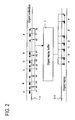
- Fig. 2 is a diagram that explains the basic concept of simulation video digest display control by a program according to the present invention.
- a digest replay buffer 1 is provided as a requirement for the present invention.
- the replay buffer 1 has either independent memory, or memory can be obtained by providing a buffer space in the RAM 170 in Fig. 1.
- a simulation program as a game program is executed in the main processor 100, the simulation data is calculated, and simulation video data 10 is created.
- the simulation data includes, assuming for example a soccer game, identification data for each individual player, characteristic data, and data to control the development of the game, and so on.
- Simulation video data 10 is created by calculation based on the player identification data and characteristic data in accordance with the game development control data. As explained above, the simulation video data 10 is processed by the graphics processor 120 in Fig. 1 and simulation video data is created. Details of the processing by this type of graphics processor 120 are not directly related to the characteristics of the present invention, so further explanation is omitted.
- the main processor 100 can buffer for a fixed time, for example five seconds, and successively accumulate in a primary buffer that is not shown the figure. Furthermore, the main processor 100 detects scenes in the simulation video data 10 that conform to predetermined digest conditions.
- simulation video data for the previous five seconds is accumulated in the primary buffer, and simulation video data is stored in the digest replay buffer 1 until a time a2 subsequent to the time a1 conforming to digest termination conditions.
- the main processor 100 detects the predetermined digest conditions at time b1, and simulation video data for the previous five seconds is accumulated in the primary buffer, and simulation video data is stored in the digest replay buffer 1 until a time b2 subsequent to the time b1 conforming to digest termination conditions.
- digest video data stored in the digest replay buffer 1 is read out as digest replay data 20.
- digest replay data 20 has the collected digest scenes A, B, C, D, E, F continuous. In this way, the digest replay data 20 is sent to the graphics processor 120 shown in Fig. 1.
- rendering processes linked to the texture memory 132 are carried out, and video data is created in the frame buffer 131. Then, the video data is converted into a video signal, and the digest scenes A, B, C, D, E, F are successively output and displayed on the display 121.
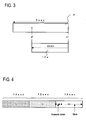
- Fig. 3 is a diagram to further explain a primary buffer 2 and extracting the digest scene.
- the start time for all the digest scenes is the buffering time of the primary buffer 2 (for example, five seconds) prior to the time of detection of digest scene conditions conformance.
- Fig. 4 is a diagram to explain the basic configuration of the digest replay buffer 1.
- the digest replay buffer 1 has capacity to accumulate 12 seconds each of simulation video data 10.
- a single digest scene can be a maximum of 12 seconds.
- the buffer capacity of the digest replay buffer 1 is 36 seconds, up to three scenes (I, II, III) can be stored.
- the digest scene video data that is currently being stored (III) exceeds 12 seconds, the beginning of the area (III) where the digest video data is being stored only is overwritten and deleted in a sliding action. In this way, the recording period of one scene can always be kept to within 12 seconds.
- the program that controls the process flows in Figs. 5 through 7 as a simulation program is, for example, stored in the ROM 160 in the system shown in Fig. 1, and execution is controlled by the main processor 100. In this way, it is possible to configure each functional means to realize the present invention.
- Figs. 5 and 6 are the digest video calculation process flow
- Fig. 7 is the digest video replay process flow.
- Step S2 a kick-off (game restart) scene determination is carried out.
- a kick-off scene determination is carried out (Step S2). In other words, when three seconds has passed, or it is determined that the conditions for out play have occurred, it is determined that there is a kick-off scene.
- Step S3 the scene data from the start of the game until the time of determination that is stored in the primary buffer 2 (Fig. 3) is set in the digest replay buffer 1 (Step S3).
- the continuing game calculation loop process is carried out (Step S4).
- the game calculation loop process functions as simulation calculation means in the image processing device according to the present invention.
- the emergency scene is set in the digest replay buffer 1 (Step S6).
- Step S5 it is determined whether there is conformance with the digest scene storage start conditions.
- the soccer game as an embodiment, when there is conformance with any of the conditions in Table T1 shown in Fig. 8 (corresponding to the times a1, b1, c1, d1, e1, f1, and so on in Fig. 2), storage of the digest scene starts.
- Step S5 functions as digest scene start determination means in the image processing device according to the present invention.
- condition item number corresponding to which condition 1 and condition 2 are set.
- Step S7 When conditions such as these to start storing a digest scene are detected, it is determined what point in time in the past five seconds of frames stored in the primary buffer 2 should be the set start (Step S7).
- the set scene is a scene from a restart [PK (penalty kick), FK (free kick), CK (corner kick)]
- the scene is extracted from one second (60 frames) prior to the restart kick, and stored in the digest replay buffer 1. If there is not one second of data prior to the restart, a full five seconds (300 frames) is set.
- the scene is extracted using three seconds (180 frames) prior to the primary buffer 2 termination time as the condition for the start point for the starting frame for i. dribbling motion (moving while controlling the ball with the feet) or keep motion (keeping the ball so that the ball is not taken by a rival player), or ii. trap motion (stopping and controlling a rolling or flying ball).
- Step 8 it is determined whether to delete a stock scene. This process determines whether to delete a scene stored in the digest replay buffer 1 by reference to the number of scenes and the amount stored.
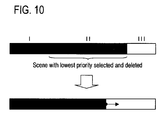
- Fig. 10 The situation shown in Fig. 10 is an example of the case where the scene currently being replayed (I) and the next replay candidate scene (II) are stored, but there is not 12 seconds capacity of vacant area (III).
- Step S8-1 the scene with the lowest priority among the scenes apart from the scene currently being replayed is selected and deleted. Then at least 12 seconds of vacant capacity is obtained by filling the area in front opened up by deleting the scene, and the next digest scene is set from the end zone.
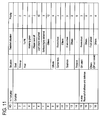
- Fig. 11 is an example of the criteria for determining the scene priority in Fig. 10.
- final result information for each scene is added, and the priority is determined based on this information.
- the final result information is added when deciding to terminate storage in a scene storage termination determination that is explained later.
- the types of final result information and priority are as shown in the example in Fig. 11.
- a game calculation and scene storage loop process is carried out (Step S10).
- the simulation calculation results from the determined storage start time until the determined termination time are stored in the buffer vacant space as a time series as a single digest scene.
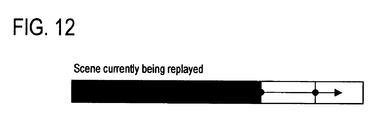
- the game calculation passes in one frame units, and at the same time the scene is stored in the digest replay buffer 1 as shown in Fig. 12.
- Step S11 If a digest scene exceeds 12 seconds, then as explained earlier regarding Fig. 3 the beginning of the currently stored scene only is taken to be excess and deleted by overwriting in a sliding action. In this way, the recorded length of a single scene can be kept to within 12 seconds (Step S11).
- Step S12 the timing for terminating storage of a single scene set in the digest replay buffer 1 is determined. Therefore, the process in Step S12 functions as digest scene termination determination means in the image processing device according to the present invention.
- Fig. 13 is an example of scene storage termination conditions.
- Step S8 stock scene deletion determination
- game calculation is temporarily stopped to avoid the situation that a goal or another important scene cannot be stored.
- Step S15 the process when there is an emergency scene set command (Step S15) is explained.
- the next digest scene to be replayed is forcibly set in the digest replay buffer 1.
- the emergency scene set command is issued, if normal calculation is being carried out the scene at that point in time in the primary buffer 2 is set in the digest replay buffer 1 (Step S15a). Then the process returns to the calculation loop.
- the game replay speed may be the same as the actual time. Also, in simulations dealing with long periods of time such as simulations of planetary bodies, replay may be faster than the actual speed.
- scene storage and calculation and replay are simultaneous processes, but it is possible that satisfaction of the storage termination conditions may not occur.
- there is a limit to the capacity of the digest replay buffer 1 in the embodiment it is 36 seconds). Therefore, it is necessary that there be a response to this type of situation.
- Step S15b If the amount stored in the digest replay buffer 1 exceeds 24 seconds, the process shown in Fig. 15 is carried out (Step S15b).
- the data stored in the buffer in the case of a soccer game can include for example the following.
- Player replay data for players that have appeared and ball replay data.
- player replay data can include the following data.
- Step S20 the pre-digest game performance process is carried out (Step S20).
- video is displayed prior to the game as a game video performance.
- digest replay the performance scenes prior to the game are few, for example, in the digest game pre-performance table shown in Fig. 16, only the scenes with a O symbol in the "Replay or not" column are displayed before replay in a digest video.
- Step S21 the digest scene stored in the digest replay buffer 1 is replayed.
- digest scenes to be replayed may be selected.
- an arbitrary digest scene may be selected by functioning as selection means for digest scenes to be replayed.
- digest scenes with high priority may be automatically selected and replayed.
- Step S22 when replay of the digest scenes is finished, it is determined whether to replay a performance scene or not (Step S22). If there is a performance scene, the performance scene is replayed (Step S23).
- Step S24 It is determined whether the digest is a goal scene or not (Step S24). If the digest is a goal scene, the scene is replayed again as a re-play (Step S25).
- the timing of the re-play is determined using the following information and is explained by reference to Fig. 17 which explains the re-play timing.
- Step S26 the scene whose replay has finished is deleted from the digest replay buffer 1 (Step S26).
- the following scenes are moved forward to provide vacant space. Deletion of scenes whose replay has been completed as in this Step S26 is realized as the function of buffer space release means in the image processing device according to the present invention.
- Step S27 if game calculation has been temporarily stopped, it is determined whether the stop can be cancelled or not (Step S27). If the stop can be cancelled, a calculation stop cancellation command is issued to the game calculation sequence, and calculation is started again (Step S28).
- determining whether calculation can be temporarily stopped is common with the "calculation temporary stop determination" (Step S12) of the game calculation sequence in Fig. 6.
- Step S30 if the scene whose replay is finished that has been deleted from the digest replay buffer 1 is the time up scene, the digest of the PK shoot out is replayed (Step S30). If the deleted scene is anything other than the time up scene, the procedure returns to replay the next replay scene (Step S21). If there is no next replay scene, an emergency scene setting command is issued to the game calculation sequence (Step S29). When replay of the digest PK shoot out (Step S9) is finished, there is a transition to the post-game performance (Step S31). After the post-game performance, the sequence is the same as full time (replay of the full game time).
- the configuration of the primary buffer 10 and replay buffer 1 as explained above in connection with Fig. 2 is an embodiment, the essence of the present invention is not limited to the configuration shown in Fig. 2, and various configurations of buffer are possible in realizing the present invention.
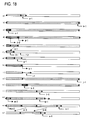
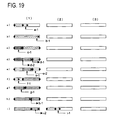
- Figs. 18 and 19 show examples of other configurations of buffer.
- Fig. 18 is an example where the primary buffer 10 is not used, and the present invention is realized with the digest replay buffer 1 only.
- the scene is written to form the digest (g-1).
- the recording is terminated (h-1), and a single digest scene is concluded.
- the space for scenes that have been replayed is made vacant, scenes are moved forward into that empty space (n-3, n-4), and at the same time scenes are directly written (o-1).
- the whole storage area is divided into segment blocks of a fixed size (for example, 2KB, 4KB, 8KB, 16KB, or similar) known as clusters, and the FAT has a control area having a two-dimensional table structure that searches at high speed in block units the used areas and empty areas within the recording area.
- a fixed size for example, 2KB, 4KB, 8KB, 16KB, or similar
- the FAT has a control area having a two-dimensional table structure that searches at high speed in block units the used areas and empty areas within the recording area.
- the file can be realized by allocating one or a plurality of clusters depending on the data size.
- information regarding what clusters constitute a particular file (the clusters constituting a file are not necessarily contiguous) or whether a cluster is currently being used or not is recorded and controlled in the FAT.
- the FAT information regarding what clusters constitute a particular file (the clusters constituting a file are not necessarily contiguous) or whether a cluster is currently being used or not.
- Fig. 19 is an example of yet another configuration of buffers, an example realized without the primary buffer 10, but using a plurality (in the example in Fig. 18, three) of digest replay buffers 1 (1), (2), (3).
- the buffer is treated as a ring buffer, and overwritten from the beginning (f-1).
- replay can start in parallel with recording (i-1), so replay of scenes from the top of the digest scenes starts (i-2).
- the present invention is not limited to these types of cases. As stated earlier, the present invention may be applied not only to sports games, but also to weather, war, ocean currents, heavenly bodies, and other images that change.
Landscapes
- Engineering & Computer Science (AREA)
- Multimedia (AREA)
- Television Signal Processing For Recording (AREA)
- Processing Or Creating Images (AREA)
Applications Claiming Priority (1)
| Application Number | Priority Date | Filing Date | Title |
|---|---|---|---|
| JP2006016775A JP2007199944A (ja) | 2006-01-25 | 2006-01-25 | シミュレーション映像のダイジェストを表示制御するプログラム |
Publications (2)
| Publication Number | Publication Date |
|---|---|
| EP1815898A2 true EP1815898A2 (fr) | 2007-08-08 |
| EP1815898A3 EP1815898A3 (fr) | 2010-05-12 |
Family
ID=38180151
Family Applications (1)
| Application Number | Title | Priority Date | Filing Date |
|---|---|---|---|
| EP07250249A Withdrawn EP1815898A3 (fr) | 2006-01-25 | 2007-01-22 | Programme de contrôle de l'affichage du résumé d'une simulation vidéo |
Country Status (3)
| Country | Link |
|---|---|
| US (1) | US20070172194A1 (fr) |
| EP (1) | EP1815898A3 (fr) |
| JP (1) | JP2007199944A (fr) |
Cited By (4)
| Publication number | Priority date | Publication date | Assignee | Title |
|---|---|---|---|---|
| WO2009102991A1 (fr) | 2008-02-15 | 2009-08-20 | Sony Computer Entertainment America Inc. | Système et procédé pour une création automatisée de caractéristiques de jeux vidéo |
| EP2186326A1 (fr) * | 2007-09-10 | 2010-05-19 | Thomson Licensing | Lecture vidéo |
| EP2213344A3 (fr) * | 2009-01-29 | 2011-09-21 | Disney Enterprises, Inc. | Système et procédé de résumé dynamique de jeu vidéo |
| CN111001149A (zh) * | 2019-12-10 | 2020-04-14 | 苏宁智能终端有限公司 | 一种基于视频回放的位置定位方法及系统 |
Families Citing this family (8)
| Publication number | Priority date | Publication date | Assignee | Title |
|---|---|---|---|---|
| JP4331240B2 (ja) | 2008-01-23 | 2009-09-16 | 株式会社東芝 | 電子機器および画像表示方法 |
| WO2010019471A1 (fr) * | 2008-08-14 | 2010-02-18 | Zoran Corporation | Système et procédé de relecture vidéo et audio instantanée efficace pour une télévision numérique |
| US8761575B2 (en) * | 2009-04-09 | 2014-06-24 | Sony Computer Entertainment America Llc | Method and apparatus for searching replay data |
| JP5294505B2 (ja) * | 2010-11-30 | 2013-09-18 | 京楽産業.株式会社 | 遊技システム |
| JP5294507B2 (ja) * | 2010-11-30 | 2013-09-18 | 京楽産業.株式会社 | 遊技システム |
| WO2015093108A1 (fr) * | 2013-12-20 | 2015-06-25 | 株式会社ソニー・コンピュータエンタテインメント | Dispositif de commande de capture, procédé de commande de capture, programme et support de mémorisation d'informations |
| JP6066101B2 (ja) * | 2014-01-30 | 2017-01-25 | インターナショナル・ビジネス・マシーンズ・コーポレーションInternational Business Machines Corporation | 構造化文書に基づいて動画を動的に作成する方法、並びに、その電子装置、電子システム、及び電子装置用プログラム |
| WO2022061712A1 (fr) * | 2020-09-25 | 2022-03-31 | 深圳市大疆创新科技有限公司 | Procédé de bataille entre des véhicules aériens sans pilote, appareil de commande de bataille entre des véhicules aériens sans pilote, véhicule aérien sans pilote et support de stockage |
Family Cites Families (18)
| Publication number | Priority date | Publication date | Assignee | Title |
|---|---|---|---|---|
| WO1996000601A1 (fr) * | 1994-06-28 | 1996-01-11 | Sega Enterprises, Ltd. | Dispositif pour jeu et procede de restitution de partie |
| US6542155B1 (en) * | 1995-04-27 | 2003-04-01 | Kabushiki Kaisha Sega Enterprises | Picture processing device, picture processing method, and game device and storage medium using the same |
| TW318226B (fr) * | 1995-05-11 | 1997-10-21 | Sega Enterprises Kk | |
| EP0916376A1 (fr) * | 1997-04-03 | 1999-05-19 | Sega Enterprises, Ltd. | Procede de presentation d'une image de jeu et procede de commande associe |
| JP3183632B2 (ja) * | 1997-06-13 | 2001-07-09 | 株式会社ナムコ | 情報記憶媒体及び画像生成装置 |
| US7075683B1 (en) * | 1999-02-15 | 2006-07-11 | Canon Kabushiki Kaisha | Dynamic image digest automatic editing system and dynamic image digest automatic editing method |
| JP3417883B2 (ja) * | 1999-07-26 | 2003-06-16 | コナミ株式会社 | 画像作成装置、画像作成方法、画像作成プログラムが記録されたコンピュータ読み取り可能な記録媒体およびビデオゲーム装置 |
| JP2001038049A (ja) * | 1999-07-30 | 2001-02-13 | Sega Corp | ゲーム装置 |
| US6699127B1 (en) * | 2000-06-20 | 2004-03-02 | Nintendo Of America Inc. | Real-time replay system for video game |
| JP4426743B2 (ja) * | 2001-09-13 | 2010-03-03 | パイオニア株式会社 | 映像情報要約装置、映像情報要約方法および映像情報要約処理プログラム |
| JP4196271B2 (ja) * | 2003-06-26 | 2008-12-17 | コニカミノルタビジネステクノロジーズ株式会社 | 印刷データ処理装置およびデータ処理装置 |
| US7068575B2 (en) * | 2003-07-30 | 2006-06-27 | Microsoft Corporation | High speed optical disc recording |
| US20050047363A1 (en) * | 2003-08-25 | 2005-03-03 | Sam Shiaw-Shiang Jiang | Method and apparatus of controlling data delivery in a wireless communication system for digesting data units outside a reconfigured transmitting window and a reconfigured receiving window |
| JP4121978B2 (ja) * | 2004-05-01 | 2008-07-23 | 株式会社コナミデジタルエンタテインメント | ゲームプログラム、ゲーム装置及びゲーム方法 |
| US20090208184A1 (en) * | 2004-12-03 | 2009-08-20 | Nec Corporation | Video content playback assistance method, video content playback assistance system, and information distribution program |
| JPWO2006104106A1 (ja) * | 2005-03-28 | 2008-09-04 | パイオニア株式会社 | ダイジェスト視聴システム及びダイジェスト視聴用再生制御装置 |
| US20070071406A1 (en) * | 2005-09-28 | 2007-03-29 | Sanyo Electric Co., Ltd. | Video recording and reproducing apparatus and video reproducing apparatus |
| JP4760572B2 (ja) * | 2006-06-30 | 2011-08-31 | ソニー株式会社 | 編集装置および編集方法、並びにプログラム |
-
2006
- 2006-01-25 JP JP2006016775A patent/JP2007199944A/ja not_active Withdrawn
-
2007
- 2007-01-19 US US11/655,135 patent/US20070172194A1/en not_active Abandoned
- 2007-01-22 EP EP07250249A patent/EP1815898A3/fr not_active Withdrawn
Cited By (7)
| Publication number | Priority date | Publication date | Assignee | Title |
|---|---|---|---|---|
| EP2186326A1 (fr) * | 2007-09-10 | 2010-05-19 | Thomson Licensing | Lecture vidéo |
| WO2009102991A1 (fr) | 2008-02-15 | 2009-08-20 | Sony Computer Entertainment America Inc. | Système et procédé pour une création automatisée de caractéristiques de jeux vidéo |
| EP2240251A4 (fr) * | 2008-02-15 | 2011-06-22 | Sony Comp Entertainment Us | Système et procédé pour une création automatisée de caractéristiques de jeux vidéo |
| EP2213344A3 (fr) * | 2009-01-29 | 2011-09-21 | Disney Enterprises, Inc. | Système et procédé de résumé dynamique de jeu vidéo |
| US8088012B2 (en) | 2009-01-29 | 2012-01-03 | Disney Enterprises, Inc. | System and method for dynamic video game recap |
| CN111001149A (zh) * | 2019-12-10 | 2020-04-14 | 苏宁智能终端有限公司 | 一种基于视频回放的位置定位方法及系统 |
| CN111001149B (zh) * | 2019-12-10 | 2021-06-04 | 苏宁智能终端有限公司 | 一种基于视频回放的位置定位方法及系统 |
Also Published As
| Publication number | Publication date |
|---|---|
| JP2007199944A (ja) | 2007-08-09 |
| EP1815898A3 (fr) | 2010-05-12 |
| US20070172194A1 (en) | 2007-07-26 |
Similar Documents
| Publication | Publication Date | Title |
|---|---|---|
| EP1815898A2 (fr) | Programme de contrôle de l'affichage de prétraitement d'une simulation vidéo | |
| US7468728B2 (en) | Apparatus for controlling a virtual environment | |
| US6955606B2 (en) | Game information storage medium and game system using the same | |
| KR101101090B1 (ko) | 게임기반 장면 생성 | |
| JP5770918B1 (ja) | 情報処理プログラム、及び情報処理方法 | |
| US20250235786A1 (en) | Route generation system within a virtual environment of a game application | |
| JP2006271785A (ja) | プログラム、キャラクタ制御方法、ならびに、キャラクタ制御装置 | |
| US6213878B1 (en) | Image processor, image processing method and game machine and recording medium | |
| US20010006909A1 (en) | Speech generating device and method in game device, and medium for same | |
| JP3244476B2 (ja) | ゲーム装置、ゲーム装置の制御方法及びコンピュータ読取可能な記録媒体 | |
| US6508712B1 (en) | Recording medium having sequentially accessible data recording regions, data access method, game progress control method, and game machine | |
| JP4071602B2 (ja) | ゲームプログラム及び当該ゲームプログラムを記憶した記憶媒体 | |
| JP4401740B2 (ja) | 編集装置 | |
| US10137371B2 (en) | Method of recording and replaying game video by using object state recording method | |
| JP3661519B2 (ja) | 連続画像を出力するためのコンピュータプログラムを記録した記録媒体、連続画像出力装置および連続画像出力方法 | |
| JP4251968B2 (ja) | コンテンツ作成装置、コンテンツ作成プログラム、およびコンテンツ作成プログラムを記録した記録媒体 | |
| JP6671418B2 (ja) | プログラム、記録媒体及びゲーム演出提示方法 | |
| KR100338240B1 (ko) | 비디오 게임장치 및 비디오게임 프로그램이 기록된 가독 기록매체 | |
| CN117695651B (zh) | 虚拟角色的运动控制方法及装置、存储介质、计算机设备 | |
| JP3411184B2 (ja) | 動画エディットシステム | |
| KR20130015320A (ko) | 게임엔진, 게임실행방법, 게임저작툴, 및 이들의 기록매체 | |
| JP3640074B2 (ja) | ストリームデータ選択装置 | |
| JP7090448B2 (ja) | プログラム、情報処理方法、及び情報処理装置 | |
| JP2026047559A (ja) | 棋譜生成装置及びプログラム | |
| JP2000014925A (ja) | 画像表示制御方法及び、これを適用するゲーム装置 |
Legal Events
| Date | Code | Title | Description |
|---|---|---|---|
| PUAI | Public reference made under article 153(3) epc to a published international application that has entered the european phase |
Free format text: ORIGINAL CODE: 0009012 |
|
| AK | Designated contracting states |
Kind code of ref document: A2 Designated state(s): AT BE BG CH CY CZ DE DK EE ES FI FR GB GR HU IE IS IT LI LT LU LV MC NL PL PT RO SE SI SK TR |
|
| AX | Request for extension of the european patent |
Extension state: AL BA HR MK YU |
|
| PUAL | Search report despatched |
Free format text: ORIGINAL CODE: 0009013 |
|
| AK | Designated contracting states |
Kind code of ref document: A3 Designated state(s): AT BE BG CH CY CZ DE DK EE ES FI FR GB GR HU IE IS IT LI LT LU LV MC NL PL PT RO SE SI SK TR |
|
| AX | Request for extension of the european patent |
Extension state: AL BA HR MK RS |
|
| AKY | No designation fees paid | ||
| REG | Reference to a national code |
Ref country code: DE Ref legal event code: 8566 |
|
| STAA | Information on the status of an ep patent application or granted ep patent |
Free format text: STATUS: THE APPLICATION IS DEEMED TO BE WITHDRAWN |
|
| 18D | Application deemed to be withdrawn |
Effective date: 20101113 |