EP1816478A2 - Procédé de détection du fibrinogène et/ou de ses derivés - Google Patents
Procédé de détection du fibrinogène et/ou de ses derivés Download PDFInfo
- Publication number
- EP1816478A2 EP1816478A2 EP07009386A EP07009386A EP1816478A2 EP 1816478 A2 EP1816478 A2 EP 1816478A2 EP 07009386 A EP07009386 A EP 07009386A EP 07009386 A EP07009386 A EP 07009386A EP 1816478 A2 EP1816478 A2 EP 1816478A2
- Authority
- EP
- European Patent Office
- Prior art keywords
- fibrinogen
- vancomycin
- pool
- plasma
- pbs
- Prior art date
- Legal status (The legal status is an assumption and is not a legal conclusion. Google has not performed a legal analysis and makes no representation as to the accuracy of the status listed.)
- Granted
Links
- 108010049003 Fibrinogen Proteins 0.000 title claims abstract description 224
- 102000008946 Fibrinogen Human genes 0.000 title claims abstract description 224
- 229940012952 fibrinogen Drugs 0.000 title claims abstract description 224
- 238000000034 method Methods 0.000 title claims abstract description 43
- MYPYJXKWCTUITO-UHFFFAOYSA-N vancomycin Natural products O1C(C(=C2)Cl)=CC=C2C(O)C(C(NC(C2=CC(O)=CC(O)=C2C=2C(O)=CC=C3C=2)C(O)=O)=O)NC(=O)C3NC(=O)C2NC(=O)C(CC(N)=O)NC(=O)C(NC(=O)C(CC(C)C)NC)C(O)C(C=C3Cl)=CC=C3OC3=CC2=CC1=C3OC1OC(CO)C(O)C(O)C1OC1CC(C)(N)C(O)C(C)O1 MYPYJXKWCTUITO-UHFFFAOYSA-N 0.000 claims abstract description 141
- 108010059993 Vancomycin Proteins 0.000 claims abstract description 139
- MYPYJXKWCTUITO-LYRMYLQWSA-N vancomycin Chemical compound O([C@@H]1[C@@H](O)[C@H](O)[C@@H](CO)O[C@H]1OC1=C2C=C3C=C1OC1=CC=C(C=C1Cl)[C@@H](O)[C@H](C(N[C@@H](CC(N)=O)C(=O)N[C@H]3C(=O)N[C@H]1C(=O)N[C@H](C(N[C@@H](C3=CC(O)=CC(O)=C3C=3C(O)=CC=C1C=3)C(O)=O)=O)[C@H](O)C1=CC=C(C(=C1)Cl)O2)=O)NC(=O)[C@@H](CC(C)C)NC)[C@H]1C[C@](C)(N)[C@H](O)[C@H](C)O1 MYPYJXKWCTUITO-LYRMYLQWSA-N 0.000 claims abstract description 139
- 229960003165 vancomycin Drugs 0.000 claims abstract description 139
- 238000012360 testing method Methods 0.000 claims abstract description 38
- 229940039227 diagnostic agent Drugs 0.000 claims abstract description 12
- 239000000032 diagnostic agent Substances 0.000 claims abstract description 12
- MYPYJXKWCTUITO-KIIOPKALSA-N chembl3301825 Chemical compound O([C@@H]1[C@@H](O)[C@H](O)[C@@H](CO)O[C@H]1OC1=C2C=C3C=C1OC1=CC=C(C=C1Cl)[C@@H](O)[C@H](C(N[C@@H](CC(N)=O)C(=O)N[C@H]3C(=O)N[C@H]1C(=O)N[C@H](C(N[C@H](C3=CC(O)=CC(O)=C3C=3C(O)=CC=C1C=3)C(O)=O)=O)[C@H](O)C1=CC=C(C(=C1)Cl)O2)=O)NC(=O)[C@@H](CC(C)C)NC)[C@H]1C[C@](C)(N)C(O)[C@H](C)O1 MYPYJXKWCTUITO-KIIOPKALSA-N 0.000 claims abstract description 8
- 239000011159 matrix material Substances 0.000 claims abstract description 5
- 210000002381 plasma Anatomy 0.000 claims description 148
- HTTJABKRGRZYRN-UHFFFAOYSA-N Heparin Chemical compound OC1C(NC(=O)C)C(O)OC(COS(O)(=O)=O)C1OC1C(OS(O)(=O)=O)C(O)C(OC2C(C(OS(O)(=O)=O)C(OC3C(C(O)C(O)C(O3)C(O)=O)OS(O)(=O)=O)C(CO)O2)NS(O)(=O)=O)C(C(O)=O)O1 HTTJABKRGRZYRN-UHFFFAOYSA-N 0.000 claims description 62
- 229960002897 heparin Drugs 0.000 claims description 62
- 229920000669 heparin Polymers 0.000 claims description 62
- 230000035484 reaction time Effects 0.000 claims description 36
- 238000001514 detection method Methods 0.000 claims description 28
- FAPWRFPIFSIZLT-UHFFFAOYSA-M Sodium chloride Chemical compound [Na+].[Cl-] FAPWRFPIFSIZLT-UHFFFAOYSA-M 0.000 claims description 24
- 210000004369 blood Anatomy 0.000 claims description 13
- 239000008280 blood Substances 0.000 claims description 13
- 238000005259 measurement Methods 0.000 claims description 13
- KCXVZYZYPLLWCC-UHFFFAOYSA-N EDTA Chemical compound OC(=O)CN(CC(O)=O)CCN(CC(O)=O)CC(O)=O KCXVZYZYPLLWCC-UHFFFAOYSA-N 0.000 claims description 12
- 239000011780 sodium chloride Substances 0.000 claims description 10
- 239000000872 buffer Substances 0.000 claims description 9
- 208000009190 disseminated intravascular coagulation Diseases 0.000 claims description 9
- 201000006474 Brain Ischemia Diseases 0.000 claims description 7
- 206010008120 Cerebral ischaemia Diseases 0.000 claims description 7
- 206010061216 Infarction Diseases 0.000 claims description 7
- 206010008118 cerebral infarction Diseases 0.000 claims description 7
- 230000007574 infarction Effects 0.000 claims description 7
- 230000002107 myocardial effect Effects 0.000 claims description 7
- 208000031225 myocardial ischemia Diseases 0.000 claims description 7
- 206010053567 Coagulopathies Diseases 0.000 claims description 5
- 229910019142 PO4 Inorganic materials 0.000 claims description 5
- 230000035602 clotting Effects 0.000 claims description 5
- 201000010099 disease Diseases 0.000 claims description 5
- 208000037265 diseases, disorders, signs and symptoms Diseases 0.000 claims description 5
- 239000010452 phosphate Substances 0.000 claims description 5
- -1 guanidino compound Chemical class 0.000 claims description 4
- 230000001575 pathological effect Effects 0.000 claims description 4
- 125000002467 phosphate group Chemical group [H]OP(=O)(O[H])O[*] 0.000 claims 1
- 239000000203 mixture Substances 0.000 abstract description 10
- 230000015271 coagulation Effects 0.000 abstract description 9
- 238000005345 coagulation Methods 0.000 abstract description 9
- 108090000190 Thrombin Proteins 0.000 description 95
- 229960004072 thrombin Drugs 0.000 description 95
- 239000003153 chemical reaction reagent Substances 0.000 description 62
- 229920000209 Hexadimethrine bromide Polymers 0.000 description 48
- 108010088751 Albumins Proteins 0.000 description 41
- 102000009027 Albumins Human genes 0.000 description 41
- 239000004475 Arginine Substances 0.000 description 41
- ODKSFYDXXFIFQN-UHFFFAOYSA-N arginine Natural products OC(=O)C(N)CCCNC(N)=N ODKSFYDXXFIFQN-UHFFFAOYSA-N 0.000 description 41
- 239000000243 solution Substances 0.000 description 38
- 239000000523 sample Substances 0.000 description 35
- 230000000694 effects Effects 0.000 description 27
- 238000006243 chemical reaction Methods 0.000 description 24
- 238000011534 incubation Methods 0.000 description 24
- 108010073385 Fibrin Proteins 0.000 description 21
- 102000009123 Fibrin Human genes 0.000 description 21
- BWGVNKXGVNDBDI-UHFFFAOYSA-N Fibrin monomer Chemical compound CNC(=O)CNC(=O)CN BWGVNKXGVNDBDI-UHFFFAOYSA-N 0.000 description 21
- 229950003499 fibrin Drugs 0.000 description 21
- VDQQXEISLMTGAB-UHFFFAOYSA-N chloramine T Chemical compound [Na+].CC1=CC=C(S(=O)(=O)[N-]Cl)C=C1 VDQQXEISLMTGAB-UHFFFAOYSA-N 0.000 description 20
- 239000002244 precipitate Substances 0.000 description 20
- 238000002835 absorbance Methods 0.000 description 19
- 229960001479 tosylchloramide sodium Drugs 0.000 description 17
- 102100033571 Tissue-type plasminogen activator Human genes 0.000 description 16
- 108050006955 Tissue-type plasminogen activator Proteins 0.000 description 16
- 238000010521 absorption reaction Methods 0.000 description 14
- 230000009257 reactivity Effects 0.000 description 13
- 238000003556 assay Methods 0.000 description 12
- 108090000623 proteins and genes Proteins 0.000 description 12
- 102000004169 proteins and genes Human genes 0.000 description 12
- 238000010790 dilution Methods 0.000 description 10
- 239000012895 dilution Substances 0.000 description 10
- 210000002966 serum Anatomy 0.000 description 10
- 108091003079 Bovine Serum Albumin Proteins 0.000 description 9
- 238000001962 electrophoresis Methods 0.000 description 8
- 230000005764 inhibitory process Effects 0.000 description 8
- 229920002113 octoxynol Polymers 0.000 description 8
- 238000001556 precipitation Methods 0.000 description 8
- KRKNYBCHXYNGOX-UHFFFAOYSA-K Citrate Chemical compound [O-]C(=O)CC(O)(CC([O-])=O)C([O-])=O KRKNYBCHXYNGOX-UHFFFAOYSA-K 0.000 description 7
- 230000015572 biosynthetic process Effects 0.000 description 7
- 229940098773 bovine serum albumin Drugs 0.000 description 7
- 239000003112 inhibitor Substances 0.000 description 7
- 230000003993 interaction Effects 0.000 description 7
- CIWBSHSKHKDKBQ-JLAZNSOCSA-N Ascorbic acid Chemical compound OC[C@H](O)[C@H]1OC(=O)C(O)=C1O CIWBSHSKHKDKBQ-JLAZNSOCSA-N 0.000 description 6
- 230000002401 inhibitory effect Effects 0.000 description 6
- 239000011541 reaction mixture Substances 0.000 description 6
- 239000006228 supernatant Substances 0.000 description 6
- 241000283690 Bos taurus Species 0.000 description 5
- FFEARJCKVFRZRR-BYPYZUCNSA-N L-methionine Chemical compound CSCC[C@H](N)C(O)=O FFEARJCKVFRZRR-BYPYZUCNSA-N 0.000 description 5
- 239000000427 antigen Substances 0.000 description 5
- 230000000890 antigenic effect Effects 0.000 description 5
- 102000036639 antigens Human genes 0.000 description 5
- 108091007433 antigens Proteins 0.000 description 5
- 230000000875 corresponding effect Effects 0.000 description 5
- 229930182817 methionine Natural products 0.000 description 5
- 238000005457 optimization Methods 0.000 description 5
- FBPFZTCFMRRESA-KVTDHHQDSA-N D-Mannitol Chemical compound OC[C@@H](O)[C@@H](O)[C@H](O)[C@H](O)CO FBPFZTCFMRRESA-KVTDHHQDSA-N 0.000 description 4
- 108010088842 Fibrinolysin Proteins 0.000 description 4
- 229930195725 Mannitol Natural products 0.000 description 4
- 235000010355 mannitol Nutrition 0.000 description 4
- 239000000594 mannitol Substances 0.000 description 4
- NBIIXXVUZAFLBC-UHFFFAOYSA-K phosphate Chemical compound [O-]P([O-])([O-])=O NBIIXXVUZAFLBC-UHFFFAOYSA-K 0.000 description 4
- 229940012957 plasmin Drugs 0.000 description 4
- 230000008569 process Effects 0.000 description 4
- 230000002829 reductive effect Effects 0.000 description 4
- 230000000638 stimulation Effects 0.000 description 4
- 238000007817 turbidimetric assay Methods 0.000 description 4
- 108010094028 Prothrombin Proteins 0.000 description 3
- 102100027378 Prothrombin Human genes 0.000 description 3
- 229940072107 ascorbate Drugs 0.000 description 3
- 235000010323 ascorbic acid Nutrition 0.000 description 3
- 239000011668 ascorbic acid Substances 0.000 description 3
- 230000002596 correlated effect Effects 0.000 description 3
- 238000002474 experimental method Methods 0.000 description 3
- 230000002779 inactivation Effects 0.000 description 3
- 239000007788 liquid Substances 0.000 description 3
- 239000007800 oxidant agent Substances 0.000 description 3
- 238000003359 percent control normalization Methods 0.000 description 3
- 238000006116 polymerization reaction Methods 0.000 description 3
- 229940039716 prothrombin Drugs 0.000 description 3
- 230000009467 reduction Effects 0.000 description 3
- XLYOFNOQVPJJNP-UHFFFAOYSA-N water Substances O XLYOFNOQVPJJNP-UHFFFAOYSA-N 0.000 description 3
- 102000021944 Butyrylcholinesterase Human genes 0.000 description 2
- 108010053652 Butyrylcholinesterase Proteins 0.000 description 2
- QDHHCQZDFGDHMP-UHFFFAOYSA-N Chloramine Chemical compound ClN QDHHCQZDFGDHMP-UHFFFAOYSA-N 0.000 description 2
- 108090000790 Enzymes Proteins 0.000 description 2
- 102000004190 Enzymes Human genes 0.000 description 2
- PWWVAXIEGOYWEE-UHFFFAOYSA-N Isophenergan Chemical compound C1=CC=C2N(CC(C)N(C)C)C3=CC=CC=C3SC2=C1 PWWVAXIEGOYWEE-UHFFFAOYSA-N 0.000 description 2
- 108010051456 Plasminogen Proteins 0.000 description 2
- 102000013566 Plasminogen Human genes 0.000 description 2
- UIIMBOGNXHQVGW-UHFFFAOYSA-M Sodium bicarbonate Chemical compound [Na+].OC([O-])=O UIIMBOGNXHQVGW-UHFFFAOYSA-M 0.000 description 2
- 239000007983 Tris buffer Substances 0.000 description 2
- 239000003963 antioxidant agent Substances 0.000 description 2
- 235000006708 antioxidants Nutrition 0.000 description 2
- 238000013459 approach Methods 0.000 description 2
- 238000003776 cleavage reaction Methods 0.000 description 2
- 238000004090 dissolution Methods 0.000 description 2
- 229940088598 enzyme Drugs 0.000 description 2
- 208000027826 familial dysfibrinogenemia Diseases 0.000 description 2
- 238000006386 neutralization reaction Methods 0.000 description 2
- QYSGYZVSCZSLHT-UHFFFAOYSA-N octafluoropropane Chemical compound FC(F)(F)C(F)(F)C(F)(F)F QYSGYZVSCZSLHT-UHFFFAOYSA-N 0.000 description 2
- 230000001590 oxidative effect Effects 0.000 description 2
- 229940093429 polyethylene glycol 6000 Drugs 0.000 description 2
- 239000000047 product Substances 0.000 description 2
- 230000007017 scission Effects 0.000 description 2
- 230000035945 sensitivity Effects 0.000 description 2
- 239000011734 sodium Substances 0.000 description 2
- PPASLZSBLFJQEF-RKJRWTFHSA-M sodium ascorbate Substances [Na+].OC[C@@H](O)[C@H]1OC(=O)C(O)=C1[O-] PPASLZSBLFJQEF-RKJRWTFHSA-M 0.000 description 2
- 235000010378 sodium ascorbate Nutrition 0.000 description 2
- 229960005055 sodium ascorbate Drugs 0.000 description 2
- PPASLZSBLFJQEF-RXSVEWSESA-M sodium-L-ascorbate Chemical compound [Na+].OC[C@H](O)[C@H]1OC(=O)C(O)=C1[O-] PPASLZSBLFJQEF-RXSVEWSESA-M 0.000 description 2
- 239000007787 solid Substances 0.000 description 2
- 239000012085 test solution Substances 0.000 description 2
- LENZDBCJOHFCAS-UHFFFAOYSA-N tris Chemical compound OCC(N)(CO)CO LENZDBCJOHFCAS-UHFFFAOYSA-N 0.000 description 2
- 238000005406 washing Methods 0.000 description 2
- PGOHTUIFYSHAQG-LJSDBVFPSA-N (2S)-6-amino-2-[[(2S)-5-amino-2-[[(2S)-2-[[(2S)-2-[[(2S)-2-[[(2S)-4-amino-2-[[(2S)-2-[[(2S)-2-[[(2S)-2-[[(2S)-2-[[(2S)-5-amino-2-[[(2S)-5-amino-2-[[(2S)-2-[[(2S)-2-[[(2S)-2-[[(2S,3R)-2-[[(2S)-5-amino-2-[[(2S)-2-[[(2S)-2-[[(2S,3R)-2-[[(2S)-2-[[(2S)-2-[[(2S)-2-[[(2S)-2-[[(2S)-5-amino-2-[[(2S)-1-[(2S,3R)-2-[[(2S)-2-[[(2S)-2-[[(2R)-2-[[(2S)-2-[[(2S)-2-[[2-[[(2S)-2-[[(2S)-2-[[(2S)-2-[[(2S)-1-[(2S)-2-[[(2S)-2-[[(2S)-2-[[(2S)-2-amino-4-methylsulfanylbutanoyl]amino]-3-(1H-indol-3-yl)propanoyl]amino]-5-carbamimidamidopentanoyl]amino]propanoyl]pyrrolidine-2-carbonyl]amino]-3-methylbutanoyl]amino]-4-methylpentanoyl]amino]-4-methylpentanoyl]amino]acetyl]amino]-3-hydroxypropanoyl]amino]-4-methylpentanoyl]amino]-3-sulfanylpropanoyl]amino]-4-methylsulfanylbutanoyl]amino]-5-carbamimidamidopentanoyl]amino]-3-hydroxybutanoyl]pyrrolidine-2-carbonyl]amino]-5-oxopentanoyl]amino]-3-hydroxypropanoyl]amino]-3-hydroxypropanoyl]amino]-3-(1H-imidazol-5-yl)propanoyl]amino]-4-methylpentanoyl]amino]-3-hydroxybutanoyl]amino]-3-(1H-indol-3-yl)propanoyl]amino]-5-carbamimidamidopentanoyl]amino]-5-oxopentanoyl]amino]-3-hydroxybutanoyl]amino]-3-hydroxypropanoyl]amino]-3-carboxypropanoyl]amino]-3-hydroxypropanoyl]amino]-5-oxopentanoyl]amino]-5-oxopentanoyl]amino]-3-phenylpropanoyl]amino]-5-carbamimidamidopentanoyl]amino]-3-methylbutanoyl]amino]-4-methylpentanoyl]amino]-4-oxobutanoyl]amino]-5-carbamimidamidopentanoyl]amino]-3-(1H-indol-3-yl)propanoyl]amino]-4-carboxybutanoyl]amino]-5-oxopentanoyl]amino]hexanoic acid Chemical compound CSCC[C@H](N)C(=O)N[C@@H](Cc1c[nH]c2ccccc12)C(=O)N[C@@H](CCCNC(N)=N)C(=O)N[C@@H](C)C(=O)N1CCC[C@H]1C(=O)N[C@@H](C(C)C)C(=O)N[C@@H](CC(C)C)C(=O)N[C@@H](CC(C)C)C(=O)NCC(=O)N[C@@H](CO)C(=O)N[C@@H](CC(C)C)C(=O)N[C@@H](CS)C(=O)N[C@@H](CCSC)C(=O)N[C@@H](CCCNC(N)=N)C(=O)N[C@@H]([C@@H](C)O)C(=O)N1CCC[C@H]1C(=O)N[C@@H](CCC(N)=O)C(=O)N[C@@H](CO)C(=O)N[C@@H](CO)C(=O)N[C@@H](Cc1cnc[nH]1)C(=O)N[C@@H](CC(C)C)C(=O)N[C@@H]([C@@H](C)O)C(=O)N[C@@H](Cc1c[nH]c2ccccc12)C(=O)N[C@@H](CCCNC(N)=N)C(=O)N[C@@H](CCC(N)=O)C(=O)N[C@@H]([C@@H](C)O)C(=O)N[C@@H](CO)C(=O)N[C@@H](CC(O)=O)C(=O)N[C@@H](CO)C(=O)N[C@@H](CCC(N)=O)C(=O)N[C@@H](CCC(N)=O)C(=O)N[C@@H](Cc1ccccc1)C(=O)N[C@@H](CCCNC(N)=N)C(=O)N[C@@H](C(C)C)C(=O)N[C@@H](CC(C)C)C(=O)N[C@@H](CC(N)=O)C(=O)N[C@@H](CCCNC(N)=N)C(=O)N[C@@H](Cc1c[nH]c2ccccc12)C(=O)N[C@@H](CCC(O)=O)C(=O)N[C@@H](CCC(N)=O)C(=O)N[C@@H](CCCCN)C(O)=O PGOHTUIFYSHAQG-LJSDBVFPSA-N 0.000 description 1
- KZKAYEGOIJEWQB-UHFFFAOYSA-N 1,3-dibromopropane;n,n,n',n'-tetramethylhexane-1,6-diamine Chemical compound BrCCCBr.CN(C)CCCCCCN(C)C KZKAYEGOIJEWQB-UHFFFAOYSA-N 0.000 description 1
- 108010027612 Batroxobin Proteins 0.000 description 1
- BHPQYMZQTOCNFJ-UHFFFAOYSA-N Calcium cation Chemical compound [Ca+2] BHPQYMZQTOCNFJ-UHFFFAOYSA-N 0.000 description 1
- MYMOFIZGZYHOMD-UHFFFAOYSA-N Dioxygen Chemical compound O=O MYMOFIZGZYHOMD-UHFFFAOYSA-N 0.000 description 1
- 241000956293 Fulda Species 0.000 description 1
- 108010010803 Gelatin Proteins 0.000 description 1
- 108010022901 Heparin Lyase Proteins 0.000 description 1
- 108091006905 Human Serum Albumin Proteins 0.000 description 1
- 102000008100 Human Serum Albumin Human genes 0.000 description 1
- 108010071390 Serum Albumin Proteins 0.000 description 1
- 102000007562 Serum Albumin Human genes 0.000 description 1
- 108010000499 Thromboplastin Proteins 0.000 description 1
- 102000002262 Thromboplastin Human genes 0.000 description 1
- 230000001133 acceleration Effects 0.000 description 1
- 230000009471 action Effects 0.000 description 1
- 230000004913 activation Effects 0.000 description 1
- 239000000654 additive Substances 0.000 description 1
- 239000011543 agarose gel Substances 0.000 description 1
- 102000003801 alpha-2-Antiplasmin Human genes 0.000 description 1
- 108090000183 alpha-2-Antiplasmin Proteins 0.000 description 1
- 239000012491 analyte Substances 0.000 description 1
- 238000004458 analytical method Methods 0.000 description 1
- 230000003115 biocidal effect Effects 0.000 description 1
- 229910001424 calcium ion Inorganic materials 0.000 description 1
- 238000007675 cardiac surgery Methods 0.000 description 1
- 239000012141 concentrate Substances 0.000 description 1
- 239000007857 degradation product Substances 0.000 description 1
- 230000001419 dependent effect Effects 0.000 description 1
- 239000003599 detergent Substances 0.000 description 1
- QLBHNVFOQLIYTH-UHFFFAOYSA-L dipotassium;2-[2-[bis(carboxymethyl)amino]ethyl-(carboxylatomethyl)amino]acetate Chemical compound [K+].[K+].OC(=O)CN(CC([O-])=O)CCN(CC(O)=O)CC([O-])=O QLBHNVFOQLIYTH-UHFFFAOYSA-L 0.000 description 1
- 239000012153 distilled water Substances 0.000 description 1
- 229940081104 fibrinogen / thrombin Drugs 0.000 description 1
- 238000002875 fluorescence polarization Methods 0.000 description 1
- 238000004108 freeze drying Methods 0.000 description 1
- 239000008273 gelatin Substances 0.000 description 1
- 229920000159 gelatin Polymers 0.000 description 1
- 235000019322 gelatine Nutrition 0.000 description 1
- 235000011852 gelatine desserts Nutrition 0.000 description 1
- 230000023597 hemostasis Effects 0.000 description 1
- 229950007870 hexadimethrine bromide Drugs 0.000 description 1
- 229940106780 human fibrinogen Drugs 0.000 description 1
- 230000002487 hyperbilirubinemic effect Effects 0.000 description 1
- 238000003018 immunoassay Methods 0.000 description 1
- 230000007246 mechanism Effects 0.000 description 1
- 235000006109 methionine Nutrition 0.000 description 1
- 239000000178 monomer Substances 0.000 description 1
- 230000003647 oxidation Effects 0.000 description 1
- 238000007254 oxidation reaction Methods 0.000 description 1
- 230000036961 partial effect Effects 0.000 description 1
- 229920000642 polymer Polymers 0.000 description 1
- 230000001376 precipitating effect Effects 0.000 description 1
- 230000017854 proteolysis Effects 0.000 description 1
- 239000003642 reactive oxygen metabolite Substances 0.000 description 1
- 230000004044 response Effects 0.000 description 1
- 230000002441 reversible effect Effects 0.000 description 1
- 238000012216 screening Methods 0.000 description 1
- 235000017557 sodium bicarbonate Nutrition 0.000 description 1
- 229910000030 sodium bicarbonate Inorganic materials 0.000 description 1
- 239000012064 sodium phosphate buffer Substances 0.000 description 1
- 239000000126 substance Substances 0.000 description 1
- 238000010998 test method Methods 0.000 description 1
- 230000001225 therapeutic effect Effects 0.000 description 1
- GPRLSGONYQIRFK-MNYXATJNSA-N triton Chemical compound [3H+] GPRLSGONYQIRFK-MNYXATJNSA-N 0.000 description 1
Images




















Classifications
-
- C—CHEMISTRY; METALLURGY
- C12—BIOCHEMISTRY; BEER; SPIRITS; WINE; VINEGAR; MICROBIOLOGY; ENZYMOLOGY; MUTATION OR GENETIC ENGINEERING
- C12Q—MEASURING OR TESTING PROCESSES INVOLVING ENZYMES, NUCLEIC ACIDS OR MICROORGANISMS; COMPOSITIONS OR TEST PAPERS THEREFOR; PROCESSES OF PREPARING SUCH COMPOSITIONS; CONDITION-RESPONSIVE CONTROL IN MICROBIOLOGICAL OR ENZYMOLOGICAL PROCESSES
- C12Q1/00—Measuring or testing processes involving enzymes, nucleic acids or microorganisms; Compositions therefor; Processes of preparing such compositions
- C12Q1/56—Measuring or testing processes involving enzymes, nucleic acids or microorganisms; Compositions therefor; Processes of preparing such compositions involving blood clotting factors, e.g. involving thrombin, thromboplastin, fibrinogen
-
- G—PHYSICS
- G01—MEASURING; TESTING
- G01N—INVESTIGATING OR ANALYSING MATERIALS BY DETERMINING THEIR CHEMICAL OR PHYSICAL PROPERTIES
- G01N33/00—Investigating or analysing materials by specific methods not covered by groups G01N1/00 - G01N31/00
- G01N33/48—Biological material, e.g. blood, urine; Haemocytometers
- G01N33/50—Chemical analysis of biological material, e.g. blood, urine; Testing involving biospecific ligand binding methods; Immunological testing
- G01N33/86—Chemical analysis of biological material, e.g. blood, urine; Testing involving biospecific ligand binding methods; Immunological testing involving blood coagulating time or factors, or their receptors
Definitions
- the present invention relates to detection methods for fibrinogen and / or fibrinogen derivatives based on turbidity measurement.
- Fibrinogen derivatives are understood to mean derivatives of fibrinogen, such as those formed in particular under the action of enzymes, in particular thrombin and / or plasmin, or of oxidants on fibrinogen.
- fibrin and / or fibrin or fibrinogen cleavage products or oxidized fibrinogen are derivatives of fibrinogen.
- the closest prior art is the functional detection of fibrinogen according to the modified Clauss method ( DE-A-4133946 ) And the so-called PT-Fbgen method (derived from the prothrombin fibrinogen, for example Thromborel-S ®, company Dade Behring, Marburg, Germany).
- This clotting time correlates indirectly with the concentration active fibrinogen of the sample.
- prothrombin time-derived fibrinogen concentration (PT-Fbgen) is calculated from the turbidity of the resulting clot in the test on the content of the sample Fbgen inferred (Thromborel-S ®, Dade Behring).
- the problem here is the uncertain thrombin activity, which varies from patient to patient, which triggers the coagulation of fibrinogen in the PT, so the clinical reliability of this test is doubted ( Mackie et al., Thromb. Haemost., Vol. 87 (2002), pp. 997-1005 ; s. Example 1.1.3).
- turbidimetric matrix-independent method ie by methods in which the fibrinogen activity and / or the fibrinogen and / or fibrinogen derivatives concentration is determined by the increase in turbidity of the solution to be examined. These methods are called Fibrinogen Functional Turbidimetric Assay (FIFTA) and Fibrinogen Antigenic Turbidimetric Assay (FIATA).
- FIFTA Fibrinogen Functional Turbidimetric Assay
- FIATA Fibrinogen Antigenic Turbidimetric Assay
- the FIFTA mimics the physiological conversion of fibrinogen to fibrin as it occurs in plasma.
- the FIFTA can be performed relatively easily, even at room temperature.
- a simple photometer in particular a microtiter plate photometer, special coagulometers or coagulation detection systems - i. E. Systems that measure clotting times are not required.
- the process is characterized in that it can be carried out without addition of a polymerization inhibitor.
- the solution to be investigated is preferably blood or blood plasma which has preferably been admixed with citrate, EDTA, heparin and / or a guanidino compound such as, for example, arginine.
- the solution can for example, in a volume between 0.1 and 100 .mu.l, preferably between 5 and 50 .mu.l, in particular in a volume of 25 - 50 ul used.
- Albumin and thrombin are preferably co-dissolved in a liquid before being added to the solution to be tested.
- the volume ratio between the solution to be examined and the thrombin and / or albumin-containing solution to be added for carrying out the assay is then preferably between 1: 1 and 1: 5, more preferably about 1: 2.
- the thrombin and / or albumin-containing solution can be correspondingly, for example, in a volume between 0.2 and 200 .mu.l, preferably in a volume between 10 and 100 .mu.l, especially in a volume of about 50-100 .mu.l be used.
- the optimal thrombin concentration in the FIFTA reagent is between 50 and 1000 mlU / ml (addition of 5-100mIU thrombin per 50 ⁇ l sample), preferably between 100 and 500 mlU / ml, more preferably between 200 and 400 mlU / ml, in particular at about 300 mIU / ml, especially when used in a 2: 1 ratio to the solution under study.
- fibrinogen can also be converted to fibrin by another protein and / or protein mixture, such as reptilase or staphylococagulase.
- the optimal albumin concentration in the FIFTA reagent is 2 to 20%, in particular 4 to 8%, preferably about 6%, especially when it is used in a ratio of 2: 1 to the solution to be investigated.
- Bovine serum albumin (BSA) or human albumin is particularly preferred here.
- albumin substitutes which are known to the person skilled in the art, for example proteins or protein degradation products such as gelatin.
- the addition of albumin prevents a falsification of the measurement result by hypoproteinemic plasmas, which would lead to an apparent increase in the fibrinogen value (FIG. 6 a, b).
- the reagent also FIFTA polybrene ® is added.
- the optimum polybrene concentration in the FIFTA reagent is between 0 and 30000 ⁇ g / ml, preferably between 0 and 1000 ⁇ g / ml, more preferably between 200 and 800 ⁇ g / ml, especially at about 400 ⁇ g / ml, especially if the FIFTA Reagent is used in a ratio of 2: 1 to the solution to be tested, and / or addition of 0-100 ug polybrene per 50 ul sample, more preferably 20-80 ug polybrene per 50 ul sample, in particular at about 40 ug polybrene per 50 ⁇ l sample.
- the polybrene concentration may optionally be 1000-30000 ⁇ g / ml in the FIFTA reagent and / or the amount of polybrene to be added 100-3000 ⁇ g per 50 ⁇ l sample be.
- a heparin neutralizer such as polybrene or heparinase ® can be added first and then the thrombin reaction can be started.
- heparin plasmas can first with 25 ul 4-200 mg / ml, preferably 10-100 mg / ml, in particular about 50 mg / ml polybrene ® in 40 mM citrate, pH 7.4, are mixed per 50 ul plasma, ie additional of 100-5000 ⁇ g, preferably 250-2500 ⁇ g, in particular about 1250 ⁇ g polybrene per 50 ⁇ l sample.
- polybrene neutralizes up to 20 IU / ml heparin in the plasma.
- Normal therapeutic heparin concentrations in the blood are up to 0.2 IU / ml.
- the heparin concentration may be increased up to about 10 IU / ml.
- a fibrinogen determination is, however, very important in these patients, since the risk of pathologically disseminated intravascular coagulation is very high in these patients.
- the high heparin concentration would sensitively disturb the determination of fibrinogen, so that to obtain a reliable Test result the addition of polybrene to neutralize the heparin is required.
- the FIFTA reagent contained no polybrene
- plasma heparin concentrations ⁇ 0.63 IU / ml would completely inhibit the added thrombin in the test system described in Tab.
- the inhibitory concentration 50% would then be 0.1 IU / ml heparin.
- the aforementioned components of the FIFTA reagent are preferably dissolved in a buffer, more preferably in phosphate-buffered NaCl (PBS solution, 10 mM Na 2 HPO 4 , 138 mM NaCl, 2.7 mM KCl, pH 7.4).
- PBS solution 10 mM Na 2 HPO 4 , 138 mM NaCl, 2.7 mM KCl, pH 7.4
- the FIFTA is preferably carried out at a temperature between 0 ° C and 42 ° C, more preferably at about 37 ° C, or, because it is easiest to handle, at room temperature.
- the reaction time is preferably between 20 seconds and 60 minutes.
- the optimum reaction time for the FIFTA at room temperature is 1 to 20 minutes, more preferably 2 to 10 minutes, especially 3 to 7 minutes, especially about 5 minutes.
- the corresponding times for 37 ° C result by dividing the times previously specified by a factor of 2.5.
- the measurement of the turbidity is preferably carried out by spectrometric absorption measurement at a wavelength between 280 and 650 nm, more preferably at about 405 nm.
- the FIFTA is a process with which both very high and very low fibrinogen activities can be determined very accurately.
- concentrations of more than 200%, preferably more than 220%, in particular more than 240% of the norm, as well as values below 50%, preferably below 40%, in particular below 30% of the norm can be determined with the FIFTA.
- the lower detection limit can be lowered below 10% of the norm.
- the half-maximal absorption increase occurs at room temperature after about 4 minutes.
- About 60% of the turbidity maximum is reached at room temperature after about 5 minutes.
- the FIFTA when optimally performed, is linear up to a fibrinogen activity of about 250% of the norm.
- the lower limit of detection when incubated for 5 min at room temperature is 25% of the norm. Determining the turbidity increase / 15 min (RT, or ⁇ A / 5-6 min 37 ° C), the lower detection limit drops to 7% of the norm (0.2 g / l).
- the intra- and inter-assay coefficient of variation (CV) values are below 4%.
- the normal range of functional fibrinogen measured by FIFTA is 100% ⁇ 20% (mean ⁇ one standard deviation).
- the FIFTA is preferably used for diagnostic purposes, in particular in the pathological disseminated intravascular coagulation and for the assessment of the patient's risk for atherothrombotic diseases such as myocardial or cerebral ischemia / infarction.
- the present invention therefore also relates to a diagnostic agent containing thrombin and / or albumin and optionally polybrene.
- the components may in this case already be present in dissolved form, as described above, or they may be present in solid form, in which case they must first be converted into the soluble form in order to carry out the process.
- Concentrations and solutions according to the invention are preferred as described above. It is preferably a diagnostic agent for detecting the pathologically disseminated intravascular coagulation and / or a Diagnostic for assessing the risk of atherothrombic patients such as myocardial or cerebral ischemia / infarct. Concentrations and solutions according to the invention are preferred as described above.
- the present invention is also a test system or kit for the detection of fibrinogen and / or fibrinogen derivatives, characterized in that it comprises a solution containing thrombin and / or albumin and optionally a solution containing polybrene, wherein thrombin, albumin and / or Polybren may be contained in the same or in different solutions. Concentrations and solutions according to the invention are preferred as described above.
- the present invention furthermore relates to the use of the diagnostic agent, the test system or kit for determining the fibrinogen and / or fibrinogen derivative concentration and / or activity.
- the solution to be investigated is preferably blood or blood plasma, in particular citrate, heparin, EDTA and / or guanidino compound plasma such as arginine plasma (for example, addition of 9 parts blood to 1 part 106 mM citrate, 15 IU Heparin / ml blood, 1.6 mg potassium EDTA / ml blood, and / or 50-1000 mM arginine (pH 8.7) / ml blood).
- arginine plasma for example, addition of 9 parts blood to 1 part 106 mM citrate, 15 IU Heparin / ml blood, 1.6 mg potassium EDTA / ml blood, and / or 50-1000 mM arginine (pH 8.7) / ml blood.
- arginine plasma for example, addition of 9 parts blood to 1 part 106 mM citrate, 15 IU Heparin / ml blood, 1.6 mg potassium EDTA / ml blood, and / or 50
- FIATA is preferably a portion of sample with a volume between 0.1 and 100 ul, more preferably with a volume between 5 and 50 ul, especially with a volume of about 25 ul, with two parts of PBS buffer (phosphate-buffered sodium chloride , optionally containing albumin, in particular 6% albumin) corresponding to a volume between 0.2 and 200 .mu.l, more preferably between 10 and 100 .mu.l, especially reacted with a volume of about 50 .mu.l to provide the solution to be measured.
- PBS buffer phosphate-buffered sodium chloride , optionally containing albumin, in particular 6% albumin
- another liquid for example 0.9% NaCl or H 2 O
- This dilution serves to better capture the subsequent turbidity increase. If the photometer reliably measures small volumes, this dilution can also be dispensed with.
- the vancomycin-containing solution (FIATA reagent) is preferably added to the test solution in a volume ratio of about 2: 3, corresponding to the abovementioned volumes, in a volume of between 0.2 and 200 ⁇ l, more preferably in a volume between 10 and 100 ul, especially added in a volume of about 50 ul.
- the vancomycin concentration in the FIATA reagent is preferably chosen so that after addition of the FIATA reagent to the solution to be measured a final vancomycin concentration of 0.4 to 20 mM, more preferably of between 0.8 and 4 mM, especially between 1 and 3 mM, in particular of about 1.76 mM, ie in particular addition of about 0.22 ⁇ mol vancomycin / 25 ⁇ l of plasma.
- the vancomycin concentration in the FIATA reagent is correspondingly between 1 and 20 mM, preferably 2 and 7 mM, in particular about 4.4 mM, so that the aforementioned concentrations are established after dilution.
- the vancomycin is preferably dissolved in aqua dest. or in PBS (phosphate-buffered sodium chloride solution, optionally containing albumin, in particular 6% albumin).
- PBS phosphate-buffered sodium chloride solution, optionally containing albumin, in particular 6% albumin
- other buffers known to those skilled in the art may be used to prepare the FIATA reagent.
- the vancomycin-containing solution can be stabilized by a detergent such as Triton X® , especially 0.1 % (w / v), and / or a protein such as albumin, especially 1-7% (w / v).
- the FIATA is preferably carried out at a temperature between 0 ° C and 42 ° C, more preferably at about 37 ° C, or, because it is easiest to handle, at room temperature.
- the optimum reaction time for the FIATA at room temperature is 2 seconds to 10 minutes, preferably 5 seconds to 5 minutes, more preferably 10 seconds to 3 minutes, especially 1 to 3 minutes. For 37 ° C, the reaction times are halved.
- the measurement of the turbidity is preferably carried out by spectrometric absorption measurement at a wavelength between 280 and 650 nm, particularly preferably at a wavelength of about 405 nm.
- the FIATA has here an upper linearity limit of more than 100% of the standard, more preferably more than 120% of the standard, especially more than 140% of the standard Norm and / or a lower detection limit of less than 20% of the norm, more preferably less than 10% of the norm, especially less than 5% of the norm.
- the FIATA in a preferred embodiment is approximately linear to a fibrinogen concentration of about 150% of the standard (4.2 g / l), resulting in a ⁇ A of 400-800 mA, especially 600 mA.
- the lower detection limit is 4% of the norm (0.1 g / l).
- Samples with fibrinogen concentrations> 150% should be diluted, preferably with 6% albumin PBS, pooled serum, PBS or 0.9% NaCl, more preferably with 6% albumin PBS.
- the amount of sample used can be reduced from 25 ⁇ l to 5-15 ⁇ l, in particular 10-12.5 ⁇ l, without changing the amount of vancomycin to be added.
- the intra- and inter-assay CV values are below 4%.
- the normal range of FIATA is 100% ⁇ 20% (mean (MW) ⁇ one standard deviation (SD)).
- the FIATA is suitable not only for the detection of fibrinogen, but also for the detection of soluble fibrin and / or denatured fibrinogen molecules. Therefore, FIATA is also suitable as a screening test for dysfibrinogens or non-functional fibrinogen. In order to detect the total content of fibrinogen and / or fibrinogen derivatives, the fibrinogen need not first be converted to fibrin, so that the addition of thrombin can be dispensed with.
- FIATA is so easy to carry out that determination of the fibrinogen and / or fibrinogen derivative concentration can even be performed outside of a hospital within seconds. Therefore, FIATA can help to identify non-hospital patients for their risk of myocardial and / or cerebral ischemia / infarction.
- the present invention therefore also relates to a diagnostic agent containing vancomycin.
- the vancomycin may already be present in dissolved form, as described above, or it may be in solid form, in which case it must first be converted into the soluble form in order to carry out the process.
- Concentrations and solutions according to the invention are preferred as described above. It is preferably a diagnostic agent for the detection of pathologically disseminated intravascular coagulation (DIC) and / or a diagnostic agent for assessing the patient's risk for atherothrombic diseases such as myocardial or cerebral ischemia / infarction. Concentrations and solutions according to the invention are preferred as described above.
- the calculation of the FIATA / FIFTA quotient may help to diagnose hemostasis activation such as in DIC and / or dysfibrinogenemia: Values ⁇ 1.1, in particular values ⁇ 1.3, are indicative of DIC and / or dysfibrinogenemia.
- the present invention also provides a test system or kit for the detection of fibrinogen and / or fibrinogen derivatives, characterized in that it comprises a vancomycin-containing solution. Concentrations and solutions according to the invention are preferred as described above.
- the present invention furthermore relates to the use of the diagnostic agent, the test system or kit for determining the fibrinogen and / or fibrinogen derivative concentration.
- Optimized embodiments for the FIATA and the FIFTA are shown in Tables 1 and 2.
- the optimized FIFTA is performed as follows: To 50 ⁇ l of citrated plasma (addition of 9 parts blood to 1 part 106 mM citrate) is added 100 ⁇ l of FIFTA reagent containing 300 mlUU / ml thrombin, 6% albumin PBS, 400 ⁇ g / ml Polybrene®, filled in with PBS , contains. The absorbance at 405 nm is measured immediately (base value) and after 5 minutes when the reaction is carried out at room temperature. When the reaction is carried out at 37 ° C, the second value is measured after 2 minutes. A microtiter plate reader is used (Milenia, DPC, Los Angeles, USA).
- ⁇ A The increase in absorbance ( ⁇ A) is determined and the results are standardized against a plasma pool of known, preferably 100% normal, fibrinogen activity (Table 1).
- the optimized FIATA is performed as follows: To 25 ⁇ l of plasma is added 50 ⁇ l of PBS and absorbance (405 nm) is measured (baseline value). Subsequently, 50 ⁇ l of 4.4 mM vancomycin in PBS are added. The absorbance at 405 nm is measured immediately (baseline value) and after 2 minutes when the reaction is performed at room temperature. When the reaction is carried out at 37 ° C, the second value is measured after 1 minute. A microtiter plate reader is used (Milenia, DPC Biermann, Krefeld, Germany). The increase in absorbance ( ⁇ A) is determined and the results are standardized against a plasma pool of known concentration of fibrinogen antigen, preferably 100% of the standard (Table 1) and against 0.9% NaCl (turbidity zero) (Table 2).
- the thrombin concentration in the test should be as physiological as possible; neither too much thrombin nor too little thrombin are suitable for an ideal functional fibrinogen test.
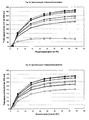
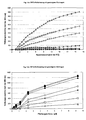
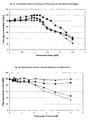
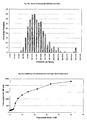
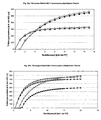
- the turbidity increase for P-pool and for 1: 2 diluted P-pool is nearly linear when a thrombin reagent with 200-450 mIU / ml of thrombin is used ( Figure 1a, b ).
- the correct quotient of 0.5 from the absorption increases in diluted P pool and P pool is achieved by 200-450 mlU / ml thrombin ( Figure 1c).
- the maximum turbidity increase for P-pool is about 450 mA; Approximately 70% of the maximum turbidity increase is achieved using 300 mlU / ml thrombin in the thrombin reagent and 5 min reaction time at RT ( Figure 1d).
- the optimal thrombin concentration in the FIFTA reagent is 200-450 mlU / ml, resulting in a ⁇ A / 5 min (RT) of 250-350 mA / 5 min for P-pool.
- 300 mlUU / ml was selected as the optimal thrombin concentration for the FIFTA reagent, ie, 200 mlU / ml final IIa concentration resulting in a ⁇ A / 5 min of about 300 mA for P-pool.
- the basal absorption of the 100% pooled plasma is about 150 mA, addition of 100 ⁇ l of 6% BSA-PBS increases the absorption by about 100 mA.
- FIFTA FIFTA reagent
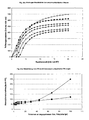
- the FIFTA reagent contained 200 mlU / ml thrombin, 6% BSA-PBS and 0, 50, 100, 200, 400, 800 or 1600 ⁇ g / ml Polybrene® (PB; hexadimethrine bromide).
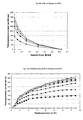
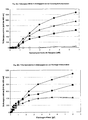
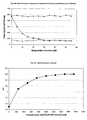
- Figs.2a-g show the neutralization (inhibition) of heparin by Polybrene ®.
- FIFTA reagent containing 400 ug / ml polybrene ® plasmatic concentrations of heparin up to 20 IU / ml are neutralized (inhibited).
- the basal turbidity increase in heparin plasma depends on the heparin concentration of the plasma and the PB concentrate in the FIFTA reagent (Figure 5).
- the basal increase in turbidity by 25 ⁇ l of 50 mg / ml PB added to 50 ⁇ l of P-pool is approximately 200 mA (FIG. 4).
- P-pool or P-pool diluted 1: 2 with PBS or with 6% BSA-PBS were analyzed in FIFTA using the 200 mlU / ml thrombin reagent without albumin.
- Turbidity-based functional fibrinogen determinations depend on the albumin concentration of the sample.
- the FIFTA on the other hand does not depend on the albumin concentration of the sample.
- the FIFTA would depend on the albumin concentration of the sample: when the P-pool is diluted 1: 2 with PBS, the fibrinogen measured is about 70% of the undiluted plasma, rather than 50%; this means that in patients with blood albumin concentrations reduced to about 50% of the norm, the turbidimetrically measured functional fibrinogen is about 40% incorrectly too high.
- the P-pool is diluted 1: 2 with 6% albumin PBS
- the measured fibrinogen is actually 50% of the undiluted P-pool ( Figures 6a, b). Addition of 6% albumin to the FIFTA reagent results in the correct 50% result for all dilute plasmas, either diluted with PBS or with 6% albumin.
- fibrinogen concentrations in the FIFTA and FIATA are reproduced correctly.
- Clauss method of fibrinogen measured in 1: 2 diluted plasma by 8% too high and measured in 1: 4 diluted plasma fibrinogen value by 35% too low compared to the expected value results for the 1: 2 diluted plasma a fibrinogen value, which is 20% too high compared to the expected value, for the 1: 4 diluted plasma results in a 49% increased Fibrinogen value compared to the expected value and for the 1: 8 diluted plasma results in an increased 83% fibrinogen value compared to the expected value.
- Some patients, in particular intensive care patients have plasma albumin concentrations of about 10 g / l, ie below 25% of the norm. This can lead to grossly falsified fibrinogen levels when fibrinogen is determined in such prior art plasmas.
- the FIFTA was performed with P-Pool and with 6% BSA-PBS dilutions of P-Pool. The turbidity increase was determined after 0-15 min and after 25 min, 75 min, 17 h at RT. The FIFTA was further performed with a 100% normal pool and a 200% fibrinogen pool (256% Fbgen pool diluted with 100% normal pooled plasma).
- the 256% Fbgen pool was assayed in FIFTA with 0-17 min reaction time (at RT). The 120% / 256% and 63% / 256% turbidity quotients were calculated.
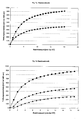
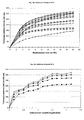
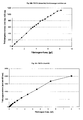
- Figs. 7a, b show the reaction kinetics of the FIFTA. At about 15 min reaction time at RT, the test reaches its maximum asymptotically. After approx. 5 min at RT approx. 60% of the maximum is reached.
- Fig. 7b shows the linearity of the calibration line of the FIFTA. A linear relationship between fibrinogen activity and turbidity increase exists at reaction times ⁇ 5 min at RT and active fibrinogen ⁇ 150% of the norm.
- Fig. 7c shows the reaction of the 200% and 100% pools. The 100% / 200% turbidity quotient is stable at 0.5 with a reaction time> 4 min at RT.
- Figure 7d shows the response of the 256% Fbgen pool, 120% plasma and 63% plasma.
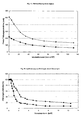
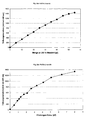
- the FIFTA was performed with 256% Fbgen pool and 256% Fbgen pool diluted 1: 2 with 6% BSA-PBS. After reaction times of 30-370 seconds at 10 second intervals and after 20 and 60 minutes in a 37 ° C water bath, the turbidity increase at 405 nm was determined. The 128% / 256% haze quotient was calculated for each reaction time.
- Fig. 8a shows the turbidity increase as a function of the reaction time at 37 ° C.
- the half-maximum haze increase occurs at a reaction time of 100 seconds (37 ° C) for the 256% Fbgen pool and a reaction time of 190 seconds (37 ° C) for the 128% dilution of the Fbgen pool.
- the 128% / 256% absorption-increase quotient reaches the correct value of 0.5 with a reaction time of 2-4 min (37 ° C) ( Figure 8b). Therefore, the optimal FIFTA reaction time is 5 min at RT or 2 min at 37 ° C.
- the resulting absorbance was determined at 405 nm, 450 nm, 595 nm, and 650 nm by a microtiter plate reader.
- the turbidity is best measured at 405 nm. Higher wavelengths lead to a decrease in turbidity ( Figure 9).
- lyophilized purified human fibrinogen (Haemochrom Enzyme Res. Essen, Germany) was reconstituted with 12.5 ml of either 6% BSA-PBS or P-Pool (containing 4.04 g / L fibrinogen).
- the resulting supplemented fibrinogen samples were diluted 1: 2, 1: 4, 1: 8, 1:16, 1:32, 1:64, 1: 128 with either 6% BSA-PBS or P-Pool and the FIFTA carried out.
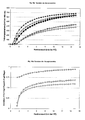
- 10a, b show the reaction kinetics of purified fibrinogen in 6% BSA-PBS in FIFTA as a function of the reaction time at RT or as a function of the concentration of active fibrinogen. At 15 min (RT) about 75% of the maximum turbidity is reached. There is no further increase if the reaction time is extended from 48 minutes to 158 minutes or 18 hours.
- 10c, d show the reaction kinetics of P-pool supplemented with purified fibrinogen as a function of the reaction time at RT or as a function of the resulting active fibrinogen concentration. At 15 min (RT) about 80% of the maximum turbidity is reached. An extension of the reaction time from 48 minutes to 158 minutes or 18 hours results in a 5-10% decrease in the final turbidity.
- Fig.10e shows the comparison between fibrinogen in BSA and fibrinogen in plasma.
- Fbgen pool and 256% Fbgen pool supplemented with purified active fibrinogen at 277% or 300% of the standard were analyzed in the FIFTA and in a FIFTA version with halved test volumes. 225% Fbgen pool was supplemented with active fibrinogen to 300% Fbgen pool and supplemented with physiol. NaCl diluted. These plasma samples with 0-300% fibrinogen were determined in FIFTA.
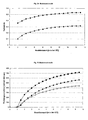
- the FIFTA is nearly linear in the fibrinogen activity range of about 25-250% of the normal mean (MV). 100% of the standard fibrinogen plasma results in a ⁇ A of about 250 mA (FIGS. 11a-c).
- the FIFTA can also be performed with 25 ⁇ l plasma and 50 ⁇ l reagent, resulting in a ⁇ A of approximately 125 mA in the microtiter plate ( Figure 11a).
- 256% Fbgen pool and the 256% Fbgen pool diluted 1: 2 with 6% BSA-PBS were used in the FIFTA (50 ⁇ l sample + 100 ⁇ l thrombin reagent).
- 67 ⁇ l of 256% Fbgen pool or 1: 2 diluted Fbgen pool were incubated with 83 ⁇ l thrombin reagent.
- 100 ⁇ l of 256% Fbgen pool or 1: 2 diluted Fbgen pool was incubated with 50 ⁇ l thrombin reagent containing 600 mlU / ml thrombin; the absorption quotients 128% / 256% were calculated.
- Figs. 12a, b show that only the 50 ⁇ l + 100 ⁇ l FIFTA version - in contrast to a 67 ⁇ l + 83 ⁇ l or to a 100 ⁇ l + 50 ⁇ l test version - into a correct 128% / 256% absorbance increase quotient of 0.5 at 5 min RT results.
- the lower detection limit of the FIFTA was defined as 3 times the SD of the 0 value.
- the lower detection limit of the FIFTA is 25% of the standard (0.7 g / l) when the reaction time is 5 min at RT; Prolongation of the reaction time to 15 min (RT) leads to a lower detection limit, which is reduced to 7% of the standard (0.2 g / l).
- the 144% P-pool was analyzed 10 times intra-assay and inter-assay. The mean values were determined and the coefficients of variation were calculated.
- n 39 normal citrated plasmas were analyzed in the FIFTA to obtain mean (MV) and standard deviation (SD) thus giving the normal range (MV ⁇ 1 SD) of plasma fibrinogen function.
- the test was calibrated against pooled normal plasmas and against commercially available frozen 100% normal plasma containing 2.8 g / l active fibrinogen (Haemochrom, Essen, Germany).
- n 334 unselected patient plasmas ( ⁇ 6 h at the time of the usual rejection of the blood samples) FIFTA was performed and the results were compared with the fibrinogen concentrations measured in the routine (modified Clauss method; Behring Coagulation Timer, DadeBehring, Marburg, Germany: 100 ⁇ l sample + 200 ⁇ l 50 IU / ml bovine thrombin, 0.15 g / 1 Gly-Pro-Arg-Pro-Ala-amide, 1.5 g / 1 CaCl 2 , 15 ⁇ g / ml Polybrene®, 0.8 g / L polyethylene glycol 6000, 6.4 g / L NaCl, 50 mM Tris, 1% bovine albumin, determination of clotting time).
- the turbidity increase at 405 nm was determined immediately after each heparin addition step and as a function of incubation time. To determine the heparin addition time (at RT) necessary to reduce the turbidity increase by 50% (inhibition time 50%) after 5 min, 10 min, 15 min or 20 min, 50 ⁇ l of P-Pool were incubated with 100 ⁇ l 200 mlU / ml thrombin in 6% BSA-PBS (without Polybrene®). After 0 seconds (before thrombin addition) and 10-140 seconds (at 10 second intervals), 10 ⁇ l of 160 IU / ml heparin in 6% BSA-PBS was added. The turbidity increase at 405 nm was determined as a function of the incubation time (3-20 min).
- Heparin can inhibit fibrin formation only within the first 2 min (RT) ( Figures 15a-c).
- RT time incubation time
- 10 IU / ml final heparin concentration at 30 s incubation time (RT) about 50% of the fibrinogen is converted into fibrin; ie 133 mIU / ml final thrombin convert about 50% of the plasmatic fibrinogen within about 30 seconds.
- the 15 min fibrin turbidity is> 80% of the maximum turbidity seen before.
- the turbidity increase in the presence of 10 IU / ml heparin is higher within the first 5 min reaction time as the one in the absence of heparin.
- the time of addition of heparin which leads to a 50% decrease in ⁇ A (ITP50) at 5-20 min incubation time (RT), is about 30 s.
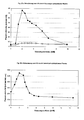
- a final arginine concentration ⁇ 125 mM completely inhibits the turbidity increase when arginine acts since the onset of thrombin activity ( Figures 16a-c).
- Semi-maximal turbidity increase occurs at 62.5 mM arginine.
- 16 mM arginine increase the turbidity increase by about 20%.
- 125 mM arginine can only inhibit ⁇ A if it reacts within the first 100 s (RT) of the Thrombin / fibrinogen interaction is added.
- Fig. 16d shows that final arginine concentrations ⁇ 250 mM ⁇ A can only inhibit if they are added to the thrombin / fibrinogen interaction within the first 3 min (RT).
- Half-maximal turbidity increases at the 7 min or 15 min reaction time result from 94 mM or 477 mM arginine.
- IC50 of chloramine-T® against plasmatic fibrinogen is about 2 mM ( Figure 18).
- 750 ⁇ l of 256% of the norm active fibrinogen in P-Pool was supplemented with 250 ⁇ l of a) 1 O 2 inhibitors methionine (200 mM) or sodium ascorbate (200 mM), b). OH radical inhibitor mannitol (200 mM), or c ) H 2 O. 25 ⁇ l samples thereof were incubated with 25 ⁇ l of 0-2.5 mM vancomycin or 0-5 mM chloramine-T® in PBS for 15 min at 37 ° C.
- the vancomycin interaction with fibrinogen in plasma can not be inhibited by methionine, ascorbate, or mannitol ( Figure 19a).
- the 100% control of methionine or H 2 O had a turbidity increase / 5 min (RT) of 386 ⁇ 11 mA, that of ascorbate was 360 ⁇ 14 mA and that of mannitol was 435 ⁇ 12 mA.
- the control experiment with chloramine-T® instead of vancomycin showed that the chloramine reaction with plasmatic fibrinogen can be inhibited by methionine or ascorbate ( Figure 19b). Therefore, in the reaction mechanism of vancomycin interaction with fibrinogen, unlike that between chloroamines and fibrinogen, non-reactive oxygen species of the singlet oxygen type appear to be involved.
- P-Pool or 1: 2 or 1: 4 diluted (in 6% BSA-PBS) P-Pool was incubated with 50 ⁇ l 0 - 6.8 mM vancomycin in PBS.
- ⁇ A at 405 nm after 1 min (RT) certainly.
- 25 ⁇ l Fbgen pool (300% of the standard, 8.4 g / l fibrinogen antigen) was incubated with 125 ⁇ l 0.55 mM, 1.1 mM, or 2.2 mM vancomycin in PBS for 1 min (RT). Then ⁇ A was determined at 405 nm.
- Fig. 20b shows that 68.8 ⁇ mol of vancomycin added to 25 ⁇ l of 300% Fbgen pool result in a saturation of ⁇ A at approximately 4 g / l of fibrinogen. At 137.5-275 ⁇ mol vancomycin, this saturation occurs at 6-8 g / L fibrinogen.
- the optimal vancomycin concentration in the vancomycin reagent of FIATA is 3-6 mM.
- 250 mg of lyophilized purified fibrinogen were reconstituted with 12.5 ml of 6% BSA-PBS or P-Pool.
- the supplemented fibrinogen samples thus obtained were diluted 1: 2, 1: 4, 1: 8, 1:16, 1:32, 1:64, 1: 128 with either BSA-PBS or P-pool to yield samples with 0 - 20 g / l fibrinogen antigen in BSA-PBS or those with 4 - 24 g / l fibrinogen antigen in P-pool.
- Fig. 21 shows the reaction of purified fibrinogen in the FIATA.
- a fibrinogen concentration of 10 g / l results in a ⁇ A of about 1000 mA, both for fibrinogen in 6% albumin and for fibrinogen in P-pool.
- the FIATA is linear to about 8 g / L (286% of normal) fibrinogen in the sample, giving a ⁇ A of about 800 mA.
- 0-55 ⁇ l 300% of the standard (8.4 g / l) P-pool was incubated with a) 50 ⁇ l PBS and 50 ⁇ l 4.4mM vancomycin in PBS or b) 100 ⁇ l PBS and 100 ⁇ l 4.4mM vancomycin in PBS.
- 0-35 ⁇ l of 300% Fbgen pool was incubated with 35-0 ⁇ l PBS (for volume balance) and a) 50 ⁇ l PBS and 50 ⁇ l 4.4mM vancomycin in PBS or b) 100 ⁇ l PBS and 100 ⁇ l 4.4mM vancomycin in PBS.
- the FIATA is nearly linear up to a fibrinogen concentration of about 150% of the norm (4.2 g / l) (Fig. 22a, b). Doubling the test volumes results in a doubling of absorption at 405 nm ( Figure 22c). Since the self-turbidity of 50 ⁇ l of plasma could be> 500 mA (hypertryglyceridemic or hyperbilirubinemic patients), the 25 ⁇ l / 50 ⁇ l / 50 ⁇ l FIATA version is the preferred version ( Figure 22d). A modified FIATA with 50 ⁇ l sample and 50 ⁇ l reagent is linear only up to about 100% of the standard fibrinogen (Fig. 22e).
- the lower detection limit of the FIATA - defined as 3 times the SD of the 0% value - is 4% of the norm (0.1 g / l).
- n 39 normal citrated plasma samples were analyzed in the FIATA to obtain mean and standard deviation (SD) resulting in the normal range of antigenic fibrinogen (0 ⁇ 1 SD) in plasma.
- SD standard deviation
- the FIATA was calibrated with pooled normal student plasmas and with commercial 100% normal pooled plasma containing 2.8 g / l fibrinogen, frozen without lyophilization additives (Haemochrom, Essen, Germany).
- FIATA was performed and compared with the routinely measured fibrinogen concentrations (modified Clauss method (Multifibren U®) on a Behring Coagulation Timer , DadeBehring, Marburg, Germany).
- modified Clauss method Multifibren U®
- FIATA was compared to a new turbidimetric functional fibrinogen assay, the FIFTA: 50 ⁇ l plasma + 100 ⁇ l 300 ml U / ml thrombin, 6% albumin PBS, 400 ⁇ g / ml Polybrene®; Determination of ⁇ A / 5 min (RT).
- 25 ⁇ l of the 143% (4.0 g / l) P-pool were incubated with 25 ⁇ l 0-50 mM vancomycin in PBS, 50 ⁇ l PBS, 0.1% Triton X 100® and 50 ⁇ l 850 mM KCl in H 2 O for 1 min (RT). The turbidity at 405 nm was determined. To reverse the precipitation, 0-110 ⁇ l of 1 M NaHCO 3 , pH 8.6, or H 2 O was added to 50 ⁇ l of P-pool which had reacted with 50 ⁇ l of 4.4 mM vancomycin in PBS for 1 min (RT).
- the supernatant was separated from the precipitate.
- the precipitate was not washed or washed 3x with H 2 O and centrifuged each time after resuspension.
- the unwashed precipitate was dissolved by the addition of 500 ⁇ l 1 M NaHCO 3 , pH 8.6, and 4500 ⁇ l PBS; the washed precipitate was dissolved by addition of 300 ⁇ l of 1 M NaHCO 3 to 1700 ⁇ l in dist. H 2 O resuspended precipitate. 3 batches of washed precipitate were dried at room temperature and weighed. The dissolved precipitate and supernatant were functionally assayed for fibrinogen.
- the turbidity increases up to about 20-fold (Fig. 24a).
- This precipitation can be reversed by NaHCO 3 ; 30 ⁇ l of 1 M NaHCO 3 , pH 8.6 lower the resulting turbidity to the PBS control value (without vancomycin).
- Addition of H 2 O instead of NaHCO 3 does not alter the turbidity produced by the vancomycin / plasma reaction ( Figure 24b).
- the generated turbidity is also reduced by the addition of arginine, pH 7.5, but not by PBS and only slightly by 20-fold concentrated PBS ( Figure 24c).
- Addition of ⁇ 10 ul 1 M NaHCO3, pH 8.6 to 50 .mu.l plasma and 50 ul of PBS resulted in a pH of ⁇ 8.5 (Fig. 24d).
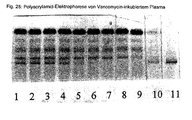
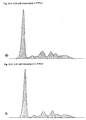
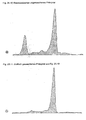
- Fibrinogen occurs in the ß2 fraction of plasma electrophoresis.
- An increase in vancomycin concentration in the plasma leads to a proportional reduction of the ß2 fraction (Fig. 25 1-9).
- the ⁇ 2 peak disappears completely selectively.
- the ⁇ 2 fractions of vancomycin-treated plasmas were 10.9%, 10.6%, 10.4%, 8.0%, 6.4%, 5.2%, 5.5%, 0% and 0% for 0 mM, 0.29 mM, 0.44 mM, 0.66 mM, 0.99 mM, respectively. 1.48 mM, 2.22 mM, 5 mM and 10 mM vancomycin, respectively.
- fibrinogen concentration in the supernatant of 1 part plasma and 1 part 4.4 mM vancomycin in PBS was 0.32 g / L, i. 0.64 g / L fibrinogen remained at initial 4.0 g / L. As a result, 16% of the fibrinogen remained in the plasma, whereas 84% of the fibrinogen was precipitated by 4.4mM vancomycin.
- Fig. 25.10. shows the electrophoresis of dissolved unwashed supernatant. 77% of the protein is found in the ß fraction of electrophoresis, about 23% is albumin.
- the total protein concentration was 6.1 g / l, the albumin concentration 0.82 g / l, and the pseudocholinesterase activity (PCHE) 136 U / l.
- the P pool had an albumin concentration of 27 g / L and a PCHE of 3340 U / I.
- Control 1 consisted of the addition of vancomycin after (instead of before) the NaHCO 3.
- Control 2 consisted of replacement of vancomycin from control 1 by PBS.
- Control 3 consisted of replacement of vancomycin and NaHCO 3 from control 1 by PBS.
- a control experiment consisted in the incubation of 50 ⁇ l P-pool with 0-50 ⁇ l 1 M NaHCO 3 , pH 8.6, 50 ⁇ l PBS and 200 ⁇ l FIFTA reagent.
- 25 ⁇ l of P-pool were incubated with 25 ⁇ l 0-50 mM vancomycin in PBS and 50 ⁇ l 1000 IU / ml t-PA in PBS, 0.1% Triton X 100® and 25 ⁇ l 0 mM or 15 mM Chloramin-T® for 30 min (RT). Then, 25 ⁇ l of 2.7 mM Val-Leu-Lys-pNA, 1.7 M KCl was added and the resulting plasmin activity was determined by measuring the linear ⁇ A / min at RT on a microtiter plate reader.
- Normal plasma supplemented with 260% of the norm soluble fibrin gives a FIATA result of 271% of the norm and a FIFTA result of 171% of the norm. Pooled centrifuged serum gives 0% FIFTA and FIATA.
- 25 ⁇ l P-Pool was incubated with 25 ⁇ l PBS or with 25 ⁇ l 2 mM Chloramin-T® in PBS. After 60 min at RT, 25 ⁇ l 0-172 mM EDTA in PBS was added. After 5 min at RT, FIATA and FIFTA were performed as in 2.7. listed.
- Fig. 1 a-d Optimization of thrombin concentration
- Thrombin concentrations in thrombin reagent 0 mlU / ml (0), 26 mlU / ml ( ⁇ ), 39 mlU / ml (-), 59 mlU / ml (X), 89 mlU / ml (*), 133 mlU / mL ( ⁇ ), 200 mLU / mL (+), 300 mLU / mL (•), 450 mLU / mL (0), 675 mLU / mL ( ⁇ ), 1013 mLU / mL
- Fig. 2a-d Optimization of the Polybrene® (PB) concentration
- the FIFTA reagent contained 200 mlU / ml thrombin, 6% BSA-PBS and 0 ⁇ g / ml Polybrene® (PB, Fig. 2a), 50 ⁇ g / ml PB (Fig. 2b), 100 ⁇ g / ml PB (Fig.
- the FIFTA reagent contained 200 mlU / ml thrombin, 6% BSA-PBS and 400 ⁇ g / ml PB ( Figure 2e), 800 ⁇ g / ml PB (Figure 2f), 1600 ⁇ g / ml PB ( Figure 2g); Heparin concentrations in the sample: 0 IU / ml ( ⁇ ), 11 IU / ml ( ⁇ ), 13 IU / ml ( ⁇ ), 17 IU / ml (X), 21 IU / ml (*), 26 IU / ml (•), 33 IU / ml (+), 41 IU / ml ( ⁇ ), 51 IU / ml ( ⁇ ), 64 IU / ml (O), 80 IU / ml ( ⁇ ), 100 IU / ml ( -).
- Fig. 3 Neutralization of 100 IU / ml heparin in plasma by Polybrene®
- Fig. 4 FIFTA in Polybrene® neutralized heparinized plasma
- Fig. 5 Haze increase due to heparin / Polybrene® complexes
- Fig. 7a, b Reaction kinetics of the FIFTA
- the FIFTA was performed with P-pool and with 6% albumin-PBS dilutions of P-pool.
- ⁇ A was determined after 0-15 min and after 25 min, 75 min, 17 h (RT); Fibrinogen activity [% of norm] in the sample: 0% (O), 2.5% (), 3.9% (-), 5.7% (0), 8.6% (•), 19% (+), 29% ( ⁇ ), 43% (*), 65% ( ⁇ ), 98% ( ⁇ ), 146% (A) ( Figure 7a).
- ⁇ A after 2 min ( ⁇ ), 5 min ( ⁇ ), 10 min ( ⁇ ), 15 min ( ⁇ ), 25 min (*), 75 min (•), 17 h (O) (Fig. 7b).
- the FIFTA was performed with 100% normal pool (•), 200% pool plasma ( ⁇ ) (Figure 7c), 256% plasma pool (•) 120% plasma pool ( ⁇ ), and 63% plasma Pool ( ⁇ ) (Fig. 7d); ⁇ A quotients 120% / 256% (•) and 63% / 256% ( ⁇ ) ( Figure 7e).
- the FIFTA was performed with 300% Fbgen pool ( ⁇ ), with 300% Fbgen pool (•) diluted 1: 2 with 6% BSA-PBS and with 120% standard pool plasma ( ⁇ ) (Fig. 7f); ⁇ A - quotient 150% / 300% (Fig. 7g).
- Fig. 8a, b Reaction kinetics at 37 ° C
- the FIFTA was performed with 256% Fbgen pool ( ⁇ ) and 256% Fbgen pool diluted 1: 2 with 6% BSA-PBS (•). After reaction times of 30-370 seconds at 10 second intervals and after 20 and 60 minutes in a 37 ° C water bath, the turbidity increase at 405 nm was determined ( Figure 8a). The 125% / 250% ⁇ A quotients were calculated ( Figure 8b).
- the FIFTA was carried out with 300% Fbgen pool and dilutions thereof (with 6% BSA-PBS); 50 ⁇ l + 100 ⁇ l test version (•), 25 ⁇ l + 50 ⁇ l test version (O).
- the FIFTA was carried out with 300% Fbgen pool and dilutions (physiological NaCl) therefrom; Fibrinogen activity in the samples: 0% (-), 17% ( ⁇ ), 23% ( ⁇ ), 30% (0), 40% (*), 53% (•), 71% (+), 95% (X), 127% (O), 169% ( ⁇ ), 225% ( ⁇ ), 300% ( ⁇ ) Turbidity increase as a function of reaction time (Figure 9b); ⁇ A as a function of fibrinogen activity (Figure 9c): Incubation times at RT: 2.5 min (O), 5 min (•), 10 min ( ⁇ ), 15 min ( ⁇ ).
- Fig. 11 Absorption wavelength for turbidity
- Fig. 12 a-e Addition calibration of the FIFTA with purified fibrinogen
- Fig. 14a, b IC50 of heparin in the FIFTA
- Fig. 15a Inhibitory time 50% of 10 IU / ml heparin in FIFTA
- Fig. 15b, c Inhibitory time 50% of 10 IU / ml heparin in FIFTA
- 50 ⁇ l P-Pool was incubated with 100 ⁇ l 200 mlU / ml thrombin in 6% BSA-PBS (without Polybrene®). After incubation times of 10 s ( ⁇ ), 20 s ( ⁇ ), 30 s ( ⁇ ), 40 s (X), 50 s (*), 60 s (•), 70 s (+), 80 s ( ⁇ ) , 90 s (-), 100 s (- ⁇ -), 110 s ( ⁇ ), 120 s (- ⁇ -), 130 s (-x-), 140 s (- * -) at RT were 10 ⁇ l 160 lU / ml heparin added in 6% BSA-PBS; Control: Add 10 ⁇ l 0 lU / ml heparin ( ⁇ ).
- ⁇ A at 405 nm was determined.
- the turbidity increase at 405 nm was determined ( Figure 14b).
- Fig. 16a, b Inhibition of fibrin formation by arginine
- Fig. 16c Inhibition of fibrin formation by arginine
- Fig. 16d Inhibition of fibrin formation by arginine
- Fig. 17 Fibrin dissolution by arginine
- Fig. 19a, b Is the reaction between vancomycin and plasmatic fibrinogen inhibitable by antioxidants?
- Fig. 20a ⁇ A as a function of vancomycin concentration
- Fig. 20b ⁇ A as a function of the fibrinogen concentration
- Fig. 21 FIATA calibration with purified fibrinogen
- 250 mg lyophilized purified fibrinogen was reconstituted with 12.5 ml of either 6% BSA-PBS (•) or P-Pool ( ⁇ ).
- the supplemented fibrinogen samples obtained were diluted 1: 2, 1: 4, 1: 8, 1:16, 1:32, 1:64, 1: 128 with either BSA-PBS or P-pool, resulting in samples either 0-20 g / L fibrinogen in BSA-PBS or samples containing 4-24 g / L fibrinogen in P-pool.
- the FIATA was carried out.
- Fig. 22a-e FIATA linearity
- Fbgen pool was diluted with 6% BSA-PBS and tested in FIATA (Fig. 22a).
- 300% Fbgen pool was diluted with standard serum and tested in FIATA (Fig. 22b).
- the test volumes of Fig. 22b were doubled and the FIATA was performed (Fig. 22c).
- 0-55 ⁇ l 250% Fbgen pool was incubated with a) 50 ⁇ l PBS and 50 ⁇ l 4.4mM vancomycin in PBS. ⁇ A at 405 nm was determined (Fig. 22d).
- the FIATA was performed with 50 ⁇ l of sample (0-300% of the norm) and 50 ⁇ l of 4.4 mM vancomycin in PBS ( Figure 22e).
- Fig. 23a-c FIATA correlation with functional fibrinogen determinations
- Fig. 24a Precipitation of plasmatic fibrinogen by vancomycin
- 25 ⁇ l of 143% (4.0 g / l) P-pool were incubated with 25 ⁇ l 0-50 mM vancomycin in PBS, 50 ⁇ l PBS, 0.1% Triton X 100® and 50 ⁇ l 850 mM KCl in H 2 O for 1 min (RT). ⁇ A at 405 nm was determined.
- Fig. 24b Abolition of vancomycin-induced fibrinogen precipitation NaHCO 3
- Fig. 24d Abolition of vancomycin-induced fibrinogen precipitation by arginine
- Fig. 25 Electrophoresis of plasma incubated with vancomycin
- Fig. 26a-c Fibrinogen reactivity in vancomycin-precipitated plasma
- Fig. 27a Stimulation of t-PA by vancomycin-precipitated fibrinogen
- 0-100 ⁇ l of the dissolved precipitate from Fig. 25 and 100-0 ⁇ l PBS were incubated with 50 ⁇ l 0.1 mg / ml glu-plasminogen in PBS, 1% BSA, 50 ⁇ l 0.6 M PO 4 3 buffer, pH 7.4, (•) , or 50 ⁇ l 1M NaHCO 3 , pH 8.6 ( ⁇ ), and 50 ⁇ l 1000 IU / ml t-PA in PBS, 0.1% Triton X 100® for 30 min (RT). Then, 25 ⁇ l of 2.7 mM Val-Leu-Lys-pNA, 1.7 M KCl was added and ⁇ A at 405 nm / h RT was determined.
- Fig. 27b, c Stimulation of t-PA by vancomycin-precipitated plasma
- 25 ⁇ l P-pool was incubated with 25 ⁇ l 0-22 mM vancomycin in PBS and 50 ⁇ l 1000 IU / ml t-PA in PBS, 0.1% Triton X 100® and 25 ⁇ l 0 mM (O) or 15 mM chloramine-T ® (•) for 30 min at RT. Then, 25 ⁇ l of 2.7 mM Val-Leu-Lys-pNA, 1.7 M KCl was added and the resulting plasmin activity was measured by determining ⁇ A / min RT (Figure 27b). Extension of the final incubation time to 158 min (RT) in a non-oxidized approach ( Figure 27c).
- Fig. 28 Vancomycin reactivity with oxidized plasma
- Fig. 29 Vancomycin reactivity with EDTA-supplemented plasma
- 25 ⁇ l P-Pool were incubated with 25 ⁇ l PBS (O) or with 25 ⁇ l 2 mM Chloramin-T® PBS (•). After 60 min (RT), 25 ⁇ l of 0-172 mM EDTA in PBS were added. After 5 min (RT), FIATA (-) and FIFTA (- - -) were performed.
- Fig. 30 Vancomycin reactivity with t-PA incubated plasma
- 25 ⁇ l 300% Fbgen pool was incubated with 25 ⁇ l PBS (O) or 15 mM chloramine-T®, PBS (•) for 60 min (RT). Then, 50 ⁇ l of 1000 IU / ml t-PA, 0.1% Triton X 100®, PBS was added. After 0-8 h (RT), 25 ⁇ l of 4.4 mM vancomycin, PBS were added and ⁇ A at 405 nm was determined.
Landscapes
- Health & Medical Sciences (AREA)
- Life Sciences & Earth Sciences (AREA)
- Chemical & Material Sciences (AREA)
- Engineering & Computer Science (AREA)
- Hematology (AREA)
- Molecular Biology (AREA)
- Organic Chemistry (AREA)
- Immunology (AREA)
- Biochemistry (AREA)
- Microbiology (AREA)
- Urology & Nephrology (AREA)
- Zoology (AREA)
- Wood Science & Technology (AREA)
- Biomedical Technology (AREA)
- Physics & Mathematics (AREA)
- Analytical Chemistry (AREA)
- Biotechnology (AREA)
- General Health & Medical Sciences (AREA)
- Proteomics, Peptides & Aminoacids (AREA)
- Biophysics (AREA)
- Bioinformatics & Cheminformatics (AREA)
- Pathology (AREA)
- General Physics & Mathematics (AREA)
- Medicinal Chemistry (AREA)
- Food Science & Technology (AREA)
- Cell Biology (AREA)
- Neurosurgery (AREA)
- General Engineering & Computer Science (AREA)
- Genetics & Genomics (AREA)
- Investigating Or Analysing Biological Materials (AREA)
- Measuring Or Testing Involving Enzymes Or Micro-Organisms (AREA)
- Medicines That Contain Protein Lipid Enzymes And Other Medicines (AREA)
- Peptides Or Proteins (AREA)
Applications Claiming Priority (2)
| Application Number | Priority Date | Filing Date | Title |
|---|---|---|---|
| DE10325173A DE10325173B4 (de) | 2003-06-04 | 2003-06-04 | Nachweisverfahren für Fibrinogen und/oder Fibrinogen-Derivate |
| EP04010893A EP1484615B1 (fr) | 2003-06-04 | 2004-06-02 | Procédé de détection du fibrinogène et/ou de ses derivés |
Related Parent Applications (1)
| Application Number | Title | Priority Date | Filing Date |
|---|---|---|---|
| EP04010893A Division EP1484615B1 (fr) | 2003-06-04 | 2004-06-02 | Procédé de détection du fibrinogène et/ou de ses derivés |
Publications (3)
| Publication Number | Publication Date |
|---|---|
| EP1816478A2 true EP1816478A2 (fr) | 2007-08-08 |
| EP1816478A3 EP1816478A3 (fr) | 2007-11-14 |
| EP1816478B1 EP1816478B1 (fr) | 2009-08-12 |
Family
ID=33154536
Family Applications (2)
| Application Number | Title | Priority Date | Filing Date |
|---|---|---|---|
| EP07009386A Expired - Lifetime EP1816478B1 (fr) | 2003-06-04 | 2004-06-02 | Procédé de détection du fibrinogène et/ou de ses derivés |
| EP04010893A Expired - Lifetime EP1484615B1 (fr) | 2003-06-04 | 2004-06-02 | Procédé de détection du fibrinogène et/ou de ses derivés |
Family Applications After (1)
| Application Number | Title | Priority Date | Filing Date |
|---|---|---|---|
| EP04010893A Expired - Lifetime EP1484615B1 (fr) | 2003-06-04 | 2004-06-02 | Procédé de détection du fibrinogène et/ou de ses derivés |
Country Status (6)
| Country | Link |
|---|---|
| US (2) | US7510879B2 (fr) |
| EP (2) | EP1816478B1 (fr) |
| AT (2) | ATE439602T1 (fr) |
| DE (4) | DE10362199B4 (fr) |
| ES (2) | ES2302998T3 (fr) |
| PT (1) | PT1484615E (fr) |
Families Citing this family (6)
| Publication number | Priority date | Publication date | Assignee | Title |
|---|---|---|---|---|
| DE10362199B4 (de) * | 2003-06-04 | 2009-09-10 | Stief, Thomas, Dr.med. | Nachweisverfahren für Fibrinogen |
| RU2298189C2 (ru) * | 2005-06-23 | 2007-04-27 | Государственное учреждение Научно-исследовательский институт терапии Сибирского отделения Российской Академии медицинских наук | Способ определения окислительной модификации фибриногена плазмы крови |
| EP2434290B1 (fr) | 2009-05-20 | 2016-02-10 | Sekisui Medical Co., Ltd. | Agent prolongeant le temps de coagulation du sang |
| WO2011019664A1 (fr) * | 2009-08-09 | 2011-02-17 | Rolls-Royce Corporation | Système, procédé et appareil pour verser une matière de coulée dans un moulage à la cire perdue |
| CN103743912B (zh) * | 2013-12-31 | 2015-11-18 | 浙江爱康生物科技有限公司 | 一种b因子测定试剂盒及其制备方法 |
| CN110257475B (zh) * | 2019-06-28 | 2023-05-02 | 深圳市国赛生物技术有限公司 | 纤维蛋白原检测试剂及其制备方法及检测试剂制品 |
Citations (3)
| Publication number | Priority date | Publication date | Assignee | Title |
|---|---|---|---|---|
| EP0137269A1 (fr) | 1983-08-25 | 1985-04-17 | Roche Diagnostics GmbH | Procédé pour la détermination simultanée de fibrinogène et de produits du clivage du fibrinogène dans le plasma |
| DE4133946A1 (de) | 1991-10-14 | 1993-04-15 | Behringwerke Ag | Funktioneller test und reagenz zur bestimmung von fibrinogen |
| US6448024B1 (en) | 2000-10-03 | 2002-09-10 | Roche Diagnostics Corporation | Method, reagent, cartridge, and device for determining fibrinogen |
Family Cites Families (8)
| Publication number | Priority date | Publication date | Assignee | Title |
|---|---|---|---|---|
| US4962406A (en) * | 1989-12-26 | 1990-10-09 | Westinghouse Electric Corp. | Compact DC/AC circuit breaker with common arc extinguishing capability |
| TW221493B (fr) * | 1990-07-10 | 1994-03-01 | Cardiovascular Diagnostics Inc | |
| JP2994557B2 (ja) * | 1994-09-02 | 1999-12-27 | 株式会社アズウェル | フィブリノゲン測定方法およびその測定試薬 |
| ATE325533T1 (de) * | 1995-09-29 | 2006-06-15 | Univ Indiana Res & Tech Corp | Verfahren zum verbesserten virusvermittelten dns- transfer unter verwendung von molekülen mit virus-und zellbindenden domänen |
| US5935804A (en) * | 1997-03-21 | 1999-08-10 | Laine; Roger A. | Method for detecting eubacteria in biological samples with catalytically inactive murein binding enzymes |
| US20020168398A1 (en) * | 2001-03-06 | 2002-11-14 | Yves Delmotte | Elongated biopolymer structure containing fibrin |
| EP1585386A4 (fr) * | 2002-02-20 | 2009-09-02 | American Integrated Biolog Inc | Production genique dans la salive |
| DE10362199B4 (de) * | 2003-06-04 | 2009-09-10 | Stief, Thomas, Dr.med. | Nachweisverfahren für Fibrinogen |
-
2003
- 2003-06-04 DE DE10362199A patent/DE10362199B4/de not_active Expired - Fee Related
- 2003-06-04 DE DE10325173A patent/DE10325173B4/de not_active Expired - Fee Related
-
2004
- 2004-06-02 PT PT04010893T patent/PT1484615E/pt unknown
- 2004-06-02 EP EP07009386A patent/EP1816478B1/fr not_active Expired - Lifetime
- 2004-06-02 DE DE502004009902T patent/DE502004009902D1/de not_active Expired - Lifetime
- 2004-06-02 DE DE502004006813T patent/DE502004006813D1/de not_active Expired - Lifetime
- 2004-06-02 EP EP04010893A patent/EP1484615B1/fr not_active Expired - Lifetime
- 2004-06-02 ES ES04010893T patent/ES2302998T3/es not_active Expired - Lifetime
- 2004-06-02 AT AT07009386T patent/ATE439602T1/de active
- 2004-06-02 AT AT04010893T patent/ATE392624T1/de active
- 2004-06-02 ES ES07009386T patent/ES2329300T3/es not_active Expired - Lifetime
- 2004-06-02 US US10/858,683 patent/US7510879B2/en not_active Expired - Fee Related
-
2009
- 2009-01-13 US US12/352,698 patent/US7741124B2/en not_active Expired - Fee Related
Patent Citations (4)
| Publication number | Priority date | Publication date | Assignee | Title |
|---|---|---|---|---|
| EP0137269A1 (fr) | 1983-08-25 | 1985-04-17 | Roche Diagnostics GmbH | Procédé pour la détermination simultanée de fibrinogène et de produits du clivage du fibrinogène dans le plasma |
| EP0137269B1 (fr) | 1983-08-25 | 1987-03-18 | Roche Diagnostics GmbH | Procédé pour la détermination simultanée de fibrinogène et de produits du clivage du fibrinogène dans le plasma |
| DE4133946A1 (de) | 1991-10-14 | 1993-04-15 | Behringwerke Ag | Funktioneller test und reagenz zur bestimmung von fibrinogen |
| US6448024B1 (en) | 2000-10-03 | 2002-09-10 | Roche Diagnostics Corporation | Method, reagent, cartridge, and device for determining fibrinogen |
Non-Patent Citations (2)
| Title |
|---|
| COLLER, B.S. ET AL.: "Effects of Vancomycin on Platelets, Plasma Proteins and Hepatitis B Surface Antigen", THROMBOS. DIATHES. HAEMORRH., vol. 34, no. 1, 1975, pages 83 - 93 |
| MACKIE ET AL., THROMB. HAEMOST., vol. 87, 2002, pages 997 - 1005 |
Also Published As
| Publication number | Publication date |
|---|---|
| EP1816478B1 (fr) | 2009-08-12 |
| US20090176310A1 (en) | 2009-07-09 |
| DE502004006813D1 (de) | 2008-05-29 |
| EP1484615A2 (fr) | 2004-12-08 |
| DE10362199B4 (de) | 2009-09-10 |
| PT1484615E (pt) | 2008-06-20 |
| ATE392624T1 (de) | 2008-05-15 |
| DE502004009902D1 (de) | 2009-09-24 |
| DE10325173A1 (de) | 2004-12-30 |
| ES2302998T3 (es) | 2008-08-01 |
| EP1484615B1 (fr) | 2008-04-16 |
| US7510879B2 (en) | 2009-03-31 |
| US20040253739A1 (en) | 2004-12-16 |
| ES2329300T3 (es) | 2009-11-24 |
| EP1816478A3 (fr) | 2007-11-14 |
| DE10325173B4 (de) | 2007-11-08 |
| EP1484615A3 (fr) | 2005-08-24 |
| US7741124B2 (en) | 2010-06-22 |
| ATE439602T1 (de) | 2009-08-15 |
Similar Documents
| Publication | Publication Date | Title |
|---|---|---|
| DE69018910T2 (de) | Verfahren zur Bestimmung des endogenen Thrombinpotentials von Plasma und Blut und Reagenziensatz zur Verwendung in besagtem Verfahren. | |
| DE69919702T2 (de) | Verfahren zur Bestimmung der Blutgerinnung in Plasma | |
| EP0158254B1 (fr) | Réactif pour la détermination du temps de thromboplastine | |
| EP2079849B1 (fr) | Procédé et dispositifs pour la détermination électrochimique d'inhibiteurs du facteur xa dans des échantillons de sang | |
| EP2484776B1 (fr) | Procédé héparine-insensible pour la détection des inhibiteurs directes du facteur de coagulation | |
| EP0915340A1 (fr) | Procédé pour déterminer le potentiel anticoagulent d'un échantillon | |
| EP0711838B2 (fr) | Méthode de détection spécifique d'agent de coagulation V avec une stabilité augmentée vis à vis de la protéine C activée | |
| EP1734369B1 (fr) | Procédure de normalisation des essais de coagulation | |
| EP1816478B1 (fr) | Procédé de détection du fibrinogène et/ou de ses derivés | |
| EP0216179A1 (fr) | Procédé pour la détermination d'inhibiteurs de protéase | |
| DE10360628A1 (de) | Kontrollplasma für Thrombinaktivitätstests | |
| AT402824B (de) | Test zur bestimmung der empfindlichkeit einer testprobe gegenüber aktiviertem protein c | |
| EP0972203A1 (fr) | Reactif pour determiner le temps de cephaline active | |
| EP0408075B1 (fr) | Méthode et réactif pour la détermination d'antithrombine III | |
| EP0825443B1 (fr) | Procédure pour la détermination quantitative de glycosaminoglycan dans une solution contenant de l'antithrombine III | |
| EP2486145B1 (fr) | Procédé de détermination du facteur XIII au moyen de matériel de référence à base de plasma. | |
| DE69916816T2 (de) | Verbesserter blutgerinnungstest | |
| EP1853925B1 (fr) | Procede pour determiner l'activite de coagulation globale d'un echantillon de sang ou de plasma | |
| EP2316931B1 (fr) | Peptidases couplées par polymère | |
| EP3535410A1 (fr) | Substance de contrôle universelle utilisée pour réaliser des tests relatifs à des inhibiteurs de facteurs de la coagulation | |
| EP1672369A1 (fr) | Procédé de determination de parametres de la coagulation sanguine, especiallement dans des systemes de flux | |
| EP1600775A2 (fr) | Méthode pour la détermination de la réactivité de lipopolysaccharide et/ou de lipide A et/ou de glucan, cette détermination étant indépendante de facteurs anti-limulus |
Legal Events
| Date | Code | Title | Description |
|---|---|---|---|
| PUAI | Public reference made under article 153(3) epc to a published international application that has entered the european phase |
Free format text: ORIGINAL CODE: 0009012 |
|
| AC | Divisional application: reference to earlier application |
Ref document number: 1484615 Country of ref document: EP Kind code of ref document: P |
|
| AK | Designated contracting states |
Kind code of ref document: A2 Designated state(s): AT BE BG CH CY CZ DE DK EE ES FI FR GB GR HU IE IT LI LU MC NL PL PT RO SE SI SK TR |
|
| PUAL | Search report despatched |
Free format text: ORIGINAL CODE: 0009013 |
|
| AK | Designated contracting states |
Kind code of ref document: A3 Designated state(s): AT BE BG CH CY CZ DE DK EE ES FI FR GB GR HU IE IT LI LU MC NL PL PT RO SE SI SK TR |
|
| 17P | Request for examination filed |
Effective date: 20080514 |
|
| AKX | Designation fees paid |
Designated state(s): AT BE BG CH CY CZ DE DK EE ES FI FR GB GR HU IE IT LI LU MC NL PL PT RO SE SI SK TR |
|
| 17Q | First examination report despatched |
Effective date: 20081230 |
|
| GRAP | Despatch of communication of intention to grant a patent |
Free format text: ORIGINAL CODE: EPIDOSNIGR1 |
|
| GRAS | Grant fee paid |
Free format text: ORIGINAL CODE: EPIDOSNIGR3 |
|
| GRAA | (expected) grant |
Free format text: ORIGINAL CODE: 0009210 |
|
| AC | Divisional application: reference to earlier application |
Ref document number: 1484615 Country of ref document: EP Kind code of ref document: P |
|
| AK | Designated contracting states |
Kind code of ref document: B1 Designated state(s): AT BE BG CH CY CZ DE DK EE ES FI FR GB GR HU IE IT LI LU MC NL PL PT RO SE SI SK TR |
|
| REG | Reference to a national code |
Ref country code: GB Ref legal event code: FG4D Free format text: NOT ENGLISH |
|
| REG | Reference to a national code |
Ref country code: CH Ref legal event code: EP |
|
| REG | Reference to a national code |
Ref country code: IE Ref legal event code: FG4D |
|
| REF | Corresponds to: |
Ref document number: 502004009902 Country of ref document: DE Date of ref document: 20090924 Kind code of ref document: P |
|
| REG | Reference to a national code |
Ref country code: SE Ref legal event code: TRGR |
|
| REG | Reference to a national code |
Ref country code: CH Ref legal event code: NV Representative=s name: PATENTANWAELTE SCHAAD, BALASS, MENZL & PARTNER AG |
|
| REG | Reference to a national code |
Ref country code: ES Ref legal event code: FG2A Ref document number: 2329300 Country of ref document: ES Kind code of ref document: T3 |
|
| PG25 | Lapsed in a contracting state [announced via postgrant information from national office to epo] |
Ref country code: FI Free format text: LAPSE BECAUSE OF FAILURE TO SUBMIT A TRANSLATION OF THE DESCRIPTION OR TO PAY THE FEE WITHIN THE PRESCRIBED TIME-LIMIT Effective date: 20090812 |
|
| PG25 | Lapsed in a contracting state [announced via postgrant information from national office to epo] |
Ref country code: SI Free format text: LAPSE BECAUSE OF FAILURE TO SUBMIT A TRANSLATION OF THE DESCRIPTION OR TO PAY THE FEE WITHIN THE PRESCRIBED TIME-LIMIT Effective date: 20090812 Ref country code: PL Free format text: LAPSE BECAUSE OF FAILURE TO SUBMIT A TRANSLATION OF THE DESCRIPTION OR TO PAY THE FEE WITHIN THE PRESCRIBED TIME-LIMIT Effective date: 20090812 |
|
| REG | Reference to a national code |
Ref country code: IE Ref legal event code: FD4D |
|
| PG25 | Lapsed in a contracting state [announced via postgrant information from national office to epo] |
Ref country code: BG Free format text: LAPSE BECAUSE OF FAILURE TO SUBMIT A TRANSLATION OF THE DESCRIPTION OR TO PAY THE FEE WITHIN THE PRESCRIBED TIME-LIMIT Effective date: 20091112 Ref country code: PT Free format text: LAPSE BECAUSE OF FAILURE TO SUBMIT A TRANSLATION OF THE DESCRIPTION OR TO PAY THE FEE WITHIN THE PRESCRIBED TIME-LIMIT Effective date: 20091212 |
|
| PG25 | Lapsed in a contracting state [announced via postgrant information from national office to epo] |
Ref country code: RO Free format text: LAPSE BECAUSE OF FAILURE TO SUBMIT A TRANSLATION OF THE DESCRIPTION OR TO PAY THE FEE WITHIN THE PRESCRIBED TIME-LIMIT Effective date: 20090812 Ref country code: CZ Free format text: LAPSE BECAUSE OF FAILURE TO SUBMIT A TRANSLATION OF THE DESCRIPTION OR TO PAY THE FEE WITHIN THE PRESCRIBED TIME-LIMIT Effective date: 20090812 Ref country code: EE Free format text: LAPSE BECAUSE OF FAILURE TO SUBMIT A TRANSLATION OF THE DESCRIPTION OR TO PAY THE FEE WITHIN THE PRESCRIBED TIME-LIMIT Effective date: 20090812 Ref country code: DK Free format text: LAPSE BECAUSE OF FAILURE TO SUBMIT A TRANSLATION OF THE DESCRIPTION OR TO PAY THE FEE WITHIN THE PRESCRIBED TIME-LIMIT Effective date: 20090812 Ref country code: IE Free format text: LAPSE BECAUSE OF FAILURE TO SUBMIT A TRANSLATION OF THE DESCRIPTION OR TO PAY THE FEE WITHIN THE PRESCRIBED TIME-LIMIT Effective date: 20090812 |
|
| PG25 | Lapsed in a contracting state [announced via postgrant information from national office to epo] |
Ref country code: SK Free format text: LAPSE BECAUSE OF FAILURE TO SUBMIT A TRANSLATION OF THE DESCRIPTION OR TO PAY THE FEE WITHIN THE PRESCRIBED TIME-LIMIT Effective date: 20090812 |
|
| PLBE | No opposition filed within time limit |
Free format text: ORIGINAL CODE: 0009261 |
|
| STAA | Information on the status of an ep patent application or granted ep patent |
Free format text: STATUS: NO OPPOSITION FILED WITHIN TIME LIMIT |
|
| 26N | No opposition filed |
Effective date: 20100517 |
|
| PG25 | Lapsed in a contracting state [announced via postgrant information from national office to epo] |
Ref country code: GR Free format text: LAPSE BECAUSE OF FAILURE TO SUBMIT A TRANSLATION OF THE DESCRIPTION OR TO PAY THE FEE WITHIN THE PRESCRIBED TIME-LIMIT Effective date: 20091113 |
|
| PG25 | Lapsed in a contracting state [announced via postgrant information from national office to epo] |
Ref country code: MC Free format text: LAPSE BECAUSE OF NON-PAYMENT OF DUE FEES Effective date: 20100630 |
|
| PG25 | Lapsed in a contracting state [announced via postgrant information from national office to epo] |
Ref country code: CY Free format text: LAPSE BECAUSE OF FAILURE TO SUBMIT A TRANSLATION OF THE DESCRIPTION OR TO PAY THE FEE WITHIN THE PRESCRIBED TIME-LIMIT Effective date: 20090812 |
|
| PG25 | Lapsed in a contracting state [announced via postgrant information from national office to epo] |
Ref country code: LU Free format text: LAPSE BECAUSE OF NON-PAYMENT OF DUE FEES Effective date: 20100602 Ref country code: HU Free format text: LAPSE BECAUSE OF FAILURE TO SUBMIT A TRANSLATION OF THE DESCRIPTION OR TO PAY THE FEE WITHIN THE PRESCRIBED TIME-LIMIT Effective date: 20100213 |
|
| PG25 | Lapsed in a contracting state [announced via postgrant information from national office to epo] |
Ref country code: TR Free format text: LAPSE BECAUSE OF FAILURE TO SUBMIT A TRANSLATION OF THE DESCRIPTION OR TO PAY THE FEE WITHIN THE PRESCRIBED TIME-LIMIT Effective date: 20090812 |
|
| PGFP | Annual fee paid to national office [announced via postgrant information from national office to epo] |
Ref country code: GB Payment date: 20140618 Year of fee payment: 11 |
|
| PGFP | Annual fee paid to national office [announced via postgrant information from national office to epo] |
Ref country code: ES Payment date: 20140624 Year of fee payment: 11 Ref country code: CH Payment date: 20140618 Year of fee payment: 11 Ref country code: AT Payment date: 20140611 Year of fee payment: 11 Ref country code: DE Payment date: 20140619 Year of fee payment: 11 Ref country code: IT Payment date: 20140624 Year of fee payment: 11 Ref country code: NL Payment date: 20140618 Year of fee payment: 11 Ref country code: SE Payment date: 20140618 Year of fee payment: 11 |
|
| PGFP | Annual fee paid to national office [announced via postgrant information from national office to epo] |
Ref country code: BE Payment date: 20140620 Year of fee payment: 11 |
|
| PGFP | Annual fee paid to national office [announced via postgrant information from national office to epo] |
Ref country code: FR Payment date: 20140619 Year of fee payment: 11 |
|
| REG | Reference to a national code |
Ref country code: DE Ref legal event code: R119 Ref document number: 502004009902 Country of ref document: DE |
|
| PG25 | Lapsed in a contracting state [announced via postgrant information from national office to epo] |
Ref country code: IT Free format text: LAPSE BECAUSE OF NON-PAYMENT OF DUE FEES Effective date: 20150602 |
|
| REG | Reference to a national code |
Ref country code: CH Ref legal event code: PL |
|
| REG | Reference to a national code |
Ref country code: SE Ref legal event code: EUG |
|
| REG | Reference to a national code |
Ref country code: AT Ref legal event code: MM01 Ref document number: 439602 Country of ref document: AT Kind code of ref document: T Effective date: 20150602 |
|
| GBPC | Gb: european patent ceased through non-payment of renewal fee |
Effective date: 20150602 |
|
| PG25 | Lapsed in a contracting state [announced via postgrant information from national office to epo] |
Ref country code: SE Free format text: LAPSE BECAUSE OF NON-PAYMENT OF DUE FEES Effective date: 20150603 |
|
| REG | Reference to a national code |
Ref country code: NL Ref legal event code: MM Effective date: 20150701 |
|
| REG | Reference to a national code |
Ref country code: FR Ref legal event code: ST Effective date: 20160229 |
|
| PG25 | Lapsed in a contracting state [announced via postgrant information from national office to epo] |
Ref country code: LI Free format text: LAPSE BECAUSE OF NON-PAYMENT OF DUE FEES Effective date: 20150630 Ref country code: NL Free format text: LAPSE BECAUSE OF NON-PAYMENT OF DUE FEES Effective date: 20150701 Ref country code: CH Free format text: LAPSE BECAUSE OF NON-PAYMENT OF DUE FEES Effective date: 20150630 Ref country code: DE Free format text: LAPSE BECAUSE OF NON-PAYMENT OF DUE FEES Effective date: 20160101 Ref country code: GB Free format text: LAPSE BECAUSE OF NON-PAYMENT OF DUE FEES Effective date: 20150602 |
|
| PG25 | Lapsed in a contracting state [announced via postgrant information from national office to epo] |
Ref country code: FR Free format text: LAPSE BECAUSE OF NON-PAYMENT OF DUE FEES Effective date: 20150630 Ref country code: AT Free format text: LAPSE BECAUSE OF NON-PAYMENT OF DUE FEES Effective date: 20150602 |
|
| REG | Reference to a national code |
Ref country code: ES Ref legal event code: FD2A Effective date: 20160728 |
|
| PG25 | Lapsed in a contracting state [announced via postgrant information from national office to epo] |
Ref country code: ES Free format text: LAPSE BECAUSE OF NON-PAYMENT OF DUE FEES Effective date: 20150603 |
|
| PG25 | Lapsed in a contracting state [announced via postgrant information from national office to epo] |
Ref country code: BE Free format text: LAPSE BECAUSE OF NON-PAYMENT OF DUE FEES Effective date: 20150630 |