EP1816519B1 - Nouveau composant de sulfonium, composition photosensible comportant le composant et procédé de formation de motif utilisant la composition photosensible - Google Patents
Nouveau composant de sulfonium, composition photosensible comportant le composant et procédé de formation de motif utilisant la composition photosensible Download PDFInfo
- Publication number
- EP1816519B1 EP1816519B1 EP07002532A EP07002532A EP1816519B1 EP 1816519 B1 EP1816519 B1 EP 1816519B1 EP 07002532 A EP07002532 A EP 07002532A EP 07002532 A EP07002532 A EP 07002532A EP 1816519 B1 EP1816519 B1 EP 1816519B1
- Authority
- EP
- European Patent Office
- Prior art keywords
- group
- acid
- exemplified
- carbon atoms
- represented
- Prior art date
- Legal status (The legal status is an assumption and is not a legal conclusion. Google has not performed a legal analysis and makes no representation as to the accuracy of the status listed.)
- Not-in-force
Links
- 150000001875 compounds Chemical class 0.000 title claims abstract description 98
- 239000000203 mixture Substances 0.000 title claims abstract description 98
- 238000000034 method Methods 0.000 title claims abstract description 30
- -1 sulfonium compound Chemical class 0.000 title description 194
- 125000001424 substituent group Chemical group 0.000 claims abstract description 71
- 125000004435 hydrogen atom Chemical group [H]* 0.000 claims abstract description 60
- 125000002887 hydroxy group Chemical group [H]O* 0.000 claims abstract description 57
- 150000001450 anions Chemical class 0.000 claims abstract description 44
- 230000001476 alcoholic effect Effects 0.000 claims abstract description 23
- 125000005647 linker group Chemical group 0.000 claims abstract description 17
- 239000011347 resin Substances 0.000 claims description 129
- 229920005989 resin Polymers 0.000 claims description 129
- 239000002253 acid Substances 0.000 claims description 86
- 239000003513 alkali Substances 0.000 claims description 31
- 230000009471 action Effects 0.000 claims description 26
- 238000010894 electron beam technology Methods 0.000 claims description 17
- 239000003431 cross linking reagent Substances 0.000 claims description 12
- 238000004132 cross linking Methods 0.000 claims description 5
- 125000000217 alkyl group Chemical group 0.000 description 132
- 125000004432 carbon atom Chemical group C* 0.000 description 112
- 125000000753 cycloalkyl group Chemical group 0.000 description 89
- 239000000243 solution Substances 0.000 description 78
- 125000003118 aryl group Chemical group 0.000 description 63
- 229910052731 fluorine Inorganic materials 0.000 description 50
- 230000035945 sensitivity Effects 0.000 description 46
- WGTYBPLFGIVFAS-UHFFFAOYSA-M tetramethylammonium hydroxide Chemical compound [OH-].C[N+](C)(C)C WGTYBPLFGIVFAS-UHFFFAOYSA-M 0.000 description 44
- 239000002904 solvent Substances 0.000 description 43
- 125000003545 alkoxy group Chemical group 0.000 description 37
- 125000001153 fluoro group Chemical group F* 0.000 description 36
- 125000005843 halogen group Chemical group 0.000 description 34
- XLYOFNOQVPJJNP-UHFFFAOYSA-N water Chemical group O XLYOFNOQVPJJNP-UHFFFAOYSA-N 0.000 description 34
- XUIMIQQOPSSXEZ-UHFFFAOYSA-N Silicon Chemical group [Si] XUIMIQQOPSSXEZ-UHFFFAOYSA-N 0.000 description 31
- 238000007654 immersion Methods 0.000 description 31
- 0 C*(C)(C)Cc1cccc(S(C)(c2ccccc2)c2ccc(C)cc2)c1 Chemical compound C*(C)(C)Cc1cccc(S(C)(c2ccccc2)c2ccc(C)cc2)c1 0.000 description 30
- 239000004094 surface-active agent Substances 0.000 description 29
- 239000004215 Carbon black (E152) Substances 0.000 description 25
- 229930195733 hydrocarbon Natural products 0.000 description 25
- 229910052710 silicon Inorganic materials 0.000 description 25
- 239000007788 liquid Substances 0.000 description 24
- 125000002496 methyl group Chemical group [H]C([H])([H])* 0.000 description 24
- 125000003178 carboxy group Chemical group [H]OC(*)=O 0.000 description 23
- 238000011156 evaluation Methods 0.000 description 22
- 239000010703 silicon Substances 0.000 description 21
- NIXOWILDQLNWCW-UHFFFAOYSA-M Acrylate Chemical compound [O-]C(=O)C=C NIXOWILDQLNWCW-UHFFFAOYSA-M 0.000 description 19
- 125000004453 alkoxycarbonyl group Chemical group 0.000 description 19
- 238000006243 chemical reaction Methods 0.000 description 19
- 229920001577 copolymer Polymers 0.000 description 19
- 239000007787 solid Substances 0.000 description 19
- YCKRFDGAMUMZLT-UHFFFAOYSA-N Fluorine atom Chemical compound [F] YCKRFDGAMUMZLT-UHFFFAOYSA-N 0.000 description 18
- 125000004093 cyano group Chemical group *C#N 0.000 description 18
- 239000011737 fluorine Substances 0.000 description 18
- 230000000269 nucleophilic effect Effects 0.000 description 18
- 230000005855 radiation Effects 0.000 description 18
- 150000007514 bases Chemical class 0.000 description 17
- 230000000052 comparative effect Effects 0.000 description 17
- 125000001495 ethyl group Chemical group [H]C([H])([H])C([H])([H])* 0.000 description 17
- 125000002947 alkylene group Chemical group 0.000 description 16
- 150000002596 lactones Chemical group 0.000 description 16
- 239000000178 monomer Substances 0.000 description 16
- 239000000758 substrate Substances 0.000 description 16
- XEKOWRVHYACXOJ-UHFFFAOYSA-N Ethyl acetate Chemical compound CCOC(C)=O XEKOWRVHYACXOJ-UHFFFAOYSA-N 0.000 description 15
- 239000007864 aqueous solution Substances 0.000 description 15
- CERQOIWHTDAKMF-UHFFFAOYSA-M Methacrylate Chemical compound CC(=C)C([O-])=O CERQOIWHTDAKMF-UHFFFAOYSA-M 0.000 description 14
- 125000001436 propyl group Chemical group [H]C([*])([H])C([H])([H])C([H])([H])[H] 0.000 description 14
- 238000000576 coating method Methods 0.000 description 13
- 229920000642 polymer Polymers 0.000 description 13
- OKKJLVBELUTLKV-UHFFFAOYSA-N Methanol Chemical compound OC OKKJLVBELUTLKV-UHFFFAOYSA-N 0.000 description 12
- 125000002252 acyl group Chemical group 0.000 description 12
- 125000000113 cyclohexyl group Chemical group [H]C1([H])C([H])([H])C([H])([H])C([H])(*)C([H])([H])C1([H])[H] 0.000 description 12
- 238000004090 dissolution Methods 0.000 description 12
- FFUAGWLWBBFQJT-UHFFFAOYSA-N hexamethyldisilazane Chemical compound C[Si](C)(C)N[Si](C)(C)C FFUAGWLWBBFQJT-UHFFFAOYSA-N 0.000 description 12
- 125000002950 monocyclic group Chemical group 0.000 description 12
- DNIAPMSPPWPWGF-UHFFFAOYSA-N monopropylene glycol Natural products CC(O)CO DNIAPMSPPWPWGF-UHFFFAOYSA-N 0.000 description 12
- 238000010943 off-gassing Methods 0.000 description 12
- 230000003287 optical effect Effects 0.000 description 12
- 125000003710 aryl alkyl group Chemical group 0.000 description 11
- 239000011248 coating agent Substances 0.000 description 11
- 125000004108 n-butyl group Chemical group [H]C([H])([H])C([H])([H])C([H])([H])C([H])([H])* 0.000 description 11
- 125000002914 sec-butyl group Chemical group [H]C([H])([H])C([H])([H])C([H])(*)C([H])([H])[H] 0.000 description 11
- JHIVVAPYMSGYDF-UHFFFAOYSA-N cyclohexanone Chemical compound O=C1CCCCC1 JHIVVAPYMSGYDF-UHFFFAOYSA-N 0.000 description 10
- 125000001511 cyclopentyl group Chemical group [H]C1([H])C([H])([H])C([H])([H])C([H])(*)C1([H])[H] 0.000 description 10
- 238000011161 development Methods 0.000 description 10
- 230000018109 developmental process Effects 0.000 description 10
- 238000010438 heat treatment Methods 0.000 description 10
- 239000000126 substance Substances 0.000 description 10
- ZWEHNKRNPOVVGH-UHFFFAOYSA-N 2-Butanone Chemical compound CCC(C)=O ZWEHNKRNPOVVGH-UHFFFAOYSA-N 0.000 description 9
- WEVYAHXRMPXWCK-UHFFFAOYSA-N Acetonitrile Chemical compound CC#N WEVYAHXRMPXWCK-UHFFFAOYSA-N 0.000 description 9
- YLQBMQCUIZJEEH-UHFFFAOYSA-N Furan Chemical group C=1C=COC=1 YLQBMQCUIZJEEH-UHFFFAOYSA-N 0.000 description 9
- 125000004414 alkyl thio group Chemical group 0.000 description 9
- 239000013078 crystal Substances 0.000 description 9
- 125000004122 cyclic group Chemical group 0.000 description 9
- 125000000623 heterocyclic group Chemical group 0.000 description 9
- 125000001449 isopropyl group Chemical group [H]C([H])([H])C([H])(*)C([H])([H])[H] 0.000 description 9
- 125000001147 pentyl group Chemical group C(CCCC)* 0.000 description 9
- 239000011148 porous material Substances 0.000 description 9
- 125000002023 trifluoromethyl group Chemical group FC(F)(F)* 0.000 description 9
- HEDRZPFGACZZDS-UHFFFAOYSA-N Chloroform Chemical compound ClC(Cl)Cl HEDRZPFGACZZDS-UHFFFAOYSA-N 0.000 description 8
- RTZKZFJDLAIYFH-UHFFFAOYSA-N Diethyl ether Chemical compound CCOCC RTZKZFJDLAIYFH-UHFFFAOYSA-N 0.000 description 8
- CATSNJVOTSVZJV-UHFFFAOYSA-N heptan-2-one Chemical compound CCCCCC(C)=O CATSNJVOTSVZJV-UHFFFAOYSA-N 0.000 description 8
- 230000002401 inhibitory effect Effects 0.000 description 8
- 125000001997 phenyl group Chemical group [H]C1=C([H])C([H])=C(*)C([H])=C1[H] 0.000 description 8
- 229920002120 photoresistant polymer Polymers 0.000 description 8
- IANQTJSKSUMEQM-UHFFFAOYSA-N 1-benzofuran Chemical group C1=CC=C2OC=CC2=C1 IANQTJSKSUMEQM-UHFFFAOYSA-N 0.000 description 7
- FCEHBMOGCRZNNI-UHFFFAOYSA-N 1-benzothiophene Chemical group C1=CC=C2SC=CC2=C1 FCEHBMOGCRZNNI-UHFFFAOYSA-N 0.000 description 7
- YTPLMLYBLZKORZ-UHFFFAOYSA-N Thiophene Chemical group C=1C=CSC=1 YTPLMLYBLZKORZ-UHFFFAOYSA-N 0.000 description 7
- 125000004423 acyloxy group Chemical group 0.000 description 7
- 125000005073 adamantyl group Chemical group C12(CC3CC(CC(C1)C3)C2)* 0.000 description 7
- 125000000732 arylene group Chemical group 0.000 description 7
- 239000003999 initiator Substances 0.000 description 7
- 125000000959 isobutyl group Chemical group [H]C([H])([H])C([H])(C([H])([H])[H])C([H])([H])* 0.000 description 7
- 125000000962 organic group Chemical group 0.000 description 7
- 239000003960 organic solvent Substances 0.000 description 7
- 125000004430 oxygen atom Chemical group O* 0.000 description 7
- 238000006116 polymerization reaction Methods 0.000 description 7
- 229920001343 polytetrafluoroethylene Polymers 0.000 description 7
- 239000004810 polytetrafluoroethylene Substances 0.000 description 7
- 125000000391 vinyl group Chemical group [H]C([*])=C([H])[H] 0.000 description 7
- XLLXMBCBJGATSP-UHFFFAOYSA-N 2-phenylethenol Chemical compound OC=CC1=CC=CC=C1 XLLXMBCBJGATSP-UHFFFAOYSA-N 0.000 description 6
- 125000003903 2-propenyl group Chemical group [H]C([*])([H])C([H])=C([H])[H] 0.000 description 6
- YEJRWHAVMIAJKC-UHFFFAOYSA-N 4-Butyrolactone Chemical compound O=C1CCCO1 YEJRWHAVMIAJKC-UHFFFAOYSA-N 0.000 description 6
- ZCYVEMRRCGMTRW-UHFFFAOYSA-N 7553-56-2 Chemical group [I] ZCYVEMRRCGMTRW-UHFFFAOYSA-N 0.000 description 6
- WKBOTKDWSSQWDR-UHFFFAOYSA-N Bromine atom Chemical group [Br] WKBOTKDWSSQWDR-UHFFFAOYSA-N 0.000 description 6
- CERQOIWHTDAKMF-UHFFFAOYSA-N Methacrylic acid Chemical compound CC(=C)C(O)=O CERQOIWHTDAKMF-UHFFFAOYSA-N 0.000 description 6
- ZMXDDKWLCZADIW-UHFFFAOYSA-N N,N-Dimethylformamide Chemical compound CN(C)C=O ZMXDDKWLCZADIW-UHFFFAOYSA-N 0.000 description 6
- KAESVJOAVNADME-UHFFFAOYSA-N Pyrrole Chemical compound C=1C=CNC=1 KAESVJOAVNADME-UHFFFAOYSA-N 0.000 description 6
- HEDRZPFGACZZDS-MICDWDOJSA-N Trichloro(2H)methane Chemical compound [2H]C(Cl)(Cl)Cl HEDRZPFGACZZDS-MICDWDOJSA-N 0.000 description 6
- 125000004450 alkenylene group Chemical group 0.000 description 6
- 125000005079 alkoxycarbonylmethyl group Chemical group 0.000 description 6
- 125000004390 alkyl sulfonyl group Chemical group 0.000 description 6
- 239000002585 base Substances 0.000 description 6
- 230000015572 biosynthetic process Effects 0.000 description 6
- 125000002915 carbonyl group Chemical group [*:2]C([*:1])=O 0.000 description 6
- 229910052801 chlorine Inorganic materials 0.000 description 6
- 125000001309 chloro group Chemical group Cl* 0.000 description 6
- 235000019441 ethanol Nutrition 0.000 description 6
- 125000001033 ether group Chemical group 0.000 description 6
- LZCLXQDLBQLTDK-UHFFFAOYSA-N ethyl 2-hydroxypropanoate Chemical compound CCOC(=O)C(C)O LZCLXQDLBQLTDK-UHFFFAOYSA-N 0.000 description 6
- 229910052740 iodine Inorganic materials 0.000 description 6
- 239000005453 ketone based solvent Substances 0.000 description 6
- 125000001624 naphthyl group Chemical group 0.000 description 6
- 229920003986 novolac Polymers 0.000 description 6
- 230000036961 partial effect Effects 0.000 description 6
- 125000003367 polycyclic group Chemical group 0.000 description 6
- 238000002360 preparation method Methods 0.000 description 6
- 239000000047 product Substances 0.000 description 6
- 125000006239 protecting group Chemical group 0.000 description 6
- 229910052717 sulfur Inorganic materials 0.000 description 6
- 125000004434 sulfur atom Chemical group 0.000 description 6
- 125000000999 tert-butyl group Chemical group [H]C([H])([H])C(*)(C([H])([H])[H])C([H])([H])[H] 0.000 description 6
- RWSOTUBLDIXVET-UHFFFAOYSA-N Dihydrogen sulfide Chemical class S RWSOTUBLDIXVET-UHFFFAOYSA-N 0.000 description 5
- 239000007983 Tris buffer Substances 0.000 description 5
- 125000004442 acylamino group Chemical group 0.000 description 5
- 239000000654 additive Substances 0.000 description 5
- 125000002723 alicyclic group Chemical group 0.000 description 5
- 125000004656 alkyl sulfonylamino group Chemical group 0.000 description 5
- 125000003277 amino group Chemical group 0.000 description 5
- 125000006598 aminocarbonylamino group Chemical group 0.000 description 5
- 125000004657 aryl sulfonyl amino group Chemical group 0.000 description 5
- 125000003917 carbamoyl group Chemical group [H]N([H])C(*)=O 0.000 description 5
- 125000002993 cycloalkylene group Chemical group 0.000 description 5
- 125000001559 cyclopropyl group Chemical group [H]C1([H])C([H])([H])C1([H])* 0.000 description 5
- 238000001312 dry etching Methods 0.000 description 5
- 125000004185 ester group Chemical group 0.000 description 5
- 235000019439 ethyl acetate Nutrition 0.000 description 5
- 125000006162 fluoroaliphatic group Chemical group 0.000 description 5
- 125000003709 fluoroalkyl group Chemical group 0.000 description 5
- 125000004051 hexyl group Chemical group [H]C([H])([H])C([H])([H])C([H])([H])C([H])([H])C([H])([H])C([H])([H])* 0.000 description 5
- 150000002576 ketones Chemical class 0.000 description 5
- 238000004519 manufacturing process Methods 0.000 description 5
- LGRLWUINFJPLSH-UHFFFAOYSA-N methanide Chemical compound [CH3-] LGRLWUINFJPLSH-UHFFFAOYSA-N 0.000 description 5
- JESXATFQYMPTNL-UHFFFAOYSA-N mono-hydroxyphenyl-ethylene Natural products OC1=CC=CC=C1C=C JESXATFQYMPTNL-UHFFFAOYSA-N 0.000 description 5
- 125000001971 neopentyl group Chemical group [H]C([*])([H])C(C([H])([H])[H])(C([H])([H])[H])C([H])([H])[H] 0.000 description 5
- 125000000449 nitro group Chemical group [O-][N+](*)=O 0.000 description 5
- 125000002868 norbornyl group Chemical group C12(CCC(CC1)C2)* 0.000 description 5
- ISWSIDIOOBJBQZ-UHFFFAOYSA-N phenol group Chemical group C1(=CC=CC=C1)O ISWSIDIOOBJBQZ-UHFFFAOYSA-N 0.000 description 5
- 230000008569 process Effects 0.000 description 5
- ARXJGSRGQADJSQ-UHFFFAOYSA-N 1-methoxypropan-2-ol Chemical compound COCC(C)O ARXJGSRGQADJSQ-UHFFFAOYSA-N 0.000 description 4
- SSDXRQPCUYNTHB-UHFFFAOYSA-M 2-(4-dibenzothiophen-5-ium-5-ylphenyl)ethanol;1,1,2,2,3,3,4,4,4-nonafluorobutane-1-sulfonate Chemical compound [O-]S(=O)(=O)C(F)(F)C(F)(F)C(F)(F)C(F)(F)F.C1=CC(CCO)=CC=C1[S+]1C2=CC=CC=C2C2=CC=CC=C21 SSDXRQPCUYNTHB-UHFFFAOYSA-M 0.000 description 4
- BGAMENQMEGNYTO-UHFFFAOYSA-M 2-(4-dibenzothiophen-5-ium-5-ylphenyl)ethanol;2,4,6-tri(propan-2-yl)benzenesulfonate Chemical compound CC(C)C1=CC(C(C)C)=C(S([O-])(=O)=O)C(C(C)C)=C1.C1=CC(CCO)=CC=C1[S+]1C2=CC=CC=C2C2=CC=CC=C21 BGAMENQMEGNYTO-UHFFFAOYSA-M 0.000 description 4
- NIXOWILDQLNWCW-UHFFFAOYSA-N 2-Propenoic acid Natural products OC(=O)C=C NIXOWILDQLNWCW-UHFFFAOYSA-N 0.000 description 4
- XLLIQLLCWZCATF-UHFFFAOYSA-N 2-methoxyethyl acetate Chemical compound COCCOC(C)=O XLLIQLLCWZCATF-UHFFFAOYSA-N 0.000 description 4
- LFQSCWFLJHTTHZ-UHFFFAOYSA-N Ethanol Chemical compound CCO LFQSCWFLJHTTHZ-UHFFFAOYSA-N 0.000 description 4
- SIKJAQJRHWYJAI-UHFFFAOYSA-N Indole Chemical compound C1=CC=C2NC=CC2=C1 SIKJAQJRHWYJAI-UHFFFAOYSA-N 0.000 description 4
- AFVFQIVMOAPDHO-UHFFFAOYSA-N Methanesulfonic acid Chemical compound CS(O)(=O)=O AFVFQIVMOAPDHO-UHFFFAOYSA-N 0.000 description 4
- NQRYJNQNLNOLGT-UHFFFAOYSA-N Piperidine Chemical compound C1CCNCC1 NQRYJNQNLNOLGT-UHFFFAOYSA-N 0.000 description 4
- VYPSYNLAJGMNEJ-UHFFFAOYSA-N Silicium dioxide Chemical compound O=[Si]=O VYPSYNLAJGMNEJ-UHFFFAOYSA-N 0.000 description 4
- WYURNTSHIVDZCO-UHFFFAOYSA-N Tetrahydrofuran Chemical compound C1CCOC1 WYURNTSHIVDZCO-UHFFFAOYSA-N 0.000 description 4
- 125000003342 alkenyl group Chemical group 0.000 description 4
- 125000004466 alkoxycarbonylamino group Chemical group 0.000 description 4
- 125000005194 alkoxycarbonyloxy group Chemical group 0.000 description 4
- 125000004397 aminosulfonyl group Chemical group NS(=O)(=O)* 0.000 description 4
- 125000004391 aryl sulfonyl group Chemical group 0.000 description 4
- 125000000751 azo group Chemical group [*]N=N[*] 0.000 description 4
- 150000001602 bicycloalkyls Chemical group 0.000 description 4
- 238000009835 boiling Methods 0.000 description 4
- 125000004106 butoxy group Chemical group [*]OC([H])([H])C([H])([H])C(C([H])([H])[H])([H])[H] 0.000 description 4
- 125000000484 butyl group Chemical group [H]C([*])([H])C([H])([H])C([H])([H])C([H])([H])[H] 0.000 description 4
- 125000001951 carbamoylamino group Chemical group C(N)(=O)N* 0.000 description 4
- 239000003795 chemical substances by application Substances 0.000 description 4
- 238000007334 copolymerization reaction Methods 0.000 description 4
- BGTOWKSIORTVQH-UHFFFAOYSA-N cyclopentanone Chemical compound O=C1CCCC1 BGTOWKSIORTVQH-UHFFFAOYSA-N 0.000 description 4
- NGDPCAMPVQYGCW-UHFFFAOYSA-N dibenzothiophene 5-oxide Chemical compound C1=CC=C2S(=O)C3=CC=CC=C3C2=C1 NGDPCAMPVQYGCW-UHFFFAOYSA-N 0.000 description 4
- 125000001301 ethoxy group Chemical group [H]C([H])([H])C([H])([H])O* 0.000 description 4
- 238000001914 filtration Methods 0.000 description 4
- 125000003187 heptyl group Chemical group [H]C([*])([H])C([H])([H])C([H])([H])C([H])([H])C([H])([H])C([H])([H])C([H])([H])[H] 0.000 description 4
- CBOIHMRHGLHBPB-UHFFFAOYSA-N hydroxymethyl Chemical compound O[CH2] CBOIHMRHGLHBPB-UHFFFAOYSA-N 0.000 description 4
- 125000000956 methoxy group Chemical group [H]C([H])([H])O* 0.000 description 4
- 239000012046 mixed solvent Substances 0.000 description 4
- 125000004923 naphthylmethyl group Chemical group C1(=CC=CC2=CC=CC=C12)C* 0.000 description 4
- 229910052757 nitrogen Inorganic materials 0.000 description 4
- 238000007344 nucleophilic reaction Methods 0.000 description 4
- 125000002347 octyl group Chemical group [H]C([*])([H])C([H])([H])C([H])([H])C([H])([H])C([H])([H])C([H])([H])C([H])([H])C([H])([H])[H] 0.000 description 4
- MDHYEMXUFSJLGV-UHFFFAOYSA-N phenethyl acetate Chemical compound CC(=O)OCCC1=CC=CC=C1 MDHYEMXUFSJLGV-UHFFFAOYSA-N 0.000 description 4
- LLHKCFNBLRBOGN-UHFFFAOYSA-N propylene glycol methyl ether acetate Chemical compound COCC(C)OC(C)=O LLHKCFNBLRBOGN-UHFFFAOYSA-N 0.000 description 4
- 230000002829 reductive effect Effects 0.000 description 4
- 229920006395 saturated elastomer Polymers 0.000 description 4
- 125000000542 sulfonic acid group Chemical group 0.000 description 4
- 238000003786 synthesis reaction Methods 0.000 description 4
- 125000000101 thioether group Chemical group 0.000 description 4
- QAEDZJGFFMLHHQ-UHFFFAOYSA-N trifluoroacetic anhydride Chemical compound FC(F)(F)C(=O)OC(=O)C(F)(F)F QAEDZJGFFMLHHQ-UHFFFAOYSA-N 0.000 description 4
- 238000005160 1H NMR spectroscopy Methods 0.000 description 3
- 125000000094 2-phenylethyl group Chemical group [H]C1=C([H])C([H])=C(C([H])=C1[H])C([H])([H])C([H])([H])* 0.000 description 3
- KFZMGEQAYNKOFK-UHFFFAOYSA-N Isopropanol Chemical compound CC(C)O KFZMGEQAYNKOFK-UHFFFAOYSA-N 0.000 description 3
- KWYUFKZDYYNOTN-UHFFFAOYSA-M Potassium hydroxide Chemical compound [OH-].[K+] KWYUFKZDYYNOTN-UHFFFAOYSA-M 0.000 description 3
- HEMHJVSKTPXQMS-UHFFFAOYSA-M Sodium hydroxide Chemical compound [OH-].[Na+] HEMHJVSKTPXQMS-UHFFFAOYSA-M 0.000 description 3
- PPBRXRYQALVLMV-UHFFFAOYSA-N Styrene Natural products C=CC1=CC=CC=C1 PPBRXRYQALVLMV-UHFFFAOYSA-N 0.000 description 3
- YXFVVABEGXRONW-UHFFFAOYSA-N Toluene Chemical compound CC1=CC=CC=C1 YXFVVABEGXRONW-UHFFFAOYSA-N 0.000 description 3
- ZMANZCXQSJIPKH-UHFFFAOYSA-N Triethylamine Chemical compound CCN(CC)CC ZMANZCXQSJIPKH-UHFFFAOYSA-N 0.000 description 3
- QYKIQEUNHZKYBP-UHFFFAOYSA-N Vinyl ether Chemical class C=COC=C QYKIQEUNHZKYBP-UHFFFAOYSA-N 0.000 description 3
- 230000032683 aging Effects 0.000 description 3
- 150000001334 alicyclic compounds Chemical class 0.000 description 3
- 150000007824 aliphatic compounds Chemical class 0.000 description 3
- 125000001931 aliphatic group Chemical group 0.000 description 3
- 125000004849 alkoxymethyl group Chemical group 0.000 description 3
- 125000003368 amide group Chemical group 0.000 description 3
- 230000003321 amplification Effects 0.000 description 3
- 150000001448 anilines Chemical class 0.000 description 3
- 125000001204 arachidyl group Chemical group [H]C([*])([H])C([H])([H])C([H])([H])C([H])([H])C([H])([H])C([H])([H])C([H])([H])C([H])([H])C([H])([H])C([H])([H])C([H])([H])C([H])([H])C([H])([H])C([H])([H])C([H])([H])C([H])([H])C([H])([H])C([H])([H])C([H])([H])C([H])([H])[H] 0.000 description 3
- 125000005162 aryl oxy carbonyl amino group Chemical group 0.000 description 3
- 125000005161 aryl oxy carbonyl group Chemical group 0.000 description 3
- 125000005110 aryl thio group Chemical group 0.000 description 3
- 125000001797 benzyl group Chemical group [H]C1=C([H])C([H])=C(C([H])=C1[H])C([H])([H])* 0.000 description 3
- 125000005382 boronyl group Chemical group 0.000 description 3
- 229910052799 carbon Inorganic materials 0.000 description 3
- 239000007795 chemical reaction product Substances 0.000 description 3
- 238000001816 cooling Methods 0.000 description 3
- 238000000354 decomposition reaction Methods 0.000 description 3
- 125000002704 decyl group Chemical group [H]C([H])([H])C([H])([H])C([H])([H])C([H])([H])C([H])([H])C([H])([H])C([H])([H])C([H])([H])C([H])([H])C([H])([H])* 0.000 description 3
- 239000006185 dispersion Substances 0.000 description 3
- 125000003438 dodecyl group Chemical group [H]C([H])([H])C([H])([H])C([H])([H])C([H])([H])C([H])([H])C([H])([H])C([H])([H])C([H])([H])C([H])([H])C([H])([H])C([H])([H])C([H])([H])* 0.000 description 3
- 150000002148 esters Chemical class 0.000 description 3
- 229940116333 ethyl lactate Drugs 0.000 description 3
- XLYOFNOQVPJJNP-UHFFFAOYSA-M hydroxide Chemical compound [OH-] XLYOFNOQVPJJNP-UHFFFAOYSA-M 0.000 description 3
- 125000004029 hydroxymethyl group Chemical group [H]OC([H])([H])* 0.000 description 3
- RAXXELZNTBOGNW-UHFFFAOYSA-N imidazole Natural products C1=CNC=N1 RAXXELZNTBOGNW-UHFFFAOYSA-N 0.000 description 3
- 125000002883 imidazolyl group Chemical group 0.000 description 3
- 125000001041 indolyl group Chemical group 0.000 description 3
- 125000000686 lactone group Chemical group 0.000 description 3
- FPYJFEHAWHCUMM-UHFFFAOYSA-N maleic anhydride Chemical class O=C1OC(=O)C=C1 FPYJFEHAWHCUMM-UHFFFAOYSA-N 0.000 description 3
- 125000002960 margaryl group Chemical group [H]C([*])([H])C([H])([H])C([H])([H])C([H])([H])C([H])([H])C([H])([H])C([H])([H])C([H])([H])C([H])([H])C([H])([H])C([H])([H])C([H])([H])C([H])([H])C([H])([H])C([H])([H])C([H])([H])C([H])([H])[H] 0.000 description 3
- 125000005395 methacrylic acid group Chemical group 0.000 description 3
- 125000001570 methylene group Chemical group [H]C([H])([*:1])[*:2] 0.000 description 3
- 125000001421 myristyl group Chemical group [H]C([*])([H])C([H])([H])C([H])([H])C([H])([H])C([H])([H])C([H])([H])C([H])([H])C([H])([H])C([H])([H])C([H])([H])C([H])([H])C([H])([H])C([H])([H])C([H])([H])[H] 0.000 description 3
- 125000004433 nitrogen atom Chemical group N* 0.000 description 3
- 125000001196 nonadecyl group Chemical group [H]C([*])([H])C([H])([H])C([H])([H])C([H])([H])C([H])([H])C([H])([H])C([H])([H])C([H])([H])C([H])([H])C([H])([H])C([H])([H])C([H])([H])C([H])([H])C([H])([H])C([H])([H])C([H])([H])C([H])([H])C([H])([H])C([H])([H])[H] 0.000 description 3
- 125000001400 nonyl group Chemical group [H]C([*])([H])C([H])([H])C([H])([H])C([H])([H])C([H])([H])C([H])([H])C([H])([H])C([H])([H])C([H])([H])[H] 0.000 description 3
- 238000003199 nucleic acid amplification method Methods 0.000 description 3
- 150000002891 organic anions Chemical class 0.000 description 3
- 125000006353 oxyethylene group Chemical group 0.000 description 3
- 125000000913 palmityl group Chemical group [H]C([*])([H])C([H])([H])C([H])([H])C([H])([H])C([H])([H])C([H])([H])C([H])([H])C([H])([H])C([H])([H])C([H])([H])C([H])([H])C([H])([H])C([H])([H])C([H])([H])C([H])([H])C([H])([H])[H] 0.000 description 3
- 125000002958 pentadecyl group Chemical group [H]C([*])([H])C([H])([H])C([H])([H])C([H])([H])C([H])([H])C([H])([H])C([H])([H])C([H])([H])C([H])([H])C([H])([H])C([H])([H])C([H])([H])C([H])([H])C([H])([H])C([H])([H])[H] 0.000 description 3
- 125000004115 pentoxy group Chemical group [*]OC([H])([H])C([H])([H])C([H])([H])C(C([H])([H])[H])([H])[H] 0.000 description 3
- 125000005005 perfluorohexyl group Chemical group FC(F)(F)C(F)(F)C(F)(F)C(F)(F)C(F)(F)C(F)(F)* 0.000 description 3
- 125000005007 perfluorooctyl group Chemical group FC(C(C(C(C(C(C(C(F)(F)F)(F)F)(F)F)(F)F)(F)F)(F)F)(F)F)(F)* 0.000 description 3
- 150000002989 phenols Chemical class 0.000 description 3
- 229920001296 polysiloxane Polymers 0.000 description 3
- NLKNQRATVPKPDG-UHFFFAOYSA-M potassium iodide Chemical compound [K+].[I-] NLKNQRATVPKPDG-UHFFFAOYSA-M 0.000 description 3
- 125000002572 propoxy group Chemical group [*]OC([H])([H])C(C([H])([H])[H])([H])[H] 0.000 description 3
- 125000000168 pyrrolyl group Chemical group 0.000 description 3
- 125000004079 stearyl group Chemical group [H]C([*])([H])C([H])([H])C([H])([H])C([H])([H])C([H])([H])C([H])([H])C([H])([H])C([H])([H])C([H])([H])C([H])([H])C([H])([H])C([H])([H])C([H])([H])C([H])([H])C([H])([H])C([H])([H])C([H])([H])C([H])([H])[H] 0.000 description 3
- 125000000383 tetramethylene group Chemical group [H]C([H])([*:1])C([H])([H])C([H])([H])C([H])([H])[*:2] 0.000 description 3
- 125000003944 tolyl group Chemical group 0.000 description 3
- 125000002889 tridecyl group Chemical group [H]C([*])([H])C([H])([H])C([H])([H])C([H])([H])C([H])([H])C([H])([H])C([H])([H])C([H])([H])C([H])([H])C([H])([H])C([H])([H])C([H])([H])C([H])([H])[H] 0.000 description 3
- 125000002948 undecyl group Chemical group [H]C([*])([H])C([H])([H])C([H])([H])C([H])([H])C([H])([H])C([H])([H])C([H])([H])C([H])([H])C([H])([H])C([H])([H])C([H])([H])[H] 0.000 description 3
- JOYRKODLDBILNP-UHFFFAOYSA-N urethane group Chemical group NC(=O)OCC JOYRKODLDBILNP-UHFFFAOYSA-N 0.000 description 3
- BYEAHWXPCBROCE-UHFFFAOYSA-N 1,1,1,3,3,3-hexafluoropropan-2-ol Chemical group FC(F)(F)C(O)C(F)(F)F BYEAHWXPCBROCE-UHFFFAOYSA-N 0.000 description 2
- RNIPJYFZGXJSDD-UHFFFAOYSA-N 2,4,5-triphenyl-1h-imidazole Chemical compound C1=CC=CC=C1C1=NC(C=2C=CC=CC=2)=C(C=2C=CC=CC=2)N1 RNIPJYFZGXJSDD-UHFFFAOYSA-N 0.000 description 2
- WKBALTUBRZPIPZ-UHFFFAOYSA-N 2,6-di(propan-2-yl)aniline Chemical compound CC(C)C1=CC=CC(C(C)C)=C1N WKBALTUBRZPIPZ-UHFFFAOYSA-N 0.000 description 2
- OZAIFHULBGXAKX-UHFFFAOYSA-N 2-(2-cyanopropan-2-yldiazenyl)-2-methylpropanenitrile Chemical compound N#CC(C)(C)N=NC(C)(C)C#N OZAIFHULBGXAKX-UHFFFAOYSA-N 0.000 description 2
- SMZOUWXMTYCWNB-UHFFFAOYSA-N 2-(2-methoxy-5-methylphenyl)ethanamine Chemical compound COC1=CC=C(C)C=C1CCN SMZOUWXMTYCWNB-UHFFFAOYSA-N 0.000 description 2
- XGLVDUUYFKXKPL-UHFFFAOYSA-N 2-(2-methoxyethoxy)-n,n-bis[2-(2-methoxyethoxy)ethyl]ethanamine Chemical compound COCCOCCN(CCOCCOC)CCOCCOC XGLVDUUYFKXKPL-UHFFFAOYSA-N 0.000 description 2
- KYTNUOGCVQHEQF-UHFFFAOYSA-M 2-(4-dibenzothiophen-5-ium-5-ylphenyl)ethyl acetate;iodide Chemical compound [I-].C1=CC(CCOC(=O)C)=CC=C1[S+]1C2=CC=CC=C2C2=CC=CC=C21 KYTNUOGCVQHEQF-UHFFFAOYSA-M 0.000 description 2
- HZAXFHJVJLSVMW-UHFFFAOYSA-N 2-Aminoethan-1-ol Chemical compound NCCO HZAXFHJVJLSVMW-UHFFFAOYSA-N 0.000 description 2
- OJPDDQSCZGTACX-UHFFFAOYSA-N 2-[n-(2-hydroxyethyl)anilino]ethanol Chemical compound OCCN(CCO)C1=CC=CC=C1 OJPDDQSCZGTACX-UHFFFAOYSA-N 0.000 description 2
- LPEKGGXMPWTOCB-UHFFFAOYSA-N 8beta-(2,3-epoxy-2-methylbutyryloxy)-14-acetoxytithifolin Natural products COC(=O)C(C)O LPEKGGXMPWTOCB-UHFFFAOYSA-N 0.000 description 2
- XKRFYHLGVUSROY-UHFFFAOYSA-N Argon Chemical compound [Ar] XKRFYHLGVUSROY-UHFFFAOYSA-N 0.000 description 2
- IJGRMHOSHXDMSA-UHFFFAOYSA-N Atomic nitrogen Chemical compound N#N IJGRMHOSHXDMSA-UHFFFAOYSA-N 0.000 description 2
- IFYNTOXVVIDADF-UHFFFAOYSA-N CCC(CS1CCCC1)=O Chemical compound CCC(CS1CCCC1)=O IFYNTOXVVIDADF-UHFFFAOYSA-N 0.000 description 2
- ZAFNJMIOTHYJRJ-UHFFFAOYSA-N Diisopropyl ether Chemical compound CC(C)OC(C)C ZAFNJMIOTHYJRJ-UHFFFAOYSA-N 0.000 description 2
- IAZDPXIOMUYVGZ-UHFFFAOYSA-N Dimethylsulphoxide Chemical compound CS(C)=O IAZDPXIOMUYVGZ-UHFFFAOYSA-N 0.000 description 2
- QUSNBJAOOMFDIB-UHFFFAOYSA-N Ethylamine Chemical compound CCN QUSNBJAOOMFDIB-UHFFFAOYSA-N 0.000 description 2
- ZRALSGWEFCBTJO-UHFFFAOYSA-N Guanidine Chemical compound NC(N)=N ZRALSGWEFCBTJO-UHFFFAOYSA-N 0.000 description 2
- MHAJPDPJQMAIIY-UHFFFAOYSA-N Hydrogen peroxide Chemical compound OO MHAJPDPJQMAIIY-UHFFFAOYSA-N 0.000 description 2
- NTIZESTWPVYFNL-UHFFFAOYSA-N Methyl isobutyl ketone Chemical compound CC(C)CC(C)=O NTIZESTWPVYFNL-UHFFFAOYSA-N 0.000 description 2
- UIHCLUNTQKBZGK-UHFFFAOYSA-N Methyl isobutyl ketone Natural products CCC(C)C(C)=O UIHCLUNTQKBZGK-UHFFFAOYSA-N 0.000 description 2
- JLTDJTHDQAWBAV-UHFFFAOYSA-N N,N-dimethylaniline Chemical compound CN(C)C1=CC=CC=C1 JLTDJTHDQAWBAV-UHFFFAOYSA-N 0.000 description 2
- GLUUGHFHXGJENI-UHFFFAOYSA-N Piperazine Chemical compound C1CNCCN1 GLUUGHFHXGJENI-UHFFFAOYSA-N 0.000 description 2
- 229920003171 Poly (ethylene oxide) Polymers 0.000 description 2
- 239000004698 Polyethylene Substances 0.000 description 2
- 239000004793 Polystyrene Substances 0.000 description 2
- GOOHAUXETOMSMM-UHFFFAOYSA-N Propylene oxide Chemical group CC1CO1 GOOHAUXETOMSMM-UHFFFAOYSA-N 0.000 description 2
- JUJWROOIHBZHMG-UHFFFAOYSA-N Pyridine Chemical group C1=CC=NC=C1 JUJWROOIHBZHMG-UHFFFAOYSA-N 0.000 description 2
- CDBYLPFSWZWCQE-UHFFFAOYSA-L Sodium Carbonate Chemical compound [Na+].[Na+].[O-]C([O-])=O CDBYLPFSWZWCQE-UHFFFAOYSA-L 0.000 description 2
- 239000004115 Sodium Silicate Substances 0.000 description 2
- GSEJCLTVZPLZKY-UHFFFAOYSA-N Triethanolamine Chemical compound OCCN(CCO)CCO GSEJCLTVZPLZKY-UHFFFAOYSA-N 0.000 description 2
- DTQVDTLACAAQTR-UHFFFAOYSA-N Trifluoroacetic acid Chemical compound OC(=O)C(F)(F)F DTQVDTLACAAQTR-UHFFFAOYSA-N 0.000 description 2
- 238000010521 absorption reaction Methods 0.000 description 2
- 125000004036 acetal group Chemical group 0.000 description 2
- 125000002777 acetyl group Chemical group [H]C([H])([H])C(*)=O 0.000 description 2
- 150000008065 acid anhydrides Chemical class 0.000 description 2
- 150000003926 acrylamides Chemical class 0.000 description 2
- 125000005042 acyloxymethyl group Chemical group 0.000 description 2
- 150000001298 alcohols Chemical class 0.000 description 2
- 150000003973 alkyl amines Chemical class 0.000 description 2
- 125000005907 alkyl ester group Chemical group 0.000 description 2
- 125000004644 alkyl sulfinyl group Chemical group 0.000 description 2
- 125000000304 alkynyl group Chemical group 0.000 description 2
- 125000002490 anilino group Chemical group [H]N(*)C1=C([H])C([H])=C([H])C([H])=C1[H] 0.000 description 2
- 150000001462 antimony Chemical class 0.000 description 2
- 125000005135 aryl sulfinyl group Chemical group 0.000 description 2
- 125000005410 aryl sulfonium group Chemical group 0.000 description 2
- 125000005200 aryloxy carbonyloxy group Chemical group 0.000 description 2
- 125000004104 aryloxy group Chemical group 0.000 description 2
- 125000003236 benzoyl group Chemical group [H]C1=C([H])C([H])=C(C([H])=C1[H])C(*)=O 0.000 description 2
- 150000001638 boron Chemical class 0.000 description 2
- MIOPJNTWMNEORI-UHFFFAOYSA-M camphorsulfonate anion Chemical compound C1CC2(CS([O-])(=O)=O)C(=O)CC1C2(C)C MIOPJNTWMNEORI-UHFFFAOYSA-M 0.000 description 2
- 150000007942 carboxylates Chemical group 0.000 description 2
- 125000002843 carboxylic acid group Chemical group 0.000 description 2
- BHQCQFFYRZLCQQ-OELDTZBJSA-N cholic acid Chemical class C([C@H]1C[C@H]2O)[C@H](O)CC[C@]1(C)[C@@H]1[C@@H]2[C@@H]2CC[C@H]([C@@H](CCC(O)=O)C)[C@@]2(C)[C@@H](O)C1 BHQCQFFYRZLCQQ-OELDTZBJSA-N 0.000 description 2
- 238000009833 condensation Methods 0.000 description 2
- 230000005494 condensation Effects 0.000 description 2
- 150000003997 cyclic ketones Chemical class 0.000 description 2
- 125000000392 cycloalkenyl group Chemical group 0.000 description 2
- CGZZMOTZOONQIA-UHFFFAOYSA-N cycloheptanone Chemical compound O=C1CCCCCC1 CGZZMOTZOONQIA-UHFFFAOYSA-N 0.000 description 2
- 125000000582 cycloheptyl group Chemical group [H]C1([H])C([H])([H])C([H])([H])C([H])([H])C([H])(*)C([H])([H])C1([H])[H] 0.000 description 2
- 125000000640 cyclooctyl group Chemical group [H]C1([H])C([H])([H])C([H])([H])C([H])([H])C([H])(*)C([H])([H])C([H])([H])C1([H])[H] 0.000 description 2
- 230000007547 defect Effects 0.000 description 2
- KXGVEGMKQFWNSR-UHFFFAOYSA-N deoxycholic acid Natural products C1CC2CC(O)CCC2(C)C2C1C1CCC(C(CCC(O)=O)C)C1(C)C(O)C2 KXGVEGMKQFWNSR-UHFFFAOYSA-N 0.000 description 2
- IYYZUPMFVPLQIF-UHFFFAOYSA-N dibenzothiophene Chemical compound C1=CC=C2C3=CC=CC=C3SC2=C1 IYYZUPMFVPLQIF-UHFFFAOYSA-N 0.000 description 2
- JQVDAXLFBXTEQA-UHFFFAOYSA-N dibutylamine Chemical compound CCCCNCCCC JQVDAXLFBXTEQA-UHFFFAOYSA-N 0.000 description 2
- ZUOUZKKEUPVFJK-UHFFFAOYSA-N diphenyl Chemical group C1=CC=CC=C1C1=CC=CC=C1 ZUOUZKKEUPVFJK-UHFFFAOYSA-N 0.000 description 2
- 239000012153 distilled water Substances 0.000 description 2
- ODQWQRRAPPTVAG-GZTJUZNOSA-N doxepin Chemical compound C1OC2=CC=CC=C2C(=C/CCN(C)C)/C2=CC=CC=C21 ODQWQRRAPPTVAG-GZTJUZNOSA-N 0.000 description 2
- 230000000694 effects Effects 0.000 description 2
- UHKJHMOIRYZSTH-UHFFFAOYSA-N ethyl 2-ethoxypropanoate Chemical compound CCOC(C)C(=O)OCC UHKJHMOIRYZSTH-UHFFFAOYSA-N 0.000 description 2
- 125000000816 ethylene group Chemical group [H]C([H])([*:1])C([H])([H])[*:2] 0.000 description 2
- 238000011049 filling Methods 0.000 description 2
- 125000002485 formyl group Chemical group [H]C(*)=O 0.000 description 2
- 238000005227 gel permeation chromatography Methods 0.000 description 2
- 125000005842 heteroatom Chemical group 0.000 description 2
- 125000001183 hydrocarbyl group Chemical group 0.000 description 2
- PZOUSPYUWWUPPK-UHFFFAOYSA-N indole Natural products CC1=CC=CC2=C1C=CN2 PZOUSPYUWWUPPK-UHFFFAOYSA-N 0.000 description 2
- RKJUIXBNRJVNHR-UHFFFAOYSA-N indolenine Natural products C1=CC=C2CC=NC2=C1 RKJUIXBNRJVNHR-UHFFFAOYSA-N 0.000 description 2
- HJOVHMDZYOCNQW-UHFFFAOYSA-N isophorone Chemical compound CC1=CC(=O)CC(C)(C)C1 HJOVHMDZYOCNQW-UHFFFAOYSA-N 0.000 description 2
- 239000000463 material Substances 0.000 description 2
- FQPSGWSUVKBHSU-UHFFFAOYSA-N methacrylamide Chemical class CC(=C)C(N)=O FQPSGWSUVKBHSU-UHFFFAOYSA-N 0.000 description 2
- 229940098779 methanesulfonic acid Drugs 0.000 description 2
- BDJSOPWXYLFTNW-UHFFFAOYSA-N methyl 3-methoxypropanoate Chemical compound COCCC(=O)OC BDJSOPWXYLFTNW-UHFFFAOYSA-N 0.000 description 2
- 229940057867 methyl lactate Drugs 0.000 description 2
- XTAZYLNFDRKIHJ-UHFFFAOYSA-N n,n-dioctyloctan-1-amine Chemical compound CCCCCCCCN(CCCCCCCC)CCCCCCCC XTAZYLNFDRKIHJ-UHFFFAOYSA-N 0.000 description 2
- 125000004123 n-propyl group Chemical group [H]C([H])([H])C([H])([H])C([H])([H])* 0.000 description 2
- 125000004998 naphthylethyl group Chemical group C1(=CC=CC2=CC=CC=C12)CC* 0.000 description 2
- 239000002245 particle Substances 0.000 description 2
- 125000004817 pentamethylene group Chemical group [H]C([H])([*:2])C([H])([H])C([H])([H])C([H])([H])C([H])([H])[*:1] 0.000 description 2
- 125000003356 phenylsulfanyl group Chemical group [*]SC1=C([H])C([H])=C([H])C([H])=C1[H] 0.000 description 2
- 150000003017 phosphorus Chemical class 0.000 description 2
- 229920000573 polyethylene Polymers 0.000 description 2
- 239000003211 polymerization photoinitiator Substances 0.000 description 2
- 229920002223 polystyrene Polymers 0.000 description 2
- 238000004321 preservation Methods 0.000 description 2
- 125000001325 propanoyl group Chemical group O=C([*])C([H])([H])C([H])([H])[H] 0.000 description 2
- WGYKZJWCGVVSQN-UHFFFAOYSA-N propylamine Chemical compound CCCN WGYKZJWCGVVSQN-UHFFFAOYSA-N 0.000 description 2
- 239000007870 radical polymerization initiator Substances 0.000 description 2
- 238000010526 radical polymerization reaction Methods 0.000 description 2
- 230000000452 restraining effect Effects 0.000 description 2
- 229940081974 saccharin Drugs 0.000 description 2
- 235000019204 saccharin Nutrition 0.000 description 2
- 239000000901 saccharin and its Na,K and Ca salt Substances 0.000 description 2
- 239000000377 silicon dioxide Substances 0.000 description 2
- 235000012239 silicon dioxide Nutrition 0.000 description 2
- 229910052814 silicon oxide Inorganic materials 0.000 description 2
- 125000003808 silyl group Chemical group [H][Si]([H])([H])[*] 0.000 description 2
- 150000003384 small molecules Chemical class 0.000 description 2
- NTHWMYGWWRZVTN-UHFFFAOYSA-N sodium silicate Chemical compound [Na+].[Na+].[O-][Si]([O-])=O NTHWMYGWWRZVTN-UHFFFAOYSA-N 0.000 description 2
- 229910052911 sodium silicate Inorganic materials 0.000 description 2
- RWSOTUBLDIXVET-UHFFFAOYSA-O sulfonium Chemical compound [SH3+] RWSOTUBLDIXVET-UHFFFAOYSA-O 0.000 description 2
- 229920001897 terpolymer Polymers 0.000 description 2
- VDZOOKBUILJEDG-UHFFFAOYSA-M tetrabutylammonium hydroxide Chemical compound [OH-].CCCC[N+](CCCC)(CCCC)CCCC VDZOOKBUILJEDG-UHFFFAOYSA-M 0.000 description 2
- 125000003396 thiol group Chemical group [H]S* 0.000 description 2
- 229930192474 thiophene Natural products 0.000 description 2
- JOXIMZWYDAKGHI-UHFFFAOYSA-N toluene-4-sulfonic acid Chemical compound CC1=CC=C(S(O)(=O)=O)C=C1 JOXIMZWYDAKGHI-UHFFFAOYSA-N 0.000 description 2
- 125000005270 trialkylamine group Chemical group 0.000 description 2
- WJKHJLXJJJATHN-UHFFFAOYSA-N triflic anhydride Chemical compound FC(F)(F)S(=O)(=O)OS(=O)(=O)C(F)(F)F WJKHJLXJJJATHN-UHFFFAOYSA-N 0.000 description 2
- 229920001567 vinyl ester resin Polymers 0.000 description 2
- 238000005406 washing Methods 0.000 description 2
- VBJIFLOSOQGDRZ-UHFFFAOYSA-N (2-chloro-2,2-difluoroacetyl) 2-chloro-2,2-difluoroacetate Chemical compound FC(F)(Cl)C(=O)OC(=O)C(F)(F)Cl VBJIFLOSOQGDRZ-UHFFFAOYSA-N 0.000 description 1
- YSWBUABBMRVQAC-UHFFFAOYSA-N (2-nitrophenyl)methanesulfonic acid Chemical compound OS(=O)(=O)CC1=CC=CC=C1[N+]([O-])=O YSWBUABBMRVQAC-UHFFFAOYSA-N 0.000 description 1
- BHQCQFFYRZLCQQ-UHFFFAOYSA-N (3alpha,5alpha,7alpha,12alpha)-3,7,12-trihydroxy-cholan-24-oic acid Natural products OC1CC2CC(O)CCC2(C)C2C1C1CCC(C(CCC(O)=O)C)C1(C)C(O)C2 BHQCQFFYRZLCQQ-UHFFFAOYSA-N 0.000 description 1
- PDVFSPNIEOYOQL-UHFFFAOYSA-N (4-methylphenyl)sulfonyl 4-methylbenzenesulfonate Chemical compound C1=CC(C)=CC=C1S(=O)(=O)OS(=O)(=O)C1=CC=C(C)C=C1 PDVFSPNIEOYOQL-UHFFFAOYSA-N 0.000 description 1
- DSSYKIVIOFKYAU-XCBNKYQSSA-N (R)-camphor Chemical group C1C[C@@]2(C)C(=O)C[C@@H]1C2(C)C DSSYKIVIOFKYAU-XCBNKYQSSA-N 0.000 description 1
- QKIHLPFZYGFMDK-UHFFFAOYSA-N 1,1,2,2,3,3,4,4,4-nonafluorobutylsulfonyl 1,1,2,2,3,3,4,4,4-nonafluorobutane-1-sulfonate Chemical compound FC(F)(F)C(F)(F)C(F)(F)C(F)(F)S(=O)(=O)OS(=O)(=O)C(F)(F)C(F)(F)C(F)(F)C(F)(F)F QKIHLPFZYGFMDK-UHFFFAOYSA-N 0.000 description 1
- WSLDOOZREJYCGB-UHFFFAOYSA-N 1,2-Dichloroethane Chemical compound ClCCCl WSLDOOZREJYCGB-UHFFFAOYSA-N 0.000 description 1
- NWUYHJFMYQTDRP-UHFFFAOYSA-N 1,2-bis(ethenyl)benzene;1-ethenyl-2-ethylbenzene;styrene Chemical compound C=CC1=CC=CC=C1.CCC1=CC=CC=C1C=C.C=CC1=CC=CC=C1C=C NWUYHJFMYQTDRP-UHFFFAOYSA-N 0.000 description 1
- RYHBNJHYFVUHQT-UHFFFAOYSA-N 1,4-Dioxane Chemical compound C1COCCO1 RYHBNJHYFVUHQT-UHFFFAOYSA-N 0.000 description 1
- SGUVLZREKBPKCE-UHFFFAOYSA-N 1,5-diazabicyclo[4.3.0]-non-5-ene Chemical compound C1CCN=C2CCCN21 SGUVLZREKBPKCE-UHFFFAOYSA-N 0.000 description 1
- FLBAYUMRQUHISI-UHFFFAOYSA-N 1,8-naphthyridine Chemical group N1=CC=CC2=CC=CN=C21 FLBAYUMRQUHISI-UHFFFAOYSA-N 0.000 description 1
- JOLQKTGDSGKSKJ-UHFFFAOYSA-N 1-ethoxypropan-2-ol Chemical compound CCOCC(C)O JOLQKTGDSGKSKJ-UHFFFAOYSA-N 0.000 description 1
- LIPRQQHINVWJCH-UHFFFAOYSA-N 1-ethoxypropan-2-yl acetate Chemical compound CCOCC(C)OC(C)=O LIPRQQHINVWJCH-UHFFFAOYSA-N 0.000 description 1
- DOVZUKKPYKRVIK-UHFFFAOYSA-N 1-methoxypropan-2-yl propanoate Chemical compound CCC(=O)OC(C)COC DOVZUKKPYKRVIK-UHFFFAOYSA-N 0.000 description 1
- KWKAKUADMBZCLK-UHFFFAOYSA-N 1-octene Chemical group CCCCCCC=C KWKAKUADMBZCLK-UHFFFAOYSA-N 0.000 description 1
- DIYFBIOUBFTQJU-UHFFFAOYSA-N 1-phenyl-2-sulfanylethanone Chemical group SCC(=O)C1=CC=CC=C1 DIYFBIOUBFTQJU-UHFFFAOYSA-N 0.000 description 1
- HYZJCKYKOHLVJF-UHFFFAOYSA-N 1H-benzimidazole Chemical compound C1=CC=C2NC=NC2=C1 HYZJCKYKOHLVJF-UHFFFAOYSA-N 0.000 description 1
- XETRHNFRKCNWAJ-UHFFFAOYSA-N 2,2,3,3,3-pentafluoropropanoyl 2,2,3,3,3-pentafluoropropanoate Chemical compound FC(F)(F)C(F)(F)C(=O)OC(=O)C(F)(F)C(F)(F)F XETRHNFRKCNWAJ-UHFFFAOYSA-N 0.000 description 1
- YQTCQNIPQMJNTI-UHFFFAOYSA-N 2,2-dimethylpropan-1-one Chemical group CC(C)(C)[C]=O YQTCQNIPQMJNTI-UHFFFAOYSA-N 0.000 description 1
- GQHTUMJGOHRCHB-UHFFFAOYSA-N 2,3,4,6,7,8,9,10-octahydropyrimido[1,2-a]azepine Chemical compound C1CCCCN2CCCN=C21 GQHTUMJGOHRCHB-UHFFFAOYSA-N 0.000 description 1
- RBBIKFDLPCEOTF-UHFFFAOYSA-N 2,3,4-tri(propan-2-yl)benzenesulfonic acid Chemical compound CC(C)C1=CC=C(S(O)(=O)=O)C(C(C)C)=C1C(C)C RBBIKFDLPCEOTF-UHFFFAOYSA-N 0.000 description 1
- AILVYPLQKCQNJC-UHFFFAOYSA-N 2,6-dimethylcyclohexan-1-one Chemical compound CC1CCCC(C)C1=O AILVYPLQKCQNJC-UHFFFAOYSA-N 0.000 description 1
- KZTWONRVIPPDKH-UHFFFAOYSA-N 2-(piperidin-1-yl)ethanol Chemical compound OCCN1CCCCC1 KZTWONRVIPPDKH-UHFFFAOYSA-N 0.000 description 1
- XNWFRZJHXBZDAG-UHFFFAOYSA-N 2-METHOXYETHANOL Chemical compound COCCO XNWFRZJHXBZDAG-UHFFFAOYSA-N 0.000 description 1
- UXGVMFHEKMGWMA-UHFFFAOYSA-N 2-benzofuran Chemical group C1=CC=CC2=COC=C21 UXGVMFHEKMGWMA-UHFFFAOYSA-N 0.000 description 1
- ZNQVEEAIQZEUHB-UHFFFAOYSA-N 2-ethoxyethanol Chemical compound CCOCCO ZNQVEEAIQZEUHB-UHFFFAOYSA-N 0.000 description 1
- SVONRAPFKPVNKG-UHFFFAOYSA-N 2-ethoxyethyl acetate Chemical compound CCOCCOC(C)=O SVONRAPFKPVNKG-UHFFFAOYSA-N 0.000 description 1
- LFSAPCRASZRSKS-UHFFFAOYSA-N 2-methylcyclohexan-1-one Chemical compound CC1CCCCC1=O LFSAPCRASZRSKS-UHFFFAOYSA-N 0.000 description 1
- ZIXLDMFVRPABBX-UHFFFAOYSA-N 2-methylcyclopentan-1-one Chemical compound CC1CCCC1=O ZIXLDMFVRPABBX-UHFFFAOYSA-N 0.000 description 1
- IHYAGCYJVNHXCT-UHFFFAOYSA-N 3,3,4,4,5,5-hexafluorooxane-2,6-dione Chemical compound FC1(F)C(=O)OC(=O)C(F)(F)C1(F)F IHYAGCYJVNHXCT-UHFFFAOYSA-N 0.000 description 1
- ZLVLNNCBGQYRAB-UHFFFAOYSA-N 3,3,4,4-tetrafluorooxolane-2,5-dione Chemical compound FC1(F)C(=O)OC(=O)C1(F)F ZLVLNNCBGQYRAB-UHFFFAOYSA-N 0.000 description 1
- PYSRRFNXTXNWCD-UHFFFAOYSA-N 3-(2-phenylethenyl)furan-2,5-dione Chemical compound O=C1OC(=O)C(C=CC=2C=CC=CC=2)=C1 PYSRRFNXTXNWCD-UHFFFAOYSA-N 0.000 description 1
- BRIXOPDYGQCZFO-UHFFFAOYSA-N 4-ethylphenylsulfonic acid Chemical compound CCC1=CC=C(S(O)(=O)=O)C=C1 BRIXOPDYGQCZFO-UHFFFAOYSA-N 0.000 description 1
- 125000002471 4H-quinolizinyl group Chemical group C=1(C=CCN2C=CC=CC12)* 0.000 description 1
- QTBSBXVTEAMEQO-UHFFFAOYSA-M Acetate Chemical compound CC([O-])=O QTBSBXVTEAMEQO-UHFFFAOYSA-M 0.000 description 1
- VHUUQVKOLVNVRT-UHFFFAOYSA-N Ammonium hydroxide Chemical compound [NH4+].[OH-] VHUUQVKOLVNVRT-UHFFFAOYSA-N 0.000 description 1
- WITZKBGXYYUJQB-UHFFFAOYSA-N CC(C)(C(CC1)C=CC1C(C)(C(CC1COC)CC(COC)=C1O)c(cc1COC)cc(COC)c1O)c(cc1COC)cc(COC)c1O Chemical compound CC(C)(C(CC1)C=CC1C(C)(C(CC1COC)CC(COC)=C1O)c(cc1COC)cc(COC)c1O)c(cc1COC)cc(COC)c1O WITZKBGXYYUJQB-UHFFFAOYSA-N 0.000 description 1
- IKLTWXSBKRGCJS-UHFFFAOYSA-N CC(C)(C(CC1)CCC1C(C)(C(CC1CO)CC(CO)C1O)C(CC1CO)CC(CO)=C1O)c(cc1CO)cc(CO)c1O Chemical compound CC(C)(C(CC1)CCC1C(C)(C(CC1CO)CC(CO)C1O)C(CC1CO)CC(CO)=C1O)c(cc1CO)cc(CO)c1O IKLTWXSBKRGCJS-UHFFFAOYSA-N 0.000 description 1
- RRHGJUXZRDZISG-UHFFFAOYSA-N CC(C)(C)OC(C(F)(F)F)(C(F)(F)F)c1ccc(C)cc1 Chemical compound CC(C)(C)OC(C(F)(F)F)(C(F)(F)F)c1ccc(C)cc1 RRHGJUXZRDZISG-UHFFFAOYSA-N 0.000 description 1
- WBDRVMIJNFZLMN-UHFFFAOYSA-N CC(C)(c1ccccc1)S Chemical compound CC(C)(c1ccccc1)S WBDRVMIJNFZLMN-UHFFFAOYSA-N 0.000 description 1
- RDJMWVLKHYKSFV-UHFFFAOYSA-N CCC(CS1(CCCC1)I)=O Chemical compound CCC(CS1(CCCC1)I)=O RDJMWVLKHYKSFV-UHFFFAOYSA-N 0.000 description 1
- WRCCHJDJNUMNAC-UHFFFAOYSA-N CC[F]S(N1CCCCC1)(=O)=O Chemical compound CC[F]S(N1CCCCC1)(=O)=O WRCCHJDJNUMNAC-UHFFFAOYSA-N 0.000 description 1
- AOAVZPXKNQAALI-UHFFFAOYSA-N Cc1ccc(C(C(F)(F)F)(C(F)(F)F)O)cc1 Chemical compound Cc1ccc(C(C(F)(F)F)(C(F)(F)F)O)cc1 AOAVZPXKNQAALI-UHFFFAOYSA-N 0.000 description 1
- HYLQJNUKPAMGON-UHFFFAOYSA-N Cc1ccc(C(C(F)(F)F)(C(F)(F)F)OC2OCCCC2)cc1 Chemical compound Cc1ccc(C(C(F)(F)F)(C(F)(F)F)OC2OCCCC2)cc1 HYLQJNUKPAMGON-UHFFFAOYSA-N 0.000 description 1
- 239000004380 Cholic acid Substances 0.000 description 1
- LCGLNKUTAGEVQW-UHFFFAOYSA-N Dimethyl ether Chemical compound COC LCGLNKUTAGEVQW-UHFFFAOYSA-N 0.000 description 1
- XXRCUYVCPSWGCC-UHFFFAOYSA-N Ethyl pyruvate Chemical compound CCOC(=O)C(C)=O XXRCUYVCPSWGCC-UHFFFAOYSA-N 0.000 description 1
- KMTRUDSVKNLOMY-UHFFFAOYSA-N Ethylene carbonate Chemical compound O=C1OCCO1 KMTRUDSVKNLOMY-UHFFFAOYSA-N 0.000 description 1
- XLYOFNOQVPJJNP-ZSJDYOACSA-N Heavy water Chemical compound [2H]O[2H] XLYOFNOQVPJJNP-ZSJDYOACSA-N 0.000 description 1
- SMEROWZSTRWXGI-UHFFFAOYSA-N Lithocholsaeure Natural products C1CC2CC(O)CCC2(C)C2C1C1CCC(C(CCC(O)=O)C)C1(C)CC2 SMEROWZSTRWXGI-UHFFFAOYSA-N 0.000 description 1
- AFVFQIVMOAPDHO-UHFFFAOYSA-M Methanesulfonate Chemical compound CS([O-])(=O)=O AFVFQIVMOAPDHO-UHFFFAOYSA-M 0.000 description 1
- FXHOOIRPVKKKFG-UHFFFAOYSA-N N,N-Dimethylacetamide Chemical compound CN(C)C(C)=O FXHOOIRPVKKKFG-UHFFFAOYSA-N 0.000 description 1
- SECXISVLQFMRJM-UHFFFAOYSA-N N-Methylpyrrolidone Chemical compound CN1CCCC1=O SECXISVLQFMRJM-UHFFFAOYSA-N 0.000 description 1
- UEEJHVSXFDXPFK-UHFFFAOYSA-N N-dimethylaminoethanol Chemical compound CN(C)CCO UEEJHVSXFDXPFK-UHFFFAOYSA-N 0.000 description 1
- CHJJGSNFBQVOTG-UHFFFAOYSA-N N-methyl-guanidine Natural products CNC(N)=N CHJJGSNFBQVOTG-UHFFFAOYSA-N 0.000 description 1
- 229910004727 OSO3H Inorganic materials 0.000 description 1
- 229920002845 Poly(methacrylic acid) Polymers 0.000 description 1
- 229920001214 Polysorbate 60 Polymers 0.000 description 1
- 239000004372 Polyvinyl alcohol Substances 0.000 description 1
- WTKZEGDFNFYCGP-UHFFFAOYSA-N Pyrazole Chemical compound C=1C=NNC=1 WTKZEGDFNFYCGP-UHFFFAOYSA-N 0.000 description 1
- 101710201629 Ribulose bisphosphate carboxylase/oxygenase activase 2, chloroplastic Proteins 0.000 description 1
- 229920002125 Sokalan® Polymers 0.000 description 1
- 229920000147 Styrene maleic anhydride Polymers 0.000 description 1
- FZWLAAWBMGSTSO-UHFFFAOYSA-N Thiazole Chemical group C1=CSC=N1 FZWLAAWBMGSTSO-UHFFFAOYSA-N 0.000 description 1
- 235000010724 Wisteria floribunda Nutrition 0.000 description 1
- DGEZNRSVGBDHLK-UHFFFAOYSA-N [1,10]phenanthroline Chemical group C1=CN=C2C3=NC=CC=C3C=CC2=C1 DGEZNRSVGBDHLK-UHFFFAOYSA-N 0.000 description 1
- JKZWZMPRTYKSJF-UHFFFAOYSA-N [OH-].CC(=O)CC1=CC=C[SH+]1 Chemical compound [OH-].CC(=O)CC1=CC=C[SH+]1 JKZWZMPRTYKSJF-UHFFFAOYSA-N 0.000 description 1
- DHKHKXVYLBGOIT-UHFFFAOYSA-N acetaldehyde Diethyl Acetal Natural products CCOC(C)OCC DHKHKXVYLBGOIT-UHFFFAOYSA-N 0.000 description 1
- 125000003668 acetyloxy group Chemical group [H]C([H])([H])C(=O)O[*] 0.000 description 1
- 239000003377 acid catalyst Substances 0.000 description 1
- 230000002378 acidificating effect Effects 0.000 description 1
- 150000007513 acids Chemical class 0.000 description 1
- 125000000641 acridinyl group Chemical group C1(=CC=CC2=NC3=CC=CC=C3C=C12)* 0.000 description 1
- 150000001252 acrylic acid derivatives Chemical class 0.000 description 1
- 229920006222 acrylic ester polymer Polymers 0.000 description 1
- LBVBDLCCWCJXFA-UHFFFAOYSA-N adamantane-1,2-dicarboxylic acid Chemical compound C1C(C2)CC3CC1C(C(=O)O)C2(C(O)=O)C3 LBVBDLCCWCJXFA-UHFFFAOYSA-N 0.000 description 1
- JIMXXGFJRDUSRO-UHFFFAOYSA-M adamantane-1-carboxylate Chemical compound C1C(C2)CC3CC2CC1(C(=O)[O-])C3 JIMXXGFJRDUSRO-UHFFFAOYSA-M 0.000 description 1
- JIMXXGFJRDUSRO-UHFFFAOYSA-N adamantane-1-carboxylic acid Chemical class C1C(C2)CC3CC2CC1(C(=O)O)C3 JIMXXGFJRDUSRO-UHFFFAOYSA-N 0.000 description 1
- 230000000996 additive effect Effects 0.000 description 1
- 150000001336 alkenes Chemical class 0.000 description 1
- 125000004448 alkyl carbonyl group Chemical group 0.000 description 1
- 150000005215 alkyl ethers Chemical class 0.000 description 1
- 125000005336 allyloxy group Chemical group 0.000 description 1
- 150000001408 amides Chemical class 0.000 description 1
- 125000004103 aminoalkyl group Chemical group 0.000 description 1
- 125000005124 aminocycloalkyl group Chemical group 0.000 description 1
- QGZKDVFQNNGYKY-UHFFFAOYSA-N ammonia Natural products N QGZKDVFQNNGYKY-UHFFFAOYSA-N 0.000 description 1
- 150000008064 anhydrides Chemical class 0.000 description 1
- 125000000129 anionic group Chemical group 0.000 description 1
- 125000005577 anthracene group Chemical group 0.000 description 1
- 125000005428 anthryl group Chemical group [H]C1=C([H])C([H])=C2C([H])=C3C(*)=C([H])C([H])=C([H])C3=C([H])C2=C1[H] 0.000 description 1
- 229910052786 argon Inorganic materials 0.000 description 1
- 150000008378 aryl ethers Chemical class 0.000 description 1
- 239000012298 atmosphere Substances 0.000 description 1
- 125000000656 azaniumyl group Chemical group [H][N+]([H])([H])[*] 0.000 description 1
- 150000001555 benzenes Chemical class 0.000 description 1
- 229940077388 benzenesulfonate Drugs 0.000 description 1
- SRSXLGNVWSONIS-UHFFFAOYSA-N benzenesulfonic acid Chemical compound OS(=O)(=O)C1=CC=CC=C1 SRSXLGNVWSONIS-UHFFFAOYSA-N 0.000 description 1
- 229940092714 benzenesulfonic acid Drugs 0.000 description 1
- 125000001231 benzoyloxy group Chemical group C(C1=CC=CC=C1)(=O)O* 0.000 description 1
- 125000002619 bicyclic group Chemical group 0.000 description 1
- FYGUSUBEMUKACF-UHFFFAOYSA-N bicyclo[2.2.1]hept-2-ene-5-carboxylic acid Chemical compound C1C2C(C(=O)O)CC1C=C2 FYGUSUBEMUKACF-UHFFFAOYSA-N 0.000 description 1
- 235000010290 biphenyl Nutrition 0.000 description 1
- 239000004305 biphenyl Substances 0.000 description 1
- VIIRNWDYAQXNGQ-UHFFFAOYSA-M bis(2-tert-butylphenyl)iodanium;hydroxide Chemical compound [OH-].CC(C)(C)C1=CC=CC=C1[I+]C1=CC=CC=C1C(C)(C)C VIIRNWDYAQXNGQ-UHFFFAOYSA-M 0.000 description 1
- 229920001400 block copolymer Polymers 0.000 description 1
- 125000005620 boronic acid group Chemical group 0.000 description 1
- QDHFHIQKOVNCNC-UHFFFAOYSA-N butane-1-sulfonic acid Chemical compound CCCCS(O)(=O)=O QDHFHIQKOVNCNC-UHFFFAOYSA-N 0.000 description 1
- 125000004369 butenyl group Chemical group C(=CCC)* 0.000 description 1
- 125000005569 butenylene group Chemical group 0.000 description 1
- 125000004063 butyryl group Chemical group O=C([*])C([H])([H])C([H])([H])C([H])([H])[H] 0.000 description 1
- UHOVQNZJYSORNB-UHFFFAOYSA-N c1ccccc1 Chemical compound c1ccccc1 UHOVQNZJYSORNB-UHFFFAOYSA-N 0.000 description 1
- 125000000609 carbazolyl group Chemical group C1(=CC=CC=2C3=CC=CC=C3NC12)* 0.000 description 1
- 150000001732 carboxylic acid derivatives Chemical class 0.000 description 1
- 239000003054 catalyst Substances 0.000 description 1
- 150000001768 cations Chemical class 0.000 description 1
- SVURIXNDRWRAFU-OGMFBOKVSA-N cedrol Chemical group C1[C@]23[C@H](C)CC[C@H]3C(C)(C)[C@@H]1[C@@](O)(C)CC2 SVURIXNDRWRAFU-OGMFBOKVSA-N 0.000 description 1
- UOCJDOLVGGIYIQ-PBFPGSCMSA-N cefatrizine Chemical group S([C@@H]1[C@@H](C(N1C=1C(O)=O)=O)NC(=O)[C@H](N)C=2C=CC(O)=CC=2)CC=1CSC=1C=NNN=1 UOCJDOLVGGIYIQ-PBFPGSCMSA-N 0.000 description 1
- 239000007810 chemical reaction solvent Substances 0.000 description 1
- 229960002471 cholic acid Drugs 0.000 description 1
- 235000019416 cholic acid Nutrition 0.000 description 1
- 239000002812 cholic acid derivative Substances 0.000 description 1
- QZHPTGXQGDFGEN-UHFFFAOYSA-N chromene Chemical group C1=CC=C2C=C[CH]OC2=C1 QZHPTGXQGDFGEN-UHFFFAOYSA-N 0.000 description 1
- 238000006482 condensation reaction Methods 0.000 description 1
- 239000000470 constituent Substances 0.000 description 1
- 125000001995 cyclobutyl group Chemical group [H]C1([H])C([H])([H])C([H])(*)C1([H])[H] 0.000 description 1
- QYQADNCHXSEGJT-UHFFFAOYSA-N cyclohexane-1,1-dicarboxylate;hydron Chemical compound OC(=O)C1(C(O)=O)CCCCC1 QYQADNCHXSEGJT-UHFFFAOYSA-N 0.000 description 1
- 125000000596 cyclohexenyl group Chemical group C1(=CCCCC1)* 0.000 description 1
- 125000004956 cyclohexylene group Chemical group 0.000 description 1
- 125000002933 cyclohexyloxy group Chemical group C1(CCCCC1)O* 0.000 description 1
- IIRFCWANHMSDCG-UHFFFAOYSA-N cyclooctanone Chemical compound O=C1CCCCCCC1 IIRFCWANHMSDCG-UHFFFAOYSA-N 0.000 description 1
- MAWOHFOSAIXURX-UHFFFAOYSA-N cyclopentylcyclopentane Chemical group C1CCCC1C1CCCC1 MAWOHFOSAIXURX-UHFFFAOYSA-N 0.000 description 1
- 125000004979 cyclopentylene group Chemical group 0.000 description 1
- 125000001887 cyclopentyloxy group Chemical group C1(CCCC1)O* 0.000 description 1
- 229960002887 deanol Drugs 0.000 description 1
- 125000004855 decalinyl group Chemical group C1(CCCC2CCCCC12)* 0.000 description 1
- 230000003247 decreasing effect Effects 0.000 description 1
- KXGVEGMKQFWNSR-LLQZFEROSA-N deoxycholic acid Chemical compound C([C@H]1CC2)[C@H](O)CC[C@]1(C)[C@@H]1[C@@H]2[C@@H]2CC[C@H]([C@@H](CCC(O)=O)C)[C@@]2(C)[C@@H](O)C1 KXGVEGMKQFWNSR-LLQZFEROSA-N 0.000 description 1
- 229960003964 deoxycholic acid Drugs 0.000 description 1
- 238000003795 desorption Methods 0.000 description 1
- 239000012954 diazonium Substances 0.000 description 1
- 150000001989 diazonium salts Chemical class 0.000 description 1
- MHDVGSVTJDSBDK-UHFFFAOYSA-N dibenzyl ether Chemical compound C=1C=CC=CC=1COCC1=CC=CC=C1 MHDVGSVTJDSBDK-UHFFFAOYSA-N 0.000 description 1
- QVQGTNFYPJQJNM-UHFFFAOYSA-N dicyclohexylmethanamine Chemical compound C1CCCCC1C(N)C1CCCCC1 QVQGTNFYPJQJNM-UHFFFAOYSA-N 0.000 description 1
- ZBCBWPMODOFKDW-UHFFFAOYSA-N diethanolamine Chemical compound OCCNCCO ZBCBWPMODOFKDW-UHFFFAOYSA-N 0.000 description 1
- 229940043237 diethanolamine Drugs 0.000 description 1
- HPNMFZURTQLUMO-UHFFFAOYSA-N diethylamine Chemical compound CCNCC HPNMFZURTQLUMO-UHFFFAOYSA-N 0.000 description 1
- SWSQBOPZIKWTGO-UHFFFAOYSA-N dimethylaminoamidine Natural products CN(C)C(N)=N SWSQBOPZIKWTGO-UHFFFAOYSA-N 0.000 description 1
- 239000012972 dimethylethanolamine Substances 0.000 description 1
- 238000009826 distribution Methods 0.000 description 1
- 239000000975 dye Substances 0.000 description 1
- 125000003700 epoxy group Chemical group 0.000 description 1
- CCIVGXIOQKPBKL-UHFFFAOYSA-M ethanesulfonate Chemical compound CCS([O-])(=O)=O CCIVGXIOQKPBKL-UHFFFAOYSA-M 0.000 description 1
- 125000005678 ethenylene group Chemical group [H]C([*:1])=C([H])[*:2] 0.000 description 1
- 150000002170 ethers Chemical class 0.000 description 1
- 125000003754 ethoxycarbonyl group Chemical group C(=O)(OCC)* 0.000 description 1
- 125000005745 ethoxymethyl group Chemical group [H]C([H])([H])C([H])([H])OC([H])([H])* 0.000 description 1
- FPIQZBQZKBKLEI-UHFFFAOYSA-N ethyl 1-[[2-chloroethyl(nitroso)carbamoyl]amino]cyclohexane-1-carboxylate Chemical compound ClCCN(N=O)C(=O)NC1(C(=O)OCC)CCCCC1 FPIQZBQZKBKLEI-UHFFFAOYSA-N 0.000 description 1
- WHRLOJCOIKOQGL-UHFFFAOYSA-N ethyl 2-methoxypropanoate Chemical compound CCOC(=O)C(C)OC WHRLOJCOIKOQGL-UHFFFAOYSA-N 0.000 description 1
- 229940093499 ethyl acetate Drugs 0.000 description 1
- JBTWLSYIZRCDFO-UHFFFAOYSA-N ethyl methyl carbonate Chemical compound CCOC(=O)OC JBTWLSYIZRCDFO-UHFFFAOYSA-N 0.000 description 1
- 229940117360 ethyl pyruvate Drugs 0.000 description 1
- 125000003983 fluorenyl group Chemical group C1(=CC=CC=2C3=CC=CC=C3CC12)* 0.000 description 1
- 230000009477 glass transition Effects 0.000 description 1
- JEGUKCSWCFPDGT-UHFFFAOYSA-N h2o hydrate Chemical compound O.O JEGUKCSWCFPDGT-UHFFFAOYSA-N 0.000 description 1
- UFFSXJKVKBQEHC-UHFFFAOYSA-N heptafluorobutyric anhydride Chemical compound FC(F)(F)C(F)(F)C(F)(F)C(=O)OC(=O)C(F)(F)C(F)(F)C(F)(F)F UFFSXJKVKBQEHC-UHFFFAOYSA-N 0.000 description 1
- 125000004836 hexamethylene group Chemical group [H]C([H])([*:2])C([H])([H])C([H])([H])C([H])([H])C([H])([H])C([H])([H])[*:1] 0.000 description 1
- 125000000717 hydrazino group Chemical group [H]N([*])N([H])[H] 0.000 description 1
- 150000002430 hydrocarbons Chemical class 0.000 description 1
- 239000001257 hydrogen Substances 0.000 description 1
- 229910052739 hydrogen Inorganic materials 0.000 description 1
- XMBWDFGMSWQBCA-UHFFFAOYSA-N hydrogen iodide Chemical class I XMBWDFGMSWQBCA-UHFFFAOYSA-N 0.000 description 1
- 125000002768 hydroxyalkyl group Chemical group 0.000 description 1
- 125000005350 hydroxycycloalkyl group Chemical group 0.000 description 1
- 239000005457 ice water Substances 0.000 description 1
- 230000006872 improvement Effects 0.000 description 1
- 239000012535 impurity Substances 0.000 description 1
- 238000010348 incorporation Methods 0.000 description 1
- 125000003406 indolizinyl group Chemical group C=1(C=CN2C=CC=CC12)* 0.000 description 1
- 239000011261 inert gas Substances 0.000 description 1
- 238000011835 investigation Methods 0.000 description 1
- 238000005342 ion exchange Methods 0.000 description 1
- 239000003456 ion exchange resin Substances 0.000 description 1
- 229920003303 ion-exchange polymer Polymers 0.000 description 1
- 150000002500 ions Chemical class 0.000 description 1
- KQNPFQTWMSNSAP-UHFFFAOYSA-M isobutyrate Chemical compound CC(C)C([O-])=O KQNPFQTWMSNSAP-UHFFFAOYSA-M 0.000 description 1
- 229960004592 isopropanol Drugs 0.000 description 1
- 125000003253 isopropoxy group Chemical group [H]C([H])([H])C([H])(O*)C([H])([H])[H] 0.000 description 1
- 125000002183 isoquinolinyl group Chemical group C1(=NC=CC2=CC=CC=C12)* 0.000 description 1
- 239000004973 liquid crystal related substance Substances 0.000 description 1
- SMEROWZSTRWXGI-HVATVPOCSA-N lithocholic acid Chemical compound C([C@H]1CC2)[C@H](O)CC[C@]1(C)[C@@H]1[C@@H]2[C@@H]2CC[C@H]([C@@H](CCC(O)=O)C)[C@@]2(C)CC1 SMEROWZSTRWXGI-HVATVPOCSA-N 0.000 description 1
- 239000012528 membrane Substances 0.000 description 1
- 150000002734 metacrylic acid derivatives Chemical class 0.000 description 1
- IZDROVVXIHRYMH-UHFFFAOYSA-N methanesulfonic anhydride Chemical compound CS(=O)(=O)OS(C)(=O)=O IZDROVVXIHRYMH-UHFFFAOYSA-N 0.000 description 1
- 125000001160 methoxycarbonyl group Chemical group [H]C([H])([H])OC(*)=O 0.000 description 1
- 125000004184 methoxymethyl group Chemical group [H]C([H])([H])OC([H])([H])* 0.000 description 1
- YVWPDYFVVMNWDT-UHFFFAOYSA-N methyl 2-ethoxypropanoate Chemical compound CCOC(C)C(=O)OC YVWPDYFVVMNWDT-UHFFFAOYSA-N 0.000 description 1
- CWKLZLBVOJRSOM-UHFFFAOYSA-N methyl pyruvate Chemical compound COC(=O)C(C)=O CWKLZLBVOJRSOM-UHFFFAOYSA-N 0.000 description 1
- MKQLBNJQQZRQJU-UHFFFAOYSA-N morpholin-4-amine Chemical compound NN1CCOCC1 MKQLBNJQQZRQJU-UHFFFAOYSA-N 0.000 description 1
- 239000012452 mother liquor Substances 0.000 description 1
- OOHAUGDGCWURIT-UHFFFAOYSA-N n,n-dipentylpentan-1-amine Chemical compound CCCCCN(CCCCC)CCCCC OOHAUGDGCWURIT-UHFFFAOYSA-N 0.000 description 1
- GNVRJGIVDSQCOP-UHFFFAOYSA-N n-ethyl-n-methylethanamine Chemical compound CCN(C)CC GNVRJGIVDSQCOP-UHFFFAOYSA-N 0.000 description 1
- 125000003506 n-propoxy group Chemical group [H]C([H])([H])C([H])([H])C([H])([H])O* 0.000 description 1
- QVEIBLDXZNGPHR-UHFFFAOYSA-N naphthalene-1,4-dione;diazide Chemical compound [N-]=[N+]=[N-].[N-]=[N+]=[N-].C1=CC=C2C(=O)C=CC(=O)C2=C1 QVEIBLDXZNGPHR-UHFFFAOYSA-N 0.000 description 1
- 125000004957 naphthylene group Chemical group 0.000 description 1
- 230000007935 neutral effect Effects 0.000 description 1
- 239000002736 nonionic surfactant Substances 0.000 description 1
- 125000005485 noradamantyl group Chemical group 0.000 description 1
- 125000002801 octanoyl group Chemical group C(CCCCCCC)(=O)* 0.000 description 1
- JRZJOMJEPLMPRA-UHFFFAOYSA-N olefin Natural products CCCCCCCC=C JRZJOMJEPLMPRA-UHFFFAOYSA-N 0.000 description 1
- 238000006384 oligomerization reaction Methods 0.000 description 1
- 239000011368 organic material Substances 0.000 description 1
- 125000002971 oxazolyl group Chemical group 0.000 description 1
- 125000001820 oxy group Chemical group [*:1]O[*:2] 0.000 description 1
- 125000005702 oxyalkylene group Chemical group 0.000 description 1
- 230000035515 penetration Effects 0.000 description 1
- RJQRCOMHVBLQIH-UHFFFAOYSA-M pentane-1-sulfonate Chemical compound CCCCCS([O-])(=O)=O RJQRCOMHVBLQIH-UHFFFAOYSA-M 0.000 description 1
- JGTNAGYHADQMCM-UHFFFAOYSA-N perfluorobutanesulfonic acid Chemical compound OS(=O)(=O)C(F)(F)C(F)(F)C(F)(F)C(F)(F)F JGTNAGYHADQMCM-UHFFFAOYSA-N 0.000 description 1
- 125000005003 perfluorobutyl group Chemical group FC(F)(F)C(F)(F)C(F)(F)C(F)(F)* 0.000 description 1
- 125000005004 perfluoroethyl group Chemical group FC(F)(F)C(F)(F)* 0.000 description 1
- 125000005009 perfluoropropyl group Chemical group FC(C(C(F)(F)F)(F)F)(F)* 0.000 description 1
- 230000035699 permeability Effects 0.000 description 1
- 150000002978 peroxides Chemical class 0.000 description 1
- UINNBXWPHZJNPF-UHFFFAOYSA-N phenacylsulfanium;hydroxide Chemical compound [OH-].[SH2+]CC(=O)C1=CC=CC=C1 UINNBXWPHZJNPF-UHFFFAOYSA-N 0.000 description 1
- YNPNZTXNASCQKK-UHFFFAOYSA-N phenanthrene Chemical group C1=CC=C2C3=CC=CC=C3C=CC2=C1 YNPNZTXNASCQKK-UHFFFAOYSA-N 0.000 description 1
- RDOWQLZANAYVLL-UHFFFAOYSA-N phenanthridine Chemical group C1=CC=C2C3=CC=CC=C3C=NC2=C1 RDOWQLZANAYVLL-UHFFFAOYSA-N 0.000 description 1
- 125000001791 phenazinyl group Chemical group C1(=CC=CC2=NC3=CC=CC=C3N=C12)* 0.000 description 1
- 125000001484 phenothiazinyl group Chemical group C1(=CC=CC=2SC3=CC=CC=C3NC12)* 0.000 description 1
- 125000000843 phenylene group Chemical group C1(=C(C=CC=C1)*)* 0.000 description 1
- 125000005328 phosphinyl group Chemical group [PH2](=O)* 0.000 description 1
- 150000004714 phosphonium salts Chemical class 0.000 description 1
- 125000001476 phosphono group Chemical group [H]OP(*)(=O)O[H] 0.000 description 1
- 239000003504 photosensitizing agent Substances 0.000 description 1
- LFSXCDWNBUNEEM-UHFFFAOYSA-N phthalazine Chemical group C1=NN=CC2=CC=CC=C21 LFSXCDWNBUNEEM-UHFFFAOYSA-N 0.000 description 1
- 239000004014 plasticizer Substances 0.000 description 1
- 239000004584 polyacrylic acid Substances 0.000 description 1
- 125000005570 polycyclic cycloalkylene group Chemical group 0.000 description 1
- 229920002503 polyoxyethylene-polyoxypropylene Polymers 0.000 description 1
- 229920002451 polyvinyl alcohol Polymers 0.000 description 1
- 229920001289 polyvinyl ether Polymers 0.000 description 1
- 239000000843 powder Substances 0.000 description 1
- 239000002243 precursor Substances 0.000 description 1
- 230000002265 prevention Effects 0.000 description 1
- 150000003141 primary amines Chemical class 0.000 description 1
- KCXFHTAICRTXLI-UHFFFAOYSA-N propane-1-sulfonic acid Chemical compound CCCS(O)(=O)=O KCXFHTAICRTXLI-UHFFFAOYSA-N 0.000 description 1
- 125000006410 propenylene group Chemical group 0.000 description 1
- ILPVOWZUBFRIAX-UHFFFAOYSA-N propyl 2-oxopropanoate Chemical compound CCCOC(=O)C(C)=O ILPVOWZUBFRIAX-UHFFFAOYSA-N 0.000 description 1
- RUOJZAUFBMNUDX-UHFFFAOYSA-N propylene carbonate Chemical compound CC1COC(=O)O1 RUOJZAUFBMNUDX-UHFFFAOYSA-N 0.000 description 1
- 125000004805 propylene group Chemical group [H]C([H])([H])C([H])([*:1])C([H])([H])[*:2] 0.000 description 1
- 125000004742 propyloxycarbonyl group Chemical group 0.000 description 1
- 125000003373 pyrazinyl group Chemical group 0.000 description 1
- DNXIASIHZYFFRO-UHFFFAOYSA-N pyrazoline Chemical compound C1CN=NC1 DNXIASIHZYFFRO-UHFFFAOYSA-N 0.000 description 1
- PBMFSQRYOILNGV-UHFFFAOYSA-N pyridazine Chemical group C1=CC=NN=C1 PBMFSQRYOILNGV-UHFFFAOYSA-N 0.000 description 1
- 125000000714 pyrimidinyl group Chemical group 0.000 description 1
- 229940079877 pyrogallol Drugs 0.000 description 1
- SBMSLRMNBSMKQC-UHFFFAOYSA-N pyrrolidin-1-amine Chemical compound NN1CCCC1 SBMSLRMNBSMKQC-UHFFFAOYSA-N 0.000 description 1
- 150000003242 quaternary ammonium salts Chemical class 0.000 description 1
- 125000002943 quinolinyl group Chemical group N1=C(C=CC2=CC=CC=C12)* 0.000 description 1
- 125000001567 quinoxalinyl group Chemical group N1=C(C=NC2=CC=CC=C12)* 0.000 description 1
- 150000003254 radicals Chemical class 0.000 description 1
- 230000009467 reduction Effects 0.000 description 1
- 230000007261 regionalization Effects 0.000 description 1
- 150000003839 salts Chemical class 0.000 description 1
- 150000003335 secondary amines Chemical class 0.000 description 1
- 239000004065 semiconductor Substances 0.000 description 1
- 229920005573 silicon-containing polymer Polymers 0.000 description 1
- 125000004469 siloxy group Chemical group [SiH3]O* 0.000 description 1
- CQLFBEKRDQMJLZ-UHFFFAOYSA-M silver acetate Chemical compound [Ag+].CC([O-])=O CQLFBEKRDQMJLZ-UHFFFAOYSA-M 0.000 description 1
- 229940071536 silver acetate Drugs 0.000 description 1
- 229910000029 sodium carbonate Inorganic materials 0.000 description 1
- 235000019795 sodium metasilicate Nutrition 0.000 description 1
- 238000009987 spinning Methods 0.000 description 1
- 125000003003 spiro group Chemical group 0.000 description 1
- 150000003431 steroids Chemical group 0.000 description 1
- 238000003756 stirring Methods 0.000 description 1
- 125000000547 substituted alkyl group Chemical group 0.000 description 1
- 238000006467 substitution reaction Methods 0.000 description 1
- LPSWFOCTMJQJIS-UHFFFAOYSA-N sulfanium;hydroxide Chemical compound [OH-].[SH3+] LPSWFOCTMJQJIS-UHFFFAOYSA-N 0.000 description 1
- 125000000020 sulfo group Chemical group O=S(=O)([*])O[H] 0.000 description 1
- 125000005420 sulfonamido group Chemical group S(=O)(=O)(N*)* 0.000 description 1
- 239000000725 suspension Substances 0.000 description 1
- XTXNWQHMMMPKKO-UHFFFAOYSA-N tert-butyl 2-phenylethenyl carbonate Chemical compound CC(C)(C)OC(=O)OC=CC1=CC=CC=C1 XTXNWQHMMMPKKO-UHFFFAOYSA-N 0.000 description 1
- 150000003512 tertiary amines Chemical class 0.000 description 1
- 150000008027 tertiary esters Chemical group 0.000 description 1
- 229920006029 tetra-polymer Polymers 0.000 description 1
- 125000001935 tetracenyl group Chemical group C1(=CC=CC2=CC3=CC4=CC=CC=C4C=C3C=C12)* 0.000 description 1
- 229940073455 tetraethylammonium hydroxide Drugs 0.000 description 1
- LRGJRHZIDJQFCL-UHFFFAOYSA-M tetraethylazanium;hydroxide Chemical compound [OH-].CC[N+](CC)(CC)CC LRGJRHZIDJQFCL-UHFFFAOYSA-M 0.000 description 1
- 125000001412 tetrahydropyranyl group Chemical group 0.000 description 1
- DLYUQMMRRRQYAE-UHFFFAOYSA-N tetraphosphorus decaoxide Chemical compound O1P(O2)(=O)OP3(=O)OP1(=O)OP2(=O)O3 DLYUQMMRRRQYAE-UHFFFAOYSA-N 0.000 description 1
- GVIJJXMXTUZIOD-UHFFFAOYSA-N thianthrene Chemical group C1=CC=C2SC3=CC=CC=C3SC2=C1 GVIJJXMXTUZIOD-UHFFFAOYSA-N 0.000 description 1
- 125000004149 thio group Chemical group *S* 0.000 description 1
- 125000005628 tolylene group Chemical group 0.000 description 1
- 125000004665 trialkylsilyl group Chemical group 0.000 description 1
- 125000005409 triarylsulfonium group Chemical group 0.000 description 1
- IMFACGCPASFAPR-UHFFFAOYSA-N tributylamine Chemical compound CCCCN(CCCC)CCCC IMFACGCPASFAPR-UHFFFAOYSA-N 0.000 description 1
- IMNIMPAHZVJRPE-UHFFFAOYSA-N triethylenediamine Chemical compound C1CN2CCN1CC2 IMNIMPAHZVJRPE-UHFFFAOYSA-N 0.000 description 1
- ITMCEJHCFYSIIV-UHFFFAOYSA-N triflic acid Chemical compound OS(=O)(=O)C(F)(F)F ITMCEJHCFYSIIV-UHFFFAOYSA-N 0.000 description 1
- WQGWDDDVZFFDIG-UHFFFAOYSA-N trihydroxybenzene Natural products OC1=CC=CC(O)=C1O WQGWDDDVZFFDIG-UHFFFAOYSA-N 0.000 description 1
- 125000005580 triphenylene group Chemical group 0.000 description 1
- XZZGCKRBJSPNEF-UHFFFAOYSA-M triphenylsulfanium;acetate Chemical compound CC([O-])=O.C1=CC=CC=C1[S+](C=1C=CC=CC=1)C1=CC=CC=C1 XZZGCKRBJSPNEF-UHFFFAOYSA-M 0.000 description 1
- KOFQUBYAUWJFIT-UHFFFAOYSA-M triphenylsulfanium;hydroxide Chemical compound [OH-].C1=CC=CC=C1[S+](C=1C=CC=CC=1)C1=CC=CC=C1 KOFQUBYAUWJFIT-UHFFFAOYSA-M 0.000 description 1
- WLOQLWBIJZDHET-UHFFFAOYSA-N triphenylsulfonium Chemical class C1=CC=CC=C1[S+](C=1C=CC=CC=1)C1=CC=CC=C1 WLOQLWBIJZDHET-UHFFFAOYSA-N 0.000 description 1
- MKZVNKSVBFCDLB-UHFFFAOYSA-M tris(2-tert-butylphenyl)sulfanium;hydroxide Chemical compound [OH-].CC(C)(C)C1=CC=CC=C1[S+](C=1C(=CC=CC=1)C(C)(C)C)C1=CC=CC=C1C(C)(C)C MKZVNKSVBFCDLB-UHFFFAOYSA-M 0.000 description 1
- XSQUKJJJFZCRTK-UHFFFAOYSA-N urea group Chemical group NC(=O)N XSQUKJJJFZCRTK-UHFFFAOYSA-N 0.000 description 1
- 229920002554 vinyl polymer Polymers 0.000 description 1
- 125000001834 xanthenyl group Chemical group C1=CC=CC=2OC3=CC=CC=C3C(C12)* 0.000 description 1
Images

Classifications
-
- C—CHEMISTRY; METALLURGY
- C07—ORGANIC CHEMISTRY
- C07D—HETEROCYCLIC COMPOUNDS
- C07D333/00—Heterocyclic compounds containing five-membered rings having one sulfur atom as the only ring hetero atom
- C07D333/50—Heterocyclic compounds containing five-membered rings having one sulfur atom as the only ring hetero atom condensed with carbocyclic rings or ring systems
- C07D333/76—Dibenzothiophenes
-
- G—PHYSICS
- G03—PHOTOGRAPHY; CINEMATOGRAPHY; ANALOGOUS TECHNIQUES USING WAVES OTHER THAN OPTICAL WAVES; ELECTROGRAPHY; HOLOGRAPHY
- G03F—PHOTOMECHANICAL PRODUCTION OF TEXTURED OR PATTERNED SURFACES, e.g. FOR PRINTING, FOR PROCESSING OF SEMICONDUCTOR DEVICES; MATERIALS THEREFOR; ORIGINALS THEREFOR; APPARATUS SPECIALLY ADAPTED THEREFOR
- G03F7/00—Photomechanical, e.g. photolithographic, production of textured or patterned surfaces, e.g. printing surfaces; Materials therefor, e.g. comprising photoresists; Apparatus specially adapted therefor
- G03F7/004—Photosensitive materials
- G03F7/0045—Photosensitive materials with organic non-macromolecular light-sensitive compounds not otherwise provided for, e.g. dissolution inhibitors
-
- G—PHYSICS
- G03—PHOTOGRAPHY; CINEMATOGRAPHY; ANALOGOUS TECHNIQUES USING WAVES OTHER THAN OPTICAL WAVES; ELECTROGRAPHY; HOLOGRAPHY
- G03F—PHOTOMECHANICAL PRODUCTION OF TEXTURED OR PATTERNED SURFACES, e.g. FOR PRINTING, FOR PROCESSING OF SEMICONDUCTOR DEVICES; MATERIALS THEREFOR; ORIGINALS THEREFOR; APPARATUS SPECIALLY ADAPTED THEREFOR
- G03F7/00—Photomechanical, e.g. photolithographic, production of textured or patterned surfaces, e.g. printing surfaces; Materials therefor, e.g. comprising photoresists; Apparatus specially adapted therefor
- G03F7/004—Photosensitive materials
- G03F7/038—Macromolecular compounds which are rendered insoluble or differentially wettable
-
- G—PHYSICS
- G03—PHOTOGRAPHY; CINEMATOGRAPHY; ANALOGOUS TECHNIQUES USING WAVES OTHER THAN OPTICAL WAVES; ELECTROGRAPHY; HOLOGRAPHY
- G03F—PHOTOMECHANICAL PRODUCTION OF TEXTURED OR PATTERNED SURFACES, e.g. FOR PRINTING, FOR PROCESSING OF SEMICONDUCTOR DEVICES; MATERIALS THEREFOR; ORIGINALS THEREFOR; APPARATUS SPECIALLY ADAPTED THEREFOR
- G03F7/00—Photomechanical, e.g. photolithographic, production of textured or patterned surfaces, e.g. printing surfaces; Materials therefor, e.g. comprising photoresists; Apparatus specially adapted therefor
- G03F7/004—Photosensitive materials
- G03F7/038—Macromolecular compounds which are rendered insoluble or differentially wettable
- G03F7/0382—Macromolecular compounds which are rendered insoluble or differentially wettable the macromolecular compound being present in a chemically amplified negative photoresist composition
-
- G—PHYSICS
- G03—PHOTOGRAPHY; CINEMATOGRAPHY; ANALOGOUS TECHNIQUES USING WAVES OTHER THAN OPTICAL WAVES; ELECTROGRAPHY; HOLOGRAPHY
- G03F—PHOTOMECHANICAL PRODUCTION OF TEXTURED OR PATTERNED SURFACES, e.g. FOR PRINTING, FOR PROCESSING OF SEMICONDUCTOR DEVICES; MATERIALS THEREFOR; ORIGINALS THEREFOR; APPARATUS SPECIALLY ADAPTED THEREFOR
- G03F7/00—Photomechanical, e.g. photolithographic, production of textured or patterned surfaces, e.g. printing surfaces; Materials therefor, e.g. comprising photoresists; Apparatus specially adapted therefor
- G03F7/004—Photosensitive materials
- G03F7/039—Macromolecular compounds which are photodegradable, e.g. positive electron resists
- G03F7/0392—Macromolecular compounds which are photodegradable, e.g. positive electron resists the macromolecular compound being present in a chemically amplified positive photoresist composition
-
- G—PHYSICS
- G03—PHOTOGRAPHY; CINEMATOGRAPHY; ANALOGOUS TECHNIQUES USING WAVES OTHER THAN OPTICAL WAVES; ELECTROGRAPHY; HOLOGRAPHY
- G03F—PHOTOMECHANICAL PRODUCTION OF TEXTURED OR PATTERNED SURFACES, e.g. FOR PRINTING, FOR PROCESSING OF SEMICONDUCTOR DEVICES; MATERIALS THEREFOR; ORIGINALS THEREFOR; APPARATUS SPECIALLY ADAPTED THEREFOR
- G03F7/00—Photomechanical, e.g. photolithographic, production of textured or patterned surfaces, e.g. printing surfaces; Materials therefor, e.g. comprising photoresists; Apparatus specially adapted therefor
- G03F7/004—Photosensitive materials
- G03F7/039—Macromolecular compounds which are photodegradable, e.g. positive electron resists
- G03F7/0392—Macromolecular compounds which are photodegradable, e.g. positive electron resists the macromolecular compound being present in a chemically amplified positive photoresist composition
- G03F7/0397—Macromolecular compounds which are photodegradable, e.g. positive electron resists the macromolecular compound being present in a chemically amplified positive photoresist composition the macromolecular compound having an alicyclic moiety in a side chain
-
- G—PHYSICS
- G03—PHOTOGRAPHY; CINEMATOGRAPHY; ANALOGOUS TECHNIQUES USING WAVES OTHER THAN OPTICAL WAVES; ELECTROGRAPHY; HOLOGRAPHY
- G03F—PHOTOMECHANICAL PRODUCTION OF TEXTURED OR PATTERNED SURFACES, e.g. FOR PRINTING, FOR PROCESSING OF SEMICONDUCTOR DEVICES; MATERIALS THEREFOR; ORIGINALS THEREFOR; APPARATUS SPECIALLY ADAPTED THEREFOR
- G03F7/00—Photomechanical, e.g. photolithographic, production of textured or patterned surfaces, e.g. printing surfaces; Materials therefor, e.g. comprising photoresists; Apparatus specially adapted therefor
- G03F7/004—Photosensitive materials
- G03F7/09—Photosensitive materials characterised by structural details, e.g. supports, auxiliary layers
- G03F7/11—Photosensitive materials characterised by structural details, e.g. supports, auxiliary layers having cover layers or intermediate layers, e.g. subbing layers
-
- G—PHYSICS
- G03—PHOTOGRAPHY; CINEMATOGRAPHY; ANALOGOUS TECHNIQUES USING WAVES OTHER THAN OPTICAL WAVES; ELECTROGRAPHY; HOLOGRAPHY
- G03F—PHOTOMECHANICAL PRODUCTION OF TEXTURED OR PATTERNED SURFACES, e.g. FOR PRINTING, FOR PROCESSING OF SEMICONDUCTOR DEVICES; MATERIALS THEREFOR; ORIGINALS THEREFOR; APPARATUS SPECIALLY ADAPTED THEREFOR
- G03F7/00—Photomechanical, e.g. photolithographic, production of textured or patterned surfaces, e.g. printing surfaces; Materials therefor, e.g. comprising photoresists; Apparatus specially adapted therefor
- G03F7/26—Processing photosensitive materials; Apparatus therefor
-
- Y—GENERAL TAGGING OF NEW TECHNOLOGICAL DEVELOPMENTS; GENERAL TAGGING OF CROSS-SECTIONAL TECHNOLOGIES SPANNING OVER SEVERAL SECTIONS OF THE IPC; TECHNICAL SUBJECTS COVERED BY FORMER USPC CROSS-REFERENCE ART COLLECTIONS [XRACs] AND DIGESTS
- Y10—TECHNICAL SUBJECTS COVERED BY FORMER USPC
- Y10S—TECHNICAL SUBJECTS COVERED BY FORMER USPC CROSS-REFERENCE ART COLLECTIONS [XRACs] AND DIGESTS
- Y10S430/00—Radiation imagery chemistry: process, composition, or product thereof
- Y10S430/1053—Imaging affecting physical property or radiation sensitive material, or producing nonplanar or printing surface - process, composition, or product: radiation sensitive composition or product or process of making binder containing
- Y10S430/1055—Radiation sensitive composition or product or process of making
- Y10S430/114—Initiator containing
- Y10S430/122—Sulfur compound containing
- Y10S430/123—Sulfur in heterocyclic ring
Definitions
- the present invention relates to a photosensitive composition capable of changing the property by reaction upon irradiation with actinic ray or radiation (X-ray, electron beam, EUV, etc.), a compound for use in the photosensitive composition, and a pattern-forming method using the photosensitive composition. More specifically, the invention relates to a photosensitive composition for use in a manufacturing process of semiconductors, e.g., IC, the manufacture of circuit substrates for liquid crystals, thermal heads and the like, other photo-fabrication processes, lithographic printing plates, and acid-curable compositions, and also the invention relates to a compound for use in the photosensitive composition, and a pattern-forming method using the photosensitive composition.
- a manufacturing process of semiconductors e.g., IC
- the manufacture of circuit substrates for liquid crystals, thermal heads and the like other photo-fabrication processes, lithographic printing plates, and acid-curable compositions
- the invention relates to a compound for use in the photosensitive composition, and a pattern-forming method
- Chemical amplification resist compositions are pattern- forming materials capable of generating an acid at the area irradiated with radiation such as a far ultraviolet ray, changing the solubility in a developer of the area irradiated with the actinic radiation and the non-irradiated area by the reaction with the acid as a catalyst, and forming a pattern on a substrate.
- radiation such as a far ultraviolet ray
- the compositions are high sensitivity, high resolution and good patterns can be formed as compared with conventionally used naphthoquinonediazide/novolak resins.
- triphenylsulfonium salts are generally known (e.g., refer to U.S. Patent 6,548,221 ).
- US 2004/0265733 A1 describes a composition useful for forming a photoresist layer at i-line (365 nm) comprising (a) a film forming resin; (b) a specific dibenzothiophenium salt; (c) optionally, additives to adjust the optical, mechanical and film forming properties; (d) optionally, a base or radiation sensitive base; and (e) a solvent in which components (a), (b), (c) and (d) are dissolved to form a clear solution.
- EP 1 693 705 A2 describes a resist composition comprising a sulfonium salt, a compound for use in the resist composition and a pattern forming method using the resist composition.
- an object of the present invention is to provide a photosensitive composition excellent in sensitivity, resolution, roughness, a pattern shave, and outgassing characteristics, another object is to provide a compound for use in the photosensitive composition, and a further object is to provide a pattern-forming method using the photosensitive composition.
- the present invention provides a photosensitive composition comprising:
- the present invention provides a photosensitive composition comprising:
- the present invention provides a pattern-forming method which comprises:
- the photosensitive film is exposed with X-ray, electron beam or EUV.
- the present invention provides a compound represented by Formula (I):
- Fig. 1 is a schematic drawing of a laboratory apparatus of two-beam interference exposure, wherein 1 denotes laser; 2 denotes diaphragm; 3 denotes shutter; 4, 5 and 6 denote reflection mirrors; 7 denotes condenser lens; 8 denotes prism; 9 denotes immersion liquid; 10 denotes wafer having an antireflection film and a resist film; and 11 denotes wafer stage.
- an alkyl group includes not only an alkyl group having no substituent (an unsubstituted alkyl group) but also an alkyl group having a substituent (a substituted alkyl group).
- the present invention is based on the finding of a novel compound represented by formula (I) capable of generating an acid (hereinafter also referred to as "acid generator A1") upon irradiation with actinic ray or radiation that is useful for a photosensitive composition.
- a photosensitive composition containing acid generator A1 may be either a positive or negative photosensitive composition.
- a positive photosensitive composition in the invention preferably a positive resist composition, contains acid generator (A1), and resin (B) capable of decomposing by the action of an acid to increase solubility in an alkali developing solution, and if necessary, dissolution inhibiting compound (E) capable of decomposing by the action of an acid to increase solubility in an alkali developing solution having a molecular weight of 3,000 or less.
- a negative photosensitive composition in the invention preferably a negative resist composition, contains acid generator (A1), resin (C) soluble in an alkali developing solution, and acid crosslinking agent (D) capable of crosslinking with the resin soluble in an alkali developing solution by the action of an acid.
- acid generator A1 acid generator A1
- resin (C) soluble in an alkali developing solution resin (C) soluble in an alkali developing solution
- acid crosslinking agent (D) capable of crosslinking with the resin soluble in an alkali developing solution by the action of an acid.
- R 1 to R 13 each independently represents a hydrogen atom or a substituent, and at least one of R 1 to R 13 is a substituent containing an alcoholic hydroxyl group.
- Z represents a single bond or a divalent linking group not having an electron attractive property.
- X - represents a counter ion.
- the alcoholic hydroxyl group in the invention means a hydroxyl group bonding to the carbon atom of an alkyl group.
- each of R 1 to R 13 is represented by -W-Y, where Y is an alkyl group substituted with a hydroxyl group, and W is a single bond or a divalent linking group.
- alkyl group represented by Y a methyl group, an ethyl group, a propyl group, an isopropyl group, an n-butyl group, an isobutyl group, a sec-butyl group, a pentyl group, a neopentyl group, a hexyl group, a heptyl group, an octyl group, a nonyl group, a decyl group, an undecyl group, a dodecyl group, a tridecyl group, a tetradecyl group, a pentadecyl group, a hexadecyl group, a heptadecyl group, an octadecyl group, a nonadecyl group, an eicosyl group, a cyclopropyl group, a cyclopentyl group, a cyclohex
- the divalent linking group represented by W is not especially restricted, and, for example, divalent groups obtained by substituting an arbitrary hydrogen atom of a monovalent group with a single bond can be exemplified, and as such monovalent groups, e.g., an alkoxyl group, an acyloxy group, a carbamoyloxy group, an alkoxycarbonyloxy group, an aryloxycarbonyloxy group, an acylamino group, an amino- carbonylamino group, an alkoxycarbonylamino group, an aryloxycarbonylamino group, a sulfamoylamino group, an alkylsulfonylamino group, an arylsulfonylamino group, an alkylthio group, an arylthio group, a sulfamoyl group, an alkylsulfinyl group, an arylsulfinyl group, an alkylsulfonyl group
- W preferably represents a single bond, or a divalent group obtained by substituting an arbitrary hydrogen atom of an alkoxyl group, an acyloxy group, an acylamino group, an alkylsulfonylamino group, an arylsulfonylamino group, an alkylthio group, an alkylsulfonyl group, an acyl group, an alkoxycarbonyl group, or a carbamoyl group with a single bond, and more preferably a single bond, or a divalent group obtained by substituting an arbitrary hydrogen atom of an acyloxy group, an alkylsulfonyl group, an acyl group, or an alkoxycarbonyl group with a single bond.
- R 1 to R 13 each independently represents a substituent containing an alcoholic hydroxyl group
- the number of carbon atoms contained in the substituent is preferably from 2 to 10, more preferably from 2 to 6, and especially preferably from 2 to 4.
- the substituent containing an alcoholic hydroxyl group represented by R 1 to R 13 may have two or more alcoholic hydroxyl groups.
- the number of the alcoholic hydroxyl groups of the substituent containing an alcoholic hydroxyl group represented by R 1 to R 13 is from 1 to 6, preferably from 1 to 3, and more preferably 1.
- the number of alcoholic hydroxyl groups of the compound represented by formula (I) is from 1 to 10 in total of R 1 to R 13 , preferably from 1 to 6, and more preferably from 1 to 3.
- R 1 to R 13 each independently represents a hydrogen atom or a substituent, and any substituent may be used with no particular restriction, e.g., a halogen atom, an alkyl group (including a cycloalkyl group, a bicycloalkyl group, a tricycloalkyl group), an alkenyl group (including a cycloalkenyl group, a bicycloalkenyl group), an alkynyl group, an aryl group, a heterocyclic group, a cyano group, a nitro group, a carboxyl group, an alkoxyl group, an aryloxy group, a silyloxy group, a heterocyclic oxy group, an acyloxy group, a carbamoyloxy group, an alkoxycarbonyloxy group, an aryloxy- carbonyloxy group, an amino group (including an anilino group), an alkyl group (including a cycloalkyl group, a
- contiguous two of R 1 to R 13 can also form a ring together (e.g., hydrocarbon rings of aromatic groups or non-aromatic groups, heterocyclic rings, and polycyclic condensed rings can be formed by combination of these rings, e.g., a benzene ring, a naphthalene ring, an anthracene ring, a phenanthrene ring, a fluorene ring, a triphenylene ring, a naphthacene ring, a biphenyl ring, a pyrrole ring, a furan ring, a thiophene ring, an imidazole ring, an oxazole ring, a thiazole ring, a pyridine ring, a pyrazine ring, a pyrimidine ring, a pyridazine ring, an indolizine ring, an indole ring, a
- R 1 to R 13 each preferably represents a hydrogen atom, a halogen atom, an alkyl group (including a cycloalkyl group, a bicycloalkyl group and a tricycloalkyl group), an alkenyl group (including a cycloalkenyl group and a bicyclo- alkenyl group), an alkynyl group, an aryl group, a cyano group, a carboxyl group, an alkoxyl group, an aryloxy group, an acyloxy group, a carbamoyloxy group, an acylamino group, an amino- carbonylamino group, an alkoxycarbonylamino group, an aryloxycarbonylamino group, a sulfamoylamino group, an alkyl- or arylsulfonylamino group, an alkylthio group, an aryl
- R 1 to R 13 each more preferably represents a hydrogen atom, a halogen atom, an alkyl group (including a cycloalkyl group, a bicycloalkyl group, and a tricycloalkyl group), a cyano group, an alkoxyl group, an acyloxy group, an acylamino group, an aminocarbonylamino group, an alkoxy- carbonylamino group, an alkyl- or arylsulfonylamino group, an alkylthio group, a sulfamoyl group, an alkyl- or arylsulfonyl group, an alkoxycarbonyl group, or a carbamoyl group.
- R 1 to R 13 each especially preferably represents a hydrogen atom, an alkyl group (including a cycloalkyl group, a bicycloalkyl group, and a tricycloalkyl group), a halogen atom, or an alkoxyl group.
- At least one of R 1 to R 13 contains an alcoholic hydroxyl group, and preferably at least one of R 9 to R 13 contains an alcoholic hydroxyl group.
- the compound represented by formula (I) has a counter anion X - .
- an organic anion is preferred.
- the organic anion is an anion containing at least one carbon atom. Further, the organic anion is preferably a non-nucleophilic anion.
- a non-nucleophilic anion is an anion having extremely low ability of causing a nucleophilic reaction and capable of restraining the aging decomposition due to an intramolecular nucleophilic reaction.
- non-nucleophilic anions e.g., a sulfonate anion, a carboxylate anion, a sulfonylimide anion, a bis(alkyl- sulfonyl)imide anion, and a tris(alkylsulfonyl)methyl anion
- a sulfonate anion e.g., a carboxylate anion, a sulfonylimide anion, a bis(alkyl- sulfonyl)imide anion, and a tris(alkylsulfonyl)methyl anion.
- non-nucleophilic sulfonate anions e.g., an alkylsulfonate anion, an arylsulfonate anion, and a camphorsulfonate anion are exemplified.
- non-nucleophilic carboxylate anions e.g., an alkylcarboxylate anion, an arylcarboxylate anion and an aralkylcarboxylate anion are exemplified.
- the alkyl moiety in the alkylsulfonate anion may be an alkyl group or a cycloalkyl group, preferably an alkyl group having from 1 to 30 carbon atoms and a cycloalkyl group having from 3 to 30 carbon atoms, e.g., a methyl group, an ethyl group, a propyl group, an isopropyl group, an n-butyl group, an isobutyl group, a sec-butyl group, a pentyl group, a neopentyl group, a hexyl group, a heptyl group, an octyl group, a nonyl group, a decyl group, an undecyl group, a dodecyl group, a tridecyl group, a tetradecyl group, a pentadecyl group, a hexadecyl group,
- the aryl group in the arylsulfonate anion is preferably an aryl group having from 6 to 14 carbon atoms, e.g., a phenyl group, a tolyl group, and a naphthyl group can be exemplified.
- substituents of the alkyl group, cycloalkyl group and aryl group of the alkylsulfonate anion and arylsulfonate anion e.g., a nitro group, a halogen atom (a fluorine atom, a chlorine atom, a bromine atom, and an iodine atom), a carboxyl group, a hydroxyl group, an amino group, a cyano group, an alkoxyl group (preferably having from 1 to 15 carbon atoms), a cycloalkyl group (preferably having from 3 to 15 carbon atoms), an aryl group (preferably having from 6 to 14 carbon atoms), an alkoxycarbonyl group (preferably having from 2 to 7 carbon atoms), an acyl group (preferably having from 2 to 12 carbon atoms), and an alkoxycarbonyloxy group (preferably having from 2 to 7 carbon atoms) can be exemplified.
- alkyl moiety in the alkylcarboxylate anion the same alkyl groups and cycloalkyl groups as in the alkyl- sulfonate anion can be exemplified.
- aryl group in the arylcarboxylate anion the same aryl groups as in the arylsulfonate anion can be exemplified.
- aralkyl group in the aralkylcarboxylate anion preferably an aralkyl group having from 6 to 12 carbon atoms, e.g., a benzyl group, a phenethyl group, a naphthylmethyl group, a naphthylethyl group, and a naphthylmethyl group can be exemplified.
- alkyl group, cycloalkyl group, aryl group and aralkyl group in the alkylcarboxylate anion arylcarboxylate anion and aralkylcarboxylate anion, e.g., the same halogen atoms, alkyl groups, cycloalkyl groups, alkoxyl groups and alkylthio groups as in the arylsulfonate anion can be exemplified.
- sulfonylimide anion e.g., a saccharin anion can be exemplified.
- the alkyl group in the bis(alkylsulfonyl)imide anion and tris(alkylsulfonyl)methyl anion is preferably an alkyl group having from 1 to 5 carbon atoms, e.g., a methyl group, an ethyl group, a propyl group, an isopropyl group, an n-butyl group, an isobutyl group, a sec-butyl group, a pentyl group and a neopentyl group are exemplified.
- substituents on these alkyl groups e.g., a halogen atom, an alkyl group substituted with a halogen atom, an alkoxyl group, and an alkylthio group can be exemplified.
- non-nucleophilic anions e.g., fluorinated phosphorus, fluorinated boron and fluorinated antimony can be exemplified.
- a sulfonate anion is preferred, and an aryl- sulfonate anion is more preferred.
- the addition amount of the compound represented by formula (I) is preferably from 0.1 to 20 mass% as the total amount on the basis of all the solids content of the photosensitive composition, more preferably from 0.5 to 10 mass%, and still more preferably from 3 to 8 mass%. (In this specification, mass ratio is equal to weight ratio.)
- the molecular weight of the compound represented by formula (I) is preferably from 200 to 2,000, and especially preferably from 400 to 1,000.
- the compound represented by formula (I) can be synthesized according to the method of condensation reaction of a benzene derivative containing a hydroxyl group protected with a protective group in the substituent and a cyclic sulfoxide compound to form a sulfonium salt, and deprotecting the protective group of the hydroxyl group.
- W represents a divalent linking group
- R represents an alkylene group
- P represents a protective group
- acids for use in the reaction to form a sulfonium salt methanesulfonic acid, ethanesulfonic acid, propane- sulfonic acid, butanesulfonic acid, pentanesulfonic acid, trifluoromethanesulfonic acid, benzenesulfonic acid, p-toluenesulfonic acid, p-ethylbenzenesulfonic acid, and nonafluorobutanesulfonic acid are exemplified, and the conjugate base of the acid used becomes the anion of the sulfonium.
- acid anhydride is exemplified and strong acid anhydrides, e.g., trifluoroacetic anhydride, polyphosphoric anhydride, methanesulfonic anhydride, trifluoromethanesulfonic anhydride, p-toluenesulfonic anhydride, nonafluorobutanesulfonic anhydride, tetrafluoro- succinic anhydride, hexafluoroglutaric anhydride, chloro- difluoroacetic anhydride, pentafluoropropionic anhydride, and heptafluorobutanoic anhydride are exemplified.
- strong acid anhydrides e.g., trifluoroacetic anhydride, polyphosphoric anhydride, methanesulfonic anhydride, trifluoromethanesulfonic anhydride, p-toluenesulfonic anhydride, nonafluorobutanesulfonic
- ether and ester are exemplified, e.g., methyl ether, aryl ether, benzyl ether, acetic ester, benzoic ester, and carbonic ester are exemplified.
- Counter anion X - can be converted to a desired anion by the addition of the conjugate acid of an objective anion through an ion exchange resin.
- diazonium salt, phosphonium salt, sulfonium salt, iodonium salt, imidosulfonate, oximesulfonate, diazodisulfone, disulfone, and o-nitrobenzylsulfonate are exemplified as acid generator A2.
- compounds obtained by introducing a group or a compound capable of generating an acid upon irradiation with actinic ray or radiation to the main chain or side chain of polymers for example, the compounds disclosed in U.S. Patent 3,849,137 , German Patent 3,914,407 , JP-A-63-26653 , JP-A-55- 164824 , JP-A-62-69263 , JP-A-63-146038 , JP-A-63-163452 , JP-A-62-153853 , JP-A-63-146029 , etc., can be used.
- R 201 , R 202 and R 203 each independently represents an organic group.
- the number of carbon atoms of the organic groups represented by R 201 , R 202 and R 203 is generally from 1 to 30, and preferably from 1 to 20.
- R 201 , R 202 and R 203 may be bonded to each other to form a cyclic structure, and an oxygen atom, a sulfur atom, an ester bond, an amido bond or a carbonyl group may be contained in the ring.
- an alkylene group e.g., a butylene group, a pentylene group
- Z - represents a non-nucleophilic anion
- non-nucleophilic anions represented by Z - include, e.g., a sulfonate anion, a carboxylate anion, a sulfonylimide anion, a bis(alkylsulfonyl)imide anion, and a tris(alkylsulfonyl)methyl anion.
- a non-nucleophilic anion is an anion having extremely low ability of causing a nucleophilic reaction and capable of restraining the aging decomposition due to an intramolecular nucleophilic reaction, so that the aging stability of a resist can be improved with a non-nucleophilic anion.
- sulfonate anions e.g., an aliphatic sulfonate anion, an aromatic sulfonate anion and a camphor sulfonate anion are exemplified.
- carboxylate anions e.g., an aliphatic carboxylate anion, an aromatic carboxylate anion and an aralkylcarboxylate anion are exemplified.
- the aliphatic moiety in the aliphatic sulfonate anion may be an alkyl group or a cycloalkyl group, preferably an alkyl group having from 1 to 30 carbon atoms and a cycloalkyl group having from 3 to 30 carbon atoms, e.g., a methyl group, an ethyl group, a propyl group, an isopropyl group, an n-butyl group, an isobutyl group, a sec-butyl group, a pentyl group, a neopentyl group, a hexyl group, a heptyl group, an octyl group, a nonyl group, a decyl group, an undecyl group, a dodecyl group, a tridecyl group, a tetradecyl group, a pentadecyl group, a hexadecyl
- the aromatic group in the aromatic sulfonate anion is preferably an aryl group having from 6 to 14 carbon atoms, e.g., a phenyl group, a tolyl group, and a naphthyl group are exemplified.
- the alkyl group, cycloalkyl group and aryl group in the aliphatic sulfonate anion and aromatic sulfonate anion may have a substituent.
- substituents of the alkyl group, cycloalkyl group and aryl group in the aliphatic sulfonate anion and aromatic sulfonate anion e.g., a nitro group, a halogen atom (a fluorine atom, a chlorine atom, a bromine atom, and an iodine atom), a carboxyl group, a hydroxyl group, an amino group, a cyano group, an alkoxyl group (preferably having from 1 to 15 carbon atoms), a cycloalkyl group (preferably having from 3 to 15 carbon atoms), an aryl group (preferably having from 6 to 14 carbon atoms), an alkoxycarbonyl group (preferably having from 2 to 7 carbon atoms), an acyl group (
- the same alkyl group and cycloalkyl group as in the aliphatic sulfonate anion can be exemplified.
- aromatic group in the aromatic carboxylate anion the same aryl group as in the aromatic sulfonate anion can be exemplified.
- aralkyl group in the aralkylcarboxylate anion preferably an aralkyl group having from 6 to 12 carbon atoms, e.g., a benzyl group, a phenethyl group, a naphthylmethyl group, and a naphthylethyl group can be exemplified.
- the alkyl group, cycloalkyl group, aryl group, and aralkyl group in the aliphatic carboxylate anion, aromatic carboxylate anion and aralkylcarboxylate anion may have a substituent.
- substituents of the alkyl group, cycloalkyl group, aryl group and aralkyl group in the aliphatic carboxylate anion, aromatic carboxylate anion and aralkylcarboxylate anion e.g., the same halogen atom, alkyl group, cycloalkyl group, alkoxyl group and alkylthio group as in the aromatic sulfonate anion can be exemplified.
- sulfonylimide anion e.g., a saccharin anion
- a saccharin anion e.g., a saccharin anion
- the alkyl group in the bis(alkylsulfonyl)imide anion and tris(alkylsulfonyl)methyl anion is preferably an alkyl group having from 1 to 5 carbon atoms, e.g., a methyl group, an ethyl group, a propyl group, an isopropyl group, an n-butyl group, an isobutyl group, a sec-butyl group, a pentyl group, a neopentyl group, etc., are exemplified.
- halogen atom an alkyl group substituted with a halogen atom, an alkoxyl group, an alkylthio group, etc.
- an alkyl group substituted with a fluorine atom is preferred.
- non-nucleophilic anions e.g., fluorinated phosphorus, fluorinated boron and fluorinated antimony can be exemplified.
- an aliphatic sulfonate anion in which the ⁇ -position of the sulfonic acid is substituted with a fluorine atom an aromatic sulfonate anion substituted with a fluorine atom or a group having a fluorine atom, a bis(alkylsulfonyl)imide anion having an alkyl group substituted with a fluorine atom, and a tris(alkylsulfonyl)methide anion having an alkyl group substituted with a fluorine atom are preferred.
- non-nucleophilic anions are an aliphatic perfluoro- sulfonate anion having from 4 to 8 carbon atoms, and a benzenesulfonate anion having a fluorine atom
- still more preferred non-nucleophilic anions are a nonafluorobutane- sulfonate anion, a perfluorooctanesulfonate anion, a penta- fluorobenzenesulfonate anion, and a 3,5-bis(trifluoro- methyl)benzenesulfonate anion.
- the compound represented by formula (ZI) may be a compound having a plurality of structures represented by formula (ZI).
- compound (ZI) may be a compound having a structure that at least one of R 201 , R 202 and R 203 of a compound represented by formula (ZI) is bonded to at least one of R 201 , R 202 and R 203 of another compound represented by formula (ZI).
- Compound (ZI-1) is an arylsulfonium compound that at least one of R 201 to R 203 in formula (ZI) represents an aryl group, i.e., a compound having arylsulfonium as a cation.
- All of R 201 to R 203 of the arylsulfonium compound may be aryl groups, or a part of R 201 to R 203 may be an aryl group and the remainder may be an alkyl group or a cycloalkyl group.
- arylsulfonium compounds e.g., a triarylsulfonium compound, a diarylalkylsulfonium compound, an aryldialkyl- sulfonium compound, a diarylcycloalkylsulfonium compound, and an aryldicycloalkylsulfonium compound are exemplified.
- aryl groups of the arylsulfonium compound a phenyl group and a naphthyl group are preferred, and the more preferred group is a phenyl group.
- the aryl group may be an aryl group having a heterocyclic structure having an oxygen atom, a nitrogen atom or a sulfur atom.
- a pyrrole residue (a group formed by eliminating one hydrogen atom from pyrrole), a furan residue (a group formed by eliminating one hydrogen atom from furan), a thiophene residue (a group formed by eliminating one hydrogen atom from thiophene), an indole residue (a group formed by eliminating one hydrogen atom from indole), a benzofuran residue (a group formed by eliminating one hydrogen atom from benzofuran), and a benzothiophene residue (a group formed by eliminating one hydrogen atom from benzothiophene)
- a pyrrole residue a group formed by eliminating one hydrogen atom from pyrrole
- a furan residue a group formed by eliminating one hydrogen atom from furan
- a thiophene residue (a group formed by eliminating one hydrogen atom from thiophene)
- an indole residue a group formed by eliminating one hydrogen atom from indole
- a benzofuran residue (a group formed by eliminating one hydrogen atom from
- alkyl group or the cycloalkyl group that the arylsulfonium compound has according to necessity, a straight chain or branched alkyl group having from 1 to 15 carbon atoms and a cycloalkyl group having from 3 to 15 carbon atoms are preferred, e.g., a methyl group, an ethyl group, a propyl group, an n-butyl group, a sec-butyl group, a t-butyl group, a cyclopropyl group, a cyclobutyl group and a cyclohexyl group can be exemplified.
- the aryl group, alkyl group and cycloalkyl group represented by R 201 , R 202 and R 203 may have a substituent and, e.g., an alkyl group (e.g., having from 1 to 15 carbon atoms), a cycloalkyl group (e.g., having from 3 to 15 carbon atoms), an aryl group (e.g., having from 6 to 14 carbon atoms), an alkoxyl group (e.g., having from 1 to 15 carbon atoms), a halogen atom, a hydroxyl group, and a phenylthio group are exemplified as the substituents.
- an alkyl group e.g., having from 1 to 15 carbon atoms
- a cycloalkyl group e.g., having from 3 to 15 carbon atoms
- an aryl group e.g., having from 6 to 14 carbon atoms
- an alkoxyl group e.g
- the preferred substituents are a straight chain or branched alkyl group having from 1 to 12 carbon atoms, a cycloalkyl group having from 3 to 12 carbon atoms, and a straight chain, branched or cyclic alkoxyl group having from 1 to 12 carbon atoms, and the more preferred substituents are an alkyl group having from 1 to 4 carbon atoms and an alkoxyl group having from 1 to 4 carbon atoms.
- the substituent may be substituted on any one of three of R 201 to R 203 , or may be substituted on all of the three. When R 201 , R 202 and R 203 each independently represents an aryl group, it is preferred that the substituent be substituted on the p-position of the aryl group.
- Compound (ZI-2) is a compound in the case where R 201 , R 202 and R 203 in formula (ZI) each independently represents an organic group not containing an aromatic ring.
- the aromatic ring also includes an aromatic ring containing a hetero atom.
- the organic groups not containing an aromatic ring represented by R 201 to R 203 generally have from 1 to 30 carbon atoms, and preferably from 1 to 20 carbon atoms.
- R 201 , R 202 and R 203 each preferably represents an alkyl group, a cycloalkyl group, an allyl group, or a vinyl group, more preferably a straight chain or branched 2-oxoalkyl group, a 2-oxocycloalkyl group or an alkoxycarbonylmethyl group, and especially preferably a straight or branched 2-oxoalkyl group.
- the alkyl group and cycloalkyl group represented by R 201 to R 203 are preferably a straight chain or branched alkyl group having from 1 to 10 carbon atoms (e.g., a methyl group, an ethyl group, a propyl group, a butyl group, a pentyl group), and a cycloalkyl group having from 3 to 10 carbon atoms (e.g., a cyclopentyl group, a cyclohexyl group, a norbonyl group).
- the alkyl group is more preferably a 2-oxoalkyl group or an alkoxycarbonylmethyl group.
- the cycloalkyl group is more preferably a 2-oxocycloalkyl group.
- alkoxyl group in the alkoxycarbonylmethyl group preferably an alkoxyl group having from 1 to 5 carbon atoms (e.g., a methoxy group, an ethoxy group, a propoxy group, a butoxy group, a pentoxy group) can be exemplified.
- R 201 to R 203 may further be substituted with a halogen atom, an alkoxyl group (e.g., having from 1 to 5 carbon atoms), a hydroxyl group, a cyano group, or a nitro group.
- a halogen atom e.g., having from 1 to 5 carbon atoms
- an alkoxyl group e.g., having from 1 to 5 carbon atoms
- a hydroxyl group e.g., having from 1 to 5 carbon atoms
- a cyano group e.g., a cyano group
- Compound (ZI-3) is a compound represented by the following formula (ZI-3), which compound has a phenacyl- sulfonium salt structure.
- R 1c , R 2c , R 3c , R 4c and R 5c each independently represents a hydrogen atom, an alkyl group, a cycloalkyl group, an alkoxyl group, or a halogen atom.
- R 6c and R 7c each independently represents a hydrogen atom, an alkyl group or a cycloalkyl group.
- R x and R y each independently represents an alkyl group, a cycloalkyl group, an allyl group, or a vinyl group.
- R 1c to R 5c , R 6c and R 7c , and R x and R y may be bonded to each other to form cyclic structures, respectively, and the cyclic structures may contain an oxygen atom, a sulfur atom, an ester bond, or an amido bond.
- R 1c to R 5c , R 6c and R 7c , and R x and R y a butylene group, a pentylene group, etc., can be exemplified.
- Z c - represents a non-nucleophilic anion, and the same non-nucleophilic anions as represented by Z- in formula (ZI) can be exemplified.
- the alkyl groups represented by R 1c to R 7c may be either straight chain or branched, e.g., an alkyl group having from 1 to 20 carbon atoms, preferably a straight chain or branched alkyl group having from 1 to 12 carbon atoms (e.g., a methyl group, an ethyl group, a straight chain or branched propyl group, a straight chain or branched butyl group, a straight chain or branched pentyl group) can be exemplified.
- a cycloalkyl group having from 3 to 8 carbon atoms e.g., a cyclopentyl group and a cyclohexyl group
- R 1c to R 7c a cycloalkyl group having from 3 to 8 carbon atoms
- the alkoxyl groups represented by R 1c to R 5c may be any of straight chain, branched and cyclic, e.g., an alkoxyl group having from 1 to 10 carbon atoms, preferably a straight chain or branched alkoxyl group having from 1 to 5 carbon atoms (e.g., a methoxy group, an ethoxy group, a straight chain or branched propoxy group, a straight chain or branched butoxy group, a straight chain or branched pentoxy group), a cyclic alkoxyl group having from 3 to 8 carbon atoms (e.g., a cyclopentyloxy group, a cyclohexyloxy group) can be exemplified.
- an alkoxyl group having from 1 to 10 carbon atoms preferably a straight chain or branched alkoxyl group having from 1 to 5 carbon atoms (e.g., a methoxy group, an ethoxy group, a straight chain
- any of R 1c to R 5c represents a straight chain or branched alkyl group, a cycloalkyl group, or a straight chain, branched or cyclic alkoxyl group, it is more preferred that the sum total of the carbon atoms of R 1c to R 5c is from 2 to 15, by which the solubility in a solvent increases and generation of particles during preservation can be restrained.
- alkyl group and cycloalkyl group represented by R x and R y the same alkyl groups and cycloalkyl groups represented by R 1c to R 7c can be exemplified, and a 2-oxoalkyl group, a 2-oxocycloalkyl group and an alkoxycarbonylmethyl group are more preferred.
- alkoxyl group of the alkoxycarbonylmethyl group the same alkoxyl groups as those represented by R 1c to R 5c can be exemplified.
- R x and R y each preferably represents an alkyl group or a cycloalkyl group having 4 or more carbon atoms, more preferably 6 or more carbon atoms, and still more preferably an alkyl group or a cycloalkyl group having 8 or more carbon atoms.
- R 204 , R 205 , R 206 and R 207 each independently represents an aryl group, an alkyl group or a cycloalkyl group.
- the aryl group represented by R 204 to R 207 is preferably a phenyl group or a naphthyl group, and more preferably a phenyl group.
- the aryl group represented by R 204 to R 207 may be an aryl group having a heterocyclic structure and having an oxygen atom, a nitrogen atom or a sulfur atom.
- a pyrrole residue (a group formed by eliminating one hydrogen atom from pyrrole), a furan residue (a group formed by eliminating one hydrogen atom from furan), a thiophene residue (a group formed by eliminating one hydrogen atom from thiophene), an indole residue (a group formed by eliminating one hydrogen atom from indole), a benzofuran residue (a group formed by eliminating one hydrogen atom from benzofuran), and a benzothiophene residue (a group formed by eliminating one hydrogen atom from benzothiophene)
- a pyrrole residue a group formed by eliminating one hydrogen atom from pyrrole
- a furan residue a group formed by eliminating one hydrogen atom from furan
- a thiophene residue (a group formed by eliminating one hydrogen atom from thiophene)
- an indole residue (a group formed by eliminating one hydrogen atom from indole)
- a benzofuran residue (a group formed by eliminating one hydrogen atom
- the alkyl group and the cycloalkyl group represented by R 204 to R 207 are preferably a straight chain or branched alkyl group having from 1 to 10 carbon atoms (e.g., a methyl group, an ethyl group, a propyl group, a butyl group, a pentyl group), and a cycloalkyl group having from 3 to 10 carbon atoms (e.g., a cyclopentyl group, a cyclohexyl group, a norbonyl group).
- 1 to 10 carbon atoms e.g., a methyl group, an ethyl group, a propyl group, a butyl group, a pentyl group
- a cycloalkyl group having from 3 to 10 carbon atoms e.g., a cyclopentyl group, a cyclohexyl group, a norbonyl group.
- the aryl group, alkyl group and cycloalkyl group represented by R 204 to R 207 may have a substituent.
- substituents that the aryl group, alkyl group and cycloalkyl group represented by R 204 to R 207 may have, e.g., an alkyl group (e.g., having from 1 to 15 carbon atoms), a cycloalkyl group (e.g., having from 3 to 15 carbon atoms), an aryl group (e.g., having from 6 to 15 carbon atoms), an alkoxyl group (e.g., having from 1 to 15 carbon atoms), a halogen atom, a hydroxyl group, and a phenylthio group can be exemplified.
- Z - represents a non-nucleophilic anion, and the same non-nucleophilic anions as those represented by Z - in formula (ZI) can be exemplified.
- the compounds capable of generating an acid upon irradiation with actinic ray or radiation usable in the invention the compounds represented by the following formula (ZIV), (ZV) or (ZVI) can further be exemplified.
- Ar 3 and Ar 4 each independently represents an aryl group.
- R 206 , R 207 and R 208 each independently represents an alkyl group, a cycloalkyl group or an aryl group.
- A represents an alkylene group, an alkenylene group or an arylene group.
- a compound capable of generating an acid upon irradiation with actinic ray or radiation a compound capable of generating an acid having one sulfonic acid group or imido group is preferred, a compound capable of generating a monovalent perfluoroalkanesulfonic acid, a compound capable of generating an aromatic sulfonic acid substituted with a monovalent fluorine atom or a group containing a fluorine atom, and a compound capable of generating an imidic acid substituted with a monovalent fluorine atom or a group containing a fluorine atom are more preferred, and a sulfonium salt of a fluorine-substituted alkanesulfonic acid, a fluorine-substituted benzenesulfonic acid, or a fluorine-substituted imidic acid is still more preferred.
- a fluorine-substituted alkanesulfonic acid a fluorine-substituted benzenesulfonic acid, and fluorine- substituted imidic acid each having pKa of generated acid of -1 or less are especially preferred, by which sensitivity is improved.
- Acid generator A2 can also be used alone or in combination two or more.
- the amount of acid generator A2 is preferably 50 mass% or less to acid generator A1, and more preferably 30 mass% or less.
- Resin (B) capable of decomposing by the action of an acid to increase solubility in an alkali developing solution:
- a resin capable of decomposing by the action of an acid to increase solubility in an alkali developing solution for use in a positive photosensitive composition in the invention is a resin having a group capable of decomposing by the action of an acid to generate an alkali-soluble group ("an acid- decomposable group") on the main chain or side chain of the resin, or on both the main chain and side chain.
- an acid- decomposable group an alkali-soluble group
- a resin having an acid-decomposable group on the side chain is more preferred.
- a preferred acid-decomposable group is a group obtained by substituting the hydrogen atom of an alkali-soluble group such as a -COOH group or an -OH group with a group capable of desorption by the action of an acid.
- a preferred acid-decomposable group in the invention is an acetal group or a tertiary ester group.
- the parent resin in the case where the acid-decomposable group is bonded as the side chain is an alkali-soluble resin having an -OH group or a -COOH group on the side chain.
- alkali-soluble resins can be exemplified.
- the alkali dissolution rate of such alkali-soluble resins is preferably 170 ⁇ /sec or more when measured with 0.261N tetramethylammonium hydroxide (TMAH) at 23°C, and especially preferably 330 ⁇ /sec or more.
- TMAH tetramethylammonium hydroxide
- alkali-soluble resins are o-, m-, p-poly(hydroxystyrene) and copolymers thereof, hydrogenated poly(hydroxystyrene), halogen- or alkyl-substituted poly(hydroxystyrene), a partially O-alkylated or O-acylated product of poly- (hydroxystyrene), styrene-hydroxystyrene copolymers, ⁇ -methylstyrene-hydroxystyrene copolymers, alkali-soluble resins having a hydroxystyrene structural unit such as hydrogenated novolak resins, (meth)acrylic acid, and alkali-soluble resins containing a repeating unit having a carboxyl group such as norbornenecarboxylic acid.
- repeating units having a preferred acid- decomposable group e.g., t-butoxycarbonyloxystyrene, 1-alkoxyethoxy- styrene, and (meth)acrylic acid tertiary alkyl ester are exemplified, and 2-alkyl-2-adamantyl (meth)acrylate and dialkyl(1-adamantyl)methyl (meth)acrylate are more preferred.
- Components (B) for use in the invention can be obtained, as disclosed in EP 254853 , JP-A-2-25850 , JP-A-3-223860 and JP-A-4-251259 , by reacting an alkali-soluble resin with the precursor of an acid-decomposable group, or copolymerizing an alkali-soluble resin monomer to which an acid-decomposable group is bonded with various monomers.
- a resin of component (B) When the positive photosensitive composition of the invention is irradiated with KrF excimer laser beams, electron beams, X-rays, or high energy rays of wavelength of 50 nm or lower (e.g., EUV), it is preferred for a resin of component (B) to have a hydroxystyrene repeating unit, more preferably a copolymer of hydroxystyrene/hydroxystyrene protected with an acid-decomposable group, or hydroxystyrene/(meth)acrylic acid tertiary alkyl ester.
- component (B) for use in the invention are shown below, but the invention is not restricted thereto.
- tBu means a t-butyl group.
- the content of an acid-decomposable group is expressed by B/(B+S), taking the number of the acid- decomposable groups in a resin as (B), and the number of alkali-soluble groups not protected with acid-eliminable groups as (S).
- the content is preferably from 0.01 to 0.7, more preferably from 0.05 to 0.50, and still more preferably from 0.05 to 0.40.
- the resin of component (B) is a resin having a monocyclic or polycyclic alicyclic hydrocarbon structure and capable of decomposing by the action of an acid to thereby increase the solubility in an alkali developing solution.
- an alicyclic hydrocarbon acid-decomposable resin As a resin having a monocyclic or polycyclic alicyclic hydrocarbon structure and capable of decomposing by the action of an acid to thereby increase the solubility in an alkali developing solution (hereinafter also referred to as "an alicyclic hydrocarbon acid-decomposable resin"), a resin containing at least one repeating unit selected from the group consisting of a repeating unit having a partial structure containing alicyclic hydrocarbon represented by any of the following formulae (pI) to (pV), and a repeating unit represented by the following formula (II-AB) is preferred.
- R 11 represents a methyl group, an ethyl group, an n-propyl group, an isopropyl group, an n-butyl group, an isobutyl group, or a sec-butyl group; and Z represents an atomic group necessary to form a cycloalkyl group together with a carbon atom.
- R 12 , R 13 , R 14 , R 15 and R 16 each independently represents a straight chain or branched alkyl group or a cycloalkyl group each having from 1 to 4 carbon atoms, provided that at least one of R 12 to R 14 , or either R 15 or R 16 represents a cycloalkyl group.
- R 17 , R 18 , R 19 , R 20 and R 21 each independently represents a hydrogen atom, a straight chain or branched alkyl group or a cycloalkyl group each having from 1 to 4 carbon atoms, provided that at least one of R 17 to R 21 represents a cycloalkyl group, and either R 19 or R 21 represents a straight chain or branched alkyl group or a cycloalkyl group each having from 1 to 4 carbon atoms.
- R 22 , R 23 , R 24 and R 25 each independently represents a hydrogen atom, a straight chain or branched alkyl group or a cycloalkyl group each having from 1 to 4 carbon atoms, provided that at least one of R 22 to R 25 represents a cycloalkyl group, and R 23 and R 24 may be bonded to each other to form a ring.
- R 11 ' and R 12 ' each independently represents a hydrogen atom, a cyano group, a halogen atom, or an alkyl group.
- Z' contains bonded two carbon atoms (C-C) and represents an atomic group to form an alicyclic structure.
- Formula (II-AB) is more preferably represented by the following formula (II-AB1) or (II-AB2).
- R 5 represents an alkyl group, a cycloalkyl group, or a group having a lactone structure.
- X represents an oxygen atom, a sulfur atom, -NH-, -NHSO 2 - or -NHSO 2 NH-.
- A' represents a single bond or a divalent linking group.
- R 17 ' represents -COOH, -COOR 5 , -CN, a hydroxyl group, an alkoxyl group, -CO-NH-R 6 , -CO-NH-SO 2 -R 6 , or a group having a lactone structure.
- R 6 represents an alkyl group or a cycloalkyl group.
- n 0 or 1.
- the alkyl group represented by R 12 to R 25 in formulae (pI) to (pV) is a straight chain or branched alkyl group having from 1 to 4 carbon atoms, e.g., a methyl group, an ethyl group, a propyl group, an n-butyl group, a sec-butyl group, and a t-butyl group are exemplified.
- the cycloalkyl group represented by R 11 to R 25 or the cycloalkyl group formed by Z and carbon atoms may be monocyclic or polycyclic. Specifically, groups having a monocyclic, bicyclic, tricyclic or tetracyclic structure having 5 or more carbon atoms can be exemplified. The number of carbon atoms of the groups is preferably from 6 to 30, and especially preferably from 7 to 25. These cycloalkyl groups may have a substituent.
- an adamantyl group, a noradamantyl group, a decalin residue, a tricyclodecanyl group, a tetracyclododecanyl group, a norbornyl group, a cedrol group, a cyclopentyl group, a cyclohexyl group, a cycloheptyl group, a cyclooctyl group, a cyclodecanyl group, and a cyclododecanyl group can be exemplified.
- More preferred cycloalkyl groups are an adamantyl group, a norbornyl group, a cyclohexyl group, a cyclopentyl group, a tetracyclododecanyl group, and a tricyclodecanyl group.
- alkyl groups and cycloalkyl groups may further have a substituent.
- substituents of the alkyl groups and cycloalkyl groups an alkyl group (having from 1 to 4 carbon atoms), a halogen atom, a hydroxyl group, an alkoxyl group (having from 1 to 4 carbon atoms), a carboxyl group, and an alkoxycarbonyl group (having from 2 to 6 carbon atoms) can be exemplified.
- alkyl group, alkoxyl group and alkoxy- carbonyl group may further have a substituent.
- substituents that these alkyl group, alkoxyl group and alkoxycarbonyl group may further have, a hydroxyl group, a halogen atom and an alkoxyl group are exemplified.
- the structures represented by formulae (pI) to (pV) in the resin can be used for the protection of alkali-soluble groups.
- alkali-soluble groups various groups well known in this technical field can be exemplified.
- the structures in which the hydrogen atoms of carboxylic acid group, a sulfonic acid group, a phenol group and a thiol group are substituted with the structures represented by formulae (pI) to (pV) are exemplified, and preferably the structures in which the hydrogen atoms of carboxylic acid group and a sulfonic acid group are substituted with the structures represented by formulae (pI) to (pV) are exemplified.
- R represents a hydrogen atom, a halogen atom, or a straight chain or branched alkyl group having from 1 to 4 carbon atoms, and a plurality of R's may be the same or different.
- A represents a single group or the combination of two or more groups selected from the group consisting of a single bond, an alkylene group, an ether group, a thioether group, a carbonyl group, an ester group, an amido group, a sulfonamido group, a urethane group, and a urea group.
- a single bond is preferred.
- R p1 represents a group represented by any of formulae (pI) to (pVI).
- the repeating unit represented by (pA) is most preferably a repeating unit by 2-alkyl-2-adamantyl (meth)acrylate and dialkyl(1-adamantyl)methyl (meth)acrylate.
- Rx represents H, CH 3 , CF 3 or CH 2 OH;
- Rxa and Rxb each independently represents an alkyl group having from 1 to 4 carbon atoms.
- halogen atoms represented by R 11 ' and R 12 ' in formula (II-AB) a chlorine atom, a bromine atom, a fluorine atom and an iodine atom are exemplified.
- alkyl group represented by R 11 ' and R 12 ' a straight chain or branched alkyl group having from 1 to 10 carbon atoms is preferred, e.g., a methyl group, an ethyl group, an n-propyl group, an isopropyl group, a straight chain or branched butyl group, pentyl group, hexyl group and heptyl group are exemplified.
- the atomic group represented by Z' to form an alicyclic structure is an atomic group to form a repeating unit having an alicyclic hydrocarbon structure in the resin, which may have a substituent, and an atomic group to form a repeating unit having a bridged alicyclic hydrocarbon structure is especially preferred.
- the skeleton of the alicyclic hydrocarbon structure may have a substituent, and as the substituents, the groups represented by R 13 ' to R 16 ' in formula (II-AB1) or (II-AB2) can be exemplified.
- a group capable of decomposing by the action of an acid can be contained in at least one repeating unit of a repeating unit having a partial structure containing alicyclic hydrocarbon represented by any of formulae (pI) to (pV), a repeating unit represented by formula (II-AB), and a repeating unit of the later-described copolymer component.
- R 13 ' to R 16 ' in formula (II-AB1) or (II-AB2) can also be the substituents of the atomic group to form an alicyclic hydrocarbon structure in formula (II-AB), or of the atomic group Z to form a bridged alicyclic hydrocarbon structure.
- the alicyclic hydrocarbon-based acid-decomposable resin in the invention contains a repeating unit having a lactone group.
- the lactone group any group having a lactone structure can be used, but preferably groups having a 5- to 7-membered ring lactone structure, e.g., 5- to 7-membered ring lactone structures condensed with other ring structures in the form of forming a bicyclo structure or a spiro structure are preferred.
- the alicyclic hydrocarbon-based acid-decomposable resin in the invention to contain a repeating unit having a group having a lactone structure represented by any of the following formulae (LC1-1) to (LC1-16).
- a group having a lactone structure may be directly bonded to the main chain of the repeating unit.
- Preferred lactone structures are (LC1-1), (LC1-4) (LC1-5), (LC1-6), (LC1-13) and (LC1-14).
- the lactone structure moiety may have or may not have a substituent (Rb 2 ).
- Rb 2 a substituent
- an alkyl group having from 1 to 8 carbon atoms, a cycloalkyl group having from 3 to 7 carbon atoms, an alkoxyl group having from 1 to 8 carbon atoms, an alkoxycarbonyl group having from 1 to 8 carbon atoms, a carboxyl group, a halogen atom, a hydroxyl group, a cyano group, and an acid-decomposable group are exemplified.
- n 2 represents an integer of from 0 to 4.
- a plurality of Rb 2 may be the same or different, and a plurality of Rb 2 may be bonded to each other to form a ring.
- repeating units having a group having a lactone structure represented by any of formulae (LC 1-1) to (LC 1-16) a repeating unit represented by formula (II-AB1) or (II-AB2) in which at least one of R 13 ' to R 16 ' is a group having a lactone structure represented by any of formulae (LC1-1) to (LC1-16) (for example, R 5 of -COOR 5 is a group represented by any of formulae (LC1-1) to (LC1-16)), or a repeating unit represented by the following formula (AI) can be exemplified.
- Rb 0 represents a hydrogen atom, a halogen atom, or an alkyl group having from 1 to 4 carbon atoms.
- alkyl group represented by Rb 0 e.g., a methyl group, an ethyl group, a propyl group, an n-butyl group, a sec-butyl group, a t-butyl group, etc.
- the alkyl group represented by Rb 0 may have a substituent.
- the preferred substituents that the alkyl group represented by Rb 0 may have, e.g., a hydroxyl group and a halogen atom are exemplified.
- Rb 0 a fluorine atom, a chlorine atom, a bromine atom and an iodine atom can be exemplified.
- Rb 0 preferably represents a hydrogen atom or a methyl group.
- Ab represents an alkylene group, a divalent linking group having a monocyclic or polycyclic alicyclic hydrocarbon structure, a single bond, an ether group, an ester group, a carbonyl group, a carboxyl group, or a divalent linking group combining these groups.
- Ab preferably represents a single bond or a linking group represented by -Ab 1 -CO 2 -.
- Ab 1 represents a straight chain or branched alkylene group, or a monocyclic or polycyclic cycloalkylene group, and preferably a methylene group, an ethylene group, a cyclohexyl residue, an adamantyl residue, or a norbornyl residue.
- V represents a group represented by any of formulae (LC1-1) to (LC1-16).
- Repeating units having a lactone structure generally have optical isomers, and any optical isomer may be used.
- One kind of optical isomer may be used alone, or a plurality of optical isomers may be used as mixture.
- the optical purity (ee) of the optical isomer is preferably 90 or more, and more preferably 95 or more.
- Rx represents H, CH 3 , CH 2 OH or CF 3 .
- Rx represents H, CH 3 , CH 2 OH or CF 3 .
- Rx represents H, CH 3 , CH 2 OH or CF 3 .
- the alicyclic hydrocarbon-based acid-decomposable resin in the invention prefferably has a repeating unit having an alicyclic hydrocarbon structure substituted with a polar group, by which adhesion with a substrate and affinity with a developing solution are improved.
- a polar group a hydroxyl group and a cyano group are preferred.
- the hydroxyl group as the polar group forms an alcoholic hydroxyl group.
- R 2c , R 3c and R 4c each independently represents a hydrogen atom, a hydroxyl group, or a cyano group, provided that at least one of R 2c , R 3c and R 4c represents a hydroxyl group or a cyano group.
- R 2c , R 3c and R 4c represent a hydroxyl group and the remainder represents a hydrogen atom. More preferably two of R 2c , R 3c and R 4c represent a hydroxyl group and the remainder represents a hydrogen atom.
- the group represented by formula (VIIa) is preferably dihydroxy or monohydroxy, and more preferably dihydroxy.
- R 1c represents a hydrogen atom, a methyl group, a trifluoromethyl group, or a hydroxymethyl group.
- R 2c , R 3c and R 4 each has the same meaning as R 2c , R 3c and R 4c in formula (VIIa).
- the alicyclic hydrocarbon-based acid-decomposable resin in the invention may have a repeating unit represented by the following formula (VIII).
- Z 2 represents -O- or -N(R 41 )-.
- R 41 represents a hydrogen atom, a hydroxyl group, an alkyl group, or -OSO 2 -R 42 .
- R 42 represents an alkyl group, a cycloalkyl group, or a camphor residue.
- the alkyl group represented by R 41 and R 42 may be substituted with a halogen atom (preferably a fluorine atom) and the like.
- the alicyclic hydrocarbon-based acid-decomposable resin in the invention it is preferred for the alicyclic hydrocarbon-based acid-decomposable resin in the invention to have a repeating unit having an alkali-soluble group, and it is more preferred to have a repeating unit having a carboxyl group, by which the resolution in the use for contact hole is enhanced.
- the repeating units having a carboxyl group both a repeating unit having a carboxyl group directly bonded to the main chain of a resin such as a repeating unit by acrylic acid or methacrylic acid, and a repeating unit having a carboxyl group bonded to the main chain of a resin via a linking group are preferred, and the linking group may have a monocyclic or polycyclic hydrocarbon structure.
- the repeating unit by acrylic acid or methacrylic acid is most preferred.
- the alicyclic hydrocarbon-based acid-decomposable resin in the invention may have a repeating unit having one to three groups represented by the following formula (F1), by which line edge roughness property is improved.
- R 50 , R 51 , R 52 , R 53 , R 54 and R 55 each independently represents a hydrogen atom, a fluorine atom, or an alkyl group, provided that at least one of R 50 to R 55 represents a fluorine atom, or an alkyl group in which at least one hydrogen atom is substituted with a fluorine atom.
- Rx represents a hydrogen atom or an organic group (preferably an acid-decomposable protective group, an alkyl group, a cycloalkyl group, an acyl group, or an alkoxycarbonyl group).
- the alkyl group represented by R 50 to R 55 may be substituted with a halogen atom, e.g., a fluorine atom, or a cyano group, and preferably an alkyl group having from 1 to 3 carbon atoms, e.g., a methyl group and a trifluoromethyl group can be exemplified.
- a halogen atom e.g., a fluorine atom, or a cyano group
- an alkyl group having from 1 to 3 carbon atoms e.g., a methyl group and a trifluoromethyl group
- R 50 to R 55 represent a fluorine atom.
- an acid- decomposable protective group As the organic group represented by Rx, an acid- decomposable protective group, and an alkyl group, a cycloalkyl group, an acyl group, an alkylcarbonyl group, an alkoxycarbonyl group, an alkoxycarbonylmethyl group, an alkoxymethyl group, and a 1-alkoxyethyl group, each of which may have a substituent, are preferred.
- the repeating unit having the group represented by formula (F1) is preferably a repeating unit represented by the following formula (F2).
- Rx represents a hydrogen atom, a halogen atom, or an alkyl group having from 1 to 4 carbon atoms.
- alkyl group represented by Rx may have, a hydroxyl group and a halogen atom are exemplified.
- Fa represents a single bond or a straight chain or branched alkylene group, and preferably a single bond.
- Fb represents a monocyclic or polycyclic hydrocarbon group.
- Fc represents a single bond or a straight chain or branched alkylene group, and preferably a single bond or a methylene group.
- F 1 represents a group represented by formula (F1).
- p 1 represents from 1 to 3.
- cyclic hydrocarbon group represented by Fb a cyclopentyl group, a cyclohexyl group, or a norbornyl group is preferred.
- the alicyclic hydrocarbon-based acid-decomposable resin in the invention can contain various kinds of repeating structural units, besides the above repeating structural units, for the purpose of the adjustments of dry etching resistance, aptitude for standard developing solutions, adhesion to a substrate, resist profile, and further, general requisite characteristics of resists, e.g., resolution, heat resistance and sensitivity.
- repeating structural units corresponding to the monomers shown below can be exemplified, but the invention is not restricted thereto.
- Such monomers include compounds having one addition polymerizable unsaturated bond selected from acrylic esters, methacrylic esters, acrylamides, methacryl- amides, allyl compounds, vinyl ethers, vinyl esters, etc.
- addition polymerizable unsaturated compounds copolymerizable with the monomers corresponding to the above various repeating structural units may be used for copolymerization.
- the molar ratio of the content of each repeating structural unit is arbitrarily set to adjust dry etching resistance and aptitude for standard developing solutions of a resist, adhesion to a substrate, and resist profile, in addition, general requisite characteristics of a resist, e.g., resolution, heat resistance and sensitivity.
- the content of a repeating unit having an acid- decomposable group is preferably from 10 to 60 mol% in the total repeating structural units, more preferably from 20 to 50 mol%, and still more preferably from 25 to 40 mol%.
- the content of the repeating unit having a partial structure containing the alicyclic hydrocarbon represented by any of formulae (pI) to (pV) is preferably from 25 to 70 mol% in all the repeating structural units, more preferably from 35 to 65 mol%, and still more preferably from 40 to 60 mol%.
- the content of the repeating unit represented by formula (II-AB) is preferably from 10 to 60 mol% in all the repeating structural units, more preferably from 15 to 55 mol%, and still more preferably from 20 to 50 mol%.
- the content of the repeating unit having a lactone group is preferably from10 to 70 mol% in all the repeating structural units, more preferably from 20 to 60 mol%, and still more preferably from 25 to 60 mol%.
- the content of the repeating unit having the alicyclic hydrocarbon structure substituted with a polar group is preferably from 1 to 40 mol% in all the repeating structural units, more preferably from 5 to 30 mol%, and still more preferably from 5 to 20 mol%.
- the content of the repeating structural units on the basis of the monomers of further copolymerization components in the resin can also be optionally set according to the desired resist performances, and the content is generally preferably 99 mol% or less to the total mol number of the repeating structural units having a partial structure containing the alicyclic hydrocarbon represented by any of formulae (pI) to (pV) and the repeating units represented by formula (II-AB), more preferably 90 mol% or less, and still more preferably 80 mol% or less.
- the resin does not have an aromatic group from the aspect of the transparency to ArF rays.
- the alicyclic hydrocarbon-based acid-decomposable resin for use in the invention is preferably such that all the repeating units consist of (meth)acrylate repeating units.
- any of the following cases can be used, that is, a case where all the repeating units consist of methacrylate, a case where all the repeating units consist of acrylate, and a case where the repeating units consist of mixture of methacrylate and acrylate, but it is preferred that acrylate repeating units account for 50 mol% or less of all the repeating units.
- More preferred resins are terpolymers comprising from 25 to 50 mol% of the repeating unit having a partial structure containing the alicyclic hydrocarbon represented by any of formulae (pi) to (pV), from 25 to 50 mol% of the repeating unit having the lactone structure, and from 5 to 30 mol% of the repeating unit having the alicyclic hydrocarbon structure substituted with the polar group, and tetrapolymers further containing from 5 to 20 mol% of the repeating units having a carboxyl group or the structure represented by formula (F1).
- the alicyclic hydrocarbon-based acid-decomposable resins for use in the invention can be synthesized according to ordinary methods (e.g., radical polymerization).
- ordinary methods e.g., radical polymerization
- a batch polymerization method of dissolving a monomer and an initiator in a solvent and heating the solution to perform polymerization, and a dropping polymerization method of adding a solution of a monomer and an initiator to a heated solvent over 1 to 10 hours by dropping are exemplified, and dropping polymerization is preferred.
- reaction solvents ethers, e.g., tetrahydrofuran, 1,4-dioxane, and diisopropyl ether, ketones, e.g., methyl ethyl ketone and methyl isobutyl ketone, an ester solvent, e.g., ethyl acetate, amide solvents, e.g., dimethylformamide and dimethyacetamide, and the later-described solvents capable of dissolving the composition of the invention, e.g., propyelne glycol monomethyl ether acetate, propylene glycol monomethyl ether, and cyclohexanone are exemplified. It is more preferred to use the same solvent in polymerization as the solvent used in the photosensitive composition in the invention, by which the generation of particles during preservation can be restrained.
- radical polymerization initiators e.g., azo initiators, peroxide and the like.
- radical polymerization initiators azo initiators are preferred, and azo initiators having an ester group, a cyano group, or a carboxyl group are preferred.
- azobisisobutyronitrile, azobis- dimethylvaleronitrile, dimethyl-2,2'-azibis(2-methyl-propionate), etc. are exemplified.
- Initiators are added additionally or dividedly, if desired, and after termination of the reaction, the reaction product is put into a solvent and an objective polymer is recovered as powder or a solid state.
- the reaction concentration is from 5 to 50 mass%, and preferably from 10 to 30 mass%.
- the reaction temperature is generally from 10 to 150°C, preferably from 30 to 120°C, and more preferably from 60 to 100°C.
- the resin of component (B) should have a silicon atom.
- resins having a silicon atom and capable of decomposing by the action of an acid to thereby increase the solubility in an alkali developing solution resins having a silicon atom at least on one side of the main chain and the side chain can be used.
- resins having a siloxane structure on the side chain of resins copolymer of, e.g., an olefin monomer having a silicon atom on the side chain, and a (meth)acrylic acid monomer having maleic anhydride and an acid decomposable group on the side chain.
- resins having a silicon atom resins having a trialkylsilyl structure and a monocyclic or polycyclic siloxane structure are preferred, resins having repeating units having the structures represented by any of the following formulae (SS-1) to (SS-4) are more preferred, and (meth)acrylic ester repeating units having the structures represented by any of formulae (SS-1) to (SS-4), vinyl repeating units, and allyl repeating units are still more preferred.
- Rs represents an alkyl group having from 1 to 5 carbon atoms, preferably a methyl group or an ethyl group.
- resins having silicon atoms have two or more kinds of different repeating units having silicon atoms, resins having both (Sa) repeating unit having from 1 to 4 silicon atoms and (Sb) repeating unit having from 5 to 10 silicon atoms are more preferred, and resins having at least one repeating unit having a structure represented by any of formulae (SS-1) to (SS-3) and a repeating unit having a structure represented by formula (SS-4) are still more preferred.
- the resin of component (B) is preferably a resin having a structure wherein the main chain and/or side chain of the polymer skeleton are substituted with fluorine atoms and capable of decomposing by the action of an acid to increase the solubility in an alkali developing solution (hereinafter also referred to as "a fluorine-based acid-decomposable resin), the resin is more preferably a resin having a hydroxyl group the 1-position of which is substituted with a fluorine atom or a fluoroalkyl group, or having a group obtained by protecting a hydroxyl group the 1-position of which is substituted with a fluorine atom or a fluoroalkyl group with an acid-decomposable group.
- a fluorine-based acid-decomposable resin the resin is more preferably a resin having a hydroxyl group the 1-position of which is substituted with a fluorine atom or a fluoroalkyl group, or having a group obtained by protecting a
- the especially preferred resin is a resin having a hexafluoro-2- propanol structure, or a resin having a structure that the hydroxyl group of hexafluoro-2-propanol is protected with an acid-decomposable group.
- resins having at least one repeating unit represented by any of the following formulae (FA) to (FG) are preferably exemplified.
- R 100 , R 101 , R 102 and R 103 each independently represents a hydrogen atom, a fluorine atom, an alkyl group, or an aryl group.
- R 104 and R 106 each independently represents a hydrogen atom, a fluorine atom, or an alkyl group, and at least one of R 104 and R 106 represents a fluorine atom or a fluoroalkyl group. Preferably both R 104 and R 106 represent a trifluoromethyl group.
- R 105 represents a hydrogen atom, an alkyl group, a cycloalkyl group, an acyl group, an alkoxycarbonyl group, or a group decomposable by the action of an acid.
- a 1 represents a single bond, a divalent linking group, e.g., an alkylene group, a cycloalkylene group, an alkenylene group, an arylene group, -OCO-, -COO-, -CON(R 24 )-, or a linking group containing a plurality of these groups.
- R 24 represents a hydrogen atom or an alkyl group.
- R 107 and R 108 each independently represents a hydrogen atom, a halogen atom, an alkyl group, an alkoxyl group, an alkoxycarbonyl group, or a group decomposable by the action of an acid.
- R 109 represents a hydrogen atom, an alkyl group, a cycloalkyl group, or a group decomposable by the action of an acid.
- b 0, 1 or 2.
- R 100 and R 101 in formulae (FA) and (FC) may form a ring through an alkylene group (having from 1 to 5 carbon atoms) which may be substituted with a fluorine atom.
- the repeating units represented by formulae (FA) to (FG) have at least 1, preferably 3 or more, fluorine atoms per one repeating unit.
- the alkyl group is an alkyl group having from 1 to 8 carbon atoms, specifically, a methyl group, an ethyl group, a propyl group, an n-butyl group, a sec-butyl group, a hexyl group, a 2-ethylhexyl group, and an octyl group are preferably exemplified.
- the cycloalkyl group may be monocyclic or polycyclic.
- the monocyclic cycloalkyl groups those having from 3 to 8 carbon atoms, e.g., a cyclopropyl group, a cyclopentyl group, a cyclohexyl group, a cycloheptyl group, and a cyclooctyl group are preferably exemplified.
- the polycyclic groups preferably those having from 6 to 20 carbon atoms, e.g., an adamantyl group, a norbornyl group, an isoboronyl group, a camphanyl group, a dicyclopentyl group, an ⁇ -pinel group, a tricyclodecanyl group, a tetracyclododecyl group, and an androstanyl group are exemplified.
- the carbon atoms in the monocyclic or polycyclic cycloalkyl groups may be substituted with hetero atoms such as an oxygen atom, etc.
- the fluoroalkyl group is a fluoroalkyl group having from 1 to 12 carbon atoms, and specifically a trifluoromethyl group, a perfluoroethyl group, a perfluoropropyl group, a perfluoro- butyl group, a perfluorohexyl group, a perfluorooctyl group, a perfluorooctylethyl group, and a perfluorododecyl group are preferably exemplified.
- the aryl group is an aryl group having from 6 to 15 carbon atoms, and specifically a phenyl group, a tolyl group, a dimethylphenyl group, a 2,4,6-trimethylphenyl group, a naphthyl group, an anthryl group and a 9,10-dimethoxyanthryl group are preferably exemplified.
- the alkoxyl group is an alkoxyl group having from 1 to 8 carbon atoms, and specifically a methoxy group, an ethoxy group, an n-propoxy group, an isopropoxy group, a butoxy group, a pentoxy group, an allyloxy group, and an octoxy group are preferably exemplified.
- the acyl group is an acyl group having from 1 to 10 carbon atoms, and specifically a formyl group, an acetyl group, a propanoyl group, a butanoyl group, a pivaloyl group, an octanoyl group, and a benzoyl group are preferably exemplified.
- alkoxycarbonyl group an i-propoxycarbonyl group, a t-butoxycarbonyl group, a t-amyloxycarbonyl group, and a 1-methyl-1-cyclohexyloxycarbonyl group, preferably a secondary, and more preferably a tertiary alkoxycarbonyl group are exemplified.
- halogen atom e.g., a fluorine atom, a chlorine atom, a bromine atom and an iodine atom are exemplified.
- alkylene group preferably an alkylene group having from 1 to 8 carbon atoms, e.g., a methylene group, an ethylene group, a propylene group, a butylene group, a hexylene group, and an octylene group are exemplified.
- alkenylene group preferably an alkenylene group having from 2 to 6 carbon atoms, e.g., an ethenylene group, a propenylene group and a butenylene group are exemplified.
- cycloalkylene group preferably a cycloalkylene group having from 5 to 8 carbon atoms, e.g., a cyclopentylene group and a cyclohexylene group are exemplified.
- arylene group preferably an arylene group having from 6 to 15 carbon atoms, e.g., a phenylene group, a tolylene group and a naphthylene group are exemplified.
- substituents include groups having active hydrogen, e.g., an alkyl group, a cycloalkyl group, an aryl group, an amino group, an amido group, a ureido group, a urethane group, a hydroxyl group, and a carboxyl group, a halogen atom (e.g., a fluorine atom, a chlorine atom, a bromine atom, and an iodine atom), an alkoxyl group (e.g., a methoxy group, an ethoxy group, a propoxy group, a butoxy group), a thioether group, an acyl group (e.g., an acetyl group, a propanoyl group, a benzoyl group), an acyloxy group (e.g., an acetoxy group, a propanoyloxy group, a benzoyloxy group), an acyloxy group (e.g.,
- alkyl, cycloalkyl and aryl groups those described above are exemplified, but the alkyl group may further be substituted with a fluorine atom or a cycloalkyl group.
- R 36 , R 37 , R 38 and R 39 each independently represents an alkyl group, a cycloalkyl group, an aryl group, an aralkyl group, or an alkenyl group
- R 01 and R 02 each independently represents a hydrogen atom, an alkyl group, a cycloalkyl group, an alkenyl group (e.g., a vinyl group, an allyl group, a butenyl group, a cyclohexenyl group), an aralkyl group (e.g., a benzyl group, a phenethyl group, a naphthylmethyl group), or an aryl group.
- the preferred specific examples of the groups include the ether groups or the ester groups of tertiary alkyl groups such as a t-butyl group, a t-amyl group, a 1-alkyl-1-cyclohexyl group, a 2-alkyl-2-adamantyl group, a 2-adamantyl-2-propyl group, and a 2-(4-methylcyclohexyl)-2-propyl group, acetal groups or acetal ester groups such as a 1-alkoxy-1-ethoxy group and a tetrahydropyranyl group, a t-alkylcarbonate group and a t-alkylcarbonylmethoxy group.
- tertiary alkyl groups such as a t-butyl group, a t-amyl group, a 1-alkyl-1-cyclohexyl group, a 2-alkyl-2-adamantyl group, a 2-adamant
- the total content of the repeating units represented by formulae (FA) to (FG) is generally from 10 to 80 mol% to all the repeating units constituting the resin, preferably from 30 to 70 mol%, and more preferably from 35 to 65 mol%.
- the fluorine-based acid- decomposable resins may further be copolymerized with other polymerizable monomers in addition to the above repeating structural units.
- the usable copolymerizable monomers compounds having one addition polymerizable unsaturated bond selected from acrylic esters, acrylamides, methacrylic esters, methacryl- amides, allyl compounds, vinyl ethers, vinyl esters, styrens, and crotonic esters other than described above are exemplified.
- these fluorine-based acid- decomposable resins contain other repeating units as the copolymerization components besides the above repeating units having fluorine atoms from the points of improving dry etching resistance, adjusting alkali solubility, and improving adhesion with substrates.
- Preferred other repeating units are as follows.
- R 41 represents an alkyl group, a cycloalkyl group, an aralkyl group, or an aryl group, and the alkyl group represented by R 41 may be substituted with an aryl group.
- R 42 represents a hydrogen atom, a halogen atom, a cyano group, or an alkyl group.
- a 5 represents a single bond, a divalent alkylene group, alkenylene group, cycloalkylene group, or arylene group, or -O-CO-R 22 -, -CO-O-R 23 -, or -CO-N(R 24 )-R 25 -.
- R 22 , R 23 and R 25 which may be the same or different, each independently represents a single bond, or a divalent alkylene group, alkenylene group, cycloalkylene group or arylene group which may have an ether group, an ester group, an amido group, a urethane group or a ureido group.
- R 24 represents a hydrogen atom, an alkyl group, a cycloalkyl group, an aralkyl group, or an aryl group.
- the total amount of the repeating units represented by any of formulae (XV) to (XVII) and other repeating units is generally from 0 to 70 mol% to the total repeating units constituting the resin, preferably from 10 to 60 mol%, and more preferably from 20 to 50 mol%.
- the fluorine-based acid-decomposable resins may contain an acid-decomposable group in any repeating unit.
- the content of a repeating unit having an acid decomposable group is preferably from 10 to 70 mol% to the total repeating units, more preferably from 20 to 60 mol%, and still more preferably from 30 to 60 mol%.
- the fluorine-based acid-decomposable resins can be synthesized by radical polymerization almost similar to the synthesis of alicyclic hydrocarbon-based acid-decomposable resins.
- the weight average molecular weight of the resin of component (B) is preferably from 2,000 to 200,000 as the polystyrene equivalent by the GPC method.
- the weight average molecular weight is more preferably from 5,000 to 50,000, and still more preferably from 7,000 to 30,000.
- the degree of dispersion of molecular weight (Mw/Mn) of the resin of component (B) is preferably from 1.0 to 3.0, more preferably from 1.2 to 2.5, and still more preferably from 1.2 to 1.6.
- the proportion of the resin of component (B) of the invention in the entire composition is preferably from 40 to 99.99 mass% in the total solids content, more preferably from 50 to 99 mass%, and still more preferably from 80 to 96 mass%.
- component (C) or “alkali-soluble resin”, also.
- the alkali dissolution rate of alkali-soluble resins is preferably 20 ⁇ /sec or more when measured with 0.261 N tetramethylammonium hydroxide (TMAH) at 23°C, and especially preferably 200 ⁇ /sec or more.
- TMAH tetramethylammonium hydroxide
- alkali-soluble resins for use in the invention e.g., novolak resins, hydrogenated novolak resins, acetone- pyrogallol resins, o-polyhydroxystyrene, m-polyhydroxy- styrene, p-polyhydroxystyrene, hydrogenated polyhydroxy- styrene, halogen- or alkyl-substituted polyhydroxystyrene, hydroxystyrene-N-substituted maleimide copolymers, o/p- and m/p-hydroxystyrene copolymers, partially O-alkylated products of the hydroxyl group of polyhydroxystyrene (e.g., from 5 to 30 mol% O-methylated, O-(1-methoxy)ethylated, O-(1-ethoxy)ethylated, O-2-tetrahydropyranylated, and O-(t-butoxy
- alkali-soluble resins are novolak resins, o-polyhydroxystyrene, m-polyhydroxystyrene p-polyhydroxystyrene, copolymers of them, alkyl-substituted polyhydroxystyrene, partially O-alkylated or O-acylated products of polyhydroxystyrene, styrene-hydroxystyrene copolymers, and ⁇ -methylstyrene-hydroxystyrene copolymers.
- the novolak resins can be obtained by addition condensation to aldehydes with the prescribed monomers as main components in the presence of an acid catalyst.
- the weight average molecular weight of alkali-soluble resins is 2,000 or more, preferably from 5,000 to 200,000, and more preferably from 5,000 to 100,000.
- the weight average molecular weight is defined as the polystyrene equivalent by gel permeation chromatography.
- Alkali-soluble resins (C) in the invention may be used in combination of two kinds or more.
- the use amount of alkali-soluble resins is from 40 to 97 mass% based on all the solids content of the photosensitive composition, and preferably from 60 to 90 mass%.
- Dissolution inhibiting compound (E) capable of decomposing by the action of an acid to increase solubility in an alkali developing solution having a molecular weight of 3,000 or less:
- component (E) The compound is hereinafter referred to as “component (E)” or also “dissolution-inhibiting compound”.
- dissolution inhibiting compound (E) capable of decomposing by the action of an acid to thereby increase the solubility in an alkali developing solution having a molecular weight of 3,000 or less
- alicyclic or aliphatic compounds containing an acid-decomposable group such as cholic acid derivatives containing an acid-decomposable group described in Proceeding of SPIE, 2724, 355 (1996) are preferred so as not to reduce the permeability to lights of 220 nm or less.
- acid-decomposable groups and alicyclic structures the same as those described above in the alicyclic hydrocarbon- based acid-decomposable resin are exemplified.
- a phenolic compound having a structure that the phenolic hydroxyl group is substituted with an acid-decomposable group is preferably used.
- the phenolic compounds compounds having from 1 to 9 phenolic skeletons are preferred, and those having from 2 to 6 are more preferred.
- the molecular weight of the dissolution-inhibiting compound in the invention is 3,000 or less, preferably from 300 to 3,000, and more preferably from 500 to 2,500.
- the addition amount of the dissolution-inhibiting compound is preferably from 3 to 50 mass% based on the solids content of the photosensitive composition, and more preferably from 5 to 40 mass%.
- Acid crosslinking agent (D) capable of crosslinking with the alkali-soluble resin by the action of an acid:
- the acid crosslinking agent is hereinafter referred to as “component (D)” or also “crosslinking agent”.
- a crosslinking agent is used in the negative photosensitive composition of the invention.
- crosslinking agents Every compound capable of crosslinking the resins soluble in an alkali developing solution by the action of an acid can be used as crosslinking agents, but the following (1) to (3) are preferably used.
- alkoxymethyl groups those having 6 or less carbon atoms, and as the acyloxymethyl groups, those having 6 or less carbon atoms are preferred.
- L 1 to L 8 which may be the same or different, each independently represents a hydrogen atom, a hydroxymethyl group, a methoxymethyl group, an ethoxymethyl group, or an alkyl group having from 1 to 6 carbon atoms.
- Crosslinking agents are used generally in proportion of from 3 to 70 mass% in the solids content of the photosensitive composition, and preferably from 5 to 50 mass%.
- the photosensitive composition of the invention For decreasing the fluctuation of performances during the period of time from exposure to heating, it is preferred for the photosensitive composition of the invention to contain (F) a basic compound.
- R 250 , R 251 and R 252 each independently represents a hydrogen atom, an alkyl group having from 1 to 20 carbon atoms, a cycloalkyl group having from 3 to 20 carbon atoms, or an aryl group having from 6 to 20 carbon atoms, and R 250 and R 251 may be bonded to each other to form a ring.
- These groups may have a substituent, and as the alkyl group and cycloalkyl group having a substituent, an aminoalkyl group having from 1 to 20 carbon atoms or an aminocycloalkyl group having from 3 to 20 carbon atoms, a hydroxyalkyl group having from 1 to 20 carbon atoms or a hydroxycycloalkyl group having from 3 to 20 carbon atoms are preferred.
- These groups may contain an oxygen atom, a sulfur atom or a nitrogen atom in the alkyl chain.
- R 253 , R 254 , R 255 and R 256 each independently represents an alkyl group having from 1 to 6 carbon atoms, or a cycloalkyl group having from 3 to 6 carbon atoms.
- guanidine, aminopyrrolidine, pyrazole, pyrazoline, piperazine, aminomorpholine, aminoalkylmorpholine, and piperidine can be exemplified, and these compounds may have a substituent.
- compounds having an imidazole structure, a diazabicyclo structure, an onium hydroxide structure, an onium carboxylate structure, a trialkylamine structure, an aniline structure, or a pyridine structure, alkylamine derivatives having a hydroxyl group and/or an ether bond, and aniline derivatives having a hydroxyl group and/or an ether bond can be exemplified.
- imidazole imidazole, 2,4,5-triphenylimidazole, and benzimidazole can be exemplified.
- diazabicyclo structure 1,4-diazabicyclo[2.2.2]octane, 1,5-diazabicyclo[4.3.0]non-5-ane, and 1,8-diazabicyclo[5.4.0]undeca-7-ene can be exemplified.
- triarylsulfonium hydroxide, phenacylsulfonium hydroxide, sulfonium hydroxide having a 2-oxoalkyl group, specifically triphenylsulfonium hydroxide, tris(t-butyl- phenyl)sulfonium hydroxide, bis(t-butylphenyl)iodonium hydroxide, phenacylthiophenium hydroxide, and 2-oxopropyl- thiophenium hydroxide can be exemplified.
- the compounds having an onium carboxylate structure are compounds having an onium hydroxide structure in which the anionic part is carboxylated, e.g., acetate, adamantane-1- carboxylate, and perfluoroalkyl carboxylate are exemplified.
- the compounds having a trialkylamine structure tri(n-butyl)amine and tri(n-octyl)amine can be exemplified.
- aniline compounds 2,6-diisopropylaniline and N,N-dimethylaniline can be exemplified.
- alkylamine derivatives having a hydroxyl group and/or an ether bond ethanolamine, diethanol- amine, triethanolamine, and tris(methoxyethoxyethyl)amine can be exemplified.
- aniline derivatives having a hydroxyl group and/or an ether bond N,N-bis(hydroxyethyl)- aniline can be exemplified.
- component (B) when the use amount of component (B) is 0.05 mass% or more, a basic compound may not be used.
- the use amount of the basic compound is generally from 0.001 to 10 mass% based on the solids content of the photosensitive composition, and preferably from 0.01 to 5 mass%.
- the addition amount is preferably 0.001 mass% or more, and in view of sensitivity and the developability of a non-exposed area, the addition amount is preferably 10 mass% or less.
- the photosensitive composition in the invention to further contain a surfactant either one, or two or more, of fluorine and/or silicon surfactants (a fluorine surfactant, a silicon surfactant, a surfactant containing both a fluorine atom and a silicon atom).
- a surfactant either one, or two or more, of fluorine and/or silicon surfactants (a fluorine surfactant, a silicon surfactant, a surfactant containing both a fluorine atom and a silicon atom).
- the photosensitive composition in the invention By containing fluorine and/or silicon surfactants, it becomes possible for the photosensitive composition in the invention to provide a resist pattern excellent in sensitivity and resolution, and low in defects in adhesion and development in using an exposure light source of 250 nm or lower, in particular 220 nm or lower.
- fluorine and/or silicon surfactants are disclosed, e.g., in JP-A-62-36663 , JP-A-61-226746 , JP-A-61-226745 , JP-A-62-170950 , JP-A-63-34540 , JP-A-7-230165 , JP-A-8-62834 , JP-A-9-54432 , JP-A-9-5988 , JP-A-2002-277862 , U.S. Patents 5,405,720 , 5,360,692 , 5,529,881 , 5,296,330 , 5,436,098 , 5,576,143 , 5,294,511 and 5,824,451 .
- the commercially available surfactants shown below can also be used as they are.
- fluorine or silicon surfactants usable in the invention e.g., Eftop EF301 and EF303 (manufactured by Shin-Akita Kasei Co., Ltd.), Fluorad FC 430 and 431 (manufactured by Sumitomo 3M Limited), Megafac F171, F173, F 176, F 189, and R08 (manufactured by Dainippon Ink and Chemicals Inc.), Sarfron S-382, SC 101, 102, 103, 104, 105 and 106 (manufactured by ASAHI GLASS CO., LTD.), Troy Sol S-366 (manufactured by Troy Chemical Co., Ltd.) are exemplified.
- polysiloxane polymer KP-341 manufactured by Shin-Etsu Chemical Co., Ltd.
- surfactants using polymers having fluoro-aliphatic groups derived from fluoro-aliphatic compounds manufactured by a telomerization method (also called a telomer method) or an oligomerization method (also called an oligomer method) can be used.
- the fluoro-aliphatic compounds can be synthesized by the method disclosed in JP-A-2002-90991 .
- polymers having fluoro-aliphatic groups copolymers of monomers having fluoro-aliphatic groups and (poly(oxyalkylene)) acrylate and/or (poly(oxyalkylene)) methacrylate are preferred, and they may be distributed at random or block copolymerized.
- poly(oxyalkylene) groups a poly(oxyethylene) group, a poly(oxypropylene) group, and a poly(oxybutylene) group are exemplified.
- the polymers may be units having alkylenes different in chain length in the same chain length, such as a block combination of poly(oxyethylene and oxypropylene and oxyethylene), and a block combination of poly(oxyethylene and oxypropylene).
- copolymers of monomers having fluoro-aliphatic groups and poly(oxyalkylene) acrylate (or methacrylate) may be not only bipolymers but also terpolymers or higher polymers obtained by copolymerization of monomers having different two or more kinds of fluoro-aliphatic groups and different two or more kinds of poly(oxyalkylene) acrylates (or methacrylates) at the same time.
- the addition amount of fluorine and/or silicon surfactant is preferably from 0.0001 to 2 mass% to the total amount of the photosensitive composition (excluding solvents), and more preferably from 0.001 to 1 mass%.
- the above components of the photosensitive composition of the invention are dissolved in a prescribed organic solvent.
- organic solvents usable in the invention ethylene dichloride, cyclohexanone, cyclopentanone, 2-heptanone, ⁇ -butyrolactone, methyl ethyl ketone, ethylene glycol monomethyl ether, ethylene glycol monoethyl ether, 2-methoxyethyl acetate, ethylene glycol monoethyl ether acetate, propylene glycol monomethyl ether, propylene glycol monomethyl ether acetate, toluene, ethyl acetate, methyl lactate, ethyl lactate, methyl methoxypropionate, ethyl ethoxypropionate, methyl pyruvate, ethyl pyruvate, propyl pyruvate, N,N-dimethylformamide, dimethyl sulfoxide, N-methylpyrrolidone, and tetrahydrofuran are exemplified.
- Solvents containing at least a ketone structure are preferably used in the invention.
- solvents containing a ketone structure chain-like ketone solvents and cyclic ketone solvents are exemplified, and those having from 5 to 8 carbon atoms are preferred for capable of obtaining good coating property.
- chain-like ketone solvents e.g., 2-heptanone, methyl ethyl ketone, methyl isobutyl ketone, etc.
- 2-heptanone is preferred.
- cyclic ketone solvents e.g., cyclopentanone, 3-methyl-2-cyclopentanone, cyclohexanone, 2-methylcyclo- hexanone, 2,6-dimethylcyclohexanone, cycloheptanone, cyclooctanone, isophorone, etc.
- cyclohexanone and cycloheptanone are preferred.
- the solvents having a ketone structure are used alone, or as mixed solvents with other solvents.
- the solvents to be mixed (combined use solvents) propylene glycol monoalkyl ether carboxylate, alkyl lactate, propylene glycol monoalkyl ether, alkyl alkoxypropionate, lactone compounds, etc., can be exemplified.
- propylene glycol monoalkyl ether carboxylate e.g., propylene glycol monomethyl ether acetate, propylene glycol monomethyl ether propionate, propylene glycol monoethyl ether acetate, etc.
- propylene glycol monoalkyl ether carboxylate e.g., propylene glycol monomethyl ether acetate, propylene glycol monomethyl ether propionate, propylene glycol monoethyl ether acetate, etc.
- alkyl lactate e.g., methyl lactate, ethyl lactate, etc.
- alkyl lactate e.g., methyl lactate, ethyl lactate, etc.
- propylene glycol monoalkyl ether e.g., propylene glycol monomethyl ether and propylene glycol monoethyl ether, etc.
- propylene glycol monoalkyl ether e.g., propylene glycol monomethyl ether and propylene glycol monoethyl ether, etc.
- alkyl alkoxypropionate e.g., methyl methoxy- propionate, ethyl methoxypropionate, methyl ethoxypropionate, ethyl ethoxypropionate, etc.
- alkyl alkoxypropionate e.g., methyl methoxy- propionate, ethyl methoxypropionate, methyl ethoxypropionate, ethyl ethoxypropionate, etc.
- lactone compounds e.g., ⁇ -butyrolactone, etc.
- lactone compounds e.g., ⁇ -butyrolactone, etc.
- propylene glycol monoalkyl ether carboxylate, alkyl lactate and propylene glycol monoalkyl ether can be exemplified, and as more preferred combined use solvent, propylene glycol monomethyl ether acetate can be exemplified.
- the ratio of the ketone solvent and the combined use solvent is preferably from 10/90 to 95/5, more preferably from 20/80 to 80/20, and still more preferably from 30/70 to 70/30.
- high boiling point solvents having a boiling point of 200°C or higher e.g., ethylene carbonate, propylene carbonate, etc.
- ethylene carbonate, propylene carbonate, etc. may be mixed.
- the addition amount of these high boiling point solvents is generally from 0.1 to 15 mass% in all the solvents, preferably from 0.5 to 10 mass%, and more preferably from 1 to 5 mass%.
- a photosensitive composition having solids content concentration of generally from 3 to 25 mass%, preferably from 5 to 22 mass%, and more preferably from 5 to 15 mass% is prepared with a single solvent, preferably two or more solvents.
- dyes, plasticizers, surfactants other than the surfactants of component (G), photosensitizers, and compounds for expediting the dissolution of composition in a developing solution may be further added to the photosensitive composition in the present invention.
- Compounds for expediting dissolution in a developing solution that can be used in the invention are low molecular weight compounds having a molecular weight of 1,000 or less and having two or more phenolic OH groups or one or more carboxyl groups. When carboxyl groups are contained, alicyclic or aliphatic compounds are preferred.
- the preferred addition amount of these dissolution accelerating compounds is preferably from 2 to 50 mass% based on the resin of component (B) or the resin of component (C), and more preferably from 5 to 30 mass%.
- the amount is preferably 50 mass% or less in the point of restraint of development residue and prevention of pattern deformation in development.
- phenolic compounds having a molecular weight of 1,000 or less can be easily synthesized with referring to the methods disclosed, e.g., in JP-A-4-122938 , JP-A-2-28531 , U.S. Patent 4,916,210 , and EP 219294 .
- carboxylic acid derivatives having a steroid structure e.g., cholic acid, deoxycholic acid, and lithocholic acid
- adamantanecarboxylic acid derivatives, adamantanedicarboxylic acid, cyclohexanecarboxylic acid, and cyclohexanedicarboxylic acid are exemplified, but the invention is not restricted to these compounds.
- surfactants other than fluorine and/or silicon surfactants (G) can also be used.
- nonionic surfactants such as polyoxyethylene alkyl ethers, polyoxyethylene alkylallyl ether, polyoxyethylene- polyoxypropylene block copolymers, sorbitan aliphatic esters, and polyoxyethylene sorbitan aliphatic esters can be exemplified.
- surfactants may be used alone or may be used in combination of some kinds.
- the photosensitive composition in the invention is used by dissolving the above components in a prescribed organic solvent, preferably a mixed solvent as described above, and coating the solution on a prescribed support as follows.
- the photosensitive composition is coated on a substrate such as the one used in the manufacture of precision integrated circuit element (e.g., silicon/silicon dioxide coating) by an appropriate coating method with a spinner or a coater, and dried, to thereby form a photosensitive film.
- a substrate such as the one used in the manufacture of precision integrated circuit element (e.g., silicon/silicon dioxide coating)
- a spinner or a coater e.g., silicon/silicon dioxide coating
- the photosensitive film is irradiated with actinic ray or radiation through a prescribed mask, preferably subjected to baking (heating), and then development. Thus, a good pattern can be obtained.
- exposure may be performed by filling a liquid having higher refractive index than that of air between a photosensitive film and a lens, by which resolution can be raised.
- infrared rays, visible rays, ultraviolet rays, far ultraviolet rays, X-rays and electron beams can be exemplified, and preferably far ultraviolet rays of wavelengths of 250 nm or less, and more preferably 220 nm or less.
- a KrF excimer laser (248 nm), an ArF excimer laser (193 nm), an F 2 excimer laser (157 nm), X-rays and electron beams are exemplified, and ArF excimer lasers, F 2 excimer lasers, EUV (13 nm), and electron beams are preferred.
- the photosensitive composition in the invention is subjected to immersion exposure, it is preferred that the photosensitive composition is used in a thickness of from 30 to 250 nm in view of the improvement of resolution, and more preferably a thickness of from 30 to 100 nm.
- a desired thickness can be realized by setting the concentration of solids content in the photosensitive composition in a proper range and giving appropriate viscosity to thereby improve the coating property and film forming property.
- the concentration of all the solids content in the photosensitive composition is generally from 1 to 10 mass%, more preferably from 1 to 8 mass%, and still more preferably from 1.0 to 6.0 mass%.
- the photosensitive composition in the invention is used by dissolving each of the above components in a prescribed organic solvent, preferably in a mixed solvent as described above, and coating the solution on a prescribed support as follows.
- the photosensitive composition is coated on a substrate such as the one used in the production of precision integrated circuit elements (e.g., silicon/silicon dioxide coating) by an appropriate coating method with a spinner or a coater in an arbitrary thickness (generally from 30 to 500 nm). After coating, if necessary, a resist film is washed with the immersion liquid. The washing time is generally from 5 seconds to 5 minutes.
- a substrate such as the one used in the production of precision integrated circuit elements (e.g., silicon/silicon dioxide coating) by an appropriate coating method with a spinner or a coater in an arbitrary thickness (generally from 30 to 500 nm).
- a resist film is washed with the immersion liquid.
- the washing time is generally from 5 seconds to 5 minutes.
- the coated photosensitive composition is dried by spin or bake to form a photosensitive film (hereafter also called resist film), and the resist film formed is subjected to exposure (immersion exposure) for pattern formation through a mask via an immersion liquid.
- exposure is performed in the state of filling an immersion liquid between a resist film and an optical lens.
- the exposure dose can be optionally set, but is generally from 1 to 100 mJ/cm 2 .
- the resist film is washed with the immersion liquid.
- the washing time is generally from 5 seconds to 5 minutes.
- the resist film is preferably subjected to spin or/and bake, development and rinsing, whereby a good pattern can be obtained. It is preferred to perform bake, and the temperature of bake is generally from 30 to 300°C.
- the time from exposure to bake process is preferably shorter from the viewpoint of PED.
- the exposure rays here are far ultraviolet rays of wavelengths of preferably 250 nm or less, and more preferably 220 nm or less.
- a KrF excimer laser (248 nm), an ArF excimer laser (193 nm), an F 2 excimer laser (157 nm), and X-rays are exemplified.
- An immersion liquid for use in immersion exposure preferably has a temperature coefficient of refractive index as small as possible so as to be transparent to the exposure wavelength and to hold the distortion of an optical image reflected on the resist at the minimum.
- the exposure light source is an ArF excimer laser (wavelength: 193 nm)
- the medium may be an aqueous solution or an organic solvent.
- a trace amount of additive that does not dissolve the resist layer on a wafer and has a negligible influence on the optical coating of the underside of a lens element may be added.
- additives aliphatic alcohols having a refractive index almost equal to the refractive index of water are preferred, specifically methyl alcohol, ethyl alcohol and isopropyl alcohol are exemplified.
- the water to be used is preferably distilled water. Further, pure water filtered through an ion exchange filter may be used.
- the electric resistance of water is preferably 18.3 M ⁇ cm or higher, and TOC (total organic material concentration) is preferably 20 ppb or lower, and it is preferred that water has been subjected to deaeration treatment.
- additives capable of increasing the refractive index may be added to water, or heavy water (D 2 O) may be used in place of water.
- a film hardly soluble in an immersion liquid may be provided between a resist film by the photosensitive composition of the invention and an immersion liquid so as not to bring the resist film into direct contact with the immersion liquid.
- the necessary functions required of the topcoat are the aptitude for coating on the upper layer of a resist, the transparency to radiation, in particular the transparency to the ray of 193 nm, and the insolubility in an immersion liquid. It is preferred that the topcoat is not mixed with a resist and can be coated uniformly on a resist upper layer.
- a polymer not containing an aromatic group is preferred as the topcoat.
- hydrocarbon polymers, acrylic ester polymers, polymethacrylic acid, polyacrylic acid, polyvinyl ether, silicon-containing polymers, and fluorine-containing polymers are exemplified.
- a developing solution may be used, or a remover may be used separately.
- a solvent low in penetration into a resist is preferred.
- the topcoat can be peeled off by an alkali developing solution.
- the topcoat is preferably acidic, but from the viewpoint of non-intermixture with the resist, the topcoat may be neutral or alkaline.
- the refractive index of the topcoat for ArF immersion exposure is nearer the refractive index of water (1.44). Further, from the viewpoint of the transparency and refractive index, the thickness of the topcoat is preferably thinner.
- the topcoat is preferably water-soluble.
- an alkali developing solution is used as follows.
- alkaline aqueous solutions of inorganic alkalis e.g., sodium hydroxide, potassium hydroxide, sodium carbonate, sodium silicate, sodium metasilicate, aqueous ammonia, etc.
- primary amines e.g., ethylamine, n-propylamine, etc.
- secondary amines e.g., diethylamine, di-n-butylamine, etc.
- tertiary amines e.g., triethylamine, methyldiethylamine, etc.
- alcohol amines e.g., dimethylethanolamine, triethanolamine, etc.
- quaternary ammonium salts e.g., tetramethylammonium hydroxide, tetraethylammonium hydroxide, etc., and cyclic amines,
- alcohols and surfactants may be added to the above alkali developing solutions.
- the alkali concentration of an alkali developing solution is generally from 0.1 to 20 mass%.
- the pH of an alkali developing solution is generally from 10.0 to 15.0.
- Dibenzothiophene (20.0 g) is suspended in 80.0 ml of trifluoroacetic acid at room temperature. To the suspension is slowly dropped 12.4 ml of 30% aqueous hydrogen peroxide while cooling with ice so as to maintain the reaction temperature around 60°C. After completion of dropping, the reaction solution is stirred at room temperature for 30 minutes. After the reaction, the reaction solution is added to 1,000 ml of water to precipitate crystals. The crystals are recovered by filtration and washed with water. The obtained crystals are recrystallized with acetonitrile to obtain 19.2 g of dibenzothiophene-S-oxide.
- 1 H-NMR 400 MHz, CDCl 3 ) ⁇ 7.51 (t, 2H), 7.59 (t, 2H), 7.81 (d, 2H), 8.00 (d, 2H)
- each resin (B) used in Examples is shown below.
- the number on the right hand of each repeating unit is a molar ratio, and the rest is the same as above.
- a solution having the concentration of solids content of 12 mass% was prepared by dissolving the components in the solvents respectively shown in Table 1, and a positive resist solution was prepared by filtrating the above-prepared solution through a polytetrafluoroethylene filter or a polyethylene filter having a pore size of 0.1 ⁇ m.
- the thus prepared positive resist solution was evaluated as follows. The results obtained are shown in Table 1.
- An antireflection film DUV-42 (manufactured by Brewer Science) was uniformly coated on a silicon substrate having been subjected to hexamethyldisilazane treatment in a thickness of 600 ⁇ by a spin coater, and dried on a hot plate at 100°C for 90 seconds, and then dried by heating at 190°C for 240 seconds. After that, each positive resist solution was coated thereon by a spin coater and dried at 120°C for 90 seconds to form a resist film having a thickness of 0.25 ⁇ m.
- the resist film was subjected to exposure through a mask with an ArF excimer laser stepper (NA: 0.6, manufactured by ISI Co.), and heated on a hot plate at 120°C for 90 seconds just after exposure. Further, the resist film was developed with a 2.38 mass% tetramethylammonium hydroxide aqueous solution at 23°C for 60 seconds, rinsed with pure water for 30 seconds, and then dried, whereby a line pattern was formed.
- NA ArF excimer laser stepper
- the resist film was subjected to areal exposure with varying the exposure amount 0.5 by 0.5 mJ within the range of exposure amount of from 10 to 40 mJ/cm 2 , and further baking at 110°C for 90 seconds. After that, a dissolving rate of the resist film at each exposure amount was measured with a 2.38 mass% tetramethylammonium hydroxide (TMAH) aqueous solution, and a sensitivity curve was obtained.
- TMAH tetramethylammonium hydroxide
- dissolving contrast ( ⁇ value) was computed from the gradient of the straight line part of the sensitivity curve. The greater the ⁇ value, the better is the dissolving contrast.
- the distance from the intrinsic base line of the edge was measured at arbitrary 30 points with a scanning electron microscope (S-9220, manufactured by Hitachi, Ltd.), and the standard deviation was found, from which 3 ⁇ was computed.
- a solution having the concentration of solids content of 8 mass% was prepared by dissolving each of the components in Examples 1 to 8 in the solvents respectively shown in Table 1, and a positive resist solution was prepared by filtrating the above-prepared solution through a polyethylene filter having a pore size of 0.1 ⁇ m.
- the positive resist solution prepared was evaluated according to the following method.
- An organic antireflection film ARC29A (manufactured by Nissan Chemical Industries, Ltd.) was coated on a silicon wafer, and the coating was baked at 205°C for 60 seconds to thereby form an antireflection film having a thickness of 78 nm.
- the above-prepared positive resist solution was coated on the antireflection film and baked at 120°C for 60 seconds, whereby a resist film having a thickness of 150 nm was formed.
- the obtained wafer was subjected to two-beam interference exposure with pure water as the immersion liquid (wet exposure). In the two-beam interference exposure (wet exposure), as shown in Fig.
- wafer 10 having the antireflection film and the resist film was exposed via prism 8 and immersion liquid 9 (pure water) with laser 1, diaphragm 2, shutter 3, three reflection mirrors 4, 5 and 6, and condenser lens 7.
- the wavelength of laser 1 was 193 nm
- prism 8 was used for forming line and space pattern of 65 nm.
- the wafer was baked at 120°C for 60 seconds, and then developed with a 2.38 mass% of tetramethylammonium hydroxide aqueous solution for 60 seconds, rinsed with pure water, and dried with spinning to obtain a resist pattern. It was confirmed that line and space of 65 nm was resolved from the observation of the obtained resist pattern with a scanning electron microscope S-9260 (manufactured by Hitachi, Ltd.).
- compositions in Examples 1 to 8 showed good image forming performance even in the exposure method via an immersion liquid.
- FHi-028DD resist resist for i-ray, manufactured by Fuji Film Olin Co., Ltd.
- a spin coater Mark 8 manufactured by Tokyo Electron Limited
- the obtained film was further baked at 200°C for 3 minutes to thereby form a lower resist layer having a thickness of 0.40 ⁇ m.
- a solution having the concentration of solids content of 11 mass% was prepared by dissolving the components in the solvents respectively shown in Table 2 below.
- the solution was filtrated through a membrane filter having a pore diameter of 0.1 ⁇ m, whereby a composition for an upper resist layer was prepared.
- the upper resist layer composition was coated on the lower resist layer in the same manner as in the lower layer, and heated at 130°C for 90 seconds, whereby an upper resist layer having a thickness of 0.20 ⁇ m was formed.
- Resins (SI-1) to (SI-5) in Table 2 are as follows.
- the thus-obtained wafer was subjected to exposure with ArF Excimer Stepper 9300 (manufactured by ISI Co.) attached with a resolution mask with varying the exposure amount.
- the wafer was developed with a 2.38 mass% tetrahydroammonium hydroxide developing solution for 60 seconds, rinsed with distilled water and dried to form an upper layer pattern.
- the resist was evaluated in the same manner as in Example 1 (ArF positive exposure).
- a positive resist solution having the concentration of solids content of 14 mass% was prepared by dissolving the components in the solvents respectively shown in Table 3 below, and filtrating the solution through a polytetrafluoroethylene filter having a pore size of 0.1 ⁇ m.
- the prepared positive resist solution was uniformly coated on a silicone substrate having been subjected to hexamethyldisilazane treatment by a spin coater, and dried by heating on a hot plate at 120°C for 90 seconds to form a resist film having a thickness of 0.4 ⁇ m.
- the resist film was subjected to pattern exposure through a mask for line and space with a KrF excimer laser stepper (NA: 0.63), and heated on a hot plate at 110°C for 90 seconds just after exposure. Further, the resist film was developed with a 2.38 mass% tetramethylammonium hydroxide aqueous solution at 23°C for 60 seconds, rinsed with pure water for 30 seconds, and then dried, whereby a line pattern was formed.
- NA KrF excimer laser stepper
- the resist film was subjected to areal exposure with varying the exposure amount 0.5 by 0.5 mJ within the range of exposure amount of from 10 to 40 mJ/cm 2 , and further baking at 110°C for 90 seconds. After that, a dissolving rate of the resist film at each exposure amount was measured with a 2.38 mass% tetramethylammonium hydroxide (TMAH) aqueous solution, and a sensitivity curve was obtained.
- TMAH tetramethylammonium hydroxide
- dissolving contrast ( ⁇ value) was computed from the gradient of the straight line part of the sensitivity curve. The greater the ⁇ value, the better is the dissolving contrast.
- the distance from the intrinsic base line of the edge was measured at arbitrary 30 points with a scanning electron microscope (S-9220, manufactured by Hitachi, Ltd.), and the standard deviation was found, from which 3 ⁇ was computed.
- Resins (R-2), (R-7), (R-8), (R-9), (R-14) and (R-17) shown in Table 3 are the resins exemplified above. The molar ratio of repeating units and weight average molecular weight of each resin are shown in Table 4 below. TABLE 4 Resin Molar Ratio of Repeating Units (correspondent from the left hand in order) Weight Average Molecular Weight R-2 60/20/20 12,000 R-7 60/30/10 18,000 R-8 60/20/20 12,000 R-9 60/40 13,000 R-14 60/15/25 12,000 R-17 80/20 15,000
- a negative resist solution having the concentration of solids content of 14 mass% was prepared by dissolving the components in the solvents respectively shown in Table 5 below, and filtrating the solution through a polytetrafluoroethylene filter having a pore size of 0.1 ⁇ m.
- a positive resist solution having the concentration of solids content of 12 mass% was prepared by dissolving the components in the solvents respectively shown in Table 3, and filtrating the solution through a polytetrafluoroethylene filter having a pore size of 0.1 ⁇ m.
- the prepared positive resist solution was uniformly coated on a silicon substrate having been subjected to hexamethyldisilazane treatment by a spin coater, and dried by heating on a hot plate at 120°C for 60 seconds to form a resist film having a thickness of 0.3 ⁇ m.
- the resist film was irradiated with an electron beam projection lithographic apparatus (accelerating voltage: 100 keV, manufactured by Nikon Corporation), and heated on a hot plate at 110°C for 90 seconds just after irradiation. Further, the resist film was developed with a 2.38 mass% tetramethyl- ammonium hydroxide aqueous solution at 23°C for 60 seconds, rinsed with pure water for 30 seconds, and then dried, whereby a line and space pattern was formed. Performances were evaluated in the same manner as in Example 1.
- the resist film was subjected to areal exposure with varying the exposure amount 0.1 by 0.1 ⁇ C/cm 2 within the range of exposure amount of from 0 to 10 ⁇ C/cm 2 , and further baking at 110°C for 90 seconds. After that, a dissolving rate of the resist film at each exposure amount was measured with a 2.38 mass% tetramethylammonium hydroxide (TMAH) aqueous solution, and a sensitivity curve was obtained.
- TMAH tetramethylammonium hydroxide
- the exposure amount at the time when the dissolving rate of the resist was saturated was taken as sensitivity, and dissolving contrast ( ⁇ value) was computed from the gradient of the straight line part of the sensitivity curve.
- the distance from the intrinsic base line of the edge was measured at arbitrary 30 points with a scanning electron microscope (S-9220, manufactured by Hitachi, Ltd.), and the standard deviation was found, from which 3 ⁇ was computed.
- the resist film was irradiated with 2.0 times the quantity of irradiation at sensitivity determined by areal exposure with electron beam ( ⁇ C/cm 2 ), and the thickness of the film after exposure (before post-baking) was measured, and the coefficient of fluctuation from the film thickness at unexposed time was found according to the following equation.
- Coefficient of fluctuation in film thickness % film thickness at unexposed time - film thickness after exposure / film thickness at unexposed time ⁇ 100
- a negative resist solution having the concentration of solids content of 12 mass% was prepared by dissolving the components in the solvents respectively shown in Table 5, and filtrating the solution through a polytetrafluoroethylene filter having a pore size of 0.1 ⁇ m.
- the prepared negative resist solution was uniformly coated on a silicon substrate having been subjected to hexamethyldisilazane treatment by a spin coater, and dried by heating on a hot plate at 120°C for 60 seconds to form a resist film having a thickness of 0.3 ⁇ m.
- the resist film was irradiated with an electron beam projection lithographic apparatus (accelerating voltage: 100 keV, manufactured by Nikon Corporation), and heated on a hot plate at 110°C for 90 seconds just after irradiation. Further, the resist film was developed with a 2.38 mass% tetramethyl- ammonium hydroxide aqueous solution at 23°C for 60 seconds, rinsed with pure water for 30 seconds, and then dried, whereby a line and space pattern was formed. Performances were evaluated in the same manner as in Example 27 (electron beam positive exposure).
- a positive resist solution having the concentration of solids content of 8 mass% was prepared by dissolving the components in the solvents respectively shown in Table 3, and filtrating the solution through a polytetrafluoroethylene filter having a pore size of 0.1 ⁇ m. Evaluations were performed as follows.
- the prepared positive resist solution was uniformly coated on a silicon substrate having been subjected to hexamethyldisilazane treatment by a spin coater, and dried by heating on a hot plate at 120°C for 60 seconds to form a resist film having a thickness of 0.15 ⁇ m.
- the obtained resist film was subjected to areal exposure with EUV ray (wavelength: 13 nm) with varying the exposure amount 0.5 by 0.5 mJ within the range of exposure amount of from 0 to 10.0 mJ, and the resist film was further baked at 110°C for 90 seconds. After that, a dissolving rate of the resist film at each exposure amount was measured with a 2.38 mass% tetramethylammonium hydroxide (TMAH) aqueous solution, and a sensitivity curve was obtained.
- EUV ray wavelength: 13 nm
- TMAH tetramethylammonium hydroxide
- the resist film was irradiated with 2.0 times the quantity of irradiation at sensitivity determined by areal exposure with EUV (mJ/cm 2 ), and the thickness of the film after exposure (before post-baking) was measured, and the coefficient of fluctuation from the film thickness at unexposed time was found according to the following equation.
- Coefficient of fluctuation in film thickness % film thickness at unexposed time - film thickness after exposure / film thickness at unexposed time ⁇ 100
- a positive resist solution having the concentration of solids content of 8 mass% was prepared by dissolving the components in the solvents respectively shown in Table 5, and filtrating the solution through a polytetrafluoroethylene filter having a pore size of 0.1 ⁇ m.
- Each of the prepared resists was evaluated as follows.
- the prepared positive resist solution was uniformly coated on a silicon substrate having been subjected to hexamethyldisilazane treatment by a spin coater, and dried by heating on a hot plate at 120°C for 60 seconds to form a resist film having a thickness of 0.15 ⁇ m.
- the obtained resist film was subjected to areal exposure with EUV ray (wavelength: 13 nm) with varying exposure amount 0.5 by 0.5 mJ within the range of exposure amount of from 0 to 10.0 mJ, and the resist film was further baked at 110°C for 90 seconds. After that, a dissolving rate of the resist film at each exposure amount was measured with a 2.3 8 mass% tetramethylammonium hydroxide (TMAH) aqueous solution, and a sensitivity curve was obtained.
- EUV ray wavelength: 13 nm
- TMAH tetramethylammonium hydroxide
- Example 39 Evaluation was performed in the same manner as in Example 39 (EUV positive exposure). The results obtained are shown in Table 9 below. TABLE 9 EUV Negative Exposure Example No. Evaluation Sensitivity (mJ/cm 2 ) ⁇ Value Outgassing Characteristics (%) Example 45 3.3 5.0 1.2 Example 46 3.6 5.4 2.6 Example 47 3.0 5.6 2.1 Example 48 3.1 4.8 1.8 Example 49 3.4 4.9 2.6 Example 50 3.8 4.8 1.5 Comparative Example 8 5.6 3.0 8.2
- the resist compositions in the invention are high sensitivity, high contrast and excellent in outgassing characteristics in the characteristic evaluation by irradiation with EUV ray as compared with comparative compositions.
- the invention can provide a photosensitive composition excellent in sensitivity, resolution, roughness, and outgassing characteristics, and a pattern-forming method using the photosensitive composition.
Landscapes
- Physics & Mathematics (AREA)
- Spectroscopy & Molecular Physics (AREA)
- General Physics & Mathematics (AREA)
- Chemical & Material Sciences (AREA)
- Organic Chemistry (AREA)
- Engineering & Computer Science (AREA)
- Architecture (AREA)
- Structural Engineering (AREA)
- Materials For Photolithography (AREA)
- Organic Low-Molecular-Weight Compounds And Preparation Thereof (AREA)
- Exposure And Positioning Against Photoresist Photosensitive Materials (AREA)
- Heterocyclic Compounds Containing Sulfur Atoms (AREA)
- Polymerisation Methods In General (AREA)
Claims (5)
- Composition photosensible comprenant :un composé représenté par la formule (I) :
 dans laquelle R1 à R13 représentent chacun indépendamment un atome d'hydrogène ou un substituant, et l'un au moins des R1 à R13 est un substituant contenant un groupement hydroxyle alcoolique ;Z représente une liaison simple ou un groupement de liaison bivalent ne possédant pas de propriété d'attraction pour les électrons ; etX- représente un contre-anion ; etune résine (B) capable de se décomposer sous l'action d'un acide, pour augmenter la solubilité dans une solution de développement alcaline.
 - Composition photosensible comprenant :un composé représenté par la formule (I) :
 dans laquelle R1 à R13 représentent chacun indépendamment un atome d'hydrogène ou un substituant, et l'un au moins des R1 à R13 est un substituant contenant un groupement hydroxyle alcoolique ;Z représente une liaison simple ou un groupement de liaison bivalent ne possédant pas de propriété d'attraction pour les électrons ; etX- représente un contre-anion ; etune résine (C) soluble dans une solution de développement alcaline ; etun agent de réticulation acide (D) capable de réticulation avec la résine soluble dans une solution de développement alcaline sous l'action d'un acide.
 - Procédé de formation d'un motif, qui comprend :formation d'un film photosensible à partir d'une composition photosensible telle que définie à la revendication 1 ou à la revendication 2 ; etexposition et développement du film photosensible.
- Procédé de formation d'un motif selon la revendication 3, dans lequel le film photosensible est exposé par des rayons X, un faisceau d'électrons ou des EUV.
- Composé représenté par la formule (I) :
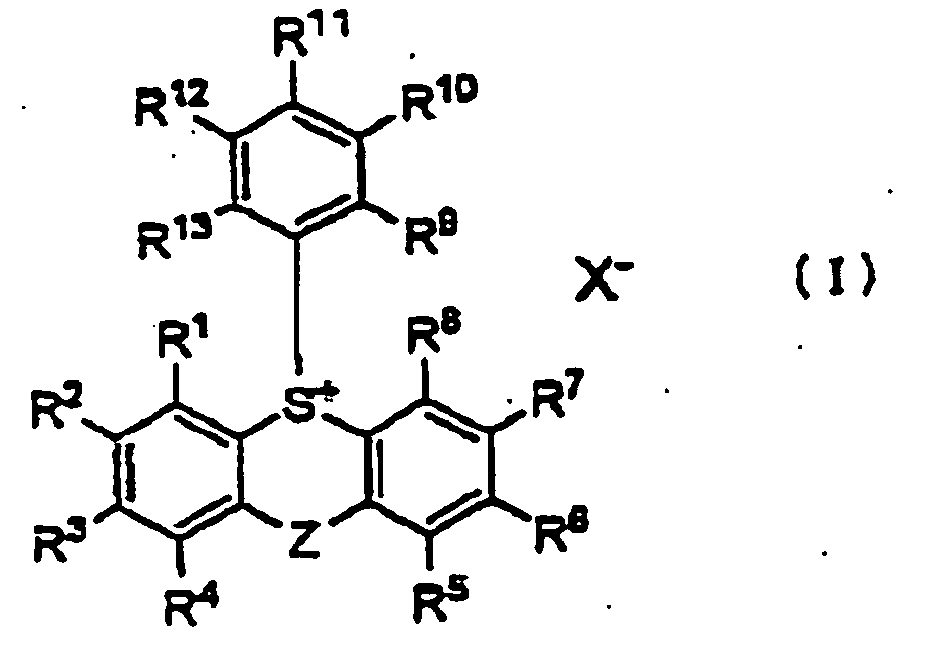 dans laquelle R1 à R13 représentent chacun indépendamment un atome d'hydrogène ou un substituant, et l'un au moins des R1 à R13 est un substituant contenant un groupement hydroxyle alcoolique ;Z représente une liaison simple ; etX- représente un contre-anion.
Applications Claiming Priority (1)
| Application Number | Priority Date | Filing Date | Title |
|---|---|---|---|
| JP2006029870A JP4792299B2 (ja) | 2006-02-07 | 2006-02-07 | 新規なスルホニウム化合物、該化合物を含有する感光性組成物及び該感光性組成物を用いたパターン形成方法 |
Publications (2)
| Publication Number | Publication Date |
|---|---|
| EP1816519A1 EP1816519A1 (fr) | 2007-08-08 |
| EP1816519B1 true EP1816519B1 (fr) | 2010-11-03 |
Family
ID=37890111
Family Applications (1)
| Application Number | Title | Priority Date | Filing Date |
|---|---|---|---|
| EP07002532A Not-in-force EP1816519B1 (fr) | 2006-02-07 | 2007-02-06 | Nouveau composant de sulfonium, composition photosensible comportant le composant et procédé de formation de motif utilisant la composition photosensible |
Country Status (7)
| Country | Link |
|---|---|
| US (1) | US8021819B2 (fr) |
| EP (1) | EP1816519B1 (fr) |
| JP (1) | JP4792299B2 (fr) |
| KR (2) | KR20070080581A (fr) |
| AT (1) | ATE487162T1 (fr) |
| DE (1) | DE602007010194D1 (fr) |
| TW (1) | TWI443452B (fr) |
Families Citing this family (16)
| Publication number | Priority date | Publication date | Assignee | Title |
|---|---|---|---|---|
| JP2008037857A (ja) * | 2006-07-14 | 2008-02-21 | Tokyo Ohka Kogyo Co Ltd | 化合物、酸発生剤、レジスト組成物及びレジストパターン形成方法 |
| JP5140354B2 (ja) * | 2006-09-19 | 2013-02-06 | 富士フイルム株式会社 | 感光性組成物、該感光性組成物に用いる化合物及び該感光性組成物を用いたパターン形成方法 |
| EP1906241A1 (fr) | 2006-09-29 | 2008-04-02 | FUJIFILM Corporation | Composition de réserve et procédé de formation de motif l'utilisant |
| JP5096796B2 (ja) * | 2007-03-05 | 2012-12-12 | 東京応化工業株式会社 | レジスト組成物およびレジストパターン形成方法 |
| JP5066405B2 (ja) * | 2007-08-02 | 2012-11-07 | 富士フイルム株式会社 | 電子線、x線又はeuv用レジスト組成物及び該組成物を用いたパターン形成方法 |
| TWI470345B (zh) | 2007-08-03 | 2015-01-21 | Fujifilm Corp | 含新穎化合物之光阻組成物、使用該光阻組成物之圖案形成方法、及新穎化合物 |
| JP5276821B2 (ja) * | 2007-10-01 | 2013-08-28 | 東京応化工業株式会社 | レジスト組成物およびレジストパターン形成方法 |
| JP4961324B2 (ja) | 2007-10-26 | 2012-06-27 | 富士フイルム株式会社 | 電子線、x線又はeuv用ポジ型レジスト組成物及びそれを用いたパターン形成方法 |
| JP5150296B2 (ja) | 2008-02-13 | 2013-02-20 | 富士フイルム株式会社 | 電子線、x線またはeuv用ポジ型レジスト組成物及びこれを用いたパターン形成方法 |
| JP5417150B2 (ja) | 2008-12-18 | 2014-02-12 | 富士フイルム株式会社 | 感活性光線性又は感放射線性樹脂組成物、レジスト膜、それを用いたパターン形成方法、及び樹脂 |
| JP5124535B2 (ja) * | 2009-07-03 | 2013-01-23 | 富士フイルム株式会社 | 感活性光線性又は感放射性樹脂組成物及びそれを用いたパターン形成方法 |
| JP5618815B2 (ja) * | 2010-12-24 | 2014-11-05 | 富士フイルム株式会社 | 感活性光線性又は感放射線性樹脂組成物、並びに、この組成物を用いた感活性光線性又は感放射線性膜及びパターン形成方法 |
| JP5906787B2 (ja) | 2011-03-08 | 2016-04-20 | 住友化学株式会社 | 塩、レジスト組成物及びレジストパターンの製造方法 |
| JP5739497B2 (ja) | 2012-09-15 | 2015-06-24 | ローム アンド ハース エレクトロニック マテリアルズ エルエルシーRohm and Haas Electronic Materials LLC | 酸発生剤化合物およびそれを含むフォトレジスト |
| JPWO2019123842A1 (ja) * | 2017-12-22 | 2020-12-03 | 富士フイルム株式会社 | 感活性光線性又は感放射線性樹脂組成物、レジスト膜、パターン形成方法、レジスト膜付きマスクブランクス、フォトマスクの製造方法、電子デバイスの製造方法 |
| TWI678596B (zh) | 2018-09-13 | 2019-12-01 | 新應材股份有限公司 | 正型光阻組成物及圖案化聚醯亞胺層之形成方法 |
Family Cites Families (20)
| Publication number | Priority date | Publication date | Assignee | Title |
|---|---|---|---|---|
| JPH06199770A (ja) * | 1992-12-28 | 1994-07-19 | Japan Synthetic Rubber Co Ltd | 新規オニウム塩およびそれを含有する感放射線性樹脂 組成物 |
| US5731364A (en) * | 1996-01-24 | 1998-03-24 | Shipley Company, L.L.C. | Photoimageable compositions comprising multiple arylsulfonium photoactive compounds |
| TWI263866B (en) | 1999-01-18 | 2006-10-11 | Sumitomo Chemical Co | Chemical amplification type positive resist composition |
| US6680157B1 (en) | 2000-10-12 | 2004-01-20 | Massachusetts Institute Of Technology | Resist methods and materials for UV and electron-beam lithography with reduced outgassing |
| JP2002148788A (ja) * | 2000-11-10 | 2002-05-22 | Fuji Photo Film Co Ltd | レジスト組成物 |
| CA2452566C (fr) * | 2001-07-19 | 2011-08-23 | Lamberti Spa | Sels de sulfonium, procedes de preparation associes et utilisation de ces sels en tant que photoinitiateurs dans des systemes durcissables par rayonnement |
| JP3856290B2 (ja) * | 2001-10-12 | 2006-12-13 | 富士フイルムホールディングス株式会社 | ネガ型レジスト組成物 |
| GB0204467D0 (en) * | 2002-02-26 | 2002-04-10 | Coates Brothers Plc | Novel fused ring compounds, and their use as cationic photoinitiators |
| AU2003233559A1 (en) * | 2002-05-16 | 2003-12-02 | Rensselaer Polytechnic Institute | Photopolymerizable compositions comprising thianthrenium salt cationic photoinitiators |
| EP1480078A1 (fr) | 2003-05-21 | 2004-11-24 | ASML Netherlands B.V. | Méthode pour déposer une couche sur un substrat pour la lithographie par rayons EUV, ainsi que substrat portant une couche de photoréserve |
| US20040265733A1 (en) * | 2003-06-30 | 2004-12-30 | Houlihan Francis M. | Photoacid generators |
| JP4612999B2 (ja) * | 2003-10-08 | 2011-01-12 | 富士フイルム株式会社 | ポジ型レジスト組成物及びそれを用いたパターン形成方法 |
| JP2005263897A (ja) * | 2004-03-17 | 2005-09-29 | Konica Minolta Medical & Graphic Inc | インクジェット用インク組成物及び画像形成方法 |
| JP2005275283A (ja) * | 2004-03-26 | 2005-10-06 | Fuji Photo Film Co Ltd | 電子線、euv光又はx線用ポジ型レジスト組成物及びそれを用いたパターン形成方法 |
| JP4677353B2 (ja) * | 2005-02-18 | 2011-04-27 | 富士フイルム株式会社 | レジスト組成物、該レジスト組成物に用いる化合物及び該レジスト組成物を用いたパターン形成方法 |
| US7541131B2 (en) | 2005-02-18 | 2009-06-02 | Fujifilm Corporation | Resist composition, compound for use in the resist composition and pattern forming method using the resist composition |
| JP2006328297A (ja) * | 2005-05-30 | 2006-12-07 | Konica Minolta Medical & Graphic Inc | 活性光線硬化型組成物及び活性光線硬化型インクジェットインク組成物、それを用いた画像形成方法及びインクジェット記録装置 |
| JP2007293250A (ja) * | 2006-03-27 | 2007-11-08 | Fujifilm Corp | ポジ型レジスト組成物およびそれを用いたパターン形成方法 |
| US7851130B2 (en) * | 2006-09-19 | 2010-12-14 | Fujifilm Corporation | Photosensitive composition, compound for use in the photosensitive composition, and pattern-forming method using the photosensitive composition |
| EP1906241A1 (fr) * | 2006-09-29 | 2008-04-02 | FUJIFILM Corporation | Composition de réserve et procédé de formation de motif l'utilisant |
-
2006
- 2006-02-07 JP JP2006029870A patent/JP4792299B2/ja not_active Expired - Lifetime
-
2007
- 2007-02-06 TW TW096104246A patent/TWI443452B/zh active
- 2007-02-06 DE DE602007010194T patent/DE602007010194D1/de active Active
- 2007-02-06 EP EP07002532A patent/EP1816519B1/fr not_active Not-in-force
- 2007-02-06 AT AT07002532T patent/ATE487162T1/de not_active IP Right Cessation
- 2007-02-07 KR KR1020070012585A patent/KR20070080581A/ko not_active Ceased
- 2007-02-07 US US11/703,100 patent/US8021819B2/en active Active
-
2013
- 2013-12-10 KR KR20130152829A patent/KR101508153B1/ko active Active
Also Published As
| Publication number | Publication date |
|---|---|
| EP1816519A1 (fr) | 2007-08-08 |
| US8021819B2 (en) | 2011-09-20 |
| KR20140001187A (ko) | 2014-01-06 |
| KR101508153B1 (ko) | 2015-04-07 |
| DE602007010194D1 (de) | 2010-12-16 |
| TWI443452B (zh) | 2014-07-01 |
| JP2007210904A (ja) | 2007-08-23 |
| TW200736826A (en) | 2007-10-01 |
| US20070184384A1 (en) | 2007-08-09 |
| KR20070080581A (ko) | 2007-08-10 |
| ATE487162T1 (de) | 2010-11-15 |
| JP4792299B2 (ja) | 2011-10-12 |
Similar Documents
| Publication | Publication Date | Title |
|---|---|---|
| EP1816519B1 (fr) | Nouveau composant de sulfonium, composition photosensible comportant le composant et procédé de formation de motif utilisant la composition photosensible | |
| KR101319457B1 (ko) | 감광성 조성물, 그 감광성 조성물에 사용되는 화합물 및 그 감광성 조성물을 사용한 패턴형성방법 | |
| US7749679B2 (en) | Photosensitive composition, pattern-forming method using the photosensitive composition and compounds used in the photosensitive composition | |
| US7851130B2 (en) | Photosensitive composition, compound for use in the photosensitive composition, and pattern-forming method using the photosensitive composition | |
| KR101358725B1 (ko) | 감광성 조성물, 이 감광성 조성물에 사용되는 화합물 및 이 감광성 조성물을 사용한 패턴형성방법 | |
| US8110333B2 (en) | Resist composition containing novel sulfonium compound, pattern-forming method using the resist composition, and novel sulfonium compound | |
| JP5140354B2 (ja) | 感光性組成物、該感光性組成物に用いる化合物及び該感光性組成物を用いたパターン形成方法 | |
| US8084183B2 (en) | Resist composition for electron beam, X-ray, or EUV, and pattern-forming method using the same | |
| EP1693705B1 (fr) | Composition de réserve positive et procédé de formation de motif utilisant la composition de réserve | |
| US20080138742A1 (en) | Photosensitive composition, compound for use in the photosensitive composition and pattern forming method using the photosensitive composition | |
| KR20130049796A (ko) | 감광성 조성물을 사용한 패턴형성방법 | |
| US8003294B2 (en) | Photosensitive composition, compound used for photosensitive composition and pattern-forming method using photosensitive composition | |
| US7695891B2 (en) | Photosensitive composition, pattern forming method using the photosensitive composition and compound for use in the photosensitive composition | |
| JP4742001B2 (ja) | 感光性組成物、該感光性組成物に用いる化合物及び該感光性組成物を用いたパターン形成方法 | |
| JP4695996B2 (ja) | 感光性組成物及び該感光性組成物を用いたパターン形成方法 | |
| JP2006251466A (ja) | 感光性組成物及び該感光性組成物を用いたパターン形成方法 |
Legal Events
| Date | Code | Title | Description |
|---|---|---|---|
| PUAI | Public reference made under article 153(3) epc to a published international application that has entered the european phase |
Free format text: ORIGINAL CODE: 0009012 |
|
| AK | Designated contracting states |
Kind code of ref document: A1 Designated state(s): AT BE BG CH CY CZ DE DK EE ES FI FR GB GR HU IE IS IT LI LT LU LV MC NL PL PT RO SE SI SK TR |
|
| AX | Request for extension of the european patent |
Extension state: AL BA HR MK YU |
|
| 17P | Request for examination filed |
Effective date: 20071114 |
|
| AKX | Designation fees paid |
Designated state(s): AT BE BG CH CY CZ DE DK EE ES FI FR GB GR HU IE IS IT LI LT LU LV MC NL PL PT RO SE SI SK TR |
|
| 17Q | First examination report despatched |
Effective date: 20090213 |
|
| GRAP | Despatch of communication of intention to grant a patent |
Free format text: ORIGINAL CODE: EPIDOSNIGR1 |
|
| GRAS | Grant fee paid |
Free format text: ORIGINAL CODE: EPIDOSNIGR3 |
|
| GRAA | (expected) grant |
Free format text: ORIGINAL CODE: 0009210 |
|
| AK | Designated contracting states |
Kind code of ref document: B1 Designated state(s): AT BE BG CH CY CZ DE DK EE ES FI FR GB GR HU IE IS IT LI LT LU LV MC NL PL PT RO SE SI SK TR |
|
| REG | Reference to a national code |
Ref country code: GB Ref legal event code: FG4D |
|
| REG | Reference to a national code |
Ref country code: CH Ref legal event code: EP |
|
| REG | Reference to a national code |
Ref country code: IE Ref legal event code: FG4D |
|
| REF | Corresponds to: |
Ref document number: 602007010194 Country of ref document: DE Date of ref document: 20101216 Kind code of ref document: P |
|
| REG | Reference to a national code |
Ref country code: NL Ref legal event code: VDEP Effective date: 20101103 |
|
| LTIE | Lt: invalidation of european patent or patent extension |
Effective date: 20101103 |
|
| PG25 | Lapsed in a contracting state [announced via postgrant information from national office to epo] |
Ref country code: LT Free format text: LAPSE BECAUSE OF FAILURE TO SUBMIT A TRANSLATION OF THE DESCRIPTION OR TO PAY THE FEE WITHIN THE PRESCRIBED TIME-LIMIT Effective date: 20101103 |
|
| PG25 | Lapsed in a contracting state [announced via postgrant information from national office to epo] |
Ref country code: SI Free format text: LAPSE BECAUSE OF FAILURE TO SUBMIT A TRANSLATION OF THE DESCRIPTION OR TO PAY THE FEE WITHIN THE PRESCRIBED TIME-LIMIT Effective date: 20101103 Ref country code: AT Free format text: LAPSE BECAUSE OF FAILURE TO SUBMIT A TRANSLATION OF THE DESCRIPTION OR TO PAY THE FEE WITHIN THE PRESCRIBED TIME-LIMIT Effective date: 20101103 Ref country code: IS Free format text: LAPSE BECAUSE OF FAILURE TO SUBMIT A TRANSLATION OF THE DESCRIPTION OR TO PAY THE FEE WITHIN THE PRESCRIBED TIME-LIMIT Effective date: 20110303 Ref country code: PT Free format text: LAPSE BECAUSE OF FAILURE TO SUBMIT A TRANSLATION OF THE DESCRIPTION OR TO PAY THE FEE WITHIN THE PRESCRIBED TIME-LIMIT Effective date: 20110303 Ref country code: LV Free format text: LAPSE BECAUSE OF FAILURE TO SUBMIT A TRANSLATION OF THE DESCRIPTION OR TO PAY THE FEE WITHIN THE PRESCRIBED TIME-LIMIT Effective date: 20101103 Ref country code: BG Free format text: LAPSE BECAUSE OF FAILURE TO SUBMIT A TRANSLATION OF THE DESCRIPTION OR TO PAY THE FEE WITHIN THE PRESCRIBED TIME-LIMIT Effective date: 20110203 Ref country code: SE Free format text: LAPSE BECAUSE OF FAILURE TO SUBMIT A TRANSLATION OF THE DESCRIPTION OR TO PAY THE FEE WITHIN THE PRESCRIBED TIME-LIMIT Effective date: 20101103 Ref country code: NL Free format text: LAPSE BECAUSE OF FAILURE TO SUBMIT A TRANSLATION OF THE DESCRIPTION OR TO PAY THE FEE WITHIN THE PRESCRIBED TIME-LIMIT Effective date: 20101103 Ref country code: FI Free format text: LAPSE BECAUSE OF FAILURE TO SUBMIT A TRANSLATION OF THE DESCRIPTION OR TO PAY THE FEE WITHIN THE PRESCRIBED TIME-LIMIT Effective date: 20101103 |
|
| PG25 | Lapsed in a contracting state [announced via postgrant information from national office to epo] |
Ref country code: GR Free format text: LAPSE BECAUSE OF FAILURE TO SUBMIT A TRANSLATION OF THE DESCRIPTION OR TO PAY THE FEE WITHIN THE PRESCRIBED TIME-LIMIT Effective date: 20110204 |
|
| PG25 | Lapsed in a contracting state [announced via postgrant information from national office to epo] |
Ref country code: CZ Free format text: LAPSE BECAUSE OF FAILURE TO SUBMIT A TRANSLATION OF THE DESCRIPTION OR TO PAY THE FEE WITHIN THE PRESCRIBED TIME-LIMIT Effective date: 20101103 Ref country code: EE Free format text: LAPSE BECAUSE OF FAILURE TO SUBMIT A TRANSLATION OF THE DESCRIPTION OR TO PAY THE FEE WITHIN THE PRESCRIBED TIME-LIMIT Effective date: 20101103 Ref country code: ES Free format text: LAPSE BECAUSE OF FAILURE TO SUBMIT A TRANSLATION OF THE DESCRIPTION OR TO PAY THE FEE WITHIN THE PRESCRIBED TIME-LIMIT Effective date: 20110214 |
|
| PG25 | Lapsed in a contracting state [announced via postgrant information from national office to epo] |
Ref country code: RO Free format text: LAPSE BECAUSE OF FAILURE TO SUBMIT A TRANSLATION OF THE DESCRIPTION OR TO PAY THE FEE WITHIN THE PRESCRIBED TIME-LIMIT Effective date: 20101103 Ref country code: DK Free format text: LAPSE BECAUSE OF FAILURE TO SUBMIT A TRANSLATION OF THE DESCRIPTION OR TO PAY THE FEE WITHIN THE PRESCRIBED TIME-LIMIT Effective date: 20101103 Ref country code: PL Free format text: LAPSE BECAUSE OF FAILURE TO SUBMIT A TRANSLATION OF THE DESCRIPTION OR TO PAY THE FEE WITHIN THE PRESCRIBED TIME-LIMIT Effective date: 20101103 Ref country code: SK Free format text: LAPSE BECAUSE OF FAILURE TO SUBMIT A TRANSLATION OF THE DESCRIPTION OR TO PAY THE FEE WITHIN THE PRESCRIBED TIME-LIMIT Effective date: 20101103 |
|
| PLBE | No opposition filed within time limit |
Free format text: ORIGINAL CODE: 0009261 |
|
| STAA | Information on the status of an ep patent application or granted ep patent |
Free format text: STATUS: NO OPPOSITION FILED WITHIN TIME LIMIT |
|
| PG25 | Lapsed in a contracting state [announced via postgrant information from national office to epo] |
Ref country code: MC Free format text: LAPSE BECAUSE OF NON-PAYMENT OF DUE FEES Effective date: 20110228 |
|
| REG | Reference to a national code |
Ref country code: CH Ref legal event code: PL |
|
| 26N | No opposition filed |
Effective date: 20110804 |
|
| GBPC | Gb: european patent ceased through non-payment of renewal fee |
Effective date: 20110206 |
|
| PG25 | Lapsed in a contracting state [announced via postgrant information from national office to epo] |
Ref country code: LI Free format text: LAPSE BECAUSE OF NON-PAYMENT OF DUE FEES Effective date: 20110228 Ref country code: CH Free format text: LAPSE BECAUSE OF NON-PAYMENT OF DUE FEES Effective date: 20110228 |
|
| REG | Reference to a national code |
Ref country code: FR Ref legal event code: ST Effective date: 20111102 |
|
| REG | Reference to a national code |
Ref country code: IE Ref legal event code: MM4A |
|
| REG | Reference to a national code |
Ref country code: DE Ref legal event code: R097 Ref document number: 602007010194 Country of ref document: DE Effective date: 20110804 |
|
| PG25 | Lapsed in a contracting state [announced via postgrant information from national office to epo] |
Ref country code: IT Free format text: LAPSE BECAUSE OF FAILURE TO SUBMIT A TRANSLATION OF THE DESCRIPTION OR TO PAY THE FEE WITHIN THE PRESCRIBED TIME-LIMIT Effective date: 20101103 |
|
| PG25 | Lapsed in a contracting state [announced via postgrant information from national office to epo] |
Ref country code: FR Free format text: LAPSE BECAUSE OF NON-PAYMENT OF DUE FEES Effective date: 20110228 Ref country code: IE Free format text: LAPSE BECAUSE OF NON-PAYMENT OF DUE FEES Effective date: 20110206 |
|
| PG25 | Lapsed in a contracting state [announced via postgrant information from national office to epo] |
Ref country code: GB Free format text: LAPSE BECAUSE OF NON-PAYMENT OF DUE FEES Effective date: 20110206 |
|
| PG25 | Lapsed in a contracting state [announced via postgrant information from national office to epo] |
Ref country code: CY Free format text: LAPSE BECAUSE OF FAILURE TO SUBMIT A TRANSLATION OF THE DESCRIPTION OR TO PAY THE FEE WITHIN THE PRESCRIBED TIME-LIMIT Effective date: 20101103 Ref country code: LU Free format text: LAPSE BECAUSE OF NON-PAYMENT OF DUE FEES Effective date: 20110206 |
|
| PG25 | Lapsed in a contracting state [announced via postgrant information from national office to epo] |
Ref country code: TR Free format text: LAPSE BECAUSE OF FAILURE TO SUBMIT A TRANSLATION OF THE DESCRIPTION OR TO PAY THE FEE WITHIN THE PRESCRIBED TIME-LIMIT Effective date: 20101103 |
|
| PG25 | Lapsed in a contracting state [announced via postgrant information from national office to epo] |
Ref country code: HU Free format text: LAPSE BECAUSE OF FAILURE TO SUBMIT A TRANSLATION OF THE DESCRIPTION OR TO PAY THE FEE WITHIN THE PRESCRIBED TIME-LIMIT Effective date: 20101103 |
|
| PGFP | Annual fee paid to national office [announced via postgrant information from national office to epo] |
Ref country code: DE Payment date: 20150203 Year of fee payment: 9 |
|
| PGFP | Annual fee paid to national office [announced via postgrant information from national office to epo] |
Ref country code: BE Payment date: 20151223 Year of fee payment: 10 |
|
| REG | Reference to a national code |
Ref country code: DE Ref legal event code: R119 Ref document number: 602007010194 Country of ref document: DE |
|
| PG25 | Lapsed in a contracting state [announced via postgrant information from national office to epo] |
Ref country code: DE Free format text: LAPSE BECAUSE OF NON-PAYMENT OF DUE FEES Effective date: 20160901 |
|
| PG25 | Lapsed in a contracting state [announced via postgrant information from national office to epo] |
Ref country code: BE Free format text: LAPSE BECAUSE OF NON-PAYMENT OF DUE FEES Effective date: 20170228 |
|
| REG | Reference to a national code |
Ref country code: BE Ref legal event code: MM Effective date: 20170228 |