EP1816980B1 - Dispositif medical pour reguler la temperature et traiter l'oeil et les tissus environnants - Google Patents
Dispositif medical pour reguler la temperature et traiter l'oeil et les tissus environnants Download PDFInfo
- Publication number
- EP1816980B1 EP1816980B1 EP05852161A EP05852161A EP1816980B1 EP 1816980 B1 EP1816980 B1 EP 1816980B1 EP 05852161 A EP05852161 A EP 05852161A EP 05852161 A EP05852161 A EP 05852161A EP 1816980 B1 EP1816980 B1 EP 1816980B1
- Authority
- EP
- European Patent Office
- Prior art keywords
- shell
- eye
- fluid
- thermal
- pressure
- Prior art date
- Legal status (The legal status is an assumption and is not a legal conclusion. Google has not performed a legal analysis and makes no representation as to the accuracy of the status listed.)
- Expired - Lifetime
Links
Images





Classifications
-
- A—HUMAN NECESSITIES
- A61—MEDICAL OR VETERINARY SCIENCE; HYGIENE
- A61F—FILTERS IMPLANTABLE INTO BLOOD VESSELS; PROSTHESES; DEVICES PROVIDING PATENCY TO, OR PREVENTING COLLAPSING OF, TUBULAR STRUCTURES OF THE BODY, e.g. STENTS; ORTHOPAEDIC, NURSING OR CONTRACEPTIVE DEVICES; FOMENTATION; TREATMENT OR PROTECTION OF EYES OR EARS; BANDAGES, DRESSINGS OR ABSORBENT PADS; FIRST-AID KITS
- A61F9/00—Methods or devices for treatment of the eyes; Devices for putting in contact-lenses; Devices to correct squinting; Apparatus to guide the blind; Protective devices for the eyes, carried on the body or in the hand
- A61F9/0008—Introducing ophthalmic products into the ocular cavity or retaining products therein
- A61F9/0017—Introducing ophthalmic products into the ocular cavity or retaining products therein implantable in, or in contact with, the eye, e.g. ocular inserts
-
- A—HUMAN NECESSITIES
- A61—MEDICAL OR VETERINARY SCIENCE; HYGIENE
- A61B—DIAGNOSIS; SURGERY; IDENTIFICATION
- A61B3/00—Apparatus for testing the eyes; Instruments for examining the eyes
- A61B3/10—Objective types, i.e. instruments for examining the eyes independent of the patients' perceptions or reactions
- A61B3/16—Objective types, i.e. instruments for examining the eyes independent of the patients' perceptions or reactions for measuring intraocular pressure, e.g. tonometers
- A61B3/165—Non-contacting tonometers
-
- A—HUMAN NECESSITIES
- A61—MEDICAL OR VETERINARY SCIENCE; HYGIENE
- A61B—DIAGNOSIS; SURGERY; IDENTIFICATION
- A61B5/00—Measuring for diagnostic purposes; Identification of persons
- A61B5/145—Measuring characteristics of blood in vivo, e.g. gas concentration or pH-value ; Measuring characteristics of body fluids or tissues, e.g. interstitial fluid or cerebral tissue
-
- A—HUMAN NECESSITIES
- A61—MEDICAL OR VETERINARY SCIENCE; HYGIENE
- A61B—DIAGNOSIS; SURGERY; IDENTIFICATION
- A61B5/00—Measuring for diagnostic purposes; Identification of persons
- A61B5/145—Measuring characteristics of blood in vivo, e.g. gas concentration or pH-value ; Measuring characteristics of body fluids or tissues, e.g. interstitial fluid or cerebral tissue
- A61B5/14539—Measuring characteristics of blood in vivo, e.g. gas concentration or pH-value ; Measuring characteristics of body fluids or tissues, e.g. interstitial fluid or cerebral tissue for measuring pH
-
- A—HUMAN NECESSITIES
- A61—MEDICAL OR VETERINARY SCIENCE; HYGIENE
- A61B—DIAGNOSIS; SURGERY; IDENTIFICATION
- A61B5/00—Measuring for diagnostic purposes; Identification of persons
- A61B5/145—Measuring characteristics of blood in vivo, e.g. gas concentration or pH-value ; Measuring characteristics of body fluids or tissues, e.g. interstitial fluid or cerebral tissue
- A61B5/14546—Measuring characteristics of blood in vivo, e.g. gas concentration or pH-value ; Measuring characteristics of body fluids or tissues, e.g. interstitial fluid or cerebral tissue for measuring analytes not otherwise provided for, e.g. ions, cytochromes
-
- A—HUMAN NECESSITIES
- A61—MEDICAL OR VETERINARY SCIENCE; HYGIENE
- A61B—DIAGNOSIS; SURGERY; IDENTIFICATION
- A61B5/00—Measuring for diagnostic purposes; Identification of persons
- A61B5/41—Detecting, measuring or recording for evaluating the immune or lymphatic systems
- A61B5/414—Evaluating particular organs or parts of the immune or lymphatic systems
- A61B5/417—Evaluating particular organs or parts of the immune or lymphatic systems the bone marrow
-
- A—HUMAN NECESSITIES
- A61—MEDICAL OR VETERINARY SCIENCE; HYGIENE
- A61B—DIAGNOSIS; SURGERY; IDENTIFICATION
- A61B5/00—Measuring for diagnostic purposes; Identification of persons
- A61B5/68—Arrangements of detecting, measuring or recording means, e.g. sensors, in relation to patient
- A61B5/6801—Arrangements of detecting, measuring or recording means, e.g. sensors, in relation to patient specially adapted to be attached to or worn on the body surface
- A61B5/6813—Specially adapted to be attached to a specific body part
- A61B5/6814—Head
- A61B5/6821—Eye
-
- A—HUMAN NECESSITIES
- A61—MEDICAL OR VETERINARY SCIENCE; HYGIENE
- A61F—FILTERS IMPLANTABLE INTO BLOOD VESSELS; PROSTHESES; DEVICES PROVIDING PATENCY TO, OR PREVENTING COLLAPSING OF, TUBULAR STRUCTURES OF THE BODY, e.g. STENTS; ORTHOPAEDIC, NURSING OR CONTRACEPTIVE DEVICES; FOMENTATION; TREATMENT OR PROTECTION OF EYES OR EARS; BANDAGES, DRESSINGS OR ABSORBENT PADS; FIRST-AID KITS
- A61F7/00—Heating or cooling appliances for medical or therapeutic treatment of the human body
- A61F7/12—Devices for heating or cooling internal body cavities
-
- A—HUMAN NECESSITIES
- A61—MEDICAL OR VETERINARY SCIENCE; HYGIENE
- A61B—DIAGNOSIS; SURGERY; IDENTIFICATION
- A61B17/00—Surgical instruments, devices or methods
- A61B2017/00017—Electrical control of surgical instruments
- A61B2017/00022—Sensing or detecting at the treatment site
- A61B2017/00084—Temperature
- A61B2017/00088—Temperature using thermistors
-
- A—HUMAN NECESSITIES
- A61—MEDICAL OR VETERINARY SCIENCE; HYGIENE
- A61B—DIAGNOSIS; SURGERY; IDENTIFICATION
- A61B90/00—Instruments, implements or accessories specially adapted for surgery or diagnosis and not covered by any of the groups A61B1/00 - A61B50/00, e.g. for luxation treatment or for protecting wound edges
- A61B90/06—Measuring instruments not otherwise provided for
- A61B2090/064—Measuring instruments not otherwise provided for for measuring force, pressure or mechanical tension
-
- A—HUMAN NECESSITIES
- A61—MEDICAL OR VETERINARY SCIENCE; HYGIENE
- A61F—FILTERS IMPLANTABLE INTO BLOOD VESSELS; PROSTHESES; DEVICES PROVIDING PATENCY TO, OR PREVENTING COLLAPSING OF, TUBULAR STRUCTURES OF THE BODY, e.g. STENTS; ORTHOPAEDIC, NURSING OR CONTRACEPTIVE DEVICES; FOMENTATION; TREATMENT OR PROTECTION OF EYES OR EARS; BANDAGES, DRESSINGS OR ABSORBENT PADS; FIRST-AID KITS
- A61F7/00—Heating or cooling appliances for medical or therapeutic treatment of the human body
- A61F2007/0001—Body part
- A61F2007/0002—Head or parts thereof
- A61F2007/0004—Eyes or part of the face surrounding the eyes
-
- A—HUMAN NECESSITIES
- A61—MEDICAL OR VETERINARY SCIENCE; HYGIENE
- A61F—FILTERS IMPLANTABLE INTO BLOOD VESSELS; PROSTHESES; DEVICES PROVIDING PATENCY TO, OR PREVENTING COLLAPSING OF, TUBULAR STRUCTURES OF THE BODY, e.g. STENTS; ORTHOPAEDIC, NURSING OR CONTRACEPTIVE DEVICES; FOMENTATION; TREATMENT OR PROTECTION OF EYES OR EARS; BANDAGES, DRESSINGS OR ABSORBENT PADS; FIRST-AID KITS
- A61F7/00—Heating or cooling appliances for medical or therapeutic treatment of the human body
- A61F2007/0054—Heating or cooling appliances for medical or therapeutic treatment of the human body with a closed fluid circuit, e.g. hot water
-
- A—HUMAN NECESSITIES
- A61—MEDICAL OR VETERINARY SCIENCE; HYGIENE
- A61F—FILTERS IMPLANTABLE INTO BLOOD VESSELS; PROSTHESES; DEVICES PROVIDING PATENCY TO, OR PREVENTING COLLAPSING OF, TUBULAR STRUCTURES OF THE BODY, e.g. STENTS; ORTHOPAEDIC, NURSING OR CONTRACEPTIVE DEVICES; FOMENTATION; TREATMENT OR PROTECTION OF EYES OR EARS; BANDAGES, DRESSINGS OR ABSORBENT PADS; FIRST-AID KITS
- A61F7/00—Heating or cooling appliances for medical or therapeutic treatment of the human body
- A61F2007/0054—Heating or cooling appliances for medical or therapeutic treatment of the human body with a closed fluid circuit, e.g. hot water
- A61F2007/0056—Heating or cooling appliances for medical or therapeutic treatment of the human body with a closed fluid circuit, e.g. hot water for cooling
-
- A—HUMAN NECESSITIES
- A61—MEDICAL OR VETERINARY SCIENCE; HYGIENE
- A61F—FILTERS IMPLANTABLE INTO BLOOD VESSELS; PROSTHESES; DEVICES PROVIDING PATENCY TO, OR PREVENTING COLLAPSING OF, TUBULAR STRUCTURES OF THE BODY, e.g. STENTS; ORTHOPAEDIC, NURSING OR CONTRACEPTIVE DEVICES; FOMENTATION; TREATMENT OR PROTECTION OF EYES OR EARS; BANDAGES, DRESSINGS OR ABSORBENT PADS; FIRST-AID KITS
- A61F9/00—Methods or devices for treatment of the eyes; Devices for putting in contact-lenses; Devices to correct squinting; Apparatus to guide the blind; Protective devices for the eyes, carried on the body or in the hand
- A61F9/007—Methods or devices for eye surgery
Definitions
- the present invention generally relates to medical devices useful in reducing and preventing injury to the eye and orbit by inducing local temperature control of the tissue and by administering a constant source of medication(s). More specifically, the invention provides devices for surrounding the exterior surface of the eye for use in hypothermia or hyperthermia applications, the rapid flow of fluid using conduction and convection principles, the application of treatment modalities, and the transmission of temperature control to other tissues of the orbit including the adnexae, the optic nerve, and extra-ocular muscles.
- the medical device has a thermister for temperature measurement, irrigation/aspiration ports for fluid exchange and application of therapeutic modalities, and a flexible inflatable unit that surrounds the external surface of the eye. An external system for control of temperature, pressure and flow rate is described.
- Pathology to tissues of the eye may occur due to blunt injuries, such as a blow to the eye/orbit, resulting in hemorrhage within or around the eye and associated swelling of eye tissue.
- blunt injuries such as a blow to the eye/orbit
- hemorrhage within or around the eye and associated swelling of eye tissue.
- Inflammation of orbital tissue is usually managed with systemic medical therapy or even surgical decompression.
- Other types of inflammation of the tissues within the eye include posterior uveitis, choroiditis, retinitis, vitritis, scleritis, thyroid-related eye disease, phacoanaphylaxis, anterior uveitis, and sympathetic ophthalmia.
- Secondary glaucoma may result from inflammation involving the anterior segment of the eye.
- Infections of the eye may involve the cornea, the sclera, the vitreous, the retina/choroid, the ciliary body, the lens, and the anterior chamber. They are usually treated with systemic antibiotics, sometimes systemic steroids, and topical drops of antibiotics, and intraocular antibiotic injections.
- hypothermia has proved encouraging in the recent literature for the purpose of decreasing oxygen-consumption and for decreasing swelling of the brain and other central nervous system (CNS) tissue. Since the eye is part of the CNS, it seems logical that hypothermia of the eye may decrease swelling of the eye and optic nerve in the same way as hypothermia of the brain prevents brain swelling. Unfortunately, cooling of the entire body to cool the brain does have inherent dangers, and similarly cooling of the eye by cooling the body may also have deleterious effects. The heart responds to hypothermia with arrhythmias, and the blood clotting mechanisms may be severely impaired resulting in hemorrhage. Moreover, cooling the body only results in a few degrees of cooling of the CNS.
- US Re. 28,873 shows a device for the treatment of the eye with liquid medical solution such as antibiotics that can be place under the eyelids and covers a greater area of the eye than the abovementioned devices.
- this device does not include the possibility of controlling the temperature of the eye.
- the invention provides devices and exemplifies methods for enhancing the treatment of diseases of the eye and orbital tissues as disclosed in the appended claims. More specifically, the invention provides devices and exemplifies methods for controlling the temperature of the eye, optic nerve, orbit, and peri-orbital tissues by applying hypothermia, hyperthermia, or euthermia rapidly without violating the tissue with surgical intervention. Moreover, the devices can also apply medications and/or chemicals to the eye, optic nerve, orbit, and peri orbital tissues.
- the first embodiment of the device comprises a thermalregulating shell consisting of a multi-layered spherical unit that conforms to the shape of the eye, fitting into the fornices of both the upper and the lower eyelids. Fluid will flow into an entry port and out through the exit port. Rapid flow of fluid will result in both convection and conduction exchange of temperature between the device and the surrounding tissues, including the eye and its adnexae.
- Rapid flow of fluid will facilitate the administration of appropriate medications and/or chemicals to the adjacent tissues through a semi-permeable membrane, or nanotubules, or millipore/micropore system, or other appropriate materials that deliver treatment to the tissues.
- a semi-permeable membrane, or nanotubules, or millipore/micropore system or other appropriate materials that deliver treatment to the tissues.
- a slower flow of fluid may be efficacious.
- a pump system may be configured with a peristaltic pump with multiple inlet and outlet connections that have the capability of transporting large volumes of fluid rapidly throughout the entire volume of the thermal-regulating shell, distributing the fluid through channels within the shell.
- the system may be custom designed for the best delivery of fluid to the tissues of the eye, the orbit, and adjacent sinuses and other peri-orbita.
- the pump may be battery operated and simplified to allow for portability and ease of use.
- An external system will control temperature, pressure and flow-rate.
- the thermal-regulating shell is designed with an opening in front of the cornea to allow for measurement of intraocular pressure and for viewing the structures within the eye from the cornea to the retina and optic nerve.
- an inserter In order to place the shell around the eye and beneath the eyelids, an inserter will allow for gentle placement of the hermal-regulating shell beneath the lids.
- the shell will be designed with a semi-firm material such as metal or plastic or other synthetic substance placed into the shell to give shape and firmness. This may be configured in a ribbing pattern or a matrix to keep the shell in contact with the surface of the eye. Once the shell is in position, the inserter is removed, and the shell remains in close contact to the eye.
- thermo-regulating shell When treating the posterior orbita including the optic nerve, it may be desirable to surgically open the superior and/or inferior fornices to allow the thermo-regulating shell to enter the orbit more posteriorly, closer to the tissue to be treated.
- pulsations In the case of central retinal artery occlusion, it may be advantageous to create pulsations with both positive and negative pressure through the dual-layered shell.
- the pulsations of the shell will generate differential pressures within the eye, allowing for dispersion of the embolus out of the major retinal artery.
- Eye-pressure measuring devices can be built into the shell to monitor intraocular pressure and regulate the fluids flowing through the shell to prevent excessive pressure on the eye.
- an insulating material such as a ceramic
- direction of thermal regulation and delivery of medications can be targeted more toward the eye.
- coating the inner surface of the shell with appropriate films one may direct thermal regulation and delivery of medications to other tissues of the orbit, peri-orbita, and surrounding sinuses.
- Medications may more easily penetrate the sclera of the eye resulting in higher levels within the eye. Since the shell will be placed behind the equator of the eye, therapy will be directed into the posterior half of the eye including the vitreous, the retina, the choroid, the macula, and the anterior optic nerve. Temperature control will also extend to the posterior half of the eye. In the case of hypothermia, preservation of the neurological tissue of the retina and optic nerve can be achieved despite insult such as ischemia. The physician will have a longer period of time to treat the insult with medical therapy and/or surgery.
- hypothermia and appropriate medical therapy will both halt the progression and destroy the infective agent. Infections within the eye (endophthalmitis) will also respond to hypothermia and appropriate medical therapy, especially with rapid cooling and constant administration of appropriate medical therapy into the eye through the sclera. Rather than giving large doses of systemic antibiotics or other anti-infectious agents, it may be possible to produce effective levels of medication by delivering therapy closer to the site of infection.
- Inflammation of the eye will respond to both hypothermia and appropriate medical therapy.
- Inflammation of the orbit, ocular adnexae, and ocular muscles can be better managed by utilizing hypothermia in conjunction with appropriate anti-inflammatory medications such as steroids, non-steroidal anti-inflammatory drugs, and antimetabolites.
- anti-inflammatory medications such as steroids, non-steroidal anti-inflammatory drugs, and antimetabolites.
- Such inflammatory diseases may include Graves' eye disease with exophthalmous and pseudotumor of the orbit.
- Infections of the orbit may be amenable to hypothermia and appropriate medical therapy. Shielding the eye from such therapy may be accomplished by coating the surface of the shell that abuts the eye with an insulator such as a ceramic compound. In this way, therapy can be directed away from the eye, toward the infection in the orbit.
- Tumors of the eye may be amenable to both hypothermia and hyperthermia.
- Hypothermia may be an adjunct to pre-surgical treatment, surgical therapy, and post-operative management.
- Hyperthermia may be helpful in augmenting the effect of laser therapy, photodynamic therapy, and medical therapy.
- Macular disease may respond to a combination of medical therapy, laser therapy, and hypothermia. Preservation of retinal tissue and the prevention of edema of the macula before and/or after laser therapy may be accomplished with this system of thermal control and drug delivery.
- a new approach to prevention of ischemic optic neuropathy following such surgical intervention can be accomplished by using a method of pumping tissue fluid and venous drainage from the orbit to the cavernous sinus.
- Fig. 1 the normal anatomy is shown of a side view of an eye 1 , with upper and lower eyelids 2 , upper and lower fornices 3 , orbit 4 and optic nerve 5 .
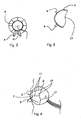
- a thermal-regulating shell 6 in accordance with the present invention is illustrated in Fig. 2 (front view) and Fig. 3 (side view). As seen in Fig. 3 the cross-sectional view of the thermal- regulating shell 6 supports a posterior opening 12 suitable in size to allow the shell 6 to conform and slip over the eye 1 .
- Fig. 4 shows the general position of the device 6 when positioned onto the eye 1.
- the thermal-regulating shell 6 comprises a fluid cavity suitably designed to facilitate temperature controlled fluid to be circulated within the thermal- regulating shell 6.
- the thermal- regulating shell 6 includes a suitably designed central anterior opening 7, a fluid entry port 8, and a fluid exit port 9, both in fluid communication with the shell 6.
- Other structures such as wires 10 or other suitable semi-rigid means, seen most clearly in Fig . 4 , may be incorporated into the thermal- regulating shell 6 which can facilitate fluid flow within the shell 6. This provides a supporting structure as well as a method to direct fluid evenly or preferentially for improved thermal transfer between the eye 1 to the thermal regulating shell 6.
- medicament or other fluids will pass through its semi-permeable membrane to the eye 1 and/ or surrounding orbital 4 tissues.
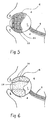
- Microtubules 13, nanotubules, micropores or other transport system will deliver this medicament through its inner semi-permeable membrane 15 and/or outer semi-permeable 14 layer.
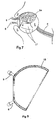
- Fig. 7 Within the inner system of the shell in Fig. 7 , there are cavities 17 where fluid flows through its channels 16 to optimize thermal transmission. This system of channels and cavities throughout the shell are shown in Fig. 7 side view and Fig. 10 's section view. The channels are formed by ridges 18 best seen in Fig. 8 .
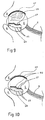
- the plural cavity shell may contain a rigid outer layer or cavity 17 shown in Fig. 9 or a rigid inner layer or cavity 17 shown in Fig. 10 .
- This rigid or semi-rigid layer or cavity not only maintains the structural shape of the device, but it can also serve as an insulator composed of a material such as ceramics or act as a shield comprised of a material such as lead covers and may provide other protective purposes.
- the system contains a plural cavity shell with a rigid material made of either ceramic, lead, steal, or other rigid substance, and it is located on its outer layer 19 or inner layer 20.
- the outer cavity 14 of the silicone rubber shell 6 in Fig. 11 is flexible and pulsating due to an attached pump mechanism that rhythmically raises and lowers the pump speed and pressure. This manually massages the orbital tissue to facilitate venous and fluid drainage to the cavernous sinus and prevents congestion of the orbit. This action may be useful in the treatment of acute ischemic optic neuropathy or in the prevention of ischemic optic neuropathy during prolonged back or neck surgery
- the firm outer shell layer or cavity 19 shown in Fig. 12 stabilizes the orbit while the inner pulsating shell layers 15 massage the eye 1 to lower the intra-ocular pressure and facilitate intra-ocular vascular flow.
- the cross-sectional view of the thermal-regulating shell 6 supports a posterior opening 12 suitable in size to allow the shell 6 to conform and slip over the eye 1 .
- fluid temperature and fluid circulation can be controlled to predetermined temperatures and rates of fluid flow.
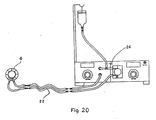
- Positive pressure is controlled by raising and lowering a fluid bottle 21 height. Fluid pressure is communicated through a fluid tube 22.
- Fluid flow is then presented to a temperature control unit 23. Fluid temperature is adjusted to the desired setting by means of the temperature control selector 24. Temperature conditioned fluid is then provided to the supply connector 25 as seen in Fig. 13 . Return fluid is presented to the fluid management unit 26 by means of the fluid return connector 27.
- Fluid flow is controlled throughout the fluid management system 26 by adjusting the fluid pump speed.
- Speed selection is adjusted by means of a speed selector 30 which is displayed on the front panel 31 of the fluid management system 26 using a suitable pump speed indicator 32.
- the fluid management is preferably powered electrically with input power controlled by a suitable power switch 33.
- FIG. 14 Another means for retaining the thermal-regulating shell 6 is demonstrated using the eyelids 2 which fixate and conform to an eye speculum 34 as shown in Figs. 14 and 15 .
- the compressed posterior extension 35 is also shown in Fig. 14 .
- the shell 6 conforms to the eye 1 and can be expanded posteriorly by unfolding its posterior extension 35, as shown in Fig. 15 .
- the speculum 34 may be integrated into the thermal-regulating shell's geometry 6.
- the speculum 34 geometry may also incorporate suitable rigid or semi-rigid geometry to facilitate attachment of other instruments (not shown).
- a preferred counter-bore fixation ring 36 may be incorporated into and around the speculum geometry 34.
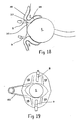
- a thermal regulating device having the shape of a plural layer lid speculum 37 is shown in Fig. 18 . Its anterior portion 38 cools the eyelids while its posterior portion 39 hooks under the lid to serve as a lid speculum 37 as well as a thermal-regulating apparatus for both the lid and the eye.
- Fig. 19 shows the frontal view of the thermal-regulating lid speculum with its anterior portion 38 visible and its posterior portion 39 functioning as a shell extension hidden from view and an inserting clamp 40 attached;
- Fig. 20 the fluid management system 26 is communicated to the thermal- regulating shell 6 by means of suitable fluid tubing 22.
- Another means of maintaining thermal-regulating shell 6 placement as well as additional eye cooling can be achieve through the use of a cooling patch 41 with flow channels 16 and separated from the thermal-regulating shell 6 as shown in Fig. 21 or combined with the shell as shown in Fig. 22 .
- Channels 16 are used to encourage fluid flow to the posterior shell in the combined unit.
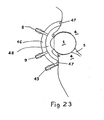
- FIG. 23 Another means of maintaining thermal-regulation is the use of the suction aided system 46 that cools the eyelids 2, eye 1, and anterior orbit 4 as shown in Fig. 23 (not part of the invention).
- Thermal-regulation of the eye 1 and the surrounding tissues can be used for various therapeutic and interventional purposes.
- the thermal regulating device 6 uses both conductive and convective methods for temperature control of the eye 1, and the surrounding tissue.
- the device 6 includes an anterior central opening 7 to allow for direct inspection of the cornea and other ocular structures when the device 6 is installed on the eye 1.
- Fluid entry ports 8 and fluid exit ports 9 may be placed anywhere on said device 6 though preferentially medially or laterally to take advantage of anatomical relationship of the eye 1 and eyelid 2., There will be a thermal exchange of temperature using conduction between the shell 6 and the eye 1 or other nearby structures and convection of the rapidly moving irrigating fluid.
- This device 6 is composed of a material that facilitates heat exchange between the eye 1 and the conductive fluid.
- a material such as silicone rubber or any other material with properties such as softness, malleability, and good heat-exchange capability is desired.
- the material may consist of a semi-permeable membrane, or millipore/micropore systems, or microtubules 13, or nanotubules, or material that has been prepared with special channels 16 in its cavities 17 for passage of treatment modalities.
- the body of the shell 6 may be reinforced with a wire 10 or other firm mesh resulting in a supporting matrix 10.
- Various sensors 11 may be embedded in the wire matrix 10 or in the shell 6 in order to take readings throughout the involved tissue surfaces.
- the embedded sensors 11 can measure various ocular surface properties such as ocular temperature, ocular pressure, ocular surface pH, ionic concentrations, chemicals detection or concentrations, oxygen saturation, drug concentrations, and other monitoring features yet to be in common use.
- the matrix 10 firmness also assists in pushing the fornices 3 posteriorly and extending the shell 6 coverage to the posterior surface of the eye 1 as shown in Fig. 15 .
- the device 6 is a dual or plural layer system enclosing one or more cavities 17 within which circulates the fluids for heat exchange. Within these cavities there will be ridges 18 and channels 16 that redirect the circulating fluids to maximize heat-exchange. Thermal-regulation of the posterior portion of the eye 1 will be optimized via these channels 16 which may contain one-way valves and gates to redirect fluids. These features will allow for rapid as well as even or uneven distribution of fluids.
- these channels 16, gates, or shell layers may have micropores/millipores 13 of various dimensions to allow selective filtration or passage of molecules of certain sizes.
- the outer coated layer 19 of the silicone rubber shell 6 can be coated with ceramic, lead, or another insulating material to maximize thermal regulation of the eye 1.
- the inner coated layer 20 or part thereof may be coated with ceramic, lead, or other insulating material to protect the eye or other structures from temperature changes when treating tissue outside of the eye 1.
- the shell 6 can have an expandable posterior extension 35 that expands and pushes the fornices 3 posteriorly. This expansion can be achieved by positive pressure from the fluid circulating throughout the cavity or more directly from additional fluid inlet ports. Although the device is non-invasive, it can push the flexible and yielding ocular fornices 3 beyond the normal anatomical end-points effectively cooling the posterior retina, macula, vitreous, optic nerve 5, orbit, adnexae and other surrounding tissues.
- the dual or plural layered system can provide both positive and negative pressure on the eye 1 by either pulsing or keeping a constant pressure.
- Eye-pressure measuring devices 11 can be incorporated into the encapsulating shell device 6 to monitor the intraocular pressure and regulate the fluids flowing through the device 6 to prevent excessive pressure on the eye 1.
- FIG. 6 Other embodiments of the shell design 6 include an integrated cooling system for the eye 1 and eyelid Fig. 6 .
- the eyelid 2 may be cooled mainly by lid speculum 34 by holding the eyelid 2 apart.
- the thermally controlled fluid in this extension can be integrated with the rest of the shell's temperature-controlled system.
- the eyelid temperature-controlled system and the eye globe temperature-controlled system can be regulated separately by separate fluid pump systems to maximize the inner 20 and outer 19 shell's thermal-regulating effects to create differential cooling in different volumes of the eye and periorbital tissues.
- separate temperature controls of two or more compartments within the shell 6 can create a temperature gradient if it is so desired. The temperature gradients can then influence the flow characteristics of fluids within the eye 1.
- the outer layer lid-speculum system 37 may be a separate unit with its own temperature-regulating system for the eyelids and nearby structures and doubly serves as an eyelid speculum 34.
- This system works in conjunction with a shell device 6 for the eye 1 to temperature regulate the eye 1 and the lid separately.
- This or another example may use a clamp 40 for easy insertion and retraction of the device.
- This system in conjunction with a central opening 7 for the shell 6 allows the eye 1 to be exposed for therapeutic observation or intervention and treatment.
- the eye 1 if the eye 1 is covered by a shell without a central opening and does not need to be exposed, the eye will have more efficient temperature control due to a greater surface area being treated.
- An outer thermal-regulating heat exchange pad 41 with channels 16 can cover the closed eyelid 2.
- a separate system for entry 42 and exit 43 ports are needed for this pad 41.
- an alternative integrated system 45 will incorporate both the pad 41 and shell 6.
- a zip-lock system 44 may be used.
- This outer device 41 may be loosely or firmly placed on or near the eyelid 2 as a pad or patch with the help of adhesives, suction mechanisms or other mechanical means. Within the cavities 17 there will be ridges 18 and channels 16 that redirect the circulating fluids to maximize heat-exchange.
- a conductive heat-exchange system 46 can encapsulate the eyelid 2 forming a complete sealed system with the use of a vacuum chamber 47 whereby fluid 48 can freely circulate directly around the eye 1 for the purpose of cooling, heating, drug-delivery, irrigating, and other functions.
- the sealing can be accomplished with a zip-lock system 44, a suction-aided system 46, a mechanical clamp 40 or other mechanical means to form a cavity bordered by said device anteriorly and the eye posteriorly.
- the suction system 46 is accomplished by removing air via the vacuum port 49 by creating a vacuum in the vacuum chamber 47.
- An anesthetic solution and/or gel can be applied to the eye 1 to prepare for the insertion of the device 6.
- the anesthetic material may be coated on the shell 6 prior to insertion beneath the lids 2.
- Commercially available anesthetic solutions such as Proparacaine or Tetracaine and anesthetic gels such as Lidocaine are readily available.
- the eyelid 2, ocular surface and surrounding areas are then properly cleansed with antiseptic solutions such as Betadine and properly covered with a sterile drape.
- antiseptic solutions such as Betadine
- Other techniques are available and can be chosen according to the desired level of topical and local anesthesia.
- peri-bulbar or retro-bulbar injection of Lidocaine and Bupivacaine can achieve very deep and complete local anesthetic effects.
- a Tenon's infiltration of local anesthetics with a blunt Greenbaum cannula has essentially no risk of globe perforation yet quite effectively renders deep local anesthesia.
- an anesthetic lid block may be desirable in certain situations to facilitate eyelid speculum 34 and device 6 insertion and maintenance.
- the device 6 With the eyelid 2 manually separated, the device 6 is inserted into the cavity surrounding the globe.
- the shape of the device 6 takes advantage of the different posterior depths of the fornices 3 in different quadrants to maximize its reach.
- the device 6 can be prefabricated to have a less protracting depth. The device 6 can reach deeper in this sequence: medially, inferiorly, superiorly and laterally.
- the medial canthal tendons tend to limit the posterior reach while temporally and superiorly, the extensions of the fornices are quite posterior.
- the eyelids 2 are allowed to stay closed throughout the procedure.
- a standard lid speculum or a thermal-regulating device shaped similarly to a speculum 34 is inserted to keep the eyelid 2 apart followed by insertion of the thermal-regulating shell 6.
- thermal regulating-eyelid speculum devices 34 as shown in Fig. 14 through 19 may be used to keep the eyelid 2 apart.
- Fig. 16 and 17 show the same device as Fig. 14 with the addition of a ring base 36 or other suitable rigid or semi-rigid geometry that can support various diagnostic or surgical devices including but not limited to a gonioscope, viewing prisms, fundus contact lenses, medication wells, and others.
Landscapes
- Health & Medical Sciences (AREA)
- Life Sciences & Earth Sciences (AREA)
- Physics & Mathematics (AREA)
- Public Health (AREA)
- Veterinary Medicine (AREA)
- Engineering & Computer Science (AREA)
- Biomedical Technology (AREA)
- Heart & Thoracic Surgery (AREA)
- Animal Behavior & Ethology (AREA)
- General Health & Medical Sciences (AREA)
- Medical Informatics (AREA)
- Molecular Biology (AREA)
- Surgery (AREA)
- Biophysics (AREA)
- Pathology (AREA)
- Ophthalmology & Optometry (AREA)
- Optics & Photonics (AREA)
- Vascular Medicine (AREA)
- Hematology (AREA)
- Immunology (AREA)
- Thermal Sciences (AREA)
- Thermotherapy And Cooling Therapy Devices (AREA)
- Pharmaceuticals Containing Other Organic And Inorganic Compounds (AREA)
- Radiation-Therapy Devices (AREA)
- Medicines That Contain Protein Lipid Enzymes And Other Medicines (AREA)
- Control Of Temperature (AREA)
- Percussion Or Vibration Massage (AREA)
- Measuring And Recording Apparatus For Diagnosis (AREA)
Claims (13)
- Dispositif médical pour réguler la température et traiter un oeil (1) et le tissu voisin, ledit dispositif médical comprenant :- une coque (6) dimensionnée et mise en forme afin d'épouser la forme d'un oeil (1) et de se glisser sur celui-ci et afin d'être placée sur la surface de l'oeil (1) au sein des fornix supérieur et inférieur (3) situés sous les paupières supérieure et inférieure (2), ladite coque (6) ayant une ouverture postérieure (12) destinée à permettre le positionnement de ladite coque (6) sur ledit oeil (1), et- un orifice d'entrée de fluide (8) en communication de fluide avec ladite coque (6).caractérisé en ce que
ladite coque (6) comprend en outre :- une ouverture antérieure centrale (7) destinée à permettre une inspection de l'oeil (1) lorsque la coque (6) est disposée sur celui-ci, et- un orifice de sortie de fluide (9) en communication de fluide avec ladite coque (6), destiné à faire circuler le fluide au travers de ladite coque (6). - Dispositif selon la revendication 1, comprenant en outre des capteurs disposés dans ladite coque (6) afin de mesurer les propriétés oculaires.
- Dispositif selon la revendication 1, comprenant en outre un appareil destiné à réguler la température du fluide (23), la pression (21), et le débit de l'écoulement de fluide (26) au travers de ladite coque (6).
- Dispositif selon la revendication 3, comprenant en outre un appareil destiné à faire varier la pression du fluide au travers de ladite coque (6) de manière à masser l'oeil (1).
- Dispositif selon la revendication 4, dans lequel l'appareil destiné à faire varier la pression comprend une unité de pulsation disposée entre la coque (6) et les tissus de l'orbite (4) de l'oeil (1).
- Dispositif selon la revendication 1, dans lequel ladite coque (6) comprend en outre un moyen destiné à introduire un médicament dans l'oeil (1) et/ou le tissu péri-orbital.
- Dispositif selon la revendication 1, comprenant en outre un revêtement de coque (6) extérieur.
- Dispositif selon la revendication 7, dans lequel ledit revêtement de coque (6) extérieur est sélectionné à partir du groupe constitué d'un matériau isolant et d'un médicament.
- Dispositif selon la revendication 1, comprenant en outre un revêtement de coque (6) intérieur.
- Dispositif selon la revendication 9, dans lequel ledit revêtement de coque (6) intérieur est sélectionné à partir du groupe constitué d'un matériau thermoconducteur et d'un médicament.
- Dispositif selon la revendication 1, comprenant en outre un spéculum (37) destiné à la séparation et au refroidissement des paupières (2).
- Dispositif selon la revendication 11, comprenant en outre une bague de fixation à épaulement (36) destinée à faciliter la fixation d'autres instruments.
- Dispositif selon la revendication 1, comprenant en outre un timbre de refroidissement (41) ayant des canaux de fluide (16) en communication de fluide avec ladite coque (6) afin de refroidir les paupières (2).
Applications Claiming Priority (2)
| Application Number | Priority Date | Filing Date | Title |
|---|---|---|---|
| US63080604P | 2004-11-23 | 2004-11-23 | |
| PCT/US2005/042688 WO2006058189A2 (fr) | 2004-11-23 | 2005-11-22 | Dispositif medical pour reguler la temperature et traiter l'oeil et les tissus environnants |
Publications (3)
| Publication Number | Publication Date |
|---|---|
| EP1816980A2 EP1816980A2 (fr) | 2007-08-15 |
| EP1816980A4 EP1816980A4 (fr) | 2009-11-11 |
| EP1816980B1 true EP1816980B1 (fr) | 2011-03-16 |
Family
ID=36498541
Family Applications (1)
| Application Number | Title | Priority Date | Filing Date |
|---|---|---|---|
| EP05852161A Expired - Lifetime EP1816980B1 (fr) | 2004-11-23 | 2005-11-22 | Dispositif medical pour reguler la temperature et traiter l'oeil et les tissus environnants |
Country Status (7)
| Country | Link |
|---|---|
| US (1) | US7229468B2 (fr) |
| EP (1) | EP1816980B1 (fr) |
| JP (1) | JP2008520397A (fr) |
| CN (1) | CN100553588C (fr) |
| AT (1) | ATE501684T1 (fr) |
| DE (1) | DE602005026978D1 (fr) |
| WO (1) | WO2006058189A2 (fr) |
Families Citing this family (97)
| Publication number | Priority date | Publication date | Assignee | Title |
|---|---|---|---|---|
| US7431710B2 (en) | 2002-04-08 | 2008-10-07 | Glaukos Corporation | Ocular implants with anchors and methods thereof |
| US20070088415A1 (en) * | 2001-11-07 | 2007-04-19 | Minu Llc | Method of treating the eye using controlled heat delivery |
| MXPA04011059A (es) | 2002-05-09 | 2005-07-14 | Daemen College | Unidad de estimulacion electrica y sistema de bano maria. |
| US8012115B2 (en) * | 2003-02-18 | 2011-09-06 | S.K. Pharmaceuticals, Inc. | Optic nerve implants |
| US8262715B2 (en) * | 2004-11-23 | 2012-09-11 | Eye Delivery System, Llc | Medical device and method for temperature control and treatment of the eye and surrounding tissues via magnetic drug therapy |
| US20070282282A1 (en) * | 2004-11-23 | 2007-12-06 | Wong Edward K Jr | Medical device and method for temperature control and treatment of the eye and surrounding tissues |
| US20070060988A1 (en) | 2005-07-18 | 2007-03-15 | Grenon Stephen M | Melting meibomian gland obstructions |
| WO2008024100A2 (fr) * | 2006-08-21 | 2008-02-28 | Tearscience, Inc. | Procédé et appareil pour traiter un dysfonctionnement de glande |
| WO2013003594A2 (fr) | 2011-06-28 | 2013-01-03 | Tearscience, Inc. | Procédés et systèmes de traitement de dysfonctionnement de la glande de meibomius à l'aide d'énergie radiofréquence |
| US8950405B2 (en) | 2006-05-15 | 2015-02-10 | Tearscience, Inc. | Treatment of obstructive disorders of the eye or eyelid |
| US7981095B2 (en) | 2005-07-18 | 2011-07-19 | Tearscience, Inc. | Methods for treating meibomian gland dysfunction employing fluid jet |
| US8915253B2 (en) | 2005-07-18 | 2014-12-23 | Tearscience, Inc. | Method and apparatus for treating gland dysfunction employing heated medium |
| US7981145B2 (en) | 2005-07-18 | 2011-07-19 | Tearscience Inc. | Treatment of meibomian glands |
| US20080114423A1 (en) * | 2006-05-15 | 2008-05-15 | Grenon Stephen M | Apparatus for inner eyelid treatment of meibomian gland dysfunction |
| US20090043365A1 (en) | 2005-07-18 | 2009-02-12 | Kolis Scientific, Inc. | Methods, apparatuses, and systems for reducing intraocular pressure as a means of preventing or treating open-angle glaucoma |
| US20070202186A1 (en) | 2006-02-22 | 2007-08-30 | Iscience Interventional Corporation | Apparatus and formulations for suprachoroidal drug delivery |
| US12290640B2 (en) | 2006-04-20 | 2025-05-06 | University of Pittsburgh—of the Commonwealth System of Higher Education | Noninvasive, regional brain thermal stimulation for inducing relaxation |
| CA2649875C (fr) | 2006-04-20 | 2014-11-18 | University Of Pittsburgh | Procede et appareil de stimulation thermique de region cerebrale non invasive pour le traitement des troubles neurologiques |
| US9492313B2 (en) | 2006-04-20 | 2016-11-15 | University Of Pittsburgh - Of The Commonwealth System Of Higher Education | Method and apparatus of noninvasive, regional brain thermal stimuli for the treatment of neurological disorders |
| US11684510B2 (en) | 2006-04-20 | 2023-06-27 | University of Pittsburgh—of the Commonwealth System of Higher Education | Noninvasive, regional brain thermal stimuli for the treatment of neurological disorders |
| US8425583B2 (en) | 2006-04-20 | 2013-04-23 | University of Pittsburgh—of the Commonwealth System of Higher Education | Methods, devices and systems for treating insomnia by inducing frontal cerebral hypothermia |
| US9211212B2 (en) | 2006-04-20 | 2015-12-15 | Cerêve, Inc. | Apparatus and method for modulating sleep |
| US8197435B2 (en) | 2006-05-02 | 2012-06-12 | Emory University | Methods and devices for drug delivery to ocular tissue using microneedle |
| US8007524B2 (en) | 2006-05-15 | 2011-08-30 | Tearscience, Inc. | Heat treatment and heat loss reduction for treating meibomian gland dysfunction |
| US8128674B2 (en) | 2006-05-15 | 2012-03-06 | Tearscience, Inc. | System for outer eyelid heat and pressure treatment for treating meibomian gland dysfunction |
| US8128673B2 (en) | 2006-05-15 | 2012-03-06 | Tearscience, Inc. | System for inner eyelid heat and pressure treatment for treating meibomian gland dysfunction |
| US9314369B2 (en) | 2006-05-15 | 2016-04-19 | Tearscience, Inc. | System for inner eyelid treatment of meibomian gland dysfunction |
| US8137390B2 (en) | 2006-05-15 | 2012-03-20 | Tearscience, Inc. | System for providing heat treatment and heat loss reduction for treating meibomian gland dysfunction |
| JP5137956B2 (ja) * | 2006-09-29 | 2013-02-06 | テイアサイエンス・インコーポレーテツド | 流体ジェットを用いてマイボーム腺機能不全を治療する方法および装置 |
| WO2008089327A1 (fr) * | 2007-01-17 | 2008-07-24 | Tearscience, Inc. | Procédés, systèmes et appareils de traitement thermique du dysfonctionnement des glandes de meibomius |
| WO2008141047A1 (fr) * | 2007-05-09 | 2008-11-20 | Eye Delivery System, Llc. | Dispositif médical de régulation de la température et traitement de l'œil et de tissus environnants |
| CN101386203B (zh) * | 2008-10-15 | 2011-09-14 | 广州卫视博生物科技有限公司 | 折叠式人工玻璃体制造方法及其模具 |
| US9522081B2 (en) | 2008-12-02 | 2016-12-20 | University Of Washington | Methods and devices for brain cooling for treatment and/or prevention of epileptic seizures |
| US8591562B2 (en) * | 2008-12-02 | 2013-11-26 | University Of Washington | Methods and devices for brain cooling for treatment and prevention of acquired epilepsy |
| US7824372B1 (en) * | 2009-05-13 | 2010-11-02 | Kurup Shree K | Syringe guide and shield for use in administering ophthalmologic injections |
| JP5937004B2 (ja) | 2009-05-18 | 2016-06-22 | ドーズ メディカル コーポレーションDose Medical Corporation | 薬剤溶出眼内インプラント |
| US10206813B2 (en) | 2009-05-18 | 2019-02-19 | Dose Medical Corporation | Implants with controlled drug delivery features and methods of using same |
| US12478503B2 (en) | 2009-05-18 | 2025-11-25 | Glaukos Corporation | Implants with controlled drug delivery features and methods of using same |
| EP2627292B1 (fr) | 2010-10-15 | 2018-10-10 | Clearside Biomedical, Inc. | Dispositif pour accès oculaire |
| US9668915B2 (en) | 2010-11-24 | 2017-06-06 | Dose Medical Corporation | Drug eluting ocular implant |
| US10245178B1 (en) | 2011-06-07 | 2019-04-02 | Glaukos Corporation | Anterior chamber drug-eluting ocular implant |
| US20130109999A1 (en) * | 2011-10-31 | 2013-05-02 | Kimberly-Clerk, Inc. | Manometer for Use in Testing Spinal Region and Related Method |
| US11285040B2 (en) | 2012-01-04 | 2022-03-29 | Sight Sciences, Inc. | Combination treatment systems |
| US9724230B2 (en) | 2012-01-04 | 2017-08-08 | Sight Sciences, Inc. | Dry eye treatment apparatus and methods |
| US9510972B2 (en) | 2012-01-04 | 2016-12-06 | Sight Sciences, Inc. | Dry eye treatment systems |
| US10973680B2 (en) | 2012-01-04 | 2021-04-13 | Sight Sciences, Inc. | Controller for dry eye treatment systems |
| ITVR20120122A1 (it) * | 2012-06-08 | 2013-12-09 | Bbs Srl | Vitrectomo |
| EP2879617A4 (fr) * | 2012-08-03 | 2016-03-23 | J D Franco&Company | Dispositifs et méthodes de traitement d'occlusion de l'artère ophtalmique |
| US10342699B2 (en) | 2012-08-03 | 2019-07-09 | J.D. Franco & Co., Llc | Systems and methods for treating eye diseases |
| US9421128B2 (en) * | 2012-08-14 | 2016-08-23 | Samir Sayegh | Positioning device for eye surgery and procedures |
| US10842670B2 (en) | 2012-08-22 | 2020-11-24 | Johnson & Johnson Vision Care, Inc. | Apparatuses and methods for diagnosing and/or treating lipid transport deficiency in ocular tear films, and related components and devices |
| WO2014056895A1 (fr) | 2012-10-08 | 2014-04-17 | Universität Leipzig | Dispositif pour le traitement médical de la sclère |
| CN102895062B (zh) * | 2012-10-23 | 2014-11-26 | 汪彦良 | 一种眼罩 |
| KR102467714B1 (ko) | 2012-11-08 | 2022-11-16 | 클리어사이드 바이오메디컬, 인코포레이드 | 인간 대상체에서 안구 질병을 치료하기 위한 방법 및 장치 |
| JP6352303B2 (ja) | 2013-01-02 | 2018-07-04 | イービービー セラピュティクス インコーポレイテッド | 睡眠促進システム |
| CN103211581B (zh) * | 2013-04-19 | 2014-11-05 | 温州医学院 | 温度与光照可控型视网膜光损伤定量研究装置 |
| US9763827B2 (en) | 2013-04-30 | 2017-09-19 | Tear Film Innovations, Inc. | Systems and methods for the treatment of eye conditions |
| US10092449B2 (en) | 2013-04-30 | 2018-10-09 | Tear Film Innovations, Inc. | Systems and methods for the treatment of eye conditions |
| AU2014259694B2 (en) | 2013-05-03 | 2018-11-08 | Clearside Biomedical, Inc. | Apparatus and methods for ocular injection |
| US10188550B2 (en) | 2013-06-03 | 2019-01-29 | Clearside Biomedical, Inc. | Apparatus and methods for drug delivery using multiple reservoirs |
| WO2014200864A1 (fr) * | 2013-06-14 | 2014-12-18 | University Of Houston System | Dispositif de stimulation et d'enregistrement d'accommodation |
| US9801560B2 (en) * | 2013-08-27 | 2017-10-31 | Johnson & Johnson Vision Care, Inc. | Ophthalmic lens with a neural frequency detection system |
| EP3128966A1 (fr) * | 2014-04-09 | 2017-02-15 | Universität Leipzig | Dispositif pour un traitement médical d'une sclère |
| US20150342875A1 (en) | 2014-05-29 | 2015-12-03 | Dose Medical Corporation | Implants with controlled drug delivery features and methods of using same |
| WO2015196085A2 (fr) | 2014-06-20 | 2015-12-23 | Clearside Biomedical, Inc. | Canule à diamètre variable et procédés de commande de profondeur d'insertion pour administration de médicaments |
| USD750223S1 (en) | 2014-10-14 | 2016-02-23 | Clearside Biomedical, Inc. | Medical injector for ocular injection |
| EP3240507A4 (fr) | 2014-12-29 | 2018-12-05 | Ocudyne LLC | Appareil et procédé pour traiter des maladies oculaires |
| KR102687051B1 (ko) * | 2015-03-26 | 2024-07-23 | 더 리젠츠 오브 더 유니버시티 오브 미시건 | 냉각마취 및 무통을 위한 장치 및 방법 |
| US10039667B2 (en) * | 2015-06-22 | 2018-08-07 | Mortan Inc. | Ocular irrigation device and method |
| WO2017040853A1 (fr) | 2015-09-02 | 2017-03-09 | Glaukos Corporation | Implants d'administration de médicament présentant capacité d'administration bidirectionnelle |
| WO2017053885A1 (fr) | 2015-09-25 | 2017-03-30 | Glaukos Corporation | Implants lacrymaux à caractéristiques d'administration de médicament régulée et leurs procédés d'utilisation |
| WO2017139375A1 (fr) | 2016-02-10 | 2017-08-17 | Clearside Biomedical, Inc. | Kit d'injection oculaire, conditionnement et procédés d'utilisation |
| AU2017229852B2 (en) | 2016-03-09 | 2022-03-03 | J.D. Franco & Co., Llc | Systems and methods for treating eye diseases using retrograde blood flow |
| US11318043B2 (en) | 2016-04-20 | 2022-05-03 | Dose Medical Corporation | Bioresorbable ocular drug delivery device |
| WO2017192565A1 (fr) | 2016-05-02 | 2017-11-09 | Clearside Biomedical, Inc. | Systèmes et méthodes pour l'administration de médicaments par voie ophtalmique |
| US10974063B2 (en) | 2016-06-30 | 2021-04-13 | Alcon Inc. | Light therapy for eyelash growth |
| US10973681B2 (en) | 2016-08-12 | 2021-04-13 | Clearside Biomedical, Inc. | Devices and methods for adjusting the insertion depth of a needle for medicament delivery |
| US20230181358A1 (en) * | 2016-08-31 | 2023-06-15 | Syed Khizer Rahim Khaderi | Methods and Systems for Creating a Fluid and Pressure Equilibrium Between the Sub-Arachnoid Space and the Intraocular Compartment |
| US11690985B2 (en) | 2016-09-24 | 2023-07-04 | J.D. Franco & Co., Llc | Systems and methods for single puncture percutaneous reverse blood flow |
| AU2017370691A1 (en) | 2016-12-08 | 2019-07-04 | J.D. Franco & Co., Llc | Methods and devices for treating an eye using a filter |
| EP3573538A4 (fr) | 2017-01-25 | 2020-12-16 | J.D. Franco & Co., LLC | Dispositifs d'accès et de fermeture de vaisseau sanguin et procédés d'utilisation associés |
| US12090294B2 (en) | 2017-05-02 | 2024-09-17 | Georgia Tech Research Corporation | Targeted drug delivery methods using a microneedle |
| US10898212B2 (en) | 2017-05-07 | 2021-01-26 | J.D. Franco & Co., Llc | Devices and methods for treating an artery |
| WO2019022934A1 (fr) * | 2017-07-28 | 2019-01-31 | The Regents Of The University Of Michigan | Procédés d'atténuation de la douleur de la surface oculaire et dispositifs pour leur mise en œuvre |
| DE102017117657A1 (de) * | 2017-08-03 | 2019-02-07 | Carl Zeiss Meditec Ag | Vorrichtung zur Beeinflussung eines Augeninnendrucks |
| US10779929B2 (en) | 2017-10-06 | 2020-09-22 | J.D. Franco & Co., Llc | Treating eye diseases by deploying a stent |
| US10398880B2 (en) | 2017-11-02 | 2019-09-03 | J.D. Franco & Co., Llc | Medical systems, devices, and related methods |
| US10758254B2 (en) | 2017-12-15 | 2020-09-01 | J.D. Franco & Co., Llc | Medical systems, devices, and related methods |
| US11478249B2 (en) | 2018-02-23 | 2022-10-25 | J.D. Franco & Co., Llc | Ophthalmic artery therapy under reverse flow |
| US12263115B2 (en) | 2018-09-11 | 2025-04-01 | Sight Sciences, Inc. | Forceps treatment systems |
| US10765843B2 (en) | 2018-12-31 | 2020-09-08 | J.D. Franco & Co., Llc | Intravascular devices, systems, and methods to address eye disorders |
| CN111110439B (zh) * | 2020-03-04 | 2022-01-25 | 郑州医笃筑工智能科技有限公司 | 一种视网膜静脉用微针装置 |
| WO2021205636A1 (fr) * | 2020-04-10 | 2021-10-14 | メドキュア株式会社 | Dispositif de restauration de la vision et procédé d'utilisation du dispositif de restauration de la vision |
| CN115957067A (zh) * | 2021-10-09 | 2023-04-14 | 上海臻复医疗科技有限公司 | 眼部冷敷装置 |
| CN117562733A (zh) * | 2022-08-08 | 2024-02-20 | 上海臻复医疗科技有限公司 | 眼杯以及眼部治疗装置 |
| WO2025043525A1 (fr) * | 2023-08-30 | 2025-03-06 | 上海臻复医疗科技有限公司 | Appareil de compresse thérapeutique oculaire |
| WO2025239981A1 (fr) * | 2024-05-17 | 2025-11-20 | Sight Sciences, Inc. | Systèmes de traitement oculaire |
Family Cites Families (13)
| Publication number | Priority date | Publication date | Assignee | Title |
|---|---|---|---|---|
| US1092829A (en) * | 1911-08-03 | 1914-04-14 | Carl Friedrich Ern | Razor. |
| USRE28873E (en) * | 1969-10-17 | 1976-06-22 | Scleral lens with attached tube | |
| US4108146A (en) * | 1977-05-16 | 1978-08-22 | Theodore Alan Golden | Bendable thermal pack unit |
| US4387707A (en) * | 1981-05-14 | 1983-06-14 | Polikoff Lawrence A | Eye treatment device and method |
| US4798599A (en) * | 1984-01-03 | 1989-01-17 | George Thomas | Eye washing method and apparatus |
| US5643336A (en) * | 1995-01-09 | 1997-07-01 | Lopez-Claros; Marcelo Enrique | Heating and cooling pad |
| US6406447B1 (en) * | 1995-01-27 | 2002-06-18 | Board Of Reagents, The University Of Texas System | Self-sealed irrigation system |
| FR2773320B1 (fr) * | 1998-01-05 | 2000-03-03 | Optisinvest | Dispositif pour le transfert intraoculaire de produits actifs par iontophorese |
| US6024095A (en) * | 1998-04-10 | 2000-02-15 | Proteus Therapeutics, Inc. | Corneal heat and stretch method and apparatus |
| US6918904B1 (en) * | 2001-11-07 | 2005-07-19 | Minu, L.L.C. | Method of reshaping the cornea by controlled thermal delivery |
| GB2384430B (en) * | 2002-01-24 | 2003-12-03 | John Robert Fuller | Therapeutic eye and eyelid cover |
| US7377917B2 (en) * | 2002-12-09 | 2008-05-27 | The Trustees Of Dartmouth College | Feedback control of thermokeratoplasty treatments |
| CN2595340Y (zh) * | 2003-01-23 | 2003-12-31 | 王清华 | 眼睛疲劳恢复器 |
-
2005
- 2005-11-22 CN CNB2005800384570A patent/CN100553588C/zh not_active Expired - Fee Related
- 2005-11-22 AT AT05852161T patent/ATE501684T1/de not_active IP Right Cessation
- 2005-11-22 WO PCT/US2005/042688 patent/WO2006058189A2/fr not_active Ceased
- 2005-11-22 DE DE602005026978T patent/DE602005026978D1/de not_active Expired - Lifetime
- 2005-11-22 EP EP05852161A patent/EP1816980B1/fr not_active Expired - Lifetime
- 2005-11-22 JP JP2007543507A patent/JP2008520397A/ja active Pending
- 2005-11-22 US US11/285,690 patent/US7229468B2/en not_active Expired - Lifetime
Also Published As
| Publication number | Publication date |
|---|---|
| EP1816980A4 (fr) | 2009-11-11 |
| CN100553588C (zh) | 2009-10-28 |
| JP2008520397A (ja) | 2008-06-19 |
| WO2006058189A3 (fr) | 2007-02-01 |
| ATE501684T1 (de) | 2011-04-15 |
| US7229468B2 (en) | 2007-06-12 |
| US20060136022A1 (en) | 2006-06-22 |
| EP1816980A2 (fr) | 2007-08-15 |
| WO2006058189A2 (fr) | 2006-06-01 |
| CN101068506A (zh) | 2007-11-07 |
| DE602005026978D1 (de) | 2011-04-28 |
Similar Documents
| Publication | Publication Date | Title |
|---|---|---|
| US7229468B2 (en) | Medical device and method for temperature control and treatment of the eye and surrounding tissues | |
| US8262715B2 (en) | Medical device and method for temperature control and treatment of the eye and surrounding tissues via magnetic drug therapy | |
| US20070282282A1 (en) | Medical device and method for temperature control and treatment of the eye and surrounding tissues | |
| US20250288458A1 (en) | Dry eye treatment apparatus and methods | |
| US12263116B2 (en) | Dry eye treatment systems | |
| US7981095B2 (en) | Methods for treating meibomian gland dysfunction employing fluid jet | |
| WO2006017286A3 (fr) | Reexecution d'etat logiciel | |
| EP2056974A1 (fr) | Procédé et appareil de traitement du dysfonctionnement de la glande de meibomius au moyen d'un fluide | |
| WO2008141047A1 (fr) | Dispositif médical de régulation de la température et traitement de l'œil et de tissus environnants |
Legal Events
| Date | Code | Title | Description |
|---|---|---|---|
| PUAI | Public reference made under article 153(3) epc to a published international application that has entered the european phase |
Free format text: ORIGINAL CODE: 0009012 |
|
| AK | Designated contracting states |
Kind code of ref document: A2 Designated state(s): AT BE BG CH CY CZ DE DK EE ES FI FR GB GR HU IE IS IT LI LT LU LV MC NL PL PT RO SE SI SK TR |
|
| AX | Request for extension of the european patent |
Extension state: AL BA HR MK YU |
|
| 17P | Request for examination filed |
Effective date: 20070801 |
|
| RBV | Designated contracting states (corrected) |
Designated state(s): AT BE BG CH CY CZ DE DK EE ES FI FR GB GR HU IE IS IT LI LT LU LV MC NL PL PT RO SE SI SK TR |
|
| DAX | Request for extension of the european patent (deleted) | ||
| RA4 | Supplementary search report drawn up and despatched (corrected) |
Effective date: 20090914 |
|
| A4 | Supplementary search report drawn up and despatched |
Effective date: 20090914 |
|
| 17Q | First examination report despatched |
Effective date: 20091116 |
|
| R17C | First examination report despatched (corrected) |
Effective date: 20100726 |
|
| GRAP | Despatch of communication of intention to grant a patent |
Free format text: ORIGINAL CODE: EPIDOSNIGR1 |
|
| GRAS | Grant fee paid |
Free format text: ORIGINAL CODE: EPIDOSNIGR3 |
|
| GRAA | (expected) grant |
Free format text: ORIGINAL CODE: 0009210 |
|
| AK | Designated contracting states |
Kind code of ref document: B1 Designated state(s): AT BE BG CH CY CZ DE DK EE ES FI FR GB GR HU IE IS IT LI LT LU LV MC NL PL PT RO SE SI SK TR |
|
| REG | Reference to a national code |
Ref country code: GB Ref legal event code: FG4D |
|
| REG | Reference to a national code |
Ref country code: CH Ref legal event code: EP |
|
| REG | Reference to a national code |
Ref country code: IE Ref legal event code: FG4D |
|
| REF | Corresponds to: |
Ref document number: 602005026978 Country of ref document: DE Date of ref document: 20110428 Kind code of ref document: P |
|
| REG | Reference to a national code |
Ref country code: DE Ref legal event code: R096 Ref document number: 602005026978 Country of ref document: DE Effective date: 20110428 |
|
| REG | Reference to a national code |
Ref country code: NL Ref legal event code: VDEP Effective date: 20110316 |
|
| PG25 | Lapsed in a contracting state [announced via postgrant information from national office to epo] |
Ref country code: LV Free format text: LAPSE BECAUSE OF FAILURE TO SUBMIT A TRANSLATION OF THE DESCRIPTION OR TO PAY THE FEE WITHIN THE PRESCRIBED TIME-LIMIT Effective date: 20110316 Ref country code: GR Free format text: LAPSE BECAUSE OF FAILURE TO SUBMIT A TRANSLATION OF THE DESCRIPTION OR TO PAY THE FEE WITHIN THE PRESCRIBED TIME-LIMIT Effective date: 20110617 Ref country code: LT Free format text: LAPSE BECAUSE OF FAILURE TO SUBMIT A TRANSLATION OF THE DESCRIPTION OR TO PAY THE FEE WITHIN THE PRESCRIBED TIME-LIMIT Effective date: 20110316 Ref country code: SE Free format text: LAPSE BECAUSE OF FAILURE TO SUBMIT A TRANSLATION OF THE DESCRIPTION OR TO PAY THE FEE WITHIN THE PRESCRIBED TIME-LIMIT Effective date: 20110316 Ref country code: ES Free format text: LAPSE BECAUSE OF FAILURE TO SUBMIT A TRANSLATION OF THE DESCRIPTION OR TO PAY THE FEE WITHIN THE PRESCRIBED TIME-LIMIT Effective date: 20110627 |
|
| LTIE | Lt: invalidation of european patent or patent extension |
Effective date: 20110316 |
|
| PG25 | Lapsed in a contracting state [announced via postgrant information from national office to epo] |
Ref country code: SI Free format text: LAPSE BECAUSE OF FAILURE TO SUBMIT A TRANSLATION OF THE DESCRIPTION OR TO PAY THE FEE WITHIN THE PRESCRIBED TIME-LIMIT Effective date: 20110316 Ref country code: BG Free format text: LAPSE BECAUSE OF FAILURE TO SUBMIT A TRANSLATION OF THE DESCRIPTION OR TO PAY THE FEE WITHIN THE PRESCRIBED TIME-LIMIT Effective date: 20110616 Ref country code: FI Free format text: LAPSE BECAUSE OF FAILURE TO SUBMIT A TRANSLATION OF THE DESCRIPTION OR TO PAY THE FEE WITHIN THE PRESCRIBED TIME-LIMIT Effective date: 20110316 Ref country code: AT Free format text: LAPSE BECAUSE OF FAILURE TO SUBMIT A TRANSLATION OF THE DESCRIPTION OR TO PAY THE FEE WITHIN THE PRESCRIBED TIME-LIMIT Effective date: 20110316 Ref country code: CY Free format text: LAPSE BECAUSE OF FAILURE TO SUBMIT A TRANSLATION OF THE DESCRIPTION OR TO PAY THE FEE WITHIN THE PRESCRIBED TIME-LIMIT Effective date: 20110316 |
|
| PG25 | Lapsed in a contracting state [announced via postgrant information from national office to epo] |
Ref country code: BE Free format text: LAPSE BECAUSE OF FAILURE TO SUBMIT A TRANSLATION OF THE DESCRIPTION OR TO PAY THE FEE WITHIN THE PRESCRIBED TIME-LIMIT Effective date: 20110316 |
|
| PG25 | Lapsed in a contracting state [announced via postgrant information from national office to epo] |
Ref country code: EE Free format text: LAPSE BECAUSE OF FAILURE TO SUBMIT A TRANSLATION OF THE DESCRIPTION OR TO PAY THE FEE WITHIN THE PRESCRIBED TIME-LIMIT Effective date: 20110316 Ref country code: PT Free format text: LAPSE BECAUSE OF FAILURE TO SUBMIT A TRANSLATION OF THE DESCRIPTION OR TO PAY THE FEE WITHIN THE PRESCRIBED TIME-LIMIT Effective date: 20110718 |
|
| PG25 | Lapsed in a contracting state [announced via postgrant information from national office to epo] |
Ref country code: RO Free format text: LAPSE BECAUSE OF FAILURE TO SUBMIT A TRANSLATION OF THE DESCRIPTION OR TO PAY THE FEE WITHIN THE PRESCRIBED TIME-LIMIT Effective date: 20110316 Ref country code: IS Free format text: LAPSE BECAUSE OF FAILURE TO SUBMIT A TRANSLATION OF THE DESCRIPTION OR TO PAY THE FEE WITHIN THE PRESCRIBED TIME-LIMIT Effective date: 20110716 Ref country code: SK Free format text: LAPSE BECAUSE OF FAILURE TO SUBMIT A TRANSLATION OF THE DESCRIPTION OR TO PAY THE FEE WITHIN THE PRESCRIBED TIME-LIMIT Effective date: 20110316 Ref country code: CZ Free format text: LAPSE BECAUSE OF FAILURE TO SUBMIT A TRANSLATION OF THE DESCRIPTION OR TO PAY THE FEE WITHIN THE PRESCRIBED TIME-LIMIT Effective date: 20110316 |
|
| PG25 | Lapsed in a contracting state [announced via postgrant information from national office to epo] |
Ref country code: NL Free format text: LAPSE BECAUSE OF FAILURE TO SUBMIT A TRANSLATION OF THE DESCRIPTION OR TO PAY THE FEE WITHIN THE PRESCRIBED TIME-LIMIT Effective date: 20110316 |
|
| PLBE | No opposition filed within time limit |
Free format text: ORIGINAL CODE: 0009261 |
|
| STAA | Information on the status of an ep patent application or granted ep patent |
Free format text: STATUS: NO OPPOSITION FILED WITHIN TIME LIMIT |
|
| 26N | No opposition filed |
Effective date: 20111219 |
|
| PG25 | Lapsed in a contracting state [announced via postgrant information from national office to epo] |
Ref country code: DK Free format text: LAPSE BECAUSE OF FAILURE TO SUBMIT A TRANSLATION OF THE DESCRIPTION OR TO PAY THE FEE WITHIN THE PRESCRIBED TIME-LIMIT Effective date: 20110316 Ref country code: PL Free format text: LAPSE BECAUSE OF FAILURE TO SUBMIT A TRANSLATION OF THE DESCRIPTION OR TO PAY THE FEE WITHIN THE PRESCRIBED TIME-LIMIT Effective date: 20110316 |
|
| REG | Reference to a national code |
Ref country code: DE Ref legal event code: R097 Ref document number: 602005026978 Country of ref document: DE Effective date: 20111219 |
|
| PG25 | Lapsed in a contracting state [announced via postgrant information from national office to epo] |
Ref country code: IT Free format text: LAPSE BECAUSE OF FAILURE TO SUBMIT A TRANSLATION OF THE DESCRIPTION OR TO PAY THE FEE WITHIN THE PRESCRIBED TIME-LIMIT Effective date: 20110316 |
|
| PG25 | Lapsed in a contracting state [announced via postgrant information from national office to epo] |
Ref country code: MC Free format text: LAPSE BECAUSE OF NON-PAYMENT OF DUE FEES Effective date: 20111130 |
|
| REG | Reference to a national code |
Ref country code: CH Ref legal event code: PL |
|
| GBPC | Gb: european patent ceased through non-payment of renewal fee |
Effective date: 20111122 |
|
| PG25 | Lapsed in a contracting state [announced via postgrant information from national office to epo] |
Ref country code: CH Free format text: LAPSE BECAUSE OF NON-PAYMENT OF DUE FEES Effective date: 20111130 Ref country code: LI Free format text: LAPSE BECAUSE OF NON-PAYMENT OF DUE FEES Effective date: 20111130 |
|
| REG | Reference to a national code |
Ref country code: FR Ref legal event code: ST Effective date: 20120731 |
|
| REG | Reference to a national code |
Ref country code: IE Ref legal event code: MM4A |
|
| REG | Reference to a national code |
Ref country code: DE Ref legal event code: R119 Ref document number: 602005026978 Country of ref document: DE Effective date: 20120601 |
|
| PG25 | Lapsed in a contracting state [announced via postgrant information from national office to epo] |
Ref country code: IE Free format text: LAPSE BECAUSE OF NON-PAYMENT OF DUE FEES Effective date: 20111122 Ref country code: GB Free format text: LAPSE BECAUSE OF NON-PAYMENT OF DUE FEES Effective date: 20111122 |
|
| PG25 | Lapsed in a contracting state [announced via postgrant information from national office to epo] |
Ref country code: FR Free format text: LAPSE BECAUSE OF NON-PAYMENT OF DUE FEES Effective date: 20111130 |
|
| PG25 | Lapsed in a contracting state [announced via postgrant information from national office to epo] |
Ref country code: LU Free format text: LAPSE BECAUSE OF NON-PAYMENT OF DUE FEES Effective date: 20111122 |
|
| PG25 | Lapsed in a contracting state [announced via postgrant information from national office to epo] |
Ref country code: DE Free format text: LAPSE BECAUSE OF NON-PAYMENT OF DUE FEES Effective date: 20120601 |
|
| PG25 | Lapsed in a contracting state [announced via postgrant information from national office to epo] |
Ref country code: TR Free format text: LAPSE BECAUSE OF FAILURE TO SUBMIT A TRANSLATION OF THE DESCRIPTION OR TO PAY THE FEE WITHIN THE PRESCRIBED TIME-LIMIT Effective date: 20110316 |
|
| PG25 | Lapsed in a contracting state [announced via postgrant information from national office to epo] |
Ref country code: HU Free format text: LAPSE BECAUSE OF FAILURE TO SUBMIT A TRANSLATION OF THE DESCRIPTION OR TO PAY THE FEE WITHIN THE PRESCRIBED TIME-LIMIT Effective date: 20110316 |