EP1817084B1 - Sprinkleur antigel a ensemble deflecteur a fermeture etanche - Google Patents
Sprinkleur antigel a ensemble deflecteur a fermeture etanche Download PDFInfo
- Publication number
- EP1817084B1 EP1817084B1 EP05849632A EP05849632A EP1817084B1 EP 1817084 B1 EP1817084 B1 EP 1817084B1 EP 05849632 A EP05849632 A EP 05849632A EP 05849632 A EP05849632 A EP 05849632A EP 1817084 B1 EP1817084 B1 EP 1817084B1
- Authority
- EP
- European Patent Office
- Prior art keywords
- longitudinal axis
- dry sprinkler
- locator
- metallic
- inlet
- Prior art date
- Legal status (The legal status is an assumption and is not a legal conclusion. Google has not performed a legal analysis and makes no representation as to the accuracy of the status listed.)
- Expired - Lifetime
Links
Images
Classifications
-
- A—HUMAN NECESSITIES
- A62—LIFE-SAVING; FIRE-FIGHTING
- A62C—FIRE-FIGHTING
- A62C35/00—Permanently-installed equipment
- A62C35/58—Pipe-line systems
- A62C35/62—Pipe-line systems dry, i.e. empty of extinguishing material when not in use
-
- A—HUMAN NECESSITIES
- A62—LIFE-SAVING; FIRE-FIGHTING
- A62C—FIRE-FIGHTING
- A62C37/00—Control of fire-fighting equipment
- A62C37/08—Control of fire-fighting equipment comprising an outlet device containing a sensor, or itself being the sensor, i.e. self-contained sprinklers
- A62C37/10—Releasing means, e.g. electrically released
- A62C37/11—Releasing means, e.g. electrically released heat-sensitive
- A62C37/14—Releasing means, e.g. electrically released heat-sensitive with frangible vessels
-
- A—HUMAN NECESSITIES
- A62—LIFE-SAVING; FIRE-FIGHTING
- A62C—FIRE-FIGHTING
- A62C37/00—Control of fire-fighting equipment
- A62C37/08—Control of fire-fighting equipment comprising an outlet device containing a sensor, or itself being the sensor, i.e. self-contained sprinklers
-
- A—HUMAN NECESSITIES
- A62—LIFE-SAVING; FIRE-FIGHTING
- A62C—FIRE-FIGHTING
- A62C37/00—Control of fire-fighting equipment
- A62C37/08—Control of fire-fighting equipment comprising an outlet device containing a sensor, or itself being the sensor, i.e. self-contained sprinklers
- A62C37/10—Releasing means, e.g. electrically released
-
- A—HUMAN NECESSITIES
- A62—LIFE-SAVING; FIRE-FIGHTING
- A62C—FIRE-FIGHTING
- A62C37/00—Control of fire-fighting equipment
- A62C37/08—Control of fire-fighting equipment comprising an outlet device containing a sensor, or itself being the sensor, i.e. self-contained sprinklers
- A62C37/10—Releasing means, e.g. electrically released
- A62C37/11—Releasing means, e.g. electrically released heat-sensitive
Definitions
- Automatic sprinkler systems are some of the most widely used devices for fire protection. These systems have sprinklers that are activated once the ambient temperature in an environment, such as a room or building exceeds a predetermined value. Once activated, the sprinklers distribute fire-extinguishing fluid, preferably water, in the room or building. A sprinkler system is considered effective if it extinguishes or prevents growth of a fire. Failures of such systems may occur when the system has been rendered inoperative during building alternation or disuse, or the occupancy hazard has been increased beyond initial system capability. Examples of known automatic sprinklers include: U.S. Patent No. 6,367,599 which is directed to an automatic flush sprinkler sidewall sprinkler assembly, and U.S. Patent No. 6,554,077 which is directed to quick response adjustable automatic sprinkler arrangements.
- the fluid supply for a sprinkler system may be separate from that used by a fire department.
- An underground main for the sprinkler system enters the building to supply a riser.
- a horizontally disposed array of pipes extends throughout the fire compartment in the building.
- Other risers may feed distribution networks to systems in adjacent fire compartments. Compartmentalization can divide a large building horizontally, on a single floor, and, vertically, floor to floor. Thus, several sprinkler systems may serve one building.
- branch lines carry the sprinklers.
- a sprinkler may extend up from a branch line, placing the sprinkler relatively close to the ceiling, or a sprinkler can be pendant below the branch line.
- a flush-mounted pendant sprinkler may extend only slightly below the ceiling.
- Fluid for fighting a fire can be provided to the sprinklers in various configurations.
- a wet-pipe system for buildings having heated spaces for piping branch lines, all the system pipes contain water for immediate release through any sprinkler that is activated.
- a dry-pipe system which may include pipes, risers, and feed mains, disposed in unheated open areas, cold rooms, passageways, or other areas exposed to freezing temperatures, such as unheated buildings in freezing climates or cold-storage rooms, branch lines and other distribution pipes may contain a dry gas (air or nitrogen) under pressure. This pressure of gas holds closed a dry pipe valve at the riser. When heat from a fire activates a sprinkler, the gas escapes and the dry-pipe valve trips, water enters branch lines, and fire fighting begins as the sprinkler distributes the fluid.
- a dry sprinkler may include a threaded inlet containing a closure assembly, some length of tubing connected to the threaded inlet, and a fluid deflecting structure located at the other end of the tubing. There may also be a mechanism that connects the thermally responsive component to the closure assembly.
- the threaded inlet is preferably secured to a branch line.
- the branch line may be filled with fluid (wet pipe system) or be filled with a gas (dry pipe system). In either installation, the medium within the branch line is generally excluded from the tubing of the dry sprinkler via the closure assembly until activation of the thermally responsive component.
- the closure assembly or portions of the mechanism may be expelled from the tubing of the dry sprinkler by fluid pressure and gravity.
- the closure assembly is pivotally mounted to a movable mechanism that is a tube structure, and the closure assembly is designed to pivot on a pin pivot axis transverse to the longitudinal axis of the dry sprinkler, while the tube structure is maintained within the tubing of the dry sprinkler.
- Examples of known dry sprinklers include: U.S. Patent No. 5,188,185 , which is directed to a dry sprinkler: U.S. Patent No. 1,903,150 , which is directed to a sprinkler head for a dry pipe fire extinguishing system and U.S. Patent No. 5,775,431 , which is directed to dry sprinkler arrangements.
- a sealing plug has been provided as a component of a closure assembly to seal the inlet of the dry sprinkler.
- the sealing plug includes a metallic annulus that has a face disposed about a central axis between an inner perimeter and outer perimeter.
- the central axis of the sealing plug When the dry sprinkler is in an unactuated condition, the central axis of the sealing plug is generally parallel and aligned with the longitudinal axis of the tubing so that the metallic annulus is elastically deformed. Upon actuation of the dry sprinkler, the metallic annulus provides a force to assist in movement of the closure assembly along the longitudinal axis of the tubing.
- an arrangement of components is provided within the known dry sprinklers.
- This arrangement of components positions the sealing plug within the passageway defined by the tube structure to prohibit and allow fluid flow through the dry sprinkler.
- the sealing plug is positioned at the inlet to provide a seal of the inlet, and within the passageway to permit flow through the dry sprinkler.
- the arrangement of components orients the central axis of the sealing plug generally parallel to and aligned with the longitudinal axis.
- the arrangement of components translates the sealing plug along the passageway.
- the known dry sprinklers have employed a sealing plug with an elastically deformable metallic annulus to translate the closure assembly within the passageway, the arrangement of components, including the sealing plug, has been found to be inadequate for the performance of the dry sprinkler. Specifically, the inventors has discovered that the known arrangements of components apparently fail to provide a flow rate in which the known sprinklers were rated for in a fire protection system.
- the present invention provides a dry sprinkler for a fire protection system.
- the present invention allows a dry sprinkler to operate over a range of start pressures for a rated K-factor.
- the present invention provides an operative dry sprinkler by maintaining a positive seal while the dry sprinkler is in a standby, i.e., unactuated mode, and by permitting a flow of at least 95% of the rated flow as determined by the product of the rated K-factor of the sprinkler and the square root of the gauge pressure of the fluid fed to an inlet in 10 5 Pa (bar) (pounds per square inch gauge in US units) when a heat responsive trigger actuates the dry sprinkler.
- a dry sprinkler having an unactuated mode and an actuated mode comprising:
- a sprinkler is coupled to a piping network (not shown), which is supplied with a fire fighting fluid, e.g., fluid from a pressurized supply source.
- a fire fighting fluid e.g., fluid from a pressurized supply source.
- the preferred embodiments include dry sprinklers that are suitable for use such as, for example, with a dry pipe system. (e.g. that is the entire system is exposed to freezing temperatures in an unheated portion of a building) or a wet pipe system ⁇ e.g. the sprinkler extends into an unheated portion of a building).
- Pipe systems may be installed in accordance with the 2002 Edition of the National Fire Protection Association Standard for the Installation of Sprinkler Systems, NFPA 13 (2002 edition).
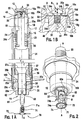
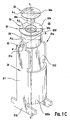
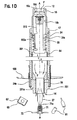
- FIGs 1A, 1B , 1C , 1D , and 2 illustrate preferred embodiments of a dry sprinkler 10.
- the dry sprinkler 10 includes an outer structure assembly 20, outlet frame 25, locator 50, trigger 61, and fluid deflecting structure 70.
- the locator 50 includes a diverter assembly 40 and an inner assembly 501 ( Fig. 1D ).
- the sprinkler 10 can be mounted through a holder or escutcheon 100 as shown in a perspective view of Figure 2 .
- the outer structure assembly 20 defines a passageway 20a that extends along a longitudinal axis A-A between an inlet 12 and an outlet 14.
- the longitudinal axis A-A can be a central axis of the geometric center of the outer structure with a generally constant cross-sectional area over an axial length along the longitudinal axis of the structure.
- the outer structure assembly 20 includes the inlet fitting 16 coupled to a casing tube 24, and an outlet frame 25 coupled to the casing tube 24.
- the casing tube 24 has an inner casing tube surface 24a that cinctures part of the passageway 20a.
- the inner casing tube surface 24a has complementary threads formed at one end that cooperatively engage first coupling threads 18 of the inlet fitting 16.
- the inner casing tube surface 24a has third coupling threads 24d formed proximate the other end of the casing tube 24. The threads 24d terminate at an interior portion 24e of the casing tube 24.
- the casing tube 24 can be coupled to inlet fitting 16 and outlet frame 25 by any suitable technique, such as, for example, thread connections, crimping, bonding, welding, or by a pin and groove.
- a stop surface 17 can be provided as part of the inlet fitting 16.
- the outer inlet fitting surface 16a has fitting threads 16i formed proximate the inlet 12
- the inner inlet fitting surface 16b has first coupling threads formed distal to the threads 16i.
- the fitting threads are used for coupling the dry sprinkler to the piping network
- the inlet fitting 16 has an inlet entrance surface 16c.
- the inlet fitting 16a can be provided with at least one of 3 ⁇ 4 inch, 1 inch, 1.25 inch NPT and 7-1 ISO (Metric) threads 16i formed thereon.
- the inlet fitting 16 has an outer inlet fitting surface 16a and an inner inlet fitting surface 16b.
- the surface 16a cinctures part of the passageway 20a to define an entrance surface 16c and inlet sealing surface 16d.
- the entrance surface 16c can include a convex profile that forms a compound curved surface intersecting a generally planar surface of the inlet sealing surface 16d.
- the inlet fitting 16 can have various different internal surface configurations proximate the entrance surface 16c, however, any suitable configuration may be employed.
- a radiused entrance surface 16c intersects the sealing surface 16d, and the entrance surface 16c can be a surface disposed about the longitudinal axis that has, in a cross-sectional view, a curved profile converging towards the longitudinal axis A-A.
- entrance surface 16c can be a frustoconical surface disposed about the longitudinal axis that has, in a cross-sectional view, a linear profile converging towards the longitudinal axis A-A.
- the sealing surface 16d intersects a surface 16e diverging, and preferably about 60 degrees, to the longitudinal axis A-A.
- the surface 16e intersects a surface 16b extending generally parallel to the longitudinal axis A-A.
- the generally parallel surface 16b intersects a diverging surface 16g, which intersects a surface 16h generally parallel to the longitudinal axis A-A.
- the inlet fitting 16 is provided with a radially projecting boss portion 17.
- the boss portion 17 provides a stop that limits relative threaded engagement between, for example, the inlet fitting 16 and the piping network, the inlet fitting 16 and the casing tube 24, or the outlet frame 25 and the casing tube 24.
- the inlet fitting 16 is provided with screw threads so that the inlet fitting 16 can be coupled to the casing tube 24 via the threaded portion 18.
- the inlet fitting 16 and the casing tube 24 can be formed as a unitary member such that thread portion 18 is not utilized.
- the casing tube 24 can extend as a single tube from the inlet 12 to the outlet 14.
- threaded connection to secure the inlet to the casing can also be utilized such as other mechanical coupling techniques, which can include crimping or bonding.
- other mechanical coupling techniques which can include crimping or bonding.
- either of the respective inner and outer surfaces of the inlet fitting 16, casing tube 24, and outlet frame 25 may be threaded so long as the mating part is cooperatively threaded on the opposite surface, i.e., threads on an inner surface cooperate with threads on an outer surface.
- the locator 50 can include a solid member of a predetermined cross-section such that fluid flows through an inner assembly 501.
- the locator 50 preferably, is disposed within the tubular outer structure assembly 20, which includes the casing tube 24.
- the cross-sectional profiles of the inner and outer surfaces of a tube may be different.
- the locator 50 is coupled to the inner assembly 501, which includes a fluid tube 54, a guide tube 56, and the trigger 61.
- the locator 50 is coupled to the fluid tube 54, and the fluid tube 54 is coupled to the guide tube 56, and the guide tube 56 is coupled to the trigger seat 62 of the trigger 61.
- the locator 50 can locate the diverter assembly 40 with respect to the longitudinal axis A-A.
- the locator 50 has a first yoke support end 51a contacting the diverter assembly 40 and a second yoke support end 51b coupled to the fluid tube 54.
- the locator 50 may optionally include a biasing member that in a preferred embodiment includes an assist spring 55 to assist movement of the locator 50 from its unactuated position ( Fig. 1A ) to an actuated position ( Fig. 1D ).
- the locator 50 has a central axis Y extending generally coincident with the longitudinal axis A-A.
- Locator 50 has two main portions 511 and 512 symmetric about the central axis Y. Each of the main portions has a first end and a second end 51a and 51b.
- a connecting portion 502a connects the main portions 511 and 512 between a first end 51 a and a second end 51 b of each of the main portions 511 and 512.
- the main portions 511 and 512 are each provided with an opening 51c extending along an axis P-P transversely intersecting the yoke axis Y.
- the diverter assembly 40 is fixed to the connector 33 so that the diverter assembly 40 is not free to translate with respect to the locator 50.
- the connecting portion 502a can be a single arcuate member connecting the main portions 511 and 512 on one side of the axis Y to form an elongate member having an arcuate channel extending between the ends of the main portions 511 and 512.
- Locator 50 has some freedom of movement relative to the fluid tube 54 as long as the fluid flow F through the inlet forms a generally symmetric flow path about the locator 50.
- the diverter assembly 40 can be fixed to the locator 50 by a rivet, bolt and nut, screw, two pins, a protrusion cooperating with a recess, or any suitable arrangement that prevents the diverter assembly 40 from rotating with respect to the locator 50 and also allows for compression of the metallic annulus 32 against the sealing surface 16d in a closed position of the dry sprinkler 10.
- locator 50 Due to the alignment of the diverter assembly 40 with the sealing surface 16d of the inlet fitting 16 in the closed position ( Fig. 1A ), locator 50 is generally coaxial with the longitudinal axis A-A in the closed position. Due to the assist spring 55 acting against the asymmetric connecting portion 502a, locator 50 translates along the longitudinal axis A-A in the open position of the dry sprinkler ( Fig. 1D ) such that the outer circumference 32d of the metallic annulus 32 separates from the sealing surface 16d and circumscribes the longitudinal axis A-A to permit a flow of fluid around the shield 30 in a generally symmetric flow path through the passageway 20a.
- outlet frame can be used with the dry sprinklers of the preferred embodiments. Any suitable outlet frame, however, may be used so long as the outlet frame positions a fluid deflecting structure proximate the outlet of the dry sprinkler.
- a preferred outlet frame 25 is shown in Figure 1A .
- Another preferred outlet frame 251 is shown in Figure 1D .
- the outlet frame 25 has an outer outlet frame surface 25a and an inner outlet frame surface 25b, which surfaces cincture part of the passageway 20a.
- the outer outlet frame surface 25a can be provided with coupling threads formed proximate one end of the outlet frame 25 that cooperatively engage coupling threads of the structure 20.
- the outlet frame 25 has an opening 31 so that an annular member, such as a trigger seat 62, can be mounted therein.
- the other end of the outlet frame 25 can include at least one frame arm 27 that is coupled to the fluid deflecting structure 70.
- the outlet frame 25 and frame arms 27 are formed as a unitary member.
- the outlet frame 25, frame aims 27, and fluid deflecting structure 70 can be made from rough or fine casting, and, if desired, machined.
- the thermal trigger 61 is disposed proximate to the outlet 14 of the sprinkler 10.
- the trigger 61 is a frangible bulb that is interposed between a trigger seat 62 and the fluid deflecting structure 70.
- the trigger 61 itself can be a solder link, or any other suitable heat responsive arrangement instead of a frangible bulb.
- the heat responsive trigger may be any suitable arrangement of components that reacts to the appropriate condition(s) by actuating the dry sprinkler.
- the trigger 61 operates to: (1) maintain the inner tubular assembly proximate the first position over the first range of temperatures between about minus 51 degrees Celsius (minus 60 degrees Fahrenheit) to about just below a temperature rating of the trigger; and (2) permit the inner tubular assembly to move along the longitudinal axis to the second position over a second range of temperatures at or greater than the temperature rating of the trigger.
- the temperature rating can be a suitable temperature such as, for example, about 57, 68, 79, 93 or 141 degrees Celsius (134, 155, 175, 200, or 286 degrees Fahrenheit) and plus-or-minus ( ⁇ ) 20% of each of the stated values.
- the trigger seat 62 can be an annular member with a nub portion formed at one end of the trigger seat 62.
- the trigger seat 62 may also include a drain port 63.
- the nub portion has an interior cavity configured to receive a terminal end of the frangible bulb 61.
- the trigger seat 62 has a biasing spring 64 located in a groove 62a.
- the spring 64 is connected to the frame arms 27 of the fluid deflecting structure 70.
- a spacer (not shown) can be located between the second guide tube portion 58 and the trigger seat 62.
- the longitudinal thickness of the spacer would be selected to increase the travel of the locator 50 as it moves from the first position to the second position. In particular, the longitudinal thickness of the spacer would be selected to establish a predetermined travel of the locator 50 before the second end 57b of the first guide tube portion 57 comes to rest on the outlet frame 25.
- the fluid deflecting structure 70 may include an adjustment screw 71 and a planar surface 74 coupled to the frame arms 27 of the outlet frame 25.
- the adjustment screw 71 is provided with external threads 73 that can be used to adjust an axial spacing between the trigger seat 62 and the frangible glass bulb 61.
- the adjustment screw 71 also has a screw seat portion 71 a that engages the frangible bulb 61.
- the adjustment screw 71 and the planar surface member 74a have been described as separate parts, they can be formed as a unitary member.
- a generally planar surface member 74 can be coupled to the adjustment screw 71.
- the planar surface member 74 can be provided with a plurality of tines 74a and a plurality of slots, which are disposed in a predetermined periodic pattern about the longitudinal axis A-A so as to deflect the fluid flow F to form an appropriate spray pattern.
- a planar surface 74 other configurations could be employed to provide the desired fluid deflection pattern.
- the member 74 includes a plurality of tines 74a disposed equiangularly about the longitudinal axis A-A that cooperates with deflecting arms 74b formed on the frame arm 27 to deflect fluid over a desired coverage area.
- the dry sprinkler 10 can extend for a predetermined length L from, for example, a ceiling, a wall, or a floor of an enclosed area.
- the length L can be any value, and preferably, between two to fifty inches depending on the application of the sprinkler 10.
- the diverter assembly 40 includes a shield 30, a metallic annulus 32 and a mounting portion 34.
- the shield 30 includes a first face 30a and a second face 30b disposed about a central axis X-X.
- the central axis X-X preferably defines an axis of the diverter assembly 40, and more particularly, an axis of the first face 30a.
- the first face 30a of the shield 30 extends continuously between the central axis X-X and an outer perimeter of the shield.
- the first face 30a forms an air gap with the inlet surface 16c and preferably forms an air gap with both the inlet surface 16c and the metallic annulus 32.
- the first face 30a has circumference of about 12.7 mm (0.5 inches) with respect to the central axis X-X, the first face 30 defining a generally conic surface that extends at an included angle ⁇ of about 30 degrees with respect to the second face 30b with a tip portion of the conic surface having a radius of curvature R1 of about 3.2 mm (0.125 inches) with respect to the central axis X-X, where the tip portion is located at a distance "h" of about 3.2 mm (1/8 inches) from the second face 30b.
- the diverter assembly 40 also includes a resilient metallic annulus 32.
- the metallic annulus 32 includes a first metallic surface 32a and a second metallic surface 32b spaced apart between an inner circumference 32c to an outer circumference 32d with respect to the central axis X-X.
- the metallic annulus 32 is member that, in its uncompressed state, may have a frustoconical configuration with a base of the frustum facing the inlet, and in a compressed state, has a generally planar configuration with respect to its central axis X-X.
- the metallic annulus 32 can be formed by a suitable resilient material that provides for an appropriate axial spring force as the diverter changes from a compressed to an uncompressed state.
- the resilient material for the diverter can be, for example, stainless steel, beryllium, nickel or combinations thereof.
- a coating may be provided on the diverter such as, for example, synthetic rubber, Teflon, or nylon.
- the metallic annulus 32 can be disposed on the mounting portion 34 so that a third face 34a of the mounting portion 34 confronts the second metallic surface 32b of the metallic annulus 32.
- the third face 34a includes a boss portion 34b that supports the inner circumference 32c of the metallic annulus 32.
- the third face 34a also includes an extension portion 34c that extends between the inner circumference 32c of the metallic annulus 32 and the second face 30b of the shield 30.
- the resilient material is a beryllium and nickel alloy categorized as UNS N03360, 1 ⁇ 2 hard.
- the first face 30a and second face 30b of the shield 30 is preferably provided by a unitary member having a threaded shank portion 30c of about 0.2 inches in length along the central axis X-X that can be used to connect the first and second faces 30a, 30b to the mounting aperture 34d of the mounting portion 34.
- the second face 30b has a first cross-sectional area A1 orthogonal to the central axis X-X less than a second cross-sectional area A2 of the metallic annulus 32 as projected orthogonally with respect to the central axis X-X.
- the third face 34a of the mounting portion 34 has a third cross-sectional area A3 orthogonally with respect to the central axis X-X preferably the same as the first cross-sectional area A1.
- the mounting portion 34 can be coupled to the locator 51 via a connector 33 fixed to both the mounting portion 34 and an opening Sic of the locator 51.
- the mounting portion 34 is fixed to the locator 51 with a suitable connector, such as, for example, a rivet or threaded screw so that the mounting portion 34 is not rotatable about the connector 33.
- a start pressure i.e., an initial pressure present at the inlet when the dry sprinkler is actuated, can be at various start pressures.
- the start pressure is at least 1.37896.105 Pa (20 pounds per square inch (psig) ) , and, more particular, greater than 6,89480 ⁇ 10 5 Pa (100 psig ) .
- the dry sprinkler 10 has a rated discharge coefficient, or rated K- factor, that is at least 80.8 (5.6 in US units), and, can be 115.4, 161.6, 202.0, 242.4, 207.8 or 368.0 (8.0, 11.2, 14.0, 16.8, 14.4 or 25.5 in US units).
- K- factor rated discharge coefficient
- any suitable value for the K-factor could be provided for the dry sprinkler of the preferred embodiments.
- the discharge coefficient or K-factor is quantified as a flow of fluid, preferably fluid, from the outlet 14 of the outer structure assembly 20, e.g., in liters per minute (in gallons per minute), (GPM), divided by the square root of the pressure of the fluid fed into the outer structure assembly 20, e.g., in 10 5 Pa (pounds per square inch gauge (psig)).
- the rated K-factor, or rated discharge coefficient is a mean value.
- the rated K-factors are expressed in standard sizes, which have an acceptable range, which is approximately five percent or less deviation from the standard value over the range of pressures.
- a "rated" K-factor of 161.6 (11.2 in US units) encompasses all measured K-factors between 158.7 (11.0 in US units) and 116.0 (11.5 in US units).
- the K-factors of the preferred embodiment may decrease as the sprinkler length L increases. For example, when L is 1.22m (48 inchest the K- factor of the dry sprinkler 10 can be reduced from 161.6 (11.2 in US units) to approximately 147.2 (10.2 in US units).
- the K-factor allows for an approximation of flow rate to be expected from the outlet of a sprinkler based on the square root of the pressure of fluid fed into the inlet of the sprinkler.
- the dry sprinkler of each of the preferred embodiments has a rated K-factor of at least 80.8 (5.6 in US units).
- each dry sprinkler has an arrangement of components that allows for an actual minimum flow rate in liter per minute (gallons per minute (GPM) in US units) through the outlet as a product of the rated K- factor and the square root of the pressure in 10 5 Pa (pounds per square inch gauge (psig) in US units) of the fluid fed into an inlet of the dry sprinkler of each preferred embodiment.
- the preferred embodiment has an actual minimum flow rate from the outlet 14 of approximately equal to 95% of the magnitude of a rated K-factor times the square root of the pressure of the flow of fluid fed into the inlet of each embodiment.
- the diverter assembly 40 can include a suitable shape that presents as small a frontal area and as small a coefficient of drag as suitable when the diverter assembly 40 is translated to the open position.
- a frontal surface area is provided by the first face 30a of the shield 30 and the metallic annulus 32.
- a flow of fluid through the inlet is diverted into a generally symmetrical flow path about the shield 30 when the locator is translated to a second position ( Fig. 1 D) in the structure 24.
- the flow of fluid is diverted by the shield 30 when the locator is translated to a second position so that a majority of the flow does not impinge upon the metallic surface 32a of the annulus 32 during operation of the dry sprinkler where the pressure of the fluid flow F is between 0 and 12.06583 ⁇ 10 5 Pa (175 psig) and the flow rate is about 95% of the rated K-factor times the square root of the pressure of the fluid fed to the inlet.
- the cross-sectional area A1 of the shield is less than the largest cross-sectional area A2 of the diverter assembly 40 and the height "h" of the shield and the angle of inclination 0 with respect to an orthogonal axis relative to axis X-X are configured so that the majority of flow does not impinge upon operational flow of fluid through the dry sprinkler.
- the first face 30a is configured with the height "h” so that the face 30a does not extend past the outer periphery of inlet surface 16c.
- the diverter assembly 40 is supported by contacting the mounting portion 34 against a portion of the locator 50 so that the metallic annulus 32 of the diverter assembly 40, in an unactuated position of the dry sprinkler 10, engages a sealing surface 16d of the inlet fitting 16.
- the first metallic surface 32a of the metallic annulus 32 of the diverter assembly 40 is preferably compressed against the sealing surface 16d such that the central axis X-X of the metallic surface 32a is generally coaxial with the longitudinal axis A-A and the shield 30 acts to reduce the formation of an ice dam on the inlet surface 16c.
- the metallic annulus 32 When the dry sprinkler 10 is actuated by activation of the trigger 61 so that the metallic annulus 32 is biased from the sealing surface 16d, the metallic annulus 32 forms a generally truncated cone with its central axis X-X generally coaxial with the longitudinal axis A-A.
- the first face 30a or bias member 55 can be made of a copper, bronze, galvanized carbon steel, carbon steel, or stainless steel material.
- the trigger 61 In operation, when the trigger 61 is actuated, e.g., by shattering where the trigger is frangible bulb, the trigger 61 separates from the dry sprinkler 10. The separation of the trigger 61 removes the support for the locator 50 against the resilient spring force of the metallic annulus 32 or the mass of the fluid at the inlet 12. Consequently, the metallic annulus 32 separates from the sealing surface 16d as the diverter assembly 40 translates along with the locator 50 and inner assembly 501. The axial force provided by the metallic annulus 32 or the spring 55 assists in separating the diverter assembly 40 from the inlet fitting 16. Thereafter, fluid or a suitable fire-fighting fluid is allowed to flow through the inlet 12.
- the diverter assembly 40 Due to the configuration of the diverter assembly 40, including the first face 30a, fluid flow F through the inlet 12 to the outlet 14 forms a generally symmetric flow path about the axis A-A through a portion of the passageway 20a.
- the diverter assembly 40 and the locator 50 provide the means for establishing a generally symmetric fluid flow F path about the longitudinal axis A-A through the outlet at a flow rate of at least 95 percent of the rated K-factor multiplied by the square root of the pressure of the fluid flow F fed to the inlet 12 in bar (equals 10 5 Pa) (pounds per square inch gauge in US units).
- the deflector 72 distributes the fluid flow F over a protection area below the sprinkler 10.
- the means do not include any sealing member whose sealing member is positioned, in its entirety, offset or asymmetric to the longitudinal axis A-A in the passageway 20a in either in the closed or opened position of the locator 50.
Landscapes
- Health & Medical Sciences (AREA)
- Public Health (AREA)
- Business, Economics & Management (AREA)
- Emergency Management (AREA)
- Fire-Extinguishing By Fire Departments, And Fire-Extinguishing Equipment And Control Thereof (AREA)
- Gasket Seals (AREA)
- Investigating Materials By The Use Of Optical Means Adapted For Particular Applications (AREA)
- Nozzles (AREA)
Claims (27)
- Asperseur antigel (10) présentant un mode inactif et un mode activé, comprenant:une structure (20) définissant un passage qui s'étend le long d'un axe longitudinal (A-A) entre une entrée (12) et une sortie (14), la structure présentant un facteur K nominal qui définit un écoulement de fluide attendu en litres (gallons) par minute à partir de la sortie (14) divisé par la racine carrée de la surpression de l'écoulement de fluide qui est amené dans l'entrée (12) du passage en 105 pascal (livres par valeur de pression en pouces carrés);une structure de déflexion de fluide (70) à proximité de la sortie (14) à une première distance dans le mode inactif, et à une deuxième distance dans le mode activé, les première et deuxième distances étant égales; etdes moyens pour établir un chemin d'écoulement de fluide essentiellement symétrique autour de l'axe longitudinal (A-A) à travers la sortie (14) à un débit d'au moins 95 pour cent du facteur K nominal multiplié par la racine carrée de la surpression de l'écoulement de fluide qui est amené dans l'entrée (12) en 105 pascal (livres par valeur de pression en pouces carrés), les moyens comprenant :un positionneur (50) comprenant un élément tubulaire présentant une première extrémité, une deuxième extrémité et un canal qui s'étend entre les première et deuxième extrémités coaxialement à l'axe longitudinal (A-A) afin de définir un passage de fluide, le positionneur (50) étant déplaçable le long de l'axe longitudinal (A-A) entre une première position et une deuxième position;un ensemble de déflecteur (40) supporté par le positionneur (50) pour boucher un écoulement de fluide à travers le passage lorsque le positionneur (50) se trouve dans la première position; etun arrangement qui empêche l'ensemble de déflecteur (40) de tourner par rapport au positionneur (50).
- Asperseur antigel (10) selon la revendication 1, dans lequel la structure (20) comprend un élément tubulaire disposé autour de l'axe longitudinal (A-A).
- Asperseur antigel (10) selon la revendication 2, dans lequel le positionneur (50) comprend un joug présentant des parties de paroi symétriques par rapport à l'axe longitudinal (A-A).
- Asperseur antigel (10) selon la revendication 3, dans lequel l'ensemble de déflecteur (40) comprend en outre:un anneau métallique (32) présentant des première et deuxième surfaces métalliques (32a, 32b) espacées le long de l'axe longitudinal (A-A) entre une circonférence intérieure et une circonférence extérieure par rapport à l'axe longitudinal (A-A), l'anneau métallique (32) bouchant l'écoulement de fluide à travers le passage lorsque le positionneur (50) est proche de la première position;un écran (30) présentant une première face (30a) exposée à l'entrée (12), une deuxième face (30b) opposée à la première surface métallique (32a) pour définir une fente entre celles-ci; etla partie de montage (34) qui supporte l'anneau métallique (32) et l'écran (30), la partie de montage (34) présentant en outre une troisième face (34a) opposée à la deuxième surface métallique (32b).
- Asperseur antigel (10) selon la revendication 4, dans lequel la première face (30a) de l'écran (30) comprend une surface essentiellement conique disposée autour d'un axe qui s'étend à travers l'écran (30), la première face (30a) présentant une première région de section transversale disposée autour de l'axe.
- Asperseur antigel (10) selon la revendication 5, dans lequel la deuxième face (30b) de l'écran (30) comprend une surface essentiellement plane disposée autour de l'axe, la deuxième face (30b) présentant une deuxième région de section transversale disposée autour de l'axe.
- Asperseur antigel (10) selon la revendication 6, dans lequel l'axe comprend un axe de l'écran (30) qui est essentiellement coïncident avec l'axe longitudinal (A-A).
- Asperseur antigel (10) selon la revendication 4, dans lequel la troisième face (34a) de la partie de montage (34) est distante des première et deuxième surfaces de l'écran (30) et opposée à la deuxième surface métallique (32b) de l'anneau métallique (32), dans lequel l'écran (30) définit une première région de section transversale, et l'anneau métallique (32) définit une deuxième région de section transversale, la troisième face de la partie de montage (34) comprenant une troisième région de section transversale orthogonale autour de l'axe longitudinal (A-A).
- Asperseur antigel (10) selon la revendication 8, dans lequel la troisième face (34a) comprend une partie qui s'étend en travers de la fente entre la deuxième face (30b) et l'anneau métallique (32).
- Asperseur antigel (10) selon la revendication 1, dans lequel le positionneur (50) comprend un élément allongé disposé à l'intérieur de la structure.
- Asperseur antigel (10) selon la revendication 10, dans lequel le positionneur (50) est couplé à l'ensemble de déflecteur (40) par une broche (33) disposée le long d'un axe essentiellement orthogonal à l'axe longitudinal (A-A).
- Asperseur antigel (10) selon la revendication 1, dans lequel l'entrée (12) comprend une surface d'étanchéité (16d) disposée autour de l'axe longitudinal (A-A) à proximité de l'entrée (12).
- Asperseur antigel (10) selon la revendication 12, dans lequel le positionneur (50) présente une première position inactive et une deuxième position activée, et les première et deuxième surfaces métalliques (32a, 32b) définissent un plan qui est essentiellement orthogonal à l'axe longitudinal (A-A), la première surface métallique (32a) étant contiguë à la surface d'étanchéité (16d) de l'entrée (12) dans la première position du positionneur (50).
- Asperseur antigel (10) selon la revendication 13, dans lequel les première et deuxième surfaces métalliques (32a, 32b) entourent l'axe longitudinal (A-A) afin de définir un cône essentiellement tronqué dont la base est essentiellement orthogonale à l'axe longitudinal (A-A) dans la deuxième position du positionneur (50).
- Asperseur antigel (10) selon la revendication 14, dans lequel l'entrée (12) comprend une surface extérieure essentiellement cylindrique qui comporte un filet parmi les filets NPT de 19,05 mm (0,75 pouce), 25,4 mm (1 pouce), 31,75 mm (1,25 pouces) et 7-1 ISO formé sur celle-ci.
- Asperseur antigel (10) selon la revendication 15, dans lequel l'entrée (12) comprend en outre une surface courbe (16c) exposée à l'entrée (12), la surface courbe (16c) étant connectée à une surface d'étanchéité essentiellement plane (16d), la surface d'étanchéité essentiellement plane (16d) étant couplée à une surface tronconique (16e) opposée à l'axe longitudinal (A-A) à proximité de la surface d'étanchéité essentiellement plane (16d), la surface tronconique (16e) s'étendant sous un angle d'environ 60° par rapport à l'axe longitudinal (A-A).
- Asperseur antigel (10) selon la revendication 15, dans lequel l'entrée (12) comprend une surface d'entrée (16c) qui présente une première extrémité et une deuxième extrémité qui sont disposées le long de et entourent l'axe longitudinal (A-A) avec une surface de courbure essentiellement arrondie et une surface d'appui (16d) à proximité de la deuxième extrémité de la surface d'entrée (16c) qui forme un joint en conjonction avec l'anneau métallique (32).
- Asperseur antigel (10) selon la revendication 17, dans lequel la surface d'entrée (16c) présente une surface convexe qui entoure l'axe longitudinal (A-A), et la surface d'appui (16d) présente une surface annulaire plane qui entoure l'axe longitudinal (A-A).
- Asperseur antigel (10) selon la revendication 18, dans lequel l'entrée (12) comprend en outre une surface oblique (16e) à proximité de la surface annulaire plane.
- Asperseur antigel (10) selon la revendication 4, dans lequel la première face (30a) présente une surface essentiellement conique disposée autour d'un axe qui s'étend à travers la première face (30a), la première face (30a) comprenant une première région de section transversale disposée autour de l'axe, la première surface métallique (32a) comportant une saillie orthogonale qui définit une deuxième région de section transversale disposée autour de l'axe, la troisième face (34a) de la partie de montage (34) présentant une surface essentiellement plane disposée autour de l'axe, définissant une troisième région de section transversale disposée autour de l'axe, et chacune des première et troisième régions de section transversale présentant une grandeur inférieure à la deuxième région de section transversale.
- Asperseur antigel (10) selon la revendication 20, dans lequel la partie de montage (34) comprend une partie qui s'étend en travers de la fente entre la deuxième face (30b) et la première surface métallique (32a).
- Asperseur antigel (10) selon la revendication 21, dans lequel la structure comprend un élément tubulaire disposé autour de l'axe longitudinal (A-A), et le positionneur (50) comprend un joug qui présente des parties de paroi (511, 512) qui sont symétriques par rapport à l'axe longitudinal (A-A).
- Asperseur antigel (10) selon la revendication 22, dans lequel l'entrée (12) comprend une surface d'étanchéité (16d) disposée autour de l'axe longitudinal (A-A) à proximité de l'entrée (12).
- Asperseur antigel (10) selon la revendication 23, dans lequel les première et deuxième surfaces métalliques (32a, 32b) présentent une surface plane essentiellement orthogonale à l'axe longitudinal (A-A), la première surface métallique (32a) étant contiguë à la surface d'étanchéité (16d) dans la première position du positionneur (50).
- Asperseur antigel (10) selon la revendication 24, dans lequel les première et deuxième surfaces métalliques (32a, 32b) entourent l'axe longitudinal (A-A) afin de définir un cône dont la base est essentiellement orthogonale à l'axe longitudinal (A-A) dans la deuxième position du positionneur (50).
- Asperseur antigel (10) selon la revendication 1, dans lequel l'entrée (12) comprend:une surface d'étanchéité plane (16d) disposée autour de et perpendiculaire à l'axe longitudinal (A-A) ;une surface d'entrée (16c) disposée autour de l'axe longitudinal (A-A), la surface d'entrée (16c) convergeant en direction de l'axe longitudinal (A-A) de manière à définir un profil courbe qui coupe la surface d'étanchéité (16d), etune surface divergeante (16e) disposée autour de l'axe longitudinal (A-A), la surface divergeante coupant la surface d'étanchéité (16d) et définissant un profil qui diverge de l'axe longitudinal (A-A) d'un angle.
- Asperseur antigel (10) selon la revendication 26, dans lequel l'ensemble de déflecteur (40) comprend en outre:un anneau métallique (32) présentant des première et deuxième surfaces métalliques (32a, 32b) distantes l'une de l'autre le long de l'axe longitudinal (A-A) entre une circonférence intérieure et une circonférence extérieure par rapport à l'axe longitudinal (A-A), une partie de la première surface métallique (32a) engageant la surface d'étanchéité plane (16d) de l'entrée (12) afin de boucher l'écoulement de fluide à travers le passage lorsque le positionneur (50) est proche de la première position; etun écran (30) qui définit un axe central (X-X) coaxial à l'axe longitudinal (A-A), l'écran (30) étant connecté à la partie de montage (34) de telle sorte que l'écran (30) forme une fente avec la première surface métallique (32a) de l'anneau métallique (32), et l'axe central (X-X) de l'écran (30) reste coaxial à l'axe longitudinal (A-A) lorsque le positionneur (50) se déplace de la première position vers la deuxième position.
Applications Claiming Priority (2)
| Application Number | Priority Date | Filing Date | Title |
|---|---|---|---|
| US11/000,129 US7559376B2 (en) | 2004-12-01 | 2004-12-01 | Dry sprinkler with a diverter seal assembly |
| PCT/US2005/042994 WO2006060341A2 (fr) | 2004-12-01 | 2005-11-30 | Sprinkleur antigel a ensemble deflecteur a fermeture etanche |
Publications (3)
| Publication Number | Publication Date |
|---|---|
| EP1817084A2 EP1817084A2 (fr) | 2007-08-15 |
| EP1817084A4 EP1817084A4 (fr) | 2007-11-21 |
| EP1817084B1 true EP1817084B1 (fr) | 2010-06-02 |
Family
ID=36565603
Family Applications (1)
| Application Number | Title | Priority Date | Filing Date |
|---|---|---|---|
| EP05849632A Expired - Lifetime EP1817084B1 (fr) | 2004-12-01 | 2005-11-30 | Sprinkleur antigel a ensemble deflecteur a fermeture etanche |
Country Status (8)
| Country | Link |
|---|---|
| US (6) | US7559376B2 (fr) |
| EP (1) | EP1817084B1 (fr) |
| AT (1) | ATE469682T1 (fr) |
| CA (1) | CA2588678C (fr) |
| DE (1) | DE602005021682D1 (fr) |
| DK (1) | DK1817084T3 (fr) |
| ES (1) | ES2346675T3 (fr) |
| WO (1) | WO2006060341A2 (fr) |
Families Citing this family (28)
| Publication number | Priority date | Publication date | Assignee | Title |
|---|---|---|---|---|
| US7165624B1 (en) | 1998-05-15 | 2007-01-23 | Grinnell Corporation | Early suppression fast response fire protection sprinkler |
| US6976543B1 (en) | 2000-11-22 | 2005-12-20 | Grinnell Corporation | Low pressure, extended coverage, upright fire protection sprinkler |
| US8327946B1 (en) | 2002-07-19 | 2012-12-11 | Tyco Fire Products Lp | Dry sprinkler |
| US7516800B1 (en) | 2002-07-19 | 2009-04-14 | Tyco Fire Products Lp | Dry sprinkler |
| CA2462636C (fr) * | 2004-02-09 | 2010-09-14 | The Viking Corporation | Installation d'extincteur automatique antigel |
| US7559376B2 (en) | 2004-12-01 | 2009-07-14 | Tyco Fire Products Lp | Dry sprinkler with a diverter seal assembly |
| US20060289174A1 (en) * | 2005-06-22 | 2006-12-28 | Hong-Zeng Yu | Deluge-like sprinkler fire scheme using high thermal sensitivity and high temperature rating sensing elements |
| US7766252B2 (en) * | 2006-02-15 | 2010-08-03 | The Viking Corporation | Dry sprinkler assembly |
| US20070215362A1 (en) * | 2006-03-20 | 2007-09-20 | Fire Sprinkler System, Inc. | Fire sprinkler system |
| US8162069B2 (en) * | 2006-09-05 | 2012-04-24 | The Reliable Automatic Sprinkler Co., Inc. | Automatic fire protection sprinkler with extended body |
| US9358411B2 (en) | 2011-05-27 | 2016-06-07 | Victaulic Company | Flexible dry sprinkler |
| TWI549716B (zh) * | 2011-06-28 | 2016-09-21 | 泰科防火產品有限合夥公司 | 具有多個連結配置之乾式噴灑器 |
| US9511248B2 (en) | 2011-08-10 | 2016-12-06 | Victaulic Company | Sprinkler system and installation |
| KR20140121438A (ko) * | 2012-02-07 | 2014-10-15 | 마리오프 코포레이션 오와이 | 폴리머 밀봉부를 갖는 미분무수 소화 스프링클러 |
| CN104602766A (zh) | 2012-04-20 | 2015-05-06 | 泰科消防产品有限合伙公司 | 干式喷洒器组件 |
| US8887822B2 (en) | 2012-06-01 | 2014-11-18 | Reliable Automatic Sprinkler Co., Inc. | Flexible dry sprinklers |
| FR3002152B1 (fr) * | 2013-02-21 | 2015-12-04 | Vactec | Chandelle seche destinee a etre montee dans une installation de protection contre les incendies du type comprenant un reseau de sprinklers sous vide |
| GB2537414B (en) * | 2015-04-17 | 2019-11-13 | Graviner Ltd Kidde | Pyrotechnic valve |
| ES3039117T3 (en) | 2015-10-06 | 2025-10-17 | Marioff Corp Oy | Suppression unit, nozzle for suppression unit, and method |
| ES2770621T3 (es) | 2015-10-06 | 2020-07-02 | Marioff Corp Oy | Unidad de extinción y método |
| US11110311B2 (en) | 2017-05-31 | 2021-09-07 | Tyco Fire Products Lp | Antifreeze formulation and sprinkler systems comprising improved antifreezes |
| AU2019325570B2 (en) | 2018-08-23 | 2022-04-07 | Victaulic Company | Dry sprinkler assembly |
| US11577108B2 (en) | 2019-10-17 | 2023-02-14 | Minimax Viking Research & Development Gmbh | Dry sprinkler assemblies for fire protection sprinkler systems |
| EP4045154B1 (fr) * | 2019-10-17 | 2026-04-22 | Minimax Viking Patent Management GmbH | Ensembles d'extincteurs secs pour systèmes d'extincteur de protection contre l'incendie |
| US12397304B2 (en) * | 2020-04-01 | 2025-08-26 | Minimax Viking Patent Management Gmbh | Dry fire protection sprinkler and fluid deflection member assemblies |
| US11786770B2 (en) | 2020-04-01 | 2023-10-17 | Minimax Viking Research & Development Gmbh | Dry fire protection sprinkler assemblies |
| US12186608B2 (en) * | 2021-04-14 | 2025-01-07 | Tyco Fire Products Lp | Thermal trigger seat for sprinkler system |
| EP4518981A4 (fr) | 2022-05-01 | 2026-04-22 | Minimax Viking Patent Man Gmbh | Systèmes et ensembles sprinkler de protection contre l'incendie à sec |
Family Cites Families (43)
| Publication number | Priority date | Publication date | Assignee | Title |
|---|---|---|---|---|
| US2732018A (en) | 1956-01-24 | Pendent sprinkler head | ||
| US1338469A (en) | 1916-07-24 | 1920-04-27 | Sivert P Waage | Thermally-actuated drain-valve |
| US1903150A (en) | 1932-04-04 | 1933-03-28 | Tyden Emil | Pendant sprinkler system |
| US2155990A (en) | 1938-05-25 | 1939-04-25 | Jr Willis K Hodgman | Pendant sprinkler head |
| US2180258A (en) | 1938-08-09 | 1939-11-14 | Globe Automatic Sprinkler Co | Sprinkler system |
| US2211399A (en) | 1939-03-02 | 1940-08-13 | Seth L Winslow | Sprinkler head |
| US2291818A (en) | 1941-07-24 | 1942-08-04 | Gen Fire Extinguisher Co | Sprinkler system |
| US2291813A (en) | 1941-07-24 | 1942-08-04 | Gen Fire Extinguisher Co | Sprinkler system |
| US2768696A (en) | 1953-05-01 | 1956-10-30 | Grinnell Corp | Sprinkler systems |
| US2871953A (en) | 1954-12-06 | 1959-02-03 | Grinnell Corp | Pendent sprinkler |
| US3007528A (en) | 1959-07-17 | 1961-11-07 | Star Sprinkler Corp | Dry pendant sprinklers |
| US3061015A (en) | 1960-01-11 | 1962-10-30 | Hodgman Mfg Co Inc | Dry pendent sprinkler head |
| US3067823A (en) | 1960-07-01 | 1962-12-11 | Frederick J Kavanagh | Automatic sprinkler |
| US3080000A (en) | 1961-07-19 | 1963-03-05 | Star Sprinkler Corp | Dry pendant sprinklers |
| US3135331A (en) | 1962-09-24 | 1964-06-02 | Floyd J Lee | Dry adapter for fire-extinguishing sprinkler systems |
| US3401751A (en) | 1966-04-22 | 1968-09-17 | Standard Fire Prot Equipment C | Dry pipes sprinkler system |
| US3584689A (en) | 1969-06-26 | 1971-06-15 | Norris Industries | Dry-type sprinkler |
| US3924687A (en) | 1974-02-20 | 1975-12-09 | Viking Corp | Valve and sprinkler head for automatic fire extinguishing systems |
| US4007878A (en) | 1976-08-19 | 1977-02-15 | Central Sprinkler Corporation | Adjustable dry pendant sprinkler head assembly |
| US4091872A (en) | 1977-02-07 | 1978-05-30 | A-T-O Inc. | Adjustable dry pendent sprinkler |
| GB1564662A (en) | 1977-06-15 | 1980-04-10 | Mather & Platt Ltd | Sprinkler arrangements |
| US4220208A (en) | 1977-11-21 | 1980-09-02 | Hays Heating & Plumbing Company | Dry pipe fire extinguishing sprinkler system |
| US4237982A (en) | 1978-05-01 | 1980-12-09 | The Reliable Automatic Sprinkler Co., Inc. | Adjustable dry sprinkler having a latching mechanism controlled by a sleeve |
| US4228858A (en) | 1978-05-01 | 1980-10-21 | The Reliable Automatic Sprinkler Co. | Dry sprinkler with non-load-transmitting sealing arrangement |
| US4258795A (en) | 1979-03-08 | 1981-03-31 | Central Sprinkler Corporation | On-off sprinkler head having an offset drive motor |
| US4417626A (en) | 1982-07-12 | 1983-11-29 | Interfit, Inc. | Adjustable pendent sprinkler assembly |
| US4830117A (en) * | 1987-12-24 | 1989-05-16 | Fire Sprinkler Specialties, Inc. | Shut-off device for an automatic sprinkler |
| US5228520A (en) | 1988-12-22 | 1993-07-20 | Holger Gottschalk | Sprinkler system for refrigerated spaces |
| US5188185A (en) | 1991-06-19 | 1993-02-23 | Grinnell Corporation | Dry sprinkler |
| DE4122665A1 (de) | 1991-07-09 | 1993-01-14 | Total Feuerschutz Gmbh | Sprinkler fuer selbsttaetige feuerloeschanlagen |
| US5366022A (en) | 1991-09-30 | 1994-11-22 | Central Sprinkler Corporation | Extended coverage ceiling sprinklers and systems |
| US5775431A (en) | 1996-09-11 | 1998-07-07 | The Reliable Automatic Sprinkler Co., Inc. | Dry sprinkler arrangements |
| US6152236A (en) * | 1998-10-05 | 2000-11-28 | The Viking Corporation | Combined trigger and concealing device for a sprinkler head |
| US6367559B1 (en) * | 1998-12-29 | 2002-04-09 | The Viking Corporation | Double-blade deflector for side wall sprinkler |
| US6962208B2 (en) | 2000-05-17 | 2005-11-08 | The Viking Corporation | Compact pendant sprinkler head |
| US6851482B2 (en) | 2000-11-02 | 2005-02-08 | Kevin Michael Dolan | Sprinkler assembly |
| US6554077B2 (en) * | 2001-04-12 | 2003-04-29 | The Reliable Automatic Sprinkler Co., Inc. | Quick response adjustable automatic sprinkler arrangements |
| US20030075343A1 (en) | 2001-10-22 | 2003-04-24 | National Foam, Inc., D/B/A Kidde Fire Fighting | Dry sprinkler |
| US7516800B1 (en) | 2002-07-19 | 2009-04-14 | Tyco Fire Products Lp | Dry sprinkler |
| CA2462636C (fr) * | 2004-02-09 | 2010-09-14 | The Viking Corporation | Installation d'extincteur automatique antigel |
| US7275603B2 (en) * | 2004-10-26 | 2007-10-02 | The Reliable Automatic Sprinkler Co., Inc. | Concealed pendent fire protection sprinkler with drop-down deflector |
| US7559376B2 (en) | 2004-12-01 | 2009-07-14 | Tyco Fire Products Lp | Dry sprinkler with a diverter seal assembly |
| US7766252B2 (en) | 2006-02-15 | 2010-08-03 | The Viking Corporation | Dry sprinkler assembly |
-
2004
- 2004-12-01 US US11/000,129 patent/US7559376B2/en not_active Expired - Lifetime
-
2005
- 2005-11-30 AT AT05849632T patent/ATE469682T1/de not_active IP Right Cessation
- 2005-11-30 EP EP05849632A patent/EP1817084B1/fr not_active Expired - Lifetime
- 2005-11-30 DK DK05849632.4T patent/DK1817084T3/da active
- 2005-11-30 CA CA2588678A patent/CA2588678C/fr not_active Expired - Lifetime
- 2005-11-30 DE DE602005021682T patent/DE602005021682D1/de not_active Expired - Lifetime
- 2005-11-30 ES ES05849632T patent/ES2346675T3/es not_active Expired - Lifetime
- 2005-11-30 WO PCT/US2005/042994 patent/WO2006060341A2/fr not_active Ceased
-
2009
- 2009-05-06 US US12/436,290 patent/US8225881B2/en not_active Expired - Lifetime
-
2012
- 2012-06-21 US US13/529,033 patent/US8826998B2/en not_active Expired - Lifetime
-
2013
- 2013-03-11 US US13/793,392 patent/US20130186652A1/en not_active Abandoned
-
2016
- 2016-11-10 US US15/348,340 patent/US9737742B2/en not_active Expired - Lifetime
- 2016-11-10 US US15/348,421 patent/US9744390B2/en not_active Expired - Lifetime
Also Published As
| Publication number | Publication date |
|---|---|
| US20170056696A1 (en) | 2017-03-02 |
| US9744390B2 (en) | 2017-08-29 |
| WO2006060341A2 (fr) | 2006-06-08 |
| US9737742B2 (en) | 2017-08-22 |
| DK1817084T3 (da) | 2010-09-27 |
| CA2588678A1 (fr) | 2006-06-08 |
| US20130186652A1 (en) | 2013-07-25 |
| WO2006060341A3 (fr) | 2007-03-01 |
| EP1817084A4 (fr) | 2007-11-21 |
| EP1817084A2 (fr) | 2007-08-15 |
| US20130153247A1 (en) | 2013-06-20 |
| US20060113093A1 (en) | 2006-06-01 |
| ATE469682T1 (de) | 2010-06-15 |
| DE602005021682D1 (de) | 2010-07-15 |
| US20090211772A1 (en) | 2009-08-27 |
| US8826998B2 (en) | 2014-09-09 |
| US20170056697A1 (en) | 2017-03-02 |
| ES2346675T3 (es) | 2010-10-19 |
| US7559376B2 (en) | 2009-07-14 |
| US8225881B2 (en) | 2012-07-24 |
| CA2588678C (fr) | 2015-01-06 |
Similar Documents
| Publication | Publication Date | Title |
|---|---|---|
| US9737742B2 (en) | Dry sprinkler with a diverter seal assembly | |
| US11925826B2 (en) | Dry sprinkler assemblies | |
| US8469112B1 (en) | Dry sprinkler | |
| US20070246231A1 (en) | Extended coverage horizontal sidewall sprinkler | |
| US7314093B2 (en) | Fast response sprinkler assembly for a fire extinguishing system | |
| US20250195930A1 (en) | Dry sprinkler | |
| AU2012275317B2 (en) | Dry sprinklers with multiple coupling arrangements | |
| NZ618903B2 (en) | Dry sprinklers with multiple coupling arrangements | |
| HK1128437B (en) | Extended coverage horizontal sidewall sprinkler |
Legal Events
| Date | Code | Title | Description |
|---|---|---|---|
| PUAI | Public reference made under article 153(3) epc to a published international application that has entered the european phase |
Free format text: ORIGINAL CODE: 0009012 |
|
| 17P | Request for examination filed |
Effective date: 20070524 |
|
| AK | Designated contracting states |
Kind code of ref document: A2 Designated state(s): AT BE BG CH CY CZ DE DK EE ES FI FR GB GR HU IE IS IT LI LT LU LV MC NL PL PT RO SE SI SK TR |
|
| AX | Request for extension of the european patent |
Extension state: AL BA HR MK YU |
|
| A4 | Supplementary search report drawn up and despatched |
Effective date: 20071023 |
|
| DAX | Request for extension of the european patent (deleted) | ||
| 17Q | First examination report despatched |
Effective date: 20081006 |
|
| RAP1 | Party data changed (applicant data changed or rights of an application transferred) |
Owner name: TYCO FIRE PRODUCTS LP |
|
| GRAP | Despatch of communication of intention to grant a patent |
Free format text: ORIGINAL CODE: EPIDOSNIGR1 |
|
| GRAS | Grant fee paid |
Free format text: ORIGINAL CODE: EPIDOSNIGR3 |
|
| GRAA | (expected) grant |
Free format text: ORIGINAL CODE: 0009210 |
|
| AK | Designated contracting states |
Kind code of ref document: B1 Designated state(s): AT BE BG CH CY CZ DE DK EE ES FI FR GB GR HU IE IS IT LI LT LU LV MC NL PL PT RO SE SI SK TR |
|
| REG | Reference to a national code |
Ref country code: GB Ref legal event code: FG4D |
|
| REG | Reference to a national code |
Ref country code: CH Ref legal event code: EP |
|
| REG | Reference to a national code |
Ref country code: IE Ref legal event code: FG4D |
|
| REF | Corresponds to: |
Ref document number: 602005021682 Country of ref document: DE Date of ref document: 20100715 Kind code of ref document: P |
|
| REG | Reference to a national code |
Ref country code: NL Ref legal event code: T3 |
|
| REG | Reference to a national code |
Ref country code: SE Ref legal event code: TRGR |
|
| REG | Reference to a national code |
Ref country code: DK Ref legal event code: T3 |
|
| REG | Reference to a national code |
Ref country code: ES Ref legal event code: FG2A Ref document number: 2346675 Country of ref document: ES Kind code of ref document: T3 |
|
| PG25 | Lapsed in a contracting state [announced via postgrant information from national office to epo] |
Ref country code: LT Free format text: LAPSE BECAUSE OF FAILURE TO SUBMIT A TRANSLATION OF THE DESCRIPTION OR TO PAY THE FEE WITHIN THE PRESCRIBED TIME-LIMIT Effective date: 20100602 |
|
| LTIE | Lt: invalidation of european patent or patent extension |
Effective date: 20100602 |
|
| PG25 | Lapsed in a contracting state [announced via postgrant information from national office to epo] |
Ref country code: AT Free format text: LAPSE BECAUSE OF FAILURE TO SUBMIT A TRANSLATION OF THE DESCRIPTION OR TO PAY THE FEE WITHIN THE PRESCRIBED TIME-LIMIT Effective date: 20100602 Ref country code: SI Free format text: LAPSE BECAUSE OF FAILURE TO SUBMIT A TRANSLATION OF THE DESCRIPTION OR TO PAY THE FEE WITHIN THE PRESCRIBED TIME-LIMIT Effective date: 20100602 Ref country code: LV Free format text: LAPSE BECAUSE OF FAILURE TO SUBMIT A TRANSLATION OF THE DESCRIPTION OR TO PAY THE FEE WITHIN THE PRESCRIBED TIME-LIMIT Effective date: 20100602 |
|
| PG25 | Lapsed in a contracting state [announced via postgrant information from national office to epo] |
Ref country code: GR Free format text: LAPSE BECAUSE OF FAILURE TO SUBMIT A TRANSLATION OF THE DESCRIPTION OR TO PAY THE FEE WITHIN THE PRESCRIBED TIME-LIMIT Effective date: 20100903 Ref country code: PL Free format text: LAPSE BECAUSE OF FAILURE TO SUBMIT A TRANSLATION OF THE DESCRIPTION OR TO PAY THE FEE WITHIN THE PRESCRIBED TIME-LIMIT Effective date: 20100602 Ref country code: CY Free format text: LAPSE BECAUSE OF FAILURE TO SUBMIT A TRANSLATION OF THE DESCRIPTION OR TO PAY THE FEE WITHIN THE PRESCRIBED TIME-LIMIT Effective date: 20100602 |
|
| PG25 | Lapsed in a contracting state [announced via postgrant information from national office to epo] |
Ref country code: EE Free format text: LAPSE BECAUSE OF FAILURE TO SUBMIT A TRANSLATION OF THE DESCRIPTION OR TO PAY THE FEE WITHIN THE PRESCRIBED TIME-LIMIT Effective date: 20100602 |
|
| PG25 | Lapsed in a contracting state [announced via postgrant information from national office to epo] |
Ref country code: PT Free format text: LAPSE BECAUSE OF FAILURE TO SUBMIT A TRANSLATION OF THE DESCRIPTION OR TO PAY THE FEE WITHIN THE PRESCRIBED TIME-LIMIT Effective date: 20101004 Ref country code: IS Free format text: LAPSE BECAUSE OF FAILURE TO SUBMIT A TRANSLATION OF THE DESCRIPTION OR TO PAY THE FEE WITHIN THE PRESCRIBED TIME-LIMIT Effective date: 20101002 Ref country code: SK Free format text: LAPSE BECAUSE OF FAILURE TO SUBMIT A TRANSLATION OF THE DESCRIPTION OR TO PAY THE FEE WITHIN THE PRESCRIBED TIME-LIMIT Effective date: 20100602 Ref country code: CZ Free format text: LAPSE BECAUSE OF FAILURE TO SUBMIT A TRANSLATION OF THE DESCRIPTION OR TO PAY THE FEE WITHIN THE PRESCRIBED TIME-LIMIT Effective date: 20100602 Ref country code: RO Free format text: LAPSE BECAUSE OF FAILURE TO SUBMIT A TRANSLATION OF THE DESCRIPTION OR TO PAY THE FEE WITHIN THE PRESCRIBED TIME-LIMIT Effective date: 20100602 |
|
| PLBE | No opposition filed within time limit |
Free format text: ORIGINAL CODE: 0009261 |
|
| STAA | Information on the status of an ep patent application or granted ep patent |
Free format text: STATUS: NO OPPOSITION FILED WITHIN TIME LIMIT |
|
| 26N | No opposition filed |
Effective date: 20110303 |
|
| REG | Reference to a national code |
Ref country code: DE Ref legal event code: R097 Ref document number: 602005021682 Country of ref document: DE Effective date: 20110302 |
|
| PG25 | Lapsed in a contracting state [announced via postgrant information from national office to epo] |
Ref country code: MC Free format text: LAPSE BECAUSE OF NON-PAYMENT OF DUE FEES Effective date: 20101130 |
|
| REG | Reference to a national code |
Ref country code: CH Ref legal event code: PL |
|
| PG25 | Lapsed in a contracting state [announced via postgrant information from national office to epo] |
Ref country code: CH Free format text: LAPSE BECAUSE OF NON-PAYMENT OF DUE FEES Effective date: 20101130 Ref country code: LI Free format text: LAPSE BECAUSE OF NON-PAYMENT OF DUE FEES Effective date: 20101130 |
|
| PG25 | Lapsed in a contracting state [announced via postgrant information from national office to epo] |
Ref country code: IE Free format text: LAPSE BECAUSE OF NON-PAYMENT OF DUE FEES Effective date: 20101130 |
|
| PG25 | Lapsed in a contracting state [announced via postgrant information from national office to epo] |
Ref country code: HU Free format text: LAPSE BECAUSE OF FAILURE TO SUBMIT A TRANSLATION OF THE DESCRIPTION OR TO PAY THE FEE WITHIN THE PRESCRIBED TIME-LIMIT Effective date: 20101203 Ref country code: LU Free format text: LAPSE BECAUSE OF NON-PAYMENT OF DUE FEES Effective date: 20101130 Ref country code: BG Free format text: LAPSE BECAUSE OF FAILURE TO SUBMIT A TRANSLATION OF THE DESCRIPTION OR TO PAY THE FEE WITHIN THE PRESCRIBED TIME-LIMIT Effective date: 20100602 |
|
| PG25 | Lapsed in a contracting state [announced via postgrant information from national office to epo] |
Ref country code: TR Free format text: LAPSE BECAUSE OF FAILURE TO SUBMIT A TRANSLATION OF THE DESCRIPTION OR TO PAY THE FEE WITHIN THE PRESCRIBED TIME-LIMIT Effective date: 20100602 |
|
| PG25 | Lapsed in a contracting state [announced via postgrant information from national office to epo] |
Ref country code: BG Free format text: LAPSE BECAUSE OF FAILURE TO SUBMIT A TRANSLATION OF THE DESCRIPTION OR TO PAY THE FEE WITHIN THE PRESCRIBED TIME-LIMIT Effective date: 20100902 |
|
| REG | Reference to a national code |
Ref country code: FR Ref legal event code: PLFP Year of fee payment: 11 |
|
| REG | Reference to a national code |
Ref country code: FR Ref legal event code: PLFP Year of fee payment: 12 |
|
| REG | Reference to a national code |
Ref country code: FR Ref legal event code: PLFP Year of fee payment: 13 |
|
| PGFP | Annual fee paid to national office [announced via postgrant information from national office to epo] |
Ref country code: DK Payment date: 20201125 Year of fee payment: 16 |
|
| PGFP | Annual fee paid to national office [announced via postgrant information from national office to epo] |
Ref country code: BE Payment date: 20201127 Year of fee payment: 16 |
|
| REG | Reference to a national code |
Ref country code: DK Ref legal event code: EBP Effective date: 20211130 |
|
| PG25 | Lapsed in a contracting state [announced via postgrant information from national office to epo] |
Ref country code: BE Free format text: LAPSE BECAUSE OF NON-PAYMENT OF DUE FEES Effective date: 20211130 |
|
| REG | Reference to a national code |
Ref country code: BE Ref legal event code: MM Effective date: 20211130 |
|
| PG25 | Lapsed in a contracting state [announced via postgrant information from national office to epo] |
Ref country code: DK Free format text: LAPSE BECAUSE OF NON-PAYMENT OF DUE FEES Effective date: 20211130 |
|
| PGFP | Annual fee paid to national office [announced via postgrant information from national office to epo] |
Ref country code: NL Payment date: 20231124 Year of fee payment: 19 |
|
| PGFP | Annual fee paid to national office [announced via postgrant information from national office to epo] |
Ref country code: ES Payment date: 20231218 Year of fee payment: 19 |
|
| PGFP | Annual fee paid to national office [announced via postgrant information from national office to epo] |
Ref country code: FI Payment date: 20231124 Year of fee payment: 19 |
|
| PGFP | Annual fee paid to national office [announced via postgrant information from national office to epo] |
Ref country code: DE Payment date: 20241128 Year of fee payment: 20 |
|
| PGFP | Annual fee paid to national office [announced via postgrant information from national office to epo] |
Ref country code: GB Payment date: 20241126 Year of fee payment: 20 |
|
| PGFP | Annual fee paid to national office [announced via postgrant information from national office to epo] |
Ref country code: FR Payment date: 20241126 Year of fee payment: 20 |
|
| PGFP | Annual fee paid to national office [announced via postgrant information from national office to epo] |
Ref country code: IT Payment date: 20241125 Year of fee payment: 20 |
|
| PGFP | Annual fee paid to national office [announced via postgrant information from national office to epo] |
Ref country code: SE Payment date: 20241224 Year of fee payment: 20 |
|
| PG25 | Lapsed in a contracting state [announced via postgrant information from national office to epo] |
Ref country code: FI Free format text: LAPSE BECAUSE OF NON-PAYMENT OF DUE FEES Effective date: 20241130 |
|
| REG | Reference to a national code |
Ref country code: NL Ref legal event code: MM Effective date: 20241201 |
|
| PG25 | Lapsed in a contracting state [announced via postgrant information from national office to epo] |
Ref country code: NL Free format text: LAPSE BECAUSE OF NON-PAYMENT OF DUE FEES Effective date: 20241201 |
|
| REG | Reference to a national code |
Ref country code: DE Ref legal event code: R071 Ref document number: 602005021682 Country of ref document: DE |
|
| REG | Reference to a national code |
Ref country code: GB Ref legal event code: PE20 Expiry date: 20251129 |
|
| REG | Reference to a national code |
Ref country code: ES Ref legal event code: FD2A Effective date: 20260107 |
|
| PG25 | Lapsed in a contracting state [announced via postgrant information from national office to epo] |
Ref country code: ES Free format text: LAPSE BECAUSE OF NON-PAYMENT OF DUE FEES Effective date: 20241201 |