EP1817852B1 - Verfahren und vorrichtung zum zuteilen von funkbetriebsmitteln in einem mobilfunknetz - Google Patents
Verfahren und vorrichtung zum zuteilen von funkbetriebsmitteln in einem mobilfunknetz Download PDFInfo
- Publication number
- EP1817852B1 EP1817852B1 EP05736303A EP05736303A EP1817852B1 EP 1817852 B1 EP1817852 B1 EP 1817852B1 EP 05736303 A EP05736303 A EP 05736303A EP 05736303 A EP05736303 A EP 05736303A EP 1817852 B1 EP1817852 B1 EP 1817852B1
- Authority
- EP
- European Patent Office
- Prior art keywords
- session
- sessions
- transmission rate
- resources
- radio
- Prior art date
- Legal status (The legal status is an assumption and is not a legal conclusion. Google has not performed a legal analysis and makes no representation as to the accuracy of the status listed.)
- Expired - Lifetime
Links
- 238000000034 method Methods 0.000 title claims abstract description 55
- 230000005540 biological transmission Effects 0.000 claims abstract description 128
- 230000009467 reduction Effects 0.000 claims abstract description 7
- 238000004590 computer program Methods 0.000 claims description 5
- 230000004044 response Effects 0.000 claims description 2
- 238000013468 resource allocation Methods 0.000 description 14
- 238000004364 calculation method Methods 0.000 description 9
- 230000000903 blocking effect Effects 0.000 description 8
- 230000008569 process Effects 0.000 description 6
- 230000001413 cellular effect Effects 0.000 description 4
- 238000010586 diagram Methods 0.000 description 3
- 230000011664 signaling Effects 0.000 description 3
- 230000008859 change Effects 0.000 description 2
- 101100166793 Mus musculus Cela2a gene Proteins 0.000 description 1
- 230000003044 adaptive effect Effects 0.000 description 1
- 230000001419 dependent effect Effects 0.000 description 1
- 238000001514 detection method Methods 0.000 description 1
- 230000000694 effects Effects 0.000 description 1
- 230000000977 initiatory effect Effects 0.000 description 1
- 230000007246 mechanism Effects 0.000 description 1
- 230000006855 networking Effects 0.000 description 1
- 230000003595 spectral effect Effects 0.000 description 1
- 238000001228 spectrum Methods 0.000 description 1
- 230000003068 static effect Effects 0.000 description 1
- 230000001960 triggered effect Effects 0.000 description 1
Images





Classifications
-
- H—ELECTRICITY
- H04—ELECTRIC COMMUNICATION TECHNIQUE
- H04W—WIRELESS COMMUNICATION NETWORKS
- H04W72/00—Local resource management
- H04W72/04—Wireless resource allocation
- H04W72/044—Wireless resource allocation based on the type of the allocated resource
-
- H—ELECTRICITY
- H04—ELECTRIC COMMUNICATION TECHNIQUE
- H04W—WIRELESS COMMUNICATION NETWORKS
- H04W72/00—Local resource management
- H04W72/04—Wireless resource allocation
-
- H—ELECTRICITY
- H04—ELECTRIC COMMUNICATION TECHNIQUE
- H04W—WIRELESS COMMUNICATION NETWORKS
- H04W72/00—Local resource management
- H04W72/50—Allocation or scheduling criteria for wireless resources
- H04W72/56—Allocation or scheduling criteria for wireless resources based on priority criteria
- H04W72/563—Allocation or scheduling criteria for wireless resources based on priority criteria of the wireless resources
-
- H—ELECTRICITY
- H04—ELECTRIC COMMUNICATION TECHNIQUE
- H04W—WIRELESS COMMUNICATION NETWORKS
- H04W28/00—Network traffic management; Network resource management
- H04W28/16—Central resource management; Negotiation of resources or communication parameters, e.g. negotiating bandwidth or QoS [Quality of Service]
- H04W28/18—Negotiating wireless communication parameters
- H04W28/22—Negotiating communication rate
Definitions
- the present invention relates to mobile radio communication in general, and in particular to a method and apparatus for allocating radio resources in a mobile radio communication network operating according to the principles of code division multiple access (CDMA).
- CDMA code division multiple access
- the radio bandwidth allocated to a mobile radio network is limited.
- the number of ongoing calls and/or data transfer sessions and the rate by which bits are transferred in the ongoing calls/data transfer sessions are limited by the radio bandwidth that has been allocated to the mobile radio network. Since radio bandwidth is a scarce resource, there is a need for utilizing the bandwidth allocated to a mobile radio network as efficiently as possible.
- the maximum transmission capacity available in the network is tightly coupled to the amount of interference in the air interface.
- Document WO 95 07578 A1 concerns a method and apparatus for determining the transmission data rate in a multi user communication system.
- the usage of the communication resource, uplink or downlink, is measured.
- the measured usage value is compared against a predetermined threshold value and the data rate of the communications is modified in accordance with the comparison.
- Document US 6 393 030 B1 concerns a method for maximizing cellular capacity in multi-media CDMA system.
- the transmission rate of data is reduced if the traffic is overloaded and increased in case the traffic load is low.
- a problem to which the present invention relates is how to improve the utilization of the radio resources allocated to a mobile radio network operating according to the principles of code division multiple access.
- the method comprises:
- slow down of transmission rates can be restricted to situations when slow down is necessary in order to increase the capacity of the system.
- Slow down of elastic sessions will only have to be performed to the extent necessary in order for the amount of radio resources utilised by the sessions to fall within the total amount of radio resources available for allocation to the sessions.
- the amount of radio resources available for allocation to the sessions involving the radio base station is sufficient for all sessions to transmit at their respective peak transmission rate, no slow down will have to be performed.
- the invention is defined by the features of claim 1.
- the determining further comprises ensuring that the reduced transmission rate is not lower than a minimum transmission rate of the elastic session.
- the first slow down rate is determined in accordance with a priority policy according to which different session classes are given different priority and sessions of a higher priority class are allocated radio resources corresponding to a reduced transmission rate only if a reduction of transmission rate of sessions of session classes of lower priority is not sufficient.
- the first slow down rate is determined in accordance with a priority policy according to which, if a total amount of resources available for allocation to sessions involving the radio base station is not sufficient for each ongoing session to transmit at its peak transmission rate, the transmission rate of each ongoing session is slowed down with a slow down rate.
- the allocating of resources to the elastic session is performed upon an indication indicating that a total amount of resources available for allocation to ongoing sessions is not sufficient for all ongoing sessions to operate at their respective peak transmission rate.
- an elastic session can transmit at its peak transmission rate at least until the resources available for allocation to ongoing sessions is not sufficient
- the allocating of resources to the elastic session is performed upon the entry of a new session involving the radio base station.
- the entry of a new session will change the total amount of resources available for allocation, as well as the number of ongoing sessions, and an updating of the radio resource shares allocated to ongoing sessions could advantageously be performed.
- the allocating of resources to the elastic session is performed in response to an indication indicating that a total amount of resources available for allocation to ongoing sessions involving the radio base station has changed. Hence, if the radio resources available for allocation to ongoing sessions is changed, the radio resource shares allocated to the ongoing sessions can be adjusted accordingly.
- a computer program operable to execute the inventive method
- a radio network node comprising a computer arrangement arranged to execute the inventive computer program
- a mobile radio network comprising the inventive radio network node.
- a method of optimising the utilisation of radio resources available for allocation by a radio base station to sessions upheld between the radio base station and mobile stations in a mobile radio network operating according to code division multiple access comprises:
- the reduced radio resource share allocated to at least one upheld session can be determined according to a number of different priority policies, as is further discussed below.
- a schematic illustration of a mobile radio network 100 operating according to the principles of code division multiple access (CDMA) is shown in Fig. 1 .
- Mobile radio network 100 will in the following be referred to as CDMA network 100.
- a CDMA network 100 generally comprises a number of radio base stations 105, where each base station 105 serves a geographical area referred to as a cell 110.
- a base station 105 typically comprises an antenna and a radio transceiver for communicating with mobile stations 125 in the cell 110 over a radio interface 130.
- the base station 105 is generally connected to a core network 135 via a radio network control node 140.
- the radio network control node 140 typically comprises software and hardware for controlling the radio base station 105.
- the radio network control node 140 is often referred to as a radio network controller (RNC) or a base station controller (BSC).
- RNC radio network controller
- BSC base station controller
- the radio interface 130 can typically be used for voice calls, as well as for data transfer sessions. In the following, calls, as well as data transfer sessions, will be referred to as sessions. Different sessions in the same cell could involve communication between the same mobile station 125 and a radio base station 105, or between different mobile stations 125 and the radio base station 105.
- a base station 105 can simultaneously transmit data relating to several ongoing sessions by use of the same radio frequency band. However, in order to ensure that each ongoing session receives sufficient quality of service, the power levels and the transmission rates of the ongoing sessions are kept at a level so that interference effects resides below tolerable levels.
- different sessions can be transmitted at different transmission rates.
- the rate by which bits are transmitted can vary during an ongoing session. Such sessions can be referred to as elastic sessions.
- the rate by which bits are transmitted is fixed, such as for circuit switched fax sessions and calls where a mobile station 125 can only transmit and receive data at a specified transmission rate employing implicit or explicit transmission rate control mechanisms.
- Elastic sessions may be divided into two groups: So called best effort services, i.e. non-real-time elastic session by which a fixed amount of data is to be transferred and for which a slow down will imply a longer holding time, and real-time elastic sessions, where the transmission rate may be reduced at the expense of quality of service, and for which a slow down will normally not imply a longer holding time.
- So called best effort services i.e. non-real-time elastic session by which a fixed amount of data is to be transferred and for which a slow down will imply a longer holding time
- real-time elastic sessions where the transmission rate may be reduced at the expense of quality of service, and for which a slow down will normally not imply a longer holding time.
- non-real-time elastic sessions are packet switched fax sessions and data transfer sessions where data is transferred by use of the TCP protocol, USD (User Diagram Protocol), Datagram Congestion Control Protocol or similar protocols.
- Examples of real-time elastic sessions are calls where a mobile station 125 uses a voice coder allowing a flexible voice coding, such as an Adaptive Multirate (AMR) codec, and real-time data transfer sessions wherein the transmission rate can be adapted, such as e.g. sessions by which video information is transferred by use of a video codec that can adapt the transmission rate.
- AMR Adaptive Multirate
- the capacity of a CDMA network 100 can be measured as the average number of sessions receiving service at a given time with a given level of quality.
- a slow down rate a By slowing down the transmission rates of all ongoing non-real-time elastic sessions in a cell by a fixed slow down rate a, the capacity of a CDMA cell 110 can increase, as is shown in E. Altman, "Capacity of Multi-Service Cellular Networks with Transmission-Rate Control: A Queuing Analysis", ACM Mobicom '02, Atlanta, GA, September 23-28,2002 .
- the slow down rate a is a factor by which the transmission rate of all sessions is slowed down.
- each elastic session in a CDMA network 100 which applies a fixed slow down rate a is served at a lower transmission rate than if no slow down rate was applied, the number of ongoing sessions can increase, and the total amount of information that can be simultaneously transmitted by the CDMA network 100 is increased.
- An elastic session typically has a peak transmission rate, R peak , which is the maximum transmission rate at which the elastic session can operate, and a minimum transmission rate, R min , which is the minimum transmission rate at which the elastic session can operate.
- R peak peak transmission rate
- R min minimum transmission rate at which the elastic session can operate.
- a group of sessions which have the same peak transmission rate, R peak , and the same minimum transmission rate, R min , as well as the same normalised signal energy per bit requirement, E / N 0 , will hereinafter be referred to as a session class.
- E denotes the required received signal energy per bit for the receiving party to discern the information
- N 0 denotes the noise spectral density.
- the number of ongoing sessions in a CDMA network 100 is low enough for each elastic session to operate at its peak transmission rate, R peak .
- R peak peak transmission rate
- the radio resources would not be utilized in an optimal way. Rather, since each session which has been slowed down by the fixed slowdown rate a will often be active for a longer period of time than if no slow down had been applied, in order to transmit the same amount of information, the radio bandwidth occupied by the session will be occupied for longer, and other mobile stations 125, which request the start of a session during the extra residency time of the ongoing sessions, may have to be turned down or may not be served at the requested transmission rate.
- the slow down of a session in a cell 110 can be made dependent on the required transmission rate of the other ongoing sessions in the cell 110.
- the allocation of resources to an elastic session served by a base station 105 is made in dependency of the resource requirements of the other ongoing sessions served by the base station 105.
- the maximum possible slow down of a session should advantageously be restricted so that the resulting reduced transmission rate, R a , does not go below the minimum transmission rate, R min , of the session.
- a slow down can successfully be applied to real-time elastic sessions as well as to non-real-time elastic sessions.
- the allocation of resources to an elastic session is preferably not static, but can advantageously be reviewed and updated. Such updating can e.g. take place upon the start of a new session served by the same base station 105, upon handover between the same base station 105 and another base station, and upon termination of another session served by the same base station 105.
- the total amount of resources, C total that are available for allocation to sessions within the cell 110 are distributed between ongoing sessions in a manner so that the amount of resources allocated to a single session, and thereby also the overall resource utilization, is optimised in accordance with a priority policy, as is further discussed below.
- the transmission rate by which information can be transmitted over a session depends on the transmission power of the session, or, more correctly, on the power received by the receiving party of the session.
- ⁇ ( R ) denote the minimum ratio of the received power and the total interference energy at the receiving party that is required in order for a session to transmit at a transmission rate, R .
- the minimum ratio ⁇ ( R ) required for transmission at peak transmission rate, R peak of will be denoted ⁇ peak
- ⁇ ( R ) is a measure of the share of the total resources allocated within a cell 110 that are allocated to a session, and will in the following be referred to as the resource share, ⁇ , of a session. If the resource share, ⁇ , allocated to a session is reduced, the maximum transmission rate at which the session can transmit information is also reduced, as is clear from equations (1) and (3).
- the resource share ⁇ required for a session to transmit at peak transmission rate, R peak will in the following be referred to as the peak resource share, ⁇ peak , of the session.
- ⁇ ⁇ peak ⁇ 1 - ⁇ a ⁇ a ⁇ 1 - ⁇ peak
- ⁇ a denotes the resource share required by a session transmitting at a reduced transmission rate R a , and will be referred to as the reduced resource share.
- the resource share ⁇ depends on the required signal energy per bit, E. Since the required signal energy per bit often varies between session classes, the resource share ⁇ required to transmit at a transmission rate R often vary between session classes. Hence, in order to indicate the possible dependency of session class, any resource share ⁇ will hereinafter be denoted ⁇ ( k ), where k denotes a session class.
- M(k) denotes the number of active sessions belonging to session class k.
- the total load ⁇ must be kept below the pole capacity, C pole .
- the total amount of radio resources available for allocation to sessions within a cell 110 will be referred to as the total amount of resources available for allocation, C total .
- C total is kept below the pole capacity, C pole , any measure of C total may be used.
- a CDMA system 100 often operates with a C total well below the pole capacity.
- the allocation of radio resources in the CDMA network 100 is made in accordance with a priority policy where some session classes are given higher priority than other session classes.
- a priority policy where some session classes are given higher priority than other session classes.
- the allocation of radio resources in the CDMA network 100 is made in accordance with a priority policy where all elastic session classes are given the same priority.
- a the slow down rate
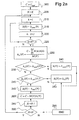
- Figs. 2a some session classes k are given higher priority than other session classes. If the total amount of resources available for allocation, C total , is not sufficient for all ongoing sessions to transmit at their respective peak transmission rate, R peak , sessions of the lowest priority will be slowed down. Only if this slow down is not sufficient will sessions of the next lowest priority be slowed down, and so forth.
- base station 105 supports K different session classes 1,.... K , wherein session class K has lowest priority and session class 1 has the highest priority.
- Fig. 2a assumes that admission control is applied in the CDMA system 100, so that a new session is only admitted if the total amount of radio resources, C total , is large enough for each ongoing session to transmit at its minimum transmission rate, R min , or a higher transmission rate.
- a parameter representing the resources available for allocation, C is given the value of C total .
- a counter N is set to a value representing the session class having the lowest priority: K .
- the resource share of sessions of class k, ⁇ (k) is set to the peak resource share, ⁇ peak (k), for session classes 1 to N -1.
- ⁇ peak (k) is the required resources share per session of session class k required for supporting transmission at the peak transmission rate, R peak (k), of sessions of session class k
- a counter k is set to 1.
- ⁇ (k) is set to ⁇ peak (k).
- the counter k is incremented by 1.
- step 230 is entered, in which a reduced share of resources, ⁇ a (k), is calculated for sessions of the N th session class. This is done by adding the resource shares, ⁇ , allocated to all sessions of session classes 1 to N- 1, and subtracting this sum from the total amount of resources, C total . The value thus obtained corresponds to the resource share available to allocate to sessions of session class N. This value is then divided by the number of sessions of session class N, M(N), in order to obtain the reduced resource share, ⁇ a (N) of sessions of session class N.
- Step 235 is then entered, in which the calculated reduced resource share of session class N , ⁇ a (N), is compared to the peak resource share, ⁇ peak (N), of session class N. If this comparison shows that the reduced resource share, ⁇ a(N) , is larger than the peak resource share, ⁇ peak (N), then step 240 is entered, in which the resource shares allocated to sessions of session class (N) , ⁇ (N), is set to the peak resource share, ⁇ peak (N). Hence, in this scenario, all sessions are allocated their peak resource share, ⁇ peak , and all sessions can transmit at their peak transmission rate, R peak .
- Step 295 is then entered, in which the process ends.
- step 245 is entered, in which the reduced resource share, ⁇ a (N), is compared to the minimum resource share of sessions of session class N, ⁇ min (N).
- ⁇ min (k) is the resource share required for a session of session class k in order to support transmission at minimum transmission rate of session class k, R min (k).
- step 250 is entered, in which the resource share of sessions of session class N, ⁇ (N), is set to the value of the reduced resource share of sessions of session class N, ⁇ a (N).
- R peak the peak transmission rate
- the sessions of resource class N will be slowed down by a slow down rate a(N), and will hence transmit at a reduced transmission rate, R a (N).
- Step 295 is then entered, in which the process ends.
- step 255 is entered, in which the resource share allocated to sessions of session class N, ⁇ (N), is set to the minimum resource share of session class N, ⁇ min (N).
- the reduction of resources allocated to sessions of session class N to the minimum share of resources for this class is not sufficient, but a reduction of the resources allocated to at least one session class of a higher priority will also have to be made.
- step 260 is then entered, in which the resources allocated to sessions of session class N , i.e.
- Step 285 is then entered, in which the counter N is reduced by 1.
- step 290 it is then checked whether the value of counter N is larger than 0, and if so, step 210 is re-entered, and the process is repeated with a new value of N . If the check in step 290 finds that the value of counter N is zero, then the process ends in step 295.
- One or more session classes supported by cell 110 of CDMA network 100 may require a fixed transmission rate, as discussed above. If so, in order to reduce the number of performed calculations, the resources required to support sessions of this fixed rate session class(es) can be subtracted from the amount of resources available for allocation, C, in step 200.
- such fixed rate session classes could be treated as an elastic session class of any priority, having the same value of ⁇ peak and ⁇ min .
- step it is checked if the new value of C, i.e. the amount of resources available to allocation to session classes of higher priority than N, is greater than zero. If not, the resource share, ⁇ , allocated to session class N , is set to zero in step.
- step 1 the counter K , representing the session class of the lowest priority for which transmission can be allowed, is reduced by 1, since the total amount of resources is not sufficient to support transmission of all original session classes.
- step 285 of Fig. 2a is entered.
- a check could be introduced, after all the classes have been allocated their resource shares, ⁇ , as to whether any of the allocated resource shares, ⁇ , have been set to zero. If so, it could be checked whether there are any residual resources available. If so, these residual resources could be allocated to some of the sessions of the session class for which ⁇ has been given the value zero.
- all elastic session classes are given the same priority.
- An example of a method of allocating radio resources to sessions in this embodiment is illustrated in Fig. 3 .
- the method of Fig. 3 applies to the situation where the CDMA cell 110 supports sessions of K different session classes, referred to as class 1,..., K .
- the allocation of resources in such a cell 110 where all elastic session classes are given the same priority is not trivial, since the minimum and maximum transmission rates, R min and S peak , may vary between classes, and it is possible that R min of one class is greater than Rp eak of another class.
- step 300 a counter k is given the value 1.
- step 320 it is then checked whether the reduced resource share, ⁇ a (k), allocated to sessions of session class k in step 315 is larger than the peak resource share for sessions of session class k, ⁇ peak (k). If so, step 325 is entered, in which the resource share, ⁇ (k) , allocated to sessions of session class k is set to the peak resource share, ⁇ peak (k). If not, step 330 is entered, in which it is checked whether the counter k has reached the value K , i.e. if all session classes have been allocated a resource share ⁇ . If so, the process is ended in step 340. If not, step 335 is entered, in which the counter k is incremented by 1. Step 315 is then entered with a new value of k, so that the allocated resource share, ⁇ (k) , can be calculated for a new session class.
- the method of Fig. 3 could include a step where it is checked, prior to entering step 315, whether the total amount of resources, C total , is large enough for all admitted sessions to operate at their respective peak transmission rate, R peak . If so, the respective peak resource share, ⁇ peak (k), could be allocated to all sessions of all session classes, and the steps 315-335 would not have to be entered.
- the total amount of resources, C total could preferably be replaced, in Fig. 3 , by the total amount of resources available to sessions of elastic classes.
- the total number of session classes, K would then accordingly be replaced by the total number of elastic session classes.
- the resources necessary for transmission in sessions belonging to classes of fixed transmission rate could advantageously be allocated to such sessions prior to entering step 300.
- Steps 320 and 325 of Fig. 3 are not necessary but could be omitted. However, if omitted, sessions of a session class may sometimes transmit at a higher transmission power than is required for transmission at the peak transmission rate of the session class, and hence causing an unnecessary high interference. Analogously, steps 235 and 240 could be omitted from the procedure illustrated in Figs. 2a .
- the resource allocating procedure of Fig. 3 calculates the resource share, ⁇ , to be allocated to a session of session class k when no session class is given priority over any other session classes.
- a similar procedure could be used in an embodiment of the invention where sessions are not grouped into session classes, but the resource share to be allocated is calculated separately for each session. However, by grouping the sessions into session classes and allocating the same amount of resources to all sessions belonging to the same session class, the amount of resources to be allocated will only have to be determined once per session, and less calculations will have to be made within the CDMA system 100.
- the priority policies employed in the procedures illustrated in Figs. 2 and 3 , respectively, are examples only, and other priority policies could be used for allocating radio resources to sessions in dependency of the resource requirements of the other ongoing sessions in the cell 110.
- different levels of slow down can be applied, so that the slow down of the sessions in a low priority class is first made to a level so that the low priority class operates at a transmission rate lower than the peak transmission rate, but higher than the minimum transmission rate. If further slow down is required, sessions of higher priory classes can be somewhat slowed down, before the low priority class if further slowed down.
- the allocation of resources to sessions served by a base station 105 can advantageously be updated when the set up of a new session is requested from base station 105, either by initiation of a new session or by a session being handed over to the base station 105.
- the allocation of resources to ongoing sessions could advantageously be updated when a session served by base station 105 is terminated.
- the radio resources in a cell 110 will hence be optimally utilised at any time, and the resource share, ⁇ , allocated to a session within a cell 110 will at any time be based on the requirements of the other presently ongoing sessions within the cell 110.
- the total amount of resources available for allocation, C total often depends on the ongoing sessions in neighbouring cells 110, served by other base stations 105, (cf. equation 7).
- the total amounted of resources available for allocation, C total could be advantageously be updated at regular intervals, and the allocation of resources to ongoing sessions could be updated upon such updating of C total , so that any changes to C total can be accounted for in the allocation of resources.
- the inventive method of sharing resources between elastic sessions can advantageously be applied in a CDMA network 100.
- Hardware and software for performing the allocation of resources in dependency of the resource requirements of ongoing sessions can advantageously be part of the radio network control node 140, or of a corresponding central node.
- hardware and software for performing the inventive method of allocating resources can be part of the radio base station 105.
- the CDMA network 100 would preferably comprise hardware and software for transmitting information signals, relating to the allocation of resources, between a mobile station 125 and the CDMA network 100.
- information signals relating to the allocation of resources, between a mobile station 125 and the CDMA network 100.
- signalling hardware and software as well as the functionality for performing the resource allocation according to the invention, is implemented in the radio network control node 140. Needless to say, these functionalities could be implemented elsewhere in mobile radio system 100.
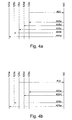
- Fig. 4a illustrates a scenario where initially four mobile stations, 125a, 125b, 125c, and 125d uphold ongoing sessions in a cell 110 controlled by a radio network control node 140.
- a fifth mobile station, mobile station 125e sends a session request 400 to start a session of session class k.
- Radio network control node 140 then calculates the resource share ⁇ to be allocated to the mobile station 125e, based on the available resources in the cell 110 as well as the resource requirements of the sessions of mobile stations 125a- 125e, as discussed above in relation to Figs. 2 and 3 .
- radio network control node 140 Since the arrival of a new session upheld by mobile station 125e may alter the resource share that should be allocated to one or more of mobile stations 125a-d, radio network control node 140 further re-calculates the resource shares allocated to mobile stations 125a, 125b, 125c and 125d, as discussed in relation to Figs. 2 and 3 .
- the new resource shares allocated to sessions of mobile stations 125a-125e are then communicated to mobile stations 125a-125e in allocation messages 405a-405e, respectively. However, if no changes are necessary to the resource share allocated to a session of a mobile station 125, the corresponding allocation message 405 does not have to be transmitted.
- Fig. 4b illustrates the scenario when five mobile stations 125a-125e are initially upholding sessions in a cell 110.
- Mobile station 125c then terminates its session and transmits a termination request 410 to the mobile radio network 100.
- the radio network control node 140 is triggered by the termination request 410 to update the radio resource allocation to the ongoing sessions upheld by mobile stations 125a, 125b, 125d and 125e, by executing a resource allocation procedure which takes into account the requirements of the other ongoing sessions, e.g. one of the resource allocation procedures illustrated in Figs 2 and 3 .
- the new resource shares allocated to mobile stations 125a, 125b, 125d and 125e are then communicated to these mobile stations in messages 405a, 405b, 405d and 405e, respectively.
- a session may leave the cell 110 without the mobile station 125a spending a termination request 410. This could e.g. be the case when mobile station 125a enters a geographical area of poor radio coverage, or when the session is handed over to a different cell 110. Obviously, the resource allocation procedure could be initiated upon the detection of a session having left the cell 110, regardless of whether a termination request 410 has been received by the mobile radio system 100 or not.
- the resource allocation procedure is only executed upon entry of a new session into the cell 110, and not upon exit of a session.
- the session request 400 should preferably comprise information from which the minimum and peak transmission rates, R min and R peak , of the requested session are derivable. Such information could e.g. be information on the session class k to which the requested session belongs, or information on R min and R peak .
- An allocation message 405 could e.g. comprise information on the allocated resources as a resource share ⁇ , as a transmission rate R , as a slowdown rate a , or as a transmission power P .
- the relationship between these measures is given by equations 4-6 above.
- the resource share ⁇ discussed in the above relates to the power received from a mobile station 125 at the base station 105
- the corresponding transmission power to be used by the mobile station 125 can be obtained by the mobile station 125 by measuring the received power on the downlink channel and comparing the received power to the actual power transmitted by the base station 105, if it is assumed that the path loss on the uplink and the downlink are the same.
- the message 405e, transmitted to the mobile station 125e requesting a new session could be the same as the allocation messages 405a-405d, communicating a change in the allocation of resources, or could be different.
- the radio resource control node 140 In order to execute the inventive resource allocation procedure, the radio resource control node 140 would need access to information on the total amount of resources available for allocation, C total , and the number of ongoing sessions, M , in the cell 110, as well as the peak and minimum resource requirements of the ongoing sessions. This information could either be stored in the radio network control node 140 and be updated from time to time, or be communicated from the base station 105 each time the resource allocation procedure is to be executed. Furthermore, in a system which applies session classes, the radio network control node 140 would need access to information on the number of session classes, K , supported by base station 105.
- every ongoing session can operate at its peak transmission rate.
- the traffic load in the cell increases so that every ongoing session cannot operate at its peak transmission rate, one or more of the ongoing sessions are slowed down to a transmission rate below the peak transmission rate, but only to the extent that is necessary.
- the utilization of radio resources of the mobile radio network can be optimised.
- the method of allocating radio resources can also be applied to the downlink channel.
- the total amount of resources available for allocation, C total is not restricted by the pole capacity, C pole , but rather by the total transmission power of the base station 105.
- ⁇ (2) represents the peak resource share of session class 2
- ⁇ peak (2) is the arrival intensity of session class 2
- â(2) represents the maximum slowdown rate of session class 2
- a max (2) represents the maximum slowdown rate of session class 3 etc.
- the numerical value of ⁇ in Table 1 is set of 0.049
- the numerical value of ⁇ is set to 29.26
- the numerical value of ⁇ is set to 32.03 (which does not vary between session classes in the used cell model).
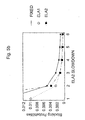
- Fig. 5a illustrates calculated blocking probabilities plotted as a function of the slow down rate a of session class 3 for a system in which the slow down rates a of the elastic session classes do not depend on the transmission requirements of the ongoing sessions, but are fixed in all system states.
- the case illustrated in Fig. 5a corresponds to the allocation method disclosed in E. Altman, "Capacity of Multi-Service Cellular Networks with Transmission-Rate Control: A Queuing Analysis", ACM Mobicom '02, Atlanta, GA, September 23-28, 2002 .
- the blocking probability is the probability of a new session arriving at the cell 110 being denied access by the admission control.
- Fig. 5b illustrates calculated blocking probabilities plotted as a function of maximum slow down rate a max of session class 3, for a system in which the slow down rates a of the elastic session classes 2 and 3, a(2) and a(3), are determined according to the resource requirements of the ongoing sessions according to the priority policy illustrated in Fig. 2a .
- Fig. 5c illustrates the calculated blocking probabilities plotted as a function of the maximum slow down rate a max of session class 3, in the case where the slow down rates a of the elastic session classes 2 and 3, a(2) and a(3), are determined according to the resource requirements of the ongoing sessions according to the priority policy illustrated in Fig. 3 .
Landscapes
- Engineering & Computer Science (AREA)
- Computer Networks & Wireless Communication (AREA)
- Signal Processing (AREA)
- Quality & Reliability (AREA)
- Mobile Radio Communication Systems (AREA)
Claims (11)
- Verfahren zum Zuweisen von Funkressourcen an eine elastische Sitzung, wobei die Rate, mit der Bits übertragen werden, während der laufenden Sitzung schwanken kann, die über eine Funkschnittstelle (130) zwischen einer an einer Vielzahl von anderen laufenden Sitzungen beteiligte Funkbasisstation (105) und einer Mobilstation (125) in einem nach dem Codemultiplex-Vielfachzugriff funktionierenden mobilen Funknetzwerk (100) übertragen wird, umfassend
Zuweisen eines Funkressourcenanteils, der einer reduzierten Übertragungsrate entspricht, an die elastische Sitzung, wobei die Reduzierung der Übertragungsrate einer Höchstübertragungsrate der elastischen Sitzung entspricht, die die maximale Übertragungsrate ist, mit der die elastische Sitzung funktionieren kann, die durch eine erste Verlangsamungsrate verlangsamt wird;
Bestimmen der ersten Verlangsamungsrate in Abhängigkeit von den Anforderungen der Übertragungsrate der laufenden Sitzungen derart, dass der zugewiesene Funkressourcenanteil nicht niedriger ist als ein Funkressourcenanteil, der der maximalen Übertragungsrate entspricht, wenn eine Gesamtmenge von Ressourcen, die der Funkbasisstation (105) zur Verfügung stehen, um laufenden Sitzungen zugewiesen zu werden, ausreichend für alle laufenden Sitzungen ist, um mit einer respektiven Höchstübertragungsrate zu übertragen, wobei das Verfahren dadurch gekennzeichnet ist, dass:die elastische Sitzung zu einer der letzten zwei Sitzungsklassen gehört; unddie erste Verlangsamungsrate bestimmt ist, entsprechend einer Prioritätsrichtlinie, nach der verschiedenen Sitzungsklassen verschiedene Prioritäten verliehen werden, und Sitzungen einer höheren Prioritätsklasse Funkressourcen, die einer reduzierten Übertragungsrate entsprechen, nur dann zugewiesen werden, wenn eine Reduzierung der Übertragungsrate von Sitzungen von Sitzungsklassen niedriger Priorität nicht ausreichend ist. - Verfahren nach Anspruch 1, wobei die Bestimmung ferner umfasst
Sicherstellung (245, 255, 315), dass die reduzierte Übertragungsrate nicht niedriger ist als eine Minimumsübertragungsrate der elastischen Sitzung. - Verfahren nach Anspruch 2, wobei die elastische Sitzung eine Echtzeit-Sitzung ist.
- Verfahren nach einem der Ansprüche 1-3, wobei
die erste Verlangsamungsrate bestimmt ist entsprechend einer Prioritätsrichtlinie nach der, wenn eine Gesamtmenge von Ressourcen, die zur Verfügung stehen, um Sitzungen, die eine Funkbasisstation (105) involvieren, zugewiesen zu werden, nicht für jede laufende Sitzung ausreichend ist, um mit deren Höchstübertragungsrate zu übertragen, wobei die Übertragungsrate für jede laufende Sitzung mit einer Verlangsamungsrate verlangsamt wird. - Verfahren nach einem der vorstehenden Ansprüche, wobei
jede laufende Sitzung mit einer Höchstübertragungsrate verbunden ist; und
das Zuweisen von Ressourcen an die elastische Sitzung bei einer Anzeige ausgeführt wird, die anzeigt, dass eine Gesamtmenge von für das Zuweisen laufender Sitzungen zur Verfügung stehenden Ressourcen nicht für alle laufenden Sitzungen ausreichend ist, um mit deren entsprechender Höchstübertragungsrate zu funktionieren. - Verfahren nach einem der vorstehenden Ansprüche, wobei
das Zuweisen von Ressourcen an die elastische Sitzung beim Eintreten einer neuen die Funkbasisstation (105) involvierenden Sitzung ausgeführt wird. - Verfahren nach einem der vorstehenden Ansprüche, wobei
das Zuweisen von Ressourcen an die elastische Sitzung beim Austreten einer laufenden Sitzung ausgeführt wird. - Verfahren nach einem der vorstehenden Ansprüche, wobei
das Zuweisen von Ressourcen an die elastische Sitzung ausgeführt wird als Antwort auf eine Anzeige, die anzeigt, dass sich eine Gesamtmenge von Ressourcen, die zur Verfügung stehen, um Sitzungen, die eine Funkbasisstation (105) involvieren, zugewiesen zu werden, verändert hat. - Computerprogrammprodukt, umfassend:ein Computerprogramm-codemittel betreibbar, wenn es an einem Computer läuft, um das Verfahren nach einem der Ansprüche 1-8 auszuführen.
- Funknetzwerkknoten (105, 125, 140) für das Zuweisen von Funkressourcen an Sitzungen in einem mobilen Funknetzwerk (100), das nach dem Codemultiplex-Vielfachzugriff funktioniert, wobei der Funknetzwerkknoten (105, 125, 140) Folgendes umfasst:eine Computeranordnung, die angeordnet ist, um das Computerprogrammprodukt nach Anspruch 9 auszuführen.
- Mobiles Funknetzwerk (100), das nach dem Codemultiplex-Vielfachzugriff funktioniert und den Funknetzwerkknoten (105, 125, 140) nach Anspruch 10 umfasst.
Applications Claiming Priority (3)
| Application Number | Priority Date | Filing Date | Title |
|---|---|---|---|
| SE0402963A SE0402963D0 (sv) | 2004-12-03 | 2004-12-03 | Method and apparatus for allocating radio resources in a mobile radio network |
| US59306104P | 2004-12-06 | 2004-12-06 | |
| PCT/SE2005/000619 WO2006059936A1 (en) | 2004-12-03 | 2005-04-29 | Method and apparatus for allocating radio resources in a mobile radio network |
Publications (2)
| Publication Number | Publication Date |
|---|---|
| EP1817852A1 EP1817852A1 (de) | 2007-08-15 |
| EP1817852B1 true EP1817852B1 (de) | 2010-04-07 |
Family
ID=33550591
Family Applications (1)
| Application Number | Title | Priority Date | Filing Date |
|---|---|---|---|
| EP05736303A Expired - Lifetime EP1817852B1 (de) | 2004-12-03 | 2005-04-29 | Verfahren und vorrichtung zum zuteilen von funkbetriebsmitteln in einem mobilfunknetz |
Country Status (8)
| Country | Link |
|---|---|
| US (2) | US7912473B2 (de) |
| EP (1) | EP1817852B1 (de) |
| KR (1) | KR101120243B1 (de) |
| AT (1) | ATE463893T1 (de) |
| DE (1) | DE602005020494D1 (de) |
| ES (1) | ES2344209T3 (de) |
| SE (1) | SE0402963D0 (de) |
| WO (1) | WO2006059936A1 (de) |
Families Citing this family (12)
| Publication number | Priority date | Publication date | Assignee | Title |
|---|---|---|---|---|
| US8811369B2 (en) | 2006-01-11 | 2014-08-19 | Qualcomm Incorporated | Methods and apparatus for supporting multiple communications modes of operation |
| EP1977563B1 (de) | 2006-01-11 | 2018-01-03 | QUALCOMM Incorporated | Codierung von bakensignalen zur identifikationsbereitstellung bei der peer-to-peer-kommunikation |
| LU91292B1 (en) * | 2006-12-01 | 2008-06-02 | European Gsa | New Chaotic Spreading Codes for Galileo |
| WO2008149403A1 (ja) * | 2007-06-04 | 2008-12-11 | Fujitsu Limited | 無線基地局装置、および無線リソース接続切替方法 |
| JP4989513B2 (ja) * | 2008-02-22 | 2012-08-01 | 株式会社エヌ・ティ・ティ・ドコモ | 無線通信システム、無線通信方法及び基地局 |
| US8595501B2 (en) | 2008-05-09 | 2013-11-26 | Qualcomm Incorporated | Network helper for authentication between a token and verifiers |
| JP4965682B2 (ja) * | 2010-04-05 | 2012-07-04 | 株式会社エヌ・ティ・ティ・ドコモ | 無線通信システム、無線制御装置、無線基地局及び無線通信方法 |
| US8595374B2 (en) | 2010-12-08 | 2013-11-26 | At&T Intellectual Property I, L.P. | Method and apparatus for capacity dimensioning in a communication network |
| US8953521B1 (en) * | 2010-12-15 | 2015-02-10 | Sprint Communications Company L.P. | Facilitating communication between wireless access components |
| US8787159B2 (en) * | 2011-04-14 | 2014-07-22 | Alcatel Lucent | Mechanism for wireless access networks to throttle traffic during congestion |
| CN102958169B (zh) * | 2011-08-30 | 2015-04-08 | 鼎桥通信技术有限公司 | 专用物理信道分配方法及rnc |
| EP2955963A1 (de) * | 2014-06-11 | 2015-12-16 | Gemalto M2M GmbH | Verfahren zur Abschätzung das Datendurchsatzes eines in einem zellulären Netzwerk betriebenen Drathlosgeräts |
Family Cites Families (8)
| Publication number | Priority date | Publication date | Assignee | Title |
|---|---|---|---|---|
| US5103459B1 (en) * | 1990-06-25 | 1999-07-06 | Qualcomm Inc | System and method for generating signal waveforms in a cdma cellular telephone system |
| US5151919A (en) * | 1990-12-17 | 1992-09-29 | Ericsson-Ge Mobile Communications Holding Inc. | Cdma subtractive demodulation |
| ZA946674B (en) | 1993-09-08 | 1995-05-02 | Qualcomm Inc | Method and apparatus for determining the transmission data rate in a multi-user communication system |
| US6011590A (en) * | 1997-01-03 | 2000-01-04 | Ncr Corporation | Method of transmitting compressed information to minimize buffer space |
| KR100243343B1 (ko) * | 1997-10-23 | 2000-02-01 | 정선종 | 멀티미디어 코드분할 다중접속 시스템의 셀 용량을 최대로 하는방법 |
| GB2357670A (en) * | 1999-12-24 | 2001-06-27 | Nokia Networks Oy | Controlling a base station transmitter comprising a multi-carrier power amplifier |
| US6721280B1 (en) * | 2000-04-19 | 2004-04-13 | Qualcomm Incorporated | Method and apparatus for voice latency reduction in a voice-over-data wireless communication system |
| CN1251525C (zh) * | 2001-10-01 | 2006-04-12 | 株式会社Ntt都科摩 | 资源控制方法、移动通信系统、基站和移动站 |
-
2004
- 2004-12-03 SE SE0402963A patent/SE0402963D0/sv unknown
-
2005
- 2005-04-29 EP EP05736303A patent/EP1817852B1/de not_active Expired - Lifetime
- 2005-04-29 WO PCT/SE2005/000619 patent/WO2006059936A1/en not_active Ceased
- 2005-04-29 ES ES05736303T patent/ES2344209T3/es not_active Expired - Lifetime
- 2005-04-29 US US11/720,505 patent/US7912473B2/en active Active
- 2005-04-29 KR KR1020077012774A patent/KR101120243B1/ko not_active Expired - Fee Related
- 2005-04-29 DE DE602005020494T patent/DE602005020494D1/de not_active Expired - Lifetime
- 2005-04-29 AT AT05736303T patent/ATE463893T1/de not_active IP Right Cessation
-
2011
- 2011-02-14 US US13/026,561 patent/US8238928B2/en not_active Expired - Fee Related
Also Published As
| Publication number | Publication date |
|---|---|
| US20110134890A1 (en) | 2011-06-09 |
| KR20070087594A (ko) | 2007-08-28 |
| EP1817852A1 (de) | 2007-08-15 |
| US20080123600A1 (en) | 2008-05-29 |
| ES2344209T3 (es) | 2010-08-20 |
| SE0402963D0 (sv) | 2004-12-03 |
| US8238928B2 (en) | 2012-08-07 |
| KR101120243B1 (ko) | 2012-03-16 |
| DE602005020494D1 (de) | 2010-05-20 |
| US7912473B2 (en) | 2011-03-22 |
| WO2006059936A1 (en) | 2006-06-08 |
| ATE463893T1 (de) | 2010-04-15 |
Similar Documents
| Publication | Publication Date | Title |
|---|---|---|
| US8238928B2 (en) | Method and apparatus for allocating radio resources in a mobile radio network | |
| EP1879339B1 (de) | Verfahren und Vorrichtung zur Überlastungsregelung in einem drahtlosen Kommunikationssystem | |
| US7961616B2 (en) | Method and apparatus for congestion control in a wireless communication system | |
| US6895235B2 (en) | Adaptive load and coverage management system and method | |
| US7532892B2 (en) | Method and device for controlling admission of users to a cellular radio network | |
| JP2000091985A (ja) | 通信システムの電力制御方法 | |
| WO2007039513A1 (en) | A method and apparatus for allocation of radio resources | |
| JP4777684B2 (ja) | 拡張専用チャネル用の分散リソース管理 | |
| US7512068B1 (en) | Call admission control for a wireless network | |
| Ni | GPRS network planning on the existing GSM system | |
| Kim et al. | Adaptive Handoff Algorithms for dynamic traffic load distribution in 4G mobile networks | |
| KR20020028664A (ko) | 광대역 코드분할다중접속 시스템의 호 수락 제어방법 및무선링크 자원관리방법 | |
| EP1389888A1 (de) | Dynamisches Anpassen von Ressourcen-Schwellwerten in Abhängigkeit der Zelllast in mobilen Kommunikationsnetzen | |
| Pérez-Romero et al. | Admission control for different UE-MAC algorithms in UTRA-FDD | |
| WO2006107909A2 (en) | Communication system and a processor and a method for use therein | |
| WO2002091781A1 (en) | Method and device for controlling admission of users to a cellular radio network | |
| CN101557605A (zh) | 一种实现接纳控制的方法和装置 | |
| Gillberg et al. | Interaction of Speech and Packet Data Users in a Radio Network | |
| AU2002305839A1 (en) | Method and apparatus for congestion control in a wireless communication system | |
| AU2002305880A1 (en) | Method and apparatus for reduction of congestion through data rate adjustment in a wireless communication system |
Legal Events
| Date | Code | Title | Description |
|---|---|---|---|
| PUAI | Public reference made under article 153(3) epc to a published international application that has entered the european phase |
Free format text: ORIGINAL CODE: 0009012 |
|
| 17P | Request for examination filed |
Effective date: 20070417 |
|
| AK | Designated contracting states |
Kind code of ref document: A1 Designated state(s): AT BE BG CH CY CZ DE DK EE ES FI FR GB GR HU IE IS IT LI LT LU MC NL PL PT RO SE SI SK TR |
|
| 17Q | First examination report despatched |
Effective date: 20071025 |
|
| DAX | Request for extension of the european patent (deleted) | ||
| GRAP | Despatch of communication of intention to grant a patent |
Free format text: ORIGINAL CODE: EPIDOSNIGR1 |
|
| RIC1 | Information provided on ipc code assigned before grant |
Ipc: H04B 7/26 20060101AFI20091002BHEP Ipc: H04W 72/10 20090101ALI20091002BHEP |
|
| GRAS | Grant fee paid |
Free format text: ORIGINAL CODE: EPIDOSNIGR3 |
|
| GRAA | (expected) grant |
Free format text: ORIGINAL CODE: 0009210 |
|
| AK | Designated contracting states |
Kind code of ref document: B1 Designated state(s): AT BE BG CH CY CZ DE DK EE ES FI FR GB GR HU IE IS IT LI LT LU MC NL PL PT RO SE SI SK TR |
|
| REG | Reference to a national code |
Ref country code: GB Ref legal event code: FG4D |
|
| REG | Reference to a national code |
Ref country code: CH Ref legal event code: EP |
|
| REG | Reference to a national code |
Ref country code: IE Ref legal event code: FG4D |
|
| REG | Reference to a national code |
Ref country code: CH Ref legal event code: NV Representative=s name: SERVOPATENT GMBH |
|
| REF | Corresponds to: |
Ref document number: 602005020494 Country of ref document: DE Date of ref document: 20100520 Kind code of ref document: P |
|
| REG | Reference to a national code |
Ref country code: NL Ref legal event code: T3 |
|
| REG | Reference to a national code |
Ref country code: ES Ref legal event code: FG2A Ref document number: 2344209 Country of ref document: ES Kind code of ref document: T3 |
|
| PG25 | Lapsed in a contracting state [announced via postgrant information from national office to epo] |
Ref country code: SI Free format text: LAPSE BECAUSE OF FAILURE TO SUBMIT A TRANSLATION OF THE DESCRIPTION OR TO PAY THE FEE WITHIN THE PRESCRIBED TIME-LIMIT Effective date: 20100407 |
|
| LTIE | Lt: invalidation of european patent or patent extension |
Effective date: 20100407 |
|
| PG25 | Lapsed in a contracting state [announced via postgrant information from national office to epo] |
Ref country code: SE Free format text: LAPSE BECAUSE OF FAILURE TO SUBMIT A TRANSLATION OF THE DESCRIPTION OR TO PAY THE FEE WITHIN THE PRESCRIBED TIME-LIMIT Effective date: 20100407 Ref country code: LT Free format text: LAPSE BECAUSE OF FAILURE TO SUBMIT A TRANSLATION OF THE DESCRIPTION OR TO PAY THE FEE WITHIN THE PRESCRIBED TIME-LIMIT Effective date: 20100407 |
|
| PG25 | Lapsed in a contracting state [announced via postgrant information from national office to epo] |
Ref country code: AT Free format text: LAPSE BECAUSE OF FAILURE TO SUBMIT A TRANSLATION OF THE DESCRIPTION OR TO PAY THE FEE WITHIN THE PRESCRIBED TIME-LIMIT Effective date: 20100407 Ref country code: IS Free format text: LAPSE BECAUSE OF FAILURE TO SUBMIT A TRANSLATION OF THE DESCRIPTION OR TO PAY THE FEE WITHIN THE PRESCRIBED TIME-LIMIT Effective date: 20100807 Ref country code: MC Free format text: LAPSE BECAUSE OF NON-PAYMENT OF DUE FEES Effective date: 20100430 |
|
| PG25 | Lapsed in a contracting state [announced via postgrant information from national office to epo] |
Ref country code: GR Free format text: LAPSE BECAUSE OF FAILURE TO SUBMIT A TRANSLATION OF THE DESCRIPTION OR TO PAY THE FEE WITHIN THE PRESCRIBED TIME-LIMIT Effective date: 20100708 Ref country code: PL Free format text: LAPSE BECAUSE OF FAILURE TO SUBMIT A TRANSLATION OF THE DESCRIPTION OR TO PAY THE FEE WITHIN THE PRESCRIBED TIME-LIMIT Effective date: 20100407 Ref country code: CY Free format text: LAPSE BECAUSE OF FAILURE TO SUBMIT A TRANSLATION OF THE DESCRIPTION OR TO PAY THE FEE WITHIN THE PRESCRIBED TIME-LIMIT Effective date: 20100512 |
|
| PG25 | Lapsed in a contracting state [announced via postgrant information from national office to epo] |
Ref country code: IE Free format text: LAPSE BECAUSE OF NON-PAYMENT OF DUE FEES Effective date: 20100429 Ref country code: PT Free format text: LAPSE BECAUSE OF FAILURE TO SUBMIT A TRANSLATION OF THE DESCRIPTION OR TO PAY THE FEE WITHIN THE PRESCRIBED TIME-LIMIT Effective date: 20100809 Ref country code: EE Free format text: LAPSE BECAUSE OF FAILURE TO SUBMIT A TRANSLATION OF THE DESCRIPTION OR TO PAY THE FEE WITHIN THE PRESCRIBED TIME-LIMIT Effective date: 20100407 Ref country code: DK Free format text: LAPSE BECAUSE OF FAILURE TO SUBMIT A TRANSLATION OF THE DESCRIPTION OR TO PAY THE FEE WITHIN THE PRESCRIBED TIME-LIMIT Effective date: 20100407 |
|
| PLBE | No opposition filed within time limit |
Free format text: ORIGINAL CODE: 0009261 |
|
| STAA | Information on the status of an ep patent application or granted ep patent |
Free format text: STATUS: NO OPPOSITION FILED WITHIN TIME LIMIT |
|
| PG25 | Lapsed in a contracting state [announced via postgrant information from national office to epo] |
Ref country code: BE Free format text: LAPSE BECAUSE OF FAILURE TO SUBMIT A TRANSLATION OF THE DESCRIPTION OR TO PAY THE FEE WITHIN THE PRESCRIBED TIME-LIMIT Effective date: 20100407 Ref country code: SK Free format text: LAPSE BECAUSE OF FAILURE TO SUBMIT A TRANSLATION OF THE DESCRIPTION OR TO PAY THE FEE WITHIN THE PRESCRIBED TIME-LIMIT Effective date: 20100407 Ref country code: RO Free format text: LAPSE BECAUSE OF FAILURE TO SUBMIT A TRANSLATION OF THE DESCRIPTION OR TO PAY THE FEE WITHIN THE PRESCRIBED TIME-LIMIT Effective date: 20100407 Ref country code: CZ Free format text: LAPSE BECAUSE OF FAILURE TO SUBMIT A TRANSLATION OF THE DESCRIPTION OR TO PAY THE FEE WITHIN THE PRESCRIBED TIME-LIMIT Effective date: 20100407 |
|
| 26N | No opposition filed |
Effective date: 20110110 |
|
| PG25 | Lapsed in a contracting state [announced via postgrant information from national office to epo] |
Ref country code: IT Free format text: LAPSE BECAUSE OF FAILURE TO SUBMIT A TRANSLATION OF THE DESCRIPTION OR TO PAY THE FEE WITHIN THE PRESCRIBED TIME-LIMIT Effective date: 20100407 |
|
| REG | Reference to a national code |
Ref country code: FR Ref legal event code: ST Effective date: 20111125 |
|
| PG25 | Lapsed in a contracting state [announced via postgrant information from national office to epo] |
Ref country code: FR Free format text: LAPSE BECAUSE OF NON-PAYMENT OF DUE FEES Effective date: 20100607 |
|
| PG25 | Lapsed in a contracting state [announced via postgrant information from national office to epo] |
Ref country code: BG Free format text: LAPSE BECAUSE OF FAILURE TO SUBMIT A TRANSLATION OF THE DESCRIPTION OR TO PAY THE FEE WITHIN THE PRESCRIBED TIME-LIMIT Effective date: 20100407 Ref country code: HU Free format text: LAPSE BECAUSE OF FAILURE TO SUBMIT A TRANSLATION OF THE DESCRIPTION OR TO PAY THE FEE WITHIN THE PRESCRIBED TIME-LIMIT Effective date: 20101008 Ref country code: LU Free format text: LAPSE BECAUSE OF NON-PAYMENT OF DUE FEES Effective date: 20100429 |
|
| PG25 | Lapsed in a contracting state [announced via postgrant information from national office to epo] |
Ref country code: TR Free format text: LAPSE BECAUSE OF FAILURE TO SUBMIT A TRANSLATION OF THE DESCRIPTION OR TO PAY THE FEE WITHIN THE PRESCRIBED TIME-LIMIT Effective date: 20100407 |
|
| PG25 | Lapsed in a contracting state [announced via postgrant information from national office to epo] |
Ref country code: BG Free format text: LAPSE BECAUSE OF FAILURE TO SUBMIT A TRANSLATION OF THE DESCRIPTION OR TO PAY THE FEE WITHIN THE PRESCRIBED TIME-LIMIT Effective date: 20100707 |
|
| PGFP | Annual fee paid to national office [announced via postgrant information from national office to epo] |
Ref country code: ES Payment date: 20160426 Year of fee payment: 12 Ref country code: CH Payment date: 20160427 Year of fee payment: 12 Ref country code: GB Payment date: 20160427 Year of fee payment: 12 Ref country code: DE Payment date: 20160427 Year of fee payment: 12 Ref country code: FI Payment date: 20160427 Year of fee payment: 12 |
|
| PGFP | Annual fee paid to national office [announced via postgrant information from national office to epo] |
Ref country code: NL Payment date: 20170426 Year of fee payment: 13 |
|
| REG | Reference to a national code |
Ref country code: DE Ref legal event code: R119 Ref document number: 602005020494 Country of ref document: DE |
|
| REG | Reference to a national code |
Ref country code: CH Ref legal event code: PL |
|
| GBPC | Gb: european patent ceased through non-payment of renewal fee |
Effective date: 20170429 |
|
| PG25 | Lapsed in a contracting state [announced via postgrant information from national office to epo] |
Ref country code: DE Free format text: LAPSE BECAUSE OF NON-PAYMENT OF DUE FEES Effective date: 20171103 Ref country code: FI Free format text: LAPSE BECAUSE OF NON-PAYMENT OF DUE FEES Effective date: 20170429 |
|
| PG25 | Lapsed in a contracting state [announced via postgrant information from national office to epo] |
Ref country code: GB Free format text: LAPSE BECAUSE OF NON-PAYMENT OF DUE FEES Effective date: 20170429 Ref country code: CH Free format text: LAPSE BECAUSE OF NON-PAYMENT OF DUE FEES Effective date: 20170430 Ref country code: LI Free format text: LAPSE BECAUSE OF NON-PAYMENT OF DUE FEES Effective date: 20170430 |
|
| REG | Reference to a national code |
Ref country code: ES Ref legal event code: FD2A Effective date: 20180703 |
|
| PG25 | Lapsed in a contracting state [announced via postgrant information from national office to epo] |
Ref country code: ES Free format text: LAPSE BECAUSE OF NON-PAYMENT OF DUE FEES Effective date: 20170430 |
|
| REG | Reference to a national code |
Ref country code: NL Ref legal event code: MM Effective date: 20180501 |
|
| PG25 | Lapsed in a contracting state [announced via postgrant information from national office to epo] |
Ref country code: NL Free format text: LAPSE BECAUSE OF NON-PAYMENT OF DUE FEES Effective date: 20180501 |