EP1817954A2 - Bahnenware zum Schutz von Pflanzenkulturen - Google Patents
Bahnenware zum Schutz von Pflanzenkulturen Download PDFInfo
- Publication number
- EP1817954A2 EP1817954A2 EP06026178A EP06026178A EP1817954A2 EP 1817954 A2 EP1817954 A2 EP 1817954A2 EP 06026178 A EP06026178 A EP 06026178A EP 06026178 A EP06026178 A EP 06026178A EP 1817954 A2 EP1817954 A2 EP 1817954A2
- Authority
- EP
- European Patent Office
- Prior art keywords
- webs
- sheet material
- material according
- strip
- structures
- Prior art date
- Legal status (The legal status is an assumption and is not a legal conclusion. Google has not performed a legal analysis and makes no representation as to the accuracy of the status listed.)
- Withdrawn
Links
Images





Classifications
-
- A—HUMAN NECESSITIES
- A01—AGRICULTURE; FORESTRY; ANIMAL HUSBANDRY; HUNTING; TRAPPING; FISHING
- A01G—HORTICULTURE; CULTIVATION OF VEGETABLES, FLOWERS, RICE, FRUIT, VINES, HOPS OR SEAWEED; FORESTRY; WATERING
- A01G13/00—Protection of plants
- A01G13/30—Ground coverings
- A01G13/32—Mats; Nets; Sheets or films
- A01G13/33—Sheets or films
-
- B—PERFORMING OPERATIONS; TRANSPORTING
- B29—WORKING OF PLASTICS; WORKING OF SUBSTANCES IN A PLASTIC STATE IN GENERAL
- B29C—SHAPING OR JOINING OF PLASTICS; SHAPING OF MATERIAL IN A PLASTIC STATE, NOT OTHERWISE PROVIDED FOR; AFTER-TREATMENT OF THE SHAPED PRODUCTS, e.g. REPAIRING
- B29C65/00—Joining or sealing of preformed parts, e.g. welding of plastics materials; Apparatus therefor
- B29C65/02—Joining or sealing of preformed parts, e.g. welding of plastics materials; Apparatus therefor by heating, with or without pressure
- B29C65/08—Joining or sealing of preformed parts, e.g. welding of plastics materials; Apparatus therefor by heating, with or without pressure using ultrasonic vibrations
-
- B—PERFORMING OPERATIONS; TRANSPORTING
- B29—WORKING OF PLASTICS; WORKING OF SUBSTANCES IN A PLASTIC STATE IN GENERAL
- B29C—SHAPING OR JOINING OF PLASTICS; SHAPING OF MATERIAL IN A PLASTIC STATE, NOT OTHERWISE PROVIDED FOR; AFTER-TREATMENT OF THE SHAPED PRODUCTS, e.g. REPAIRING
- B29C66/00—General aspects of processes or apparatus for joining preformed parts
- B29C66/01—General aspects dealing with the joint area or with the area to be joined
- B29C66/05—Particular design of joint configurations
- B29C66/10—Particular design of joint configurations particular design of the joint cross-sections
- B29C66/11—Joint cross-sections comprising a single joint-segment, i.e. one of the parts to be joined comprising a single joint-segment in the joint cross-section
- B29C66/112—Single lapped joints
- B29C66/1122—Single lap to lap joints, i.e. overlap joints
-
- B—PERFORMING OPERATIONS; TRANSPORTING
- B29—WORKING OF PLASTICS; WORKING OF SUBSTANCES IN A PLASTIC STATE IN GENERAL
- B29C—SHAPING OR JOINING OF PLASTICS; SHAPING OF MATERIAL IN A PLASTIC STATE, NOT OTHERWISE PROVIDED FOR; AFTER-TREATMENT OF THE SHAPED PRODUCTS, e.g. REPAIRING
- B29C66/00—General aspects of processes or apparatus for joining preformed parts
- B29C66/01—General aspects dealing with the joint area or with the area to be joined
- B29C66/05—Particular design of joint configurations
- B29C66/20—Particular design of joint configurations particular design of the joint lines, e.g. of the weld lines
- B29C66/21—Particular design of joint configurations particular design of the joint lines, e.g. of the weld lines said joint lines being formed by a single dot or dash or by several dots or dashes, i.e. spot joining or spot welding
-
- B—PERFORMING OPERATIONS; TRANSPORTING
- B29—WORKING OF PLASTICS; WORKING OF SUBSTANCES IN A PLASTIC STATE IN GENERAL
- B29C—SHAPING OR JOINING OF PLASTICS; SHAPING OF MATERIAL IN A PLASTIC STATE, NOT OTHERWISE PROVIDED FOR; AFTER-TREATMENT OF THE SHAPED PRODUCTS, e.g. REPAIRING
- B29C66/00—General aspects of processes or apparatus for joining preformed parts
- B29C66/01—General aspects dealing with the joint area or with the area to be joined
- B29C66/05—Particular design of joint configurations
- B29C66/20—Particular design of joint configurations particular design of the joint lines, e.g. of the weld lines
- B29C66/22—Particular design of joint configurations particular design of the joint lines, e.g. of the weld lines said joint lines being in the form of recurring patterns
- B29C66/229—Other specific patterns not provided for in B29C66/221 - B29C66/227
-
- B—PERFORMING OPERATIONS; TRANSPORTING
- B29—WORKING OF PLASTICS; WORKING OF SUBSTANCES IN A PLASTIC STATE IN GENERAL
- B29C—SHAPING OR JOINING OF PLASTICS; SHAPING OF MATERIAL IN A PLASTIC STATE, NOT OTHERWISE PROVIDED FOR; AFTER-TREATMENT OF THE SHAPED PRODUCTS, e.g. REPAIRING
- B29C66/00—General aspects of processes or apparatus for joining preformed parts
- B29C66/01—General aspects dealing with the joint area or with the area to be joined
- B29C66/05—Particular design of joint configurations
- B29C66/20—Particular design of joint configurations particular design of the joint lines, e.g. of the weld lines
- B29C66/23—Particular design of joint configurations particular design of the joint lines, e.g. of the weld lines said joint lines being multiple and parallel or being in the form of tessellations
- B29C66/232—Particular design of joint configurations particular design of the joint lines, e.g. of the weld lines said joint lines being multiple and parallel or being in the form of tessellations said joint lines being multiple and parallel, i.e. the joint being formed by several parallel joint lines
-
- B—PERFORMING OPERATIONS; TRANSPORTING
- B29—WORKING OF PLASTICS; WORKING OF SUBSTANCES IN A PLASTIC STATE IN GENERAL
- B29C—SHAPING OR JOINING OF PLASTICS; SHAPING OF MATERIAL IN A PLASTIC STATE, NOT OTHERWISE PROVIDED FOR; AFTER-TREATMENT OF THE SHAPED PRODUCTS, e.g. REPAIRING
- B29C66/00—General aspects of processes or apparatus for joining preformed parts
- B29C66/01—General aspects dealing with the joint area or with the area to be joined
- B29C66/05—Particular design of joint configurations
- B29C66/305—Decorative or coloured joints
-
- B—PERFORMING OPERATIONS; TRANSPORTING
- B29—WORKING OF PLASTICS; WORKING OF SUBSTANCES IN A PLASTIC STATE IN GENERAL
- B29C—SHAPING OR JOINING OF PLASTICS; SHAPING OF MATERIAL IN A PLASTIC STATE, NOT OTHERWISE PROVIDED FOR; AFTER-TREATMENT OF THE SHAPED PRODUCTS, e.g. REPAIRING
- B29C66/00—General aspects of processes or apparatus for joining preformed parts
- B29C66/40—General aspects of joining substantially flat articles, e.g. plates, sheets or web-like materials; Making flat seams in tubular or hollow articles; Joining single elements to substantially flat surfaces
- B29C66/41—Joining substantially flat articles ; Making flat seams in tubular or hollow articles
- B29C66/43—Joining a relatively small portion of the surface of said articles
- B29C66/435—Making large sheets by joining smaller ones or strips together
-
- B—PERFORMING OPERATIONS; TRANSPORTING
- B29—WORKING OF PLASTICS; WORKING OF SUBSTANCES IN A PLASTIC STATE IN GENERAL
- B29C—SHAPING OR JOINING OF PLASTICS; SHAPING OF MATERIAL IN A PLASTIC STATE, NOT OTHERWISE PROVIDED FOR; AFTER-TREATMENT OF THE SHAPED PRODUCTS, e.g. REPAIRING
- B29C66/00—General aspects of processes or apparatus for joining preformed parts
- B29C66/70—General aspects of processes or apparatus for joining preformed parts characterised by the composition, physical properties or the structure of the material of the parts to be joined; Joining with non-plastics material
- B29C66/72—General aspects of processes or apparatus for joining preformed parts characterised by the composition, physical properties or the structure of the material of the parts to be joined; Joining with non-plastics material characterised by the structure of the material of the parts to be joined
- B29C66/729—Textile or other fibrous material made from plastics
-
- B—PERFORMING OPERATIONS; TRANSPORTING
- B29—WORKING OF PLASTICS; WORKING OF SUBSTANCES IN A PLASTIC STATE IN GENERAL
- B29C—SHAPING OR JOINING OF PLASTICS; SHAPING OF MATERIAL IN A PLASTIC STATE, NOT OTHERWISE PROVIDED FOR; AFTER-TREATMENT OF THE SHAPED PRODUCTS, e.g. REPAIRING
- B29C66/00—General aspects of processes or apparatus for joining preformed parts
- B29C66/70—General aspects of processes or apparatus for joining preformed parts characterised by the composition, physical properties or the structure of the material of the parts to be joined; Joining with non-plastics material
- B29C66/73—General aspects of processes or apparatus for joining preformed parts characterised by the composition, physical properties or the structure of the material of the parts to be joined; Joining with non-plastics material characterised by the intensive physical properties of the material of the parts to be joined, by the optical properties of the material of the parts to be joined, by the extensive physical properties of the parts to be joined, by the state of the material of the parts to be joined or by the material of the parts to be joined being a thermoplastic or a thermoset
- B29C66/739—General aspects of processes or apparatus for joining preformed parts characterised by the composition, physical properties or the structure of the material of the parts to be joined; Joining with non-plastics material characterised by the intensive physical properties of the material of the parts to be joined, by the optical properties of the material of the parts to be joined, by the extensive physical properties of the parts to be joined, by the state of the material of the parts to be joined or by the material of the parts to be joined being a thermoplastic or a thermoset characterised by the material of the parts to be joined being a thermoplastic or a thermoset
- B29C66/7392—General aspects of processes or apparatus for joining preformed parts characterised by the composition, physical properties or the structure of the material of the parts to be joined; Joining with non-plastics material characterised by the intensive physical properties of the material of the parts to be joined, by the optical properties of the material of the parts to be joined, by the extensive physical properties of the parts to be joined, by the state of the material of the parts to be joined or by the material of the parts to be joined being a thermoplastic or a thermoset characterised by the material of the parts to be joined being a thermoplastic or a thermoset characterised by the material of at least one of the parts being a thermoplastic
- B29C66/73921—General aspects of processes or apparatus for joining preformed parts characterised by the composition, physical properties or the structure of the material of the parts to be joined; Joining with non-plastics material characterised by the intensive physical properties of the material of the parts to be joined, by the optical properties of the material of the parts to be joined, by the extensive physical properties of the parts to be joined, by the state of the material of the parts to be joined or by the material of the parts to be joined being a thermoplastic or a thermoset characterised by the material of the parts to be joined being a thermoplastic or a thermoset characterised by the material of at least one of the parts being a thermoplastic characterised by the materials of both parts being thermoplastics
-
- B—PERFORMING OPERATIONS; TRANSPORTING
- B29—WORKING OF PLASTICS; WORKING OF SUBSTANCES IN A PLASTIC STATE IN GENERAL
- B29C—SHAPING OR JOINING OF PLASTICS; SHAPING OF MATERIAL IN A PLASTIC STATE, NOT OTHERWISE PROVIDED FOR; AFTER-TREATMENT OF THE SHAPED PRODUCTS, e.g. REPAIRING
- B29C66/00—General aspects of processes or apparatus for joining preformed parts
- B29C66/01—General aspects dealing with the joint area or with the area to be joined
- B29C66/05—Particular design of joint configurations
- B29C66/20—Particular design of joint configurations particular design of the joint lines, e.g. of the weld lines
- B29C66/22—Particular design of joint configurations particular design of the joint lines, e.g. of the weld lines said joint lines being in the form of recurring patterns
- B29C66/221—Particular design of joint configurations particular design of the joint lines, e.g. of the weld lines said joint lines being in the form of recurring patterns being in the form of a sinusoidal wave
-
- B—PERFORMING OPERATIONS; TRANSPORTING
- B29—WORKING OF PLASTICS; WORKING OF SUBSTANCES IN A PLASTIC STATE IN GENERAL
- B29C—SHAPING OR JOINING OF PLASTICS; SHAPING OF MATERIAL IN A PLASTIC STATE, NOT OTHERWISE PROVIDED FOR; AFTER-TREATMENT OF THE SHAPED PRODUCTS, e.g. REPAIRING
- B29C66/00—General aspects of processes or apparatus for joining preformed parts
- B29C66/70—General aspects of processes or apparatus for joining preformed parts characterised by the composition, physical properties or the structure of the material of the parts to be joined; Joining with non-plastics material
- B29C66/71—General aspects of processes or apparatus for joining preformed parts characterised by the composition, physical properties or the structure of the material of the parts to be joined; Joining with non-plastics material characterised by the composition of the plastics material of the parts to be joined
-
- B—PERFORMING OPERATIONS; TRANSPORTING
- B29—WORKING OF PLASTICS; WORKING OF SUBSTANCES IN A PLASTIC STATE IN GENERAL
- B29K—INDEXING SCHEME ASSOCIATED WITH SUBCLASSES B29B, B29C OR B29D, RELATING TO MOULDING MATERIALS OR TO MATERIALS FOR MOULDS, REINFORCEMENTS, FILLERS OR PREFORMED PARTS, e.g. INSERTS
- B29K2023/00—Use of polyalkenes or derivatives thereof as moulding material
-
- B—PERFORMING OPERATIONS; TRANSPORTING
- B29—WORKING OF PLASTICS; WORKING OF SUBSTANCES IN A PLASTIC STATE IN GENERAL
- B29K—INDEXING SCHEME ASSOCIATED WITH SUBCLASSES B29B, B29C OR B29D, RELATING TO MOULDING MATERIALS OR TO MATERIALS FOR MOULDS, REINFORCEMENTS, FILLERS OR PREFORMED PARTS, e.g. INSERTS
- B29K2067/00—Use of polyesters or derivatives thereof, as moulding material
-
- B—PERFORMING OPERATIONS; TRANSPORTING
- B29—WORKING OF PLASTICS; WORKING OF SUBSTANCES IN A PLASTIC STATE IN GENERAL
- B29K—INDEXING SCHEME ASSOCIATED WITH SUBCLASSES B29B, B29C OR B29D, RELATING TO MOULDING MATERIALS OR TO MATERIALS FOR MOULDS, REINFORCEMENTS, FILLERS OR PREFORMED PARTS, e.g. INSERTS
- B29K2077/00—Use of PA, i.e. polyamides, e.g. polyesteramides or derivatives thereof, as moulding material
-
- B—PERFORMING OPERATIONS; TRANSPORTING
- B29—WORKING OF PLASTICS; WORKING OF SUBSTANCES IN A PLASTIC STATE IN GENERAL
- B29K—INDEXING SCHEME ASSOCIATED WITH SUBCLASSES B29B, B29C OR B29D, RELATING TO MOULDING MATERIALS OR TO MATERIALS FOR MOULDS, REINFORCEMENTS, FILLERS OR PREFORMED PARTS, e.g. INSERTS
- B29K2101/00—Use of unspecified macromolecular compounds as moulding material
- B29K2101/12—Thermoplastic materials
-
- B—PERFORMING OPERATIONS; TRANSPORTING
- B29—WORKING OF PLASTICS; WORKING OF SUBSTANCES IN A PLASTIC STATE IN GENERAL
- B29K—INDEXING SCHEME ASSOCIATED WITH SUBCLASSES B29B, B29C OR B29D, RELATING TO MOULDING MATERIALS OR TO MATERIALS FOR MOULDS, REINFORCEMENTS, FILLERS OR PREFORMED PARTS, e.g. INSERTS
- B29K2105/00—Condition, form or state of moulded material or of the material to be shaped
- B29K2105/06—Condition, form or state of moulded material or of the material to be shaped containing reinforcements, fillers or inserts
- B29K2105/08—Condition, form or state of moulded material or of the material to be shaped containing reinforcements, fillers or inserts of continuous length, e.g. cords, rovings, mats, fabrics, strands or yarns
- B29K2105/0854—Condition, form or state of moulded material or of the material to be shaped containing reinforcements, fillers or inserts of continuous length, e.g. cords, rovings, mats, fabrics, strands or yarns in the form of a non-woven mat
-
- B—PERFORMING OPERATIONS; TRANSPORTING
- B29—WORKING OF PLASTICS; WORKING OF SUBSTANCES IN A PLASTIC STATE IN GENERAL
- B29K—INDEXING SCHEME ASSOCIATED WITH SUBCLASSES B29B, B29C OR B29D, RELATING TO MOULDING MATERIALS OR TO MATERIALS FOR MOULDS, REINFORCEMENTS, FILLERS OR PREFORMED PARTS, e.g. INSERTS
- B29K2223/00—Use of polyalkenes or derivatives thereof as reinforcement
-
- B—PERFORMING OPERATIONS; TRANSPORTING
- B29—WORKING OF PLASTICS; WORKING OF SUBSTANCES IN A PLASTIC STATE IN GENERAL
- B29K—INDEXING SCHEME ASSOCIATED WITH SUBCLASSES B29B, B29C OR B29D, RELATING TO MOULDING MATERIALS OR TO MATERIALS FOR MOULDS, REINFORCEMENTS, FILLERS OR PREFORMED PARTS, e.g. INSERTS
- B29K2223/00—Use of polyalkenes or derivatives thereof as reinforcement
- B29K2223/10—Polymers of propylene
- B29K2223/12—PP, i.e. polypropylene
-
- B—PERFORMING OPERATIONS; TRANSPORTING
- B29—WORKING OF PLASTICS; WORKING OF SUBSTANCES IN A PLASTIC STATE IN GENERAL
- B29L—INDEXING SCHEME ASSOCIATED WITH SUBCLASS B29C, RELATING TO PARTICULAR ARTICLES
- B29L2031/00—Other particular articles
- B29L2031/70—Agricultural usage or equipment
- B29L2031/7006—Agricultural usage or equipment for greenhouses
Definitions
- the invention relates to a sheet material for the protection of crops against weathering, comprising at least two webs of nonwovens and / or films which at least partially overlap each other and are integrally connected to one another in the overlap regions. Furthermore, the invention relates to a method for producing the sheet goods and its use.
- the invention has for its object to provide a sheet product for the protection of crops, which has improved crack resistance and in particular an improved tear strength.
- the compound is formed as a strip-shaped pattern, which in turn is composed of isolated structures.
- Structures in the sense of the invention are planar sections of any geometry in which two overlapping webs are bonded together in a material-locking manner.
- the scattered structures result in a significantly improved tear propagation resistance, because although the compound can dissolve in a single structure, but the crack of a single structure can not be transferred to another structure.
- the areas of engraving points are in the range from 0.2 to 2 mm 2 , preferably from 0.4 to 1 mm 2 . These surfaces offer a good tensile strength at the same time easy manufacturability.
- the web products remain flexible even in the overlap areas.
- the basis weight of the nonwoven or film webs is preferably a basis weight of 10 to 150 g / m 2 , in particular of 15 to 60 g / m 2 .
- the selected range results in a high mechanical stability with good handling.
- Preferably nonwoven or film webs are used with isotropic mechanical properties, ie nonwovens or films in the machine direction and transverse to about the same values for the maximum tensile strength and maximum tensile strain exhibit.
- isotropic mechanical properties ie nonwovens or films in the machine direction and transverse to about the same values for the maximum tensile strength and maximum tensile strain exhibit.
- the production of the web goods is simplified because the connection of the nonwoven or film webs can be done on each side.
- the nonwoven fabric used has in particular good stretch properties and thus good work absorption properties, so that a wind attack is absorbed by stretching of the material.
- the web material may comprise at least two nonwoven webs and / or film webs, of which the webs each overlap with the adjacent webs and are integrally connected to one another in these overlap regions.
- the width of the overlap areas of the nonwoven or film webs preferably ranges between 5 to 35 cm.
- the overlap area enables a material-saving connection with good strength at the same time.
- the web material may have in the overlap areas a reinforcing strip of film and / or of a nonwoven fabric, which is bonded cohesively to the nonwoven or film webs. This further improves the crack resistance of the web goods.
- the nonwoven webs and / or film webs and the reinforcing strips are of the same material and consist, for example, of polypropylene.
- the structures may be formed as dots, rods, arcs or rods with thickenings at both ends.
- the rods are designed especially rounded. These embodiments improve the tearing behavior, since acute-angled geometries are avoided as preferred tearing points.
- the structures may also be mixtures of rods, circular arcs or rods with thickenings. Likewise, any desired linear combination of the mentioned geometries can be considered.
- At least two parallel patterns may be arranged in the overlap region.
- the two parallel patterns improve the strength of the joint and improve the tear behavior of the web. In the case of very strong mechanical stresses, the second parallel pattern starts to crack.
- the strips may be interrupted. As a result, the tear strength of the web material is further improved.
- At least two patterns may consist of staggered sections of structures, which sections may be interconnected at their ends by transverse sections of structures. This geometry also improves the tear strength.
- the cohesive connection can be formed by an ultrasonic welding.
- Ultrasonic welding is a cost-effective and mass-production-suitable method for material-bonded joining of webs.
- the compound is preferably carried out without a supplement or auxiliaries, which is particularly advantageous in the application of the web goods in the food industry.
- Another cohesive connection is gluing.
- the basis weights of the nonwoven webs can be 10 to 150 g / m 2 .
- the nonwoven webs may be formed of spunbond webs or staple fiber nonwoven webs. Synthetic polymers, in particular polyester, polyamide, polyolefin or polypropylene are preferably used to produce the nonwoven or film web according to the invention.
- the nonwovens may contain fibers and / or filaments of various thermoplastic polymers, preferably polypropylene, metallocene polypropylene, CoPP or polyester, CoPET or mixtures of these plastics.
- the nonwoven fabric may also contain binder fibers, which melt in the course of the production process and solidify the web material. Such binder fibers are, for example, bicomponent fibers, core-sheath fibers or pie-fibers.
- the nonwovens used according to the invention may consist of different fiber types in different titre ranges, in particular a titer of 0.1 to 10 dtex, preferably of 1.3 to 4 dtex.
- fibers are to be understood to mean threads of finite length, that is to say threads with lengths of up to the decimeter range. Filaments in the context of this description are threads of virtually infinite length, ie threads with lengths above the decimeter range.
- the nonwoven fabrics used according to the invention are solidified, for example, by needlepunching and / or by water jet treatment and / or by using a chemical binder and / or binder fibers.
- the solidification of the nonwoven fabrics by means of a calender treatment, most preferably by a point consolidation. This solidification is preferably carried out without additives, which is particularly advantageous in the food industry.
- the nonwoven fabric or the film has as an additive a UV stabilizer or a color masterbatch, the useful life of the web goods increases.
- the nonwoven webs usable for the sheet material may have been produced by various web forming techniques.
- the nonwoven webs can be made, for example, by spunbonding, carding, meltblowing, wet-laid, electrostatic, meltblown, or aerodynamic nonwoven processes.
- the sheets which can be used for the sheet goods can likewise be produced by various production methods, for example by extrusion or by blow molding.
- the sheet product according to the invention is used to protect crops from the effects of weathering. Such applications are known in horticulture and agriculture. Further areas of application are the covering of rents or the use of the sheet goods as a tree covering.
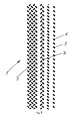
- FIG. 1 shows a sheet material 1 for the protection of crops against the effects of weather.
- the web 1 consists of three parallel webs 2, 3, 11 which are formed in this embodiment of a nonwoven fabric.
- the nonwoven fabric has a basis weight of 18 g / m 2 , is formed as staple fiber fleece and consists of polypropylene fibers.
- the air permeability of this nonwoven fabric is 3,200 l / m 2 s, measured at 50 PA / 5 cm 2 (DIN EN ISO 9237). This results in a high air permeability with optimal protection of the covered culture.
- the nonwoven fabric used has isotropic properties in terms of the maximum tensile strength and the maximum tensile strain.
- the webs 2, 3 may also consist of a film, which may also be formed of polypropylene.
- the webs 2, 3, 11 overlap at the edges such that a 30 cm wide overlap region 4 is formed.
- the webs 2, 3, 11 by means of ultrasonic welding materially connected to each other. In this case, the welding is performed so that the connection is formed as a strip-shaped pattern 5, wherein the pattern 5 composed of individual structures 6.
- the structures 6 are formed in this embodiment as a rod. Other possible structures 6 are points, rods, circular arcs or rods with thickenings at both ends.
- two parallel patterns 5 are arranged.
- the sheet goods may advantageously be provided with a marginal strip, for example in a width of 25 cm.
- This edge strip consists of a nonwoven fabric with a higher basis weight, in this embodiment 30 g / m 2 .
- This edge strip is materially connected to the web material by the method according to the invention.
- the advantage of the edge strip lies in the increase in the strength of the edge region.
- the edge region can be weighted with objects, for example stones, in order to fix the web goods in their position.
- At least two nonwoven fabric and / or film webs (2, 3) of thermoplastic materials are combined to produce the web material 1 so that they each overlap one another on one side parallel to their longitudinal extent. Thereafter, the webs 2, 3, 11 are ultrasonically welded welded together so that a strip-shaped pattern 5 of isolated structures 6 is formed.
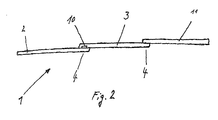
- FIG. 2 shows the web 1 according to FIG. 1 in a side view.
- a reinforcing strip 10 is additionally arranged which, depending on the material of the web 2, 3, 11, consists of film or of a nonwoven fabric.
- FIG. 3 shows in detail a strip-shaped pattern 5 for a strip product according to FIG. 1.
- the strip-shaped pattern 5 is characterized by a meandering shape.
- three strip-shaped pattern 5 are formed from staggered sections 7 of structures 6, wherein the sections 7 are connected to each other at their ends 8 by transverse further sections 9 of structures 6.
- the pattern 5 formed from individual structures 6 is not rectilinear and has interruptions in the longitudinal direction as a result of the meandering course.
- the structures 6 have the shape of two interlocking circles, so that overall results in a rod-shaped expression with thickening at both ends ("bone").
- FIG. 4 shows in detail another strip-shaped pattern 5 for a strip product according to FIG. 1.
- This pattern 5 is similar to that shown in FIG. 3, but is formed from discontinuous sections 7 of structures 6.
- FIG. 5 shows in detail another strip-shaped pattern 5 for a piece of sheet material according to FIG. 1.
- This pattern 5 is made up of three mutually parallel lines formed from individual sections 7 of structures 6 which are spaced from each other.
- FIG. 6 shows in detail another strip-shaped pattern 5 for a strip product according to FIG. 1.
- This pattern 5 is similar to that shown in FIG. In this embodiment, however, the individual sections 7 are wider executed. As a result of the overall larger welded surface, this composite can absorb higher loads.
- FIG. 7 This pattern 5 is constructed from four mutually parallel sections 7 formed from structures 6 and spaced apart from each other. The individual sections 7 are of different widths.
- FIG. 8 shows in detail another strip-shaped pattern 5 for a strip product according to FIG. 1.
- This pattern 5 consists of arcuate sections 7 which are formed by the structures 6.
- FIG. 9 shows in detail another strip-shaped pattern 5 for a strip product according to FIG. 1. This consists of rod-shaped sections 7 which are oriented in different directions. The rod-shaped sections 7 are formed by the structures 6.
Landscapes
- Engineering & Computer Science (AREA)
- Mechanical Engineering (AREA)
- Health & Medical Sciences (AREA)
- General Health & Medical Sciences (AREA)
- Toxicology (AREA)
- Life Sciences & Earth Sciences (AREA)
- Environmental Sciences (AREA)
- Textile Engineering (AREA)
- Laminated Bodies (AREA)
- Nonwoven Fabrics (AREA)
- Protection Of Plants (AREA)
Abstract
Description
- Die Erfindung betrifft eine Bahnenware zum Schutz von Pflanzenkulturen gegen Witterungseinflüsse, umfassend mindestens zwei Bahnen von Vliesstoffen und/oder Folien, die zumindest teilweise einander überlappen und in den Überlapp-Bereichen stoffschlüssig miteinander verbunden sind. Des Weiteren betrifft die Erfindung ein Verfahren zur Herstellung der Bahnenware sowie dessen Verwendung.
- Bahnenwaren zum Schutz von Pflanzenkulturen sind aus der
DE 9111254 U bekannt. Bei der vorbekannten Bahnenware handelt es sich um licht-, luft- und feuchtigkeitsdurchlässige Vliesstoffbahnen, wobei mehrere Vliesstoff- oder Folienbahnen stoffschlüssig, beispielsweise durch Schweißen, entlang der Längskanten miteinander verbunden sind, um eine größere Breite der Bahnenware zu erreichen. - Bei der Handhabung dieser aus mehreren Vliesstoff- oder Folienbahnen zusammengesetzten Bahnenware hat sich herausgestellt, dass diese bei der Handhabung einreißen können. Eine Schwachstelle ist dabei insbesondere die Verbindungen zwischen den einzelnen Bahnen. Das Einreißen der Bahnenware hat eine verkürzte Gebrauchsdauer sowie eine Verschlechterung der Gebrauchseigenschaften zur Folge. Durch die entstandenen Risse treten beispielsweise die zu schützenden Pflanzenkulturen direkt mit der Außenumgebung in Kontakt und der Schutz der Pflanzenkulturen ist eingeschränkt.
- Der Erfindung liegt die Aufgabe zugrunde, eine Bahnenware zum Schutz von Pflanzenkulturen bereitzustellen, die eine verbesserte Rissbeständigkeit und insbesondere eine verbesserter Weiterreißfestigkeit aufweist.
- Diese Aufgabe wird mit den Merkmalen von Anspruch 1, 12 und 13 gelöst. Auf vorteilhafte Ausgestaltungen nehmen die Unteransprüche Bezug.
- Zur Lösung der Aufgabe ist die Verbindung als streifenförmiges Muster ausgebildet, die sich wiederum aus vereinzelten Strukturen zusammensetzt. Strukturen im Sinne der Erfindung sind flächige Abschnitte beliebiger Geometrie, in denen zwei überlappende Bahnen stoffschlüssig miteinander verbunden sind. Durch die vereinzelten Strukturen ergibt sich eine wesentlich verbesserte Weiterreißfestigkeit, da sich zwar die Verbindung in einer einzelnen Struktur lösen kann, aber sich der Riss einer einzelnen Struktur nicht auf eine andere Struktur übertragen kann. Die Flächeninhalte von Gravurpunkten bewegen sich erfindungsgemäß im Bereich von 0,2 bis 2 mm2, vorzugsweise von 0,4 bis 1 mm2. Diese Flächeninhalte bieten eine gute Reißfestigkeit bei gleichzeitig einfacher Herstellbarkeit. Des Weiteren bleibt die Bahnenware auch in den Überlapp-Bereichen flexibel. Bevorzugt beträgt das Flächengewicht der Vliesstoff- oder Folienbahnen ein Flächengewichten von 10 bis 150 g/m2, insbesondere von 15 bis 60 g/m2. Der gewählte Bereich ergibt eine hohe mechanische Stabilität bei einer guten Handhabbarkeit. Vorzugsweise werden Vliesstoff- oder Folienbahnen mit isotropen mechanischen Eigenschaften eingesetzt, also Vliesstoffe oder Folien, die in Maschinenlaufrichtung und quer dazu etwa gleiche Werte für die Höchstzugkraft und Höchstzugdehnung aufweisen. Dadurch ist die Herstellung der Bahnenware vereinfacht, da die Verbindung der Vliesstoff- oder Folienbahnen an jeder Seite erfolgen kann. Des Weiteren ergibt sich eine Bahnenware, die in jeder Richtung die gleichen Eigenschaften aufweist. Der eingesetzte Vliesstoff weist insbesondere gute Dehneigenschaften und damit gute Arbeitsaufnahmeeigenschaften auf, so dass ein Windangriff durch Dehnung des Materials abgefangen wird. Die Bahnenware kann mindestens zwei Vliesstoffbahnen und/oder Folienbahnen umfassen, von denen die Bahnen jeweils mit den benachbarten Bahnen überlappen und in diesen Überlapp-Bereichen stoffschlüssig miteinander verbunden sind.
- Die Breite der Überlapp-Bereiche der Vliesstoff- oder Folienbahnen bewegt sich vorzugsweise zwischen 5 bis 35 cm. Die Überdeckungsbereich ermöglicht eine materialsparende Verbindung bei gleichzeitig guter Festigkeit.
- Die Bahnenware kann in den Überlapp-Bereichen einen Verstärkungsstreifen aus Folie und/oder aus einem Vliesstoff aufweisen, der mit den Vliesstoff- oder Folienbahnen stoffschlüssig verbunden ist. Dadurch verbessert sich nochmals die Rissbeständigkeit der Bahnenware. Die Vliesstoffbahnen und/oder Folienbahnen und der Verstärkungsstreifen materialeinheitlich sein und beispielsweise aus Polypropylen bestehen.
- Die Strukturen können als Punkte, Stäbchen, Kreisbögen oder Stäbchen mit Verdickungen an beiden Enden ausgebildet sein. Die Stäbchen sind dabei insbesondere angerundet ausgeführt. Diese Ausgestaltungen verbessern das Einreißverhalten, da spitzwinklige Geometrien als bevorzugte Anrissstellen vermieden werden. Die Strukturen können auch Mischungen aus Stäbchen, Kreisbögen oder Stäbchen mit Verdickungen sein. Ebenfalls kann auch jede beliebige Linearkombination der genannten Geometrien in Betracht gezogen werden.
- Es können zumindest zwei einander parallele Muster in dem Überlapp-Bereich angeordnet sein. Die zwei parallelen Muster verbessern die Festigkeit der Verbindung und verbessern das Rissverhalten der Bahnenware. Bei sehr starken mechanischen Beanspruchungen fängt das zweite parallele Muster einen Rissfortschritt auf.
- Die Streifen können unterbrochen ausgebildet sein. Dadurch ist die Weiterreißfestigkeit der Bahnenware nochmals verbessert.
- In einer weiteren Ausführung können zumindest zwei Muster aus gegeneinander versetzten Abschnitten von Strukturen bestehen, wobei die Abschnitte an ihren Enden durch quer verlaufende Abschnitte von Strukturen miteinander verbunden sein können. Diese Geometrie verbessert ebenfalls die Weiterreißfestigkeit.
- Die stoffschlüssige Verbindung kann durch eine Ultraschall-Verschweißung gebildet sein. Ultraschall-Schweißen ist ein kostengünstiges und großserientaugliches Verfahren zum stoffschlüssigen Verbinden von Bahnenware. Die Verbindung erfolgt dabei vorzugsweise ohne Zuschlag oder Hilfsstoffe, was insbesondere bei der Anwendung der Bahnenware im Lebensmittelbereich vorteilhaft ist. Eine andere stoffschlüssige Verbindungsart ist das Kleben.
- Die Flächengewichte der Vliesstoffbahnen können 10 bis 150 g/m2 betragen.
- Eine weitere Lösung der Aufgabe umfasst ein Verfahren zur Herstellung der Bahnenware nach einem der vorherigen Ansprüche, aufweisend die Maßnahmen:
- a. Kombinieren von mindestens zwei Vliesstoff- und/oder Folienbahnen aus thermoplastischen Kunststoffen, so dass diese jeweils auf einer Seite parallel zu ihrer Längserstreckung miteinander überlappen, und
- b. Ultraschallverschweißen der Vliesstoff- und/oder Folienbahnen in den Überlappungsbereichen, so dass ein streifenförmiges Muster aus vereinzelten Strukturen entsteht.
- Die Vliesstoffbahnen können aus Spinnvliesstoffen oder Stapelfaservliesstoffen gebildet sein. Zur Herstellung der erfindungsgemäßen Vliesstoff- oder Folienbahn kommen vorzugsweise synthetische Polymere, insbesondere Polyester, Polyamid, Polyolefin oder Polypropylen zum Einsatz. Die Vliesstoffe können dabei Fasern und/oder Filamente aus verschiedenen thermoplastischen Polymeren enthalten, vorzugsweise aus Polypropylen, Metallocen-Polypropylen, CoPP oder Polyester, CoPET oder Mischungen aus diesen Kunststoffen. Der Vliesstoff kann neben Fasern aus den genannten Polymeren auch noch Bindefasem enthalten, welche im Verlaufe des Herstellungsverfahrens schmelzen und die Bahnenware verfestigen. Derartige Bindefasem sind beispielsweise Bikomponentenfasem, Kem-Mantelfasern oder Pie-Fasem. Die erfindungsgemäß zum Einsatz kommenden Vliesstoffe können aus unterschiedlichen Fasertypen in unterschiedlichen Titerbereichen bestehen, insbesondere einem Titer von 0,1 bis 10 dtex, vorzugsweise von 1,3 bis 4 dtex. Unter Fasern sind im Rahmen dieser Beschreibung Fäden endlicher Länge zu verstehen, also Fäden mit Längen bis in den Dezimeterbereich. Unter Filamenten sind im Rahmen dieser Beschreibung Fäden praktisch unendlicher Länge zu verstehen, also Fäden mit Längen oberhalb des Dezimeterbereichs. Die erfindungsgemäß zum Einsatz kommenden Vliesstoffe werden beispielsweise durch Vernadeln und/oder durch Wasserstrahlbehandlung und/oder durch Einsatz eines chemischen Binders und/oder von Bindefasern verfestigt. Vorzugsweise erfolgt die Verfestigung der Vliesstoffe mittels,einer Kalander-Behandlung, ganz besonders bevorzugt durch eine Punktverfestigung. Diese Verfestigung erfolgt vorzugsweise ohne Zusatzstoffe, was insbesondere im Lebensmittelbereich vorteilhaft ist.
- Wenn dem Vliesstoff oder der Folie als Zusatzstoff einen UV-Stabilisator oder einen Farb-Masterbatch aufweist, steigt die Gebrauchsdauer der Bahnenware.
- Die für die Bahnenware verwendbaren Vliesstoffe können mit verschiedenen Vliesbildungstechniken erzeugt worden sein. Die Vliesstoffbahnen können beispielsweise durch Spinnvliesverfahren, Kardierverfahren, Schmelzblasverfahren, Nassvlies-Verfahren, elektrostatisches Spinnen, Meltblown-Verfahren oder aerodynamische Vliesherstellungsverfahren hergestellt werden. Die für die Bahnenware verwendbaren Folien können ebenfalls durch verschiedene Herstellungsverfahren erzeugt werden, beispielsweise durch Extrusion oder durch Blasformen.
- Die erfindungsgemäße Bahnenware wird zum Schutz von Pflanzenkulturen gegen Witterungseinflüsse eingesetzt. Derartige Anwendungen sind im Gartenbau und in der Landwirtschaft bekannt. Weitere Anwendungsgebiete sind das Abdecken von Mieten oder die Verwendung der Bahnenware als Baumumhüllung.
- Die erfindungsgemäße Bahnenware wird nachfolgend anhand der Figuren näher erläutert. Diese zeigen, jeweils schematisch:
- Fig. 1 eine erfindungsgemäße Bahnenware in der Draufsicht;
- Fig. 2 die Bahnenware gemäß Figur 1 in der Seitenansicht;
- Fig. 3 eine erste Ausführung des Musters;
- Fig. 4 eine zweite Ausführung des Musters;
- Fig. 5 eine dritte Ausführung des Musters;
- Fig. 6 eine vierte Ausführung des Musters;
- Fig. 7 eine fünfte Ausführung des Musters;
- Fig. 8 eine sechste Ausführung des Musters;
- Fig. 9 eine siebte Ausführung des Musters.
- Figur 1 zeigt eine Bahnenware 1 zum Schutz von Pflanzenkulturen gegen Witterungseinflüsse. Die Bahnenware 1 besteht aus drei parallel zueinander ausgerichteten Bahnen 2, 3, 11 die in dieser Ausführung aus einem Vliesstoff gebildet sind. Der Vliesstoff weist ein Flächengewicht von 18 g/m2 auf, ist als Stapelfaservlies ausgebildet und besteht aus Polypropylenfasern. Die Luftdurchlässigkeit dieses Vliesstoffes beträgt 3.200 l/m2s, gemessen bei 50 PA/5 cm2 (DIN EN ISO 9237). Dabei ergibt sich eine hohe Luftdurchlässigkeit bei optimalem Schutz der abgedeckten Kultur. Der eingesetzte Vliesstoff weist isotrope Eigenschaften in Bezug auf die Höchstzugkraft und die Höchstzugdehnung auf. In anderen Ausführungen können die Bahnen 2, 3 auch aus einer Folien bestehen, die ebenfalls aus Polypropylen gebildet sein kann. Die Bahnen 2, 3, 11 überlappen sich an den Rändern derart, dass sich ein 30 cm breiter Überlapp-Bereich 4 bildet. In diesem Überlapp-Bereich 4 sind die Bahnen 2, 3, 11 mittels Ultraschall-Schweißen stoffschlüssig miteinander verbunden. Dabei ist die Schweißung so erfolgt, dass die Verbindung als streifenförmiges Muster 5 ausgebildet ist, wobei sich die Muster 5 aus vereinzelten Strukturen 6 zusammensetzen. Die Strukturen 6 sind in dieser Ausführung als Stäbchen ausgebildet. Weitere mögliche Strukturen 6 sind Punkte, Stäbchen, Kreisbögen oder Stäbchen mit Verdickungen an beiden Enden. In dem Überlapp-Bereich 4 sind zwei einander parallele Muster 5 angeordnet. Die Bahnenware kann vorteilhafterweise mit einem Randstreifen, beispielsweise in einer Breite von 25 cm versehen sein. Dieser Randstreifen besteht aus einem Vliesstoff mit einem höheren Flächengewicht, in dieser Ausführung 30 g/m2. Dieser Randstreifen ist mit dem erfindungsgemäßen Verfahren stoffschlüssig mit der Bahnenware verbunden. Der Vorteil des Randstreifens liegt in der Erhöhung der Festigkeit des Randbereichs, Des Weiteren kann der Randbereich mit Gegenständen beispielsweise Steinen beschwert werden, um die Bahnenware in ihrer Lage zu fixieren. Zur Herstellung der Bahnenware 1 werden mindestens zwei Vliesstoff- und/oder Folienbahnen (2, 3) aus thermoplastischen Kunststoffen kombiniert, so dass diese jeweils auf einer Seite parallel zu ihrer Längserstreckung miteinander überlappen. Danach werden die Bahnen 2, 3, 11 per Ultraschallverschweißen so miteinander verschweißt, dass ein streifenförmiges Muster 5 aus vereinzelten Strukturen 6 entsteht.
- Figur 2 zeigt die Bahnenware 1 gemäß Figur 1 in der Seitenansicht. In dem links abgebildeten Überlapp-Bereich 4 ist zusätzlich ein Verstärkungsstreifen 10 angeordnet, der je nach Material der Bahn 2, 3, 11 aus Folie oder aus einem Vliesstoff besteht.
- Figur 3 zeigt im Detail ein streifenförmiges Muster 5 für eine Bahnenware gemäß Figur 1. Das streifenförmige Muster 5 zeichnet sich durch eine Mäanderfom aus. Dabei sind drei streifenförmige Muster 5 aus gegeneinander versetzten Abschnitten 7 von Strukturen 6 gebildet, wobei die Abschnitte 7 an ihren Enden 8 durch quer verlaufende weitere Abschnitte 9 von Strukturen 6 miteinander verbunden sind. Dadurch ist das aus einzelnen Strukturen 6 gebildete Muster 5 nicht geradlinig und weist durch den mäanderförmigen Verlauf Unterbrechungen in der Längsrichtung auf. Die Strukturen 6 weisen die Form zweier ineinander greifender Kreise auf, so dass sich insgesamt eine stäbchenförmige Ausprägung mit Verdickungen an beiden Enden ("Knochen") ergibt.
- Figur 4 zeigt im Detail ein weiteres streifenförmiges Muster 5 für eine Bahnenware gemäß Figur 1. Dieses Muster 5 ähnelt dem in Figur 3 gezeigten, wird jedoch aus unterbrochenen Abschnitten 7 von Strukturen 6 gebildet.
- Figur 5 zeigt im Detail ein weiteres streifenförmiges Muster 5 für eine Bahnenware gemäß Figur 1. Dieses Muster 5 ist aus drei parallel zueinander verlaufenden, aus einzelnen Abschnitten 7 aus Strukturen 6 gebildeten Linien, die voneinander beabstandet sind, aufgebaut.
- Figur 6 zeigt im Detail ein weiteres streifenförmiges Muster 5 für eine Bahnenware gemäß Figur 1. Dieses Muster 5 ähnelt dem in Figur 5 gezeigten. In dieser Ausführung sind die einzelnen Abschnitte 7 sind jedoch breiter ausgeführt. Infolge der insgesamt größeren verschweißten Fläche kann dieser Verbund höhere Lasten aufnehmen.
- Figur 7 Dieses Muster 5 ist aus vier parallel zueinander verlaufenden aus Strukturen 6 gebildeten und voneinander beabstandet verlaufenden Abschnitten 7 aufgebaut. Die einzelnen Abschnitte 7 sind unterschiedlich breit.
- Figur 8 zeigt im Detail ein weiteres streifenförmiges Muster 5 für eine Bahnenware gemäß Figur 1. Dieses Muster 5 besteht aus bogenförmigen Abschnitten 7 die durch die Strukturen 6 gebildet sind.
- Figur 9 zeigt im Detail ein weiteres streifenförmiges Muster 5 für eine Bahnenware gemäß Figur 1. Dieses besteht aus stäbchenförmigen Abschnitten 7 die in unterschiedlichen Richtungen orientiert sind. Die stäbchenförmigen Abschnitte 7 sind durch die Strukturen 6 gebildet.
Claims (12)
- Bahnenware (1) zum Schutz von Pflanzenkulturen gegen Witterungseinflüsse, umfassend mindestens zwei Bahnen (2, 3) von Vliesstoffen und/oder Folien, die zumindest teilweise einander überlappen und in den Überlapp-Bereichen (4) stoffschlüssig miteinander verbunden sind, dadurch gekennzeichnet, dass die Verbindung als streifenförmiges Muster (5) ausgebildet ist, die sich aus vereinzelten Strukturen (6) zusammensetzt.
- Bahnenware nach Anspruch 1, dadurch gekennzeichnet, dass die Strukturen (6) als Punkte, Stäbchen, Kreisbögen oder Stäbchen mit Verdickungen an beiden Enden oder deren Mischungen ausgebildet sind.
- Bahnenware nach Anspruch 1 oder 2, dadurch gekennzeichnet, dass zumindest zwei einander parallele Muster (5) in dem Überlapp-Bereich (4) angeordnet sind.
- Bahnenware nach einem der Ansprüche 1 bis 3, dadurch gekennzeichnet, dass das streifenförmige Muster (5) unterbrochen ausgebildet sind.
- Bahnenware nach einem der Ansprüche 1 bis 4, dadurch gekennzeichnet, dass zumindest zwei streifenförmige Muster (5) aus gegeneinander versetzten Abschnitten (7) von Strukturen (6) bestehen, wobei die Abschnitte (7) an ihren Enden (8) durch quer verlaufende weitere Abschnitte (9) von Strukturen (6) miteinander verbunden sind.
- Bahnenware nach einem der Ansprüche 1 bis 5, dadurch gekennzeichnet, dass die stoffschlüssige Verbindung der Bahnen (2, 3) durch eine Ultraschall-Verschweißung gebildet ist.
- Bahnenware nach einem der Ansprüche 1 bis 6, dadurch gekennzeichnet, dass in den Überlapp-Bereichen (4) der Bahnen (2, 3) ein Verstärkungsstreifen (10) aus Folie und/oder aus einem Vliesstoff angeordnet ist.
- Bahnenware nach einem der Ansprüche 1 bis 7, dadurch gekennzeichnet, dass die Vliesstoffbahnen (2, 3) aus Spinnvliesstoffen oder Stapelfaservliesstoffen gebildet sind.
- Bahnenware nach einem der Ansprüche 1 bis 8, dadurch gekennzeichnet, dass die Vliesstoffbahnen (2, 3) aus Polyesterfasern oder vorzugsweise aus Polypropylenfasern bestehen
- Bahnenware nach einem der Ansprüche 1 bis 9, dadurch gekennzeichnet, dass die Flächengewichte der Vliesstoff oder Folienbahnen (2, 3) 10 bis 150 g/m2 betragen.
- Verfahren zur Herstellung der Bahnenware (1) nach einem der vorherigen Ansprüche, umfassend die Maßnahmen kombinieren von mindestens zwei Vliesstoff- und/oder Folienbahnen (2,3) aus thermoplastischen Kunststoffen, so dass diese jeweils auf einer Seite parallel zu ihrer Längserstreckung miteinander überlappen, und Ultraschallverschweißen der Vliesstoff- und/oder Folienbahnen (2, 3) in den Überlapp-Bereichen (4), so dass ein streifenförmiges Muster (5) aus vereinzelten Strukturen (6) entsteht.
- Verwendung der Bahnenware (1) nach einem der vorherigen Ansprüche zum Abdecken von Pflanzenkulturen und/oder Böden als Schutz gegen Wifferungseinflüsse.
Applications Claiming Priority (1)
| Application Number | Priority Date | Filing Date | Title |
|---|---|---|---|
| DE102006005688A DE102006005688B3 (de) | 2006-02-08 | 2006-02-08 | Bahnenware zum Schutz von Pflanzenkulturen |
Publications (2)
| Publication Number | Publication Date |
|---|---|
| EP1817954A2 true EP1817954A2 (de) | 2007-08-15 |
| EP1817954A3 EP1817954A3 (de) | 2008-11-26 |
Family
ID=37896693
Family Applications (1)
| Application Number | Title | Priority Date | Filing Date |
|---|---|---|---|
| EP06026178A Withdrawn EP1817954A3 (de) | 2006-02-08 | 2006-12-18 | Bahnenware zum Schutz von Pflanzenkulturen |
Country Status (2)
| Country | Link |
|---|---|
| EP (1) | EP1817954A3 (de) |
| DE (1) | DE102006005688B3 (de) |
Cited By (2)
| Publication number | Priority date | Publication date | Assignee | Title |
|---|---|---|---|---|
| CN105145210A (zh) * | 2015-09-18 | 2015-12-16 | 江苏农林职业技术学院 | 一种板结土壤中单行蔬菜栽培畦双窄幅留缝式盖膜装置 |
| FR3066479A1 (fr) * | 2017-05-16 | 2018-11-23 | Constructions Industrielles De La Mediterranee-Cnim | Dispositif de protection d'un element constitue par un film souple dechirable |
Families Citing this family (6)
| Publication number | Priority date | Publication date | Assignee | Title |
|---|---|---|---|---|
| FR2915346B1 (fr) * | 2007-04-24 | 2011-08-26 | Fiberweb France Sas | Nappe de protection avec bords renforces |
| GR1006247B (el) * | 2007-12-27 | 2009-01-29 | Πλαστικο φυλλο θερμοκηπιων ή τουνελς | |
| WO2009144018A1 (de) * | 2008-05-30 | 2009-12-03 | Gebr. Duerrbeck Kunststoffe Gmbh | Agrarfolienanordnung mit speziellen optischen eigenschaften |
| DE102008025937B4 (de) * | 2008-05-30 | 2013-04-11 | Gebr. Dürrbeck Kunststoffe GmbH | Agrarfolienanordnung mit speziellen optischen Eigenschaften |
| FR2989306A1 (fr) * | 2012-04-16 | 2013-10-18 | Ryb Sa | Structure geosynthetique multi-fonction |
| EP4494455A1 (de) * | 2023-07-20 | 2025-01-22 | IFG Exelto NV | Gewächshausschirm |
Citations (1)
| Publication number | Priority date | Publication date | Assignee | Title |
|---|---|---|---|---|
| DE9111254U1 (de) | 1991-09-11 | 1992-01-02 | Silver-Plastics Gmbh & Co Kg, 5210 Troisdorf | Agrarvlies zum Abdecken von Pflanzenkulturen |
Family Cites Families (2)
| Publication number | Priority date | Publication date | Assignee | Title |
|---|---|---|---|---|
| DE4130343C2 (de) * | 1991-09-12 | 2002-07-04 | Corovin Gmbh | Verbundvliesmaterial und Verfahren zur Herstellung eines Verbundvliesmaterials |
| GB0030733D0 (en) * | 2000-12-16 | 2001-01-31 | Don & Low Nonwovens Ltd | Sheeting |
-
2006
- 2006-02-08 DE DE102006005688A patent/DE102006005688B3/de not_active Expired - Fee Related
- 2006-12-18 EP EP06026178A patent/EP1817954A3/de not_active Withdrawn
Patent Citations (1)
| Publication number | Priority date | Publication date | Assignee | Title |
|---|---|---|---|---|
| DE9111254U1 (de) | 1991-09-11 | 1992-01-02 | Silver-Plastics Gmbh & Co Kg, 5210 Troisdorf | Agrarvlies zum Abdecken von Pflanzenkulturen |
Cited By (2)
| Publication number | Priority date | Publication date | Assignee | Title |
|---|---|---|---|---|
| CN105145210A (zh) * | 2015-09-18 | 2015-12-16 | 江苏农林职业技术学院 | 一种板结土壤中单行蔬菜栽培畦双窄幅留缝式盖膜装置 |
| FR3066479A1 (fr) * | 2017-05-16 | 2018-11-23 | Constructions Industrielles De La Mediterranee-Cnim | Dispositif de protection d'un element constitue par un film souple dechirable |
Also Published As
| Publication number | Publication date |
|---|---|
| DE102006005688B3 (de) | 2007-04-19 |
| EP1817954A3 (de) | 2008-11-26 |
Similar Documents
| Publication | Publication Date | Title |
|---|---|---|
| DE68920982T2 (de) | Monogestrecktes netz- und folienartiges Element, insbesondere für geotechnische Anwendungen. | |
| EP3676088B1 (de) | Verbundfolie | |
| EP1277865B1 (de) | Dreidimensionale regelmässig strukturierte Vliesstoffe, Verfahren zu deren Herstellung und deren Verwendung | |
| DE102007049031A1 (de) | Polypropylenmischung | |
| DE4129188A1 (de) | Schmelzfaserverklebter schichtstoff, verfahren und zwischenprodukt zu dessen herstellung und dessen verwendung | |
| DE69402688T2 (de) | Luftfilter und verfahren zu seiner herstellung | |
| DE102018008585A1 (de) | Verbundfolie | |
| DE4137310A1 (de) | Gittermatte | |
| DE19806530A1 (de) | Verbundstoff | |
| DE102006005688B3 (de) | Bahnenware zum Schutz von Pflanzenkulturen | |
| DE102013008402B4 (de) | Faservlies und Verfahren zur Herstellung desselben | |
| EP1733088B1 (de) | Spunbond-vlies aus polymerfasern und deren verwendung | |
| DE102007036742A1 (de) | Elastische Flächenanordnung, elastisches Element, elastisches Flächenelement sowie Einweg-Absoptionsprodukt und Windel und Verfahren zum Herstellen einer elastischen Flächenanordnung | |
| DE102018008584A1 (de) | Verbundfolie | |
| WO2010066894A2 (de) | Verfahren zur herstellung von fasergelegen, sowie fasergelege und deren verwendung | |
| DE4143237A1 (de) | Filterelement zum filtern von gasen und/oder fluessigkeiten, insbesondere zum filtern der in den fahrgastraum eines kraftfahrzeuges einstroemenden luft | |
| EP0013355B1 (de) | Verfahren zur Herstellung von Spinnvliesen | |
| EP0687756B1 (de) | Filamentverstärkte Vliesstoffbahn | |
| DE2706976A1 (de) | Verfahren zur vermeidung von abfall bei der vliesherstellung | |
| DE19758700C2 (de) | Dämmelement und Verfahren zu seiner Herstellung | |
| DE102008024944A1 (de) | Grundvlies für Trilaminate | |
| EP4573887B1 (de) | Flächenelement | |
| DE19630524C1 (de) | Spinnvliesstoff und Vorrichtung zu dessen Herstellung | |
| EP3926086B1 (de) | Vliesstoffelement und herstellungsverfahren | |
| DE10138000B4 (de) | Verwendung eines Folievliesstoffes als Geotextil |
Legal Events
| Date | Code | Title | Description |
|---|---|---|---|
| PUAI | Public reference made under article 153(3) epc to a published international application that has entered the european phase |
Free format text: ORIGINAL CODE: 0009012 |
|
| AK | Designated contracting states |
Kind code of ref document: A2 Designated state(s): AT BE BG CH CY CZ DE DK EE ES FI FR GB GR HU IE IS IT LI LT LU LV MC NL PL PT RO SE SI SK TR |
|
| AX | Request for extension of the european patent |
Extension state: AL BA HR MK YU |
|
| PUAL | Search report despatched |
Free format text: ORIGINAL CODE: 0009013 |
|
| AK | Designated contracting states |
Kind code of ref document: A3 Designated state(s): AT BE BG CH CY CZ DE DK EE ES FI FR GB GR HU IE IS IT LI LT LU LV MC NL PL PT RO SE SI SK TR |
|
| AX | Request for extension of the european patent |
Extension state: AL BA HR MK RS |
|
| 17P | Request for examination filed |
Effective date: 20090526 |
|
| AKX | Designation fees paid |
Designated state(s): AT BE BG CH CY CZ DE DK EE ES FI FR GB GR HU IE IS IT LI LT LU LV MC NL PL PT RO SE SI SK TR |
|
| 17Q | First examination report despatched |
Effective date: 20090701 |
|
| STAA | Information on the status of an ep patent application or granted ep patent |
Free format text: STATUS: THE APPLICATION IS DEEMED TO BE WITHDRAWN |
|
| 18D | Application deemed to be withdrawn |
Effective date: 20131019 |