EP1818316A1 - Procédé de fabrication de sable artificiel pour l'industrie de la céramique et des verriers à partir de déchets de verre obtenus dans une collecte de verre séparée - Google Patents
Procédé de fabrication de sable artificiel pour l'industrie de la céramique et des verriers à partir de déchets de verre obtenus dans une collecte de verre séparée Download PDFInfo
- Publication number
- EP1818316A1 EP1818316A1 EP20070102144 EP07102144A EP1818316A1 EP 1818316 A1 EP1818316 A1 EP 1818316A1 EP 20070102144 EP20070102144 EP 20070102144 EP 07102144 A EP07102144 A EP 07102144A EP 1818316 A1 EP1818316 A1 EP 1818316A1
- Authority
- EP
- European Patent Office
- Prior art keywords
- cullet
- fraction
- glass
- sand
- rejected
- Prior art date
- Legal status (The legal status is an assumption and is not a legal conclusion. Google has not performed a legal analysis and makes no representation as to the accuracy of the status listed.)
- Withdrawn
Links
- 239000011521 glass Substances 0.000 title claims abstract description 98
- 239000006063 cullet Substances 0.000 title claims abstract description 83
- 239000000919 ceramic Substances 0.000 title claims abstract description 49
- 239000004576 sand Substances 0.000 title claims abstract description 38
- 238000004519 manufacturing process Methods 0.000 title claims abstract description 26
- 238000005816 glass manufacturing process Methods 0.000 title claims abstract description 8
- XLYOFNOQVPJJNP-UHFFFAOYSA-N water Substances O XLYOFNOQVPJJNP-UHFFFAOYSA-N 0.000 claims abstract description 54
- 238000005406 washing Methods 0.000 claims abstract description 47
- 238000000034 method Methods 0.000 claims abstract description 42
- 239000002245 particle Substances 0.000 claims abstract description 33
- 238000000926 separation method Methods 0.000 claims abstract description 21
- 230000003287 optical effect Effects 0.000 claims abstract description 18
- 238000000227 grinding Methods 0.000 claims abstract description 15
- 238000012216 screening Methods 0.000 claims abstract description 14
- 238000011144 upstream manufacturing Methods 0.000 claims abstract description 11
- 239000000126 substance Substances 0.000 claims description 44
- 238000011282 treatment Methods 0.000 claims description 13
- 239000003086 colorant Substances 0.000 claims description 9
- 238000000746 purification Methods 0.000 claims description 9
- 238000007906 compression Methods 0.000 claims description 6
- 238000001035 drying Methods 0.000 claims description 5
- 239000003337 fertilizer Substances 0.000 claims description 4
- 229910010272 inorganic material Inorganic materials 0.000 claims description 4
- 239000011147 inorganic material Substances 0.000 claims description 4
- 239000007900 aqueous suspension Substances 0.000 claims description 3
- 239000004568 cement Substances 0.000 claims description 3
- 239000002351 wastewater Substances 0.000 claims 4
- 239000000654 additive Substances 0.000 claims 1
- 230000000996 additive effect Effects 0.000 claims 1
- 239000000463 material Substances 0.000 description 94
- VYPSYNLAJGMNEJ-UHFFFAOYSA-N Silicium dioxide Chemical compound O=[Si]=O VYPSYNLAJGMNEJ-UHFFFAOYSA-N 0.000 description 29
- 230000008569 process Effects 0.000 description 18
- 230000008901 benefit Effects 0.000 description 16
- 239000000203 mixture Substances 0.000 description 16
- 230000009467 reduction Effects 0.000 description 16
- 239000002994 raw material Substances 0.000 description 12
- 238000002844 melting Methods 0.000 description 10
- 230000008018 melting Effects 0.000 description 10
- 239000000047 product Substances 0.000 description 10
- 239000004033 plastic Substances 0.000 description 9
- 229920003023 plastic Polymers 0.000 description 9
- 238000012360 testing method Methods 0.000 description 8
- 238000005265 energy consumption Methods 0.000 description 7
- 239000006260 foam Substances 0.000 description 6
- 230000006872 improvement Effects 0.000 description 6
- 239000013072 incoming material Substances 0.000 description 6
- 230000001603 reducing effect Effects 0.000 description 6
- 239000004575 stone Substances 0.000 description 6
- 239000002699 waste material Substances 0.000 description 6
- 238000009837 dry grinding Methods 0.000 description 5
- 239000005431 greenhouse gas Substances 0.000 description 5
- 239000000123 paper Substances 0.000 description 5
- 238000004064 recycling Methods 0.000 description 5
- CWYNVVGOOAEACU-UHFFFAOYSA-N Fe2+ Chemical compound [Fe+2] CWYNVVGOOAEACU-UHFFFAOYSA-N 0.000 description 4
- 238000005516 engineering process Methods 0.000 description 4
- 238000011160 research Methods 0.000 description 4
- 238000001238 wet grinding Methods 0.000 description 4
- 238000011161 development Methods 0.000 description 3
- 230000000694 effects Effects 0.000 description 3
- 230000002349 favourable effect Effects 0.000 description 3
- 239000000843 powder Substances 0.000 description 3
- 238000012545 processing Methods 0.000 description 3
- 230000035945 sensitivity Effects 0.000 description 3
- 239000007858 starting material Substances 0.000 description 3
- 239000003513 alkali Substances 0.000 description 2
- 239000004411 aluminium Substances 0.000 description 2
- 229910052782 aluminium Inorganic materials 0.000 description 2
- XAGFODPZIPBFFR-UHFFFAOYSA-N aluminium Chemical compound [Al] XAGFODPZIPBFFR-UHFFFAOYSA-N 0.000 description 2
- PNEYBMLMFCGWSK-UHFFFAOYSA-N aluminium oxide Inorganic materials [O-2].[O-2].[O-2].[Al+3].[Al+3] PNEYBMLMFCGWSK-UHFFFAOYSA-N 0.000 description 2
- 230000015572 biosynthetic process Effects 0.000 description 2
- 239000003795 chemical substances by application Substances 0.000 description 2
- 239000011248 coating agent Substances 0.000 description 2
- 238000000576 coating method Methods 0.000 description 2
- 229910052593 corundum Inorganic materials 0.000 description 2
- 230000003247 decreasing effect Effects 0.000 description 2
- 230000006866 deterioration Effects 0.000 description 2
- 239000002283 diesel fuel Substances 0.000 description 2
- 230000007613 environmental effect Effects 0.000 description 2
- 238000010304 firing Methods 0.000 description 2
- 239000012535 impurity Substances 0.000 description 2
- 239000011368 organic material Substances 0.000 description 2
- 239000005022 packaging material Substances 0.000 description 2
- 230000009257 reactivity Effects 0.000 description 2
- 238000011084 recovery Methods 0.000 description 2
- 238000006479 redox reaction Methods 0.000 description 2
- 238000007670 refining Methods 0.000 description 2
- 239000007787 solid Substances 0.000 description 2
- 239000000725 suspension Substances 0.000 description 2
- 239000005028 tinplate Substances 0.000 description 2
- 229910001845 yogo sapphire Inorganic materials 0.000 description 2
- KKCBUQHMOMHUOY-UHFFFAOYSA-N Na2O Inorganic materials [O-2].[Na+].[Na+] KKCBUQHMOMHUOY-UHFFFAOYSA-N 0.000 description 1
- 238000005299 abrasion Methods 0.000 description 1
- 230000009471 action Effects 0.000 description 1
- QVGXLLKOCUKJST-UHFFFAOYSA-N atomic oxygen Chemical compound [O] QVGXLLKOCUKJST-UHFFFAOYSA-N 0.000 description 1
- 239000002585 base Substances 0.000 description 1
- 238000000071 blow moulding Methods 0.000 description 1
- 239000011449 brick Substances 0.000 description 1
- 239000006227 byproduct Substances 0.000 description 1
- 230000015556 catabolic process Effects 0.000 description 1
- 229910010293 ceramic material Inorganic materials 0.000 description 1
- 238000006243 chemical reaction Methods 0.000 description 1
- 239000011362 coarse particle Substances 0.000 description 1
- 238000011109 contamination Methods 0.000 description 1
- 238000001816 cooling Methods 0.000 description 1
- 238000010908 decantation Methods 0.000 description 1
- 230000007547 defect Effects 0.000 description 1
- 238000006731 degradation reaction Methods 0.000 description 1
- 238000010586 diagram Methods 0.000 description 1
- 238000004090 dissolution Methods 0.000 description 1
- 238000009826 distribution Methods 0.000 description 1
- 230000005611 electricity Effects 0.000 description 1
- 238000011156 evaluation Methods 0.000 description 1
- 238000001704 evaporation Methods 0.000 description 1
- 230000008020 evaporation Effects 0.000 description 1
- 239000000446 fuel Substances 0.000 description 1
- 229910052500 inorganic mineral Inorganic materials 0.000 description 1
- 229910052809 inorganic oxide Inorganic materials 0.000 description 1
- 230000007774 longterm Effects 0.000 description 1
- 239000002184 metal Substances 0.000 description 1
- 229910052751 metal Inorganic materials 0.000 description 1
- 239000007769 metal material Substances 0.000 description 1
- 239000011707 mineral Substances 0.000 description 1
- 239000006060 molten glass Substances 0.000 description 1
- 238000005457 optimization Methods 0.000 description 1
- 150000002894 organic compounds Chemical class 0.000 description 1
- 239000001301 oxygen Substances 0.000 description 1
- 229910052760 oxygen Inorganic materials 0.000 description 1
- 239000003208 petroleum Substances 0.000 description 1
- 229920002635 polyurethane Polymers 0.000 description 1
- 239000004814 polyurethane Substances 0.000 description 1
- 229910052573 porcelain Inorganic materials 0.000 description 1
- 229910001414 potassium ion Inorganic materials 0.000 description 1
- 238000003825 pressing Methods 0.000 description 1
- 230000000750 progressive effect Effects 0.000 description 1
- 230000001737 promoting effect Effects 0.000 description 1
- 239000000377 silicon dioxide Substances 0.000 description 1
- 238000004513 sizing Methods 0.000 description 1
- 239000002893 slag Substances 0.000 description 1
- 229910001415 sodium ion Inorganic materials 0.000 description 1
- 229920003002 synthetic resin Polymers 0.000 description 1
- 239000000057 synthetic resin Substances 0.000 description 1
- 238000012546 transfer Methods 0.000 description 1
Images

Classifications
-
- B—PERFORMING OPERATIONS; TRANSPORTING
- B03—SEPARATION OF SOLID MATERIALS USING LIQUIDS OR USING PNEUMATIC TABLES OR JIGS; MAGNETIC OR ELECTROSTATIC SEPARATION OF SOLID MATERIALS FROM SOLID MATERIALS OR FLUIDS; SEPARATION BY HIGH-VOLTAGE ELECTRIC FIELDS
- B03B—SEPARATING SOLID MATERIALS USING LIQUIDS OR USING PNEUMATIC TABLES OR JIGS
- B03B9/00—General arrangement of separating plant, e.g. flow sheets
- B03B9/06—General arrangement of separating plant, e.g. flow sheets specially adapted for refuse
- B03B9/061—General arrangement of separating plant, e.g. flow sheets specially adapted for refuse the refuse being industrial
- B03B9/062—General arrangement of separating plant, e.g. flow sheets specially adapted for refuse the refuse being industrial the refuse being glass
-
- C—CHEMISTRY; METALLURGY
- C03—GLASS; MINERAL OR SLAG WOOL
- C03C—CHEMICAL COMPOSITION OF GLASSES, GLAZES OR VITREOUS ENAMELS; SURFACE TREATMENT OF GLASS; SURFACE TREATMENT OF FIBRES OR FILAMENTS MADE FROM GLASS, MINERALS OR SLAGS; JOINING GLASS TO GLASS OR OTHER MATERIALS
- C03C1/00—Ingredients generally applicable to manufacture of glasses, glazes, or vitreous enamels
- C03C1/002—Use of waste materials, e.g. slags
-
- C—CHEMISTRY; METALLURGY
- C03—GLASS; MINERAL OR SLAG WOOL
- C03C—CHEMICAL COMPOSITION OF GLASSES, GLAZES OR VITREOUS ENAMELS; SURFACE TREATMENT OF GLASS; SURFACE TREATMENT OF FIBRES OR FILAMENTS MADE FROM GLASS, MINERALS OR SLAGS; JOINING GLASS TO GLASS OR OTHER MATERIALS
- C03C1/00—Ingredients generally applicable to manufacture of glasses, glazes, or vitreous enamels
- C03C1/02—Pretreated ingredients
- C03C1/022—Purification of silica sand or other minerals
-
- C—CHEMISTRY; METALLURGY
- C03—GLASS; MINERAL OR SLAG WOOL
- C03C—CHEMICAL COMPOSITION OF GLASSES, GLAZES OR VITREOUS ENAMELS; SURFACE TREATMENT OF GLASS; SURFACE TREATMENT OF FIBRES OR FILAMENTS MADE FROM GLASS, MINERALS OR SLAGS; JOINING GLASS TO GLASS OR OTHER MATERIALS
- C03C23/00—Other surface treatment of glass not in the form of fibres or filaments
- C03C23/0075—Cleaning of glass
-
- C—CHEMISTRY; METALLURGY
- C03—GLASS; MINERAL OR SLAG WOOL
- C03C—CHEMICAL COMPOSITION OF GLASSES, GLAZES OR VITREOUS ENAMELS; SURFACE TREATMENT OF GLASS; SURFACE TREATMENT OF FIBRES OR FILAMENTS MADE FROM GLASS, MINERALS OR SLAGS; JOINING GLASS TO GLASS OR OTHER MATERIALS
- C03C25/00—Surface treatment of fibres or filaments made from glass, minerals or slags
- C03C25/70—Cleaning, e.g. for reuse
-
- C—CHEMISTRY; METALLURGY
- C04—CEMENTS; CONCRETE; ARTIFICIAL STONE; CERAMICS; REFRACTORIES
- C04B—LIME, MAGNESIA; SLAG; CEMENTS; COMPOSITIONS THEREOF, e.g. MORTARS, CONCRETE OR LIKE BUILDING MATERIALS; ARTIFICIAL STONE; CERAMICS; REFRACTORIES; TREATMENT OF NATURAL STONE
- C04B14/00—Use of inorganic materials as fillers, e.g. pigments, for mortars, concrete or artificial stone; Treatment of inorganic materials specially adapted to enhance their filling properties in mortars, concrete or artificial stone
- C04B14/02—Granular materials, e.g. microballoons
- C04B14/04—Silica-rich materials; Silicates
- C04B14/22—Glass ; Devitrified glass
-
- C—CHEMISTRY; METALLURGY
- C04—CEMENTS; CONCRETE; ARTIFICIAL STONE; CERAMICS; REFRACTORIES
- C04B—LIME, MAGNESIA; SLAG; CEMENTS; COMPOSITIONS THEREOF, e.g. MORTARS, CONCRETE OR LIKE BUILDING MATERIALS; ARTIFICIAL STONE; CERAMICS; REFRACTORIES; TREATMENT OF NATURAL STONE
- C04B14/00—Use of inorganic materials as fillers, e.g. pigments, for mortars, concrete or artificial stone; Treatment of inorganic materials specially adapted to enhance their filling properties in mortars, concrete or artificial stone
- C04B14/02—Granular materials, e.g. microballoons
- C04B14/04—Silica-rich materials; Silicates
- C04B14/22—Glass ; Devitrified glass
- C04B14/24—Glass ; Devitrified glass porous, e.g. foamed glass
-
- Y—GENERAL TAGGING OF NEW TECHNOLOGICAL DEVELOPMENTS; GENERAL TAGGING OF CROSS-SECTIONAL TECHNOLOGIES SPANNING OVER SEVERAL SECTIONS OF THE IPC; TECHNICAL SUBJECTS COVERED BY FORMER USPC CROSS-REFERENCE ART COLLECTIONS [XRACs] AND DIGESTS
- Y02—TECHNOLOGIES OR APPLICATIONS FOR MITIGATION OR ADAPTATION AGAINST CLIMATE CHANGE
- Y02W—CLIMATE CHANGE MITIGATION TECHNOLOGIES RELATED TO WASTEWATER TREATMENT OR WASTE MANAGEMENT
- Y02W30/00—Technologies for solid waste management
- Y02W30/50—Reuse, recycling or recovery technologies
- Y02W30/60—Glass recycling
Definitions
- the present invention relates in general to the field of technologies for recovering cullet obtained by separated glass collection.
- this cullet is partially recycled for the production of hollow glassware, particularly bottles.
- This research has included, for example, the development of the "Case Gob” method, designed to add a uniform layer of compressive stress to the outer surface of the finished bottles, by supplying the forming machines with drops coated with a layer of glass characterized by a high coefficient of expansion and produced continuously in a second small furnace. During cooling, the outer glass contracts farther than the inner glass, thus generating the desired compressive stresses.
- Another method is the ionic exchange process, which has the same aim as the preceding method, but achieves this by replacing the sodium ions on the outer surface of the container with potassium ions which are characterized by a higher ionic radius, and therefore generate the said compressive stresses.
- the problem of the presence of non-glass materials in the "furnace ready" cullet is related to that of the optimal control of the optical machines installed in primary cullet selection and treatment plants, which detect the presence of opaque bodies in order to eliminate materials which are not dissolved in the production of glass, these machines providing for the rejection of these opaque bodies by diverting the contaminated flow.
- This operation makes it possible, on the one hand, to achieve a reasonable level of assurance that the "furnace ready" cullet passing through this operating stage of the primary plant does not contain the aforesaid harmful materials, or only contains marginal levels of them, but on the other hand it entails an increase in the rejected material, predominantly glass, which contains almost all the harmful materials present in the supply.
- the object of the present invention is to overcome the problems of the known art described above, and in particular that of decreasing the rejection of materials for recycling, without having a negative effect on the quality of the materials which can be obtained by this recycling process.
- the invention therefore proposes a method for producing artificial sand for the ceramic and glassmaking industry from a rejected fraction of the cullet obtained by the separated collection of glass, in which the said rejected fraction is separated from the cullet by automated separation based on optical transparency properties, having the characteristics defined in Claim 1.
- the rejected fraction of the cullet which as mentioned above contains all the unmeltable materials present in the starting material and a very large proportion of organic compounds, is washed to remove most of the soluble substances.
- This washing can take place upstream of the optical separation of the rejected fraction from the cullet, in which case all the cullet is washed, including the fraction that will subsequently be rejected, or downstream of the optical separation, in which case only the rejected fraction is washed.
- the rejected fraction is subsequently ground in grinders adjusted for the specific type of supply in order to obtain a product that must not contain particles whose size exceeds 1.2 mm.
- this product has been found to be surprisingly suitable as a raw material for the ceramic and glassmaking industry, even though it has been obtained from the rejected fraction of cullet.
- the invention therefore also proposes an artificial sand for the ceramic and glassmaking industry, having the characteristics defined in Claim 9.
- This sand is classified to obtain two products differing from each other solely in their particle size: a fraction with a particle size in the range from 0.08 to 1.2 mm, particularly suitable for the hollow glassware industry, and a fraction with a particle size of less than 0.08 mm, particularly suitable for the ceramic industry.
- the invention therefore proposes a use of an artificial sand for the production of hollow glassware, having the characteristics defined in Claim 10, and a use of an artificial sand for the production of ceramic ware, having the characteristics defined in Claim 11.
- the method according to the invention uses as its starting material the cullet obtained from separated collection of solid urban waste, or alternatively a specific rejected fraction of this cullet.
- urban waste denotes, for the purposes of the current regulations in this field, the waste produced in the home, in offices, in public places and in business activities, while it excludes process slag from industrial activities.
- the separated collection of waste is defined, for the purposes of the current regulations in this field, as "a collection procedure which groups urban waste into uniform categories of goods". In separated collection, it is possible to bring certain objects containing glass, such as bottles, jars and the like together, according to the "glass" category of goods.
- the material collected by separated glass collection is not entirely composed of glass, but contains impurities in the form of other materials, such as plastics, metallic materials, ceramics, stone materials, and others.
- this collected material (also referred to below as “cullet”) is sent to glass recycling plants (also referred to below as “primary plants”), in which the cullet is subjected to various separation processes so as to remove as much of the metallic and plastics materials from the glass as possible.
- the term "cullet obtained from separated glass collection” denotes precisely the collected material which has been subjected to the processes for separating the metallic and plastics materials. This cullet still contains impurities, particularly ceramic and stone materials.
- the average composition of this cullet is as follows:
- cullet is conventionally subjected in the primary plants to a further process of automated separation, which uses optical machines to separate the opaque bodies, such as stone and ceramic materials or glass contaminated with paper or the like, from the rest of the glass, based on the optical transparency properties of the materials. Additionally, in these machines it is impossible to avoid the classification of a fraction of the transparent glass in the non-transparent fraction.
- the term "furnace ready cullet” typically denotes the fraction of cullet which is classified as transparent by these optical machines and therefore is composed exclusively of glass.
- the term "rejected fraction of cullet” denotes the rejected fraction of glass which is classified as non-transparent by the optical machines.
- the average composition of this rejected fraction of cullet is as follows: glass, 92-95%; plastics and paper, 1.0-1.50; ferrous material, 0.1% max.; non-ferrous material, 0.1% max.; ceramic and stone, 3-5%.
- the method according to the invention can be used to produce artificial sand for the ceramic and glassmaking industry from the rejected fraction of cullet obtained from the separated collection of solid urban waste.
- This method essentially comprises a stage of washing with water, a grinding stage and a screening stage.
- a stage of washing with water a grinding stage and a screening stage.
- the aforementioned two new raw materials namely Glassy Sand and Ceramic Sand
- Washing with water which is one of the key elements in the process because it imparts one of the essential characteristics of Glassy Sand and Ceramic Sand, namely the reduction of the organic substances present, can be carried out on all the cullet obtained by separated collection, after preselection to remove packaging materials of other kinds (paper, plastics, aluminium, tinplate, etc.) which may be present, or solely on the material rejected by the primary plant.
- the first solution yields the following important benefits:
- the grinding of the rejected material from the primary stages of the treatment of glass obtained by separated collection is also essential for the purposes of the process according to the invention, and can be carried out by either a wet or a dry process, using conventional pebble mills in the first case, or high-compression roll mills of suitable size in the second case.
- downstream stages of the process are adapted appropriately, according to the type of mill to be used.
- the washing water is separated after grinding and hydraulic classification which leads to the production of the Glassy Sand and Ceramic Sand.
- the washed rejected material is dried by any recovered heat flows which may be available, or, when the plant is a large one (producing an overall total of about 300,000 metric tons per year of "furnace ready" cullet, Glassy Sand and Ceramic Sand), the plastics materials present in the rejected material can be used to produce a "diesel oil” (by a known method developed by Kouei Industries) which is very similar to that obtained from natural crude petroleum, a small part of which can be used to generate the heat required for drying.
- Both of these solutions can be used either when the washing is carried out on all the cullet obtained by separated collection or when it is applied only to the rejected material from the primary plants for the production of "furnace ready" mixed cullet.
- dry grinding is carried out with machines (high-compression mills) characterized by high efficiency and low energy consumption, which, by comparison with wet grinding, yield electricity savings in excess of the consumption of heat energy required to dry the washed rejected material, and it is therefore also convenient in cases where no recoverable heat flows are available and where it is impossible to produce "diesel oil" by controlled thermal degradation in the absence of air from the plastics materials present in the materials to be treated
- the two new raw materials are obtained from the ground material, in which the absence of particles with a diameter exceeding 1.2 mm (except for negligible fractions) must be ensured by particle sizing which yields, on one hand, a fraction with a diameter in the range from 0.08 to 1.2 mm (Glassy Sand) and, on the other hand, a glass powder containing all the material with a diameter of less than 0.08 mm (Ceramic Sand).
- This separation can be carried out by means of different technologies, depending on whether the material is obtained by wet or dry grinding.
- the classification must initially separate in a quantitative way all the material with a particle size of more than 1.2 mm, which is recycled for further grinding.
- This operation is preferably carried out, in both cases, by using metal screens with an aperture of suitable dimensions.
- the material with a diameter of less than 1.2 mm obtained by wet grinding is separated into the two desired fractions by means of a hydraulic classification process, while the material obtained by dry grinding is sent to a wind separator which achieves the same result by using the principle that, when operating in suitable conditions, the finer product is removed by the air while the coarser product (over 0.08 mm) falls to the base of the equipment.
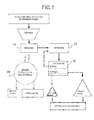
- Figure 1 shows a flow chart which relates to the case in which the primary plant for producing "furnace ready” cullet operates with the glass obtained by separated collection as is, in other words without washing.
- the numerals 10, 20 and 30 indicate, respectively, the stages of washing with water, grinding and screening.
- the numeral 40 indicates a stage of purifying the washing water.
- the washing 10 is carried out on the predominantly glass material rejected by the primary plant, which is subsequently treated to produce Glassy Sand and Ceramic Sand.
- the illustrated process can reduce the non-recyclable material to entirely marginal levels (2% maximum). Indeed, about 70% of the cullet obtained by separated collection typically leaves the plant in "furnace ready" pieces. The remaining 30%, in other words the rejected fraction, is used according to the invention to produce Glassy Sand and Ceramic Sand. About 21% of this rejected fraction is processed into Glassy Sand and about 7% is processed into Ceramic Sand (these percentages are percentages by weight with respect to the total quantity of cullet obtained by separated collection).
- the water used in a ratio of 10/1 to the glass material, travels with the material through the stages of washing 10, grinding 20 in a pebble mill and hydraulic classification 30.
- the process includes a section 40 for purifying the water.
- This water is initially sent to a chemical-physical decantation stage, which separates a small quantity (about 1% of the incoming material) of very fine glass (brick sand), which is impure because of the presence of organic substances and can be used either by the brickmaking or the cement industry, and is then sent to a biological treatment stage which produces a suspension of organic material (0.7% of the incoming material) which can be used as a fertilizer.
- a chemical-physical decantation stage which separates a small quantity (about 1% of the incoming material) of very fine glass (brick sand), which is impure because of the presence of organic substances and can be used either by the brickmaking or the cement industry, and is then sent to a biological treatment stage which produces a suspension of organic material (0.7% of the incoming material) which can be used as a fertilizer.
- the water leaving the purification plant is fully recycled for washing 10 after topping up to replace the small quantities lost (by evaporation and as residual moisture in the two new raw materials and in the by-products).
- the content of total organic substances of the water entering the washing plant expressed in terms of COD (Chemical Oxygen Demand, measured in mg/l according to the official IRSA-CNR method no. 5130) is less than 300, while the water leaving the plant has a COD level exceeding the entry level by an amount depending on the COD of the glass material subjected to washing.
- COD Chemical Oxygen Demand, measured in mg/l according to the official IRSA-CNR method no. 5130
- Glassy Sand has the average chemical composition of glass for the production of containers although its particle size distribution curve completely matches that of silica sands. It also has a low content of total organic substances, which, is stated above, makes it easy to control the redox reactions which, to repeat, are much more active when fine cullet is used than when coarser cullet is used.
- Ceramic Sand also has the average chemical composition of glass for the production of containers.
- the greater benefit of its use in the ceramic industry is the fact that it contributes alkaline oxides (Na 2 O and K 2 O) at a substantially lower cost than that of the natural minerals used in ceramic mixtures for the same purpose.
- Figure 2 shows a flow chart relating to the case in which all the glass is washed upstream of the primary plant for producing "furnace ready" cullet.
- the numerals 10', 20' and 30' indicate, respectively, the stages of washing with water, grinding and screening.
- the numeral 40' indicates a stage of purifying the washing water.
- the process can include electronic equipment for the separation 51' of glass of different colours.
- the predominantly glassy rejected material is first dried, then dry ground (stage 20') in a high-compression mill, and then screened (stage 30') to separate the material with a particle size of more than 1.2 mm, and is finally sent to a wind separator (stage 60') which produces the two new raw materials (Glassy Sand and Ceramic Sand).
- Table 1 shows the ranges of particle size, chemical characteristics (compositions in terms of inorganic oxides) and content of organic substances in the two new raw materials proposed by the present invention.
- Table 1 Characteristics Glassy Sand Ceramic Sand Particle size characteristics ⁇ 0.08 mm % 5 max 95 min 0.08 ⁇ # ⁇ 1.20 mm % 95 min 5 max > 1.20 mm % 0 0 Others % Content of organic substances H 2 O soluble COD 50 - 250 N.D.
- the content of organic substances in the incoming washing water was 200, while at the outflow it was 600.
- Example 2 Using the same plant and the same rejected material as described in Example 1, a second test was conducted at the same rate (35 metric tons/hour) and for the same effective period, using washing water which had previously been heated to a temperature of 40°C and cooled to 20°C upstream of the purification treatments.
- the content of unmeltable opaque materials was found to be less than 5 parts per million, and therefore 10 times less than the average value found in mixed cullet.
Landscapes
- Chemical & Material Sciences (AREA)
- Engineering & Computer Science (AREA)
- Life Sciences & Earth Sciences (AREA)
- Organic Chemistry (AREA)
- Materials Engineering (AREA)
- Geochemistry & Mineralogy (AREA)
- General Chemical & Material Sciences (AREA)
- Chemical Kinetics & Catalysis (AREA)
- Ceramic Engineering (AREA)
- General Life Sciences & Earth Sciences (AREA)
- Civil Engineering (AREA)
- Structural Engineering (AREA)
- Glass Compositions (AREA)
- Processing Of Solid Wastes (AREA)
Applications Claiming Priority (1)
| Application Number | Priority Date | Filing Date | Title |
|---|---|---|---|
| IT000099A ITTO20060099A1 (it) | 2006-02-13 | 2006-02-13 | Procedimento per la produzione di sabbia artificiale per l'industria ceramica e vetraria a partire da rottame di vetro risultante dalla raccolta differenziata del vetro |
Publications (1)
| Publication Number | Publication Date |
|---|---|
| EP1818316A1 true EP1818316A1 (fr) | 2007-08-15 |
Family
ID=37969969
Family Applications (1)
| Application Number | Title | Priority Date | Filing Date |
|---|---|---|---|
| EP20070102144 Withdrawn EP1818316A1 (fr) | 2006-02-13 | 2007-02-12 | Procédé de fabrication de sable artificiel pour l'industrie de la céramique et des verriers à partir de déchets de verre obtenus dans une collecte de verre séparée |
Country Status (2)
| Country | Link |
|---|---|
| EP (1) | EP1818316A1 (fr) |
| IT (1) | ITTO20060099A1 (fr) |
Cited By (2)
| Publication number | Priority date | Publication date | Assignee | Title |
|---|---|---|---|---|
| WO2012139550A1 (fr) * | 2011-04-09 | 2012-10-18 | TDC Trade, Development & Construction Limited | Procédé de fabrication de mousse de verre par recyclage d'un mélange de verres de rebut |
| RU2466944C1 (ru) * | 2011-07-06 | 2012-11-20 | Юлия Алексеевна Щепочкина | Шихта для получения стекла |
Citations (8)
| Publication number | Priority date | Publication date | Assignee | Title |
|---|---|---|---|---|
| US5333797A (en) * | 1992-04-03 | 1994-08-02 | Becker John C | Commingled recyclables recovery and recycling process and related apparatuses |
| WO1994019294A1 (fr) * | 1993-02-25 | 1994-09-01 | Svensk Glasåtervinning Ab | Procede de production de beton |
| WO1996023587A1 (fr) * | 1995-01-30 | 1996-08-08 | R & J Hansen, L.L.C. | Procede de traitement du verre de recuperation |
| EP0990466A1 (fr) * | 1998-09-30 | 2000-04-05 | Kaneto Co., Ltd. | Procédé de fabrication de sable de verre et système associé |
| US6168102B1 (en) | 1997-11-13 | 2001-01-02 | David Bergart | Rotary drum washer |
| US20050173306A1 (en) * | 2003-11-17 | 2005-08-11 | Casella Waste Systems, Inc. | Systems and methods for glass recycling at a beneficiator |
| EP1616637A2 (fr) * | 2004-07-13 | 2006-01-18 | Casella Waste Systems, Inc. | Systèmes et méthodes de tri de matériaux recyclables dans une installation de récupération |
| US20060130707A1 (en) * | 2004-12-16 | 2006-06-22 | Grasso Louis P Jr | Production of glass powder from waste glass, and products made using the same, especially concrete |
-
2006
- 2006-02-13 IT IT000099A patent/ITTO20060099A1/it unknown
-
2007
- 2007-02-12 EP EP20070102144 patent/EP1818316A1/fr not_active Withdrawn
Patent Citations (8)
| Publication number | Priority date | Publication date | Assignee | Title |
|---|---|---|---|---|
| US5333797A (en) * | 1992-04-03 | 1994-08-02 | Becker John C | Commingled recyclables recovery and recycling process and related apparatuses |
| WO1994019294A1 (fr) * | 1993-02-25 | 1994-09-01 | Svensk Glasåtervinning Ab | Procede de production de beton |
| WO1996023587A1 (fr) * | 1995-01-30 | 1996-08-08 | R & J Hansen, L.L.C. | Procede de traitement du verre de recuperation |
| US6168102B1 (en) | 1997-11-13 | 2001-01-02 | David Bergart | Rotary drum washer |
| EP0990466A1 (fr) * | 1998-09-30 | 2000-04-05 | Kaneto Co., Ltd. | Procédé de fabrication de sable de verre et système associé |
| US20050173306A1 (en) * | 2003-11-17 | 2005-08-11 | Casella Waste Systems, Inc. | Systems and methods for glass recycling at a beneficiator |
| EP1616637A2 (fr) * | 2004-07-13 | 2006-01-18 | Casella Waste Systems, Inc. | Systèmes et méthodes de tri de matériaux recyclables dans une installation de récupération |
| US20060130707A1 (en) * | 2004-12-16 | 2006-06-22 | Grasso Louis P Jr | Production of glass powder from waste glass, and products made using the same, especially concrete |
Cited By (2)
| Publication number | Priority date | Publication date | Assignee | Title |
|---|---|---|---|---|
| WO2012139550A1 (fr) * | 2011-04-09 | 2012-10-18 | TDC Trade, Development & Construction Limited | Procédé de fabrication de mousse de verre par recyclage d'un mélange de verres de rebut |
| RU2466944C1 (ru) * | 2011-07-06 | 2012-11-20 | Юлия Алексеевна Щепочкина | Шихта для получения стекла |
Also Published As
| Publication number | Publication date |
|---|---|
| ITTO20060099A1 (it) | 2007-08-14 |
Similar Documents
| Publication | Publication Date | Title |
|---|---|---|
| CN107511251B (zh) | 一种从高岭土尾矿中回收云母和长石以及石英砂的方法 | |
| AU737868B2 (en) | A method of recycling mixed colored cullet into amber, green, or flint glass | |
| KR960700312A (ko) | 유해 폐기물로 부터 환경적으로 허용적인 연마제품을 제조하기 위한 방법 및 장치(process and apparatus for producing an environmentally acceptable abrasive product from hazrdous wastes) | |
| CN102079625A (zh) | 一种利用尾矿固体废弃物制造的微晶玻璃及生产方法 | |
| CN107055542B (zh) | 处理含硅硅渣的方法 | |
| EP1818316A1 (fr) | Procédé de fabrication de sable artificiel pour l'industrie de la céramique et des verriers à partir de déchets de verre obtenus dans une collecte de verre séparée | |
| CN109265010B (zh) | 一种锂瓷石尾矿微晶玻璃及其制备方法 | |
| CN106242300A (zh) | 一种利用废日用玻璃白料制备建筑装饰微晶玻璃的方法 | |
| US5620491A (en) | Process and apparatus for decontaminating glass cullet | |
| US4276155A (en) | Method for recycling the water used in a process for recovering glass from municipal waste | |
| CN118993694A (zh) | 一种以玄武岩为原料熔融生产新材料的方法 | |
| EP2659991A1 (fr) | Procédé et équipement permettant de récupérer des déchets provenant d'installations de production de fibres continues et pour recycler directement le verre ainsi obtenu | |
| Pellegrino | Energy and environmental profile of the US glass industry | |
| Baran et al. | Beneficiation of Municipal Glass Packaging Waste as a Secondary Flux for Ceramic Tile Production | |
| JP4203946B2 (ja) | 廃ガラス材のリサイクル方法、及び該方法によって製造されたガラスカレット | |
| Rapin et al. | Recycling and recovery of glass material | |
| CN104496412B (zh) | 制瓷质砖专用的煤渣 | |
| Epure et al. | Replacement of natural sand with sand obtained from the recycling of crushed household glass | |
| JP3836493B1 (ja) | 無機粒子の製造方法 | |
| Duckett | The influence of color mixture on the use of glass cullet recovered from municipal solid waste | |
| Sedrick Yeih | Role and Effects of Silica sand on the quality of glass | |
| CN111387475A (zh) | 一种食品添加剂珍珠岩的制备方法 | |
| JP2001293456A (ja) | グラスウール屑の処理方法およびその装置 | |
| KR100534151B1 (ko) | 건식 방법에 의한 브라운관 연마재 슬러지의 재활용 방법 | |
| GB2237015A (en) | Method of manufacturing glass-ceramic articles |
Legal Events
| Date | Code | Title | Description |
|---|---|---|---|
| PUAI | Public reference made under article 153(3) epc to a published international application that has entered the european phase |
Free format text: ORIGINAL CODE: 0009012 |
|
| AK | Designated contracting states |
Kind code of ref document: A1 Designated state(s): AT BE BG CH CY CZ DE DK EE ES FI FR GB GR HU IE IS IT LI LT LU LV MC NL PL PT RO SE SI SK TR |
|
| AX | Request for extension of the european patent |
Extension state: AL BA HR MK YU |
|
| 17P | Request for examination filed |
Effective date: 20080212 |
|
| AKX | Designation fees paid |
Designated state(s): AT BE BG CH CY CZ DE DK EE ES FI FR GB GR HU IE IS IT LI LT LU LV MC NL PL PT RO SE SI SK TR |
|
| 17Q | First examination report despatched |
Effective date: 20090325 |
|
| STAA | Information on the status of an ep patent application or granted ep patent |
Free format text: STATUS: THE APPLICATION IS DEEMED TO BE WITHDRAWN |
|
| 18D | Application deemed to be withdrawn |
Effective date: 20091006 |