EP1818437A1 - Tricot-chaîne avec fils de trame pour renforcer des matériaux cimenteux - Google Patents
Tricot-chaîne avec fils de trame pour renforcer des matériaux cimenteux Download PDFInfo
- Publication number
- EP1818437A1 EP1818437A1 EP06002869A EP06002869A EP1818437A1 EP 1818437 A1 EP1818437 A1 EP 1818437A1 EP 06002869 A EP06002869 A EP 06002869A EP 06002869 A EP06002869 A EP 06002869A EP 1818437 A1 EP1818437 A1 EP 1818437A1
- Authority
- EP
- European Patent Office
- Prior art keywords
- fabric
- yarns
- weft
- warp
- stitching
- Prior art date
- Legal status (The legal status is an assumption and is not a legal conclusion. Google has not performed a legal analysis and makes no representation as to the accuracy of the status listed.)
- Withdrawn
Links
- 239000004744 fabric Substances 0.000 title claims abstract description 80
- 239000000463 material Substances 0.000 title claims abstract description 33
- 230000002787 reinforcement Effects 0.000 title claims abstract description 5
- 238000000576 coating method Methods 0.000 claims abstract description 21
- 239000011248 coating agent Substances 0.000 claims abstract description 19
- 239000004567 concrete Substances 0.000 claims abstract description 17
- 239000003513 alkali Substances 0.000 claims abstract description 13
- 238000010276 construction Methods 0.000 claims abstract description 13
- 239000000203 mixture Substances 0.000 claims abstract description 10
- 230000003252 repetitive effect Effects 0.000 claims abstract description 6
- 239000011083 cement mortar Substances 0.000 claims abstract 4
- 229920003048 styrene butadiene rubber Polymers 0.000 claims description 11
- 239000004372 Polyvinyl alcohol Substances 0.000 claims description 10
- 229920002451 polyvinyl alcohol Polymers 0.000 claims description 10
- 239000000835 fiber Substances 0.000 claims description 9
- 239000011150 reinforced concrete Substances 0.000 claims description 4
- 229920000297 Rayon Polymers 0.000 claims description 3
- 229920003235 aromatic polyamide Polymers 0.000 claims description 3
- 229920000728 polyester Polymers 0.000 claims description 3
- 239000002964 rayon Substances 0.000 claims description 3
- OKTJSMMVPCPJKN-UHFFFAOYSA-N Carbon Chemical compound [C] OKTJSMMVPCPJKN-UHFFFAOYSA-N 0.000 claims description 2
- 239000004952 Polyamide Substances 0.000 claims description 2
- 229910000831 Steel Inorganic materials 0.000 claims description 2
- 229910052799 carbon Inorganic materials 0.000 claims description 2
- 239000011152 fibreglass Substances 0.000 claims description 2
- 229920002647 polyamide Polymers 0.000 claims description 2
- 229920000098 polyolefin Polymers 0.000 claims description 2
- 239000010959 steel Substances 0.000 claims description 2
- 241000531908 Aramides Species 0.000 claims 1
- 238000003780 insertion Methods 0.000 description 11
- 230000037431 insertion Effects 0.000 description 11
- 230000003014 reinforcing effect Effects 0.000 description 11
- 239000002174 Styrene-butadiene Substances 0.000 description 9
- KAKZBPTYRLMSJV-UHFFFAOYSA-N Butadiene Chemical compound C=CC=C KAKZBPTYRLMSJV-UHFFFAOYSA-N 0.000 description 6
- PPBRXRYQALVLMV-UHFFFAOYSA-N Styrene Chemical compound C=CC1=CC=CC=C1 PPBRXRYQALVLMV-UHFFFAOYSA-N 0.000 description 6
- 239000000126 substance Substances 0.000 description 6
- 239000011398 Portland cement Substances 0.000 description 5
- 239000004568 cement Substances 0.000 description 5
- 235000012241 calcium silicate Nutrition 0.000 description 4
- XLYOFNOQVPJJNP-UHFFFAOYSA-N water Substances O XLYOFNOQVPJJNP-UHFFFAOYSA-N 0.000 description 4
- KWYUFKZDYYNOTN-UHFFFAOYSA-M Potassium hydroxide Chemical compound [OH-].[K+] KWYUFKZDYYNOTN-UHFFFAOYSA-M 0.000 description 3
- HEMHJVSKTPXQMS-UHFFFAOYSA-M Sodium hydroxide Chemical compound [OH-].[Na+] HEMHJVSKTPXQMS-UHFFFAOYSA-M 0.000 description 3
- AXCZMVOFGPJBDE-UHFFFAOYSA-L calcium dihydroxide Chemical compound [OH-].[OH-].[Ca+2] AXCZMVOFGPJBDE-UHFFFAOYSA-L 0.000 description 3
- 239000000920 calcium hydroxide Substances 0.000 description 3
- 229910001861 calcium hydroxide Inorganic materials 0.000 description 3
- 229910052918 calcium silicate Inorganic materials 0.000 description 3
- 230000000704 physical effect Effects 0.000 description 3
- 229920000642 polymer Polymers 0.000 description 3
- 239000000378 calcium silicate Substances 0.000 description 2
- 150000001875 compounds Chemical class 0.000 description 2
- 239000002245 particle Substances 0.000 description 2
- ODINCKMPIJJUCX-UHFFFAOYSA-N Calcium oxide Chemical compound [Ca]=O ODINCKMPIJJUCX-UHFFFAOYSA-N 0.000 description 1
- OWYWGLHRNBIFJP-UHFFFAOYSA-N Ipazine Chemical compound CCN(CC)C1=NC(Cl)=NC(NC(C)C)=N1 OWYWGLHRNBIFJP-UHFFFAOYSA-N 0.000 description 1
- 229920000877 Melamine resin Polymers 0.000 description 1
- 239000004640 Melamine resin Substances 0.000 description 1
- VYPSYNLAJGMNEJ-UHFFFAOYSA-N Silicium dioxide Chemical compound O=[Si]=O VYPSYNLAJGMNEJ-UHFFFAOYSA-N 0.000 description 1
- 239000012615 aggregate Substances 0.000 description 1
- 239000003570 air Substances 0.000 description 1
- AGWMJKGGLUJAPB-UHFFFAOYSA-N aluminum;dicalcium;iron(3+);oxygen(2-) Chemical compound [O-2].[O-2].[O-2].[O-2].[O-2].[Al+3].[Ca+2].[Ca+2].[Fe+3] AGWMJKGGLUJAPB-UHFFFAOYSA-N 0.000 description 1
- 239000004760 aramid Substances 0.000 description 1
- 229920006231 aramid fiber Polymers 0.000 description 1
- 239000002585 base Substances 0.000 description 1
- JHLNERQLKQQLRZ-UHFFFAOYSA-N calcium silicate Chemical compound [Ca+2].[Ca+2].[O-][Si]([O-])([O-])[O-] JHLNERQLKQQLRZ-UHFFFAOYSA-N 0.000 description 1
- -1 calcium silicate hydrates Chemical class 0.000 description 1
- OYACROKNLOSFPA-UHFFFAOYSA-N calcium;dioxido(oxo)silane Chemical compound [Ca+2].[O-][Si]([O-])=O OYACROKNLOSFPA-UHFFFAOYSA-N 0.000 description 1
- 239000002131 composite material Substances 0.000 description 1
- 239000000470 constituent Substances 0.000 description 1
- HOOWDPSAHIOHCC-UHFFFAOYSA-N dialuminum tricalcium oxygen(2-) Chemical compound [O--].[O--].[O--].[O--].[O--].[O--].[Al+3].[Al+3].[Ca++].[Ca++].[Ca++] HOOWDPSAHIOHCC-UHFFFAOYSA-N 0.000 description 1
- BCAARMUWIRURQS-UHFFFAOYSA-N dicalcium;oxocalcium;silicate Chemical compound [Ca+2].[Ca+2].[Ca]=O.[O-][Si]([O-])([O-])[O-] BCAARMUWIRURQS-UHFFFAOYSA-N 0.000 description 1
- 229920001971 elastomer Polymers 0.000 description 1
- 239000002657 fibrous material Substances 0.000 description 1
- 239000012467 final product Substances 0.000 description 1
- 238000004079 fireproofing Methods 0.000 description 1
- 238000009408 flooring Methods 0.000 description 1
- 239000010881 fly ash Substances 0.000 description 1
- 230000009477 glass transition Effects 0.000 description 1
- 239000003292 glue Substances 0.000 description 1
- 230000036571 hydration Effects 0.000 description 1
- 238000006703 hydration reaction Methods 0.000 description 1
- 150000004679 hydroxides Chemical class 0.000 description 1
- 238000009940 knitting Methods 0.000 description 1
- 239000004816 latex Substances 0.000 description 1
- 229920000126 latex Polymers 0.000 description 1
- 238000000034 method Methods 0.000 description 1
- 229920001778 nylon Polymers 0.000 description 1
- 230000035515 penetration Effects 0.000 description 1
- 239000000047 product Substances 0.000 description 1
- 229920005989 resin Polymers 0.000 description 1
- 239000011347 resin Substances 0.000 description 1
- 239000011435 rock Substances 0.000 description 1
- 239000005060 rubber Substances 0.000 description 1
- 239000004576 sand Substances 0.000 description 1
- 229910021487 silica fume Inorganic materials 0.000 description 1
- 239000002893 slag Substances 0.000 description 1
- 230000000087 stabilizing effect Effects 0.000 description 1
- 229910021534 tricalcium silicate Inorganic materials 0.000 description 1
- 235000019976 tricalcium silicate Nutrition 0.000 description 1
- 229920002554 vinyl polymer Polymers 0.000 description 1
- 238000009941 weaving Methods 0.000 description 1
Images


Classifications
-
- E—FIXED CONSTRUCTIONS
- E04—BUILDING
- E04F—FINISHING WORK ON BUILDINGS, e.g. STAIRS, FLOORS
- E04F13/00—Coverings or linings, e.g. for walls or ceilings
- E04F13/07—Coverings or linings, e.g. for walls or ceilings composed of covering or lining elements; Sub-structures therefor; Fastening means therefor
- E04F13/08—Coverings or linings, e.g. for walls or ceilings composed of covering or lining elements; Sub-structures therefor; Fastening means therefor composed of a plurality of similar covering or lining elements
- E04F13/14—Coverings or linings, e.g. for walls or ceilings composed of covering or lining elements; Sub-structures therefor; Fastening means therefor composed of a plurality of similar covering or lining elements stone or stone-like materials, e.g. ceramics concrete; of glass or with an outer layer of stone or stone-like materials or glass
- E04F13/141—Coverings or linings, e.g. for walls or ceilings composed of covering or lining elements; Sub-structures therefor; Fastening means therefor composed of a plurality of similar covering or lining elements stone or stone-like materials, e.g. ceramics concrete; of glass or with an outer layer of stone or stone-like materials or glass with an outer layer of concrete
-
- B—PERFORMING OPERATIONS; TRANSPORTING
- B28—WORKING CEMENT, CLAY, OR STONE
- B28B—SHAPING CLAY OR OTHER CERAMIC COMPOSITIONS; SHAPING SLAG; SHAPING MIXTURES CONTAINING CEMENTITIOUS MATERIAL, e.g. PLASTER
- B28B23/00—Arrangements specially adapted for the production of shaped articles with elements wholly or partly embedded in the moulding material; Production of reinforced objects
- B28B23/0006—Arrangements specially adapted for the production of shaped articles with elements wholly or partly embedded in the moulding material; Production of reinforced objects the reinforcement consisting of aligned, non-metal reinforcing elements
-
- D—TEXTILES; PAPER
- D04—BRAIDING; LACE-MAKING; KNITTING; TRIMMINGS; NON-WOVEN FABRICS
- D04B—KNITTING
- D04B21/00—Warp knitting processes for the production of fabrics or articles not dependent on the use of particular machines; Fabrics or articles defined by such processes
- D04B21/10—Open-work fabrics
- D04B21/12—Open-work fabrics characterised by thread material
-
- D—TEXTILES; PAPER
- D04—BRAIDING; LACE-MAKING; KNITTING; TRIMMINGS; NON-WOVEN FABRICS
- D04B—KNITTING
- D04B21/00—Warp knitting processes for the production of fabrics or articles not dependent on the use of particular machines; Fabrics or articles defined by such processes
- D04B21/14—Fabrics characterised by the incorporation by knitting, in one or more thread, fleece, or fabric layers, of reinforcing, binding, or decorative threads; Fabrics incorporating small auxiliary elements, e.g. for decorative purposes
- D04B21/16—Fabrics characterised by the incorporation by knitting, in one or more thread, fleece, or fabric layers, of reinforcing, binding, or decorative threads; Fabrics incorporating small auxiliary elements, e.g. for decorative purposes incorporating synthetic threads
- D04B21/165—Fabrics characterised by the incorporation by knitting, in one or more thread, fleece, or fabric layers, of reinforcing, binding, or decorative threads; Fabrics incorporating small auxiliary elements, e.g. for decorative purposes incorporating synthetic threads with yarns stitched through one or more layers or tows, e.g. stitch-bonded fabrics
-
- E—FIXED CONSTRUCTIONS
- E04—BUILDING
- E04C—STRUCTURAL ELEMENTS; BUILDING MATERIALS
- E04C2/00—Building elements of relatively thin form for the construction of parts of buildings, e.g. sheet materials, slabs, or panels
- E04C2/02—Building elements of relatively thin form for the construction of parts of buildings, e.g. sheet materials, slabs, or panels characterised by specified materials
- E04C2/04—Building elements of relatively thin form for the construction of parts of buildings, e.g. sheet materials, slabs, or panels characterised by specified materials of concrete or other stone-like material; of asbestos cement; of cement and other mineral fibres
- E04C2/06—Building elements of relatively thin form for the construction of parts of buildings, e.g. sheet materials, slabs, or panels characterised by specified materials of concrete or other stone-like material; of asbestos cement; of cement and other mineral fibres reinforced
-
- E—FIXED CONSTRUCTIONS
- E04—BUILDING
- E04F—FINISHING WORK ON BUILDINGS, e.g. STAIRS, FLOORS
- E04F13/00—Coverings or linings, e.g. for walls or ceilings
- E04F13/02—Coverings or linings, e.g. for walls or ceilings of plastic materials hardening after applying, e.g. plaster
- E04F13/04—Bases for plaster
- E04F13/047—Plaster carrying meshes
-
- D—TEXTILES; PAPER
- D10—INDEXING SCHEME ASSOCIATED WITH SUBLASSES OF SECTION D, RELATING TO TEXTILES
- D10B—INDEXING SCHEME ASSOCIATED WITH SUBLASSES OF SECTION D, RELATING TO TEXTILES
- D10B2403/00—Details of fabric structure established in the fabric forming process
- D10B2403/02—Cross-sectional features
- D10B2403/024—Fabric incorporating additional compounds
- D10B2403/0241—Fabric incorporating additional compounds enhancing mechanical properties
- D10B2403/02412—Fabric incorporating additional compounds enhancing mechanical properties including several arrays of unbent yarn, e.g. multiaxial fabrics
-
- D—TEXTILES; PAPER
- D10—INDEXING SCHEME ASSOCIATED WITH SUBLASSES OF SECTION D, RELATING TO TEXTILES
- D10B—INDEXING SCHEME ASSOCIATED WITH SUBLASSES OF SECTION D, RELATING TO TEXTILES
- D10B2505/00—Industrial
- D10B2505/02—Reinforcing materials; Prepregs
Definitions
- the present invention generally relates to concrete or cementitious materials reinforced with a fabric, especially a weft insertion warp knit fabric, and to a fabric for such reinforcement.
- Such reinforced concrete or cementitious materials can be formed as plates or panels, undulated or not, used in applications such as the flooring or covering of constructions intended for agriculture, industry, such plates or panels can also be used for the domestic dwellings in both the covering and as cementitious boards.
- US 5,763,043 discloses an open grid fabric for reinforcing wall segments having high strength, alkali resistance, and impact resistance.
- the fabric has warp, weft, and tie yarns and comprises certain knits and leno weaves, including a warp knit weft inserted fabric, and bears an alkali resistant resin coating.
- this document does not teach that the warp and weft yarns may be monofilaments or twisted multifilaments, or that the tie yarns may be knitted with a tight tension.
- Fig. 1 shows reinforced concrete (10) containing a cementitious material (100) and a reinforcing fabric (200).
- the fabric is shown embedded in the concrete material towards the surface of the concrete, but is not limited to this construction and may be on an outer side of the concrete or more towards the middle. Additionally, more than the one shown layer of reinforcing fabric (200) may be used.
- Concrete is made up principally of cementitious material, fine aggregate, coarse aggregate, water, air, chemical admixtures, and fiber.
- the cementitious material is the glue that holds concrete together.
- Typical cementitious materials used in concrete are Portland cement, fly ash, blast furnace slag, and silica fume.
- Portland cement is the dominant cementitious material used, andthe other cementitious materials will typically be added to the Portland material to adjust its performance and cost.
- Portland cement is a mixture of many compounds, and the four major constituents are tricalcium silicate, dicalcium silicate, tricalcium aluminate and tetracalcium aluminoferrite. Each Portland cement contains different amounts of these major components.
- the calcium silicates (representing ⁇ 75 wt.-% of the Portland cement) react with water to form calcium hydroxide and calcium silicate hydrate.
- the calcium silicate hydrates provide the principal performance benefits of cement.
- the highly alkaline environment of cement is due to the hydroxides such as calcium hydroxide and the lime (CaO) present in the cement.
- Fine aggregate consists of natural or manmade sand with a particle size distribution whose maximum size is typically 9.5 mm.
- Coarse aggregate consists of natural or manufactured particles (typically rocks) with a size of approximately 1.2-152 mm (0.3-6 inches). Aggregates typically make up 6075% of the final concrete.
- the water is critical for the hydration of the cement.
- the water/cementitious material ratio determines many of the critical properties of concrete.
- the reinforcing fabric of the invention is typically used towards the center of the cementitious material.
- the fabric is typically used towards the outside of the cementitious material on one or both outside surfaces.
- Fig. 2 shows a cross sectional drawing of the reinforcing fabric (200) made up of the weft inserted warp knit fabric (210) and the alkali resistant coating (220).
- the coating completely covers the fabric yarns to protect the yarns from the cement environment.
- Figs. 3 and 4 show the weft inserted warp knit fabric (210), which is made in a weft insertion warp knit machine with in-lay warp yarns (212), weft inserted yarns (213), and stitching yarns (211).
- the stitching yarns stitch in a specific chain stitch pattern wherein the fabric (210) is stabilized and precisely maintained in a parallel way.
- the reinforcing fabric has at least one layer of a weft inserted warp knit fabric (210) including in-lay warp yarns (212), stitching yarns (211), and weft inserted yarns (213), wherein each stitching yarn (211) forms a wale around a corresponding inlay warp yarn (212), and wherein the weft insertion yarns (213) are inserted in a parallel repetitive construction in the stitches of the stitching yarns (211).
- a weft inserted warp knit fabric including in-lay warp yarns (212), stitching yarns (211), and weft inserted yarns (213), wherein each stitching yarn (211) forms a wale around a corresponding inlay warp yarn (212), and wherein the weft insertion yarns (213) are inserted in a parallel repetitive construction in the stitches of the stitching yarns (211).
- the in-lay warp yarns (212), stitching yarns (211) and weft yarns (213) may be formed with any man-made material that meets the necessary physical properties, such as polyamide, polyester, rayon, para-aramid, fiberglass, polyolefin, polyvinyl, polyvinyl alcohol (PVA), steel, carbon, meta-aramid and derivates, polyacrylic and any other known yarn material containing artificial or natural fibers.
- hybrid yarns made of at least two fibers of different materials can be used. These different fiber materials can produce hybrid yarns with different chemical and physical properties. Hybrid yarns are able to change the physical properties of the final product they are used in.
- Preferred examples of hybrid yarns include an aramid fiber with any of a nylon fiber, a rayon fiber, and a polyester fiber.
- the warp and weft yarns are not sized before knitting.
- the inlay warp yarns (212) and/or weft yarns (213) preferably may be any of single monofilament yarns, multiply twisted filament yarns, and substantially twisted multifilament yarns.
- "Twisted filament” here means a multifilament yarn having a twist of preferably at least Z60 or S60 (60 turns/m in the right (Z) or left (S) direction). It also includes several multifilament yarns twisted together, preferably by at least Z100 or S100 twist. Each individual multifilament yarn could be untwisted or could be pre-twisted before being assembled or cabled to get together a final additional twist of preferably at least Z100 or S100.
- a concrete example useful in the present invention is a 1100 dtex f210 PVA yarn twisted Z60, then assembled at four of these yarns and twisted again with S100 (a twisted filament yarn referred to as (1100 dtex f 210 Z60) x 4 S100).
- the warp and weft yarns may also be formed from staple fibers.
- the warp yarns (212) and weft yarns (213) are not roving.
- the in-lay warp yarns (212) are placed such that there are 0.1-4 ends/cm (0.25-10 ends/inch) in the weft inserted warp knit fabric (210).
- the number of ends is defined as the number of wales or the number of needles (or gauge) on a warp knitted fabric or the number of warp yarns per cm (inch).
- the stitching yarns (211) may be made with any single monofilament or twisted multifilament, or may be made of staple fibers.
- the stitching yarn (211) has a weight per unit length of 22700 dtex (20-630 deniers) and may be a single yarn or may be twisted multiply yarns.
- Fig. 3 shows the front side of one embodiment of the invention where the weft yarn (213) inserted every forth stitch of the stitching yarn (211).
- Fig. 4 shows the backside of the embodiment of Fig. 3.
- Each individual stitch yarn (211) forms a wale of stitches along an associated warp yarn (212).
- the stitching yarns (211) join a sheet of weft yarns (213) with a sheet of warp yarns (212) when each of the weft yarns (213) are inserted in the corresponding stitch of the stitching yarns (211) along the warp yarn (212). This particular joining between the two sheets of reinforcing yarns (warp and weft yarns) maintains a parallel and equal interval between these reinforcing yarns.
- the fabric (210) of the invention can be produced on a weft insertion warp knit machine, which is wider and faster than a traditional weaving machine makingthe process economical.
- the chain stitch pattern is worked on one needle for each individual warp yarn (212) and weft yarns (213) are inserted in a repetitive construction.
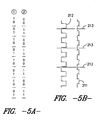
- Fig. 5a shows the chain pattern of the embodiment of the present invention shown in Figures 3 and 4.
- Fig. 5b shows the lapping movement for the embodiment of the present invention shown in Figs. 3 and 4.
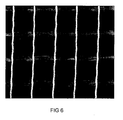
- An image of the weft inserted warp knit fabric (210) is shown in Fig. 6.
- the stitch used for the stitching yarn (211), as shown in Figs. 3, 4, 5a and 5b, is a chain stitch working always on the same needle.
- the chain stitch may be made with opened stitches (0.1/1.0 or 1.0/0.1) as represented in all figures.
- the chain stitch may also be made with closed stitches (0.1/0.1 or 1.0/1.0) or a combination or mixture of both open and closed stitches (as example only: 0.1/0.1/1.0/1.0).
- the pattern for the chain stitching yarn used for the in-lay cord warp (212) is a 0.0/1.1 movement around the same needle, alternatively changing at each stitch, one stitch on the right side of the needle and next stitch on the other left side of the same needle, or in opposite way, first stitch on the left side then second stitch on the right side of the same needle (1.1/0.0). If closed stitch and opened stitch are mixed, the in-lay movement of in-lay bar would be adapted following the result needed, it is possible to also mix the movement of inlay bar versus the stitching bar (as example: 0.0/1.1/1.1/1.1/0.0/0.0), without any limitation.
- the stitching yarn (211) stitches with high tension creating a secure connection between the in-lay warp (212) and weft-inserted yarns (213).
- loose tension is preferred because it permits a polymer coating to penetrate the warp yarn strands more uniformly and deeply. It has been found that using a high or tight tension on the stitching yarn (211) creates a fabric with a precise construction of the warp yarns (212) and weft yarns (213) in terms of geometry, spacing, and stability, while at the same time having an even coating on the yarns (211), (212), and (213).
- the ratio of the length of stitching yarn (211) to the length of in-lay warp yarn (212) is 3.1 or less, and more preferably the ratio is within the range of 2.63.0.
- the denier of the stitching yarn (211) may be approximately the same or different than the denier of the inlay warp yarn (212).
- the weft insertion warp knit machine gives the possibility to stabilize the inlay warp yarn (212) on a flat plane with the insertion of a weft yarn (213) in the chosen stitches of the stitching yarn (211).
- the weft yarn (213) may be inserted in each stitch or in a repetitive construction (repetitive construction including each stitch or any multiplicity of stitches), for example one weft in each four stitches.
- the terminology used to describe this weft insertion is one stitch with a weft inserted in (called "1 in”) with three consecutive stitches without a weft inserted in (called “3 out”).
- the weft inserted yarns(213) are inserted every 4 stitches of the stitching yarn (211).
- having less weft yarns inserted per cm (inch) is preferred over increasing the size of each individual stitch having a weft inserted in each stitch.
- the fabric has 6.3 stitches/cm (16 per inch) and 1.6 weft yarns/cm inserted (4 per inch), which means that each of the stitches has a small size.
- the fabric will have only 1.6 stitches/cm (4 per inch) and 1.6 weft yarns/cm inserted (4 per inch), which means that each stitch is much larger. Having one weft insertedevery 4 stitches enables the stability and geometry of the fabric.
- the fabric is desired to be open allowing the cementitious material to pass through the fabric. More closed fabrics, such as when a weft yarn (213) is inserted at each stitch of the stitching yarn (211), produce a fabric that will not allow for as much penetration as a more open fabric.
- the present fabric has a structure, which is sufficiently open to allow a good flow of the cementitious material through the fabric, thus allowing easy processing, and at the same time good stabilizing and reinforcing properties are achieved.
- the weft yarns are inserted at a rate of 0.8-16 stitches/cm (2-40 stitches/ inch).
- the fabric will contain 0.2-4 wefts/cm (0.5-10 wefts/inch).
- Another embodiment of the invention may have 0.1-4 wales/cm (0.25-10 wales/inch).
- the number of wales could be 2,36 wales/cm (6 per inch). The space needed between wefts will determine the construction per cm (inch).
- the weft inserted warp knit fabric (210) is formed, it is then coated with the alkali resistant coating (220) (See Fig. 2).
- alkali resistant coatings include, but are not limited to composite plate, rubber material, styrene butadiene rubber (SBR), and polyvinyl alcohol (PVA) coatings.
- the coating (220) must be resistant to bases such as NaOH, KOH, and Ca(OH) 2 .
- the coating may be applied by any known means such that all of the yarns of the fabric (210) are coated in the alkali resistant material.
- the weight of the coating (220) should be within the range of 1560 g/m 2 , more preferably 20-50 g/m 2 , even more preferably 25-40 g/m 2 to protect the fabric (210) against the alkaline of the cementitous material (100).
- a preferred specific example may be a coating weight of about 30 g/m 2 .
- the fabric (210) coated with the alkali resistant coating (220) should pass at least one of the Austria norm test B 61 22, the FR norm tests (Building Norm M1) and the test according to German DIN 4102. These tests are related to concrete products, which are used in the internal portion of buildings.
- the geometric shape, or stability of the fabric, needs to be held stable. Stability of the fabric (210) is to the thickness of the fabric and stiffness is related to the Tg (glasstransition temperature) of the alkali resistant coating.
- the alkali resistant chemical of the coating (220) is Penformax ® 18034 F, which is a formulated compound, based on a blend of a soft and stiff carboxylated SBR latex, in order to modify the Tgof the coating.
- the soft SBR has a styrene content of 50 wt.-%, a butadiene content of 50 wt.-%, and a Tg of -2°C.
- the stiff SBR has a styrene content of 75 wt.-%, a butadiene content of 25 wt.-%, and a Tg of +54°C.
- the styrene and butadiene content of the soft and stiff SBR may be varied to obtain the desired physical characteristics.
- the weight ratio of soft SBR to stiff SBR is 60:40.
- the soft and stiff SBR polymers may be present in a weight ratio of 90:10 to 10:90, more preferably 60:40 to 40:60, depending on the stiffness desired to achieve.
- the SBR mixture imparts excellent alkali resistance to the fabric (210) and good adhesion to the cementitious material (100).
- melamine resin may be added to the polymer of the coating (220) in order to modify the stiffness.
- PVA is used as the coating (220) because of its compatibility with concrete (tensile strength, temperature stability, elongation at break, and temperature stability) as well as its excellent alkali resistance.
- PVA is available as, for example, as Vibatex KN ® (Ciba Geigy).
- PVA may also be modified with a fluororesin, such as Flovan CGN ® , other fluororesin chemicals, or other chemicals.
- the fabric (210) or the yarns, (211), (212), (213) making up the fabric may also be subjected to chemicals that improve the adhesion of the reinforcing fabric (200) to the cementitious material (100) or to give other advantages such as nonwicking and/or fire proofing.
- a blue or other coloration may be added for identification of the fabric.
Landscapes
- Engineering & Computer Science (AREA)
- Architecture (AREA)
- Civil Engineering (AREA)
- Structural Engineering (AREA)
- Chemical & Material Sciences (AREA)
- Ceramic Engineering (AREA)
- Textile Engineering (AREA)
- Manufacturing & Machinery (AREA)
- Mechanical Engineering (AREA)
- Woven Fabrics (AREA)
Priority Applications (2)
| Application Number | Priority Date | Filing Date | Title |
|---|---|---|---|
| EP06002869A EP1818437A1 (fr) | 2006-02-13 | 2006-02-13 | Tricot-chaîne avec fils de trame pour renforcer des matériaux cimenteux |
| PCT/EP2007/001230 WO2007093377A1 (fr) | 2006-02-13 | 2007-02-13 | Tricot chaîne à insertion de trame pour le renforcement de matériaux cimentaires |
Applications Claiming Priority (1)
| Application Number | Priority Date | Filing Date | Title |
|---|---|---|---|
| EP06002869A EP1818437A1 (fr) | 2006-02-13 | 2006-02-13 | Tricot-chaîne avec fils de trame pour renforcer des matériaux cimenteux |
Publications (1)
| Publication Number | Publication Date |
|---|---|
| EP1818437A1 true EP1818437A1 (fr) | 2007-08-15 |
Family
ID=36032155
Family Applications (1)
| Application Number | Title | Priority Date | Filing Date |
|---|---|---|---|
| EP06002869A Withdrawn EP1818437A1 (fr) | 2006-02-13 | 2006-02-13 | Tricot-chaîne avec fils de trame pour renforcer des matériaux cimenteux |
Country Status (2)
| Country | Link |
|---|---|
| EP (1) | EP1818437A1 (fr) |
| WO (1) | WO2007093377A1 (fr) |
Cited By (11)
| Publication number | Priority date | Publication date | Assignee | Title |
|---|---|---|---|---|
| WO2010115513A1 (fr) * | 2009-04-06 | 2010-10-14 | University Of Ulster | Procédé de fabrication d'un article en béton composite |
| DE102011009510A1 (de) | 2011-01-26 | 2012-07-26 | Tesa Se | Klebeband, das insbesondere zur Transportsicherung eingesetzt werden kann |
| WO2012123682A1 (fr) * | 2011-03-16 | 2012-09-20 | Mdb Texinov Sa | Armature de renfort d'elements a matrice minerale |
| DE102011089331A1 (de) | 2011-09-16 | 2013-03-21 | Tesa Se | Klebebandsystem zur Bildung eines Aufreißstreifens |
| US8771526B2 (en) | 2009-03-04 | 2014-07-08 | University Of Ulster | Composite concrete article and method of manufacture thereof |
| DE102014102861A1 (de) * | 2014-03-04 | 2015-09-10 | Technische Universität Dresden | Bewehrungsgitter für den Betonbau, Hochleistungsfilamentgarn für den Betonbau und Verfahren zu deren Herstellung |
| CN107268175A (zh) * | 2016-04-08 | 2017-10-20 | 海宁市昊润纺织有限公司 | 一种广告布的生产工艺 |
| DE102016220682A1 (de) | 2016-10-21 | 2018-04-26 | Tesa Se | Physikalische Vorbehandlung zur Filamenteinbindung |
| WO2019110498A1 (fr) | 2017-12-04 | 2019-06-13 | Tesa Se | Utilisation d'un ruban adhésif pour la liaison articulée d'éléments en forme de plaques |
| DE102020103451B4 (de) | 2020-02-11 | 2024-12-05 | Hitexbau Gmbh | Verstärkungsgitter, Verfahren zu dessen Herstellung und armiertes Element aus Beton und/oder Mörtel |
| WO2024261159A1 (fr) * | 2023-06-23 | 2024-12-26 | Saint-Gobain Centre De Recherches Et D'etudes Europeen | Support tricoté destiné à la fabrication d'un cmc |
Families Citing this family (1)
| Publication number | Priority date | Publication date | Assignee | Title |
|---|---|---|---|---|
| KR20240045128A (ko) * | 2022-09-29 | 2024-04-05 | 이성만 | 리사이클 가능한 광고용 원단, 이를 포함하는 콘크리트 보강재 및 섬유 강화 콘크리트 |
Citations (6)
| Publication number | Priority date | Publication date | Assignee | Title |
|---|---|---|---|---|
| EP0106986A2 (fr) * | 1982-10-21 | 1984-05-02 | ispo GmbH | Mortier ou matériau de revêtement avec armature textile |
| EP0464803A1 (fr) * | 1990-07-05 | 1992-01-08 | Bay Mills Limited | Reinforcement pour des systèmes de murs |
| US5763043A (en) * | 1990-07-05 | 1998-06-09 | Bay Mills Limited | Open grid fabric for reinforcing wall systems, wall segment product and methods of making same |
| US6171984B1 (en) * | 1997-12-03 | 2001-01-09 | Ppg Industries Ohio, Inc. | Fiber glass based geosynthetic material |
| US20010002971A1 (en) * | 1998-09-29 | 2001-06-07 | Mark Kittson | Geotextile fabric |
| US20050233656A1 (en) * | 2004-02-25 | 2005-10-20 | Royer Joseph R | Fabric reinforced cement |
-
2006
- 2006-02-13 EP EP06002869A patent/EP1818437A1/fr not_active Withdrawn
-
2007
- 2007-02-13 WO PCT/EP2007/001230 patent/WO2007093377A1/fr not_active Ceased
Patent Citations (6)
| Publication number | Priority date | Publication date | Assignee | Title |
|---|---|---|---|---|
| EP0106986A2 (fr) * | 1982-10-21 | 1984-05-02 | ispo GmbH | Mortier ou matériau de revêtement avec armature textile |
| EP0464803A1 (fr) * | 1990-07-05 | 1992-01-08 | Bay Mills Limited | Reinforcement pour des systèmes de murs |
| US5763043A (en) * | 1990-07-05 | 1998-06-09 | Bay Mills Limited | Open grid fabric for reinforcing wall systems, wall segment product and methods of making same |
| US6171984B1 (en) * | 1997-12-03 | 2001-01-09 | Ppg Industries Ohio, Inc. | Fiber glass based geosynthetic material |
| US20010002971A1 (en) * | 1998-09-29 | 2001-06-07 | Mark Kittson | Geotextile fabric |
| US20050233656A1 (en) * | 2004-02-25 | 2005-10-20 | Royer Joseph R | Fabric reinforced cement |
Cited By (16)
| Publication number | Priority date | Publication date | Assignee | Title |
|---|---|---|---|---|
| US8771526B2 (en) | 2009-03-04 | 2014-07-08 | University Of Ulster | Composite concrete article and method of manufacture thereof |
| US8871657B2 (en) | 2009-04-06 | 2014-10-28 | University Of Ulster | Method of manufacture of a composite concrete article |
| WO2010115513A1 (fr) * | 2009-04-06 | 2010-10-14 | University Of Ulster | Procédé de fabrication d'un article en béton composite |
| DE102011009510A1 (de) | 2011-01-26 | 2012-07-26 | Tesa Se | Klebeband, das insbesondere zur Transportsicherung eingesetzt werden kann |
| WO2012101045A2 (fr) | 2011-01-26 | 2012-08-02 | Tesa Se | Bande adhésive pouvant notamment être employée comme sécurité de transport |
| FR2972732A1 (fr) * | 2011-03-16 | 2012-09-21 | Mdb Texinov Sa | Armature de renfort d'elements a matrice minerale |
| WO2012123682A1 (fr) * | 2011-03-16 | 2012-09-20 | Mdb Texinov Sa | Armature de renfort d'elements a matrice minerale |
| WO2013037648A2 (fr) | 2011-09-16 | 2013-03-21 | Tesa Se | Système de ruban adhésif pour la formation d'une bande d'ouverture |
| DE102011089331A1 (de) | 2011-09-16 | 2013-03-21 | Tesa Se | Klebebandsystem zur Bildung eines Aufreißstreifens |
| DE102014102861A1 (de) * | 2014-03-04 | 2015-09-10 | Technische Universität Dresden | Bewehrungsgitter für den Betonbau, Hochleistungsfilamentgarn für den Betonbau und Verfahren zu deren Herstellung |
| CN107268175A (zh) * | 2016-04-08 | 2017-10-20 | 海宁市昊润纺织有限公司 | 一种广告布的生产工艺 |
| CN107268175B (zh) * | 2016-04-08 | 2019-09-20 | 海宁市昊润纺织有限公司 | 一种广告布的生产工艺 |
| DE102016220682A1 (de) | 2016-10-21 | 2018-04-26 | Tesa Se | Physikalische Vorbehandlung zur Filamenteinbindung |
| WO2019110498A1 (fr) | 2017-12-04 | 2019-06-13 | Tesa Se | Utilisation d'un ruban adhésif pour la liaison articulée d'éléments en forme de plaques |
| DE102020103451B4 (de) | 2020-02-11 | 2024-12-05 | Hitexbau Gmbh | Verstärkungsgitter, Verfahren zu dessen Herstellung und armiertes Element aus Beton und/oder Mörtel |
| WO2024261159A1 (fr) * | 2023-06-23 | 2024-12-26 | Saint-Gobain Centre De Recherches Et D'etudes Europeen | Support tricoté destiné à la fabrication d'un cmc |
Also Published As
| Publication number | Publication date |
|---|---|
| WO2007093377A1 (fr) | 2007-08-23 |
Similar Documents
| Publication | Publication Date | Title |
|---|---|---|
| WO2007093377A1 (fr) | Tricot chaîne à insertion de trame pour le renforcement de matériaux cimentaires | |
| US7625827B2 (en) | Exterior finishing system and building wall containing a corrosion-resistant enhanced thickness fabric and method of constructing same | |
| US7615178B2 (en) | Fabric reinforcement and cementitious boards faced with same | |
| AU2003298848B2 (en) | Textile reinforced wallboard | |
| AU2009333357B2 (en) | Polyolefin coated fabric reinforcement and cementitious boards reinforced with same | |
| EP1595012A2 (fr) | Materiau de surface a porosite controlee pour panneaux de construction | |
| EP3184682B1 (fr) | Grilles tridirectionnelles pour renforcement | |
| US20040219845A1 (en) | Fabric reinforced cement | |
| CA3086492C (fr) | Couche de renforcement, plaque en materiau cimentaire et procede de formation de la plaque en materiau cimentaire | |
| US20130295360A1 (en) | Reinforcing fabric, a cementitious board, and method of forming the cementitious board | |
| WO2023137259A1 (fr) | Renfort en tissu destiné à améliorer la résistance à la flexion d'une plaque en ciment et ses procédés de fabrication | |
| JP2002069785A (ja) | 合撚材料 | |
| AU2007202174B2 (en) | Facing material with controlled porosity for construction boards | |
| EP3519370B1 (fr) | Renfort en verre | |
| Marques | Design of fibrous structures for civil engineering applications | |
| JP2001073252A (ja) | 衝撃性に優れた土木建築用メッシュシート | |
| WO2006137655A1 (fr) | Procede perfectionne de fabrication de beton renforce de fibres renforce par une etoffe tissee enduite de resine thermodurcie |
Legal Events
| Date | Code | Title | Description |
|---|---|---|---|
| PUAI | Public reference made under article 153(3) epc to a published international application that has entered the european phase |
Free format text: ORIGINAL CODE: 0009012 |
|
| AK | Designated contracting states |
Kind code of ref document: A1 Designated state(s): AT BE BG CH CY CZ DE DK EE ES FI FR GB GR HU IE IS IT LI LT LU LV MC NL PL PT RO SE SI SK TR |
|
| AX | Request for extension of the european patent |
Extension state: AL BA HR MK YU |
|
| 17P | Request for examination filed |
Effective date: 20071217 |
|
| AKX | Designation fees paid |
Designated state(s): AT BE BG CH CY CZ DE DK EE ES FI FR GB GR HU IE IS IT LI LT LU LV MC NL PL PT RO SE SI SK TR |
|
| GRAP | Despatch of communication of intention to grant a patent |
Free format text: ORIGINAL CODE: EPIDOSNIGR1 |
|
| STAA | Information on the status of an ep patent application or granted ep patent |
Free format text: STATUS: THE APPLICATION IS DEEMED TO BE WITHDRAWN |
|
| 18D | Application deemed to be withdrawn |
Effective date: 20090603 |