EP1818565A2 - Schwingungsdämpfer mit amplitudenselektiver Dämpfkraft - Google Patents
Schwingungsdämpfer mit amplitudenselektiver Dämpfkraft Download PDFInfo
- Publication number
- EP1818565A2 EP1818565A2 EP07001804A EP07001804A EP1818565A2 EP 1818565 A2 EP1818565 A2 EP 1818565A2 EP 07001804 A EP07001804 A EP 07001804A EP 07001804 A EP07001804 A EP 07001804A EP 1818565 A2 EP1818565 A2 EP 1818565A2
- Authority
- EP
- European Patent Office
- Prior art keywords
- piston rod
- vibration damper
- damper according
- piston
- spacer sleeve
- Prior art date
- Legal status (The legal status is an assumption and is not a legal conclusion. Google has not performed a legal analysis and makes no representation as to the accuracy of the status listed.)
- Granted
Links
Images




Classifications
-
- F—MECHANICAL ENGINEERING; LIGHTING; HEATING; WEAPONS; BLASTING
- F16—ENGINEERING ELEMENTS AND UNITS; GENERAL MEASURES FOR PRODUCING AND MAINTAINING EFFECTIVE FUNCTIONING OF MACHINES OR INSTALLATIONS; THERMAL INSULATION IN GENERAL
- F16F—SPRINGS; SHOCK-ABSORBERS; MEANS FOR DAMPING VIBRATION
- F16F9/00—Springs, vibration-dampers, shock-absorbers, or similarly-constructed movement-dampers using a fluid or the equivalent as damping medium
- F16F9/32—Details
- F16F9/50—Special means providing automatic damping adjustment, i.e. self-adjustment of damping by particular sliding movements of a valve element, other than flexions or displacement of valve discs; Special means providing self-adjustment of spring characteristics
- F16F9/512—Means responsive to load action, i.e. static load on the damper or dynamic fluid pressure changes in the damper, e.g. due to changes in velocity
- F16F9/5126—Piston, or piston-like valve elements
Definitions
- the invention relates to a vibration damper with amplitude-selective damping force according to the preamble of patent claim 1.
- the older one DE 10 2005 045 267 describes a vibration damper with amplitude-selective damping force, which is controlled by a mounted on the piston rod assembly.
- the assembly consists of several in one another and successively arranged sleeves, which determine a total of three flow paths.
- a first flow path between a piston rod pin and an inner sleeve-shaped base carrier serves as inflow and outflow to a piston rod-side damping valve.
- a spacer sleeve Radially outside the sleeve-shaped base support a spacer sleeve is arranged, which has axially extending bypass channels for a flow connection between the lateral surface of the spacer sleeve and an inner wall of a cylinder.
- Object of the present invention is to simplify the components of the attached to the piston rod assembly for generating the amplitude-selective damping force.
- a bypass channel is present, which is formed by a spacer sleeve, which additionally limits an inflow and outflow to the piston rod assembly.
- the big advantage is that the piston assembly consists of axially stacked individual components, which engage only for radial centering and support on a short section. It is also very easy to use sintered components, since it is possible to produce undercut-free contours on the components.
- the spacer sleeve connects at least at one end to a head part, which has the stop surface.
- the part of the bypass channel in the spacer sleeve is formed by a simple through hole.
- rotational orientation surfaces are provided between the spacer sleeve and the head part.
- Each bypass channel in the spacer sleeve is assigned a bypass channel in the head part.
- the spacer sleeve and the head part are fixed by a clamping sleeve within the piston assembly.
- the piston rod completely penetrates the piston assembly, so that the components of the piston assembly are only subjected to pressure.
- the head part forms with the clamping sleeve an annular space for a check valve controlling the bypass valve, so that the principle of the layered design is continued.
- the spacer sleeve has on the lateral surface at least one axially extending web, wherein in the at least one web extends a bypass channel.
- a plurality of webs are used, so that the spacer sleeve in the outer shape has a gear-like contour.
- a head part is arranged, which are designed as equal parts.
- the collet and a distributor ring associated with the piston which has a connection to the at least one bypass channel, are designed as identical parts.
- Figures 1 and 2 show a piston assembly 1 within a damping medium-filled cylinder 3 as part of a vibration damper. It is irrelevant whether the vibration damper is constructed according to the monotube or twin-tube principle.
- the piston assembly is attached to a piston rod 5 and divides the cylinder 3 in a piston rod side and a piston rod remote working space 7; 9th
- a piston 11 within the piston assembly 1 has passageways 13; 15 (Fig. 2), which are equipped with valve discs, so that for both flow directions damping valves 17; 19 are available.
- the piston arrangement comprises in series a distributor ring 21, (FIGS. 8-10), a first head part 23 (FIGS. 6 and 7), a spacer sleeve 25 (FIGS. 4 and 5), a second head part 27 and a clamping sleeve 29, shown in Figs. 11-13. All these components 21 - 29 form an assembly 31 for generating an amplitude-selective damping force and are penetrated by the piston rod 5. At least the two head parts 23; 27 are designed as identical parts.
- a piston nut 33 fixes the assembly 31 axially.
- the piston rod 5 and the lateral surface 34 of the assembly 31 form an annular space 35 (Figure 2) for damping medium exchange via the damping valves 17; 19 between the two workrooms 7; 9, wherein in the clamping sleeve 29 through-flow window 37 are designed for the damping medium.
- an intermediate ring 41 is braced, which limits a Wegringnut 43 (Fig. 2) for an axially movable valve ring 45 in height.
- On both sides of the intermediate ring 41 are still Vorö Stammsiden 47; 49, each with different edges Recesses arranged.
- a similar embodiment of an axially movable valve ring 51 in a Wegringnut 53 (FIG. 2), which are formed by an intermediate ring 55 and Vorö réellesiden 57,59, between the second head portion 27 and the clamping sleeve 29 is executed.
- the switching ring grooves 43; 53 have a port 61; 63 to channels 65; 67, the sections of the two head parts 23; 27 and the spacer sleeve 25 are formed.
- Both head parts 23; 27 have abutment surfaces 69; 71 at its annular ridge 73; 75, wherein an axially movable switching ring 77 sliding on the head parts 23; 27 and the spacer sleeve 25 is mounted.
- the switching ring 77 limited to the stop surfaces 69; 71 each have an annular space 79; 81, which varies in size depending on the switching position of the switching ring.
- Both annular spaces 79; 81 are axially extending connecting grooves 83 in the outer lateral surfaces of the head parts 23; 27 and the spacer sleeve 25 in connection and allow a back flow of the switching ring (Fig. 2).
- Each head part 23; 27 has at least one transverse opening 85; 87, which alternately on blind hole-shaped channels 89; 91 are connected.
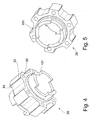
- the spacer sleeve 25 has on its lateral surface via axially extending webs 93 for the channels 65, wherein between the webs 93, the connecting grooves 83 can be seen. This results in the spacer sleeve a gear-like contour.
- each Movement direction are in the head parts 23; 27 alternately through holes 95; 97 and blind-hole-shaped channels 89; 91 formed in the transverse openings 85; 87 open and emanate from one of the spacer sleeve 25 facing end face.
- the cross sections of the transverse openings 85; 87 decrease in the direction of the adjacent stop surface.
- the channels 65; 67 form a bypass channel to the connecting grooves 83 between the annular spaces 79; 81. So that each of the predetermined transverse opening 85; 87 is connected to the associated channel, exist between the spacer sleeve 25 and the two head parts 23; 27 rotational orientation surfaces 99; 101, so that a faulty mounting is excluded.
- the distributor ring 21 and the first head part 23 form an annular space 103 in which a check valve 105 is arranged, which allows an inflow of damping medium into the first head part 23.
- the second head portion 27 and the clamping sleeve 29 form a similar annular space 107 in which also a check valve 109 is arranged, which allows an influx into the channels 67.
- Figures 6 and 7 show the first and second head part 23; 27, which are designed as identical parts, in a perspective view.
- Fig. 6 is particularly well, the uniform distribution of the through holes 95; 97 of the axially extending Connecting grooves 83 and the blind-hole-shaped channels 89; 91 with transverse opening 85; 87 to recognize.
- FIG. 7 shows, by way of example, a section from the pre-opening disk 49; 57 (FIG. 1) with a pre-opening cross-section 115 as part of the switching ring groove.
- the Vorö Stammside 49:57 is located on an end face which faces either in the direction of the clamping sleeve 29 or the distribution ring 21. Starting from this end face is followed by a stepped passage opening, with a wave-shaped support profile 117.
- the inner diameter forms centering surfaces 119 for a disc-shaped spring of one of the check valves 105; 109 (Fig. 1).
- An upper side 121 of the support profile serves as Abhubbegrenzungs Solution for the valve disc of the respective check valve 105; 109, the outer diameter shown in dashed lines is smaller than the maximum radial extent of the wave profile, so that at a maximum opening position of the check valve there is a plurality of passage openings with a circular section-shaped cross section.
- a second paragraph can be seen, which forms a centering surface 131 for the valve disc of the check valve 105. Furthermore, this centering surface 131 is used for the first head part 23.
- the distributor ring 21 has an annular groove 133 for a seal 135 (FIG. 1) and a centering surface 137 for the piston 11.
- Fig. 10 shows the top of the distributor ring 21 with a clamping surface 139 for the valve discs of the damping valve 17 on the piston, and through holes 141 to the piston valves 17; 19th
- clamping sleeve 29 is very similar in terms of functionality to the distributor ring 21.
- a clamping surface 143 on the top serves for the piston nut.
Landscapes
- Engineering & Computer Science (AREA)
- General Engineering & Computer Science (AREA)
- Physics & Mathematics (AREA)
- Fluid Mechanics (AREA)
- Mechanical Engineering (AREA)
- Fluid-Damping Devices (AREA)
Abstract
Description
- Die Erfindung betrifft einen Schwingungsdämpfer mit amplitudenselektiver Dämpfkraft gemäß dem Oberbegriff von Patentanspruch 1.
- Die ältere
DE 10 2005 045 267 beschreibt einen Schwingungsdämpfer mit amplitudenselektiver Dämpfkraft, die von einer an der Kolbenstange befestigten Baugruppe gesteuert wird. Die Baugruppe besteht aus mehreren ineinander und hintereinander angeordneten Hülsen, die insgesamt drei Strömungswege bestimmen. Ein erster Strömungsweg zwischen einem Kolbenstangenzapfen und einem inneren hülsenförmigen Grundträger dient als Zu- und Abfluss zu einem kolbenstangenseitigen Dämpfventil. Radial außerhalb des hülsenförmigen Grundträgers ist eine Distanzhülse angeordnet, die axial verlaufende Bypasskanäle für eine Strömungsverbindung zwischen der Mantelfläche der Distanzhülse und einer Innenwandung eines Zylinders aufweist. - Der Zu- und der Abfluss in die Bypasskanäle erfolgt über einen Verteilerring, der zwischen der Distanzhülse und einem kolbenstangenseitigen Kolben axial verspannt ist.
- Aufgabe der vorliegenden Erfindung ist es, die Bauteile der an der Kolbenstange befestigten Baugruppe zur Erzeugung der amplitudenselektiven Dämpfkraft zu vereinfachen.
- Erfindungsgemäß wird die Aufgabe dadurch gelöst, dass hydraulisch parallel zur Strömungsverbindung ein Bypasskanal vorliegt, der von einer Distanzhülse gebildet wird, die zusätzlich einen Zu- und Abfluss zur Kolbenstangenanordnung begrenzt.
- Der große Vorteil besteht darin, dass die Kolbenanordnung aus axial geschichteten Einzelbauteilen besteht, die nur zur radialen Zentrierung und Abstützung auf einem kurzen Abschnitt ineinander greifen. Es können sehr einfach auch gesinterte Bauteile verwendet werden, da man an den Bauteilen hinterschneidungsfreie Konturen erzeugen kann.
- In weiterer vorteilhafter Ausgestaltung schließt sich der Distanzhülse zumindest an einem Ende ein Kopfteil an, das die Anschlagfläche aufweist.
- Gemäß einem vorteilhaften Unteranspruch verläuft in dem mindestens einen Kopfteil ein Teilabschnitt des Bypasskanals. Der Teil des Bypasskanals in der Distanzhülse wird von einer einfachen Durchgangsöffnung gebildet. Eine Queröffnung vom Bypasskanal in die Strömungsverbindung, die von dem Schaltring gesteuert wird, setzt an einer Deckfläche des Kopfteils an, so dass auch das Kopfteil sehr einfach sintertechnisch oder in einem Schrriiedeverfahren herstellbar ist.
- Zwecks einfacher und fehlerfreier Montage sind zwischen der Distanzhülse und dem Kopfteil Drehorientierungsflächen ausgeführt. Jedem Bypasskanal in der Distanzhülse ist ein Bypasskanal in dem Kopfteil zugeordnet.
- Die Distanzhülse und das Kopfteil werden von einer Spannhülse innerhalb der Kolbenanordnung fixiert. Dabei durchdringt die Kolbenstange die Kolbenanordnung vollständig, so dass die Bauteile der Kolbenanordnung nur auf Druck beansprucht werden.
- In der Spannhülse sind Durchströmungsfenster ausgeführt, die den Dämpfmediumstrom zu oder von den Kolbenventilen freigeben.
- Das Kopfteil bildet mit der Spannhülse einen Ringraum für ein den Bypasskanal steuerndes Rückschlagventil, so dass das Prinzip der geschichteten Bauweise fortgesetzt wird.
- Die Distanzhülse weist auf der Mantelfläche mindestens einen axial verlaufenden Steg auf, wobei in dem mindestens einen Steg ein Bypasskanal verläuft. Bevorzugt kommen mehrere Stege zur Anwendung, so dass die Distanzhülse in der äußeren Gestalt eine zahnradähnliche Kontur aufweist.
- Es ist vorgesehen, dass an beiden Enden der Distanzhülse ein Kopfteil angeordnet ist, die als Gleichteile ausgeführt sind.
- Mit demselben Ziel der Beschränkung der Teilevielfalt innerhalb der Kolbenanordnung sind die Spannhülse und ein dem Kolben zugeordneter Verteilerring, der einen Anschluss an den mindestens einen Bypasskanal aufweist, als Gleichteile ausgeführt.
- Anhand der folgenden Figurenbeschreibung soll die Erfindung näher erläutert werden.
- Es zeigt:
- Fig. 1
- Längsschnitt durch die Kolbenanordnung
- Fig. 2
- weiterer Längsschnitt zur Fig. 1
- Fig. 3
- Explosionszeichnung zur Fig. 1
- Fig. 4 u. 5
- Distanzhülse als Einzelteil
- Fig. 6 u. 7
- Kopfteil
- Fig. 8 - 10
- Verteilerring
- Fig. 11 - 13
- Spannhülse
- Fig. 14
- Kolbenanordnung nach dem Funktionsprinzip der Fig. 1 in einem kolbenstangenseitigen Arbeitsraum
- Die Figuren 1 und 2 zeigen eine Kolbenanordnung 1 innerhalb eines dämpfmediumgefüllten Zylinders 3 als Teil eines Schwingungsdämpfers. Dabei ist es unerheblich, ob der Schwingungsdämpfer nach dem Einrohr- oder Zweirohrprinzip aufgebaut ist. Die Kolbenanordnung ist an einer Kolbenstange 5 befestigt und unterteilt den Zylinder 3 in einen kolbenstangenseitigen und einen kolbenstangenfernen Arbeitsraum 7; 9.
- Ein Kolben 11 innerhalb der Kolbenanordnung 1 besitzt Durchtrittskanäle 13; 15 (Fig. 2), die mit Ventilscheiben bestückt sind, so dass für beide Durchströmungsrichtungen Dämpfventile 17; 19 zur Verfügung stehen.
- Neben dem Kolben 11 umfasst die Kolbenanordnung in Reihe einen Verteilerring 21, (Figuren 8 -10), ein erstes Kopfteil 23 (Fig. 6 und 7), eine Distanzhülse 25 (Fig. 4 und 5), ein zweites Kopfteil 27 und eine Spannhülse 29, dargestellt in den Fig. 11 -13. Alle genannten Bauteile 21 - 29 bilden eine Baugruppe 31 zur Erzeugung einer amplitudenselektiven Dämpfkraft und werden von der Kolbenstange 5 durchdrungen. Zumindest die beiden Kopfteile 23; 27 sind als Gleichteile ausgeführt. Eine Kolbenmutter 33 fixiert die Baugruppe 31 axial. Die Kolbenstange 5 und die Mantelfläche 34 der Baugruppe 31 bilden einen Ringraum 35 (Fig. 2) zum Dämpfmediumaustausch über die Dämpfventile 17; 19 zwischen den beiden Arbeitsräumen 7; 9, wobei in der Spannhülse 29 Durchströmungsfenster 37 für das Dämpfmedium ausgeführt sind.
- Hydraulisch parallel zu den Dämpfventilen 17; 19 besteht eine Strömungsverbindung 39, die beispielsweise durch axiale Kanäle in der Mantelfläche des Kolbens 11 ausgeführt sein können. Zwischen dem Verteilerring 21 und dem ersten Kopfteil 23 ist ein Zwischenring 41 verspannt, der eine Schaltringnut 43 (Fig. 2) für einen axial beweglichen Ventilring 45 in der Höhe begrenzt. Beidseitig am Zwischenring 41 sind noch Voröffnungsscheiben 47; 49 mit jeweils unterschiedlichen randseitigen Aussparungen angeordnet. Eine gleichartige Ausführung eines axial beweglichen Ventilrings 51 in einer Schaltringnut 53 (Fig. 2), die von einem Zwischenring 55 und Voröffnungsscheiben 57,59 gebildet werden, ist zwischen dem zweiten Kopfteil 27 und der Spannhülse 29 ausgeführt. Die Schaltringnuten 43; 53 verfügen über einen Anschluss 61; 63 zu Kanälen 65; 67, die abschnittsweise von den beiden Kopfteilen 23; 27 und der Distanzhülse 25 gebildet werden.
- Beide Kopfteile 23; 27 verfügen über Anschlagflächen 69; 71 an ihrem Ringsteg 73; 75, wobei ein axial beweglicher Schaltring 77 gleitend auf den Kopfteilen 23; 27 und der Distanzhülse 25 gelagert ist. Der Schaltring 77 begrenzt mit den Anschlagflächen 69; 71 jeweils einen Ringraum 79; 81, der in seiner Größe in Abhängigkeit der Schaltstellung des Schaltrings variiert. Beide Ringräume 79; 81 stehen über axial verlaufende Verbindungsnuten 83 in den äußeren Mantelflächen der Kopfteile 23; 27 und der Distanzhülse 25 in Verbindung und ermöglichen eine Hinterströmung des Schaltrings (Fig. 2).
- Jedes Kopfteil 23; 27 verfügt über mindestens eine Queröffnung 85; 87, die wechselweise an sacklochförmigen Kanälen 89; 91 angeschlossen sind. In diesem Ausführungsbeispiel kommen, wie aus den Darstellungen der Distanzhülse 25 und der Kopfteile 23; 27 nach den Fig. 4 und 5 bzw. 6 und 7 drei sacklochförmige Kanäle 89; 91 für die Kolbenstangeneinfahrbewegung in Richtung des Arbeitsraums 9 und drei Kanäle 91 für die Kolbenstangenausfahrbewegung zur Anwendung. Die Distanzhülse 25 verfügt auf ihrer Mantelfläche über axial verlaufende Stege 93 für die Kanäle 65, wobei zwischen den Stegen 93 die Verbindungsnuten 83 erkennbar sind. Dadurch ergibt sich für die Distanzhülse eine zahnradähnliche Kontur. Für jeweils eine Bewegungsrichtung sind in den Kopfteilen 23; 27 abwechselnd Durchgangsöffnungen 95; 97 und sacklochförmige Kanäle 89; 91 eingeformt, die in den Queröffnungen 85; 87 münden und von einer der Distanzhülse 25 zugewandten Stirnfläche ausgehen. Die Querschnitte der Queröffnungen 85; 87 verringern sich in Richtung der benachbarten Anschlagfläche. Die Kanäle 65; 67 bilden einen Bypasskanal zu den Verbindungsnuten 83 zwischen den Ringräumen 79; 81. Damit jeweils die vorbestimmte Queröffnung 85; 87 mit dem zugeordneten Kanal verbunden ist, bestehen zwischen der Distanzhülse 25 und den beiden Kopfteilen 23; 27 Drehorientierungsflächen 99; 101, so dass eine fehlerhafte Montage ausgeschlossen ist.
- Der Verteilerring 21 und das erste Kopfteil 23 bilden einen Ringraum 103, in dem ein Rückschlagventil 105 angeordnet ist, das einen Zustrom von Dämpfmedium in das erste Kopfteil 23 zulässt. Auch das zweite Kopfteil 27 und die Spannhülse 29 bilden einen gleichartigen Ringraum 107 in dem ebenfalls ein Rückschlagventil 109 angeordnet ist, das einen Zustrom in die Kanäle 67 ermöglicht.
- In der Fig. 3 sind die beiden Kopfteile 23; 27 und die Distanzhülse 25 in einer Explosionszeichnung mit Ringdichtungen 111; 113 dargestellt. In dieser Perspektive kann man die ineinander greifenden Drehorientierungsflächen 99; 101 zur winkelgenauen Lagefixierung erkennen.
- Die Figuren 6 und 7 zeigen das erste und zweite Kopfteil 23; 27, die als Gleichteile ausgeführt sind, in einer perspektivischen Darstellung. In der Fig. 6 ist besonders gut die gleichmäßige Verteilung der Durchgangsöffnungen 95; 97 der axial verlaufenden Verbindungsnuten 83 und der sacklochförmigen Kanäle 89; 91 mit Queröffnung 85; 87 zu erkennen.
- Zum besseren Verständnis ist in der Fig. 7 beispielhaft ein Ausschnitt aus der Voröffnungsscheibe 49; 57 (Fig. 1) mit einem Voröffnungsquerschnitt 115 als Teil der Schaltringnut dargestellt. Die Voröffnungsscheibe 49:57 liegt auf einer Stirnfläche auf, die entweder in Richtung der Spannhülse 29 oder des Verteilerrings 21 weist. Ausgehend von dieser Stirnfläche folgt eine gestufte Durchgangsöffnung, mit einem wellenförmigen Auflageprofil 117. Der innere Durchmesser bildet Zentrierflächen 119 für eine scheibenförmige Feder eines der Rückschlagventile 105; 109 (Fig. 1). Eine Oberseite 121 des Auflageprofils dient als Abhubbegrenzungsfläche für die Ventilscheibe des jeweiligen Rückschlagventils 105; 109, dessen gestrichelt dargestellter Außendurchmesser kleiner ist als die maximale radiale Ausdehnung des Wellenprofils, so dass bei einer maximalen Öffnungsstellung des Rückschlagventils eine Mehrzahl von Durchtrittsöffnungen mit einem kreisabschnittsförmigen Querschnitt vorliegt.
- In der Figurenfolge 8 - 10 ist der Verteilerring als Einzelheit dargestellt. Zusammen mit der Fig. 8 wird ein Ausschnitt der Voröffnungsscheibe 47; 59 mit einem Voröffnungsquerschnitt 123 gezeigt, die auf einer Auflagefläche 125 verspannt ist. Auf einem der Auflagefläche folgenden axialen Absatz sind auf dem Umfang mehrere Nuten 127 eingearbeitet, die einen Teil der Anschlüsse 61 (Fig. 1) zum Rückschlagventil 105 bilden. Der Absatz dient als Zentrierfläche 129.
- In Fig. 9 ist ein zweiter Absatz erkennbar, der eine Zentrierfläche 131 für die Ventilscheibe des Rückschlagventils 105 bildet. Des Weiteren wird diese Zentrierfläche 131 für das erste Kopfteil 23 verwendet. Am anderen Ende verfügt der Verteilerring 21 über eine Ringnut 133 für eine Dichtung 135 (Fig. 1) und eine Zentrierfläche 137 zum Kolben 11.
- Fig. 10 zeigt die Oberseite des Verteilerrings 21 mit einer Spannfläche 139 für die Ventilscheiben des Dämpfventils 17 am Kolben, sowie Durchgangsöffnungen 141 zu den Kolbenventilen 17; 19.
- Aus der Figurenfolge 11 - 13 ist ersichtlich, dass die Spannhülse 29 hinsichtlich der Funktionalität sehr stark dem Verteilerring 21 gleicht. Eine Spannfläche 143 auf der Oberseite dient für die Kolbenmutter.
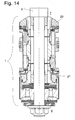
- Mit der Fig. 14 soll dokumentiert werden, dass sich die gesamte Kolbenanordnung 1 auch im kolbenstangenseitigen Arbeitsraum 7 erstrecken kann. Bei dieser Variante ist es besonders einfach zu erreichen, dass die Spannhülse 29 und der Verteilerring 21 als Gleichteile ausgeführt sind. Prinzipiell lässt sich diese Möglichkeit auch in der Variante nach Fig. 1 realisieren. Man muss nur dafür sorgen, dass die Innendurchmesser von Verteilerring und Spannhülse über ein Befestigungsgewinde an der Kolbenstange geschoben werden können.
- Hinsichtlich der Funktionsweise der Kolbenanordnung wird auf die
DE 10 2005 045 267 verwiesen, der Offenbarungsgehalt Teil dieser Beschreibung sein soll.
Claims (11)
- Schwingungsdämpfer mit amplitudenselektiver Dämpfkraft, umfassend eine Kolbenstange (5), die in einem dämpfmittelgefüllten Zylinder (3) axial beweglich geführt ist, wobei die Kolbenstange (5) eine Kolbenanordnung (1) trägt, die den Zylinder (3) in einen kolbenstangenseitigen und einen kolbenstangenfernen Arbeitsraum (7; 9) unterteilt, wobei zwischen den Arbeitsräumen (7; 9) eine Strömungsverbindung (39; 83) vorliegt, die in Abhängigkeit von der Kolbenstangenbewegung von einem axial beweglichen Schaltring (77) gesteuert wird, wobei der Schaltweg des Schaltrings (77) von zwei Anschlagflächen (69; 71) begrenzt wird,
dadurch gekennzeichnet,
dass hydraulisch parallel zur Strömungsverbindung (39; 83) ein Bypasskanal (65; 67) vorliegt, der von einer Distanzhülse (25) gebildet wird, die zusätzlich einen Zu- und Abfluss (35) zur Kolbenstangenanordnung begrenzt. - Schwingungsdämpfer nach Anspruch 1,
dadurch gekennzeichnet,
dass sich der Distanzhülse (25) zumindest an einem Ende ein Kopfteil (23; 27) anschließt, das die Anschlagfläche (69; 71) aufweist. - Schwingungsdämpfer nach Anspruch 1,
dadurch gekennzeichnet,
dass in dem mindestens einen Kopfteil (23; 27) ein Teilabschnitt (95; 97; 91; 89) des Bypasskanals (65; 67) verläuft. - Schwingungsdämpfer nach Anspruch 2,
dadurch gekennzeichnet,
dass zwischen der Distanzhülse (25) und dem Kopfteil (23; 27) Drehorientierungsflächen (99; 101) ausgeführt sind. - Schwingungsdämpfer nach Anspruch 2,
dadurch gekennzeichnet,
dass die Distanzhülse (25) und das Kopfteil (23; 27) von einer Spannhülse (29) innerhalb der Kolbenanordnung (1) fixiert werden. - Schwingungsdämpfer nach Anspruch 1,
dadurch gekennzeichnet,
dass die Kolbenstange (5) die Kolbenanordnung (1) vollständig durchdringt. - Schwingungsdämpfer nach Anspruch 5,
dadurch gekennzeichnet,
dass in der Spannhülse (29) Durchströmungsfenster (37) ausgeführt sind. - Schwingungsdämpfer nach Anspruch 5,
dadurch gekennzeichnet,
dass das Kopfteil (27) mit der Spannhülse (29) einen Ringraum (107) für ein den Bypasskanal (65; 67) steuerndes Rückschlagventil (109) bildet. - Schwingungsdämpfer nach Anspruch 1,
dadurch gekennzeichnet,
dass die Distanzhülse (25) auf der Mantelfläche mindestens einen axial verlaufenden Steg (9) aufweist, wobei in den mindestens einen Steg (93) ein Bypasskanal (65; 67) verläuft. - Schwingungsdämpfer nach Anspruch 2,
dadurch gekennzeichnet,
dass an beiden Enden der Distanzhülse (25) ein Kopfteil (23; 27) angeordnet ist, die als Gleichteile ausgeführt sind. - Schwingungsdämpfer nach Anspruch 6,
dadurch gekennzeichnet,
dass die Spannhülse (29) und ein dem Kolben (11) zugeordneter Verteilerring (21), der einen Anschluss (61) an den mindestens einen Bypasskanal (65) aufweist, als Gleichteile ausgeführt sind.
Applications Claiming Priority (1)
| Application Number | Priority Date | Filing Date | Title |
|---|---|---|---|
| DE102006005935A DE102006005935A1 (de) | 2006-02-09 | 2006-02-09 | Schwingungsdämpfer mit amplitudenselektiver Dämpfkraft |
Publications (3)
| Publication Number | Publication Date |
|---|---|
| EP1818565A2 true EP1818565A2 (de) | 2007-08-15 |
| EP1818565A3 EP1818565A3 (de) | 2009-08-19 |
| EP1818565B1 EP1818565B1 (de) | 2011-07-27 |
Family
ID=38042877
Family Applications (1)
| Application Number | Title | Priority Date | Filing Date |
|---|---|---|---|
| EP07001804A Not-in-force EP1818565B1 (de) | 2006-02-09 | 2007-01-27 | Schwingungsdämpfer mit amplitudenselektiver Dämpfkraft |
Country Status (3)
| Country | Link |
|---|---|
| EP (1) | EP1818565B1 (de) |
| AT (1) | ATE518075T1 (de) |
| DE (1) | DE102006005935A1 (de) |
Cited By (3)
| Publication number | Priority date | Publication date | Assignee | Title |
|---|---|---|---|---|
| EP1985888A1 (de) * | 2007-04-27 | 2008-10-29 | ZF Friedrichshafen AG | Schwingungsdämpfer mit amplitudenselektiver Dämpfkraft |
| EP2175160A3 (de) * | 2008-10-07 | 2014-06-25 | ZF Friedrichshafen AG | Schwingungsdämpfer mit amplitudenselektiver Dämpfkraft |
| US9038790B2 (en) | 2011-11-08 | 2015-05-26 | Progressive Suspension, Llc | Frequency sensitive shock absorber |
Families Citing this family (1)
| Publication number | Priority date | Publication date | Assignee | Title |
|---|---|---|---|---|
| DE102007053160A1 (de) | 2007-11-08 | 2009-05-20 | Zf Friedrichshafen Ag | Schwingungsdämpfer mit amplitudenselektiver Dämpfkraft |
Family Cites Families (4)
| Publication number | Priority date | Publication date | Assignee | Title |
|---|---|---|---|---|
| DE4427273B4 (de) * | 1993-08-19 | 2004-08-26 | Volkswagen Ag | Hydraulischer Teleskop-Schwingungsdämpfer |
| US6352145B1 (en) * | 1998-10-07 | 2002-03-05 | Tenneco Automotive Inc. | Stroke dependent damping |
| DE102005020293A1 (de) * | 2005-04-30 | 2006-11-09 | Zf Friedrichshafen Ag | Schwingungsdämpfer mit amplitudenselektiver Dämpfkraft |
| DE102005045267B3 (de) * | 2005-09-22 | 2006-12-21 | Zf Friedrichshafen Ag | Schwingungsdämpfer mit amplitudenselektiver Dämpfkraft |
-
2006
- 2006-02-09 DE DE102006005935A patent/DE102006005935A1/de not_active Ceased
-
2007
- 2007-01-27 EP EP07001804A patent/EP1818565B1/de not_active Not-in-force
- 2007-01-27 AT AT07001804T patent/ATE518075T1/de active
Cited By (4)
| Publication number | Priority date | Publication date | Assignee | Title |
|---|---|---|---|---|
| EP1985888A1 (de) * | 2007-04-27 | 2008-10-29 | ZF Friedrichshafen AG | Schwingungsdämpfer mit amplitudenselektiver Dämpfkraft |
| EP2175160A3 (de) * | 2008-10-07 | 2014-06-25 | ZF Friedrichshafen AG | Schwingungsdämpfer mit amplitudenselektiver Dämpfkraft |
| US9038790B2 (en) | 2011-11-08 | 2015-05-26 | Progressive Suspension, Llc | Frequency sensitive shock absorber |
| US9657805B2 (en) | 2011-11-08 | 2017-05-23 | Performance Machine, Llc | Frequency sensitive shock absorber |
Also Published As
| Publication number | Publication date |
|---|---|
| EP1818565B1 (de) | 2011-07-27 |
| DE102006005935A1 (de) | 2007-08-30 |
| EP1818565A3 (de) | 2009-08-19 |
| ATE518075T1 (de) | 2011-08-15 |
Similar Documents
| Publication | Publication Date | Title |
|---|---|---|
| DE4138117C2 (de) | Hydraulischer Schwingungsdämpfer | |
| EP1826454B1 (de) | Schwingungsdämpfer mit amplitudenselektiver Dämpfkraft | |
| EP2927439B1 (de) | Hydraulikventil für einen Schwenkmotorversteller einer Nockenwelle | |
| DE1505478A1 (de) | Stufenlos verstellbarer Stossdaempfer,insbesondere fuer Kraftfahrzeuge | |
| WO1997004258A1 (de) | Stufenventil | |
| EP2366915A2 (de) | Schwingungsdämpfer mit hubabhängiger Dämpfkraft | |
| DE10058136C1 (de) | Umschaltventil mit strömungsrichtungsabhängigem Querschnitt | |
| WO2019154533A1 (de) | Feder für ein rückschlagventil, rückschlagventil mit einer derartigen feder, regelbarer schwingungsdämpfer mit einem solchen rückschlagventil sowie kraftfahrzeug mit einem derartigen regelbaren schwingungsdämpfer | |
| DE4445926C1 (de) | Teleskop-Schwingungsdämpfer | |
| EP1818565B1 (de) | Schwingungsdämpfer mit amplitudenselektiver Dämpfkraft | |
| DE202010006605U1 (de) | Zentralventil | |
| DE3126654C2 (de) | ||
| EP1767811B1 (de) | Schwingungsdämpfer mit amplitudenselektiver Dämpfkraft | |
| WO2015132043A1 (de) | Ventil, insbesondere für einen schwingungsdämpfer | |
| EP1473483A2 (de) | Hydraulischer Stossdämpfer | |
| DE10347204B4 (de) | Dämpferventil eines Schwingungsdämpfers | |
| WO1997006357A1 (de) | Vorrichtung zur wahlweisen betätigung zumindest eines gaswechselventils | |
| DE4315457C2 (de) | Ventil für einen hydraulischen Teleskop-Schwingungsdämpfer | |
| EP1795776B1 (de) | Schwingungsdämpfer mit amplitudenselektiver Dämpfkraft | |
| EP3762638B1 (de) | Plattenventil sowie verfahren zum betrieb desselben | |
| DE19934053C2 (de) | Mehrwegeventil | |
| DE102010031144B4 (de) | Schwingungsdämpfer mit amplitudenabhängiger Dämpfkraft | |
| DE102004001743A1 (de) | Schwingungsdämpfer mit einer amplitudenabhängigen Dämpfkraftcharakteristik | |
| EP2058548A2 (de) | Schwingungsdämpfer mit amplitudenselektiver Dämpfkraft | |
| DE19728100A1 (de) | Stößel für einen Ventiltrieb einer Brennkraftmaschine |
Legal Events
| Date | Code | Title | Description |
|---|---|---|---|
| PUAI | Public reference made under article 153(3) epc to a published international application that has entered the european phase |
Free format text: ORIGINAL CODE: 0009012 |
|
| AK | Designated contracting states |
Kind code of ref document: A2 Designated state(s): AT BE BG CH CY CZ DE DK EE ES FI FR GB GR HU IE IS IT LI LT LU LV MC NL PL PT RO SE SI SK TR |
|
| AX | Request for extension of the european patent |
Extension state: AL BA HR MK YU |
|
| PUAL | Search report despatched |
Free format text: ORIGINAL CODE: 0009013 |
|
| AK | Designated contracting states |
Kind code of ref document: A3 Designated state(s): AT BE BG CH CY CZ DE DK EE ES FI FR GB GR HU IE IS IT LI LT LU LV MC NL PL PT RO SE SI SK TR |
|
| AX | Request for extension of the european patent |
Extension state: AL BA HR MK RS |
|
| 17P | Request for examination filed |
Effective date: 20100128 |
|
| 17Q | First examination report despatched |
Effective date: 20100223 |
|
| AKX | Designation fees paid |
Designated state(s): AT BE BG CH CY CZ DE DK EE ES FI FR GB GR HU IE IS IT LI LT LU LV MC NL PL PT RO SE SI SK TR |
|
| GRAP | Despatch of communication of intention to grant a patent |
Free format text: ORIGINAL CODE: EPIDOSNIGR1 |
|
| GRAS | Grant fee paid |
Free format text: ORIGINAL CODE: EPIDOSNIGR3 |
|
| GRAA | (expected) grant |
Free format text: ORIGINAL CODE: 0009210 |
|
| AK | Designated contracting states |
Kind code of ref document: B1 Designated state(s): AT BE BG CH CY CZ DE DK EE ES FI FR GB GR HU IE IS IT LI LT LU LV MC NL PL PT RO SE SI SK TR |
|
| REG | Reference to a national code |
Ref country code: GB Ref legal event code: FG4D Free format text: NOT ENGLISH |
|
| REG | Reference to a national code |
Ref country code: CH Ref legal event code: EP |
|
| REG | Reference to a national code |
Ref country code: DE Ref legal event code: R096 Ref document number: 502007007753 Country of ref document: DE Effective date: 20110915 |
|
| REG | Reference to a national code |
Ref country code: NL Ref legal event code: VDEP Effective date: 20110727 |
|
| PG25 | Lapsed in a contracting state [announced via postgrant information from national office to epo] |
Ref country code: LT Free format text: LAPSE BECAUSE OF FAILURE TO SUBMIT A TRANSLATION OF THE DESCRIPTION OR TO PAY THE FEE WITHIN THE PRESCRIBED TIME-LIMIT Effective date: 20110727 Ref country code: IS Free format text: LAPSE BECAUSE OF FAILURE TO SUBMIT A TRANSLATION OF THE DESCRIPTION OR TO PAY THE FEE WITHIN THE PRESCRIBED TIME-LIMIT Effective date: 20111127 Ref country code: NL Free format text: LAPSE BECAUSE OF FAILURE TO SUBMIT A TRANSLATION OF THE DESCRIPTION OR TO PAY THE FEE WITHIN THE PRESCRIBED TIME-LIMIT Effective date: 20110727 Ref country code: PT Free format text: LAPSE BECAUSE OF FAILURE TO SUBMIT A TRANSLATION OF THE DESCRIPTION OR TO PAY THE FEE WITHIN THE PRESCRIBED TIME-LIMIT Effective date: 20111128 Ref country code: SE Free format text: LAPSE BECAUSE OF FAILURE TO SUBMIT A TRANSLATION OF THE DESCRIPTION OR TO PAY THE FEE WITHIN THE PRESCRIBED TIME-LIMIT Effective date: 20110727 Ref country code: FI Free format text: LAPSE BECAUSE OF FAILURE TO SUBMIT A TRANSLATION OF THE DESCRIPTION OR TO PAY THE FEE WITHIN THE PRESCRIBED TIME-LIMIT Effective date: 20110727 |
|
| PG25 | Lapsed in a contracting state [announced via postgrant information from national office to epo] |
Ref country code: CY Free format text: LAPSE BECAUSE OF FAILURE TO SUBMIT A TRANSLATION OF THE DESCRIPTION OR TO PAY THE FEE WITHIN THE PRESCRIBED TIME-LIMIT Effective date: 20110727 Ref country code: GR Free format text: LAPSE BECAUSE OF FAILURE TO SUBMIT A TRANSLATION OF THE DESCRIPTION OR TO PAY THE FEE WITHIN THE PRESCRIBED TIME-LIMIT Effective date: 20111028 Ref country code: LV Free format text: LAPSE BECAUSE OF FAILURE TO SUBMIT A TRANSLATION OF THE DESCRIPTION OR TO PAY THE FEE WITHIN THE PRESCRIBED TIME-LIMIT Effective date: 20110727 Ref country code: SI Free format text: LAPSE BECAUSE OF FAILURE TO SUBMIT A TRANSLATION OF THE DESCRIPTION OR TO PAY THE FEE WITHIN THE PRESCRIBED TIME-LIMIT Effective date: 20110727 Ref country code: PL Free format text: LAPSE BECAUSE OF FAILURE TO SUBMIT A TRANSLATION OF THE DESCRIPTION OR TO PAY THE FEE WITHIN THE PRESCRIBED TIME-LIMIT Effective date: 20110727 |
|
| REG | Reference to a national code |
Ref country code: IE Ref legal event code: FD4D |
|
| PG25 | Lapsed in a contracting state [announced via postgrant information from national office to epo] |
Ref country code: IE Free format text: LAPSE BECAUSE OF FAILURE TO SUBMIT A TRANSLATION OF THE DESCRIPTION OR TO PAY THE FEE WITHIN THE PRESCRIBED TIME-LIMIT Effective date: 20110727 Ref country code: SK Free format text: LAPSE BECAUSE OF FAILURE TO SUBMIT A TRANSLATION OF THE DESCRIPTION OR TO PAY THE FEE WITHIN THE PRESCRIBED TIME-LIMIT Effective date: 20110727 Ref country code: CZ Free format text: LAPSE BECAUSE OF FAILURE TO SUBMIT A TRANSLATION OF THE DESCRIPTION OR TO PAY THE FEE WITHIN THE PRESCRIBED TIME-LIMIT Effective date: 20110727 |
|
| PG25 | Lapsed in a contracting state [announced via postgrant information from national office to epo] |
Ref country code: EE Free format text: LAPSE BECAUSE OF FAILURE TO SUBMIT A TRANSLATION OF THE DESCRIPTION OR TO PAY THE FEE WITHIN THE PRESCRIBED TIME-LIMIT Effective date: 20110727 Ref country code: RO Free format text: LAPSE BECAUSE OF FAILURE TO SUBMIT A TRANSLATION OF THE DESCRIPTION OR TO PAY THE FEE WITHIN THE PRESCRIBED TIME-LIMIT Effective date: 20110727 Ref country code: IT Free format text: LAPSE BECAUSE OF FAILURE TO SUBMIT A TRANSLATION OF THE DESCRIPTION OR TO PAY THE FEE WITHIN THE PRESCRIBED TIME-LIMIT Effective date: 20110727 |
|
| PLBE | No opposition filed within time limit |
Free format text: ORIGINAL CODE: 0009261 |
|
| STAA | Information on the status of an ep patent application or granted ep patent |
Free format text: STATUS: NO OPPOSITION FILED WITHIN TIME LIMIT |
|
| PG25 | Lapsed in a contracting state [announced via postgrant information from national office to epo] |
Ref country code: DK Free format text: LAPSE BECAUSE OF FAILURE TO SUBMIT A TRANSLATION OF THE DESCRIPTION OR TO PAY THE FEE WITHIN THE PRESCRIBED TIME-LIMIT Effective date: 20110727 |
|
| 26N | No opposition filed |
Effective date: 20120502 |
|
| BERE | Be: lapsed |
Owner name: ZF FRIEDRICHSHAFEN A.G. Effective date: 20120131 |
|
| REG | Reference to a national code |
Ref country code: DE Ref legal event code: R097 Ref document number: 502007007753 Country of ref document: DE Effective date: 20120502 |
|
| PG25 | Lapsed in a contracting state [announced via postgrant information from national office to epo] |
Ref country code: MC Free format text: LAPSE BECAUSE OF NON-PAYMENT OF DUE FEES Effective date: 20120131 |
|
| REG | Reference to a national code |
Ref country code: CH Ref legal event code: PL |
|
| GBPC | Gb: european patent ceased through non-payment of renewal fee |
Effective date: 20120127 |
|
| PG25 | Lapsed in a contracting state [announced via postgrant information from national office to epo] |
Ref country code: CH Free format text: LAPSE BECAUSE OF NON-PAYMENT OF DUE FEES Effective date: 20120131 Ref country code: LI Free format text: LAPSE BECAUSE OF NON-PAYMENT OF DUE FEES Effective date: 20120131 Ref country code: GB Free format text: LAPSE BECAUSE OF NON-PAYMENT OF DUE FEES Effective date: 20120127 |
|
| PG25 | Lapsed in a contracting state [announced via postgrant information from national office to epo] |
Ref country code: BE Free format text: LAPSE BECAUSE OF NON-PAYMENT OF DUE FEES Effective date: 20120131 |
|
| REG | Reference to a national code |
Ref country code: AT Ref legal event code: MM01 Ref document number: 518075 Country of ref document: AT Kind code of ref document: T Effective date: 20120127 |
|
| PG25 | Lapsed in a contracting state [announced via postgrant information from national office to epo] |
Ref country code: ES Free format text: LAPSE BECAUSE OF FAILURE TO SUBMIT A TRANSLATION OF THE DESCRIPTION OR TO PAY THE FEE WITHIN THE PRESCRIBED TIME-LIMIT Effective date: 20111107 |
|
| PGFP | Annual fee paid to national office [announced via postgrant information from national office to epo] |
Ref country code: FR Payment date: 20130204 Year of fee payment: 7 Ref country code: DE Payment date: 20130123 Year of fee payment: 7 |
|
| PG25 | Lapsed in a contracting state [announced via postgrant information from national office to epo] |
Ref country code: BG Free format text: LAPSE BECAUSE OF FAILURE TO SUBMIT A TRANSLATION OF THE DESCRIPTION OR TO PAY THE FEE WITHIN THE PRESCRIBED TIME-LIMIT Effective date: 20111027 Ref country code: AT Free format text: LAPSE BECAUSE OF NON-PAYMENT OF DUE FEES Effective date: 20120127 |
|
| PG25 | Lapsed in a contracting state [announced via postgrant information from national office to epo] |
Ref country code: TR Free format text: LAPSE BECAUSE OF FAILURE TO SUBMIT A TRANSLATION OF THE DESCRIPTION OR TO PAY THE FEE WITHIN THE PRESCRIBED TIME-LIMIT Effective date: 20110727 |
|
| PG25 | Lapsed in a contracting state [announced via postgrant information from national office to epo] |
Ref country code: LU Free format text: LAPSE BECAUSE OF NON-PAYMENT OF DUE FEES Effective date: 20120127 |
|
| PG25 | Lapsed in a contracting state [announced via postgrant information from national office to epo] |
Ref country code: HU Free format text: LAPSE BECAUSE OF FAILURE TO SUBMIT A TRANSLATION OF THE DESCRIPTION OR TO PAY THE FEE WITHIN THE PRESCRIBED TIME-LIMIT Effective date: 20070127 |
|
| REG | Reference to a national code |
Ref country code: DE Ref legal event code: R119 Ref document number: 502007007753 Country of ref document: DE |
|
| REG | Reference to a national code |
Ref country code: DE Ref legal event code: R119 Ref document number: 502007007753 Country of ref document: DE Effective date: 20140801 |
|
| PG25 | Lapsed in a contracting state [announced via postgrant information from national office to epo] |
Ref country code: DE Free format text: LAPSE BECAUSE OF NON-PAYMENT OF DUE FEES Effective date: 20140801 |
|
| REG | Reference to a national code |
Ref country code: FR Ref legal event code: ST Effective date: 20140930 |
|
| PG25 | Lapsed in a contracting state [announced via postgrant information from national office to epo] |
Ref country code: FR Free format text: LAPSE BECAUSE OF NON-PAYMENT OF DUE FEES Effective date: 20140131 |