EP1819105A1 - Dispositif et procédé de communication sans fil - Google Patents
Dispositif et procédé de communication sans fil Download PDFInfo
- Publication number
- EP1819105A1 EP1819105A1 EP20070002624 EP07002624A EP1819105A1 EP 1819105 A1 EP1819105 A1 EP 1819105A1 EP 20070002624 EP20070002624 EP 20070002624 EP 07002624 A EP07002624 A EP 07002624A EP 1819105 A1 EP1819105 A1 EP 1819105A1
- Authority
- EP
- European Patent Office
- Prior art keywords
- time
- right acquisition
- parameter
- wireless communication
- transmission right
- Prior art date
- Legal status (The legal status is an assumption and is not a legal conclusion. Google has not performed a legal analysis and makes no representation as to the accuracy of the status listed.)
- Granted
Links
Images






Classifications
-
- H—ELECTRICITY
- H04—ELECTRIC COMMUNICATION TECHNIQUE
- H04W—WIRELESS COMMUNICATION NETWORKS
- H04W72/00—Local resource management
- H04W72/12—Wireless traffic scheduling
- H04W72/1221—Wireless traffic scheduling based on age of data to be sent
-
- H—ELECTRICITY
- H04—ELECTRIC COMMUNICATION TECHNIQUE
- H04L—TRANSMISSION OF DIGITAL INFORMATION, e.g. TELEGRAPHIC COMMUNICATION
- H04L65/00—Network arrangements, protocols or services for supporting real-time applications in data packet communication
- H04L65/80—Responding to QoS
-
- H—ELECTRICITY
- H04—ELECTRIC COMMUNICATION TECHNIQUE
- H04L—TRANSMISSION OF DIGITAL INFORMATION, e.g. TELEGRAPHIC COMMUNICATION
- H04L1/00—Arrangements for detecting or preventing errors in the information received
- H04L1/12—Arrangements for detecting or preventing errors in the information received by using return channel
- H04L1/16—Arrangements for detecting or preventing errors in the information received by using return channel in which the return channel carries supervisory signals, e.g. repetition request signals
- H04L1/18—Automatic repetition systems, e.g. Van Duuren systems
- H04L1/1867—Arrangements specially adapted for the transmitter end
- H04L1/1887—Scheduling and prioritising arrangements
-
- H—ELECTRICITY
- H04—ELECTRIC COMMUNICATION TECHNIQUE
- H04W—WIRELESS COMMUNICATION NETWORKS
- H04W28/00—Network traffic management; Network resource management
- H04W28/16—Central resource management; Negotiation of resources or communication parameters, e.g. negotiating bandwidth or QoS [Quality of Service]
- H04W28/18—Negotiating wireless communication parameters
-
- H—ELECTRICITY
- H04—ELECTRIC COMMUNICATION TECHNIQUE
- H04W—WIRELESS COMMUNICATION NETWORKS
- H04W74/00—Wireless channel access
- H04W74/08—Non-scheduled access, e.g. ALOHA
- H04W74/0833—Random access procedures, e.g. with 4-step access
- H04W74/0841—Random access procedures, e.g. with 4-step access with collision treatment
- H04W74/085—Random access procedures, e.g. with 4-step access with collision treatment collision avoidance
Definitions
- the present invention relates to a wireless communication device and wireless communication method whereby communication priority control is executed in a wireless LAN communication system, in particular a CSMA/CA (carrier sense multiple access with collision avoidance) system.
- a CSMA/CA carrier sense multiple access with collision avoidance
- a terminal performs virtual carrier sensing for a random time prior to transmission to confirm that no other terminal is in communication with the base station; if another terminal is in communication with the base station, the terminal waits until this communication has been completed, and performs actual packet transmission.
- virtual carrier sensing means that, after the channel has been idle for a time called the IFS (Inter Frame Space), a random number is generated within a prescribed range called the CW (Contention Window) and a random time is determined based on this random number and back-off control is performed as described below within this random time.
- IFS Inter Frame Space
- Back-off control means that control is performed wherein a calculated random number value is used as an initial value, this value is diminished with lapse of time, and actual packet transmission is performed when the value has reached 0.
- the IFS is prescribed in accordance with wireless LAN standard IEEE802.11, and is a fixed time for which idle detection should be performed prior to transmission; the CW is the maximum value that can be taken by the random number used in back-off: these are necessary parameters for implementation of user multiplexing.
- the minimum value CWmin and the maximum value CWmax are prescribed, and for back-off in the initial transmission a random value is calculated using the value of CWmin, and back-off is performed with the CW that is doubled every time retransmission is attempted: the value CWmax is the maximum value of CW.
- Communication with a plurality of terminals sharing the same channel is possible by such back-off in accordance with a random function.
- packet transmission may be performed by a plurality of terminals simultaneously: in this case, packet collision will occur, and packets will not be correctly received, resulting in degradation of communication quality.
- a prior art technique relating to priority control in such a communication system is EDCA (Enhanced Distributed Channel Access) as specified in IEEE802.11e indicated in "ANSI/IEEE std 802.11, wireless LAN medium access control (MAC) and physical layer (PHY) specifications, 1999” (hereinafter called Document 1).
- EDCA Enhanced Distributed Channel Access
- MAC wireless LAN medium access control
- PHY physical layer
- HCCA HCF controlled channel access
- IEEE802.11e a polling frame containing channel use opportunity (TXOP) information is transmitted to a wireless communication device by a base station, and if a terminal receives such a polling frame, the terminal obtains priority rights without being subjected to back-off.
- TXOP channel use opportunity
- the base station communicates a parameter, relating to transmission waiting time, that is dependent on the amount of traffic in the entire cell, to all of the terminals, and every time the terminals perform transmission, the probability of packet collision is controlled by performing transmission in accordance with this parameter, in order to obtain smooth communication.
- a parameter relating to transmission waiting time, that is dependent on the amount of traffic in the entire cell
- smooth communication by all of the terminals is achieved by arranging to perform transmission solely at a "transmission allowed time-point" that is allocated within a prescribed time period that is repeated periodically.
- the prior art technique EDCA is merely a technique of conferring relative order of transmission priority of packets having different priorities, and is not a technique that contributes to guaranteeing quality or conferring priority between terminals that transmit packets having the same priority. It is therefore not possible to lower the likelihood of packet collision caused by simultaneous transmission of packets of the same priority by a plurality of terminals. If packet collision occurs, even if retransmission is successful, delay takes place, and if retransmission fails, packet loss occurs. Furthermore, when back-off is performed by a plurality of terminals in order to acquire packet transmission right, a transmission waiting time i.e. delay is generated in order for a terminal whose transmission right has been taken by another terminal to acquire a transmission right again. The probability of occurrence of such problems increases as the number of terminals increases. The delays and packet loss caused by such problems cause serious degradation of quality in the case in particular of real-time applications typified by VoIP (Voice over Internet Protocol).
- VoIP Voice over Internet Protocol
- HCCA a channel use time is conferred on each terminal by transmitting a polling frame thereto and this makes it possible to guarantee quality; however, no specific method of schedule design has been specified and no way of coping with expansion of the time for exchanging signals in response to lowering of transmission rate resulting from retransmission timing or link adaptation has been described.
- HCCA if a cell using the same frequency or an adjacent frequency is present in the vicinity, inefficient bandwidth utilization occurs in the region of cell overlap, and there is collision of the polling transmitted by the base stations. In particular in the case of applications such as VoIP that require periodic packet transmission, once polling collision occurs, collisions occur consecutively, and this causes severe degradation of quality.
- the present invention is made in order to solve the problems described above.
- the object of the present invention is to provide a wireless communication device and wireless communication method whereby the transmission and reception timing can be suitably adapted in a communication environment in which a plurality of terminals that require periodic transmission of packets as in the case of VoIP are present in a single cell.
- a wireless communication device is a wireless communication device that performs packet transmission in accordance with a packet transmission system, comprising: time-point management means that manages the time-point and outputs current time-point information; and parameter management means that manages a parameter relating to packet transmission right acquisition priority, wherein the parameter management means comprises: parameter holding means that holds, in association with a time-point, a parameter relating to packet transmission right acquisition priority that changes with a different distribution between wireless communication devices located in the same wireless LAN area, in a prescribed period; and parameter alteration means that reads, from the parameter holding means, the parameter associated with current time-point information that is output by the time-point management means and dynamically alters a current parameter relating to packet transmission right acquisition priority in accordance with the parameter thus read.
- the parameter management means comprises: parameter holding means that holds, in association with a time-point, a parameter relating to packet transmission right acquisition priority that changes with a different distribution between wireless communication devices located in the same wireless LAN area, in a prescribed period; and parameter alteration means that
- a wireless communication device further comprises: transmission rate control means that manages the transmission rate used by this wireless communication device itself and outputs maximum transfer rate information; and channel occupation time calculation means that calculates the channel occupation time corresponding to the time required for packet transmission and reception, based on the maximum transmission rate information that is output by the transmission rate control means and transmission packet size, and the parameter management means sets a packet transmission right acquisition priority time of this wireless communication device itself to a value longer than the channel occupation time calculated by the channel occupation time calculation means.
- the parameter management means is configured to set the packet transmission right acquisition priority time of this wireless communication device itself such that the packet transmission right acquisition priority time of this wireless communication device itself partially overlaps with a packet transmission right acquisition priority time of another wireless communication device in the same wireless LAN area.
- the parameter management means is configured to set the packet transmission right acquisition priority time of this wireless communication device itself such that the packet transmission right acquisition priority time of this wireless communication device itself partially overlaps with a packet transmission right acquisition priority time of another wireless communication device in the same wireless LAN area.
- a construction is adopted wherein the parameter management means is configured to manage the parameter by employing, as a distribution function of packet transmission right acquisition priority in the packet transmission right acquisition priority time, a function in which the maximum value of the packet transmission right acquisition priority occurs subsequent to an intermediate time-point of the packet transmission right acquisition priority time and before a termination time-point thereof.
- the parameter management means is configured to manage the parameter by employing, as a distribution function of packet transmission right acquisition priority in the packet transmission right acquisition priority time, a function in which the maximum value of the packet transmission right acquisition priority occurs subsequent to an intermediate time-point of the packet transmission right acquisition priority time and before a termination time-point thereof.
- the parameter management means is configured to manage the parameter by employing a step function as a distribution function of packet transmission right acquisition priority in the packet transmission right acquisition priority time.
- a step function as a distribution function of packet transmission right acquisition priority in the packet transmission right acquisition priority time.
- a wireless communication device further comprises failure management means that manages and outputs at least one of a transmission failure probability based on a transmission failure history in the packet transmission right acquisition priority time and a transmission right acquisition failure probability based on a transmission right acquisition failure history, and when at least one of the transmission failure probability and transmission right acquisition failure probability output by the failure management means is a prescribed threshold value or more, the parameter management means is configured to increase the value of the packet transmission right acquisition priority in the packet transmission right acquisition priority time or a variance of this value. In this way, smooth communication becomes possible by increasing the transmission success probability in the transmission right acquisition priority time.
- the parameter management means is configured to use a Contention Window in accordance with a prescribed distribution function in the packet transmission right acquisition priority time, not only on an initial transmission, but also on re-transmitting, so long as this is within the packet transmission right acquisition priority time.
- transmission right acquisition can be achieved in prioritized fashion compared with other wireless communication devices in the transmission right acquisition priority time, not only on the initial transmission, but also on re-transmitting.
- the parameter management means is configured to set the packet transmission right acquisition priority time such that the packet transmission right acquisition priority time of a wireless communication device whose channel occupation time has been increased to such an extent as to impede transmission right acquisition by another wireless communication device among a plurality of wireless communication devices located within the same wireless LAN area, is last in terms of time among packet transmission right acquisition priority times of the plurality of wireless communication devices.
- the packet transmission right acquisition priority time such that the packet transmission right acquisition priority time of a wireless communication device whose channel occupation time has been increased to such an extent as to impede transmission right acquisition by another wireless communication device among a plurality of wireless communication devices located within the same wireless LAN area, is last in terms of time among packet transmission right acquisition priority times of the plurality of wireless communication devices.
- the present invention relating to a wireless communication device can be described as an invention relating to a wireless communication method, as below: this invention relating to a wireless communication method presents the same beneficial effects.
- a wireless communication method in a wireless communication device provided with parameter holding means that holds, in association with a time-point, a parameter relating to packet transmission right acquisition priority that changes with a different distribution between wireless communication devices located in the same wireless LAN area, in a prescribed period, is a wireless communication method for performing packet transmission in accordance with a packet transmission system that performs wireless bandwidth allocation by virtual carrier sensing.
- the wireless communication method comprises: a time-point ascertaining step of ascertaining a current time-point; a parameter reading step of reading the parameter relating to packet transmission right acquisition priority associated with current time-point information, from the parameter holding means; and a parameter alteration step of dynamically altering a current parameter relating to packet transmission right acquisition priority, in accordance with the parameter thus read.
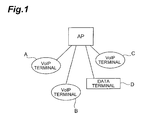
- Figure 1 is a layout diagram of a wireless LAN network according to an embodiment of the present invention.
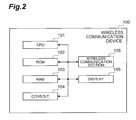
- Figure 2 is a hardware layout diagram of a wireless communication device.
- Figure 3 is a function block layout diagram of a wireless communication device.
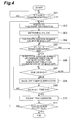
- Figure 4 is a flow chart showing packet transmission processing performed according to the present invention.
- Figure 5 is a time chart showing the transmission right acquisition condition of each VoIP terminal when transmission right acquisition priority times are set at different time-points for each of the VoIP terminals in accordance with the packet generation period.
- Figure 6 is a time chart showing the transmission right acquisition condition of each VoIP terminal when the transmission right acquisition priority times of each VoIP terminal are allocated no more than the calculated channel occupation time if transmission and reception are performed with the maximum transmission rate.
- Figure 7 is a time chart showing the transmission right acquisition condition of each VoIP terminal when the transmission right acquisition priority times are allocated such that no overlapping of the VoIP terminals takes place.
- Figure 8 is a time chart showing the transmission right acquisition condition of each VoIP terminal when the transmission right acquisition priority times of each VoIP terminal are allocated such that there is partial overlap with the transmission right acquisition priority times of other VoIP terminals.
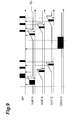
- Figure 9 is a time chart showing the transmission right acquisition condition of each VoIP terminal when the maximum value of the distribution function of packet transmission right acquisition priority time is after an intermediate time-point.
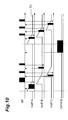
- Figure 10 is a time chart showing the transmission right acquisition condition of each VoIP terminal when the maximum value of the distribution function of packet transmission right acquisition priority time is before the intermediate time-point.
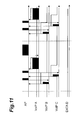
- Figure 11 is a time chart showing the transmission right acquisition condition of each VoIP terminal when the packet transmission right acquisition priority time of a given terminal is set to the last in the case where another VoIP terminal becomes unable to acquire a transmission right within the packet transmission right acquisition priority time.
- Figure 12 is a table showing the values of IFS and CWmin for VoIP terminals A to C and a data terminal D respectively.
- Figure 13 is a table showing the values of IFS and CWmin for VoIP terminals A to C respectively in the case where the transmission waiting time parameter that is once set to a small value is held for a prescribed period.
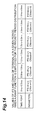
- Figure 14 is a table showing the values of IFS and CWmin of a VoIP terminal A in a period in the case where a ramp function is employed in the distribution of priority time.
- Figure 15 is a table showing the values of IFS and CWmin of a VoIP terminal A in the case where the transmission rate of the VoIP terminal A drops and another VoIP terminal becomes unable to acquire a transmission right within the transmission right acquisition priority period.
- Figure 1 shows a layout diagram of a wireless LAN network according to this embodiment.
- the wireless LAN network comprises an AP (access point) which is the base station of the wireless LAN, VoIP terminals A, B, C equipped with control unit according to IEEE802.11b and according to the present invention, and a data terminal D in which only the IEEE802 .11 standard technology is implemented.
- AP access point
- VoIP terminals A, B, C equipped with control unit according to IEEE802.11b and according to the present invention
- D data terminal in which only the IEEE802 .11 standard technology is implemented.
- the hardware layout of VoIP terminals A, B, C (hereinbelow referred to in common as “wireless communication devices 100") in which communication unit according to IEEE802.11b and according to the present invention are implemented is shown in Figure 2 and a functional block layout diagram thereof is shown in Figure 3, respectively.
- the VoIP CODEC period of the wireless communication devices 100 is 40 milli second (hereinafter described "ms") in each case.
- the wireless communication devices 100 shown in Figure 2 comprise as their hardware construction a CPU 101, a ROM 102, a RAM 103, a console (key buttons etc) 104, a wireless communication section 105 capable of wireless communication using CSMA/CA, and a display 106.
- the wireless communication devices 100 shown in Figure 3 comprise, as their functional block layout, a back-off control section 201, a random number calculation section 202, a parameter management section 203, a time-point management section 204, an IFS period idle detection section 205, a failure management section 206, a channel occupation time calculation section 207, a transfer rate control section 208, and a transmission success/failure detection section 209.
- a back-off control section 201 the wireless communication devices 100 shown in Figure 3 comprise, as their functional block layout, a back-off control section 201, a random number calculation section 202, a parameter management section 203, a time-point management section 204, an IFS period idle detection section 205, a failure management section 206, a channel occupation time calculation section 207, a transfer rate control section 208, and a transmission success/failure detection section 209.
- the various functional blocks are described below.
- the back-off control section 201 is a back-off control section for obtaining transmission right that is mounted in the wireless communication section 105 of Figure 2 and, if the random period wireless space is idle, VoIP packets are sent to a transmission section (not shown) that transmits these packets.
- the random number calculation section 202 is implemented in the wireless communication section 105 of Figure 2 and has a function of calculating a random value in a range from 0 to CW using CW that is obtained from the parameter management section 203.
- the parameter management section 203 is implemented by the CPU 101, ROM 102 and RAM 103 of Figure 2.
- This parameter management section 203 comprises a parameter holding section 203A that holds, in association with a time-point, the parameter (for example IFS and CW) relating to packet transmission right acquisition priority that changes with a different distribution between wireless communication devices located in the same wireless LAN area, in a prescribed period; and a parameter alteration section 203B that reads, from the parameter holding section 203A, the parameter associated with current time-point information that is output by the time-point management section 204 and dynamically alters the current parameter in accordance with the parameter thus read.
- This parameter holding section 203A is implemented by the ROM (for example EEPROM capable of addition/alteration/deletion of the storage contents) 102 of Figure 2, and the parameter alteration section 203B is implemented by the CPU 101 and RAM 103.
- the time-point management section 204 is a timer that is implemented by the wireless communication section 105 of Figure 2.
- the IFS period idle detection section 205 is implemented by the wireless communication section 105 of Figure 2 and performs carrier sensing, and has a function of identifying whether or not a wireless space consecutive with the IFS period obtained by the parameter management section 203 is idle.
- the failure management section 206 is implemented by the ROM 102, RAM 103 and wireless communication section 105 of Figure 2: it has the function of managing failure history of the wireless communication device 100 involving failure of packet transmission due to packet collision or failure of transmission right acquisition due to back-off. In addition, the failure management section 206 has a function of calculating the transmission failure probability using the failure history, and sending the transmission failure probability information to the parameter management section 203.
- the channel occupation time calculation section 207 is implemented by the wireless communication section 105 of Figure 2 and has a function of calculating a time (i.e. channel occupation time) necessary for transmission and reception of packets using the packet length and the transmission rate obtained by the transmission rate control section 208 and a function of sending to the parameter management section 203 the channel occupation time thus calculated.
- the transmission rate control section 208 is implemented by the wireless communication section 105 of Figure 2 and manages the value of the transmission rate that is currently used by the wireless communication device 100.
- the transmission success/failure detection section 209 has a function of ascertaining whether transmission has succeeded or failed, and, in the case of failure, of sending transmission failure information to the parameter management section 203.
- FIG. 4 is a flow chart of packet transmission processing executed by a wireless communication device 100 to which the present invention has been applied.
- the packet transmission processing executed by a given wireless communication device 100 (for example VoIP terminal A) is described below with reference to Figure 4.
- step 301 it is ascertained whether or not packets to be transmitted having periodicity are present. If it is then found that packets to be transmitted are present, in step 302, the time-point management section 204 refers to the current time-point information and sends the current time-point information to the parameter management section 203.
- the parameter management section 203 determines the parameters such as IFS or CW corresponding to the current time-point.
- the random number calculation section 202 calculates a random number value for back-off using CWmin.
- the IFS period idle detection section 205 ascertains whether or not the wireless space consecutive with the IFS period is idle. If carrier sensing shows a busy condition before becoming idle consecutive with the IFS period, the IFS period idle detection section 205 again waits for an idle condition to be produced, before detecting the period for which the idle condition is produced consecutive with the IFS period. On the other hand, if in step 305 an idle condition is detected consecutive with the IFS period, the back-off control section 201 commences back-off, using the random number value obtained in step 304 as the initial value of the back-off timer.
- step 307 the back-off control section 201 decrements the back-off timer with lapse of time (step 308), and steps 307 to 309 are repeated until it is found that the back-off timer value has become 0 (i.e. until a positive result is obtained in step 309).
- step 307 processing returns to step 305 while holding the back-off timer value at this time-point, and the IFS period idle detection section 205 again performs detection of an idle condition consecutive with the IFS period.
- the back-off control section 201 recommences back-off from the back-off timer value when a busy condition is detected in the back-off step 306.
- the back-off control section 201 in step 310, sends the actually transmitted packet to the packet transmission section (not shown), so that packet transmission is performed by the packet transmission section.
- step 311 the transmission success/failure detection section 209 terminates the series of transmission processes if it finds that packet transmission has succeeded. However, if, in step 311, it finds that transmission has failed, retransmission is performed, but, on this occasion, the transmission success/failure detection section 209 reports the transmission failure information to the parameter management section 203.
- processing returns to step 302 and the time-point management section 204 sends the current time-point information to the parameter management section 203; in step 303, the parameter management section 203 re-determines the IFS and CW to be used for retransmission, on the basis of the current time-point information that is reported thereto and the transmission failure information that is reported thereto by the transmission success/failure detection section 209, and attempts packet transmission by the same procedure as described above.
- the packet transmission right priority acquisition distributions of the respective VoIP terminals A to C are set in accordance with the VoIP CODEC period. If this transmission right acquisition priority distribution function is assumed to be f(t) (0 ⁇ t ⁇ 40), f(t) may be the reciprocal of IFS, which is a parameter relating to the transmission waiting time, or the reciprocal of CW. In this case, if the starting time-point of a given single period is assumed to be 0 ms, and the end time-point of the single period is assumed to be 40 ms, IFS and CW of each VoIP terminal are as shown in Figure 12.
- packet transmission right acquisition periods are allocated in prioritized fashion to each VoIP terminal and it is thereby made possible to suppress packet collision with other VoIP terminals.
- the data terminal D By reducing the value of the f(t) of all of the VoIP terminals A, B, C the data terminal D also becomes able to acquire a transmission right during the period from time 5.1 ms to 40 ms.
- the transmission right acquisition priority distribution function f(t) in this embodiment is repeated with a period of 40 ms, which is the period of the VoIP CODEC. It is therefore sufficient to define f(t) in 0 ⁇ t ⁇ 40. It should be noted that the values in the Table are merely given by way of example and any suitable value could be employed for these values.
- the parameter management section 203 can set a larger value than the transmission and reception channel occupation time calculated by the maximum transmission rate, as the transmission right acquisition priority time of each VoIP terminal.
- the following advantages are obtained by setting the transmission right acquisition priority time to a value larger than the transmission and reception channel occupation time (2.5 ms) calculated by the maximum transmission rate.
- the transmission and reception period of the data terminal D would interrupt the transmission right acquisition priority time of the VoIP terminal A, leading to the possibility of failure of the VoIP terminal A to acquire a transmission right in the transmission right acquisition priority time. Also, if, as shown in Figure 6, the transmission rate of a given VoIP terminal A is dropped, this would result in the possibility of failure of the following VoIP terminal B to acquire a transmission right in the transmission right acquisition priority time.
- the transmission right acquisition priority time of the VoIP terminals must be set to be greater than the transmission and reception channel occupation time calculated by the maximum transmission rate, so as to make it possible to solve the problem shown in Figure 6. It should be noted that the transmission right acquisition priority time of the VoIP terminals is of course set to a value no more than the packet generation period.
- the parameter management section 203 may set the packet transmission right acquisition priority time of its own wireless communication device such that the packet transmission right acquisition priority time of its own wireless communication device partially overlaps the packet transmission right acquisition priority time of another wireless communication device in the same wireless LAN area. If, as shown in Figure 7, the transmission right acquisition priority time is to be allocated so as not to overlap with any of the VoIP terminals, a time band would be generated in the transmission right priority acquisition period of the VoIP terminals A, B and C in which no VoIP terminal is performing transmission or reception i.e. the channel (bandwidth) would be inefficiently utilized.
- the parameter values such as of IFS and CW at the starting time-point of the transmission right acquisition priority time may be temporarily set to smaller values, these values being held until the time-point of termination of this period.
- the parameter tables of the VoIP terminals A, B, and C may be respectively set as shown in Figure 13. In this way, implementation is facilitated and it also becomes possible to acquire the transmission right in the order: VoIP terminals A, B, C.
- f(t) is assumed to be a step function as one example given by way of explanation, but any suitable distribution could be employed.
- a step function has the advantage of ease of implementation, since the values of the f(t) of the VoIP terminal A and VoIP terminal B in the period from time-point 1.3 ms to 2.5 ms in this example are equal, there is a high likelihood of transmission packet collision of the VoIP terminal A and VoIP terminal B.
- the parameter management section 203 may either be constructed so as to hold in the form of a parameter table parameter values in the priority time calculated beforehand so as to simulate a ramp function, as in Figure 14, or may be constructed such that only the calculation expression of a ramp function is held, and specific values are found by calculation every time there is a transmission request.
- the maximum value of f(t) is before the determination time-point of the transmission right acquisition priority time and after the intermediate time-point of the transmission right acquisition priority time. If the maximum value of f(t) is to be after the starting time-point of the transmission right acquisition priority time and before the intermediate time-point of the transmission right acquisition priority time, as in Figure 10, there would be a possibility of the transmission right acquisition priority time of the VoIP terminal A being interrupted by the transmission and reception period of the data terminal D: the result would be that there would be little benefit even in conferring a large priority right at the starting time-point of the priority time.
- the transmission and reception channel occupation time of the VoIP terminal A would interrupt the transmission right acquisition priority time of the VoIP terminal B: the result would be that there would be little benefit even in conferring a large priority right at the starting time-point of the priority time.
- the VoIP terminal C might acquire the transmission right before transmission by the VoIP terminal B, with the result that the VoIP terminal B would be unable to acquire a transmission right within the priority time of its home base station.
- the value and variance of the transmission right acquisition priority distribution function f(t) may be different for each VoIP terminal and/or may be dynamically altered.
- the value of f(t) corresponds to the reciprocal of the IFS or CWmin parameter value in this example, and the variance corresponds to the length of the priority time. If packet transmission failures occur repeatedly, the transmission failure probability is reported to the parameter management section 203 by the failure management section 206 that holds the transmission failure history. If the probability of transmission failure in the transmission right acquisition priority time of its home base station becomes greater than a threshold value, the parameter management section 203 may increase the transmission right acquisition probability by increasing the value, or variance, of the transmission right acquisition priority distribution function f(t).
- the channel occupation time calculation section 207 therefore reports the result of the channel occupation time calculation to the parameter management section 203, and the parameter management section 203 sets the transmission right acquisition priority time of the VoIP terminal A to be right at the end of the series of priority times.
- the parameter table that is held by the parameter management section 203 of the VoIP terminal A is altered as shown in Figure 15.
- Function f(t) in this case and the associated transmission and reception sequence are shown in Figure 11. In this way, the situation that transmission priority acquisition by the VoIP terminals B and C may fail due to channel occupation associated with transmission and reception by the VoIP terminal A can be avoided.
- the CW size is doubled every time retransmission is performed, but, with the present technique, the respective CW sizes of the VoIP terminals A, B, C are altered in accordance with the values of CWmin shown in the first to third tables from the top in Figure 12 in the transmission right acquisition priority period irrespective of whether the transmission is the first transmission or a retransmission.
- the size of the CW is doubled as in the standard technique in the transmission right acquisition priority time of the home base station, the transmission right acquisition priority is decreased.
- the time range 5.1 ms to 40 ms in this example it would be possible to double the CW size every time retransmission is performed, as in the standard technique.
- Retransmission by a VoIP terminal that has failed to acquire a transmission right in the transmission right acquisition priority time of the home base station or by a VoIP terminal that has acquired a transmission right but whose transmission is unsuccessful due to packet collision may be attempted in the period in which no transmission right acquisition priority time has been conferred on any VoIP terminal (for example period from the time-point 5.1 ms to the time-point 40 ms). Although delay of packet transmission/reception occurs if transmission succeeds in this period, packet loss can be avoided.
- packets may not be generated.
- VoIP packets to be transmitted are not generated in the silent interval.
- the VoIP terminal B has no packets to be transmitted in the transmission right priority acquisition period of the home base station, so there has been no packet transmission.
- another VoIP terminal may transmit.
- acquisition of a transmission right is possible by normal back-off, even at a time-point outside the priority time. Consequently, even if for example a given VoIP terminal has not transmitted in the transmission right priority acquisition period of its home base station, it is not the case that this priority period must always consist of wasted idle slots: thus effective bandwidth utilization can be achieved.
- a parameter management section 203 comprises a parameter holding section 203A that holds a parameter that changes with a different distribution between wireless communication devices in a prescribed period and, in addition, the parameter associated with the current time-point is read from a parameter table that is held in this parameter holding section 203A and a parameter relating to the packet transmission right acquisition priority is actively altered in response to this parameter.
- packets to be transmitted are held by a plurality of VoIP terminals, packet transmission from each of the VoIP terminals takes place with different timing from the other VoIP terminals, so smooth communication can be achieved in which the probability of packet collision is lowered.
- the parameter management section 203 reduces the parameter such as for example IFS or CW, in the transmission right acquisition priority time, or increases the probability of packet transmission success by increasing the transmission right acquisition priority time, such as thereby to make possible smooth communication.
- the channel occupation time calculation section 207 by using the transmission rate that is reported thereto by the transmission rate control section 208 and the transmission packet size, calculates the channel occupation time prior to transmission and reports this to the parameter management section 203, and the packet management section 203 creates a parameter table of for example the IFS or CW such as to set the transmission right acquisition priority time of its home base station as a transmission right acquisition priority time in the latter part of the series of priority times, if the channel occupation time that would result from transmission and reception by the home base station is so large that other VoIP terminals would not be able to obtain a transmission right in the transmission right acquisition priority time. In this way, the probability of failure of other VoIP terminals to acquire a transmission right within the transmission right acquisition priority time due to channel occupation by any of the VoIP terminals A, B, C can be reduced, making possible smooth communication.
Landscapes
- Engineering & Computer Science (AREA)
- Computer Networks & Wireless Communication (AREA)
- Signal Processing (AREA)
- Multimedia (AREA)
- Small-Scale Networks (AREA)
- Mobile Radio Communication Systems (AREA)
- Communication Control (AREA)
Applications Claiming Priority (1)
| Application Number | Priority Date | Filing Date | Title |
|---|---|---|---|
| JP2006031395A JP4880316B2 (ja) | 2006-02-08 | 2006-02-08 | 無線通信装置及び無線通信方法 |
Publications (2)
| Publication Number | Publication Date |
|---|---|
| EP1819105A1 true EP1819105A1 (fr) | 2007-08-15 |
| EP1819105B1 EP1819105B1 (fr) | 2012-05-02 |
Family
ID=38128761
Family Applications (1)
| Application Number | Title | Priority Date | Filing Date |
|---|---|---|---|
| EP20070002624 Ceased EP1819105B1 (fr) | 2006-02-08 | 2007-02-07 | Dispositif et procédé de communication sans fil |
Country Status (4)
| Country | Link |
|---|---|
| US (1) | US7738481B2 (fr) |
| EP (1) | EP1819105B1 (fr) |
| JP (1) | JP4880316B2 (fr) |
| CN (1) | CN100592715C (fr) |
Cited By (1)
| Publication number | Priority date | Publication date | Assignee | Title |
|---|---|---|---|---|
| US12430533B2 (en) | 2018-10-10 | 2025-09-30 | Maxwell, Inc. | Neural network processing apparatus, neural network processing method, and neural network processing program |
Families Citing this family (18)
| Publication number | Priority date | Publication date | Assignee | Title |
|---|---|---|---|---|
| JP4750644B2 (ja) * | 2006-08-09 | 2011-08-17 | 株式会社エヌ・ティ・ティ・ドコモ | 無線システム、無線通信装置及び通信方法 |
| JP4238918B2 (ja) * | 2007-04-02 | 2009-03-18 | 沖電気工業株式会社 | 通信制御装置、通信制御方法、通信制御プログラム、ノード及び通信システム |
| KR101169145B1 (ko) * | 2007-06-20 | 2012-07-30 | 노키아 지멘스 네트웍스 오와이 | 무선 액세스 네트워크들에서 반영구 할당 및 동적 할당 간의 충돌들의 방지 |
| JP5201498B2 (ja) | 2007-08-08 | 2013-06-05 | 株式会社エヌ・ティ・ティ・ドコモ | 無線通信装置及び無線通信方法 |
| CN101478788B (zh) * | 2008-01-05 | 2012-04-25 | 华为技术有限公司 | 侦听寻呼的方法与系统 |
| JP4885916B2 (ja) * | 2008-07-22 | 2012-02-29 | 株式会社日立情報制御ソリューションズ | データ伝送装置、データ伝送方法及びデータ伝送システム |
| JP2010062846A (ja) * | 2008-09-03 | 2010-03-18 | Ntt Docomo Inc | 無線通信制御方法、無線通信基地局、無線通信端末および無線通信システム |
| JP5141570B2 (ja) * | 2009-01-20 | 2013-02-13 | 富士通株式会社 | 無線アドホックネットワークのための無線通信機 |
| US20110044303A1 (en) * | 2009-08-18 | 2011-02-24 | Xuquan Ji | Device, system, and method of adjusting a contention window for wireless transmission |
| US8705552B1 (en) | 2010-02-09 | 2014-04-22 | Marvell International Ltd. | Controlling latency variations in a packet node |
| US8730990B2 (en) * | 2011-09-15 | 2014-05-20 | Nokia Corporation | Method, apparatus, and computer program product for quiet period management in wireless networks for coexistence |
| US9854991B2 (en) | 2013-03-15 | 2018-01-02 | Medtronic Navigation, Inc. | Integrated navigation array |
| US9492741B2 (en) | 2013-05-22 | 2016-11-15 | Microsoft Technology Licensing, Llc | Wireless gaming protocol |
| JP6146568B2 (ja) * | 2013-09-02 | 2017-06-14 | パナソニックIpマネジメント株式会社 | 無線通信装置及び無線通信方法 |
| US9866494B2 (en) | 2015-11-04 | 2018-01-09 | Microsoft Technology Licensing, Llc | Wireless communication using delayed frame transmission |
| US10091132B2 (en) * | 2016-01-29 | 2018-10-02 | Raytheon Company | Systems and methods for resource contention resolution |
| CN107959575B (zh) * | 2016-10-14 | 2020-11-17 | 华为技术有限公司 | 传输唤醒帧的方法和设备 |
| CN115066894B (zh) * | 2020-03-31 | 2025-07-22 | 索尼互动娱乐股份有限公司 | 传输装置,传输方法和程序 |
Citations (2)
| Publication number | Priority date | Publication date | Assignee | Title |
|---|---|---|---|---|
| WO2003085891A1 (fr) * | 2002-04-05 | 2003-10-16 | Siemens Aktiengesellschaft | Procede et dispositif de commande priorisee de l'acces a des supports dans un reseau de communication radio |
| EP1557992A2 (fr) * | 2004-01-26 | 2005-07-27 | Samsung Electronics Co., Ltd. | Procédé et dispositif d'établissement, de transmission et de réception de données pour la communication dans un réseau hertzien à détection de porteuses virtuelles |
Family Cites Families (14)
| Publication number | Priority date | Publication date | Assignee | Title |
|---|---|---|---|---|
| JPH10261980A (ja) * | 1997-03-18 | 1998-09-29 | Fujitsu Ltd | 無線通信ネットワーク用基地局装置,無線通信ネットワークの通信制御方法,無線通信ネットワークシステムおよび無線端末装置 |
| JP3970563B2 (ja) * | 2001-09-03 | 2007-09-05 | 株式会社エヌ・ティ・ティ・ドコモ | 送信制御方法、通信システムおよび基地局 |
| US7280517B2 (en) * | 2001-11-02 | 2007-10-09 | At&T Corp. | Wireless LANs and neighborhood capture |
| US20030087645A1 (en) * | 2001-11-08 | 2003-05-08 | Kim Byoung-Jo J. | Frequency assignment for multi-cell IEEE 802.11 wireless networks |
| US6937591B2 (en) * | 2003-02-27 | 2005-08-30 | Microsoft Corporation | Quality of service differentiation in wireless networks |
| JP2004320230A (ja) * | 2003-04-14 | 2004-11-11 | Sharp Corp | マルチキャスト型通信システムにおける送信局および受信局、並びに通信方法 |
| JP2004343309A (ja) * | 2003-05-14 | 2004-12-02 | Matsushita Electric Ind Co Ltd | 無線ネットワーク装置および無線ネットワーク装置のリソース割り当て方法 |
| JP4108006B2 (ja) * | 2003-06-23 | 2008-06-25 | 東京電力株式会社 | 無線lan通信システム |
| JP4173789B2 (ja) * | 2003-09-19 | 2008-10-29 | 株式会社キャンパスクリエイト | ノード、これを用いた通信システムおよび通信方法 |
| KR20050040454A (ko) * | 2003-10-28 | 2005-05-03 | 삼성전자주식회사 | 분산조정함수 모드에서의 무선랜 통신방법 |
| JP2005184522A (ja) | 2003-12-19 | 2005-07-07 | Oki Electric Ind Co Ltd | 送受信タイミング調整装置、無線アクセス装置及び無線ネットワークシステム |
| JP4628162B2 (ja) * | 2004-04-16 | 2011-02-09 | 株式会社ソニー・コンピュータエンタテインメント | 通信端末装置、通信システムおよび電力制御方法 |
| US8027327B2 (en) | 2004-06-25 | 2011-09-27 | Alcatel Lucent | Distributed scheduling in wireless networks with service differentiation |
| US7477621B1 (en) * | 2004-09-07 | 2009-01-13 | Marvell International Ltd. | System and method for estimating bandwidth requirements of and allocating bandwidth to communication devices operating in a network |
-
2006
- 2006-02-08 JP JP2006031395A patent/JP4880316B2/ja not_active Expired - Fee Related
-
2007
- 2007-02-05 US US11/671,280 patent/US7738481B2/en not_active Expired - Fee Related
- 2007-02-07 EP EP20070002624 patent/EP1819105B1/fr not_active Ceased
- 2007-02-08 CN CN200710007088A patent/CN100592715C/zh not_active Expired - Fee Related
Patent Citations (2)
| Publication number | Priority date | Publication date | Assignee | Title |
|---|---|---|---|---|
| WO2003085891A1 (fr) * | 2002-04-05 | 2003-10-16 | Siemens Aktiengesellschaft | Procede et dispositif de commande priorisee de l'acces a des supports dans un reseau de communication radio |
| EP1557992A2 (fr) * | 2004-01-26 | 2005-07-27 | Samsung Electronics Co., Ltd. | Procédé et dispositif d'établissement, de transmission et de réception de données pour la communication dans un réseau hertzien à détection de porteuses virtuelles |
Non-Patent Citations (1)
| Title |
|---|
| LAN/MAN STANDARDS COMMITTEE: "Local and metropolitan area networks - Specific requirements", INTERNET CITATION, 11 November 2005 (2005-11-11), XP002429954, Retrieved from the Internet <URL:http://standards.ieee.org/reading/ieee/std/lanman/restricted/802.11e- 2005.pdf> [retrieved on 20070417] * |
Cited By (1)
| Publication number | Priority date | Publication date | Assignee | Title |
|---|---|---|---|---|
| US12430533B2 (en) | 2018-10-10 | 2025-09-30 | Maxwell, Inc. | Neural network processing apparatus, neural network processing method, and neural network processing program |
Also Published As
| Publication number | Publication date |
|---|---|
| CN101018196A (zh) | 2007-08-15 |
| CN100592715C (zh) | 2010-02-24 |
| US7738481B2 (en) | 2010-06-15 |
| JP4880316B2 (ja) | 2012-02-22 |
| EP1819105B1 (fr) | 2012-05-02 |
| JP2007214795A (ja) | 2007-08-23 |
| US20070183326A1 (en) | 2007-08-09 |
Similar Documents
| Publication | Publication Date | Title |
|---|---|---|
| US7738481B2 (en) | Wireless communication device and wireless communication method | |
| US7643509B2 (en) | Hybrid implicit token carrier sensing multiple access/collision avoidance protocol | |
| US7274708B2 (en) | Random medium access methods with backoff adaptation to traffic | |
| JP4155801B2 (ja) | ホームプラグネットワークにおけるQoSマネージャのチャネル確保方法 | |
| EP2978273B1 (fr) | Procédé de contention ofdma et point d'accès | |
| US9918340B1 (en) | Enhanced distributed channel access parameter variation within restricted access window | |
| JP4480563B2 (ja) | 無線LAN基地局装置のQoS制御方法 | |
| JP5677280B2 (ja) | 無線通信装置および無線通信方法 | |
| Barcelo et al. | Learning-BEB: avoiding collisions in WLANs | |
| KR100560738B1 (ko) | 씨에스엠에이/씨에이 기반 무선 랜 시스템의 매체 접근제어 방법 및 그 방법을 수행하는 단말 | |
| EP2413649A1 (fr) | Procédé de communication sans fil et système avec protocole pour évitement des collisions | |
| JP2007511972A (ja) | マルチチャネルデバイスによる媒体へのアクセス方法 | |
| US10028306B2 (en) | Method and device for data communication in a network | |
| WO2016145601A1 (fr) | Procédé et dispositif permettant d'ajuster une fenêtre d'intervalle d'attente | |
| EP1973273B1 (fr) | Procédé et appareil pour planifier en temps réel le trafic dans des réseaux sans fil | |
| WO2016039931A1 (fr) | Perfectionnements d'extensions multimédias wi-fi | |
| JP7801342B2 (ja) | 優先チャネルアクセス | |
| CN114651475A (zh) | 用于rta分组的edca队列 | |
| EP4482247A1 (fr) | Procédé et appareil de traitement de données, dispositif et support de stockage lisible par ordinateur | |
| JP2001237839A (ja) | 無線パケット優先制御方法 | |
| CN101715241B (zh) | 用于分布式无线局域网介质接入控制的方法及装置 | |
| CN108966360A (zh) | 非授权频段上LTE系统和WiFi系统共存时的数据传输方法 | |
| US20250220731A1 (en) | Data Transmission Method and Apparatus | |
| CN102843775A (zh) | 调度方法、装置及网络设备 | |
| US9148873B1 (en) | Method and apparatus for providing different types of physical layer devices access to a wireless medium |
Legal Events
| Date | Code | Title | Description |
|---|---|---|---|
| PUAI | Public reference made under article 153(3) epc to a published international application that has entered the european phase |
Free format text: ORIGINAL CODE: 0009012 |
|
| 17P | Request for examination filed |
Effective date: 20070207 |
|
| AK | Designated contracting states |
Kind code of ref document: A1 Designated state(s): AT BE BG CH CY CZ DE DK EE ES FI FR GB GR HU IE IS IT LI LT LU LV MC NL PL PT RO SE SI SK TR |
|
| AX | Request for extension of the european patent |
Extension state: AL BA HR MK YU |
|
| AKX | Designation fees paid |
Designated state(s): DE GB |
|
| 17Q | First examination report despatched |
Effective date: 20090217 |
|
| REG | Reference to a national code |
Ref country code: DE Ref legal event code: R079 Ref document number: 602007022340 Country of ref document: DE Free format text: PREVIOUS MAIN CLASS: H04L0012560000 Ipc: H04W0072120000 |
|
| RIC1 | Information provided on ipc code assigned before grant |
Ipc: H04W 72/12 20090101AFI20111111BHEP |
|
| GRAP | Despatch of communication of intention to grant a patent |
Free format text: ORIGINAL CODE: EPIDOSNIGR1 |
|
| GRAS | Grant fee paid |
Free format text: ORIGINAL CODE: EPIDOSNIGR3 |
|
| GRAA | (expected) grant |
Free format text: ORIGINAL CODE: 0009210 |
|
| RIN1 | Information on inventor provided before grant (corrected) |
Inventor name: IGARASHI, KEI Inventor name: SUGIYAMA, TAKATOSHI Inventor name: YAMADA, AKIRA Inventor name: FUJIWARA, ATSUSHI |
|
| AK | Designated contracting states |
Kind code of ref document: B1 Designated state(s): DE GB |
|
| REG | Reference to a national code |
Ref country code: GB Ref legal event code: FG4D |
|
| REG | Reference to a national code |
Ref country code: DE Ref legal event code: R096 Ref document number: 602007022340 Country of ref document: DE Effective date: 20120628 |
|
| PLBE | No opposition filed within time limit |
Free format text: ORIGINAL CODE: 0009261 |
|
| STAA | Information on the status of an ep patent application or granted ep patent |
Free format text: STATUS: NO OPPOSITION FILED WITHIN TIME LIMIT |
|
| 26N | No opposition filed |
Effective date: 20130205 |
|
| REG | Reference to a national code |
Ref country code: DE Ref legal event code: R097 Ref document number: 602007022340 Country of ref document: DE Effective date: 20130205 |
|
| PGFP | Annual fee paid to national office [announced via postgrant information from national office to epo] |
Ref country code: DE Payment date: 20180123 Year of fee payment: 12 Ref country code: GB Payment date: 20180207 Year of fee payment: 12 |
|
| REG | Reference to a national code |
Ref country code: DE Ref legal event code: R119 Ref document number: 602007022340 Country of ref document: DE |
|
| GBPC | Gb: european patent ceased through non-payment of renewal fee |
Effective date: 20190207 |
|
| PG25 | Lapsed in a contracting state [announced via postgrant information from national office to epo] |
Ref country code: DE Free format text: LAPSE BECAUSE OF NON-PAYMENT OF DUE FEES Effective date: 20190903 Ref country code: GB Free format text: LAPSE BECAUSE OF NON-PAYMENT OF DUE FEES Effective date: 20190207 |