EP1820875A2 - Korrosionsbeschichtung für Umweltschutz einer Turbinenschaufel - Google Patents
Korrosionsbeschichtung für Umweltschutz einer Turbinenschaufel Download PDFInfo
- Publication number
- EP1820875A2 EP1820875A2 EP06126889A EP06126889A EP1820875A2 EP 1820875 A2 EP1820875 A2 EP 1820875A2 EP 06126889 A EP06126889 A EP 06126889A EP 06126889 A EP06126889 A EP 06126889A EP 1820875 A2 EP1820875 A2 EP 1820875A2
- Authority
- EP
- European Patent Office
- Prior art keywords
- silicon
- exterior surface
- turbine blade
- gas turbine
- preselected
- Prior art date
- Legal status (The legal status is an assumption and is not a legal conclusion. Google has not performed a legal analysis and makes no representation as to the accuracy of the status listed.)
- Withdrawn
Links
Images


Classifications
-
- C—CHEMISTRY; METALLURGY
- C23—COATING METALLIC MATERIAL; COATING MATERIAL WITH METALLIC MATERIAL; CHEMICAL SURFACE TREATMENT; DIFFUSION TREATMENT OF METALLIC MATERIAL; COATING BY VACUUM EVAPORATION, BY SPUTTERING, BY ION IMPLANTATION OR BY CHEMICAL VAPOUR DEPOSITION, IN GENERAL; INHIBITING CORROSION OF METALLIC MATERIAL OR INCRUSTATION IN GENERAL
- C23C—COATING METALLIC MATERIAL; COATING MATERIAL WITH METALLIC MATERIAL; SURFACE TREATMENT OF METALLIC MATERIAL BY DIFFUSION INTO THE SURFACE, BY CHEMICAL CONVERSION OR SUBSTITUTION; COATING BY VACUUM EVAPORATION, BY SPUTTERING, BY ION IMPLANTATION OR BY CHEMICAL VAPOUR DEPOSITION, IN GENERAL
- C23C10/00—Solid state diffusion of only metal elements or silicon into metallic material surfaces
- C23C10/04—Diffusion into selected surface areas, e.g. using masks
-
- C—CHEMISTRY; METALLURGY
- C23—COATING METALLIC MATERIAL; COATING MATERIAL WITH METALLIC MATERIAL; CHEMICAL SURFACE TREATMENT; DIFFUSION TREATMENT OF METALLIC MATERIAL; COATING BY VACUUM EVAPORATION, BY SPUTTERING, BY ION IMPLANTATION OR BY CHEMICAL VAPOUR DEPOSITION, IN GENERAL; INHIBITING CORROSION OF METALLIC MATERIAL OR INCRUSTATION IN GENERAL
- C23C—COATING METALLIC MATERIAL; COATING MATERIAL WITH METALLIC MATERIAL; SURFACE TREATMENT OF METALLIC MATERIAL BY DIFFUSION INTO THE SURFACE, BY CHEMICAL CONVERSION OR SUBSTITUTION; COATING BY VACUUM EVAPORATION, BY SPUTTERING, BY ION IMPLANTATION OR BY CHEMICAL VAPOUR DEPOSITION, IN GENERAL
- C23C10/00—Solid state diffusion of only metal elements or silicon into metallic material surfaces
- C23C10/18—Solid state diffusion of only metal elements or silicon into metallic material surfaces using liquids, e.g. salt baths, liquid suspensions
-
- C—CHEMISTRY; METALLURGY
- C23—COATING METALLIC MATERIAL; COATING MATERIAL WITH METALLIC MATERIAL; CHEMICAL SURFACE TREATMENT; DIFFUSION TREATMENT OF METALLIC MATERIAL; COATING BY VACUUM EVAPORATION, BY SPUTTERING, BY ION IMPLANTATION OR BY CHEMICAL VAPOUR DEPOSITION, IN GENERAL; INHIBITING CORROSION OF METALLIC MATERIAL OR INCRUSTATION IN GENERAL
- C23C—COATING METALLIC MATERIAL; COATING MATERIAL WITH METALLIC MATERIAL; SURFACE TREATMENT OF METALLIC MATERIAL BY DIFFUSION INTO THE SURFACE, BY CHEMICAL CONVERSION OR SUBSTITUTION; COATING BY VACUUM EVAPORATION, BY SPUTTERING, BY ION IMPLANTATION OR BY CHEMICAL VAPOUR DEPOSITION, IN GENERAL
- C23C10/00—Solid state diffusion of only metal elements or silicon into metallic material surfaces
- C23C10/18—Solid state diffusion of only metal elements or silicon into metallic material surfaces using liquids, e.g. salt baths, liquid suspensions
- C23C10/26—Solid state diffusion of only metal elements or silicon into metallic material surfaces using liquids, e.g. salt baths, liquid suspensions more than one element being diffused
-
- C—CHEMISTRY; METALLURGY
- C23—COATING METALLIC MATERIAL; COATING MATERIAL WITH METALLIC MATERIAL; CHEMICAL SURFACE TREATMENT; DIFFUSION TREATMENT OF METALLIC MATERIAL; COATING BY VACUUM EVAPORATION, BY SPUTTERING, BY ION IMPLANTATION OR BY CHEMICAL VAPOUR DEPOSITION, IN GENERAL; INHIBITING CORROSION OF METALLIC MATERIAL OR INCRUSTATION IN GENERAL
- C23C—COATING METALLIC MATERIAL; COATING MATERIAL WITH METALLIC MATERIAL; SURFACE TREATMENT OF METALLIC MATERIAL BY DIFFUSION INTO THE SURFACE, BY CHEMICAL CONVERSION OR SUBSTITUTION; COATING BY VACUUM EVAPORATION, BY SPUTTERING, BY ION IMPLANTATION OR BY CHEMICAL VAPOUR DEPOSITION, IN GENERAL
- C23C10/00—Solid state diffusion of only metal elements or silicon into metallic material surfaces
- C23C10/28—Solid state diffusion of only metal elements or silicon into metallic material surfaces using solids, e.g. powders, pastes
-
- C—CHEMISTRY; METALLURGY
- C23—COATING METALLIC MATERIAL; COATING MATERIAL WITH METALLIC MATERIAL; CHEMICAL SURFACE TREATMENT; DIFFUSION TREATMENT OF METALLIC MATERIAL; COATING BY VACUUM EVAPORATION, BY SPUTTERING, BY ION IMPLANTATION OR BY CHEMICAL VAPOUR DEPOSITION, IN GENERAL; INHIBITING CORROSION OF METALLIC MATERIAL OR INCRUSTATION IN GENERAL
- C23C—COATING METALLIC MATERIAL; COATING MATERIAL WITH METALLIC MATERIAL; SURFACE TREATMENT OF METALLIC MATERIAL BY DIFFUSION INTO THE SURFACE, BY CHEMICAL CONVERSION OR SUBSTITUTION; COATING BY VACUUM EVAPORATION, BY SPUTTERING, BY ION IMPLANTATION OR BY CHEMICAL VAPOUR DEPOSITION, IN GENERAL
- C23C10/00—Solid state diffusion of only metal elements or silicon into metallic material surfaces
- C23C10/28—Solid state diffusion of only metal elements or silicon into metallic material surfaces using solids, e.g. powders, pastes
- C23C10/34—Embedding in a powder mixture, i.e. pack cementation
- C23C10/52—Embedding in a powder mixture, i.e. pack cementation more than one element being diffused in one step
-
- C—CHEMISTRY; METALLURGY
- C23—COATING METALLIC MATERIAL; COATING MATERIAL WITH METALLIC MATERIAL; CHEMICAL SURFACE TREATMENT; DIFFUSION TREATMENT OF METALLIC MATERIAL; COATING BY VACUUM EVAPORATION, BY SPUTTERING, BY ION IMPLANTATION OR BY CHEMICAL VAPOUR DEPOSITION, IN GENERAL; INHIBITING CORROSION OF METALLIC MATERIAL OR INCRUSTATION IN GENERAL
- C23C—COATING METALLIC MATERIAL; COATING MATERIAL WITH METALLIC MATERIAL; SURFACE TREATMENT OF METALLIC MATERIAL BY DIFFUSION INTO THE SURFACE, BY CHEMICAL CONVERSION OR SUBSTITUTION; COATING BY VACUUM EVAPORATION, BY SPUTTERING, BY ION IMPLANTATION OR BY CHEMICAL VAPOUR DEPOSITION, IN GENERAL
- C23C10/00—Solid state diffusion of only metal elements or silicon into metallic material surfaces
- C23C10/60—After-treatment
-
- F—MECHANICAL ENGINEERING; LIGHTING; HEATING; WEAPONS; BLASTING
- F01—MACHINES OR ENGINES IN GENERAL; ENGINE PLANTS IN GENERAL; STEAM ENGINES
- F01D—NON-POSITIVE DISPLACEMENT MACHINES OR ENGINES, e.g. STEAM TURBINES
- F01D5/00—Blades; Blade-carrying members; Heating, heat-insulating, cooling or antivibration means on the blades or the members
- F01D5/12—Blades
- F01D5/28—Selecting particular materials; Particular measures relating thereto; Measures against erosion or corrosion
- F01D5/288—Protective coatings for blades
-
- Y—GENERAL TAGGING OF NEW TECHNOLOGICAL DEVELOPMENTS; GENERAL TAGGING OF CROSS-SECTIONAL TECHNOLOGIES SPANNING OVER SEVERAL SECTIONS OF THE IPC; TECHNICAL SUBJECTS COVERED BY FORMER USPC CROSS-REFERENCE ART COLLECTIONS [XRACs] AND DIGESTS
- Y10—TECHNICAL SUBJECTS COVERED BY FORMER USPC
- Y10T—TECHNICAL SUBJECTS COVERED BY FORMER US CLASSIFICATION
- Y10T428/00—Stock material or miscellaneous articles
- Y10T428/12—All metal or with adjacent metals
- Y10T428/12493—Composite; i.e., plural, adjacent, spatially distinct metal components [e.g., layers, joint, etc.]
- Y10T428/12771—Transition metal-base component
- Y10T428/12861—Group VIII or IB metal-base component
- Y10T428/12931—Co-, Fe-, or Ni-base components, alternative to each other
Definitions
- the present invention relates generally to a corrosion resistant coating and more particularly to a method of applying a corrosion resistant coating to an under platform surface of a gas turbine engine turbine blade.
- the compressors and turbine of the turbine engine can comprise turbine disks (sometimes termed “turbine rotors”) or turbine shafts, as well as a number of blades mounted to the turbine disks/shafts and extending radially outwardly therefrom into the gas flow path, and rotating. Also included in the turbine engine are rotating, as well as static, seal elements that channel the airflow used for cooling certain components such as turbine blades and vanes. The airflow channeled by these rotating, as well as static, seal elements carry corrodant deposits to the non-gas path sides of turbine blades. As the maximum operating temperature of the turbine engine increases, the turbine blades are subjected to higher temperatures. As a result, oxidation and corrosion of the turbine blades have become of greater concern.
- Metal salts such as alkaline sulfate, sulfites, chlorides, carbonates, oxides, and other corrodant salt deposits resulting from ingested dirt, fly ash, volcanic ash, concrete dust, sand, sea salt, etc. are a major source of the corrosion, but other elements in the bleed gas environment can also accelerate the corrosion.
- Alkaline sulfate corrosion in the temperature range and atmospheric region of interest results in pitting of the turbine blade substrate at temperatures typically starting around 1200°F (649°C). This pitting corrosion has been shown to occur on turbine blades, primarily the region beneath platforms of turbine blades. The oxidation and corrosion damage can lead to failure or premature removal and replacement of the turbine blades unless the damage is reduced or repaired.
- Turbine blades for use at the highest operating temperatures are typically made of nickel-base superalloys selected for good elevated temperature strength and fatigue resistance.
- the turbine blade alloys are coated with environmental coatings to primarily protect the turbine airfoil and platform structures for oxidation and corrosion. These coatings may additionally be deposited on the under platform region of the turbine blade.
- Typical environmental coatings in wide use include MCrA1X overlay coatings (where M is iron, cobalt and/or nickel, and X is yttrium or another rare earth element), and diffusion coatings that contain aluminum intermetallics, predominantly beta-phase nickel aluminide ( ⁇ NiA1) and platinum aluminides (PtAl).
- Cooler areas on turbine blades are susceptible to hot corrosion attach. This hot corrosion attack is often particularly severe in the under platform areas where contaminants accumulate and service temperature is in the range of fastest attack. Coatings are often used to provide protection. However, these coatings can result in significant production difficulties.
- the most common coating for the under platform area and/or shank portion of the dovetail section is platinum aluminide. Platinum plating control in the complex geometry of the under platform area and the shank portion of the dovetail is very difficult.
- PtAl coating is considered expensive. Parts with complex coating requirements require difficult masking and in-process strip cycles in order to obtain the proper coating in certain areas and avoidance in other areas. In severe applications it is observed that the PtAl has corrosion resistance that is insufficient for desired part life.
- One embodiment of the present invention is a method for coating a portion of a gas turbine engine blade, the method comprising providing a gas turbine blade comprising a superalloy selected form the group consisting of nickel-base superalloys, cobalt-base superalloys, iron-base superalloys, and combinations thereof.
- the blade further comprises an airfoil section having at least an exterior surface, a platform section having an exterior surface, an under platform section having an exterior surface; and, a dovetail section having an exterior surface, the exterior surface of the dovetail section comprising a shank exterior surface and a serrated exterior surface.
- the method further comprises applying a layer of silicon-modified aluminum composition to a preselected exterior surface selected from the group consisting of the under platform exterior surface, the dovetail shank exterior surface, and combinations thereof, the silicon-modified aluminum composition comprising a silicon and aluminum particulate component and an additional component selected from the group consisting of a fugitive binder component, a liquid carrier component, at least on chromium-containing salt component, and combinations thereof, the silicon and aluminum particulate component comprising from about 10 weight percent to about 20 weight percent silicon and balance aluminum.
- the method further comprises heating the gas turbine blade to a preselected temperature in the range of about 600°C to about 800°C in a an environment selected from the group consisting of a vacuum and a protective atmosphere.
- the method further comprises holding the temperature of the gas turbine blade at the preselected temperature for a preselected length of time in the range of about 0.5 hours to about 4 hours to diffuse the aluminum and silicon particulates into the preselected exterior surface to form a silicon-enriched diffusion aluminide coating.
- the method further comprises cooling the gas turbine blade.
- the method further comprises cleaning the gas turbine blade.
- Another embodiment includes a method for coating a portion of a gas turbine engine blade.
- the method comprises the steps of providing a gas turbine blade comprising a nickel-base superalloy, the blade further comprising an airfoil section having at least an exterior surface, a platform section having an exterior surface, an under platform section having an exterior surface, a dovetail section having an exterior surface, the exterior surface of the dovetail section comprising a shank exterior surface and a serrated exterior surface.
- the method further comprises applying a layer of silicon-modified aluminum composition to a preselected exterior surface selected from the group consisting of the under platform exterior surface, the dovetail shank exterior surface, and combinations thereof.
- the silicon-modified aluminum composition comprises about 35 weight percent aluminum particulates, about 6 weight percent silicon particulates, about 12 weight percent binder salts, and balance water.
- the method further comprises heating the gas turbine blade to a preselected temperature in the range of about 600°C to about 800°C in a an environment selected from the group consisting of a vacuum and a protective atmosphere.
- the method further comprises holding the temperature of the gas turbine blade at the preselected temperature for a preselected length of time in the range of about 0.5 hours to about 4 hours to diffuse the aluminum and silicon particulates into the preselected exterior surface to form a silicon-enriched diffusion aluminide coating, wherein the silicon-enriched diffusion aluminide coating has a thickness in the range of about 0.5 mils to about 4 mils.
- the method further comprises cooling the gas turbine blade.
- the method further comprises cleaning the gas turbine blade.
- Another embodiment of the present invention is a gas turbine engine turbine blade comprising a superalloy selected from the group consisting of nickel-base superalloys, iron-base superalloys, cobalt-base superalloys, and combinations thereof; an airfoil section having at least an exterior surface, a platform section having an exterior surface, an under platform section having an exterior surface, and a dovetail section having an exterior surface, the exterior surface of the dovetail section comprising a shank exterior surface and a serrated exterior surface.
- a superalloy selected from the group consisting of nickel-base superalloys, iron-base superalloys, cobalt-base superalloys, and combinations thereof
- an airfoil section having at least an exterior surface
- a platform section having an exterior surface
- an under platform section having an exterior surface
- a dovetail section having an exterior surface, the exterior surface of the dovetail section comprising a shank exterior surface and a serrated exterior surface.
- the blade further comprises a silicon-modified diffusion aluminide layer a surface of a turbine blade section selected from the group consisting of the exterior surface of the under platform section, the exterior surface of the dovetail section, and combinations thereof, the silicon modified diffusion aluminide layer having a concentration of silicon at a surface of the silicon-modified diffusion aluminide layer in the range of about 1 weight percent to about 10 weight percent and a concentration of aluminum at the surface of the silicon modified diffusion aluminide layer in the range of about 5 weight percent to about 25 weight percent.
- An advantage of various embodiments of the present invention is that the corrosion resistant coating of the present invention will provide corrosion resistance at elevated temperatures where corrosion damage is more severe.
- Another advantage of various embodiments of the present invention is that the corrosion resistant coating of the present invention can be applied at a relatively low temperature with no need for in-process stripping of preselected areas.
- Another advantage of various embodiments of the present invention is that that corrosion resistant coating of the present invention can be formed by relatively uncomplicated and inexpensive methods.
- Yet another advantage of various embodiments of the present invention is that the corrosion resistant coating of the present invention is compatible with other gas turbine blade coating(s).
- Yet another advantage of various embodiments of the present invention is that the corrosion resistant coating of the present invention can used to refurbish existing gas turbine blades for continued engine operation.
- particle refers to a particle, powder, flake, etc., that inherently exists in a relatively small form or can be formed by, for example, grinding, shredding, fragmenting, pulverizing or otherwise subdividing a larger form of the material into a relatively small form.
- silicon and aluminum particulate component refers to particulates comprising aluminum particulates and silicon particulates or aluminum and silicon alloy particulates.
- liquid carrier component refers to any carrier component that is liquid at ambient temperatures and in which the silicon and aluminum particulate component and fugitive binder component is typically carried in, dispersed in, dissolved in, etc.
- Liquid carrier components include aqueous systems (e.g., comprising water), organic systems (e.g., comprising alcohols such as ethanol, propanol, isopropanol, etc., other liquid organic materials or solvents such as ethylene glycol, acetone, etc.) or any combination thereof.
- aqueous systems e.g., comprising water
- organic systems e.g., comprising alcohols such as ethanol, propanol, isopropanol, etc., other liquid organic materials or solvents such as ethylene glycol, acetone, etc.
- These liquid carrier components can comprise other optional materials such as surfactants, buffers, etc.
- Aqueous carrier components can consist essentially of water, i.e., is substantially free of other optional materials, but more typically comprises other optional materials such as compatible organic solvents, surfactants, etc.
- Suitable surfactants for use in aqueous carrier components can include nonionic surfactants, anionic surfactants, cationic surfactants, amphoteric surfactants, zwitterionic surfactants, or any combination thereof.
- surfactants suitable for use herein include ethoxylated alkyl phenols or aliphatic alcohols, nonionic tertiary glycols, cationic secondary and tertiary amines of the polyoxy cocamine type, quaternary amines, as well as sodium heptadecyl sulfate, sodium tetradecyl sulfate and sodium 2-ethylhexyl sulfate.
- the inclusion of surfactants can be for the purpose of improving the wettability of the particulate component, reducing the surface tension of the silicon-modified aluminide coating, promoting the formation of improved smoothness and thickness uniformity in the as-applied coating, etc.
- fugitive binder component refers to a binder component selected to cure to a solid matrix that holds the aluminum and silicon particulates in contact with the substrate surface during heating to the diffusion temperature. It also is selected to be fugitive during diffusion to yield residues that are only loosely adherent to the surface after diffusion has been completed.
- binders in include materials known to those skilled in the art such as binder salts, organic binders, etc.
- the term "silicon-modified aluminum composition” refers to any composition comprising a silicon and aluminum particulate component and a fugitive binder component.
- the silicon-modified aluminum composition also contains a liquid carrier component, as such liquid carrier components are known in the art.
- the liquid carrier component is water.
- the weight percent of silicon in the silicon and aluminum particulate component is in the range of about 10 percent to about 20 percent, balance aluminum. In a most preferred embodiment, the weight percent of silicon in the silicon and aluminum particulate component is about 15 percent, balance aluminum.
- the liquid carrier component and the fugitive binder composition typically comprise the balance of the silicon modified aluminum slurry.
- the silicon-modified aluminum composition of this invention can be formulated as flowable solids (e.g., flowable powders), can be formulated as cast tapes comprising a blend, mixture or other combination of the silicon and aluminum particulate and fugitive binder components, with or without a supporting structure such as a film, strip, etc., or can be formulated as liquids.
- the silicon-modified aluminum compositions of this invention can comprise other optional components such as viscosity modifying or controlling agents, etc.
- the silicon-modified aluminum composition is formulated as a liquid composition.
- the liquid silicon-modified aluminum composition of this invention can be of any desired consistency, flowability, viscosity, etc., including thixotropic or non-thixotropic compositions. If the silicon-modified aluminum composition is prepared as a liquid, the weight percent of the silicon and aluminum particulate component is preferably about 41 weight percent, the fugitive binder component is preferably about 12 weight percent, balance liquid carrier component and optional component(s).
- the silicon-modified composition may also contain up to 10 weight percent of at least one chromium-containing salt, as such chromium-containing salts are known in the art.
- Such silicon-modified aluminum compositions include commercially available silicon-modified aluminum compositions, for example, Sermaloy J (from Sermatech International, Inc. of Pottstown, Pennsylvania). It is believed that the Sermalloy J composition comprises about 35 weight percent aluminum particulates, about 6 weight percent silicon particulates, about 12 percent binder salts (as the fugitive binder) and about 47 weight percent water (as the liquid carrier) based on the description provided in U.S. Patent 6,126,758 , which is assigned to Sermatech International, Inc. and Rolls-Royce, plc., and which is hereby incorporated by reference in its entirety.
- aluminide layer refers to aluminide and platinum aluminide coatings as known in the art, including newly applied coatings and coatings that have previously been in service in a gas turbine engine. Typically, these coatings are applied using a diffusion process.
- the term “comprising” means various particulates, materials, coatings, compositions, components, layers, steps, etc., can be conjointly employed in the present invention. Accordingly, the term “comprising” encompasses the more restrictive terms “consisting essentially of' and “consisting of.”
- FIG. 1 there is shown the method of an embodiment of the present invention for applying a silicon-modified diffusion aluminide coating to the surface of an under platform section and/or the surface of a shank exterior surface of a dovetail section of a gas turbine engine turbine blade.
- the initial step 100 is the provision of a gas turbine engine blade having an under platform exterior surface and a shank exterior surface.
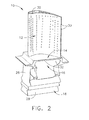
- an exemplary gas turbine engine blade 10 has several sections, including a airfoil section 12 having at least an exterior surface, a platform section 14 having an exterior surface, an under platform section 16 having an exterior surface 32, and a dovetail section 18 having a shank exterior surface 26 and a serrated exterior surface 28.
- Cooling holes 30 are also shown in FIG. 2.
- the under platform metal substrate 40 shown in FIG. 3 made with the process of FIG. 1 is bare substrate of the under platform exterior surface and/or the shank exterior surface from an as-manufactured superalloy turbine blade 10.
- substrate 40 may be an aluminide layer previously applied to the under platform exterior surface and/or the shank exterior surface.
- the substrate 40 may also be a partially or completely degraded aluminide layer previously applied to the under platform exterior surface and/or the shank exterior surface.
- the silicon-modified diffusion aluminide coating of this invention can also be applied during original manufacture of the gas turbine engine blade (i.e., an OEM turbine blade), after the turbine blade has been in operation for a period of time, after other coatings have been removed from the turbine blade (e.g., a repair situation), etc.
- the metal substrate 40 of the gas turbine engine blade 10 can comprise any of a variety of metals, or more typically metal alloys, including those based on nickel, cobalt and/or iron alloys.
- Substrate 40 typically comprises a superalloy based on nickel, cobalt and/or iron. Such superalloys are well-known in the art.
- the substrate is a nickel-base superalloy.
- Turbine blade substrate 40 more typically comprises a nickel-based alloy, and particularly a nickel-based superalloy, that has more nickel than any other element.
- the turbine blade 40 may be a new-make turbine blade or a turbine blade selected from the group consisting of a repaired used blade, an upgraded used blade, and a restored used blade.
- the nickel-based superalloy can be strengthened by the precipitation of gamma prime or a related phase.
- a nickel-based superalloy for which the corrosion resistant coating of this invention is particularly useful is available by the trade name René N5, having a nominal composition in weight percent of about 7.5 percent cobalt, about 7.0 percent chromium, about 1.5 percent molybdenum, about 5 percent tungsten, about 3 percent rhenium, about 6.5 percent tantalum, about 6.2 percent aluminum, about 0.15 percent hafnium, about 0.05 percent carbon, about 0.004 percent boron, about 0.01 percent yttrium, balance nickel and incidental impurities.
- René N5 having a nominal composition in weight percent of about 7.5 percent cobalt, about 7.0 percent chromium, about 1.5 percent molybdenum, about 5 percent tungsten, about 3 percent rhenium, about 6.5 percent tantalum, about 6.2 percent aluminum, about 0.15 percent hafnium, about 0.05 percent carbon, about 0.004 percent boron, about 0.01 percent yttrium, balance nickel and incidental impurities.
- René 142 Another nickel-based superalloy for which the corrosion resistant coating is particularly useful is available under the trade name René 142, having a nominal composition in weight percent of about 12 percent cobalt, about 6.8 percent chromium, about 1.5 percent molybdenum, about 4.9 percent tungsten, about 2.8 percent rhenium, about 6.35 percent tantalum, about 6.15 percent aluminum, about 1.5 percent hafnium, about 0.2 percent iron, about 0.1 percent manganese, about 0.12 percent carbon, about 0.015 percent boron, balance nickel and incidental impurities.
- René 142 having a nominal composition in weight percent of about 12 percent cobalt, about 6.8 percent chromium, about 1.5 percent molybdenum, about 4.9 percent tungsten, about 2.8 percent rhenium, about 6.35 percent tantalum, about 6.15 percent aluminum, about 1.5 percent hafnium, about 0.2 percent iron, about 0.1 percent manganese, about 0.12 percent carbon, about 0.015 percent boron, balance nickel and
- the next optional step 105 is the masking of a preselected portion of the turbine blade 10, wherein the portion masked is the portions of the blade 10 leaving a non-masked exterior surface selected from the group consisting of the under platform exterior surface 32, dovetail shank exterior surface 26 and combinations thereof, unmasked.
- the next optional step 110 is roughening the under platform exterior surface 32 and/or the dovetail shank exterior surface 26 to make the such substrate surface(s) 40 more receptive to the application of the coating of the present invention.
- Such roughening includes chemical and/or mechanic pretreatment. Suitable pretreatment methods include grit blasting, with or without masking of surfaces that are not to be subjected to grit blasting (see U.S.
- Patent 5,723,078 to Nagaraj et al issued March 3, 1998, especially col. 4, lines 46-66, which is incorporated by reference in its entirety), micromachining, laser etching (see U.S. Patent 5,723,078 to Nagaraj et al, issued March 3, 1998 , especially col. 4, line 67 to col. 5, line 3 and 14-17, which is incorporated by reference in its entirety), treatment with chemical etchants such as those containing hydrochloric acid, hydrofluoric acid, nitric acid, ammonium bifluorides and mixtures thereof, (see, for example, U.S. Patent 5,723,078 to Nagaraj et al, issued March 3, 1998 , especially col. 5, lines 3-10; U.S.
- water under pressure i.e., water jet treatment
- the surface 42 of metal substrate 40 is pretreated by grit blasting where surface 42 is subjected to the abrasive action of silicon carbide particles, steel particles, alumina particles or other types of abrasive particles.
- These particles used in grit blasting are typically alumina particles and typically have a particle size of from about 600 to about 35 mesh (from about 25 to about 500 micrometers), more typically from about 360 to about 35 mesh (from about 35 to about 500 micrometers).
- the next step 115 is applying a layer of silicon-modified aluminum composition on the surface 42 of the metal substrate 40.
- the silicon-modified aluminum composition can be deposited in solid form, e.g., as a flowable solid, as a cast tape (e.g., a cast tape formed as a layer or plurality layers of particulates adhered together as a coherent mass or matrix by the binder, with or without a supporting structure such as a film, strip, etc.), etc, to provide a solid layer of the silicon-modified aluminum comprising the corrosion resistant particulates and binder component.
- the silicon-modified aluminum composition is deposited as a liquid, e.g., an aqueous coating composition.
- Liquid silicon-modified aluminum composition of this invention can be deposited on substrate 40 by any manner of application for depositing liquids including pouring, flowing, dipping, brushing, spraying, rolling, etc., to provide an uncured layer of the composition comprising the particulates and binder component.
- the next optional step 120 is removing the maskant from the turbine blade 10 as known in the art, if maskant was applied in optional step 105.
- the next step 125 is heating the turbine blade 10 in a protective atmosphere (e.g. argon, etc.) or a vacuum to a preselected temperature in the range of about 600°C to about 800°C. In a preferred embodiment, the preselected temperature is in the range of about 700°C to about 800°C.
- the next step 130 is holding the temperature of the turbine blade at the preselected temperature for a preselected period of time to cause the silicon and aluminum particulate component to diffuse into the substrate to form a silicon-modified diffusion aluminide layer 52 adjacent to the substrate 40, the diffusion aluminide layer 52 having a new surface 54.
- the preselected period of time is preferably in the range of about 0.5 hours to about 4 hours.
- the fugitive binder component is burned off or vaporized during the steps of heating 125 and holding 130, leaving, at most, a loosely adherent residue on the surface of the newly formed silicon-modified diffusion aluminide layer. If any liquid carrier component is present in the deposited coating composition, the liquid carrier component is evaporated and/or vaporized during the steps of heating 125 and holding 130.
- the silicon modified diffusion aluminide layer 52 can be formed up to a thickness of about 10 mils (254 microns), and typically has a thickness in the range of from about 0.1 to about 5 mils (from about 3 to about 127 microns), more typically from about 0.5 to about 4 mils (from about 12 to about 102 microns).
- the next optional step 135 is heating the turbine blade at a second preselected temperature in the range of about 700°C to about 900°C for a second preselected period of time in the range of about 1 hour to about 4 hours to further diffuse the aluminum into the substrate 40.
- the next step 140 is cooling the turbine blade 10 to ambient temperature.
- the final step is cleaning the turbine blade as known in the art to remove any residue from the turbine blade component 10.
- Another embodiment of the present invention is a turbine blade 10 wherein the shank exterior surface 26 of the dovetail and/or the exterior surface 32 of the under platform section 16 is coated with the silicon-modified diffusion aluminide layer 52 of the present invention.
- the weight percent of silicon at the surface 54 of the silicon modified diffusion aluminide layer 52 is preferably in the range of 1 weight percent to about 10 weight percent, while the weight percent of aluminum at the surface 54 of the silicon-modified diffusion aluminide layer 52 is in the range of about 5 weight percent to about 25 weight percent.
Landscapes
- Chemical & Material Sciences (AREA)
- Engineering & Computer Science (AREA)
- Materials Engineering (AREA)
- Mechanical Engineering (AREA)
- Chemical Kinetics & Catalysis (AREA)
- Metallurgy (AREA)
- Organic Chemistry (AREA)
- General Engineering & Computer Science (AREA)
- Turbine Rotor Nozzle Sealing (AREA)
- Other Surface Treatments For Metallic Materials (AREA)
- Solid-Phase Diffusion Into Metallic Material Surfaces (AREA)
Applications Claiming Priority (1)
| Application Number | Priority Date | Filing Date | Title |
|---|---|---|---|
| US11/358,339 US7597934B2 (en) | 2006-02-21 | 2006-02-21 | Corrosion coating for turbine blade environmental protection |
Publications (2)
| Publication Number | Publication Date |
|---|---|
| EP1820875A2 true EP1820875A2 (de) | 2007-08-22 |
| EP1820875A3 EP1820875A3 (de) | 2008-04-23 |
Family
ID=37758774
Family Applications (1)
| Application Number | Title | Priority Date | Filing Date |
|---|---|---|---|
| EP06126889A Withdrawn EP1820875A3 (de) | 2006-02-21 | 2006-12-21 | Korrosionsbeschichtung für Umweltschutz einer Turbinenschaufel |
Country Status (2)
| Country | Link |
|---|---|
| US (2) | US7597934B2 (de) |
| EP (1) | EP1820875A3 (de) |
Cited By (8)
| Publication number | Priority date | Publication date | Assignee | Title |
|---|---|---|---|---|
| EP1959026A3 (de) * | 2007-02-15 | 2009-05-06 | Rolls-Royce Deutschland Ltd & Co KG | Verfahren zur Ausbildung einer Aluminium-Diffusionsschicht zum Oxidationsschutz |
| EP2239346A1 (de) | 2009-04-09 | 2010-10-13 | Siemens Aktiengesellschaft | Schlickerzusammensetzung um eine Superlegierungskomponente zu aluminisieren |
| WO2010134918A1 (en) * | 2009-05-21 | 2010-11-25 | General Electric Company | Methods for improving corrosion and oxidation resistance to the under platform region of a gas turbine blade |
| WO2010134917A1 (en) * | 2009-05-21 | 2010-11-25 | General Electric Company | Corrosion resistant articles |
| DE102011011200A1 (de) | 2011-02-14 | 2012-08-16 | Dechema Gesellschaft Für Chemische Technik Und Biotechnologie E.V. | Verfahren zur Erzeugung von Diffusionsschichten ohne Aktivator über Metallfolien |
| DE102012010602A1 (de) * | 2012-05-30 | 2013-12-05 | Dechema-Forschungsinstitut | Verfahren zum Beschichten eines kobalt-, nickel- und/oder eisenhaltigenSubstrats mit einer korrosionsbeständigen Schicht |
| EP2940250A1 (de) * | 2014-03-19 | 2015-11-04 | Honeywell International Inc. | Turbinenleitschaufen mit Gleitgelenken mit oxidationsbeständiger Dichtungsmaterialimprägnierung und Verfahren zur Herstellung davon |
| DE112008003399B4 (de) * | 2007-12-20 | 2016-08-25 | General Electric Co. | Verfahren zum Reparieren von Sperrüberzügen |
Families Citing this family (14)
| Publication number | Priority date | Publication date | Assignee | Title |
|---|---|---|---|---|
| US20090239061A1 (en) * | 2006-11-08 | 2009-09-24 | General Electric Corporation | Ceramic corrosion resistant coating for oxidation resistance |
| US8790789B2 (en) * | 2008-05-29 | 2014-07-29 | General Electric Company | Erosion and corrosion resistant coatings, methods and articles |
| US20110076410A1 (en) * | 2009-09-30 | 2011-03-31 | Andrew Jay Skoog | Method for making strain tolerant corrosion protective coating compositions and coated articles |
| US20110076480A1 (en) * | 2009-09-30 | 2011-03-31 | Andrew Jay Skoog | Strain tolerant corrosion protective coating compositions and coated articles |
| US9012824B2 (en) * | 2011-03-16 | 2015-04-21 | Raytheon Company | Low-heat-transfer interface between metal parts |
| US9845526B2 (en) * | 2012-04-03 | 2017-12-19 | MTU Aero Engines AG | Slip and process for producing an aluminum diffusion layer |
| EP3012343B1 (de) | 2014-10-20 | 2020-04-22 | United Technologies Corporation | Beschichtungssystem für innengekühlte komponente und verfahren dafür |
| DE102015203729A1 (de) * | 2015-03-03 | 2016-09-22 | MTU Aero Engines AG | Vorrichtung und Verfahren zum partiellen Abdecken einer Bauteilzone eines Bauteils |
| CA2937308C (en) | 2015-07-27 | 2023-10-24 | Pratt & Whitney Canada Corp. | Turbine blade with hot-corrosion-resistant coating |
| US9803139B1 (en) | 2016-06-24 | 2017-10-31 | General Electric Company | Process for removing aluminum-silicon coatings from metallic structures, and related processes for preparing magnetic components |
| DE102016224546A1 (de) * | 2016-12-09 | 2018-06-14 | MTU Aero Engines AG | HEIßGASKORROSIONS - UND OXIDATIONSSCHUTZSCHICHT FÜR TIAL-LEGIERUNGEN |
| DE102017212075A1 (de) | 2017-07-14 | 2019-01-17 | MTU Aero Engines AG | Verfahren zum Beschichten eines Bauteils für den Heißgaskanal einer Strömungsmaschine |
| DE202019107269U1 (de) * | 2019-12-30 | 2020-01-23 | C4 Laser Technology GmbH | Verschleiß- und Korrosionsschutzschicht aufweisende Bremseinheit |
| CN115725941B (zh) * | 2022-11-14 | 2025-01-24 | 中国航发沈阳黎明航空发动机有限责任公司 | 一种航空发动机涡轮叶片等离子沉积铝硅涂层制备方法 |
Family Cites Families (28)
| Publication number | Priority date | Publication date | Assignee | Title |
|---|---|---|---|---|
| USRE26001E (en) * | 1966-04-26 | Diffusion coating of metals | ||
| US3656919A (en) * | 1965-11-01 | 1972-04-18 | Avco Corp | Composite metal having a nickel alloy base with a diffused coating |
| US4310574A (en) * | 1980-06-20 | 1982-01-12 | The United States Of America As Represented By The Administrator Of The National Aeronautics And Space Administration | Method of protecting a surface with a silicon-slurry/aluminide coating |
| US4500364A (en) * | 1982-04-23 | 1985-02-19 | Exxon Research & Engineering Co. | Method of forming a protective aluminum-silicon coating composition for metal substrates |
| GB2167773A (en) * | 1984-11-29 | 1986-06-04 | Secr Defence | Improvements in or relating to coating processes |
| GB9210683D0 (en) * | 1992-05-19 | 1992-07-08 | Rolls Royce Plc | Multiplex aluminide-silicide coating |
| GB9218859D0 (en) * | 1992-09-05 | 1992-10-21 | Rolls Royce Plc | Aluminide-silicide coatings |
| US5795659A (en) * | 1992-09-05 | 1998-08-18 | International Inc. | Aluminide-silicide coatings coated products |
| US5650235A (en) * | 1994-02-28 | 1997-07-22 | Sermatech International, Inc. | Platinum enriched, silicon-modified corrosion resistant aluminide coating |
| FR2745590B1 (fr) * | 1996-02-29 | 1998-05-15 | Snecma | Revetement de barriere thermique a sous-couche amelioree et pieces revetues par une telle barriere thermique |
| US6458473B1 (en) * | 1997-01-21 | 2002-10-01 | General Electric Company | Diffusion aluminide bond coat for a thermal barrier coating system and method therefor |
| GB9724844D0 (en) * | 1997-11-26 | 1998-01-21 | Rolls Royce Plc | A coated superalloy article and a method of coating a superalloy article |
| US6010746A (en) * | 1998-02-03 | 2000-01-04 | United Technologies Corporation | In-situ repair method for a turbomachinery component |
| US6435835B1 (en) * | 1999-12-20 | 2002-08-20 | United Technologies Corporation | Article having corrosion resistant coating |
| ATE303503T1 (de) | 1999-12-20 | 2005-09-15 | United Technologies Corp | Gegenstände mit korrosionsbeständigen beschichtungen |
| US6394755B1 (en) * | 2000-01-24 | 2002-05-28 | General Electric Company | Enhanced coating system for turbine airfoil applications |
| US6497920B1 (en) * | 2000-09-06 | 2002-12-24 | General Electric Company | Process for applying an aluminum-containing coating using an inorganic slurry mix |
| US6635362B2 (en) * | 2001-02-16 | 2003-10-21 | Xiaoci Maggie Zheng | High temperature coatings for gas turbines |
| WO2002070617A1 (en) * | 2001-03-08 | 2002-09-12 | Liburdi Engineering Limited | Method of application of a protective coating to a substrate |
| FR2827311B1 (fr) * | 2001-07-12 | 2003-09-19 | Snecma Moteurs | Procede de reparation locale de pieces revetues d'une barriere thermique |
| GB2378452A (en) * | 2001-08-09 | 2003-02-12 | Rolls Royce Plc | A metallic article having a protective coating and a method therefor |
| US6676992B2 (en) * | 2001-08-22 | 2004-01-13 | General Electric Company | Article protected by a diffusion aluminide coating applied by painting techniques |
| US6520401B1 (en) * | 2001-09-06 | 2003-02-18 | Sermatech International, Inc. | Diffusion bonding of gaps |
| CN1422974A (zh) | 2001-12-06 | 2003-06-11 | 杨锡尧 | 阻止燃气轮机叶片表面腐蚀的涂层配方与工艺 |
| EP1371812A1 (de) * | 2002-06-04 | 2003-12-17 | ALSTOM (Switzerland) Ltd | Verfahren zum Reparieren von beschädigten Laufschaufeln des Turbinenteils einer Gasturbine |
| US6881439B2 (en) * | 2002-12-04 | 2005-04-19 | General Electric Company | Aluminide coating process |
| US7056555B2 (en) * | 2002-12-13 | 2006-06-06 | General Electric Company | Method for coating an internal surface of an article with an aluminum-containing coating |
| US7270852B2 (en) * | 2003-08-04 | 2007-09-18 | General Electric Company | Aluminizing slurry compositions free of hexavalent chromium, and related methods and articles |
-
2006
- 2006-02-21 US US11/358,339 patent/US7597934B2/en not_active Expired - Fee Related
- 2006-12-21 EP EP06126889A patent/EP1820875A3/de not_active Withdrawn
-
2008
- 2008-01-02 US US11/968,368 patent/US7993759B2/en not_active Expired - Fee Related
Cited By (14)
| Publication number | Priority date | Publication date | Assignee | Title |
|---|---|---|---|---|
| EP1959026A3 (de) * | 2007-02-15 | 2009-05-06 | Rolls-Royce Deutschland Ltd & Co KG | Verfahren zur Ausbildung einer Aluminium-Diffusionsschicht zum Oxidationsschutz |
| DE112008003399B4 (de) * | 2007-12-20 | 2016-08-25 | General Electric Co. | Verfahren zum Reparieren von Sperrüberzügen |
| EP2239346A1 (de) | 2009-04-09 | 2010-10-13 | Siemens Aktiengesellschaft | Schlickerzusammensetzung um eine Superlegierungskomponente zu aluminisieren |
| WO2010115649A2 (en) | 2009-04-09 | 2010-10-14 | Siemens Aktiengesellschaft | Superalloy component and slurry composition |
| US9873936B2 (en) | 2009-04-09 | 2018-01-23 | Siemens Aktiengesellschaft | Superalloy component and slurry composition |
| GB2482459A (en) * | 2009-05-21 | 2012-02-01 | Gen Electric | Corrosion resistant articles |
| GB2482460A (en) * | 2009-05-21 | 2012-02-01 | Gen Electric | Methods for improving corrosion and oxidation resistance to the under platform region of a gas turbine blade |
| JP2012527537A (ja) * | 2009-05-21 | 2012-11-08 | ゼネラル・エレクトリック・カンパニイ | ガスタービンブレードの下部プラットフォーム領域の耐食性および耐酸化性を改善する方法 |
| WO2010134917A1 (en) * | 2009-05-21 | 2010-11-25 | General Electric Company | Corrosion resistant articles |
| WO2010134918A1 (en) * | 2009-05-21 | 2010-11-25 | General Electric Company | Methods for improving corrosion and oxidation resistance to the under platform region of a gas turbine blade |
| DE102011011200A1 (de) | 2011-02-14 | 2012-08-16 | Dechema Gesellschaft Für Chemische Technik Und Biotechnologie E.V. | Verfahren zur Erzeugung von Diffusionsschichten ohne Aktivator über Metallfolien |
| DE102012010602A1 (de) * | 2012-05-30 | 2013-12-05 | Dechema-Forschungsinstitut | Verfahren zum Beschichten eines kobalt-, nickel- und/oder eisenhaltigenSubstrats mit einer korrosionsbeständigen Schicht |
| EP2940250A1 (de) * | 2014-03-19 | 2015-11-04 | Honeywell International Inc. | Turbinenleitschaufen mit Gleitgelenken mit oxidationsbeständiger Dichtungsmaterialimprägnierung und Verfahren zur Herstellung davon |
| US9970307B2 (en) | 2014-03-19 | 2018-05-15 | Honeywell International Inc. | Turbine nozzles with slip joints impregnated by oxidation-resistant sealing material and methods for the production thereof |
Also Published As
| Publication number | Publication date |
|---|---|
| US20100040476A1 (en) | 2010-02-18 |
| US7993759B2 (en) | 2011-08-09 |
| US20070196686A1 (en) | 2007-08-23 |
| US7597934B2 (en) | 2009-10-06 |
| EP1820875A3 (de) | 2008-04-23 |
Similar Documents
| Publication | Publication Date | Title |
|---|---|---|
| US7993759B2 (en) | Corrosion coating for turbine blade environmental protection | |
| JP5226184B2 (ja) | 超合金部品の補修及び再分類 | |
| US20090047135A1 (en) | Layered corrosion resistant coating for turbine blade environmental protection | |
| US7776143B2 (en) | Particulate corrosion resistant coating composition | |
| EP1837104B1 (de) | Instandhaltung von Hochdruckturbinenplatten mit gesinterten Vorformen | |
| US7314674B2 (en) | Corrosion resistant coating composition, coated turbine component and method for coating same | |
| US7749569B2 (en) | Methods for improving corrosion and oxidation resistance to the under platform region of a gas turbine blade | |
| EP2660349B1 (de) | Verfahren zur Regenerierung einer beschichteten Superlegierungskomponente | |
| EP1077273A1 (de) | Schutz der inneren und äusseren Oberfläche einer Gasturbinenschaufel | |
| JP2008111425A (ja) | ガスタービンエンジン圧縮機用摩擦皮膜 | |
| EP1710398A1 (de) | Turbinnenkomponente ausser Turbinnenschaufel mit einer korrosionsbeständigen Keramikschicht und Verfahren zu deren Herstellung | |
| EP1295960A2 (de) | Oxidation von Gasturbinen-Scheiben und Dichtungen vor Gebrauch | |
| CN101508070A (zh) | 修理发动机部件的方法 | |
| EP1752559A2 (de) | Verfahren zum Wiederherstellen von Teilen einer Turbine | |
| JP4579383B2 (ja) | 緻密セラミック遮熱皮膜を表面から除去する方法 | |
| US20240375155A1 (en) | Method of removing contaminants from a diffusion-coated component | |
| CA2761697A1 (en) | Methods for improving corrosion and oxidation resistance to the under platform region of a gas turbine blade | |
| CA2761714A1 (en) | Corrosion resistant articles | |
| US20130230406A1 (en) | Corrosion Resistant Articles | |
| Pedraza et al. | Refurbishment | |
| US6933012B2 (en) | Method for protecting a surface with a silicon-containing diffusion coating |
Legal Events
| Date | Code | Title | Description |
|---|---|---|---|
| PUAI | Public reference made under article 153(3) epc to a published international application that has entered the european phase |
Free format text: ORIGINAL CODE: 0009012 |
|
| AK | Designated contracting states |
Kind code of ref document: A2 Designated state(s): AT BE BG CH CY CZ DE DK EE ES FI FR GB GR HU IE IS IT LI LT LU LV MC NL PL PT RO SE SI SK TR |
|
| AX | Request for extension of the european patent |
Extension state: AL BA HR MK YU |
|
| RIN1 | Information on inventor provided before grant (corrected) |
Inventor name: GORMAN, MARK DANIEL Inventor name: NAGARAJ, BANGALORE ASWATHA |
|
| PUAL | Search report despatched |
Free format text: ORIGINAL CODE: 0009013 |
|
| AK | Designated contracting states |
Kind code of ref document: A3 Designated state(s): AT BE BG CH CY CZ DE DK EE ES FI FR GB GR HU IE IS IT LI LT LU LV MC NL PL PT RO SE SI SK TR |
|
| AX | Request for extension of the european patent |
Extension state: AL BA HR MK RS |
|
| 17P | Request for examination filed |
Effective date: 20081023 |
|
| 17Q | First examination report despatched |
Effective date: 20081203 |
|
| AKX | Designation fees paid |
Designated state(s): DE FR GB |
|
| STAA | Information on the status of an ep patent application or granted ep patent |
Free format text: STATUS: THE APPLICATION IS DEEMED TO BE WITHDRAWN |
|
| 18D | Application deemed to be withdrawn |
Effective date: 20170701 |