EP1824751B1 - Beutel mit integralen klappen zum festbinden über dem beutel - Google Patents
Beutel mit integralen klappen zum festbinden über dem beutel Download PDFInfo
- Publication number
- EP1824751B1 EP1824751B1 EP05808375A EP05808375A EP1824751B1 EP 1824751 B1 EP1824751 B1 EP 1824751B1 EP 05808375 A EP05808375 A EP 05808375A EP 05808375 A EP05808375 A EP 05808375A EP 1824751 B1 EP1824751 B1 EP 1824751B1
- Authority
- EP
- European Patent Office
- Prior art keywords
- bag
- roll
- aperture
- cut
- protrusion
- Prior art date
- Legal status (The legal status is an assumption and is not a legal conclusion. Google has not performed a legal analysis and makes no representation as to the accuracy of the status listed.)
- Expired - Lifetime
Links
Images


Classifications
-
- B—PERFORMING OPERATIONS; TRANSPORTING
- B65—CONVEYING; PACKING; STORING; HANDLING THIN OR FILAMENTARY MATERIAL
- B65D—CONTAINERS FOR STORAGE OR TRANSPORT OF ARTICLES OR MATERIALS, e.g. BAGS, BARRELS, BOTTLES, BOXES, CANS, CARTONS, CRATES, DRUMS, JARS, TANKS, HOPPERS, FORWARDING CONTAINERS; ACCESSORIES, CLOSURES, OR FITTINGS THEREFOR; PACKAGING ELEMENTS; PACKAGES
- B65D33/00—Details of, or accessories for, sacks or bags
- B65D33/002—Rolls, strips or like assemblies of bags
-
- B—PERFORMING OPERATIONS; TRANSPORTING
- B65—CONVEYING; PACKING; STORING; HANDLING THIN OR FILAMENTARY MATERIAL
- B65D—CONTAINERS FOR STORAGE OR TRANSPORT OF ARTICLES OR MATERIALS, e.g. BAGS, BARRELS, BOTTLES, BOXES, CANS, CARTONS, CRATES, DRUMS, JARS, TANKS, HOPPERS, FORWARDING CONTAINERS; ACCESSORIES, CLOSURES, OR FITTINGS THEREFOR; PACKAGING ELEMENTS; PACKAGES
- B65D33/00—Details of, or accessories for, sacks or bags
- B65D33/06—Handles
- B65D33/08—Hand holes
-
- B—PERFORMING OPERATIONS; TRANSPORTING
- B65—CONVEYING; PACKING; STORING; HANDLING THIN OR FILAMENTARY MATERIAL
- B65D—CONTAINERS FOR STORAGE OR TRANSPORT OF ARTICLES OR MATERIALS, e.g. BAGS, BARRELS, BOTTLES, BOXES, CANS, CARTONS, CRATES, DRUMS, JARS, TANKS, HOPPERS, FORWARDING CONTAINERS; ACCESSORIES, CLOSURES, OR FITTINGS THEREFOR; PACKAGING ELEMENTS; PACKAGES
- B65D33/00—Details of, or accessories for, sacks or bags
- B65D33/16—End- or aperture-closing arrangements or devices
- B65D33/1608—Integral flaps for tying above the bag
-
- Y—GENERAL TAGGING OF NEW TECHNOLOGICAL DEVELOPMENTS; GENERAL TAGGING OF CROSS-SECTIONAL TECHNOLOGIES SPANNING OVER SEVERAL SECTIONS OF THE IPC; TECHNICAL SUBJECTS COVERED BY FORMER USPC CROSS-REFERENCE ART COLLECTIONS [XRACs] AND DIGESTS
- Y10—TECHNICAL SUBJECTS COVERED BY FORMER USPC
- Y10T—TECHNICAL SUBJECTS COVERED BY FORMER US CLASSIFICATION
- Y10T428/00—Stock material or miscellaneous articles
- Y10T428/13—Hollow or container type article [e.g., tube, vase, etc.]
- Y10T428/1334—Nonself-supporting tubular film or bag [e.g., pouch, envelope, packet, etc.]
Definitions
- the present invention relates to a bag, and in particular to a bag, such as a bin liner, for storing refuse, or a food storage bag.
- a known refuse bag is typically rectangular in shape, and is conveniently closed before transporting the bag to a collection point.
- the bag may be closed by use of a discrete tie, usually made of wire.
- a discrete tie usually made of wire.
- the use of a discrete tie can be cumbersome, especially if the bag has been loaded to capacity, and can result in the tie being difficult to apply and/or make the bag difficult to carry.
- One such design includes a tie integral with the bag, the tie being in the form of "four shallow ears" or protrusions that extend from the body, the ears being arranged so that they have to be tied in a knot to close the bag.
- a tie integral with the bag the tie being in the form of "four shallow ears" or protrusions that extend from the body, the ears being arranged so that they have to be tied in a knot to close the bag.
- Another known design of bag incorporates a draw-tape around the mouth of the bag. Once the bag is full, the draw-tape is pulled to close the mouth of the bag, and the bag can be lifted and transported by the loop created by the draw-tape after it is pulled.
- this type of bag is more difficult to mass produce, and results in an expensive refuse bag and the tape is prone to failure.
- US Patent No. 5,908,244 discloses a bag with handle portions and each handle portion has a plurality of apertures therein. However, only one of the apertures in each handle portion is created to provide a handle. The other apertures are provided for holding a stack of bags on a rack. Therefore, US 5,908,244 does not disclose a plurality of apertures, each aperture created so as to provide a handle.
- US 2002/0020648 discloses a roll of plastic bags which are joined "mouth to mouth” and “bottom to bottom” and are separated by sealed seams and perforations. However, US 2002/0020648 does not disclose a plurality of apertures in a pair of elongate protrusions, each aperture created so as to provide a handle.
- a bag comprising an elongate body having a closed end defining a bottom of the bag and an open end defining a mouth of the bag and wherein the body is provided with a pair of integral elongate protrusions that extend away from the body, the pair of elongate protrusions being arranged such that they can be tied together to close the mouth of the bag, wherein each protrusion is provided with a plurality of apertures formed therein, and wherein each aperture is created so as to provide a handle.
- the present invention therefore, provides a refuse bag with handles, the design of which can be easily tied and carried.
- the bag can be easily mass-produced resulting in no material wastage to produce the handles.
- the apertures may be created by a punch so as create cut-outs.
- the punch may allow the cut-outs to be fully removed.
- the punch may be designed to leave a portion of each cut-out connected to its protrusion, so as to form an "upside-down cut-out". The feature of an "upside-down cut-out" reduces the possibility of tear propagation when a loaded bag is lifted.
- upside down cut-out it is meant that the material is punched to form a cut-out where at least some of the material closest to the body of the bag is not penetrated or weakened, so that the material of the cut-out remains connected to the protrusion.
- each aperture is located in a portion of the respective protrusion close to the body of the bag. Providing the apertures in these locations maximises the material above the apertures, and thereby maximises the strength of the elongate protrusions when they are used as a handle for lifting or carrying the bag.
- Each protrusion is provided with a plurality of apertures formed therein. This provides the advantage that the weight of the bag, when loaded, is distributed over the material surrounding the apertures. Therefore, within reason, the more apertures that are provided in the protrusions the greater the lift capacity of the bag will be.
- the elongate protrusions are curved in shape, and preferably extend sufficiently from the body to allow a single cross-over of the protrusions to form a hitch to close the mouth of the bag, or a double cross-over to form a simple knot, to prevent any articles from falling out of the bag.
- the bag is made from a thermoplastics material such as polyethylene.
- the polyethylene material may be high, medium, low or linear low density or any blend of thermoplastics material.
- the closed end of the bag is formed by heat sealing.
- a roll of material defining a plurality of bags, each bag comprising an elongate body having a closed end defining a bottom of that bag and an open end defining a mouth of that bag, wherein the body of each bag is provided with a pair of integral elongate protrusions that extend away from that body, wherein each protrusion is provided with a plurality of apertures formed therein, and wherein each aperture is created so as to provide a handle, and each bag being formed so as to be separable from the roll.
- Each elongate protrusion will have at least two apertures formed therein.
- each aperture is defined by a cut-out.
- the cut-out is an "upside-down cut-out".
- the plurality of apertures may be formed by removal of material.
- the material of the roll is a thermoplastics material, for example polyethylene.
- the polyethylene material may be high, medium, low or linear low density or any blend of thermoplastics material.
- each bag is created by heat sealing across the width of the material.
- the material may be provided with a respective first weakened line adjacent to the closed end of each bag to enable that bag to be separated from the next bag on the roll.
- each bag may be provided with a second weakened line defining elongate protrusions extending away from the body of that bag.
- the first and second weakened lines may be perforated lines of weakness.
- the perforations forming the perforated lines of weakness are of equal length.
- the bags are arranged on the roll such that the open end of one bag is located adjacent to the open end of an adjacent bag.
- the material is folded before forming a roll.
- the material is centre folded, that is to say the material is folded along its longitudinal axis.
- the material may be 'c' folded.
- 'c' folded means that the ends extending along the length of the material are folded towards the longitudinal axis of the material, and thereby form a c-shape when viewed from an end of the material.
- a method of providing a roll of bags comprising the steps of providing a tube of material, heat sealing across the width of the material to form a closed end of each bag; creating a respective first weakened line adjacent to each closed end and a respective second weakened line at an open end of each bag to enable one end of each bag to be separated from an adjacent bag, wherein each second weakened line is shaped so that each bag has elongate protrusions extending away from a body of the bag at its open end, and creating a plurality of apertures in each protrusion wherein each aperture is created so as to provide a handle.
- the step of creating an aperture in the elongate protrusions may be performed by punching.
- the material is centre folded before creating the second weakened line and, preferably, before punching. Centre folding the material enables a single punch to create two apertures in each elongate protrusion.
- the method includes the step of c-folding the material so as to reduce the width of the body before converting the material into a roll.
- the method includes the step of double c-folding the material.
- the method may also include the step of folding the free ends at the centre of the material outwardly to increase the thickness at the edges of the material before converting into a roll.
- a plastic bag 10 for handling refuse such as domestic waste.
- the bag 10 comprises an elongate body 12 having a closed end, defining a bottom 14 of the bag, the closed end being created by heat sealing across the width of the body of the bag.
- an opening defines a mouth 16 of the bag.
- the bag 10 also includes a single pair of integral elongate protrusions 18 that extend away from the body 12, each elongate protrusion including two apertures or holes 20 created by removing a portion of material enabling the elongate protrusions to act as handles.
- the bag 10 is made from a thermoplastics material such as polyethylene.
- the apertures 20 provided in the elongate protrusions 18 form a closed handle, that is to say an opening, surrounded by material, into which a user can place a hand so as to lift or carry the bag 10.
- Providing a closed handle provides the advantage that a user does not merely relying on gripping around the protrusions or ears to carry the bag 10, which can result in the protrusions or "ears" slipping out of the user's hand, especially when the bag is heavily laden.
- the apertures 20 of the bag 10 are located in each elongate protrusion 18 at a position which is relatively close to the body 12 of the bag. Positioning the apertures 20 in such a location maximises the material above each of the apertures, and therefore ensures maximum strength is provided when the protrusions 18 are used as handles for lifting and/or carrying the bag 10.
- the apertures 20 are formed by punching cut-outs in the material.
- the cut-outs can be completely removed by the punch as it creates the cut-outs.
- the punch may create cut-outs each of which is loosely coupled to the respective protrusion by small webs.
- the protrusions 18 are arranged to be of a sufficient length to enable them to be tied or manipulated, as illustrated in Figs 2a and 2b . That is to say, the protrusions 18 can be crossed over and pulled together to form a hitch so as to close the mouth 16 of the bag 10, and are of sufficient length to enable the protrusions to be tied in a double knot. After the knot has been tied, the protrusions 18 can be arranged so that the apertures 20 in the protrusions are coincident with one another. The bag 10 can then be lifted and carried by the user by inserting their fingers, or hand, into the apertures.
- a modified bag 40 is provided with a respective cut-out 42 in each of a pair of elongate protrusions 44.
- Each cut-out 42 is arranged so that a portion of that cut-out is not weakened or cut, and therefore remains firmly connected to, or integral with, its protrusion 44.
- the uncut or connecting portions are arranged to be portions of the cut-outs 42 closest to the body of the bag 40 forming an "upside-down cut-out". This feature reduces the possibility of tear propagation when a loaded bag 40 is lifted.
- a bag 50 is provided with four apertures 52 in each of two elongate protrusions 54 of the bag.
- the protrusions 54 are arranged to receive the fingers of a user.
- a bag 60 may be arranged to have three apertures 62, 64 and 66 provided in each of two elongate protrusions 68, wherein each aperture 62 is spaced longitudinally along the bag 60 with respect to the other apertures 64, 66 in each protrusion 68.
- a plurality of bags 80 is provided in an elongate length of thermoplastics material 82 which can be folded, and subsequently converted into a roll.
- Each of the bags 80 is arranged so as to be separable from an adjacent bag.
- the material 82 is in the form of a tube which can be extruded in this form so as to be seamless.
- the tube may be formed from a single sheet, which is folded along its length so that its free-ends overlap. The free-ends are then heat sealed so as to form a tube. Alternately, two elongate sheets may be superimposed and then heat sealed along the length of both sheets to form a tube.
- the bags 80 are arranged in a "head to head” style on the material 82. This means that the bags 80 are arranged such that an open end 88 of one bag is located adjacent to the open end of a next bag, and subsequently, the closed end 84 of one bag is adjacent to a closed end of another bag, as illustrated in Fig. 6 . Having the bags 80 arranged in a "head to head” style ensures no waste.
- each closed end 84 is heat sealed across its width so as to form each closed end 84 so as define a bottom of each bag 80.
- a first perforated line of weakness 86 is created so as to be located adjacent to each closed end 84, thereby allowing respective bags 80 either side of each first perforated line 86 to be separated from one another when required. Due to the layout of the bags 80 on the material 82, each first perforated line of weakness 86 is located between the closed ends 84 of two adjacent bags.
- Each open end 88 is defined in the material 82 by a respective second perforated line of weakness 90 the length of each perforation being equal.
- the shape of the second perforated line 90 is such that it defines the shape of each elongate protrusion 92.
- the second perforated line 90 is arranged such that each of the protrusions 92 is slightly curved in shape.
- the protrusions can be made in any one of a number of shapes.
- the process of defining each of the bags 80 on the material 82 includes the step of centre folding the material along its longitudinal axis. Prior to centre folding the material is heat sealed to form closed ends 84 of each bag and the perforated lines of weakness 86 are created adjacent to the closed end of each bag. After the material 82 is centre folded, apertures 94 are created by punching one or more holes in each of the protrusions 92.
- the advantage of centre folding the material 82 is that it reduces the number of punches required, for example, a single punch can be used to create two apertures in each protrusion when the material is centre folded.
- the second perforated lines 90 which define the open ends of each bag 80 can also be made after the material 82 has been centre folded.
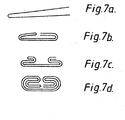
- Figs. 6 and 7a illustrate the material in a centre folded arrangement.
- the material before converting the material 82 into a roll, the material can be 'c' folded by bringing the edges of the material towards the longitudinal axis of the centre folded material as illustrated in Fig. 7b . This step reduces the width of the bag before it is converted into a roll.
- the material 82 may also include the step of folding the free ends at the centre of the bag outwardly, as illustrated in Fig. 7c , so that the material is reverse 'c' folded.
- the process may include the step of folding the edges of the material towards the longitudinal axis of the centre of the folded material after the first 'c' fold, as illustrated in Fig. 7d , so that the material is double 'c' folded.
- the bags are suitable for use as bin liners for storing refuse and as food storage bags.
- the use of the bags is not so limited, and other uses are contemplated, for example, storing clothes or various raw materials prior to production, toys, packaging etc.
- the person skilled in the art would modify the dimensions of the bag accordingly to suit the particular intended use.
Landscapes
- Engineering & Computer Science (AREA)
- Mechanical Engineering (AREA)
- Bag Frames (AREA)
- Container Filling Or Packaging Operations (AREA)
- Closing Of Containers (AREA)
- Supplying Of Containers To The Packaging Station (AREA)
- Packages (AREA)
- Making Paper Articles (AREA)
- Control And Other Processes For Unpacking Of Materials (AREA)
- Air Bags (AREA)
- Sampling And Sample Adjustment (AREA)
Claims (23)
- Beutel (10), umfassend einen länglichen Körper (12) mit einem geschlossenen Ende, das einen Boden (14) des Beutels definiert, und mit einem offenen Ende, das eine Öffnung (16) des Beutels definiert, wobei der Körper (12) mit einem Paar integraler Vorsprünge (18) versehen ist, die sich von dem Körper (12) weg erstrecken und die derart ausgebildet und angeordnet sind, dass sie zum Verschließen der Beutelöffnung (16) miteinander verschnürt werden können, wobei jeder Vorsprung (18) mit einer Mehrzahl von darin gebildeten Öffnungen (20) versehen ist und wobei jede Öffnung (20) derart ausgebildet ist, dass sie einen Griff bereitstellt.
- Beutel (10) nach Anspruch 1, wobei jede Öffnung (20) derart bemessen ist, dass der Finger einer Hand in die Öffnung (20) gesteckt werden kann.
- Beutel (10) nach Anspruch 1 oder Anspruch 2, wobei jede Öffnung (20) durch einen Ausschnitt (42) definiert ist.
- Beutel (10) nach einem der Ansprüche 1 bis 3, wobei jede Öffnung (20) durch einen ausgeschnittenen Bereich (42) derart definiert ist, dass der ausgeschnittene Bereich (42) mit einem zugehörigen Vorsprung (44) verbunden bleibt.
- Beutel (10) nach einem der Ansprüche 1 bis 4, wobei jede Öffnung (20) durch einen "auf dem Kopf stehenden Ausschnitt" definiert ist.
- Beutel (10) nach einem der Ansprüche 1 bis 5, wobei sich jede Öffnung (20) in einem Bereich des jeweiligen Vorsprungs (18) in der Nähe des Beutelkörpers befindet.
- Beutel (10) nach einem der vorhergehenden Ansprüche, wobei der Beutel (10) aus einem thermoplastischen Material wie Polyethylen hergestellt ist.
- Materialrolle (82), die eine Vielzahl von Beuteln (80) definiert, wobei jeder Beutel (80) einen länglichen Körper mit einem geschlossenen Ende (84) umfasst, das den Boden dieses Beutels definiert, und mit einem offenen Ende (88), das die Öffnung dieses Beutels definiert, wobei der Körper jedes Beutels (80) mit einem Paar integraler länglicher Vorsprünge (92) versehen ist, die sich von diesem Körper weg erstrecken, wobei jeder Vorsprung mit einer Mehrzahl von darin gebildeten Öffnungen (94) versehen ist und wobei die jede Öffnung (94) derart ausgebildet ist, dass sie einen Griff bereitstellt, und wobei jeder Beutel (80) von der Rolle abtrennbar ausgebildet ist.
- Rolle nach Anspruch 8, wobei jede Öffnung (94) durch einen Ausschnitt (42) definiert ist.
- Rolle nach Anspruch 8, wobei jede Öffnung (94) durch einen ausgeschnittenen Bereich (42) derart definiert ist, dass der ausgeschnittene Bereich (42) mit dem zugehörigen Vorsprung (92) verbunden bleibt.
- Rolle nach einem der Ansprüche 8 bis 10, wobei jede Öffnung (94) durch einen "auf dem Kopf stehenden Ausschnitt" definiert ist.
- Rolle nach Anspruch 8, wobei jede Öffnung (94) durch das Entfernen von Material aus der Rolle gebildet ist.
- Rolle nach einem der Ansprüche 8 bis 12, wobei die Materialrolle (82) angrenzend an das geschlossene Ende (84) jedes Beutels (80) mit einer jeweiligen ersten Schwächungslinie (86) versehen ist, die ein Abtrennen des Beutels von dem nächsten Beutel auf der Rolle ermöglicht, und wobei ein offenes Ende (88) jedes Beutels (80) mit der zweiten Schwächungslinie (90) versehen ist, die längliche Vorsprünge (92) definiert, die sich von dem Körper dieses Beutels weg erstrecken, um ein Abtrennen dieses Beutels von dem nächsten Beutel auf der Rolle zu ermöglichen.
- Rolle nach Anspruch 13, wobei die erste (86) und die zweite (90) Schwächungslinie perforierte Schwächungslinien sind.
- Rolle nach Anspruch 14, wobei die Perforationen, die die perforierten Schwächungslinien (86, 90) bilden, gleich lang sind.
- Rolle nach einem der Ansprüche 8 bis 15, wobei die Beutel (80) derart auf den Rollen angeordnet sind, dass das offene Ende (88) eines Beutels angrenzend an das offene Ende (88) eines angrenzenden Beutels angeordnet ist.
- Rolle nach einem der Ansprüche 8 bis 16, wobei das Material (82) vor dem Bilden einer Rolle gefaltet wird.
- Verfahren zum Bereitstellen einer Rolle von Beuteln (80), wobei das Verfahren die folgenden Schritte umfasst:Bereitstellen eines Schlauchs von Material (82), Heißsiegeln über die Breite des Materials (82), zum Bilden eines geschlossenen Endes (84) jedes Beutels, Schaffen einer jeweiligen ersten Schwächungslinie (86) angrenzend an jedes geschlossene Ende (84) und einer jeweiligen zweiten Schwächungslinie (90) an einem offenen Ende (88) jedes Beutels, um das Abtrennen jedes Endes jedes Beutels von dem angrenzenden Beutel zu ermöglichen, wobei jede zweite Schwächungslinie (90) derart geformt wird, dass jeder Beutel längliche Vorsprünge (92) besitzt, die sich von einem Körper des Beutels an seinem offenen Ende (88) weg erstrecken, und Schaffen einer Mehrzahl von Öffnungen (94) in jedem Vorsprung (92), wobei jede Öffnung (94) derart ausgebildet wird, dass sie einen Griff bereitstellt.
- Verfahren nach Anspruch 18, ferner umfassend den Schritt des Schaffens von Öffnungen (94) in den länglichen Vorsprüngen (92) durch Stanzen.
- Verfahren nach Anspruch 18 oder Anspruch 19, wobei das Material (82) in der Mitte gefaltet wird, bevor die zweite Schwächungslinie (90) hergestellt wird.
- Verfahren nach einem der Ansprüche 18 bis 20, ferner umfassend den Schritt einer C-Faltung des Materials (82).
- Verfahren nach einem der Ansprüche 18 bis 21, ferner umfassend den Schritt einer Doppel-C-Faltung.
- Verfahren nach einem der Ansprüche 18 bis 22, ferner umfassend den Schritt des Nachaußenfaltens des freien Endes in der Mitte des Materials, um die Dicke an den Kanten des Materials zu vergrößern, bevor das Material in eine Rolle umgewandelt wird.
Priority Applications (1)
| Application Number | Priority Date | Filing Date | Title |
|---|---|---|---|
| PL05808375T PL1824751T3 (pl) | 2004-11-24 | 2005-11-24 | Torba z integralnymi klapami do zawiązywania powyżej torby |
Applications Claiming Priority (2)
| Application Number | Priority Date | Filing Date | Title |
|---|---|---|---|
| GBGB0425844.8A GB0425844D0 (en) | 2004-11-24 | 2004-11-24 | A bag |
| PCT/GB2005/004517 WO2006056784A1 (en) | 2004-11-24 | 2005-11-24 | A bag with integral flaps for tying above the bag |
Publications (2)
| Publication Number | Publication Date |
|---|---|
| EP1824751A1 EP1824751A1 (de) | 2007-08-29 |
| EP1824751B1 true EP1824751B1 (de) | 2010-01-27 |
Family
ID=33561294
Family Applications (1)
| Application Number | Title | Priority Date | Filing Date |
|---|---|---|---|
| EP05808375A Expired - Lifetime EP1824751B1 (de) | 2004-11-24 | 2005-11-24 | Beutel mit integralen klappen zum festbinden über dem beutel |
Country Status (8)
| Country | Link |
|---|---|
| US (1) | US8083409B2 (de) |
| EP (1) | EP1824751B1 (de) |
| AT (1) | ATE456517T1 (de) |
| DE (1) | DE602005019198D1 (de) |
| GB (2) | GB0425844D0 (de) |
| PL (1) | PL1824751T3 (de) |
| RU (1) | RU2355613C2 (de) |
| WO (1) | WO2006056784A1 (de) |
Families Citing this family (18)
| Publication number | Priority date | Publication date | Assignee | Title |
|---|---|---|---|---|
| NZ569369A (en) * | 2005-12-30 | 2011-03-31 | Glad Products Co | Tear resistant bag using a opening defined by peaks and valleys where the peaks tie together to close the bag |
| US20100195937A1 (en) * | 2009-02-05 | 2010-08-05 | The Glad Products Company | Bag |
| US8790009B2 (en) | 2010-07-06 | 2014-07-29 | B3 Plastics, Llc | Bag with secondary handle |
| US20130279831A1 (en) | 2012-04-18 | 2013-10-24 | Texas Ice Express, LLC | Bag closure construction |
| WO2014032024A1 (en) | 2012-08-23 | 2014-02-27 | Waterview Innovation, Llc | Reusable multi-purpose bag formed of nonwoven fibrous material |
| US9266647B2 (en) * | 2012-08-23 | 2016-02-23 | Waterview Innovation, Llc | Reusable shopping bag having multiple secondary uses |
| EP2735521A1 (de) * | 2012-11-21 | 2014-05-28 | Mondi Consumer Packaging International AG | Flachgelegter Folienbeutel zum Erhitzen von Lebensmitteln |
| US10414547B2 (en) * | 2014-12-04 | 2019-09-17 | API Industries, Inc. | Flap tie bag |
| RU2697771C1 (ru) * | 2019-03-14 | 2019-08-19 | Александр Васильевич Бобровских | Перфорированный мешок для кухонной мойки |
| USD906124S1 (en) | 2019-03-20 | 2020-12-29 | Reynolds Consumer Products LLC | Top portion of a bag |
| RU2704457C1 (ru) * | 2019-04-22 | 2019-10-28 | Александр Васильевич Бобровских | Биомешок с перфорацией для кухонной мойки |
| USD900627S1 (en) | 2019-04-23 | 2020-11-03 | Checker Food Products Company | Plastic bag with perforations |
| USD900628S1 (en) | 2019-04-23 | 2020-11-03 | Checker Food Products Company | Plastic bag with perforations |
| RU192425U1 (ru) * | 2019-07-03 | 2019-09-16 | Федеральное государственное бюджетное образовательное учреждение высшего образования "Волгоградский государственный технический университет" (ВолгГТУ) | Мешок для мусорного бака |
| RU192426U1 (ru) * | 2019-07-03 | 2019-09-16 | Федеральное государственное бюджетное образовательное учреждение высшего образования "Волгоградский государственный технический университет" (ВолгГТУ) | Мешок для мусорного бака |
| RU194990U1 (ru) * | 2019-11-07 | 2020-01-10 | Евгений Абрамович Бронштейн | Лента из мешков из полимерной плёнки, имеющих две ручки и два выступа для связывания друг с другом |
| RU196771U1 (ru) * | 2020-01-14 | 2020-03-16 | Евгений Абрамович Бронштейн | Лента из мешков из полимерной плёнки |
| GB2623051A (en) * | 2022-10-06 | 2024-04-10 | Charles Richardson Philip | Li tie |
Family Cites Families (17)
| Publication number | Priority date | Publication date | Assignee | Title |
|---|---|---|---|---|
| FI45539C (fi) * | 1967-01-24 | 1972-07-10 | Suominen Heikki S | Kannikkeella tai ripustimella varustettu muovipussi. |
| US3402749A (en) * | 1967-03-10 | 1968-09-24 | Minigrip Inc | Plastic film shopping bag |
| US4445230A (en) * | 1982-06-17 | 1984-04-24 | Spadaro Giorgio I | Bag with integral closure tie |
| US4759639A (en) * | 1986-11-24 | 1988-07-26 | Dematteis Robert B | Thermoplastic bag |
| GB2208843A (en) * | 1987-08-19 | 1989-04-19 | Flexible Bag Manufacturing Com | Flexible refuse bags |
| DE8716803U1 (de) * | 1987-12-22 | 1988-02-18 | Stiegler GmbH Maschinenfabrik, 7062 Rudersberg | Beutelrolle mit Beuteln aus thermoplastischer Kunststoffolie |
| JPH02125721A (ja) * | 1988-05-13 | 1990-05-14 | Lourence C J Greyvenstein | 連続形状パーフォレーション材料 |
| FR2632274B1 (fr) * | 1988-06-06 | 1990-09-21 | Capy Gilbert | Dispositif de fermeture des sacs a parois minces et souples |
| GB9222933D0 (en) * | 1991-11-04 | 1992-12-16 | Greyvenstein Lourence C J | Refuse bags |
| RU2043260C1 (ru) * | 1992-05-22 | 1995-09-10 | Юрий Васильевич Пименов | Мешок |
| US5720557A (en) * | 1996-03-01 | 1998-02-24 | Reynolds Consumer Products, Inc. | Tack and tie bags |
| JPH10338302A (ja) * | 1997-06-05 | 1998-12-22 | Kiyoshi Matsumura | 塵芥収納用袋 |
| US5908244A (en) * | 1998-03-05 | 1999-06-01 | Galambos; Louis G. | Plastic film bag with locking closure feature |
| US6065871A (en) * | 1999-03-04 | 2000-05-23 | Rex International Incorporated | Bag with tear-resistant handle |
| US20020020648A1 (en) * | 2000-06-02 | 2002-02-21 | Richard Lam | Plastic bag roll |
| DE20118417U1 (de) * | 2001-11-13 | 2002-02-28 | COMPO GmbH & Co. KG, 48157 Münster | Aus Folie gebildetes Behältnis, insbesondere Behältnis für Blumenerde |
| DE20219944U1 (de) * | 2002-01-04 | 2003-04-03 | Toppac Ag, Schwarzenbach | Sack aus schlauchförmiger Kunststofffolie |
-
2004
- 2004-11-24 GB GBGB0425844.8A patent/GB0425844D0/en not_active Ceased
-
2005
- 2005-11-24 RU RU2007122448/12A patent/RU2355613C2/ru active
- 2005-11-24 US US11/720,096 patent/US8083409B2/en not_active Expired - Fee Related
- 2005-11-24 EP EP05808375A patent/EP1824751B1/de not_active Expired - Lifetime
- 2005-11-24 PL PL05808375T patent/PL1824751T3/pl unknown
- 2005-11-24 DE DE602005019198T patent/DE602005019198D1/de not_active Expired - Lifetime
- 2005-11-24 AT AT05808375T patent/ATE456517T1/de not_active IP Right Cessation
- 2005-11-24 WO PCT/GB2005/004517 patent/WO2006056784A1/en not_active Ceased
- 2005-11-24 GB GB0523943A patent/GB2422817B/en not_active Expired - Fee Related
Also Published As
| Publication number | Publication date |
|---|---|
| GB0523943D0 (en) | 2006-01-04 |
| US20090004414A1 (en) | 2009-01-01 |
| DE602005019198D1 (de) | 2010-03-18 |
| GB0425844D0 (en) | 2004-12-29 |
| WO2006056784A9 (en) | 2006-08-10 |
| RU2007122448A (ru) | 2008-12-27 |
| ATE456517T1 (de) | 2010-02-15 |
| RU2355613C2 (ru) | 2009-05-20 |
| PL1824751T3 (pl) | 2010-08-31 |
| US8083409B2 (en) | 2011-12-27 |
| EP1824751A1 (de) | 2007-08-29 |
| GB2422817A (en) | 2006-08-09 |
| GB2422817B (en) | 2008-05-28 |
| WO2006056784A1 (en) | 2006-06-01 |
Similar Documents
| Publication | Publication Date | Title |
|---|---|---|
| US8083409B2 (en) | Bag with integral flaps for tying above the bag | |
| AU2015367428B2 (en) | A blank for a reclosable container | |
| JP6425656B2 (ja) | 包装体の製造方法 | |
| US20020112982A1 (en) | Flexible package and handle and method of using same | |
| US6089753A (en) | Easy to open handle bag and method of making the same | |
| JPH049347Y2 (de) | ||
| JP6040798B2 (ja) | 使い捨ておむつ等の包装袋及びその製造方法 | |
| US6286680B1 (en) | Pack of bags made of a thermoplastic foil and method for producing the pack of bags | |
| JP2015054761A (ja) | 切り取り式袋テープ、袋ロールおよび袋ロールの使用方法 | |
| EP1252073A1 (de) | Tragezugbeutel mit tragegriff | |
| JP2004269010A (ja) | ロール製品収納用包装袋 | |
| US6779922B2 (en) | Bag for automated filling and sealing machine | |
| JP3145074U (ja) | 携帯用ごみ袋 | |
| JPH05270548A (ja) | 袋及び袋の製造方法 | |
| JP2003118804A (ja) | ゴミ袋 | |
| JP3231564U (ja) | 切り取り式の手さげ袋ロール | |
| JP3040195U (ja) | 易開封性包装袋 | |
| JP6964317B1 (ja) | バッグ | |
| JP4301904B2 (ja) | 包装用袋及びその包装体 | |
| JP2000142713A (ja) | パック | |
| JP3947446B2 (ja) | 包装箱 | |
| KR20250001254U (ko) | 휴대형 주머니체 | |
| JP2507719Y2 (ja) | 盤状物用手提げ袋 | |
| GB2509770A (en) | Block of carrier bags | |
| JP3061368U (ja) | ゴミ収集袋 |
Legal Events
| Date | Code | Title | Description |
|---|---|---|---|
| PUAI | Public reference made under article 153(3) epc to a published international application that has entered the european phase |
Free format text: ORIGINAL CODE: 0009012 |
|
| 17P | Request for examination filed |
Effective date: 20070615 |
|
| AK | Designated contracting states |
Kind code of ref document: A1 Designated state(s): AT BE BG CH CY CZ DE DK EE ES FI FR GB GR HU IE IS IT LI LT LU LV MC NL PL PT RO SE SI SK TR |
|
| DAX | Request for extension of the european patent (deleted) | ||
| 17Q | First examination report despatched |
Effective date: 20080328 |
|
| GRAP | Despatch of communication of intention to grant a patent |
Free format text: ORIGINAL CODE: EPIDOSNIGR1 |
|
| GRAS | Grant fee paid |
Free format text: ORIGINAL CODE: EPIDOSNIGR3 |
|
| GRAA | (expected) grant |
Free format text: ORIGINAL CODE: 0009210 |
|
| AK | Designated contracting states |
Kind code of ref document: B1 Designated state(s): AT BE BG CH CY CZ DE DK EE ES FI FR GB GR HU IE IS IT LI LT LU LV MC NL PL PT RO SE SI SK TR |
|
| REG | Reference to a national code |
Ref country code: GB Ref legal event code: FG4D |
|
| REG | Reference to a national code |
Ref country code: CH Ref legal event code: EP |
|
| REG | Reference to a national code |
Ref country code: IE Ref legal event code: FG4D |
|
| REF | Corresponds to: |
Ref document number: 602005019198 Country of ref document: DE Date of ref document: 20100318 Kind code of ref document: P |
|
| REG | Reference to a national code |
Ref country code: NL Ref legal event code: T3 |
|
| REG | Reference to a national code |
Ref country code: CH Ref legal event code: NV Representative=s name: KELLER & PARTNER PATENTANWAELTE AG |
|
| REG | Reference to a national code |
Ref country code: SE Ref legal event code: TRGR |
|
| PG25 | Lapsed in a contracting state [announced via postgrant information from national office to epo] |
Ref country code: AT Free format text: LAPSE BECAUSE OF FAILURE TO SUBMIT A TRANSLATION OF THE DESCRIPTION OR TO PAY THE FEE WITHIN THE PRESCRIBED TIME-LIMIT Effective date: 20100127 |
|
| PG25 | Lapsed in a contracting state [announced via postgrant information from national office to epo] |
Ref country code: PT Free format text: LAPSE BECAUSE OF FAILURE TO SUBMIT A TRANSLATION OF THE DESCRIPTION OR TO PAY THE FEE WITHIN THE PRESCRIBED TIME-LIMIT Effective date: 20100527 Ref country code: IS Free format text: LAPSE BECAUSE OF FAILURE TO SUBMIT A TRANSLATION OF THE DESCRIPTION OR TO PAY THE FEE WITHIN THE PRESCRIBED TIME-LIMIT Effective date: 20100527 Ref country code: ES Free format text: LAPSE BECAUSE OF FAILURE TO SUBMIT A TRANSLATION OF THE DESCRIPTION OR TO PAY THE FEE WITHIN THE PRESCRIBED TIME-LIMIT Effective date: 20100508 |
|
| PG25 | Lapsed in a contracting state [announced via postgrant information from national office to epo] |
Ref country code: SI Free format text: LAPSE BECAUSE OF FAILURE TO SUBMIT A TRANSLATION OF THE DESCRIPTION OR TO PAY THE FEE WITHIN THE PRESCRIBED TIME-LIMIT Effective date: 20100127 Ref country code: FI Free format text: LAPSE BECAUSE OF FAILURE TO SUBMIT A TRANSLATION OF THE DESCRIPTION OR TO PAY THE FEE WITHIN THE PRESCRIBED TIME-LIMIT Effective date: 20100127 |
|
| REG | Reference to a national code |
Ref country code: PL Ref legal event code: T3 |
|
| PG25 | Lapsed in a contracting state [announced via postgrant information from national office to epo] |
Ref country code: EE Free format text: LAPSE BECAUSE OF FAILURE TO SUBMIT A TRANSLATION OF THE DESCRIPTION OR TO PAY THE FEE WITHIN THE PRESCRIBED TIME-LIMIT Effective date: 20100127 Ref country code: BE Free format text: LAPSE BECAUSE OF FAILURE TO SUBMIT A TRANSLATION OF THE DESCRIPTION OR TO PAY THE FEE WITHIN THE PRESCRIBED TIME-LIMIT Effective date: 20100127 Ref country code: RO Free format text: LAPSE BECAUSE OF FAILURE TO SUBMIT A TRANSLATION OF THE DESCRIPTION OR TO PAY THE FEE WITHIN THE PRESCRIBED TIME-LIMIT Effective date: 20100127 Ref country code: GR Free format text: LAPSE BECAUSE OF FAILURE TO SUBMIT A TRANSLATION OF THE DESCRIPTION OR TO PAY THE FEE WITHIN THE PRESCRIBED TIME-LIMIT Effective date: 20100428 Ref country code: CY Free format text: LAPSE BECAUSE OF FAILURE TO SUBMIT A TRANSLATION OF THE DESCRIPTION OR TO PAY THE FEE WITHIN THE PRESCRIBED TIME-LIMIT Effective date: 20100127 |
|
| PG25 | Lapsed in a contracting state [announced via postgrant information from national office to epo] |
Ref country code: BG Free format text: LAPSE BECAUSE OF FAILURE TO SUBMIT A TRANSLATION OF THE DESCRIPTION OR TO PAY THE FEE WITHIN THE PRESCRIBED TIME-LIMIT Effective date: 20100427 Ref country code: SK Free format text: LAPSE BECAUSE OF FAILURE TO SUBMIT A TRANSLATION OF THE DESCRIPTION OR TO PAY THE FEE WITHIN THE PRESCRIBED TIME-LIMIT Effective date: 20100127 Ref country code: CZ Free format text: LAPSE BECAUSE OF FAILURE TO SUBMIT A TRANSLATION OF THE DESCRIPTION OR TO PAY THE FEE WITHIN THE PRESCRIBED TIME-LIMIT Effective date: 20100127 |
|
| PLBE | No opposition filed within time limit |
Free format text: ORIGINAL CODE: 0009261 |
|
| STAA | Information on the status of an ep patent application or granted ep patent |
Free format text: STATUS: NO OPPOSITION FILED WITHIN TIME LIMIT |
|
| 26N | No opposition filed |
Effective date: 20101028 |
|
| PG25 | Lapsed in a contracting state [announced via postgrant information from national office to epo] |
Ref country code: DK Free format text: LAPSE BECAUSE OF FAILURE TO SUBMIT A TRANSLATION OF THE DESCRIPTION OR TO PAY THE FEE WITHIN THE PRESCRIBED TIME-LIMIT Effective date: 20100127 |
|
| PGFP | Annual fee paid to national office [announced via postgrant information from national office to epo] |
Ref country code: IE Payment date: 20101123 Year of fee payment: 6 |
|
| PGFP | Annual fee paid to national office [announced via postgrant information from national office to epo] |
Ref country code: LU Payment date: 20101123 Year of fee payment: 6 |
|
| PGFP | Annual fee paid to national office [announced via postgrant information from national office to epo] |
Ref country code: LV Payment date: 20101102 Year of fee payment: 6 |
|
| PGFP | Annual fee paid to national office [announced via postgrant information from national office to epo] |
Ref country code: MC Payment date: 20111028 Year of fee payment: 7 Ref country code: CH Payment date: 20111118 Year of fee payment: 7 |
|
| REG | Reference to a national code |
Ref country code: IE Ref legal event code: MM4A |
|
| PG25 | Lapsed in a contracting state [announced via postgrant information from national office to epo] |
Ref country code: LV Free format text: LAPSE BECAUSE OF NON-PAYMENT OF DUE FEES Effective date: 20111124 |
|
| PG25 | Lapsed in a contracting state [announced via postgrant information from national office to epo] |
Ref country code: HU Free format text: LAPSE BECAUSE OF FAILURE TO SUBMIT A TRANSLATION OF THE DESCRIPTION OR TO PAY THE FEE WITHIN THE PRESCRIBED TIME-LIMIT Effective date: 20100728 |
|
| PG25 | Lapsed in a contracting state [announced via postgrant information from national office to epo] |
Ref country code: TR Free format text: LAPSE BECAUSE OF FAILURE TO SUBMIT A TRANSLATION OF THE DESCRIPTION OR TO PAY THE FEE WITHIN THE PRESCRIBED TIME-LIMIT Effective date: 20100127 Ref country code: IE Free format text: LAPSE BECAUSE OF NON-PAYMENT OF DUE FEES Effective date: 20111124 |
|
| PG25 | Lapsed in a contracting state [announced via postgrant information from national office to epo] |
Ref country code: LU Free format text: LAPSE BECAUSE OF NON-PAYMENT OF DUE FEES Effective date: 20111124 |
|
| REG | Reference to a national code |
Ref country code: CH Ref legal event code: PL |
|
| PG25 | Lapsed in a contracting state [announced via postgrant information from national office to epo] |
Ref country code: LI Free format text: LAPSE BECAUSE OF NON-PAYMENT OF DUE FEES Effective date: 20121130 Ref country code: CH Free format text: LAPSE BECAUSE OF NON-PAYMENT OF DUE FEES Effective date: 20121130 |
|
| PG25 | Lapsed in a contracting state [announced via postgrant information from national office to epo] |
Ref country code: MC Free format text: LAPSE BECAUSE OF NON-PAYMENT OF DUE FEES Effective date: 20121130 |
|
| REG | Reference to a national code |
Ref country code: FR Ref legal event code: PLFP Year of fee payment: 11 |
|
| REG | Reference to a national code |
Ref country code: FR Ref legal event code: PLFP Year of fee payment: 12 |
|
| REG | Reference to a national code |
Ref country code: DE Ref legal event code: R081 Ref document number: 602005019198 Country of ref document: DE Owner name: AB "PLASTA", LT Free format text: FORMER OWNER: GELBARD, EDWARD S., KNIGHTSBRIDGE, GB Ref country code: DE Ref legal event code: R082 Ref document number: 602005019198 Country of ref document: DE Representative=s name: KEILITZ, WOLFGANG, DIPL.-ING.UNIV., DE |
|
| REG | Reference to a national code |
Ref country code: GB Ref legal event code: 732E Free format text: REGISTERED BETWEEN 20170427 AND 20170503 |
|
| REG | Reference to a national code |
Ref country code: NL Ref legal event code: PD Owner name: AB "PLASTA"; LT Free format text: DETAILS ASSIGNMENT: CHANGE OF OWNER(S), ASSIGNMENT; FORMER OWNER NAME: EDWARD S. GELBARD Effective date: 20170517 |
|
| REG | Reference to a national code |
Ref country code: FR Ref legal event code: TP Owner name: AB "PLASTA", LT Effective date: 20170906 |
|
| REG | Reference to a national code |
Ref country code: FR Ref legal event code: PLFP Year of fee payment: 13 |
|
| PGFP | Annual fee paid to national office [announced via postgrant information from national office to epo] |
Ref country code: FR Payment date: 20200910 Year of fee payment: 16 |
|
| PGFP | Annual fee paid to national office [announced via postgrant information from national office to epo] |
Ref country code: IT Payment date: 20201023 Year of fee payment: 16 |
|
| PGFP | Annual fee paid to national office [announced via postgrant information from national office to epo] |
Ref country code: LT Payment date: 20220103 Year of fee payment: 17 Ref country code: GB Payment date: 20220112 Year of fee payment: 17 Ref country code: DE Payment date: 20220107 Year of fee payment: 17 |
|
| PGFP | Annual fee paid to national office [announced via postgrant information from national office to epo] |
Ref country code: SE Payment date: 20220120 Year of fee payment: 17 Ref country code: PL Payment date: 20220107 Year of fee payment: 17 Ref country code: NL Payment date: 20220117 Year of fee payment: 17 |
|
| PG25 | Lapsed in a contracting state [announced via postgrant information from national office to epo] |
Ref country code: FR Free format text: LAPSE BECAUSE OF NON-PAYMENT OF DUE FEES Effective date: 20211130 |
|
| PG25 | Lapsed in a contracting state [announced via postgrant information from national office to epo] |
Ref country code: IT Free format text: LAPSE BECAUSE OF NON-PAYMENT OF DUE FEES Effective date: 20211124 |
|
| REG | Reference to a national code |
Ref country code: DE Ref legal event code: R119 Ref document number: 602005019198 Country of ref document: DE |
|
| REG | Reference to a national code |
Ref country code: LT Ref legal event code: MM4D Effective date: 20221124 |
|
| REG | Reference to a national code |
Ref country code: SE Ref legal event code: EUG |
|
| REG | Reference to a national code |
Ref country code: NL Ref legal event code: MM Effective date: 20221201 |
|
| GBPC | Gb: european patent ceased through non-payment of renewal fee |
Effective date: 20221124 |
|
| PG25 | Lapsed in a contracting state [announced via postgrant information from national office to epo] |
Ref country code: LT Free format text: LAPSE BECAUSE OF NON-PAYMENT OF DUE FEES Effective date: 20221124 |
|
| PG25 | Lapsed in a contracting state [announced via postgrant information from national office to epo] |
Ref country code: SE Free format text: LAPSE BECAUSE OF NON-PAYMENT OF DUE FEES Effective date: 20221125 Ref country code: NL Free format text: LAPSE BECAUSE OF NON-PAYMENT OF DUE FEES Effective date: 20221201 |
|
| PG25 | Lapsed in a contracting state [announced via postgrant information from national office to epo] |
Ref country code: GB Free format text: LAPSE BECAUSE OF NON-PAYMENT OF DUE FEES Effective date: 20221124 Ref country code: DE Free format text: LAPSE BECAUSE OF NON-PAYMENT OF DUE FEES Effective date: 20230601 |
|
| PG25 | Lapsed in a contracting state [announced via postgrant information from national office to epo] |
Ref country code: PL Free format text: LAPSE BECAUSE OF NON-PAYMENT OF DUE FEES Effective date: 20231124 |
|
| PG25 | Lapsed in a contracting state [announced via postgrant information from national office to epo] |
Ref country code: PL Free format text: LAPSE BECAUSE OF NON-PAYMENT OF DUE FEES Effective date: 20240409 |
|
| PG25 | Lapsed in a contracting state [announced via postgrant information from national office to epo] |
Ref country code: PL Free format text: LAPSE BECAUSE OF FAILURE TO SUBMIT A TRANSLATION OF THE DESCRIPTION OR TO PAY THE FEE WITHIN THE PRESCRIBED TIME-LIMIT Effective date: 20221124 |