EP1824930B1 - Peroxidvulkanisierbare butylzusammensetzungen für kautschukartikel - Google Patents
Peroxidvulkanisierbare butylzusammensetzungen für kautschukartikel Download PDFInfo
- Publication number
- EP1824930B1 EP1824930B1 EP05810881A EP05810881A EP1824930B1 EP 1824930 B1 EP1824930 B1 EP 1824930B1 EP 05810881 A EP05810881 A EP 05810881A EP 05810881 A EP05810881 A EP 05810881A EP 1824930 B1 EP1824930 B1 EP 1824930B1
- Authority
- EP
- European Patent Office
- Prior art keywords
- rubber
- polymer
- peroxide
- tert
- polybutadiene
- Prior art date
- Legal status (The legal status is an assumption and is not a legal conclusion. Google has not performed a legal analysis and makes no representation as to the accuracy of the status listed.)
- Expired - Lifetime
Links
Images

Classifications
-
- C—CHEMISTRY; METALLURGY
- C08—ORGANIC MACROMOLECULAR COMPOUNDS; THEIR PREPARATION OR CHEMICAL WORKING-UP; COMPOSITIONS BASED THEREON
- C08L—COMPOSITIONS OF MACROMOLECULAR COMPOUNDS
- C08L23/00—Compositions of homopolymers or copolymers of unsaturated aliphatic hydrocarbons having only one carbon-to-carbon double bond; Compositions of derivatives of such polymers
- C08L23/02—Compositions of homopolymers or copolymers of unsaturated aliphatic hydrocarbons having only one carbon-to-carbon double bond; Compositions of derivatives of such polymers not modified by chemical after-treatment
- C08L23/18—Homopolymers or copolymers of hydrocarbons having four or more carbon atoms
- C08L23/20—Homopolymers or copolymers of hydrocarbons having four or more carbon atoms having four to nine carbon atoms
- C08L23/22—Copolymers of isobutene; Butyl rubber; Homopolymers or copolymers of other iso-olefins
-
- C—CHEMISTRY; METALLURGY
- C08—ORGANIC MACROMOLECULAR COMPOUNDS; THEIR PREPARATION OR CHEMICAL WORKING-UP; COMPOSITIONS BASED THEREON
- C08J—WORKING-UP; GENERAL PROCESSES OF COMPOUNDING; AFTER-TREATMENT NOT COVERED BY SUBCLASSES C08B, C08C, C08F, C08G or C08H
- C08J5/00—Manufacture of articles or shaped materials containing macromolecular substances
-
- C—CHEMISTRY; METALLURGY
- C08—ORGANIC MACROMOLECULAR COMPOUNDS; THEIR PREPARATION OR CHEMICAL WORKING-UP; COMPOSITIONS BASED THEREON
- C08L—COMPOSITIONS OF MACROMOLECULAR COMPOUNDS
- C08L23/00—Compositions of homopolymers or copolymers of unsaturated aliphatic hydrocarbons having only one carbon-to-carbon double bond; Compositions of derivatives of such polymers
- C08L23/02—Compositions of homopolymers or copolymers of unsaturated aliphatic hydrocarbons having only one carbon-to-carbon double bond; Compositions of derivatives of such polymers not modified by chemical after-treatment
- C08L23/04—Homopolymers or copolymers of ethene
- C08L23/06—Polyethylene
-
- C—CHEMISTRY; METALLURGY
- C08—ORGANIC MACROMOLECULAR COMPOUNDS; THEIR PREPARATION OR CHEMICAL WORKING-UP; COMPOSITIONS BASED THEREON
- C08L—COMPOSITIONS OF MACROMOLECULAR COMPOUNDS
- C08L23/00—Compositions of homopolymers or copolymers of unsaturated aliphatic hydrocarbons having only one carbon-to-carbon double bond; Compositions of derivatives of such polymers
- C08L23/02—Compositions of homopolymers or copolymers of unsaturated aliphatic hydrocarbons having only one carbon-to-carbon double bond; Compositions of derivatives of such polymers not modified by chemical after-treatment
- C08L23/16—Ethylene-propylene or ethylene-propylene-diene copolymers
-
- C—CHEMISTRY; METALLURGY
- C08—ORGANIC MACROMOLECULAR COMPOUNDS; THEIR PREPARATION OR CHEMICAL WORKING-UP; COMPOSITIONS BASED THEREON
- C08L—COMPOSITIONS OF MACROMOLECULAR COMPOUNDS
- C08L23/00—Compositions of homopolymers or copolymers of unsaturated aliphatic hydrocarbons having only one carbon-to-carbon double bond; Compositions of derivatives of such polymers
- C08L23/02—Compositions of homopolymers or copolymers of unsaturated aliphatic hydrocarbons having only one carbon-to-carbon double bond; Compositions of derivatives of such polymers not modified by chemical after-treatment
- C08L23/18—Homopolymers or copolymers of hydrocarbons having four or more carbon atoms
- C08L23/20—Homopolymers or copolymers of hydrocarbons having four or more carbon atoms having four to nine carbon atoms
-
- C—CHEMISTRY; METALLURGY
- C08—ORGANIC MACROMOLECULAR COMPOUNDS; THEIR PREPARATION OR CHEMICAL WORKING-UP; COMPOSITIONS BASED THEREON
- C08L—COMPOSITIONS OF MACROMOLECULAR COMPOUNDS
- C08L9/00—Compositions of homopolymers or copolymers of conjugated diene hydrocarbons
-
- C—CHEMISTRY; METALLURGY
- C08—ORGANIC MACROMOLECULAR COMPOUNDS; THEIR PREPARATION OR CHEMICAL WORKING-UP; COMPOSITIONS BASED THEREON
- C08K—Use of inorganic or non-macromolecular organic substances as compounding ingredients
- C08K5/00—Use of organic ingredients
- C08K5/04—Oxygen-containing compounds
- C08K5/14—Peroxides
Definitions
- the present invention is directed to a peroxide curable rubber compound containing a butyl rubber polymer, an olefin polymer of ethylene, at least one ⁇ -olefin and optionally at least one diene, and a high vinyl polybutadiene polymer.
- the present invention is also directed to a peroxide curable rubber compound containing a butyl polymer, an EP(D)M rubber polymer, and a 1,2-polybutadiene polymer.
- peroxide curable rubber compounds offer several advantages over conventional sulfur-curing systems. Typically, these compounds display very fast cure rates and the resulting cured articles tend to possess excellent heat resistance and low compression set. In addition, peroxide-curable formulations are much "cleaner" in that they do not contain any extractable inorganic impurities (e.g. sulfur). Such rubber articles can therefore be used, for example, in condenser caps, biomedical devices, pharmaceutical devices (stoppers in medicine-containing vials, plungers in syringes) and possibly in seals for fuel cells.
- butyl-type rubber compounds for sealing applications over other synthetic rubber compounds is preferred because of butyl rubbers non-permeability of gases such as oxygen, nitrogen, and moisture and its stability to acids, alkalis and chemicals.
- a commercially available butyl terpolymer based on isobutylene (IB), isoprene (IP) and divinylbenzene (DVB), sold under the tradename Bayer XL-10000 is curable with peroxides alone.
- this material possesses some disadvantages. Since DVB is incorporated during the polymerization process a significant amount of crosslinking occurs during manufacturing. The resulting high Mooney viscosity (ca. 60-75 MU, M L 1+8@125 °C) and presence of gel particles can make this material difficult to process. Also, the presence of significant amounts of free DVB can present safety concerns. It would be desirable to have an isobutylene based polymer which is peroxide curable, completely soluble (i.e. gel free) and devoid of harmful or malodorous chemicals in its composition.
- White et al. U.S. Patent No. 5,578.682 discloses a process for obtaining an uncured polymer with a bimodal molecular weight distribution derived from a polymer that originally possessed a monomodal molecular weight distribution.
- the polymer e.g., polyisobutylene, a butyl rubber or a copolymer of isobutylene and para-methylstyrene, was mixed with a polyunsaturated crosslinking agent (and, optionally, a free radical initiator) and subjected to high shearing mixing conditions in the presence of organic peroxide.
- Sudo et. al. U.S. Patent No. 54,465 discloses a method for curing butyl rubber having an isoprene contents ranging from 0.5 to 2.5 mol %, by treatment with a peroxide and a bismaleimide species.
- the rubber composition contains optionally an organosilicone compound and the articles thereof are useful for pharmaceutical chemicals or medical treatments.
- the compositions of Sudo, et al. have excellent molten fluidity after cure.
- Co-Pending CA Patent Application 2,458,741 describes the preparation of butyl-based, peroxide curable compounds which employed the use of novel grades of high isoprene butyl rubber. According to this application, N,N'- m -phenylenedimaleimide is useful as a cure promoter (co-agent).
- Cotsakis et al. discloses a pressure sensitive tape for forming water-tight field joints in rubber membranes.
- This adhesive roofing tape was based on a combination of brominated butyl rubber and EPDM rubber utilizing a peroxide cure system. Both these rubbers can be cured separately with peroxides alone.
- An important aspect of Costsakis, et al. is to have a high molecular weight polyisobutylene as a plasticizer. The degradation products from the action of peroxide on PIB contributed to surface tack.
- Walker et al. (US 3,584,080 ) claimed peroxide-vulcanizable compositions containing copolymers of an isoolefin like isobutylene and an aromatic divinyl compound like DVB (or terpolymers IB-IP-DVB) together with a minor amount of a rubbery or resinous polymer (such as PE, NR or EP(D)M rubber) present in a mixed compound.
- a rubbery or resinous polymer such as PE, NR or EP(D)M rubber
- the central aspect of this invention was that the butyl-based polymer contained divinylbenzene in its composition.
- the claims did not include polybutadiene (BR rubber) as one possible type of rubber co-vulcanized with the butyl-based polymer.
- BR rubber polybutadiene
- Saotome JP 55-62943 A1 discloses a thermoplastic elastic polymer composition produced by heating and mixing a mixture of butyl-based rubber (IIR or PIB) and an EP(D)M rubber in the presence of an organic peroxide, and partially curing the mixture.
- the resulting polymer composition has excellent molten fluidity and is intended for hot-melt adhesives and sealants when a tackifier is added to it.
- the amount of peroxide present in the compound is typically in a range of 0.1 to 1.5 parts per 100 parts of polymer.
- the examples are based on blends composed of 70 parts of EP(D)M rubber and 30 parts of butyl rubber or PIB.
- Saotome is specific for compositions having excellent molten processability (and hence the degree of crosslinking has to be limited) and it is silent of the cure state characteristics (e.g., from the MDR test) of the compounds.
- the central aspect of Saotome is to suppress the generation of gel which hinders the processability in melt.
- Yaeda JP S50-74643A ) disclosed a butyl rubber composition made of butyl rubber and 1,2-polybutadiene with a vinyl bond content of at least 70 %.
- the sulfur-vulcanized compounds had high hardness and superior tear resistance and compression set.
- Yaeda does not disclose peroxide curing.
- Yaeda did not disclose a tri-component systems with the EP(D)M rubber as one of the components of the mixed or cured compound.
- EPDM rubber is known to be used in several applications where butyl rubber is utilized, e.g., cable insulation, shock absorber parts, window seals, roofing membranes and condenser caps.
- butyl rubber e.g., cable insulation, shock absorber parts, window seals, roofing membranes and condenser caps.
- EPDM cannot match butyl rubber in impermeability for gases and moisture.
- a peroxide cured compound based on butyl and EPDM should be superior to that containing EPDM alone.
- Co-pending CA POS-1170 discloses a peroxide curable rubber compound containing a butyl rubber polymer and an olefin polymer of ethylene and at least one ⁇ -olefin.
- polystyrene foams There are several grades of commercial polybutadiene available in the market. They differ in macro- and microstructure which in turns affects their properties as well as the properties of the vulcanizates. Polybutadiene can be cured with peroxides. For example, liquid polybutadiene like Ricon ® are used as co-agents or reactive plasticizers and promote crosslinking with free radicals and reduce the viscosity in the mixing/processing stages.
- the present invention describes the preparation of butyl-containing, peroxide-curable compounds which employ the use of butyl rubber, EP(D)M rubber and high vinyl polybutadiene rubber present simultaneously in the composition.
- the butyl elastomer gives predominantly a sealing property and both the EP(D)M rubber and 1,2-polybutadiene act as cure promoters (co-agents) for IIR.
- cure promoters co-agents
- the EP(D)M serves as the primary co-agent while a minor amount of the 1,2-polybutadiene acts as a secondary but very effective cure promoter.
- the MDR and stress-strain characteristics of the vulcanized compounds prepared according to the present invention are comparable to those of a reference compound based on a peroxide-curable butyl rubber, Bayer XL-10000. This demonstrates a significant degree of crosslinking in the final products which are not intended for good processability in the molten state, as in JP 55-62943 A1 .
- the rubber articles based on compounds according to the present invention are useful for sealing applications where a high Shore A hardness, good elongation and low permeability to gases or moisture is important such as for electrolytic condenser caps.
- the present invention relates to a peroxide curable butyl compound containing a butyl rubber polymer, a polymer of ethylene, at least one ⁇ -olefin, and optionally at least one diene, and a high vinyl polybutadiene polymer, wherein the high vinyl polybutadiene Rubben polymer is polybutadiene will at least 70% of vinyl groups in 1,2 microstructure and between 1 to 10 pbr of u peroxide curing agent.
- the present invention also relates to a peroxide curable compound containing a butyl rubber polymer, an EP(D)M rubber polymer, and 1,2-polybutadiene wherein the high vinyl polybutadiene Rubber polymer in polybutadiene with at least 70% of vinyl groups in 1,2 micro-structure and between 1 to 10 pbr of a peroxide curing agent.
- the present invention also relates to a process for preparing a peroxide curable compound including mixing a butyl rubber polymer, an EP(D)M rubber polymer, 1,2-polybutadiene and at least one peroxide curing agent, wherein the high vinyl polybutadiene Rubber polymer is polybutadiene with at least 70% of vinyl groups in 1,2 microstructure.
- the present invention further relates to article containing peroxide curable compounds prepared with a butyl rubber polymer, an EP(D)M rubber polymer, and 1,2-polybutadiene wherein the high vinyl polybutadiene Rubber polymer in polybutadiene with at least 70% of vinyl groups in 1,2 micro-structure and between 1 to 10 pbr of a peroxide curing agent.
- the present invention relates to butyl polymers.
- the terms "butyl rubber”, “butyl polymer” and “butyl rubber polymer” are used throughout this specification interchangeably.
- Suitable butyl polymers according to the present invention are derived from a monomer mixture containing a C 4 to C 7 monoolefin monomer and a C 4 to C 14 multiolefin monomer.
- Suitable butyl polymers according to the present invention are also essentially gel free ( ⁇ 10 wt.% gel).
- the term "gel” is understood to denote a fraction of the polymer insoluble for 60 minutes in cyclohexane boiling under reflux. According to the present invention the gel content is preferably less than 10 wt.%, more preferably less than 5 wt%, most preferably less that 3 wt% and even most preferably less than 1 wt%.
- the monomer mixture contains from 80% to 99% by weight of a C 4 to C 7 monoolefin monomer and from 1.0% to 20% by weight of a C 4 to C 14 multiolefin monomer. More preferably, the monomer mixture contains from 85% to 99% by weight of a C 4 to C 7 monoolefin monomer and from 1.0% to 10% by weight of a C 4 to C 14 multiolefin monomer. Most preferably, the monomer mixture contains from 95% to 99% by weight of a C 4 to C 7 monoolefin monomer and from 1.0% to 5.0% by weight of a C 4 to C 14 multiolefin monomer.
- the preferred C 4 to C 7 monoolefin monomer may be selected from isobutylene, 2-methyl-1-butene, 3-methyl-1-butene, 2-methyl-2-butene, 4-methyl-1-pentene and mixtures thereof.
- the most preferred C 4 to C 7 monoolefin monomer is isobutylene.
- the preferred C 4 to C 14 multiolefin monomer may be selected from isoprene, butadiene, 2-methylbutadiene, 2,4-dimethylbutadiene, piperyline, 3-methyl-1,3-pentadiene, 2,4-hexadiene, 2-neopentylbutadiene, 2-methly-1,5-hexadiene, 2,5-dimethly-2,4-hexadiene, 2-methyl-1,4-pentadiene, 2-methyl-1,6-heptadiene, cyclopenta-diene, methylcyclopentadiene, cyclohexadiene, 1-vinyl-cyclohexadiene and mixtures thereof.
- the most preferred C 4 to C 14 multiolefin monomer is isoprene.
- the monomer mixture used to prepare suitable butyl rubber polymers for the present invention may contain crosslinking agents, transfer agents and further monomers, provided that the other monomers are copolymerizable with the other monomers in the monomer mixture.
- Suitable crosslinking agents, transfer agents and monomers include all known to those skilled in the art.
- Butyl rubber polymers useful in the present invention can be prepared by any process known in the art and accordingly the process is not restricted to a special process of polymerizing the monomer mixture. Such processes are well known to those skilled in the art and usually include contacting the monomer mixture described above with a catalyst system. The polymerization can be conducted at a temperature conventional in the production of butyl polymers - e.g., in the range of from -100 °C to +50 °C. The polymer may be produced by polymerization in solution or by a slurry polymerization method.
- the present invention relates to peroxide curable compounds containing an olefin polymer of ethylene with at least one ⁇ -olefin as one of the needed components in such compounds.
- Suitable olefin polymers contain monomers of ethylene and at least one ⁇ -olefin such as propylene (e.g, EP rubber).
- the olefin polymer can also contain other alpha-olefin monomers, such as 1-butene, hexene-1, octene-1,4-methylpentene-1, decene-1, dodecene-1, tridecene-1, tetradecene-1, pentadecene-1, hexadecene-1, heptadecene-1, octadecene-1, nonadecene-1 and mixtures thereof and/or diene monomers to form terpolymers or tetrapolymers.
- alpha-olefin monomers such as 1-butene, hexene-1, octene-1,4-methylpentene-1, decene-1, dodecene-1, tridecene-1, tetradecene-1, pentadecene-1, hexadecene-1, heptadecene-1,
- the olefin polymer according to the present invention is a polymer of ethylene, propylene and at least one additional conjugated diene monomer, for example isoprene and 1,3-butadiene, or an unconjugated diene containing 5 to 25 carbon atoms, for example 1,4-pentadiene, 1,4-hexadiene, 1,5-hexadiene, 2,5-dimethyl-1,5hexadiene and 1,4-octadiene; cyclic dienes, for example cyclopentadiene, cyclohexadiene, cyclooctadiene and dicyclopentadiene; alkylidene and alkenyl norbornenes, for example 5-ethylidene-2-norbornene, 5-butylidene-2-norbornene, 2-methallyl-5-norbornene, 2-isopropenyl-5-norbornene and tricyclodienes.
- EPDM or "EPDM rubber polymer” or “EPDM rubber” are used interchangeably through this specification and denotes ethylene/propylene/diene terpolymers.
- Suitable diene monomers in the EPDM include the preferred monomers listed above 5-hexadiene, ethylidene norbornene and dicyclopentadiene.
- the diene content in the EPDM is preferably 0.5 to 12 % by weight, based on EPDM.
- the present invention relates to peroxide curable compounds containing a high vinyl polybutadiene polymer.
- a high vinyl polybutadiene through this specification contains 70 to 95% vinyl groups pendant to the main polymer chains (1,2-microstructure) and the remaining 30 to 5% are of the cis-trans microstructure along the main chain.
- a high vinyl polybutadiene according to the present invention is 1,2- polybutadiene polymer with a vinyl bond content of at least 70 %. More preferably the vinyl bond content is at least 85 %.
- the crystallization degree of a high vinyl polybutadiene according to the present invention is at least 5 %, but in view of ease of mixing, it is preferably 5 to 50 %, and more preferably 5 to 30 %.
- the molecular weight can be selected from a wide range, from liquid states to solid states, and according to the present invention 1,2- polybutadiene in the solid state is preferred.
- Suitable 1,2- polybutadiene useful in the present invention can be manufactured by many known methods including, for example, those disclosed in Japanese Patent Applications S44-32425 , S44-32426 and S45-38070 .
- Commercially available 12,-polybutadine polymers are available from Japan Synthetic Rubber Company under the grade JSR RB810.
- JSR RB810 has more than 90 % of 1,2-bonds and is a thermoplastic elastomer which has an average molecular weight of around 120,000 g/mol and a crystallinity of 15-30 %. Due to this low crystallinity level, this polymer has a suitable melting point and can be easily processed in general-type equipment for processing of polymers.
- the compounds of the present invention contain from 50 to 98 parts of butyl polymer per hundred parts rubber, preferably 70 to 93 parts phr, and from 1 to 40 phr of olefin polymer, preferably 5 to 30 phr, and from 1 to 30 phr of 1,2-polybutadtechnische, preferably 2 to 15 phr.
- the compound of the present invention further contains at least one peroxide curing system.
- the present invention is not limited to a special peroxide curing system.
- inorganic or organic peroxides are suitable.
- organic peroxides such as dialkylperoxides, ketalperoxides, aralkylperoxides, peroxide ethers, peroxide esters, such as di-tert.-butylperoxide, bis-(tert.-butylperoxyisopropyl)-benzene, dicumylperoxide, 2,5-dimethyl-2,5-di(tert.-butylperoxy)-hexane, 2,5-dimethyl-2,5-di(tert.-butylperoxy)-hexene-(3), 1,1-bis-(tert.-butylperoxy)-3,3,5-trimethyl-cyclohexane, benzoylperoxide, tert.-butylcumy
- the compound of the present invention may further contain other natural or synthetic rubbers such as ABR (butadiene/acrylic acid-C 1 -C 4 -alkylester-copolymers), CR (polychloroprene), IR (polyisoprene), SBR (styrene/butadiene-copolymers) with styrene contents in the range of 1 to 60 wt%, NBR (butadiene/acrylonitrile-copolymers with acrylonitrile contents of 5 to 60 wt%, HNBR (partially or totally hydrogenated NBR-rubber), FKM (fluoropolymers or fluororubbers), and mixtures of the given polymers.
- ABR butadiene/acrylic acid-C 1 -C 4 -alkylester-copolymers
- CR polychloroprene
- IR polyisoprene
- SBR styrene/butadiene-copolymers
- the compound may further contain at least one active or inactive filler.
- Suitable fillers include:
- suitable mineral fillers include silica, silicates, clay such as bentonite, gypsum, alumina, titanium dioxide, talc, mixtures of these. These mineral particles have hydroxyl groups on their surface, rendering them hydrophilic and oleophobic. This exacerbates the difficulty of achieving good interaction between the filler particles and the tetrapolymer.
- the preferred mineral is silica, or for example, silica made by carbon dioxide precipitation of sodium silicate.
- Dried amorphous silica particles suitable for use in accordance with the present invention may have a mean agglomerate particle size in the range of from 1 to 100 microns, or, for example, between 10 and 50 microns or, between 10 and 25 microns.
- a suitable amorphous dried silica moreover usually has a BET surface area, measured in accordance with DIN (Deutsche Industrie Norm) 66131, of in the range of from 50 and 450 square meters per gram and a DBP absorption, as measured in accordance with DIN 53601, of in the range of from 150 and 400 grams per 100 grams of silica, and a drying loss, as measured according to DIN ISO 787/11, of in the range of from 0 to 10 percent by weight.
- Suitable silica fillers are available under the trade names HiSil® 210, HiSil® 233 and HiSil® 243 from PPG Industries Inc. Also suitable are Vulkasil S and Vulkasil N, from Bayer AG.
- the ratio of mineral fillers to carbon black is usually in the range of from 0.05 to 20, or, for example, 0.1 to 10.
- carbon black in an amount of in the range of from 20 to 200 parts by weight, for example 30 to 150 parts by weight, or, for example, 40 to 100 parts by weight.
- the rubber compound according to the present invention can contain further auxiliary products for rubbers, such as reaction accelerators, vulcanizing accelerators, vulcanizing acceleration auxiliaries, antioxidants, foaming agents, anti-aging agents, heat stabilizers, light stabilizers, ozone stabilizers, processing aids, plasticizers, tackifiers, blowing agents, dyestuffs, pigments, waxes, extenders, organic acids, inhibitors, metal oxides, and activators such as triethanolamine, polyethylene glycol, hexanetriol, which are known to the rubber industry.
- the rubber aids are used in conventional amounts, which depend inter alia on the intended use. Conventional amounts are e.g. from 0.1 to 50 wt.%, based on rubber.
- the compound furthermore may contain in the range of 0.1 to 20 phr of an organic fatty acid, such as a unsaturated fatty acid having one, two or more carbon double bonds in the molecule which more preferably includes 10% by weight or more of a conjugated diene acid having at least one conjugated carbon-carbon double bond in its molecule.
- organic fatty acid such as a unsaturated fatty acid having one, two or more carbon double bonds in the molecule which more preferably includes 10% by weight or more of a conjugated diene acid having at least one conjugated carbon-carbon double bond in its molecule.
- those fatty acids have in the range of from 8-22 carbon atoms, or for example, 12-18. Examples include stearic acid, palmitic acid and oleic acid and their calcium-, zinc-, magnesium-, potassium- and ammonium salts.
- the ingredients of the final compound can be mixed together in any known manner, suitably at an elevated temperature that may range from 25 °C to 200 °C. Normally the mixing time does not exceed one hour and a time in the range from 2 to 30 minutes is usually adequate.
- the mixing is suitably carried out in a suitable mixing means such as an internal mixer such as a Banbury mixer, or a Haake or Brabender miniature internal mixer.
- a two roll mill mixer also provides a good dispersion of the additives within the elastomer.
- An extruder also provides good mixing, and permits shorter mixing times. It is possible to carry out the mixing in two or more stages, and the mixing can be done in different apparatus, for example one stage in an internal mixer and one stage in an extruder.
- the present invention provides shaped articles containing the inventive peroxide-curable compound, which would then be vulcanized by heating it over the decomposition temperature of the peroxide and/or radiation.
- Articles prepared with compounds according to the present invention have the preferred properties of EPDM like very good resistance to ozone, weathering, heat, oxidation and good chemical resistance and have the impermeability to gasses and moisture of butyl rubber therefore making compounds according to the present invention suitable for applications such as containers for pharmaceuticals, in particular stopper and seals for glass or plastic vials, tubes, parts of syringes and bags for medical and non-medical applications, condenser caps and seals for fuel cells, parts of electronic equipment, in particular insulating parts, seals and parts of containers containing electrolytes, rings, dampening devices, ordinary seals, and sealants.
- Cure characteristics were determined with a Moving Die Rheometer (MDR) test carried out according to ASTM standard D-5289 on a Monsanto MDR 200 (E). The upper disc oscillated though a small arc of 1 degree.
- MDR Moving Die Rheometer
- Curing was achieved with the use of an Electric Press equipped with an Allan-Bradley Programmable Controller.
- the compounds studied were composed of: Polymer(s): 100 phr Carbon black (IRB #7; N330): 50 phr Peroxide (DI-CUP 40 C): 1-5 phr
- the final compound was refined (6 passes on a 6" x 12" mill).
- Example 1 The compound of Example 1 was based on commercial pre-crosslinked butyl rubber (Bayer XL-1 0000) mixed in a Brabender mixer. The amount of peroxide used was 1 phr.
- the value from the Die C Tear test was 15.67 kN/m and the compression set was 9.22 %.
- Example 2 The compound of Example 2 was based on commercial polymers: 170 g of butyl rubber (Bayer RB 402), 30 g of EPDM rubber (Buna EP T 3950) and 15 g of JSR RB810. All three elastomers were pre-blended together on a mill for 30 min at ca. 80 °C. Subsequently, this rubber blend was introduced into the Brabender internal mixer and compounded with carbon black and 3 phr of peroxide.
- the result from the Die C Tear test was 23.54 kN/m and the compression set was 21.26 %.
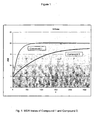
- the results for the Examples 1 and 2 are summarized in Table 1 and the MDR traces of the compounds are given in Figure 1 .
- Example 1 (XL-10000)
- Example 2 IIR + EPDM + BR Hardness, Shore A2 (pts.) 55 66 Ultimate Elongation (%) 136 140 Ultimate Tensile (MPa) 4.89 4.41 Stress @ 100 (MPa) 3.94 3.93 ⁇ Torque (dNm) 13.9 12.8 Die C Tear (kN/m) 15.7 23.5 Compression Set (%) 9.22 21.26
- a cured compound should possess a high hardness, a relatively high elongation, good tear strength and a low compression set.
- the inventive compound had higher Shore A hardness and tear resistance than the reference compound containing XL-10000, while, its compression set was higher, the obtained value of the compression set is comparable to a resin cured butyl rubber where also carbon-carbon covalent bonds are formed.
- the elongation and tensile properties for Compounds 1 & 2 were very similar, as well as delta torque values from the MDR test.
- the compound of Example 3 was based on commercial pre-crosslinked butyl rubber (Bayer XL-10000) mixed on a 6" x 12" mill.
- the compound was composed of 100 parts of rubber, 50 phr of carbon black and 2 phr of peroxide.
- the result from the Die C Tear test was 16.90 kN/m and the compression set was 11.49 %.
- the compound of Example 4 was based on experimental high isoprene butyl rubber (XIIR).
- XIIR experimental high isoprene butyl rubber
- the method of manufacturing of such IIR possessing an isoprene content of up to 8.0 mol % and Mooney viscosity (ML 1+8 @ 125 °C) between 35 and 40 MU in a continuous process is described below.
- the monomer feed composition was comprised of 4.40 wt. % of isoprene (IP or IC5) and 25.7 wt. % of isobutene (IP or IC4).
- This mixed feed was introduced into the continuous polymerization reactor at a rate of 5900 kg/hour.
- DVB was introduced into the reactor at a rate of 5.4 to 6 kg/hour.
- Polymerization was initiated via the introduction of an AlCl 3 /MeCl solution (0.23 wt. % of AlCl 3 in MeCl) at a rate of 204 to 227 kg/hour.
- the internal temperature of the continuous reaction was maintained between -95 and -100 °C through the use of an evaporative cooling process.
- the newly formed polymer crumb was separated from the MeCl diluent with the use of an aqueous flash tank. At this point, ca. 1 wt. % of stearic acid was introduced into the polymer crumb. Prior to drying, 0.1 wt. % of Irganox® 1010 was added to the polymer. Drying of the resulting material was accomplished with the use of a conveyor oven.
- the content of isoprene in the obtained polymer was 7.5 mol %.
- the compound was composed of 85 parts of XIIR, 10 parts of EPDM, 5 parts of JSR RB810 and 5 phr of peroxide and mixed on a 6" x 12" inch mill.
- the result from the Die C Tear test was 24.44 kN/m and the compression set was 16.35 %.
- the inventive compound had a considerably lower Mooney viscosity than a reference compound, which should be beneficial for processability. Also, there were improvements in Shore A hardness, the ultimate elongation and tear properties.
Landscapes
- Chemical & Material Sciences (AREA)
- Health & Medical Sciences (AREA)
- Chemical Kinetics & Catalysis (AREA)
- Medicinal Chemistry (AREA)
- Polymers & Plastics (AREA)
- Organic Chemistry (AREA)
- Engineering & Computer Science (AREA)
- Manufacturing & Machinery (AREA)
- Materials Engineering (AREA)
- Compositions Of Macromolecular Compounds (AREA)
- Sealing Material Composition (AREA)
- Fuel Cell (AREA)
- Closures For Containers (AREA)
Claims (9)
- Kautschukmasse, enthaltend• ein Butylkautschukpolymer,• ein Polybutadienkautschukpolymer mit hohem Vinylgehalt, wobei es sich bei dem Polybutadienkautschukpolymer mit hohem Vinylgehalt um Polybutadien mit mindestens 70% Vinylgruppen in 1,2-Mikrostruktur handelt,• ein Olefinpolymer von Ethylen, mindestens einem α-Olefin und gegebenenfalls mindestens einem Dien und• 1 bis 10 phr eines Peroxid-Härters.
- Kautschukmasse nach Anspruch 1, wobei es sich bei dem Olefinpolymer um EP(D)M-Kautschuk handelt.
- Kautschukmasse nach Anspruch 1, wobei der Peroxid-Härter aus der Gruppe bestehend aus Dialkylperoxiden, Ketalperoxiden, Aralkylperoxiden, Peroxidethern und Peroxidestern ausgewählt ist.
- Kautschukmasse nach Anspruch 3, wobei der Peroxid-Härter aus der Gruppe bestehend aus Di-tert.-butylperoxid, Bis(tert.-butylperoxyisopropyl)-benzol, Dicumylperoxid, 2,5-Dimethyl-2,5-di(tert.-butylperoxy)hexan, 2,5-Dimethyl-2,5-di(tert.-butylperoxy)hexen-(3), 1,1-Bis(tert.-butylperoxy)-3,3,5-trimethylcyclohexan, Benzoylperoxid, tert.-Butylcumylperoxid, tert.-Butylperbenzoat und Mischungen davon ausgewählt ist.
- Kautschukmasse nach Anspruch 1, die ferner mindestens einen Füllstoff enthält.
- Kautschukmasse nach Anspruch 1, wobei es sich bei dem Füllstoff um Ruß handelt.
- Verfahren zur Herstellung einer peroxidhärtbaren Kautschukmasse, bei dem man• ein Butylkautschukpolymer,• ein Polybutadienkautschukpolymer mit hohem Vinylgehalt, wobei es sich bei dem Polybutadienkautschukpolymer mit hohem Vinylgehalt um Polybutadien mit mindestens 70% Vinylgruppen in 1,2-Mikrostruktur handelt,• ein Olefinpolymer von Ethylen, mindestens einem α-Olefin und gegebenenfalls mindestens einem Dienin Gegenwart eines Peroxid-Härters mischt.
- Formkörper, umfassend die Masse nach Anspruch 1.
- Formkörper nach Anspruch 8, bei dem es sich um einen Behälter für Pharmazeutika, einen Kondensatordeckel, eine Dichtung für Brennstoffzellen, einen Elektrolyte enthaltenden Behälter, Ringe, Dämpfungsvorrichtungen, gewöhnliche Dichtungen und Dichtungsmassen handelt.
Applications Claiming Priority (2)
| Application Number | Priority Date | Filing Date | Title |
|---|---|---|---|
| US63436704P | 2004-12-08 | 2004-12-08 | |
| PCT/CA2005/001739 WO2006060896A1 (en) | 2004-12-08 | 2005-11-16 | Peroxide vulcanizable butyl compositions useful for rubber articles |
Publications (3)
| Publication Number | Publication Date |
|---|---|
| EP1824930A1 EP1824930A1 (de) | 2007-08-29 |
| EP1824930A4 EP1824930A4 (de) | 2009-05-27 |
| EP1824930B1 true EP1824930B1 (de) | 2011-05-11 |
Family
ID=36577626
Family Applications (1)
| Application Number | Title | Priority Date | Filing Date |
|---|---|---|---|
| EP05810881A Expired - Lifetime EP1824930B1 (de) | 2004-12-08 | 2005-11-16 | Peroxidvulkanisierbare butylzusammensetzungen für kautschukartikel |
Country Status (10)
| Country | Link |
|---|---|
| US (2) | US20080293852A1 (de) |
| EP (1) | EP1824930B1 (de) |
| JP (1) | JP5559459B2 (de) |
| KR (1) | KR101237193B1 (de) |
| CN (1) | CN101072826B (de) |
| AT (1) | ATE509068T1 (de) |
| BR (1) | BRPI0518520A2 (de) |
| CA (1) | CA2587743C (de) |
| RU (1) | RU2431645C2 (de) |
| WO (1) | WO2006060896A1 (de) |
Families Citing this family (24)
| Publication number | Priority date | Publication date | Assignee | Title |
|---|---|---|---|---|
| DE102005044453A1 (de) * | 2005-09-17 | 2007-03-22 | Lanxess Deutschland Gmbh | Peroxidisch vernetzte hydrierte Vinylpolybutadiene sowie deren Verwendung zur Herstellung von technischen Gummiartikeln mit gutem Rückverformungsverhalten über einen breiten Temperaturbereich |
| JP2008024882A (ja) * | 2006-07-25 | 2008-02-07 | Jsr Corp | シール材用熱可塑性エラストマー組成物、成形部材、及びコンデンサ |
| CA2598342C (en) * | 2006-09-08 | 2014-10-14 | Lanxess Inc. | Peroxide cured thermoplastic vulcanizates comprising butyl rubber |
| JP5941302B2 (ja) * | 2012-03-07 | 2016-06-29 | 株式会社ブリヂストン | ゴム組成物、及び、前記ゴム組成物を有するタイヤ |
| CN103102540A (zh) * | 2012-11-13 | 2013-05-15 | 铜陵亿亨达电子有限责任公司 | 一种耐老化的电容外壳橡胶包裹料 |
| CN103102672A (zh) * | 2012-11-13 | 2013-05-15 | 铜陵亿亨达电子有限责任公司 | 一种耐磨损的电容外壳橡胶包裹料 |
| CN103102539A (zh) * | 2012-11-13 | 2013-05-15 | 铜陵亿亨达电子有限责任公司 | 一种用改性粉煤灰制备的电容外壳橡胶包裹料 |
| CN103102536B (zh) * | 2012-11-13 | 2015-03-04 | 铜陵兴怡金属材料有限公司 | 一种用于包裹电容外壳的氯丁橡胶料 |
| CN103102537B (zh) * | 2012-11-13 | 2015-03-04 | 铜陵兴怡金属材料有限公司 | 一种耐油的电容外壳橡胶包裹料 |
| CN103102538A (zh) * | 2012-11-13 | 2013-05-15 | 铜陵亿亨达电子有限责任公司 | 一种耐腐蚀的电容外壳橡胶包裹料 |
| CN102964802A (zh) * | 2012-11-14 | 2013-03-13 | 安徽江威精密制造有限公司 | 一种耐冷热冲击的电容外壳橡胶包裹料 |
| JP6251556B2 (ja) * | 2013-12-04 | 2017-12-20 | 株式会社日本化学研究所 | 缶蓋用シーリングコンパウンド |
| US10680256B2 (en) | 2016-03-31 | 2020-06-09 | Sumitomo Riko Company Limited | Sealing member for a fuel cell |
| CN108794899B (zh) * | 2017-04-28 | 2021-08-10 | 中国石油化工股份有限公司 | 一种减振橡胶复合材料及其制备方法 |
| CN108794900A (zh) * | 2017-04-28 | 2018-11-13 | 中国石油化工股份有限公司 | 一种超轻耐热橡胶复合材料及其制备方法 |
| CN115483035B (zh) * | 2017-09-29 | 2025-03-07 | 松下知识产权经营株式会社 | 蓄电设备 |
| US10633513B2 (en) | 2018-03-26 | 2020-04-28 | Fina Technology, Inc. | Curable low sulfur liquid rubber compositions and methods of manufacturing the same |
| KR20210139257A (ko) | 2019-03-20 | 2021-11-22 | 니폰 제온 가부시키가이샤 | 전기 화학 디바이스용의 시일제 및 시일제 조성물 |
| US11078349B2 (en) | 2019-04-24 | 2021-08-03 | Fina Technology, Inc. | Curable low sulfur liquid rubber compositions |
| JP7356863B2 (ja) * | 2019-10-28 | 2023-10-05 | Nok株式会社 | 有機過酸化物架橋性ゴム組成物 |
| JP7459620B2 (ja) * | 2020-03-31 | 2024-04-02 | 住友ゴム工業株式会社 | 医療用ゴム組成物、医療用ゴム部品、および、プレフィルドシリンジ |
| CN116583545A (zh) * | 2020-10-28 | 2023-08-11 | 株式会社可乐丽 | 固化性组合物和密封剂 |
| EP4239001A4 (de) * | 2020-10-28 | 2024-08-21 | Kuraray Co., Ltd. | Härtbare zusammensetzung und dichtungsmittel |
| KR102634390B1 (ko) * | 2023-09-22 | 2024-02-06 | 평화산업주식회사 | 에어서스펜션 벨로우즈의 내구성능 향상을 위한 고무 조성물 |
Family Cites Families (32)
| Publication number | Priority date | Publication date | Assignee | Title |
|---|---|---|---|---|
| US3584080A (en) * | 1968-03-07 | 1971-06-08 | Polymer Corp | Vulcanizable compositions comprising copolymers of an isoolefin and an aromatic divinyl compound |
| JPS5615665B2 (de) * | 1973-11-03 | 1981-04-11 | ||
| JPS52142753A (en) * | 1976-05-24 | 1977-11-28 | Japan Synthetic Rubber Co Ltd | Thermoplastic elastomer compositions |
| JPS5562943A (en) * | 1978-11-06 | 1980-05-12 | D J- K Internatl Kk | Thermoplastic elastic polymer composition |
| US4789708A (en) * | 1986-07-15 | 1988-12-06 | Hughes Tool Company | Synthetic elastomer with improved chemical, aging and oil resistance |
| JP2610426B2 (ja) * | 1987-04-07 | 1997-05-14 | 東燃化学 株式会社 | 熱可塑性エラストマー組成物 |
| US4946881A (en) * | 1987-08-28 | 1990-08-07 | Uniroyal Chemical Company, Inc. | Tire sidewall |
| US5120779A (en) * | 1987-08-28 | 1992-06-09 | Uniroyal Chemical Company, Inc. | Tire sidewall |
| US5047530A (en) * | 1987-08-28 | 1991-09-10 | Uniroyal Chemical Company, Inc. | Arylenediamine substituted triazines |
| IL87542A (en) * | 1987-08-28 | 1993-01-31 | Uniroyal Chem Co Inc | Arylenediamino substituted triazine derivatives, processes for the preparation thereof and compositions containing the same |
| US4794134A (en) * | 1987-08-28 | 1988-12-27 | Uniroyal Chemical Company, Inc. | Ozone resistant elastomeric articles |
| US4794135A (en) * | 1987-08-28 | 1988-12-27 | Uniroyal Chemical Company, Inc. | Arylenediamine substituted triazines |
| US4956405A (en) * | 1987-08-28 | 1990-09-11 | Uniroyal Chemical Company, Inc. | Ozone resistant elastomeric articles |
| JPH0832803B2 (ja) * | 1988-05-17 | 1996-03-29 | 日本石油化学株式会社 | 熱可塑性エラストマー組成物 |
| JPH02235951A (ja) * | 1989-03-08 | 1990-09-18 | Nankai Rubber Kk | ゴム組成物 |
| JP2689398B2 (ja) * | 1990-08-24 | 1997-12-10 | 株式会社 大協精工 | ゴム組成物及び医薬品・医療用具用ゴム製品 |
| JPH06107738A (ja) * | 1991-08-27 | 1994-04-19 | Erasuto Mitsukusu:Kk | 部分架橋ブチルゴム組成物 |
| JPH05283302A (ja) * | 1992-03-31 | 1993-10-29 | Nippon Valqua Ind Ltd | コンデンサ封口シール用ゴム |
| JP3197068B2 (ja) * | 1992-08-06 | 2001-08-13 | ジェイエスアール株式会社 | ブチルゴムの架橋方法 |
| IT1274746B (it) * | 1994-08-30 | 1997-07-24 | Enichem Elastomers | Composizione plastoelastomerica poliolefinica vulcanizzata e procedimento per la sua preparazione |
| US5686179A (en) * | 1994-11-09 | 1997-11-11 | Cotsakis; Daniel John | Pressure sensitive tape for forming water-tight field joints in rubber membranes |
| US5578682A (en) * | 1995-05-25 | 1996-11-26 | Exxon Chemical Patents Inc. | Bimodalization of polymer molecular weight distribution |
| JPH09221516A (ja) * | 1996-02-15 | 1997-08-26 | Mitsui Petrochem Ind Ltd | オレフィン系熱可塑性エラストマー組成物 |
| JP3845231B2 (ja) * | 1999-08-20 | 2006-11-15 | 本田技研工業株式会社 | 射出成形用金型の不良判定方法 |
| US6469089B2 (en) * | 1999-10-08 | 2002-10-22 | Cabot Corporation | Elastomeric compounds with improved wet skid resistance and methods to improve wet skid resistance |
| JP2002198270A (ja) * | 2000-12-27 | 2002-07-12 | Nippon Chemicon Corp | 電解コンデンサの封口体およびそれを用いた電解コンデンサ |
| JP2002348415A (ja) * | 2001-05-24 | 2002-12-04 | Jsr Corp | 熱可塑性エラストマー組成物、およびその成形品 |
| US6555599B2 (en) * | 2001-03-26 | 2003-04-29 | Milliken & Company | Antimicrobial vulcanized EPDM rubber articles |
| WO2003011917A1 (en) * | 2001-07-31 | 2003-02-13 | Exxonmobil Chemical Patents Inc. | Method of curing elastomers |
| CA2386628C (en) * | 2002-05-16 | 2010-07-06 | Bayer Inc. | Hologen- and sulfur-free shaped articles comprising peroxide curable compounds of butyl rubber |
| CA2465407C (en) * | 2004-04-28 | 2012-11-13 | Rui Resendes | Peroxide curable butyl formulations |
| CA2489036C (en) * | 2004-12-03 | 2013-02-12 | Lanxess Inc. | Peroxide curable butyl formulations for rubber articles |
-
2005
- 2005-11-16 KR KR1020077012794A patent/KR101237193B1/ko not_active Expired - Fee Related
- 2005-11-16 US US11/791,561 patent/US20080293852A1/en not_active Abandoned
- 2005-11-16 WO PCT/CA2005/001739 patent/WO2006060896A1/en not_active Ceased
- 2005-11-16 EP EP05810881A patent/EP1824930B1/de not_active Expired - Lifetime
- 2005-11-16 AT AT05810881T patent/ATE509068T1/de not_active IP Right Cessation
- 2005-11-16 BR BRPI0518520-3A patent/BRPI0518520A2/pt not_active IP Right Cessation
- 2005-11-16 RU RU2007125574/05A patent/RU2431645C2/ru not_active IP Right Cessation
- 2005-11-16 CN CN2005800422252A patent/CN101072826B/zh not_active Expired - Fee Related
- 2005-11-16 CA CA2587743A patent/CA2587743C/en not_active Expired - Fee Related
- 2005-11-16 JP JP2007544706A patent/JP5559459B2/ja not_active Expired - Fee Related
-
2013
- 2013-12-19 US US14/133,947 patent/US20140171581A1/en not_active Abandoned
Also Published As
| Publication number | Publication date |
|---|---|
| JP5559459B2 (ja) | 2014-07-23 |
| CA2587743C (en) | 2013-05-28 |
| CN101072826B (zh) | 2011-02-02 |
| CN101072826A (zh) | 2007-11-14 |
| KR20070092960A (ko) | 2007-09-14 |
| EP1824930A1 (de) | 2007-08-29 |
| JP2008523174A (ja) | 2008-07-03 |
| RU2007125574A (ru) | 2009-01-20 |
| US20080293852A1 (en) | 2008-11-27 |
| CA2587743A1 (en) | 2006-06-15 |
| RU2431645C2 (ru) | 2011-10-20 |
| EP1824930A4 (de) | 2009-05-27 |
| BRPI0518520A2 (pt) | 2008-11-25 |
| KR101237193B1 (ko) | 2013-02-25 |
| ATE509068T1 (de) | 2011-05-15 |
| US20140171581A1 (en) | 2014-06-19 |
| WO2006060896A1 (en) | 2006-06-15 |
Similar Documents
| Publication | Publication Date | Title |
|---|---|---|
| US20140171581A1 (en) | Peroxide vulcanizable butyl compositions useful for rubber articles | |
| US6974851B2 (en) | Halogen- and sulfur-free shaped articles containing peroxide curable compounds of butyl rubber | |
| EP1819771B1 (de) | Peroxidhärtbare butylformulierungen für kautschukartikel | |
| JP5264485B2 (ja) | 高マルチオレフィンハロブチルアイオノマーを含む過酸化物硬化性ゴムコンパウンド | |
| EP1506978B1 (de) | Mit Peroxiden haertbare Butylformulierungen | |
| US20060106148A1 (en) | Peroxide cured butyl rubber compositions and a process for making peroxide cured butyl rubber compositions | |
| US20060264575A1 (en) | Peroxide cured butyl compositions having improved hardness and compression set | |
| CA2508177A1 (en) | Peroxide cured butyl compositions having improved hardness and compression set | |
| EP1591477A1 (de) | Peroxidhärtbare Butylzusammensetzungen |
Legal Events
| Date | Code | Title | Description |
|---|---|---|---|
| PUAI | Public reference made under article 153(3) epc to a published international application that has entered the european phase |
Free format text: ORIGINAL CODE: 0009012 |
|
| 17P | Request for examination filed |
Effective date: 20070709 |
|
| AK | Designated contracting states |
Kind code of ref document: A1 Designated state(s): AT BE BG CH CY CZ DE DK EE ES FI FR GB GR HU IE IS IT LI LT LU LV MC NL PL PT RO SE SI SK TR |
|
| DAX | Request for extension of the european patent (deleted) | ||
| A4 | Supplementary search report drawn up and despatched |
Effective date: 20090424 |
|
| 17Q | First examination report despatched |
Effective date: 20090907 |
|
| GRAC | Information related to communication of intention to grant a patent modified |
Free format text: ORIGINAL CODE: EPIDOSCIGR1 |
|
| GRAP | Despatch of communication of intention to grant a patent |
Free format text: ORIGINAL CODE: EPIDOSNIGR1 |
|
| GRAS | Grant fee paid |
Free format text: ORIGINAL CODE: EPIDOSNIGR3 |
|
| GRAA | (expected) grant |
Free format text: ORIGINAL CODE: 0009210 |
|
| AK | Designated contracting states |
Kind code of ref document: B1 Designated state(s): AT BE BG CH CY CZ DE DK EE ES FI FR GB GR HU IE IS IT LI LT LU LV MC NL PL PT RO SE SI SK TR |
|
| REG | Reference to a national code |
Ref country code: GB Ref legal event code: FG4D |
|
| REG | Reference to a national code |
Ref country code: CH Ref legal event code: EP |
|
| REG | Reference to a national code |
Ref country code: IE Ref legal event code: FG4D |
|
| REG | Reference to a national code |
Ref country code: DE Ref legal event code: R096 Ref document number: 602005028028 Country of ref document: DE Effective date: 20110622 |
|
| REG | Reference to a national code |
Ref country code: NL Ref legal event code: VDEP Effective date: 20110511 |
|
| PG25 | Lapsed in a contracting state [announced via postgrant information from national office to epo] |
Ref country code: SE Free format text: LAPSE BECAUSE OF FAILURE TO SUBMIT A TRANSLATION OF THE DESCRIPTION OR TO PAY THE FEE WITHIN THE PRESCRIBED TIME-LIMIT Effective date: 20110511 Ref country code: LT Free format text: LAPSE BECAUSE OF FAILURE TO SUBMIT A TRANSLATION OF THE DESCRIPTION OR TO PAY THE FEE WITHIN THE PRESCRIBED TIME-LIMIT Effective date: 20110511 Ref country code: PT Free format text: LAPSE BECAUSE OF FAILURE TO SUBMIT A TRANSLATION OF THE DESCRIPTION OR TO PAY THE FEE WITHIN THE PRESCRIBED TIME-LIMIT Effective date: 20110912 |
|
| PG25 | Lapsed in a contracting state [announced via postgrant information from national office to epo] |
Ref country code: IS Free format text: LAPSE BECAUSE OF FAILURE TO SUBMIT A TRANSLATION OF THE DESCRIPTION OR TO PAY THE FEE WITHIN THE PRESCRIBED TIME-LIMIT Effective date: 20110911 Ref country code: GR Free format text: LAPSE BECAUSE OF FAILURE TO SUBMIT A TRANSLATION OF THE DESCRIPTION OR TO PAY THE FEE WITHIN THE PRESCRIBED TIME-LIMIT Effective date: 20110812 Ref country code: LV Free format text: LAPSE BECAUSE OF FAILURE TO SUBMIT A TRANSLATION OF THE DESCRIPTION OR TO PAY THE FEE WITHIN THE PRESCRIBED TIME-LIMIT Effective date: 20110511 Ref country code: FI Free format text: LAPSE BECAUSE OF FAILURE TO SUBMIT A TRANSLATION OF THE DESCRIPTION OR TO PAY THE FEE WITHIN THE PRESCRIBED TIME-LIMIT Effective date: 20110511 Ref country code: CY Free format text: LAPSE BECAUSE OF FAILURE TO SUBMIT A TRANSLATION OF THE DESCRIPTION OR TO PAY THE FEE WITHIN THE PRESCRIBED TIME-LIMIT Effective date: 20110511 Ref country code: ES Free format text: LAPSE BECAUSE OF FAILURE TO SUBMIT A TRANSLATION OF THE DESCRIPTION OR TO PAY THE FEE WITHIN THE PRESCRIBED TIME-LIMIT Effective date: 20110822 Ref country code: SI Free format text: LAPSE BECAUSE OF FAILURE TO SUBMIT A TRANSLATION OF THE DESCRIPTION OR TO PAY THE FEE WITHIN THE PRESCRIBED TIME-LIMIT Effective date: 20110511 Ref country code: AT Free format text: LAPSE BECAUSE OF FAILURE TO SUBMIT A TRANSLATION OF THE DESCRIPTION OR TO PAY THE FEE WITHIN THE PRESCRIBED TIME-LIMIT Effective date: 20110511 |
|
| PG25 | Lapsed in a contracting state [announced via postgrant information from national office to epo] |
Ref country code: NL Free format text: LAPSE BECAUSE OF FAILURE TO SUBMIT A TRANSLATION OF THE DESCRIPTION OR TO PAY THE FEE WITHIN THE PRESCRIBED TIME-LIMIT Effective date: 20110511 |
|
| PG25 | Lapsed in a contracting state [announced via postgrant information from national office to epo] |
Ref country code: EE Free format text: LAPSE BECAUSE OF FAILURE TO SUBMIT A TRANSLATION OF THE DESCRIPTION OR TO PAY THE FEE WITHIN THE PRESCRIBED TIME-LIMIT Effective date: 20110511 Ref country code: CZ Free format text: LAPSE BECAUSE OF FAILURE TO SUBMIT A TRANSLATION OF THE DESCRIPTION OR TO PAY THE FEE WITHIN THE PRESCRIBED TIME-LIMIT Effective date: 20110511 |
|
| PG25 | Lapsed in a contracting state [announced via postgrant information from national office to epo] |
Ref country code: SK Free format text: LAPSE BECAUSE OF FAILURE TO SUBMIT A TRANSLATION OF THE DESCRIPTION OR TO PAY THE FEE WITHIN THE PRESCRIBED TIME-LIMIT Effective date: 20110511 Ref country code: DK Free format text: LAPSE BECAUSE OF FAILURE TO SUBMIT A TRANSLATION OF THE DESCRIPTION OR TO PAY THE FEE WITHIN THE PRESCRIBED TIME-LIMIT Effective date: 20110511 Ref country code: PL Free format text: LAPSE BECAUSE OF FAILURE TO SUBMIT A TRANSLATION OF THE DESCRIPTION OR TO PAY THE FEE WITHIN THE PRESCRIBED TIME-LIMIT Effective date: 20110511 Ref country code: RO Free format text: LAPSE BECAUSE OF FAILURE TO SUBMIT A TRANSLATION OF THE DESCRIPTION OR TO PAY THE FEE WITHIN THE PRESCRIBED TIME-LIMIT Effective date: 20110511 |
|
| PLBE | No opposition filed within time limit |
Free format text: ORIGINAL CODE: 0009261 |
|
| STAA | Information on the status of an ep patent application or granted ep patent |
Free format text: STATUS: NO OPPOSITION FILED WITHIN TIME LIMIT |
|
| 26N | No opposition filed |
Effective date: 20120214 |
|
| REG | Reference to a national code |
Ref country code: DE Ref legal event code: R097 Ref document number: 602005028028 Country of ref document: DE Effective date: 20120214 |
|
| PG25 | Lapsed in a contracting state [announced via postgrant information from national office to epo] |
Ref country code: MC Free format text: LAPSE BECAUSE OF NON-PAYMENT OF DUE FEES Effective date: 20111130 |
|
| REG | Reference to a national code |
Ref country code: CH Ref legal event code: PL |
|
| PG25 | Lapsed in a contracting state [announced via postgrant information from national office to epo] |
Ref country code: CH Free format text: LAPSE BECAUSE OF NON-PAYMENT OF DUE FEES Effective date: 20111130 Ref country code: LI Free format text: LAPSE BECAUSE OF NON-PAYMENT OF DUE FEES Effective date: 20111130 |
|
| REG | Reference to a national code |
Ref country code: IE Ref legal event code: MM4A |
|
| PG25 | Lapsed in a contracting state [announced via postgrant information from national office to epo] |
Ref country code: IE Free format text: LAPSE BECAUSE OF NON-PAYMENT OF DUE FEES Effective date: 20111116 |
|
| PG25 | Lapsed in a contracting state [announced via postgrant information from national office to epo] |
Ref country code: LU Free format text: LAPSE BECAUSE OF NON-PAYMENT OF DUE FEES Effective date: 20111116 |
|
| PG25 | Lapsed in a contracting state [announced via postgrant information from national office to epo] |
Ref country code: BG Free format text: LAPSE BECAUSE OF FAILURE TO SUBMIT A TRANSLATION OF THE DESCRIPTION OR TO PAY THE FEE WITHIN THE PRESCRIBED TIME-LIMIT Effective date: 20110811 |
|
| PG25 | Lapsed in a contracting state [announced via postgrant information from national office to epo] |
Ref country code: TR Free format text: LAPSE BECAUSE OF FAILURE TO SUBMIT A TRANSLATION OF THE DESCRIPTION OR TO PAY THE FEE WITHIN THE PRESCRIBED TIME-LIMIT Effective date: 20110511 |
|
| PG25 | Lapsed in a contracting state [announced via postgrant information from national office to epo] |
Ref country code: HU Free format text: LAPSE BECAUSE OF FAILURE TO SUBMIT A TRANSLATION OF THE DESCRIPTION OR TO PAY THE FEE WITHIN THE PRESCRIBED TIME-LIMIT Effective date: 20110511 |
|
| PGFP | Annual fee paid to national office [announced via postgrant information from national office to epo] |
Ref country code: BE Payment date: 20131113 Year of fee payment: 9 |
|
| PG25 | Lapsed in a contracting state [announced via postgrant information from national office to epo] |
Ref country code: BE Free format text: LAPSE BECAUSE OF NON-PAYMENT OF DUE FEES Effective date: 20141130 |
|
| REG | Reference to a national code |
Ref country code: FR Ref legal event code: PLFP Year of fee payment: 11 |
|
| PGFP | Annual fee paid to national office [announced via postgrant information from national office to epo] |
Ref country code: DE Payment date: 20151110 Year of fee payment: 11 Ref country code: IT Payment date: 20151124 Year of fee payment: 11 Ref country code: GB Payment date: 20151111 Year of fee payment: 11 |
|
| PGFP | Annual fee paid to national office [announced via postgrant information from national office to epo] |
Ref country code: FR Payment date: 20151008 Year of fee payment: 11 |
|
| REG | Reference to a national code |
Ref country code: DE Ref legal event code: R119 Ref document number: 602005028028 Country of ref document: DE |
|
| GBPC | Gb: european patent ceased through non-payment of renewal fee |
Effective date: 20161116 |
|
| REG | Reference to a national code |
Ref country code: FR Ref legal event code: ST Effective date: 20170731 |
|
| PG25 | Lapsed in a contracting state [announced via postgrant information from national office to epo] |
Ref country code: IT Free format text: LAPSE BECAUSE OF NON-PAYMENT OF DUE FEES Effective date: 20161116 Ref country code: FR Free format text: LAPSE BECAUSE OF NON-PAYMENT OF DUE FEES Effective date: 20161130 |
|
| PG25 | Lapsed in a contracting state [announced via postgrant information from national office to epo] |
Ref country code: DE Free format text: LAPSE BECAUSE OF NON-PAYMENT OF DUE FEES Effective date: 20170601 Ref country code: GB Free format text: LAPSE BECAUSE OF NON-PAYMENT OF DUE FEES Effective date: 20161116 |