EP1826688A2 - Verfahren zum Lernen des Benutzerverhaltens in einem ubiquitären System - Google Patents
Verfahren zum Lernen des Benutzerverhaltens in einem ubiquitären System Download PDFInfo
- Publication number
- EP1826688A2 EP1826688A2 EP07075135A EP07075135A EP1826688A2 EP 1826688 A2 EP1826688 A2 EP 1826688A2 EP 07075135 A EP07075135 A EP 07075135A EP 07075135 A EP07075135 A EP 07075135A EP 1826688 A2 EP1826688 A2 EP 1826688A2
- Authority
- EP
- European Patent Office
- Prior art keywords
- events
- user
- event
- collected data
- list
- Prior art date
- Legal status (The legal status is an assumption and is not a legal conclusion. Google has not performed a legal analysis and makes no representation as to the accuracy of the status listed.)
- Withdrawn
Links
Images






Classifications
-
- G—PHYSICS
- G06—COMPUTING OR CALCULATING; COUNTING
- G06F—ELECTRIC DIGITAL DATA PROCESSING
- G06F16/00—Information retrieval; Database structures therefor; File system structures therefor
- G06F16/90—Details of database functions independent of the retrieved data types
-
- G—PHYSICS
- G06—COMPUTING OR CALCULATING; COUNTING
- G06F—ELECTRIC DIGITAL DATA PROCESSING
- G06F16/00—Information retrieval; Database structures therefor; File system structures therefor
- G06F16/60—Information retrieval; Database structures therefor; File system structures therefor of audio data
- G06F16/63—Querying
- G06F16/635—Filtering based on additional data, e.g. user or group profiles
- G06F16/637—Administration of user profiles, e.g. generation, initialization, adaptation or distribution
Definitions
- the present invention relates to an information retrieval system, in particular a pervasive system in consumer electronics and home entertainment for retrieval of audio and visual information but also information containing text, pictures etc., having means for recording knowledge of user operational behaviour of the system, the recorded experience to be used to improve the user convenience in the daily use of the complete system.
- the system adapts dynamically to recorded operational behaviour and possesses a mode of operation that might inspire the user in the daily use of system facilities.
- the present invention is especially directed to be applied in a multi user and multi domain environment and include access to physical - as well as the virtual information sources e.g. located on the Internet.
- the dynamic list constitutes a specific list of topics to choose among and/or supporting the user with inspiration in the operation.
- a concept of 'less-is-more' is described, this concept offering means for inspiration and intelligent use of an information retrieval system.
- the object is achieved with the presented functionality to inspire the user to select an experience.
- the system will serve a list containing different experiences for the user, experiences which all are relevant for the actual user in an actual context.
- the goal is to offer the user access to everything, any time and anywhere. Doing that is a challenge, where less is more, due to the fact that 'relevant information' is better than 'all information'.
- the invention discloses a system where information relevant for the user in the actual situation, place and time is served to the user as an 'inspire mode of operation'.
- Advanced criteria functions acts as a filter for accessing the right information, these functions operates on information sources which are accessible locally, and/or via local networks, and/or via global networks e.g. the Internet.
- the access to the information might be via fixed lines or via wireless communication lines or in a mix of the mentioned as appropriate for an actual system configuration.
- the sources of information constitute the basic data to be filtered and reduced into a relevant set of Suggestion lists, which lists further, are the sources of information for generating the Inspire list that's presented for the user as part of an application user interface (UI).
- UI application user interface
- a first aspect of the invention relates to a method of sharing information between a first and a second user, the method comprising:
- an event may be any experience
- the user may have, such as any movie, broadcast TV programme, live show of any kind, any type of music (radio/video, live, or recorded), viewing images, activities (playing games, browsing, sports, communicating with others in any manner), or the like.
- Events may be divided into sub-groups, such as genres, types, subjects, and/or themes.
- Different types may also be called different media genres, such as music, TV/sat, movie, photo, radio, internet-radio, games, exercise, web browsing, communication via sms/email or orally.
- Non-exhaustive examples are:
- events are available to the user when these e.g. are available on or via a public-service channel/source to which the user has access.
- available events are events stored in readily available storage media at the user, such as MP3/CD/DVDs positioned in a related player.
- Other events may be a list of activities available outside (maybe depending on the weather).
- Other events may be downloaded from the user's calendar or other knowledge of activities to which the user may gain access (concerts, movies, or the like) at or around the present point in time.
- Events may be available right away or within a predetermined period of time, depending on the user's preferences. If the event was a movie shown in a movie theatre, the user would need time to get there, whereby the timing of "availability" would be different than when the movie is shown on a TV readily and swiftly available to the user.
- the present aspect enables the second user to identify or recommend an event to the first user, such as a user whom the second user knows or suspects would benefit from or like experiencing the event.
- the first user's information system may store this information until the event becomes available, such as when an Electronic Program Guide reveals that the e.g. movie is available on a channel available to the user.
- the informing step may comprise informing the first information system of where to access the event, such as an URL, a particular server, a particular TV/cable programme or the like. The first information system may then access the event at that position.
- the informing step comprises transmitting information relating to the identified event to a communication device, and the transmission of information relating to the identified event from the communication device to the information system.
- This communication may take place over a Local Area Network, a Wide Area Network, the WWW or in any other manner, depending on the distance between the two users.
- a plurality of information systems transmit information to or receive information from the communication device, whereby the communication device may act as a hub transmitting such identification information. Also, this device may be used for information systems to upload information to (events or the like), where the receiver (first information system) may download it and provide it to the user. Also this type of communication and sharing of events is possible.
- the informing step also comprises the second user identifying the first user, especially when the second user is able to transmit information to multiple users.
- the identifying step comprises the second user entering information into a second communication system adapted to transmit information to the first information system.
- the first person may also identify events and recommend these to the second user.
- the step of providing the updated list comprises informing the first user of the fact that the identified event has been identified by the second user.
- the event may be put into a context or may simply be deleted/ignored depending on the first person's evaluation of e.g. the taste of the second person.
- the first step normally would be used when the number of events available to the first person is larger than the maximum number of desired entries on the list.
- An additional parameter which it might be desirable to take into account when determining whether to provide the identified event on the list is the second user's ID. For some users (spouse, son/daughter, relative, best "mate", or the like), the actual user may decide to always wish the event to be on the list. Also, it may be desirable to always dismiss recommendations from certain persons.
- the updating step comprises determining, for each event available to the user, a priority, and providing, as the list, a (such as a prioritized) list comprising all events or all events having a priority higher than a predetermined, lowest priority.
- a priority such as a prioritized
- the priority of the individual events may be determined, and the most pertinent event(s) easily determined.
- An alternative to the providing of only of events with a priority higher than a predetermined priority it may be selected to only provide a predetermined number of events - starting at the highest priority.
- the identifying step comprises the second user experiencing the event by receiving information relating to the event from an external source (such as TV, WWW, Radio, Cable, Satellite, streams from any source), the updating step being succeeded by the step of the first user receiving information from the external source and experiencing the event.
- an external source such as TV, WWW, Radio, Cable, Satellite, streams from any source
- the first information system may store a number of recommendations and await that such events become available (such as from EPGs or the Internet).
- a subsequent step could be that the user selects an event from the list of events, and controls an AV system to provide the event to the user.
- an AV system may be any system adapted to provide the event to the user. If the event is available from a public source, the AV system should have access to that source, such as using TV/Radio/WWW technology adapted to receive the signal and provide the event to the user in the form of e.g. audio or video.
- a second aspect of the invention relates to a system for sharing information between a first and a second user, the system comprising:
- a communication device is provided, the second information system being adapted to transmit information relating to the event to the communication device, and the communication device being adapted to transmit information relating to the event to the first information system. Then, a plurality of information systems may be adapted to transmit information to or receive information from the communication device.
- the second information system may be adapted to also transmit information relating to the identity of the first user.
- the first information system may be adapted to, when providing the updated list, indicate to the first user the fact that the identified event has been identified by the second user.
- the first information system is adapted to:
- a filtering may also be performed on the basis of the identity of the recommending second user.
- the updating means may be adapted to determine, for each event available to the user, a priority, and to provide as the list a (preferably prioritized) list comprising all events or all events having a priority higher than a predetermined lowest priority to the user.
- the second information system may be adapted to identify events received from an external source, the updating means comprising updating the list only when receiving information, such as from the external source, that the event is available.
- the informing means may be adapted to provide to the first information system information of where to access the event.
- system may also comprise means for controlling an AV system to provide the user with an event, selected by the user, from the list of events.
- a third aspect of the invention relates to a method of providing information to a user, the method comprising:
- environment is to be given the broadest possible interpretation.
- the “environment” is meant to be everything which may affect the user while experiencing an event.
- the overall function of the present method is to be able to inspire the person by providing a list of selected events similar to other events that the user has experienced in the same or a similar environment.
- One type of environment may be a forum/venue/room in which the user is positioned.
- other forums/venues/rooms than ones wherein the user readily has events available (such as in the user's home) may be used, such as concerts, shopping centres, or the like.
- a room/forum/venue may be defined in any manner. Different rooms/forums/venues may be different rooms in a house. Alternatively or additionally, these may include a summer house, one or more cars, the working place of the user as well as a general "room/venue/forum" which the user is in when "on the road", such as when travelling. Naturally, different means of travelling may be differed as different "rooms/forums/venues". Also, a room/forum/venue may be an external place, such as a concert, a movie theatre or the like.
- the step of providing the selected events comprises:
- the difference between the forums/rooms/venues may be a physical distance there between or a predetermined difference determined on the basis of a difference in the uses of the rooms/venues/forums or the like.
- the difference between a living room and a bed room may be defined to be large, even though these rooms are positioned physically beside each other in a house.
- step 2. is performed when the user changes room/venue/forum, in order to maintain the list updated.
- the environment comprises a time of day, the week, the month, and/or the year of experiencing the event(s) and wherein:
- Users may have quite fixed rhythms which he/she desires maintained. Also, the user may have different rhythms or habits on weekdays and days of.
- this type of music may be given a high priority when the user enters the living room in the afternoon on a weekday.
- a difference in the weather may e.g. be a difference in outside temperature, whether there is precipitation or clouds, or whether the sun is out or not.
- Another parameter may be the atmosphere in the room, such as the humidity, sound pressure (shouting or whispering, noise, talking, laughter), whether the drapes/shades are drawn or not, whether all persons take part in the event or others perform other tasks (talk, read, play cards, etc.).
- parameters of an actual room/venue/forum may be of interest, such as the audio/speaker or lighting setting (which lamps, how bright, which colour, shades/blinds drawn, etc) or the room temperature. These parameters may describe the person's mood or the surroundings at the present time. Dimmed lighting e.g. may indicate that an intimate situation takes place and that the music or other events should not be loud or fast.
- the user's mood may be determined in a number of manners. The simplest manner is for the user to simply enter, into the system, information relating to the user's mood.
- Another manner is to use information relating to the environment: the lighting setting selected by the user, the music selected by the user, or the like. Dimmed lights and loud, fast music could indicate that a party is going on, where dimmed light and dimmed, slow music rather indicates a more moody situation (sad or romantic, e.g.).
- the behaviour of the user may be used for determining the user's mood.
- imaging technology adapted to recognize faces or grimaces of the person is one manner.
- Other manners may be to analyze the user's movement pattern, temperature, voice (loud, quiet, crying, laughing, etc.) or the like.
- the method may comprise the subsequent steps of the user selecting an event from the provided information, and an AV system is controlled to provide the event to the user.
- the invention relates to a system for providing information to a user, the system comprising:
- the means for providing the selected events comprises:
- the second means are adapted to perform the quantification and providing steps when the user changes room/venue/forum. or even continuously, in order for the information provided to stay updated and relevant.
- different rooms/venues/forum are different rooms in a house, a house, a summer house, a car, a persons place or work, or generally when the person is "on the road”.
- time of day/week/month/year may be obtained from an internal clock or calendar or from an external source, such as a TV signal or the WWW.
- the weather information may be derived from sensors, such as sensors positioned outside, or from e.g. the WWW or weather information in e.g. a TV signal.
- the number and identity of persons may be obtained using imaging technology and e.g. face recognition or by the persons wearing e.g. tags (such as RFID tags) from which they may be identified and counted. Naturally, the persons may also be required to state their identity or type it into a keyboard.
- imaging technology e.g. face recognition or by the persons wearing e.g. tags (such as RFID tags) from which they may be identified and counted.
- tags such as RFID tags
- the persons may also be required to state their identity or type it into a keyboard.
- the collecting means and the second means may comprise one or more of a number of means for determining the user's mood, such as imaging means for obtaining an image of the person or a part thereof in order to determine the person's mood, such as from grimaces or the person's behavioural pattern.
- imaging means for obtaining an image of the person or a part thereof in order to determine the person's mood, such as from grimaces or the person's behavioural pattern.
- the person's temperature, behaviour, choice of music/lighting or other information may be used.
- system may further comprise means for controlling an AV system to provide the user with an event, selected by the user, from the provided information.
- the present embodiment comprises a content suggestion control arrangement to assist the users in choosing from the amount of sources of information available.
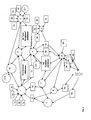
- the content suggestion control arrangement (Fig. 1) may present the user with an Inspire list established with elements from the Suggestion lists these lists being a comprehensive collection of information related to an actual user, the personal background of the user and the behaviour of the user in the access to information supported by the system:
- the Inspire list is dynamic and changes all the time to adapt to any new situation. An operation from the user, or just the fact that the time goes by, can trigger that the list is changing. When the user is browsing his music collection, photo collection, film collection, etc. the list is changing. The more the user by the choices made restrains the possibilities in the navigation e.g. in his music collection the more filtered the Inspire list will be. If there in the behaviour of the "user-behaviour-context space" or in the life sculpture of the user is something dominating from another media genre, this is also to be displayed in the Inspire list. For instance if the user listens to music and browses his music collection, a TV program might appear in the Inspire list.
- the system according to the present embodiment comprises a content suggestion control arrangement having an element for the collection and analysis of user behaviour data for providing suggestions to the user of the system of content, i.e. sources of information to be rendered by the user in sub-domains of the system.
- the present element for the collection and analysis of user behaviour data is unique in that it collects and analyses data not only concerning the contents, i.e. units of information, accessed and used for rendering by the specific user, but also including the context of rendering, i.e. the sub-domain among a plurality of sub-domains in the system in which the user had the experience with the contents.
- the content suggestion control arrangement may suggest content to the user based on other factors also on the context in which the user require suggestions for content source.
- a simple example is a user who usually listens to a specific radio broadcasted channel in the kitchen, which is a sub-domain of the system in a house.
- the system will have the particular radio channel on the list.
- the user behaviour data comprises the time of the day of rendering of the units of information, including information of the date, from which data relating to the type of day, i.e. working day, holiday, weekend, season of the year etc. may be deduced so that these factors may be included in the analyses leading to the suggestion of content to the user.
- Metadata relating to the content of the units of information are stored in data storage means accessible by the system, whereby not only units of information previously rendered by the user in question may be suggested to a user but also units of information related to or diverting in specified directions from previously rendered units of information.
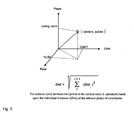
- All these collected user data may be stored in a multi-dimensional space where each axis represents one of the types of data, i.e. the time of rendering, the sub-domain etc. as illustrated with a three-dimensional space in Fig. 3.
- the weight of a given set of data for a particular user experience of a unit of information on the provision of suggestions of contents to a user may be dependent on the distance between the set of data and the occasion in which the suggestions are requested, i.e. the time and date, the sub-domain etc. so that experiences closer in time are weighted higher than more distant experiences, etc.
- a number of parameters defining the weight of various data in a collected set of data may be user-defined.
- the element for the collection and analysis of user behaviour data collects and stores data continuously and the user may e.g. choose to request suggestions based on another occasion than the present, i.e. suggestions based on a date several years ago, on summer vacation although the actual season is winter etc., and collected user behaviour data may be exchanged between users of the system and of similar systems.
- FIG. 2 An example of the architecture of a complete content suggestion control arrangement according to the present invention is shown in Fig. 2, where:
- the primary target of the invention is to offer operational features for the benefits of the user, where the system adopts relevant experiences and in a simple and easy-to-use mode is able to suggest interesting options and potential selections to be made for the user.
- This mode of operation might be named 'Inspire':
- the system might inspire the user to select an experience.
- the System will serve a list containing different experiences for the user, experiences which all are relevant for the actual user in the actual context.
- the system can give the user access to everything, anytime and anywhere. Normally this will imply that the user gets a lot of choices as well, choices which it seems like the user doesn't want. Instead the system must find out exactly what is relevant for the actual user in the actual situation, place and time, and then serve that to the user in the right way, where less-is-more.
- a function has to log the user behaviour, which implies that the System knows the habits of the user / users, and knows what he/she/they usually select in a given context.
- the Inspire-list served to the user by the system takes values connected to user behaviour patterns.
- An experience from the user behaviour patterns is not the only contributor to the Inspire-list.
- Which suggestions are chosen / selected for the resulting Inspire-list is dependent mostly of user behaviour information, e.g. but not limited to media genre and activity.
- the Life Sculpture information acts like a filter and can cause a removal of elements from the Inspire-list.
- the Life Sculpture can add elements as well.
- the system supports the user to gain experience of his/her personal use patterns.
- the system will only display that information to the user if requested so by the user. If the user wants to change some of those user patterns, then this is done by communicating those wishes to the Life-style-intelligence meta data.
- the system supports the user to get help from the system to change habits, e.g. to move the user pattern in a certain direction, if the user wants so.
- user behaviour is collected and constitutes the suggestion data (see Fig. 1), which data is the source for generating the user related Inspire list.
- the suggestion data is a collection of events recorded by the system, these events being data elements with 3 objects: a) content, b) action in this content, and c) the actual context variables for this user.
- the content object contains the 'stored content' as well as 'live content', the content being stored as an identifier of the actual content related to the event.
- All content has unique identifiers in the overall system.
- All data resides in databases containing stored meta data e.g. but not limited to: music-database, photo-database, movie database, audio-memory database, video-memory database, e-mail database, phone-message database, or a list with live content active data e.g. but not limited to: TV - source in the kitchen, TV source in the main room, and audio tuner in the bed room.
- the stored content is the unique content identifier for the actual database and/or source in action as the identified event.
- the content-identifiers might be stored in a short- or even in a long period of time, which enables the user to replay a specific event from historical recorded events.
- the system handles physical as well as virtual sources of information.
- a DVD actually is in a media player it might be added to the relevant music/movie database and allocated a content-identifier.
- the action object contains information about the use of the actual content, the use level being quantified as: a) identified and accessed, or b) observed and ignored.
- This use level validation is a mixture of time spent on the event and level of interest.
- the system automatically records the action, and optionally the user has the possibility specifically to qualify the action object to be 'good' or 'bad'.
- the action object might have e.g., but not limited to, the attributes: a) viewed completely, b) viewed shortly within a predefined time period, c) user has marked as 'good', d) user has marked as 'bad', e) new content added, and f) user has discarded to add a system proposed action.
- the context object contains parameter values of a set of recorded context parameters, e.g. but not limited to: a) user ID, b) place [domain, sub domain, room], c) time and date, d) ambience of the room (light/temperature), e) user mood , f) other user preferences, g) actual operation [source, control position/mode], and h) miscellaneous.
- a) user ID e.g. but not limited to: a) user ID, b) place [domain, sub domain, room], c) time and date, d) ambience of the room (light/temperature), e) user mood , f) other user preferences, g) actual operation [source, control position/mode], and h) miscellaneous.
- the system handles multi user and multi domain operations. For two or more consecutive users in the same room the attributes for one user might be dependant of the activity of another user, thus its two different situations if the user is alone in a room or one or more other users are active on the system in the same room.
- user behaviour data is collected and constitutes the collection of recorded events.
- the context related data is to be considered as an n-dimensional space (Fig. 3) having the context parameters along the axis.
- the space In a basic context room with the context parameters 'place', 'time' and 'user' the space is in 3 dimensions. Any event might be located in the space having related content and action parameter values. At the opposite there is not necessarily an event related to every point in the context room. There might be 0, 1, 2 or more events related to all points in the context room. Extension of the context room with one more parameter implies that the n-dimensional space is extended to be a (n+1)-dimensional space.
- the distance (dist) between two points in the context room is calculated based upon the individual distances ( dist i ) of the relevant points of coordinates.
- Figure 4 displays an example of the preferred embodiment of the invention having a 3-dimensional space and a calculation of the distance between the two points marked with the '*'.
- the Life Sculpture parameters defines a multidimensional data space of social and/or life related options e.g., but not limited to: age, sex, interests, political orientation, religion, preferred media genre, and preferred food.
- the EPG parameters defines a multidimensional data space of electronically program guides available as virtual media sources or as physical sources e.g., but not limited to: TV stations, radio stations, satellite channels, DAB channels, tele/phone services, e-mail, and WEB services.
- the UserConstant is a defined default value that's assigned as the delta criteria.
- the PlaceConstant is a defined default value that's assigned as the delta criteria.
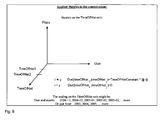
- Figure 7 displays the metrics on the Time axis of the preferred embodiment of the invention. Identical time-frame is identified when having the calculated delta time falls within a pre-defined interval value (e.g. 3 hours).
- the TimeOfDayConstant is a defined default value that's assigned as the delta criteria.
- Figure 8 displays the metrics on the Time-Of-Week axis of the preferred embodiment of the invention.
- a new time-frame is identified when having the calculated delta time greater than a pre-defined value (TimeOfWeekConstant).
- Figure 9 displays the metrics on the Time-Of-Week axis of the preferred embodiment of the invention.
- a new time-frame is identified when having the calculated delta time greater than a pre-defined value (TimeOfHistConstant).
- an example of parameter values in the context room is: Axis Variable: Description Symbolic values 1.dim. User User identifier Unknown, user1, user2, user3, ..., userN 2.dim. Place Domain, sub domain, room or zone Livingroom, kitchen, bedroom, office, bathroom, summerhouse, car, hotel room 3.dim. Time of the day/night The time axis is contiguous and not quantified. The time might be considered to be cyclic in a 24 hours period. Integers (Differences between two time stamps) 4.dim. Time period in a week Most users might have different habits and use patterns from day to day and in workday versus holidays and week-ends. Workday, week-end or holiday 5.dim.
- FIG. 2 more data sets act as central storage of the content data (4a), the context data (1m), the content data (4a) and the life sculpture data (2f).
- the content data constitutes the collection of records for: Id, file name, title, media genre [music, photo, internet radio, movie, web, e-mail, sms, v-memory, a-memory, TV tuner, SAT tuner, CD/DVD player], genre [rock, jazz, classic, etc.], artist, album, owner, mood [depressed, exhausted, cal, exited, glad, sad, angry etc.], year/date, time, manufacturer, model, country, language, station, strm codec, strm bandwidth.
- Id user, place, date time, content Id of presentation media, light setting, speaker setting, social connected to user Id, activity [play, login, grab, throw, record, skip, make play list, add meta data, make personal channel, make book mark, input new content, communicate, selected elements from suggestion lists, channel selected, traditional navigation music mode, traditional navigation genre mode, traditional navigation content mode, other].
- the life sculpture data constitutes the collection of records for: Id, user, sex, age, married status, education, relatives [family, friends, other], job category, interests [sport, culture, action, travel, art, literature, movie, music, food, practical, academic, scientific, philosophic], life style, location [home, vacation, temporary], contact [phone, web, e-mail, other], event calendar, other.
- suggestion data sets are generated via context space calculations.
- user behaviour based suggestion lists might be calculated based on an actual context point defined by: the user id, the actual place, and the actual date time.
- the distance between the point and the actual point is calculated applying the metric of the context space.
- the system constructs a suggestion-list which contains the content-titles which the actual user usually plays in the actual place and at the actual time.
- Those content-titles is a mix of live content and stored content, and is a mix of different media genre, e.g.: music-track-titles, music-album-titles, movie-titles, TV-channels, photo-titles, photo-album-titles (automatically generated), web-pages, e-mail-subject-titles, radio-channels, CD-player.
- the system constructs a suggestion-list which contains the content-music-titles which the actual user usually plays in the actual place and at the actual time.
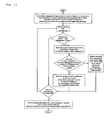
- Figure 12 discloses the procedure:
- the system constructs a suggestion-list which contains the content-music-genres which the actual user usually plays in the actual place and at the actual time.
- Figure 13 discloses the procedure:
- the system constructs a suggestion list which contains the content-genre of a given media genre different from music ex. video, photo or web, which the actual user usually plays in the actual place and at the actual time.
- the demanded media genre has to be equal to the wanted media genre (video, photo, web, etc.).
- some genres have to exist for the media genre: video, photo web.
- the wanted metadata simply doesn't exist, e.g. the metadata: genre on the user's personal photos. To avoid this situation the existence of metadata in the content-database determines which kind of user behaviour based suggestion lists the system will generate.
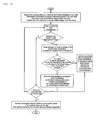
- the system constructs a suggestion-list which contains the content-photo-albums which the actual user usually plays in the actual place and at the actual time.
- Figure 14 discloses the procedure:
- the system constructs a suggestion-list which contains the content-music-artists which the actual user usually plays in the actual place and at the actual time.
- Figure 15 discloses the procedure:
- the system can generate user behaviour based suggestion lists using every existing view from each database as a value of "preferred view", and as a filter as well.
- "preferred view” can take values from ⁇ view1 ... viewX, ... viewY, ... ⁇ .
- ⁇ view_i element_j of view_i ⁇ , where i and j takes all existing values.
- New metadata means that new columns will appear in the content-database or in the context-database. Or new elements will appear in an existing column.
- the different suggestions lists can tell the system something about the habits of the user when the user is playing content, what content the user usually plays in which places and at which time of the day and night, but not only that. It also tells the system something about how the user usually selects the content.
- This kind of information can help the system to find some content which is relevant for the user, additionally it can help the system to change the content manager, to change the way the system serves the content for the user. E.g. changing the content-navigator, adding something to the content-navigator and in this mode the system is able to adapt to the user, instead of forcing the user to adapt to the system.
- life sculpture based suggestion lists might be calculated based on an actual context point defined by: the user id, the actual place, and the actual date time.
- wanted-inspire-mode not in use, small-suggestion-list, big-suggestion-list (with seed-function), auto-play first suggestion in small-pip, auto-play first suggestion in medium-pip, auto-play first suggestion in big-pip, etc.
- preferred LAI level learning-only, learning-and-acting
- want-to-be-surprised yes, no
- EPG suggestion lists can be generated, based on the data that the system gets from the electronic program guide (EPG).
- This information is placed as points in an EPG-space, which as an example is defined by the axis: Time, Program-Genre, and TV-channel.
- the program-genre-axe is an axe of discrete values, which are all existing program-genre which can be found in EPG-metadata and where the TV-channel-axe is an axe of discrete values, which are all existing TV-channels which can be found in EPG-metadata.
- a metric is put on the EPG-space, using the same principles as used for the metric of the context-space.
- the metric-constant(s) of the TV-channel-axe are bigger than the metric-constant(s) of the program-genre-axe, which again are bigger than the metric-constant of the time-axe.
- Online analysis of the content-space and the EPG-space can change all the metric-constants (calibrate the metrics).
- Identifying p is obtained by running through the elements of this suggestion list starting from the top and looking at the value of the metadata genre of all the elements (this is found in the content-database).
- the first found genre which is equal to one of the existing genres from the EPG, is used as a value for p.
- Identifying ch is obtained by running through the elements of this suggestion list starting from the top and looking at the value of the metadata: 'TV-channel' of all the elements (this is found in the content-database). The first found TV-channel which is equal to one of the existing TV-channels from the EPG, is used as a value for ch.
- Some elements might have the value 'no TV-channels' metadata, e.g. if it is a movie or video memory resident data (v-mem) not recorded via a TV-tuner).
- the actual point is a point in the EPG-space and it's possible for all the existing points in the EPG-space to calculate the distance between any points and the actual point using the metric of the EPG-space.
- each point in the EPG-space now has a distance to the actual point, and an EPG-entry identifier.
- This identifier is used to get information about the actual programme in the EPG, e.g. a: title, programme-genre, TV-station, start-time, end-time, web-page, and others.
- the model is scalable. In the future when more metadata is required from the EPG, then the model is extended to use those new metadata as well. This will result in new filters and new possibilities of use, and new views for the user.
- the system has a continuously update mode of the suggestion lists.
- this update mode following events apply: a) when another user enters the room b) when a user moves to another room, c) when a user grabs the remote control device , d) when another user takes control, e) when a user leaves the room (or the house),f) when the time shifts to another time interval, g) when the ambience of the room changes (light-setting and or HT-setting), h) when the mood of the user chances, i) when the interests of the user chances, j) when a source in the system becomes locked, k) when the user controls the system / interacts with the system (press a key on the remote, moves the free cursor, talks to the system, gesticulate ), I) when an automatic system-function starts / stops and m) when a new source / product is added to / removed
- an adaptive mode of operation is obtained, which mode is dynamic and where the system continuously adopts knowledge about the user that navigates in an actual context.
- the basic data for the system to adapt to the user is found in the accumulated data in the suggestion lists.
- the type of experiences the system might deduce over time is: a) during the user interaction with the system, where a traditional navigation is applied, the system can propose qualified suggestions to the expected next step from the user, b) the content manager will adapt to the user behaviour, c) the Inspiration list might expand, or become shorter or completely disappear if its not used, d) in fact all user entry dialogs might change
- the accumulated data in suggestion lists are based on a) User behaviour based suggestion lists, which are built on different combination of "preferred view” and none, one or several filters, and b) Life Sculpture based suggestion list and c) EPG suggestion lists.
- an 'actual mate experience list' can be generated. This might be obtained if the system is connected to a dedicated internet server service, and if a friend of the user also has a system which is connected to the same internet service, then it is possible for those two friends to recommend an experience to each other, encouraging each other to share an experience.
- All of the suggestion lists can contain none, one or several suggestions, depending of the situation. As soon as the situation has changed e.g. trigged by a change in the content-database, the context-database, the Life Sculpture, the EPG, a dedicated-internet service-information, or a changed in time, those lists which are depending on the parameter which has changed is recalculated and rebuilt.
- Suggestion lists have supplementary lists attached.
- the list contains e.g. the suggestions: play, grab, throw, and communicate.
- the supplementary lists cannot be generated to this User behaviour based suggestion list.
- the identified user experiences, recorded actions and events constitutes a number of variables in a problem domain where the solution space is defined by means of relations among the variables.
- Said relations are defined as constraints in terms of definitions of legal combinations, where said constraints define conclusions on specific premises that might occur.
- Said relations can be defined as legal combinations or as illegal combinations as appropriate and is organized as relations among variables in the general mathematical notation of 'Disjunctive Form':
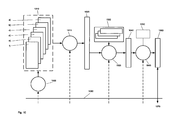
- Fig 10 displays how said relations can be defined in one single constraint table or in two or more constraint tables (1030) where common variables from table to table secure logical consistency across the entire problem domain.
- Another aspect of the invention is that said relations as defined in one or more tables (1030), might be reloaded from an external data source which enables a very flexible redefinition of the premises and conclusions that's applied in generating the Inspire list.
- the problem solver engine (1025) proceeds in finding the result (1040) by a search into the set of legal combinations (1030). According to definitions made in the constraint tables (1030) the result might be an optimized list of variables (1040) required to generate the Inspire list (1060);
- Figure 10 displays one embodiment of the invention.
- the application controls the recording and organizing of the user experiences and system use by archiving (1005) into the suggestion data set (1010) : a) user behaviour based suggestions; b) life sculpture based suggestions; and c) EPG suggestions and recorded transactions: d) last experienced, e) actual mate experience, f) last recorded / downloaded.
- the validation of the dataset in the suggestion data set (1010) is executed in a three step procedure, the first step (1015) being the creation of a list variables (1020) extracted from the suggestion data set (1010) containing the relevant parameters that influences the content of the Inspire list (1040,1060).
- the second step in the procedure is to calculate what the relevant conclusions are, those conclusions being made based on the defined set of constraints (1030) and interrogated by the search engine (1025), and the conclusion to be stored as a list of variables that constitutes the raw unsorted Inspire list.
- the third step in the procedure is to sort and order (1045) the Inspire list parameters according to predefined presentation requirements (1050) to obtain the final and ordered list (1060), to support ease of use and user access via the application user interface (1070).
- the constraint table is exemplified with the primary parameters interesting for this example: Line # Cursor On level Cursor On Medi a genre 1 1 E 1 1 P 1 2 E 1 2 P 2 1 E 2 1 P 2 2 E 2 2 P 2 3 E 2 3 P 3 1 E 3 1 P 3 2 E 3 2 P 1 none none 1 1 1 2 1 3 1 4 1 5 2 none none 1 1 1 2 1 3 1 4 1 5 0 0 3 none none 1 1 1 2 1 3 1 4 1 5 0 0 0 1 1 E List 1 suggestion 1 existence the existence of suggestion 1 in the suggestion list 1 1 1 P List 1 suggestion 1 priority the priority of suggestion 1 in the suggestion list 1 1 2 E List 1 suggestion 2 existence the existence of suggestion 2 in the suggestion list 1 1 2 P List 1 suggestion 2 priority the priority of suggestion 2 in the suggestion list 1 Etc.
- the product is ready to be used. The user has not selected anything yet.
- the resulting Inspire list is: ⁇ numb-1 from list 1; numb-2 from list 1, numb-1 from list 2, numb-2 from list 2, and numb-3 from list 2 ⁇
- the user has placed the cursor (traditional navigation) on music.
- the resulting Inspire list is: ⁇ numb-1 from list 4; numb-2 from list 4, numb-1 from list 5, numb-2 from list 5, and numb-3 from list 5 ⁇ .
Landscapes
- Engineering & Computer Science (AREA)
- Theoretical Computer Science (AREA)
- Databases & Information Systems (AREA)
- Data Mining & Analysis (AREA)
- Physics & Mathematics (AREA)
- General Engineering & Computer Science (AREA)
- General Physics & Mathematics (AREA)
- Multimedia (AREA)
- Information Retrieval, Db Structures And Fs Structures Therefor (AREA)
- Management Or Editing Of Information On Record Carriers (AREA)
Applications Claiming Priority (2)
| Application Number | Priority Date | Filing Date | Title |
|---|---|---|---|
| PCT/DK2006/000111 WO2006089555A1 (en) | 2005-02-25 | 2006-02-24 | Pervasive media information retrieval system |
| US78916406P | 2006-04-05 | 2006-04-05 |
Publications (2)
| Publication Number | Publication Date |
|---|---|
| EP1826688A2 true EP1826688A2 (de) | 2007-08-29 |
| EP1826688A3 EP1826688A3 (de) | 2008-01-23 |
Family
ID=37907634
Family Applications (1)
| Application Number | Title | Priority Date | Filing Date |
|---|---|---|---|
| EP07075135A Withdrawn EP1826688A3 (de) | 2006-02-24 | 2007-02-16 | Verfahren zum Lernen des Benutzerverhaltens in einem ubiquitären System |
Country Status (1)
| Country | Link |
|---|---|
| EP (1) | EP1826688A3 (de) |
Cited By (2)
| Publication number | Priority date | Publication date | Assignee | Title |
|---|---|---|---|---|
| EP2013781A2 (de) * | 2006-04-21 | 2009-01-14 | Hewlett-Packard Development Company, L.P. | Verfahren und system zur erfassung von datenobjekten in grossen datenobjektbibliotheken |
| US9824125B2 (en) | 2012-06-11 | 2017-11-21 | Philips Lighting Holding B.V. | Methods and apparatus for storing, suggesting, and/or utilizing lighting settings |
Families Citing this family (1)
| Publication number | Priority date | Publication date | Assignee | Title |
|---|---|---|---|---|
| US10109214B2 (en) | 2015-03-06 | 2018-10-23 | International Business Machines Corporation | Cognitive bias determination and modeling |
Family Cites Families (5)
| Publication number | Priority date | Publication date | Assignee | Title |
|---|---|---|---|---|
| EP1395929A2 (de) * | 2001-01-18 | 2004-03-10 | Koninklijke Philips Electronics N.V. | Anordnung, erleichterungseinrichtung, erstbenutzereinrichtung und verfahren |
| US8099325B2 (en) * | 2002-05-01 | 2012-01-17 | Saytam Computer Services Limited | System and method for selective transmission of multimedia based on subscriber behavioral model |
| CN1633818A (zh) * | 2002-07-01 | 2005-06-29 | 诺基亚公司 | 向通信终端分发宣传消息的系统和方法 |
| US8412566B2 (en) * | 2003-07-08 | 2013-04-02 | Yt Acquisition Corporation | High-precision customer-based targeting by individual usage statistics |
| ES2448400T3 (es) * | 2003-11-26 | 2014-03-13 | Sony Corporation | Sistema para acceder a elementos de contenido sobre una red |
-
2007
- 2007-02-16 EP EP07075135A patent/EP1826688A3/de not_active Withdrawn
Cited By (2)
| Publication number | Priority date | Publication date | Assignee | Title |
|---|---|---|---|---|
| EP2013781A2 (de) * | 2006-04-21 | 2009-01-14 | Hewlett-Packard Development Company, L.P. | Verfahren und system zur erfassung von datenobjekten in grossen datenobjektbibliotheken |
| US9824125B2 (en) | 2012-06-11 | 2017-11-21 | Philips Lighting Holding B.V. | Methods and apparatus for storing, suggesting, and/or utilizing lighting settings |
Also Published As
| Publication number | Publication date |
|---|---|
| EP1826688A3 (de) | 2008-01-23 |
Similar Documents
| Publication | Publication Date | Title |
|---|---|---|
| US20070277196A1 (en) | Methods of user behavior learning and acting in a pervasive system | |
| US20210097630A1 (en) | Web-Based Platform and Method for Providing Interactive Interface Between Performing Artists and Others | |
| US8577874B2 (en) | Tunersphere | |
| US8214462B1 (en) | System and method for providing a personalized media service | |
| JP5250100B2 (ja) | メディア・コンテンツのプログラミング、配信、および消費 | |
| US8539044B2 (en) | On-line schedule system with personalization features | |
| US6192340B1 (en) | Integration of music from a personal library with real-time information | |
| US11775580B2 (en) | Playlist preview | |
| US20120159337A1 (en) | System and method for recommending media content | |
| CA2866585A1 (en) | Systems and methods for audio attribute mapping | |
| JP2001155038A (ja) | 多重階層構造を有するユーザ嗜好度情報構造及びそれを利用したマルチメディア情報の提供方法 | |
| CN102550039A (zh) | 用于关联并提供共享属性的不同类型的媒体内容的方法和系统 | |
| EP2288978A1 (de) | System und verfahren zur verbindung von medieninhalten | |
| US20200382571A1 (en) | Method and system for generation of media | |
| EP2849096A1 (de) | Elektronische Vorrichtung, Programmempfehlungssystem, Programmempfehlungsverfahren und Programmempfehlungsprogramm | |
| CN1386367A (zh) | 电子内容指南能使内容资源成为透明 | |
| EP1856632A1 (de) | Pervasives system zum abruf von mediendaten | |
| US20100257030A1 (en) | Method and system for conducting a contest | |
| US9172732B1 (en) | System and method for providing a personalized media service | |
| EP1826688A2 (de) | Verfahren zum Lernen des Benutzerverhaltens in einem ubiquitären System | |
| JP2003169312A (ja) | 電子番組表提供システム、電子番組表提供方法、そのプログラム、及びそのプログラムを記録した記録媒体 | |
| CN103561300A (zh) | 产生对至少一个内容项目的推荐的方法和设备 | |
| KR20050059188A (ko) | 상이한 형태들의 미디어 콘텐트를 연관시키기 위한 시스템및 방법 | |
| KR100902756B1 (ko) | 개인화된 방송 프로그램 자동 편성 시스템 및 그 방법 | |
| WO2007081761A2 (en) | Method and system for generation of media |
Legal Events
| Date | Code | Title | Description |
|---|---|---|---|
| PUAI | Public reference made under article 153(3) epc to a published international application that has entered the european phase |
Free format text: ORIGINAL CODE: 0009012 |
|
| AK | Designated contracting states |
Kind code of ref document: A2 Designated state(s): AT BE BG CH CY CZ DE DK EE ES FI FR GB GR HU IE IS IT LI LT LU LV MC NL PL PT RO SE SI SK TR |
|
| AX | Request for extension of the european patent |
Extension state: AL BA HR MK YU |
|
| PUAL | Search report despatched |
Free format text: ORIGINAL CODE: 0009013 |
|
| AK | Designated contracting states |
Kind code of ref document: A3 Designated state(s): AT BE BG CH CY CZ DE DK EE ES FI FR GB GR HU IE IS IT LI LT LU LV MC NL PL PT RO SE SI SK TR |
|
| AX | Request for extension of the european patent |
Extension state: AL BA HR MK YU |
|
| 17P | Request for examination filed |
Effective date: 20080723 |
|
| AKX | Designation fees paid |
Designated state(s): AT BE BG CH CY CZ DE DK EE ES FI FR GB GR HU IE IS IT LI LT LU LV MC NL PL PT RO SE SI SK TR |
|
| 17Q | First examination report despatched |
Effective date: 20081103 |
|
| STAA | Information on the status of an ep patent application or granted ep patent |
Free format text: STATUS: THE APPLICATION IS DEEMED TO BE WITHDRAWN |
|
| 18D | Application deemed to be withdrawn |
Effective date: 20090114 |