EP1828889B1 - Procédé de compilation, appareil de compilation et système informatique pour compiler une boucle dans un programme - Google Patents
Procédé de compilation, appareil de compilation et système informatique pour compiler une boucle dans un programme Download PDFInfo
- Publication number
- EP1828889B1 EP1828889B1 EP05823486A EP05823486A EP1828889B1 EP 1828889 B1 EP1828889 B1 EP 1828889B1 EP 05823486 A EP05823486 A EP 05823486A EP 05823486 A EP05823486 A EP 05823486A EP 1828889 B1 EP1828889 B1 EP 1828889B1
- Authority
- EP
- European Patent Office
- Prior art keywords
- instructions
- instruction
- loop
- instruction section
- combined
- Prior art date
- Legal status (The legal status is an assumption and is not a legal conclusion. Google has not performed a legal analysis and makes no representation as to the accuracy of the status listed.)
- Expired - Lifetime
Links
Images



Classifications
-
- G—PHYSICS
- G06—COMPUTING OR CALCULATING; COUNTING
- G06F—ELECTRIC DIGITAL DATA PROCESSING
- G06F8/00—Arrangements for software engineering
- G06F8/40—Transformation of program code
- G06F8/41—Compilation
- G06F8/45—Exploiting coarse grain parallelism in compilation, i.e. parallelism between groups of instructions
- G06F8/451—Code distribution
- G06F8/452—Loops
Definitions
- the invention relates to a method, an apparatus and a computer system for compiling a program including a loop, and more particularly to a method, an apparatus and a computer system for compiling a program including a loop in VLIW (Very Long Instruction Word) processors.
- VLIW Very Long Instruction Word
- a conventional computer system its hardware portion comprises a CPU (Central Processing Unit), memories and the like.
- the computer system operates through executing instructions.
- the conventional instruction-set computer includes RISC (Reduced Instruction-Set Computer) and CISC (Complicated Instruction-Set Computer), and the VLIW becomes a more and more popular technology in the field of micro-processor design.
- the VLIW processors Compared with RISC and CISC processors, the VLIW processors have advantages of low cost, low energy consumption, simple structure and high processing speed.
- the VLIW processors use fixed-length long instructions composed of several shorter instructions which can be executed in parallel. And, the VLIW processors do not need many complicated control circuits which must be used when Super-scalar processors coordinate to execute in parallel during operation.
- VLIW processors further combine more than two instructions into an instruction packet.
- a compiler schedules the instruction packet in advance to make the VLIW processors be capable of rapidly executing the instructions in parallel, so that the micro-processors do not need to execute the complicated time sequence analyses which must be completed in the Super-scalar RISC and CISC processors.
- a so-called multiple-issue processor allows the processor to execute multiple instructions in one clock cycle.
- the multiple-issue processors come in two flavors:
- a VLIW instruction usually consists of several sub-instructions. Each sub-instruction corresponds to a certain functional unit (i.e. module) in the processor and to a set of operations.
- modules i.e. module
- one VLIW instruction includes two integer operations, two floating-point operations, two memory references and a branch.
- a VLIW processor uses multiple, independent functional units, and each functional unit is used to execute one sub-instruction of the VLIW instruction.
- the parallel scheduling of these operations requires complicated compiling schemes and tools.
- Fig. 1 shows the relationship between the VLIW instruction and the VLIW processor.
- the VLIW instruction includes four sub-instructions, which are ADD int a, b; MUL double c, 3.142; READ d, AR0; and BNZ loop, e, respectively.
- These four sub-instructions correspond to four functional units in the VLIW processors: an integral functional unit (INT FU), a floating-point functional unit (Float FU), a data memory (Data Memory) and a program memory (Program Memory).
- INT FU integral functional unit
- Float FU floating-point functional unit
- Data Memory data memory
- Program Memory Program Memory
- the conventional VLIW compiling apparatus translates each instruction and generates machine codes independently, i.e. each instruction corresponds to one VLIW binary instruction with specific length (e.g. 256 bits).
- the compiling scheme will leads to waste of operations margin, especially in loop structures.
- a loop is one of the basic program structures whatever in high and low level languages. In most DSP (Digital Signal Processing) style applications, large amount of loops are used for computations such as filtering, correlation, etc. Actually, the loop structure let processors execute repeating instruction blocks with minimum program memory space.
- DSP Digital Signal Processing
- the loop is expressed as machine (binary) instructions. Each binary instruction occupies 256 bits in program memory. If the repeating times of the loop is K, the processor needs K cycles for the implementation of the whole loop structure (assuming the whole loop structure is to execute repeatedly one loop and is a zero-overhead loop). So one of the advantages of the conventional compiling method for loops is to let processor execute a much longer repeating loop structure with a limited program memory space.
- the conventional compiling method can reach optimal result for both program memory space occupation and loop execution efficiency.
- the conventional compiling method cannot guarantee the loop execution efficiency.
- the execution efficiency of the loop structure is not high so as to cause waste of the loop time, so that it is difficult for the operating efficiency of the whole VLIW processor to satisfy the requirements.
- BOGONG SU ET AL "A software pipelining based VLIW architecture and optimizing compiler" MICROPROGRAMMING AMD MICROARCHITECTURE.
- a pipeline register file may be used to reduce the inter-body dependence distance between overlapping of the adjacent loop iterations to further shorten the length of the optimised loop body.
- US-A-6 038 396 (IWATA ET AL) 14 March 2000 ( 2000-03-14 ), teaches a compiling apparatus and method for a VLIW system computer.
- an instruction of an intermediate code format designated for each slot of the VLIW instruction is divided corresponding to each slot and stored into a plurality of intermediate code files.
- the instructions of the intermediate code format stored in intermediate code files are then read in serially to execute an instruction scheduling process taking into account dependency between instructions.
- ALLAN V ET AL "SOFTWARE PIPELINING" ACM COMPUTING SURVEYS, NEW YORK, NY, US, vol. 27, no. 3, September 1995 (1995-09), pages 367-432, XP008044857 ISSN: 0360-0300 , teaches a technique for software pipelining which utilises parallelism at the instruction level. The technique reforms loop so that a faster execution is realised. Iterations may be executed in overlapping fashion to increase parallelism.
- MORIF microprogram optimisation technique
- a method for compiling a program including a loop for a processor comprising multiple functional plurality of registers, the loop in the program including K instructions, K ⁇ 2, and repeating for M times, M ⁇ 2, comprising the steps of: a) performing a resource conflict analysis on the K instructions in the loop, wherein the step a) comprises: in the case that K is an even number, determining successively and respectively whether the functional units for executing the ith instruction, 1 ⁇ i ⁇ K/2, and those for executing the jth instruction, K/2+1 ⁇ j ⁇ K, in the K instructions, are in conflict; and determining successively whether the registers for executing the ith instruction, 1 ⁇ i ⁇ K/2, and those for executing any one from the jth instruction, K/2+1 ⁇ j ⁇ K, to the Kth instructions, in the K instructions, are in conflict and in the case that K is an odd number, determining successively and respectively whether the functional units for executing
- a compiling apparatus for compiling a program including a loop for a processor comprising multiple functional units and a plurality of registers, the loop in the program including K instructions, K ⁇ 2, and repeating for M times, M ⁇ 2, the compiling apparatus comprising: analysis means for performing a resource conflict analysis on the K instructions in the loop, wherein the analysis means comprises: means for determining successively and respectively whether the functional units for executing the ith instruction and those for executing the jth instruction, in the K instructions, have conflicts; and means for determining successively whether the register for executing the ith instruction of the K instructions and the register for executing any one from the jth to Kth instructions have conflicts, wherein in the case that K is an even number, 1 ⁇ i ⁇ K/2, and, K/2+1 ⁇ j ⁇ K, while in the case that K is an odd number, 1 ⁇ i ⁇ (K+1)/2-1, and, (K+1)/2+1 ⁇ j
- a computer system including a memory, an input and output apparatus and a compiling apparatus for a program including a loop for a processor comprising multiple functional units and a plurality of registers, the loop in the program including K instructions, K ⁇ 2, and repeating for M times, M ⁇ 2, wherein the compiling apparatus comprises: analysis means for performing resource conflict analysis to the K instructions in the loop, wherein the analysis means comprises: means for determining successively and respectively whether the functional units for executing the ith instruction and those for executing the jth instruction, in the K instructions, have conflicts; and means for determining successively whether the register for executing the ith instruction of the K instructions and the register for executing any one from the jth to Kth instructions have conflicts, wherein in the case that K is an even number, 1 ⁇ i ⁇ K/2, and, K/2+1 ⁇ j ⁇ K, while in the case that K is an odd number, 1 ⁇ i ⁇ (K+1)/2-1, and,
- the cycle efficiency of the program can be improved remarkably.
- a resource conflict analysis is introduced.
- the analysis for each instruction in the loop is added.
- the resource conflict analysis process consists of two parts:
- the function of the functional unit analysis is to avoid the conflict of the functional units required for executing two instructions.
- the registers conflict analysis is to check the data dependency between two instructions.
- Fig. 2 is a flow chart of a compiling method for a program including a loop according to the first embodiment of the invention, wherein the loop includes K instructions (K is an integer equal to or more than 2) and repeats for M times (M ⁇ 2) in the program.
- the compiling method for a program including a loop comprises the following basic steps:
- Step S101 a resource conflict analysis is performed to the K instructions in the loop and it is judged whether there is resource conflict between the corresponding instructions.
- Step S102 according to the analysis results in Step S101, the K instructions in the loop are divided into a first combined instruction section, a connection instruction section and a second combined instruction section, wherein there is no resource conflict between the instructions in the first combined instruction section and the instructions in the second combined instruction section respectively.
- the instructions in the first combined instruction section and the instructions in the second combined instruction section can be compiled in parallel respectively, and the instructions in the connection instruction section have resource conflicts with the instructions in the first or second combined instruction sections.
- Step S101 in Fig. 2 is described in detail.
- Fig. 3 shows the details of the resource conflict analysis step mentioned in the above Step S101 in the case that K is an even number.
- Step S201 two variables i and j are set, and variables i and j are initialized as 0 and K/2 respectively.
- the initial values of the variables i and j are set only for designing the flow chart.
- the variation range of variable i is 1 ⁇ i ⁇ K/2 and that of variable j is (K/2+1) ⁇ j ⁇ K.
- the instructions, to which the variable i directs are the first section instructions (the front half instructions) of the loop, and the instructions, to which the variable j directs, are the second section instructions (the rear half instructions) of the loop.
- Step S204 it is judged whether the functional unit executing the ith instruction and the functional unit executing the jth instruction are conflicting in the loop.
- Step S204 If the judgment result in Step S204 is "No", the flow proceeds to Step S205, and it is further judged whether the register for executing the ith instruction is in conflict with that for executing the jth instruction.
- the source register or the target register used for executing the ith instruction and the source register or the target register used for executing any one of the jth to Kth instructions involve the same register, it is determined that the register conflict exists between the ith instruction and the jth instruction, otherwise it is determined that the register conflict does not exist between the ith instruction and the jth instruction.
- Step S204 If the judgment result in Step S204 is "Yes", which means that the functional unit conflicts exist between the corresponding instruction, the flow returns to Step S203, and continues to judge whether the functional unit conflict exists between the instruction in the first section instructions to which the variable i directs and the following instruction in the second section instructions to which the variable j directs (Step S204).
- Step S205 if the judgment result in Step S205 is "Yes", the flow returns to Step S203.
- Step S207 If the judgment result in Step S207 is "No”, the flow continues to judge whether j is less than K (Step S208); if the answer is "Yes”, the flow returns to Step S206, otherwise the flow proceeds to Step S209.
- Step S207 If the judgment result in Step S207 is "Yes", the flow returns to Step S203.
- Step S209 the corresponding instructions have neither functional unit conflicts nor register conflicts, so that it is determined that there is no resource conflict between the corresponding instructions.
- the above-mentioned processing has completed the judgment of the resource conflict between one instruction in the first section and one instruction and its following instructions in the second section in the loop.
- Step S210 it is judged whether variable i is less than K/2. If the judgment result in Step S210 is "No", the flow returns to Step S202, otherwise the resource conflict judgment to the instructions in the loop is terminated and the flow proceeds to Step S102 ( Fig. 2 ).
- Step S202 the judgment of the resource conflict between another instruction in the first section and another instruction and its following instructions in the second section in the loop begins.
- the resource conflict analysis process is similar to that in the case that K is an even number, exempt for the varying range of the variable i being 1 ⁇ i ⁇ ((K+1)/2-1) and the varying range of the variable j being ((K+1)/2+1) ⁇ j ⁇ K.
- the case that the central instruction is in conflict with other instructions in the loop is not considered.
- the compiling method for a program including a loop according to the first embodiment of the invention, shown in Figs. 2 and 3 is applicable to the loop with the front n instructions matching with the rear n instructions, i.e. to the loop without resource conflicts.
- the front n instructions and the rear n instructions must be arranged continually, and exhibit a one-one corresponding matching relationship.
- the middle K-2n instructions of the loop can be used as the connection instruction section.
- the connection instruction section is compiled sequentially.
- Fig. 4 (a) shows the case of compiling a loop including even number of instructions by using the compiling method for a program including a loop according to the first embodiment of the invention.
- arrows in Fig. 4(a) show the match cases (without conflict) between respective corresponding instructions, wherein the two-heads arrows represent that there is neither functional unit conflict nor register conflict between the two instructions and the single-head arrows represent that there is no register conflict between the two instructions.
- the loop is divided into a first combined instruction section (including instructions A, B, C and D) and a second combined instruction section (including instructions E, F, G and H).
- the number of the instructions in the connection instruction section is zero.
- the instructions E, F, G and H in the cycle N-1 and the instructions A, B, C and D in the cycle N can be compiled in parallel respectively, and the instructions E, F, G and H in the cycle N and the instructions A, B, C and D in the cycle N+1 can be compiled in parallel respectively.
- the execution time of the loop is reduced remarkably.
- the first combined instruction section includes the instructions A and B
- the second combined instruction section includes the instructions G and H
- the connection instruction section includes instructions C, D, E and F.
- the execution time of the loop is slightly longer than that in the case shown in Fig. 4(a) .
- Fig. 4(b) shows the case of compiling a loop including odd number of instructions by using the compiling method for a program including a loop according to the first embodiment of the invention.
- the first combined instruction section includes instructions A, B and C
- the second combined instruction section includes instructions E, F and G
- the connection instruction section includes instruction D.
- the instructions E, F and G in the cycle N-1 and the instructions A, B and C in the cycle N can be compiled in parallel respectively, and the instructions E, F and G in the cycle N and the instructions A, B and C in the cycle N+1 can be compiled in parallel respectively.
- connection instruction section in the respective cycles can be compiled sequentially.
- Fig. 5 shows a VLIW loop, where the VLIW loop represented by the assembler language is in the left box and the compiling result of the VLIW loop is in the right box.
- the instruction A (READ a, AR0+; READ b, AR1+;) only revolves a read and write functional unit, and the registers required to be operated for executing the instruction A comprise a and b; and the instruction E ( MUL int e, f, g;) only revolves a computation functional unit, and the registers required to be operated for executing the instruction E comprise e, f and g. Then there is neither functional unit conflict nor register conflict between instructions A and E. There is no register conflict between instructions A and F.
- the instruction B (ADD int a, b, c; SUB int b, a, d;) and the instruction F( WRITE g, AR2+;) also occupies different functional units, and there is no register conflict between instructions B and F.
- Fig. 6 shows the dividing result of the instruction sections of the adjacent three cycles executing the same loop, and the combination of instruction sections in the adjacent cycles.
- a compiling apparatus compiles respective instruction sections in the cycle N-1, cycle N and cycle N+1 in the following order:
- the second combined instruction section in the cycle N-1 and the first combined instruction section in the cycle N are combined to be compiled, and the second combined instruction section in the cycle N and the first combined instruction section in the N+1 cycle are combined to be compiled. In this case, only seven instruction sections need to be compiled.
- the instruction combination is to make the first combined instruction section in the cycle N move up and be executed in parallel together with the second combined instruction section in the cycle N-1, and to make the first combined instruction section in the cycle N+1 move up and be executed in parallel together with the second combined instruction section in the cycle N.
- the first combined instruction section of the first cycle executing the loop and the second combined instruction section of the last cycle executing the loop can not be combined and compiled together with the adjacent instruction sections, and are executed sequentially.
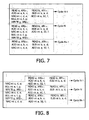
- the loop shown in Fig. 7 can be divided into the following instruction sections:
- the first instruction MUL int e, f, g in the second combined instruction section in the cycle N and the first instruction READ a, AR0+; READ b, AR1+ in the first combined instruction section in the cycle N+1 are combined to be compiled, and the second instruction WRITE g, AR2+; in the second combined instruction section in the cycle N and the second instruction ADD int a, b, c; SUB int b, a, d in the first combined instruction section in the cycle N+1 are combined to be compiled.
- Fig. 9 shows the compiled result of the instruction sets after the combination shown in Fig. 8 .
- Fig. 10 schematically shows a compiling apparatus for realizing the compiling method, according to the second embodiment of the invention, and in the program, the loop includes K instructions (K ⁇ 2) and repeats for M times (M ⁇ 2).
- the compiling apparatus comprises:
- the resource conflict analysis unit 500 comprises a functional unit conflict analysis unit 510 and a register conflict analysis unit 520.
- the functional unit conflict analysis unit 510 is used to judge sequentially whether the functional units for executing ith instruction of the K instructions and those for executing jth instruction have conflicts. In the case that K is an even number, 1 ⁇ i ⁇ K/2, and (K/2+1) ⁇ j ⁇ K. In the case that K is an odd number, 1 ⁇ i ⁇ ((K+1)/2-1), and ((K+1)/2+1) ⁇ j ⁇ K.
- the register conflict analysis unit 520 is used to judge sequentially whether the registers for executing ith instruction of the K instructions and those for executing jth to Kth instructions have conflicts. In the case that K is an even number, 1 ⁇ i ⁇ K/2, and (K/2+1) ⁇ j ⁇ K. In the case that K is an odd number, 1 ⁇ i ⁇ ((K+1)/2-1), and ((K+1)/2+1) ⁇ j ⁇ K.
- the instructions of the second combined instruction section in the cycle N and the instructions of the first combined instruction section in the cycle N+1 have neither functional unit conflict nor register conflict respectively, and can be respectively combined to be compiled.
- connection instruction section in respective cycle can be compiled sequentially.
- the instructions in the front half instructions are divided as the first combined instruction section, and the instructions in the rear half instructions are divided as the second combined instruction section.
- the number of the instructions in the connection instruction section is zero, that is, there is no connection instruction section.
- a computer system which comprises a memory, an input and output apparatus (not shown) and a compiling apparatus for a program including a loop.
- the compiling apparatus is the same as the compiling apparatus according to the second embodiment of the invention, as described with referring to Fig. 10 .
- the compiling apparatus or the computer system for a program including a loop according to the invention By using the compiling method, the compiling apparatus or the computer system for a program including a loop according to the invention, the cycle efficiency of the program can be improved remarkably.
- the instructions of the combined instruction sections take a proportion of n% of the instructions in the whole loop and that the loop repeats for K times.
- the efficiency improvement can be up to about 39.84% (approximately 40%).
Landscapes
- Engineering & Computer Science (AREA)
- General Engineering & Computer Science (AREA)
- Theoretical Computer Science (AREA)
- Software Systems (AREA)
- Physics & Mathematics (AREA)
- General Physics & Mathematics (AREA)
- Devices For Executing Special Programs (AREA)
- Executing Machine-Instructions (AREA)
- Advance Control (AREA)
Claims (17)
- Procédé mis en oeuvre par ordinateur pour compiler un programme comportant une boucle pour un processeur comprenant de multiples unités fonctionnelles et une pluralité de registres, la boucle dans le programme comportant K instructions, K ≥ 2, et se répétant M fois, M ≥ 2, comprenant les étapes suivantes :a) exécution d'une analyse de conflits de ressources sur les K instructions dans la boucle, l'étape a) comprenant :si K est un nombre pair,la détermination successivement et respectivement si les unités fonctionnelles pour exécuter l'ième instruction, 1 ≤ i ≤ K/2, et celles pour exécuter la jème instruction, K/2+1 ≤ j ≤ K, dans les K instructions, sont en conflit ou non ; etla détermination successivement si les registres pour exécuter l'ième instruction, 1 ≤ i ≤ K/2, et ceux pour exécuter n'importe laquelle de la jéme instruction, K/2+1 ≤ j ≤ K, aux Kèmes instructions, dans les K instructions, sont en conflit ou non ;etsi K est un nombre impair,la détermination successivement et respectivement si les unités fonctionnelles pour exécuter l'iéme instruction, 1 ≤ 1 ≤ (K+1)/2-1, et celles pour exécuter la jème instruction, (K+1)/2+1 ≤ j ≤ K, dans les K instructions, sont en conflit ou non ; etla détermination successivement si les registres pour exécuter l'ième instruction, 1 ≤ i ≤ (K+1)/2-1, et celles pour exécuter n'importe laquelle de la jème instruction, (K+1 )/++1 ≤ j ≤ K, à la Kème instruction, dans les K instructions, sont en conflit ou non ;b) division des K instructions dans la boucle en une première section d'instructions combinées, une section d'instructions de connexions et une seconde section d'instructions combinées, aucun conflit de ressource n'existant entre les instructions dans la première section d'instructions combinées et les instructions dans la seconde section d'instructions combinées respectivement ; etc) compilation du programme, les instructions dans la première section d'instructions combinées dans la répétition de la boucle N, N = 2,3, ... M, et les instructions dans la seconde section d'instructions combinées dans la répétition de la boucle N-1 étant compilées pour être exécutées en parallèle.
- Procédé selon la revendication 1, dans lequel les instructions dans la section d'instructions de connexions et les instructions dans les première ou seconde sections d'instructions combinées ont des conflits de ressources.
- Procédé selon la revendication 2, dans lequel le nombre d'instructions dans la section d'instructions de connexions est zéro.
- Procédé selon la revendication 1, dans lequel le nombre d'instructions dans la première section d'instructions combinées et celui dans la seconde section d'instructions combinées sont égaux.
- Procédé selon la revendication 1, dans lequel les instructions dans la section d'instructions de connexions dans des cycles respectifs sont compilées pour être exécutées séquentiellement.
- Procédé selon la revendication 1, dans lequel les instructions dans la première section d'instructions combinées du premier cycle et dans la seconde section d'instructions combinées du Mème cycle sont compilées pour être exécutées séquentiellement.
- Appareil de compilation pour compiler un programme comportant une boucle pour un processeur comprenant de multiples unités fonctionnelles et une pluralité de registres, la boucle dans le programme comportant K instructions, K ≥ 2, et se répétant M fois, M ≥ 2, l'appareil de compilation comprenant :un moyen d'analyse (510) pour exécuter une analyse de conflits de ressources sur les K instructions dans la boucle, le moyen d'analyse (510) comprenant :un moyen pour déterminer successivement et respectivement si les unités fonctionnelles pour exécuter l'ième instruction, et celles pour exécuter la jème instruction, dans les K instructions, sont en conflit ou non ; etun moyen pour déterminer successivement si le registre pour exécuter l'ième instruction des K instructions, et le registre pour exécuter n'importe laquelle des jème aux Kèmes instructions sont en conflit ou non ;dans lequel si K est un nombre pair, 1 ≤ i ≤ K/2, et, K/2+1 ≤ j ≤ K, tandis que si K est un nombre impair, 1 ≤ i ≤ (K+1)/2-1, et (K+1)/2+1 ≤ j ≤ K ;un moyen de division (530) pour les K instructions dans la boucle en une première section d'instructions combinées, une section d'instructions de connexions et une seconde section d'instructions combinées, aucun conflit de ressource n'existant entre les instructions dans la première section d'instructions combinées et les instructions dans la seconde section d'instructions combinées respectivement ; etun moyen de compilation (540) pour compiler le programme, les instructions dans la première section d'instructions combinées dans la répétition de la boucle N, N = 2,3, ... M, et les instructions dans la seconde section d'instructions combinées dans la répétition de la boucle N-1 étant compilées pour être exécutées en parallèle.
- Appareil de compilation selon la revendication 7, dans lequel les instructions dans la section d'instructions de connexion et les instructions dans les première ou seconde sections d'instructions combinées ont des conflits de ressources.
- Appareil de compilation selon la revendication 8, dans lequel le nombre d'instructions dans la section d'instructions de connexions est zéro.
- Appareil de compilation selon la revendication 7, dans lequel le nombre d'instructions dans la première section d'instructions combinées et celui dans la seconde section d'instructions combinées sont égaux.
- Appareil de compilation selon la revendication 7, dans lequel le moyen de compilation (540) est configuré de telle sorte que les instructions dans la section d'instructions de connexions dans des cycles respectifs soient compilées pour être exécutées séquentiellement.
- Appareil de compilation selon la revendication 7, dans lequel le moyen de compilation (540) est configuré de telle sorte que les instructions, dans la première section d'instructions combinées du premier cycle et dans la seconde section d'instructions combinées du Méme cycle soient compilées pour être exécutées séquentiellement.
- Système informatique comportant une mémoire, un appareil d'entrée et de sortie et un appareil de compilation de programme comportant une boucle pour un processeur comprenant de multiples unités fonctionnelles et une pluralité de registres, la boucle dans le programme comportant K instructions, K ≥ 2, et se répétant M fois, M ≥ 2, l'appareil de compilation comprenant :un moyen d'analyse (510) pour exécuter une analyse de conflits de ressources sur les K instructions dans la boucle, le moyen d'analyse (510) comprenant :un moyen pour déterminer successivement et respectivement si les unités fonctionnelles pour exécuter l'ième instruction, et celles pour exécuter la jéme instruction, dans les K instructions, sont en conflit ou non ; etun moyen pour déterminer successivement si le registre pour exécuter l'iéme instruction des K instructions, et le registre pour exécuter n'importe laquelle des jème aux Kèmes instructions sont en conflit ou non ;dans lequel si K est un nombre pair, 1 ≤ i ≤ K/2, et, K/2+1 ≤ j ≤ K, tandis que si K est un nombre impair, 1 ≤ i ≤ (K+1)/2-1, et (K+1)/2+1 ≤ j ≤ K ;un moyen de division (530) pour les K instructions dans la boucle en une première section d'instructions combinées, une section d'instructions de connexions et une seconde section d'instructions combinées, aucun conflit de ressource n'existant entre les instructions dans la première section d'instructions combinées et les instructions dans la seconde section d'instructions combinées respectivement ; etun moyen de compilation (540) pour compiler le programme, les instructions dans la première section d'instructions combinées dans la répétition de la boucle N, N = 2,3, ... M, et les instructions dans la seconde section d'instructions combinées dans la répétition de la boucle N-1 étant compilées pour être exécutées en parallèle.
- Système informatique selon la revendication 13, dans lequel les instructions dans la section d'instructions de connexion et les instructions dans les première ou seconde sections d'instructions combinées ont des conflits de ressources.
- Système informatique selon la revendication 14, dans lequel le nombre d'instructions dans la section d'instructions de connexions est zéro.
- Système informatique selon la revendication 13, dans lequel le nombre d'instructions dans la première section d'instructions combinées et celui dans la seconde section d'instructions combinées sont égaux.
- Système informatique selon la revendication 13, dans lequel le moyen de compilation (540) est configuré de telle sorte que les instructions dans la section d'instructions de connexions dans des cycles respectifs soient compilées pour être exécutées séquentiellement.
Applications Claiming Priority (2)
| Application Number | Priority Date | Filing Date | Title |
|---|---|---|---|
| CN200410098827 | 2004-12-13 | ||
| PCT/IB2005/054089 WO2006064409A1 (fr) | 2004-12-13 | 2005-12-07 | Procede de compilation, appareil de compilation et systeme informatique pour une boucle dans un programme |
Publications (2)
| Publication Number | Publication Date |
|---|---|
| EP1828889A1 EP1828889A1 (fr) | 2007-09-05 |
| EP1828889B1 true EP1828889B1 (fr) | 2010-09-15 |
Family
ID=36102696
Family Applications (1)
| Application Number | Title | Priority Date | Filing Date |
|---|---|---|---|
| EP05823486A Expired - Lifetime EP1828889B1 (fr) | 2004-12-13 | 2005-12-07 | Procédé de compilation, appareil de compilation et système informatique pour compiler une boucle dans un programme |
Country Status (6)
| Country | Link |
|---|---|
| US (1) | US8479179B2 (fr) |
| EP (1) | EP1828889B1 (fr) |
| JP (1) | JP2008523523A (fr) |
| AT (1) | ATE481678T1 (fr) |
| DE (1) | DE602005023651D1 (fr) |
| WO (1) | WO2006064409A1 (fr) |
Families Citing this family (3)
| Publication number | Priority date | Publication date | Assignee | Title |
|---|---|---|---|---|
| US8959496B2 (en) * | 2010-04-21 | 2015-02-17 | Microsoft Corporation | Automatic parallelization in a tracing just-in-time compiler system |
| JP5148674B2 (ja) * | 2010-09-27 | 2013-02-20 | 株式会社東芝 | プログラム並列化装置およびプログラム |
| KR102593320B1 (ko) * | 2016-09-26 | 2023-10-25 | 삼성전자주식회사 | 전자 장치, 프로세서 및 그 제어 방법 |
Family Cites Families (10)
| Publication number | Priority date | Publication date | Assignee | Title |
|---|---|---|---|---|
| JPH0475139A (ja) * | 1990-07-18 | 1992-03-10 | Toshiba Corp | ループ並列化装置 |
| US5669001A (en) * | 1995-03-23 | 1997-09-16 | International Business Machines Corporation | Object code compatible representation of very long instruction word programs |
| US5797013A (en) * | 1995-11-29 | 1998-08-18 | Hewlett-Packard Company | Intelligent loop unrolling |
| JPH1097423A (ja) * | 1996-09-20 | 1998-04-14 | Hitachi Ltd | ループ処理の並列実行制御に適したレジスタ構成を有するプロセッサ |
| JPH11134197A (ja) | 1997-10-29 | 1999-05-21 | Fujitsu Ltd | Vliw方式計算機用のコンパイル装置及び方法並びにコンパイル実行プログラムを格納した記録媒体 |
| EP1062577A2 (fr) * | 1998-12-08 | 2000-12-27 | Koninklijke Philips Electronics N.V. | Procede d'execution d'un programme d'interpretation |
| JP3583656B2 (ja) * | 1999-07-05 | 2004-11-04 | 富士通株式会社 | ループ最適化動作を行うvliwプロセッサ |
| US6374403B1 (en) * | 1999-08-20 | 2002-04-16 | Hewlett-Packard Company | Programmatic method for reducing cost of control in parallel processes |
| EP1620792A2 (fr) * | 2003-04-28 | 2006-02-01 | Koninklijke Philips Electronics N.V. | Systeme de traitement en parallele |
| FR2865047B1 (fr) * | 2004-01-14 | 2006-04-07 | Commissariat Energie Atomique | Systeme de generation automatique de codes optimises |
-
2005
- 2005-12-07 WO PCT/IB2005/054089 patent/WO2006064409A1/fr not_active Ceased
- 2005-12-07 AT AT05823486T patent/ATE481678T1/de not_active IP Right Cessation
- 2005-12-07 DE DE602005023651T patent/DE602005023651D1/de not_active Expired - Lifetime
- 2005-12-07 US US11/721,670 patent/US8479179B2/en not_active Expired - Fee Related
- 2005-12-07 EP EP05823486A patent/EP1828889B1/fr not_active Expired - Lifetime
- 2005-12-07 JP JP2007546242A patent/JP2008523523A/ja active Pending
Also Published As
| Publication number | Publication date |
|---|---|
| US8479179B2 (en) | 2013-07-02 |
| ATE481678T1 (de) | 2010-10-15 |
| DE602005023651D1 (de) | 2010-10-28 |
| US20100005456A1 (en) | 2010-01-07 |
| JP2008523523A (ja) | 2008-07-03 |
| WO2006064409A1 (fr) | 2006-06-22 |
| EP1828889A1 (fr) | 2007-09-05 |
Similar Documents
| Publication | Publication Date | Title |
|---|---|---|
| JP3896087B2 (ja) | コンパイラ装置およびコンパイル方法 | |
| Rau | Iterative modulo scheduling: An algorithm for software pipelining loops | |
| US8812285B2 (en) | Designing digital processors using a flexibility metric | |
| US8549501B2 (en) | Framework for generating mixed-mode operations in loop-level simdization | |
| US6113650A (en) | Compiler for optimization in generating instruction sequence and compiling method | |
| US5303357A (en) | Loop optimization system | |
| EP0843257B1 (fr) | Optimiseur de code pour des ordinateurs à pipeline | |
| US6754893B2 (en) | Method for collapsing the prolog and epilog of software pipelined loops | |
| JPH09282179A (ja) | オーバーヘッド命令を最小限にする最適化コンパイラにおける命令スケジューリングの方法および装置 | |
| Cheung et al. | INSIDE: Instruction selection/identification & design exploration for extensible processors | |
| EP1828889B1 (fr) | Procédé de compilation, appareil de compilation et système informatique pour compiler une boucle dans un programme | |
| CN100583042C (zh) | 针对程序中循环的编译方法和编译设备 | |
| Ewart et al. | Polynomial evaluation on superscalar architecture, applied to the elementary function ex | |
| Liang et al. | TCX: A RISC style tensor computing extension and a programmable tensor processor | |
| Togawa et al. | A hardware/software cosynthesis system for digital signal processor cores | |
| CN118092931A (zh) | 基于指导语句的函数向量化方法及系统 | |
| Brand | Approximate and Reconfigurable Precision Instruction Set Processors for Tightly Coupled Processor Arrays | |
| JP4721975B2 (ja) | コンパイラ装置およびコンパイル方法 | |
| Qian | Loop transformations for clustered VLIW architectures | |
| Lee et al. | An effective and efficient code generation algorithm for uniform loops on non-orthogonal DSP architecture | |
| Radhakrishnan et al. | Dual-pipeline heterogeneous asip design | |
| Dugal | Code scheduling and optimization for a superscalar X 86 microprocessor | |
| Paar et al. | A novel predication scheme for a SIMD system-on-chip | |
| Hughey et al. | Finding the next computational model: Experience with the UCSC Kestrel | |
| Soliman et al. | Performance evaluation of a simplified matrix processor |
Legal Events
| Date | Code | Title | Description |
|---|---|---|---|
| PUAI | Public reference made under article 153(3) epc to a published international application that has entered the european phase |
Free format text: ORIGINAL CODE: 0009012 |
|
| 17P | Request for examination filed |
Effective date: 20070713 |
|
| AK | Designated contracting states |
Kind code of ref document: A1 Designated state(s): AT BE BG CH CY CZ DE DK EE ES FI FR GB GR HU IE IS IT LI LT LU LV MC NL PL PT RO SE SI SK TR |
|
| AX | Request for extension of the european patent |
Extension state: AL BA HR MK YU |
|
| 17Q | First examination report despatched |
Effective date: 20071008 |
|
| RAP1 | Party data changed (applicant data changed or rights of an application transferred) |
Owner name: NXP B.V. |
|
| RAP1 | Party data changed (applicant data changed or rights of an application transferred) |
Owner name: NXP B.V. |
|
| GRAC | Information related to communication of intention to grant a patent modified |
Free format text: ORIGINAL CODE: EPIDOSCIGR1 |
|
| GRAP | Despatch of communication of intention to grant a patent |
Free format text: ORIGINAL CODE: EPIDOSNIGR1 |
|
| RTI1 | Title (correction) |
Free format text: COMPILING METHOD, COMPILING APPARATUS AND COMPUTER SYSTEM TO COMPILE A LOOP IN A PROGRAM |
|
| GRAS | Grant fee paid |
Free format text: ORIGINAL CODE: EPIDOSNIGR3 |
|
| GRAA | (expected) grant |
Free format text: ORIGINAL CODE: 0009210 |
|
| AK | Designated contracting states |
Kind code of ref document: B1 Designated state(s): AT BE BG CH CY CZ DE DK EE ES FI FR GB GR HU IE IS IT LI LT LU LV MC NL PL PT RO SE SI SK TR |
|
| AX | Request for extension of the european patent |
Extension state: AL BA HR MK YU |
|
| REG | Reference to a national code |
Ref country code: GB Ref legal event code: FG4D Ref country code: CH Ref legal event code: EP |
|
| REG | Reference to a national code |
Ref country code: IE Ref legal event code: FG4D |
|
| REF | Corresponds to: |
Ref document number: 602005023651 Country of ref document: DE Date of ref document: 20101028 Kind code of ref document: P |
|
| REG | Reference to a national code |
Ref country code: GB Ref legal event code: 732E Free format text: REGISTERED BETWEEN 20101014 AND 20101020 |
|
| RAP2 | Party data changed (patent owner data changed or rights of a patent transferred) |
Owner name: ST-ERICSSON SA |
|
| REG | Reference to a national code |
Ref country code: NL Ref legal event code: VDEP Effective date: 20100915 |
|
| PG25 | Lapsed in a contracting state [announced via postgrant information from national office to epo] |
Ref country code: LT Free format text: LAPSE BECAUSE OF FAILURE TO SUBMIT A TRANSLATION OF THE DESCRIPTION OR TO PAY THE FEE WITHIN THE PRESCRIBED TIME-LIMIT Effective date: 20100915 Ref country code: AT Free format text: LAPSE BECAUSE OF FAILURE TO SUBMIT A TRANSLATION OF THE DESCRIPTION OR TO PAY THE FEE WITHIN THE PRESCRIBED TIME-LIMIT Effective date: 20100915 Ref country code: FI Free format text: LAPSE BECAUSE OF FAILURE TO SUBMIT A TRANSLATION OF THE DESCRIPTION OR TO PAY THE FEE WITHIN THE PRESCRIBED TIME-LIMIT Effective date: 20100915 |
|
| LTIE | Lt: invalidation of european patent or patent extension |
Effective date: 20100915 |
|
| PG25 | Lapsed in a contracting state [announced via postgrant information from national office to epo] |
Ref country code: CY Free format text: LAPSE BECAUSE OF FAILURE TO SUBMIT A TRANSLATION OF THE DESCRIPTION OR TO PAY THE FEE WITHIN THE PRESCRIBED TIME-LIMIT Effective date: 20100915 Ref country code: SI Free format text: LAPSE BECAUSE OF FAILURE TO SUBMIT A TRANSLATION OF THE DESCRIPTION OR TO PAY THE FEE WITHIN THE PRESCRIBED TIME-LIMIT Effective date: 20100915 Ref country code: PL Free format text: LAPSE BECAUSE OF FAILURE TO SUBMIT A TRANSLATION OF THE DESCRIPTION OR TO PAY THE FEE WITHIN THE PRESCRIBED TIME-LIMIT Effective date: 20100915 |
|
| PG25 | Lapsed in a contracting state [announced via postgrant information from national office to epo] |
Ref country code: LV Free format text: LAPSE BECAUSE OF FAILURE TO SUBMIT A TRANSLATION OF THE DESCRIPTION OR TO PAY THE FEE WITHIN THE PRESCRIBED TIME-LIMIT Effective date: 20100915 Ref country code: SE Free format text: LAPSE BECAUSE OF FAILURE TO SUBMIT A TRANSLATION OF THE DESCRIPTION OR TO PAY THE FEE WITHIN THE PRESCRIBED TIME-LIMIT Effective date: 20100915 Ref country code: GR Free format text: LAPSE BECAUSE OF FAILURE TO SUBMIT A TRANSLATION OF THE DESCRIPTION OR TO PAY THE FEE WITHIN THE PRESCRIBED TIME-LIMIT Effective date: 20101216 |
|
| PG25 | Lapsed in a contracting state [announced via postgrant information from national office to epo] |
Ref country code: IS Free format text: LAPSE BECAUSE OF FAILURE TO SUBMIT A TRANSLATION OF THE DESCRIPTION OR TO PAY THE FEE WITHIN THE PRESCRIBED TIME-LIMIT Effective date: 20110115 Ref country code: RO Free format text: LAPSE BECAUSE OF FAILURE TO SUBMIT A TRANSLATION OF THE DESCRIPTION OR TO PAY THE FEE WITHIN THE PRESCRIBED TIME-LIMIT Effective date: 20100915 Ref country code: CZ Free format text: LAPSE BECAUSE OF FAILURE TO SUBMIT A TRANSLATION OF THE DESCRIPTION OR TO PAY THE FEE WITHIN THE PRESCRIBED TIME-LIMIT Effective date: 20100915 Ref country code: EE Free format text: LAPSE BECAUSE OF FAILURE TO SUBMIT A TRANSLATION OF THE DESCRIPTION OR TO PAY THE FEE WITHIN THE PRESCRIBED TIME-LIMIT Effective date: 20100915 Ref country code: IT Free format text: LAPSE BECAUSE OF FAILURE TO SUBMIT A TRANSLATION OF THE DESCRIPTION OR TO PAY THE FEE WITHIN THE PRESCRIBED TIME-LIMIT Effective date: 20100915 Ref country code: PT Free format text: LAPSE BECAUSE OF FAILURE TO SUBMIT A TRANSLATION OF THE DESCRIPTION OR TO PAY THE FEE WITHIN THE PRESCRIBED TIME-LIMIT Effective date: 20110117 Ref country code: NL Free format text: LAPSE BECAUSE OF FAILURE TO SUBMIT A TRANSLATION OF THE DESCRIPTION OR TO PAY THE FEE WITHIN THE PRESCRIBED TIME-LIMIT Effective date: 20100915 Ref country code: SK Free format text: LAPSE BECAUSE OF FAILURE TO SUBMIT A TRANSLATION OF THE DESCRIPTION OR TO PAY THE FEE WITHIN THE PRESCRIBED TIME-LIMIT Effective date: 20100915 |
|
| PG25 | Lapsed in a contracting state [announced via postgrant information from national office to epo] |
Ref country code: BE Free format text: LAPSE BECAUSE OF FAILURE TO SUBMIT A TRANSLATION OF THE DESCRIPTION OR TO PAY THE FEE WITHIN THE PRESCRIBED TIME-LIMIT Effective date: 20100915 Ref country code: ES Free format text: LAPSE BECAUSE OF FAILURE TO SUBMIT A TRANSLATION OF THE DESCRIPTION OR TO PAY THE FEE WITHIN THE PRESCRIBED TIME-LIMIT Effective date: 20101226 |
|
| PLBE | No opposition filed within time limit |
Free format text: ORIGINAL CODE: 0009261 |
|
| STAA | Information on the status of an ep patent application or granted ep patent |
Free format text: STATUS: NO OPPOSITION FILED WITHIN TIME LIMIT |
|
| PG25 | Lapsed in a contracting state [announced via postgrant information from national office to epo] |
Ref country code: MC Free format text: LAPSE BECAUSE OF NON-PAYMENT OF DUE FEES Effective date: 20101231 |
|
| REG | Reference to a national code |
Ref country code: CH Ref legal event code: PL |
|
| 26N | No opposition filed |
Effective date: 20110616 |
|
| PG25 | Lapsed in a contracting state [announced via postgrant information from national office to epo] |
Ref country code: DK Free format text: LAPSE BECAUSE OF FAILURE TO SUBMIT A TRANSLATION OF THE DESCRIPTION OR TO PAY THE FEE WITHIN THE PRESCRIBED TIME-LIMIT Effective date: 20100915 |
|
| REG | Reference to a national code |
Ref country code: FR Ref legal event code: ST Effective date: 20110831 |
|
| REG | Reference to a national code |
Ref country code: DE Ref legal event code: R097 Ref document number: 602005023651 Country of ref document: DE Effective date: 20110616 |
|
| PG25 | Lapsed in a contracting state [announced via postgrant information from national office to epo] |
Ref country code: LI Free format text: LAPSE BECAUSE OF NON-PAYMENT OF DUE FEES Effective date: 20101231 Ref country code: FR Free format text: LAPSE BECAUSE OF NON-PAYMENT OF DUE FEES Effective date: 20110103 Ref country code: CH Free format text: LAPSE BECAUSE OF NON-PAYMENT OF DUE FEES Effective date: 20101231 Ref country code: IE Free format text: LAPSE BECAUSE OF NON-PAYMENT OF DUE FEES Effective date: 20101207 |
|
| REG | Reference to a national code |
Ref country code: DE Ref legal event code: R119 Ref document number: 602005023651 Country of ref document: DE Effective date: 20110701 |
|
| PG25 | Lapsed in a contracting state [announced via postgrant information from national office to epo] |
Ref country code: DE Free format text: LAPSE BECAUSE OF NON-PAYMENT OF DUE FEES Effective date: 20110701 |
|
| PG25 | Lapsed in a contracting state [announced via postgrant information from national office to epo] |
Ref country code: HU Free format text: LAPSE BECAUSE OF FAILURE TO SUBMIT A TRANSLATION OF THE DESCRIPTION OR TO PAY THE FEE WITHIN THE PRESCRIBED TIME-LIMIT Effective date: 20110316 Ref country code: BG Free format text: LAPSE BECAUSE OF FAILURE TO SUBMIT A TRANSLATION OF THE DESCRIPTION OR TO PAY THE FEE WITHIN THE PRESCRIBED TIME-LIMIT Effective date: 20100915 Ref country code: LU Free format text: LAPSE BECAUSE OF NON-PAYMENT OF DUE FEES Effective date: 20101207 |
|
| PG25 | Lapsed in a contracting state [announced via postgrant information from national office to epo] |
Ref country code: TR Free format text: LAPSE BECAUSE OF FAILURE TO SUBMIT A TRANSLATION OF THE DESCRIPTION OR TO PAY THE FEE WITHIN THE PRESCRIBED TIME-LIMIT Effective date: 20100915 |
|
| PG25 | Lapsed in a contracting state [announced via postgrant information from national office to epo] |
Ref country code: BG Free format text: LAPSE BECAUSE OF FAILURE TO SUBMIT A TRANSLATION OF THE DESCRIPTION OR TO PAY THE FEE WITHIN THE PRESCRIBED TIME-LIMIT Effective date: 20101215 |
|
| PGFP | Annual fee paid to national office [announced via postgrant information from national office to epo] |
Ref country code: GB Payment date: 20171121 Year of fee payment: 13 |
|
| GBPC | Gb: european patent ceased through non-payment of renewal fee |
Effective date: 20181207 |
|
| PG25 | Lapsed in a contracting state [announced via postgrant information from national office to epo] |
Ref country code: GB Free format text: LAPSE BECAUSE OF NON-PAYMENT OF DUE FEES Effective date: 20181207 |