EP1830263A2 - Ausführung von Anwendungen in einer Multi-Thread-Umgebung - Google Patents
Ausführung von Anwendungen in einer Multi-Thread-Umgebung Download PDFInfo
- Publication number
- EP1830263A2 EP1830263A2 EP07250062A EP07250062A EP1830263A2 EP 1830263 A2 EP1830263 A2 EP 1830263A2 EP 07250062 A EP07250062 A EP 07250062A EP 07250062 A EP07250062 A EP 07250062A EP 1830263 A2 EP1830263 A2 EP 1830263A2
- Authority
- EP
- European Patent Office
- Prior art keywords
- application
- applications
- legacy
- class
- environment
- Prior art date
- Legal status (The legal status is an assumption and is not a legal conclusion. Google has not performed a legal analysis and makes no representation as to the accuracy of the status listed.)
- Granted
Links
Images


Classifications
-
- G—PHYSICS
- G06—COMPUTING OR CALCULATING; COUNTING
- G06F—ELECTRIC DIGITAL DATA PROCESSING
- G06F9/00—Arrangements for program control, e.g. control units
- G06F9/06—Arrangements for program control, e.g. control units using stored programs, i.e. using an internal store of processing equipment to receive or retain programs
- G06F9/46—Multiprogramming arrangements
- G06F9/52—Program synchronisation; Mutual exclusion, e.g. by means of semaphores
- G06F9/526—Mutual exclusion algorithms
Definitions
- the present invention relates to executing applications in a multi-threaded environment, and in particular to executing applications originally designed to be run in a single-threaded environment.
- Smart cards are cards with embedded circuitry that provide a variety of functionality.
- smart cards may be used for credit or debit cards, SIMs for mobile phones, authorization cards for pay television, access-control cards, electronic wallets, public transport payment cards, and for a wide variety of other purposes.
- One quickly growing use for smart cards is in the area of digital identification. Smart cards are becoming common as tools for verifying and maintaining digital identification information. The reason for the use of smart cards in the area of digital identification is that the cards are engineered to be secure and tamper resistant.
- a typical smart card in use today will include around 512 bytes of volatile storage (e.g., RAM), a slightly greater amount of non-volatile storage (e.g., around 16 kilobytes of EPROM), and a small microprocessor.
- volatile storage e.g., RAM
- non-volatile storage e.g., around 16 kilobytes of EPROM
- JCVM does not contain all the standard Java virtual machine instructions
- applications for current smart cards are compacted into a specialized CAP file format.
- Compressed applets or "CAP" files are traditional Java class files that have been compressed by translating standard Java virtual machine instructions into a more compact format. This is done by stripping unnecessary information from the Class files from which the CAP files are generated and reducing the number of commands and functions available to be called.
- stripping unnecessary information can include substituting long strings of characters for tokens (e.g., a few characters or a small number representing a longer string).
- an original Class file may make an external call to the "JavaCard.Framework.Shareable" library.
- a conversion tool translates that call so that all instances of the external "JavaCard.Framework.Shareable” call are replaced with a token (usually only a single byte in size) that references that particular library.
- the original command containing 28 characters (or 28 bytes) is significantly reduced. Accordingly, the size of a CAP file is much smaller than an ordinary Class file.
- mapping of the call to the token may be stored in a separate file (such as a JCA or EXP file). Then, when other applications are translated, those applications can use the same tokens for specific calls. In this way, only one copy of the external resource with its tokenized name needs to be stored in the smart card environment.
- the smart card's virtual machine since smart cards have limited resources, the smart card's virtual machine generally supports a subset of the instructions a normal virtual machine would support. Accordingly, during the translation process, instructions in a Class format (e.g., Java byte code) are translated into similar CAP instructions. Often, multiple Class file instructions have to be reduced to a single instruction to perform a similar function. Generally, compacting commands reduces functionality. In many cases, a Class file instruction is simply not supported by a smart card. In those cases, the conversion tool may terminate because it cannot complete a translation, or it may simply ignore the command, throw an exception, prompt the user to change the Class file instruction, enter a corresponding CAP file instruction, or launch a debugging interface. Because of the limited number of commands supported by current smart cards, the size of the applications is considerably reduced.
- a Class format e.g., Java byte code
- the conversion tool may take additional steps to preprocess a file before converting it into CAP format. Basically, this means that some of the tasks that current Java virtual machines perform are done prior to converting the file into CAP format. For example, in a standard Java environment, static variables are typically initialized either when a program is launched or the variable is used. In the Class-to-CAP conversion process, static variables are pre-initialized and symbolic references in the Class file are resolved before the file is converted. Moreover, to further reduce the resources required to execute CAP files, Java Classes are checked to make sure they are properly formed and use only the subset of the Java programming language that is properly supported by the smart card platform before converting a Class file to CAP format. This preprocessing keeps the Java virtual machine on current smart cards as small as possible by reducing the amount of error-checking and error-handling the smart cards need to perform.
- JCA Java Class Assembly
- EXP export
- next generation smart cards provide far greater computing resources than current smart cards.
- the next generation smart cards have far greater computing resources than current smart cards (e.g., "legacy smart cards)
- the computing resources are still relatively limited when compared to other computing devices (e.g., notebook computers, cell phones, personal computers, etc.)
- the next generation smart cards can provide a more sophisticated computing environment than the legacy smart cards.
- software developers have begun developing more sophisticated software for the next generation smart card.
- Sun Microsystem's next generation Java Card technology takes advantage of the next generation smart cards' greater resources by, among other things, creating a virtual machine that can execute Java Class files.
- the next generation Java Card virtual machine expands what a smart card can do.
- the new virtual machine can implement a much larger set of Java Class libraries (e.g., Strings), can execute applications in a multi-threaded environment, and can make available many of Java's access control mechanisms.
- the next generation Java Card environment provides support for many, if not all, of Java's traditional features.
- CAP files have been designed to run as single-threaded applications.
- applications on the legacy smart cards have been designed to share common resources (e.g., application data units or certain system files).
- sharing a single common resource among multiple applications causes the JCVM to slow down because the JCVM has to perform additional checking to flag the unsafe storing of references.
- an application may contain a reference to an APDU object that is now in use by a different application. The JCVM performs checks to flag these bad references. Otherwise, an application could use its stored reference to access information in the APDU object even though another application has assumed control of it.
- a proposed solution is to simply update legacy applications to be compatible with the next generation smart card.
- the cost and time involved in updating and upgrading CAP files and other legacy applications can be quite significant.
- Software users may not have the time to wait for new software releases, and, even so, they may not be able to afford the updated applications once released.
- software developers may not put a high priority on updating older applications. Hence, it may be months or years (or maybe never) before an application is updated.
- a legacy smart card application generally refers to a single threaded application, which expects to be the only active application at any given time.
- a next generation smart card framework generally refers to a multi-threaded smart card environment in which multiple applications can be executing concurrently. In the legacy smart card environment, to ensure the safe execution of a legacy smart card application, access to the legacy smart card application by other applications is permitted only through a shareable interface object.
- the specialized environment in the next generation smart card framework creates new copies of objects that in a legacy smart card environment were shared.
- the new copies of objects are generated whenever another application requests access to the shared object.
- the amount of data used to create the copies is limited to just the object type itself.
- the techniques provide mechanisms to manage the interaction between a legacy application and next generation applications (e.g., by serializing calls to the legacy application).
- a proxy mechanism is created to manage the communication between a legacy application and non-legacy applications.
- Fig. 1 illustrates an implementation of a framework 100 for next generation smart cards.
- framework 100 is a Java-based software framework, designed to provide a development and runtime environment on next generation smart cards.
- Framework 100 allows users to leverage current development environments and tools to develop applications that execute on next generation smart cards.
- Framework 100 also allows software developers to leverage the increased computing resources available on next generation smart cards to provide greater functionality to users.
- framework 100 provides the necessary mechanisms to create a backwards compatible environment in which legacy applications may execute without significantly impacting performance and execution safety.
- framework 100 may also execute extended applets 107.
- Extended applets refer to legacy applications that have been rewritten by software developers to take advantage of the new libraries and lower level functionality of the next generation smart card framework 100.
- Extended applets 107 are not compressed class files or translated versions of compressed class files.
- an extended applet can be a Java Class file written to include Java Class features.
- legacy applets 120 generally refer to applications that were designed to run on legacy smart cards and were converted from a more fully-featured version into a compressed format to run on the limited resource environments of legacy smart cards, then translated back into the functional equivalent of the original file.
- legacy applets 120 include files that were translated into the CAP file format and then translated back into a Java Class format.
- Virtual machine 102 is designed to run in the resource environment of next generation smart cards.
- virtual machine 102 also creates a runtime environment in which legacy applications can execute.
- virtual machine 102 includes code that transitions the runtime environment from using a single shared copy of an object, to an environment that creates separate objects for each application, thereby, avoiding deadlock and other security issues.
- virtual machine 102 includes code to generate proxy objects that control access to legacy applications. By doing so, legacy applications can run as single-threaded applications in a multi-threaded environment. In various implementations, these features may be performed by components other than virtual machine 102.
- virtual machine 102 can be further enhanced to improve overall application performance. Basically, virtual machine 102 is designed to improve performance of all applications running on next generation smart cards.
- Each of the other building blocks can be a software module.
- the other building blocks can be application programming interfaces, dynamic link library files, separate applications, integrated components of virtual machine 102, or some other software tool that defines interfaces between virtual machine 102 and the applications.
- each of the other building blocks may refer to more than one module or software file.
- applet container 109 may refer to several files that contain object definitions for objects and methods called by extended applets 107.
- common APIs 104 provide access to applications and virtual machine 102 to commonly requested functions, routines, protocols, and interfaces. For example, if a number of applications commonly call the same function (e.g., a data sort function), that function can be written as a separate helper file and packaged as one of the common APIs 104.
- a function e.g., a data sort function
- the legacy APIs 108 also contain other classes and resources, such as Java Card 2.x APIs, that provide interfaces, functions, and routines so that virtual machine 102 can execute extended and legacy applets.
- Java Card 2.x APIs that provide interfaces, functions, and routines so that virtual machine 102 can execute extended and legacy applets.
- applet container 109 and applet API 110 may provide additional support and library files so that those applications can execute properly.
- the other building blocks (or a subset thereof), particularly the applet container 109 and applet API 110 can help provide the special runtime environment in which legacy applications execute.
- the class pre-loading mechanism isolates legacy application library files and code, such as legacy APIs 106, from multi-threaded applications in the framework. By isolating the library files from multi-threaded applications, much of a legacy application's code becomes inaccessible to non-legacy applications. As a result, a legacy application can run more securely since only legacy applications running in a single-threaded mode can access the code.
- servlet-based applications 101 and extended applets 107 are applications that have been designed and updated to run in a next generation smart card framework.
- Legacy applets 120 are legacy application that were developed to run in legacy smart card environments and that have not yet been updated to run in next generation smart card environments.
- legacy applets 120 include applications that are in a compressed file format incompatible with next generation smart card frameworks.
- the legacy applications are converted from their compressed format into a format compatible with next generation smart cards.
- the next generation smart card framework particularly the runtime environment, is adapted to recreate the specialized environment in which the legacy applications were designed to execute in.
- the next generation smart card framework creates new objects where previously they were shared.
- the next generation smart card framework uses proxy objects to control access to legacy applications. In this way, legacy applications can run as single threaded applications in the next generation multi-threaded smart card framework.
- legacy applications generally need to be converted from the format created for the limited resource environments of legacy smart cards into a format compatible with next generation smart cards.
- the underlying virtual machine does not directly support CAP files. This is generally a design decision based on the fact that providing direct support for non-legacy and legacy applications would consume too many computing resources.
- the legacy application files are converted into a format compatible with the next generation smart card's virtual machine before the legacy application is executed.
- a normalizer tool translates a compressed Class file into a non-compressed Class file format.
- the normalizer tool essentially recreates lost information in the legacy application files. For example, in the most basic setting, a user imports a CAP file into a normalizer tool to convert the CAP file into a Class file(s). The normalizer tool then creates a new file and maps each CAP file instruction to a corresponding Class file instruction and places the translated instruction into the new file. Once all the instructions have been translated, the new file is saved as a Class file.
- the normalizer tool converts legacy applications to files that are the functional equivalents of the original files.
- normalizer tool generates code that substantially duplicates the function of the original application.
- a normalizer tool converts a CAP file back into a file executable by the next generation virtual machine and functionally equivalent to the original Java Class file.
- the normalizer tool may be able to recreate in its entirety an original, non-compressed file.
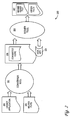
- system 200 for converting legacy application is part of the next generation smart card framework.
- the legacy applications are converted at the time the legacy application is launched on the next generation smart card.
- system 200 is separate from the next generation smart cards.
- a legacy application can be downloaded from the legacy smart card and passed through an off-card normalizer tool to convert the legacy application into a format interpretable by a next generation smart card.
- system 200 includes normalizer tool 201 that receives as input a legacy application 202 with any associated helper files 203 and outputs "converted code" 204.
- the converted code 204 generally refers to any non-compressed application format. For example, it can refer to a Class file or some other non-compiled set of instructions, byte code, a non-legacy application, or other symbolic representation of an application performing the functional equivalent of legacy application 202.
- converted code 204 is Java Class byte code.
- a CAP file (along with any associated helper files) include enough information to create Class files that can act as the functional equivalent of the original Class file from which the CAP file was generated.
- the process for converting a CAP file to a Class file generally includes translating instructions in the CAP file and its component files to a corresponding set of instructions in the Class file.
- normalizer tool 201 takes as input a CAP file and any associated files (e.g., an EXP file that contains information about external classes associated with the CAP application).
- the instructions contained in the CAP file and its associated files are converted into Java Class instructions and saved as a Java Class file, e.g., converted code.
- dup_x1, dup_x2, dup2_x1, or dup2_x2 64 (0x40) swap_x Use a conversion for the swap x byte code 65 (0x41) sadd 96 (0x60) iadd 66 (0x42) iadd 96 (0x60) iadd 67 (0x43) ssub 100 (0x64) isub 68 (0x44) isub 100 (0x64) isub 69 (0x45) smul 104 (0x68) imul 0 (0x46) imul 104 (0x68) imul 71 (0x47) sdiv 108 (0x6c) idiv 72 (0x48) idiv 108 (0x6c) idiv 73 (0x49) srem 112 (0x41) sadd 96 (0x60) iadd 66 (0x42) iadd 96 (0x60) iadd 67 (0x43) ssub 100 (0x64) isub 68 (0x44) isub 100 (0
- the normalizer tool 201 To convert the CAP file into a Class file, the normalizer tool 201 iterates over the entire CAP file mapping each CAP instruction to its corresponding Class instruction. For example, using Table 3 as a guide, suppose the normalizer tool 201 encounters the CAP file instruction (0x70). The normalizer tool performs a table look-up to find the corresponding Java Class instruction (0xA7) and replaces the CAP instruction with the Java Class instruction in converted code 204.
- the normalizer tool 201 may also consult the additional helper files. For example, if the CAP file includes an instruction to an external function or routine that has its mapping stored in an EXP file, the normalizer tool consults the EXP file for the appropriate call mapping. In the end, normalizer tool 201 generates converted code 204 that performs the functional equivalent of the CAP file. In this example, the resulting converted code is Java Class byte code.
- normalizer tool 201 attempts to create a file that performs the functional equivalent of the original application.
- differences between the converted code 204 created by normalizer tool 201 and an original Class file should be few. Some of the more common differences can include the following:
- converted code 204 may be different from the byte codes in the original class files due to optimizations that take place on the byte code before converting a Class file to a CAP file.
- signer tool 206 signs the converted code 204 with a private key 208, so that other applications and users may verify the integrity of the Classes 207 provided.
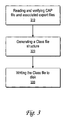
- Fig. 3 It illustrates an example procedure 300 for converting a legacy application into a non-legacy application.
- the procedure involves three main steps: 1) reading and verifying the legacy application and associated files 310, 2) generating non-legacy files corresponding to the legacy application 320, and 3) writing the non-legacy files to disk so they can be tested 330.
- a normalizer tool like the normalizer tool illustrated in Fig. 2, reads a legacy application, such as a CAP file, to verify its integrity.
- a legacy application such as a CAP file
- an off-card tool can be used to perform this step.
- the step of verifying its integrity involves ensuring that the file is complete and does not contain errors or other inconsistencies (e.g., bad instructions or calls to invalid routines). If the legacy application is valid and complete, the application is then translated into its corresponding non-legacy application format.
- a different set of components and structures may be used to parse and extract information from a legacy application.
- the Class file is checked to ensure its validity.
- the normalizer tool generates a JAR file that contains all the newly created non-legacy application files, as well as the legacy application files. The reason for storing both is so that the two sets of files can be compared on subsequent installations to ensure the data is complete and accurate.
- other files and Classes such as a proxy shareable interface object class, may be added to the JAR file in order to help the converted application execute in a next generation smart card framework.
- the newly created files are tested, for example, by loading it using a Java class loader.
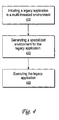
- a specialized environment is created for the legacy applications. This specialized environment ensures that the legacy applications can execute as single-threaded applications.
- the runtime environment (including the virtual machine) creates objects in which it stores and manipulates data.
- the objects created by the runtime environment are owned by the application that creates it.
- a firewall mechanism protects each legacy application from unpermitted external access. Thus, a legacy application cannot access another application's objects or object methods unless they are explicitly shared.
- the firewall mechanism is a virtual machine runtime-enforced protection created for legacy smart card environments. For example, in a Java Card environment, the Java Card virtual machine ensures application isolation through its firewall mechanism. As a result, a legacy application can access resources within its own context, but not beyond it. The way the firewall controls access to an application is by assigning an object space, called a "context," to each application on the card when it is initially executed.
- the legacy smart card environment's firewall mechanism creates and manages each generated context. In a legacy environment only one context is active at any one time (e.g., because the legacy environment is single-threaded).
- the firewall mechanism checks the call to determine if access should be allowed. Generally, when a call is made from within the same context, access to the called resource is allowed. On the other hand, calls made from an application or resource in a different context is generally prohibited by the firewall.
- the legacy smart card environment provides secure ways of sharing data.
- those mechanisms include: entry point objects (EPO), global arrays, and shareable interface objects (SIO).
- an EPO is a mechanism in Java Card that allows certain objects to be flagged (e.g., either by the virtual machine at runtime or by the developer) as entry point objects. Once flagged, those methods become accessible to any context.
- Global arrays refer to specific data structures that by their nature are accessible in any context. For example, for applications to communicate, APDU messages are sent between applications. The APDU ("Application Data Unit") buffer holds those messages until they can be processed. In order for an application to send and receive those messages, the application has to have access to them. Accordingly, an APDU buffer is implemented as a global array that applications and resources from any context can access.
- a requestor application that requires access to an object held by a receiving application sends a call to the receiving application, which determines whether it will share the requested object with the requestor application.
- the requestor application may call the "JCSystem.getAppletShareableInterfaceObject ()" method to access another application's object interface.
- the receiving application Upon receiving the call, if the receiving application determines that it can grant access to the requestor application, then the receiving application returns a reference (of type SIO) to the requested object.
- Techniques are used during on-card execution to provide the specialized runtime requirements of legacy applications without imposing a significant performance penalty on other applications.
- APDUs are often shared and/or reused. Sharing APDUs creates the potential for security leaks. For example, since APDUs can be shared and/or reused, it might be possible for one application to access information from another application stored in the APDU (because the APDU and the information in the APDU are common to both applications). Thus, an application could snoop for and capture confidential information meant for another application.
- legacy smart card environments granted exclusive access to the APDUs until an application terminated. Then, before granting access to other applications, the APDU buffers were cleared. Accordingly, legacy applications were developed with the expectation of having exclusive access to certain shared objects.
- next generation smart card framework 100 creates an environment in which legacy applications can execute smoothly.
- next generation smart card framework 100 provides a multi-threaded environment in which legacy applications can execute.
- a proxy object is introduced to the next generation smart card framework 100.
- the proxy object acts as a surrogate to the legacy application's SIO.
- the proxy objects help prevent legacy applications from unnecessarily tying up resources and slowing down the performance of other applications.
- messages sent to the legacy applications can be in the form of APDUs.
- a legacy application accepts and responds to those messages in a single-threaded manner.
- a legacy application 120 receives an APDU, it expects to be able to process the entire request and respond back to the calling service before receiving any additional information.
- proxy object generally refers to an object of type class "proxy.” In one embodiment, there is a proxy object for every SIO.
- applet API 110 creates the proxy object for a legacy application.
- virtual machine 102 automatically instantiates the proxy object when a legacy application is invoked.
- the original message intended for the legacy application is forwarded to the proxy object.
- the message is serialized and processed.
- the proxy object invokes the appropriate method and/or called data called through the legacy application SIO.
- the legacy application sends the response to the proxy object which then forwards the response to the requesting application.
- the proxy object can track when the legacy application becomes available. Moreover, the proxy object can ensure a certain level of performance.
- the legacy application responds directly to the requesting application.
- the proxy object intercedes when a call comes in from a source external to the legacy application.
- the proxy object holds up other calls until the SIO is released. Then the proxy object calls the requested information through the SIO. Accordingly, requesting applications can communicate with legacy applications.
- legacy applet 120 can continue to function without being compromised by other applications. It should also be noted, that the proxy object should not create much of a performance penalty. Only applications attempting to access a legacy application are directly affected. Other processes and applications continue executing around the legacy application.
- a specialized environment is created for the legacy application.
- the next generation smart card virtual machine creates and manages the specialized environment.
- a legacy application is usually only accessible to other applications through an SIO. Since the next generation smart card environment allows multiple applications to execute concurrently, the legacy application may receive numerous calls at a time (even though its SIO may only be designed to handle one call at a time).
- a proxy object is created to encapsulate the SIO. By doing so, access to the SIO can be controlled. Basically, the proxy object intercepts calls and forwards them to the legacy application (through the SIO) as each previous call is completed. Thus, only one call (or however many calls the SIO is capable of handling) is allowed to access the shareable interface at a time.
- FIG. 5 is a block diagram that illustrates a computer system 500 and smart card in accordance with one embodiment of the invention.
- Computer system 500 includes a bus 502 or other communication mechanism for communicating information, and a processor 504 coupled with bus 502 for processing information.
- Computer system 500 also includes a main memory 506, such as a random access memory (RAM) or other dynamic storage device, coupled to bus 502 for storing information and instructions to be executed by processor 504.
- Main memory 506 also may be used for storing temporary variables or other intermediate information during execution of instructions to be executed by processor 504.
- Computer system 500 further includes a read only memory (ROM) 508 or other static storage device coupled to bus 502 for storing static information and instructions for processor 504.
- ROM read only memory
- a storage device 510 such as a magnetic disk or optical disk, is provided and coupled to bus 502 for storing information and instructions.
- Computer system 500 may be coupled via bus 502 to a display 512, such as a cathode ray tube (CRT), for displaying information to a computer user.
- a display 512 such as a cathode ray tube (CRT)
- An input device 514 is coupled to bus 502 for communicating information and command selections to processor 504.
- cursor control 516 is Another type of user input device
- cursor control 516 such as a mouse, a trackball, or cursor direction keys for communicating direction information and command selections to processor 504 and for controlling cursor movement on display 512.
- This input device typically has two degrees of freedom in two axes, a first axis (e.g., x) and a second axis (e.g., y), that allows the device to specify positions in a plane.
- tools and techniques are provided by computer system 500 in response to processor 504 executing one or more sequences of one or more instructions contained in main memory 506.
- Such instructions may be read into main memory 506 from another machine-readable medium, such as storage device 510.
- Execution of the sequences of instructions contained in main memory 506 causes processor 504 to perform the process steps described herein.
- processors in a multi-processing arrangement may also be employed to execute the sequences of instructions contained in main memory 506.
- hard-wired circuitry may be used in place of or in combination with software instructions to implement the invention.
- embodiments of the invention are not limited to any specific combination of hardware circuitry and software.
- machine-readable medium refers to any medium that participates in providing instructions to processor 504 for execution. Such a medium may take many forms, including but not limited to, non-volatile media, volatile media, and transmission media.
- Non-volatile media includes, for example, optical or magnetic disks, such as storage device 510.
- Volatile media includes dynamic memory, such as main memory 506.
- Transmission media includes coaxial cables, copper wire and fiber optics, including the wires that comprise bus 502. Transmission media can also take the form of acoustic or light waves, such as those generated during radio wave and infrared data communications.
- Various forms of computer readable media may be involved in carrying one or more sequences of one or more instructions to processor 504 for execution.
- the instructions may initially be carried on a magnetic disk of a remote computer.
- the remote computer can load the instructions into its dynamic memory and send the instructions over a telephone line using a modem.
- a modem local to computer system 500 can receive the data on the telephone line and use an infrared transmitter to convert the data to an infrared signal.
- An infrared detector coupled to bus 502 can receive the data carried in the infrared signal and place the data on bus 502.
- Bus 502 carries the data to main memory 506, from which processor 504 retrieves and executes the instructions.
- the instructions received by main memory 506 may optionally be stored on storage device 510 either before or after execution by processor 504.
- Computer system 500 also includes a communication interface 518 coupled to bus 502.
- Communication interface 518 provides a two-way data communication coupling to a network link 520 that is connected to a local network 522.
- communication interface 518 may be an integrated services digital network (ISDN) card or a modem to provide a data communication connection to a corresponding type of telephone line.
- ISDN integrated services digital network
- communication interface 518 may be a local area network (LAN) card to provide a data communication connection to a compatible LAN.
- LAN local area network
- Wireless links may also be implemented.
- communication interface 518 sends and receives electrical, electromagnetic or optical signals that carry digital data streams representing various types of information.
- Computer system 500 can send messages and receive data, including program code, through the network(s), network link 520 and communication interface 518.
- a server 530 might transmit a requested code for an application program through Internet 528, ISP 526, local network 522 and communication interface 518.
- one such downloaded application provides for techniques as described herein.
Landscapes
- Engineering & Computer Science (AREA)
- Software Systems (AREA)
- Theoretical Computer Science (AREA)
- Physics & Mathematics (AREA)
- General Engineering & Computer Science (AREA)
- General Physics & Mathematics (AREA)
- Stored Programmes (AREA)
- Devices For Executing Special Programs (AREA)
Applications Claiming Priority (2)
| Application Number | Priority Date | Filing Date | Title |
|---|---|---|---|
| US75778006P | 2006-01-09 | 2006-01-09 | |
| US11/641,923 US8032872B2 (en) | 2006-01-09 | 2006-12-18 | Supporting applets on a high end platform |
Publications (3)
| Publication Number | Publication Date |
|---|---|
| EP1830263A2 true EP1830263A2 (de) | 2007-09-05 |
| EP1830263A3 EP1830263A3 (de) | 2008-05-21 |
| EP1830263B1 EP1830263B1 (de) | 2020-05-27 |
Family
ID=38255361
Family Applications (1)
| Application Number | Title | Priority Date | Filing Date |
|---|---|---|---|
| EP07250062.2A Active EP1830263B1 (de) | 2006-01-09 | 2007-01-08 | Ausführung von Anwendungen in einer Multifadenumgebung |
Country Status (3)
| Country | Link |
|---|---|
| US (1) | US8032872B2 (de) |
| EP (1) | EP1830263B1 (de) |
| CN (1) | CN101013379B (de) |
Cited By (3)
| Publication number | Priority date | Publication date | Assignee | Title |
|---|---|---|---|---|
| US9872087B2 (en) | 2010-10-19 | 2018-01-16 | Welch Allyn, Inc. | Platform for patient monitoring |
| WO2025235246A1 (en) * | 2024-05-09 | 2025-11-13 | Oracle International Corporation | Converting data from an optimized format to a target format |
| US12608185B2 (en) | 2022-12-12 | 2026-04-21 | Oracle International Corporation | Systems and methods for creating an extended smart card application file from multiple smart card application files |
Families Citing this family (39)
| Publication number | Priority date | Publication date | Assignee | Title |
|---|---|---|---|---|
| WO2007028227A1 (en) * | 2005-09-09 | 2007-03-15 | Ibm Canada Limited - Ibm Canada Limitee | Integrating different programming language debug tools for observing thread execution |
| US8234631B2 (en) * | 2007-08-14 | 2012-07-31 | Dynatrace Software Gmbh | Method and system for tracing individual transactions at the granularity level of method calls throughout distributed heterogeneous applications without source code modifications |
| US8464225B2 (en) | 2007-05-06 | 2013-06-11 | Dynatrace Software Gmbh | Method and system for adaptive, generic code instrumentation using run-time or load-time generated inheritance information for diagnosis and monitoring application performance and failure |
| US9231858B1 (en) | 2006-08-11 | 2016-01-05 | Dynatrace Software Gmbh | Completeness detection of monitored globally distributed synchronous and asynchronous transactions |
| US8533687B1 (en) | 2009-11-30 | 2013-09-10 | dynaTrade Software GmbH | Methods and system for global real-time transaction tracing |
| EP1936574A1 (de) * | 2006-12-01 | 2008-06-25 | Cassis International PTE Ltd. | CAP-Datei zur Personalisierung von Java-Anwendungen |
| US8285329B1 (en) | 2007-04-02 | 2012-10-09 | Sprint Communications Company L.P. | Mobile device-based control of smart card operation |
| US9047412B2 (en) | 2007-05-06 | 2015-06-02 | Dynatrace Corporation | System and method for extracting instrumentation relevant inheritance relationships for a distributed, inheritance rule based instrumentation system |
| US8249654B1 (en) * | 2007-09-27 | 2012-08-21 | Sprint Communications Company L.P. | Dynamic smart card application loading |
| US9883381B1 (en) | 2007-10-02 | 2018-01-30 | Sprint Communications Company L.P. | Providing secure access to smart card applications |
| US8689012B1 (en) * | 2008-10-17 | 2014-04-01 | Sprint Communications Company L.P. | Diagnostics for secure elements in a mobile device |
| EP2256658A1 (de) * | 2009-05-26 | 2010-12-01 | Gemalto SA | Verfahren zur Ausführung einer in eine tragbare elektronische Vorrichtung eingebetteten Anwendung |
| EP2273748A1 (de) * | 2009-07-09 | 2011-01-12 | Gemalto SA | Verfahren zur Verwaltung einer in einen gesicherten elektronischen Token eingebetteten Anwendung |
| US9691055B2 (en) | 2010-12-17 | 2017-06-27 | Google Inc. | Digital wallet |
| US8196131B1 (en) | 2010-12-17 | 2012-06-05 | Google Inc. | Payment application lifecycle management in a contactless smart card |
| US8352749B2 (en) | 2010-12-17 | 2013-01-08 | Google Inc. | Local trusted services manager for a contactless smart card |
| US8335921B2 (en) | 2010-12-17 | 2012-12-18 | Google, Inc. | Writing application data to a secure element |
| US9274919B2 (en) | 2011-04-29 | 2016-03-01 | Dynatrace Software Gmbh | Transaction tracing mechanism of distributed heterogenous transactions having instrumented byte code with constant memory consumption and independent of instrumented method call depth |
| US8171525B1 (en) | 2011-09-15 | 2012-05-01 | Google Inc. | Enabling users to select between secure service providers using a central trusted service manager |
| US8255687B1 (en) | 2011-09-15 | 2012-08-28 | Google Inc. | Enabling users to select between secure service providers using a key escrow service |
| US8313036B1 (en) | 2011-09-16 | 2012-11-20 | Google Inc. | Secure application directory |
| US8385553B1 (en) | 2012-02-28 | 2013-02-26 | Google Inc. | Portable secure element |
| CN104335220B (zh) | 2012-03-30 | 2018-04-20 | 爱迪德技术有限公司 | 用于防止和检测安全威胁的方法和系统 |
| US8429409B1 (en) | 2012-04-06 | 2013-04-23 | Google Inc. | Secure reset of personal and service provider information on mobile devices |
| TWI494856B (zh) * | 2012-05-21 | 2015-08-01 | Irene Tsai | Program call method and mobile device |
| CN103514050B (zh) * | 2012-06-19 | 2016-12-21 | 蔡毓芬 | 程式呼叫方法及行动装置 |
| GB201217084D0 (en) * | 2012-09-25 | 2012-11-07 | Uni I Oslo | Network security |
| CN105528233B (zh) * | 2015-07-10 | 2018-09-18 | 北京中电华大电子设计有限责任公司 | 一种Java Card中用于CAP文件比较的方法及装置 |
| CN104978154A (zh) * | 2015-07-27 | 2015-10-14 | 武汉天喻信息产业股份有限公司 | 一种基于缓存操作的flash快速读写方法及系统 |
| EP3176695A1 (de) * | 2015-12-04 | 2017-06-07 | Gemalto Sa | Verfahren zur verwaltung eines pakets in einem sicheren element |
| CN106909353B (zh) * | 2015-12-22 | 2019-12-13 | 阿里巴巴集团控股有限公司 | 应用程序的运行方法和装置 |
| EP3321838B1 (de) * | 2016-11-14 | 2019-07-17 | Giesecke+Devrient Mobile Security GmbH | Java-kartenplattform und applet-sicherheit |
| US11055087B2 (en) * | 2018-03-16 | 2021-07-06 | Google Llc | Leveraging previously installed application elements to install an application |
| CN110221904B (zh) * | 2019-06-17 | 2023-08-04 | 腾讯科技(深圳)有限公司 | 一种业务流程控制方法 |
| US11347661B2 (en) * | 2019-11-06 | 2022-05-31 | Oracle International Corporation | Transitioning between thread-confined memory segment views and shared memory segment views |
| CN114489593A (zh) * | 2021-12-27 | 2022-05-13 | 无锡融卡科技有限公司 | 便于应用升级的Java卡和Java卡应用升级方法 |
| US11809839B2 (en) | 2022-01-18 | 2023-11-07 | Robert Lyden | Computer language and code for application development and electronic and optical communication |
| US12538130B2 (en) | 2022-09-20 | 2026-01-27 | Oracle International Corporation | Systems and methods for running multiple logical secure elements on the same secure hardware |
| US12531875B2 (en) | 2022-09-20 | 2026-01-20 | Oracle International Corporation | Access control systems and methods for logical secure elements running on the same secure hardware |
Citations (1)
| Publication number | Priority date | Publication date | Assignee | Title |
|---|---|---|---|---|
| EP0911732A2 (de) | 1997-10-24 | 1999-04-28 | Sun Microsystems, Inc. | Verfahren, Gerät und Programmprodukt zum Verbinden einer Mehrdrahtanwendungsprogrammierschnittstelle und einer Einzeldrahtanwendungsprogrammierschnittstelle |
Family Cites Families (8)
| Publication number | Priority date | Publication date | Assignee | Title |
|---|---|---|---|---|
| JP2613326B2 (ja) * | 1991-07-15 | 1997-05-28 | 財団法人ニューメディア開発協会 | 情報処理装置の履歴内容提示方法、及びその装置 |
| US6332215B1 (en) * | 1998-12-08 | 2001-12-18 | Nazomi Communications, Inc. | Java virtual machine hardware for RISC and CISC processors |
| US7225436B1 (en) * | 1998-12-08 | 2007-05-29 | Nazomi Communications Inc. | Java hardware accelerator using microcode engine |
| US7127605B1 (en) * | 1999-05-10 | 2006-10-24 | Axalto, Inc. | Secure sharing of application methods on a microcontroller |
| US7124445B2 (en) * | 2002-06-21 | 2006-10-17 | Pace Anti-Piracy, Inc. | Protecting software from unauthorized use by converting source code modules to byte codes |
| US7484095B2 (en) * | 2003-01-16 | 2009-01-27 | Sun Microsystems, Inc. | System for communicating program data between a first device and a second device |
| US7707547B2 (en) * | 2005-03-11 | 2010-04-27 | Aptana, Inc. | System and method for creating target byte code |
| CN100462890C (zh) * | 2005-06-16 | 2009-02-18 | 北京航空航天大学 | 智能卡安全环境的控制方法 |
-
2006
- 2006-12-18 US US11/641,923 patent/US8032872B2/en active Active
-
2007
- 2007-01-08 EP EP07250062.2A patent/EP1830263B1/de active Active
- 2007-01-09 CN CN2007100006173A patent/CN101013379B/zh active Active
Patent Citations (1)
| Publication number | Priority date | Publication date | Assignee | Title |
|---|---|---|---|---|
| EP0911732A2 (de) | 1997-10-24 | 1999-04-28 | Sun Microsystems, Inc. | Verfahren, Gerät und Programmprodukt zum Verbinden einer Mehrdrahtanwendungsprogrammierschnittstelle und einer Einzeldrahtanwendungsprogrammierschnittstelle |
Cited By (3)
| Publication number | Priority date | Publication date | Assignee | Title |
|---|---|---|---|---|
| US9872087B2 (en) | 2010-10-19 | 2018-01-16 | Welch Allyn, Inc. | Platform for patient monitoring |
| US12608185B2 (en) | 2022-12-12 | 2026-04-21 | Oracle International Corporation | Systems and methods for creating an extended smart card application file from multiple smart card application files |
| WO2025235246A1 (en) * | 2024-05-09 | 2025-11-13 | Oracle International Corporation | Converting data from an optimized format to a target format |
Also Published As
| Publication number | Publication date |
|---|---|
| EP1830263A3 (de) | 2008-05-21 |
| US8032872B2 (en) | 2011-10-04 |
| CN101013379A (zh) | 2007-08-08 |
| US20070169043A1 (en) | 2007-07-19 |
| EP1830263B1 (de) | 2020-05-27 |
| CN101013379B (zh) | 2013-03-20 |
Similar Documents
| Publication | Publication Date | Title |
|---|---|---|
| EP1830263B1 (de) | Ausführung von Anwendungen in einer Multifadenumgebung | |
| Bartel et al. | Dexpler: converting android dalvik bytecode to jimple for static analysis with soot | |
| EP0932865B1 (de) | Verwendung einer hohen programmiersprache in einem mikrokontroller | |
| EP1155366B1 (de) | Techniken zum gewähren des zugriffs durch eine kontextsperre in einem gerät mit kleinem platzbedarf unter verwendung von einem eingangspunktobjekt | |
| CN1918549A (zh) | 用于为计算系统提供可配置防火墙的框架 | |
| KR20010103747A (ko) | 글로벌 데이터 구조를 사용해서 소형 풋프린트 장치의콘텍스트 배리어를 넘어선 액세스를 허용하기 위한 기술 | |
| US7634771B2 (en) | Object generation in packages | |
| CN101379479A (zh) | 具有对于对象的受控访问的软件系统 | |
| EP1155365B1 (de) | Verfahren zur durchführung von sicherheitvorgaben in einem kleingerät unter verwendung von einer kontextsperre | |
| EP1163579B1 (de) | Techniken zum gewähren des zugriffs durch eine kontextsperre in einem gerät mit kleinem platzbedarf unter verwendung von laufzeitumgebungsprivilegien | |
| Binder et al. | Secure mobile agent systems using Java: where are we heading? | |
| KR20010103746A (ko) | 공유 객체 인터페이스들을 사용해서 소형 풋프린트 장치의콘텍스트 배리어를 넘어선 액세스를 허용하기 위한 기술 | |
| US20200117803A1 (en) | Using object flow integrity to improve software security | |
| Lancia et al. | Java card virtual machine compromising from a bytecode verified applet | |
| WO2002041145A2 (en) | System and methods providing runtime byte code simplification for platform independent languages | |
| CN109189411B (zh) | 一种云应用安装方法 | |
| Schreiber | Android binder | |
| Markantonakis | The case for a secure multi-application smart card operating system | |
| Welch et al. | Using reflection as a mechanism for enforcing security policies on compiled code | |
| Sarrab | Bytecode instrumentation mechanism for monitoring mobile application information flow | |
| CN117648679B (zh) | 一种基于JavaScript的资源隔离方法与系统 | |
| EP2447836A1 (de) | Mehrfacher virtueller Maschinenantrieb auf einer Einzelkarte | |
| EP1477877A1 (de) | Verfahren zur Implementierung eines Javakartenzugangsschutzsystems in eine Chipkartensteuerung | |
| Laha | COMPACK–A Network Based RunPE for Software Piracy Prevention | |
| EP1477878A1 (de) | Verfahren zur Implementierung einer Firewall für eine interpretierte Sprache in einer Steuerungsvorrichtung |
Legal Events
| Date | Code | Title | Description |
|---|---|---|---|
| PUAI | Public reference made under article 153(3) epc to a published international application that has entered the european phase |
Free format text: ORIGINAL CODE: 0009012 |
|
| AK | Designated contracting states |
Kind code of ref document: A2 Designated state(s): AT BE BG CH CY CZ DE DK EE ES FI FR GB GR HU IE IS IT LI LT LU LV MC NL PL PT RO SE SI SK TR |
|
| AX | Request for extension of the european patent |
Extension state: AL BA HR MK YU |
|
| PUAL | Search report despatched |
Free format text: ORIGINAL CODE: 0009013 |
|
| AK | Designated contracting states |
Kind code of ref document: A3 Designated state(s): AT BE BG CH CY CZ DE DK EE ES FI FR GB GR HU IE IS IT LI LT LU LV MC NL PL PT RO SE SI SK TR |
|
| AX | Request for extension of the european patent |
Extension state: AL BA HR MK RS |
|
| 17P | Request for examination filed |
Effective date: 20081105 |
|
| 17Q | First examination report despatched |
Effective date: 20081229 |
|
| AKX | Designation fees paid |
Designated state(s): AT BE BG CH CY CZ DE DK EE ES FI FR GB GR HU IE IS IT LI LT LU LV MC NL PL PT RO SE SI SK TR |
|
| RAP1 | Party data changed (applicant data changed or rights of an application transferred) |
Owner name: ORACLE AMERICA, INC. |
|
| STAA | Information on the status of an ep patent application or granted ep patent |
Free format text: STATUS: EXAMINATION IS IN PROGRESS |
|
| REG | Reference to a national code |
Ref country code: DE Ref legal event code: R079 Ref document number: 602007060282 Country of ref document: DE Free format text: PREVIOUS MAIN CLASS: G06F0009460000 Ipc: G06F0009520000 |
|
| GRAP | Despatch of communication of intention to grant a patent |
Free format text: ORIGINAL CODE: EPIDOSNIGR1 |
|
| STAA | Information on the status of an ep patent application or granted ep patent |
Free format text: STATUS: GRANT OF PATENT IS INTENDED |
|
| RIC1 | Information provided on ipc code assigned before grant |
Ipc: G06F 9/52 20060101AFI20191205BHEP |
|
| INTG | Intention to grant announced |
Effective date: 20200102 |
|
| GRAS | Grant fee paid |
Free format text: ORIGINAL CODE: EPIDOSNIGR3 |
|
| GRAA | (expected) grant |
Free format text: ORIGINAL CODE: 0009210 |
|
| STAA | Information on the status of an ep patent application or granted ep patent |
Free format text: STATUS: THE PATENT HAS BEEN GRANTED |
|
| REG | Reference to a national code |
Ref country code: DE Ref legal event code: R081 Ref document number: 602007060282 Country of ref document: DE Owner name: ORACLE AMERICA, INC., REDWOOD CITY, US Free format text: FORMER OWNER: SUN MICROSYSTEMS, INC., SANTA CLARA, CALIF., US |
|
| AK | Designated contracting states |
Kind code of ref document: B1 Designated state(s): AT BE BG CH CY CZ DE DK EE ES FI FR GB GR HU IE IS IT LI LT LU LV MC NL PL PT RO SE SI SK TR |
|
| REG | Reference to a national code |
Ref country code: GB Ref legal event code: FG4D |
|
| REG | Reference to a national code |
Ref country code: CH Ref legal event code: EP |
|
| REG | Reference to a national code |
Ref country code: AT Ref legal event code: REF Ref document number: 1275257 Country of ref document: AT Kind code of ref document: T Effective date: 20200615 |
|
| REG | Reference to a national code |
Ref country code: DE Ref legal event code: R096 Ref document number: 602007060282 Country of ref document: DE |
|
| REG | Reference to a national code |
Ref country code: LT Ref legal event code: MG4D |
|
| PG25 | Lapsed in a contracting state [announced via postgrant information from national office to epo] |
Ref country code: SE Free format text: LAPSE BECAUSE OF FAILURE TO SUBMIT A TRANSLATION OF THE DESCRIPTION OR TO PAY THE FEE WITHIN THE PRESCRIBED TIME-LIMIT Effective date: 20200527 Ref country code: IS Free format text: LAPSE BECAUSE OF FAILURE TO SUBMIT A TRANSLATION OF THE DESCRIPTION OR TO PAY THE FEE WITHIN THE PRESCRIBED TIME-LIMIT Effective date: 20200927 Ref country code: PT Free format text: LAPSE BECAUSE OF FAILURE TO SUBMIT A TRANSLATION OF THE DESCRIPTION OR TO PAY THE FEE WITHIN THE PRESCRIBED TIME-LIMIT Effective date: 20200928 Ref country code: FI Free format text: LAPSE BECAUSE OF FAILURE TO SUBMIT A TRANSLATION OF THE DESCRIPTION OR TO PAY THE FEE WITHIN THE PRESCRIBED TIME-LIMIT Effective date: 20200527 Ref country code: GR Free format text: LAPSE BECAUSE OF FAILURE TO SUBMIT A TRANSLATION OF THE DESCRIPTION OR TO PAY THE FEE WITHIN THE PRESCRIBED TIME-LIMIT Effective date: 20200828 Ref country code: LT Free format text: LAPSE BECAUSE OF FAILURE TO SUBMIT A TRANSLATION OF THE DESCRIPTION OR TO PAY THE FEE WITHIN THE PRESCRIBED TIME-LIMIT Effective date: 20200527 |
|
| REG | Reference to a national code |
Ref country code: NL Ref legal event code: MP Effective date: 20200527 |
|
| PG25 | Lapsed in a contracting state [announced via postgrant information from national office to epo] |
Ref country code: LV Free format text: LAPSE BECAUSE OF FAILURE TO SUBMIT A TRANSLATION OF THE DESCRIPTION OR TO PAY THE FEE WITHIN THE PRESCRIBED TIME-LIMIT Effective date: 20200527 Ref country code: BG Free format text: LAPSE BECAUSE OF FAILURE TO SUBMIT A TRANSLATION OF THE DESCRIPTION OR TO PAY THE FEE WITHIN THE PRESCRIBED TIME-LIMIT Effective date: 20200827 |
|
| REG | Reference to a national code |
Ref country code: AT Ref legal event code: MK05 Ref document number: 1275257 Country of ref document: AT Kind code of ref document: T Effective date: 20200527 |
|
| PG25 | Lapsed in a contracting state [announced via postgrant information from national office to epo] |
Ref country code: NL Free format text: LAPSE BECAUSE OF FAILURE TO SUBMIT A TRANSLATION OF THE DESCRIPTION OR TO PAY THE FEE WITHIN THE PRESCRIBED TIME-LIMIT Effective date: 20200527 |
|
| PG25 | Lapsed in a contracting state [announced via postgrant information from national office to epo] |
Ref country code: DK Free format text: LAPSE BECAUSE OF FAILURE TO SUBMIT A TRANSLATION OF THE DESCRIPTION OR TO PAY THE FEE WITHIN THE PRESCRIBED TIME-LIMIT Effective date: 20200527 Ref country code: AT Free format text: LAPSE BECAUSE OF FAILURE TO SUBMIT A TRANSLATION OF THE DESCRIPTION OR TO PAY THE FEE WITHIN THE PRESCRIBED TIME-LIMIT Effective date: 20200527 Ref country code: ES Free format text: LAPSE BECAUSE OF FAILURE TO SUBMIT A TRANSLATION OF THE DESCRIPTION OR TO PAY THE FEE WITHIN THE PRESCRIBED TIME-LIMIT Effective date: 20200527 Ref country code: CZ Free format text: LAPSE BECAUSE OF FAILURE TO SUBMIT A TRANSLATION OF THE DESCRIPTION OR TO PAY THE FEE WITHIN THE PRESCRIBED TIME-LIMIT Effective date: 20200527 Ref country code: RO Free format text: LAPSE BECAUSE OF FAILURE TO SUBMIT A TRANSLATION OF THE DESCRIPTION OR TO PAY THE FEE WITHIN THE PRESCRIBED TIME-LIMIT Effective date: 20200527 Ref country code: IT Free format text: LAPSE BECAUSE OF FAILURE TO SUBMIT A TRANSLATION OF THE DESCRIPTION OR TO PAY THE FEE WITHIN THE PRESCRIBED TIME-LIMIT Effective date: 20200527 Ref country code: EE Free format text: LAPSE BECAUSE OF FAILURE TO SUBMIT A TRANSLATION OF THE DESCRIPTION OR TO PAY THE FEE WITHIN THE PRESCRIBED TIME-LIMIT Effective date: 20200527 |
|
| PG25 | Lapsed in a contracting state [announced via postgrant information from national office to epo] |
Ref country code: PL Free format text: LAPSE BECAUSE OF FAILURE TO SUBMIT A TRANSLATION OF THE DESCRIPTION OR TO PAY THE FEE WITHIN THE PRESCRIBED TIME-LIMIT Effective date: 20200527 Ref country code: SK Free format text: LAPSE BECAUSE OF FAILURE TO SUBMIT A TRANSLATION OF THE DESCRIPTION OR TO PAY THE FEE WITHIN THE PRESCRIBED TIME-LIMIT Effective date: 20200527 |
|
| REG | Reference to a national code |
Ref country code: DE Ref legal event code: R097 Ref document number: 602007060282 Country of ref document: DE |
|
| PLBE | No opposition filed within time limit |
Free format text: ORIGINAL CODE: 0009261 |
|
| STAA | Information on the status of an ep patent application or granted ep patent |
Free format text: STATUS: NO OPPOSITION FILED WITHIN TIME LIMIT |
|
| 26N | No opposition filed |
Effective date: 20210302 |
|
| PG25 | Lapsed in a contracting state [announced via postgrant information from national office to epo] |
Ref country code: SI Free format text: LAPSE BECAUSE OF FAILURE TO SUBMIT A TRANSLATION OF THE DESCRIPTION OR TO PAY THE FEE WITHIN THE PRESCRIBED TIME-LIMIT Effective date: 20200527 |
|
| PG25 | Lapsed in a contracting state [announced via postgrant information from national office to epo] |
Ref country code: MC Free format text: LAPSE BECAUSE OF FAILURE TO SUBMIT A TRANSLATION OF THE DESCRIPTION OR TO PAY THE FEE WITHIN THE PRESCRIBED TIME-LIMIT Effective date: 20200527 |
|
| REG | Reference to a national code |
Ref country code: CH Ref legal event code: PL |
|
| PG25 | Lapsed in a contracting state [announced via postgrant information from national office to epo] |
Ref country code: LU Free format text: LAPSE BECAUSE OF NON-PAYMENT OF DUE FEES Effective date: 20210108 |
|
| REG | Reference to a national code |
Ref country code: BE Ref legal event code: MM Effective date: 20210131 |
|
| PG25 | Lapsed in a contracting state [announced via postgrant information from national office to epo] |
Ref country code: FR Free format text: LAPSE BECAUSE OF NON-PAYMENT OF DUE FEES Effective date: 20210131 |
|
| PG25 | Lapsed in a contracting state [announced via postgrant information from national office to epo] |
Ref country code: LI Free format text: LAPSE BECAUSE OF NON-PAYMENT OF DUE FEES Effective date: 20210131 Ref country code: CH Free format text: LAPSE BECAUSE OF NON-PAYMENT OF DUE FEES Effective date: 20210131 |
|
| PG25 | Lapsed in a contracting state [announced via postgrant information from national office to epo] |
Ref country code: IE Free format text: LAPSE BECAUSE OF NON-PAYMENT OF DUE FEES Effective date: 20210108 |
|
| PG25 | Lapsed in a contracting state [announced via postgrant information from national office to epo] |
Ref country code: BE Free format text: LAPSE BECAUSE OF NON-PAYMENT OF DUE FEES Effective date: 20210131 |
|
| PG25 | Lapsed in a contracting state [announced via postgrant information from national office to epo] |
Ref country code: HU Free format text: LAPSE BECAUSE OF FAILURE TO SUBMIT A TRANSLATION OF THE DESCRIPTION OR TO PAY THE FEE WITHIN THE PRESCRIBED TIME-LIMIT; INVALID AB INITIO Effective date: 20070108 Ref country code: CY Free format text: LAPSE BECAUSE OF FAILURE TO SUBMIT A TRANSLATION OF THE DESCRIPTION OR TO PAY THE FEE WITHIN THE PRESCRIBED TIME-LIMIT Effective date: 20200527 |
|
| P01 | Opt-out of the competence of the unified patent court (upc) registered |
Effective date: 20230522 |
|
| PG25 | Lapsed in a contracting state [announced via postgrant information from national office to epo] |
Ref country code: TR Free format text: LAPSE BECAUSE OF FAILURE TO SUBMIT A TRANSLATION OF THE DESCRIPTION OR TO PAY THE FEE WITHIN THE PRESCRIBED TIME-LIMIT Effective date: 20200527 |
|
| PGFP | Annual fee paid to national office [announced via postgrant information from national office to epo] |
Ref country code: GB Payment date: 20251204 Year of fee payment: 20 |
|
| PGFP | Annual fee paid to national office [announced via postgrant information from national office to epo] |
Ref country code: DE Payment date: 20251203 Year of fee payment: 20 |