EP1830499A2 - Empfänger für den Empfang von digitalen Satellitensignalen und Verfahren zum Erweitern des Sendebereichs vom digitalen Satellitenrundfunk für Empfangsvorrichtungen - Google Patents
Empfänger für den Empfang von digitalen Satellitensignalen und Verfahren zum Erweitern des Sendebereichs vom digitalen Satellitenrundfunk für Empfangsvorrichtungen Download PDFInfo
- Publication number
- EP1830499A2 EP1830499A2 EP07075138A EP07075138A EP1830499A2 EP 1830499 A2 EP1830499 A2 EP 1830499A2 EP 07075138 A EP07075138 A EP 07075138A EP 07075138 A EP07075138 A EP 07075138A EP 1830499 A2 EP1830499 A2 EP 1830499A2
- Authority
- EP
- European Patent Office
- Prior art keywords
- satellite
- signals
- signal
- band
- converted
- Prior art date
- Legal status (The legal status is an assumption and is not a legal conclusion. Google has not performed a legal analysis and makes no representation as to the accuracy of the status listed.)
- Withdrawn
Links
Images


Classifications
-
- H—ELECTRICITY
- H04—ELECTRIC COMMUNICATION TECHNIQUE
- H04H—BROADCAST COMMUNICATION
- H04H40/00—Arrangements specially adapted for receiving broadcast information
- H04H40/18—Arrangements characterised by circuits or components specially adapted for receiving
- H04H40/27—Arrangements characterised by circuits or components specially adapted for receiving specially adapted for broadcast systems covered by groups H04H20/53 - H04H20/95
- H04H40/90—Arrangements characterised by circuits or components specially adapted for receiving specially adapted for broadcast systems covered by groups H04H20/53 - H04H20/95 specially adapted for satellite broadcast receiving
-
- H—ELECTRICITY
- H04—ELECTRIC COMMUNICATION TECHNIQUE
- H04H—BROADCAST COMMUNICATION
- H04H20/00—Arrangements for broadcast or for distribution combined with broadcast
- H04H20/02—Arrangements for relaying broadcast information
-
- H—ELECTRICITY
- H04—ELECTRIC COMMUNICATION TECHNIQUE
- H04H—BROADCAST COMMUNICATION
- H04H20/00—Arrangements for broadcast or for distribution combined with broadcast
- H04H20/53—Arrangements specially adapted for specific applications, e.g. for traffic information or for mobile receivers
- H04H20/61—Arrangements specially adapted for specific applications, e.g. for traffic information or for mobile receivers for local area broadcast, e.g. instore broadcast
- H04H20/62—Arrangements specially adapted for specific applications, e.g. for traffic information or for mobile receivers for local area broadcast, e.g. instore broadcast for transportation systems, e.g. in vehicles
Definitions
- the present invention is generally directed to RF receivers, and, more specifically, to a digital satellite RF receiver and method of improving digital satellite RF receiver access to digital satellite signals.
- Satellite digital audio radio (SDAR) services have become increasingly popular, offering digital radio services covering large geographic areas, such as North America. These services receive uplinked programming which, in turn, is rebroadcast directly to digital radios that subscribe to the service. Each subscriber to the service generally possesses a digital radio having a receiver and one or more antennas for receiving the digital broadcast. Although many digital radios have been designed for use in vehicles, other digital radios are increasingly being designed for use in the home or office environment, and for personal portable or wearable usage, including in outdoor environments.
- the digital satellite receivers are generally programmed to receive and decode the digital satellite signals, which typically include many channels of digital audio. These signals are received directly from satellites, or from terrestrial repeaters that retransmit the digital satellite signals in order to provide improved coverage and availability.
- the satellite service may also transmit data that may be used for various other applications.
- the broadcast signals may include advertising, information about warranty issues, information about the broadcast audio programs, and news, sports, and entertainment programming.
- the digital broadcasts may be employed for any of a number of satellite audio radio, satellite television, satellite Internet, and various other consumer services.
- the receiver section of the digital radio typically must be able to receive the digital satellite signal from a satellite or repeater. In most geographic areas, a clear uninterrupted view of the sky is generally required in order to properly receive the satellite signal. This can be problematic in situations in which a user wishes to use a digital satellite receiver while located inside a structure, such as a vehicle, or when the user is unable to locate the receiver such that the receiver can receive a digital satellite signal from a satellite or terrestrial repeater.
- vehicles equipped for providing satellite-based services generally include one or more antennas for receiving the satellite digital broadcast.
- An antenna arrangement includes one or more antennas mounted in the sideview mirror housing(s) of an automobile.
- the antennas(s) may be mounted at other locations, depending on factors such as vehicle type, size, and configuration. While these antennas are capable of providing a digital satellite signal to a digital satellite receiver (typically mounted in the vehicle and directly connected to the antenna), they are not typically able to provide that signal to portable digital receivers carried by users in the vehicle compartment. Due to the enclosed nature of the vehicle compartment, it may be difficult for users of portable digital receivers to obtain an adequate digital satellite signal without being directly tethered to the vehicle antenna.
- Another example of a situation in which digital satellite signals may be inadequate for portable digital receiver use is in the home or office environment.
- a home-user of digital satellite radio will have an antenna attached to the roof of the home, or in another location (such as near a window) where an adequate digital satellite signal can be received. While this can work well for satellite receivers directly connected to the antenna, portable digital satellite receiver users who wish to use their devices without being "tethered" to the fixed antenna might find it difficult to receive an adequate digital satellite signal without moving to a location where the portable digital receiver can directly receive a digital satellite signal (such as outside the house or near a door or window).
- Delphi XM® Signal Repeater marketed by Delphi, which receives S-band satellite signals from an antenna in the home, converts the S-band signals to a frequency in the Industrial, Scientific, and Medical (ISM) frequency band, and wirelessly retransmits the converted digital satellite signals in the ISM-band to an up-converter antenna module connected to the antenna input of a digital satellite receiver located in the house.
- the up-converter antenna module converts the ISM-band satellite signals back to S-band satellite signals, and provides the S-band satellite signals to the digital satellite receiver via the receiver's antenna input.
- the digital satellite receiver processes the S-band satellite signals as it would any standard S-band satellite signal received directly from a satellite or terrestrial repeater.
- the solution discussed above provides enhanced service, but requires both down-converter circuitry to convert an S-band signal to a frequency in the ISM-band, and an up-converter antenna module to convert the ISM-band signal back to the S-band before the signal can be received and processed by a typical digital satellite receiver.
- the additional up-converter antenna module adds expense to portable digital satellite receiver systems, and increases the power consumption budget of those systems, which usually is not preferred in portable devices in general.
- this solution is designed to repeat signals transmitted by one of two popular commercially available digital satellite systems (XM®), but not both systems.
- What is needed is a digital satellite receiver system that can receive retransmitted digital satellite signals that have been converted to frequency bands other than the S-band, and that can directly process digital satellite signals in frequency bands other than the S-band without requiring an S-band antenna, or circuitry to first convert a non-S-band signal to the S-band.
- a system for receiving and processing a digital satellite radio signal includes an antenna for receiving a broadcast wireless digital satellite radio signal, and a repeater module for receiving digital satellite radio signals from the antenna, converting those signals into converted satellite signals in the Industrial, Scientific, and Medical frequency range, and transmitting the converted satellite signals.
- the system also includes at least one receiver module for receiving the converted satellite signals transmitted by the repeater module and extracting data directly from the received converted satellite signals.
- a digital satellite radio receiver for receiving satellite broadcast signals and satellite signals converted to the ISM frequency band by a repeater.
- the receiver includes at least one antenna for receiving at least one of a digital satellite radio signal and a signal in the ISM frequency band.
- the receiver also includes ISM receiving circuitry for receiving converted signals in the ISM frequency band and extracting data directly from the converted signals.
- the receiver further includes satellite receiving circuitry for receiving digital satellite radio signals and extracting data directly from the digital satellite radio signals.
- a method for processing digital satellite radio signals includes the steps of receiving a digital satellite radio signal in a repeater, converting the digital satellite radio signal to a converted satellite signal in the ISM frequency band to form a converted satellite ISM signal, and transmitting the converted satellite ISM signal.
- the method also includes the steps of receiving the converted satellite ISM signal and at least one receiver, and processing the converted satellite ISM signal in the receiver to obtain data.
- a system 10 for receiving and processing digital satellite radio signals is generally illustrated located onboard a vehicle 12, such as an automobile, according to one embodiment of the present invention.
- the system 10 generally includes a repeater module 20 and one or more ISM-band receiver modules 30.
- the repeater module 20 receives broadcast satellite signals and makes the satellite broadcast data available to the receiver modules 30. While the system 10 is shown and described herein for use in a vehicle 12, it should be appreciated that system 10 may be employed in other environments.
- the vehicle 12 is shown equipped with a repeater module 20 coupled to a satellite antenna 22.
- Repeater module 20 is configured to receive digital satellite radio signals via satellite antenna 22.
- the digital satellite radio signals are currently generally broadcast by remote satellites at frequencies in the 2320-2345 MHz band.
- Repeater module 20 also converts the digital satellite radio signals into digital radio signals in the Industrial, Scientific, and Medical frequency band (hereinafter converted satellite ISM signals), and retransmits the converted satellite ISM signals to receivers within range that are capable of receiving and processing signals in the ISM-band.
- converted satellite ISM signals Industrial, Scientific, and Medical frequency band
- the ISM-band currently generally includes the frequency ranges of 6.765-6.795; 13.553-13.567; 26.957-27.283; 40.664-40.70; 433.05-434.79; 902-928; 2,400-2,500, 5,725-5,875, 24,000-24,250; 61,000-61,500; 122,000-123,000; and 244,000-246,000 MHz.
- the vehicle 12 is also shown equipped with a plurality, such as four, ISM-band receiver modules 30 located within the vehicle compartment of vehicle 12.
- ISM-band receiver modules 30 are configured to receive converted satellite ISM signals from repeater module 20, and to decode the converted satellite ISM signals to extract audio or other data directly from the converted satellite ISM signals.
- ISM-band receiver modules 30 can be connected to portable electronic devices, such as a laptop computer 24 or a cellular phone 25.
- ISM-band receiver modules 30 may also be directly integrated within other electronic devices, such as PDA 26.
- ISM-band receiver modules 30 can act as stand-alone audio receivers providing an audio output decoded from the converted satellite ISM signals.
- satellite antenna 22 receives digital satellite radio signals from one or more satellite or terrestrial repeaters.
- the received digital satellite radio signals may be XM® satellite radio signals, SIRIUS TM digital satellite radio signals, or other broadcast digital satellite radio signals.
- the received digital satellite radio signals are received in a frequency band suitable for the reception and transmission of digital satellite radio signals, such as, for example, 2.320 GHz TO 2.345 GHz.
- Satellite antenna 22 provides the received digital satellite radio signals to repeater module 20.
- Repeater module 20 converts the received digital satellite radio signals that have been received in a satellite frequency band into digital satellite radio signals in the Industrial, Scientific, and Medical frequency band.
- the digital satellite radio signals that have been converted into digital satellite radio signals in the ISM frequency band are then retransmitted in the ISM frequency band by repeater module 20.
- the converted satellite ISM signals retransmitted by repeater module 20 are received by ISM-band receiver modules within range of repeater module 20, such as ISM-band receiver modules 30 shown located in the vehicle compartment of vehicle 12.
- ISM-band receiver modules 30 receive the converted satellite ISM signals in the ISM-band, and extract audio or other data directly from converted satellite ISM signals.
- an ISM-band receiver module 30 When configured as a stand-alone receiver, an ISM-band receiver module 30 provides an audio output signal that has been decoded from a received converted satellite ISM signal.
- an ISM-band receiver module 30 When connected to or integrated within portable electronic devices, an ISM-band receiver module 30 provides audio or data output for use in the portable electronic device, such as for playback through speakers of a laptop computer 24, playback through the speaker of a cellular phone 25, or playback on a PDA 26.
- repeater modules 20 and one or more ISM-band receiver modules 30 may be located within a vehicle 12. Although repeater module 20 and ISM-band receiver modules 30 are shown in a vehicle 12, it should also be appreciated that repeater module 20 and ISM-band receiver modules 30 could be located in other structures, such as houses or other buildings, or could be located in an outside environment. It should also be appreciated that more than one antenna 22 could be connected to repeater module 20, and that ISM-band receiver modules 30 could have one or more antennas for receiving ISM-band signals, satellite band signals, or signals in another frequency band.
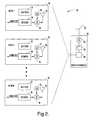
- the system 10 for receiving and processing digital satellite radio signals is generally illustrated, according to a first embodiment.
- the system 10 includes a satellite antenna 22 for receiving digital satellite radio signals broadcast in a satellite frequency band.
- the system also includes the repeater module 20 coupled to the satellite antenna 22 for receiving digital satellite radio signals, converting the received digital satellite radio signals to signals in the ISM frequency band (converted satellite ISM signals), and retransmitting or broadcasting the converted digital satellite radio signals to remote receivers 30 capable of receiving digital satellite radio signals broadcast in the ISM frequency band.
- the repeater module 20 includes mixer circuitry for converting received digital satellite signals to signals into an ISM frequency band, filter circuitry 26 for filtering the converted signals to exclude non-ISM-band signals, and gain control circuitry 28 for limiting the power of signals transmitted by repeater module 20 to power levels meeting FCC requirements.
- the broadcast transmission of the converted digital satellite radio signals is at a power level sufficient to cover the range of the intended application, e.g., to cover the entire vehicle passenger compartment.
- the system 10 includes multiple ISM-band receivers 30 for receiving converted satellite ISM signals from repeater module 20.
- Receiver modules 30 are shown each having a battery 32 for providing power to the circuitry of receiver module 30.
- a non-battery power supply may be employed to supply the power.
- Each receiver module 30 is also shown having an ISM-band antenna 34 for receiving converted satellite ISM signals in an ISM frequency band.
- ISM-band antenna 34 provides received converted satellite ISM signals to a mixer 36.
- Mixer 36 is also shown receiving a signal from a local oscillator 35.
- Local oscillator 35 is configured to provide a signal (such as a sine wave) to mixer 36 to enable mixer 36 to convert the received converted satellite ISM signal to a base-band signal at about 0 Hz.
- Mixer 36 is also configured to provide the resulting base-band (0 Hz) signal to decoder 38.
- Decoder 38 is configured to extract audio signals from converted satellite ISM base-band signals provided by mixer 36, and to provide an audio output from the receiver module 30.
- satellite antenna 22 receives a digital satellite radio signal from a satellite or terrestrial repeater.
- the received digital satellite radio signal may include audio and/or other data.
- Satellite antenna 22 provides the received digital satellite radio signal to repeater module 20.
- Repeater module 20 converts the received digital satellite radio signal into a converted satellite ISM signal in an ISM frequency band.
- Repeater module 20 filters the converted satellite ISM signal to exclude frequencies outside of an ISM-band, and retransmits the converted satellite ISM signal in a more local broadcast such that receiver modules 30 within range of repeater module 20 can receive the converted satellite ISM signal.
- Receiver modules 30 within range of repeater module 20 receive the converted satellite ISM signal transmitted by repeater module 20 via antenna 34.
- receiver modules 30 a sine wave provided by local oscillator 35 drives mixer 36 to convert the received converted satellite ISM signal to a base-band signal at 0 Hz. Decoder 38 then processes the base-band signal (0 Hz) received from mixer 36 to extract audio and/or other data from the base-band signal. Receiver modules 30 may be further configured to amplify the audio output signal and broadcast the audio output signal on speakers coupled to or integrated within receiver modules 30.
- receiver modules 30 could receive and process converted satellite ISM signals to provide audio output for each receiver module 30.
- system 10 illustrated in Fig. 2 could be implemented in a vehicle, in a structure, such as a building or a house, or outside.
- satellite antenna 22 and repeater module 20 are capable of receiving, converting, and rebroadcasting in an ISM frequency band digital satellite radio signals transmitted by the XM® system, the SIRIUS TM system, both systems, or any other digital satellite radio system.
- receiver modules 30 may be further capable of receiving and processing in an ISM frequency band digital satellite radio signals from the XM® system, the SIRIUS TM system, both systems, or any other digital satellite radio system.
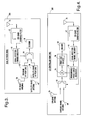
- a digital satellite radio receiver 30A for receiving digital satellite radio signals and converted satellite ISM signals in the system 10 is generally illustrated, according to a second embodiment.
- Digital satellite radio receiver 30A is shown having a first ISM-band antenna 34 connected to an ISM-band bandpass filter 42 for receiving signals in an ISM frequency band.
- ISM-band bandpass filter 42 provides a signal to signal detector/control circuitry 44, which provides a signal to switch 46 indicative of the strength or quality of the received signal in an ISM frequency band.
- Digital satellite radio receiver 30A is also shown having a second ISM-band antenna 34 coupled to an ISM-band RF front-end circuit 40 for receiving signals transmitted in an ISM frequency band.
- ISM-band RF front-end circuit 40 is configured to receive a digital satellite radio signal that has been converted into an ISM frequency band, convert the ISM-band input signal to a base-band (0 Hz) signal, and pass the base-band signal to switch 46.
- Digital satellite radio receiver 30A is also shown having a satellite band antenna 48 for receiving digital satellite radio signals transmitted in a satellite frequency band such as the S-band. Satellite band antenna 48 is shown coupled to a satellite band RF front-end circuit 50. Satellite band RF front-end circuit 50 receives digital satellite radio signals broadcast in a satellite band, converts the satellite-band signals to base-band (0 Hz) signals, and provides the base-band signals to switch 46.
- Switch 46 is shown providing the base-band signal from the ISM-band RF front-end circuit 40 or the satellite-band RF front-end circuit 50 to a decoder 38.
- Switch 46 determines which of the base-band signals to provide to decoder 38 based on the signal strength/quality signal provided by signal detector/control circuitry 44.
- Decoder 38 is configured to decode the base-band signal to provide audio or other output data.
- ISM-band bandpass filter 42 receives a digital satellite radio signal that has been converted to an ISM frequency band (converted satellite ISM signal) via antenna 34. After filtering the received signal to exclude non-ISM frequencies, ISM-band bandpass filter 42 provides a filtered signal to signal detector/control circuitry 44. Signal detector/control circuitry 44 provides a signal to switch 46 indicative of the strength or quality of the received converted satellite ISM signal. Based on the information provided by signal detector/control circuitry 44, switch 46 determines whether a base-band signal from ISM-band RF front-end circuit 40 or a base-band signal from satellite band RF front-end circuit 50 will be provided to decoder 38.
- switch 46 will select satellite band RF front-end circuit 50 as the source for the base-band signal to be processed by decoder 38. If, however, signal detector/control circuitry 44 determines that an adequate converted satellite ISM signal is available, switch 46 will select ISM-band RF front-end circuit 40 as the source for the base-band signal to be processed by decoder 38.
- converted satellite ISM signals are first received in ISM-band antenna 34 and provided by ISM-band antenna 34 to ISM-band RF front-end circuit 40.
- ISM-band RF front-end circuit 40 then processes the received ISM-band signals to convert them to base-band signals, and provides the resulting base-band signals to switch 46.
- satellite band antenna 48 first receives digital satellite radio signals in the satellite band, and provides those signals to satellite band RF front-end circuit 50. Satellite band RF front-end circuit 50 then processes the digital satellite radio signals received in the satellite frequency band to convert them to base-band signals, and passes the resulting base-band signals on to switch 46.
- switch 46 determines which base-band signals will be passed on to decoder 38 for further processing. Decoder 38 then processes the selected base-band signals to extract audio or other information.
- receiver 30A in Fig. 3 shows two ISM-band antennas 34, it should be appreciated that one ISM-band antenna 34 could provide input signals both to ISM-band bandpass filter 42 and ISM-band RF front-end circuit 40. In addition, it should be appreciated that more than two ISM-band antennas 34 could be utilized in the receiver, and that more than one satellite band antenna 48 could be utilized in the receiver 60. It should also be appreciated that although one ISM-band RF front-end circuit and one satellite band RF front-end circuit are shown in Fig. 3, receiver 30A could have multiple ISM-band RF front-end circuits and multiple satellite band RF front-end circuits with switch 46 operating to select an optimal base-band signal for further processing in decoder 38.
- a digital satellite radio receiver 30B for receiving digital satellite radio signals and converted satellite ISM signals in system 10 is generally illustrated according to a third embodiment.
- Receiver 30B is shown having a first ISM-band antenna 34 for providing a digital satellite radio signal that has been converted into an ISM frequency band to a switch 46.
- Receiver 30B is also shown having a satellite band antenna 48 for providing a digital satellite radio signal in the satellite frequency band to switch 46.
- Receiver 30B is also shown having a second ISM-band antenna 34 for receiving a digital satellite radio signal that has been converted to an ISM frequency band, and providing that signal to ISM-band bandpass filter 42 for filtering frequencies outside the ISM-band.
- ISM-band bandpass filter 42 is configured to provide a filtered converted satellite ISM signal to signal detector/control circuitry 44.
- Signal detector/control circuitry 44 is configured to evaluate the strength and/or quality of the ISM signal provided by filter 42, and provide a signal quality output signal to switch 46 and programmable oscillator 52.
- Programmable oscillator 52 is configured to provide a signal (such as a sine wave) to mixer 54 to drive mixer 54 and front-end circuitry 56 to convert an input signal from switch 46 to a base-band (0 Hz) signal.
- Front-end circuitry 56 is configured to provide the resulting base-band signal to decoder 38.
- Decoder 38 is configured to process the base-band signal to extract audio or other information.
- second ISM-band antenna 34, ISM-band bandpass filter 42, signal detector/control circuitry 44, and switch 46 operate in a manner similar to that discussed for the embodiment shown in Fig. 3.
- signal detector/control circuitry 44 determines whether a converted satellite ISM signal of sufficient strength is available for processing. If signal detector/control circuitry 44 determines that a converted satellite ISM signal is either unavailable or too weak, signal detector/control circuitry 44 provides a signal to switch 46 such that switch 46 will select the satellite band antenna 48 as the source for a signal to be further processed. If signal detector/control circuitry 44 determines that an adequate converted satellite ISM signal is available, signal detector/control circuitry 44 provides a signal to switch 46 such that switch 46 selects the ISM-band antenna 34 as the source for the signal to be further processed.
- Signal detector/control circuitry 44 also provides a signal indicative of the availability of an adequate ISM-band signal to programmable phase-locked oscillator 52.
- Programmable phase-locked oscillator 52 utilizes the signal from signal detector/control circuitry 44 to select the frequency at which to drive mixer 54. If signal detector/control circuitry 44 indicates that an adequate ISM signal is available, oscillator 52 provides a frequency that will enable mixer 54 and front-end circuitry 56 to convert an ISM-band signal received from switch 46 to base-band. If an adequate ISM signal is not available, oscillator 52 provides a frequency that will enable mixer 54 and front-end circuitry 56 to convert a satellite-band signal from switch 46 to base-band.
- one set of circuitry can be actively reconfigured based on signals from signal detector/control circuitry 44 to process signals in either an ISM-band or a satellite band.
- front-end circuitry 56 provides the resulting processed base-band digital satellite radio signal to decoder 38 for extraction of audio and/or other data.
- a digital satellite radio receiver 30C for receiving digital satellite radio signals and converted satellite ISM signals in system 10 is generally illustrated, according to a fourth embodiment.
- Digital satellite radio receiver 30C is shown having an ISM-band antenna 34 for receiving digital satellite radio signals broadcast in an ISM frequency band.
- ISM-band antenna 34 provides the received ISM-band signal to ISM-band RF front-end circuit 40.
- ISM-band RF front-end circuit 40 is configured to process the received converted satellite ISM signal to convert the received signal to a base-band signal.
- ISM-band RF front-end 40 is also configured to provide the base-band digital satellite radio signal extracted from the converted satellite ISM signals to receiver circuitry 58, which may include conventional SDARS diversity receiver circuitry.
- Receiver 30C is also shown having a satellite band antenna 48 for receiving digital satellite radio signals broadcast in a satellite frequency band.
- Satellite band antenna 48 provides a received digital satellite radio signal to satellite band RF front-end circuit 50.
- Satellite band RF front-end 50 is configured to process the digital satellite radio signals received in the satellite frequency band to convert the received digital satellite radio signals to base-band signals, and provide the resulting base-band signals to receiver circuitry 58, which may include conventional SDARS diversity receiver circuitry.
- Receiver circuitry 58 is configured to evaluate the base-band digital satellite radio signals received from ISM-band RF front-end 40 and satellite band RF front-end 50 to determine which signal source to use, and to further process that signal source to extract audio and/or other data.
- ISM-band antenna 34 receives a converted satellite ISM signal and provides that signal to ISM-band RF front-end circuit 40.
- ISM-band RF front-end circuit 40 processes the received converted ISM signal to convert it to a base-band signal.
- ISM-band RF front-end circuit 40 then provides the resulting base-band signal to diversity receiver circuitry 58.
- satellite-band antenna 48 receives a digital satellite radio signal and provides that signal to satellite-band RF front-end circuit 50.
- Satellite-band RF front-end 50 processes the received digital satellite radio signal to convert it to a base-band signal.
- Satellite-based RF front-end 50 then provides the resulting base-band signal to diversity receiver circuitry 58.
- Diversity receiver circuitry 58 evaluates the received base-band signals, and processes one or more of the base-band signals to extract and/or process audio and/or other data.
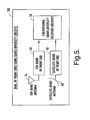
- System 90 includes a first repeater module 20 located at a first location, such as in a vehicle.
- Repeater module 20 is configured to receive digital satellite radio signals in the satellite frequency band, and rebroadcast the digital satellite signals in a first frequency band within the ISM frequency band.
- System 90 also includes a second repeater module 20A located at a second location, such as in the vehicle.
- Repeater module 20A is configured to receive digital satellite radio signals in the satellite frequency band, and rebroadcast the digital satellite radio signals at a second frequency in the ISM frequency band.
- Satellite band ISM diversity receiver 92 includes a first ISM antenna 34 configured to receive a converted satellite ISM signal from repeater module 20 and provide the converted satellite ISM signal to a first frequency converter 94.
- First frequency converter 94 is configured to receive a converted satellite ISM signal transmitted by repeater module 20 at a first frequency in the ISM-band, and convert the digital satellite radio signal from the received converted satellite ISM signal in the first frequency band to a base-band signal.
- Receiver 92 is also shown having a second ISM-band antenna 34 configured to receive a converted satellite ISM signal transmitted by repeater module 20A and provide that received signal to a second frequency converter 96.
- Second frequency converter 96 is configured to receive a converted satellite ISM signal transmitted by repeater module 20A at a second frequency in the ISM-band that is different from the first frequency transmitted by repeater module 20, and to convert the digital satellite radio signal from the received converted satellite ISM signals in the second frequency band to a base-band signal.
- Both first frequency converter 94 and second frequency converter 96 are shown providing base-band digital satellite radio signals extracted from ISM-band signals to satellite band diversity receiver circuitry 58.
- Satellite band diversity receiver circuitry 58 may include conventional circuitry that is configured to select from among the different base-band digital satellite radio signals provided by first frequency converter 94 and second frequency converter 96, and process the selected base-band signal to extract and/or process audio and/or other data.
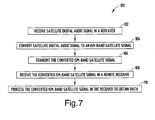
- a method 100 for receiving and processing digital satellite radio signals with system 10 or 90 is provided, according to one embodiment of the present invention.
- a satellite digital audio signal is received in a repeater module.
- the satellite digital audio signal is converted to a signal in the ISM-band.
- the converted satellite signal in the ISM-band is transmitted.
- a converted ISM-band satellite signal is received in a remote receiver.
- the converted ISM-band satellite signal is processed in the receiver to obtain data.
- the present invention provides the benefit of a digital satellite receiver system that is capable of directly processing converted digital satellite signals without the need for additional antennas or circuitry to reconvert the digital satellite signals into a satellite frequency range.
- the present invention provides for a digital satellite receiver system that is capable of retransmitting and processing signals provided by more than one conventional satellite radio system.
Landscapes
- Engineering & Computer Science (AREA)
- Signal Processing (AREA)
- Physics & Mathematics (AREA)
- Astronomy & Astrophysics (AREA)
- General Physics & Mathematics (AREA)
- Radio Relay Systems (AREA)
Applications Claiming Priority (1)
| Application Number | Priority Date | Filing Date | Title |
|---|---|---|---|
| US11/365,422 US20070206666A1 (en) | 2006-03-01 | 2006-03-01 | Digital satellite receiver and method for expanding digital satellite radio coverage for devices |
Publications (1)
| Publication Number | Publication Date |
|---|---|
| EP1830499A2 true EP1830499A2 (de) | 2007-09-05 |
Family
ID=38050031
Family Applications (1)
| Application Number | Title | Priority Date | Filing Date |
|---|---|---|---|
| EP07075138A Withdrawn EP1830499A2 (de) | 2006-03-01 | 2007-02-16 | Empfänger für den Empfang von digitalen Satellitensignalen und Verfahren zum Erweitern des Sendebereichs vom digitalen Satellitenrundfunk für Empfangsvorrichtungen |
Country Status (3)
| Country | Link |
|---|---|
| US (1) | US20070206666A1 (de) |
| EP (1) | EP1830499A2 (de) |
| CN (1) | CN101030806A (de) |
Families Citing this family (4)
| Publication number | Priority date | Publication date | Assignee | Title |
|---|---|---|---|---|
| US7711335B2 (en) * | 2006-06-01 | 2010-05-04 | Delphi Technologies, Inc. | Digital satellite receiver and method for switching among multiple receiver antennas using diversity circuitry |
| CN102625062B (zh) * | 2012-03-20 | 2014-10-08 | 华为终端有限公司 | 一种传输流搬移设备及卫星电视天线共用系统 |
| US9306639B2 (en) * | 2014-07-29 | 2016-04-05 | Nxp, B.V. | Cooperative antenna-diversity radio receiver |
| US11166222B2 (en) * | 2019-08-02 | 2021-11-02 | AR & NS Investment, LLC | Communication by a repeater system including a network of radio frequency (RF) repeater devices |
Family Cites Families (6)
| Publication number | Priority date | Publication date | Assignee | Title |
|---|---|---|---|---|
| US5912641A (en) * | 1997-01-21 | 1999-06-15 | Globalstar L.P. | Indoor satellite cellular repeater system |
| US5794138A (en) * | 1997-02-26 | 1998-08-11 | Cd Radio Inc. | Satellite broadcast system receiver |
| US6023616A (en) * | 1998-03-10 | 2000-02-08 | Cd Radio Inc. | Satellite broadcast receiver system |
| US6134437A (en) * | 1997-06-13 | 2000-10-17 | Ericsson Inc. | Dual-mode satellite/cellular phone architecture with physically separable mode |
| US6996369B2 (en) * | 2002-08-22 | 2006-02-07 | Eagle Broadband, Inc. | Repeater for a satellite phone |
| US7386272B2 (en) * | 2005-02-15 | 2008-06-10 | Delphi Technologies, Inc. | System and method for transmitting signals having audio data in a vehicle |
-
2006
- 2006-03-01 US US11/365,422 patent/US20070206666A1/en not_active Abandoned
-
2007
- 2007-02-16 EP EP07075138A patent/EP1830499A2/de not_active Withdrawn
- 2007-02-28 CN CNA200710092390XA patent/CN101030806A/zh active Pending
Also Published As
| Publication number | Publication date |
|---|---|
| CN101030806A (zh) | 2007-09-05 |
| US20070206666A1 (en) | 2007-09-06 |
Similar Documents
| Publication | Publication Date | Title |
|---|---|---|
| EP1863193B1 (de) | Digitaler Satellitenempfänger und Verfahren zur Schaltung zwischen mehreren Empfängerantennen unter Verwendung einer Diversitätschaltung | |
| US6510317B1 (en) | Satellite digital audio radio service tuner architecture for reception of satellite and terrestrial signals | |
| JP3889885B2 (ja) | ミリ波送信装置、ミリ波受信装置、ミリ波送受信システム及び電子機器 | |
| US7260356B2 (en) | Method and apparatus for wirelessly coupling a source signal to a radio frequency receiver | |
| US7447171B2 (en) | Antenna diversity system | |
| JPH11313020A5 (de) | ||
| US20060133465A1 (en) | Wireless home repeater for satellite radio products | |
| EP1830499A2 (de) | Empfänger für den Empfang von digitalen Satellitensignalen und Verfahren zum Erweitern des Sendebereichs vom digitalen Satellitenrundfunk für Empfangsvorrichtungen | |
| US20100158138A1 (en) | Satellite broadcasting system and signal receiving method thereof | |
| US20060053453A1 (en) | Wireless redistribution system for terrestrial digital television broadcasting and receiving system for terrestrial digital television broadcasting | |
| JP3865715B2 (ja) | 地上デジタルテレビ放送の伝送装置および受信装置 | |
| CN103597813A (zh) | 调谐器模块和移动体通信终端 | |
| US20060217059A1 (en) | Mobile broadcast receiving apparatus and control method therefor | |
| CN1316817C (zh) | 视频接收调谐器 | |
| MX2008012197A (es) | Sistema y metodo para comunicaciones de datos de fuente multiple. | |
| JP4017620B2 (ja) | 地上波デジタルtv放送の無線再配信システム | |
| JP2004159283A (ja) | 衛星放送地上中継装置 | |
| US20070053314A1 (en) | Method and apparatus for providing satellite television and other data to mobile antennas | |
| JP2003168986A (ja) | ミリ波帯無線送信装置およびミリ波帯無線受信装置およびミリ波帯無線通信システム | |
| JP4017619B2 (ja) | 地上波デジタルtv放送の無線再配信システム | |
| US8032100B2 (en) | System and method of communicating multiple carrier waves | |
| JPH11112376A (ja) | 衛星放送受信システム | |
| JPH01233924A (ja) | 衛生放送受信用アンテナ | |
| KR100602497B1 (ko) | Dmb 수신기능을 갖는 휴대용 단말기 및 그 수신처리 방법 | |
| JP2008066803A (ja) | 再送信システム並びに再送信装置 |
Legal Events
| Date | Code | Title | Description |
|---|---|---|---|
| PUAI | Public reference made under article 153(3) epc to a published international application that has entered the european phase |
Free format text: ORIGINAL CODE: 0009012 |
|
| AK | Designated contracting states |
Kind code of ref document: A2 Designated state(s): AT BE BG CH CY CZ DE DK EE ES FI FR GB GR HU IE IS IT LI LT LU LV MC NL PL PT RO SE SI SK TR |
|
| AX | Request for extension of the european patent |
Extension state: AL BA HR MK YU |
|
| STAA | Information on the status of an ep patent application or granted ep patent |
Free format text: STATUS: THE APPLICATION IS DEEMED TO BE WITHDRAWN |
|
| 18D | Application deemed to be withdrawn |
Effective date: 20120901 |