EP1831179B1 - Verfahren zur herstellung von onium-salzen mit tetrafluoroborat-anion mit reduziertem halogenid-gehalt - Google Patents
Verfahren zur herstellung von onium-salzen mit tetrafluoroborat-anion mit reduziertem halogenid-gehalt Download PDFInfo
- Publication number
- EP1831179B1 EP1831179B1 EP05807705A EP05807705A EP1831179B1 EP 1831179 B1 EP1831179 B1 EP 1831179B1 EP 05807705 A EP05807705 A EP 05807705A EP 05807705 A EP05807705 A EP 05807705A EP 1831179 B1 EP1831179 B1 EP 1831179B1
- Authority
- EP
- European Patent Office
- Prior art keywords
- atoms
- tetrafluoroborate
- substituents
- chain
- straight
- Prior art date
- Legal status (The legal status is an assumption and is not a legal conclusion. Google has not performed a legal analysis and makes no representation as to the accuracy of the status listed.)
- Expired - Lifetime
Links
- 0 *N(*)C1N=CC=CN1* Chemical compound *N(*)C1N=CC=CN1* 0.000 description 8
Classifications
-
- C—CHEMISTRY; METALLURGY
- C07—ORGANIC CHEMISTRY
- C07D—HETEROCYCLIC COMPOUNDS
- C07D233/00—Heterocyclic compounds containing 1,3-diazole or hydrogenated 1,3-diazole rings, not condensed with other rings
- C07D233/54—Heterocyclic compounds containing 1,3-diazole or hydrogenated 1,3-diazole rings, not condensed with other rings having two double bonds between ring members or between ring members and non-ring members
-
- C—CHEMISTRY; METALLURGY
- C07—ORGANIC CHEMISTRY
- C07C—ACYCLIC OR CARBOCYCLIC COMPOUNDS
- C07C209/00—Preparation of compounds containing amino groups bound to a carbon skeleton
- C07C209/04—Preparation of compounds containing amino groups bound to a carbon skeleton by substitution of functional groups by amino groups
- C07C209/06—Preparation of compounds containing amino groups bound to a carbon skeleton by substitution of functional groups by amino groups by substitution of halogen atoms
- C07C209/12—Preparation of compounds containing amino groups bound to a carbon skeleton by substitution of functional groups by amino groups by substitution of halogen atoms with formation of quaternary ammonium compounds
-
- C—CHEMISTRY; METALLURGY
- C07—ORGANIC CHEMISTRY
- C07C—ACYCLIC OR CARBOCYCLIC COMPOUNDS
- C07C381/00—Compounds containing carbon and sulfur and having functional groups not covered by groups C07C301/00 - C07C337/00
- C07C381/12—Sulfonium compounds
-
- C—CHEMISTRY; METALLURGY
- C07—ORGANIC CHEMISTRY
- C07D—HETEROCYCLIC COMPOUNDS
- C07D213/00—Heterocyclic compounds containing six-membered rings, not condensed with other rings, with one nitrogen atom as the only ring hetero atom and three or more double bonds between ring members or between ring members and non-ring members
- C07D213/02—Heterocyclic compounds containing six-membered rings, not condensed with other rings, with one nitrogen atom as the only ring hetero atom and three or more double bonds between ring members or between ring members and non-ring members having three double bonds between ring members or between ring members and non-ring members
- C07D213/04—Heterocyclic compounds containing six-membered rings, not condensed with other rings, with one nitrogen atom as the only ring hetero atom and three or more double bonds between ring members or between ring members and non-ring members having three double bonds between ring members or between ring members and non-ring members having no bond between the ring nitrogen atom and a non-ring member or having only hydrogen or carbon atoms directly attached to the ring nitrogen atom
- C07D213/06—Heterocyclic compounds containing six-membered rings, not condensed with other rings, with one nitrogen atom as the only ring hetero atom and three or more double bonds between ring members or between ring members and non-ring members having three double bonds between ring members or between ring members and non-ring members having no bond between the ring nitrogen atom and a non-ring member or having only hydrogen or carbon atoms directly attached to the ring nitrogen atom containing only hydrogen and carbon atoms in addition to the ring nitrogen atom
- C07D213/16—Heterocyclic compounds containing six-membered rings, not condensed with other rings, with one nitrogen atom as the only ring hetero atom and three or more double bonds between ring members or between ring members and non-ring members having three double bonds between ring members or between ring members and non-ring members having no bond between the ring nitrogen atom and a non-ring member or having only hydrogen or carbon atoms directly attached to the ring nitrogen atom containing only hydrogen and carbon atoms in addition to the ring nitrogen atom containing only one pyridine ring
- C07D213/20—Quaternary compounds thereof
-
- C—CHEMISTRY; METALLURGY
- C07—ORGANIC CHEMISTRY
- C07D—HETEROCYCLIC COMPOUNDS
- C07D213/00—Heterocyclic compounds containing six-membered rings, not condensed with other rings, with one nitrogen atom as the only ring hetero atom and three or more double bonds between ring members or between ring members and non-ring members
- C07D213/02—Heterocyclic compounds containing six-membered rings, not condensed with other rings, with one nitrogen atom as the only ring hetero atom and three or more double bonds between ring members or between ring members and non-ring members having three double bonds between ring members or between ring members and non-ring members
- C07D213/04—Heterocyclic compounds containing six-membered rings, not condensed with other rings, with one nitrogen atom as the only ring hetero atom and three or more double bonds between ring members or between ring members and non-ring members having three double bonds between ring members or between ring members and non-ring members having no bond between the ring nitrogen atom and a non-ring member or having only hydrogen or carbon atoms directly attached to the ring nitrogen atom
- C07D213/60—Heterocyclic compounds containing six-membered rings, not condensed with other rings, with one nitrogen atom as the only ring hetero atom and three or more double bonds between ring members or between ring members and non-ring members having three double bonds between ring members or between ring members and non-ring members having no bond between the ring nitrogen atom and a non-ring member or having only hydrogen or carbon atoms directly attached to the ring nitrogen atom with hetero atoms or with carbon atoms having three bonds to hetero atoms with at the most one bond to halogen, e.g. ester or nitrile radicals, directly attached to ring carbon atoms
- C07D213/72—Nitrogen atoms
- C07D213/74—Amino or imino radicals substituted by hydrocarbon or substituted hydrocarbon radicals
-
- C—CHEMISTRY; METALLURGY
- C07—ORGANIC CHEMISTRY
- C07D—HETEROCYCLIC COMPOUNDS
- C07D295/00—Heterocyclic compounds containing polymethylene-imine rings with at least five ring members, 3-azabicyclo [3.2.2] nonane, piperazine, morpholine or thiomorpholine rings, having only hydrogen atoms directly attached to the ring carbon atoms
- C07D295/02—Heterocyclic compounds containing polymethylene-imine rings with at least five ring members, 3-azabicyclo [3.2.2] nonane, piperazine, morpholine or thiomorpholine rings, having only hydrogen atoms directly attached to the ring carbon atoms containing only hydrogen and carbon atoms in addition to the ring hetero elements
- C07D295/023—Preparation; Separation; Stabilisation; Use of additives
-
- C—CHEMISTRY; METALLURGY
- C07—ORGANIC CHEMISTRY
- C07D—HETEROCYCLIC COMPOUNDS
- C07D295/00—Heterocyclic compounds containing polymethylene-imine rings with at least five ring members, 3-azabicyclo [3.2.2] nonane, piperazine, morpholine or thiomorpholine rings, having only hydrogen atoms directly attached to the ring carbon atoms
- C07D295/02—Heterocyclic compounds containing polymethylene-imine rings with at least five ring members, 3-azabicyclo [3.2.2] nonane, piperazine, morpholine or thiomorpholine rings, having only hydrogen atoms directly attached to the ring carbon atoms containing only hydrogen and carbon atoms in addition to the ring hetero elements
- C07D295/037—Heterocyclic compounds containing polymethylene-imine rings with at least five ring members, 3-azabicyclo [3.2.2] nonane, piperazine, morpholine or thiomorpholine rings, having only hydrogen atoms directly attached to the ring carbon atoms containing only hydrogen and carbon atoms in addition to the ring hetero elements with quaternary ring nitrogen atoms
-
- C—CHEMISTRY; METALLURGY
- C07—ORGANIC CHEMISTRY
- C07F—ACYCLIC, CARBOCYCLIC OR HETEROCYCLIC COMPOUNDS CONTAINING ELEMENTS OTHER THAN CARBON, HYDROGEN, HALOGEN, OXYGEN, NITROGEN, SULFUR, SELENIUM OR TELLURIUM
- C07F9/00—Compounds containing elements of Groups 5 or 15 of the Periodic Table
- C07F9/02—Phosphorus compounds
- C07F9/28—Phosphorus compounds with one or more P—C bonds
- C07F9/54—Quaternary phosphonium compounds
- C07F9/5407—Acyclic saturated phosphonium compounds
Definitions
- the invention relates to a process for the preparation of onium salts with tetrafluoroborate anion by reacting an onium halide with an oxonium tetrafluoroborate, sulfonium tetrafluoroborate or triphenylcarbonium tetrafluoroborate.
- Ionic liquids A large number of onium salts are ionic liquids.
- Ionic liquids through their properties in modern research, are an effective alternative to traditional volatile organic solvents for organic synthesis.
- the use of ionic liquids as a novel reaction medium could continue to be a practical solution for both solvent emission and reprocessing problems
- Be catalysts R. Sheldon "Catalytic reactions in ionic liquids", Chem. Commun., 2001, 2399-2407 ; MJ Earle, KR Seddon "Ionic Liquids, Green Solvent for the Future", Pure Appl. Chem., 72 (2000), 1391-1398 ; P. Wasserscheid, W. Keim "Ionic Liquids - Novel Solutions for Transition-Metal Catalysis," Angew.
- Ionic liquids or liquid salts are ionic species consisting of an organic cation and a generally inorganic anion. They contain no neutral molecules and usually have melting points less than 373 K. However, the melting point may also be higher without restricting the applicability of the salts in all fields of application.
- organic cations include tetraalkylammonium, tetraalkylphosphonium, N-alkylpyridinium, 1,3-dialkylimidazolium or trialkylsulfonium.
- Suitable anions are, for example, BF 4 - , PF 6 - , SbF 6 - , NO 3 - , CF 3 SO 3 - , (CF 3 SO 2 ) 2 N - , ArylSO 3 - , CF 3 CO 2 - , CH 3 CO 2 - or Al 2 Cl 7 - to call.
- Ionic liquids such as melting point, thermal and electrochemical stability or viscosity
- properties of ionic liquids are determined by the choice of cations and anions.
- Ionic liquids are non-volatile materials and therefore can not be purified by conventional purification methods, such as distillation, because they have been developed for most organic solvents.
- ionic liquids with tetrafluoroborate anion the technology is crucial to be synthesized by the reaction per se or the reaction regime with low impurities.
- a predominant contaminant in known ionic liquids are halide ions. If the proportion of halide ions, for example chloride ions, is greater than 1000 ppm (0.1%), the applicability of the ionic liquid is reduced, in particular in the application for electrochemical processes.
- Holderberg et al. (“Electrophilic induced addition reactions of bisphosphonioisophosphine dolide cations", Tetrahedron 56, 2000, 57-62 ) discloses the metathesis reaction of phosphonium bromide with seaweed salt [Me 3 O] [BF 4] , in which Br - is replaced by [BF 4 ] - .
- EP 1182197 A1 describes the solvent-free one-pot reaction of 1-methylimidazole with an alkyl chloride and sodium tetrafluoroborate to give imidazolium tetrafluoroborates.
- the object is achieved by the method according to the invention.
- the invention accordingly provides a process for the preparation of onium tetrafluoroborates by reacting an onium halide with a trialkyloxonium tetrafluoroborate, sulfonium tetrafluoroborate or triphenylcarbonium tetrafluoroborate.
- the process according to the invention is an improvement on the known synthesis processes for onium tetrafluoroborates, which are generally 2-stage processes, as in P. Wasserscheid and W. Keim, Angew. Chem. 112 (2000), 3926-3945 described.
- an organic base typically an amine, phosphine or a heterocyclic compound
- the resulting onium halide is converted to the tetrafluoroborate via an anion exchange in the second step.
- the halide for example, 1-ethyl-3-methylimidazolium chloride or bromide
- NaBF 4 in acetone after Park and RJ Kazlauskas, J. Organic Chemistry, 66 (2001), 8395-8401
- NaBF 4 in water after R. Karmakar and A. Samanta, J. Phys. Chem. A, 106 (2002), 6670-6675
- the process of the invention allows the synthesis of a plurality of tetrafluoroborate salts, it being possible for different substituents, for example alkyl groups, to be present on the onium cation, so-called unsymmetrical compounds.
- the new method can also be used to purify tetrafluoroborates containing chloride, bromide or iodide anions as impurities. This gives ionic liquids with tetrafluoroborate anions in high quality without the use of expensive materials such as silver tetrafluoroborate or without impurities on silver cations.
- Suitable onium halides according to claim 1 are, when reacted with trialkyloxonium tetrafluoroborate or triphenylcarbonium tetrafluoroborate, phosphonium halides, thiouronium halides, guanidinium halides or heterocyclic cation halides or, when reacted with trialkylsulfonium tetrafluoroborate, ammonium halides, Phosphonium halides, Thiouroniumhalogenide, Guanidiniumhalogenide or halides with heterocyclic cation, wherein the halides can be selected from the group of chlorides, bromides or iodides. Chlorides or bromides are preferably used in the process according to the invention.
- Thiouronium iodides are preferably used in the process according to the invention for the class of thiouronium salts.
- the onium halides are usually commercially available or can be prepared by synthesis methods as known from the literature, for example in the standard works such Houben-Weyl, Methods of Organic Chemistry, Georg-Thieme-Verlag, Stuttgart or Richard C. Larock, Comprehensive Organic Transformations, 2nd Edition, Wiley-VCH, New York, 1999 are known. One can also make use of known per se, not mentioned here variants.
- Ammonium and phosphonium halides can be exemplified by the formula (1) [XR 4 ] + Hal - (1), to be discribed, in which XN, P Hal Cl, Br or I and R each independently H, where not all substituents R may be H at the same time, straight-chain or branched alkyl having 1-20 C atoms, straight-chain or branched alkenyl having 2-20 C atoms and one or more double bonds, straight-chain or branched alkynyl having 2-20 C atoms and one or more triple bonds, saturated, partially or completely unsaturated cycloalkyl having 3-7 C atoms, which may be substituted by alkyl groups having 1-6 C atoms, wherein one or more Rs may be partially or completely substituted with F, but not all four or three Rs may be completely substituted with F, and wherein one or two non-adjacent and non- ⁇ or ⁇ -standing carbon atoms of the R, are replaced by atoms and / or atomic
- Halides having a heterocyclic cation can be represented, for example, by the formula (4) [HetN] + Hal - (4) be described, wherein Hal Cl, Br or I and HetN + a heterocyclic cation selected from the group or means, wherein the substituents R 1 'to R 4 ' are each independently Hydrogen or CN, straight-chain or branched alkyl having 1-20 C atoms, straight-chain or branched alkenyl having 2-20 C atoms and one or more double bonds, straight-chain or branched alkynyl having 2-20 C atoms and one or more triple bonds, Dialkylamino having alkyl groups with 1-4 C atoms, which, however, is not bound to the heteroatom of the heterocycle, saturated, partially or fully unsaturated cycloalkyl having 3-7 C-atoms which may be substituted with alkyl groups having 1-6 C-atoms, or aryl-C 1 -C 6 alkyl, where the substituents R 1
- Suitable substituents R and R 1 to R 7 of the compounds of the formulas (1) to (3) according to the invention are preferably hydrogen in addition to hydrogen: C 1 - to C 20 -, in particular C 1 - to C 14 -alkyl groups, and saturated or unsaturated, that is also aromatic, C 3 - to C 7 -cycloalkyl groups which may be substituted by C 1 - to C 6 -alkyl groups, in particular phenyl.
- the substituents R and R 1 to R 7 may likewise be substituted by further functional groups, for example by CN, SO 2 R ', SO 2 OR 'or COOR'.
- R 'does not mean partially or perfluorinated C 1 to C 6 alkyl, C 3 to C 7 cycloalkyl, unsubstituted or substituted phenyl.
- the substituents R in the compounds of the formula (1) may be identical or different. Preferably, three substituents in formula (1) are the same and one substituent different.
- the substituent R is particularly preferably methyl, ethyl, isopropyl, propyl, butyl, sec-butyl, pentyl, hexyl, octyl, decyl or tetradecyl.
- guanidinium cation Up to four substituents of the guanidinium cation may also be linked in pairs to form mono-, bi- or polycyclic cations. Without restriction of generality, examples of such guanidinium cations are: or where the substituents R 1 to R 3 and R 6 may have a previously stated or particularly preferred meaning.
- the carbocycles or heterocycles of the above-mentioned guanidinium cations can still be replaced by C 1 - to C 6 -alkyl, C 1 - to C 6 -alkenyl, NO 2 , F, Cl, Br, I, C 1 -C 6 -alkoxy , SCF 3 , SO 2 CH 3 , SO 2 CF 3 , COOR ", SO 2 NR" 2 , SO 2 X ', SO 3 R ", substituted or unsubstituted phenyl, where X' and R" are previously or later have meaning indicated.
- the carbocyclic or heterocyclic rings of the above-mentioned guanidinium cations may be substituted by C 1 - to C 6 -alkyl, C 1 - to C 6 alkenyl, NO 2, F, Cl, Br, I, C 1 -C 6 alkoxy , SCF 3 , SO 2 CH 3 , SO 2 CF 3 , COOR ", SO 2 NR" 2 , SO 2 X ', SO 3 R ", substituted or unsubstituted phenyl, where X' and R" have the meaning given above or later.
- the C 1 -C 14 alkyl is for example methyl, ethyl, isopropyl, propyl, butyl, sec-butyl or tert-butyl, furthermore also pentyl, 1-, 2- or 3-methylbutyl, 1,1-, 1 , 2- or 2,2-dimethylpropyl, 1-ethylpropyl, hexyl, heptyl, octyl, nonyl, decyl, undecyl, dodecyl, tridecyl or tetradecyl.
- perfluorinated for example as difluoromethyl, trifluoromethyl, pentafluoroethyl, heptafluoropropyl or nonafluorobutyl.
- a straight-chain or branched alkenyl having 2 to 20 C atoms, wherein several double bonds may also be present, is, for example, vinyl, allyl, 2- or 3-butenyl, isobutenyl, sec-butenyl, furthermore 4-pentenyl, iso-pentenyl, Hexenyl, heptenyl, octenyl, -C 9 H 17 , -C 10 H 19 to -C 20 H 39 ; preferably allyl, 2- or 3-butenyl, isobutenyl, sec-butenyl, furthermore preferred is 4-pentenyl, iso-pentenyl or hexenyl.
- a straight-chain or branched alkynyl having 2 to 20 C atoms, wherein a plurality of triple bonds may also be present, is, for example, ethynyl, 1- or 2-propynyl, 2- or 3-butynyl, furthermore 4-pentynyl, 3-pentynyl, hexynyl, Heptynyl, octynyl, -C 9 H 15 , -C 10 H 17 to -C 20 H 37 , preferably ethynyl, 1- or 2-propynyl, 2- or 3-butynyl, 4-pentynyl, 3-pentynyl or hexynyl.
- Aryl-C 1 -C 6 -alkyl is, for example, benzyl, phenylethyl, phenylpropyl, phenylbutyl, phenylpentyl or phenylhexyl, where both the phenyl ring and the alkylene chain, as described above, may be partially or completely substituted by F, more preferably benzyl or phenylpropyl.
- phenyl ring or the alkylene chain can likewise be substituted by further functional groups, for example by CN, SO 2 R ', SO 2 OR' or COOR '.
- R ' has a previously defined meaning.
- Unsubstituted saturated or partially or fully unsaturated cycloalkyl groups having 3-7 C atoms are therefore cyclopropyl, cyclobutyl, cyclopentyl, cyclohexyl, cycloheptyl, cyclopentenyl, cyclopenta-1,3-dienyl, cyclohexenyl, cyclohexa-1,3-dienyl, cyclohexa-1 , 4-dienyl, phenyl, cycloheptenyl, cyclohepta-1,3-dienyl, cyclohepta-1,4-dienyl or cyclohepta-1,5-dienyl which may be substituted by C 1 to C 6 alkyl groups, again Cycloalkyl group or substituted with C 1 - to C 6 -alkyl cycloalkyl group may also be substituted by halogen atoms such as F, Cl, Br or I, in
- R 1 to R 6 or R 1 'to R 4 ' can also one or two non-adjacent and non- ⁇ to the heteroatom or ⁇ bonded carbon atoms, by atoms and / or atomic groups selected from the group -O-, -S-, -S (O) - or -SO 2 - be replaced.
- C 3 - to C 7 -cycloalkyl is, for example, cyclopropyl, cyclobutyl, cyclopentyl, cyclohexyl or cycloheptyl.
- R ' is substituted phenyl, by C 1 - to C 6 alkyl, C 1 - to C 6 alkenyl, NO 2 , F, Cl, Br, I, C 1 -C 6 alkoxy, SCF 3 , SO 2 CH 3 , SO 2 CF 3 , COOR ", SO 2 X ', SO 2 NR" 2 or SO 3 R "substituted phenyl, wherein X' is F, Cl or Br and R" is an unsubstituted or partially fluorinated C 1 - to C 6 -alkyl or C 3 - to C 7 -cycloalkyl as defined for R ', for example, o-, m- or p-methylphenyl, o-, m- or p-ethylphenyl, o-, m- or p-propylphenyl , o-, m- or p-isopropylphenyl, o-, m- or
- the substituents R 1 to R 7 are each, independently of one another, preferably a straight-chain or branched alkyl group having 1 to 10 C atoms.
- the substituents R 1 and R 2 , R 3 and R 4 and R 5 and R 6 in compounds of the formulas (2) and (3) may be the same or different. More preferably, R 1 to R 7 are each independently methyl, ethyl, n-propyl, isopropyl, n-butyl, sec-butyl, phenyl or cyclohexyl, most preferably methyl, ethyl, n-propyl, isopropyl or n-butyl ,
- Suitable substituents R 1 'to R 4 ' of compounds of the formula (4) according to the invention are preferably hydrogen in addition to hydrogen: CN, C 1 - to C 20 -, in particular C 1 - to C 12 -alkyl groups, and saturated or unsaturated, ie also aromatic, C 3 - to C 7 -cycloalkyl groups which may be substituted by C 1 - to C 6 -alkyl groups, in particular phenyl or aryl-C 1 -C 6 -alkyl or diaminoalkyl having C 1 -C 4 - Alkyl groups, provided that it is not bound to the heteroatom.
- R 1 'to R 4 ' may likewise be substituted by further functional groups, for example by CN, SO 2 R ', SO 2 OR' or COOR '.
- R 'does not mean partially or perfluorinated C 1 to C 6 alkyl, C 3 to C 7 cycloalkyl, unsubstituted or substituted phenyl.
- the substituents R 1 'and R 4 ' are each, in each case independently of one another, more preferably CN, methyl, ethyl, isopropyl, propyl, butyl, sec-butyl, pentyl, hexyl, octyl, decyl, cyclohexyl, phenyl, phenylpropyl or benzyl. They are very particularly preferably CN, methyl, ethyl, n-butyl or hexyl. In pyrrolidinium, piperidinium or indolinium compounds, the two substituents R 1 'and R 4 ' are preferably different.
- R 2 'or R 3 ' is, in each case independently of one another, in particular hydrogen, methyl, ethyl, isopropyl, propyl, butyl, sec-butyl, tert-butyl, cyclohexyl, dimethylamino, diethylamino, methylethylamino, phenyl or benzyl.
- R 2 ' is particularly preferably dimethylamino, hydrogen, methyl, ethyl, isopropyl, propyl, butyl, sec-butyl or tert-butyl.
- R 2 'and R 3 ' are hydrogen, dimethylamino or methyl.
- HetN + of the formula (4) is preferable wherein the substituents R 1 'to R 4 ' each independently have a meaning as described above.
- HetN + is particularly preferably imidazolium, pyrrolidinium or pyridinium, as defined above, wherein the substituents R 1 'to R 4 ' each independently have a meaning as described above.
- Oxonium tetrafluoroborate having the formula [(alkyl) 3 O] + [BF 4 ] - is preferably an oxonium tetrafluoroborate having straight-chain or branched alkyl groups having 1-8 C atoms, preferably having 1-4 C atoms, used are each independent of each other. Preference is given to using oxonium tetrafluoroborates in which the alkyl groups are identical. Also usable are tritylium tetrafluoroborate, [(phenyl) 3 C] + [BF 4 ] - .
- sulfonium tetrafluoroborate having the formula [(alkyl) 3 S] + [BF 4 ] - is preferably a sulfonium tetrafluoroborate with straight-chain or branched alkyl groups having 1-8 carbon atoms, preferably 1-4 carbon atoms used, the are each independent of each other. Preference is given to using sulfonium tetrafluoroborates in which the alkyl groups are identical.
- oxonium tetrafluoroborates or sulfonium tetrafluoroborates used are generally commercially available or can be prepared by synthesis processes as described in the literature, for example in the standard works such as Houben-Weyl, Methods of Organic Chemistry, Georg-Thieme-Verlag, Stuttgart or Richard C. Larock, Comprehensive Organic Transformations, 2nd Edition, Wiley-VCH, New York, 1999 are known. One can also make use of known per se, not mentioned here variants.
- oxonium tetrafluoroborates are trimethyloxonium tetrafluoroborate, triethyloxonium tetrafluoroborate (Meerwein salt), tris (n-propyl) oxonium tetrafluoroborate, dimethyl ethyloxonium tetrafluoroborate, diethyl methyloxonium tetrafluoroborate or tris (i-propyl) oxonium tetrafluoroborate.
- trimethyl- or triethyloxonium tetrafluoroborate triethyloxonium tetrafluoroborate
- sulfonium tetrafluoroborates are trimethylsulfonium, triethylsulfonium, dimethylethylsulfonium, diethylmethylsulfonium, dipropylmethylsulfonium, dipropylethylsulfonium, dibutylmethylsulfonium, di-sec-butylmethylsulfonium, dibutylethylsulfonium tetrafluoroborate.
- Very particular preference is given to using trimethylsulfonium and triethylsulfonium tetrafluoroborate.
- the reaction is carried out according to the invention when reacted with trialkyloxonium tetrafluoroborate or triphenylcarbonium tetrafluoroborate at temperatures between 0 ° and 100 ° C., preferably at 20 ° to 50 °, particularly preferably at room temperature.
- the reaction according to the invention takes place at temperatures between 0 and 150 ° C., preferably at 20 to 100 ° C. No solvent is needed.
- solvents for example dimethoxyethane, acetonitrile, dichloromethane, tetrahydrofuran, dimethyl sulfoxide, dioxane, propionitrile or mixtures with one another.
- the reaction is carried out with an excess or equimolar amount of the corresponding oxonium tetrafluoroborate, sulfonium tetrafluoroborate or triphenylcarbonium tetrafluoroborate.
- the method described is also suitable for introducing the anions [(phenyl) 4 B] - , PF 6 - , SbF 6 - or AsF 6 - into ionic liquids with onium cations by alkyloxonium salts or alkylsulfonium salts with the corresponding anions with onium Halides are reacted.
- the NMR spectra were measured on solutions in deuterated solvents at 20 ° C on a Bruker ARX 400 spectrometer with a 5 mm 1 H / BB broadband head with deuterium lock, unless indicated in the examples.
- the measurement frequencies of the different cores are: 1 H: 400.13 MHz and 19 F: 376.50 MHz.
- the referencing method is specified separately for each spectrum or for each data record.
- Triethyloxonium tetrafluoroborate added. The reaction mixture is stirred for 30 minutes at room temperature. Subsequently, all volatile products are removed in a vacuum of 13.3 Pa and 80 ° C (oil bath temperature) within 30 minutes. 3.88 g of tetrabutylphosphonium tetrafluoroborate are obtained. The yield is approximately quantitative.
Landscapes
- Chemical & Material Sciences (AREA)
- Organic Chemistry (AREA)
- Health & Medical Sciences (AREA)
- Life Sciences & Earth Sciences (AREA)
- Biochemistry (AREA)
- General Health & Medical Sciences (AREA)
- Molecular Biology (AREA)
- Organic Low-Molecular-Weight Compounds And Preparation Thereof (AREA)
- Pyridine Compounds (AREA)
Description
- Die Erfindung betrifft ein Verfahren zur Herstellung von Onium-Salzen mit Tetrafluoroborat-Anion durch Umsetzung eines Onium-Halogenids mit einem Oxonium-Tetrafluoroborat, Sulfonium-Tetrafluoroborat oder Triphenylcarbonium-Tetrafluoroborat.
- Eine große Anzahl von Onium-Salzen sind ionische Flüssigkeiten. Ionische Flüssigkeiten stellen durch Ihre Eigenschaften in der modernen Forschung eine wirksame Alternative zu traditionellen flüchtigen organischen Solventien für die organische Synthese dar. Die Verwendung von ionischen Flüssigkeiten als neues Reaktionsmedium könnte weiterhin eine praktische Lösung sowohl für die Lösungsmittel Emission als auch für Probleme in der Wiederaufbereitung von Katalysatoren sein (R. Sheldon "Catalytic reactions in ionic liquids", Chem. Commun., 2001, 2399-2407; M.J. Earle, K.R. Seddon "Ionic liquids. Green solvent for the future", Pure Appl. Chem., 72 (2000), 1391-1398; P. Wasserscheid, W. Keim "Ionische Flüssigkeiten - neue Lösungen für die Übergangsmetallkatalyse", Angew. Chem., 112 (2000), 3926-3945; T. Welton "Room temperature ionic liquids. Solvents for synthesis and catalysis", Chem. Rev., 92 (1999), 2071-2083 oder R. Hagiwara, Ya. Ito "Room temperature ionic liquids of alkylimidazolium cations and fluoroanions", J. Fluorine Chem., 105 (2000), 221-227).
- Ionische Flüssigkeiten oder flüssige Salze sind ionische Spezies, die aus einem organischen Kation und einem in der Regel anorganischen Anion bestehen. Sie enthalten keine neutralen Moleküle und weisen meistens Schmelzpunkte kleiner 373 K auf. Der Schmelzpunkt kann jedoch auch höher liegen, ohne die Anwendbarkeit der Salze auf allen Anwendungsgebieten zu beschränken. Beispiele für organische Kationen sind unter anderem Tetraalkylammonium, Tetraalkylphosphonium, N-Alkylpyridinium, 1,3-Dialkylimidazolium oder Trialkylsulfonium. Unter einer Vielzahl von geeigneten Anionen sind beispielsweise BF4 -, PF6 -, SbF6 -, NO3 -, CF3SO3 -, (CF3SO2)2N-, ArylSO3 -, CF3CO2 -, CH3CO2 - oder Al2Cl7 - zu nennen.
- Die Eigenschaften der ionischen Flüssigkeiten, beispielsweise der Schmelzpunkt, die thermische und elektrochemische Stabilität oder Viskosität, werden durch die Auswahl der Kationen und Anionen bestimmt. Ionische Flüssigkeiten sind nicht flüchtige Materialien und können daher nicht durch herkömmliche Methoden der Aufreinigung, wie beispielsweise der Destillation, gereinigt werden, weil sie für die meisten organischen Lösungsmittel entwickelt wurden.
- Daher ist bei Verfahren zur Herstellung von Onium-Salzen, insbesondere ionischer Flüssigkeiten mit Tetrafluoroborat-Anion, die Technologie von entscheidender Bedeutung, damit diese durch die Reaktion per se oder die Reaktionsführung mit geringen Verunreinigungen synthetisiert werden können. Eine vorwiegend vorhandene Verunreinigung in bekannten ionischen Flüssigkeiten sind Halogenid-Ionen. Ist der Anteil an Halogenid-Ionen, beispielsweise Chlorid-Ionen, größer als 1000 ppm (0,1 %), so reduziert sich die Anwendbarkeit der ionischen Flüssigkeit, insbesondere in der Anwendung für elektrochemische Prozesse.
- Holderberg et al. ("Electrophile induced addition reactions of bisphosphonio-isophosphin dolide cations", Tetrahedron 56, 2000, 57-62) offenbart die Metathese-Reaktion von Phosphoniumbromid mit Meerweinsalz [Me3O][BF4], in der Br- durch [BF4]- ausgetauscht wird.
EP 1182197 A1 beschreibt die Lösungsmittel-freie Eintopfreaktion von 1-Methylimidazol mit einem Alkylchlorid und Natriumtetrafluoroborat, bei der Imidazoliumtetrafluoroborate erhalten werden.
In einem weiteren Dokument (US 2003/080312 A1 ) wird die Synthese von Halogenid-freien Ionischen Flüssigkeiten durch die Umsetzung von N-Methylimidazol mit Trifluoressigsäureethylester beschrieben. Nach einem Anionenaustausch mit HBF4 erhält man neben Trifluoressigsäure das Tetrafluoroborat-Salz.
Eine weitere Möglichkeit zur Synthese von Halogenid-freien Ionischen Flüssigkeiten aus N-Methylimidazol und Meerweinsalz wird inUS B1 6245918 offenbart. - Aufgabe der vorliegenden Erfindung war dementsprechend ein alternatives Verfahren zur Herstellung von Onium-Tetrafluoroboraten mit geringem Chlorid-Gehalt zur Verfügung zu stellen, welches zu Produkten mit hoher Reinheit in guter Ausbeute führt und auch für eine großtechnische Produktion geeignet ist.
- Die Aufgabe wird durch das erfindungsgemäße Verfahren gelöst. Gegenstand der Erfindung ist demgemäss ein Verfahren zur Herstellung von Onium-Tetrafluoroboraten durch Umsetzung eines Onium-Halogenids mit einem Trialkyloxonium-Tetrafluoroborat, Sulfonium-Tetrafluoroborat oder Triphenylcarbonium-Tetrafluoroborat.
- Das erfindungsgemäße Verfahren ist eine Verbesserung der bekannten Syntheseverfahren für Onium-Tetrafluoroborate, die in der Regel 2-StufenVerfahren sind, wie in P. Wasserscheid und W. Keim, Angew. Chem. 112 (2000), 3926-3945 beschrieben. Im ersten Schritt der bekannten Verfahren wird eine organische Base, typischerweise ein Amin, Phosphin oder eine heterocyclische Verbindung, mit einem Alkylhalogenid alkyliert und das entstehende Onium-Halogenid im zweiten Schritt über einen Anionenaustausch in das Tetrafluoroborat umgewandelt.
- In der zweiten Stufe wird das Halogenid, beispielsweise 1-Ethyl-3-methylimidazoliumchlorid oder -bromid, mit NaBF4 in Aceton nach S. Park und R. J. Kazlauskas, J. Organic Chemistry, 66 (2001), 8395-8401, mit NaBF4 in Wasser nach R. Karmakar und A. Samanta, J. Phys. Chem. A, 106 (2002), 6670-6675, mit AgBF4 oder HBF4 in Wasser nach J. D. Holbrey und K. R. Seddon, J. Chem. Soc., Dalton Trans., (1999), 2133-2139, mit NH4BF4 in Aceton nach J. Fuller et al, J. Electrochem. Soc., 144 (1997), 3881-3885, mit HBF4 in Methanol nach T. Nishida et al, J. of Fluorine Chem., 120 (2003), 135-141 oder mit NH4BF4 unter Mikrowellenbestrahlung nach V.V. Namboodiri und R. S. Varma, Tetrahedron Lett., 43 (2002), 5381-5383 umgesetzt.
- Alle bekannten Verfahren haben einen Nachteil, insbesondere für eine großtechnische Synthese. Silbertetrafluoroborat ist beispielsweise ein teures Reagenz. Die Umsetzungen mit NaBF4, NH4BF4 und HBF4 in Wasser erfordern einen Aufreinigungsschritt, eventuell durch Verwendung von AgBF4 oder Adsorbentien. HBF4 in Methanol ist nicht kommerziell erhältlich und ist teurer als wässrige HBF4, die wiederum kommerziell erhältlich ist. Bei der Umsetzung in wässriger HBF4 entsteht jedoch die Halogenwasserstoffsäure als Nebenprodukt, die aus dem Endprodukt nicht durch Destillation entfernt werden kann, da sich im Wasser zwei Salze und zwei Säuren im Gleichgewicht befinden. Die erhaltenen Onium-Tetrafluoroborate enthalten zwangsläufig immer einige Prozente an Halogenidionen, dokumentiert durch Untersuchungen von N.M.M Mateus et al, Green Chemistry, 5 (2003), 347-352.
- Überraschenderweise wurde ein einfaches Verfahren entwickelt. Bei der Umsetzung eines Onium-Halogenids, beispielsweise einem Chlorid, Bromid oder Iodid, mit einem Oxonium Tetrafluoroborat, beispielsweise Meerwein Salz, mit einem Sulfonium-Tetrafluoroborat oder Triphenylcarbonium Tetrafluoroborat, entstehen daher Onium-Tetrafluoroborate und Alkylhalogenide oder Triphenylhalogenide und Dialkylether oder Dialkylsulfide als Nebenprodukte, die entweder Gase oder leicht flüchtige Verbindungen sind und ohne großen prozesstechnischen Aufwand aus der Reaktionsmischung entfernt werden können. Einige dieser Nebenprodukte sind selbst wertvolle Materialien für organische Synthesen.
- Das erfindungsgemäße Verfahren erlaubt die Synthese einer Vielzahl von Tetrafluoroborat-Salzen, wobei unterschiedliche Substituenten, beispielsweise Alkylgruppen, am Onium-Kation vorliegen können, sogenannte unsymmetrische Verbindungen. Die neue Methode kann jedoch auch zur Reinigung von Tetrafluoroboraten verwendet werden, die Chlorid-, Bromid- oder Iodid-Anionen als Verunreinigungen enthalten. Man erhält so ionische Flüssigkeiten mit Tetrafluoroborat-Anionen in hoher Qualität ohne den Einsatz von teuren Materialien wie Silbertetrafluoroborat bzw. ohne Verunreinigungen an Silberkationen.
- Geeignete Onium-Halogenide nach Anspruch 1 sind bei Umsetzung mit Trialkyloxonium-Tetrafluoroborat oder Triphenylcarbonium-Tetrafluoroborat Phosphoniumhalogenide, Thiouroniumhalogenide, Guanidiniumhalogenide oder Halogenide mit heterocyclischem Kation oder bei Umsetzung mit Trialkylsulfonium-Tetrafluoroborat Ammoniumhalogenide, Phosphoniumhalogenide, Thiouroniumhalogenide, Guanidiniumhalogenide oder Halogenide mit heterocyclischem Kation, wobei die Halogenide aus der Gruppe Chloride, Bromide oder Iodide ausgewählt werden können. Bevorzugt werden im erfindungsgemäßen Verfahren Chloride oder Bromide eingesetzt. Im erfindungsgemäßen Verfahren werden für die Klasse der Thiouronium-Salze bevorzugt Thiouroniumiodide eingesetzt.
- Die Onium-Halogenide sind in der Regel kommerziell erhältlich oder können nach Syntheseverfahren hergestellt werden, wie sie aus der Literatur, z.B. in den Standardwerken wie Houben-Weyl, Methoden der organischen Chemie, Georg-Thieme-Verlag, Stuttgart oder Richard C. Larock, Comprehensive Organic Transformations, 2nd Edition, Wiley-VCH, New York, 1999 bekannt sind. Dabei kann man auch von an sich bekannten, hier nicht näher erwähnten Varianten Gebrauch machen.
- Folgende Onium-Halogenide nach Anspruch 1 werden für das erfindungsgemäße Verfahren eingesetzt.
- Ammonium- und Phosphoniumhalogenide können beispielsweise durch die Formel (1)
[XR4]+ Hal- (1),
beschrieben werden,
wobei
X N, P
Hal Cl, Br oder I und
R jeweils unabhängig voneinander
H, wobei nicht alle Substituenten R gleichzeitig H sein dürfen, geradkettiges oder verzweigtes Alkyl mit 1-20 C-Atomen,
geradkettiges oder verzweigtes Alkenyl mit 2-20 C-Atomen und einer oder mehreren Doppelbindungen,
geradkettiges oder verzweigtes Alkinyl mit 2-20 C-Atomen und einer oder mehreren Dreifachbindungen, gesättigtes, teilweise oder vollständig ungesättigtes Cycloalkyl mit 3-7 C-Atomen, das mit Alkylgruppen mit 1-6 C-Atomen substituiert sein kann bedeutet,
wobei ein oder mehrere R teilweise oder vollständig mit F substituiert sein können, wobei jedoch nicht alle vier oder drei R vollständig mit F substituiert sein dürfen,
und wobei ein oder zwei nicht benachbarte und nicht α- oder ω-ständige Kohlenstoffatome des R, durch Atome und/oder Atomgruppierungen ausgewählt aus der Gruppe -O-, -S-, -S(O)- oder-SO2- ersetzt sein können. - Ausgeschlossen sind jedoch Verbindungen der Formeln (1), in denen alle vier oder drei Substituenten R vollständig mit Halogenen substituiert sind, beispielsweise Tris(trifluormethyl)methylammoniumchlorid, Tetra(trifluormethyl)ammoniumchlorid oder Tetra(nonafluorbutyl)-ammoniumchlorid, Tris(trifluormethyl)methylphosphoniumchlorid, Tetra(trifluormethyl)phosphoniumchlorid oder Tetra(nonafluorbutyl)phosphoniumchlorid.
- Thiouroniumhalogenide können beispielsweise durch die Formel (2)
[(R1R2N)-C(=SR7)(NR3R4)]+ Hal- (2)
und Guanidiniumhalogenide können beispielsweise durch die Formel (3)
[C(NR1R2)(NR3R4)(NR5R6)]+ Hal- (3),
beschrieben werden,
wobei
Hal bei Formel (2) Br oder I bedeutet und bei Formel (3) Cl, Br oder I bedeutet, und
R1 bis R7 jeweils unabhängig voneinander
Wasserstoff oder CN, wobei Wasserstoff für R7 ausgeschlossen wird, geradkettiges oder verzweigtes Alkyl mit 1 bis 20 C-Atomen, geradkettiges oder verzweigtes Alkenyl mit 2-20 C-Atomen und einer oder mehreren Doppelbindungen,
geradkettiges oder verzweigtes Alkinyl mit 2-20 C-Atomen und einer oder mehreren Dreifachbindungen,
gesättigtes, teilweise oder vollständig ungesättigtes Cycloalkyl mit 3-7 C-Atomen, das mit Alkylgruppen mit 1-6 C-Atomen substituiert sein kann, bedeutet,
wobei ein oder mehrere der Substituenten R1 bis R7 teilweise oder vollständig mit F substituiert sein können, wobei jedoch nicht alle Substituenten an einem N-Atom vollständig mit F substituiert sein dürfen, wobei die Substituenten R1 bis R7 paarweise durch Einfach- oder Doppelbindung miteinander verbunden sein können
und wobei ein oder zwei nicht benachbarte, nicht direkt am Heteroatom gebundene und nicht ω-ständige Kohlenstoffatome der Substituenten R1 bis R6 durch Atome und/oder Atomgruppierungen ausgewählt aus der Gruppe -O-, -S-, -S(O)- oder -SO2- ersetzt sein können. - Halogenide mit heterocyclischem Kation können beispielsweise durch die Formel (4)
[HetN]+ Hal- (4)
beschrieben werden, wobei
Hal Cl, Br oder I und
HetN+ ein heterocyclisches Kation, ausgewählt aus der Gruppe


R1' bis R4' jeweils unabhängig voneinander
Wasserstoff oder CN,
geradkettiges oder verzweigtes Alkyl mit 1-20 C-Atomen,
geradkettiges oder verzweigtes Alkenyl mit 2-20 C-Atomen und einer oder mehreren Doppelbindungen,
geradkettiges oder verzweigtes Alkinyl mit 2-20 C-Atomen und einer oder mehreren Dreifachbindungen,
Dialkylamino mit Alkylgruppen mit 1-4 C-Atomen, welches jedoch nicht am Heteroatom des Heterocyclus gebunden vorliegt,
gesättigtes, teilweise oder vollständig ungesättigtes Cycloalkyl mit 3-7 C-Atomen, das mit Alkylgruppen mit 1-6 C-Atomen substituiert sein kann oder Aryl-C1-C6-alkyl bedeutet,
wobei die Substituenten R1' und R4' teilweise oder vollständig mit F substituiert sein können, wobei jedoch nicht gleichzeitig R1' und R4' CN sind oder vollständig mit F substituiert sein dürfen,
wobei die Substituenten R2' und R3' teilweise oder vollständig mit Halogenen oder teilweise mit NO2 oder CN substituiert sein dürfen,
und wobei ein oder zwei nicht benachbarte, nicht direkt am Heteroatom gebundene und nicht ω-ständige Kohlenstoffatome der Substituenten R1' bis R4', durch Atome und/oder Atomgruppierungen ausgewählt aus der Gruppe -O-, -S-, -S(O)- oder -SO2- ersetzt sein können. - Unter vollständig ungesättigten Substituenten werden im Sinne der vorliegenden Erfindung auch aromatische Substituenten verstanden.
- Als Substituenten R und R1 bis R7 der Verbindungen der Formeln (1) bis (3) kommen erfindungsgemäß dabei neben Wasserstoff bevorzugt in Frage: C1- bis C20-, insbesondere C1- bis C14-Alkylgruppen, und gesättigte oder ungesättigte, d.h. auch aromatische, C3- bis C7-Cycloalkylgruppen, die mit C1- bis C6-Alkylgruppen substituiert sein können, insbesondere Phenyl.
Die Substituenten R und R1 bis R7 können jedoch ebenfalls durch weitere funktionelle Gruppen substituiert sein, beispielsweise durch CN, SO2R', SO2OR' oder COOR'. R' bedeutet nicht, teilweise oder perfluoriertes C1- bis C6 Alkyl, C3- bis C7-Cycloalkyl, unsubstituiertes oder substituiertes Phenyl. - Die Substituenten R in den Verbindungen der Formel (1) können dabei gleich oder verschieden sein. Bevorzugt sind drei Substituenten in Formel (1) gleich und ein Substituent verschieden.
- Der Substituent R ist insbesondere bevorzugt Methyl, Ethyl, Isopropyl, Propyl, Butyl, sek.-Butyl, Pentyl, Hexyl, Octyl, Decyl oder Tetradecyl.
- Bis zu vier Substituenten des Guanidinium-Kations können auch paarweise derart verbunden sein, dass mono-, bi- oder polycyclische Kationen entstehen.
Ohne Einschränkung der Allgemeinheit sind Beispiele für solche Guanidinium-Kationen:


- Gegebenenfalls können die Carbocyclen oder Heterocyclen der zuvor angegebenen Guanidinium-Kationen noch durch C1- bis C6-Alkyl, C1- bis C6-Alkenyl, NO2, F, Cl, Br, I, C1-C6-Alkoxy, SCF3, SO2CH3, SO2CF3, COOR", SO2NR"2, SO2X', SO3R", substituiertes oder unsubstituiertes Phenyl substituiert sein, wobei X' und R" eine zuvor oder später angegebene Bedeutung haben.
- Bis zu vier Substituenten des des Thiouroniumkations [(R1R2N)-C(=SR7)(NR3R4)]+ können auch paarweise derart verbunden sein, dass mono-, bi- oder polycyclische Kationen entstehen.
Ohne Einschränkung der Allgemeinheit sind Beispiele für solche Kationen im folgenden angegeben: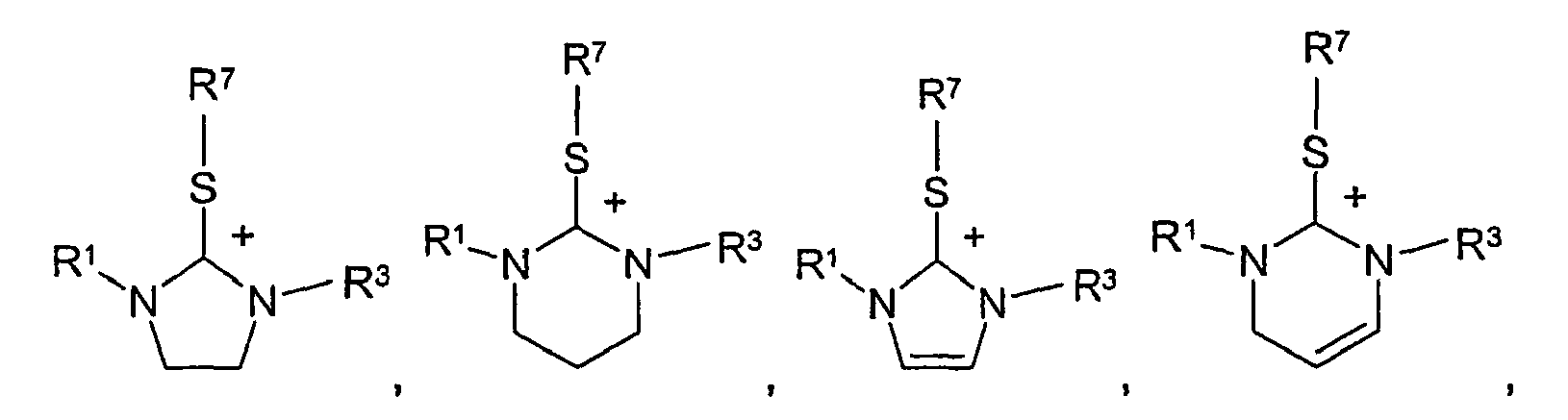


- Die C1-C14-Alkylgruppe ist beispielsweise Methyl, Ethyl, Isopropyl, Propyl, Butyl, sek.-Butyl oder tert.-Butyl, ferner auch Pentyl, 1-, 2- oder 3-Methylbutyl, 1,1-, 1,2- oder 2,2-Dimethylpropyl, 1-Ethylpropyl, Hexyl, Heptyl, Octyl, Nonyl, Decyl, Undecyl, Dodecyl, Tridecyl oder Tetradecyl. Gegebenenfalls perfluoriert, beispielsweise als Difluormethyl, Trifluormethyl, Pentafluorethyl, Heptafluorpropyl oder Nonafluorbutyl.
- Ein geradkettiges oder verzweigtes Alkenyl mit 2 bis 20 C-Atomen, wobei auch mehrere Doppelbindungen vorhanden sein können, ist beispielsweise Vinyl, Allyl, 2- oder 3-Butenyl, Isobutenyl, sek.-Butenyl, ferner 4-Pentenyl, iso-Pentenyl, Hexenyl, Heptenyl, Octenyl, -C9H17, -C10H19 bis -C20H39; vorzugsweise Allyl, 2- oder 3-Butenyl, Isobutenyl, sek.-Butenyl, ferner bevorzugt ist 4-Pentenyl, iso-Pentenyl oder Hexenyl.
- Ein geradkettiges oder verzweigtes Alkinyl mit 2 bis 20 C-Atomen, wobei auch mehrere Dreifachbindungen vorhanden sein können, ist beispielsweise Ethinyl, 1- oder 2-Propinyl, 2- oder 3-Butinyl, ferner 4-Pentinyl, 3-Pentinyl, Hexinyl, Heptinyl, Octinyl, -C9H15, -C10H17 bis -C20H37, vorzugsweise Ethinyl, 1- oder 2-Propinyl, 2- oder 3-Butinyl, 4-Pentinyl, 3-Pentinyl oder Hexinyl.
- Aryl-C1-C6-alkyl bedeutet beispielsweise Benzyl, Phenylethyl, Phenylpropyl, Phenylbutyl, Phenylpentyl oder Phenylhexyl, wobei sowohl der Phenylring als auch die Alkylenkette, wie zuvor beschrieben teilweise oder vollständig mit F substituiert sein können, besonders bevorzugt Benzyl oder Phenylpropyl.
- Der Phenylring oder auch die Alkylenkette können jedoch ebenfalls durch weitere funktionelle Gruppen substituiert sein, beispielsweise durch CN, SO2R', SO2OR' oder COOR'. R' hat dabei eine zuvor definierte Bedeutung.
- Unsubstituierte gesättigte oder teilweise oder vollständig ungesättigte Cycloalkylgruppen mit 3-7 C-Atomen sind daher Cyclopropyl, Cyclobutyl, Cyclopentyl, Cyclohexyl, Cycloheptyl, Cyclopentenyl, Cyclopenta-1,3-dienyl, Cyclohexenyl, Cyclohexa-1,3-dienyl, Cyclohexa-1,4-dienyl, Phenyl, Cycloheptenyl, Cyclohepta-1,3-dienyl, Cyclohepta-1,4-dienyl oder Cyclohepta-1,5-dienyl, welche mit C1- bis C6-Alkylgruppen substituiert sein können, wobei wiederum die Cycloalkylgruppe oder die mit C1- bis C6-Alkylgruppen substituierte Cycloalkylgruppe auch mit Halogenatomen wie F, Cl, Br oder I, insbesondere F oder Cl oder NO2 substituiert sein kann. Die Cycloalkylgruppen können jedoch ebenfalls durch weitere funktionelle Gruppen substituiert sein, beispielsweise durch CN, SO2R', SO2OR' oder COOR'. R' hat dabei eine zuvor definierte Bedeutung.
- In den Substituenten R, R1 bis R6 oder R1' bis R4' können auch ein oder zwei nicht benachbarte und nicht α-ständig zum Heteroatom oder ωgebundene Kohlenstoffatome, durch Atome und/oder Atomgruppierungen ausgewählt aus der Gruppe -O-, -S-, -S(O)- oder -SO2- ersetzt sein.
- Ohne Einschränkung der Allgemeinheit sind Beispiele für derart modifizierte Substituenten R, R1 bis R6 und R1' bis R4':
- -OCH3, -OCH(CH3)2, -CH2OCH3, -CH2-CH2-O-CH3, -C2H4OCH(CH3)2, -C2H4SC2H5, -C2H4SCH(CH3)2, -S(O)CH3, -SO2CH3, -SO2C6H5, -SO2C3H7, -SO2CH(CH3)2, -SO2CH2CF3, -CH2SO2CH3, -O-C4H8-O-C4H9, -CF3, -C2F5, -C3F7, -C4F9, -CF2CF2H, -CF2CHFCF3, -CF2CH(CF3)2, -C2F4N(C2F5)C2F5, -CHF2, -CH2CF3, -C2F2H3, -C3FH6, -CH2C3F7, -CH2C(O)OCH3, -CH2C6H5 oder -C(O)C6H5.
- In R' ist C3- bis C7-Cycloalkyl beispielweise Cyclopropyl, Cyclobutyl, Cyclopentyl, Cyclohexyl oder Cycloheptyl.
- In R' bedeutet substituiertes Phenyl, durch C1- bis C6-Alkyl, C1- bis C6-Alkenyl, NO2, F, Cl, Br, I, C1-C6-Alkoxy, SCF3, SO2CH3, SO2CF3, COOR", SO2X', SO2NR"2 oder SO3R" substituiertes Phenyl, wobei X' F, Cl oder Br und R" ein nicht oder teilweise fluoriertes C1- bis C6-Alkyl oder C3- bis C7-Cycloalkyl wie für R' definiert bedeutet, beispielsweise, o-, m- oder p-Methylphenyl, o-, m- oder p-Ethylphenyl, o-, m- oder p-Propylphenyl, o-, m-oder p-Isopropylphenyl, o-, m- oder p-tert.-Butylphenyl, o-, m- oder p-Nitrophenyl, o-, m- oder p-Methoxyphenyl, o-, m- oder p-Ethoxyphenyl, o-, m-, p-(Trifluormethyl)phenyl, o-, m-, p-(Trifluormethoxy)phenyl, o-, m-, p-(Trifluormethylsulfonyl)phenyl, o-, m- oder p-Fluorphenyl, o-, m- oder p-Chlorphenyl, o-, m- oder p-Bromphenyl, o-, m- oder p-Iodphenyl, weiter bevorzugt 2,3-, 2,4-, 2,5-, 2,6-, 3,4- oder 3,5-Dimethylphenyl, 2,3-, 2,4-, 2,5-, 2,6-, 3,4- oder 3,5-Difluorphenyl, 2,3-, 2,4-, 2,5-, 2,6-, 3,4- oder 3,5-Dichlorphenyl, 2,3-, 2,4-, 2,5-, 2,6-, 3,4- oder 3,5-Dibromphenyl, 2,3-, 2,4-, 2,5-, 2,6-, 3,4- oder 3,5-Dimethoxyphenyl, 5-Fluor-2-methylphenyl, 3,4,5-Trimethoxyphenyl oder 2,4,5-Trimethylphenyl.
- Die Substituenten R1 bis R7 sind jeweils unabhängig voneinander bevorzugt eine geradkettige oder verzweigte Alkylgruppe mit 1 bis 10 C-Atomen. Die Substituenten R1 und R2, R3 und R4 und R5 und R6 in Verbindungen der Formeln (2) und (3) können dabei gleich oder verschieden sein. Besonders bevorzugt sind R1 bis R7 jeweils unabhängig voneinander Methyl, Ethyl, n-Propyl, Isopropyl, n-Butyl, sek.-Butyl, Phenyl oder Cyclohexyl, ganz besonders bevorzugt Methyl, Ethyl, n-Propyl, Isopropyl oder n-Butyl.
- Als Substituenten R1' bis R4' von Verbindungen der Formel (4) kommen erfindungsgemäß dabei neben Wasserstoff bevorzugt in Frage: CN, C1- bis C20-, insbesondere C1- bis C12-Alkylgruppen, und gesättigte oder ungesättigte, d.h. auch aromatische, C3- bis C7-Cycloalkylgruppen, die mit C1- bis C6-Alkylgruppen substituiert sein können, insbesondere Phenyl oder Aryl-C1-C6-alkyl oder Diaminoalkyl mit C1-C4-Alkylgruppen, sofern diese nicht an das Heteroatom gebunden vorliegt.
Die Substituenten R1' bis R4' können jedoch ebenfalls durch weitere funktionelle Gruppen substituiert sein, beispielsweise durch CN, SO2R', SO2OR' oder COOR'. R' bedeutet nicht, teilweise oder perfluoriertes C1- bis C6 Alkyl, C3- bis C7-Cycloalkyl, unsubstituiertes oder substituiertes Phenyl. - Die Substituenten R1' und R4' sind jeweils unabhängig voneinander insbesondere bevorzugt CN, Methyl, Ethyl, Isopropyl, Propyl, Butyl, sek.-Butyl, Pentyl, Hexyl, Octyl, Decyl, Cyclohexyl, Phenyl, Phenylpropyl oder Benzyl. Sie sind ganz besonders bevorzugt CN, Methyl, Ethyl, n-Butyl oder Hexyl. In Pyrrolidinium-, Piperidinium oder Indolinium-Verbindungen sind die beiden Substituenten R1' und R4' bevorzugt unterschiedlich.
- Der Substituent R2' oder R3' ist jeweils unabhängig voneinander insbesondere Wasserstoff, Methyl, Ethyl, Isopropyl, Propyl, Butyl, sek.-Butyl, tert.-Butyl, Cyclohexyl, Dimethylamino, Diethylamino, Methylethylamino, Phenyl oder Benzyl. Besonders bevorzugt ist R2' Dimethylamino, Wasserstoff, Methyl, Ethyl, Isopropyl, Propyl, Butyl, sek.-Butyl oder tert.-Butyl. Ganz besonders bevorzugt sind R2' und R3' Wasserstoff, Dimethylamino oder Methyl.
- HetN+ der Formel (4) ist bevorzugt


- HetN+ ist besonders bevorzugt Imidazolium, Pyrrolidinium oder Pyridinium, wie zuvor definiert, wobei die Substituenten R1' bis R4' jeweils unabhängig voneinander eine zuvor beschriebene Bedeutung haben.
- Als Oxonium-Tetrafluoroborat mit der Formel [(Alkyl)3O]+ [BF4]- wird bevorzugt ein Oxonium-Tetrafluoroborat mit geradkettigen oder verzweigten Alkylgruppen mit 1-8 C-Atomen, bevorzugt mit 1-4 C-Atomen eingesetzt, die jeweils unabhängig voneinander sind. Bevorzugt werden Oxonium-Tetrafluoroborate eingesetzt, bei denen die Alkylgruppen gleich sind. Verwendbar sind auch Tritylium Tetrafluoroborat, [(Phenyl)3C]+ [BF4]-.
- Als Sulfonium-Tetrafluoroborat mit der Formel [(Alkyl)3S]+ [BF4]- wird bevorzugt ein Sulfonium-Tetrafluoroborat mit geradkettigen oder verzweigten Alkylgruppen mit 1-8 C-Atomen, bevorzugt mit 1-4 C-Atomen eingesetzt, die jeweils unabhängig voneinander sind. Bevorzugt werden Sulfonium-Tetrafluoroborate eingesetzt, bei denen die Alkylgruppen gleich sind.
- Die eingesetzten Oxonium-Tetrafluoroborate oder Sulfonium-Tetrafluoroborate sind in der Regel kommerziell erhältlich oder können nach Syntheseverfahren hergestellt werden, wie sie aus der Literatur, z.B. in den Standardwerken wie Houben-Weyl, Methoden der organischen Chemie, Georg-Thieme-Verlag, Stuttgart oder Richard C. Larock, Comprehensive Organic Transformations, 2nd Edition, Wiley-VCH, New York, 1999 bekannt sind. Dabei kann man auch von an sich bekannten, hier nicht näher erwähnten Varianten Gebrauch machen.
- Beispiele für Oxonium-Tetrafluoroborate sind Trimethyloxonium-Tetrafluoroborat, Triethyloxonium-Tetrafluoroborat (Meerwein-Salz), Tris-(n-propyl)oxonium-Tetrafluoroborat, Dimethyl-ethyloxonium-Tetrafluoroborat, Diethyl-methyloxonium-Tetrafluoroborat oder Tris-(i-propyl)oxonium-Tetrafluoroborat. Ganz besonders bevorzugt wird Trimethyl- oder Triethyloxonium-Tetrafluoroborat eingesetzt.
- Beispiele für Sulfonium-Tetrafluoroborate sind Trimethylsulfonium- , Triethylsulfonium- , Dimethylethylsulfonium-, Diethylmethylsulfonium-, Dipropylmethylsulfonium-, Dipropylethylsulfonium-, Dibutylmethylsulfonium-, Di-sec-butylmethylsulfonium-, Dibutylethylsulfonium-Tetrafluoroborat. Ganz besonders bevorzugt wird Trimethylsulfonium- und Triethylsulfonium-Tetrafluoroborat eingesetzt.
- Ein allgemeines Schema fasst das erfindungsgemäße Verfahren zusammen:

- Die Substituenten R, R1 bis R7 und HetN+ der Verbindungen der Formeln (1) bis (8) entsprechen den Bedeutungen, wie zuvor beschrieben.
- Die Reaktion wird erfindungsgemäß bei Umsetzung mit Trialkyloxonium-Tetrafluoroborat oder Triphenylcarbonium-Tetrafluoroborat bei Temperaturen zwischen 0° und 100°C, bevorzugt bei 20° bis 50°, besonders bevorzugt bei Raumtemperatur durchgeführt. Bei Umsetzung mit Sulfonium-Tetrafluoroborat erfolgt die Reaktion erfindungsgemäß bei Temperaturen zwischen 0 und 150°C, bevorzugt bei 20 bis 100°C. Es wird kein Lösungsmittel benötigt. Es können jedoch auch Lösungsmittel eingesetzt werden, beispielsweise Dimethoxyethan, Acetonitril, Dichlormethan, Tetrahydrofuran, Dimethylsulfoxid, Dioxan, Propionitril oder Gemische untereinander.
- Die Umsetzung wird mit einem Überschuss oder equimolarer Menge an dem entsprechenden Oxonium-Tetrafluoroborat, Sulfonium-Tetrafluoroborat oder Triphenylcarbonium-Tetrafluoroborat durchgeführt.
- Die beschriebene Methode ist ebenfalls zur Einführung der Anionen [(Phenyl)4B]-, PF6 -, SbF6 - oder AsF6 - in ionische Flüssigkeiten mit Onium-Kationen geeignet, indem Alkyloxonium-Salze oder Alkylsulfoniumsalze mit den entsprechenden Anionen mit Onium-Halogeniden umgesetzt werden.
- Auch ohne weitere Ausführungen wird davon ausgegangen, dass ein Fachmann die obige Beschreibung im weitesten Umfang nutzen kann. Die bevorzugten Ausführungsformen und Beispiele sind deswegen lediglich als beschreibende, keineswegs als in irgendeiner Weise limitierende Offenbarung aufzufassen.
- Es versteht sich für den Fachmann von selbst, dass in den vorab und nachfolgend genannten Verbindungen Substituenten wie beispielsweise H, N, O, Cl, F durch die entsprechenden Isotope ersetzt sein können.
- Die NMR-Spektren wurden an Lösungen in deuterierten Lösungsmitteln bei 20°C an einem Bruker ARX 400 Spektrometer mit einem 5 mm Breitbandkopf 1H/BB mit Deuterium Lock gemessen, falls nicht in den Beispielen angegeben. Die Messfrequenzen der verschiedenen Kerne sind: 1H: 400,13 MHz und 19F: 376,50 MHz. Die Methode der Referenzierung wird bei jedem Spektrum bzw. bei jedem Datensatz separat angegeben.
-

- Zu 2.21 g (10.90 mmol) 1-Hexyl-3-methylimidazoliumchlorid werden 2.09 g (11.01 mmol) triethyloxonium Tetrafluoroborat zugegeben. Die Reaktionsmischung wird für 30 Minuten bei Raumtemperatur gerührt und anschließend alle flüchtigen Produkte im Vakuum von 13.3 Pa und 80°C (Temperatur des Ölbads) innerhalb von 30 Minuten entfernt. Man erhält 2.77 g 1-Hexyl-3-methylimidazolium Tetrafluoroborat als Flüssigkeit. Die Ausbeute ist annähernd quantitativ.
- 1H NMR (Referenz: TMS; CD3CN), ppm: 0.87 m (CH3); 1.29 m (3CH2); 1.81 m (CH2); 3.82 s (CH3); 4.11 t (CH2); 7.34 d,d (CH); 7.38 d,d (CH); 8.47 br. s. (CH); 3JH,H = 7.1 Hz; JH,H = 1.8 Hz.
19F NMR (Referenz: CCl3F-intern; CD3CN), ppm: -150.2 (BF4). -

- Zu einer Suspension von 2.13 g (9.34 mmol) 1-Cyano-4-dimethylaminopyridiniumbromid in 5 ml trockenem Dichlormethan werden 2.95 g (15.53 mmol) Triethyloxonium Tetrafluoroborat in 10 ml trockenem Dichlormethan zugegeben. Die Reaktionsmischung wird bei Raumtemperatur für 15 Stunden gerührt. Alle flüchtigen Produkte werden im Vakuum bei 13.3 Pa und Raumtemperatur während einer Stunde entfernt. Der Rückstand wird in 10 ml trockenem Acetonitril aufgenommen und 1-Cyano-4-dimethylaminopyridinium Tetrafluoroborat fällt bei einer Zugabe von 30 ml Ethylacetat aus. Der Niederschlag wird abfiltriert und im Vakuum bei Raumtemperatur getrocknet. Man erhält 1.40 g des Feststoffs. Bei partieller Destillation des Lösungsmittels fallen noch einmal 0.39 g an. Die Ausbeute an 1-Cyano-4-dimethylaminopyridinium Tetrafluoroborat beträgt daher zusammen 1.79 g, das entspricht 81.6 %.
- 1H NMR (Referenz: TMS; CD3CN), ppm 3.32 s (2CH3); 6.98 d,m (2CH, A); 8.05 d,m (2CH, B); 3JH(A),H(B) = 8.1 Hz.
19F NMR (Referenz: CCl3F-intern; CD3CN), ppm: -150,6 s (BF4).
13C NMR (Referenz: TMS; CD3CN), ppm: 42.2 q,q [N(CH3)2]; 107.6 m (CN); 109.8 d,m (2CH); 141.5 d,m (2CH); 158.0 m (C); 1JC,H = 195 Hz; 1JC,H = 175 Hz; 1JC,H = 142 Hz ; 3JC,H = 3.3 Hz. - Raman-Spektrum: 2266.7 cm-1 (CN).
Elementaranalyse C8H10BF4N3 (Mol. masse 234.99):
gefunden: C 40.78 %, H 4.57 %, N 18.10 %
berechnet: C 40.89 %, H 4.29 %, N 17.88%. - Analog zu Beispiel 1 werden
- 1-Methylimidazoliumchlorid mit Diethyloxonium-Tetrafluoroborat zu 1-Methylimidazolium-Tetrafluoroborat;
- 1-Butylimidazoliumchlorid mit Diethyloxonium-Tetrafluoroborat zu 1-Butylimidazolium-Tetrafluoroborat;
- 1-Ethyl-3-methyl-imidazoliumchlorid mit Diethyloxonium-Tetrafluoroborat zu 1-Ethyl-3-methylimidazolium-Tetrafluoroborat;
- 1-Butyl-3-methylimidazoliumchlorid mit Diethyloxonium-Tetrafluoroborat zu 1-Butyl-3-methylimidazolium-Tetrafluoroborat;
- 1-Methyl-3-pentylimidazoliumchlorid mit Diethyloxonium-Tetrafluoroborat zu 1-Methyl-3-pentylimidazolium-Tetrafluoroborat;
- 3-Methyl-1-octylimidazoliumchlorid mit Diethyloxonium-Tetrafluoroborat zu 3-Methyl-1-octylimidazolium-Tetrafluoroborat;
- 1-Decyl-3-methylimidazoliumchlorid mit Diethyloxonium-Tetrafluoroborat zu 1-Decyl-3-methylimidazolium-Tetrafluoroborat;
- 1-Dodecyl-3-methylimidazoliumchlorid mit Diethyloxonium-Tetrafluoroborat zu 1-Dodecyl-3-methylimidazolium-Tetrafluoroborat;
- 3-Methyl-1-tetradecylimidazoliurnchlorid mit Diethyloxonium-Tetrafluoroborat zu 3-Methyl-1-tetradecylimidazolium-Tetrafluoroborat;
- 1-Benzyl-3-methylimidazoliumchlorid mit Diethyloxonium-Tetrafluoroborat zu 1-Benzyl-3methylimidazolium-Tetrafluoroborat;
- 3-Methyl-1-phenylimidazoliumchlorid mit Diethyloxonium-Tetrafluoroborat zu 3-Methyl-1-phenylimidazolium-Tetrafluoroborat;
- 1-Ethyl-2,3-dimethylimidazoliumchlorid mit Diethyloxonium-Tetrafluoroborat zu 1-Ethyl-2,3-dimethylimidazolium-Tetrafluoroborat;
- 1-Butyl-2,3-dimethylimidazoliumchlorid mit Diethyloxonium-Tetrafluoroborat zu 1-Butyl-2,3-dimethylimidazolium-Tetrafluoroborat;
- 1-Hexyl-2,3-dimethylimidazoliumchlorid mit Diethyloxonium-Tetrafluoroborat zu 1-Hexyl-2,3-dimethylimidazolium-Tetrafluoroborat oder
- 1-Hexyldecyl-2,3-dimethylimidazoliumchlorid mit Diethyloxonium-Tetrafluoroborat zu 1-Hexyldecyl-2,3-dimethylimidazolium-Tetrafluoroborat umgesetzt.
-

- Zu einer Lösung von 2.77 g (12.82 mmol) 1-Butyl-pyridiniumbromid in 10 ml trockenem Dichlormethan werden 2.48 g (13.04 mmol) Triethyloxonium Tetrafluoroborat zugegeben. Die Reaktionsmischung wird für 30 Minuten bei Raumtemperatur gerührt. Anschließend werden alle flüchtigen Produkte im Vakuum von 13.3 Pa und 80°C (Ölbadtemperatur) innerhalb von 30 Minuten entfernt. Man erhält 2.82 g 1-Butyl-pyridinium Tetrafluoroborat als Flüssigkeit. Die Ausbeute ist annähernd quantitativ.
- 1H NMR (Referenz: TMS; CD3CN), ppm: 0.95 t (CH3); 1.37 m (CH2); 1.95 m (CH2); 4.54 t (CH2); 8.04 m (2CH); 8.52 t,t (CH); 8.73 d (2CH); 3JH,H = 7.3 Hz; 3JH,H = 7.6 Hz; 3JH,H = 7.9 Hz; 3JH,H = 5.7 Hz; 4JH,H = 1.2 Hz.
19F NMR (Referenz: CCl3F-intern; CD3CN), ppm: -150,2 (BF4). -
- 1-Hexylpyridiniumchlorid mit Triethyloxonium-Tetrafluoroborat zu 1-Hexylpyridiniu m-Tetrafluoroborat;
- 1-Butyl-4-methylpyridiniumchlorid mit Triethyloxonium-Tetrafluoroborat zu 1-Butyl-4-methylpyridinium-Tetrafluoroborat;
- 1-Butyl-3-methylpyridiniumbromid mit Triethyloxonium-Tetrafluoroborat zu 1-Butyl-3-methylpyridinium-Tetrafluoroborat oder
- 1-Butyl-3-ethylpyridiniumbromid mit Triethyloxonium-Tetrafluoroborat zu 1-Butyl-3-ethylpyridinium-Tetrafluoroborat
-

- Zu einer Lösung von 2.45 g (12.62 mmol) 1-Ethyl-1-methyl-pyrrolidiniumbromid in 10 ml trockenem Dichlormethan werden 2.40 g (12.63 mmol) Triethyloxonium Tetrafluoroborat zugegeben. Die Reaktionsmischung wird für 30 Minuten bei Raumtemperatur gerührt. Anschließend werden alle flüchtigen Produkte im Vakuum von 13.3 Pa und 80°C (Ölbadtemperatur) innerhalb von 30 Minuten entfernt. Man erhält 2.53 g 1-Ethyl-1-methylpyrrolidinium Tetrafluoroborat. Die Ausbeute ist annähernd quantitativ.
- 1H NMR (Referenz: TMS; CD3CN), ppm: 1.31 t,m (CH3); 2.13 m (2CH2); 2.93 s (CH3); 3.32 q (CH2); 3.39 m (2CH2); 3JH,H = 7.3 Hz.
19F NMR (Referenz: CCl3F-intern ; CD3CN), ppm: -150.4 s (BF4). -
- 1-Butyl-1-methylpyrrolidinium-chlorid mit Triethyloxonium-Tetrafluoroborat zu 1-Butyl-1-methylpyrrolidinium-Tetrafluoroborat;
- 1-Hexyl-1-methylpyrrolidinium-chlorid mit Triethyloxonium-Tetrafluoroborat zu 1-Hexyl-1-methylpyrrolidinium-Tetrafluoroborat;
- 1-Methyl-1-octylpyrrolidinium-chlorid mit Triethyloxonium-Tetrafluoroborat zu 1-Methyl-1-octylpyrrolidinium-Tetrafluoroborat;
- Trihexyl-tetradecylphosphoniumchlorid mit Triethyloxonium-Tetrafluoroborat zu
- Trihexyl-tetradecylphosphonium-Tetrafluoroborat
-

- Zu einer Lösung von 3.73 g (16.64 mmol) N,N,N',N'-Tetramethyl-N"-ethylguanidiniumbromid in 10 ml trockenem Dichlormethan werden 3.20 g (16.83 mmol) Triethyloxonium Tetrafluoroborat zugegeben. Die Reaktionsmischung wird für 30 Minuten bei Raumtemperatur gerührt. Anschließend werden alle flüchtigen Produkte im Vakuum von 13.3 Pa und 80°C (Ölbadtemperatur) innerhalb von 30 Minuten entfernt. Man erhält 3.84 g N,N,N',N'-Tetramethyl-N"-ethylguanidinium Tetrafluoroborat. Die Ausbeute ist annähernd quantitativ.
- 1H NMR (Referenz: TMS; CD3CN), ppm: 1.11 t (CH3); 2.86 br.s; 2.87 br.s; 2.91 s (4CH3); 3.20 m (CH2); 6.17 br.s (NH); 3JH,H = 7.1 Hz.
19F NMR (Referenz: CCl3F - intern; CD3CN), ppm: -150.4 s (BF4). -

- Zu einer Lösung von 3.81 g (11.23 mmol) Tetrabutylphosphoniumbromid in 10 ml trockenem Dichlormethan werden 2.14 g (11.27 mmol)
- Triethyloxonium Tetrafluoroborat zugegeben. Die Reaktionsmischung wird für 30 Minuten bei Raumtemperatur gerührt. Anschließend werden alle flüchtigen Produkte im Vakuum von 13.3 Pa und 80°C (Ölbadtemperatur) innerhalb von 30 Minuten entfernt. Man erhält 3.88 g Tetrabutylphosphonium Tetrafluoroborat. Die Ausbeute ist annähernd quantitativ.
- 1H NMR (Referenz: TMS; CD3CN), ppm: 0.94 t (CH3); 1.47 m (2CH2); 2.05 m (CH2); 3JH,H = 7.1 Hz.
19F NMR (Referenz: CCl3F - intern ; CD3CN), ppm: -150.4 s (BF4). -

- Zu 5.98 g (34.2 mmol) festem 1-Butyl-3-methylimidazoliumchlorid werden 7.06 g (34.3 mmol) Triethylsulfoniumtetrafluoroborat, (C2H5)3S+ BF4 -, zugefügt. Die Reaktionsmischung wird bei 60-70°C (Temperatur des Ölbades) und unter Inertgasatmosphäre (Stickstoff) für einen Zeitraum von 4 Wochen gerührt. Alle flüchtigen Produkte werden bei einer Badtemperatur von 70°C und bei einem Druck von 13.3 Pa innerhalb von 3 Stunden abgepumpt. Man erhält 7.74 g einer Flüssigkeit. Die Ausbeute an 1-Butyl-3-methylimidazoliumtetrafluoroborat ist nahezu quantitativ. Das erhaltene Produkt wird mittels NMR-Spektroskopie untersucht.
- 1H NMR (Referenz: TMS; Lösungsmittel: CD3CN), ppm: 0.91 t (CH3); 1.29 m (CH2); 1.79 m (CH2); 3.82 s (CH3); 4.13 t (CH2); 7.36 d,d (CH); 7.39 d,d (CH); 8.61 br. s. (CH); 3JH,H = 7.2 Hz; JH,H = 1.5 Hz.
19F NMR (Referenz: CCl3F-intern; Lösungsmittel: CD3CN), ppm: -150.1 (BF4). -

- Zu 5.28 g (26 mmol) flüssigen 1-Hexyl-3-methylimidazoliumchlorids werden 5.38 g (26.1 mmol) Triethylsulfoniumtetrafluoroborat, (C2H5)3S+ BF4 -, zugefügt. Die Reaktionsmischung wird bei 60-70°C (Temperatur des Ölbades) und unter Inertgasatmosphäre (Stickstoff) für einen Zeitraum von 3 Wochen gerührt. Alle flüchtigen Produkte werden bei einer Badtemperatur von 70°C und bei einem Druck von 13.3 Pa innerhalb von 3 Stunden abgepumpt. Man erhält 6.6 g einer Flüssigkeit. Die Ausbeute an 1-Hexyl-3-methylimidazoliumtetrafluoroborat ist nahezu quantitativ. Das erhaltene Produkt wird mittels NMR-Spektroskopie untersucht.
- 1H NMR (Referenz: TMS; Lösungsmittel: CD3CN), ppm: 0.87 m (CH3); 1.29 m (3CH2); 1.81 m (CH2); 3.82 s (CH3); 4.11 t (CH2); 7.34 d,d (CH); 7.37 d,d (CH); 8.50 br. s. (CH); 3JH,H = 7.1 Hz; JH,H = 1.5 Hz.
- 19F NMR (Referenz: CCl3F-intern; Lösungsmittel: CD3CN), ppm: -150.2 (BF4).
-

- Eine Mischung aus 4.82 g (22.3 mmol) N-Buyl-pyridiniumbromid und 4.62 g (22.4 mmol) Triethylsulfoniumtetrafluoroborat, (C2H5)3S+ BF4 -, werden bei 85-90°C (Temperatur des Ölbades) bei einem dynamischen Druck von 7 Pa innerhalb von 24 Stunden umgesetzt. Nach Abkühlung auf Raumtemperatur werden 4.97 g eines Öls erhalten. Die Ausbeute an N-Butyl-pyridiniumtetrafluoroborat ist nahezu quantitativ. Das erhaltene Produkt wird mittels NMR-Spektroskopie untersucht.
- 1H NMR (Referenz: TMS; Lösungsmittel: CD3CN), ppm: 0.93 t (CH3); 1.35 m (CH2); 1.95 m (CH2); 4.58 t (CH2); 8.05 m (2CH); 8.52 t,t (CH); 8.82 d (2CH); 3JH,H = 7.6 Hz; 3JH,H = 7.2 Hz; 3JH,H = 7.9 Hz; 4JH,H = 1.4 Hz.
- 19F NMR (Referenz: CCl3F-intern; Lösungsmittel: CD3CN), ppm: -150.1 (BF4).
-

- Eine Mischung aus 1.07 g (3.71 mmol) S-Ethyl-N,N,N',N'-tetramethylthiouroniumiodid und 0.77 g (3.74 mmol) Triethylsulfoniumtetrafluoroborat, (C2H5)3S+ BF4 -, werden bei 85-90°C (Temperatur des Ölbades) bei einem dynamischen Druck von 7 Pa innerhalb von 20 Stunden umgesetzt. Nach Abkühlung auf Raumtemperatur werden 0.92 g eines Feststoffs erhalten. Die Ausbeute an S-Ethyl-N,N,N',N'-tetramethylthiouroniumtetrafluoroborat ist nahezu quantitativ. Der Schmelzpunkt beträgt 72-76°C. Das erhaltene Produkt wird mittels NMR-Spektroskopie untersucht.
- 1H NMR (Referenz: TMS; Lösungsmittel: CD3CN), ppm: 1.31 t (CH3); 3.01 q (CH2); 3.23 s (4CH3); 3JH,H = 7.4 Hz.
- 19F NMR (Referenz: CCl3F-intern; Lösungsmittel: CD3CN), ppm: -150.5 (BF4).
-

- Zu 0.56 g (2.76 mmol) 1-Hexyl-3-methylimidazoliumchlorid werden 0.912 g (2.76 mmol) Triphenylcarboniumtetrafluoroborat, (C6H5)3C+ BF4 - und 5 cm3 Benzol zugegeben. Die Reaktionsmischung wird bei raumtemperatur für 30 Minuten gerührt. Die obere (Benzol)-Phase wird abgetrennt und das Produkt dreimal mit 10 ml Benzol gewaschen. Der Rückstand wird im Vakuum bei 13.3 Pa bei einer Badtemperatur von 100°C getrocknet. Es werden 0.7 g einer Flüssigkeit erhalten. Die Ausbeute an 1-Hexyl-3-methylimidazoliumtetrafluoroborat ist nahezu quantitativ. Das erhaltene Produkt wird mittels NMR-Spektroskopie untersucht.
- 1H NMR (Referenz: TMS; Lösungsmittel: CD3CN), ppm 0.89 m (CH3); 1.31 m (3CH2); 1.82 m (CH2); 3.84 s (CH3); 4.11 m (CH2); 7.36 d,d (CH); 7.39 d,d (CH); 8.50 br. s. (CH); 3JH,H = 7.2 Hz; JH,H = 1.7 Hz.
- 19F NMR (Referenz: CCl3F-intern; Lösungsmittel: CD3CN), ppm: -150.2 (BF4)
Claims (4)
- Verfahren zur Herstellung von Onium-Tetrafluoroboraten der Formeln (5) bis (8)
[XR4]+ [BF4]- (5)
[(R1R2N)-C(=SR7)(NR3R4)]+ [BF4]- (6)
[C(NR1R2N)(NR3R4)(NR5R6)]+ [BF4]- (7)
[HetN]+ [BF4]- (8),
durch Umsetzung eines Onium-Halogenids der Formel (1),
[XR4]+ Hal- (1),
wobei
X N, P
Hal Cl, Br oder I und
R jeweils unabhängig voneinander
H, wobei nicht alle Substituenten R gleichzeitig H sein dürfen, geradkettiges oder verzweigtes Alkyl mit 1-20 C-Atomen,
geradkettiges oder verzweigtes Alkenyl mit 2-20 C-Atomen und einer oder mehreren Doppelbindungen,
geradkettiges oder verzweigtes Alkinyl mit 2-20 C-Atomen und einer oder mehreren Dreifachbindungen,
gesättigtes, teilweise oder vollständig ungesättigtes Cycloalkyl mit 3-7 C-Atomen, das mit Alkylgruppen mit 1-6 C-Atomen substituiert sein kann bedeutet,
wobei ein oder mehrere R teilweise oder vollständig mit F substituiert sein können, wobei jedoch nicht alle vier oder drei R vollständig mit F substituiert sein dürfen,
und wobei ein oder zwei nicht benachbarte und nicht α- oder ω-ständige Kohlenstoffatome des R, durch Atome und/oder Atomgruppierungen ausgewählt aus der Gruppe -O-, -S-, -S(O)- oder-SO2- ersetzt sein können
oder der Formel (2)
[(R1R2N)-C(=SR7)(NR3R4)]+ Hal- (2),
wobei
Hal Br oder I und
R1 bis R7 jeweils unabhängig voneinander
Wasserstoff oder CN, wobei Wasserstoff für R7 ausgeschlossen wird, geradkettiges oder verzweigtes Alkyl mit 1 bis 20 C-Atomen, geradkettiges oder verzweigtes Alkenyl mit 2-20 C-Atomen und einer oder mehreren Doppelbindungen,
geradkettiges oder verzweigtes Alkinyl mit 2-20 C-Atomen und einer oder mehreren Dreifachbindungen,
gesättigtes, teilweise oder vollständig ungesättigtes Cycloalkyl mit 3-7 C-Atomen, das mit Alkylgruppen mit 1-6 C-Atomen substituiert sein kann, bedeutet,
wobei ein oder mehrere der Substituenten R1 bis R7 teilweise oder vollständig mit F substituiert sein können, wobei jedoch nicht alle Substituenten an einem N-Atom vollständig mit F substituiert sein dürfen, wobei die Substituenten R1 bis R7 paarweise durch Einfach- oder Doppelbindung miteinander verbunden sein können und wobei ein oder zwei nicht benachbarte, nicht direkt am Heteroatom gebundene und nicht ω-ständige Kohlenstoffatome der Substituenten R1 bis R6 durch Atome und/oder Atomgruppierungen ausgewählt aus der Gruppe -O-, -S-, -S(O)- oder -SO2- ersetzt sein können oder der Formel (3)
[C(NR1R2)(NR3R4)(NR5R6)]+ Hal- (3),
wobei,
Hal Cl, Br oder I und
R1 bis R6 jeweils unabhängig voneinander
Wasserstoff oder CN,
geradkettiges oder verzweigtes Alkyl mit 1 bis 20 C-Atomen, geradkettiges oder verzweigtes Alkenyl mit 2-20 C-Atomen und einer oder mehreren Doppelbindungen,
geradkettiges oder verzweigtes Alkinyl mit 2-20 C-Atomen und einer oder mehreren Dreifachbindungen,
gesättigtes, teilweise oder vollständig ungesättigtes Cycloalkyl mit 3-7 C-Atomen, das mit Alkylgruppen mit 1-6 C-Atomen substituiert sein kann, bedeutet,
wobei ein oder mehrere der Substituenten R1 bis R6 teilweise oder vollständig mit F substituiert sein können, wobei jedoch nicht alle
Substituenten an einem N-Atom vollständig mit F substituiert sein dürfen, wobei die Substituenten R1 bis R6 paarweise durch Einfach- oder Doppelbindung miteinander verbunden sein können und wobei ein oder zwei nicht benachbarte, nicht direkt am Heteroatom gebundene und nicht ω-ständige Kohlenstoffatome der Substituenten R1 bis R6 durch Atome und/oder Atomgruppierungen ausgewählt aus der Gruppe -O-, -S-, -S(O)- oder -SO2- ersetzt sein können oder der Formel (4) entspricht,
[HetN]+ Hal- (4)
wobei
Hal Cl, Br oder I und
HetN+ ein heterocyclisches Kation, ausgewählt aus der Gruppe


R1' bis R4' jeweils unabhängig voneinander
Wasserstoff oder CN,
geradkettiges oder verzweigtes Alkyl mit 1-20 C-Atomen,
geradkettiges oder verzweigtes Alkenyl mit 2-20 C-Atomen und einer oder mehreren Doppelbindungen,
geradkettiges oder verzweigtes Alkinyl mit 2-20 C-Atomen und einer oder mehreren Dreifachbindungen,
Dialkylamino mit Alkylgruppen mit 1-4 C-Atomen, welches jedoch nicht am Heteroatom des Heterocyclus gebunden vorliegt,
gesättigtes, teilweise oder vollständig ungesättigtes Cycloalkyl mit 3-7 C-Atomen, das mit Alkylgruppen mit 1-6 C-Atomen substituiert sein kann oder Aryl-C1-C6-alkyl bedeutet,
wobei die Substituenten R1' und R4' teilweise oder vollständig mit F substituiert sein können, wobei jedoch nicht gleichzeitig R1' und R4' CN sind oder vollständig mit F substituiert sein dürfen,
wobei die Substituenten R2' und R3' teilweise oder vollständig mit Halogenen oder teilweise mit NO2 oder CN substituiert sein dürfen und wobei ein oder zwei nicht benachbarte, nicht direkt am Heteroatom gebundene und nicht ω-ständige Kohlenstoffatome der Substituenten R1' bis R4', durch Atome und/oder Atomgruppierungen ausgewählt aus der Gruppe -O-, -S-, -S(O)- oder -SO2- ersetzt sein können,
mit einem Trialkyloxonium-Tetrafluoroborat, Trialkylsulfonium-Tetrafluoroborat oder Triphenylcarbonium-Tetrafluoroborat. - Verfahren nach Anspruch 1, dadurch gekennzeichnet, dass ein Oxonium-Tetrafluoroborat eingesetzt wird.
- Verfahren nach Anspruch 1 oder 2, dadurch gekennzeichnet, dass die Reaktion bei Umsetzung mit Trialkyloxonium-Tetrafluoroborat oder Triphenylcarbonium-Tetrafluoroborat bei Temperaturen zwischen 0° und 100°C und bei Umsetzung mit Sulfonium-Tetrafluoroborat bei Temperaturen zwischen 0 und 150°Cdurchgeführt wird.
- Verwendung der Verfahren nach einem der Ansprüche 1 bis 3 zur Reinigung von Onium-Tetrafluoroboraten, die durch Onium-Halogenide verunreinigt sind.
Applications Claiming Priority (3)
| Application Number | Priority Date | Filing Date | Title |
|---|---|---|---|
| DE200410060073 DE102004060073A1 (de) | 2004-12-14 | 2004-12-14 | Verfahren zur Hertellung von Onium-Salzen mit Tetrafluoroborat-Anion mit reduziertem Halogenid-Gehalt |
| DE200510035103 DE102005035103A1 (de) | 2005-07-27 | 2005-07-27 | Verfahren zur Herstellung von Onium-Salzen mit Tetrafluoroborat-Anion mit reduziertem Halogenid-Gehalt |
| PCT/EP2005/012398 WO2006063653A1 (de) | 2004-12-14 | 2005-11-18 | Verfahren zur herstellung von onium-salzen mit tetrafluoroborat-anion mit reduziertem halogenid-gehalt |
Publications (2)
| Publication Number | Publication Date |
|---|---|
| EP1831179A1 EP1831179A1 (de) | 2007-09-12 |
| EP1831179B1 true EP1831179B1 (de) | 2010-11-03 |
Family
ID=35697085
Family Applications (1)
| Application Number | Title | Priority Date | Filing Date |
|---|---|---|---|
| EP05807705A Expired - Lifetime EP1831179B1 (de) | 2004-12-14 | 2005-11-18 | Verfahren zur herstellung von onium-salzen mit tetrafluoroborat-anion mit reduziertem halogenid-gehalt |
Country Status (9)
| Country | Link |
|---|---|
| US (1) | US8101749B2 (de) |
| EP (1) | EP1831179B1 (de) |
| JP (1) | JP2008523118A (de) |
| KR (1) | KR20070089935A (de) |
| AT (1) | ATE486855T1 (de) |
| CA (1) | CA2590780A1 (de) |
| DE (1) | DE502005010498D1 (de) |
| RU (1) | RU2415843C2 (de) |
| WO (1) | WO2006063653A1 (de) |
Families Citing this family (3)
| Publication number | Priority date | Publication date | Assignee | Title |
|---|---|---|---|---|
| US8198219B2 (en) | 2008-02-22 | 2012-06-12 | Basf Se | Method for producing solid materials on the basis of synthetic polymers and/or biopolymers and use thereof |
| US9525148B2 (en) | 2008-04-03 | 2016-12-20 | Qd Vision, Inc. | Device including quantum dots |
| FR2980122B1 (fr) * | 2011-09-16 | 2013-10-25 | Commissariat Energie Atomique | Procede de synthese de liquides ioniques |
Family Cites Families (10)
| Publication number | Priority date | Publication date | Assignee | Title |
|---|---|---|---|---|
| US4454214A (en) * | 1982-12-03 | 1984-06-12 | Xerox Corporation | Toner compositions containing pyridinium tetrafluoroborates |
| JPH0831401B2 (ja) * | 1986-10-31 | 1996-03-27 | 三菱化学株式会社 | 電解液 |
| GB9616264D0 (en) * | 1996-08-02 | 1996-09-11 | British Nuclear Fuels Plc | Reprocessing irradiated fuel |
| FR2779143B1 (fr) | 1998-05-29 | 2001-10-12 | Inst Francais Du Petrole | Procede ameliore de preparation d'un sel fondu |
| GB9928290D0 (en) * | 1999-12-01 | 2000-01-26 | Univ Belfast | Process for preparing ambient temperature ionic liquids |
| EP1182197A1 (de) * | 2000-08-24 | 2002-02-27 | Solvent Innovation GmbH | Einstufiges Verfahren zur Darstellung ionischer Flüssigkeiten |
| KR100861916B1 (ko) * | 2001-03-26 | 2008-10-09 | 닛신보세키 가부시키 가이샤 | 이온성 액체, 축전 디바이스용 전해질염, 축전 디바이스용전해액, 전기 2중층 캐패시터, 및 2차전지 |
| KR101090547B1 (ko) * | 2003-02-13 | 2011-12-08 | 고에이 가가쿠 고교 가부시키가이샤 | 제4급 암모늄염 |
| JP4723480B2 (ja) * | 2003-06-02 | 2011-07-13 | メルク パテント ゲゼルシャフト ミット ベシュレンクテル ハフツング | ウロニウムまたはチオウロニウムカチオンを有するイオン液体 |
| DE102004034543A1 (de) * | 2004-07-16 | 2006-02-16 | Merck Patent Gmbh | Verfahren zur Herstellung von Onium-Salzen mit geringem Chlorid-Gehalt |
-
2005
- 2005-11-18 CA CA002590780A patent/CA2590780A1/en not_active Abandoned
- 2005-11-18 RU RU2007126760/04A patent/RU2415843C2/ru not_active IP Right Cessation
- 2005-11-18 EP EP05807705A patent/EP1831179B1/de not_active Expired - Lifetime
- 2005-11-18 KR KR1020077013303A patent/KR20070089935A/ko not_active Ceased
- 2005-11-18 JP JP2007545856A patent/JP2008523118A/ja not_active Ceased
- 2005-11-18 WO PCT/EP2005/012398 patent/WO2006063653A1/de not_active Ceased
- 2005-11-18 US US11/721,613 patent/US8101749B2/en not_active Expired - Fee Related
- 2005-11-18 DE DE502005010498T patent/DE502005010498D1/de not_active Expired - Lifetime
- 2005-11-18 AT AT05807705T patent/ATE486855T1/de active
Also Published As
| Publication number | Publication date |
|---|---|
| JP2008523118A (ja) | 2008-07-03 |
| WO2006063653A1 (de) | 2006-06-22 |
| EP1831179A1 (de) | 2007-09-12 |
| KR20070089935A (ko) | 2007-09-04 |
| DE502005010498D1 (de) | 2010-12-16 |
| US20090253912A1 (en) | 2009-10-08 |
| CA2590780A1 (en) | 2006-06-22 |
| US8101749B2 (en) | 2012-01-24 |
| RU2007126760A (ru) | 2009-01-27 |
| RU2415843C2 (ru) | 2011-04-10 |
| ATE486855T1 (de) | 2010-11-15 |
Similar Documents
| Publication | Publication Date | Title |
|---|---|---|
| DE102005035103A1 (de) | Verfahren zur Herstellung von Onium-Salzen mit Tetrafluoroborat-Anion mit reduziertem Halogenid-Gehalt | |
| EP2114965B1 (de) | Verbindungen enthaltend organofluorochlorophosphatanionen | |
| EP1768962B1 (de) | Verfahren zur herstellung von onium-salzen mit geringem chlorid-gehalt | |
| EP2180002B1 (de) | Verfahren zur Herstellung von Onium-Salzen mit Diakylphosphinat Anionen mit geringem Halogenid-Gehalt | |
| EP1979361B1 (de) | Oxonium- und sulfoniumsalze | |
| EP1824827B1 (de) | Verfahren zur herstellung von onium-salzen mit alkyl- oder arylsufonat-anionen oder alkyl- oder arylcarboxylat-anionen mit geringen halogenid-gehalt | |
| DE102004060073A1 (de) | Verfahren zur Hertellung von Onium-Salzen mit Tetrafluoroborat-Anion mit reduziertem Halogenid-Gehalt | |
| EP1831179A1 (de) | Verfahren zur herstellung von onium-salzen mit tetrafluoroborat-anion mit reduziertem halogenid-gehalt | |
| WO2011000490A2 (de) | Synthese von ionischen flüssigkeiten | |
| EP2513123B1 (de) | Verbindungen mit (perfluoralkyl)fluorohydrogenphosphat-anionen | |
| EP1902035B1 (de) | Verfahren zur herstellung von onium-alkylsulfiten | |
| EP1902004B1 (de) | Verfahren zur herstellung von onium-alkylsulfonaten | |
| EP1828142B1 (de) | Verfahren zur herstellung von onium alkylsulfaten mit geringem halogenid-gehalt | |
| WO2007006389A1 (de) | Mischung von onium-alkylsulfonaten und onium-alkylsulfiten |
Legal Events
| Date | Code | Title | Description |
|---|---|---|---|
| PUAI | Public reference made under article 153(3) epc to a published international application that has entered the european phase |
Free format text: ORIGINAL CODE: 0009012 |
|
| 17P | Request for examination filed |
Effective date: 20070423 |
|
| AK | Designated contracting states |
Kind code of ref document: A1 Designated state(s): AT BE BG CH CY CZ DE DK EE ES FI FR GB GR HU IE IS IT LI LT LU LV MC NL PL PT RO SE SI SK TR |
|
| 17Q | First examination report despatched |
Effective date: 20071213 |
|
| DAX | Request for extension of the european patent (deleted) | ||
| GRAP | Despatch of communication of intention to grant a patent |
Free format text: ORIGINAL CODE: EPIDOSNIGR1 |
|
| GRAS | Grant fee paid |
Free format text: ORIGINAL CODE: EPIDOSNIGR3 |
|
| GRAA | (expected) grant |
Free format text: ORIGINAL CODE: 0009210 |
|
| AK | Designated contracting states |
Kind code of ref document: B1 Designated state(s): AT BE BG CH CY CZ DE DK EE ES FI FR GB GR HU IE IS IT LI LT LU LV MC NL PL PT RO SE SI SK TR |
|
| REG | Reference to a national code |
Ref country code: GB Ref legal event code: FG4D Free format text: NOT ENGLISH |
|
| REG | Reference to a national code |
Ref country code: CH Ref legal event code: EP |
|
| REG | Reference to a national code |
Ref country code: IE Ref legal event code: FG4D Free format text: LANGUAGE OF EP DOCUMENT: GERMAN |
|
| REF | Corresponds to: |
Ref document number: 502005010498 Country of ref document: DE Date of ref document: 20101216 Kind code of ref document: P |
|
| PGFP | Annual fee paid to national office [announced via postgrant information from national office to epo] |
Ref country code: AT Payment date: 20101110 Year of fee payment: 6 |
|
| PGFP | Annual fee paid to national office [announced via postgrant information from national office to epo] |
Ref country code: DE Payment date: 20101110 Year of fee payment: 6 |
|
| REG | Reference to a national code |
Ref country code: NL Ref legal event code: VDEP Effective date: 20101103 |
|
| PGFP | Annual fee paid to national office [announced via postgrant information from national office to epo] |
Ref country code: GB Payment date: 20101117 Year of fee payment: 6 |
|
| LTIE | Lt: invalidation of european patent or patent extension |
Effective date: 20101103 |
|
| PG25 | Lapsed in a contracting state [announced via postgrant information from national office to epo] |
Ref country code: LT Free format text: LAPSE BECAUSE OF FAILURE TO SUBMIT A TRANSLATION OF THE DESCRIPTION OR TO PAY THE FEE WITHIN THE PRESCRIBED TIME-LIMIT Effective date: 20101103 |
|
| REG | Reference to a national code |
Ref country code: IE Ref legal event code: FD4D |
|
| BERE | Be: lapsed |
Owner name: MERCK PATENT G.M.B.H. Effective date: 20101130 |
|
| PG25 | Lapsed in a contracting state [announced via postgrant information from national office to epo] |
Ref country code: LV Free format text: LAPSE BECAUSE OF FAILURE TO SUBMIT A TRANSLATION OF THE DESCRIPTION OR TO PAY THE FEE WITHIN THE PRESCRIBED TIME-LIMIT Effective date: 20101103 Ref country code: NL Free format text: LAPSE BECAUSE OF FAILURE TO SUBMIT A TRANSLATION OF THE DESCRIPTION OR TO PAY THE FEE WITHIN THE PRESCRIBED TIME-LIMIT Effective date: 20101103 Ref country code: FI Free format text: LAPSE BECAUSE OF FAILURE TO SUBMIT A TRANSLATION OF THE DESCRIPTION OR TO PAY THE FEE WITHIN THE PRESCRIBED TIME-LIMIT Effective date: 20101103 Ref country code: SI Free format text: LAPSE BECAUSE OF FAILURE TO SUBMIT A TRANSLATION OF THE DESCRIPTION OR TO PAY THE FEE WITHIN THE PRESCRIBED TIME-LIMIT Effective date: 20101103 Ref country code: SE Free format text: LAPSE BECAUSE OF FAILURE TO SUBMIT A TRANSLATION OF THE DESCRIPTION OR TO PAY THE FEE WITHIN THE PRESCRIBED TIME-LIMIT Effective date: 20101103 Ref country code: PT Free format text: LAPSE BECAUSE OF FAILURE TO SUBMIT A TRANSLATION OF THE DESCRIPTION OR TO PAY THE FEE WITHIN THE PRESCRIBED TIME-LIMIT Effective date: 20110303 Ref country code: IS Free format text: LAPSE BECAUSE OF FAILURE TO SUBMIT A TRANSLATION OF THE DESCRIPTION OR TO PAY THE FEE WITHIN THE PRESCRIBED TIME-LIMIT Effective date: 20110303 Ref country code: BG Free format text: LAPSE BECAUSE OF FAILURE TO SUBMIT A TRANSLATION OF THE DESCRIPTION OR TO PAY THE FEE WITHIN THE PRESCRIBED TIME-LIMIT Effective date: 20110203 |
|
| PG25 | Lapsed in a contracting state [announced via postgrant information from national office to epo] |
Ref country code: GR Free format text: LAPSE BECAUSE OF FAILURE TO SUBMIT A TRANSLATION OF THE DESCRIPTION OR TO PAY THE FEE WITHIN THE PRESCRIBED TIME-LIMIT Effective date: 20110204 Ref country code: MC Free format text: LAPSE BECAUSE OF NON-PAYMENT OF DUE FEES Effective date: 20101130 |
|
| PG25 | Lapsed in a contracting state [announced via postgrant information from national office to epo] |
Ref country code: EE Free format text: LAPSE BECAUSE OF FAILURE TO SUBMIT A TRANSLATION OF THE DESCRIPTION OR TO PAY THE FEE WITHIN THE PRESCRIBED TIME-LIMIT Effective date: 20101103 Ref country code: CZ Free format text: LAPSE BECAUSE OF FAILURE TO SUBMIT A TRANSLATION OF THE DESCRIPTION OR TO PAY THE FEE WITHIN THE PRESCRIBED TIME-LIMIT Effective date: 20101103 Ref country code: IE Free format text: LAPSE BECAUSE OF FAILURE TO SUBMIT A TRANSLATION OF THE DESCRIPTION OR TO PAY THE FEE WITHIN THE PRESCRIBED TIME-LIMIT Effective date: 20101103 Ref country code: ES Free format text: LAPSE BECAUSE OF FAILURE TO SUBMIT A TRANSLATION OF THE DESCRIPTION OR TO PAY THE FEE WITHIN THE PRESCRIBED TIME-LIMIT Effective date: 20110214 |
|
| PG25 | Lapsed in a contracting state [announced via postgrant information from national office to epo] |
Ref country code: SK Free format text: LAPSE BECAUSE OF FAILURE TO SUBMIT A TRANSLATION OF THE DESCRIPTION OR TO PAY THE FEE WITHIN THE PRESCRIBED TIME-LIMIT Effective date: 20101103 Ref country code: RO Free format text: LAPSE BECAUSE OF FAILURE TO SUBMIT A TRANSLATION OF THE DESCRIPTION OR TO PAY THE FEE WITHIN THE PRESCRIBED TIME-LIMIT Effective date: 20101103 Ref country code: PL Free format text: LAPSE BECAUSE OF FAILURE TO SUBMIT A TRANSLATION OF THE DESCRIPTION OR TO PAY THE FEE WITHIN THE PRESCRIBED TIME-LIMIT Effective date: 20101103 Ref country code: DK Free format text: LAPSE BECAUSE OF FAILURE TO SUBMIT A TRANSLATION OF THE DESCRIPTION OR TO PAY THE FEE WITHIN THE PRESCRIBED TIME-LIMIT Effective date: 20101103 Ref country code: BE Free format text: LAPSE BECAUSE OF NON-PAYMENT OF DUE FEES Effective date: 20101130 |
|
| PLBE | No opposition filed within time limit |
Free format text: ORIGINAL CODE: 0009261 |
|
| STAA | Information on the status of an ep patent application or granted ep patent |
Free format text: STATUS: NO OPPOSITION FILED WITHIN TIME LIMIT |
|
| 26N | No opposition filed |
Effective date: 20110804 |
|
| REG | Reference to a national code |
Ref country code: DE Ref legal event code: R097 Ref document number: 502005010498 Country of ref document: DE Effective date: 20110804 |
|
| PG25 | Lapsed in a contracting state [announced via postgrant information from national office to epo] |
Ref country code: IT Free format text: LAPSE BECAUSE OF FAILURE TO SUBMIT A TRANSLATION OF THE DESCRIPTION OR TO PAY THE FEE WITHIN THE PRESCRIBED TIME-LIMIT Effective date: 20101103 |
|
| REG | Reference to a national code |
Ref country code: FR Ref legal event code: ST Effective date: 20111125 |
|
| PG25 | Lapsed in a contracting state [announced via postgrant information from national office to epo] |
Ref country code: FR Free format text: LAPSE BECAUSE OF NON-PAYMENT OF DUE FEES Effective date: 20110103 |
|
| PGFP | Annual fee paid to national office [announced via postgrant information from national office to epo] |
Ref country code: CH Payment date: 20111114 Year of fee payment: 7 |
|
| PG25 | Lapsed in a contracting state [announced via postgrant information from national office to epo] |
Ref country code: CY Free format text: LAPSE BECAUSE OF FAILURE TO SUBMIT A TRANSLATION OF THE DESCRIPTION OR TO PAY THE FEE WITHIN THE PRESCRIBED TIME-LIMIT Effective date: 20101103 |
|
| PG25 | Lapsed in a contracting state [announced via postgrant information from national office to epo] |
Ref country code: HU Free format text: LAPSE BECAUSE OF FAILURE TO SUBMIT A TRANSLATION OF THE DESCRIPTION OR TO PAY THE FEE WITHIN THE PRESCRIBED TIME-LIMIT Effective date: 20110504 Ref country code: LU Free format text: LAPSE BECAUSE OF NON-PAYMENT OF DUE FEES Effective date: 20101118 |
|
| PG25 | Lapsed in a contracting state [announced via postgrant information from national office to epo] |
Ref country code: TR Free format text: LAPSE BECAUSE OF FAILURE TO SUBMIT A TRANSLATION OF THE DESCRIPTION OR TO PAY THE FEE WITHIN THE PRESCRIBED TIME-LIMIT Effective date: 20101103 |
|
| REG | Reference to a national code |
Ref country code: CH Ref legal event code: PL |
|
| REG | Reference to a national code |
Ref country code: AT Ref legal event code: MM01 Ref document number: 486855 Country of ref document: AT Kind code of ref document: T Effective date: 20121118 |
|
| GBPC | Gb: european patent ceased through non-payment of renewal fee |
Effective date: 20121118 |
|
| PG25 | Lapsed in a contracting state [announced via postgrant information from national office to epo] |
Ref country code: CH Free format text: LAPSE BECAUSE OF NON-PAYMENT OF DUE FEES Effective date: 20121130 Ref country code: LI Free format text: LAPSE BECAUSE OF NON-PAYMENT OF DUE FEES Effective date: 20121130 Ref country code: AT Free format text: LAPSE BECAUSE OF NON-PAYMENT OF DUE FEES Effective date: 20121118 |
|
| REG | Reference to a national code |
Ref country code: DE Ref legal event code: R119 Ref document number: 502005010498 Country of ref document: DE Effective date: 20130601 |
|
| PG25 | Lapsed in a contracting state [announced via postgrant information from national office to epo] |
Ref country code: DE Free format text: LAPSE BECAUSE OF NON-PAYMENT OF DUE FEES Effective date: 20130601 |
|
| PG25 | Lapsed in a contracting state [announced via postgrant information from national office to epo] |
Ref country code: GB Free format text: LAPSE BECAUSE OF NON-PAYMENT OF DUE FEES Effective date: 20121118 |